In the United States, most antibiotics are used in the outpatient setting with physicians prescribing 81% of outpatient antibiotics followed by dentists who prescribe 10% of all outpatient antibiotics.Reference Suda, Hicks, Roberts, Hunkler, Matusiak and Schumock1–Reference Durkin, Hsueh and Sallah4 Negative public health and patient-level outcomes are associated with antibiotic use such as increasing antimicrobial drug resistance and Clostridioides (formerly Clostridium) difficile infections (CDIs).5–Reference Dantes, Mu and Hicks7 Although dentists comprise a significant proportion of outpatient antibiotic prescribers, a lack of comprehensive, consensus guidelines within the United States on treatment of acute oral infections has limited assessments of dental antibiotic prescribing.
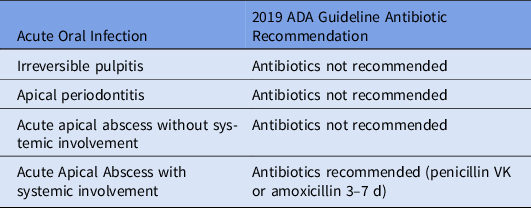
In November of 2019, the American Dental Association (ADA) released its first clinical practice guideline (CPG) on the management of common acute oral infections.8 This guideline addresses the role of antibiotics for irreversible pulpitis (IP), apical periodontitis (AP), and acute apical abscess (AAA). In this CPG, the ADA recommends short courses of amoxicillin or penicillin for 3–7 days for common acute oral infections when antibiotics are indicated (see Table 1 for CPG recommendations summary). For most uncomplicated acute oral infections in immunocompetent patients without systemic signs of infection (fever, malaise, or cellulitis), definitive source control with no adjunctive antibiotic therapy is the recommended course of treatment.8 Examples of definitive source control include pulpotomy, pulpectomy, nonsurgical root canal treatment, extraction or incision for drainage of apical abscesses. For patients with acute apical abscesses with systemic involvement, amoxicillin or penicillin are recommended in addition to definitive source control.
Summary of ADA Recommendations Where Source Control Is an Immediate Option for Immunocompetent Patients

Note. ADA, American Dental Association.
With the recent release of the ADA CPG, the goal of this study was to identify historical concordance in patients treated in Department of Veterans’ Affairs (VA) facilities for IP, AP, and AAA. We analyzed national 2017 VA data prior to the release of the 2019 ADA CPG to identify opportunities to improve guideline concordance for antibiotic prescribing and guide future dental antimicrobial stewardship efforts.
Methods
This study was a retrospective cross-sectional analysis of national VA data from January 1, 2017, through December 31, 2017. The data were extracted from the VA Corporate Data Warehouse (CDW) which includes data on medical, dental, laboratory, and pharmacy encounters of veterans who receive care at a VA facility.
Study population
Dental visits within the study period with an associated International Classification of Disease, Tenth Revision, Clinical Modification (ICD-10) code for IP, AP, and AAA were included (Supplementary Table 5 online). One patient could contribute multiple patient visits. In the United States, dentists typically document their dental procedure codes using current dental terminology (CDT) and do not typically use ICD-10 codes. However, VA dentists code using ICD-10 and CDT codes, providing an opportunity to more accurately assign a diagnosis (eg, acute oral infection) with a prescription for an antibiotic. Inpatient dental encounters and outpatient telephone encounters were excluded from the analysis.
Study definitions
IP, AP, and AAA all represent a continuum of acute oral infections; IP typically has a milder presentation. As a result, patient visits were classified in a hierarchical manner due to the potential for multiple nonmutually exclusive, acute oral infection ICD-10 codes.Reference Chow, Bennett, Dolin and Blaser9 Patient visits with only IP ICD-10 codes composed the IP group. Patient visits with AP ICD-10 codes were placed into the AP group. AP patient visits could also have IP ICD-10 codes. Patient visits with AAA ICD-10 codes were placed into the AAA group but could also have ICD-10 codes for IP and/or AP. An associated antibiotic prescription was defined as any oral antibiotic prescribed by a VA dentist ±7 days from the dental visit, regardless of antibiotic treatment duration.
Covariates
Patient demographics, medical conditions, and CDT codes were extracted from the VA CDW. Dental visit CDT codes were aggregated into categories per a standardized coding structure established by the American Dental Association. Because multiple CDT codes could be coded for a visit, our analyses assessed visits with a specific CDT category coded compared with visits without the CDT category coded. Additional variables collected include presence of high-risk cardiac conditions as defined by American Heart Association (AHA) guidelines: history of infective endocarditis, congenital heart condition, or prosthetic cardiac valve/material used for cardiac valve repair, and heart transplant recipients who develop cardiac valvulopathy,Reference Wilson, Taubert and Gewitz10 presence of a prosthetic joint, patient demographics (eg, age, sex, race, ethnicity), US Census Bureau region, number of dental procedures per visit, and Charlson comorbidity index. Cardiac conditions and prosthetic joints were identified from 1992 (the oldest data available in CDW) until the date of the dental visit. The Charlson comorbidity index was calculated 1 year prior to the dental visit.
Assessment of CPG concordance
Guideline concordance was determined based on the recommendations of the November 2019 ADA CPG (Table 1).11 IP visits with an associated antibiotic prescription were deemed guideline discordant because the ADA guideline recommends immediate source control (eg, pulpectomy, pulpotomy, root canal, etc), rather than antibiotics. Similarly, AP visits that received antibiotics were deemed guideline discordant. However, guideline concordance for AAA could not be assessed in this analysis. The ADA recommendations for the role of antibiotic therapy in the management of AAA depends on the presence of systemic signs of infection such as malaise, fever, and fascial space or lymph node involvement. Unfortunately, these data are not easily captured in administrative data.
Statistical analysis
To describe the sample, we calculated frequencies, proportions, and unadjusted odds ratios and 95% confidence intervals (CIs) for demographic and medical characteristics and receipt of antibiotics with an independent t test, the χ2 test, and the Fisher exact test. Multivariable logistic regression clustered within Veteran to account for multiple visits for the same patient was used to identify variables associated with antibiotic prescribing for each infection. A different model was created for each infection. Beginning with variables that were statistically significant (P < .05 or CI did not include 1) in the unadjusted analysis, variables with a P ≥ .05 were then removed in a backward selection process until the most parsimonious model was achieved. All analyses were conducted with the statistical program SAS version 9.4 software (SAS, Institute, Cary, NC).
Sensitivity analysis
Overall, 3 sensitivity analyses were conducted to assess the robustness of the primary analysis. In the first sensitivity analysis, visits associated with an antibiotic prescription of <3 days’ duration were excluded due to the potential for these prescriptions to be prophylaxis rather than treatment for an acute oral infection. In the second sensitivity analysis, visits for patients with high-risk cardiac conditions as defined by AHA guidelines were removed.Reference Wilson, Taubert and Gewitz10 Given that the ADA CPG do not address antibiotic therapy in immunocompromised patients, in the third sensitivity analysis we excluded the following immunocompromised patients: those receiving chemotherapy in the previous year; those with immunosuppressive conditions such as rheumatoid arthritis or systemic lupus erythematosus; those who had ≥85 days of systemic steroid therapy in the previous 90 days; and those with a history of bone marrow, stem cell, solid-organ transplant, or HIV/AIDS.11
Results
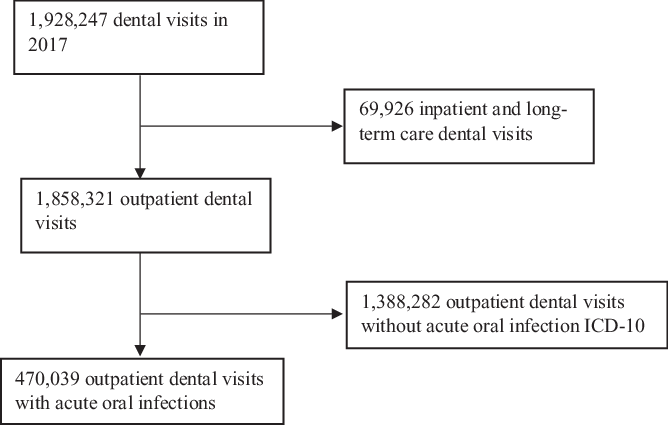
After applying inclusion and exclusion criteria, 470,039 dental visits (318,422 unique patients) were identified in VA dental clinics with corresponding ICD-10 codes for IP (n = 385,040), AP (n = 33,938), and AAA (n = 51,061) during 2017 (Fig. 1). Patient demographics including median age, sex, race, and US Census Bureau region were similar across the 3 acute oral infection types (Table 2). Patients were predominantly male (90%) with an average age of 61 years old with most patients residing in the Southern US.
Study flowchart.

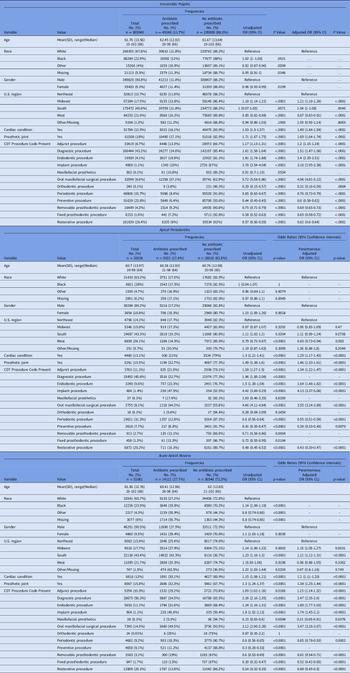
Characteristics of Eligible Dental Visits in 2017 and Unadjusted and Adjusted Associations by Acute Oral Infection Type

Note. SD, standard deviation.
Diagnostic CDT codes include examinations and radiology and laboratory procedures; Preventive CDT codes include cleanings, fluoride, and sealants; Restorative CDT codes include fillings and crowns; Endodontic CDT codes include root canals; Periodontic CDT codes includes gum-related procedures; Prosthodontics CDT codes include dentures (removable) and bridges (fixed); Maxillofacial prosthetic CDT codes includes facial, ocular, and other prostheses; Implant CDT codes include implant procedures; Oral and Maxillofacial Surgery CDT codes include extractions, biopsies, and other surgical procedures; Orthodontic CDT codes include Braces; Adjunctive CDT codes include anesthesia, professional visits, medication administration and tooth whitening and adjustments.
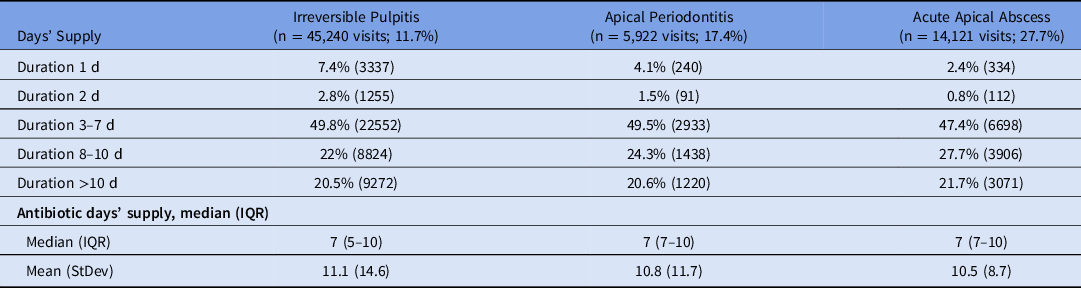
Of the 470,039 VA dental visits with oral infections coded, 12% of IP, 17% of AP, and 28% of AAA visits were associated with antibiotic prescribing. Amoxicillin (59.8%) was prescribed most frequently for all infections (Supplementary Table 2 online) followed by clindamycin (14.3%). The most common antibiotics present in the “other” category in order of decreasing frequency include sulfamethoxazole/trimethoprim, ciprofloxacin, metronidazole, levofloxacin, nitrofurantoin, minocycline, and rifaximin. Although the median days’ supply was 7 days for patient visits associated with an antibiotic prescription, prolonged use of antibiotics was frequent (42.5% of IP visits, 44.9% of AP visits, 49.4% of AAA visits received antibiotics for ≥8 days) (Table 3).
Descriptive Characteristics of Antibiotic Days’ Supply Stratified by Infection Type

IQR: Interquartile range
Unadjusted analysis
Female sex was protective against antibiotic prescribing for IP but positively associated with increased antibiotic prescribing for AP and AAA. With white race as a reference group, black race was associated with increased antibiotic prescribing for AAA, and the category of other race (defined as not white, black, or missing) was associated with decreased antibiotic prescribing for IP and AAA.
High-risk cardiac conditions, prosthetic joints, and CDT codes for endodontic procedures, implant procedures, and oral maxillofacial surgical procedures were associated with antibiotic prescribing for all 3 acute oral infection types. No further significant differences were observed among infection types when comparing characteristics associated with antibiotic prescribing (Table 2).
Adjusted analysis
Compared with the Northeast Census Bureau region, patient visits occurring in the Western US had lower odds of antibiotic prescribing for IP (adjusted odds ratio (aOR), 0.87; 95% confidence interval [CI], 0.83–0.91) and AP (aOR, 0.83; 95% CI, 0.73–0.94). For AAA, the Midwest (aOR, 1.15; 95% CI, 1.05–1.27) and the South (aOR, 1.21 95% CI, 1.12–1.31) were both associated with antibiotic prescribing. Patients with high-risk cardiac conditions, prosthetic joints, and endodontic, implant, and oral maxillofacial surgery procedures had higher odds of receiving antibiotics (Table 2). Presence of prosthetic joints were observed to have a greater association with antibiotic prescribing when compared to presence of high-risk cardiac conditions for IP (aOR, 1.69 [95% CI, 1.64–1.74] vs 1.49 [95% CI, 1.44–1.54]), AP (aOR, 1.46 [95% CI, 1.33–1.61] vs 1.29 [95% CI, 1.17–1.43]), and AAA (aOR, 1.34 [95% CI, 1.25–1.44] vs 1.2 [95% CI, 1.11–1.29]).
Visits with preventive CDT codes were protective against antibiotic prescribing. In contrast, visits with oral maxillofacial surgery CDT codes had the highest association with antibiotic prescribing across all 3 infections (IP: aOR, 4.96 [95% CI, 4.81–5.12]; AP: aOR, 3.55 [95% CI, 3.24–3.89]; AAA: aOR, 3.47 [95% CI, 3.28–3.67]) followed by implant codes (IP: aOR, 3.16 [95% CI, 2.95–3.38]; AP: aOR, 4.13 [95% CI, 3.37–5.06]; AAA: aOR, 1.74 [95% CI, 1.45–2.1]) and endodontic codes (IP: aOR, 2.4 [95% CI, 2.29–2.51]; AP: aOR, 1.64 [95% CI, 1.48–1.82]; AAA: aOR, 1.89 [1.77–2.03]).
The 3 sensitivity analyses produced similar results when compared to the full analysis (Supplementary Tables 2, 3, and 4 online). Notable variables that remained associated with antibiotic prescribing for IP and AP after performing sensitivity analyses included the presence of prosthetic joint and the presence of CDT codes for implant procedures, endodontic procedures, and oral maxillofacial surgical procedures.
Discussion
Our findings demonstrate that antibiotic prescribing for oral infections by VA dentists was mostly consistent with the ADA CPG prior to its release: 88.3% of IP and 82.6% of AP visits did not receive antibiotics and, thus, were consistent with the guidelines. However, 11.7% of IP visits and 17.4% of AP visits were associated with potentially unnecessary antibiotic prescriptions. Prolonged use of antibiotics was frequent for visits that were associated with antibiotic prescribing (42.5% of IP visits, 44.9% of AP visits, 49.4% of AAA visits received antibiotics for ≥8 days). Interestingly, the Western US had lower odds of antibiotic prescribing for IP and AP, whereas the Midwest was associated with antibiotic prescribing for IP. These geographic trends are consistent with studies conducted in primary care medical clinics,Reference Fleming-Dutra, Hersh and Shapiro12 but they are inconsistent with the highest prevalence of unnecessary antibiotic prophylaxis in the Western US.Reference Suda, Calip and Zhou13 Furthermore, specific dental procedure categories were associated with antibiotic prescribing for all infection types including oral maxillofacial surgery, tooth implants, and root canals (endodontic procedures). The guideline-discordant antibiotic prescribing observed within the study may represent unnecessary antibiotic prescribing placing patients at increased risk of adverse events without providing any meaningful benefit.Reference Thornhill, Dayer, Prendergast, Baddour, Jones and Lockhart14 Antimicrobial stewardship programs, which have reduced unnecessary dental antibiotics through employment of education and institutional guidelines, have been successfully implemented in other facilities, therefore showing potential for this prescribing group.Reference Gross, Hanna, Rowan, Bleasdale and Suda15
Importantly, not all antibiotics used for acute oral infections carry the same risk of adverse events. Clindamycin, a lincosamide antibiotic, has a higher likelihood of causing CDIs relative to other antibiotic agents and carries a significantly higher rate of fatal adverse drug reactions compared to penicillins.Reference Gross, Suda and Zhou16–Reference Teng, Reveles, Obodozie-Ofoegbu and Frei19 CDI not only causes great economic losses to society but also imparts deep suffering for patients and their families.5 Efforts to reduce unnecessary clindamycin usage has been executed successfully, with significant decreases in CDI.Reference Cruz-Rodríguez, Hernández-García, Salinas-Caballero, Pérez-Rodríguez, Garza-González and Camacho-Ortiz20,Reference Climo, Israel, Wong, Williams, Coudron and Markowitz21 One teaching hospital observed a >80% reduction in CDI following the restriction of clindamycin in their orthopedic ward.Reference Cruz-Rodríguez, Hernández-García, Salinas-Caballero, Pérez-Rodríguez, Garza-González and Camacho-Ortiz20 With dentists currently being the top prescribers of clindamycin,Reference Suda, Roberts, Hunkler and Taylor22 reducing use of clindamycin by limiting treatment durations and promoting first-line use of amoxicillin or clindamycin alternatives in penicillin-allergic patients, for acute oral infections is critical. To achieve the latter, antimicrobial stewardship efforts geared toward thorough investigation of β-lactam allergy history can mitigate unnecessary clindamycin use.
With higher rates of adverse effects occurring with prolonged exposure to antibiotic therapies, using the shortest effective course is a prudent practice.Reference Tamma, Avdic, Li, Dzintars and Cosgrove23–Reference Royer, Demerle, Dickson and Prescott26 Antibiotic courses of 3–5 days for acute oral infections are likely as effective as 7-day courses.8 Although few studies support 3-day versus 7-day courses for acute oral infections, similar studies from medical literature support using the shortest effective treatment to maximize benefit while minimizing risk of antibiotic collateral damage.Reference Vaughn, Flanders and Snyder24–Reference Royer, Demerle, Dickson and Prescott26
VA dental patients are more medically compromised than the general population with a higher rate of expected poor healing.Reference Jurasic, Gibson, Wehler, Orner and Jones27 Although in the full model the Charlson comorbidity index was not significant, when excluding those patients with probable premedication dosing or immunocompromised status, a higher Charlson comorbidity index did become significant. These patients may be considered more medically compromised than the general population described in the ADA guidelines.
Although most antimicrobial stewardship interventions have been conducted in inpatient settings, there has been an increasing focus on outpatient antimicrobial stewardship, including some successful dental stewardship interventions.Reference Spellberg25,Reference Royer, Demerle, Dickson and Prescott26 Previous studies have shown audit and feedback as well as education to be effective in curbing inappropriate dental antibiotic prescribing while also promoting accuracy in agent and dose selection.Reference Chate, White and Hale28,Reference Seager, Howell-jones, Dunstan, Lewis, Richmond and Thomas29 A recent study showed that implementation of a dental antibiotic stewardship program was successful in reducing antibiotic prescribing rates for acute oral infections by >70%. This stewardship program formulated an institutional guideline with recommendations largely consistent with the ADA CPG. As a behavioral “nudge,” recommendations in the institutional guideline were provided in a poster format and hung chairside (next to the dental chair). The results of the study confirm that implementing measures to promote adherence to the ADA CPG recommendations are a feasible and effective approach to curbing unnecessary antibiotic use.Reference Gross, Hanna, Rowan, Bleasdale and Suda15 Due to the association of antibiotic prescribing with oral and maxillofacial surgery, implant procedures, and endodontic procedures across all infection types observed in this study, it seems reasonable for a dental stewardship program to implement focused initiatives with the goal of preventing unnecessary antibiotic use for patients undergoing these specific procedures.
This study has several limitations. The results are dependent on the accuracy of ICD-10 coding in the dental setting; prescribing data suggest that antibiotics were prescribed for extra-oral infections (eg, nitrofurantoin, rifaximin). The study population includes only veterans treated within the Veterans’ Health Administration national healthcare system, which may not be representative of the general population. Dental visits associated with antibiotic courses <3 days and prescribed to patients with high risk cardiac conditions or receiving dental implants were not excluded in the primary analysis; thus, preprocedure prophylactic antibiotics may have been incorporated into the data. Patients without access to oral health care and those presenting to emergency or urgent care with oral conditions were not included. Thus, these results are not generalizable to antibiotic prescribing for oral infections in these groups. Additionally, the ADA guidelines provide recommendations for immunocompetent patients exclusively; however, immunocompromised patients were not excluded from the current study. However, sensitivity analyses were performed that excluded visits with patients with immunocompromising conditions. To account for the possibility that the antibiotic was prescribed for prophylaxis (vs treatment of an oral infection), the additional sensitivity analysis excluded patient visits that received antibiotic courses <3 days and patients with high-risk cardiac conditions. These 3 sensitivity analyses produced similar results to our primary analysis. Signs of systemic infection including extending infection, fever, and generalized malaise were not collected, making assessment of ADA guideline concordance for the treatment of AAA infeasible. Finally, these findings are based on data prior to publication of the ADA guidelines; thus, practice may have changed since the study period.
Regardless, the findings of this study suggest an opportunity for improving judicious antibiotic use in the outpatient dental setting by promoting concordance with the ADA acute oral infection guidelines. Due to ICD-10 codes not being commonly used in private-sector dental clinics, these unique VA data provide valuable insight into dental antibiotic prescribing practices for specific acute oral infections. These data provide additional evidence for antimicrobial stewardship initiatives targeting the reduction in the use of unnecessary antibiotics for IP and AP cases, especially for prolonged courses. Decreasing antibiotics prescribed for oral infections can lead to reductions in community-onset CDIs and infections caused by multidrug-resistant organisms.Reference Tampi, Pilcher and Urquhart30
Prior to the release of the ADA guidelines, 88.3% and 82.6% of IP and AP visits in the VA setting were concordant with the ADA guidelines. Data from the current study identifies opportunities to improve acute oral infection antibiotic prescribing in outpatient dental settings. These results may serve as a benchmark for future outpatient antimicrobial stewardship efforts within the dental setting. Opportunities for future work in this area include the assessment of guideline concordance of antibiotic prescribing for AAA as well as acute oral infection antibiotic prescribing practices for both emergency department settings and for populations without access to health care.
Acknowledgments
The views and opinions expressed in this article are those of the authors and do not necessarily reflect the position or the policy of the Department of Veterans’ Affairs or the US government.
Financial support
This work was supported by funding from the Veterans’ Health Administration, Office of Research and Development, Health Services Research and Development Service Investigator Initiated Research Award (grant no. HX002452) and the National Center for Advancing Translational Sciences of the National Institutes of Health (grant no. KL2TR002346) and the National Institute of Dental and Craniofacial Research of the National Institutes of Health (grant no. K23DE029514).
Conflicts of interest
All authors report no conflicts of interest relevant to this article.
Supplementary material
To view supplementary material for this article, please visit https://doi.org/10.1017/ice.2021.16