In this paper, we seek to examine one of the most rote quantitative measures of scientific output, the gross number of scientific publications. There are many considerations which render this quantum an intellectually thin and misleading index of the flourishing of ideas; but that has not prevented it from serving as a wakeup call to the bureaucrats concerned with science policy. What has been missing until now is a serious survey of the issues involved in using timeseries of scientific publications as barometers of decline in national science infrastructures.
I. How bibliometrics was taken private
Let us provisionally accept the notion that the proximate purpose of scientific research is publication: that is, the dissemination of novel ideas and findings throughout a larger community through some sanctioned or respected vehicle. If that were the case and, further, if we trusted the vehicle to impose some (undefined) modicum of quality control, then it might seem reasonable to simply count the number of articles whose authors were identified with a particular geographic entity or institutional affiliation, and then claim that those counts “measured” the immediate outputs of science. Now, from the birth of this construct of “bibliometrics” onwards,Footnote 1 it was objected that the unit of a “publication” was artificial and arbitrary in the extreme. (One still hears such cavils at tenure and promotion meetings.) Partly in response to this, and consequent upon the military pouring substantial funds into library science in the 1950s, these counts have been augmented by citation statistics: that is, individual “articles” could be rated by the numbers of citations aimed their way in other articles, obviously drawn from what were deemed a relevant subset of publication outlets. Variables such as these constitute the bread and butter of bibliometrics. Yet the impact of the commercialization of global science upon bibliometrics has gone relatively unnoticed.
Few realize the extent to which the major source of world-wide bibliometric data of this sort is a private for-profit company. As such, the exact composition and content of the data discussed below is proprietary in significant dimensions, and more than a little secret, in keeping with the character of the modern regime of science organization. A little history of bibliometrics in the US is relevant here. Eugene Garfield and Associates began two pilot projects in the late 1950s with NIH funding: one, a machine-readable patent citation index, and the second, an index to published literature on genetics. When the NIH declined to continue support for the latter database, Garfield formed the Institute for Scientific Information in 1958 to build and maintain national citation databases for the natural sciences, which would then be rented out to universities and business. He first privately published the Science Citation Index in 1963. Since then, the ISI has continued to offer bibliographic database services, which began as a wonderful tool for researchers, but which has morphed of late into something else. Its specialty has been computer automated citation indexing and analysis, a field pioneered by Garfield. ISI maintains citation databases covering thousands of academic journals, including continuations of its longtime print-based indexing service the Science Citation Index (SCI), as well as the Social Sciences Citation Index (SSCI), and the Arts and Humanities Citation Index. Its product ISI Web of Knowledge™ allows those with access to follow citation links across something in the order of 16,000 journals, to retrieve articles cited or citing a specific initial article. But broad-based does not mean truly inclusive (Testa Reference Testa2003); as both Garfield and later ISI representatives have stated unequivocally, the range of journals to be incorporated into the database is an economic decision it reserves to itself. Sometimes this is justified by an appeal to the so-called “Bradford’s Law”, viz., the observation that a small number of journals publish the bulk of “significant” scientific results; yet the problem of the lack of openness in the decision-making process remains. ISI was acquired by Thomson Scientific & Healthcare in 1992, became known as Thomson ISI and now as Thomson Scientific. It is currently a component of the multi-billion dollar Thomson-Reuters Corporation, formed from the 2008 merger with Reuters, a major provider of financial data and business journalism.
This background is required in order to understand the ways in which the very structure of the Web of Knowledge and Thomson ISI have been transformed under the pressure of historical events to serve less and less as a helpful tool for researchers (Charbonneau Reference Charbonneau2006), and more and more a contrivance for the (Foucaulvian) discipline and evaluation of institutions and a proxy output measure for the research. In other words, what started out as something harmless, rather like a thesaurus, has turned into a sharp-edged audit device wielded by bureaucracies uninterested in the shape of actual knowledge and its elusive character.Footnote 2 In particular, Thomson now retails its products as a one-stop shop for corporate monitoring and control of intellectual property in its many incarnations. Threatened on the one hand by Google Scholar, which is (after all) free, and much easier to use for the average researcher (Noruzi Reference Noruzi2005), and on the other by the ongoing consolidation of academic publishing by a very few conglomerate firms doing battle with numerous “open source” e-journal startups, Thomson has increasingly sought to position the Web of Science as another high-cost limited access proprietary database in a portfolio attuned to the special needs of corporate and administrative clients – thus the logic of the merger with Reuters. Ranking individuals, departments, academic institutions, corporations and the like according to their “productivity”, as well as their possible relevance to targeted IP, has become their stock in trade. Google Scholar, by contrast, tends to pick up many journal citations in languages other than English that are missed by the Web of Science; but it also makes no distinction between “sanctioned journals” and all manner of other motley publication formats found on the Web. Many scientometricians would thus tend to look askance at Google Scholar, suggesting that it did not “measure” much of anything.
The upshot of these considerations is that anyone who seeks to use bibliometric measures as indices of scientific output has been forced to make use of the products of Thomson ISI. The NSF does so almost exclusively in its Science and Engineering Indicators; consequently we shall follow their lead, but gingerly, gingerly, since it will be imperative to point to the flaws of these measures at every step along the way. What we are straining towards is the identification of some plausible quantitative indices of changes in science publications over time. As every statistician knows, this is only possible if the underlying basket of things measured stays relatively invariant over time; or if that is unattainable, changes in the basket are controlled and documented so that they can be linked backwards to earlier measurement data. Yet this is precisely what Thomson refuses to do (although its officers might retort that it is not the job of Thomson to provide that service).
II. The problems with just counting journal articles
The question we shall set out to explore in this section is: what are the primary objections to existing indices of the number and distribution of scientific publications over the range of the current privatization regime. Thomson acknowledges that this could be accomplished by tracking a fixed set of journals. However, Thomson instead constantly revises what it considers to be the “core set” of scientific journals by its own opaque decision criteria, without providing comparative data which would permit overlaps of “old” and “new” core sets. And the rate of change as to the “core set” is not trivial: reportedly, Thomson’s core set encompassed 4,460 journals in 1988 and 5,262 journals in 2001.Footnote 3 It is not that the provision of statistics based upon an invariant core set are in principle impossible; it is just that because Thompson is not forced to do so by the government, and corporate clients are uninterested in an invariant core set, then they simply neglect to do so.
For some time, the NSF had contracted out the production of bibliometric indicators for Science & Engineering Indicators, and hence the reprocessing of Thomson ISI data into fixed core sets, to a separate private firm, namely, CHI Inc. Since the Thomson set would generally change roster between each edition, and there were sometimes further complications of journals merger or ceasing publication, it happened CHI was forced to rebuild the fixed core set anew each time for the NSF tables. When Francis Narin retired and sold CHI, the NSF seemed to lose interest in the process, and no one was left minding the store.Footnote 4 This illustrates some of the problems associated with government outsourcing of key decisions over knowledge gathering and collation to private firms. It seems the definitions of “science” sought by Thomson’s clients bore little relationship to serious definitions of output sought by contemporary scholars of science policy and science practice.
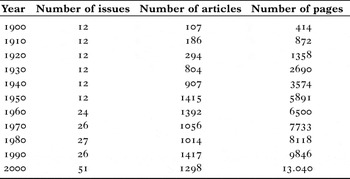
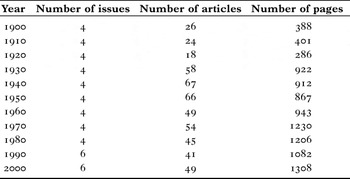
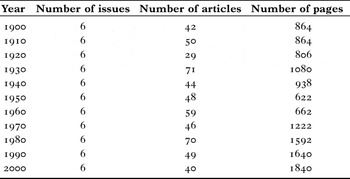
Thus the distinction between a concertedly fixed journal set and expanding journal sets is something no bibliometrician worth their salt could ignore; but that does exhaust the fine points of qualifications to the attempt to quantify publications. Another tricky distinction is what counts as “an article”. Thomson states that it counts articles, notes and reviews, but not letters to the editor, news pieces, editorials, or anything else it considers ephemera. If we were casting our glance back to 19th century science, such distinctions would grow ever more tenuous. Fortunately, that will not be an issue here. What does become apparent is that the number of articles in a year’s individual journal volume grows and contracts at different rates in different disciplines, as do numbers of published pages: in itself, this could constitute an interesting indicator of the economic expansion or contraction of research pursued, as well as the level of subsidies involved in the dissemination of research findings. In Tables I–III below, we provide some broad indications of the vicissitudes of American journals in chemistry, mathematics and sociology over the course of the 20th century, using a standardized counting procedure.
Volume of article production: Journal of the American Chemical Society

Note: numbers of pages in 1900, 1910, 1920, and 1930 are adjusted to reflect changes in page sizes.
Volume of article production: American Journal of Mathematics


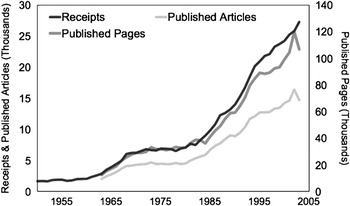
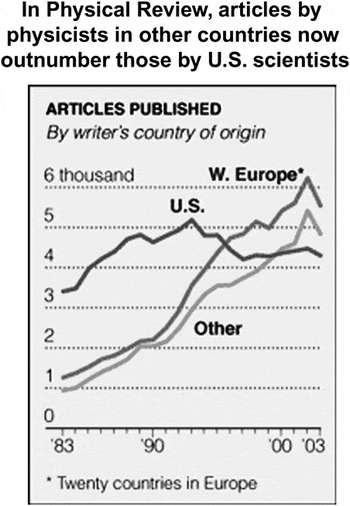
We often take it for granted that scientific research is a nearly unstoppable juggernaut, inexorably expanding the production of knowledge at exponential rates, and pressing against the bounds of human limitations. However, one thing to take away from a perusal of these tables is that inexorability is neither necessary nor guaranteed. Crises like the Great Depression hurt some sciences but not others; mathematics tends to expand at a relatively modest growth rate, even though it does not depend upon large-scale investment in infrastructure, unlike, say, chemistry or physics. Changes in the way that publication is subsidized or otherwise funded also play a role.Footnote 5 But speaking of physics, which experienced the most effusive rates of expansion in the middle of the 20th century, it now appears that, at least with regard to the journals associated with the American Physical Society, that expansion has now ceased, at least from the data presented in Figure 1.

One lesson to be drawn from this bird’s-eye survey of American journal publication is that the changing manifestation of scientific journals matters; the state of their health should be a necessary prerequisite for understanding any subsequent bibliometric exercises. The current struggle over the extent to which the scientific journal of the future will be edited and promulgated over the Web (including specialized preprint archives) rather than through older paper channels, and the way in which that technological transformation intersects with the battle over whether scientific journals will be owned and controlled by individual professional scholarly societies or university presses versus a few large corporations such as Springer, Reed Elsevier, Wiley and Kluwer, are an essential backdrop for any long-term comparisons. Since circa 1980, privatization has spread to the very heart of the scientific enterprise, viz., the vehicles through which new ideas are conveyed to the appropriate target audience.Footnote 7 It should go without saying that the whole setup of Thomson ISI is better suited to tracking privatized corporate publication of scientific results than the more anarchic Web publication and hybrid cyber-media.
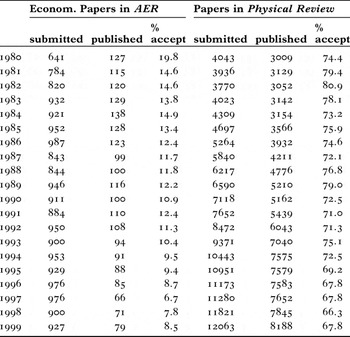
Different disciplines also vary astoundingly widely in their publication practices, something that must equally be kept in mind when dealing at the global levels of aggregation so characteristic of bibliometric practice. As one might expect, the acceptance rates in highly prestigious journals tend to fall in trend over time, even given the counter-trend of expansion of pages/year documented above in the previous tables. But acceptance rates between disciplines vary to an even greater degree, as illustrated in table IV below. Here we compare the acceptance/submission rates for the American Economic Review (AER), the main publication of the American Economics Association, and Physical Review (PR), the flagship publication of the American Institute of Physics. They differ by orders of magnitude, with the PR eight times more likely to publish a submitted paper than the AER. One should not interpret this divergence as evidence so much of a differential stringency of resources (although it cannot be altogether discounted), as it is an index of the degree of a hermeneutics of suspicion of the respective editorial staffs towards their membership base. The American economics profession has always been on guard against any whiff of heresy or conceptual deviance on the part of the writings of its members, far more so than the physics profession. In the latter, having successfully negotiated the apprenticeship of the Ph.D. and (in many instances) a further lab apprenticeship stood as sufficient guarantee that your ideas were worth serious consideration within the physics profession. This sociological point is directly relevant for bibliometric inquiry, because the physics profession’s journal structure exhibits a flatter hierarchy, tending to distribute publication amongst its active members far more equitably in fewer ranked publications, whereas the economics profession instead forces publication distribution to be spread out more broadly across many less-highly ranked journals,Footnote 8 by severely restricting access to ranked core journals. It thus produces higher “peaks” but many more papers that fall outside the bibliometric net.Footnote 9 The overall bibliometric result would be that a shift from journals following the physics model to those following the economics model (perhaps as a result of the progressive privatization of scientific journals publication through time) would clearly put downward pressure on all the usual bibliometric measurements: article counts, citation counts, and their various derivatives.
Acceptance Rates in Economics and Physics Journals

Source: Scheiding, Reference Scheiding2006
The final caveat to be covered here concerns who or what counts as an “author” in bibliometric practice. The contemporary scientific author in the regime of globalized privatization has become more of a corporate than a corporeal entity, in many senses of the term. The science policy historian Derek Price once predicted that the single-authored scientific paper would become extinct by 1980. While this reveals that the track record of prediction for scientometricians has not been much better than the abysmal record of economists, there still persists an element of truth in the notion that science has become less and less the province of the lone individual savant, pecking away at his laptop, alone in his office.Footnote 10 Instead, authorship has become more like an honorific state of grace, parceled out sparingly amongst teams of researchers, on principles which may or may not have had any direct relationship to the effort or ingenuity involved in the final article. There are interesting commentaries upon the problems this has wrought when attempting to map “authorship” onto intellectual property and issues of responsibility.Footnote 11 Here we are more narrowly concerned with the impact the growth of multi-authored articles has had on bibliometric exercises.
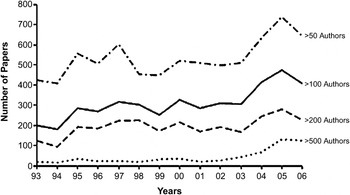
Once authorship attribution starts rising above fifty or so participants, bibliometric measures start to lose their meaning. In cases where the average ratio of words per “author” per article sinks down below 30 or so, clearly, scholarly attribution becomes unmoored from the idea of words having personal inspiration.Footnote 12 Far from being a fluke, articles generated by anything from a platoon to a battalion of researchers have only become increasingly common in the modern privatization regime. (It certainly helps explain the gargantuan publication totals inscribed in vitas of scientists in biomedicine and experimental physics.) Some idea of their prevalence in the core set of journals chosen by Thomson ISI can be gleaned by a graph it provides, reproduced below as Figure ii.
Multiauthor Papers, 1993-2006
Source: Thomson Scientific Science Indicators http://www.sciencewatch.com/nov-dec2007/sw_nov-dec2007_page1.htm

We could simply capitulate at this point or, alternatively, we could impose one more jury-rigged adjustment to the Thomson (and NSF) figures in order to link articles to people, universities, corporations and nations. The standard options are [1] to ignore the problem by assigning one unit of authorship to every person named as such in the article linked to their reported institutional affiliation (the whole count method); or [2] to assign a fraction of “authorship” equal to the reciprocal of the number of authors to each person identified (the fractional count method). If we are interested in output indicators over time, it should be apparent that the whole count method is utterly misleading, since it vastly expands the countable universe of article attributions as a function of the proliferation of multi-authorship. (Again, we aver here that we decline to say anything cogent about the modern nature of “true authorship”, itself drastically revised in the modern regime of privatized science.) Thus in this paper we shall only report statistics using the fractional count method, even though that may in some instances lead to somewhat peculiar numerical quantities of “authorship” and its related measures.Footnote 13
III. Silence of the labs: bibliometrics as output
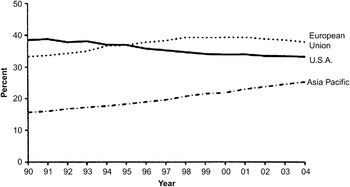
Having gotten those pesky preliminaries out of the way, we can now ask, what has been happening to scientific publications in the recent past? [All data are from Thomson ISI, unless otherwise noted.] The data comprise the aggregation of Thomson’s Science Citation Index and its Social Science Citation Index; that is, the disciplinary definition of “science” is here construed quite broadly. The first generalization that can be noted is that the US share of total global scientific articles published is falling. At the same time, European Union countries began to enjoy greater representation in the scientific literature, although their proportion appeared to peak around the turn of the millennium; by contrast, the presence of Asian scientists has been enjoying almost unchecked expansion, as displayed in Figure iii.
Percent of World Science, All fields, 1990-2004

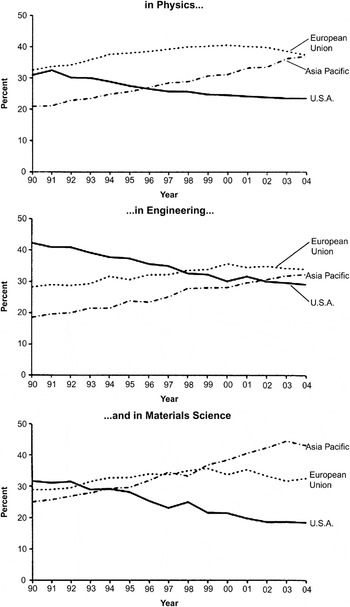
Should there be any doubt concerning the location of these declines in publication share, it so happens that they can be similarly observed in most individual areas of the physical sciences over the same time horizon, as illustrated in Figure iv.
Percent of World Papers, 1990-2004

The immediate objection that might arise is that perhaps the US share is slipping in total, but that it might nonetheless continue to maintain its lead in quality-adjusted superior work. Some bibliometric inquiry has therefore looked at shares of the most highly cited articles in the world. Contrary to expectations, one discovers rather similar continuous declines in US shares, both in total and broken down by individual discipline (NSF SRS 2007, pp. 15-17). It is nevertheless still commonplace to argue that if one controls for shares of active researchers in total population, and adjusts in various ways for what one considers “quality” publications, then the US still comes out way ahead of the European Union in bibliographic measures (Dosi et al. Reference Dosi and Grazzi2006, p. 1454). But it remains unclear why proportions of population should matter to this issue of scientific decline. In addition, quality indicators are even more slippery than the objections outlined above in section 2.
There are, of course, many possible reasons for the US slipping from world pre-eminence in output of scientific articles, at least in these crude quantitative terms; the one that immediately occurs to most people is that as the world becomes more developed and technologically advanced, it was inevitable that the US could no longer continue to dominate science in the way it had done since WWII. In this view, US supremacy was an historical aberration, bound to erode as other countries caught up in development status. This has been more or less the benign interpretation of globalization, and was the predominant view that was said to have emerged from a series of interviews of scientists conducted by the NSF.
If US researchers figure less prominently in the journal literature, the reason does not appear to be because they are reporting their findings in ways that bypass the journals. Those interviewed consistently reported that research done in other developed countries and in several emerging Asian economies is getting better and becoming more abundant. In their view, improved capacity overseas is more likely to account for the increased share of S&E papers from foreign institutions than changes in what Americans have been doing. In an expanding literature, they see a continuing, even growing, American presence, but more marked growth occurring in other countries
(Bell et al. Reference Bell, Hill and Lehming2007, p. 2).But perhaps the casual impressions of individual high-profile American scientists are not exactly the best sources of intelligence concerning the global evolution of the modern privatization regime. We can further explore the Thomson ISI database by looking at what has been happening to the absolute number of scientific articles originated by US authors, using the fractional count method. Here the interpretation grows rather more controversial. The NSF and many science policy scholars have here taken the position that absolute levels of US scientific publication have “flattened” for a decade or more.Footnote 14 But an equally persuasive case can be made that we are living though a period of absolute decline of published scientific output in the US (Hicks Reference Hicks, Stephan and Ehrenberg2007, Tijssen Reference Tijssen2004, Adams, Reference Adams, Galama and Hosek2007). Let us briefly examine some of the evidence.
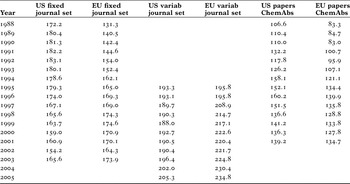
As indicated above, Thomson ISI does not maintain a fixed journal set over time for purposes of construction of time series. Using that as an excuse, the most recent Science and Engineering Indicators (NSB 2008a) presents an estimate of total US and European Union scientific papers (reproduced below in table V as columns 3 and 4) from 1996-2005 showing a minor US decline, with sharp recovery 2003-5. But these aggregate numbers cannot betoken what the NSB commentary claims for them, since everyone openly admits that Thomson has sharply augmented the journals set towards the end of the period: the fact of more added journals would by itself guarantee more total papers attributed to the US. Yet there is some cause to question why S & EI chose to treat that expanded set version as definitive, since in another NSB publication (Hill et al. Reference Hill, Rapoport, Lehming and Bell2007) they did manage to produce data from a fixed journal set measure extracted from the Thomson database, although only extending from 1988 to 2003 (reproduced here as columns 1 and 2 in Table V). Comparison of the two versions is instructive. In the fixed set, the US contraction is more severe and long-lasting, and never recovers the peak attained in 1992. The fixed set for the EU counts suffers some attenuation after 1999, but seems to recover much more readily than the US. For purposes of further comparison, an independent attempt by Chemical Abstracts to count papers attributable to the US vs. the EU is reproduced in table V as columns 5 and 6. Although the peak and timing of the US decline diverges from that in columns 1 and 2 (as one would expect from a different journal sample), again the US decline is not reversed in the data time frame. As long as one hews to the legitimate statistical desideratum of a fixed journal set, one invariably detects absolute declines in US scientific publications from the mid-90s onwards. The absolute decline of American publications is also evident in some data from key individual journals like Physical Review, as demonstrated in figure v.
Overtaking the US
Source: The American Physical Society

Absolute numbers of published scientific articles, by different sampling schemes

Sources: all data in thousands, fractional count method
Columns 2 and 3: Hillet al. Reference Hill, Rapoport, Lehming and Bell2007, app. table II
Columns 4 and 5: NSB 2008a, app. 5-34
Columns 6 and 7: Hillet al Reference Hill, Rapoport, Lehming and Bell2007, app.1
This raises the uncomfortable prospect that the NSF has explicitly chosen data in S & EI 2008 to disguise or otherwise sugarcoat the absolute decline in bibliometric measures of US scientific output. There is the very real danger of the politicians in charge poised and ready to shoot the messenger.
The problem for the US science policy community seems to be that the period since 1995 experienced substantial increases in US academic and industrial R&D expenditures (inflation-corrected), expansion of the American academic R&D workforce (although not tenured positions) and, yet, output as measured by bibliometric statistics (modulo all the qualifications we have tried to make explicit) has been falling in trend. This unmistakeable bibliometric contraction, if and when finally acknowledged, will further cast doubt upon the upbeat message thought to be inherent in the pronounced rise in patent statistics that are often promoted by cheerleaders for the modern privatization regime as proof of concept of commercialization of research. If anything, gross numbers of patents turn out to be an even more flawed index of the success of science.Footnote 15
One of the more insidious effects of the attempts by official bodies to mask the apparent decline is the suppression of some insistent questions which would naturally arise once the reversal in trend had been acknowledged. Perhaps the most obvious question which imposes itself is: Why the reversal in the mid-90s? As explained in detail (in Mirowski and Sent, 2008), the bloodbath of corporate in-house R&D, which occurred right around that same time, and the subsequent move to outsource applied corporate research to low-cost developing countries, goes quite a long way in explaining the sharp break in bibliometric trend in a decade which was otherwise relatively devoid of events foreshadowing dire alterations in the science base. This was pointed out a few years ago in an important but overlooked article by Tijssen (Reference Tijssen2004). After registering substantial growth in corporate scientific publications in the 1980s and early 1990s, a renaissance that had actually increased the corporate share of global published scientific output, the situation was sharply reversed in the mid-90s. Moreover, there was also a national component to this great transformation: “American and European companies appear to be downsizing the basic research efforts or at least restricting the dissemination of results in international journals, whereas their Asian competitors seem to focus more strongly on basic research activities and/or publish more research articles in peer-reviewed international journals” (2004). Further light has been shed on this phenomenon by James Adams (Reference Adams, Galama and Hosek2007). In a sample taken of 823 firms from 1990-2004, he shows that the scientific publication records of the top 200 firms in R&D expenditures in the US in 1998 fell continuously from 1992 by almost half, whereas the publication record of the remaining 600 + firms rose. The top 200 clearly consist of the old-line diversified firms with legacy in-house labs, whereas much of the rest were closer to the biotech model. The difference in scale between the two subsets was so great, however, that it resulted in a substantial fall in publications for the entire aggregate sector throughout the period. This reiterates the point that the shedding of in-house R&D capacity on the part of the nation’s largest firms was an epoch-making event in the history of the US research base, a transformation which has not been offset by the rise of boutique for-profit small businesses. The sectors most responsible for the global privatization regime and enthusiastic support for new models of the commercialization of science are also the ones that tend to be most responsible for US publication decline.
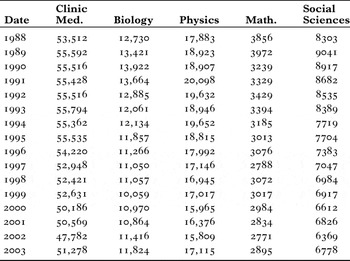
Another question which naturally rears its head is: Given we are dealing in rather large unwieldy aggregates, perhaps the “decline” has been localized in just a few subject areas, while the changing composition of the sciences may otherwise offset the blip, with new more vital areas picking up the slack after a transition period. Again resorting to the fixed journal set data neglected by the NSF, reproduced in Table VI, we recognize that this scenario does not appear to capture the current dynamic. Biology and clinical medicine, the favored objects of the privatization regime, have experienced contracting publications since the early 1990s in the US; but, rather more unexpectedly, so have mathematics and the social sciences. Indeed, one of the more striking facts about modern science in the US is that the contraction has occurred across the board, with only a few minor exceptions.
US Publications, various sciences, fixed journal set

Source: Hillet al, Reference Hill, Rapoport, Lehming and Bell2007, app. table II, from data supplied by Thomson ISI, fractional counts; units are single articles.
The person who has thought longest and hardest on this issue is Diana Hicks (Reference Hicks2005, Reference Hicks, Stephan and Ehrenberg2007). She has doggedly insisted that the phenomena is one of decline, not retrenchment, and because of its broad scope and relative obscurity, it requires something more than armchair speculations; recent candidates have been that the US has an aging research cohort (Mervis Reference Mervis2007), or a general authorial trend towards more collaborative work (Bell et al. Reference Bell, Hill and Lehming2007). There are many excuses that one hears, such as the possibility that it is the newly formed journals, perhaps codifying cross-disciplinary research, that often contain the real cutting-edge science (and thus apparently escape the net of Thomson ISI); or that science is becoming Web-acclimatized with preprints, e-journals and other such phenomena (ditto); but she dismisses these possibilities. Interestingly, she also discounts the effect of patenting on academic publication, based upon a single article (Agrawal and Henderson 2002); here she may have been too hasty, since the fact that most professors who patent at MIT also prove to be star publishers may not tell us all that much about the cumulative effects of the patent system upon aggregate publication in both the corporate and academic spheres. Instead, she boldly adopts the position that the US science base is now falling behind both the European Union and the Asian Pacific powers, and because funding and research personnel are expanding more rapidly in those other areas, US scientists are slowly but surely being nudged out of the core set of academic journals.Footnote 16 In essence, she has been arguing that the US quality is not degenerating as such; it is just that certain key rivals are getting better at an accelerating rate, and in the process are thus displacing American authors from core journals over time.
Without necessarily disagreeing with the weight of her stress on global forces, I would venture to suggest that she does not take the analysis far enough. The downturn in the US clearly started in the business sector, and preceded much of the current Chinese buildup of a science base and, in particular, occurred in areas of science closely related to high-quality in-house R&D programs. The decimation of this sector was not a simple case of the non-US industrial sector getting better; rather, it was more plausibly an instance of the US resource base becoming demonstrably hobbled and starved. Examples are legion; but one can simply point to the history of Bell Labs, perhaps the preeminent instance of world class in-house corporate research in the US. AT&T spun off Bell Labs as Lucent, after allowing it to deteriorate (Endlich Reference Endlich2004). Lucent was not able to survive in the new regime merely by doing world-class science, and was subsequently bought up by Alcatel. Alcatel, in turn, has gutted whatever research capacity remained, in favor of turning the formidable patent portfolio of the desiccated husk into a bag of patent troll curses, to rain down fear on the economic landscape (Brumfiel Reference Brumfiel2008). In just one case, Alcatel won $1.52 billion in damages from Microsoft, for Bell work on the MP3 format. Inevitably, article output has suffered, just as if one had decided to dismantle Stanford and sell off its capital assets to make a quick profit, turning what was left into a patent troll.
Yet the notion that the decline in publications can be completely accounted for by the corporate sector would be too stark and simplistic a proposition. I have argued elsewhere (forthcoming) that in the new globalized privatization regime, publication is neither a desideratum nor a right of a scientist: rather, it is something that may be permitted or blocked, encouraged or reined in, depending upon the strategic plans of powerful actors in the science bureaucracy. I have also described some of the extraordinary fetters placed upon scientists who stumble into a research area studded with intellectual property, which include prior publication restraint, confidentiality clauses, disclosure agreements, and the like. The notion that the proliferation of these fetters has had absolutely no impact upon the rate of scientific publication in America beggars belief. Indeed, there is already some evidence that, in the sample set of the top 110 US universities, total scientific publications have leveled off since circa 1995, although publication rates at private universities have nonetheless continued to increase (Adams Reference Adams, Galama and Hosek2007, p.77). Some such phenomenon is more or less what one would have expected of the privatized regime; the research output of state universities continues to be hobbled by commercialization demands and the relinquishment of their public service orientation, whereas a few rich private universities thrive in the hypercommerical environment. The current economic depression has only made things worse in the American state university system.
And here we discover the second major cause of the American publication decline, this time located in the university sector. A further overlooked variable in the bibliometric equation is that the proportion of faculty in most universities situated below the top 10 who are actually tenured, and therefore expected to publish, has fallen drastically since the 1970s, from an estimate of about 57 % then to roughly 35 % in 2003 (Gravois Reference Gravois2006). The displacement of tenured by temporary “gypsy” faculty has only accelerated since then, with that category expanding at a rate of 7.2 %, while tenured faculty expanded at a paltry rate of 0.4 % (Lederman, Reference Lederman2007). In 2006, American universities attained the dubious milestone that, for the first time in history, the majority of full-time employees in higher education fell into the category of administrative/managerial functions, rather than teaching and research faculty (Jaschik Reference Jaschik2008). Administrators do tend to prattle on about “excellence”, but they rarely directly contribute to the cutting edge of research. Research faculty have been replaced by part-timers and other non-tenured categories, which have proliferated in the modern university. Thus the cadre from within the modern university from which one would expect a stream of publishable research has constituted a vanishingly smaller proportion of total university employment in the modern privatization regime. None of this story depends upon the (correct) observation that some other countries have vigorously augmented their science base, and are consequently enjoying an upward trend of publications. In other words, much of the slowdown in bibliometric output measures in the US can be regarded as attributable to the consequences of the modern privatization of science and the commercialization of the university sector within the US.
The catchphrase that the “privatization of science is a global phenomenon”, and that it therefore must be incongruous to insist upon its differential impact upon a particular nation, should be mitigated in the current context because of the peculiar status of the US within the world system of science in the last half of the 20th century. First of all, the US was in most dimensions the first to pioneer the neoliberal reorganization of the science regime, just as it was the first to fashion the military shape of the Cold War regime. Most developed countries have tended to follow its lead, although all indications are that this may change in the near future. Indeed, insofar as other developed countries opt for the neoliberal script in all its particulars, including the commodification and privatization of public education,Footnote 17 the enforcement of TRIPS-mandated fortification of Intellectual Property, the spread of Bayh-Dole style giveaways to corporate interests in other countries, and the offshoring and outsourcing of research functions in pursuit of the most “efficient” production of science, then in all likelihood they will also experience a decline in article output in the foreseeable future.
Secondly, the US industrial research base has been heavily outsourced to other lower cost countries, which has given them a one-time boost in scientific publications, while at the same time sharply diminishing US domestic article output. The official data on corporate outsourcing found in S & EI 2008 are deeply flawed (as explained in Mirowski, forthcoming); but some indication of the scope and extent of the cross-border outsourcing movement in the first decade of the new millennium can be gleaned from data presented in Thursby and Thursby (Reference Thursby and Thursby2006), which was based upon interviews with 250 heads of corporate research departments in 15 separate industry classes. The most striking aspect of these tabulations is that they suggest, were it not for European interest in tapping into the American base, according to these executives there would be no new industrial research capacity built in the US. After the financial crisis of Fall 2008, that prospect does not seem so far-fetched. Hence the contraction of US scientific output is closely linked to the collapse of corporate investment in long-term research capacity at home.
The second arresting aspect of Thursby and Thursby (Reference Thursby and Thursby2006) is the strong movement of corporate R&D to China, and to a lesser extent, India. This net export of American research capacity by itself could account not only for a modicum of the American decline in output, but perhaps for a fair proportion of the rising publications of China and East Asia as well. It is not merely that the scientific capacities of East Asia have been growing, but also that the investment in China by US companies has had as one of its consequences an increased Chinese propensity to publish in English-language outlets. Hence, the changing rates of scientific output are much more closely related to various novel features of the neoliberal regime than the conventional benign version of globalization would allow.
Yet the increase in Chinese research personnel and publication, while clearly a corollary of China’s own recent economic rise to world preeminence carries its own ironies for the future of global science. Unusually for the history of a rising economic power, China has not profoundly shifted proportionate funding towards the higher education sector and state research enterprises as it grew richer, but has rather encouraged the corporate sector to take the lead in the building of new scientific capacity. In this respect, the policy shift away from the state sector and towards commercialized science has mirrored the contemporary experience of the US.
Thus the rising Chinese presence in bibliographic statistics is not a simple straightforward reflection of a burgeoning university sector, as is sometimes suggested by those wishing to portray the fall in US publications as a simple artifact of economic development in previously underdeveloped areas. What appears to be occurring is that a new mode of scientific research is taking root in countries like China, wherein publication for corporate global strategic objectives provides the dominant model. Insofar as this has already had a dampening effect upon scientific productivity in the US since the mid-1990s, it will be instructive to observe whether a similar dynamic becomes entrenched in the Chinese system, after the initial period of foundational investment comes to an end. This may already be the case in the current economic contraction.
Conclusion
The looming issue of the decline of science in the US in the 21st century is a complex of thorny considerations, ranging from the effects of privatization upon the availiability and cogency of bibliometric statistics, to the interplay of the outsourcing of corporate R&D to China and India along with the late modern model of neoliberal privatization of the conduct of science, to the transformation of the modern American university (Lewin Reference Lewin2009). This is clearly an issue that simple changes in Presidential administrations, or pledges of renewed respect for the integrity of the scientific profession, or testimonials to American ingenuity can barely penetrate. It is therefore time for a new economics of science that ventures beyond optimization models which baldly assert that The Market is the premier information processor for all mankind. This paper seeks to point the way towards an empirical analysis that combines micro considerations of bibliometrics with macro considerations of shifting investment and international placement of research capacities in order to provide a serious answer to the question: Is American science in decline?