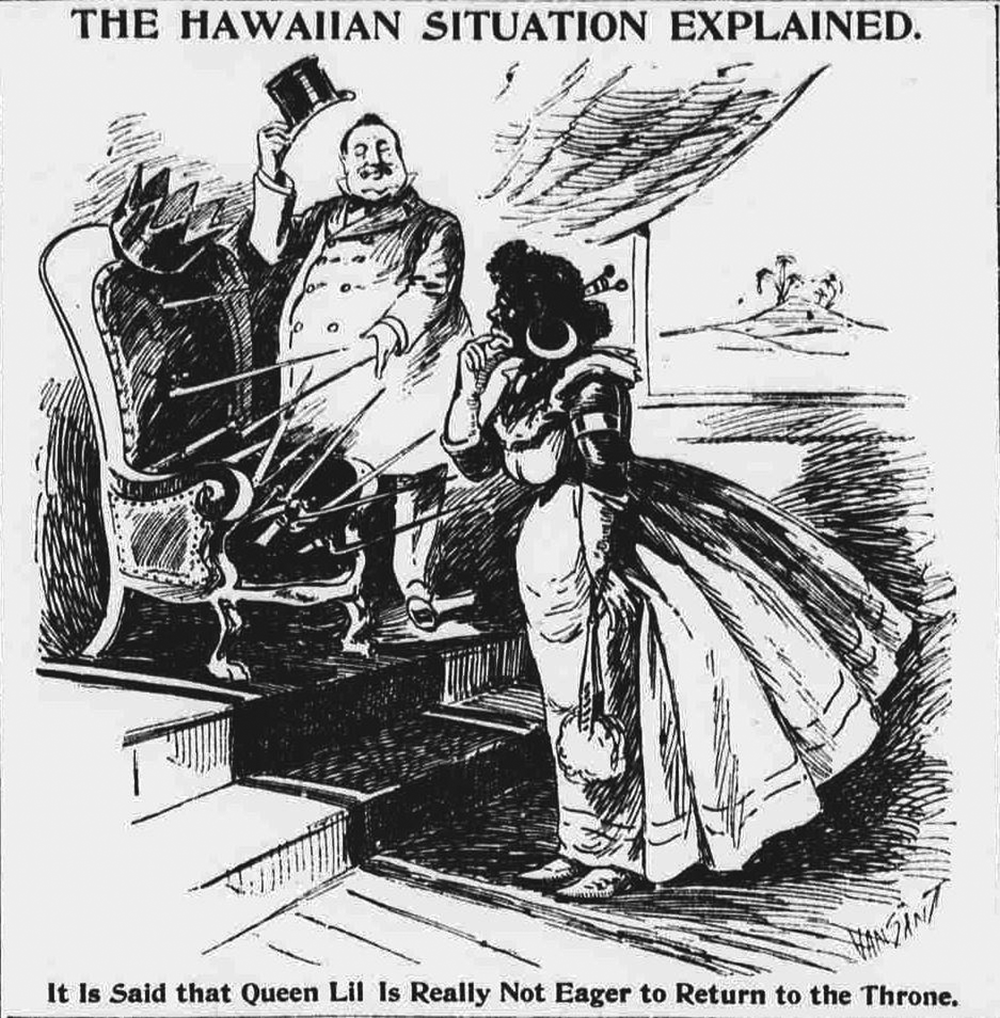
What of its white settler colonial origins haunts us when we look for Shakespeare in “black America”? Of the many places where we might begin, let us begin on its margins. On 14 December 1893, a cartoon drawn by political caricaturist J. Franklin van Sant called “The Hawaiian Situation Explained” appeared on the front page of New York's Evening World newspaper. The cartoon depicts US President Grover Cleveland and Queen Lili‘uokalani in the Hawaiian throne room. As the queen stands two steps below the throne's dais, Cleveland stands next to the throne, hat raised, as he gallantly offers the queen her throne. But the throne is compromised, its seat and back a nest of sharp bayonets, making it impossible to sit on without harm. The crown rests precariously on the chair's “head.” It is a throne of knives, absent the body of a monarch who is only imaginable as penetrated by death. And yet, there she is: “Queen Lil,” the black queen, dressed in a white formal gown, her gloved right index finger poised between exaggerated overly full lips in a moment of consideration, of hesitation about resuming governance of her kingdom. The sarcasm of the cartoon's caption, that “Queen Lil” is “really not eager to return to the throne,” is underscored by the threatening bayonets and the black queen's pause. She cannot have what she has fought for for an entire year since a junta of haole men – Hawai‘i citizens and foreigners – overthrew her government on 17 January 1893.Footnote 1 She cannot rule without being stabbed repeatedly. Those knives keep her legitimate governance in abeyance, threatening it and her with elimination.
J. Franklin van Sant, “The Hawaiian Situation Explained,” Evening World, 14 December 1893, front page.

In Van Sant's political cartoon, we find a collision of politics and cultures in its depiction of a queen's hesitation to regain a kingdom at the risk of death. Hawaiian constitutional monarchy is contrasted with American democracy, a democracy famously born in rebellion against the “tyranny” of a king's rule. That the Americans in the Hawai‘i junta might call upon such a past to justify their usurpation of Lili‘u is not surprising. Only this time, they were settlers in a foreign nation, seeking to force a regime change in a sovereign country that had international treaties of commerce and peace, including with the United States. This cartoon highlights the grave threat of physical violence that the junta used to force Queen Lili‘uokalani to yield, and it also offers us a pointed example of what anthropologist Patrick Wolfe called settler colonialism's “logic of elimination” of Native polities as it intersects with white supremacy's racialization of the Native under the construct of black savagery.Footnote 2
In his influential work on settler colonialism, Wolfe described settler colonialism's logic of elimination as an ongoing structural program to exterminate a “political alternative” to its own political birth, excluding “a sovereignty and a basis for social organization that preceded the social contract that settlers imported with them.”Footnote 3 Without this erasure, an “alternative source of political legitimacy” remained to haunt the territory the settlers claimed as their own.Footnote 4 Further, Wolfe examined how this settler imperative to continually eliminate Native nations includes assimilation by racialization; an intersecting “logic of maximization” shaped white settler colonialism's enslavement of Africans, who are subject to racialization.
But how do this cartoon and the overthrow of the Hawaiian kingdom speak to “black America” and our study of Shakespeare within it? In this image, as with other American political cartoons depicting Hawaiian monarchs of the later nineteenth century, we arguably find Hawai‘i transformed into a new site of “black America” – a white supremacist and settler colonial fantasy of erasing Native rule over a multiethnic national citizenry while simultaneously impugning the political and cultural advancement of African American citizens through antiblack racism. African American uses of “black America” are legible as sites of empowerment, self-possession, and communal self-articulation against the racist antiblackness of white supremacy. And Queen Lili‘uokalani's caricature here in a white supremacist representation insists that her savage blackness, dolled up in a formal gown, relegates her to an inferior position in relation to the civilized white man: race-ing her erases her representative status as the legitimate leader of the sovereign nation of Hawai‘i.
This essay is an addition to conversations about Shakespeare and “race” that important scholars in our field have courageously continued to insist upon and expand. It is my hope that we might go further to “consider how using the terminology and structures of ‘race’ occludes questions of native sovereignty and to ask whether we reproduce one structure of domination as we attempt to displace another.”Footnote 5 There is a potential power of our mutually respectful meeting in “blackness,” a critical place from which to bring together anti-settler and antiracist critiques.Footnote 6 By bringing into this work critical Indigenous studies’ analysis of “race” as a technology in ongoing structural processes of settler colonialism, we might bring parts of the untold late nineteenth-century history of Shakespeare in Hawai‘i into our broader conversation about why indigeneity is part of understanding race and Shakespeare in “black America.”
The mobility of Shakespeare's texts through long, global histories of colonial settlement, with the “civilizing” educational projects that settlement generated, gives rise to an even more evocative way of interpreting this cartoon. After all, stabbing a ruler to death to force regime change occupies play after play in Shakespeare's dramatic works. Those usurpation and assassination stories operate like a meeting place where Americans and Hawaiians can see what overthrowing a monarch looks like. Shakespeare's texts had been used in colonization throughout the nineteenth century to turn savages into passable subjects and bolster white hegemony.Footnote 7 But cultural colonialism works both ways, especially when colonized peoples appropriate colonizers’ texts of high cultural capital into their own languages, put towards their own uses. Such is the case with Shakespeare's appearance and circulation in Hawai‘i's English- and Hawaiian-language newspapers from 1866 through the 1893 overthrow and 1898 annexation to the US.
To proceed, I'd like to present a cluster of Shakespearean invocations, quotations, and translations in Hawai‘i newspapers from 1893 through 1896, the span of years between the overthrow of the Hawaiian kingdom and two years prior to the 1898 US annexation.Footnote 8 While politicians, Hawaiian ali‘i (chiefs), and political commentators occasionally sprinkled Shakespeare's lines into their public discourse – often enabled by their availability in books like Bartlett's Familiar Quotations – the references to Shakespeare's Macbeth I examine here offer us something more deliberate. In reading Hawaiians using Shakespeare in the midst of an intensive phase of political elimination, I want to observe how Hawaiians may have used Shakespeare to create space for what Wolfe calls an “indigenous residue” to persist under white settler colonialism, haunting the resultant polity with a critical alternative, not yet vanquished.
The first Shakespearean reference in Hawaiian newspapers I'd like to examine resembles what Ayanna Thompson describes as “Weyward” Macbeth, the movement of elements from the “haunted” Scottish play through American racial constructions.Footnote 9 On the day of the overthrow of the Hawaiian kingdom, a letter to the editor of the Daily Bulletin, from a foreigner, someone who signs as “AN AMERICAN,” was published under the title “Of What Are They Afraid”:
EDITOR BULLETIN:--
The Advertiser this morning says: “The landing of troops from the Boston furnishes a guarantee that the persons and property of American citizens will be safe from violences, etc.” What are those who claim to be American citizens afraid of? From what quarter is violence expected? None whatever, except like Banquo's ghost, from the “deep shadows of cowardly and guilty consciences.” It would be well under present circumstances for the Advertiser to come forward and state to the public who were the ones that forced the late King at the point of the bayonet to break his oath and forswear the late constitution that he had sworn to uphold?Footnote 10
Citing another newspaper, this writer here disdainfully points out that his fellow Americans, who falsely claimed that Hawaiian citizens threatened their lives and property with violence, did so as a pretext for asking armed American marines from the USS Boston to march into downtown Honolulu on the day Queen Lili‘uokalani attempted to promulgate a new constitution to replace the “Bayonet Constitution,” which King Kalākaua had been forced to sign.Footnote 11 These falsified fears, he notes, are the mere fantasies of “cowardly and guilty consciences,” ephemeral as Banquo's ghost was to Macbeth, and trade in similar regicidal desires – if not in fact, then in spirit.
Another letter to the editor of the Daily Bulletin, published on 21 June 1893 as “Its Right Name,” picked up Banquo's apparition once again in reference to the overthrow of the lawful kingdom, this time criticizing the junta's obvious intent to seek annexation of the islands to the US. The correspondent, who signed himself “HAWAII FOREVER,” wrote,
How in the name of common sense, or what kind of a “precedent” would it be for a nation to take a hand in overthrowing a nation and then treat with that nation on the subject of annexation? To use the term annexation in this controversy, is out of place; it should be called by its right name thus; A bastard conquest, by ex-Minister Stevens [US]. The Star [another Hawai‘i newspaper] and its backers may squirm and twist as they will, to hide the facts; still like “Banquo's ghost that will not down,” the fact remains – that if ex-Minister Stevens with his Boston troops had not taken a heavy hand in this revolution, Queen Liliuokalani would today be on the throne of Hawaii surrounded by a contented people.Footnote 12
Banquo's ghost operates here to represent the dead figure of the Hawaiian kingdom, slain by “bastard conquest,” now haunting the Provisional Government's pleas to the US for annexation; the image of rightful monarchical rule “will not down,” will not be repressed. Queen Lili‘uokalani, very much alive and with the support of the people of Hawai‘i, continued to press President Cleveland for the restoration of her kingdom.
The phrase “like Banquo's ghost that will not down” has a rich genealogy in American politics, ripe for Hawaiian appropriation and recirculation in late nineteenth-century newspapers. It is a reference to that moment in Act IV of Macbeth when Macbeth sees a vision during his second visit to the witches. This is the parade of Banquo's kingly descendants, led by the ghost of Banquo. Macbeth begins his retort to the apparitions, “Thou art too like the spirit of Banquo: down!” The phrase was refashioned in the famous 1830 debate between Senator Robert Hayne and Senator Daniel Webster over Senator Samuel Foot's resolution to temporarily halt federal public land sales. In his remarks on Webster and Foot's opposition to the sale of federal lands to the new western states, Hayne invoked Banquo's ghost as a metaphor for a supposed “Coalition” of New England states against the South and new western states’ desires to sell their own lands.Footnote 13 And while the Hayne–Webster debate looks to be about “the West” and states’ rights, it is an important pre-Civil War articulation of how race and slavery haunt the country's constitutionalism and the uneasy union of North and South.
From that seeming origin point, the phrase continued to wander through President Lincoln's description of being haunted, days before his assassination, by a dream of the death of “The President.” Banquo's ghost then floated into Booker T. Washington's address, “The South as an Opening for a Business Career,” delivered at Lincoln University on 26 April 1888. For Washington, black Americans' desire to govern was Banquo's ghost that “will not down,” especially through black people's relations to land that “has been purchased and paid for ten times over by the sweat and blood of our forefathers.”Footnote 14 Ida B. Wells also circulated the metaphor of Banquo's ghost as the “race problem or negro question” in a speech she gave on 3 February 1893 at the Tremont Temple in Boston.Footnote 15 And back in Hawai‘i, in the 1880s, Banquo's ghost was used at least twice in English- and Hawaiian-language newspapers as a metaphor for the problem of immigrant contract plantation workers becoming naturalized Hawaiian citizens and potential members of the kingdom's polity, against the wishes of the white sugar plantation owner-elites.Footnote 16
This wandering of Banquo's ghost that will not down, figuring what will not stay repressed in white settler colonial endeavors, underscores the ongoing structural processes that connect American histories of African slave labor with settler theft of Native land and elimination of Native polities. Hawaiian reappropriations of the Shakespearean figure and its accrued mana in American political discourse themselves could operate as figures for indigenous residue, substantial reminders that the political and social structures of a seemingly vanquished Native people continue in their actions and words, even when articulated out from beneath the structures of white settler colonialism. With this in mind, Hawaiian Shakespeare in the Hawai‘i newspapers should be investigated as loci of indigenous residue.
Three years after the Overthrow, in the midst of strenuous political efforts by Queen Lili‘uokalani and her royalist supporters, we find a significant reappearance of Uilama Ho‘onaueueihe (William Shakespeare) in a Hawai‘i newspaper. Years of the queen's political lobbying of President Cleveland for the return of her kingdom had not worked. In early January 1895, a royalist faction waged a three-day armed conflict against the junta-created Republic of Hawai‘i. As a result, the rebellion's leaders, many of whom were important ali‘i (chiefs), were arrested, tried, convicted of treason, and sentenced to hang. On 24 January 1895, she abdicated her throne in exchange for the commutation of the rebels’ death sentences. The queen herself was tried and convicted, and sentenced to imprisonment in a single palace room. After long months of confinement, she was released on 6 September 1895 but not allowed to leave O'ahu. Her official pardon, which restored all of her civil rights and freedom to travel, was granted on 13 October 1896.
On 16 October, a verse translation from English to Hawaiian of Shakespeare's Julius Caesar began its serial publication in Ka Nupepa Kuokoa. This translation is notable for its difference from previous translations of Shakespeare. The newspaper publications of Shakespeare's works in the 1860s were translations of the Lamb prose adaptations, but this 1896 Moolelo o Juliusa Kaisara was a direct translation from an unknown edition of Shakespeare's play. This translation has never been scrutinized in comparison to the English original, nor has it been critically analyzed and set in conversation with its historical moment in Hawai‘i. Most importantly for us, with its body of a ruler penetrated by knives and the ruin of a polity, it offers a rich opportunity to continue this discussion of what happens when a “civilizing” text is turned in Hawaiian hands to reflect upon the savagery of political violence and white settler colonialism's logic of elimination.