Epidemiological research indicates that approximately 60% of men and 50% of women experience at least one traumatic event over the course of their lives (Kessler, Sonnega, Bromet, Hughes, & Nelson, Reference Kessler, Sonnega, Bromet, Hughes and Nelson1995). However, only 5% of men and 10% of women go on to develop posttraumatic stress disorder (PTSD; Kessler et al., Reference Kessler, Sonnega, Bromet, Hughes and Nelson1995). Although there is scant epidemiological research examining these questions in children, preliminary research investigating the population prevalence of childhood exposure to trauma indicates that between 15 and 43% of children experience at least one traumatic event in childhood, and of those, 3.5–6.3% receive diagnoses of PTSD (Boney-McCoy & Finkelhor, Reference Boney-McCoy and Finkelhor1995; Costello, Erkanli, Fairbank, & Angold, Reference Costello, Erkanli, Fairbank and Angold2002; Cuffe et al., Reference Cuffe, Addy, Garrison, Waller, Jackson and McKeown1998; Giaconia et al., Reference Giaconia, Reinherz, Silverman, Pakiz, Frost and Cohen1995). The discrepancy between the relatively high level at which children are exposed to trauma and the lower incidence of subsequent maladaptive functioning suggests that the pathway between exposure to trauma and development of PTSD may be mediated or moderated by other factors. However, the nature of these factors is poorly understood. Furthermore, little is known about the variables predisposing certain children to develop specific types of PTSD symptoms. The DSM-IV (American Psychiatric Association, 1994) defines three clusters of symptoms that comprise a diagnosis of PTSD: reexperiencing symptoms, avoidance symptoms, and hyperarousal symptoms.
The theoretical framework provided by the field of developmental psychopathology (Cicchetti & Cohen, Reference Cicchetti and Cohen1995) offers one lens through which to understand the differential impact of traumatic experiences and the later emergence of posttraumatic stress symptoms in some children (Toth & Cicchetti, Reference Toth and Cicchetti1998). The developmental psychopathological perspective seeks to examine a complete spectrum of behaviors representing varying levels of adaptation, with an underlying aim of better understanding the risk factors and resultant sequelae impacting a child's developmental trajectory (Cicchetti, Reference Cicchetti1984, Reference Cicchetti, Cicchetti and Carlson1989, Reference Cicchetti1993; Rutter & Sroufe, Reference Rutter and Sroufe2000). According to this perspective, early life experiences may have critical implications for development, such that children who have been exposed to trauma, in combination with other proximal and distal risk factors, may be more highly predisposed to later maladaptive outcomes.
De Bellis and colleagues have examined the contributions of diverse physiological, biological, and psychological systems on the developmental sequelae of children with a history of early trauma (De Bellis, Baum, et al., Reference De Bellis, Baum, Birmaher, Keshavan, Eccard and Boring1999; De Bellis, Keshavan, et al., Reference De Bellis, Keshavan, Clark, Casey, Giedd and Boring1999). This research has linked childhood trauma exposure with physiological hyperarousal, structural brain abnormalities, cognitive impairments, and psychopathology (Beers & De Bellis, Reference Beers and De Bellis2002; De Bellis, Daum, et al., 1999; De Bellis, Keshavan, et al., Reference De Bellis, Keshavan, Clark, Casey, Giedd and Boring1999). However, no longitudinal research has yet examined the role that early attachment relationships may play in the emergence of posttraumatic stress symptoms following exposure to trauma later in childhood. A history of disorganized attachment could represent one key risk factor within a broader constellation of mutually influential risk factors predisposing a child to the later development of posttraumatic stress symptoms (Lyons-Ruth, Yellin, Melnick, & Atwood, Reference Lyons-Ruth, Yellin, Melnick and Atwood2003).
The infant's attachment relationship with his or her primary caregiver has traditionally been evaluated using Ainsworth's strange situation (Ainsworth, Blehar, Waters, & Wall, Reference Ainsworth, Blehar, Waters and Wall1978), a 21-min structured observational laboratory-based procedure, in which infants are exposed to mild but increasingly stressful events, including brief separations from and reunions with their caregiver as well as the introduction of an unfamiliar adult into the playroom.
Observations of structured parent–child interactions have revealed several distinct attachment relationship patterns, which can be broadly divided into organized and disorganized classifications. In the domain of organized attachment classifications, secure attachment relationships comprise approximately two thirds of all attachment relationships. Securely attached infants seek proximity and contact with their caregiver in situations that provoke uncertainty or fear, and the caregiver is able to soothe and reassure the infant in an effective manner, participating in the child's process of learning self-regulation skills (Carlson, Cicchetti, Barnett, & Braunwald, Reference Carlson, Cicchetti, Barnett, Braunwald, Cicchetti and Carlson1989). Insecure–avoidant and insecure–resistant attachment relationships are characterized by infants' organized attempts to elicit caregivers' attention and protection. Children with insecure–avoidant attachment classifications tend to evade physical contact with their caregiver. Attachment theorists posit that children with avoidant attachment have learned that bids for affection or contact may result in rejecting reactions from the caregiver. Avoidant infants are thought to protect themselves through excessive self-reliance and emotionally detached play. In contrast, infants with insecure–resistant attachment classifications seek to elicit their caregiver's attention through heightened vigilance and indicators of distress. Thus, in avoidant or resistant attachment relationships, children employ an organized, albeit insecure, system for coping with the stresses of the strange situation, by either minimizing their attachment behavior toward the caregiver (avoidant) or by heightening it (resistant).
In contrast, children with disorganized attachment classifications appear to lack an organized strategy for coping with the stresses of the strange situation (Main & Morgan, Reference Main, Morgan, Michelson and Ray1996). Instead, children exhibit behavioral disorganization or disorientation in the presence of the caregiver, such as failing to approach the caregiver when distressed, or exhibiting contradictory behavior patterns such seeking proximity with the caregiver then freezing or stilling, or avoiding the caregiver (e.g., by averting gaze) while simultaneously maintaining contact with her (Main & Solomon, 1986, Reference Main, Solomon, Greenberg, Cicchetti and Cummings1990). Other children with disorganized attachment classifications exhibit cognitive disorientation or affective dysregulation, such as appearing dazed or depressed while with the caregiver or showing apprehension of the caregiver on reunion.
Disorganized attachment behavior is thought to reflect the activation of incompatible “approach–avoidance” behavioral systems that the child is unable to organize, in which the caregiver may represent both a “haven of safety and a source of fear” (Main & Hesse, Reference Main, Hesse, Greenberg, Cicchetti and Cummings1990). Thus, although biological tendencies may motivate a distressed child to seek proximity and contact with the attachment figure, the caregiver's own frightened or frightening behavior may simultaneously compel the child to escape (Cassidy & Mohr, Reference Cassidy and Mohr2001; Hesse & Main, Reference Hesse and Main2006). Recent research has also found that caregivers of disorganized infants are more likely to have their own histories of childhood trauma and unresolved loss resulting, in part, in feelings of helplessness (Lyons-Ruth et al., Reference Lyons-Ruth, Yellin, Melnick and Atwood2003; Solomon & George, Reference Solomon, George, Solomon and George1999). The cognitive and behavioral disorientation and dysregulation exhibited by disorganized infants in the presence of the caregiver suggests that these children may have difficulty in later childhood coping effectively when confronted with even mildly stressful events. Indeed, research suggests that disorganized attachment often has deleterious long-term implications.
To date, two lines of research have examined the longitudinal correlates of early disorganized attachment. The first investigates a link between disorganized attachment and later dissociation (which is closely connected to posttraumatic stress symptomatology), whereas the second provides support for an association between disorganized attachment and later externalizing behaviors. It is notable that the longitudinal correlates of early disorganized attachment (i.e., dissociative and externalizing behaviors) overlap with the two of the three symptom clusters comprising a diagnosis of PTSD (American Psychiatric Association, 1994). That is, the PTSD avoidance symptom cluster includes dissociative-type behaviors, including symptoms such as numbing of general responsiveness. The PTSD hyperarousal symptom cluster includes externalizing-type behaviors, including symptoms such as irritability or outbursts of anger (DSM-IV). Both dissociative symptoms and externalizing symptoms are responses commonly seen in individuals who have been exposed to trauma.
The theoretical literature linking disorganized attachment and dissociative symptoms posits that the quality of early attachment relationships may impact children's responses to later trauma (Liotti, Reference Liotti1992, Reference Liotti, Kuehlwein and Rosen1994; Lyons-Ruth et al., Reference Lyons-Ruth, Yellin, Melnick and Atwood2003). Liotti speculated that an insecure–disorganized attachment classification may be linked with (a) subsequent vulnerability and (b) dissociative behaviors in response to later trauma. According to this perspective, infants with a history of disorganized attachment might be expected to be at greater risk for displaying dissociative behaviors after exposure to trauma, when compared to children with a history of other attachment classifications. Dissociative behaviors can be seen as unconscious strategies by which some children cope with traumatic experiences (Liotti, Reference Liotti2004). These behaviors may further be employed more often in children with a history of disorganized attachment classifications because these children have not received practice in strategies of self-regulation (Liotti, Reference Liotti1992, Reference Liotti2004).
Although Liotti's theoretical framework is compelling, empirical research evaluating his model is limited. In one exception, Carlson (Reference Carlson1998) found that children with a history of disorganized attachment were more likely to have dissociative symptoms in adolescence compared to children with a history of other attachment classifications. Further, analyzing data from the same sample, Ogawa and colleagues (Ogawa, Sroufe, Weinfield, Carlson, & Egeland, Reference Ogawa, Sroufe, Weinfield, Carlson and Egeland1997) found that disorganized attachment in infancy was strongly associated with dissociative symptoms in adulthood.
Although the developmental processes underlying the association between disorganized attachment and later dissociative phenomena are not clearly understood, this relation is congruent with current theoretical understandings of the origins, sequelae, and behavioral indicators of disorganized attachment. According to Main and Solomon (Reference Main, Solomon, Greenberg, Cicchetti and Cummings1990), disorganized attachment, in contrast to avoidant or resistant insecure attachment classifications, is characteristic of infants who lack a coherent system for managing the stress inherent in the separations and reunions of the strange situation paradigm. The trancelike states observed during the strange situation in some children with disorganized attachment have been likened to minidissociative episodes (Liotti, Reference Liotti1992). These behaviors may serve to help children without more advanced strategies of coping to temporarily escape from the affectively charged environments of the strange situation (Ogawa et al., Reference Ogawa, Sroufe, Weinfield, Carlson and Egeland1997).
In the second line of longitudinal research examining the long-term correlates of disorganized attachment, several studies have linked disorganized attachment in infancy with childhood externalizing behaviors (Lyons-Ruth, Easterbrooks, & Cibelli, Reference Lyons-Ruth, Easterbrooks and Cibelli1997; Main & Cassidy, Reference Main and Cassidy1988; Shaw, Owens, Vondra, Keenan, & Winslow, Reference Shaw, Owens, Vondra, Keenan and Winslow1996). Main and colleagues (Hesse & Main, Reference Hesse and Main2000; Main & Cassidy, Reference Main and Cassidy1988) suggest that behaviors associated with early disorganized attachment undergo transformation over the course of childhood such that the indicators of disorientation, apprehension, and helplessness seen in disorganized infants develop into controlling behaviors in early childhood. Thus, the behavioral disorganization and disorientation seen in infants' disorganized attachment relationships have diminished by early childhood and are replaced by a controlling style marked either by role-reversed behaviors or punitive behaviors toward the caregiver (Hesse & Main, Reference Hesse and Main2000; Marvin & Whelan, Reference Marvin and Whelan2003).
Lyons-Ruth and colleagues (1997) extended these findings, reporting that the externalizing behavior pattern seen in children with a history of disorganized attachment is not limited to children's interactions with their caregivers. Lyons-Ruth et al. found that children's aggressive behavior toward peers was more strongly associated with a history of disorganized attachment than with a history of insecure–avoidant or insecure–resistant attachment classifications. Further, Shaw and colleagues (1996) followed a sample of at-risk children longitudinally over 5 years and found that children who were classified as having disorganized attachments at 12 months were more likely to develop elevated levels of aggression at age 2 and higher rates of disruptive behavior at age 5. A recent meta-analysis supports these findings, reporting that disorganized attachment in infancy predicts aggression in school aged children, with an effect size of .29 across 12 studies (van Ijzendoorn, Schuengel, & Bakermans-Kranenburg, Reference van Ijzendoorn, Schuengel and Bakermans-Kranenburg1999).
The broad purpose of the present study was to examine whether disorganized attachment status in infancy, compared to other nondisorganized attachment statuses, is associated with a higher level of posttraumatic stress symptoms at 8.5 years of age, following trauma exposure and after statistical control for child gender, intrauterine cocaine exposure (IUCE), and continuity of maternal care (i.e., whether or not the child was always in the biological mother's care since the time of the child's birth).
Three specific aims were evaluated:
-
1. The first aim was to evaluate whether disorganized attachment status in infancy was associated with a higher overall level of posttraumatic stress symptoms at 8.5 years of age. We hypothesized that disorganized attachment classification in infancy would predict a higher level of PTSD symptoms from all PTSD symptoms clusters at 8.5 years, following exposure to a traumatic event, when compared to other nondisorganized attachment statuses.
-
2. The second aim was to investigate whether disorganized attachment status in infancy was associated with heightened symptomatology within specific PTSD domains. Two alternative hypotheses were evaluated, based on the literature linking disorganized attachment to later dissociative behaviors (PTSD avoidance cluster symptoms) and externalizing behaviors (PTSD hyperarousal cluster symptoms): (a) disorganized attachment status in infancy will be associated with a higher level of avoidance cluster posttraumatic stress symptoms at 8.5 years, following exposure to trauma, when compared to other nondisorganized attachment classifications; and (b) disorganized attachment status in infancy will predict heightened hyperarousal cluster PTSD symptoms at 8.5 years, when compared with other nondisorganized attachment classifications.
-
3. The third aim was to evaluate whether disorganized attachment status in infancy is linked to heightened symptomatology from other types of anxiety disorders (e.g., separation anxiety, generalized anxiety, or specific phobias) at 8.5 years. This analysis was carried out in an attempt to examine whether a possible association between disorganized attachment and posttraumatic stress symptomatology was simply an artifact of a relationship between disorganized attachment and other forms of anxiety. We hypothesized that disorganized attachment status at 12 months would not be significantly associated with anxiety disorders besides PTSD at 8.5 years.
Method
Participants
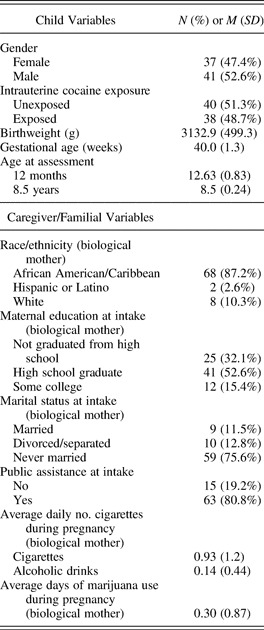
The sample consisted of 78 8.5-year-old children (mean age = 8.47 years, SD = 0.24; 53% male) and their primary caregivers (87.2% African American/Caribbean, 84.7% with a high school level of education or less) from low-income, urban backgrounds. Dyads were participants in a larger, ongoing prospective study examining the effect of IUCE on children's growth, developmental status, and psychosocial adaptation from birth to adolescence. Children in the present sample varied in IUCE status (48.7% with IUCE) and continuity of maternal care. At the time of the 8.5-year visit, 66% had been in the care of their biological mother continually since birth, whereas 34% had received nonmaternal care at some point (24% received kinship care and 11% received nonkinship foster care). Descriptive statistics for the sample's characteristics are provided in Table 1.
Sample characteristics

Recruitment and inclusion criteria
Infant–caregiver dyads were recruited on the postpartum floor of Boston City Hospital (now Boston Medical Center) from October 1990 to March 1993 by trained staff who screened maternity and nursery records 7 days per week. Recruited dyads met the following inclusion and exclusion criteria: (a) mother able to communicate fluently in English; (b) mother age 18 years or older; (c) infant gestational age ≥36 weeks; (d) no requirement for neonatal intensive care unit, (e) no obvious major congenital malformations; (f) no diagnosis of fetal alcohol syndrome in the neonatal record; (g) no history of HIV seropositivity noted in the mother's or infant's medical record; and (h) no indication by neonatal or maternal urine toxic screen or meconium assay or history in medical record of mother's use during pregnancy of illegal opiates, methadone, amphetamines, phencyclidine, barbiturates, or hallucinogens. Criteria (b)–(h) excluded infants with known major risk factors that might confound any specific effects of IUCE. Maternal and infant characteristics at intake were obtained from review of maternal and infant medical records and confirmed by maternal interviews, infant physical exams, and bioassays conducted by study personnel.
All eligible cocaine using and noncocaine using mothers contacted by study staff were invited to participate. Eligible noncocaine using mothers who were comparable in ethnicity (African American/African Caribbean vs. other) to the recruited cocaine-using mothers were approached preferentially for recruitment. Further details about recruitment procedures and sample characteristics at intake are reported elsewhere (Frank et al., Reference Frank, McCarten, Robson, Mirochnick, Cabral and Park1999; Tronick, Frank, Cabral, Mirochnick, & Zuckerman, Reference Tronick, Frank, Cabral, Mirochnick and Zuckerman1996).
A total of 252 dyads were originally recruited at the time of delivery. Of these, 154 (n = 90, 58.5%, with IUCE) were videotaped in the strange situation at the 12-month follow-up visit. There were no significant differences between the sample of infants with attachment data (n = 154) and the larger recruitment sample (N = 252) on key biologic or social contextual variables, including infants' gender, birth weight, or gestational age, or on mothers' education, age, marital status, race/ethnicity, welfare status, or parity. There also were no significant differences in IUCE status or prenatal exposure to marijuana or tobacco. However, a higher percentage of mothers in the infancy attachment sample had used light to moderate amounts of alcohol during pregnancy. Attachment findings are reported elsewhere (Beeghly, Frank, Rose-Jacobs, Cabral, & Tronick, Reference Beeghly, Frank, Rose-Jacobs, Cabral and Tronick2003). Thirty-three of the 154 (21%) children in the infancy sample were classified as insecure–disorganized.
The present sample was based on 78 children who had complete data at both the 12-month and 8.5-year follow-up visits, including attachment data at 12 months, children's self-reported exposure to trauma at 8.5 years, as assessed using the Violence Exposure Scale—Revised (VEX-R; Shahinfar, Fox, & Leavitt, Reference Shahinfar, Fox and Leavitt2000), and children's self-reported psychiatric functioning at 8.5 years, as assessed using the Diagnostic Interview for Children and Adolescents (DICA; Reich, Reference Reich2000). There was no significant difference between the percentage of children with disorganized attachment in the present sample (14 of 78, 18%) and the infancy attachment sample (33 of 154, 21%), p = .31. To evaluate further the possibility of differential attrition, we examined whether the present sample (N = 78) differed significantly from the larger cohort recruited at intake (N = 252) on several important variables. Results of bivariate analyses revealed that the two samples did not differ significantly on IUCE status, or on prenatal exposure to marijuana, tobacco, or alcohol. The two samples also did not differ significantly on key social and biological contextual variables including level of maternal education, marital status, parity, welfare status, race/ethnicity, or the infant's birth weight, gestational age, or gender. Taken together, these results indicate that the caregiver–child dyads evaluated in the present sample and in the infancy attachment sample are largely representative of those in the original cohort recruited at intake.
Procedures
12-Month laboratory visit
Data regarding children's attachment status at the 12-month visit were available from a previous study (Beeghly et al., Reference Beeghly, Frank, Rose-Jacobs, Cabral and Tronick2003). Children's attachment status was scored from videotapes of child–caregiver interaction during Ainsworth's strange situation paradigm following the procedures outlined by Ainsworth and colleagues (1978). The strange situation is a well-established laboratory-based observational assessment of the infant–caregiver attachment relationship consisting of eight episodes designed to exert an increasing amount of mild stress on the infant (e.g., introduction to an unfamiliar room, playing with an unfamiliar adult with caregiver present, followed by two brief separations from and reunions with the caregiver). Infants were classified as secure, insecure–avoidant, insecure–resistant, insecure–disorganized, or insecure–other using traditional scoring systems. Consistent with other researchers' approaches, the insecure–disorganized and insecure–other categories were collapsed for this study (Fraley & Spieker, Reference Fraley and Spieker2003; Munson, McMahon, & Spieker, Reference Munson, McMahon and Spieker2001; NICHD, 2004). Two children (2.6%) in this sample were classified as insecure–other.
Coders used Main and Solomon's (1990) scoring system to note indices of infant behavioral disorganization and disorientation during episodes of the strange situation in which the caregiver was present, using a 9-point Likert scale (1 = no indices of disorganization, 5 = border, 9 = high level of disorganization). Infants with a disorganization rating of 6 or higher were assigned a primary attachment classification of insecure–disorganized (D), whereas infants with a disorganization rating of 4 or lower were judged not disorganized. Infants with a disorganization rating of 5 fell on the border and were judged to be either insecure–disorganized or not disorganized depending on other contextual considerations. Various behaviors reflect behavioral disorganization but differ in degree of intensity. Strong indicators include such behaviors such as exhibiting apprehension of the caregiver on reunion, failing to approach the caregiver when highly distressed, and exhibiting contradictory behavior patterns such as seeking proximity with the caregiver then freezing or stilling en route, or avoiding the caregiver while in physical contact with her (Main & Solomon, Reference Main, Solomon, Greenberg, Cicchetti and Cummings1990).
Coders were trained to score infant attachment (both organized and disorganized patterns) at a national training center. Each coder achieved criterion reliability of at least .80 in scoring 20 videotaped cases available from an external laboratory, which had been previously scored by an expert, certified attachment coder. Following this training one primary coder scored all 154 videotaped strange situation protocols. The second coder independently scored 86 (56%) randomly selected protocols. Disagreements were resolved in conference between the two coders, and any that could not be resolved were scored by an attachment expert from an external laboratory. Percent agreement coefficients and Cohen κ were calculated for major classification, secure/insecure status, and disorganized/nondisorganized status. All coefficients were at or above .85 prior to conferencing. See Beeghly et al. (Reference Beeghly, Frank, Rose-Jacobs, Cabral and Tronick2003) for detailed information about attachment scoring, reliability, and findings in the larger cohort (N = 154).
8.5-Year laboratory visit
The DICA (Reich, Reference Reich2000) was administered to the study children at the 8.5-year visit by an experienced doctoral-level clinical psychologist masked to children's IUCE status, attachment status, and background variables. Four DICA scales were examined in this study: PTSD, separation anxiety, generalized anxiety disorder, and specific phobia. The DICA is a widely used, broad-based, semistructured interview schedule for children aged 6–17 that has been used in both clinical and nonclinical populations (Reich, Reference Reich2000) and as a research measure in a range of samples of traumatized children, including victims of motor vehicle accidents (Keppel-Benson, Ollendick, & Benson, Reference Keppel-Benson, Ollendick and Benson2002), burns (Saxe, Stoddard, & Courtney, Reference Saxe, Stoddard and Courtney2001), and interpersonal abuse (Famularo, Fenton, & Augustyn, Reference Famularo, Fenton and Augustyn1996). Diagnoses and symptoms are based on DSM-IV (1994) criteria. The first question of the PTSD module of the DICA assesses criterion A1 of the PTSD diagnosis: “Has anything happened to you that was really terrifying [scary] for you?” Children who responded affirmatively were asked to describe the trauma and were asked whether the event included real or imagined bodily harm/injury to self or others and whether they felt fear, helplessness, or horror. If children endorsed more than one traumatic experience meeting DSM-IV Criterion A, they were asked, “Which of these is the scariest thing that has happened to you?” The event specified as the scariest became the index trauma. Children were subsequently asked a series of questions about symptoms of PTSD based on this index trauma. If children denied having experienced a traumatic event, the DICA–PTSD module was discontinued, and that child was recorded as having endorsed zero PTSD symptoms. The DICA yields a score for total PTSD symptoms as well as subscale scores for symptom counts in the three PTSD clusters: reexperiencing, hyperarousal, and avoidance. DICA protocols were scored by trained coders who were masked to IUCE status, attachment status, and background variables.
Children were also administered the VEX-R (Shahinfar, Fox, & Leavitt, Reference Shahinfar, Fox and Leavitt2000), a cartoon-based child self-report instrument examining children's lifetime exposure to everyday violence or trauma across diverse settings. Children rate each item on a scale from zero, corresponding to “never,” to three, corresponding to “lots of times.” Total scores range from 0 to 66, with higher scores indicating more violence/trauma witnessed or experienced. Emerging evidence supports the validity of the VEX-R for assessing violence/trauma exposure in children (Raviv et al., Reference Raviv, Erel, Fox, Leavitt, Raviv, Dar, Shahinfar and Greenbaum2001). In other studies based on this cohort, higher VEX-R scores have been associated with higher symptoms of depression, anxiety, PTSD, and subjective reports of distress (Augustyn, Frank, Cabral, & Zuckerman, Reference Augustyn, Frank, Cabral and Zuckerman2002; Augustyn, Grant Knight, Woods, Cabral, & Frank, Reference Augustyn, Grant Knight, Woods, Cabral and Frank2004).
Analytic plan
A multiple-step analytic plan was carried out to evaluate the study's three aims regarding whether disorganized attachment status at 12 months was independently associated with children's overall PTSD symptomatology, symptom counts in specific PTSD symptom clusters (avoidance, hyperarousal, and reexperiencing), or other forms of anxiety in children at 8.5 years, after controlling for relevant covariates.
Preliminary analyses were carried out prior to evaluating the study's three aims. We first examined the rate of disorganized attachment in our sample (N = 78) at the 12-month visit. We then calculated children's trauma exposure counts, based on the DICA data from the sample at 8.5 years. Next, we calculated the proportion of our sample meeting the PTSD subjectively traumatic criterion (A2) as determined by the DSM-IV (American Psychiatric Association, 1994). We then examined the average number of PTSD symptoms endorsed by the sample. Finally, we performed chi-square analyses to examine the association between IUCE and disorganized attachment in this sample.
Poisson regression
Following these analyses, the study's three aims were evaluated using multivariate Poisson regression. The Poisson regression is an appropriate statistic to use for these analyses as it takes into account the relatively high rate of participants with DICA symptom counts of zero. The predictor in each regression model was children's attachment status (disorganized/not). Each regression also included three theoretically derived covariates: children's gender, IUCE status, and continuity of maternal care (i.e., whether or not the child was always in the care of the biological mother since birth).
Children's gender was included in the regression model because the literature indicates gender differences in PTSD prevalence, with females at higher risk of developing PTSD following exposure to traumatic events (Cuffe et al., Reference Cuffe, Addy, Garrison, Waller, Jackson and McKeown1998). Although not of primary interest in the present study, IUCE status was evaluated as a possible moderator or confounder of the relation between attachment status in infancy and subsequent posttraumatic stress symptoms, as the larger sample was originally selected for IUCE status. Putatively, IUCE may serve as a marker for other risk factors such as prenatal exposure to other drugs, lower birth weight, or nonoptimal caregiving. Further, although findings in the literature are inconsistent, some research has shown that children with intrauterine drug exposure are more likely to be classified as disorganized in the strange situation (Swanson, Beckwith, & Howard, Reference Swanson, Beckwith and Howard2000). Prior research in this cohort indicated that there was no significant association between IUCE and attachment status at 12 months (Beeghly et al., Reference Beeghly, Frank, Rose-Jacobs, Cabral and Tronick2003). Finally, the child's caregiving environment was thought to be a critical covariate, as the quality of infant–caregiver attachment is likely to be impacted by moves between biological mother, kinship, and/or nonkinship/foster care. The relevant covariate in this study was defined as whether or not a child was always in biological mother's care.
Other biologic and demographic variables that have been identified in the literature as affecting children's developmental and psychosocial functioning (i.e., maternal education, marital status, parity, welfare status, race/ethnicity, infant's birth weight, and gestational age) were also evaluated for possible inclusion as covariates in the Poisson regressions. Any variable significantly associated with disorganized attachment status was included. None of the above variables met criteria for retention. In addition, children's lifetime trauma exposure, as measured by the VEX-R total score, was evaluated as a potential covariate, as it is a central predictor in the development of PTSD (Foy, Siprelle, Rueger, & Carroll, Reference Foy, Siprelle, Rueger and Carroll1984). One-way analyses of variance indicated that disorganized attachment status was not associated with children's total VEX-R score, F (3, 62) = .44, p = .66; therefore, trauma exposure was not retained as a covariate in the Poisson regressions.
The dependent variable in the regression model for Aim 1 was children's overall PTSD symptom count. For Aim 2, the dependent variables were children's avoidance cluster, hyperarousal cluster, and reexperiencing cluster PTSD symptom counts, whereas the dependent variables for Aim 3 were children's symptom counts for separation anxiety, generalized anxiety disorder, and specific phobias.
Findings are noted as statistically significant where two tailed p ≤ .05.
Results
All analyses reported in this study are based on the sample of 78 children (52.6% male, 48.7% with IUCE), from the larger prospective study, who had complete longitudinal data (i.e., attachment data at 12 months, and DICA and VEX-R data at 8.5 years). At the 12-month visit, 16 of the 78 children in the sample (21%) received a disorganized (N = 14) or insecure–other attachment classification (N = 2) and 79% had an organized attachment classification, of whom 49 (63%) were classified as secure, 8 (10%) as insecure–avoidant, and 5 (6%) as insecure–resistant. At the 8.5-year visit, 50 children in the sample (64%) reported having experienced or witnessed at least one traumatic event as measured by self-reported trauma on the DICA (Reich, Reference Reich2000). Forty-three (55%) children in the sample met full criterion A of the PTSD diagnosis, requiring that they experienced, witnessed, or were otherwise confronted with a traumatic event that caused feelings of fear, helplessness, or horror. On average, the sample endorsed 6.36 (SD = 5.43) PTSD symptoms at 8.5 years. Children in the sample who did not endorse having experienced a traumatic event were counted as having zero PTSD symptoms on the DICA.
Children's average VEX-R score at 8.5 years was 20.83 (SD = 13.85), with a range of 0–63. Consistent with findings presented by Beeghly and colleagues (2003) in a larger sample from the infancy attachment study, results of chi-square analyses for the current sample indicated no significant association between children's IUCE status and disorganized attachment status, χ2 (1, N = 78) = 0.46, p = .50. In addition, there was no significant relation between IUCE and children's self-reported lifetime trauma exposure, as measured by the VEX-R total score. Children's VEX-R total scores also were not significantly associated with disorganized attachment status for infants with and without disorganized attachment, M (SD) = 23.3 (15.2) and 20.2 (13.6), respectively (p = .47).
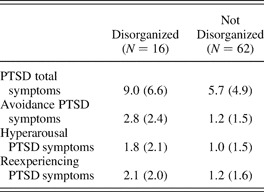
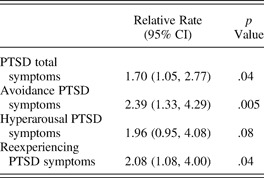
The first aim of the present study was to evaluate whether children with disorganized attachment status at 12 months were more likely to report higher overall PTSD symptoms than those without disorganized attachment, after controlling for gender, IUCE status, and continuity of maternal care. Results of the Poisson regression indicated that disorganized attachment status at 12 months was significantly associated with overall PTSD symptoms at 8.5 years for children with and without disorganized attachment, M (SD) = 9.0 (6.6) and 5.7 (4.9), respectively; rate ratio = 1.70; 95% confidence interval (CI), 1.05–2.77), χ2 (1, N = 77) = 4.28, p = .04.
The second aim was to investigate whether disorganized attachment status in infancy was associated with heightened symptoms within specific domains of PTSD (avoidance cluster symptoms, hyperarousal cluster symptoms, or reexperiencing cluster symptoms) at 8.5 years. It was hypothesized that disorganized attachment would be associated with higher avoidance and hyperarousal cluster symptoms, but not reexperiencing symptoms.
Results of Poisson regressions confirmed our hypothesis that disorganized attachment status at 12 months significantly predicted higher avoidance cluster PTSD symptoms at 8.5 years after covariate control for children with and without disorganized attachment, M (SD) = 2.8 (2.4) and 1.2 (1.5), respectively; rate ratio = 2.39; 95% CI, 1.33–4.29), χ2 (1, N = 77) = 7.81, p = 0.005, but not higher hyperarousal cluster PTSD symptoms for children with and without disorganized attachment, M (SD) = 1.8 (2.1) and 1.0 (1.5), respectively; rate ratio = 1.96; 95% CI, 0.95–4.08, χ2 (1, N = 77) = 3.02, p = .08. Contrary to expectations, disorganized attachment status was significantly associated with a higher rate of reexperiencing cluster PTSD symptoms at 8.5 years, after covariate control for children with and without disorganized attachment, M (SD) = 2.1 (2.0) and 1.2 (1.6), respectively; rate ratio = 2.08; 95% CI, 1.08–4.00, χ2 (1, N = 63) = 4.43, p = .04. Average symptom counts on the DICA–PTSD module by disorganized attachment status are presented in Table 2. Relative rates of PTSD by disorganized attachment status covarying children's gender, IUCE status, and continuity of maternal care are presented in Table 3.
Descriptive statistics of posttraumatic stress disorder (PTSD) symptoms by disorganized attachment status

Note: Values are means (SD).
Relative rates of posttraumatic stress disorder (PTSD) symptoms by disorganized attachment status estimated from Poisson models covarying children's gender, intrauterine cocaine exposure status, and continuity of maternal care

Note: CI, confidence interval.
In Aim 3, the association between disorganized attachment status and other types of anxiety symptomatology (i.e., separation anxiety, generalized anxiety, and specific phobia symptom counts) was evaluated. Results of Poisson regressions indicated that disorganized attachment was not significantly associated with heightened anxiety symptoms in any of the other anxiety disorders measured (p > .05).
Discussion
This study examined whether a history of disorganized attachment in infancy was associated with higher posttraumatic stress symptoms at 8.5 years after control of relevant covariates, in an at-risk longitudinal sample of impoverished, urban children followed from birth to adolescence. Specifically, this study sought to test a hypothesized prospective association between early disorganized attachment and later heightened PTSD symptoms following trauma exposure. Consistent with other research linking disorganized attachment and later psychopathology (Lyons-Ruth, Reference Lyons-Ruth, Cicchetti and Toth1992, Reference Lyons-Ruth1996; Lyons-Ruth et al., Reference Lyons-Ruth, Easterbrooks and Cibelli1997; Main & Cassidy, Reference Main and Cassidy1988; Ogawa et al., Reference Ogawa, Sroufe, Weinfield, Carlson and Egeland1997), our study found a significant association between early disorganized attachment and later posttraumatic stress symptoms. Of note, this association was not significant across all clusters of PTSD symptoms, nor with other anxiety disorders, but rather was specific to the PTSD symptom clusters of avoidance and reexperiencing.
In Aim 1, we investigated whether disorganized attachment in infancy was associated with higher PTSD total symptoms at age 8.5 years in this low-income sample. Results indicated that, after controlling for child gender, IUCE status, and continuity of caregiving, there was a significant association between disorganized attachment in infancy and higher PTSD total symptoms at age 8.5.
In Aim 2, we evaluated whether disorganized attachment was associated with specific symptom clusters within the PTSD domain. Our first hypothesis was confirmed, namely, that disorganized attachment was associated with higher avoidance cluster PTSD symptoms in middle childhood. However, the alternative hypothesis that disorganized attachment would be related to hyperarousal cluster PTSD symptoms was not supported. Unexpectedly, we found a significant association between disorganized attachment and reexperiencing cluster PTSD symptoms. It is notable that there was no significant relation between disorganized attachment and children's lifetime trauma exposure, suggesting that the association between attachment and specific posttraumatic stress symptoms is not likely simply to be an artifact of disorganized children's greater exposure to trauma over time, although it should be noted that the lack of significant findings here could be a result of our relatively small sample size.
In Aim 3, we examined the hypothesis that the association between disorganized attachment and posttraumatic stress symptoms would be unique to PTSD and would not be found among other anxiety disorders. Results of Poisson regressions indicated that disorganized attachment status was not significantly associated with other anxiety disorders in childhood, including separation anxiety disorder, generalized anxiety disorder, or specific phobias.
Taken together, these findings suggest that children with a history of disorganized attachment in infancy may evidence greater difficulty than other children coping with stressful experiences later in childhood. These findings fit with our theoretical understanding of the disorganized attachment schema and its possible implications, in combination with other factors, for functioning over the life course. Generally, our findings suggest that an early relational model may in part mediate children's later traumatic stress reactions.
Our findings are generally consistent with the two existing lines of research linking early disorganized attachment with later psychopathology (Lyons-Ruth et al., Reference Lyons-Ruth, Easterbrooks and Cibelli1997; Ogawa et al., Reference Ogawa, Sroufe, Weinfield, Carlson and Egeland1997). The results presented here regarding avoidance cluster PTSD symptoms are consistent with Liotti's (1992, 1994) theoretical framework associating disorganized attachment with later dissociative behaviors, as well as with Ogawa et al.'s (1997) and Carlson's (1998) research linking infant disorganized attachment with dissociative behaviors in adolescence and adulthood.
Some researchers have argued that it is important for children to be periodically confronted with challenging experiences over which they have control in order to build brain structures allowing them to regulate anxiety, tolerate negative affect, and develop organized responses in the face of frightening situations (Cassidy & Mohr, Reference Cassidy and Mohr2001; Tronick, Reference Tronick1989). Children with a history of disorganized attachment may evidence particular difficulty coping with frightening situations or regulating negative affect, in part because caregivers may not have responded to their children effectively or consistently in the past. The combination of intersecting factors contributing to some children's inability to modulate arousal and cope with stressful events successfully may have deleterious implications for children's later development. Our findings suggest that early disorganized attachment may impact the ways in which children react to later traumatic experiences.
In examining these findings, it is important to consider several factors that may influence caregivers' abilities to respond sensitively to their infants. Although these factors were not analyzed in the present study, research has suggested that infants' disorganized attachment status is associated with caregivers' own histories of unresolved loss or attachment trauma (Schuengel, Bakermans-Kranenburg, & van Ijzendoorn, Reference Schuengel, Bakermans-Kranenburg and van Ijzendoorn1999). Parental psychopathology has also been found to predict infants' disorganized attachment status (Lyons-Ruth & Jacobvitz, Reference Lyons-Ruth, Jacobvitz and Shaver1999).
Some literature has examined the association between maternal and child attachment patterns. In a longitudinal examination of the intergenerational transmission of disorganized attachment, Lyons-Ruth, Yellin, Melnick, & Atwood (Reference Lyons-Ruth, Yellin, Melnick and Atwood2003) found infants' disorganized behavior at 12 months to be uniquely predicted by maternal unresolved state of mind as classified by the Adult Attachment Interview (AAI) and maternal childhood experiences of parental death. Lyons-Ruth et al. (Reference Lyons-Ruth, Yellin, Melnick and Atwood2003) also found that the severity of mothers' childhood trauma history was associated with a hostile–helpless state of mind on the AAI, which in turn predicted infant disorganized attachment. Supporting these findings, Solomon and George (Reference Solomon, George, Solomon and George1999) report parental helplessness as a common factor in infant disorganized attachment.
Recent research has identified five dimensions of disrupted maternal affective communication, which together predict infant disorganized attachment. These areas, identified by Lyons-Ruth, Bronfman, and Parsons (Reference Lyons-Ruth, Bronfman and Parsons1999) and replicated across samples (Goldberg, Benoit, Blokland, & Madigan, Reference Goldberg, Benoit, Blokland and Madigan2003), are (a) parental withdrawing responses, (b) negative-intrusive responses, (c) role-confused responses, (d) disoriented responses, and (e) affective communication errors. These parental responses are more likely to predict disorganized attachment than other attachment classifications. In turn, children with disorganized attachment relationships may unconsciously use dissociative behaviors to escape from stressful experiences, including perhaps the types of parental responses outlined by Lyons-Ruth and colleagues. Because these children become practiced at the use of dissociation and other disorganized cognitive and behavioral strategies in moments of stress, they may be unlikely to learn other, more adaptive, ways of coping with traumatic events. When they are later confronted with traumatic experiences, these children may be less able to modulate their affective reactions because they have historically lacked models of affect regulation.
These results are relevant to the present study's finding regarding an association between disorganized attachment and reexperiencing cluster PTSD symptoms. Although we did not specifically hypothesize such a link, this association can be viewed in much the same way as the relation between disorganized attachment and later avoidant cluster PTSD symptoms. Reexperiencing PTSD symptoms are thought to represent unintegrated traumatic material laden with unmanageable affect that intrudes into the individual's consciousness. The most plausible explanation for an association between disorganized attachment and this specific cluster of PTSD symptoms is that some children may receive less practice early in life learning affect regulation strategies (i.e., those skills necessary to later integrate stressful experiences). We posit that the caregiver factors contributing to disorganized attachment in infancy, maternal childhood trauma and loss histories, maternal helplessness and/or unresolved states of mind, as well as the multifactored disrupted affective communication (Lyons-Ruth, Bronfman, & Atwood, Reference Lyons-Ruth, Bronfman, Atwood, Solomon and George1999; Lyons-Ruth et al., Reference Lyons-Ruth, Yellin, Melnick and Atwood2003; Solomon & George, Reference Solomon, George, Solomon and George1999), together interact to put disorganized infants at risk for later difficulty integrating memories of traumatic experiences. When traumatic memories, with their concomitant powerful affect, are left unintegrated, they are likely to intrude into the individual's consciousness in disturbing, disruptive, and uncontrollable ways (i.e., reexperiencing cluster PTSD symptoms of nightmares and flashbacks).
Although our findings indicating an association between disorganized attachment in infancy and avoidant and reexperiencing cluster PTSD symptoms in middle childhood generally support our hypotheses, the specific developmental processes that underlie this relation are not clearly understood. This association may be explained in part by the disturbed patterns of caregiver–child affective communication observed in disorganized dyads in other research. This relational paradigm could launch these children on maladaptive trajectories, which in turn, may negatively impact their socioemotional functioning through childhood, adolescence, and adulthood. In contrast to the insecure–disorganized attachment classification, the insecure–avoidant and insecure–resistant attachment classifications are characterized by infants' organized attempts to maintain proximity with their caregiver. The insecure–disorganized attachment classification embodies chaotic behavioral and cognitive indicators displayed by infants who lack a coherent system for coping with the stress inherent in the separations and reunions of the strange situation (Carlson et al., Reference Carlson, Cicchetti, Barnett, Braunwald, Cicchetti and Carlson1989). In the absence of an effective system for coping with stress, it appears that disorganized infants may implement dissociative-type escape behaviors. Our results suggest that when these children later encounter traumatic experiences, they may experience these avoidant symptoms along with symptoms of reexperiencing. In addition, our findings are consistent with Liotti's model (2004), which suggests that early disorganized attachment genetically increases children's vulnerability to developing dissociative reactions to trauma throughout the lifespan. Although disorganized attachment was not associated with hyperarousal cluster PTSD symptoms in the present study, this finding may have reached significance with a larger sample.
This study's findings fit within a developmental psychopathology framework, which theorizes that early experiences, in combination with risk and protective factors, interact to shape a child's trajectory of development. Mutually influential biological, environmental, and social risk factors may contribute to later maladaptive outcomes in some children. Results from this study indicate that one such social factor, the qualities and characteristics of a child's relationship with his or her caregiver, in combination with other indicators may facilitate later resilience or susceptibility in the wake of exposure to traumatic experiences.
This study has several limitations that are important to highlight. First, the relatively small sample, in combination with the larger study's unique focus on IUCE, together impact and limit the degree of generalizability possible from the current study. Future research should replicate this study with a larger, more diverse sample.
Second, given our small sample and the exploratory nature of this study, we were unable to examine many possibly explanatory mediator or moderator variables impacting the association between disorganized attachment and PTSD symptoms. For example, it is possible that unmeasured variables such as early adversity experienced by an infant, or a child's biological vulnerability, may have contributed both to a disorganized attachment classification (Lakatos et al., Reference Lakatos, Nemoda, Toth, Ronai, Ney and Sasvari- Szekely2002) as well as to the development of traumatic stress symptoms following a stressful experience. However, children's birth weight, gestational age, IUCE, and gender were not associated with disorganized attachment or PTSD symptoms in this sample. The possibility that the association between disorganized attachment and PTSD symptoms is caused by a third variable not measured in this study must also be considered.
Third, it should be remembered that the findings from this study indicate an increased rate of PTSD symptoms and not an increased rate of diagnosed PTSD. The average number of symptoms endorsed by the disorganized versus organized groups would not alone be of particular clinical concern, nor has it been demonstrated that the children with histories of disorganized attachment are experiencing increased functional impairment because of these symptoms.
Fourth and finally, research has shown that disorganized attachment and early maltreatment are correlated (Barnett, Ganiban, & Cicchetti, Reference Barnett, Ganiban and Cicchetti1999; Beeghly & Cicchetti, Reference Beeghly and Cicchetti1994; van Ijzendoorn et al., Reference van Ijzendoorn, Schuengel and Bakermans-Kranenburg1999), and it is consequently difficult to parcel out whether children's traumatic stress symptoms, reported at 8.5 years, are specific sequelae of self-reported traumatic experiences in childhood, or whether they may have originated from a possible maltreatment/disorganized attachment history in early childhood. We attempted to account for this by examining the association between children's self-reported trauma exposure and disorganized attachment (which was not significant in this sample); however, we cannot rule out the specific contribution of early maltreatment in children with a history of disorganized attachment. Because of federal privacy legislation, although the mothers in our study did provide self-report data on Massachusetts Department of Social Services allegations of abuse or neglect, we were unable to substantiate these reports, and thus have no valid documentation of reported child maltreatment, because we assume significant underreporting.
Despite these limitations, this study's findings suggest a biologically plausible trajectory from early disorganized attachment to the later development of posttraumatic stress symptoms following exposure to a traumatic event. This study increases our understanding of the possible long-term vulnerabilities associated with early attachment relationships, particularly among children already at risk for developmental problems because of community and environmental factors.
Results from this study may also be helpful in guiding future research on the longitudinal association between early attachment and later psychopathology, generally, and posttraumatic stress symptoms, specifically, across the life course. Future studies should examine contextual risk and resilience variables that may mediate or moderate the association between early attachment and later psychopathology, with the perspective that this relationship could be attenuated by planned interventions. Further research also should examine these questions with larger, diverse samples, enabling researchers to assess the impact of attachment over the life course and to examine the differential effect of various types of trauma experienced by children and adolescents. These findings of such research bear critical relevance to the question of why some children with a history of traumatic experiences go on to develop posttraumatic stress symptoms whereas others show great resilience. The findings from the present study suggest that early attachment relationships are one such important factor.