Introduction
Many insects alter their normal rate of development or suppress the growth (quiescence, diapause) to cope up with adverse environmental conditions (Danks Reference Danks1987; Kostal Reference Kostal2006). This event is either identified by a short-term inactive stage as a direct response to unfavourable conditions, with development resuming soon after favourable condition return (quiescence) or endogenously regulated halt that takes away normal metamorphosis into an alternative pathway with development resuming not necessary on the return of suitable conditions (diapause) (Saunders Reference Saunders1982; Chapman Reference Chapman1998).
In Trichogramma Westwood (Hymenoptera: Trichogrammatidae) only facultative diapause has been identified. The main characteristic of a true facultative diapause is the anticipatory reaction induced by environmental cues long before the arrival of adverse conditions (Ivanov and Reznik Reference Ivanov and Reznik2007). These token stimuli serve as a trigger to induce diapause. The egg to larval period of Trichogramma is known to receive the token stimuli and with an appropriate temperature and photoperiod diapause could be induced (Maslennikova Reference Maslennikova1959; Bonnemaison 1972; Pizzol Reference Pizzol1978; Zaslavski and Umarova Reference Zaslavski and Umarova1990; Boivin Reference Boivin1994; Laing and Corrigan 1995; Garcia et al. Reference Garcia, Wajnberg, Pizzol and Olivejra2002). The presence of distinct eco-physiological phases; i.e., onset, maintenance and termination; is the key to differentiate diapause from quiescence (Kostal Reference Kostal2006). Diapause initiation requires a temperature near to the lower threshold temperature of the insect under study with short day length of photoperiod (Sorokina and Maslennikova Reference Sorokina and Maslennikova1986, Reference Sorokina and Maslennikova1987; Garcia et al. Reference Garcia, Wajnberg, Pizzol and Olivejra2002; Reznik et al. Reference Reznik, Kats, Umarova and Voinovich2002; Voinovich et al. Reference Voinovich, Umarova, Kats and Reznik2002, Reference Voinovich, Umarova, Kats and Reznik2003). For Trichogramma species the photoperiodic regulation of the maternal generation is known to have a significant effect on the proportion of the diapausing individuals (Maslennikova Reference Maslennikova1959; Bonnemaison Reference Bonnemaison1972; Boivin Reference Boivin1994; Laing and Corrigan Reference Laing and Corrigan1995; Garcia et al. Reference Garcia, Wajnberg, Pizzol and Olivejra2002). According to Zaslavski and Umarova (Reference Zaslavski and Umarova1990) and Reznik and Kats (Reference Reznik and Kats2004), this maternal influence could be revealed only when the appropriate photoperiod was provided to the developing Trichogramma principium Sugonjaev and Sorokina at their near threshold temperature.
Trichogramma chilonis is widely used as a biocontrol agent against lepidopteran pests in India, China, Taiwan, Japan, South Korea, Pakistan, Nepal, Reunion Island, Kenya, Australia, and South Africa due to their broader host acceptability and high survival capacity (Jalali et al. Reference Jalali, Singh, Venkatesan, Moorthy and Lalitha2006). Inundative release of Trihogramma parasitoids in Canada, Switzerland, and Russia resulted in a 77–92% reduction in pest damage on wheat (Triticum Linnaeus; Poaceae), corn (Zea mays Linnaeus; Poaceae), and cole (Brassicaceae) (Li Reference Li1994; Smith Reference Smith1996; Gagnon et al. Reference Gagnon, Audette, Dural and Boisclair2017). Trichogrammatids are thus used widely as biocontrol agents worldwide. The short life cycle of Trichogramma varies from 8–12 days at different seasons is one of the major obstacles faced by the mass rearing units (Strand Reference Strand1986; Jalali et al. Reference Jalali, Singh, Venkatesan, Moorthy and Lalitha2006). Hence, improving the long-term storage of Trichogramma by diapause induction can generate a promising technology to overcome the current impediment. Previous studies done by Garcia et al. (Reference Garcia, Wajnberg, Pizzol and Olivejra2002) and Reznik et al. (Reference Reznik, Voinovich and Vaghina2008) on successful diapause induction in Trichogramma embryophagum Hartig and Trichogramma cordubensis Vargas and Cabello from cooler regions led us to choose low temperature zone strains of T. chilonis (i.e., T. chilonis Nilgiris, T. chilonis Kodaikanal, and T. chilonis acclimatised to 15 °C). Previous studies on diapause induction in Trichogramma dealt with developmental arrests in trichogrammatids under natural and artificial environments (Lopez and Morrison Reference Lopez and Morrison1980; Zaslavski and Umarova Reference Zaslavski and Umarova1990). However, no reports are available on the occurrence of diapause in T. chilonis, either under natural or artificial environments. Our study is significant as diapause induction in T. chilonis proves that even Indian species of Trichogramma contain the genetic makeup to undergo diapause at their pre-pupal stage. Hence, the purpose of our present work was to determine the right combination of factors that could successfully initiate, maintain, and terminate diapause in strains of T. chilonis and test the biological attributes (longevity and per cent parasitism) of the emerged adults to ensure their efficacy as biocontrol agent.
Materials and methods
Field collection of geographical strains of Trichogramma chilonis
Survey trips were made to collect T. chilonis from cooler regions of India (Nainital, Nilgiris, Meghalaya, and Kodaikanal) because there were more chances of the populations from these regions to undergo diapause. Sentinel cards with C. cephalonica eggs were placed in some selected fields in the above places and then collected back after 48 hours and checked for parasitism. Parasitised eggs were obtained from sentinel cards placed in Nilgiris and Kodaikanal. We also collected T. chilonis from parasitised eggs of Lampides boeticus (Linnaeus) (Lepidoptera: Lycaenidae) infesting Lupin. The collections were given strain status (Nilgiris strain: NBAII-MP-Tr-23a and Kodaikanal strain: NBAII-MP-Tr-23b) after identification and then use for our study. The other two strains were T. chilonis laboratory (NBAII-MP-Tr-13) and T. chilonis (laboratory Strain) acclimatised to 15 °C (NBAII-MP-Tr-25).
Maintenance of Trichogramma chilonis strains
Two field-collected strains (Nilgiris and Kodaikanal) were reared in the laboratory for six generations and 15 °C strains for 65 generations at 15 °C before initiating the experiment. Pure cultures of T. chilonis strains were continuously maintained on eggs of factitious host C. cephalonica. The host eggs were exposed to ultraviolet irradiation (30 W ultraviolet tube for 45 minutes at a distance of 6.1 m) and these eggs were glued on thick white cards of 15×10 cm. These egg cards were exposed separately to adult females of the four strains of T. chilonis in the ratio of 40:1. Parasitised egg cards (Tricho cards) were placed in a walk-in chamber set at 26±1 °C, 12:12 light:dark hours, and 70±2% of relative humidity and used for our experiments.
Experimental setup
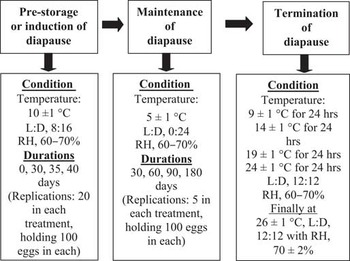
A total of 100 ultraviolet irradiated C. cephalonica eggs were pasted on thick paper cards (measuring 2×1 cm) and exposed to one to two days old T. chilonis adults in a glass tube (measuring 14×2.5 cm) for 24 hours at 26±1 °C, 12:12 light:dark hours, and 60–70% relative humidity. Cotton swabs soaked in (10%) honey solution were provided as an adult diet. A total of 80 such cards were prepared and exposed to each of the T. chilonis strains. After exposure for 24 hours, 20 parasitised cards (for each strain/pre-storage condition) were taken out and assigned to the pre-storage condition (at 10 °C, 8:16 light:dark hours, 60–70% relative humidity) for 0, 30, 35, and 40 days. After pre-storage for the above designated durations, the egg cards were moved to maintenance condition in a cooling incubator set at 5±1 °C, 24 hours of darkness, 60–70% relative humidity for 30, 60, 90, and 180 days (Remi cooling incubator-Cl-12S model; Bengaluru, India). The maintenance temperature in our study was 5 °C (with 24 hours of darkness) as it was logical to think that once diapause has initiated the insect would be able to withstand temperature much lower than what was provided during pre-storage/conditioning/initiation phase. Subsequent to each period of storage at maintenance temperature, five egg cards (from each treatment) were removed and subjected to a gradually increasing temperature in a temperature gradient chamber setup (NK system-TG-180 CCFL-5LE model; Tokyo, Japan) (9, 14, 19, 24±1 °C for 24 hours at each temperature). Finally the cards were transferred to a walk-in chamber (maintained at 26±1 °C with 12:12 light:dark hours and 70±2% relative humidity) until adult emergence. Unstored batches of the respective strains maintained at 26±1 °C with 12:12 light:dark hours and 70±2% relative humidity were used as control. The overall experimental design is depicted in Figure 1.
Outline of the experimental protocol followed to induce, maintain, and terminate diapause as a mode of long-term storage in three different strains of Trichogramma chilonis. L:D, light:dark hours; RH, relative humidity; hrs, hours.

Effect of pre-storage duration on healthy pre-pupal formation
Based on preliminary studies on threshold temperature analysis (E.G., unpublished data), we chose 10 °C as the pre-storage temperature and 30, 35, and 40 days as the pre-storage durations to find out the most suitable one to achieve the highest number of healthy pre-pupal formation Five egg cards containing ~100 C. cephalonica eggs in each were removed after each treatment for each of the strains and were dissected under stereo-zoom microscope to count the total number of healthy pre-pupae formed by prescribing the method described in Garcia et al. (Reference Garcia, Wajnberg, Pizzol and Olivejra2002).
Random dissection were done to check whether the healthy pre-pupae formed in pre-storage temperature could retain their developmental arrest at maintenance condition after 30, 60, 90, and 120 days.
Effect of long-term storage on adult emergence
Five cards with 100 eggs in each after the pre-storage and maintenance phases, for different durations for each of the three strains were kept in a walk-in chamber set at 26±1 °C (70±10% relative humidity and 12:12 light:dark hours) and regularly checked for adult emergence. From the recorded data per cent adult emergence was estimated by dividing the number of adults emerged by the mean healthy pre-pupae formed in that treatment multiplied by 100.
Effect of long-term storage on longevity and parasitism
Two mated females emerging from each treatment were transferred into a small glass tube (measuring 5×2 cm) with 10% honey solution provided as feed. Ultraviolet irradiated Corcyra Ragonot (Lepidoptera: Pyralidae) eggs were provided in 1:30 ratio every 24 hours for three days (effective parasitisation period) and this was repeated five times. From these exposed cards, per cent parasitism was calculated based on the average number of blackened eggs over the total number eggs provided per day. The average of parasitism recorded for three days was considered for analysis. The mortality of the adults was recorded in each treatment.
Statistical analysis
Data was subjected to one-way analysis of variance by taking duration as the main effect (factor) and per cent healthy pre-pupae formed, adult emergence, longevity, and per cent parasitism as the response variable. When statistical differences existed between data sets Tukey’s post-hoc test was done to separate the means.
Results
Effect of pre-storage duration on healthy pre-pupal formation
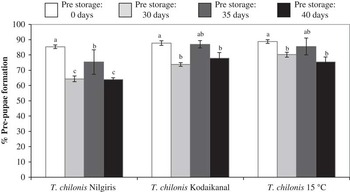
The durations of pre-storage at 10 °C had a significant effect on per cent healthy pre-pupal formation in all the strains of T. chilonis. In the case of T. chilonis Nilgiris strain the highest pre-pupal formation (75.4%) was recorded after 35 days of storage, although their value was significantly lower than in control (unstored batch) (85.4%). In the case of T. chilonis Kodaikanal and 15 °C strains the highest per cent pre-pupal formation was recorded after 35 days of storage (87% and 85.6%, respectively), both being statistically on par with their respective controls (87.8% and 88.8%). The per cent pre-pupal formation in Figure 2 indicates that diapause inducing stimuli could be successfully perceived in the three selected strains of T. chilonis.
Proportion of pre-pupae formation (mean±standard error) as a function of pre-storage condition (10 °C with 8:16 light:dark hours and 60–70% relative humidity) and durations in different strains of Trichogramma chilonis. Tukey’s post-hoc test was done to separate the means. Bars indicating the same letter were not statistically different (at P⩽0.01).

Random dissection done on parallel batches showed that the pre-pupae formed in pre-storage condition could retain their developmental arrest even in maintenance condition after different storage durations, which confirmed on their diapausing state.
Effect of long-term storage on biological parameters of diapaused batch
Trichogramma chilonis Nilgiris
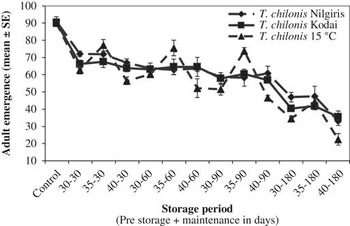
Duration of storage had significant effect on per cent adult emergence, longevity, and per cent parasitism of T. chilonis Nilgiris strain. Per cent adult emergence from the eggs stored for up to 100 days (including 40 pre-storage durations) was on par with the control (unstored batch). The batches stored for 130 days (including 40 pre-storage durations) also recorded 60.8% adult emergence, which was on par with control (Fig. 3) (F=16.92; df=12, 52; P⩽0.0001).
Proportion of adult emergence (mean±standard error) as a function of total storage period (pre-storage: at 10 °C with 8:16 light:dark hours and 60–70% relative humidity+maintenance: at 5 °C with 24 hours of darkness and 60–70% relative humidity) in different strains of Trichogramma chilonis. Tukey’s post-hoc test was done to separate the means. SE, standard error.

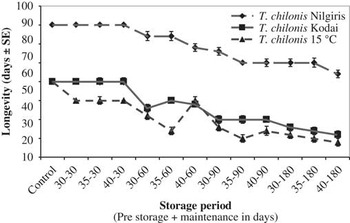
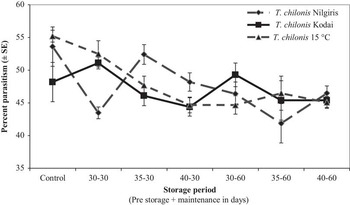
A significant reduction in per cent emergence was recorded at 220 days of storage (including 40 pre-storage durations). Longevity of more than a week was recorded for up to 120 days of storage (30 days at pre-storage condition+90 days at maintenance condition) (Fig. 4) (F=32.47; df=12, 52; P⩽0.0001). The highest per cent parasitism was recorded at 65 days (52.44%) of storage, which was on par with control (53.6%). Parasitoids which emerged after 70, 90, and 100 days of total storage could provide 48.2, 46.4, and 46.5 per cent parasitism, respectively, that were on par with control (Fig. 5) (F=3.8; df=6, 28; P⩽0.0001). Considering per cent adult emergence from diapaused batch, longevity, and per cent parasitism of these adults, 40 days of pre-storage at pre-storage condition and 60 days of storage at maintenance condition proved to be ideal.
Effect of total storage period (pre-storage: at 10 °C with 8:16 light:dark hours and 60–70% relative humidity+maintenance: at 5 °C with 0:24 light:dark hours and 60–70% relative humidity) in longevity (mean±standard error) of different strains of Trichogramma chilonis. Tukey’s post-hoc test was done to separate the means. SE, standard error.

Proportion of per cent parasitism (mean±standard error) as a function of total storage period (pre-storage: at 10 °C with 8:16 light:dark hours and 60–70% relative humidity+maintenance: at 5 °C with 0:24 light:dark hours and 60–70% relative humidity) in different strains of Trichogramma chilonis. Tukey’s post-hoc test was done to separate the means. SE, standard error.

Trichogramma chilonis Kodaikanal
Per cent adult emergence in all the treatments was significantly affected by long-term storage in comparison with control. The adult emergence from the diapaused batches was statistically on par up to 125 days of storage (35 days at pre-storage condition+90 days at maintenance condition) (Fig. 3) (F=27.6; df=12, 52; P⩽0.0001). Longevity of the adults emerging from the diapaused batches up to 70 days of storage (40 days at pre-storage condition+30 days at maintenance condition) did not significantly differ from the control (six days) (Fig. 4) (F=41.6; df=12, 52; P⩽0.0001). Per cent parasitism values ranged between 44% and 51% in the treatment batches while in control it was 48.2, all being statistically on par (Fig. 5) (F=1.55; df=6, 28; P⩽0.0001). Considering adult emergence, longevity, and parasitism, the optimum storage duration was recorded as 100 days (40 days at pre-storage condition+60 days at maintenance condition).
Trichogramma chilonis 15 °C
The highest per cent adult emergence among the stored batches was recorded after a total storage durations of 65 (35 days at pre-storage condition+30 days at maintenance condition), 95 (35 days at pre-storage condition+60 days at maintenance condition), and 125 days (35 days at pre-storage condition+90 days at maintenance condition) (77, 75.4, and 73.6%, respectively), the values being significantly lesser than the control. Among all the selected pre-storage durations, 35 days at pre-storage condition with different maintenance durations (i.e., 30, 60, 90, and 180) at maintenance condition could give higher rate of per cent adult emergence (Fig. 3) (F=14.9; df=12, 52; P⩽0.0001).
The longevity of adults in control was six days, while in the stored batches it ranged between 3–5 days (Fig. 4) (F=39.9; df=12, 52; P⩽0.0001) Parasitism by adults from the batches stored for 60 days (30 days at pre-storage condition+30 days at maintenance condition) was on par with the control (unstored batch), while beyond 60 days there was a significant reduction in parasitism ranging between 45% and 48% (Fig. 5) (F=6.05; df=6, 28; P⩽0.0001).
Discussion
Importance of abiotic factors like temperature and light in diapause induction in Trichogramma has been studied by several researchers (Voinovich et al. Reference Voinovich, Umarova, Kats and Reznik2001; Ivanov and Reznik Reference Ivanov and Reznik2007). Ma and Chen (Reference Ma and Chen2005) stated that diapause is a genetically programmed alternative pathway for development due to which different species/strains have different reactions to diapause induction. In our study, insect that could complete all the three phases of diapause under controlled conditions were considered to be diapause capable. Our result indicated that 75–87% of the selected strains could perceive the token stimuli in pre-storage condition and arrest their development at pre-pupal stage that was considered as the first eco-physiological phase of diapause. Approximately 50–64% of adults could emerge after completing their maintenance and termination phase at maintenance condition and post maintenance condition with five to eight days of longevity and more than 45% of parasitising capacity. Though the biological attributes of the emerged adults were significantly lower than the control, our results showed superiority in comparison with other studies on T. chilonis storage. As in previous studies of Jalali et al. (Reference Jalali, Venkatesan, Moorthy, Rajaratnam and Lalitha2007), they could store T. chilonis for a maximum period of 42 days by vacuum packing followed by cold storage while only 14 days of storage was possibly using three different temperature regimes (Jalali and Singh Reference Jalali and Singh1992).
Trichogramma uses short day-length along with moderate lower temperature to programme diapause; the sensitive stage for this is fairly brief and occurs before the actual diapausing stage (Denlinger Reference Denlinger2002). Earlier studies identified the egg to larval period to be the sensitive, token stimuli receiver period (Garcia et al. Reference Garcia, Wajnberg, Pizzol and Olivejra2002). This previous information led us to use the pre-pupal stage as a proxy for the number of Trichogramma prepared for diapause. It is important to identify the optimum duration required to reach this stage under simulated preparatory environment (Garcia et al. Reference Garcia, Wajnberg, Pizzol and Olivejra2002; Ivanov and Reznik Reference Ivanov and Reznik2007). In our first experiment, by exposing the T. chilonis strains for 35 days at 10 °C with a short day-length condition we could record highest number of healthy pre-pupae. The above result collaborates with the previous studies on diapause induction in trichogrammatids conducted by Garcia et al. (Reference Garcia, Wajnberg, Pizzol and Olivejra2002), Ma and Chen (Reference Ma and Chen2005), and Sorokina and Potemkina (Reference Sorokina and Potemkina2015). However, Laing and Corrigan (Reference Laing and Corrigan1995) reported that Trichogramma minutum Riley could enter diapause just after 14 days at 15 °C. In Trichogramma, exposure to temperature near lower threshold with a short day-photoperiod could yield relatively higher number of diapausing individuals (Sorokina and Maslennikova Reference Sorokina and Maslennikova1986, Reference Sorokina and Maslennikova1987; Reznik et al. Reference Reznik, Kats, Umarova and Voinovich2002; Voinovich et al. Reference Voinovich, Umarova, Kats and Reznik2002). Maslennikova (Reference Maslennikova1959) reported that in Trichogramma evanescens (Westwood) that was stored at 10 °C, more than 95% could undergo diapause regardless of photoperiod and at 15 °C the number of diapausing individuals increased with decreased photoperiod. At 12.5 °C, 100% of Trichogramma principium could enter diapause at short day-length. Thus, low temperature has been identified as one of the key factors in most species of Trichogramma responsible for diapause induction (Zaslavski and Umarova Reference Zaslavski and Umarova1990).
Our preliminary experiment done on T. chilonis laboratory population was unsuccessful. While the same strain reared at 15 °C could successfully undergo diapause, which was very interesting. This indicates that acclimatisation could also bring out similar traits in insects although their capacity to retain this trait is questionable. Studies done on Trichogramma principium showed that temperature and photoperiod of the maternal generation had significant role on diapausing progeny and even grand-maternal thermo-photoperiodic effect was evident in them (Reznik et al. Reference Reznik, Kats, Umarova and Voinovich2002, Reference Reznik, Voinovich and Vaghina2011; Reznik and Kats Reference Reznik and Kats2004). Hence, our T. chilonis laboratory strain that failed to undergo diapause needs to be tested after rearing them at 15 °C for one or two generations. Therefore, experiments are now being conducted to understand the maternal and grand-maternal influence.
From storage point of view the maintenance stage of diapause is most important as this decides the extent to which long-term storage is possible. After completing the preparatory phase, maintenance of diapause requires the most cold hardy stage of insects. For Trichogramma, pupal stage is reported to be the best for short-term cold storage by Jalali and Singh (Reference Jalali and Singh1992) as their study revealed that T. achaeae (Nagaraja and Nagarkatti) can be stored at 2, 5, and 10 °C for up to 49 days when eggs of C. cephalonica was used as host. Diapause induction in T. minutum by Laing and Corrigan (Reference Laing and Corrigan1995) showed that choosing the appropriate host for diapause induction is also very important as host physiology also contributes to this phenomenon. Our study has not investigated the effect of different host eggs on diapause induction in T. chilonis. However, choosing C. cephalonica as factitious host in our study led to successful diapause induction in T. chilonis. This gave us an upper hand from the commercialisation point of view, as in India C. cephalonica is the most widely used host for rearing Trichogramma.
Successful diapause induction studies in biocontrol agents like Trichogramma holds promise as it provides a means to stockpile the parasitoids for timely large-scale field releases. Hence, even after long-term storage the performance of the parasitoids is expected to be satisfactory (Garcia et al. Reference Garcia, Wajnberg, Pizzol and Olivejra2002; Voinovich et al. 2002; Ma and Chen Reference Ma and Chen2005). This crucial testing is not done in any of the previous diapause induction work. In the current study, longevity was significantly lower in the diapausing strains in comparison with the unstored control batches. However, in field conditions, the effective parasitism duration is reported to be mainly for the first three days. We identified 90 days of maintenance duration (40 days at pre-storage condition+90 days at maintenance condition=130 days of total storage) as ideal to obtain satisfactory adult emergence in all the tested strains. However, if we consider longevity and parasitism along with adult emergence up to 60 days of maintenance duration (40 days at pre-storage condition+60 days at maintenance condition=100 days of total storage) can provide satisfactory results. This clearly suggests that we have identified the appropriate pre-storage and maintenance conditions that could successfully take these strains through all the physiological phases of diapause and culminating in satisfactory adult emergence and parasitism rates. It will be worth investigating if our technology can be used to induce diapause as a mode of long-term storage in important Trichogramma that are widely used in North America.
Acknowledgements
The funding provided by the Department of Biotechnology, Government of India for this research project (code: BT/PR3339/AGR/5/558/2011) is gratefully acknowledged. The authors thank Dr. Kevin Floate and Dr. Brent Sinclair for their valuable comments on the manuscript. The authors are also grateful to Dr. Y. Lalitha for the cultures of C. cephalonica and T. chilonis 15 °C strains.