‘To the lawgivers, the signs themselves are the most important matter, and they are continually growing in their estimation; the new art of music is derived from the old signs – and these now stand for the musical art itself.’ With this statement, Ferruccio Busoni (1866–1924) summarized his main criticism of traditional music notation – that it was lifeless and outdated. Notation marks could only imperfectly capture living musical ideas, according to Busoni. Rejecting the more common vision of notation as a valuable ancillary tool by which the musical work as a more-or-less fixed object was preserved on paper, Busoni considered notation to be integral to the creative process, as needing to evolve just as much as any other stylistic element, and as suggestive rather than definitive.
Busoni's theories about notation range from the practical to the philosophical and they extended beyond the mere technique of jotting down music on paper. On the one hand, he proposed a new ‘organic’ method of notation that corresponded with the development of new scales and new means of organizing music in his own era. On the other, he wrote philosophically about the difficulty of transcribing inspired musical ideas on paper. Busoni's views had ramifications for the compositional process and challenged notions of the musical work as a fixed aesthetic object.
Busoni's ideas about notation are little known, and have not yet been explored comprehensively in a single scholarly source. Among the sources that do mention Busoni's approach to notation, the majority focus on either his aesthetic ideas, as expressed in the Sketch of a New Aesthetic of Music (1907), or on his lax attitude toward the notated score in performance. None take a comprehensive approach, making clear connections between Busoni's aesthetic thoughts about notation, his practical suggestions, his compositional process and his performance practice. Antony Beaumont, for instance, comments on Busoni's aesthetic writings about notation, but does not aim to connect the theories to compositional practice.Footnote 2 Larry Sitsky provides a brief overview of Busoni's new notational method, and also writes about his aesthetic ideas in a separate section of his book about Busoni's keyboard compositions, but does not attempt to bring the two together.Footnote 3 Kenneth Hamilton situates a discussion of Busoni's free treatment of notation during performance within the general context of performance practice of the era, yet without connecting the discussion to the aesthetic writings or theoretical treatise.Footnote 4
By contrast, the general subject of the role of notation in preserving and transmitting musical works and of documenting the creative process has generated extensive discourse.Footnote 5 Numerous scholars, including Roman Ingarden, Nelson Goodman, Lydia Goehr, and Carl Dahlhaus, have discussed the rise of the Classico-Romantic work concept and its maturation in the early twentieth century. Situating it firmly in the tradition of notated music, they describe the musical work as a distinct and fixed aesthetic object that is notated on paper and conceived by a single author.Footnote 6 Based on the idea that the essence of the aesthetic object can be grasped more fully through an understanding of the creative process that gave birth to the masterwork, sketch studies have also proliferated in recent decades, especially in relation to early twentieth-century music, and these appear alongside more general histories of the evolution of notation practice.Footnote 7
Recent scholarship has revisited the topic of the work concept as scholars have increasingly embraced repertoire on the peripheries of the tradition of notated music. In The Musical Work: Reality or Invention?, a collection of essays edited by Michael Talbot, for instance, eleven scholars reevaluate the defining features of the musical work from diverse vantage points, including that of popular music, jazz, or virtuosic music.Footnote 8 John Williamson, one of these authors, points out the relevance of Busoni's aesthetics and music for current discourse, claiming that his approach foreshadowed the eventual weakening of the work concept in the mid to late twentieth century:
Any consideration of the musical artwork that attempts to take full account of its weakening in the twentieth century eventually has to confront the apparently marginal case of Ferruccio Busoni. In his writings, which closely follow his compositional practice, the nineteenth-century cult of the genius and the figure of the composer-performer generate a picture of the musical artwork that follows in a Platonic tradition but with bewildering contradictions that point to the progressive weakening of the concept in the twentieth century.Footnote 9
Yet although Williamson touched upon many aspects of Busoni's work concept including notation, the brevity of his article precludes a detailed exploration, a gap my own article seeks to fill.
Busoni's views about notation, which pushed the limits of the tradition of notated music, are prescient and enrich current discourse about notation and the gradually weakening work concept. Using Busoni's notation method as a starting point, this study shows how Busoni's multifaceted views about notation forged a middle ground between the work as text and the work as performance. It also traces the continued relevance of his ideas about notation after his death and their influence on a number of other contemporaneous theorists and composers, including Arnold Schoenberg. To do this, this article examines the numerous ways Busoni approached notation as an aesthetician, performer, and composer. Its methods include analysis of Busoni's treatise about notation, an examination of his sketches and performance scores, and an investigation of his writings about notation in aesthetic texts, in particular the Sketch of a New Aesthetic of Music. Based on these complementary approaches, this article not only reveals idiosyncratic aspects of Busoni's views about notation, but also their importance as an alternative to the prevalent concept of the ‘work as text’ in the early twentieth century.
Busoni's New Method of Organic Keyboard Notation
Completed in 1909 and published by Breitkopf and Härtel in 1910 with the title, Versuch einer organischen Klavier-Noten-Schrift, praktisch erprobt an Joh. Seb. Bachs Chromatischer Phantasie in D moll [Attempt at an organic notation for the piano practically tried out on Johann Sebastian Bach's Chromatic Fantasy in D Minor] and reissued in 1920 in volume seven of the Busoni edition of Bach's works (Bearbeitungen, Übertragungen, Studien und Kompositionen für das Pianoforte nach Johann Sebastian Bach von Ferruccio Busoni: Vollständige und vervollkommnete Ausgabe), Busoni's notation method attempted to equalize all pitches in the chromatic scale.Footnote 10 Few scholars have discussed the method in any context. Notable exceptions include Edwin Monod's 1910 review article ‘Une nouvelle notation musicale’ in which Monod defended Busoni's method against criticism and advocated its adoption. Larry Sitsky proposed a practical way the method could be used in his article, ‘Ferruccio Busoni's Attempt at an Organic Notation for the Pianoforte and a Practical Application of it.’ He suggested that elements from Busoni's method, such as the use of black and white note-heads, could be melded to the traditional clef system.Footnote 11 Sitsky also briefly summarized the basic ideas of the system in his book, Busoni and the Piano: The Works, the Writings, and the Recordings. Footnote 12 John Robert McKay likewise summarized the method in his D.M.A. thesis, but offered little in the way of interpretation.Footnote 13 Major modern historical surveys of notation practice, such as those by Rastall and Ian D. Bent (et al.) in the New Grove Dictionary, do not even cursorily mention Busoni's method.Footnote 14 Read's Source Book of Notational Reform does mention Busoni's treatise, but offers little commentary.Footnote 15 The most direct discussion of the method, a short article by Thomas Seedorf, summarizes it and briefly delves into aspects of its reception but does not attempt to examine the philosophies behind the notation method or the larger picture of Busoni's notational ideas and methods in relation to practice.Footnote 16
Despite being limited to the keyboard, and despite the fact that it was never widely adopted, Busoni's organic notation method deserves scholarly attention, not least because of its early date, proposed, as it was, right at the advent of atonality. The method and the questions Busoni posed about notation's relationship with musical language, with instrumentation, and with the compositional process were insightful and innovative. Moreover, it became an example for other new notation methods, such as those of Arnold Schoenberg. As such, it possesses historiographic significance. Finally, it offers further insight into Busoni's ideas about notation, ideas that are expressed only abstractly in his main aesthetic treatises.
Busoni's suggested notation method was designed to solve two basic problems: the difficulty for the composer of notating pieces written in extended tonal and atonal systems, and a lack of coordination between visual, tactile, and audible elements for the performer. He wanted congruence between instrument, language and notation, a congruence he believed could be as natural and ‘organic’ as the relationship between motive and large-scale structure:
I believe in the practical utility of this idea, the power of its simplicity and clarity; however I will gladly and thankfully listen to any well-founded critique that leads me toward something more perfect. This idea is, after all, merely the perfection of an old, improved organicism.Footnote 17
Busoni was principally interested in creating a notation method closely coinciding with the developing musical languages of his time. Despite his initial choice to transcribe a composition by J.S. Bach using the new notation, it was his express intent to devise a system that would be better suited to the extended tonality or the atonality of his own age, such as was found in Richard Strauss's Salome or Schoenberg's Piano Pieces, Op. 11. This was indeed quite an advanced proposition at the time, given that most other notation methods equalizing all twelve tones did not appear until 1920 or later.Footnote 18 Busoni stated his purpose thus:
As I went through some tumultuous passages in the popular ‘Salome’ and several atonal piano pieces by the not entirely popular Viennese composer Arnold Schoenberg, my repeated experience was that my generally fluid ‘sight reading’ at the piano slowed down as a result of the accumulation of the accidentals.Footnote 19 G natural or G♯ or G♭? F♯ is notated, however in the preceding quarter note it is cancelled. Such doubt and guessing at each semiquaver baffles the brain, while the polyphonic and complicated piece inexorably hurries forward in a fast tempo.
And it is entirely clear to me that our octave today no longer contains seven intervals, but rather twelve; and that each of the twelve intervals must have its own place in the notation system.Footnote 20
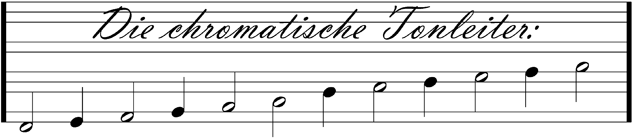
Designed for atonal music, Busoni's new notation method eliminated the need for key signatures or accidentals as he gave each chromatic tone a specific location on the stave.Footnote 21 Pitches placed on spaces denote natural tones and pitches placed on lines signify chromatic ones (Example 1).
The Chromatic Scale notated according to Busoni's new notation method on the title page of his Versuch einer organischen Klavier-Noten-Schrift Praktisch erprobet an Joh. Seb. Bachs Chromatischer Phantasie in D moll.

Busoni was also interested in devising a system that was intimately related to his own instrument, the piano. He used visual, spatial, and tactile aspects of the piano keyboard as models for his new system. He specifically hoped to eliminate the awkward visual disjunction between octaves on the keyboard, all of which look and feel the same, yet are notated differently, on both lines and spaces (Example 2).
Another hindrance to the note reading I became aware of in our writing arises from various pictures, which show the various octaves. The reader observes the well-trusted picture in my investigation.
The low C stands on the fourth of the ledger lines, the small c on the second space; both following symbols should represent one and the same tone, then comes a treble c in the third space and finally one still higher on the second ledger line.
However, if we write 10, 20, 50, then we see we always [put] the digit 0 in the same place. This 0 is comparable to the C in our octaves.Footnote 22
Illustration from Busoni's Versuch of the mismatch between the notation of octaves and their sound and appearance.

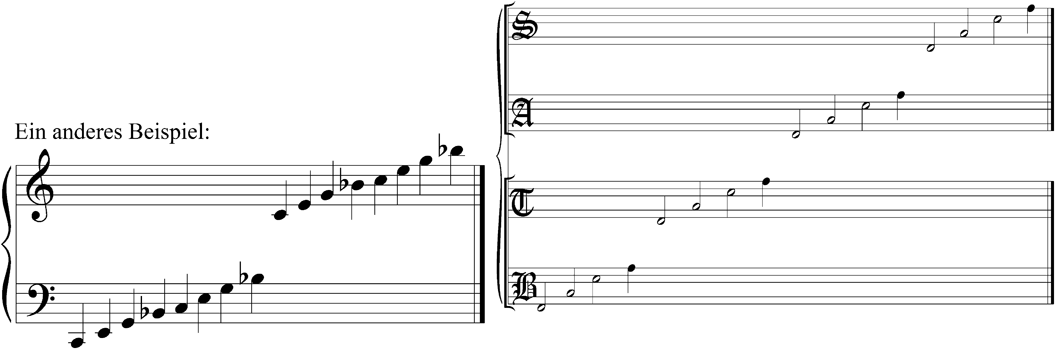
To rectify the visual, tactile, and aural disjunction, Busoni rearranged the stave to reflect the organization of the keyboard, with its regularly recurring pattern of sets of two and three black keys within the octave. Busoni likewise separated a set of two black lines and three black lines with a wider space to correspond visually to the keyboard. The five lines in each stave correspond to the five black keys and the seven spaces correspond to the seven white keys on the piano, a complete set of twelve chromatic pitches encompassing an octave from C to C (Example 3). Each octave would be scored on a different stave separated by the octave indicators, SATB (soprano, alto, tenor, bass). On each stave, the placement of the pitches is identical and encompasses a scale from c-c (Example 4). Extensions of staves could be accomplished through the use of ledger lines or 8ve signs, according to Busoni.Footnote 23
Busoni's newly proposed musical stave.

Busoni's multiple stave system.
Another connection between the keyboard and Busoni's notation method has to do with colours. In his method, each black key is represented by a black note head on a black line and each white key is represented by a white note head on a white space. Each white space is equivalent to one (or two) white keys (the spaces containing two white keys are slightly wider). In this way, the pianist could connect how the instrument looks and feels with the printed page (Example 5).Footnote 24 Thus a chromatic scale (or a twelve-note scale octave as Busoni called it) could be notated without using accidentals or key signatures (Example 6).
Diagram from Busoni's Versuch illustrating black (Schwarze) versus white (Weisse) note heads.

The chromatic scale from C to C notated according to Busoni's notation method.

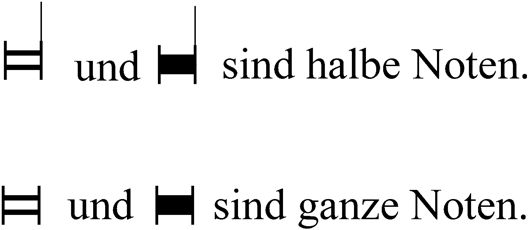
In modifying the visual appearance of note-heads (i.e. by changing the colours), Busoni also had to take into account the problems this would create for the rhythmic elements, because there would no longer be a clear way to differentiate between minims and crochets, for instance. Busoni's proposal was simply to change the shape of the note head for whole notes and half notes into rectangles to indicate duration when necessary (Example 7).
Busoni's method of notating half and whole notes.
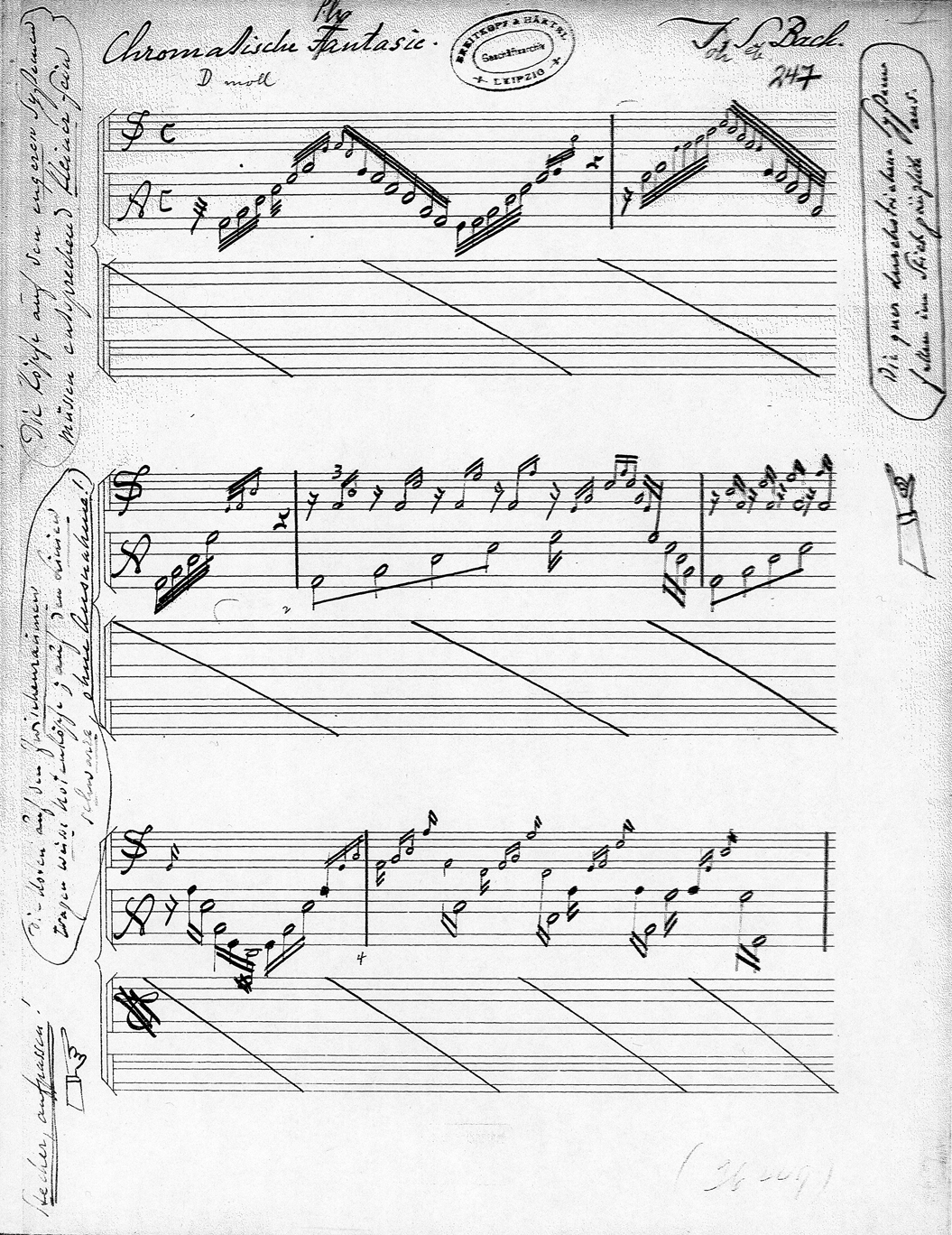
Busoni published only one piece using his new notation method – Johann Sebastian Bach's Fantasy in D minor (from the Chromatic Fantasy and Fugue in D Minor). This is a surprising choice given Busoni's statement that he was trying to devise a method suitable to the modern twelve-note octave. Perhaps the legal ramifications of trying to reissue a modern piece notated in a new way ultimately led him to try his method with a more established piece – yet one in which chromaticism still played an integral role. Or, perhaps, he wanted to start by notating a piece he himself was performing.Footnote 25 Since Busoni does not offer any explanation, one can only speculate.
In his notated example of Bach's Chromatic Fantasy, Busoni's idiosyncratic four-stave system can be observed, as well as the removal of accidentals in favour of the coloured note-heads and placement of chromatic pitches on lines (as opposed to spaces). The tenor and bass staves, although not utilised in this excerpt, are used later as the notes progress downwards in the piece (Example 8).
J.S. Bach, Chromatic Fantasy in D Minor, notated with Busoni's new notation method, Staatsbibliothek zu Berlin—Preussischer Kulturbesitz, Musikabteilung mit Mendelssohn Archiv, N. Mus. Nachl. 247.
Busoni's proposed notation system was never widely accepted and he seems not to have published any additional pieces using the method.Footnote 26 Moreover, according to Monod, the method was criticized for a number of reasons: for challenging a long established and working notation tradition, for using too many staves to be practical for modern piano music, for suppressing differences between flattened and sharpened notes (and thus distorting views of harmony), and for being suitable only for the piano.Footnote 27 The latter, in fact, was the main criticism, according to Monod, and was also what Arnold Schoenberg found objectionable. Indeed, similar criticisms seemed to prevail well into the 1920s, as is evident from August Halm's fairly critical assessment of the method in 1921, in which he denigrates not only the practicality of the method, but also its inappropriateness for use in orchestral or chamber music scores:Footnote 28
Even if well thought out, after all it means only a further burden through the learning of a second notation type, since its unconventionality makes it unnecessary – Busoni himself would certainly be the last one to allow the piano player to not also be a musician, which means the pianist would also need to read chamber music and orchestral music scores: moreover, the piano notation doesn't allow the acquisition of a harmonic and theoretical education. Besides, it is truly clear as printed, but not as written, or it is as awkward to write as the usual notation.Footnote 29
Monod, nevertheless, found the objections unjustified, except for the limited application to the piano, and even here he did not preclude the possibility that most aspects proposed by Busoni could be adapted to other instruments as well – all but the white versus black note heads. Indeed, he thought Busoni's notation of the octave similarly in all registers to be a great improvement over the old system and called for critics to overcome resistance to change and to accept modern progress.Footnote 30
Aesthetics
Despite Monod's review, objections to the method persisted, and it was eventually forgotten. Yet that Busoni's method was deemed impractical by many does not mean that it was not theoretically innovative for its time, nor that it was or has been insignificant from a philosophical perspective. Many thoughtful systems have been proposed throughout the twentieth century, and none have replaced traditional notation in common usage, perhaps largely because the central canon of performed works remains tied to tonality, and thus to traditional notation. Moreover, ideas foundational to the method that nevertheless could apply to any notational system, are forward thinking, challenging notions of Werktreue and offering an idiosyncratic vision of the creative process.
For Busoni, notation was a tool (albeit an imperfect one) for writing down, preserving, and communicating music. It was also an integral part of the creative process. Notation, according to Busoni, could never perfectly capture or portray a composer's creative ideas because distortion took place between conception and notation. But the closer the notation method coincided with the compositional idea or the instrument, the less the distortion, and the more fully it could represent the essence of the work. Hence a notation method organically derived from an instrument, however impractical it might seem when considering large-scale notation usage for multiple instruments, could (theoretically at least) make it that much easier for a composer to capture and communicate ideas when writing for keyboard and that much easier for an interpreter to realize the score in performance.
Busoni expressed many of his seminal philosophies about notation, including his dissatisfaction with current notation methods in his Sketch of a New Aesthetic of Music (1907), published just two years before he wrote his organic keyboard notation method. In the short, but dense text, Busoni's ideas about notation are broad-ranging – covering topics as diverse as a new method for notating microtones, the role of notation during the compositional process (philosophically and practically), and how well notation communicated music to interpreters.
The theme of notation's limitations is found throughout the text. Busoni believed that notation was inadequate for capturing and recording a composer's compositional ideas.Footnote 31 In forcing fleeting ideas into fixed notation, composers had to impose artificial constraints on those ideas, thereby inevitably distorting and limiting them through the selection of metre, genre and key.Footnote 32 For Busoni then, a notated score was only an imperfect replica of a work, the original idealistic form of which existed outside of space and time.
Notation, the writing out of compositions, is primarily an ingenious expedient for catching inspiration, with the purpose of exploiting it later. But notation is to improvisation as the portrait is to the living model … Every notation is, in itself, the transcription of an abstract idea. The instant the pen seizes it, the idea loses its original form. The very intention to write down the idea compels a choice of measure and key. The form and the musical agency, which the composer must decide upon, still more closely define the way and the limits.Footnote 33
Although few contemporary composers would probably argue with Busoni about some of notation's limitations, Busoni took his distrust to unprecedented levels in an age of Werktreue, in which the notated score was often equated with the ‘work itself.’ Seeing notation as an imperfect symbol for the composer's living ideas, Busoni claimed the notated score needed to be recreated in the moment of performance with a degree of liberty that was unpopular with many at the time. Without identifying specific individuals, Busoni reacted to those who viewed notation as definitive and authoritative, facetiously calling them ‘lawgivers’ and claiming that they missed and ‘killed’ the true musical spirit in insisting on literal interpretations of symbols that imperfectly portrayed musical ideas. It was, according to Busoni, up to interpreters to restore the elements lost in translation – especially by freeing the metre from the rigidity of bar lines. Any notational sign, however, could be considered rigid and in need of alteration – including pitches, form, dynamics, or pedaling:
But the lawgivers require the interpreter to reproduce the rigidity of the signs; they consider his reproduction the nearer to perfection, the more closely it clings to the signs.
What the composer's inspiration necessarily loses through notation, his interpreter should restore by his own. To the lawgivers, the signs themselves are the most important matter, and they are continually growing in their estimation; the new art of music is derived from the old signs – and these now stand for the musical art itself.
If lawgivers had their way, any given composition would always be reproduced in precisely the same tempo, whensoever, by whomsoever, and under whatsoever conditions it might be performed.Footnote 34
Busoni compared music to nature in terms of freedom and colour. One example he used was that of a sunset. A painting is confined by the space of the canvas when representing that sunset; music, on the other hand, is like nature itself in its expansiveness and its potential to ebb and flow in real time.Footnote 35 A musical composition is like a day with a hazy dawn and sunset, and time in between – yet each day, like each performance, is slightly different to the next. In the same way, interpretation needs to follow a basic structure based on the notation, but to reveal different emotional colours and musical dimensions of the composition – to re-compose and re-enliven it, if you will, in real time. Although Busoni did not clearly spell out how far a performer might go in altering the text during this re-creative interpretive process, he did consider the boundaries between composition and interpretation to be rather hazy:Footnote 36
But it is not possible; the buoyant, expansive nature of the divine child [music] rebels – it demands the opposite. Each day begins differently from the preceding, yet always with the flush of dawn. Great artists play their own works differently at each repetition, remodel them on the spur of the moment, accelerate and retard, in a way which they could not indicate by signs and always according to the given conditions of that ‘eternal harmony.’ And then the lawgiver chafes, and refers the creator to his own handwriting. As matters stand today, the lawgiver has the best of the argument.Footnote 37
For Busoni, notation symbols were doubly limited in that they were not only imperfect representations of a composer's living ideas, but also of the musical systems, such as scales, intervals, bars, and rhythms, through which the ideas are conveyed:Footnote 38
What we now call our tonal system is nothing more than a set of ‘signs’; an ingenious device to grasp something of that eternal harmony; a meagre pocket-edition of that encyclopedic work; artificial light instead of the sun. Have you ever noticed how people gaze open-mouthed at the brilliant illumination of a hall? They never do so at the million-fold brighter sunshine of noonday.Footnote 39
Since the musical systems that notation signified were changing so dramatically in the early twentieth century, notation's effectiveness was even further diminished, according to Busoni. He contended that the new systems would also require new notation. Notation needed to evolve just like any other stylistic element. Thus Busoni suggested a method for notating microtones by drawing a six-line stave in which the semitones appear on the spaces and the natural tones on lines. Third tones would be indicated using accidentals:Footnote 40 ‘A preliminary expedient for notation might be to draw six lines for the stave, using the lines for the whole tones and the spaces for the semitones … then indicating the third-tones by sharps and flats.’Footnote 41 Yet Busoni never further developed his thoughts about microtonal notation into a workable method, as he did in his notation method from 1909/1910, designed to coincide with equalization of the twelve chromatic tones.
Notation Practised
Busoni's aesthetic texts show that he was thinking very critically about the role and limitations of notation in relation to composition and interpretation. Suggesting a method of notation that was integrally related to the musical language of his time and a particular instrument was one practical way of overcoming some of the limitations described in his aesthetic text. His suggested method was intended to minimize distortion between abstract conception and concrete realization during the compositional process. Notation better suited to new music featuring twelve equal notes would make the translation from idea into concrete reality easier for the composer. Moreover, the removal of countless accidentals and the closer relation between the feel and look of the instrument would make it easier for the performer to read and understand the music more quickly.
Yet, since this was not a method that Busoni used himself, it is important to question whether there was any relationship between Busoni's theories about notation and his own musical practice. Did he engage in any additional notational practices aimed at minimizing the limits of notation using more traditional methods? How closely did he follow notation as a performer?
For the most part, Busoni's published works rely on traditional music notation. An exception is the Sonatina Seconda, K. 259 (1912), which does not feature bar lines, metre signs, or key signatures. This piece was indeed seminal in its abandonment of key signatures, a trait which became commonplace in compositions of later decades.
Although Busoni's new method of notation based on the layout of the piano keyboard differs considerably from his notation practice in published scores, both his new notation method and his notation as practised rely on similar aesthetic ideologies. Both attempted to lessen the disparity between music as conceived in the mind of the composer and the piece as recorded on paper. Despite the fact that Busoni recorded finished scores in traditional notation, he used alternative forms of notation in sketches when trying to capture his thoughts on paper. Compositional sketches were designed to minimize the ‘distortion’ involved in translating abstract ideas and musical conceptions into tangible musical compositions, just as his new method had been designed to do as well. Rather than automatically using traditional notation methods as soon as an idea came to him, Busoni began recording ideas with suggestive squiggles and shapes, words, or drawings. These gestural images became concrete musical themes and outlines of genres or forms when he began notating pieces with gradually increasing specificity.
The range of notational means used by Busoni during the compositional process can be demonstrated through an analysis of the multiple sketches for his Nocturne Symphonique, an experimental orchestral composition created between September 1912 and July 1913. The process from initial conception to publication of this piece was indeed somewhat extended for Busoni and interrupted by trips, including one to Moscow where he met with Alexander Scriabin, who was currently working on his atonal and chromatic Ninth Piano Sonata, which also lacked a key signature. The issue of whether this had a profound impact on Busoni, who found Scriabin's music fascinating, has yet to be determined.Footnote 42 Busoni originally also intended for this piece to be a piano sonatina. He described the ultimate transformation of genre in metaphorical terms, and this transformation is reflected in the extensive sketches for the project:
The third sonatina seems to have the character of a butterfly (hoping straight away for the best) – at any rate it is undergoing a metamorphosis, has for the moment assumed the form of a caterpillar, is feeding on smuggled half-hours, and crawling up the trunk of the orchestra tree.Footnote 43
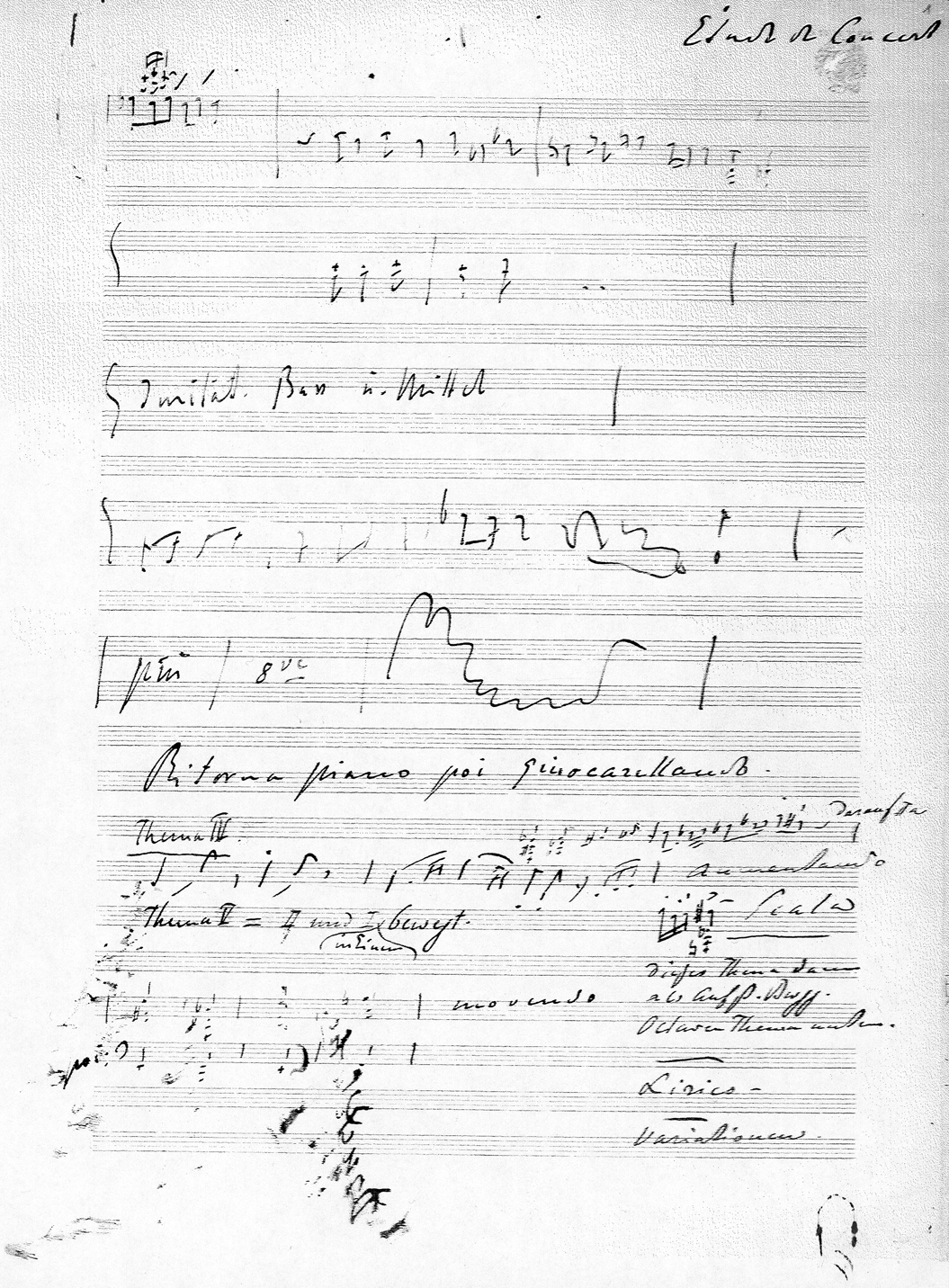
In the initial sketch, Busoni created a rough outline of much important thematic material using text, wavy lines, and fragments of traditional musical notation (Example 9). The first theme is absent and for the second theme he initially included only rudimentary pitch combinations interspersed with rests; he also suggested keys and metres. For instance, he notated the first two pitches of the first theme, C and E♭ and a few suggested rhythms that he developed more fully in later sketches. Sketches for themes three and five are included, but for theme five Busoni included only text, the meaning of which is open to interpretation: ‘II and I in einer bewegt [2 and 1 in a single movement].’Footnote 44 Arpeggiated figures found in later sketches and the final version are represented in the initial sketch by wavy gestural lines indicating the shape, contour and ambitus, but not the pitches. Independent textual suggestions – ‘Imitat. Bass u. Mittel’ (‘Imitation in the bass and middle voices’) – are only realized/notated in later sketches. Also included in the initial sketch appear to be thoughts about a multi-movement formal structure, including a lyric second movement (lirico) and a variation finale (which later turned into a set of fugal variations).
Busoni, Nocturne Symphonique, Sketches, Staatsbibliothek zu Berlin—Preussischer Kulturbesitz, Musikabteilung mit Mendelssohn Archiv, N. Mus. Nachl. 275.
Further sketches feature more traditional notation. A second sketch, featuring themes one and two, provides more precise notation of the pitches and the addition of a counter melody for theme two. A third sketch adds interpretive markings and features further re-orderings of the thematic material. A fourth sketch adds colour, texture, instrumentation and register, in addition to a more sophisticated treatment of rhythm. It is in this sketch that Busoni's orchestral conception of the piece surfaces. A final sketch features a more detailed score with auxiliary instruments added, and indeed, Busoni's instrumentation and treatment of colour is quite striking in this piece.
The variety of etching styles in the earliest sketches suggests that notation was not just a means of preserving ideas for Busoni, but also of creating or clarifying them. Notating gestures first allowed Busoni to arrive at more precise musical representations of his ideas, ideas that he eventually represented with specificity and care in accordance with traditional notational practice.Footnote 45
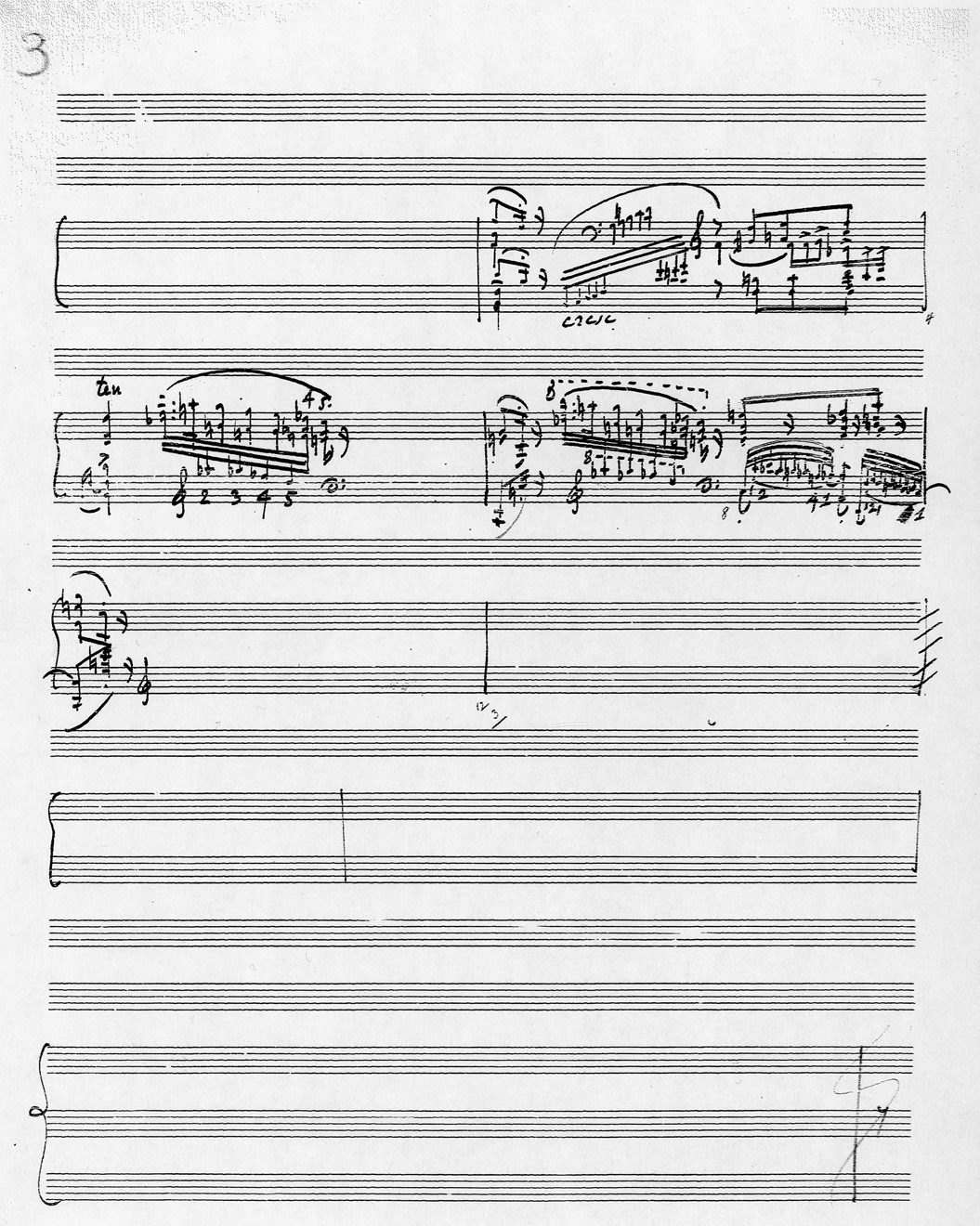
As an interpreter, Busoni likewise considered notation to be important in preserving pieces, but not as definitively so and certainly not to be taken literally in many cases. As a pianist, he was notorious for his alterations to the musical text. According to multiple eyewitness accounts, surviving piano rolls, and the single surviving disc recording in 1922 for Columbia Records, he played with a flexible rubato tempo even while changing pitches, omitting bars, doubling pitches, or changing registers.Footnote 46 In his own performance scores, Busoni scratched out and rewrote certain sections or bars of other composers' works, thereby offering a glimpse of just how imperfect he considered notation to be at representing a composer's ideas. His copy of the Liszt Paganini Etudes, for instance, includes handwritten notes related to interpretation and technique (i.e. pedaling, affect, etc.), new fingerings, and visual cues (such as the redistributions of notes between the hands) and the re-notation of passages (such as placing certain notes on staves rather than ledger lines). Busoni also crossed out and replaced certain tempo markings and bars, rewriting them directly in the score or on inserted loose pieces of manuscript paper in corresponding locations on the page. The second Etude in particular contains numerous revisions, including many rewritten bars and a new coda, all sketched out on loose sheets of staff paper and inserted into the score (Example 10). Although such alterations would not have been uncommon in the nineteenth century, they were deemed inappropriate by the early twentieth.
Liszt-Busoni, Andantino Capriccioso (Zweite Etude nach Paganini's Cappricien), Busoni's insertions, Staatsbibliothek zu Berlin—Preussischer Kulturbesitz, Musikabteilung mit Mendelssohn Archiv, N. Mus. Nachl. 203.
Influence
Although Busoni's theories and practice did not always perfectly coincide, considering both presents a more thorough understanding of his attempts to portray music in its most ideal state. Busoni realized how difficult it was to use symbols and a concrete notation system to try to capture abstract sounds and images and attempted to overcome these difficulties in a number of ways: by theorizing about the limitations of notation, by revising the current notation system, and by using non-traditional means during the creative process. Busoni showed how notation could be an integral part of the compositional process. He started with non-specific diagrams, concepts, and words, to reach toward his final aim, the capturing of an ephemeral glimpse of the essence of music in his compositions. Abstract symbols helped him translate his thoughts, even as his notation gradually assumed a more concrete form. Moreover, in viewing notation not as a fixed record of a work, but as part of an evolutionary process in which both composers and interpreters participated in capturing and revealing the musical ideas, Busoni's notational theories were innovative, calling for a more flexible understanding of the notated score and the need for more authorial and creative interpretations of the music; thus they can be seen as participating in a gradual weakening of the work concept. At the same time, by envisioning notation, an element he considered integral to the compositional idea as organically related to other compositional elements, such as instrument and language, Busoni was elevating its importance from an ancillary tool to an integral element of a composition and the compositional process.
Busoni was by no means the first to attempt to find a notational style connected to the new atonal languages. Many early proposals were also deemed impractical and had very limited use or influence. Hugo Riemann, for instance, had already proposed a form of chromatic notation as early as 1882. His method called for five-line staves that are more widely spaced than normal, allowing for three note-head positions in each space.Footnote 47 Riemann's system eliminated the need for accidentals, but was difficult to read, and thus impractical. Other methods, such as Meta Römer-Neubner's 1902 notation system without clefs, rests or accidentals, bears little resemblance to traditional notation or to the sounds they were supposed to represent.Footnote 48
Busoni's notation method, although not adopted, did however influence a number of similar notation systems suggested by later composers and thinkers. Josef Matthias Hauer (1883–1959), who sometimes used Busoni's stave format, proposed an alternative form of twelve-tone notation in 1920 that bears many similarities to Busoni's. While using an eight-line stave, black lines nevertheless correspond to chromatic tones and spaces to natural ones. The grouping of the lines also reflects the keyboard configuration. Octaves are differentiated by treble, bass and alto clef signs (or 8ve signs), and this, like Busoni's method, made accidentals unnecessary. Although Hauer did not publish many works using this method, he did use it to work out some of his later compositions.Footnote 49
Schoenberg also knew about Busoni's method, and used it as a catalyst for his own notation system for twelve-tone music. Busoni had already thought of ways to eliminate accidentals and to distribute pitch classes evenly onto the musical staves before Schoenberg. Yet, while Schoenberg sought to escape from the shadow of diatonicism, Busoni's attempts to link notation and instrument limited his model to the keyboard and thus lacked more universal applicability, even while continuing to link the notation to diatonicism. Schoenberg proposed several changes to the traditional notation system, some of which have been generally adopted, including his method of notating Sprechstimme by placing x marks on note beams. Other suggestions, related to the notation of atonal or twelve-tone music as expressed in a series of short essays dating from 1923–1931, have attracted more theoretical (rather than practical) interest.
Many of Schoenberg's ideas about notation were designed to enhance visual clarity.Footnote 50 Foreshadowing the graphic notation of the next generation of composers, he suggested that pictures or symbols should be used, whenever possible, instead of words. In his essay, ‘Pictorial Notation’ from 1923, for instance, he suggested using symbols to depict such effects as pizzicato or col legno.Footnote 51 In ‘On Notation,’ also from 1923, he advocated abolishing the natural sign, contending that accidentals should be consistently repeated throughout a bar (instead of using key signatures). The absence of an accidental would always signify a natural pitch, thereby ensuring greater readability.Footnote 52 In ‘A New Twelve-Tone Notation’ (1924), Schoenberg proposed an even more radical notation method that, much like Busoni's method, visually equalized all twelve notes of the chromatic scale by abolishing the need for accidentals of any kind. Based on the notion that adjacent chromatic pitches could share spaces within a stave of three lines per octave and three pitches per space, he assigned each pitch a specific location and symbol. This notation method, he hoped, would be more suitable to twentieth-century music that no longer used the diatonic scale as its main means of organisation:
The inadequacy of our musical notation has made itself felt and is widely admitted. Its defects, to formulate them exactly, are as follows: it is a seven-tone notation based on C major, which treats the remaining five tones as occasional alterations of the principal tones, and thus all other keys as subordinate keys.Footnote 53
According to Schoenberg's new system, notes could be differentiated based on their position in the stave (i.e. height in relation to spaces and lines) and by diagonal lines positioned to the right, left, or centre of the note-head (Example 11). Thus each note is notated equally, even though C is still afforded a position of prominence as the lowest-line note on the stave. Clef signs are used to indicate register, and ledger lines or the coupling of staves extend the staff indefinitely. If staves are coupled, Schoenberg suggests differentiating the octaves by dotting or breaking the upper lines (Example 12).
Schoenberg's Notation System (an octave).

Schoenberg's Notation System (Dotted Staff Lines).

Schoenberg's notational ideas of the 1920s were informed by Busoni's much neglected notation method. Schoenberg first received the method in 1910 directly from Busoni, when the two were regularly corresponding about their main musical endeavours and when Schoenberg was still relatively unknown as a composer. Paradoxically, Busoni attributes his own inspiration for writing the method to the receipt of Schoenberg's Three Piano Pieces, Op. 11: ‘N.B. Your pieces have inspired me to the idea of a new “Piano Notation” which – I believe – is a real “discovery”.’Footnote 54 Busoni sent a copy of his method to Schoenberg, and Schoenberg acknowledged its receipt: ‘I must thank you kindly for sending me your “organic piano notation.” I shall write in detail about it soon.’Footnote 55
Unfortunately, further letters between the two do not provide the promised discussion of the method. Schoenberg's ‘A New Twelve-Tone Notation’ (1924), however, presents a belated critique. Schoenberg admired Busoni's early attempts to create a method of notation that equalized the musical tones, but he criticized Busoni's method for its limited usefulness:
Previous attempts, so far as I have come across them, relied on the keyboard as a model. This idea is of little use, since other instruments do not have black and white keys, but is justifiable insofar as it accords with our system for naming the tones.Footnote 56
In a footnote to this paragraph (specifically linked to the sentence beginning ‘previous attempts…’), Schoenberg made the direct connection between his own method and Busoni's:
Busoni gives his proposal the title, ‘Attempt at an Organic Piano Notation’ (Versuch einer organischen Klaviernotenschrift, Leipzig, 1910) and says very aptly, ‘… and it has finally become clear to me that our present-day octave consists no longer of seven intervals, but of twelve; and that each of these intervals must have its own place on the staff.’Footnote 57
The exchanges between Schoenberg and Busoni about notation methods extend beyond Busoni's treatise, underlining that the broad topic of notation was of mutual interest. They discussed how well traditional notation could capture a composer's thoughts on paper in a series of exchanges from 1909–1910 about Schoenberg's Piano Pieces, Op. 11.Footnote 58 Other letters contain Schoenberg's thoughts about Busoni's brief proposal for notating microtonal music as expressed in his Sketch of a New Aesthetic of Music (1907).Footnote 59
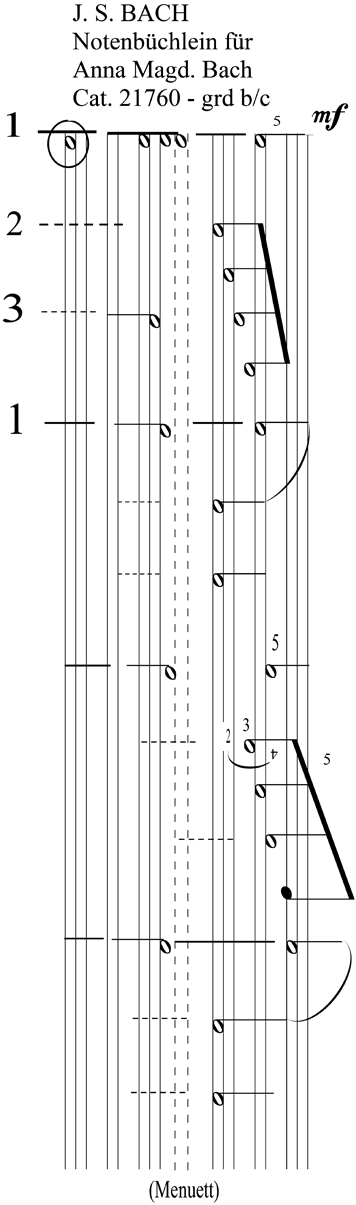
Additionally, other notation methods appearing in the following decades bear a striking similarity to Busoni's method, suggesting indebtedness to it. ‘Klavarskribo,’ proposed by Cornelis Pot (1885–1977) in 1931, is still used (however minimally) and also resembles Busoni's method. Pot, a Dutch musician, music lover, and shipbuilder, studied alternative forms of notation, Busoni's included, and developed his own new method based on them. His text, What is Klavarskribo?, specifically quotes from Busoni's notation treatise and his Sketch of a New Aesthetic of Music.Footnote 60 In Pot's method, which is also closely linked to the keyboard, staff lines in groups of 2 plus 3 represent black notes (filled with black note heads), while spaces represent white keys (with white-note heads). Each stave forms an octave and contains the notes of the chromatic scale. As in Busoni's method, further registers can be represented through the repetition of these groupings. Pot's method, however, differs from Busoni's in its more complex system of rhythmic notation and in its vertical placement of the staves, as if imitating the direction of the keys on the piano (Example 13).Footnote 61
J.S. Bach, Minuet in G from the Notebook for Anna Magdalena Bach, excerpt, notated using the Klavarskribo notation method, in Vorbeelden Catalogus Piano Deel 1. Catalogue Nr. 24486 (Slikkerveer: Holland, Klavarskribo, n.d.), 4.
Concluding Thoughts
Busoni was a maverick. He liked to question the ways in which things were traditionally done and then offer alternative solutions, even if he didn't always follow his own suggestions. This extended from the scalar systems, to instruments, to interpretation and to notation. He wanted to do away with the lawgivers and legalists, with universally accepted ideals and standards, and he wanted to create procedures and methods that themselves were constantly in flux in relation to what he was composing; he believed this was the way true creative art reached perfection:
The creator should take over no traditional law in blind belief, which would make him view his own creative endeavour, from the outset, as an exception contrasting within that law. For his individual case he should seek out and formulate a fitting individual law, which after the first complete realisation, he should annul, that he himself may not be drawn into repetitions when his next work shall be in progress.
The function of the creative artist consists in making laws, not in following laws ready made. He who follows such laws, ceases to be a creator. Creative power may be the more readily recognized the more it shakes itself loose from tradition. But an intentional avoidance of the rules cannot masquerade as creative power, and still less engender it.
The true creator strives after perfection only. And through bringing this into harmony with his own individuality, a new law arises without premeditation.Footnote 62
Notation, he argued should be no different than other musical parameters – it should be constantly changing in relation to the materials being recorded so that it could lead to a fuller and more perfect representation of ideal musical art. From squiggles and almost illegible text, to new methods, and aesthetic writings, Busoni's sketches also revealed an interrelatedness between notation and creation. The act of writing helped transcribe his abstract ideas into concrete musical themes and forms. It helped him create. Yet the end result of the notation was hardly definitive, because for Busoni, a work could not be reduced to paper. A musical work was a living entity born from human thought. It was the performer's job to bring the notation back to life, making whatever changes or adjustments were necessary to free it from the boundedness of traditional features of notation.
Busoni thus attempted to forge a middle ground between the work as text and the work as performance in an age enthralled to the concept of the Werktreue. For him, notation was useful but its value resided somewhere on a continuum between the imperfect ‘transcription’ of living ideas that would be more fully realized by performers and a means for better realizing or ‘composing’ those ideas. Perhaps this is indeed a compelling way to view it, yet one that places Busoni on the boundaries of the notated musical tradition, reflecting an idiosyncratic view of the musical work in his own time, and foreshadowing ideals that would only be appreciated in future decades.