Introduction
There is increasing evidence that exposure to sexual abuse during childhood can have long-term negative effects on later adult development, including elevated rates of physical and mental health problems, poorer educational achievement and an increased susceptibility to substance abuse and dependence (Fergusson & Mullen, Reference Fergusson and Mullen1999; Putnam, Reference Putnam2003; Boden et al. Reference Boden, Horwood and Fergusson2007b; Duncan et al. Reference Duncan, Sartor, Scherrer, Grant, Heath, Nelson, Jacob and Bucholz2008). These risks have been demonstrated across both clinic and community samples, with findings also suggesting that those exposed to more frequent and severe forms of childhood sexual abuse (CSA) are at greatest risk (Fergusson et al. 1996 a; Fleming et al. Reference Fleming, Mullen, Sibthorpe and Bammer1999).
One important domain of adult functioning that has been less well studied among the survivors of CSA concerns their adult interpersonal functioning, and in particular their ability to form and maintain intimate partner relationships. Early research on CSA exposure and intimate relationship functioning has largely focused on the sexual adjustment of females survivors of CSA (Rumstein-McKean & Hunsley, Reference Rumstein-McKean and Hunsley2001). These studies found that women who were exposed to CSA experienced more sexual adjustment problems and reported lower levels of partner attachment and relationship satisfaction, and higher levels of relationship conflict and relationship dissolution than those not exposed to CSA. For example, in a cross-sectional study of community women, CSA was found to be associated with higher rates of separation, sexual difficulties, and poor partner perceptions (Mullen et al. Reference Mullen, Martin, Anderson, Romans and Herbison1994). A more recent large retrospective survey showed that both male and female CSA survivors were more likely to be married to an alcoholic and to have current marriage and family problems (Dube et al. Reference Dube, Anda, Whitfield, Brown, Felitti, Dong and Giles2005).
It is important to note, however, that research in this area is often characterized by one or more methodological limitations that constrain the conclusions that can be drawn about the long-term partnership outcomes associated with CSA (Fergusson & Mullen, Reference Fergusson and Mullen1999; DiLillo & Damashek, Reference DiLillo and Damashek2003; Fergusson et al. Reference Fergusson, Boden and Horwood2008). First, there has been an over-reliance on clinical and high-risk community samples that limits the generalizability and interpretation of study findings, and potentially overestimates the strength of associations between CSA and partnership outcomes. Second, much of the research in this area has relied on cross-sectional and retrospective self-reports of CSA typically obtained at a single assessment (e.g. Mullen et al. Reference Mullen, Martin, Anderson, Romans and Herbison1994; Dube et al. Reference Dube, Anda, Whitfield, Brown, Felitti, Dong and Giles2005). This raises the possibility that participants' memory of childhood background factors and current functioning could be severely biased as participants seek to psychologically link their own early experiences with later adult functioning. Third, when longitudinal research designs have been used, most have been relatively short term, limited to only two or three waves of assessment (e.g. Kallstrom-Fuqua et al. Reference Kallstrom-Fuqua, Weston and Marshall2004; Testa et al. Reference Testa, VanZile-Tamsen and Livingston2005).
A further issue concerns the extent to which relevant early childhood and family factors have been adequately controlled in the analyses between CSA and later outcomes. To date, most studies have included a limited range of covariates such as socio-economic status, gender, age, race or education. Thus, the possibility remains that associations observed between CSA and later problematic partnership outcomes may reflect the family and the social contexts in which abuse occurs or the personal characteristics of the individual, rather than the direct effects of CSA exposure. This includes the tendency to assess CSA separately from other forms of child abuse or maltreatment, which is problematic because different forms of abuse have been shown to frequently co-occur (Fergusson & Mullen, Reference Fergusson and Mullen1999). When studies have included early confounding factors, findings have been mixed, with some studies showing that early childhood and family factors have a greater influence on social or interpersonal outcomes than CSA (e.g. Harter et al. Reference Harter, Alexander and Neimeyer1988) and other studies showing that the effects of CSA persist after covariate control (e.g. Finkelhor et al. Reference Finkelhor, Hotaling, Lewis and Smith1989; Dube et al. Reference Dube, Anda, Whitfield, Brown, Felitti, Dong and Giles2005).
Finally, only a few studies have examined the intervening factors and mechanisms by which CSA impacts subsequent adult intimate partner relationships. For example, one study with low-income community women identified perceptions of betrayal and powerlessness in CSA survivors as a mediator of the association between sexual abuse severity and maladaptive partner relationships (Kallstrom-Fuqua et al. Reference Kallstrom-Fuqua, Weston and Marshall2004). Another community-based study found that sexual risk taking and aggression in the romantic partners of CSA survivors mediated the link between CSA and relationship satisfaction (Testa et al. Reference Testa, VanZile-Tamsen and Livingston2005). These two studies point to concurrent or proximal factors associated with adult functioning that lead to increased risks of unhealthy and/or unstable intimate partner relationships among those exposed to CSA. However, long-term developmental studies have shown that exposure to CSA is associated with adolescent risk-taking behavior (Fergusson et al. Reference Fergusson and Lynskey1997; Waldron et al. Reference Waldron, Heath, Turkheimer, Emery, Nelson, Bucholz, Madden and Martin2008; van Roode et al. Reference van Roode, Dickson, Herbison and Paul2009), highlighting the possibility that effects of CSA on adult relationship factors may be mediated by individual functioning and experiences from adolescence.
To acquire an accurate understanding of the long-term effects of CSA it is important to examine the links between CSA exposure, life-course experiences through adolescence and adulthood, and adult intimate relationship experiences in one data set. In this manner it may be possible to document not only the long-term effects of CSA for the victims but also the potential impact on partners, relationships and offspring. Accordingly, we report the results of a 30-year prospective longitudinal study examining the links between exposure to sexual abuse during childhood and later risks of adverse intimate partnership outcomes. The specific aims of the study were:
(1) To examine associations between the extent of childhood exposure to sexual abuse and indices of partner relationship formation and quality, including the age at first cohabitation/marriage, number of cohabiting relationships, current relationship perceptions and interpartner violence (IPV).
(2) To examine the extent to which associations between CSA and adult partnership outcomes may be explained by confounding social, family or individual factors that are correlated with both family violence and later outcomes.
(3) To identify possible mediational pathways by which childhood exposure to sexual abuse may lead to later problems in partnership experiences.
Method
Participants
Participants were members of an unselected birth cohort that has been studied extensively as part of the Christchurch Health and Development Study (CHDS). The CHDS is a longitudinal study of 1265 children (630 females) born in the Christchurch (New Zealand) urban region over a 4-month period during 1977. This cohort has been studied at regular intervals from birth until age 30 (for details see Fergusson & Horwood, Reference Fergusson and Horwood2001). At age 30, 987 (78%; 509 females) of the original cohort members were interviewed. The following measures were selected for inclusion in this analysis.
Exposure to CSA
At ages 18 and 21, cohort members were questioned about their exposure to any forms of CSA prior to age 16, including: (a) non-contact episodes involving indecent exposure, public masturbation or unwanted sexual propositions; (b) episodes involving sexual contact in the form of sexual fondling, genital contact or attempts to undress the respondent; and (c) episodes involving attempted or completed vaginal, oral or anal intercourse (Fergusson et al. Reference Fergusson, Horwood and Lynskey1996a, Reference Fergusson, Lynskey and Horwoodb). Based upon the most severe form of CSA reported at either time point, cohort members were classified into a single four-point categorical variable (from least to most severe) based on their level of CSA exposure: no CSA (85.9% of the sample), non-contact CSA (2.7%), contact CSA not involving attempted or completed sexual penetration (5.1%), and severe CSA involving attempted or completed sexual penetration including vaginal, oral and anal intercourse (6.3% of the sample). A previous analysis of this repeated-measures CSA data revealed that the reports of CSA exposure were not influenced by current mental state assessments and the combined measure had good predictive validity (Fergusson et al. Reference Fergusson, Horwood and Woodward2000).
Partnership outcomes at age 30
At the 30-year assessment, cohort members were interviewed extensively about their current and past romantic partner relationships. Based on this questioning, the following measures were created to assess partnership outcomes.
Cohabitation/marriage and offspring
The age cohort members first entered a cohabiting or married relationship, the total number of cohabiting relationships they had been in and the number of offspring, if any, from these relationships were recorded and cross-checked against previous assessments.
Relationship quality
Perceptions of relationship quality were assessed with the 25-item Intimate Relations scale (Braiker & Kelley, Reference Braiker, Kelley, Burgess and and Huston1979). Participants responded to each item based on a three-point scale (1=does not apply; 2=applies somewhat; 3=definitely applies). This measure has four subscales (love, investment, ambiguity, and conflict) that were added together into two broad indices of positive (love and investment) and negative (ambiguity and conflict) relationship perceptions. Internal reliability for both indices was good (α=0.89 and 0.84 respectively).
IPV
Interpartner conflict and violence were assessed with the Revised Conflict Tactics Scale (CTS2; Straus et al. Reference Straus, Hamby, Boney-McCoy and Sugarman1996). Respondents reported the extent to which they had been the victim (α=0.83) or the perpetrator (α=0.79) of any interpartner physical violence in the past 12 months. The two measures were significantly correlated (r=0.41, p=0.001) and, for the purposes of this analysis, items were scaled as suggested by Straus et al. (Reference Straus, Hamby, Boney-McCoy and Sugarman1996) and summed to provide a total measure of IPV in any partner relationship over the past 12 months.
Partner adjustment/conduct problems
At age 30 cohort members were questioned about their current romantic partner. Eight items based on a three-point scale (does not apply, applies somewhat, definitely applies) were used to assess partner adjustment and conduct problems (sample items include: My partner has a lot of personal problems. My partner does things that are against the law such as stealing or vandalism. My partner has problems due to the use of alcohol). The internal reliability of this scale was modest but acceptable (α=0.74). For the purposes of the present analysis, cohort members were coded as having a partner with adjustment/conduct problems if they answered ‘definitely applies’ to any of the eight items.
Childhood covariate factors
To assess the extent to which associations between CSA and later partnership outcomes at age 30 could be explained by the effects of confounding and intervening factors, a wide range of measures, based on previous research and theory, were chosen from the CHDS database.
Family living standards (0–10 years)
A composite measure of material living standards between the ages of birth to 10 years was computed by summing interviewer ratings. Ratings were made annually on a five-point scale that ranged from ‘very good’ to ‘very poor’. For the purposes of the present study, scale scores were reverse coded and averaged so that lower scores were indicative of poorer living standards.
Maternal age at first birth
This was assessed in whole years at the time of the cohort member's birth.
Parental adjustment problems
At age 11, parent(s) of cohort members were questioned about the extent to which they had used cannabis or other illicit substances. At age 15, parent(s) were questioned about any history of alcoholism or alcohol problems, and any history of criminal offending. Scores on these items were combined to create a composite measure of parental adjustment problems ranging from 0 to 4.
Changes of parents (0–10 years)
Comprehensive data on family placement and changes of parents were collected at annual intervals from birth to age 16 years. All changes of custodial parents were included to construct one overall measure of parental change from birth to 10 years.
Parental use of physical punishment
At ages 18 and 21, cohort members reported on the extent to which their parents used physical punishment during their childhood (prior to age 16 years). If applicable, separate ratings were made for mother figures and father figures. These ratings were then combined into a single four-point metric of parental physical punishment based on the most severe rating at either the 18- or 21-year interview: (1) parents never used physical punishment; (2) parents seldom used physical punishment; (3) at least one parent regularly used physical punishment; (4) at least one parent used frequent or severe punishment or treated the participant in a harsh/abusive manner (Fergusson & Lynskey, Reference Fergusson and Lynskey1997).
Gender
Recorded at birth.
IQ (8–9 years)
IQ was assessed at ages 8 and 9 years using the Revised Wechsler Intelligence Scale for Children (WISC-R; Wechsler, Reference Wechsler1974). The split half reliabilities of the scales were 0.93 at age 8 and 0.95 at age 9. For this study, the WISC-R total IQ scores at ages 8 and 9 were combined by averaging over the two administrations.
Intervening factors
To examine the extent to which associations between CSA and partnership outcomes at age 30 were influenced by intervening adolescent factors, a wide range of variables were considered that included the adolescent parent–child relationship, personality, self-esteem, education, sexual behavior, mental health, substance abuse, and conduct problems. For participants currently in cohabiting relationships, relevant relationship factors were also considered such as number of cohabiting relationships and current relationship length. The following measures were included based on their contribution to the final fitted regression models.
Self-esteem (15 years)
At age 15, self-esteem was assessed using the Coopersmith Self-Esteem Inventory (SEI; Coopersmith, Reference Coopersmith1981). The four subscale scores (general, academic, social, and home) were added together to create one overall measure of self-esteem (α=0.87).
Adolescent sexual activity (16–18 years)
At 16 and 18 years, cohort members were questioned about their history of consensual sexual activity (at age 18 this was separate from the sexual abuse questions). The number of consensual sexual partners between 16 and 18 years was recorded, and those who reported having consensual sexual intercourse before the age of 16 were considered to have had early sex.
Substance abuse (16–18 years)
At age 18 years, cohort members were questioned about their use of nicotine, alcohol, cannabis and other illicit drugs over the previous 2 years using a questionnaire based on the Composite International Diagnostic Interview (CIDI; WHO, 1993). From these items, DSM-IV (APA, 1994) criteria were used to construct substance abuse diagnoses for each sample member. In the present analysis, these diagnoses were added together for one overall measure of substance abuse.
Statistical analysis
In the first phase of the analysis the bivariate associations between the extent of CSA and outcome measures (Table 1) were tested for linear trend using Mantel–Haenszel χ2 tests for dichotomous measures (early cohabitation, early parenthood, partner adjustment/conduct problems) and one-way analysis of variance for continuous measures (number of cohabitations, IPV, relationship satisfaction, relationship ambiguity). To test for gender differences in the strength of association between CSA and outcome measures, the data were first stratified by gender and regression models and then fitted to predict each outcome as a function of gender, CSA and a gender×CSA interaction. For dichotomous outcomes multiple logistic regression models were fitted whereas for continuous outcomes multiple linear regression models were fitted. No significant interaction effects were found, suggesting that the nature of the associations between the extent of CSA and the partnership outcomes were similar for men and women. For IPV, Poisson regression was used with correction for overdispersion instead of linear regression due to the distribution characteristics of this variable.
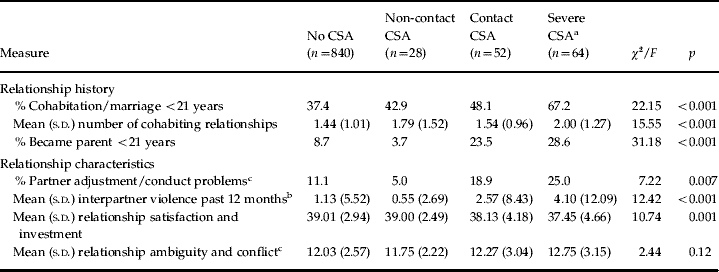
Associations between childhood sexual abuse (CSA) and partnership experiences by age 30

s.d., Standard deviation.
a Severe CSA=attempted or completed vaginal, oral or anal intercourse.
b Analysis restricted to the sample in any form of romantic partnership over the previous 12 months.
c Analysis restricted to the sample currently in cohabiting relationships at 30-year interview.
The analysis was then extended to consider (a) possible confounding by a series of childhood, family and individual characteristics (Table 2) and (b) a series of intervening factors (Table 3). The bivariate associations between CSA and confounders and intervening factors were tested using similar tests of linearity to those used for Table 1. Control for confounding was achieved by fitting multiple regression models to model each outcome as a function of CSA exposure and covariate factors. In each case model fitting was conducted using methods of both forwards and backwards variable elimination to identify the best-fitting and most parsimonious model (Table 4). The regression models were then extended in the same way to incorporate the intervening factors. Tests of significance for the combined indirect effect of the intervening factors were conducted in MPlus (Muthén & Muthén, Reference Muthén and Muthén2007) using weighted least squares regression.
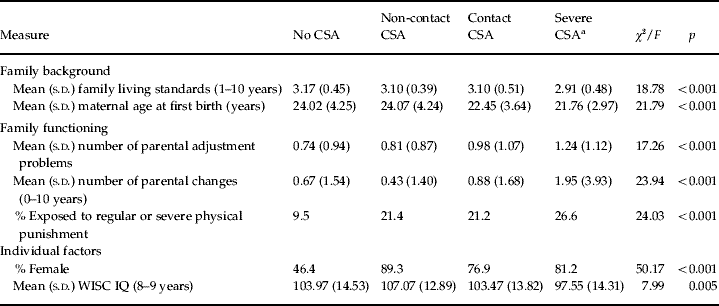
Associations between childhood sexual abuse (CSA) and socio-economic, family and individual factors

s.d., Standard deviation; WISC, Wechsler Intelligence Scale for Children.
a Severe CSA=attempted or completed vaginal, oral or anal intercourse.
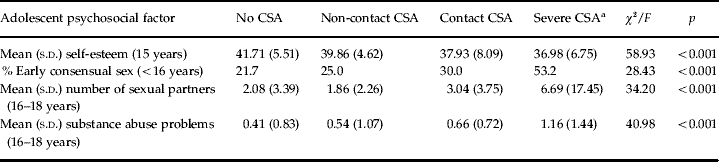
Associations between childhood sexual abuse (CSA) and intervening adolescent/young adulthood covariates

s.d., Standard deviation.
a Severe CSA=attempted or completed vaginal, oral or anal intercourse.
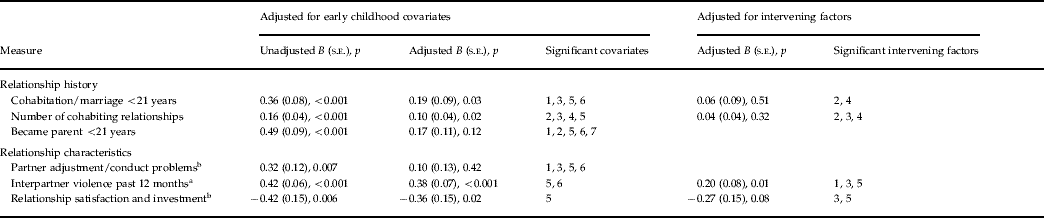
Associations between childhood sexual abuse (CSA) and partnership experiences by age 30 adjusted for early covariate and intervening factors

s.e., Standard error.
Covariates: 1, childhood living standards; 2, maternal age at first birth; 3, parental adjustment problems; 4, number of parental changes (0–10 years); 5, parental use of physical punishment (0–16 years); 6, gender; 7, Wechsler Intelligence Scale for Children (WISC) IQ (8–9 years).
Intervening factors: 1, self-esteem (15 years); 2, early consensual sexual intercourse; 3, number of sexual partners (16–18 years); 4, substance abuse problems (16–18 years); 5, number of cohabiting relationships.
a Analysis restricted to the sample in any form of romantic partnership over the previous 12 months.
b Analysis restricted to the sample currently in cohabiting relationships at 30-year interview.
Results
Associations between the extent of childhood exposure to sexual abuse and later adult partnership outcomes
Table 1 shows the associations between the extent of exposure to CSA and a range of subsequent partnership outcomes at age 30. Significant linear associations were found between the extent of CSA and several partnership outcomes. Specifically, individuals who experienced more severe forms of CSA were more likely to have entered an early cohabiting or marital relationship (p<0.001), become a parent at a young age (p<0.001), and reported more cohabiting relationships in total by age 30 (p<0.001). Increasing severity of CSA was also associated with higher rates of partner adjustment/conduct problems (p=0.007), higher rates of IPV (p<0.001), and for those currently in cohabiting or married relationships, lower levels of relationship satisfaction and investment (p=0.001). No association was found between the extent of CSA and perceived relationship ambiguity and conflict.
Social, family and individual factors associated with exposure to CSA
Although the results in Table 1 suggest the presence of clear associations between the extent of exposure to CSA and a range of partnership outcomes in adulthood, it is possible that these associations may reflect the effects of confounding factors correlated with both CSA and later partnership outcomes. To examine this issue, Table 2 shows the associations between CSA and a wide range of socio-economic, family and individual factors previously identified as predictive of CSA (Fergusson et al. Reference Fergusson, Boden and Horwood2008). Examination of Table 2 shows evidence of clear and significant (p<0.001) tendencies for increasing severity of CSA to be associated with greater social and economic disadvantage (lower family living standards, younger mother) and more dysfunctional childhood family environments (higher rates of parental adjustment problems, more frequent changes of parents, exposure to regular/severe physical punishment). In addition, those exposed to more severe forms of CSA were more likely to be female (p<0.001) and to have lower mean IQ scores (p=0.005).
Associations between exposure to CSA and partnership outcomes at age 30 after adjustment for covariates
To examine the extent to which the significant associations between CSA and the adult partnership outcomes in Table 1 could be explained by the confounding effects of the early childhood and family factors in Table 2, a series of multiple regression models were fitted in which each outcome was regressed on the measure of CSA and covariate factors. The results of these analyses are summarized in Table 4, which shows the unstandardized coefficients, standard errors and p values for adjusted associations between the dependent variables and CSA exposure, along with a list of the significant covariates for each analysis. For comparative purposes the unadjusted bivariate associations are also shown in Table 4.
The results show that, after inclusion of childhood covariates, all of the associations between CSA and the partnership outcomes were somewhat attenuated, with two variables, early parenthood and partner adjustment/conduct problems, no longer significantly associated with CSA. The four remaining variables continued to have a significant (p<0.05) association with CSA exposure after adjustment, suggesting that not all of the impact of CSA on later partnership outcomes could be explained by the correlated effects of other childhood factors. Among the covariates, increased use of physical punishment in childhood was also associated with each of the partnership outcomes.
Intervening factors
The results thus far suggest a possible causal relationship between CSA and adverse partnership outcomes and raise additional questions about the life-course processes and pathways that may mediate these associations. To address this issue we examined a range of measures that have previously been associated with CSA that reflected potential intervening pathways between CSA exposure and later outcomes. As mentioned above, these factors spanned several domains from adolescence and young adulthood, but only those variables that contributed to the final regression models are reported in Table 3. Table 3 shows that, with increasing severity of CSA, respondents during adolescence were more likely to be characterized by lower self-esteem (p<0.001), early consensual sexual intercourse (p<0.001), a greater number of sexual partners (p<0.001), and increased substance abuse (p<0.001).
Associations between exposure to CSA and partnership outcomes at age 30 after adjustment for covariates and intervening factors
To examine the influence of these intervening factors on the associations between CSA and the partnership outcomes, the multiple regression models reported on the left side of Table 4 were extended to include the intervening variables from Table 3. In addition, for the relationship characteristics measures, the number of cohabiting relationships was included as a further covariate to reflect the quality of previous partner relationships. The results of these analyses are summarized in the right-hand columns of Table 4.
The inclusion of intervening factors further reduced the association between CSA and each of the partnership outcomes. For early cohabitation and number of cohabiting relationships, any remaining associations with CSA after adjustment for intervening factors were negligible and statistically non-significant (p>0.05). Significant intervening factors for these measures included adolescent sexual risk taking (early sexual onset, number of sexual partners) and problems with substance abuse. After adjustment for intervening variables, the association with CSA remained significant for IPV (p=0.01) and marginal for relationship satisfaction/investment (p=0.08). Intervening adolescent processes included self-esteem and number of sexual partners in adolescence, in addition to the number of cohabitating/marriage relationships as a young adult. In each instance, the combined indirect effect of the intervening variables was significant, indicating partial or full mediation.
Discussion
Using data gathered over the course of a 30-year longitudinal study, we have examined associations between young people's reports of exposure to sexual abuse prior to age 16 and their later partnership outcomes in adulthood. The strengths of this study include the semi-prospective longitudinal design, the regular and long-term follow-up of the cohort, and the inclusion of an extensive range of relevant confounding and intervening factors. These strengths address the methodological limitations of previous studies, and enable an examination of the developmental consequences of CSA using a life-course approach (Fergusson & Mullen, Reference Fergusson and Mullen1999; DiLillo & Damashek, Reference DiLillo and Damashek2003; Senn et al. Reference Senn, Carey and Vanable2008).
Exposure to CSA, particularly severe forms of CSA involving attempted or completed intercourse, was associated with adverse adult partnership outcomes ranging from an early onset of cohabitation and parenthood (<21 years) to increased relationship instability, lower relationship satisfaction and higher rates of IPV. Furthermore, most of these associations remained significant, although modestly attenuated, after controlling for several early childhood confounding factors. Thus, even after taking into account other childhood factors correlated with CSA and later partner outcomes, exposure to more severe CSA seems to have a long-term influence on later partnership stability, relationship quality and risks of violence. These findings build on and extend previous cross-sectional and short-term longitudinal studies that have shown CSA to be associated with patterns of relationship formation and concurrent relationship functioning (Tsai et al. Reference Tsai, Feldman-Summers and Edgar1979; Finkelhor et al. Reference Finkelhor, Hotaling, Lewis and Smith1989; Mullen et al. Reference Mullen, Martin, Anderson, Romans and Herbison1994; Colman & Spatz Widom, Reference Colman and Spatz Widom2004).
Although each outcome was associated with a slightly different mix of early childhood covariates, exposure to more frequent or severe childhood physical punishment was a significant factor associated with all of the outcomes. This supports the general pattern of findings in this area, in which the accumulation of adverse childhood experiences greatly increases the risk of long-term adversities in individual and interpersonal functioning (Anda et al. Reference Anda, Felitti, Bremner, Walker, Whitfield, Perry, Dube and Giles2006). Previous research has also shown that sexual abuse and physical abuse often co-occur (see Fergusson & Mullen, Reference Fergusson and Mullen1999), and these results highlight the need for future research to consider other forms of child maltreatment when examining CSA.
An examination of the intervening life-course processes that help to explain the later partnership outcomes among those exposed to CSA revealed three factors from adolescence that together either fully or partially mediated these associations. The first adolescent factor significantly associated with all of the adult partnership outcomes was sexual risk taking, in the form of multiple sexual partners and/or early sexual activity. The link between CSA and sexual risk taking is one of the most consistent findings in the literature (Senn et al. Reference Senn, Carey and Vanable2008). Previous research with the present cohort found that, among females, the extent of exposure to CSA was related to earlier onset of consensual sexual intercourse, which in turn was associated with higher rates of unprotected intercourse, higher numbers of sexual partners, and risk of sexually transmitted infection (Fergusson et al. Reference Fergusson and Lynskey1997).
The present findings also suggest that this early or increased adolescent sexual activity leads to an early entry into more serious cohabiting relationships and increased risk of relationship instability and poorer functioning. Yet, only a few studies have identified an association between sexual risk taking in adolescence and partnership outcomes in adulthood. In a study with data from the National Longitudinal Study of Adolescent Health, Amato et al. (Reference Amato, Landale, Havesevich-Brooks, Booth, Eggebeen, Schoen and McHale2008) used measures of sexual risk taking as part of a latent factor of adolescent attitudes and behavior. The results showed that this latent factor was significantly associated with later family formation patterns, distinguishing between those who did and did not make an early transition to parenthood.
Substance abuse in adolescence was the second significant factor that, together with sexual risk taking, mediated the association between CSA exposure and the timing and frequency of cohabitation or marriage. Tyler (Reference Tyler2002) reviewed five studies that found a similar link between CSA and substance abuse in both males and females and in general population samples. In more recent work on substance abuse, Nelson et al. (Reference Nelson, Heath, Lynskey, Bucholz, Madden, Statham and Martin2006) studied a large twin cohort and found that, among twins where only one sibling had been exposed to CSA, there was a much greater risk of substance abuse problems than their co-siblings who had not been exposed to CSA.
Our findings on IPV support cross-sectional studies that have found links between CSA and violent or conflict-ridden intimate relationships (Kallstrom-Fuqua et al. Reference Kallstrom-Fuqua, Weston and Marshall2004; Campbell et al. Reference Campbell, Greeson, Brybee and Raja2008). Self-esteem and number of sexual partners were the significant adolescent intervening factors, and together with number of cohabiting relationships, partially mediated the link between CSA and IPV. The influence of adolescent self-esteem on IPV extends earlier CHDS findings suggesting that low self-esteem may be a small but significant contributor to later self-reported acts of aggression and hostility in young adulthood (Boden et al. Reference Boden, Fergusson and Horwood2007a), and extends the results of a recent cross-sectional study with a large Greek sample that also found low self-esteem to be predictive of IPV (Papadakaki et al. Reference Papadakaki, Tzamalouka, Chatzifotiou and Chliaoutakis2009). In this instance, the influence of self-esteem on IPV should be considered alongside adolescent decision-making processes regarding sexual activity, mate selection and patterns of relationship formation.
The findings and implications of this study should also be considered alongside the following limitations. First, because CSA was assessed retrospectively in early adulthood it could be argued that these measures were subject to memory and reporting errors. However, examination of this issue suggests that it is much more likely that the incidence and severity of CSA were under-reported rather than over-reported in this cohort (Fergusson et al. Reference Fergusson, Horwood and Woodward2000). Second, although this study has addressed partnership outcomes that have not been examined previously, the scope of our dependent variables was somewhat limited. It is possible that exposure to CSA could have direct effects on other areas of intimate relationship functioning that were not considered in this work. Third, these findings apply to a specific cohort; thus, further replication will be important to assess the extent to which these findings generalize to other cohorts and cultures.
Bearing these limitations in mind, our findings do suggest that greater exposure to more severe sexual abuse in childhood places individuals at later risk of poorer partnership outcomes by way of adolescent risk taking. More specifically, these results support a causal chain process, whereby early childhood and family factors place some individuals at risk for CSA. The extent of sexual abuse exposure is in turn related to adolescent sexual activity, substance abuse problems and low self-esteem, which in turn lead to early and more frequent cohabitation, lower relationship satisfaction and investment, and risk of IPV. Identifying this process of life-course events that surround CSA provides important clues for those clinicians designing intervention programs and treatment strategies regarding the related issues that individuals and families face when contending with sexual abuse.
Acknowledgements
This research was funded by grants from the Health Research Council of New Zealand, the Canterbury Medical Research Foundation, and the New Zealand Lottery Grants Board.
Declaration of Interest
None.