

INTRODUCTION
Coloration is an important characteristic for coral reef organisms, since it is used for multiple purposes, including mimicry (Cheney & Marshall, Reference Cheney and Marshall2009), sexual selection (Gray & McKinnon, Reference Gray and McKinnon2007), intraspecific communication (DeMartini & Donaldson, Reference DeMartini and Donaldson1996) and camouflage (Marshall, Reference Marshall2000). Thus, reef fish possess a wide diversity of colours (both discrete and vivid colours), and coloration patterns (e.g. plain, blotched, striped, spotted, etc.) (Humann & Deloach, Reference Humann and Deloach2002).
Coloration pattern of reef fish is largely used for species identification, but this could be problematic for many groups that possess highly variable colour phases (e.g. Labridae, Pomacanthidae and Scaridae), sexual dichromatism or even anomalous individuals. Moreover, fish can change their colour patterns for short periods of time (Kodric-Brown, Reference Kodric-Brown1998), for example, during the night, when many species become mottled, barred or blotched, presenting patterns of colour that blend with the environment; and/or during breeding (e.g. some labrids, labrisomids and pomacentrids), to indicate that they are prepared for reproduction (Deloach & Humann, Reference Deloach and Humann1999).
Among pomacentrids, the most common type of change in colour pattern is related to early life stages and to reproductive periods. The genus Stegastes is morphologically conservative and its classification is highly dependent upon colour patterns (Allen, Reference Allen1991; Novelli et al., Reference Novelli, Nunan and Lima2000). In this paper we aim to report the colour variations of territorial damselfish (Stegastes spp.) found in the south-western Atlantic coastal reefs and oceanic islands, emphasizing the description of underreported colour morph variations based upon underwater observations, photographic records and laboratory examination.
MATERIALS AND METHODS
Six species of territorial damselfish (genus Stegastes) occur in the south-western Atlantic, namely the Brazilian damsel S. fuscus (Cuvier 1830), the Yellowtip damselfish S. pictus (Castelnau 1855), the Rocas gregory S. rocasensis (Emery 1972), Saint Paul's gregory S. sanctipauli Lubbock & Edwards 1981, the Cocoa damselfish S. variabilis (Castelnau 1855) and S. uenfi Novelli, Nunan & Lima Reference Novelli, Nunan and Lima2000, as well as the subspecies Trindade gregory S. fuscus trindadensis Gasparini, Moura & Sazima, Reference Gasparini, Moura and Sazima1999 (Gasparini et al., Reference Gasparini, Moura and Sazima1999; Gasparini & Floeter, Reference Gasparini and Floeter2001). In order to report variations in colour patterns of Stegastes spp., photographic records were made in coastal and oceanic waters (1 to 35 m depth). Whenever possible, individuals presenting unusual coloration patterns were collected with a hand net for further species examination in the laboratory and then deposited in the fish collection of the Museu de Zoologia of the Universidade Federal da Bahia. Taxonomic identifications were confirmed in the laboratory according to Carvalho-Filho (Reference Carvalho-Filho1999) and Humman & Deloach (2002).
Underwater observations were made during daytime using skin and SCUBA dives in several sites along coastal reefs (Abrolhos—BA, Armação dos Búzios—RJ, Arraial do Cabo—RJ, Arvoredo—SC, Ilha Grande—RJ, Guarapari—ES, Maceió—AL, Maracajaú—RN, Picãozinho—PB and Salvador—BA) and oceanic islands (Atol das Rocas—RN, Fernando de Noronha—PE and Trindade—ES) in Brazil, spanning a latitudinal gradient of ~24° (from 3°51′N–27°30′S). These reefs comprised different habitats, including rocky subtropical reefs in the south-eastern coast, coral reefs in the north-eastern coast and oceanic archipelagos. In addition, individuals were observed using the focal-animal methodology for describing any unusual behavioural pattern (Lehner, Reference Lehner1996; Bell & Kramer, Reference Bell and Kramer2000). Field observations were performed by all authors, totalling approximately 1000 hours of diving time unevenly distributed between sampling sites (60% in north-eastern Brazilian reefs, 30% in southern and south-eastern Brazilian reefs and rocky shores and 10% in Brazilian oceanic archipelagos).
The oceanic archipelago of São Pedro and São Paulo (0°55′N 29°21′W) was not sampled in the present study, thus the Saint Paul's gregory S. sanctipauli could not be investigated, since the species is endemic there.
RESULTS
Four species of Stegastes (S. fuscus, S. rocasensis, S. pictus and S. variabilis) presented coloration patterns unreported in the literature. Detailed description of each pattern is presented below.
Pale morph—S. rocasensis and S. fuscus
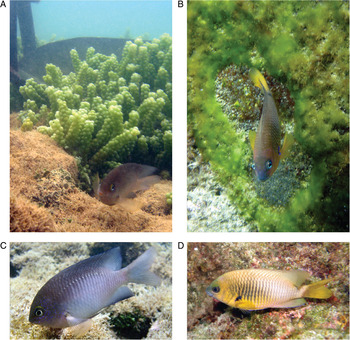
This pattern was recorded only in adult phases of two of the six species found in the study area, namely, S. fuscus and S. rocasensis (Figure 1). Pale morph is characterized by individuals presenting whitish marks over the regular coloration pattern (corresponding to its life phase), with the posterior parts of their bodies temporarily shifting to a marked pale, whitish colour, which often extends from the dorsal portion of the head to the caudal peduncle or tail. However, the pale morph may vary, for instance, extending obliquely in the ventral part from the tip of the caudal fin to the base of the pectoral fin.
(A) Stegastes fuscus individual displaying a pale colour pattern on a human-disturbed reef; (B) S. rocasensis pale individual defending an egg clutch at shallow waters of Fernando de Noronha oceanic archipelago, north-eastern Brazil. Pale individuals of S. fuscus (C) and S. rocasensis (D). Photographs by Allan T. Souza.

Pale individuals of the Rocas gregory (S. rocasensis) were mostly recorded in areas where egg clutches were observed in Fernando de Noronha archipelago (3°50′N 32°24′W), and in 77% of the events they were guarding eggs (A.T.S., personal observation; Figure 1). The pale coloration pattern is noticeably brief, during approximately 3 minutes (N = 9; 2.88 ± 1.36 minutes). Pale individuals of S. rocasensis were observed during the morning and afternoon.
For the dusky damselfish (S. fuscus), pale individuals were recorded in Picãozinho (7°07′S 34°48′W) and Abrolhos reefs (17°57′S 38°42′W). In the former reef, pale individuals were most frequently observed near areas disturbed by human activity (Figure 1), while in the latter, they were recorded near to reproductive grounds.
The proximity of pale morph individuals with egg clutches and areas disturbed by human activities was not tested in this study, thus the possible relation between these observations cannot be properly verified.
Unusual colour patterns—S. pictus and S. fuscus
Three uncommon coloration patterns were recorded in two damselfish species, being one in S. pictus and two in S. fuscus.
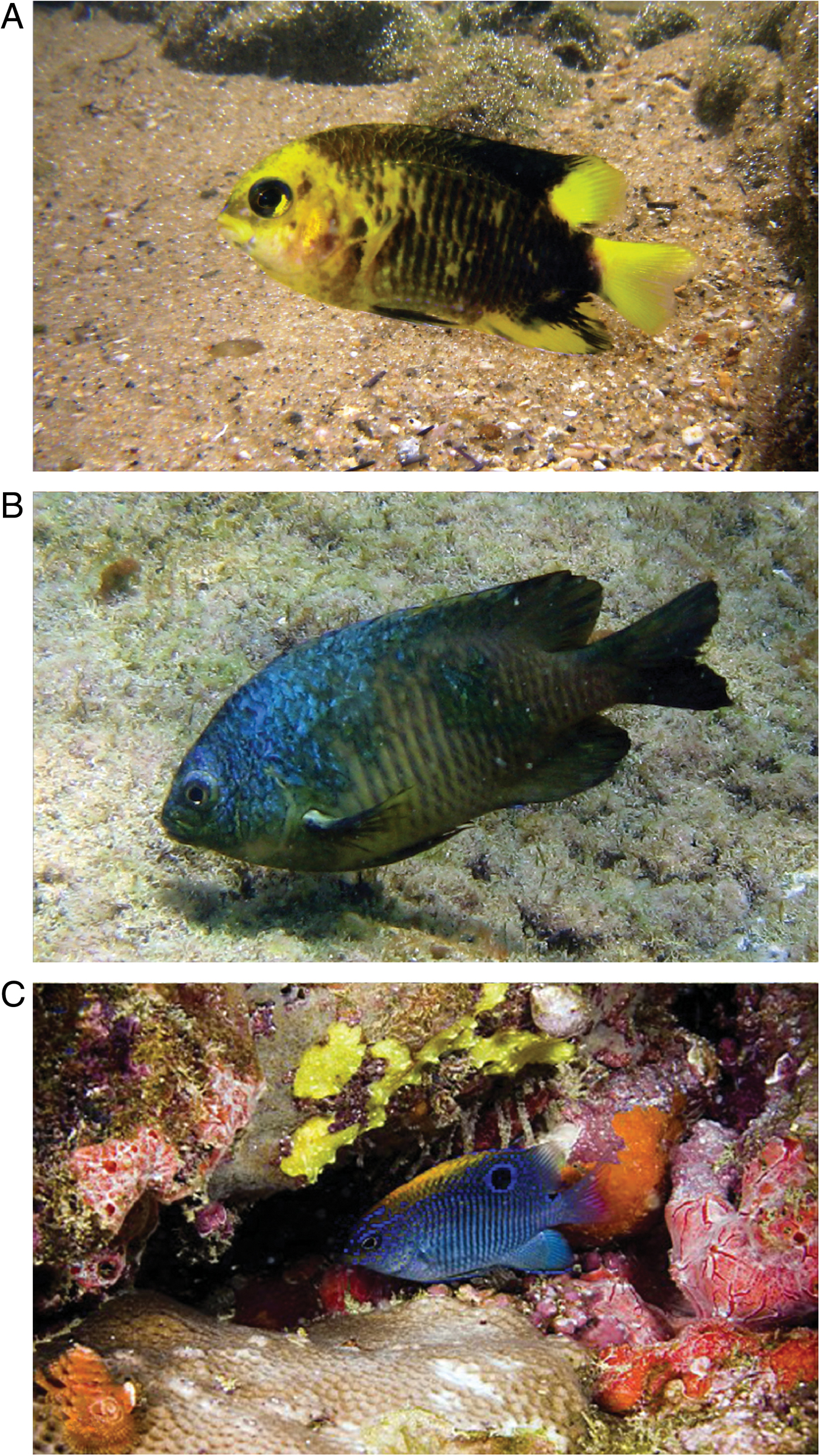
A single individual of the Yellowtip damselfish (S. pictus) was collected by a professional ornamental fisherman at Bahia State, north-eastern Brazil. This specimen (UFBA 3922) was identified in the laboratory according to its morphological characteristics. This individual (UFBA 3922) presented a yellowish base colour with an irregular dusky cover, extending over the dorsum and sides from the operculum to the base of the caudal fin (Figure 2A). This colour anomaly was previously unknown for the species (see Michael, Reference Michael2008; Sampaio & Nottingham, Reference Sampaio and Nottingham2008).
Stegastes spp. individuals showing unusual colour patterns: (A) S. pictus individual exhibiting a remarkably distinct colour pattern in north-eastern Brazil; (B) S. fuscus adult individual with a distinct colour pattern in north-eastern reefs of Brazil, probably caused by a disease; (C) S. fuscus juvenile displaying a dorso-anterior band in yellowish and reddish colours recorded in the northern reefs of Brazil. Photographs by Cláudio L.S. Sampaio (A, B) and Athila Bertoncini (C).
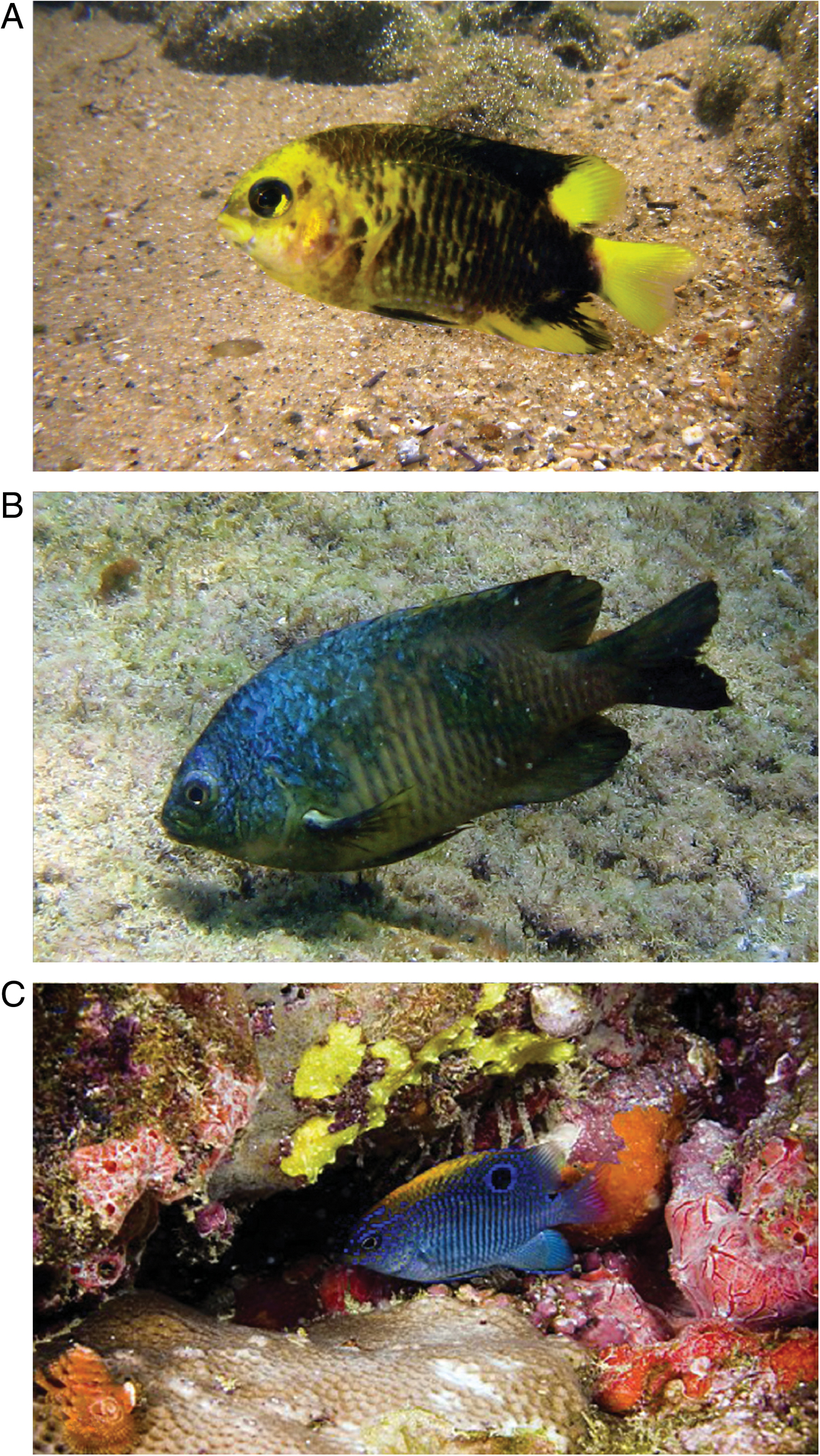
The second unusual coloration pattern was recorded in adult S. fuscus in north-eastern Brazilian reefs. This colour morph differs from the common type mainly by the presence of a diffuse blue cover over the dusky base which extends from the dorsal portion of the body (including the head and operculum) to the mid part of their body, and has diffuse irregular dark marks over the scales (Figure 2B). This coloration pattern has been recorded in different areas of Bahia State, including Salvador and Abrolhos reefs and was also unreported in the literature.
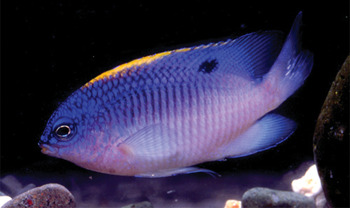
Another distinct coloration pattern was recorded in juvenile S. fuscus in Alagoas, Bahia and Espirito Santo States. It presented a yellowish/reddish dorso-anterior band (Figure 2C). This colour morph was previously recorded in different areas of the Brazilian coast (Araújo et al., Reference Araújo, Maranhão, Véras and Hazin2009), and could be associated with a variation of the common pattern. It is notable that this colour morph is very similar to S. fuscus trindadensis (Gasparini et al., Reference Gasparini, Moura and Sazima1999) (Figure 3).
Stegastes fuscus trindadensis juvenile individual displaying its typical colour morph. Photograph by João Luiz Gasparini.

Locally restricted variants—Stegastes variabilis
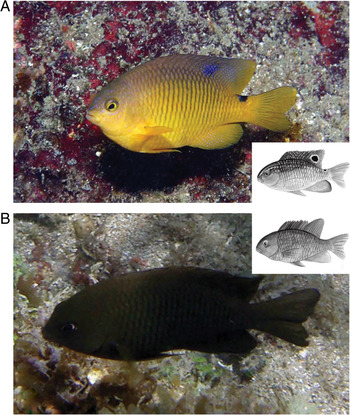
A noticeable variation in the S. variabilis coloration pattern was recorded in specific sites of north-eastern Brazilian reefs, namely in Picãozinho reef (7°07′S 34°48′W) and several coastal reefs in Bahia State. Usually the Cocoa damselfish displays a bright yellow-orange coloration pattern during the adult phase in south-eastern reefs and north-eastern deep reefs, but in specific reefs, the Cocoa damselfish exhibit a dusky coloration pattern during the adult phase (Figure 4).
(A) Two distinct colour patterns of Stegastes variabilis adults, from the Brazilian south-eastern and north-eastern deep reefs; (B) north-eastern Brazilian shallow reefs. Inset: scheme of the two distinct colour morphs. Photographs by João Paulo Krajewski (A) and Allan T. Souza (B); schemes by Felipe Ribas.

DISCUSSION
The occurrence of intraspecific variation on coloration patterns in reef fish populations is relatively common and has several causes, such as ontogenetic shifts, behavioural responses and/or communication displays, as well as genetic differentiation (see Leclercq et al., Reference Leclercq, Taylor and Miguad2010).
Our records may point toward an existing relation between pale coloration and two specific circumstances (reproduction and human induced stress). Nevertheless, since we did not compare the occurrence of pale individuals between areas with and without egg clutches and frequented by tourists, we are not able to confirm or even refute these hypotheses.
The hidden reason behind the coloration abnormalities recorded for S. pictus (Figure 2A) and S. fuscus (Figure 2B) could be various, such as nutritional deficiencies, excessive water clarity or turbidity, stress and/or social interactions (Leclercq et al., Reference Leclercq, Taylor and Miguad2010). Therefore, without further investigation any kind of explanation for the fact could be too speculative.
The yellowish/reddish S. fuscus pattern (Figure 2C) recorded in the present study was also recorded in other systems in Pernambuco and Paraíba States and also on the south-eastern coast by Araújo et al. (Reference Araújo, Maranhão, Véras and Hazin2009). The similarity to the subspecies S. fuscus trindadensis may be indicative that the subspecies actually presents a colour variation of S. fuscus. However, further genetic investigation is necessary to compare the abnormal S. fuscus individuals found on the coast with the subspecies found in Trindade Islands in order to test if the subspecies is valid indeed.
Although damselfish showed somewhat similar coloration patterns among the studied sites, intraspecific variation was also observed. For instance, S. variabilis populations from north-eastern reefs, namely Picãozinho reef (A.T.S., personal observation) and Tamandaré reef (Pacheco, Reference Pacheco2008), are predominantly dusky when adults, and this pattern differs from the yellowish pattern commonly found on southern reefs or in deeper reefs (>20 m) in the north-east. This range of colour patterns could be merely explained by dissimilarities among populations with highly different phenotype expressions, given that distinct genotypes have been previously acknowledged for the species (Molina & Galetti Jr, Reference Molina and Galetti2004). This distinct coloration pattern of S. variabilis has been reported mainly in north-eastern Brazilian shallow coastal reefs, and could be related to environmental (reef type and water temperature) distinctiveness between southern and northern reefs (see Floeter et al., Reference Floeter, Guimarães, Rocha, Ferreira, Rangel and Gasparini2001). However, in this case, the possibility of undescribed species could not be disregarded, and genetic investigations should be performed in order to test this hypothesis.
Finally, fish exhibiting chromatic anomalies are of great interest and highly valuable in the international ornamental fish market (Michael, Reference Michael2001; Luiz, Reference Luiz2003; Sampaio et al., Reference Sampaio, Carvalho-Filho, Feitoza, Ferreira, Floeter, Gasparini, Rocha, Sazima, Alves and Castro2006). Due to the scarcity of these abnormal fish in the wild, and to their ecological and genetic relevance, the capture and the trade of these fish should be strongly regulated and monitored or even prohibited, in order to prevent the decrease in natural morphological and genetic variability of the species.
ACKNOWLEDGEMENTS
The authors would like to thank Alfredo Carvalho-Filho, Athila Bertoncini, Diego Barneche, João Luiz Gasparini, João Paulo Krajewski and Osmar Luiz for kindly providing photographs and/or information and comments. The authors would like also to thank Felipe Ribas for the fish drawings and the two anonymous referees for their valuable comments.