




No CrossRef data available.
Article contents
Confrontation naming in Chinese patients with left, right or bilateral brain damage
Published online by Cambridge University Press: 06 February 2004
Abstract
Confrontation naming of 52 unilateral or bilateral brain-damaged Chinese patients were examined with a modified version of the Boston Naming Test (BNT). Chinese patients with left or right hemisphere lesions, contrary to studies on English speakers, demonstrated similar levels of naming impairments, supporting the notion that English and Chinese are mediated by different neuroprocessing systems. In addition, the psychometric properties of the BNT on Chinese population were examined. While the test demonstrated satisfactory internal consistency and discriminant validity, level of education was found to be a significant factor affecting participants' performance. A cut-off score of 24 in spontaneous naming yielded a sensitivity of 73.1% and specificity of 75.3% in differentiating normal from brain-damaged participants, suggesting that the modified BNT is applicable to the Chinese population. (JINS, 2004, 10, 46–53.)
Information
- Type
- Research Article
- Information
- Journal of the International Neuropsychological Society , Volume 10 , Issue 1 , January 2004 , pp. 46 - 53
- Copyright
- © 2004 The International Neuropsychological Society
INTRODUCTION
The impairment of confrontation naming, the ability to generate the names of objects, places or people voluntarily, is a prominent characteristic of aphasic symptoms. It is well understood from studies of patients with English as their first language that spontaneous speech is primarily mediated by the left hemisphere, especially Broca's area, which is located at the prefrontal region (Brodman's area 44). Thus, impairment on spontaneous naming is commonly observed in patients with left hemisphere damage, especially in (Kohn & Goodglass, 1985; Kreisler et al., 2000) but not limited to (Damasio et al., 1996; Kreisler et al., 2000; Takeda et al., 1999) Broca's area. For example, Damasio et al. (1996) reported that lesions in various locations of the left, but not the right, temporal lobe were associated with naming difficulty. Left hemisphere damage after anterior temporal lobectomy for the treatment of temporal lobe epilepsy might also cause a decline in naming ability (Bell et al., 2000; Langfitt & Rausch, 1996). One study that directly compared the confrontation naming of patients with left and right hemisphere damage (Sandson & Albert, 1987) has highlighted the unique contribution of left hemisphere on confrontation naming. That is, left brain-damaged patients correctly named significantly fewer items on the BNT than either right brain-damaged patients or normal controls.
Our understanding on the role of the left hemisphere on confrontation naming is primarily based upon studies on patients with English as their first language. It is unclear at this point if the same phenomenon will be observed on patients who use Chinese as their first language. Given that several recent studies on Chinese speakers suggested that the processing of Chinese language may involve more bilateral hemisphere processing (Chan et al., 2002; Tan et al., 2000), it is reasonable to speculate that different results may be observed in Chinese patients. Thus, a primary aim of the present study was to examine the role of the left and right hemispheres in naming in Chinese by comparing the performance of groups of left, right, and bilaterally hemisphere-damaged patients. If spontaneous naming in Chinese is processed more bilaterally, the performance of left, right, and bilaterally hemisphere-damaged patients should be comparable.
One of the most widely used confrontation naming tests is the Boston Naming Test (BNT; Kaplan et al., 1983) which was developed in the United States. While many studies demonstrated the clinical validity and reliability of the BNT in identifying patients with confrontation naming deficit in the United States (Goodglass & Kaplan, 1983; Kaplan et al., 1983; Margolin et al., 1990; Nicholas et al., 1996), studies have demonstrated that it is necessary to modify the test if it is to be applied to another culture. For instance, Worrall et al. (1995) found that their sample of native English-speaking Australian elderly obtained a mean score 2 to 5 points below that of North American samples. Another study also showed that healthy Australian elderly performed better on a modified version of the BNT when two items with low frequency in Australian English (“beaver” and “pretzel”) were replaced with Australian alternatives “platypus” and “pizza” (Cruice et al., 2000). It highlights the effects of cultural relevance when word frequency and examinees' familiarity for test items differ between populations. It further underscores the need to adopt culturally relevant modifications of test items and procedures, and to establish norms for different cultural and linguistic populations. Such needs had prompted normative studies in other linguistic communities outside North America, including native speakers of Spanish (Allegri et al., 1997), Dutch (Marien et al., 1998) and Korean (Kim & Na, 1999).
The BNT has also been applied in studies on Chinese population, and has been found to be sensitive in differentiating patients with dementia from normal elderly (Salmon et al., 1995) and identifying patients with temporal lobe lesions (Cheung et al., 2000). Since the BNT seems to be clinically useful in Chinese populations, it is therefore necessary to develop a culturally adapted version with a reasonably representative normative data set and study its reliability and sensitivity. One modification of the BNT considered in the present study was the number of test items. Some studies had compared shorter versions of the BNT with regard to their internal consistencies, their correlations with the 60-item version, and their discriminatory powers between clinical and normal groups. Given that the results for various 30-item versions were found to have satisfactory psychometric properties (for review, see Spreen and Strauss, 1998), a 30-item version was developed in this study in order to produce an optimally time-efficient instrument. Thus, the second purpose of this study was to examine some psychometric properties of this modified version of the BNT. In specific, the study aimed to investigate the effects of demographic variables on the naming performance in Chinese speaking adults including age, education, and gender effects. In addition, its applicability in discriminating brain-damaged patients from normal individuals was also explored.
METHODS
Research Participants
Fifty-two patients (aged 17 to 72) voluntarily participated in the present study. Among them, 29 had bilateral lesions, 11 had unilateral lesions in the left hemisphere and 12 had unilateral lesions in the right hemisphere. Their brain damage primarily involved the temporal lobe confirmed by MRI scans and was either a late complication of radiotherapy as treatment for their nasopharyngeal carcinoma (39 patients) or due to epilepsy (13 patients). All patients with nasopharyngeal carcinomas demonstrated lesions on the lateral temporal regions, and half of them had lesions on the mesial and basal temporal areas. Eight of those patients had lesions involving the lateral frontal or subcortical regions. The other 13 patients who suffered from temporal lobe epilepsy were candidates for neurosurgical intervention. Six of them had temporal lobe sclerosis, and the others had hematomas, tumors, or cysts that involve the mesial or lateral temporal regions.
The normal control (NC) group comprised 77 adults (aged 23–79), with 36 men and 41 women. They were either the spouses or family members of the patients recruited in this study, or volunteers recruited through advertisement. All normal subjects reported no history of head injury, alcohol abuse, neurological, or psychiatric disorders.
The demographic information of the four groups of participants is shown in Table 1. There was a significant age difference between the groups [F(3,125) = 6.03, p < .01]. Post-hoc analysis showed that the mean age of bilateral brain-damaged patients was significantly higher than that of left and right brain-damaged patients. There was no significant difference in years of education [F(3,125) = 1.62, p > .05] and performance on the Cantonese version of the Mini-Mental State Examination [CMMSE; Chiu et al., 1994; F(3,118) = 1.06, p > .05] among the four groups of participants. When the three groups of brain-damaged patients were collapsed, their mean age was 49.92 years (SD = 15.90), mean years of education was 8.13 (SD = 3.98) and mean CMMSE score was 27.82 (SD = 2.11). The number of years of education differed between NC and brain-damaged patients [t(127) = −2.11, p < .05], but there was no significant difference in age and CMMSE score between the two groups.
Demographic information of participants

Materials
Thirty items were selected from the original 60 items of the BNT, based on the cultural relevance of the items in the local context. The order of presentation of the stimuli followed the original sequence. For each of the 30 selected items, the Cantonese name of the object was set as the target response, and a semantic cue was designed for each response as in the original version of BNT. For example, the semantic cue for “camel” (Item 17) was, “It is an animal”, and that for “abacus” (Item 60) was, “It is used for calculation.”
Given that Chinese is a logographic language and the names of most objects consist of one sound, phonemic cuing is not applicable to this population. Thus, a multiple-choice recognition task with two distractors was designed for each item. One distractor was semantically related to the target response and the other was perceptually related. The semantic distractor was an object that belonged to the same category as the target object. The perceptual distractor was an object that visually resembled the target object, which might be similar in shape to the whole target object, or to a salient feature of the target object. For example, for the item “camel,” the semantic distractor was “cow” (both belonged to the category of animal and are similar in size and shape) and the perceptual distractor was “mountain” (the shape of camel's back resembled a mountain). The instruction of the recognition task for this item was, “Is this object a camel, a mountain, or a cow?” The order of presentation of the three choices (target response, semantic distractor, and perceptual distractor) for each item was randomized within the test.
The measures of naming performance included the total number of correct items on spontaneous naming, after semantic cuing, and then after multiple-choice recognition.
Procedure
Each participant was assessed individually by trained examiners who were blinded to their pathological involvement in the brain. The modified version of the BNT was administered to each participant as part of a neuropsychological test battery that measured cognitive domains of language, memory, attention, visual ability, visual motor coordination, and executive functions. Participants were administered all 30 items of the modified BNT, starting from Item 1. If the participant named the item correctly, the examiner proceeded to the next item. Credits were given to self-corrections. If the participant gave a wrong response, indicated that he or she did not know the answer, or gave no response within 20s, a semantic cue was given. If the participant could not name the object correctly after a semantic cue was provided, the three-choice recognition task was given. All responses were recorded verbatim.
Statistical Analyses
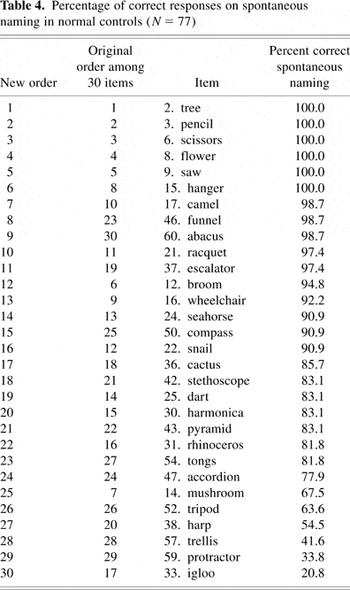
The naming performance of normal controls and the three groups of brain-damaged patients was analyzed using repeated-measures ANOVA to compare the pattern of the three naming scores, and ANOVA was used to compare the performance on the semantic cuing and recognition tasks. The internal consistency of the test was assessed by Cronbach's alpha. The effect of gender on naming was examined by comparing test performance of male and female participants using t tests, while the effects of age and education were examined through correlation analysis. The contribution of naming performance in the prediction of group membership (NC vs. brain-damaged patients) was investigated using sequential logistic analysis with demographic variables entered in the first block, followed by measures of naming performance. The discriminatory ability and optimal cut-off points on the test in differentiating normal from brain-damaged individuals were examined through receiver operating characteristic (ROC) analysis. Finally, the percentage of correct responses on spontaneous naming for each item was calculated for NC participants, which yielded an index of difficulty level for rearranging the stimuli in ascending order of difficulty.
RESULTS
Naming Performance of NC and Brain-Damaged Participants
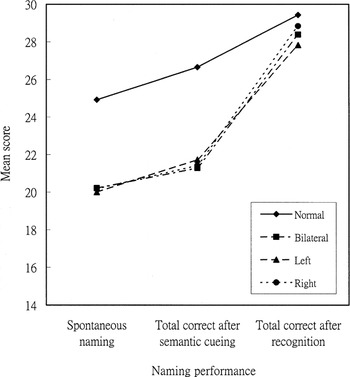
The naming scores of normal controls and the three patient groups were analyzed using repeated-measures ANOVA, with group (NC, bilateral, left and right brain-damaged) as between-subjects factor and score (spontaneous naming, score after semantic cuing and score after recognition) as the within-subjects factor. The analysis showed a significant interaction effect of Group × Score [F(6,248) = 9.25, p < .001], suggesting that the four groups demonstrated different profiles on the three naming scores. All groups showed improvement over successive cues, but the degree of improvement differed. As shown in Figure 1, performance improved steadily for normal participants from a mean of 24.92 (SD = 3.04) on spontaneous naming to 26.65 (SD = 2.75; 1.73 points improvement) with semantic cuing, and further to 29.43 (SD = 0.91; 2.78 points improvement) after recognition. For the three patient groups, naming performance improved to a similar extent as in normal controls after semantic cuing (1.07–1.73 points improvement), but relatively more significantly after recognition (6.09–7.41 points improvement).

Naming performance of normal individuals and brain-damaged patients.
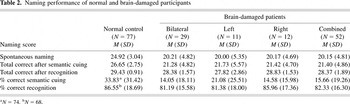
Table 2 presented the naming performance of the participants. Post-hoc analysis using Tukey's HSD showed that normal controls' performance was significantly better than the three patient groups on spontaneous naming (ps < .001), and that the performances of the three groups of patients were not significantly different. Similar results were observed in the total number of correct responses with semantic cues (ps < .001) and with recognition (ps < .01). While patients performed significantly more poorly than normal individuals, their performance were not significantly different from each other.
Naming performance of normal and brain-damaged participants

Since the numbers of errors in the spontaneous naming were different between normal individuals and patients, the effect of cues on naming was examined with a correction for baseline differences. Thus, the percentage of correct responses on semantic cuing and recognition was calculated for all participants, by dividing the number of correct responses during semantic cuing or recognition by the number of errors preceding the cues. ANOVA was conducted on these two measures and the result showed that there was a significant difference among the groups on the percentage of correct responses on semantic cuing [F(3,122) = 4.71, p < .01] but not on recognition. Post-hoc analysis showed that the percentage of correct responses on semantic cuing between NC and bilateral brain-damaged patients was significantly different (p < .05). That is, when semantic cues were provided after failure in spontaneous naming, NC participants gave correct answers to one-third of the failed items, while brain-damaged patients gave correct answers to smaller proportions (14–21%). However, for items that still could not be named correctly after semantic cuing, about 80% were correctly answered by all groups of participants in the recognition task.
Regarding recognition errors, their occurrences were relatively infrequent, which ranged from 0.57 to 2.18 among the four groups of participants. ANOVA showed that there were significant group differences on the number of recognition errors [F(3,125) = 7.21, p < .001]. Normal participants committed significantly fewer errors (M = 0.57, SD = 0.91) than bilateral (M = 1.62, SD = 1.54) and left brain-damaged (M = 2.18, SD = 2.86) patients (ps < .01).
Since correlation analysis showed that education level was related to naming performance, all between-group comparisons were repeated using education as a covariate. The results of these analyses were the same as that described above.
Reliability of the Modified Version of the BNT
The reliability of the modified version of BNT was examined using Cronbach's alpha. The alpha values were .83 for brain-damaged participants, .70 for NC participants and .83 for all participants, suggesting that the test was internally consistent.
Effects of Demographic Variables on the Naming Performance of Chinese
The effect of gender on naming performance was examined by comparing the performance of male and female NC participants. As shown in Table 1, there were about equal numbers of men and women in the groups except the group of patients with bilateral lesions. The result showed that there was no significant difference on any of the naming variables between the two groups. The spontaneous naming scores of men and women, as evaluated by t tests, was not significantly different in normal control (male: M = 25.50, SD = 3.28; female: M = 24.41, SD = 2.76; t(75) = 1.57, p > .1), bilateral (male: M = 20.83, SD = 4.80; female: M = 17.83, SD = 4.49; t(27) = 1.38, p > .1), unilateral left (male: M = 17.33, SD = 4.37; female: M = 23.20, SD = 4.92; t(9) = −2.10, p > .05), and unilateral right (male: M = 18.83, SD = 4.67; female: M = 21.50, SD = 4.72; t(10) = −0.98, p > .1) subjects.
The relationship between age, education, and naming performance was investigated using Spearman's correlation coefficient. The analysis showed a positive correlation between education and spontaneous naming score (r = .342, p < .01). No effect of age on naming performance was found.
These results suggested that performance on the modified version of the BNT was affected by education, with higher level of education associated with better naming performance. The mean spontaneous naming score of NC participants with elementary education (0–6 years) was 24.00 (SD = 2.69), high school education (7–13 years) was 24.85 (SD = 3.01) and tertiary education (>13 years) was 26.71 (SD = 3.12). ANOVA results showed that the effect of education on spontaneous naming was significant [F(2,74) = 3.81, p < .05], with individuals having tertiary education performing significantly better than those with elementary education (p < .05).
Discriminatory Ability of the Modified Version of the BNT
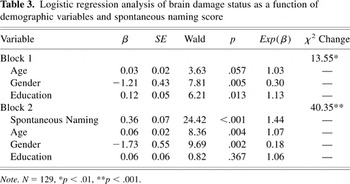
The prediction of group membership of NC versus brain-damaged participants by naming performance was investigated through logistic regression analysis. To rule out the possibility that the difference between groups is due to variation in some demographic factors, the three demographic variables were entered in the first block and spontaneous naming was then entered in the second block. The results showed that demographic variables provided useful information in the prediction of brain damage, [χ2(3) = 13.55, p < .01], but the prediction rate was only modest (64.3% overall, 42.3% for brain-damaged patients and 79.2% for control). When spontaneous naming was entered, significant improvement was observed [χ2(1) = 40.35, p < .001], and the overall prediction rate was improved to 77.5% (63.5% for brain-damaged patients and 87.0% for controls). Table 3 presents the result of the analysis.
Logistic regression analysis of brain damage status as a function of demographic variables and spontaneous naming score

Similar results were obtained with another model, with demographic variables in the first block and naming with semantic cues in the second block. A significant improvement in prediction was observed with the addition of naming with semantic cues [χ2(1) = 48.11, p < .05], and the overall prediction rate was 80.6% (67.3% for brain-damaged patients and 89.6% for controls). This suggests that spontaneous naming and naming with semantic cues provided additional information over demographic variables in differentiating between normal and brain-damaged participants.
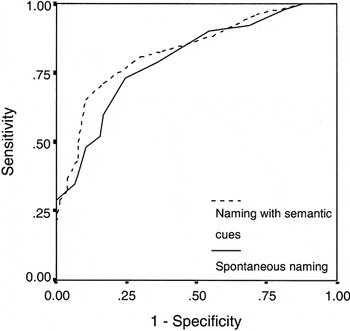
ROC analysis was performed to investigate the optimal cut-off values of naming scores in differentiating normal from brain-damaged participants. Using spontaneous naming score in the analysis, the area under the curve was .80, which was significantly different from .50 (p < .001) and suggested that spontaneous naming was able to discriminate between NC and brain-damaged participants significantly above chance level. Analysis using naming with semantic cues also showed that it was able to discriminate between the two groups above chance level (area under curve = .83, p < .001), but there was no significant difference between the areas under curve for spontaneous naming and naming with semantic cues (z = 1.61, p > .05). Figure 2 showed the ROC curves of the two naming scores. Given that both naming scores have similar discriminatory ability, spontaneous naming that does not involve further computation might be a better measure in differentiating between normal and brain-damaged individuals. A cut-off score of 24 for spontaneous naming yielded a sensitivity of 73.1% and specificity of 75.3%, and was suggested as the optimal cut-off value for the screening of naming impairment.

Receiver operating characteristics curves of spontaneous naming and naming with semantic cues.
Percentage of Correct Responses of Each Item in the BNT
For each item, the number of normal individuals who correctly gave the name of the object was tallied. Based on the frequency of correct responses, the item order was re-arranged in ascending level of difficulty as shown in Table 4. When the new item order was compared with the original order, it was observed that the change in relative ranks of most items (21 out of 30) was within five positions. Four items (Items 14, 33, 46, and 60), however, differed from the original ranks for more than 10 positions. For instance, the igloo, which is a relatively common object to Americans (ranks 17th among the 30 selected items in the BNT), was very unfamiliar to most Chinese and thus was ranked the last item on the list for Chinese population. On the other hand, the abacus was the last item in the original list of the BNT but was ranked the 9th item on the list for Chinese.
Percentage of correct responses on spontaneous naming in normal controls (N = 77)

DISCUSSION
A primary aim of the present study was to examine confrontation naming impairment in Chinese patients with unilateral left, unilateral right, and bilateral brain damage. Consistent with our hypothesis that Chinese language may be processed more bilaterally, the results showed that brain-damaged patients, irrespective of lesion locations, performed significantly worse than normal participants. These results were unlikely explained as a failure of the test in differentiating the three groups of patients, since consistent results were observed in two other verbal tests, namely the Comprehension and Similarities subtests of the Wechsler Adult Intelligence Scale–Revised (WAIS–R; Wechsler, 1981). The results showed that there were significant between-groups differences on all three measures (Comprehension: F(3,120) = 4.05, p < .005; Similarities: F(3,121) = 6.63, p < .001; and Verbal IQ: F(3,125) = 3.84, p < .05), and post-hoc analysis showed that the differences occurred between NC and bilateral brain-damaged patients, and between NC and left-brain damaged patients on one measure. No difference was found among patients with different lesion locations.
It is interesting to point out that patients with bilateral brain damage performed similarly to, but not more poorly than those with unilateral lesions. Thus, while Chinese language seems to be processed bilaterally, there seems to be limited inter-hemispheric plasticity in which the intact hemisphere can take over the task of the damaged one. These results then suggest that the function of the two hemispheres in processing Chinese may not be equivalent and interchangeable. Each hemisphere seems to be a part of a coherent system and each is responsible for its own special processing. Thus, either partial (i.e., unilateral) or total (i.e., bilateral) damage to the system will result in similar level of impairment.
The results of the present study appeared somewhat inconsistent with our understanding of the neural processing system of language in which expressive speech is primarily mediated by the left hemisphere (Bookheimer et al., 1997; Damasio et al., 1996; Glosser & Donofrio, 2001; Langfitt & Rausch, 1996). One conceivable explanation of the inconsistency between the results of the present study and that of previous studies might be that there are different neurocognitive networks that mediate English and Chinese language processing. While some studies reported common activation patterns (lateralized to left hemisphere) across Mandarin and English (Chee et al., 1999a, 1999b), there is evidence suggesting that Chinese language processing might involve networks in both hemispheres. For example, Tan et al. (2000) reported bilateral frontal and temporal activations during a word-generation task in a group of native Mandarin speakers. In another study conducted with Chinese–English bilinguals, Chan et al. (2002) found that half of the participants demonstrated activation of bilateral frontal cortex during a Chinese verbal fluency task, and left frontal activation during the same task in English. However, it should be pointed out that the tasks employed by the fMRI studies mentioned above were word generation tasks, and the one employed in the present study was naming. Thus, although both studies demonstrated more bilateral involvement for processing Chinese than English, it remains unclear if the neurophysiology that mediates these two languages is the same given that a more precise neural basis for naming cannot be revealed from the present findings. Further investigation utilizing fMRI to study the performance of these patients on different tasks that require various levels of semantic and retrieval processes will help to shed some light on this issue. Apart from studies that investigated Chinese and English language processing, studies on Japanese patients with brain damage provides further evidence of different processing systems for alphabetic and logographic languages. In particular, some Japanese patients lost the ability to read kanji (a logographic language) but not kana (an alphabetic language), while other patients demonstrated an opposite pattern (Sasanuma, 1980).
Although the brain-damaged patients in the present study demonstrated impaired naming when compared with normal control subjects, their performance improved steadily with semantic cues and then with multiple-choice recognition, showing that both semantic cues and recognition were useful in eliciting correct responses in normal individuals as well as brain-damaged patients. These results suggested that the naming difficulty demonstrated by brain-damaged patients was more likely to be a retrieval problem rather than a loss of semantic knowledge. The retrieval difficulty of brain-damaged patients in naming was also demonstrated in the percentage of correct responses on semantic cueing and recognition. While semantic cues resulted in about 16% correct responses, the less effortful recognition task resulted in about 82% correct responses.
In this study, we also investigated the psychometric properties of the modified version of the BNT. The test was found to have satisfactory internal consistency, with Cronbach's alphas ranging from .70 to .83 for normal and brain-damaged individuals. Such reliability is comparable to those of other short versions developed for English speakers, such as three 30-item versions developed by Williams et al. (1989), who reported alpha values that ranged from .62 to .74. The test was also found to be useful in differentiating between normal and brain-damaged patients. The performance on spontaneous naming offered contribution additional to demographic variables in predicting brain damage and was able to differentiate NC from brain-damaged patients at above-chance level. The results of ROC analysis suggested the optimal cut-off score for spontaneous naming to be 24, yielding a sensitivity of 73.1% and specificity of 75.3%. These rates were comparable to those of the Shanghai version by Salmon et al. (1995), who reported sensitivities of 56% to 80% and specificities of 54% to 70% in differentiating demented from non-demented elderly.
Regarding the discriminatory ability of the test, the results suggested that the modified BNT was useful in differentiating between NC and temporal lobe damaged participants. Normal adults obtained a mean spontaneous naming score of 4.8 points more, and committed significantly fewer recognition errors than brain-damaged patients. However, the mean difference in recognition errors was less than 1 point, and the majority of participants (96% of NC participants and 73% of brain-damaged patients) committed no more than two recognition errors. Thus, quantitatively, the spontaneous naming score is more useful in differentiating between controls and brain-damaged individuals. Recognition errors, on the other hand, may offer qualitative information about possible sources of naming errors, and provide indications for further assessment of cognitive functions such as visual perceptual ability or the integrity of semantic knowledge.
While the present study suggested that the modified version of the BNT is useful in discriminating normal from brain-damaged individuals, its utility in lesion localization is limited. The test is fairly sensitive to brain damage but not sensitive to lesion laterality. This was unlikely to be due to small sample size since the effect sizes of the mean difference of the spontaneous naming scores among the patient groups ranged from .01 to .04, and the power of these comparisons was smaller than .17. Effect sizes of such small magnitudes suggested that a very large sample size of patients would be needed for any significant difference in the naming scores. To obtain a power of .7, over 7000 participants in each patient group will be required.
In sum, the present study demonstrated the sensitivity and specificity of the modified Boston Naming Test in differentiating Chinese brain-damaged patients from normal individuals. It also showed that lesion laterality is not a significant factor for naming impairment in Chinese patients with brain damage. Further studies on this group of patients will help to map out the different physiological correlates of alphabetic and logographic languages in the brain.
ACKNOWLEDGMENTS
This research was supported in part by the Providence Foundation Limited Research Grants to Rebecca Cheung and also in part by donation from the Culture Homes Limited to Agnes Chan.
References
REFERENCES
Allegri, R.F.,
Mangone, C.A.,
Villavicencio, A.F.,
Rymberg, S.,
Taragano, F.E., &
Baumann, D.
(1997).
Spanish Boston Naming Test norms.
Clinical Neuropsychologist,
11,
416–420.CrossRefGoogle Scholar
Bell, B.D.,
Davies, K.G.,
Hermann, B.P., &
Walters, G.
(2000).
Confrontation naming after anterior temporal lobectomy is related
to age of acquisition of the object names.
Neuropsychologia,
38,
83–92.CrossRefGoogle Scholar
Bookheimer, S.Y.,
Zeffiro, T.A.,
Blaxton, T.,
Malow, B.A.,
Gaillaard, W.D.,
Sato, S.,
Kufta, C.,
Fedio, P., &
Theodre, W.H.
(1997).
A direct comparison of PET activation and electrocortical
stimulation mapping for language localization.
Neurology,
48,
1056–1065.Google Scholar
Chan, A.,
Yeung, D.,
Chan, Y.L.,
He, W.J.,
Cheung, M.C.,
Lam, J., &
Chung, M.
(2002, February).
Different neurocognitive semantic process for alphabetic and logographic
languages.
Poster presented at the meeting of the International Neuropsychological
Society, Columbus, OH.
Chee, M.W.,
Caplan, D.,
Soon, C.S.,
Sriram, N.,
Tan, E.W.L.,
Thiel, T., &
Weekes, B.
(1999a).
Processing of visually presented sentences in Mandarin and English
Studied with fMRI.
Neuron,
23,
127–137.Google Scholar
Chee, M.W.,
Tan, E.W.L., &
Thiel, T.
(1999b).
Mandarin and English single word processing studied with functional
magnetic resonance imaging.
Journal of Neuroscience,
19,
3050–3056.Google Scholar
Cheung, M.C.,
Chan, A.S.,
Law, S.C.,
Chan, J.H., &
Tse, V.K.
(2000).
Cognitive function of patients with nasopharyngeal carcinoma with
and without temporal lobe radionecrosis.
Archives of Neurology,
57,
1347–1352.Google Scholar
Chiu, H.F.K.,
Lee, H.C.,
Chung, W.S., &
Kwong, P.K.
(1994).
Reliability and validity of the Cantonese version of Mini-Mental
State Examination—A preliminary study.
Journal of Hong Kong College of Psychiatry,
4,
25–28.Google Scholar
Cruice, M.N.,
Worrall, L.E., &
Hickson, L.M.H.
(2000).
Boston Naming Test results for healthy older Australians: A
longitudinal and cross-sectional study.
Aphasiology,
14,
143–155.CrossRefGoogle Scholar
Damasio, H.,
Grabowski, T.J.,
Tranel, D.,
Hichwa, R.D., &
Damasio, A.R.
(1996).
A neural basis for lexical retrieval.
Nature,
380,
499–505.CrossRefGoogle Scholar
Glosser, G. &
Donofrio, N.
(2001).
Differences between nouns and verbs after anterior temporal
lobectomy.
Neuropsychology,
15,
39–47.CrossRefGoogle Scholar
Goodglass, H. &
Kaplan, E.
(1983).
The Assessment of Aphasia and Related Disorders
(2nd ed.).
Philadelphia:
Lea & Febiger.
Kaplan, E.,
Goodglass, H., &
Weintraub, S.
(1983).
The Boston Naming Test
(2nd ed.).
Philadelphia:
Lea & Febiger.
Kim, H. &
Na, D.L.
(1999).
Normative data on the Korean version of the Boston Naming Test.
Journal of Clinical and Experimental Neuropsychology,
21,
127–133.CrossRefGoogle Scholar
Kohn, S.E. &
Goodglass, H.
(1985).
Picture-naming in aphasia.
Brain and Language,
24,
266–283.CrossRefGoogle Scholar
Kreisler, A.,
Godefroy, O.,
Delmaire, C.,
Debachy, B.,
Leclercq, M.,
Pruvo, J.P., &
Leys, D.
(2000).
The anatomy of aphasia revisited.
Neurology,
54,
1117–1123.Google Scholar
Langfitt, J.T. &
Rausch, R.
(1996).
Word-finding deficits persist after left anterotemporal lobectomy.
Archives of Neurology,
53,
72–76.CrossRefGoogle Scholar
Margolin, D.I.,
Pate, D.S.,
Friedrich, F.J., &
Elia, E.
(1990).
Dysnomia in dementia and in stroke patients: Different underlying
cognitive deficits.
Journal of Clinical and Experimental Neuropsychology,
12,
597–612.Google Scholar
Marien, P.,
Mampaey, E.,
Vervaet, A.,
Saerens, J., &
De Deyn, P.P.
(1998).
Normative data for the Boston Naming Test in native Dutch-speaking
Belgian elderly.
Brain and Language,
65,
447–467.CrossRefGoogle Scholar
Nicholas, M.,
Obler, L.K.,
Au, R., &
Albert, M.L.
(1996).
On the nature of naming errors in aging and dementia: A study of
semantic relatedness.
Brain and Language,
54,
184–195.Google Scholar
Salmon, D.P.,
Jin, H.,
Zhang, M.,
Grant, I., &
Yu, E.
(1995).
Neuropsychological assessment of Chinese elderly in the Shanghai
Dementia Survey.
Clinical Neuropsychologist,
9,
159–168.CrossRefGoogle Scholar
Sandson, J. &
Albert, M.L.
(1987).
Perseveration in behavioral neurology.
Neurology,
37,
1736–1741.CrossRefGoogle Scholar
Sasanuma, S.
(1980).
Acquired dyslexia in Japanese: Clinical features and underlying
mechanisms. In
M. Coltheart,
K.E. Patterson, &
J.C. Marshall (Eds.),
Deep dyslexia (pp.
91–118).
London:
Rouledge & Kegan Paul.
Spreen, O. &
Strauss, E.
(1998).
A Compendium of neuropsychological tests: Administration, norms,
and commentary
(2nd ed.).
New York:
Oxford University Press.
Takeda, M.,
Tachibana, H.,
Shibuya, N.,
Nakajima, Y.,
Okuda, B.,
Sugita, M., &
Tanaka, H.
(1999).
Pure anomic aphasia caused by a subcortical hemorrhage in the left
temporal–parieto–occipital lobe.
Internal Medicine,
38,
293–295.CrossRefGoogle Scholar
Tan, L.H.,
Spinks, J.A.,
Gao, J.,
Liu, H.,
Perfetti, C.A.,
Xiong, J.,
Stofer, K.A.,
Pu, Y.,
Liu, Y., &
Fox, P.T.
(2000).
Brain activation in the processing of Chinese characters and words:
A functional MRI study.
Human Brain Mapping,
10,
16–27.3.0.CO;2-M>CrossRefGoogle Scholar
Wechsler, D.A.
(1981).
Manual for the Wechsler Adult Intelligence Scale–Revised.
New York:
The Psychological Corporation.
Williams, B.W.,
Mack, W., &
Henderson, V.W.
(1989).
Boston Naming Test in Alzheimer's disease.
Neuropsychologia,
27,
1073–1079.CrossRefGoogle Scholar
Worrall, L.E.,
Yiu, E.M-L.,
Hickson, L.M.H., &
Barnett, H.M.
(1995).
Normative data for the Boston Naming Test for Australian elderly.
Aphasiology,
9,
541–551.Google Scholar

Demographic information of participants
Naming performance of normal individuals and brain-damaged patients.
Naming performance of normal and brain-damaged participants
Logistic regression analysis of brain damage status as a function of demographic variables and spontaneous naming score
Receiver operating characteristics curves of spontaneous naming and naming with semantic cues.
Percentage of correct responses on spontaneous naming in normal controls (N = 77)
 You have
Access
- 113
- Cited by