


Introduction
Bats, order Chiroptera, are one of the most diverse mammalian groups, with a total of 1,511 recognised species and remarkable taxonomical and ecological diversity (Simmons & Cirranello Reference Simmons and Cirranello2026). Bats have successfully colonised nearly all terrestrial ecosystems, where they fulfil vital ecological roles, including pollination, seed dispersal, and insect control (Ramírez-Fráncel et al. Reference Ramírez-Fráncel, García-Herrera, Losada-Prado, Reinoso-Flórez, Sánchez-Hernández, Estrada-Villegas, Lim and Guevara2022). These ecosystem services are not only essential for biodiversity maintenance but also have direct implications for human well-being: for instance, the decline in bat populations caused by white-nose syndrome in North America has been linked to increased insecticide use and associated rises in infant mortality (Frank Reference Frank2024).
Bats face increasing conservation challenges worldwide. According to the IUCN Red List, approximately 15% of species are considered threatened (assessed Critically Endangered, Endangered, or Vulnerable), and 18% are Data Deficient (Frick et al. Reference Frick, Kingston and Flanders2020). Moreover, population trends are unknown for more than half of all species, suggesting that we may be significantly underestimating the true magnitude of the problem (Bland et al. Reference Bland, Collen, Orme and Bielby2015; Frick et al. Reference Frick, Kingston and Flanders2020). Specifically, bats are highly vulnerable to habitat fragmentation and human disturbance, as their slow reproductive rates and specialised ecological niches limit recovery from population declines (Voigt & Kingston Reference Voigt and Kingston2015; Frick et al. Reference Frick, Kingston and Flanders2020).
At the same time, bats have gained increasing attention in research into infectious disease, due to their role as reservoirs of several emerging zoonotic pathogens (Calisher et al. Reference Calisher, Childs, Field, Holmes and Schountz2006; Brook & Dobson Reference Brook and Dobson2015; Tian et al. Reference Tian, Sun, Li, Wang, Wang, Zhang, Meng, Ji, Suchard, Zhang, Lai, Su and Veit2022). The association between bats and zoonotic viruses dates to at least 1911, when Carini (Reference Carini1911) first suggested that vampire bats (Desmodus rotundus) were a likely source of rabies transmission in cattle. Since then, several bat species have been recognised as natural reservoirs of viruses responsible for severe human disease, such as lyssaviruses, Marburg virus, Hendra virus and Nipah virus (Liu et al. Reference Liu, Liu, Wang and Yao2024). Additionally, cumulative evidence indicates a bat origin for other emerging viruses, including severe acute respiratory syndrome coronavirus (SARS-CoV) and SARS-CoV-2, Middle East Respiratory Syndrome (MERS-CoV) (Tian et al. Reference Tian, Sun, Li, Wang, Wang, Zhang, Meng, Ji, Suchard, Zhang, Lai, Su and Veit2022; Liu et al. Reference Liu, Liu, Wang and Yao2024). Moreover, a variety of potentially zoonotic bacterial genera, such as Bartonella, Leptospira and Mycoplasma have been frequently reported in multiple chiropteran families across different geographical regions (Szentivanyi et al. Reference Szentivanyi, McKee, Jones and Foster2023). Bats also contribute to the maintenance and transmission of fungal pathogens, like Histoplasma capsulatum, the causative agent of human histoplasmosis, and parasites like Trypanosoma cruzi, the aetiological agent of Chagas disease (Jansen et al. Reference Jansen, Xavier and Roque2018; Gugnani & Denning Reference Gugnani and Denning2023). However, the great diversity of microorganisms associated with bats should be interpreted in the light of their exceptional taxonomic and ecological diversity. Importantly, bats are not unique among vertebrate hosts, and zoonotic risk has been demonstrated to be homogeneous across mammalian and avian taxa (Mollentze & Streicker Reference Mollentze and Streicker2020).
In parallel with this growth of scientific interest toward bats, public media have often portrayed this taxonomic group under a negative light (Lu et al. Reference Lu, Wang, Ye, Wang, Qiu, Zhang, Liu, Luo and Feng2021). Public fear and miscommunication about zoonotic risk can further complicate conservation efforts and have occasionally led to unfavourable public health outcomes (Lu et al. Reference Lu, Wang, Ye, Wang, Qiu, Zhang, Liu, Luo and Feng2021; Viana et al. Reference Viana, Benavides, Broos, Loayza, Niño, Bone, da Silva Filipe, Orton, Bazan, Matthiopoulos and Streicker2023). For example, in Uganda, efforts to exterminate colonies of Rousettus aegyptiacus following a Marburg outbreak, had an opposite effect and resulted in an increase in virus prevalence (Amman et al. Reference Amman, Nyakarahuka, McElroy, Dodd, Sealy, Schuh, Shoemaker, Balinandi, Atimnedi, Kaboyo, Nichol and Towner2014). In many Latin American countries, Desmodus rotundus has been culled for decades to reduce rabies transmission to humans and livestock, with contradictory results (Viana et al. Reference Viana, Benavides, Broos, Loayza, Niño, Bone, da Silva Filipe, Orton, Bazan, Matthiopoulos and Streicker2023). More recently, in Indonesia, legal bat culling was implemented as a strategy to respond to the COVID-19 pandemic (Lu et al. Reference Lu, Wang, Ye, Wang, Qiu, Zhang, Liu, Luo and Feng2021).
Taken together, these issues highlight the growing ethical responsibilities of scientists, which include not only effective communication with other experts and the public, but also ethical conduct during field research on bats. Undeniably, research on free-ranging wild animals intrinsically raises moral challenges. Ethical frameworks for animal research (e.g. the principles of the 3Rs) are well established in laboratory settings but are difficult to apply to free-ranging wildlife (Cattet Reference Cattet2013; Sikes & Paul Reference Sikes and Paul2013). Replacement is often not feasible when investigating ecological processes or pathogen dynamics in wild populations (Sikes & Paul Reference Sikes and Paul2013; Paul et al. Reference Paul, Sikes, Beaupre and Wingfield2016). Similarly, reduction must be balanced against the need for adequate sample sizes to ensure scientific validity. Refinement often depends on practical challenges of working under natural conditions (Zemanova Reference Zemanova2020). Moreover, in wildlife field research, lack of species-specific knowledge represents a further complication: welfare indicators are often not established for the studied species, making it difficult to assess the potential harm or distress that certain procedures may cause (Cattet Reference Cattet2013).
These considerations are significant in surveys targeting bats for pathogen surveillance. In fact, while such research is important, the methods implemented are often questionable from the perspective of bat conservation and well-being. Invasive procedures, such as tissue sampling, blood collection, or euthanasia to obtain specimens are common (Voigt & Kingston Reference Voigt and Kingston2015). This is especially relevant outside Europe, where legal protections (like the Agreement on the Conservation of European Bat Populations and the Habitat Directives) do not always apply, and lethal sampling is more frequently employed (Voigt & Kingston Reference Voigt and Kingston2015; UNEP/EUROBATS 2019). Moreover, although international guidelines, such as those from the American Society of Mammologists, recommend humane methods to minimise animal suffering (Sikes & Paul Reference Sikes and Paul2013), their consistent application and reporting across studies remains unclear. Indeed, in studies on bat-borne pathogens, sampling is often invasive, conducted in resource-limited settings, and sometimes involves species of conservation concern (Frick et al. Reference Frick, Kingston and Flanders2020).
Here, we conducted a Systematic Quantitative Literature Review (SQLR) with the aim of evaluating how welfare is addressed in zoonotic research, involving wild bats worldwide, with particular attention paid to methodological transparency, ethical compliance, and conservation relevance. We focused on zoonotic disease research because pathogen surveillance often involves biological sampling procedures that may affect animal welfare, and because delimiting the review to a clearly defined subset of bat field research allowed a targeted and methodologically reproducible analysis. Rather than aiming to provide an exhaustive representation of all literature in the field, this review rigorously evaluates welfare-related practices and reporting transparency within a clearly defined body of studies.
Specifically, our objectives were to assess bat species sampled, conservation status and geographical regions and describe sampling procedures and analyse the level of methodological reporting and guideline compliance.
Materials and methods
The present SQLR followed the PRISMA (Preferred Reporting Items for Systematic Reviews and Meta-Analyses) guidelines (Page et al. Reference Page, McKenzie, Bossuyt, Boutron, Hoffmann, Mulrow, Shamseer, Tetzlaff, Akl, Brennan, Chou, Glanville, Grimshaw, Hróbjartsson, Lalu, Li, Loder, Mayo-Wilson, McDonald, McGuinness and Moher2021). Two scientific database search engines, Scopus (Elsevier) and PubMed (NIH) were queried up to 30 November 2024, using the terms: “(bat* OR chiroptera*) AND (zoonos* OR zoonotic)”. Searches were performed using the fields [TITLE-ABS-KEY] for Scopus and [Title/Abstract] for PubMed. We applied the following filters: document type “article”, source type “journal”, language “English”, and a 10-year time frame (2014–2024). The 10-year time-frame was chosen to capture recent research and reporting practices, while keeping the dataset analytically manageable and comparable in terms of standards and regulatory context. After duplicate removal, each individual entry was then assessed for inclusion in our database based on the title and abstract. Inclusion criteria were full-text available, peer-reviewed, field-based studies involving bat captures and sampling for zoonotic pathogens, including viruses, bacteria, parasites, and fungi, as reported or framed by the authors of the original studies. We did not attempt to independently reclassify all detected microorganisms according to zoonotic potential when this was uncertain or discussed only at higher taxonomic levels. Studies on non-zoonotic research, collection of samples from captive, dead, or hunted bats, in vitro experiments, and other clearly unrelated papers were removed. The full text of the remaining articles was then assessed for eligibility, following the same criteria. For each record that met all our criteria, we extracted the following information into a spreadsheet: bibliographic details; geographic distribution of the studies (continent and country); bat species and conservation status (IUCN 2025 - The IUCN Red List of Threatened Species, https://www.iucnredlist.org); sample size; type of pathogen studied, type of biological sample collected and procedures performed; reference to ethical oversight; reference to institutional or governmental permits authorising the captures and use of bats for research purposes; and reference to adherence to methodological guidelines. In this review, a blood-sampling procedure was defined as the collection of blood from live animals, prior to release. When blood was collected immediately prior to or following euthanasia such interventions were only considered as euthanasia. Procedures were classified as invasive when they caused pain equal to or greater than that of a needle puncture, the threshold defined by the EU Directive 2010/63/EU on the protection of animals used for scientific purposes. Key methodological details on invasive procedures were further recorded, including blood collection (i.e. venepuncture anatomical site, volume of blood drawn, and fluid supplementation), anaesthesia (i.e. drug combinations used, administration route, dosages), and euthanasia procedures (i.e. methods applied, drugs used, dosages). When blood volume was reported but not explicitly related to body mass, we estimated compliance with the < 1% body mass guideline by comparing with average species body mass obtained from published references (including IUCN 2025 - The IUCN Red List of Threatened Species, https://www.iucnredlist.org). In studies involving multiple species, this assessment was based on conservative approximations and interpreted cautiously. The wing punch, despite being an invasive method, was excluded from our assessment due to the absence of specific guidelines and because only two studies referenced its use. The mention of veterinary oversight in anesthesia and euthanasia procedures was also recorded separately.
To assess the compliance of the studies with recommended practices involving invasive procedures, for euthanasia we used the AVMA Guidelines for the Euthanasia of Animals and for anesthesia the textbook by West et al. (Reference West, Heard and Caulkett2014), Zoo Animals and Wildlife Immobilization and Anesthesia. When study methods aligned with recommended practices were classified as Compliant, and Not-compliant otherwise. When key methodological details were not reported in the paper, procedures were classified as Not described. The detailed criteria used for this classification are available in Supplementary material 1. All data processing, analysis and visualisation were performed on RStudio® (version 4.3.2), with tidyverse and ggplot2 packages for data manipulation and visualisation (Wickham et al. Reference Wickham, Averick, Bryan, Chang, D’, Mcgowan, François, Grolemund, Hayes, Henry, Hester, Kuhn, Lin Pedersen, Miller, Bache, Müller, Ooms, Robinson, Seidel, Spinu, Takahashi, Vaughan, Wilke, Woo and Yutani2019).
Ethical status
Since this work was a pure literature review and no humans and animals were involved, there was no requirement for ethical permission to be granted.
Results
The literature search returned 1,847 and 1,551 records on PubMed and Scopus, respectively, for a total of 2,417 records after duplicates removal. After screening for title and abstract and assessing the full texts, the final database included 226 records (Figure 1). The complete list of the analysed articles is available in the spreadsheet file of Supplementary material 1.
PRISMA Flow Diagram for the search strategy and selection process of the articles published between 2014–2024 and involving capture and sampling of bats worldwide included in the present Systematic Quantitative Literature Review.

Geographic distribution, bat species, and general characteristics of the studies
The 226 articles included spanned five continents, with most studies conducted in Asia (n = 71), America (n = 68) and Africa (n = 58), and fewer in Europe (n = 26) and Oceania (n = 4). One study involved sampling in both the African and American continents and was counted under both regions.
At a country level, China (n = 36) and Brazil (n = 28) were the most represented, followed by Zambia (n = 11), Colombia (n = 9), Mexico and South Africa (n = 7 each). Eight studies were carried out in multiple countries. The global distribution is visualised in the choropleth map (Figure 2).
Geographic distribution of the studies published between 2014–2024 and involving capture and sampling of bats worldwide included in the present Systematic Quantitative Literature Review. Darker colours indicate a higher number of research articles, countries with no records are shown in grey (NA: not applicable).

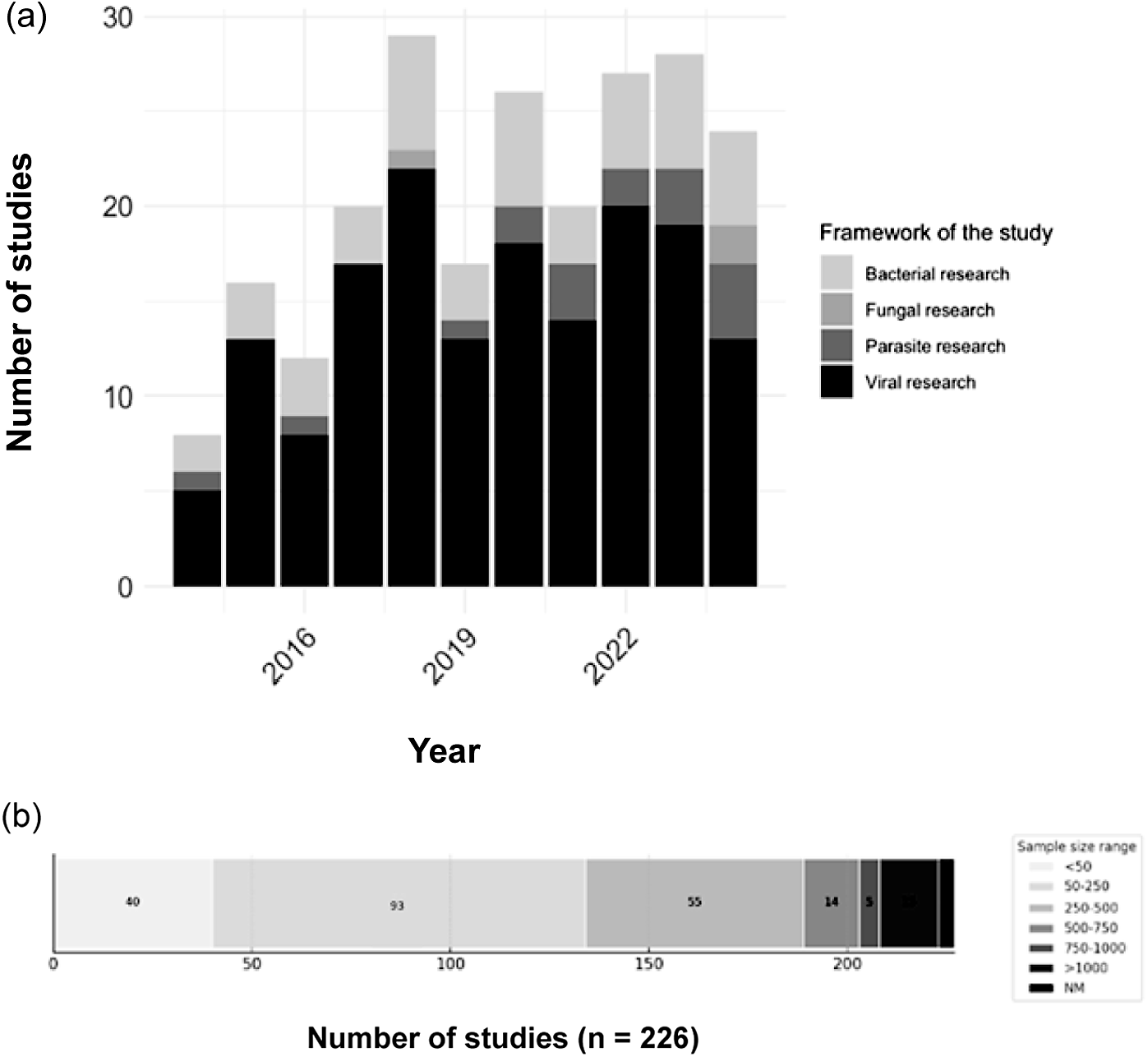
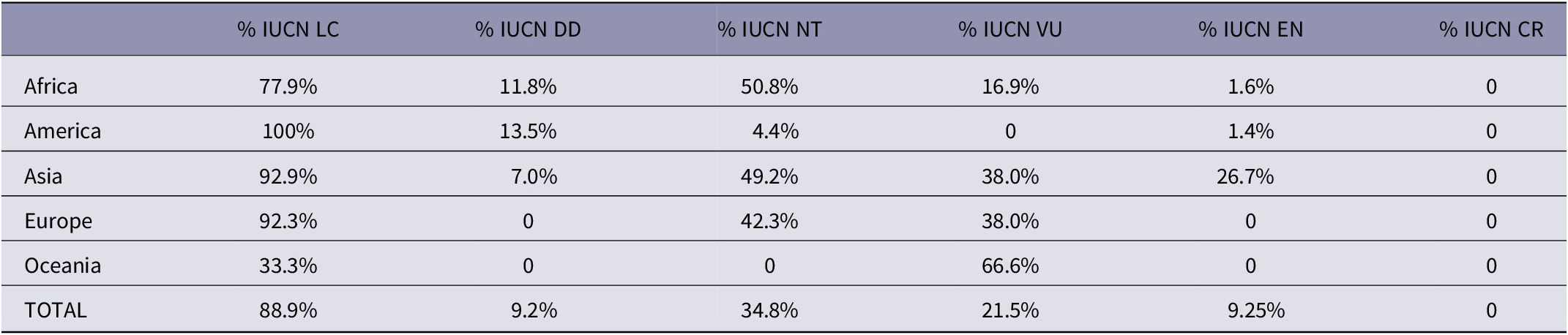
Research on bat-borne viral zoonoses was dominant throughout the articles of the ten-year period, representing 71.2% of the studies, with the annual proportion ranging between 55.5% in 2014 and 85% in 2017 (Figure 3). Research on other pathogen types (bacterial, parasite and fungal) were less well represented. Among the studies included here no clear increase from 2020 onwards was observed. Differences were observed between continents. In the American continent, viral studies accounted for 53% of the total and over 30% were focused on bacterial pathogens. Elsewhere, there was greater predominance of viral research, representing 75% of the studies in Asia, 85% in Africa, and 81% in Europe. Table 1 summarises by continent the percentages of studies including bat species belonging to each IUCN Red List category. Research in Asia and Africa often involves species of conservation concern, whereas studies in the Americas largely target non-threatened bats.
Showing (a) the temporal distribution from 2014 to 2024 of the studies relative to pathogen being assessed (bacterial, fungal, parasitic, and viral) and (b) the distribution of sample sizes across the studies, with numbers inside the bars indicating the number of studies (NM: not mentioned).

Proportion of the International Union for Conservation of Nature (IUCN) Red List categories represented among bat species sampled for zoonotic disease research, by continent. The reader should note that a single study could include multiple species belonging to different categories, such that percentages within a continent do not sum to 100% [LC: Least Concern; DD: Data Deficient; NT: Near Threatened; VU: Vulnerable; EN: Endangered; CR: Critically Endangered]

Table 1. Long description
The table consists of six columns representing I U C N categories: L C (Least Concern), D D (Data Deficient), N T (Near Threatened), V U (Vulnerable), E N (Endangered), and C R (Critically Endangered).
* Africa: 77.9 percent L C, 11.8 percent D D, 50.8 percent N T, 16.9 percent V U, 1.6 percent E N, and 0 percent C R.
* America: 100 percent L C, 13.5 percent D D, 4.4 percent N T, 0 percent V U, 1.4 percent E N, and 0 percent C R.
* Asia: 92.9 percent L C, 7.0 percent D D, 49.2 percent N T, 38.0 percent V U, 26.7 percent E N, and 0 percent C R.
* Europe: 92.3 percent L C, 0 percent D D, 42.3 percent N T, 38.0 percent V U, 0 percent E N, and 0 percent C R.
* Oceania: 33.3 percent L C, 0 percent D D, 0 percent N T, 66.6 percent V U, 0 percent E N, and 0 percent C R.
* TOTAL: 88.9 percent L C, 9.2 percent D D, 34.8 percent N T, 21.5 percent V U, 9.25 percent E N, and 0 percent C R.
Regarding the sampling size, most studies captured and sampled between 50 and 250 individuals (n = 93), followed by those sampling 250–500 individuals (n = 55). Forty studies involved fewer than 50 individuals, while large-scale samplings, with more than 500 animals, were comparatively less common. Four articles did not report the total number of bats sampled (Figure 3).
Samples collected and procedure invasiveness
Biological samples collected for zoonotic disease studies included faeces, skin swab, ectoparasites, oral and anal swabs, wing punch, blood, and internal organs. Invasive procedures identified in the reviewed papers were euthanasia (n = 109; 48.2%), anaesthesia (n = 46; 20.3%), blood sampling (n = 42; 18.6%) and PIT-tagging (n = 4; 1.7%). Additionally, two studies (0.9%) collected wing punches.
Level of compliance of the invasive procedures
There was an overall inconsistency regarding the application and reporting of recommended practices in invasive procedures, even in studies involving taxa of conservation concern. A relatively high proportion (46.3%) of research papers did not describe key methodological details, making it not possible to assess their compliance with recommended practices. Another 15.0% of the articles used methods recognised as Not compliant (Figure 4). Frequencies of studies assigned as Not compliant and missing key methodological details in threatened IUCN categories (i.e. Near Threatened, Vulnerable and Endangered) are shown in Figure 4. Similar results were obtained for the Least Concern category (overall results were 52 Compliant, 22 Not compliant and 69 Not described out of 143 total invasive procedures), and Data Deficient category (overall results were 8 Compliant, 1 Not compliant and 5 Not described out of 14 total invasive procedures).
Compliance of procedures (euthanasia, blood sampling, anaesthesia, and Passive Integrated Transponder [PIT] -tagging) with recommended practices in bat zoonotic research for (A) all studies summarised and (B) results by the International Union for Conservation of Nature (IUCN) categories of conservation concern. Stacked bars indicate the number of studies categorised as Not compliant (red), Compliant (green), and Not described (blue), the latter indicating that the methods were insufficiently detailed to allow assessment. NB NT: Near Threatened; VU: Vulnerable; EN: Endangered.

Reporting of blood-sampling procedure
Across the 42 studies involving blood sampling, 30 (71.4%) specified the anatomical site used, which included the cephalic vein (n = 17; 35.4%), interfemoral (saphenous) vein (n = 10; 20.8%), brachial (median) vein (n = 5; 10.4%), and directly from the heart (n = 3; 7.1%). Some reports indicated more than one anatomical site. Among those studies that performed blood extraction from the heart followed by release, two used anaesthesia (ketamine) and one did not report anaesthesia or any form of sedation. The volume of collected blood was indicated in 17 studies (40.5%), with 12 of these (70.6%) adhering to the < 1% bodyweight guidelines. An additional five studies explicitly stated that this threshold was respected, without specifying the exact volumes. Two papers (4.8%) mentioned fluid supplementation after the procedure.
Reporting of anaesthesia procedures
Thirty-six studies anaesthetised bats prior to euthanasia (n = 36; 78.2%), blood sampling (n = 7; 15.2%) or for safer handling of large fruit bats (Pteropodidae) during swab collection (n = 3; 6.5%). In one study, anaesthesia was also used to perform tooth extraction to determine the age. Reporting on anaesthesia protocols was typically inconsistent: 31 studies (67.3%) mentioned the drugs used, 22 (47.8%) indicated the route of administration, while just 18 (39.1%) reported the dosages. Table S1 (see Supplementary material) provides details on drug combinations, route of administration and dosages used in the reviewed studies.
Reporting of PIT-tagging procedures
Four studies marked bats for individual identification with Passive Integrated Transponders (PIT) tags. PIT-tags are glass-encapsulated microchips, injected subcutaneously, and activated by hand scanners or antenna systems. Reporting on the procedure was considered adequate for all studies, with two reporting the anatomical site where the PIT-tags were placed and two of them reporting the brand’s name of the device.
Reporting of euthanasia procedures
Among the 109 studies where bats were euthanased, only 57 (52.3%) mentioned the method used (Figure 5), 49 (45.0%) indicated the route of drug administration, and 37 (33.9%) specified the dosages. Moreover, veterinarian oversight and presence during the procedure was declared in just 12 (11.0%) papers. Significantly, over half of the studies performing euthanasia (55.0%) targeted one or more species classified within IUCN category of conservation concern.
Euthanasia methods used in the reviewed studies and application of anaesthesia prior the procedure. Each method is labelled according to American Veterinary Medical Association (AVMA) Guidelines for the Euthanasia in Animals: dots indicate methods considered “acceptable”, stars indicate methods considered “not acceptable”. The combination of dot and star mean that the method is “acceptable with conditions”, only under anaesthesia.

Reference to guidelines for sampling procedures
One hundred and two studies (45.1%) cited at least one reference document to justify their methodological compliance to established standards for animal handling, sampling, or euthanasia practices.
These references felt into three main categories: (i) legal frameworks and regulatory standards of mandatory compliance; (ii) organisational guidelines or protocols, representing recommended best practices; (iii) peer-reviewed scientific publications and book chapters. The full list of documents is available as Supplementary material 2. The most frequently cited documents were the Guidelines for use of wild mammals in research and education of the American Society of Mammologists (ASM) (n = 19), and the Guidelines for the Euthanasia of Animals of the American Veterinarian Medical Association (AVMA) (n = 11). Other commonly mentioned sources are the ARRIVE Guidelines 2.0 (n = 5), Guidelines for Surveillance and Monitoring of European Bats of EUROBATS (n = 3), guidelines from the IUCN - SSC Bat Specialist group and IUCN - SSC Wildlife Health Specialist Group (n = 3).
Institutional, governmental, and ethical permits
Most studies explicitly reported some type of permit or formal authorisation. Institutional or university approval was mentioned in 203 cases (89.8%), governmental permits in 205 studies (90.7%), and 188 studies (83.1%) stated they had obtained clearance from an ethical review board. However, the level of detail and transparency varied across studies, with 14 (12.8%) studies that practiced euthanasia lacking any statement for ethical approval.
Discussion
To the best of our knowledge, this review is the first analysis of welfare standards and reporting in bat-borne zoonotic research. Our work highlights the need for a critical re-evaluation of how research involving bats is conducted. It is notable that a substantial proportion of the studies reviewed applied euthanasia, including in threatened bat species. Euthanasia always requires explicit justification and evaluation, especially when non-lethal alternatives are feasible. Moreover, while particular caution is warranted for threatened species, invasive procedures should also be equally well justified in common ones, which are exposed to the same anthropogenic pressures and provide essential ecosystem services (Russo & Dechmann Reference Russo and Dechmann2025).
Importantly, a relatively high number of scientific papers present severe omissions in methodological reporting of these invasive procedures, and lack of compliance with internationally recognised guidelines. We call upon researchers, institutions, and academic publishers to strengthen the rigour and transparency of procedural reporting. Such shared commitment will contribute to advances in research on bat-borne pathogens, without neglecting animal welfare or long-term conservation priorities.
Indeed, disease surveillance in free-ranging wildlife, including bats, plays a crucial role in global health strategies, and has contributed to improvements in our understanding of disease transmission dynamics and to pathogens discovery. However, the scientific and societal benefits of invasive surveillance should always be weighed against its costs for animal welfare and conservation. Likewise, interpretations of zoonotic risk should remain evidence-based and avoid unsupported speculation. Indeed, wildlife itself cannot be blamed for pathogen emergence, and it is, rather, the anthropogenic disruption of ecosystems that amplifies spillover risk (Keesing & Ostfeld Reference Keesing and Ostfeld2021). The collapse of more than 70% of global wildlife populations over the past 50 years, is yet another stark confirmation of the ongoing biodiversity crisis (Living Planet Report [WWF] 2024). This context calls for an urgent shift toward more ethical and conservation-aware approaches to wildlife research.
Lack of reporting and guidelines compliance on euthanasia
Nearly half of the papers did not specify the method used for euthanasia, preventing any assessment of welfare standards. According to the AVMA, euthanasia is a two-step process involving induction of unconsciousness and insensitivity to pain, followed by cardiac and respiratory arrest. While the intentional killing of healthy animals (e.g. wild bats for public health research) remains an ethically sensitive topic, the AVMA accepts it under strict policies, guidelines and regulations (Leary et al. Reference Leary, Underwood, Anthony, Cartner, Grandin, Greenacre, Gwaltney-Brant, McCrackin, Meyer, Miller, Shearer, Turner and Yanong2020; Palmer et al. Reference Palmer, Fischer, Gamborg, Hampton and Sandøe2023). In the reviewed papers, vague statements such as “Captured bats were carefully removed from the nets from each sampling location and were immediately euthanased and dissected” were common. The lack of transparency found here raises major ethical and scientific concerns. The former relates to the welfare of free-ranging wildlife in medical research, and the latter to the reproducibility and credibility of scientific findings. Similarly, Russo et al. (Reference Russo, Ancillotto, Hughes, Galimberti and Mori2017) reported that 91% of studies collecting bats for biological and taxonomical surveys failed to indicate how euthanasia was performed. In our analysis, this rate was lower (48%), but still a cause for concern.
Even when methods were reported, important details, such as route of administration or dosages, were often missing. Moreover, the infrequent mention of veterinary oversight does not rule out that euthanasia was performed by non-skilled personnel. The American Society of Mammologists notes that veterinarians rarely accompany investigators in the field (Sikes Reference Sikes2016). Although trained field workers may be able to perform some methods for animal euthanasia (Sikes Reference Sikes2016), the presence of a veterinarian is recommended to ensure compliance with standards and prompt recognition of animal distress. In our review, exsanguination via cardiac puncture was the most common procedure and it is generally acceptable under deep anaesthesia. While most complied with this requirement, exsanguination was performed on conscious animals (n = 2) and from the brachial vein (n = 1). Overdose with inhalant anaesthetics (including isoflurane, diethyl ether, halothane) and CO2 were commonly reported. Isoflurane and halothane are accepted by the AVMA, and preferred in insectivorous bats (Lollar Reference Lollar2023), while CO₂ is acceptable with strict conditions (Sikes Reference Sikes2016). Yet, we did not find indication that distress-minimising protocols were followed when using CO₂ in any of the articles. Diethyl ether is not considered an acceptable method due to its slow induction and high irritability for the respiratory airways (Leary et al. Reference Leary, Underwood, Anthony, Cartner, Grandin, Greenacre, Gwaltney-Brant, McCrackin, Meyer, Miller, Shearer, Turner and Yanong2020). In rodents it is regarded as highly inhumane, with animals spinning and stretching before dying (Aguwa et al. Reference Aguwa, Eze, Obinwa, Okeke, Onwuelingo, Okonkwo, Ogbuokiri, Agulanna, Obiesie and Umezulike2020). Still, it was the third most mentioned euthanasia drug in our dataset, including articles that had been published recently. Other papers reported methods including cervical dislocation (conditionally accepted but requiring skilled personnel), acceptable non-inhaled drug combinations (i.e. overdose of pentobarbital, ketamine with α2-agonists), as well unapproved methods (i.e., the use of ketamine alone) (Heard et al. Reference Heard, West, Heard and Caulkett2014; Leary et al. Reference Leary, Underwood, Anthony, Cartner, Grandin, Greenacre, Gwaltney-Brant, McCrackin, Meyer, Miller, Shearer, Turner and Yanong2020; Lollar Reference Lollar2023). More unacceptable methods reported included chloral hydrate, ethyl acetate, potassium chloride, hypothermia and harvesting dead animals directly from the net.
Notably, in some of the reviewed studies, non-invasive sampling was combined with euthanasia of a subset of individuals with the sole purpose of obtaining voucher specimens for museum collections. This practice is increasingly questioned in modern biology and can be replaceable with other no-lethal alternatives (Minteer et al. Reference Minteer, Collins, Love and Puschendorf2014; Russo et al. Reference Russo, Ancillotto, Hughes, Galimberti and Mori2017).
Blood sampling and anaesthesia
Reporting on anaesthesia protocols was inconsistent across the articles reviewed. Only a very small percentage of studies provided basic details, such as drug combinations, routes of administration, or dosages, which are important to guarantee welfare. Moreover, given the scarcity of published data on bat anaesthesia, well-documented cases are valuable to expand species-specific knowledge in veterinary practice. This applies for anaesthetic protocol with recovery, rather than pre-euthanasia. In the papers reviewed here, reversible anaesthesia was used in some studies to achieve muscle relaxation and to minimise handling distress prior to sampling. In bats, inhaled agents are generally preferred for their safeness and effectiveness, while parental anaesthesia remains less studied and described for a limited number of species, mostly large fruit bats (Heard Reference Heard, West, Heard and Caulkett2014; Barbon et al. Reference Barbon, Glendewar, Drane, Shave and Routh2017; Amari et al. Reference Amari, Brioschi, Rabbogliatti, Di Cesare, Pecile, Giordano, Moretti, Magnone, Bonato and Ravasio2022). Route of delivery should be chosen carefully as it can cause damage that may compromise physiological functioning of the animals, for example injections into pectoral flight muscles should be avoided (Heard Reference Heard, West, Heard and Caulkett2014). The scarcity of knowledge on secondary effects, such as persistent penile erection in Hypsugo savii and Pipistrellus kuhlii under isoflurane, require precaution (Serpieri et al. Reference Serpieri, Prandi, Ottino, Bonaffini, Quaranta and Mauthe von Degerfeld2025). Whenever anaesthesia is applied, veterinary oversight should be ensured, even when administration is performed by trained biologists under authorised protocols, as accepted in some countries (Sikes et al. Reference Sikes2016; Directive 2010/63/EU). As anaesthesia is never risk-free, researchers should always perform thorough monitoring and fully disclose protocols and evaluate their choices in relation to the anaesthetic purpose and species involved.
Similarly, blood sampling in bats is associated with a number of specific challenges. Recognised risks include delayed haemostasis, large haematoma, and potential fight impairment (Eshar & Weinberg Reference Eshar and Weinberg2010; Heard Reference Heard, West, Heard and Caulkett2014). High variability in clot kinetics and a prolonged intrinsic pathway, compared with most terrestrial mammals, were confirmed in a recent study on Pteropus bats (Brenner et al. Reference Brenner, Alexander, Londoño, Stacy, Crevasse, Hernandez and Wellehan2024). Light anaesthesia is routinely employed prior to venipuncture in large-sized bats, but it also presents advantages in some smaller species, enabling better haemostasis, safer handling and reduced restraint time (Wimsatt et al. Reference Wimsatt, O’Shea, Ellison, Pearce and Price2005; Heard Reference Heard, West, Heard and Caulkett2014). Reports of cardiac blood sampling in conscious bats for non-terminal procedures were found in this review, raising serious concerns about animal suffering and potential risk of mortality. Although considered by some to be the most ethical no-lethal option for large-volume sampling in wild rodents (Williams et al. Reference Williams, Linske and Stafford2020), it remains unstandardised for chiropterans and should not be used. Fluid administration after venipuncture, a simple yet effective refinement measure to help maintain blood volume and prevent hypovolaemia (Wimsatt et al. Reference Wimsatt, O’Shea, Ellison, Pearce and Price2005; Heard et al. Reference Heard, West, Heard and Caulkett2014), was reported in only two cases. Many solutions are adequate for oral hydration of different species, such as Hartmann and Ringer solution for haematophagous, and sugar water for nectarivorous bats (Aguilar-Setién et al. Reference Aguilar-Setién, Aréchiga-Ceballos, Balsamo, Behrman, Frank, Fujimoto, Gilman Duane, Hudson, Jones, Ochoa Carrera, Powell, Smith, Triantis Van Sickle and Vleck2022). Details on suggested venipuncture sites and restraint techniques are described elsewhere (Eshar & Weinberg Reference Eshar and Weinberg2010; Aguilar-Setién et al. Reference Aguilar-Setién, Aréchiga-Ceballos, Balsamo, Behrman, Frank, Fujimoto, Gilman Duane, Hudson, Jones, Ochoa Carrera, Powell, Smith, Triantis Van Sickle and Vleck2022). Researchers should stay up-to-date on new restraint and blood-sampling devices, which can improve animal welfare and ease the work, such as the design proposed by Morgan et al. (Reference Morgan, Mauldin, Jones, Collier and Nakazawa2022).
Individual marking methods: PIT-tagging
Unlike forearm ringing, which remains under debate regarding use in marking bat individuals (Baker et al. Reference Baker, Lumsden, Dettmann, Schedvin, Schulz, Watkins and Jansen2001; Dietz et al. Reference Dietz, Dietz, Ivanova and Siemers2006; Zambelli et al. Reference Zambelli, Moretti, Mattei-Roesli and Bontadina2009), subcutaneous PIT-tagging of bats is currently considered a safe procedure (Lobato-Bailón et al. Reference Lobato-Bailón, López-Baucells, Guixé, Flaquer, Camprodon, Florensa-Rius, Mas, Torrent, Ordeix, Tallo-Parra, Ribas, Marco, Carvajal, López-Bejar, Napp, Pailler-García, Espunyes and Cabezón2023). In this review, studies generally provided a satisfactory description and justification of the PIT-tag placement procedure.
Guidelines and formal approvals
Less than half of the reviewed studies mentioned a source to justify compliance with established standards for animal handling, sampling, and euthanasia. This covered a heterogeneous set of sources, and such variability might reflect the absence of a universally adopted bat-specific reference document and highlights the need for greater standardisation in field procedures. The most frequently cited documents were the Guidelines for the Euthanasia of Animals of the American Veterinary Medical Association (Leary et al. Reference Leary, Underwood, Anthony, Cartner, Grandin, Greenacre, Gwaltney-Brant, McCrackin, Meyer, Miller, Shearer, Turner and Yanong2020) and the Guidelines for the use of Wild Mammals in Research and Education of the American Society of Mammalogists (Sikes Reference Sikes2016). Both provide comprehensive instructions on field protocols, personnel competencies, and oversight requirements (Sikes Reference Sikes2016; Leary et al. Reference Leary, Underwood, Anthony, Cartner, Grandin, Greenacre, Gwaltney-Brant, McCrackin, Meyer, Miller, Shearer, Turner and Yanong2020). Nevertheless, in some cases, even when these guidelines were cited, key procedural details were omitted. While citing adherence to guidelines is important, it cannot be considered sufficient alone. Full methodological details must always be disclosed to ensure transparency.
More concerning, we found published articles in which euthanasia was performed without mentioning any statement of approval by an ethical review board. Such omissions raise questions about compliance with institutional, international, national regulations, and do not align with widely recognised standards. As discussed, lethal sampling in wildlife is ethically sensitive, and the lack of approval statements may undermine public and scientific trust, compromising the perceived validity of the work. Furthermore, we are also worried that the presence of formal permits or ethical approvals do not necessarily guarantee adequate animal welfare standards. In some countries, ethical review procedures and enforcement mechanisms may be less stringent than those adopted, for instance, in the European context (e.g. UNEP/EUROBATS 2019; Directive 2010/63/EU). In international collaborations, procedures not accepted in researchers’ home countries may still be conducted in regions with weaker regulations, raising concerns about double standards and ethical consistency.
Taken together, all these issues highlight the need for internationally agreed criteria defining minimum welfare standards in bat research worldwide.
One Health, One Welfare: Toward an integrated ethical framework for bat research
One Health supports the interconnection between human, animal, and ecosystem health. Its applications are aimed to optimise health across all its dimensions, seeking a balanced compromise. In practice, however, One Health implementations in bat research often remain anthropocentric, with zoonotic risk reduction seen as the main priority (Palmer et al. Reference Palmer, Fischer, Gamborg, Hampton and Sandøe2023). Arguments about how wildlife is valued relative to human health could be raised here. Moreover, although ethical awareness and non-invasive methodologies in wildlife research have increased over the past 25 years (Zemanova Reference Zemanova2020; Schilling et al. Reference Schilling, Mazzamuto and Romeo2022), an explicit ethical framework for bat studies is still lacking. Given the volume of research conducted on bats globally, greater consistency and shared standards would be highly valuable. One Welfare, based on similar foundational ideas, but also grounded on the concepts of welfare and well-being, may serve as the basis for developing an ethical framework to guide One Health (Garcia Pinillos et al. Reference García Pinillos, Appleby, Manteca, Scott-Park, Smith and Velarde2016; Palmer et al. Reference Palmer, Fischer, Gamborg, Hampton and Sandøe2023). In the context of bat research, the One Welfare perspective could help to ensure that human health does not come at the expense of animal welfare. Considering that research on bat-borne zoonoses is carried out mainly in the Global South, integrating One Welfare would also mean more recognition for local fieldworkers, who are often excluded from the study design and operate under precarious conditions (Roth Reference Roth2024). This is directly relevant to our discussion, as social research has shown inconsistent application of animal welfare standards by field staff to be a reflection of the disconnect between top-down protocols and field reality (Roth Reference Roth2024). Thus, a more equitable and context-sensitive science would also mean higher standards of welfare. Overall, a more integrated perspective could address the gaps highlighted in our review, including limited welfare in invasive procedures and inconsistent methodological transparency.
Animal welfare implications
This review indicates that current bat-borne zoonotic research often involves practices that expose animals to avoidable harm, including the use of invasive and lethal methods without transparency. A substantial proportion of the studies assessed were found to be non-compliant with relevant animal welfare criteria, highlighting important concerns regarding animal welfare in bat research. Also concerning is the frequent omission of methodological details, which prevents proper evaluation of welfare standards and undermines efforts toward refinement. Scientific journals can contribute to this process by encouraging comprehensive reporting and ensuring that methodological and welfare considerations are adequately addressed.
We urge stronger requirements for detailed reporting, explicit justification of invasive methods, and prioritisation of less invasive alternatives as essential steps to align zoonotic research with animal welfare standards. More harmonised and internationally agreed guidance for invasive bat research, potentially built on existing frameworks, could also help promote more consistent welfare practices across studies.
In the context of the ongoing biodiversity crisis, wildlife research should be conducted with careful consideration of its potential impacts on the studied animal populations. Integrating animal welfare into research design and reporting, applying One Welfare principles, and reducing avoidable harm should become shared priorities to prevent research from adding unnecessary pressure to wild populations.
Supplementary material
The supplementary material for this article can be found at http://doi.org/10.1017/awf.2026.10123.
Data availability statement
This study is a systematic review of published literature and did not generate new primary data. The dataset extracted from the 226 included studies is available in the Supplementary material.
Acknowledgements
CP is supported by the predoctoral programme AGAUR-FI ajuts (2023 FI-3 00065) Joan Oró of the Secretariat of Universities and Research of the Department of Research and Universities of the Generalitat of Catalonia and the European Social Plus Fund. XFA acknowledges support under a Ramón y Cajal contract (RYC2022-036927-I), funded by the Agencia Estatal de Investigación (Spanish Ministry of Science, Innovation and Universities).
Competing interests
None.




 Open access

