1. Introduction
Being bilingual and intending to speak inevitably involves selecting the appropriate language. On a regular basis, proficient bilinguals switch between their languages in a seemingly effortless way and often without errors in selection. Yet, psycholinguistic research has shown that switching between languages may be costly as a result of inhibitory processes serving to prevent competing, simultaneously activated linguistic elements from interfering in production (Green, Reference Green1986, Reference Green1998). In order to study these mechanisms of cognitive control active in the bilingual mind, much research employs the cued language-switching paradigm, in which participants are asked to respond based on a language cue, with the aim of comparing response times (RT) across participant groups on switch and non-switch trials by specifically controlling for factors such as relative proficiency or language context (Meuter, Reference Meuter, Kroll and de Groot2005, Reference Meuter, Isurin, Winford and de Bot2009). While effects of co-activation, interaction and inhibition of competing linguistic structures have been found at all linguistic levels (phonetics and phonology: e.g., Goldrick, Runnqvist & Costa, Reference Goldrick, Runnqvist and Costa2014; Olson, Reference Olson2013; Marian & Spivey, Reference Marian and Spivey2003; syntax: e.g., Kootstra, van Hell & Dijkstra, Reference Kootstra, van Hell and Dijkstra2010; Hartsuiker, Pickering & Veltkamp, Reference Hartsuiker, Pickering and Veltkamp2004; Hartsuiker & Pickering, Reference Hartsuiker and Pickering2008; orthography: e.g., van Heuven, Dijkstra & Grainger, Reference van Heuven, Dijkstra and Grainger1998; semantics: e.g., Sunderman & Kroll, Reference Sunderman and Kroll2006), recent psycholinguistic research has made no attempt at isolating which linguistic level(s) may be involved in generating the observed switching costs. In fact, the language pairs chosen in these studies often differ along various dimensions simultaneously (i.e., not only in syntax but also in phonological systems and vocabulary). This makes it virtually impossible to determine which of these linguistic levels are responsible for the observed cognitive switching cost.
The current paper addresses this question by presenting data from two language contact scenarios, where the languages involved in the experiment show systematic linguistic differences, thus focusing on the typological distance in language pairs, rather than degree of bilingualism, language dominance or other participant-centered factors often discussed in the switching literature. The data come from multilingual communities in Colombia and Ecuador involving a Spanish-based creole (Palenquero) and mixed language (Media Lengua), respectively. Formed under extreme language contact conditions involving the slave trade (e.g., Palenquero) or drastic social change (e.g., Media Lengua), such contact-induced languages often incorporate grammar from one language but vocabulary from another and are, thus, excellent testing grounds to gauge the relative contribution of grammar or lexicon to switching costs. Cognates (lexical items which are cross-linguistically highly similar in form and meaning, such as Spanish bailar and Palenquero bailá “to dance”) comprise a large amount of the lexical inventory in these contact-induced varieties, providing insight into speech production and comprehension processes in the presence of numerous highly form-similar lexical items (see also Cai, Pickering, Yan & Branigan, Reference Cai, Pickering, Yan and Branigan2011; Huang, Pickering, Chen, Cai, Wang & Branigan, Reference Huang, Pickering, Chen, Cai, Wang and Branigan2019). Besides refining the nature of switching costs, data from understudied and traditionally marginalized communities may prove particularly valuable to expand our knowledge of the psycholinguistic processes involved in language processing (Speed, Wnuk & Majid, Reference Speed, Wnuk, Majid, de Groot and Hagoort2018; Jaeger & Norcliffe, Reference Jaeger and Norcliffe2009; Norcliffe, Harris & Jaeger, Reference Norcliffe, Harris and Jaeger2015; Whalen & McDonough, Reference Whalen and McDonough2015). In light of the fact that the vast majority of psycholinguistic work is still centered on Western, Educated, Industrialized, Rich, and Democratic (WEIRD) populations (Henrich, Heine & Norenzayan, Reference Henrich, Heine and Norenzayan2010), it is especially relevant to verify the validity of our theoretical models by considering data from outside of these populations (Lipski, Reference Lipski2019a).
Cueing participants to switch between these contact-induced languages and their source languages, the current study also tests for the mental representation of contact-induced languages in comparison to their grammatical or lexical donor languages, a question relevant for language contact research as issues of language status and structural convergence between languages often remain debated. If switching costs are found, this would indicate separate rather than conflated language systems. Thus, with this paper, the relationship between psycholinguistics and contact linguistics is highlighted as mutually beneficial: studying contact-induced languages can enrich psycholinguistic models of language while experimental methods can substantially enhance our understanding of language contact phenomena including contact-induced language change and the nature of contact-induced languages.
2. The cued language-switching paradigm
2.1 Switching is costly: A brief summary of the state of affairs
The cued language-switching paradigm was first employed in the seminal study conducted by Meuter and Allport (Reference Meuter and Allport1999), cueing participants to name colored digits in their first or second language unpredictably: RTs on switch trials were consistently slower than on stay trials and asymmetric depending on whether participants switched into their dominant or weaker language. The authors concluded that a participant's dominant language needs to be inhibited during speech production in the weaker language, suggesting that proficiency levels have an effect on language production. Since this first exploration of language switching in speech production, a number of studies have replicated the same effects and refined the theoretical implications (Bobb & Wodniecka, Reference Bobb and Wodniecka2013; Verhoef, Roelofs & Chwilla, Reference Verhoef, Roelofs and Chwilla2009).
Costa and Santesteban (Reference Costa and Santesteban2004) argued that balanced bilinguals, contrary to L2 learners, may not show asymmetric switching costs even between their L1 and a much weaker L3, suggesting that performance is not tied to proficiency levels in highly proficient bilinguals. These results are in line with accounts of inhibitory control, predicting that similar levels of proficiency lead to similar levels of co-activation and, consequently, similar levels of inhibition. Given that highly proficient bilinguals engage in language switching more often than L2 learners, the absence of asymmetric switching costs between a stronger and a weaker language indicates that proficient speakers do not need to inhibit their dominant language as strongly to produce a weaker language.
Besides levels of proficiency or dominance modulating switching costs, whether switching is predictable or voluntary can attenuate switching costs and may result in similar switching performances between balanced and unbalanced bilinguals, as these scenarios entail that speakers can plan their response, resembling a more ecologically-valid use of language (Gollan & Ferreira, Reference Gollan and Ferreira2009). Additionally, participant-specific strategies (bilinguals vs. professional translators) and the type of cue (language-unambiguous vs. arbitrary color cue) can influence switching costs (Ibáñez, Macizo & Bajo, Reference Ibáñez, Macizo and Bajo2010). Finally, some studies show that structural differences may modulate switching costs but that switch costs between phrases and individual words are similar (Tarlowski, Wodniecka & Marzecová, Reference Tarlowski, Wodniecka and Marzecová2013). Studying entire phrases rather than single, unrelated items is particularly relevant when real-life language switching is to be explained, where single lexical items are only rarely switched to the same extent as in switching studies conducted in the laboratory.
Since the current study examines language pairs with largely cognate vocabularies or high structural overlap, it is relevant to consider effects related to cognate facilitation (e.g., Costa, Caramazza & Sebastian-Galles, Reference Costa, Caramazza and Sebastian-Galles2000; Costa, Santesteban & Caño, Reference Costa, Santesteban and Caño2005). Declerk, Koch and Philipp (Reference Declerck, Koch and Philipp2012) examined cognate facilitation in digit and picture naming, indicating that there was no difference in switch costs between digits (which are often cognate) and cognate pictures. They conclude that the phonological co-activation induced with cognate stimuli can reduce switch costs. Other studies, however, have also reported cognate facilitation on naming latencies but increased switch costs with cognates (Christoffels, Firk & Schiller, Reference Christoffels, Firk and Schiller2007; but see Filippi, Karaminis & Thomas, Reference Filippi, Karaminis and Thomas2013, for no cognate facilitation) or no cognate influence whatsoever (Bultena, Dijkstra & van Hell, Reference Bultena, Dijkstra and van Hell2015; Ibáñez et al., Reference Ibáñez, Macizo and Bajo2010). It is unclear which effect – if any – is to be expected with cognates embedded in entire phrases, as employed in the current study.
In sum, while many studies have employed the switching paradigm, results have not been uniform and different interpretations of the degree of inhibitory control depending on the task and the bilingual speaker have been put forth (Declerck & Philipp, Reference Declerck and Philipp2015; Bobb & Wodniecka, Reference Bobb and Wodniecka2013). Given this diversity in methodologies and results, one remaining question in this line of research is what switch costs really measure, as the exact contribution of cognitive processes besides inhibition is still largely understudied. In particular, speech production usually starts with a nonlinguistic concept of the message, then proceeds to select an appropriate lemma together with the relevant morphosyntactic information, before activating the corresponding sound representations and, finally, articulating the message (Levelt, Roelofs & Meyer, Reference Levelt, Roelofs and Meyer1999). It is unclear which of these levels are the loci of language control as it is often difficult to disentangle the contribution of inhibitory processes on these individual parts of the speech production process. This mostly results from the fact that the language pairs that are usually selected in these switching studies differ on multiple linguistic levels simultaneously (e.g., not only syntax but also phonology), which obscures their respective contribution. The current paper presents two language contact scenarios that may provide a window into these speech production processes on the basis of the linguistic features characterizing the respective languages, thus allowing us to gauge the relative contribution of grammar and lexicon to language switching costs. Moreover, the current paper is one of only a few that have extended the cued language-switching paradigm to study processes of language comprehension (e.g., Bultena et al., Reference Bultena, Dijkstra and van Hell2015; Thomas & Allport, Reference Thomas and Allport2000; Grosjean, Reference Grosjean, Grosjean and Byers-Heinlein2018) and, to my knowledge, the first to employ a similar set of stimuli in both production and comprehension across multiple language pairs. Furthermore, the current study explores whether and how contact-induced languages share mental representations with their respective source languages and how switching costs may be indicative of separate linguistic systems.
2.2 Switch costs as evidence of separate linguistic systems
During bilingual speech production, the non-target language has to be inhibited to avoid interference of competing linguistic elements. When a language switch occurs, this inhibition needs to be overcome, resulting in a measurable switch cost as compared to trials without a language switch. This finding reflects the need to re-set the cognitive system and select a new task-goal on switch trials, indicating that, while languages may be co-activated and compete for selection, bilinguals in fact switch between different language schemas (Costa & Santesteban, Reference Costa and Santesteban2004). This fact has interesting implications for the field of contact linguistics, where mere geographic proximity of multiple languages has sometimes been taken to lead to contact-induced language change (e.g., convergence, i.e., increased structural similarity between two languages in contact) and where switch costs could serve as useful experimental evidence to test such putative claims of conflated linguistic systems. As concerns the case of creoles and mixed languages, it has always been of importance to linguists to define them in terms of their linguistic features and relationship to their source languages (e.g., Thomason & Kaufman, Reference Thomason and Kaufman1988; Bakker & Matras, Reference Bakker, Matras, Bakker and Matras2013; Bakker, Daval-Markussen, Parkvall & Plag, Reference Bakker, Daval-Markussen, Parkvall and Plag2011; Sebba, Reference Sebba1997; Holm, Reference Holm2000). For instance, it is often debated whether a particular creole is becoming structurally more similar to its lexical donor language (or, lexifier) over time, a process termed decreolization, resulting from social pressures from a superordinate language. While a comparison of historical and contemporary data may offer crucial insights into processes of language change, such historical evidence is often not available. Psycholinguistic methods, on the other hand, may yield a fine-grained picture of whether speakers of contact-induced languages mentally separate the highly structurally similar languages they speak, as speed and accuracy measurements can reveal “how a bilingual's two languages interact” (Dussias, Gullifer & Poepsel, Reference Dussias, Gullifer, Poepsel, Schwegler, McWhorter and Ströbel2016, p. 3): Switch costs could then serve to identify language boundaries and answer questions regarding the conflation of linguistic systems from a cognitive perspective. Since contact-induced languages share grammar or lexicon with their source languages, presence or absence of switch costs in such language pairings can thus answer the question of whether these linguistic subsystems are represented jointly or separately, which has important ramifications for current theories of language production and comprehension.
3. Language contact scenarios in Colombia and Ecuador
3.1. Colombia: The case of Palenquero Creole-Spanish bilingualism in San Basilio de Palenque
In San Basilio de Palenque (Figure 1), a village with about 4000 residents some 80km south of Cartagena, Colombia, a Spanish-based creole, Lengua Palenquera, is spoken together with Spanish (e.g., Escalante, Reference Escalante1954; Bickerton & Escalante, Reference Bickerton and Escalante1970; de Friedemann & Patiño Roselli, Reference de Friedemann and Patiño Roselli1983). The creole and its lexifier (Spanish) share a large amount of cognate vocabulary while their grammar is substantially different. Some Palenquero characteristics different from Spanish include lacking subject-verb agreement inflections, presence of preverbal Tense/Aspect/Mood (TAM) markers, clause-final placement of negation, postposed possessive pronouns, besides missing definite articles, bare plural nouns and absence of grammatical gender (e.g., Lipski, Reference Lipski2016a; Schwegler & Green, Reference Schwegler, Green, Holm and Patrick2007). Spanish, in contrast, shows subject-verb agreement, employs pre-verbal negation and preposed pronouns, allows bare nouns only in specific contexts, and generally inflects for gender. Despite the apparent grammatical differences rendering both languages mutually unintelligible, both Palenquero and Spanish are considered head-initial languages with Palenquero showing somewhat more rigid word order than Spanish, as is generally the case for creole languages. The proportion of cognate vocabulary between both languages, however, is striking, with abundant examples of high – if not perfect – form overlap: Spanish vender [ben.ˈdeɾ] matches Palenquero bendé [ben.ˈde] “to sell” while Spanish quedar [ke.ˈðaɾ] corresponds to Palenquero kelá [ke.ˈla] “to stay”, for example. In the case of mixed utterances, contrasts between both languages have been noted to be less pronounced than between language pairs that show fewer lexical similarities (Lipski, Reference Lipski2016a, p. 49; see also Schwegler & Morton, Reference Schwegler and Morton2003, p. 119, for a perspective on code-neutral segments). Given these high lexical similarities, participants switching between Palenquero and Spanish would essentially switch (similarly headed) grammar while using highly cognate vocabulary, i.e., vocabulary is practically kept constant.
Map of Northern Colombia showing the approximate geographic location of the village of San Basilio de Palenque.

Since some authors have claimed that Palenquero shows evidence of decreolization, an approximation of its linguistic structure to its lexifier (e.g., Megenney, Reference Megenney1986; but see Schwegler, Reference Schwegler, Neumann-Holzschuh and Schneider2001; Lipski, Reference Lipski2016a), previous psycholinguistic research has examined Palenquero and Spanish in a cued language-switching task using pictures in order to trace effects of decreolization experimentally (Dussias et al., Reference Dussias, Gullifer, Poepsel, Schwegler, McWhorter and Ströbel2016): The authors argue that
if significant decreolization had occurred as a result of the prolonged bilingualism and societal superstrate pressures from Spanish, one might expect the psycholinguistic status of the creole to approximate that of Spanish, effectively blurring the boundaries between the two languages; under this scenario, switch costs would not be expected (Dussias et al., Reference Dussias, Gullifer, Poepsel, Schwegler, McWhorter and Ströbel2016, p. 15).
However, RTs between a group of early and late learners of Palenquero revealed significant switching costs, suggesting that Spanish and Palenquero are cognitively separate language systems. Thus, Dussias et al. (Reference Dussias, Gullifer, Poepsel, Schwegler, McWhorter and Ströbel2016) conclude that this constitutes evidence against Palenquero having undergone partial decreolization. The current study will examine whether this result holds for the production and comprehension of short phrases.
3.2 Ecuador: The case of Quichua-Media Lengua-Spanish multilingualism in Imbabura
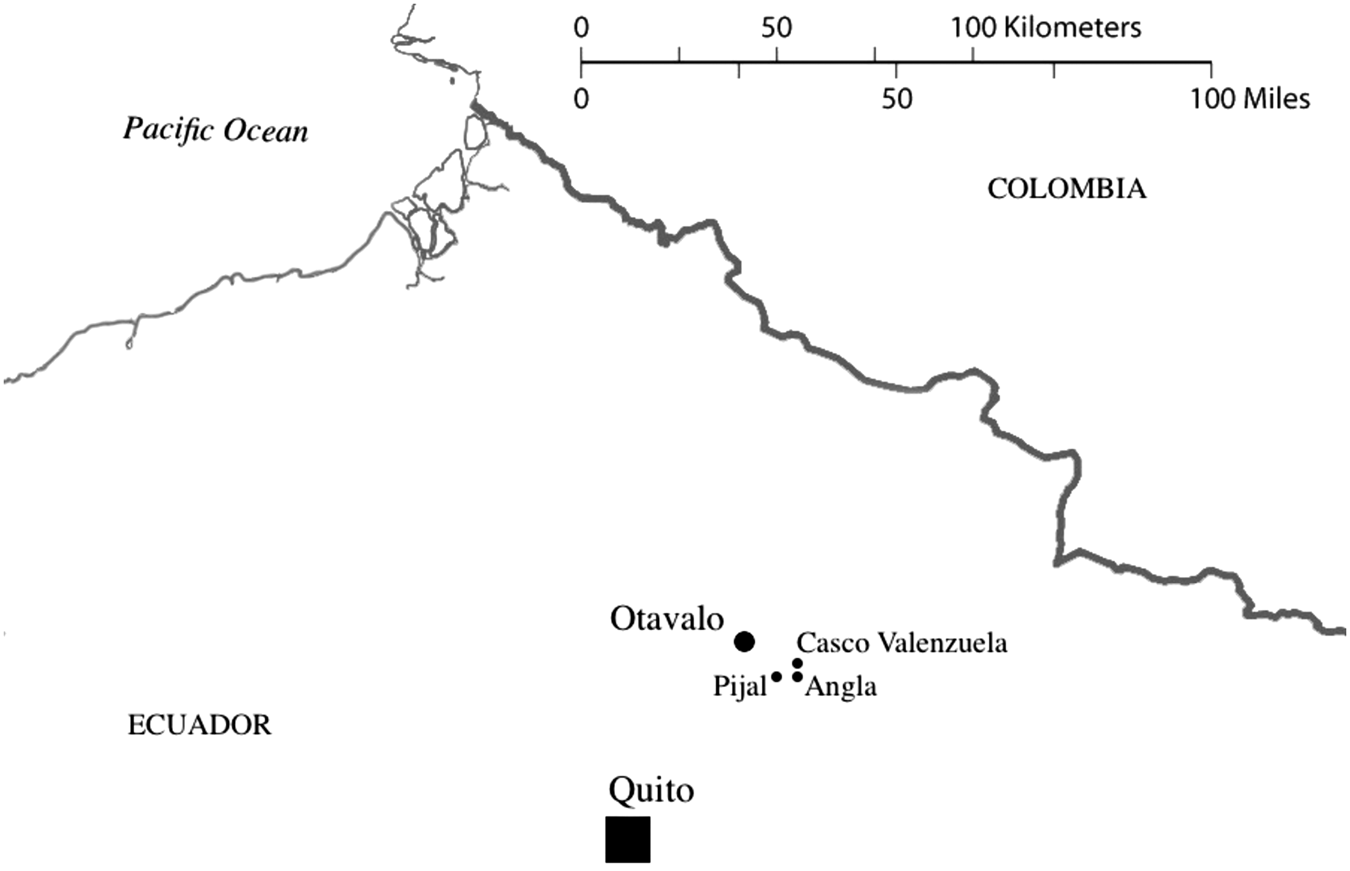
In highland Ecuador, about 20km outside of Otavalo, Imbabura Province (Figure 2), speakers in the villages of Pijal, Angla and Casco Valenzuela are multilingual in Spanish, Quichua and an intertwined language, Media Lengua (Gómez Rendón, Reference Gómez Rendón2008; Stewart, Reference Stewart2011, Reference Stewart2013, Reference Stewart2014, Reference Stewart2015a, Reference Stewartb, Reference Stewart2017, Reference Stewart2018; Lipski, Reference Lipski2016b, Reference Lipski2017; Deibel, Reference Deibel2019; Deibel, Reference Deibel, Mazzoli and Sippolaunpublished manuscript). This lexicon-grammar mixed language retains nearly all Quichua morphosyntax while over 90% of its vocabulary has been systematically replaced with Spanish lexical roots (Muysken, Reference Muysken, Highfield and Valdman1981). Compare, for example, the Media Lengua inflected verb come-hu-n “eat-prog-3” to its Quichua counterpart miku-hu-n, where inflections are identical but lexical roots are different (Media Lengua come < Spanish comer “to eat”). Thus, Media Lengua shows a clear split between lexical and grammatical categories, which are expressed in either of the two source languages, respectively.
Map of Northern Ecuador showing the approximate geographic location of the villages of Pijal, Angla and Casco Valenzuela in the Imbabura Province to the North of Quito.

From a typological perspective, Quichua and Spanish are fundamentally different: Quichua is generally described as a head-final language while Spanish can be considered a head-initial language. Given that Media Lengua follows Quichua morphosyntax, it can be characterized as head-final as well. If participants are switching between these three languages, this would correspond to 1) a switch of (non-cognate) vocabulary only (Media Lengua-Quichua switching), 2) a switch of (differently headed) grammar while employing cognate vocabulary (Media Lengua-Spanish switching) or 3) a switch of both vocabulary and differently headed grammar (Spanish-Quichua switching). In addition, since it has been suggested that Media Lengua's syntax may contain Spanish syntactic features (e.g., Muysken, Reference Muysken, Highfield and Valdman1981; Gómez Rendón, Reference Gómez Rendón2008), the presence or absence of switching costs and their modulation with respect to the other language pairings would indicate whether and how such features may be accessed during speech processing.
3.3 Summary of language pairs and hypotheses
By examining two contact-induced languages that differ systematically from their source languages, the current study tests how such systematic differences impact language switching costs. Table 1 presents a summary of the language pairs described in sections 3.1 and 3.2 in the predicted order of increased switching difficulty. It is expected that the more structurally similar the two switched languages are, the less costly it will be for participants to switch between them. Four possible switching manipulations regarding the lexicon-grammar distinction are investigated: two pairs target similar syntactic directionality with either cognate vocabulary (Palenquero-Spanish) or dissimilar vocabulary (Media Lengua-Quichua) while the other two pairs target different syntactic headedness with either cognate vocabulary (Media Lengua-Spanish) or dissimilar vocabulary (Spanish-Quichua). This manipulation will allow us to study how multiple (very similar) languages are represented and activated in the bilingual mind. In addition, the presence or absence of switching costs will indicate whether the two linguistic systems that are being switched at a time are cognitively separate or conflated.
Summary of the language pairs, their corresponding switched elements and their respective predicted difficulty.

4. Switching grammar or lexicon in production
4.1 Task design and materials
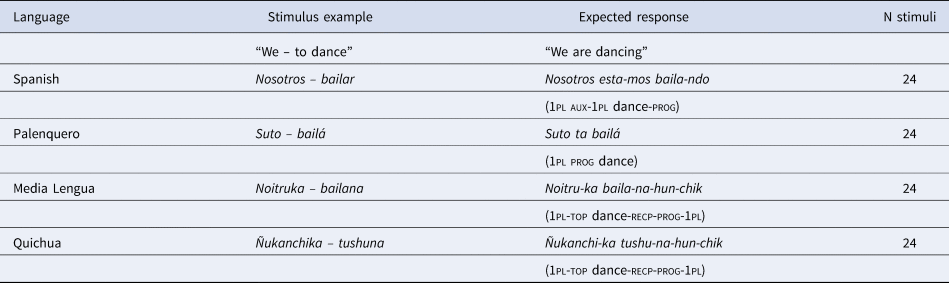
The current experiment targets production of short intransitive phrases containing a personal pronoun and an inflected verbal complex (i.e., either including an inflected verb or a TAM marker plus the verb, as applicable for each language) since lexical items in Media Lengua and Spanish would be practically identical, rendering a picture naming study (the most frequently employed technique in the paradigm) unsuitable. In order to accommodate illiterate community members, stimuli consisted of an auditory cue indicating the language to be produced unambiguously (in the present experiment, the first person plural subject pronoun to be included in the response), followed by a verb in the infinitive in the respective languages (Table 2). The Colombian stimuli were recorded by a native speaker of Palenquero and Caribbean Spanish, the Ecuadorian stimuli by a native speaker of Ecuadorian Spanish, Media Lengua and Quichua; both are members of the studied communities. Since there are no frequency measurements available for verbs in Palenquero, Quichua or Media Lengua, a total of 24 verbs was selected based on whether their Spanish equivalents are regular -ar verbs that, in their majority, describe every-day activities (e.g., bailar “to dance,” cantar “to sing,” hablar “to talk,” descansar “to rest”) to ensure that they would be used with roughly similar frequency across the two field sites. All verbs are either intransitive or can be described as object-drop verbs (Levin, Reference Levin1993), i.e., a response would be well-formed even without an object (e.g., tomar [algo] “to drink [sth]”).
Stimuli examples and expected responses for all languages (production task).

Participants were instructed to form a short phrase in the present progressive tense based on the presented stimulus. It was emphasized that languages would switch every two trials and four example responses were presented to the participants to ensure that they would perform the task accurately. Due to the high structural similarity of the languages and the auditory presentation of stimuli, a predictable design appeared most feasible and ecologically-valid for the current communities. Contrary to laboratory research, participants in field experiments are not necessarily accustomed to working with a computer or to responding to highly controlled and speeded experiments. Furthermore, the language boundaries in a participant's mind may not necessarily correspond to the separate languages a linguist would identify, particularly when the languages involved are stigmatized and not institutionally normed – characteristics which apply to several of the languages studied here. Thus, presenting detailed examples and clear instructions is particularly relevant in experiments conducted in a field research setting. At the same time, experiments in the field generally need to be shorter than laboratory studies as participants tire quickly.
There were 48 stimuli (24 in each language as per the total number of selected target verbs) in each language pair, corresponding to a total of 48 stimuli for Colombian participants (Palenquero-Spanish pair) and 144 stimuli for Ecuadorians (for the remaining three language pairs). The occurrence of verb roots was pseudo-randomized for each language pair; at least 8 trials intervened between translationally equivalent verb roots. Participants were randomly assigned to one of two stimulus lists. In Ecuador, all participants started with the Media Lengua-Quichua pair, then performed the Spanish-Quichua pair and finally the Media Lengua-Spanish pair, with breaks between each pair to prevent fatigue effects.Footnote 1 This ordering was chosen to mirror language usage patterns in the communities from most to least natural/usual (intermingling of Media Lengua relexified and Quichua phonological shells is highly common in Media Lengua discourse while longer stretches entirely in Spanish occur more rarely), prioritizing ecologically-valid experimental presentation. Examples and task instructions were repeated for each language pair. It took participants roughly 4–5 minutes to complete each language pair, including instructions and examples.
4.2 Participants and procedure
Upon arrival to the communities, participants were recruited with the help of community leaders or teachers, who identified fluent multilinguals in their communities; participants’ language abilities were later confirmed during personal interviews. Some participants had previously participated in linguistic research conducted by the present author or other researchers. While participants unfamiliar with speeded experiments may “repeatedly choose a single response (e.g., ‘correct,’ ‘language X,’ etc.), irrespective of the stimuli” (Lipski, Reference Lipski2019b, p. 8), one can account for such issues by examining scores for accuracy and single-response bias (as applied in the comprehension task below) and by triangulating results from multiple tasks that require different skills. Note that linguists’ continued interest in Palenquero has groomed Colombian participants to respond in specific ways. For example, when the current author expressed interest in studying the two languages spoken in the community, this seemed odd to various participants who had become accustomed to researchers inquiring only about Palenquero. In such cases, remaining patient as well as reaffirming to participants throughout the experiment that they are performing the task as required has proven to be a helpful strategy.
A total of 95 participants participated in the task [62 in Colombia (36 male), 33 in Ecuador (7 male)]. Participants were excluded by language pair if they did not follow the instructions or provided less than 10 correct responses for the respective language pair. This applied to 14 participants in the Palenquero-Spanish pair, 5 in the Media Lengua-Quichua pair, 6 in the Media Lengua-Spanish pair and 4 in the Spanish-Quichua pair.
Participants also provided language questionnaire data on language exposure, language acquisition, daily usage and self-rated proficiency. However, their responses were quite diverse so that no non-arbitrary groups of (un-)balanced bilinguals could be identified. Particularly when stigmatized or contact-induced languages are involved, such questionnaire answers may also not prove helpful as it remains unclear whether participants who report speaking Quichua during their childhood are actually referring to Quichua or, rather, Media Lengua. This complicates re-constructing their linguistic background, particularly given the intricate linguistic and cultural mosaic characterizing both communities (e.g., Lipski, Reference Lipski2017, Reference Lipski2019b; Schwegler, Reference Schwegler, Haboud and Ostler2011b). Since participants’ behavior in the tasks did not lend clear insights into their language dominance (Dussias et al., Reference Dussias, Gullifer, Poepsel, Schwegler, McWhorter and Ströbel2016), the results are presented without assigning participants into proficiency groups. Participants in both environments use all of the respective languages fluently in every-day contexts. These findings also find support in previous research, suggesting that performance differences between unbalanced and balanced bilinguals become less pronounced in more natural language switching settings (Gollan & Ferreira, Reference Gollan and Ferreira2009).
4.3 Data analysis and pre-processing
Participants provided a total of 2976 responses in Colombia and 4752 in Ecuador. Due to brief experimental failure, 175 responses in Colombia were not recorded and could not be considered for analysis. All responses were reviewed for accurate inflection, inclusion of the subject pronoun and cued language; responses that did not follow the task instructions properly were excluded. A total of 1541 Palenquero-SpanishFootnote 2 and 3394 Media Lengua-Spanish-Quichua responses were selected as correct responses and analyzed (55% and 71%, respectively).
Given that this study examines four languages, some of which show pro-drop tendencies or entirely different phrase structures, the question of which point is selected for measuring purposes is not trivial. After all, the onset of the auxiliary or the verb root in the response could be potential measurement candidates. However, both positions introduce additional biases rendering comparisons across languages a challenging endeavor. Consider, for example, that the present progressive – Spanish está, Palenquero ta, Media Lengua/Quichua hu – is expressed preverbally in Spanish and Palenquero but attached to the end of the verb root in Quichua and Media Lengua. In addition, onset vowels in the Spanish auxiliary está “to be” may be phonetically reduced, as occurs frequently in atonic positions in the Andean region (e.g., Lipski, Reference Lipski1990). Thus, onset of the pronoun in each response was deemed the most appropriate point of measurement for the current purpose.
Each correct response was automatically annotated for onset of speech with a Praat script placing a boundary based on measurements of pitch (if higher than 75Hz) and intensity (if higher than 40dB), which was manually reviewed for accuracy; values for speech onset were extracted with another Praat script (Boersma & Weenink, Reference Boersma and Weenink2018). Since measurements began with the onset of the verb stimulus, the duration of the stimulus was subtracted from the RT. The first trial was removed for all language pairs for all participants. RT outliers in all language pairs were detected and removed based on the recommended Median Absolute Deviation (MAD) score of 2.5, a moderately conservative modified Z-score, for each participant (Leys, Ley, Klein, Bernard & Licata, Reference Leys, Ley, Klein, Bernard and Licata2013), using the normalize() function included in the Rling package in R (Levshina, Reference Levshina2015; R Core Team, 2016).
In order to account objectively for possible within-participant fluency variations or hesitations, all data sets were subjected to further outlier removal procedures based on each participant's speech rate in each of the paired languages. The linear regression models reported in section 3.4 were applied to the data sets containing these speech rate outliers as well as the data sets after speech rate outliers had been removed. As there were practically no different statistical outcomes, the results below are based on the unpruned data sets (containing speech rate outliers).
The final data set contained 1396 responses in the Palenquero-Spanish pair, 1033 in the Media Lengua-Quichua pair, 1016 in the Media Lengua-Spanish pair and 1076 in the Spanish-Quichua pair.
4.4 Results
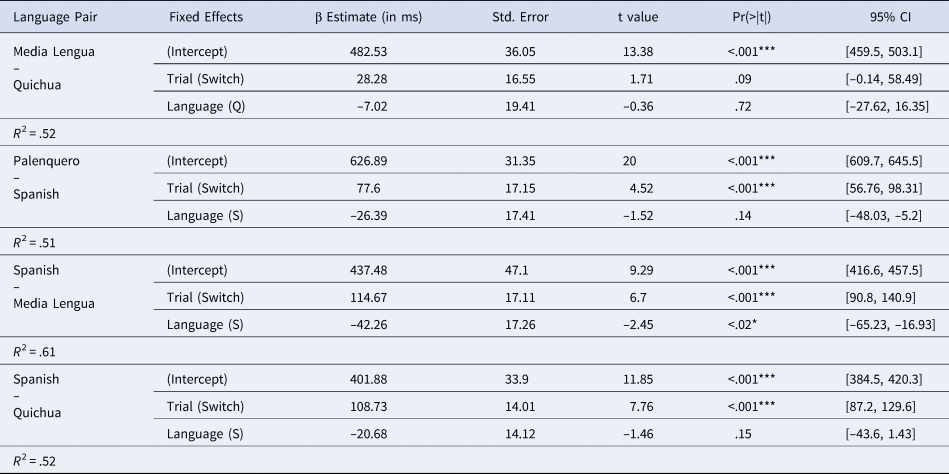
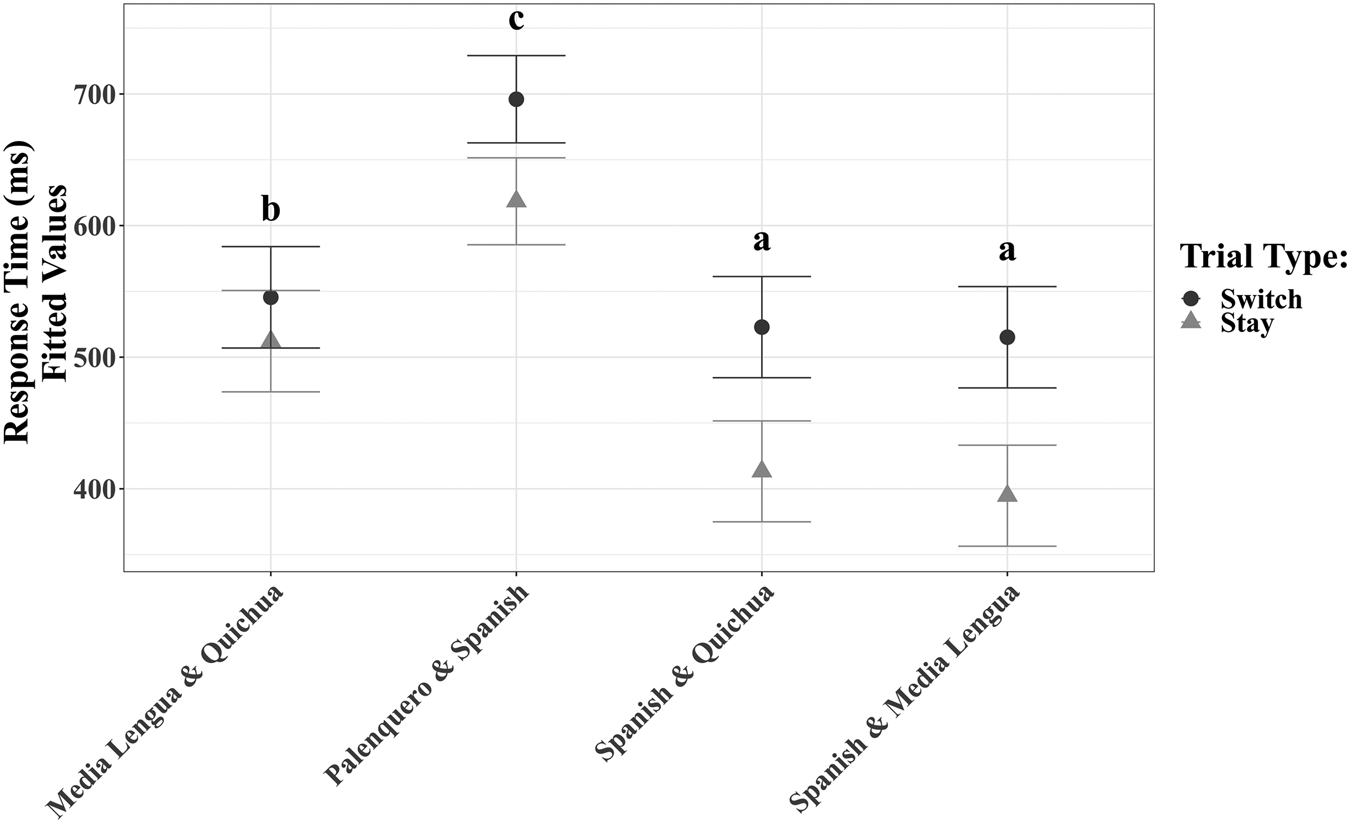
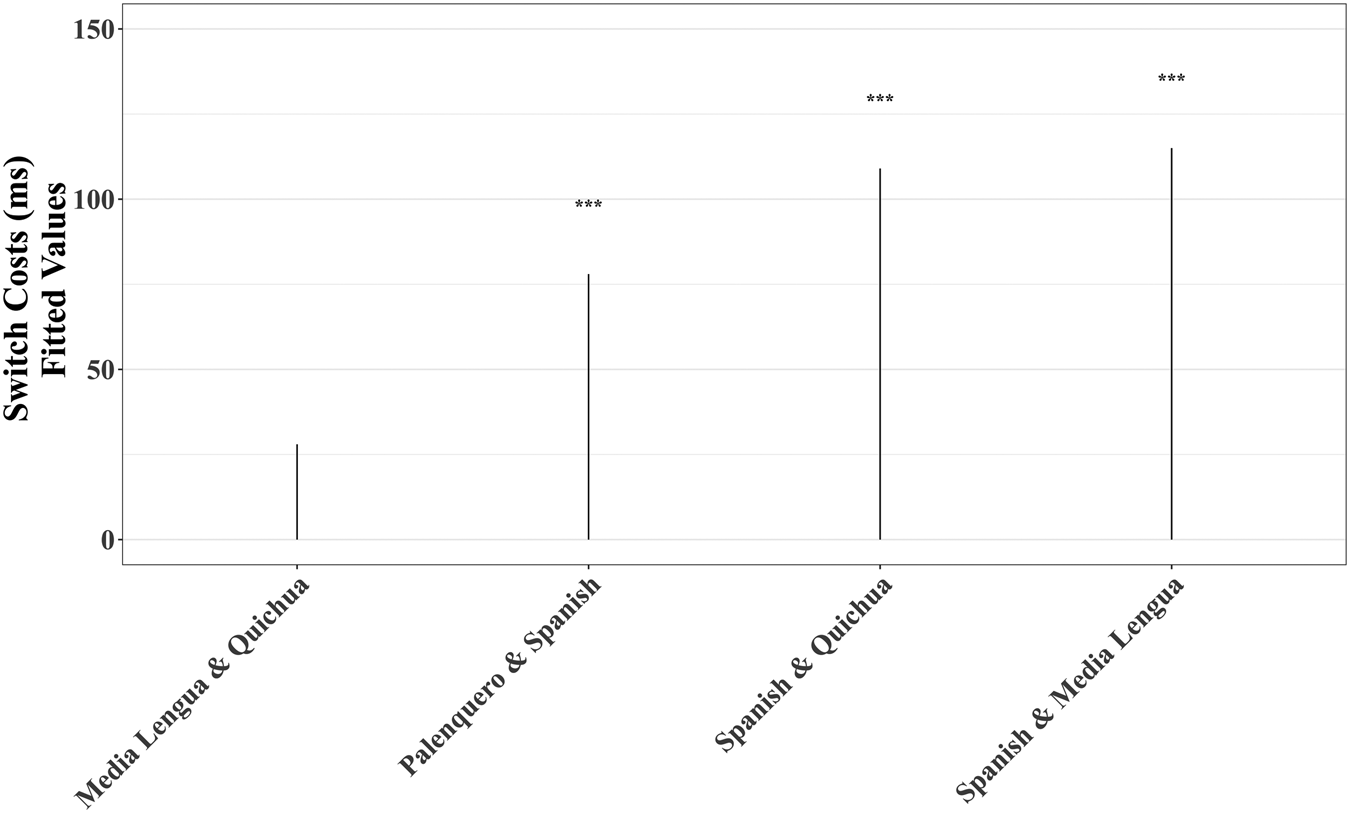
Linear mixed effects models were fit for each language pair separately, using the lme-4 package in R (Bates, Maechler, Bolker & Walker, Reference Bates, Maechler, Bolker and Walker2015b; R Core Team, 2016). All models were fit with Type of Trial (Switch or Stay), Language as fixed effects, plus Stimulus and Participant random intercepts (Table 3). For some data sets, models containing random slopes showed singular fit or failed to converge, indicating overfitting, so that random slopes were not included in any model in the interest of drawing consistent comparisons across data sets (Barr, Levy, Scheepers & Tily, Reference Barr, Levy, Scheepers and Tily2013; Bates, Kliegl, Vasishth & Baayen, Reference Bates, Kliegl, Vasishth and Baayen2015a). P-values were estimated with the lmer-Test package (Kuznetsova, Brockhoff & Christensen, Reference Kuznetsova, Brockhoff and Christensen2017). For each model, 95% confidence intervals were computed after 3000 bootstrap runs using the bias corrected and accelerated (bca) method (Carpenter & Bithell, Reference Carpenter and Bithell2000, Levshina, Reference Levshina2015, p. 167; Fox, Reference Fox2016). Finally, a post hoc analysis (Tukey multiple comparison) was conducted using the multcomp and lsmeans packages in order to examine switching costs across language pairs (Hothorn, Bretz & Westfall, Reference Hothorn, Bretz and Westfall2008; Lenth, Reference Lenth2016). For this, a model was fit with Language as fixed effect, Trial Type and Language Pair as a fixed effect interaction and random intercepts by Stimulus and Participant. Figure 3 shows the fitted model values for RT by Trial Type and Language Pair; compact letters indicate significantly different language pairs.
Production Task. Results of the linear mixed effect models predicting response time with Type of Trial and Language as fixed effects, Stimulus and Participant as random intercepts. Confidence Intervals (CI, in ms) were computed after 3000 bootstrap runs.

Post hoc (Tukey) comparisons across language pairs examining the interaction of Trial Type with Language Pair. The compact letter display indicates significantly different groupings. Fitted values are based on a mixed effects model estimating response time with Language as fixed effect, a Trial Type by Language Pair fixed effect interaction and random intercepts by Stimulus and Participant.

Table 3 and Figure 4 show robust switching costs for all language pairs except the Media Lengua-Quichua pair, with increasing effect sizes as switching becomes more difficult (as conditioned by each language pair). In sum, the results imply that switching costs may result from the re-generation of the grammatical frame: The lowest switching costs are generated in the Media Lengua-Quichua pair, where grammatical frames are identical, closely followed by the Palenquero-Spanish pair, where grammatical frames show the same headedness. Interestingly, the Media Lengua-Spanish pair patterns very similarly to the Spanish-Quichua pair, suggesting that the large grammatical distance between the respective languages cannot be mediated in switching even when the lexical roots between both languages overlap (in Figure 3, the same compact letter for both of these groups indicates their statistical similarity). In fact, the Media Lengua-Spanish pair induces higher switching costs, providing evidence that participants suffer higher switching costs when lexical roots are identical than when they are entirely different. This is not unexpected: when lexical roots that overlap in two languages are activated, two separate grammatical frames become activated. In order to respond accurately, participants need to select the target grammatical frame but inhibit the competing non-target frame. This induces more costs when lexical roots are shared (as in the Media Lengua-Spanish pair) than when lexical items correspond to two entirely different languages (as in the Spanish-Quichua pair). In the Media Lengua-Spanish pair, Spanish is also more activated than in the Media Lengua-Quichua pair, which is why switching costs in the latter pair are attenuated and language differences disappear. This suggests that Quichua and Media Lengua employ an identical grammatical frame into which lexical material can be inserted without generating large costs, in line with some theories of code-switching that argue that an abstract grammatical frame is generated into which vocabulary from both languages can be inserted (e.g., Myers-Scotton, Reference Myers-Scotton1993; Muysken, Reference Muysken2000, Reference Muysken2013). Clearly, these results may also provide experimental evidence as to why such insertional code-switches are common across bilingual communities: the grammatical frame does not need to be re-cast while processing difficulties resulting from competing activation of multiple languages can be mediated through insertions.
Fitted values for switch costs in production and their statistical significance for each language pair. Values correspond to the mixed effects models reported in Table 3.

In addition, the two pairs that contain cognate vocabulary (Palenquero-Spanish and Media Lengua-Spanish) provide insight into the mechanisms behind cognate facilitation: the Palenquero-Spanish pair showed the lowest switching costs for all language pairs that were grammatically different (i.e., all except the Media Lengua-Quichua pair). This suggests that switching costs can be modulated when there is overlap between lexical items as concerns syntactic representations: in particular, headedness. In contrast, in the Media Lengua-Spanish pair, where cognate lexical items overlap phonologically but are specified for the opposite syntactic direction, switching costs were increased. Thus, the current study presents both evidence of cognate facilitation as well as increased competition resulting from co-activated oppositely-directed syntactic frames in these cognate lexical items. These findings also imply that phonological overlap in cognate lexical items is not the only locus of competition, as suggested in prior research (e.g., Declerck et al., Reference Declerck, Koch and Philipp2012; Christoffels et al., Reference Christoffels, Firk and Schiller2007), but that syntactic features are accessed as well and compete for selection.
Furthermore, switching costs occurred in all pairs except the Media Lengua-Quichua pair suggesting that, psycholinguistically, these languages are not identical and their representational boundaries are not blurred. In the case of Palenquero-Spanish, this provides evidence that Palenquero cannot be regarded a decreolized speech variety (Dussias et al., Reference Dussias, Gullifer, Poepsel, Schwegler, McWhorter and Ströbel2016). While the boundaries between Palenquero and Spanish may be less clearly visible in code-switching, from a psycholinguistic perspective, switching between them still requires a switch of language systems: Despite Spanish and Palenquero sharing cognate lexica and head-initial grammar, a language-specific grammatical frame needs to be generated in order for participants to produce a well-formed response. Significant switching costs are expected in the Media Lengua-Spanish and the Spanish-Quichua pairs as the involved languages are undoubtedly grammatically different, showing different parameters for headedness. The similarity between the Media Lengua-Spanish and the Spanish-Quichua pairs further suggests that Media Lengua does not structurally overlap with Spanish (against possible hypotheses of convergence). Rather, Media Lengua appears to be processed in a Quichua-like fashion. The compact letters in Figure 3 confirm that there is a statistically significant difference for switching costs between the language pair that showed complete morphosyntactic overlap (Media Lengua-Quichua), the language pair that showed some morphosyntactic overlap (Palenquero-Spanish) and the language pairs that showed entirely different morphosyntactic specifications (Media Lengua-Spanish and Spanish-Quichua).
As concerns the language into which the switch occurred, only the Media Lengua-Spanish pair showed a significant effect of language, with responses in Spanish being faster. This can be interpreted as reflective of the competition occurring during selection of the language-specific morphosyntactic frame in the presence of cognate lexical items. Additionally, this effect may be related to the ambivalent linguistic attitudes attached to Media Lengua: there is only one accurate response in Spanish (a view which is reinforced in the education system) while responses in Media Lengua may be perceived as more structurally and lexically ambiguous. For all other language pairs, response language was not statistically significant (see also Dussias et al., Reference Dussias, Gullifer, Poepsel, Schwegler, McWhorter and Ströbel2016). These results support the view that participants are similarly fluent in their two languages in more natural switching settings (Gollan & Ferreira, Reference Gollan and Ferreira2009). Under this interpretation, speakers’ cognitive systems are highly adaptive to the respective interactional contexts, which reflects the close contact between languages in the current contact scenarios (Green & Abutalebi, Reference Green and Abutalebi2013; Dussias et al., Reference Dussias, Gullifer, Poepsel, Schwegler, McWhorter and Ströbel2016, p. 15).
In its broadest sense, the current data can be interpreted to provide substance to various bilingual speech phenomena, such as (A) convergence (where contact-induced language change results in linguistic structures showing increased structural similarity) and (B) different types of code-switching (Muysken, Reference Muysken2000, p. 3): insertion (of lexical items or entire constituents from one language into a structure from the other language), alternation (between structures from languages) and congruent lexicalization (of material from different lexical inventories into a shared grammatical structure).
Regarding the former phenomenon (A), the current data set shows that the more different syntactic frames in a bilingual's languages approximate each other, the less effortful language switching becomes, suggesting a possible psycholinguistic motivation for convergence when high structural overlap between languages is given. However, when languages are more dissimilar, it may be favorable to not conflate linguistic systems, as switching is easier when languages do not overlap at all (as in the Spanish-Quichua pair) than when certain items are differently syntactically specified (as in the Media Lengua-Spanish pair). Under this view, convergence would be considered a gradient. As concerns the latter phenomenon (B), congruent lexicalization and alternational switching have previously been linked to structural similarity or equivalence (Muysken, Reference Muysken2000, Reference Muysken2013; Poplack, Reference Poplack1980). Thus, language contact scenarios where languages are typologically dissimilar might then preferably lead to insertional code-switches as compared to scenarios involving typologically similar languages, where alternational code-switches or congruent lexicalization may be more optimal strategies (Muysken, Reference Muysken2000, Reference Muysken2013; Myers-Scotton, Reference Myers-Scotton1993).
5. Switching grammar or lexicon in comprehension
5.1. Task design and materials
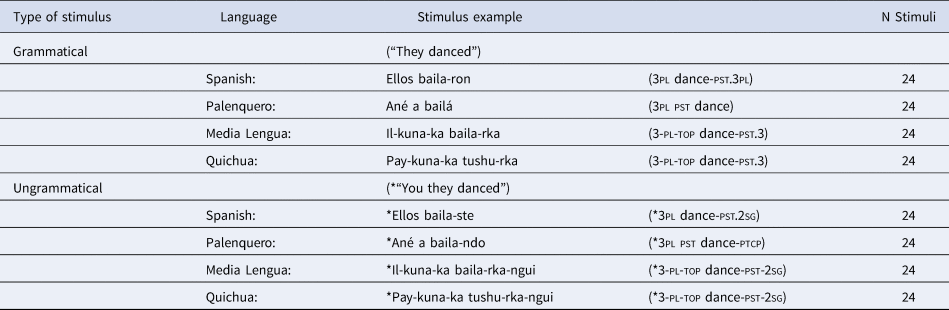
In this part of the experiment, participants listened to short grammatical or ungrammatical intransitive phrases, inflected for past tense and containing the same 24 verbs as in the production task (Table 4). Participants were instructed to judge grammaticality for these phrases as quickly and as accurately as possible. Ungrammatical phrases employed mis-matched subject-verb agreement for Spanish, Media Lengua and Quichua (e.g., a 3rd-person plural pronoun matched with a second person singular verb inflection or vice versa); Palenquero ungrammatical phrases contained the past tense morpheme {a} and a participle verb form since this creole lacks subject-verb agreement. The resulting structure [a + VERB-ndo] is ungrammatical in Palenquero; VERB-ndo, however, can occur in a present progressive structure [(a-) ta VERB-ndo] (Schwegler & Green, Reference Schwegler, Green, Holm and Patrick2007, p. 278). Importantly, all stimuli were created such that participants needed to wait until the end of each stimulus to decide on grammaticality. The same community members recorded the stimuli as for the production task.
Stimuli examples for all languages (comprehension task).

For each language pair, verb roots occurred in one grammaticality condition in one language while their translation equivalent occurred in the other grammaticality condition in the other language. For instance, if a participant heard the grammatical Palenquero phrase ané a bailá “they danced,” the same participant heard the translationally equivalent verb root in an ungrammatical Spanish phrase *Ellos bailaste “You they danced.”
There were again 48 stimuli (24 in each language, 24 grammatical) in each language pair, corresponding to a total of 48 stimuli for Colombian participants (Palenquero-Spanish pair) and 144 stimuli for Ecuadorians (for the remaining three language pairs). The occurrence of verb roots was pseudo-randomized; at least 4 trials intervened between translationally equivalent verb roots. Languages switched every two trials within each language pair. Half of all switch trials were grammatical, half ungrammatical stimuli. Participants were randomly assigned to either of two stimuli lists; all lists started with a grammatical stimulus. In Ecuador, all participants responded to the same order of pairs (Media Lengua-Quichua, Media Lengua-Spanish, Spanish-Quichua) with breaks between them to prevent fatigue effects. This ordering differs from the order chosen for the production task to probe carefully into potential ordering effects without jeopardizing the naturalness of the production data; after thoroughly examining the data, no task effects regarding ordering could be determined. Participants completed each language pair in 2–3 minutes.
5.2. Participants and procedure
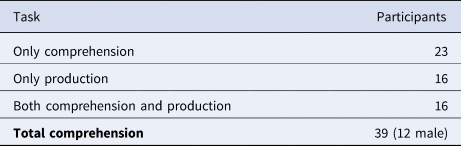
The recruitment procedure was the same as for the production task. Since Ecuadorian participants had to complete multiple language pairs, the duration of the comprehension and production experiment seemed too long after several participants had been tested. Thus, the experiment procedure was adjusted on site and the remaining participants were randomly assigned to perform either only the production or the comprehension task (see Table 5). There were similar switching trends for each language pair regardless of whether participants completed only the comprehension task or both tasks, i.e., no significant interactions between switching performance and group were found when included in the regression models reported below (p > .7 for all language pairs; see also footnote 1). Colombian participants (n = 62) participated in both the production and comprehension experiment.
Number of Ecuadorian participants across tasks.

5.3 Data analysis and pre-processing
Participants provided a total of 2976 responses in Colombia and 5616 in Ecuador. The first trial was removed for all language pairs. Then, accuracy scores and d-prime (d’-) scoresFootnote 3 were calculated for each participant and each language pair. Participants whose d’-scores were below 1 were removed: This applied to 6 participants in the Palenquero-Spanish pair, 13 participantsFootnote 4 in the Media Lengua-Quichua pair, 6 in the Media Lengua-Spanish pair and 4 in the Spanish-Quichua pair. The means of d’-scores across conditions for the final data set indicate reliable participant performance [Palenquero-Spanish: M = 3.28 (SD = 0.95); Media Lengua-Quichua: M = 2.81 (SD = 0.86); Media Lengua-Spanish: M = 3.07 (SD = 0.8); Spanish-Quichua: M = 2.98 (SD = 1.01)].
After discarding all incorrect responses, a total of 2411 (Colombia) and 3897 (Ecuador) of correct responses were subjected to further pre-processing. RT outliers were removed based on Median Absolute Deviation (MAD) scores larger than 2.5 (Leys et al., Reference Leys, Ley, Klein, Bernard and Licata2013). The duration of the stimulus was subtracted from the RTs since measurement began with the onset of the stimulus. The final data set contained 2248 in the Palenquero-Spanish pair, 990 responses in the Media Lengua-Quichua pair, 1308 in the Media Lengua-Spanish pair and 1343 in the Spanish-Quichua pair.
5.4 Results
In order to predict RTs for each language pair separately, various linear mixed effects models were fit using the lme-4 package in R (Bates et al., Reference Bates, Maechler, Bolker and Walker2015b; R Core Team, 2016). Models were fit with Type of Trial (Switch or Stay), Language and Grammaticality (Grammatical or Ungrammatical) as fixed effects, Stimulus and Participant as random intercepts. Model building and bootstrapping followed the same procedure as for the production task.
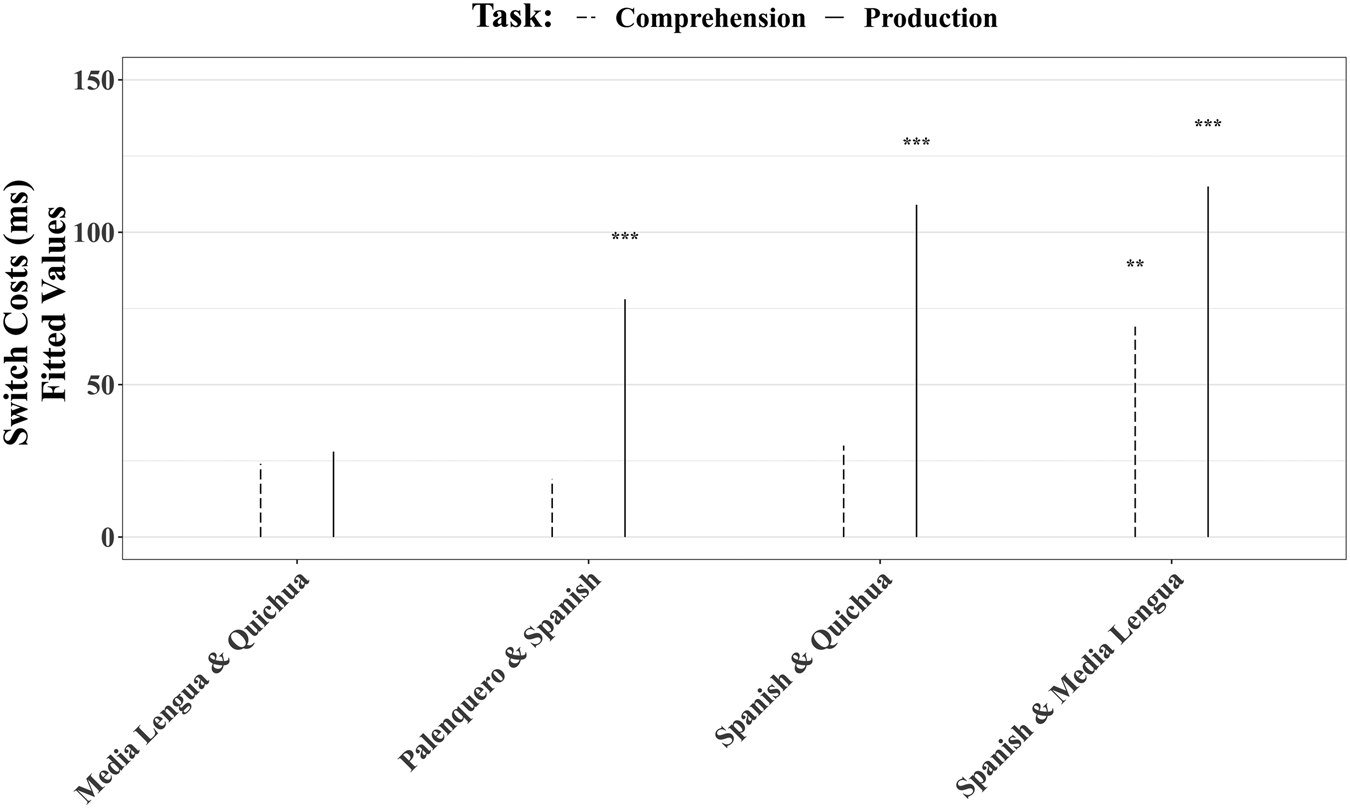
Table 6 shows significant switching costs only for the Media Lengua-Spanish pair. In addition, significant effects of language only occur in the Palenquero-Spanish pair. As is to be expected, RTs on ungrammatical trials are slower for all pairs and significantly so for the Ecuadorian data sets. In sum, these results suggest that effects of language switching are attenuated in comprehension as compared to production. This is expected as, in comprehension tasks, no explicit linguistic response has to be produced and language selection is more direct. Nevertheless, the general trend observed in the production task remains visible: the most cognitively costly switching pair is the Media Lengua-Spanish pair, in which lexical roots are phonologically identical for both languages but correspond to differently headed morphosyntactic representations. Switching cost effect sizes display an order and increase in their values across language pairs similar to the production task, indicating that systematic differences between the respective language pairs correlate with similar results across tasks (Figure 5).
Comprehension Task. Results of the linear mixed effect models predicting response time with Type of Trial, Language and Grammaticality as fixed effects, Stimulus and Participant as random intercepts. Confidence Intervals (CI, in ms) were computed after 3000 bootstrap runs.


These results suggest once again that switching costs may correspond to the re-generation of a grammatical frame on switch trials. In the Media Lengua-Quichua pair, participants can effectively listen through language switches to provide grammaticality judgements. Since Media Lengua and Quichua share identical grammatical frames, participants only need to listen for mismatched subject-verb agreement. Vocabulary changes (and, thus, language switches) are practically irrelevant in order to respond accurately. In all other conditions, the grammatical frame changes on switch trials. In the Palenquero-Spanish pair, where both languages are head-initial, comparatively low switch costs are induced while switching in the Spanish-Quichua and the Media Lengua-Spanish conditions is more cognitively costly. In the latter pair, participants cannot rely on hearing language-specific items and judging the stimuli in terms of grammaticality for the respective languages. Rather, participants are accessing cognate lexical roots and need to decide which language they are listening to in order to respond correctly, leading to significant switch costs in this condition. The Spanish-Quichua pair, where lexical items clearly belong to a specific language, thus generates less switching costs than the Media Lengua-Spanish pair. In sum, the Palenquero-Spanish pair displays once again effects of cognate facilitation while the Media Lengua-Spanish pair shows the opposite.
Additionally, the Palenquero-Spanish pair shows a significant effect of language, possibly related to less ambiguity of whether certain constructions could be considered grammatical in Spanish than in Palenquero (as was argued for the Media Lengua-Spanish data set in the production task). After all, Spanish is an institutionally normed language and previous research has noted that ungrammatical Palenquero structures are rarely corrected by Palenquero language teachers in local schools (Lipski, Reference Lipski2016c). Given that standard Spanish is more highly normed whereas a wider range of responses may be considered admissible in Palenquero, this appears to result in faster RTs in Spanish.Footnote 5
Finally, note that ungrammatical stimuli in the Palenquero-Spanish pair seem to be less cognitively costly than in any of the other language pairs. This may stem from the fact that language switching occurs more frequently and with less clearly-delineated boundaries in the Colombian contact setting than in the Ecuadorian contact setting, leading to a generally lower sensitivity to effects of grammaticality or to variation itself (Lipski, Reference Lipski2016a, Reference Lipski2016c; Schwegler & Morton, Reference Schwegler and Morton2003, see also footnote 5). Recall, however, that the Palenquero-Spanish pair is the only experimental condition where grammaticality was not dependent on subject-verb agreement since Palenquero stems remain invariant. Thus, these results may rather show a modulation to RTs based on different types of ungrammaticality (Kail, Reference Kail2004), with subject-verb agreement errors being perceived as more jarring than other types of ungrammaticality. In fact, participants showed significantly slower RTs on ungrammatical trials compared to grammatical trials when only Spanish responses were examined in line with this interpretation (p < .01).
6. General discussion
Bilinguals switch languages in every-day communication even though switching may be costly. The current study investigated whether switching costs are modulated based on the linguistic similarity of the involved languages and what this implies for the mental representation of these language pairs and, by extension, the representation of grammar and lexicon. To that end, a production and a comprehension experiment were conducted in two multilingual environments including a Spanish-based creole (Palenquero) and mixed language (Media Lengua). While both experiments show parallel trends for switching costs across language pairs, switching was less costly in the comprehension task since no linguistic response has to be produced. Rather, in comprehension, encoding of the auditory input results in more direct activation and selection of the respective language.
The production task revealed switching costs for each language pair except for the Media Lengua-Quichua pair, with modulations depending on the linguistic distance of the involved language pairs. In the context of the current study, this appears to indicate that switching costs result from the re-generation of the grammatical frame as the cognitive system has to be re-set on switch trials (Costa & Santesteban, Reference Costa and Santesteban2004; Meuter, Reference Meuter, Isurin, Winford and de Bot2009). When participants switched between Media Lengua and Quichua, switching costs were lowest and not statistically significant, providing evidence that these two languages employ identical morphosyntactic frames (Lipski, Reference Lipski2016b; Deibel, Reference Deibel2019; Deibel, Reference Deibel, Mazzoli and Sippolaunpublished manuscript). Structural priming from the preceding trial can, thus, mediate switching costs as the same grammatical frame can be recycled in subsequent trials. When participants switched between Spanish and Palenquero, two head-initial languages sharing cognate lexica, intermediate switching costs were found, suggesting that Palenquero and Spanish are cognitively separate systems and that Palenquero is not undergoing partial decreolization (Dussias et al., Reference Dussias, Gullifer, Poepsel, Schwegler, McWhorter and Ströbel2016). Switching costs were higher when participants switched between Quichua and Spanish due to the grammatical differences between Quichua and Spanish: a switch between these two languages entails switching between two grammatical systems that are differently headed besides switching vocabulary. Switching was most costly between Spanish and Media Lengua, two languages that employ grammatical frames that are differently headed but share cognate vocabulary. The high switching costs found in this condition result from the respective lexical roots being tagged for two separate lexica and activating differently headed grammatical frames, one of which has to be inhibited in order for an accurate response to be produced. In this condition, activation of Spanish is higher than in the Media Lengua-Quichua pair, resulting in the observed difference in switching costs between both conditions. These results further add to our understanding of the cognitive processes involved in language production as, when linguistic distance between different language pairs is minimized (i.e., the only difference lies at the phonological level, as in the Media Lengua-Quichua pair), switch costs can be minimized as well. Thus, this experiment provides psycholinguistic evidence that high structural similarity between different languages mitigates language switching costs, which, in the broadest sense, may be interpreted as a cognitive motivation for phenomena common in bilingual speech, such as convergence and certain types of code-switches. In addition, the results show that cognate facilitation is only found when cognate items are similarly syntactically specified: in the Palenquero-Spanish pair, two head-initial languages, lower switching costs were found than in the Media Lengua-Spanish pair, two oppositely-headed languages. Put differently, in the Media Lengua-Spanish pair, speakers are dealing with what might be termed syntactic false friends, making selection of the appropriate grammatical frame costly.
The comprehension task revealed switching costs only for the Media Lengua-Spanish pair while the general, now attenuated, ordering trends among language pairs remained roughly parallel to the production task, suggesting once again the re-generation of the grammatical frame as a source of switching costs. Participants switching between Media Lengua and Spanish need to select the appropriate morphosyntactic frame in the presence of lexical items that overlap phonologically and are causing competition. This selection process is somewhat easier when the involved lexical items are individually tagged for specific languages and phonologically dissimilar (as in the Spanish-Quichua pair), when grammatical frames are similarly headed (as in the Palenquero-Spanish pair) or practically identical (as in the Media Lengua-Quichua pair).
The current study, thus, lends insight into the mental representation of contact-induced languages, languages that share large proportions of their grammatical or lexical inventories with their source languages. This particular configuration allows us to gauge the degree to which grammar and lexicon for closely related languages are represented jointly or separately in the bilingual mind. For the case of Media Lengua, a mixed language overlapping grammatically with Quichua but incorporating Spanish lexical roots, the lack of significant switching costs in Media Lengua-Quichua switching suggests that Media Lengua syntactic representations overlap with Quichua and that, in this condition, no Spanish syntactic features are accessed. Under this view, the Spanish influence in Media Lengua is restricted to the phonological representation, as initially suggested by the relexification hypothesis (Muysken, Reference Muysken, Highfield and Valdman1981). If Spanish syntactic features were contained in Media Lengua lexical entries, we would expect larger competition of the two oppositely specified grammatical frames in the Media Lengua-Quichua pair and, consequently, significantly longer RTs on switch trials. The current results contradict this scenario. In contrast, in Media Lengua-Spanish switching, Spanish is not only more highly activated but different lexical entries containing specifications for two distinctly-headed grammatical frames are accessed as well. Suppression of the non-target grammatical frame requires the most time and results in the observed large switching costs in this pair. For the case of Palenquero-Spanish switching, the current experiment found effects of cognate facilitation due to the syntactic similarities between the two languages. These results also suggest that competing activation needs to be resolved at various linguistic levels showing different degrees of overlap depending on the language pair (Declerck & Philipp, Reference Declerck and Philipp2015; Kroll, Bobb & Wodniecka, Reference Kroll, Bobb and Wodniecka2006). These findings warrant careful consideration in future applications of the cued language-switching paradigm.
How can the current findings be integrated within theories of mental representations, which have not addressed in detail the nature of syntactic levels in the bilingual mind with respect to the headedness parameter (Austin, Blume & Sánchez, Reference Austin, Blume and Sánchez2015, p. 111; but see Putnam, Carlson & Reitter, Reference Putnam, Carlson and Reitter2018)? Most models include syntactic representations together with semantic information within a rather generically defined lemma level, mediating activation of lexical and conceptual features (Kroll & de Groot, Reference Kroll, de Groot, de Groot and Kroll1997, p. 190). In fact,
much of the research on bilingual representation (other than the work on bilingual speech production) has ignored the debate on lemma-level representation, presumably because the out-of-context nature of the tasks that have been used to test these models has not required a commitment to the semantic and syntactic constraints that operate during actual sentence processing (Kroll & de Groot, Reference Kroll, de Groot, de Groot and Kroll1997, p. 191).
Additionally, the specific languages selected for examination can obscure (or, as argued here, clarify) the make-up of the lemma level. Research on structural priming, however, has suggested that crosslinguistically similar syntactic constructions share integrated representations (Hartsuiker et al., Reference Hartsuiker, Pickering and Veltkamp2004; Hartsuiker & Pickering, Reference Hartsuiker and Pickering2008; Loebell & Bock, Reference Loebell and Bock2003; Schoonbaert, Hartsuiker & Pickering, Reference Schoonbaert, Hartsuiker and Pickering2007; Bernolet, Hartsuiker & Pickering, Reference Bernolet, Hartsuiker and Pickering2007; Hartsuiker, Beerts, Loncke, Desmet & Bernolet, Reference Hartsuiker, Beerts, Loncke, Desmet and Bernolet2016; Bernolet, Hartsuiker & Pickering, Reference Bernolet, Hartsuiker and Pickering2012; Cai et al., Reference Cai, Pickering, Yan and Branigan2011; Pickering & Ferreira, Reference Pickering and Ferreira2008; Chang, Dell & Bock, Reference Chang, Dell and Bock2006; Pickering & Branigan, Reference Pickering and Branigan1998).
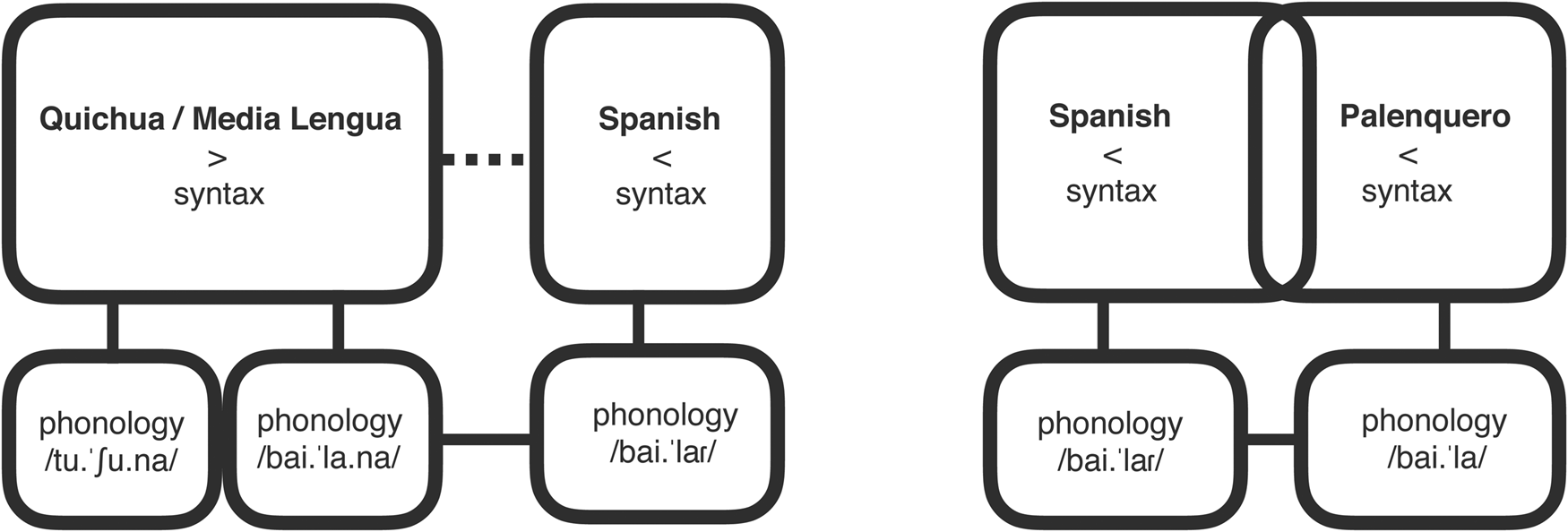
The current data lend important insights into syntactic representations in the bilingual mind when contact-induced languages, languages that show large structural overlap with their source languages, are involved. Figure 6 displays a schematic representation of the possible interplay of syntactic and phonological representations for the mixed and creole language contact scenarios described in the current paper while no explicit claims concerning semantic or conceptual representations of these languages can be made due to the lack of research in this realm. It is assumed that language access is non-selective, that both syntactic and phonological processes are – to some degree – integrated across languages, and that activation cascades to neighboring phonological segments in cognates (e.g., Costa et al., Reference Costa, Caramazza and Sebastian-Galles2000; Goldrick et al., Reference Goldrick, Runnqvist and Costa2014; Altenberg & Cairns, Reference Altenberg and Cairns1983). Crucially, it was shown in the current paper that the bilinguals examined here appear to represent highly similar syntactic structures (e.g., in Media Lengua and Quichua) only once and that cognate lexical items have separate lexical representations with differing degrees of shared syntactic representations depending on the nature of the contact scenario, as exemplified by the Palenquero-Spanish and Media Lengua-Spanish pairs. This indicates a tendency towards cognitive economy, which may be a particularly desirable bilingual strategy in otherwise cognitively taxing (i.e., typologically opposite) bilingual environments. The current data also suggest that the backward flow of activation from phonological segments to the syntactic level is modulated by language mode even when cognate roots are involved (Grosjean, Reference Grosjean and Nicol2001; Santesteban, Pickering & McLean, Reference Santesteban, Pickering and McLean2010). Under this assumption, we expect to see smaller effects of syntactic inhibition in the Media Lengua-Quichua pair, where only Media Lengua phonological segments overlap with Spanish, than in the Media Lengua-Spanish pair, where Spanish activation is higher in general. In sum, the current study stresses the similarities and differences between the involved languages in terms of directionality and cognate overlap, modulating cross-linguistic activation and, thus, switching costs.
Schematic representation of syntax and phonology as concerns contact-induced languages and their source languages (< indicates head-initial, > indicates head-final). Quichua and Media Lengua share head-final syntax and differ in whether phonological shells are maintained in Quichua (tushuna) or relexified from Spanish (bailana). Media Lengua (bailana) and Spanish (bailar) share phonological roots but differ in syntactic directionality. Spanish and Palenquero share phonological roots and syntactic directionality, but differ in other syntactic features such as noun phrase marking, negation patterns, etc. Presumably weaker connections are indicated with dotted lines.

7. Conclusion
Conducting psycholinguistic studies in field research settings can reveal insightful patterns that otherwise would remain undetected or even seem conflicting (e.g., in the case of cognates). By employing the cued language-switching paradigm in two linguistically complementary language contact environments, the current study not only tests the validity of psycholinguistic theories outside the usual populations but also adds an important theoretical perspective to the debate of what may induce switching costs in this paradigm: due to the processes involved in their formation, creoles and mixed languages show a high overlap of lexicon or grammar with their source languages, which modulates switch costs to fine degrees and allows us to gauge the relative impact of grammar and lexicon and the effect of similarity between languages in language switching – a dimension that has rarely been considered in this line of research. This not only draws attention to marginalized speech communities as a valuable population for scientific study but also furnishes a crucial test for the mental representation of different linguistic levels that creoles and mixed languages share with their source languages. Ultimately, studies like the current one will help to legitimize these traditionally stigmatized languages and contribute important linguistic evidence in order to refine models of language production and comprehension.
Acknowledgements
This research was supported by a LeClaire (Lee) B. Watts Endowed Scholarship in Romance Languages, a Penn State Liberal Arts Superior Teaching and Research Award, and a Penn State Center for Global Studies Fellowship. I am especially grateful for the help of our main contacts Gabriel Cachimuel, José María Casco, Antonio Maldonado and Bernadino Pérez Miranda as well as their families during data collection and beyond. I also thank John M. Lipski and Paola E. Dussias for their guidance and support throughout all stages of this project, Jesse Stewart for providing helpful comments on an earlier version of this manuscript, and Priscila López-Beltrán Forcada for many stimulating discussions regarding the findings. Finally, a big thank you to all Imbabureños and Palenqueros for participating and welcoming me into their communities.