


There is a large discrepancy between the importance attributed to the public communication of political actors and the (lack of) empirical analysis devoted to it. The way political elites interact with each other as well as with members of society may shape whether voters like or dislike them, how citizens perceive policy positions, or the degree to which they feel represented by the political system (Fenno Reference Fenno1978; Mansbridge Reference Mansbridge2003; Strom Reference Strom2008). However, a lack of data has hampered the empirical study of the causes and consequences of public communication involving political elites. This has begun to change recently due to advances in automated text analysis methods. The focus so far has been on examining parliamentary speeches (e.g., Martin and Vanberg Reference Martin and Vanberg2008; Eggers and Spirling Reference Eggers and Spirling2014; Herzog and Benoit Reference Herzog and Benoit2015; Proksch and Slapin Reference Proksch and Slapin2015; Lauderdale and Herzog Reference Lauderdale and Herzog2016) and politicians’ press releases (e.g., Grimmer Reference Grimmer2013; Grimmer, Westwood, and Messing Reference Grimmer, Westwood and Messing2015; Sagarzazu and Klüver Reference Sagarzazu and Klüver2017). These approaches have yielded valuable insights but have focused exclusively on the unidirectional communication by politicians to constituents in a single venue, and typically in a single country.
In this article, I introduce a method that uses large-scale event data and latent factor network models to provide a new comparative measure of the public relationships among politicians, nonpartisan political actors, and societal actors. Instead of relying on source data from a single setting, I use an extensive collection of machine-coded news reports that chronicle tens of thousands of interactions from many venues among hundreds of politicians, nonpartisan political actors (e.g., bureaucracy, police, or judiciary), and societal actors (e.g., citizens, unions, companies, religious groups). I then infer the underlying networks that give rise to these interactions by estimating latent factor network models (Hoff and Ward Reference Hoff and Ward2004; Hoff Reference Hoff2005, Reference Hoff2015). They place all actors in a low-dimensional “social space,” where those who have a cooperative relationship are placed in the same direction, while those who have a conflictual relationship are placed in different directions. From the latent positions, it is possible to compute scores that reflect the relationship of any pair of actors in the data.
This approach to quantify political relationships has a number of advantages over existing techniques. First, it is not restricted to a single venue, but captures interactions in many of them: press releases, parliamentary speeches, interviews, campaign events, and so on. Second, instead of examining only one-sided communication by politicians, it incorporates information on communication from and to nonpartisan political and societal actors as well. The approach also makes it possible to locate political and societal actors in a common space. Importantly, because the latent factor model captures third-order network dependencies (e.g., a friend of a friend is a friend), the relation between two actors can be inferred even if no direct interaction between them is reported. Finally, the approach can be estimated for a large number of countries over many years.
This new measure opens up the possibility to study the causes and consequences of cooperative or conflictual relationships between partisan political, nonpartisan political, and societal actors in a comparative manner. The relationship scores are publicly available and can be used by researchers to answer questions in areas such as coalition politics, polarization, or democratic representation and satisfaction. In this article, I describe the details of the approach and demonstrate its value by applying it to 13 Western European countries from 2001 to 2014.
APPROACH TO QUANTIFY POLITICAL RELATIONSHIPS
Data
The event data of interactions among political and societal elites I use stem from the ICEWS project (Boschee et al. Reference Boschee, Lautenschlager, O’Brien, Shellman, Starz and Ward2015). ICEWS is an early warning system that was designed in conjunction with several academic research teams to help U.S. policy analysts predict violent and nonviolent political crises (for a detailed introduction, see O’Brien Reference O’Brien and Subrahmanian2013). A central idea of the project is that the tone of interactions between the sociopolitical actors of a country can help predict such crises. It has therefore developed an extensive event collection that documents the activities of countries’ political and societal elites as comprehensively as possible.
The ICEWS project takes a large collection of news stories and machine-codes them into dyadic events reporting the event source, target, and type. Its source material stems from the media repositories of the Open Source Center and Factiva, which collect international and national news reports from a large number of publications. The first six sentences of each report are coded by BBN ACCENT, a natural language analysis system. It employs a number of linguistic models that were trained using a sample corpus to extract structured information from text (for details, see Boschee et al. Reference Boschee, Lautenschlager, O’Brien, Shellman, Starz and Ward2015). Consider the following sentence from a 2008 report from Germany: “Economics Minister Michael Glos, of the government’s conservative CDU/CSU coalition partner, attacked a draft proposal from Justice Minister Brigitte Zypries.”Footnote 1 This is machine-coded into an event described by three variables: The source is Michael Glos, Brigitte Zypries is the target, and the type is “criticize or denounce.” For the type, the coding scheme developed by the Conflict and Mediation Event Observation (CAMEO) project, containing roughly 350 categories, is used (Gerner, Schrodt, and Yilmaz Reference Gerner, Schrodt, Yilmaz, Bercovitcch and Gartner2009).
The goal of the ICEWS event data is to chronicle the activities of countries’ main sociopolitical actors. Events are therefore extensively screened and filtered to exclude historical events, those unrelated to sociopolitical activities (e.g., sports or entertainment), and exact duplicates. Validation studies find that the machine-coded information triplets were judged to be correct in around 75 percent of cases (Boschee, Natarjan, and Weischedel Reference Boschee, Natarjan, Weischedel and Subrahmanian2013; Boschee et al. Reference Boschee, Lautenschlager, O’Brien, Shellman, Starz and Ward2015), exceeding the performance that is typically achieved by human coders (King and Lowe Reference King and Lowe2003). The event collection has been made publicly available (Boschee et al. Reference Boschee, Lautenschlager, O’Brien, Shellman, Starz and Ward2015). In the Online Appendix, I provide extensive further information on the data, including technical details on the coding algorithm, descriptive statistics, a list of media sources, frequency tables of actors, and a discussion of potential objections and limitations.
I further process the event data in two ways. First, I hand code every actor as belonging into one of three categories: partisan political, nonpartisan political (e.g., bureaucracy, police, judiciary), and societal (e.g., citizens, corporations, unions, religious groups). For the first category, I code actors’ partisan affiliations, taking party switches into account. I also assign partisan affiliations to institutional actors (e.g., head of state, ministry of defense, ruling party) when they can be clearly inferred. Second, I dichotomize the event type categories into cooperative and conflictual. For example, “make optimistic comment” is a cooperative category, whereas “bring lawsuit against” is a conflictual one.Footnote 2 This dichotomization further increases coding accuracy. If, say, the example sentence above had been misclassified as “use unconventional mass violence” rather than as “criticize or denounce,” it would still correctly be considered a conflictual interaction.
Relationship Scores
The next step is to summarize this wealth of information on the relations among political and societal actors in a way that can be easily interpreted and is amenable to further quantitative analysis. The key insight is that the interactions arise from networks of relations among sociopolitical actors. My approach for a measure of political relationships is to infer the structure of those networks using a latent factor approach (Hoff and Ward Reference Hoff and Ward2004; Hoff Reference Hoff2005, Reference Hoff2015)
Denote the number of cooperative interactions between i and j by m + ij, and the number of conflictual interactions with m − ij. The interactions between the two actors can be summarized by 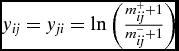 $y_{\hbox{\it\scriptsize ij}} = y_{{\hbox{\it\scriptsize ji}}} = \ln \left( \frac{m_{{\hbox{\it\scriptsize ij}}}^+ + 1}{m_{{\hbox{\it\scriptsize ij}}}^- + 1} \right)$.Footnote 3 These are then aggregated into an n × n sociomatrix Y, the cells of which are modeled as follows:
 $$\begin{eqnarray}
&&y_{{\hbox{\it\scriptsize ij}}} = \alpha + a_i + a_j + \epsilon _{{\hbox{\it\scriptsize ij}}} + \boldsymbol{u}_i^{\prime } \boldsymbol{\Lambda }\boldsymbol{u}_j, \nonumber\\
&&a_1, \dots, a_n \sim \text{i.i.d. } \mathcal {N}(0, \sigma ^2_a), \\
&&\lbrace \epsilon _{{\hbox{\it\scriptsize ij}}} \rbrace \sim \text{i.i.d. } \mathcal {N}(0, \sigma ^2_e).\nonumber
\end{eqnarray}$$
The latent factor approach decomposes the dependent variable into several components. The intercept is designated by α. Overall differences in the tone of interactions by actors are captured by the random effects a i and a j. These coefficients are larger for actors whose interactions are more cooperative in general. The random effects term εij captures the correlation of actions between a dyadic pair of actors (e.g., reciprocity). Finally, the remaining variance in y ij is absorbed by  $\boldsymbol{u}_i^{\prime } \boldsymbol{\Lambda }\boldsymbol{u}_j$, the multiplicative effects term that captures latent nodal characteristics.Footnote 4
The basic idea of the approach is to represent the network by giving actors positions in an unobserved latent space. The K-dimensional vector  $\boldsymbol{u}_i$ characterizes i’s position in that network, and
 $\boldsymbol{u}_j$ gives the same for j.
 $\boldsymbol{\Lambda }$ is a K × K diagonal matrix of (positive) scaling constants (see Hoff Reference Hoff2015).Footnote 5 The multiplicative effects term
 $\boldsymbol{u}_i^{\prime } \boldsymbol{\Lambda }\boldsymbol{u}_j$ then represents the nature of the relationship between i and j. It places two actors that tend to be cooperative with each other, or that interact in a similar way with third actors, in the same direction in the latent social space. Actors that are likely to be in conflict with each other, or that interact in different ways with third actors, are placed in opposing directions. The term
 $\boldsymbol{u}_i^{\prime } \boldsymbol{\Lambda }\boldsymbol{u}_j$ does not only reflect direct interactions between two actors, it also takes into account their relation through others. For example, if two politicians both have cooperative interactions with unions, but conflictual ones with business representatives, they likely have a cooperative relationship with each. They are thus placed in the same direction, even if they did not directly interact with each other.
To understand the multiplicative effects term intuitively, suppose K = 1, so  $\boldsymbol{u}_i$ and
 $\boldsymbol{\Lambda }$ are simply scalars u i and λ. Recall that y ij is positive when interactions are cooperative, and negative when conflictual interactions dominate. If λ is positive and u i and u j are both positive or both negative, then u iλu j will be positive, corresponding to a cooperative relationship between i and j. If one of u i and u j is negative and one is positive, so the actors are located in different directions in the space, then u iλu j is negative. Since this is not only done for i and j, but also for i and k, j and k, and so on, two actors will be located in the same direction if they have mostly cooperative interactions with each other (net of their overall level of cooperation) or if they are connected through mutual cooperation with third actors. The latent factors thus summarize the complex network of relations into a low-dimensional representation that is easily interpretable and can be used for quantitative analysis. In particular,
 $\boldsymbol{u}_i^{\prime } \boldsymbol{\Lambda }\boldsymbol{u}_j$ provides an estimated relationship score between i and j based on their positions in the latent communication network.
Focusing on the overall relationship  $\boldsymbol{u}_i^{\prime } \boldsymbol{\Lambda }\boldsymbol{u}_j$ rather than simply on y ij, the balance of the dyadic direct interactions, has a number of advantages. Equation (1) filters out actor-specific idiosyncrasies. Some actors tend to be more conflictual or more cooperative in general, no matter who they are interacting with, which would contaminate a simple count or ratio measure. The latent factor approach also partitions out the correlation of actions between a dyadic pair of actors, such as reciprocity. Furthermore, relationships are not only determined by direct interactions, but through communication with others as well. Using
 $\boldsymbol{u}_i^{\prime } \boldsymbol{\Lambda }\boldsymbol{u}_j$ has the advantage of taking these third-party communications into account. This makes it possible to analyze the relationship between two actors even if no direct interaction between them is observed. For example, political representation does not require direct communication, so we can infer how well a party i represents a societal actor j, no matter whether they directly interact or not (see Weschle Reference Weschle2017). On the practical side, this advantage is especially relevant if the data are only a partial observation of the network. While the ICEWS event collection is one of the largest and most detailed sources there is, it nevertheless can only capture a sample of the universe of interactions.
APPLICATIONS
I demonstrate the value of my approach to quantify political relationships by applying it to 13 Western European countries for the years 2001 to 2014.Footnote 6 There are a total of 250,316 domestic events involving 3,422 actors reported by 232 media sources. I estimate a separate one-dimensional (K = 1) latent factor model for each country-year, which allows me to compute yearly relationship scores for any dyadic pair of actors that are present in the data.Footnote 7 The applications here are focused on the relationships between political parties, but the data can be used to analyze nonpartisan political and societal actors as well.
Descriptive Example: Germany
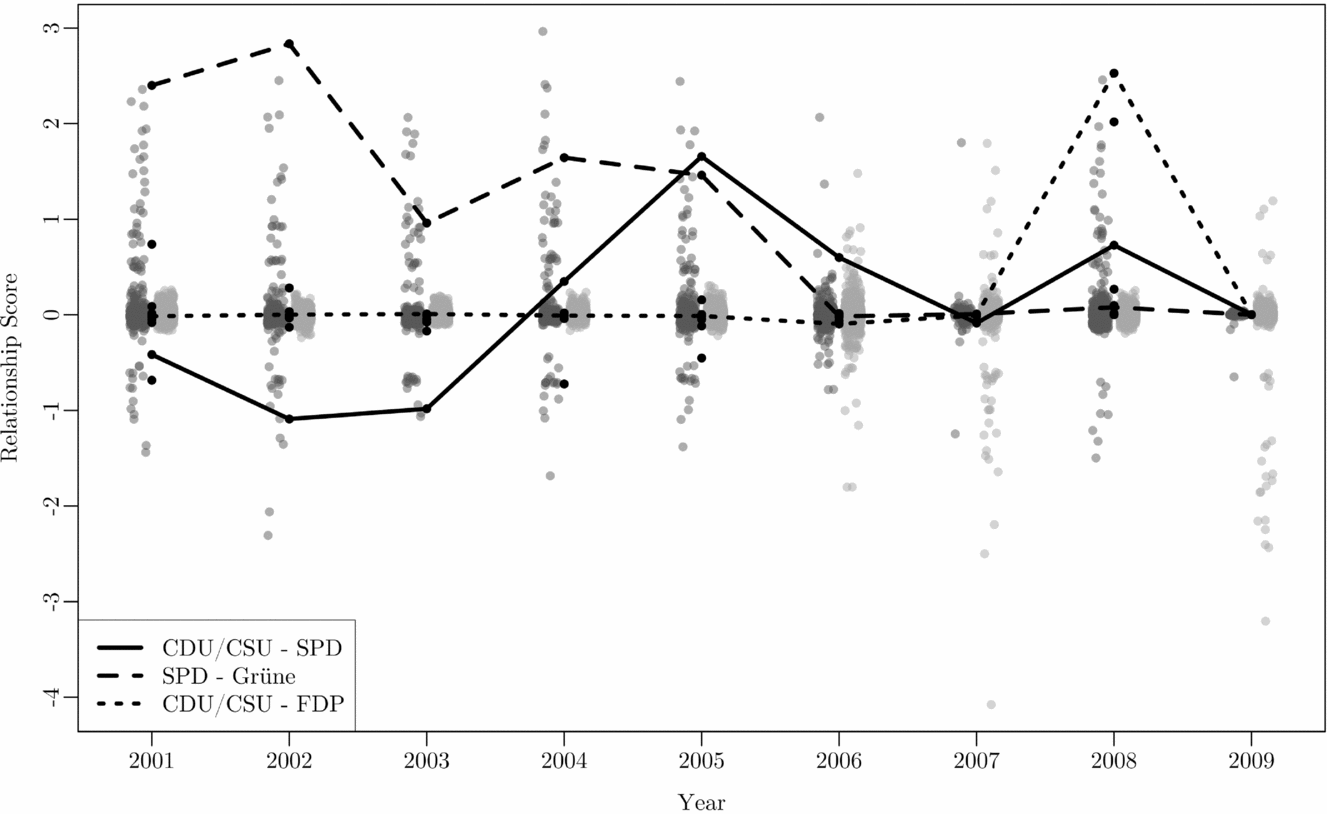
To show what the relationship scores derived from the latent factor models look like in practice, Figure 1 plots them for Germany from 2001 to 2009. In this case, I have aggregated all partisan actors in the data, so parties are unitary actors.Footnote 8 Scores involving two parties are displayed by black dots, dark gray dots represent scores between one partisan and one nonpartisan actor, and light gray is two nonpartisan actors.
Relationship Scores, Germany, 2001–2009

To highlight the face validity of the scores, I focus on three party-dyads over time. Social Democrats (SPD) and Grüne formed a coalition government until 2005. Their relationship scores during these years are consistently large, indicating a positive relation both in direct interactions as well as through third actors. After 2005, their scores go toward the neutral point. The most conflictual party-dyad relation during the SPD-Grüne coalition is between the SPD and the largest opposition party, the Christan Democratic Union/Christian Social Union (CDU/CSU). This changes once these two parties form a “grand coalition” in 2005, when they become the party dyad with the highest scores. Their relationship deteriorates over time, and the CDU/CSU becomes friendlier with the Free Democratic Party (FDP), foreshadowing the coalition they would form after the 2009 elections. However, this is not reflected in the scores for 2009, the year in which the Great Recession dominated the agenda and all party dyads exhibit neutral relationships. Notice that this is also true for the scores involving one party and one nonpartisan actor, while relations for nonpartisan dyads become more polarized (for a detailed analysis see Weschle Reference Weschle2017).
Public Relationships among Political Parties
Having shown the face validity of the measure, I now demonstrate how it makes a systematic comparative analysis of public political relationships possible. Specifically, I focus on the subset of relations between political parties. What determines whether they have cooperative or conflictual relationships?
Figure 1 suggests that coalition status matters. We would expect parties in government to work together to achieve common goals, and to have similar interactions with other actors in society. Opposition parties, in contrast, are supposed to hold the government accountable, which means direct criticism and cooperation with societal actors opposed to the government. The expectation is therefore that parties have a more cooperative relationship when they are in a coalition.
Second, given the central role that policy plays in structuring political competition in European countries, one can expect that it affects parties’ public relationships as well. If two parties advocate similar policies, they should interact in a cooperative manner with each other, and interact similarly with third actors. For example, two economically conservative parties both are likely to have cooperative relations with business and conflictual ones with unions.
To test these conjectures, I estimate a set of models in which the dyadic relationship scores involving two parties are the dependent variable. I regress this on a dummy variable indicating whether two parties are in a coalition together, as well as a dummy for opposition-opposition dyads (making government-opposition dyads the baseline). Regarding the effect of policy, I use the Comparative Manifestos Project (CMP) data and compute the absolute distance between the positions of two parties. In addition to the standard left-right difference, I also include a measure of parties’ difference on issues of nationalism and multiculturalism as a second policy dimension in European party competition.Footnote 9
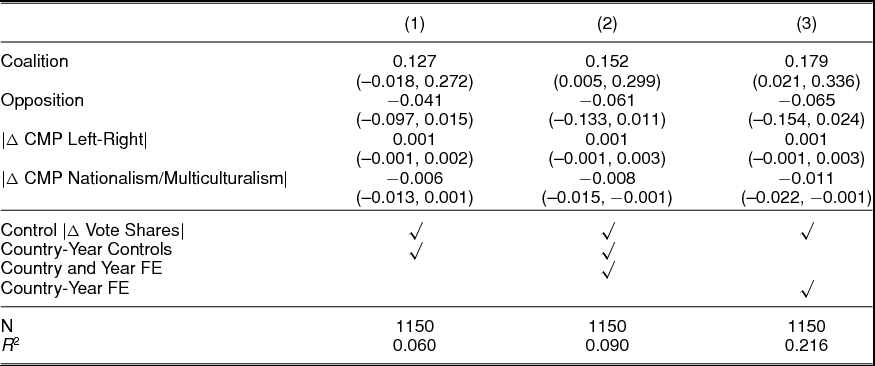
Table 1 shows the results of three specifications. The pooled model (1) and the one with country and year fixed effects (2) include the mean relationship score for each country-year to address potential concerns about the comparability of the separately estimated latent spaces. In addition, I add a set of controls at the country-year level (election year, number of parties, log population, number of events). Specification (3) includes country-year fixed effects and thus only uses variation from within each latent space, which ensures comparability. All three specifications control for the difference in vote shares between the parties. I take the uncertainty of the estimated relationship scores into account by deriving the dependent variable separately for all posterior draws of a latent factor model, running the regression and simulating coefficient draws for each (standard errors clustered at the dyad level), combining the results from these estimations, and calculating the confidence intervals.
Determinants of Party Relationship Scores

Ninety-five percent confidence intervals in parentheses (based on standard errors clustered at the dyad level).
The regressions provide evidence supporting both conjectures. Depending on the specification, a coalition partnership is associated with an increase in the relationship score by 0.30–0.42 standard deviations, compared to the government-opposition baseline. If both parties are in the opposition, the relationship score is somewhat lower than in the baseline, although the confidence intervals include zero.
Policy distance also has an effect on what kind of relationship parties have. Interestingly, it is not the difference in left-right positions that affects the relationship scores. Instead, parties with a greater difference in their positions towards nationalism/multiculturalism have lower scores. A one standard deviation increase in this independent variable is associated with a decrease in the dependent variable by 0.06–0.10 standard deviations. The public relationships of political parties are therefore not as much driven by whether they are left wing or right wing, but instead by the cleavage between “mainstream” and other parties about nationalism and multiculturalism—a fact that has only been made more salient in recent years. Overall, a systematic analysis thus shows that the public relationships among political parties in Western Europe follow predictable patterns.
CONCLUSION: USING QUANTIFIED POLITICAL RELATIONSHIPS IN COMPARATIVE POLITICS
The public relationships among political actors are important, but a lack of comparative data has largely prevented their empirical study. Using a combination of machine-coded news reports and latent factor models, I have introduced a way to quantify public relationships among political and societal actors. The scores for 13 Western European countries from 2001 to 2014 involving almost 3,500 actors are publicly available and can be incorporated by researchers into their analyses in a straightforward way.
Of course, there are some limitations. First, the relationship scores are based on media reports, which tend to focus on high-level actors. The measure does not reflect the actions of, for example, backbench members of parliament or societal actors at the local level. A second limitation is that the scores are based on public interactions, which may be different from private ones. Which interactions happen in public may also differ between countries depending on their laws, culture, or institutions. It is therefore important to address potential comparability issues in any analyses, for example, through country or country-year fixed effects. Third, the measure in its current form treats relationships as symmetric. It is possible to extend the latent factor approach to differentiate between sender and receiver behavior.Footnote 10 Finally, I treat all interactions as equal, whereas it is likely that some of them are more important for a relationship than others. However, this concern should be alleviated by the large number of interactions I am able to use.
Keeping these limitations in mind, the quantified political relationship approach opens the door for a host of new research. For example, it provides new data to study elite polarization, and the relationship scores between politicians and societal actors should be of interest for students of political representation. The potential of the new data is perhaps even stronger as an explanatory variable. Public relationships are likely to have an effect on voters, for example, on how they perceive parties’ policy positions, how polarized they are, or what their level of satisfaction with democracy is.
In the past years, scholars have increasingly made use of novel, large-scale data to address questions in comparative politics. The approach and data introduced in this article contribute to this trend and make it possible to revisit long-standing questions on the causes and consequences of political relationships.
SUPPLEMENTARY MATERIAL
To view supplementary material for this article, please visit https://doi.org/10.1017/S0003055418000461
Replication materials can be found on Dataverse at: https://doi.org/10.7910/DVN/AOTVAU.






Comments
No Comments have been published for this article.