INTRODUCTION
The tissue-cyst forming protozoan parasite Neospora caninum has emerged as an important cause of reproductive failure in cattle worldwide, leading to significant economic losses in beef and dairy cattle industries (Dubey et al. Reference Dubey, Schares and Ortega-Mora2007). In cattle, N. caninum is able to persist in the brain of an immunocompetent host in a cyst form containing slowly dividing bradyzoites (BZ). The cysts remain quiescent while awaiting an appropriate immunological scenario wherein they switch into fast replicating tachyzoites (TZ). In pregnant animals, TZ can disseminate and cause potentially fatal disease, resulting in abortion, birth of a weak calf or birth of a clinically healthy but persistently infected calf (Buxton et al. Reference Buxton, McAllister and Dubey2002; Innes et al. Reference Innes, Andrianarivo, Bjorkman, Williams and Conrad2002).
Epidemiological evidence confirming the protective immunity against vertical transmission and abortion in some N. caninum-infected cows makes immunoprophylaxis a feasible alternative for control of the disease (Innes et al. Reference Innes, Andrianarivo, Bjorkman, Williams and Conrad2002; Reichel and Ellis, Reference Reichel and Ellis2006; Dubey et al. Reference Dubey, Schares and Ortega-Mora2007). In recent years, most vaccine trials against N. caninum have focused on molecules from TZ in the form of live, inactivated or recombinant antigens, principally to control the acute phase of infection (Liddell et al. Reference Liddell, Jenkins, Collica and Dubey1999; Lunden et al. Reference Lunden, Wright, Allen and Buxton2002; Reichel and Ellis, Reference Reichel and Ellis2009; Ribeiro et al. Reference Ribeiro, Freitas, Cardoso, Pajuaba, Silva, Mineo, Silva, Mineo and Silva2009). Using vaccines containing parasite antigens from different life-cycle stages could be a promising strategy to improve the protection conferred by vaccines against neosporosis. Recently, we evaluated the role of the recombinant bradyzoite-specific SAG4 (rNcSAG4) protein of N. caninum in the protection against chronic and congenital infection in mice (Aguado-Martínez et al. Reference Aguado-Martínez, Álvarez-García, Fernández-García, Risco-Castillo, Marugán-Hernández and Ortega-Mora2009a). This study revealed that immunization with rNcSAG4 failed to protect against parasite infection. However, a slight yet significant delay in the death of pups in the rNcSAG4-vaccinated group was observed, motivating future studies to evaluate the effect of vaccines made from bradyzoite antigens. To this end, a mixture of whole Neospora TZ and BZ containing native organelle and membrane antigens from both stages could be a good candidate for vaccine development not only against the rapid dissemination of parasite during the acute infection phase but also against the establishment of persistent N. caninum infection.
We previously observed that immunization with whole inactivated TZ conferred protection against acute and chronic neosporosis in non-pregnant BALB/c mice when combined with appropriate adjuvants and antigen doses (Rojo-Montejo et al. Reference Rojo-Montejo, Collantes-Fernández, Regidor-Cerrillo, Rodríguez-Bertos, Prenafeta, Gómez-Bautista and Ortega-Mora2011). Specifically, a water-in-oil emulsion (W/O) adjuvant containing 5×10⁵ inactivated whole TZ reduced parasite presence in the brain during the chronic stage of infection, whereas aluminium hydroxide co-administrated with ginseng extract (Al/G) containing 5×10⁵ inactivated whole TZ significantly reduced acute parasitaemia. These results suggest that the W/O may control the establishment of infection in the brain, whereas the Al/G may control the vertical transmission of the parasite to progeny by reducing maternal parasitaemia and therefore the number of parasites reaching the placenta and fetus.
The objective of the present study was to investigate the protective efficacy of previously tested vaccine preparations containing inactivated whole N. caninum TZ as well as a new formulation of a tachyzoite-bradyzoite mixture (TZ-BZ) combined with W/O or Al/G against congenital and cerebral neosporosis with both pregnant and non-pregnant BALB/c mouse models (López-Pérez et al. Reference López-Pérez, Risco-Castillo, Collantes-Fernández and Ortega-Mora2006, Reference López-Pérez, Collantes-Fernández, Aguado-Martínez, Rodríguez-Bertos and Ortega-Mora2008).
MATERIALS AND METHODS
Parasite culture
Culture of N. caninum zoites for immunization
The N. caninum Nc-Spain7 isolate, recently obtained from the brain of an asymptomatic but congenitally infected calf (Regidor-Cerrillo et al. Reference Regidor-Cerrillo, Gómez-Bautista, Pereira-Bueno, Aduriz, Navarro-Lozano, Risco-Castillo, Fernández-García, Pedraza-Díaz and Ortega-Mora2008), was used for immunization. TZ were grown by continuous passage in MARC-145 cells following standard procedures (Pérez-Zaballos et al. Reference Pérez-Zaballos, Ortega-Mora, Álvarez-García, Collantes-Fernández, Navarro-Lozano, García-Villada and Costas2005). TZ for vaccine formulations were harvested 3·5 days post-infection. For formulations containing TZ-BZ, in vitro stage conversion was induced by treatment of Nc-Spain7 tachyzoite-infected cultures with 70 μ m sodium nitroprusside (SNP) for up to 7 days (Risco-Castillo et al. Reference Risco-Castillo, Fernández-García and Ortega-Mora2004). Zoites were harvested from tissue culture on day 7 post-stress. Both TZ and TZ-BZ cultures were purified by washing 3 times in sterile phosphate-buffered saline (PBS, pH 7·4) and separated from host cell debris by passing the mixture through a 25-gauge needle following passage through disposable PD-10 desalting columns (GE Healthcare, Buckinghamshire, UK) (Hemphill et al. Reference Hemphill, Gottstein and Kaufmann1996). Cell-free Nc-Spain7 zoites were counted by Trypan blue exclusion followed by counting in a Neubauer chamber, adjusted to a final concentration of 5×10⁷ zoites/ml and immediately inactivated as described below in the Vaccine formulations section.
Conversion measurement assay
Seven days after stress treatment, the tachyzoite-to-bradyzoite conversion rate was measured by double immunofluorescence (Risco-Castillo et al. Reference Risco-Castillo, Fernández-García and Ortega-Mora2004). Identification of TZ and BZ was performed by labelling parasites with antibodies directed against the immunodominant N. caninum tachyzoite surface antigen NcSAG1 (Fuchs et al. Reference Fuchs, Sonda, Gottstein and Hemphill1998) and with antiserum against T. gondii bradyzoite antigen 1 (BAG1), which exhibits cross-reactivity with N. caninum BZ (McAllister et al. Reference McAllister, Parmley, Weiss, Welch and McGuire1996). Cover-slips were labelled with a monoclonal mouse antibody directed against the tachyzoite surface antigen NcSAG1 (αSAG1) (1:2000) and a polyclonal rabbit antiserum against the intracytoplasmic bradyzoite antigen BAG1 (αBAG1) (1:100) (Risco-Castillo et al. Reference Risco-Castillo, Fernández-García and Ortega-Mora2004). Antibody binding was observed with an inverted fluorescence microscope (Model TE200 Nikon, 100×oil-immersion objective). The conversion rate of TZ to BZ was calculated by random counting of 10 fields per cover-slip and comparing the percentage of BAG1-positive zoites versus total zoites. Double immunofluorescence revealed a TZ-to-BZ conversion rate around 30%, which was used for vaccine formulations containing TZ-BZ antigen.
Parasite culture for challenge
Tachyzoites of the Nc-Liverpool isolate (Barber et al. Reference Barber, Holmdahl, Owen, Guy, Uggla and Trees1995) were maintained in vitro by continuous passage in MARC-145 cells using standard procedures (Pérez-Zaballos et al. Reference Pérez-Zaballos, Ortega-Mora, Álvarez-García, Collantes-Fernández, Navarro-Lozano, García-Villada and Costas2005). For N. caninum challenge, TZ were prepared following described procedures (López-Pérez et al. Reference López-Pérez, Risco-Castillo, Collantes-Fernández and Ortega-Mora2006, Reference López-Pérez, Collantes-Fernández, Aguado-Martínez, Rodríguez-Bertos and Ortega-Mora2008) at the required dose of 2×10⁶ TZ in a final volume of 200 μl per mouse and used immediately to infect mice.
Vaccine formulations
Purified Nc-Spain7 TZ and TZ-BZ mixtures were inactivated with 0·01 m (final concentration) of binary ethylenimine for a period of 96 h at 4°C, followed by neutralization with sodium thiosulphate (Andrianarivo et al. Reference Andrianarivo, Rowe, Barr, Anderson, Packham, Sverlow, Choromanski, Loui, Grace and Conrad2000). Inactivated whole Nc-Spain7 zoites were incorporated into the W/O or Al/G. The W/O was used at a concentration of 104 mg per dose. In the adjuvant Al/G, aluminium hydroxide was used at a concentration of 1·53 mg per dose combined with 0·2 mg of ginseng extract. Both adjuvant preparations were developed by HIPRA (Girona, Spain). The immunizing doses were prepared in a final volume of 200 μl per mouse.
Immunization assay and sample collection
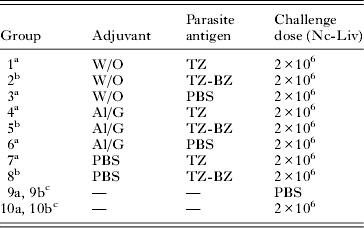
All mouse handling procedures complied with EU legislation. Eight-week-old female BALB/c mice (Harlan Interfauna Ibérica, Barcelona, Spain) were randomly divided into 10 groups. Each mouse was injected subcutaneously twice at 3-week intervals with 5×10⁵ inactivated whole N. caninum zoites (TZ or TZ-BZ) incorporated into the W/O, the Al/G or PBS. Other groups received the W/O, the Al/G or PBS alone (Table 1). For logistical reasons, the experiment was carried out at 2 different times. First, vaccine formulations containing N. caninum TZ were inoculated. Next, mice were immunized with N. caninum TZ-BZ. Non-immunized/non-challenged (group 9) and non-immunized/challenged (group 10) mice were included at both time-points (subgroups a and b) of the experiment to ensure the reproducibility of the technique. Three weeks after the booster immunization, BALB/c mice were mated for 96 h following synchronization of oestrus using the Whitten effect (Whitten, Reference Whitten1957). Day 0 of pregnancy was defined as the first day that females were housed with males. The challenge infection was achieved by subcutaneously inoculating animals with 2×10⁶ Nc-Liverpool TZ at mid-gestation (between days 6 and 10 of gestation). Pregnant animals were housed individually and allowed to carry their pregnancy to term. Pups were evaluated daily from birth to day 30 post-partum (PP) for congenital neosporosis (López-Pérez et al. Reference López-Pérez, Collantes-Fernández, Aguado-Martínez, Rodríguez-Bertos and Ortega-Mora2008). Dams and non-pregnant mice were evaluated for chronic infection until day 30 PP and day 30 post-challenge, respectively (Collantes-Fernández et al. Reference Collantes-Fernández, López-Pérez, Álvarez-García and Ortega-Mora2006; López-Pérez et al. Reference López-Pérez, Collantes-Fernández, Aguado-Martínez, Rodríguez-Bertos and Ortega-Mora2008). Brains and lungs from neonates and brains from adult mice were removed aseptically and frozen at −80°C until required for DNA extraction. Samples from some progeny could not be collected due to cannibalism by the dams. Immune responses were evaluated in 5 randomly selected mice from each group prior to the challenge (2 days after booster) and in dams at the chronic phase (day 30 PP). The number of pregnant mice analysed at this time-point (day 30 PP) varied between 5 and 10 animals per group; the number of pregnant mice analysed was related to the number of dams that survived until the end of the experiment. To measure the humoral immune response, blood samples were collected by cardiac puncture, and the recovered sera were aliquoted and cryopreserved at −80°C until serological analysis. For measurements of cytokine expression, spleen samples from each group were pooled (0·05 g of spleen tissue per mouse) and cryopreserved at −80°C until processed as described below.
Summary of group characteristics

a Mice were immunized with N. caninum whole TZ incorporated into W/O, Al/G or PBS in groups of 22 mice.
b Mice were immunized with the N. caninum whole TZ-BZ mixture incorporated into W/O, Al/G or PBS. The number of mice per group was expanded to 32 mice to make the statistical analysis more consistent by increasing the number of pregnant mice per group.
c Non-immunized/non-challenged (group 9) and non-immunized/challenged (group 10) mice were included at both time-points (subgroups a and b) of the experiment to ensure the reproducibility of the experimental design. The number of mice in subgroups a and b was 22 and 32, respectively.
Parameters evaluated for safety and efficacy
The safety of different formulations was determined by daily observation of mice for adverse reactions and by palpation for the presence of nodules at the inoculation site on day 10 after the booster vaccination. Vaccine efficacy studies were performed using both pregnant and non-pregnant BALB/c mouse models as previously described (Aguado-Martínez et al. Reference Aguado-Martínez, Álvarez-García, Fernández-García, Risco-Castillo, Marugán-Hernández and Ortega-Mora2009a; Rojo-Montejo et al. Reference Rojo-Montejo, Collantes-Fernández, Regidor-Cerrillo, Rodríguez-Bertos, Prenafeta, Gómez-Bautista and Ortega-Mora2011). In the pregnant mouse model, data on litter size, hebdomadal mortality, temporal evolution and the rate of neonatal mortality and vertical transmission were collected. Litter size was defined as the number of pups delivered per dam. Hebdomadal mortality was defined as the number of full-term dead pups at the time of birth and those that died between birth and day 2 PP. Neonates were examined daily for morbidity and mortality. Neonatal mortality was defined as the number of dead pups from day 2 to day 30 PP. Temporal evolution of neonatal mortality was evaluated using Kaplan-Meier survival curves. Finally, vertical transmission of N. caninum was identified by the presence of parasites in the lungs or brains of pups that died within 48 h (hebdomadal mortality) and pups born alive. Vaccine efficacy against the chronic N. caninum infection phase was studied in dams and non-pregnant mice by checking clinical signs compatible with neosporosis, mortality and the presence of N. caninum DNA in the brain.
DNA extraction and nested PCR
Tachyzoites for PCR controls were prepared as previously described (López-Pérez et al. Reference López-Pérez, Risco-Castillo, Collantes-Fernández and Ortega-Mora2006). The Real Pure Extraction genomic DNA kit (Durviz, Valencia, Spain) was used to extract DNA from 10–20 mg of each host tissue and 107 N. caninum tachyzoites according to the manufacturer's instructions. Amounts of DNA were measured spectrophotometrically, and samples used for DNA detection by nested PCR were diluted to a final concentration of 50 ng/μl. For the detection of parasite DNA, nested PCR on the internal transcribed spacer (ITS1) region of N. caninum was performed with 4 oligonucleotides as described by Buxton et al. Reference Buxton, Maley, Wright, Thomson, Rae and Innes1998). Secondary amplification products were visualized by 1·8% agarose gel electrophoresis and ethidium bromide staining. To avoid false positives, DNA extraction, PCR sample preparation and electrophoresis were performed in separate rooms employing different sets of instruments, aerosol barrier tips and disposable gloves. Moreover, negative control samples were included in each set of DNA extractions and PCR reactions.
Analysis of the humoral immune response
Serum levels of N. caninum-specific IgG1 and IgG2a were measured as identifiers of Th2 and Th1 immune responses, respectively, with an ELISA based on N. caninum soluble tachyzoite antigens (Long et al. Reference Long, Baszler and Mathison1998; Collantes-Fernández et al. Reference Collantes-Fernández, López-Pérez, Álvarez-García and Ortega-Mora2006). Specific IgG responses developed against different life-cycle stages were measured by ELISA based on the stage-specific recombinant NcGRA7 and NcSAG4 proteins according to previously described methods (Aguado-Martínez et al. Reference Aguado-Martínez, Álvarez-García, Fernández-García, Risco-Castillo, Marugán-Hernández and Ortega-Mora2009a,Reference Aguado-Martínez, Ortega-Mora, Álvarez-García, Rodríguez-Marco, Risco-Castillo, Marugán-Hernández and Fernández-Garcíab). Similarly, a recombinant NcBSR4 protein-based ELISA was developed to measure serum levels of specific IgG against NcBSR4 protein. The dense granule protein NcGRA7 is an immunogenic antigen that is highly associated with active replication of the parasite (Jenkins et al. Reference Jenkins, Wouda and Dubey1997; Aguado-Martínez et al. Reference Aguado-Martínez, Álvarez-García, Fernández-García, Risco-Castillo, Arnaiz-Seco, Rebordosa-Trigueros, Navarro-Lozano and Ortega-Mora2008). Therefore, we used recombinant NcGRA7 (Álvarez-García et al. Reference Álvarez-García, Pitarch, Zaballos, Fernández-García, Gil, Gómez-Bautista, Aguado-Martínez and Ortega-Mora2007) as an antigen to evaluate the antibody response developed against TZ. The recently described N. caninum NcSAG4 (Fernández-García et al. Reference Fernández-García, Risco-Castillo, Zaballos, Álvarez-García and Ortega-Mora2006) and NcBSR4 (Risco-Castillo et al. Reference Risco-Castillo, Fernández-García, Zaballos, Aguado-Martínez, Hemphill, Rodríguez-Bertos, Álvarez-García and Ortega-Mora2007) proteins are stage-specific antigens expressed at early and late bradyzoite stages, respectively. We employed both of them to measure the humoral immune response specifically developed against this slowly dividing parasite stage. The ELISA results were expressed as a relative index percentage (RIPC) using the following formula: RIPC=(OD405 sample-OD405 negative control)/(OD405 positive control-OD405 negative control)×100, where OD is the mean value of the optical density. For recombinant protein-based ELISA (GRA7, SAG4 and BSR4), the threshold value arbitrarily discriminating between ‘positive’ and ‘negative’ (cut-off) was defined by adding 3 standard deviations to the mean A405 value of sera from non-immunized/non-infected mice.
Analysis of cytokine expression
Cytokine expression was evaluated in spleen by real-time RT-PCR as previously described (López-Pérez et al. Reference López-Pérez, Collantes-Fernández, Rojo-Montejo, Navarro-Lozano, Risco-Castillo, Pérez-Pérez, Pereira-Bueno and Ortega-Mora2010). Briefly, pooled spleens (0·05 g per mouse) were homogenized in the commercial TRI REAGENT (Sigma, St Louis, MO, USA) by a Polytron PT1600E homogenizer (Kinematica, AG, Lucerne, Switzerland). Total RNA was extracted following the manufacturer's instructions, and the integrity was checked by agarose gel electrophoresis. cDNA synthesis was performed with SuperScript II Reverse Transcriptase (Invitrogen, Paisley, UK) following the manufacturer's recommendations. The primer sequences used for the amplification of interferon γ (IFN-γ), interleukin 4 (IL-4) and β-actin cDNA have previously been published (Varona et al. Reference Varona, Cadenas, Gómez, Martínez and Márquez2005). Real-time PCR was performed using the ABI PRISM 7300 Sequence Detector Machine (PE Applied Biosystem, Foster City, CA, USA) with the commercial kit Platinum SYBR Green qPCR Supermix-UDG (Invitrogen, Paisley, UK). Each sample was analysed in triplicate, and the cycle threshold (Ct) value was obtained with Sequence Detection System Software. All cycle threshold values were normalized to the expression of the housekeeping gene β-actin. For relative quantification of gene expression, the Comparative Threshold Cycle method was used. The relative n-fold change of each target cytokine expression, normalized to the endogenous reference and relative to the control group, is given by 2−∆∆Ct (Livak and Schmittgen, Reference Livak and Schmittgen2001).
Data analysis
All immunized groups were compared to the non-immunized/challenged group to evaluate the protective efficacy of the vaccine. The influence of the stage-specific antigens and adjuvant type was evaluated by comparing the different antigens (TZ vs TZ-BZ) within the same adjuvant group and the different adjuvants (W/O vs Al/G) with the same type of antigen, respectively.
Differences in morbidity, mortality, parasite detection and vertical transmission rates were organized in a contingency table. A Chi-squared test or Fisher F-test was performed, and Bonferroni´s adjustment was applied to the P value. Post-natal mortality was analysed by the Kaplan-Meier survival method (Bland and Altman, Reference Bland and Altman1998) to estimate the percentage of surviving individuals at each time-point (days PP). To compare the survival curves between groups, the log-rank statistical test was applied (Bland and Altman, Reference Bland and Altman2004). Litter size and serological data were compared using a one-way analysis of variance (one-way ANOVA) test, followed by Tukey's multiple comparison test. All statistical analyses were carried out using Statgraphics Plus v. 5.1 (StatPoint, Inc., Herndon, VA, USA) and GraphPad Prism 5 v. 5.01 (San Diego, CA, USA) software.
RESULTS
Vaccine safety
No systemic side-effects were observed in any animal after immunization. Upon palpation, nodules at the injection site were found in 64·7% to 100% of mice receiving W/O or Al/G, respectively.
Protective efficacy against congenital neosporosis
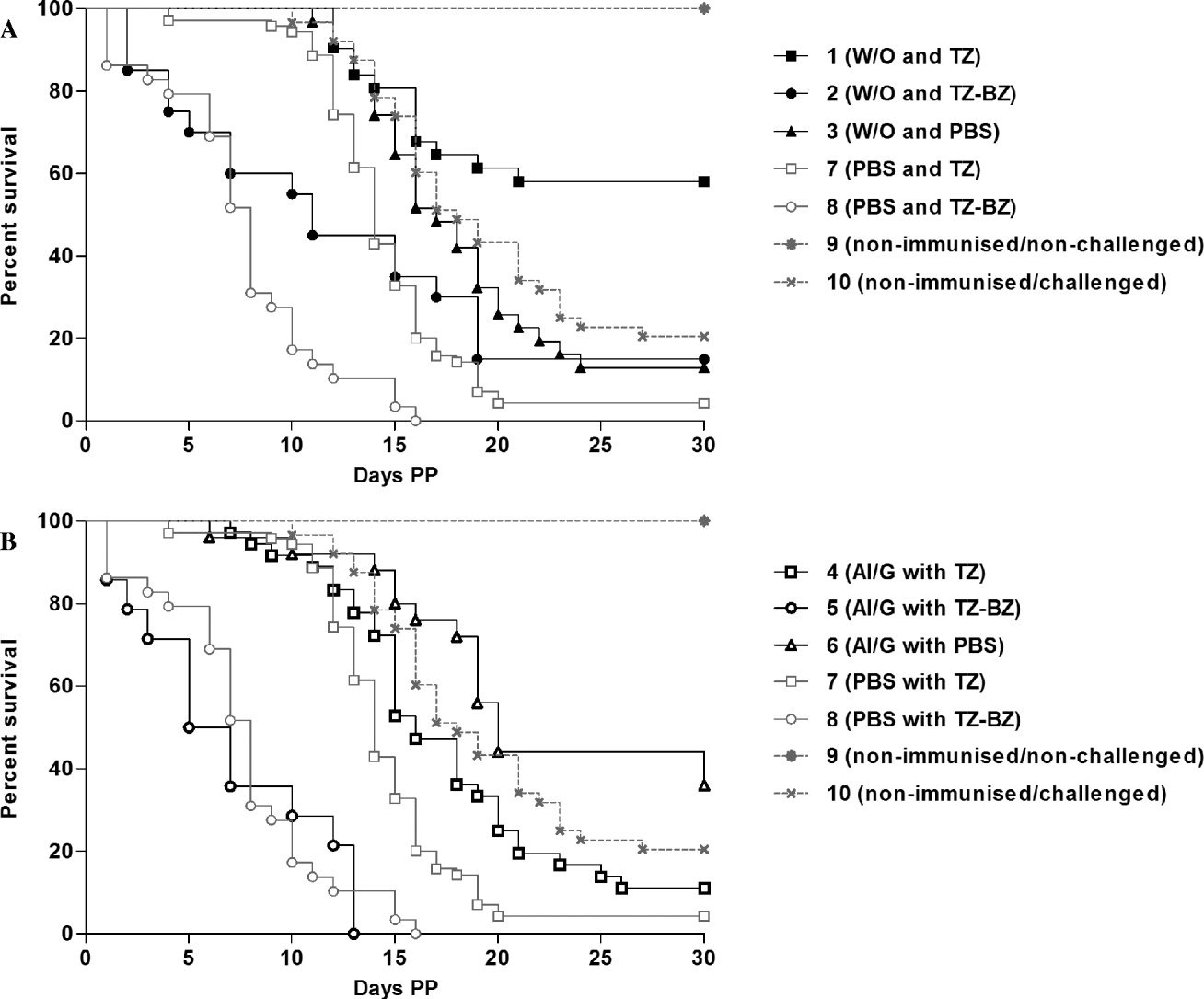
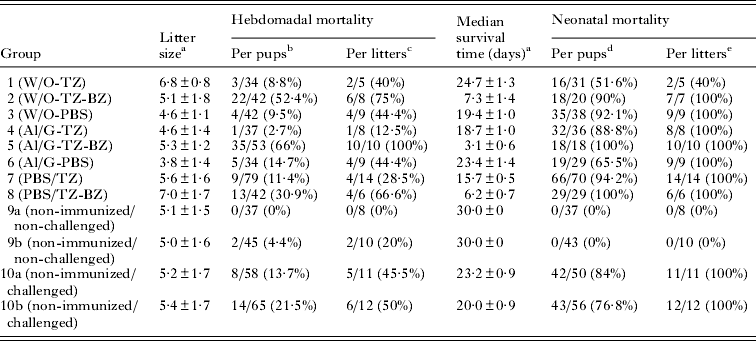
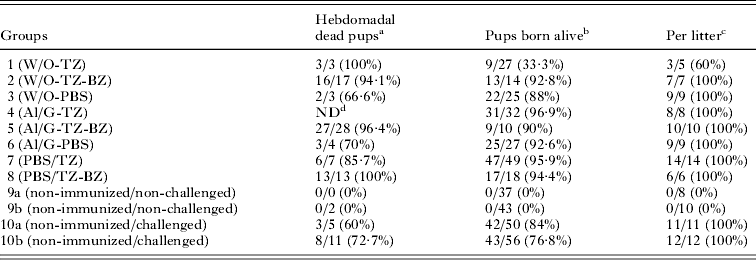
Different degrees of protection against congenital parasite infection afforded by the different vaccine formulations tested were observed (Tables 2 and 3 and Fig. 1). Dams vaccinated with TZ-BZ (groups 2, 5 and 8) and TZ (group 7) incorporated into PBS transmitted the infection more efficiently to their offspring in comparison with the non-immunized/challenged group (group 10) and displayed the most severe outcome of congenital neosporosis. A significant increase of hebdomadal mortality (groups 2 and 5 vs group 10; P<0·0001) and a shorter median survival time of neonates (groups 2, 5, 7 and 8 vs group 10; P<0·05) were observed in these groups. In contrast, the group vaccinated with TZ and W/O (group 1) had a lower mortality rate (P<0·005), longer median survival time (P<0·005) and reduced vertical transmission (P<0·0001) in comparison with the non-immunized/challenged group (group 10).
Kaplan–Meier survival curves for neonates born from dams immunized with adjuvant W/O (panel A) or adjuvant Al/G (panel B). The curves represent the percentage survival as the proportion of all individuals surviving over a period of 30 days PP. Vertical steps downwards correspond to days PP when a death was observed. Symbols indicate censored observations.

Litter size, hebdomadal mortality and neonatal mortality of pups in each group

a Average±s.d.
b No. of hebdomadal dead pups/no. of pups born in the group (percentage).
c No. of litters with at least 1 stillbirth/no. of litters in the group (percentage).
d No. of pups dead from days 2 to 30 PP/no. of pups born alive (percentage).
e No. of litters with at least 1 pup dead from days 2 to 30 PP/no. of litters in the group (percentage).
Vertical transmission in hebdomadal dead pups and pups born alive as detected by nested PCR

a No. of infected stillborns/no. of stillborns analysed in the group (percentage).
b No. of positive pups born alive/no. of analysed pups born alive (percentage).
c No. of litters with at least 1 positive pup/no. of analysed litters (percentage).
d ND, not determined. No brain samples from hebdomadal dead born pups could be recovered and analysed as a result of cannibalism of the dams observed in all the experimental groups.
When the influence of the antigen type was evaluated, higher hebdomadal mortality rates were observed in all groups vaccinated with TZ-BZ and W/O, Al/G or PBS (group 2 vs groups 1 and 3; group 5 vs groups 4 and 6; group 8 vs group 7; P<0·01). Moreover, pups born alive from dams immunized with TZ-BZ with the Al/G exhibited a shorter median survival time (group 5 vs groups 4 and 6; P<0·0001). Conversely, among the groups vaccinated using the W/O adjuvant, pups from dams given TZ displayed a lower neonatal mortality rate, longer median survival time and lower vertical transmission than pups from groups immunized with TZ-BZ or PBS (group 1 vs groups 2 and 3; P<0·0001).
When the adjuvants were compared, mice vaccinated with TZ-BZ and Al/G showed higher hebdomadal mortality than mice given the same antigen and PBS (group 5 vs group 8; P<0·001). A protective adjuvant-dependent effect was observed in mice vaccinated with TZ and W/O; the pups of these mice that were born alive showed a lower mortality rate, longer median survival time and lower vertical transmission than pups from groups immunized with Al/G or PBS (group 1 vs groups 4 and 7; P<0·005).
Taken together, these results show that immunization with the TZ-BZ antigen exacerbated congenital neosporosis and allowed parasite transmission to offspring during pregnancy. In contrast, immunization with TZ and W/O partially limited vertical transmission of parasite to progeny, preventing offspring infection.
Protective efficacy against cerebral neosporosis
Data on N. caninum-related clinical signs, mortality and parasite detection in brain during chronic infection phase are summarized in Table 4. Mice immunized with TZ-BZ (groups 2, 5 and 8) and TZ (group 7) with PBS exhibited more severe cerebral neosporosis than the non-immunized/challenged group (group 10), showing a higher frequency of clinical signs (groups 2, 5, 8 and 7 vs group 10; P<0·001) and higher mortality rates (groups 5, 8 and 7 vs group 10; P<0·0001). On the contrary, immunization with W/O and TZ reduced the presence of N. caninum in the brain compared with mice from the non-immunized/challenged group (groups 1 vs group 10; P<0·01).
Morbidity and mortality rates and detection of parasite DNA in adult mice at chronic infection phase

a No. of mice with clinical signs compatible with neosporosis/no. of mice in the group (percentage).
b No. of sacrificed mice due to severity of clinical signs/no. of mice in the group (percentage).
c No. of nested PCR positive mice/no. of analysed mice in the group (percentage).
The effect of the type of antigen was observed in the group inoculated with Al/G and TZ-BZ, in which clinical signs and mortality were significantly increased compared with those vaccinated with the same adjuvant and TZ or PBS (group 5 vs groups 4 and 6; P<0·01).
When the influence of adjuvant type was evaluated, an increase in morbidity and mortality rates was observed in groups immunized with TZ or TZ-BZ plus PBS or Al/G when compared to groups given the W/O adjuvant (groups 4 and 7 vs group 1; groups 5 and 8 vs group 2; P<0·01). Similarly, an adjuvant-dependent increase in mortality rate was observed in mice given TZ or TZ-BZ and PBS with respect to those given the Al/G adjuvant (group 7 vs group 4; group 8 vs group 5; P<0·01).
Together, these data show that the TZ-BZ antigen did not limit the establishment of chronic infection in brain and in fact exacerbated cerebral neosporosis. Conversely, immunization with TZ combined with the W/O adjuvant reduced parasite multiplication in the brain during chronic infection.
Immune response prior to challenge
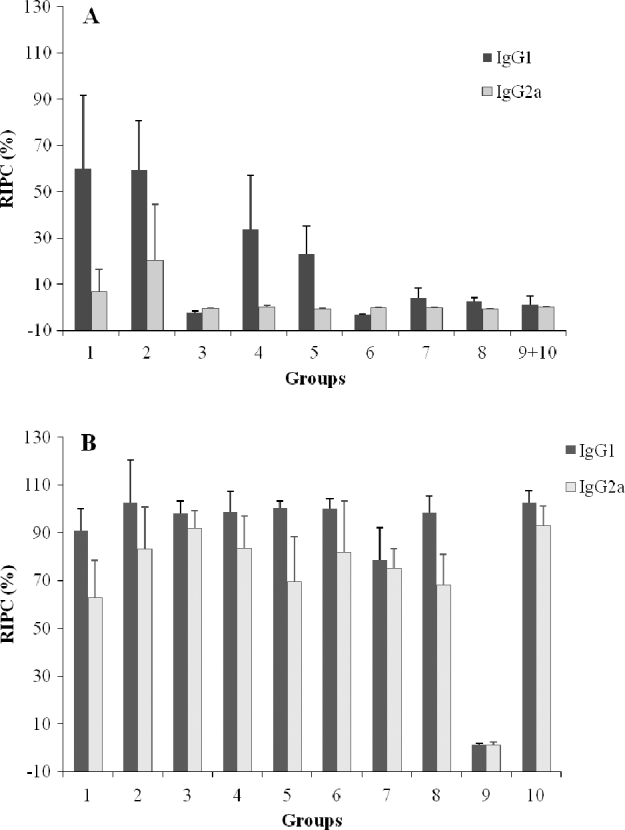
Production of IgG1 was observed in all groups that were immunized with N. caninum antigen combined with an adjuvant, but the highest levels were observed after immunization with TZ or TZ-BZ plus W/O (group 1 vs groups 7 and 9; group 2 vs groups 5, 8 and 9; P<0·0001) (Fig. 2A). With respect to the IgG2a isotype, the group given TZ-BZ and W/O produced the highest antibody levels (group 2 vs groups 5, 8 and 9; P<0·01).
ELISA anti-Neospora caninum IgG1 and IgG2a both from BALB/c mice prior to challenge at day 2 after booster (panel A) and from dams at day 30 PP (panel B). Bars represent the mean relative index percent (RIPC), and error bars indicate the standard deviation for each group. A total number of 5 mice prior to challenge and all of the surviving dams at day 30 PP were included in the analysis. Descriptions of groups 1–10 are summarized in Table 1.

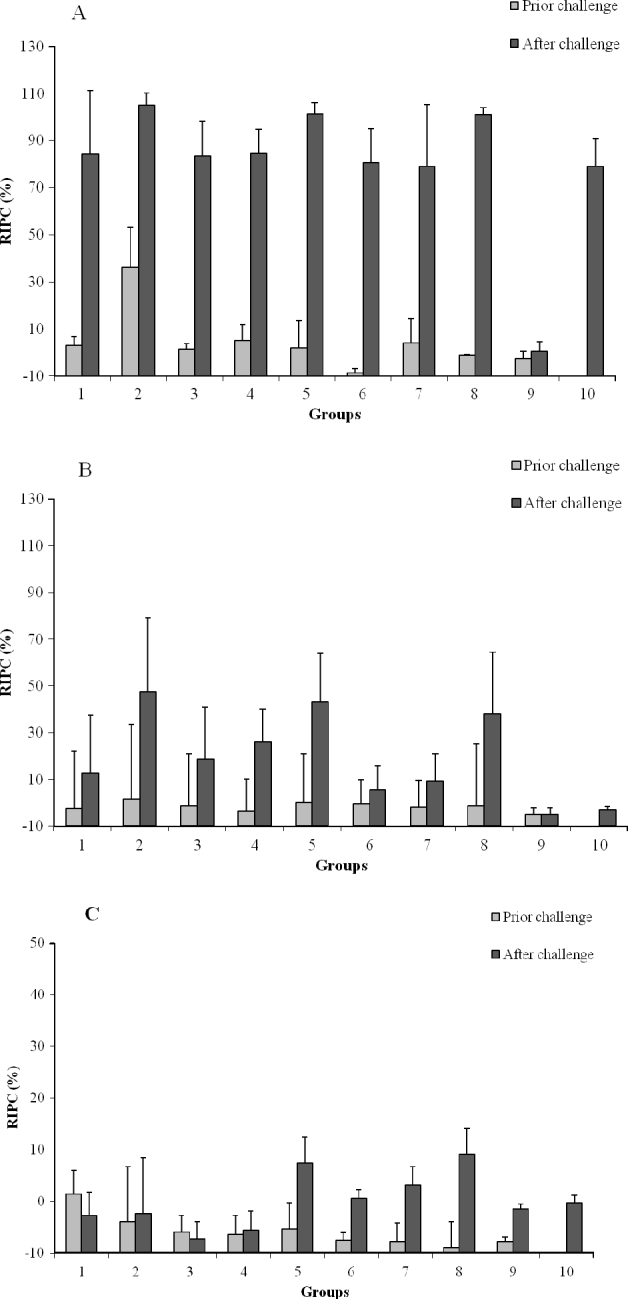
The anti-rGRA7 IgG response was significantly higher in mice immunized with TZ-BZ and W/O when compared with groups immunized with the same adjuvant, antigen or with non-immunized group (group 2 vs groups 1, 3, 5, 8 and 9; P<0·0001) (Fig. 3A). No N. caninum-specific rNcSAG4 and rNcBSR4 IgGs were detected prior to challenge in any immunized groups (Fig. 3B and C).
ELISA results for anti-rNcGRA7 (panel A), anti-rNcSAG4 (panel B) and anti-rNcBSR4 (panel C) antibodies in both BALB/c mice prior to challenge at day 2 after booster and from dams after challenge at day 30 PP. Bars represent the mean relative index percent (RIPC), and error bars indicate the standard deviation for each group. Positive cut-offs were established in GRA7-based ELISA at ⩾7·6 RIPC, in SAG4-based ELISA at ⩾7·8 and in BSR4-based ELISA at ⩾10 RIPC. Five mice prior to challenge and all of the surviving dams at day 30 PP were included in the analysis. Descriptions of groups 1–10 are summarized in Table 1.

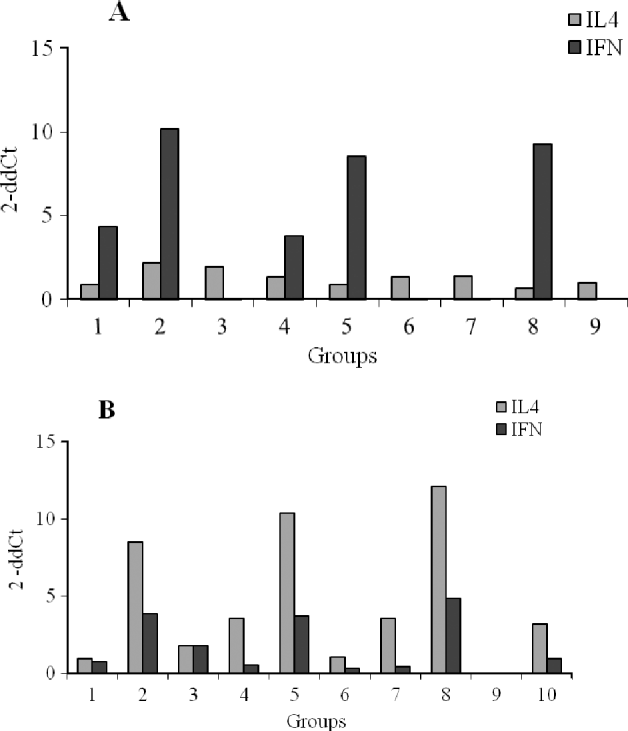
IFN-γ mRNA expression was induced in groups immunized with N. caninum antigen-containing preparations (TZ or TZ-BZ) and was highest in groups immunized with bradyzoite-specific antigens (groups 2, 5 and 8). No up-regulated IL-4 mRNA expression was detected in any immunized group (Fig. 4A).
Cytokine expression in both BALB/c mouse spleen prior to challenge 2 days after booster (A) and after challenge in dams at day 30 PP (B). The results of real-time RT-PCR are given by −2∆∆Ct. The −2∆∆Ct value for the control is 1. Bars represent the cytokine expression in the pool of each group. Five mice prior to challenge and all the surviving dams at day 30 PP were included in the analysis. Descriptions of groups 1–10 are summarized in Table 1.

Immune response after challenge
During the chronic infection phase, mice exhibited a strong anti-N. caninum response by producing IgG1 and IgG2a (Fig. 2B). Significant differences in IgG2a production were detected only between some immunized groups when compared with the non-immunized/challenged group (groups 1, 5, 7 and 8 vs group 10; P<0·0001). When the effect of adjuvant or antigen was evaluated, no influence on antibody response was observed.
Regarding the specific antibody response against N. caninum recombinant proteins, significantly higher levels of anti-rNcGRA7 IgGs were detected in groups immunized with TZ-BZ (groups 2, 5 and 8 vs group 10; P<0·0001) (Fig. 3A). Interestingly, TZ-BZ-immunized groups produced significantly higher levels of antibodies against the recombinant bradyzoite-specific proteins rNcSAG4 (groups 2, 5 and 8 vs group 10; P<0·0001) and rNcBSR4 (groups 5 and 8 vs group 10; P<0·0001) (Fig. 3B).
With regard to the cytokine mRNA expression levels in spleens from dams, groups vaccinated with TZ-BZ (groups 2, 5 and 8) showed the highest IL-4 and IFN-γ transcript levels, with a predominance of IL-4 expression (Fig. 4B).
DISCUSSION
The present study was conducted to evaluate the protective effect of inactivated whole N. caninum TZ and TZ-BZ compositions formulated with 2 different adjuvants against congenital and cerebral N. caninum infection. The ability of whole TZ antigens to reduce acute parasitaemia and parasite brain infection when combined with Al/G and W/O, respectively, during chronic neosporosis was previously demonstrated in a non-pregnant mouse model (Rojo-Montejo et al. Reference Rojo-Montejo, Collantes-Fernández, Regidor-Cerrillo, Rodríguez-Bertos, Prenafeta, Gómez-Bautista and Ortega-Mora2011). To determine if these formulations conferred protection not only against acute and cerebral neosporosis but also against congenital infection, a well-established pregnant BABL/c mouse model was used (López-Pérez et al. Reference López-Pérez, Risco-Castillo, Collantes-Fernández and Ortega-Mora2006, Reference López-Pérez, Collantes-Fernández, Aguado-Martínez, Rodríguez-Bertos and Ortega-Mora2008; Regidor-Cerrillo et al. Reference Regidor-Cerrillo, Gómez-Bautista, Del Pozo, Jiménez-Ruiz, Aduriz and Ortega-Mora2010). This model is a highly stringent tool for testing the efficacy of vaccine formulations against the transmission of the parasite to progeny (Aguado-Martínez et al. Reference Aguado-Martínez, Álvarez-García, Fernández-García, Risco-Castillo, Marugán-Hernández and Ortega-Mora2009a) because there is a high transmission rate of N. caninum to the offspring after inoculation of dams at the second trimester of gestation. The results obtained here indicate that different degrees of protection are strongly dependent on the type of antigen and the co-administered adjuvant.
An important feature of cyst-forming protozoan parasites such as N. caninum is their ability to establish a chronic infection by converting from rapidly proliferative TZ into BZ that remain hidden from the host immune system contained within tissue cysts. Vaccine preparations composed of antigens from different life-cycle stages may be advantageous to confer protection against the rapid dissemination and invasion of host cells by N. caninum TZ and the establishment and maintenance of a chronic infection after conversion of TZ to BZ (Innes and Vermeulen, Reference Innes and Vermeulen2006). To our knowledge, BZ-specific antigens have only been employed as recombinant vaccine candidates against N. caninum infection in one instance (Aguado-Martínez et al. Reference Aguado-Martínez, Álvarez-García, Fernández-García, Risco-Castillo, Marugán-Hernández and Ortega-Mora2009a). In this previous study, we evaluated the induced immune response, safety and efficacy of immunization with rNcSAG4 in a pregnant mouse model. Although no significant protection was found with this vaccine formulation, the decrease in pup mortality indicates that adjusting some aspects of vaccine development, such as ensuring the correct balance of the Th1/Th2 immune response or introducing new vaccine candidates, could lead to more encouraging results. One drawback of using recombinant preparations is that antigens may not retain their native conformation; consequently, their recognition by the immune system may be different, causing a loss of immunogenicity (Cannas et al. Reference Cannas, Naguleswaran, Muller, Eperon, Gottstein and Hemphill2003; Srinivasan et al. Reference Srinivasan, Mueller, Suana and Hemphill2007; Aguado-Martínez et al. Reference Aguado-Martínez, Álvarez-García, Fernández-García, Risco-Castillo, Marugán-Hernández and Ortega-Mora2009a). In addition, most BZ-specific antigens from the closely related parasite T. gondii appear to be poorly or not at all immunogenic during infection, and this condition may be one of the mechanisms by which BZ escape immune surveillance (Di Cristina et al. Reference Di Cristina, Del Porto, Buffolano, Beghetto, Spadoni, Guglietta, Piccolella, Felici and Gargano2004; Kim and Boothroyd, Reference Kim and Boothroyd2005). Due to the complex interaction of the parasite and host, an inactivated whole TZ-BZ mixture composed of a combination of antigens from different life-cycle stages may induce better protective immunity than when the antigens are administered singly, as occurs in our previous study. Recent studies have shown that whole TZ (live, frozen-inactivated or heat-inactivated) preparations achieve a stronger type 1 immune response compared to other N. caninum antigen preparations (lysates in the form of total, soluble or insoluble antigen). This response was characterized by an increasing number of IFN-γ-producing NK cells and the elicited IL-12 and TNF-α production by bone marrow-derived DCs and high levels of IFN-γ by spleen cells (Klevar et al. Reference Klevar, Kulberg, Boysen, Storset, Moldal, Bjorkman and Olsen2007; Strohbusch et al. Reference Strohbusch, Muller, Hemphill, Margos, Grandgirard, Leib, Greif and Gottstein2009; Feng et al. Reference Feng, Zhang and Tuo2010). Therefore, in the present study, we compared the effect of immunization with 2 different inactivated whole antigen preparations (TZ and TZ-BZ). Zoites for vaccine formulations were obtained from the Nc-Spain7 isolate of N. caninum (Regidor-Cerrillo et al. Reference Regidor-Cerrillo, Gómez-Bautista, Pereira-Bueno, Aduriz, Navarro-Lozano, Risco-Castillo, Fernández-García, Pedraza-Díaz and Ortega-Mora2008), which transforms from TZ into BZ after stress by the SNP agent in cell culture. Because the conversion to BZ is a process that can be triggered by immune-derived stress, this in vitro procedure mimics early events of the TZ-BZ switch, in which mixed parasitophorous vacuoles composed of both TZ and BZ are obtained on day 7 after stress induction. Recently, we identified differentially expressed proteins during the tachyzoite-bradyzoite stage conversion, which are likely involved in early events of bradyzoite development, using the same in vitro conversion procedure and DIGE technology (Marugán-Hernández et al. Reference Marugán-Hernández, Álvarez-García, Risco-Castillo, Regidor-Cerrillo and Ortega-Mora2010). Therefore, our initial hypothesis was that vaccination of mice with a TZ-BZ mixture, containing bradyzoite proteins upregulated early during the conversion of TZ to BZ, may induce an effective immune response against initial steps of bradyzoite cyst formation.
Surprisingly, TZ-BZ-vaccinated groups presented the shortest median survival time of pups and the highest morbidity and mortality rates in adult mice, indicating exacerbated congenital and cerebral neosporosis. These findings were associated with higher antibody levels against the N. caninum stage-specific proteins rNcGRA7, rNcSAG4 and rNcBSR4 after challenge. As mentioned above, the immunogenic dense granule protein NcGRA7 is highly involved in active replication of the parasite and host cell invasion (Augustine et al. Reference Augustine, Jenkins and Dubey1999; Cho et al. Reference Cho, Chung, Song, Na, Kang, Song and Kim2005). The high antibody production against rNcGRA7 points to widespread tachyzoite proliferation that may explain the fatal outcome of infection. On the other hand, the magnitude of antibody levels against both bradyzoite-specific proteins rNcSAG4 and rNcBSR4 may indicate an antigenic re-stimulation as a consequence of the conversion to BZ by some parasites after challenge, probably to escape detection by the host immune system and to establish a persistent infection. In this study, immunization with TZ-BZ induced a polarized type 1 immune response that was associated with a dramatic dissemination of parasites throughout the organism, where they crossed biological barriers such as the placenta or the blood-brain barrier and actively invaded fetal tissues and brain from adult mice. These results are in contrast with previous conventions describing the protective role of the Th1 immune response against N. caninum by parasite clearance via IFN-γ production (Khan et al. Reference Khan, Schwartzman, Fonseka and Kasper1997; Nishikawa et al. Reference Nishikawa, Tragoolpua, Inoue, Makala, Nagasawa, Otsuka and Mikami2001a; Yamane et al. Reference Yamane, Kitani, Kokuho, Shibahara, Haritani, Hamaoka, Shimizu, Koiwai, Shimura and Yokomizo2000). The immunological mechanisms by which TZ/BZ immunization led to the exacerbation of the disease are not clear. The immune-derived stress could favour the rapid dissemination of TZ to immune-privileged tissues, such as the brain, to evade the immune response, potentially allowing uncontrolled TZ invasion and replication to occur. The detection of the highest levels of antibody against bradyzoite-specific proteins may indicate that, once in the brain, some parasites began the conversion process and that immunization was not able to block the first steps of the conversion from TZ to BZ as we initially hypothesized. Because proper techniques to detect tissue cysts in the brain were not used, further studies are required to determine whether vaccination with TZ-BZ antigens is able to impair both cyst formation and successful establishment of a chronic infection. Alternatively, inflammatory cytokine-mediated immunopathological changes may also contribute to disease severity. Dysregulation of the balance between Th1 and Th2 responses by the hyper-production of Th1-related cytokines such as IFN-γ was also associated with a failure in the protection against toxoplasmosis and neosporosis in different vaccine assays (Kim and Boothroyd, Reference Kim and Boothroyd2005; Aguado-Martínez et al. Reference Aguado-Martínez, Álvarez-García, Fernández-García, Risco-Castillo, Marugán-Hernández and Ortega-Mora2009a; Ribeiro et al. Reference Ribeiro, Freitas, Cardoso, Pajuaba, Silva, Mineo, Silva, Mineo and Silva2009). Interestingly, a different pattern of cytokine expression was observed during chronic infection in the spleens of mice immunized with TZ-BZ, where IL-4 expression was up-regulated. For other intracellular protozoa such as Leishmania, it has been suggested that parasite load might affect the type of immune response developed. High parasite load would favour a Th2 response, which acts directly to down-regulate Th1 cells (Hondowicz and Scott, Reference Hondowicz and Scott2002). The more rapid dissemination and uncontrolled parasite multiplication within host tissues in TZ-BZ-vaccinated groups may induce a progressive impairment of immune functions, dysregulating the delicate balance between infection control and host survival and finally resulting in an exacerbated neosporosis.
In accordance with previous results (Rojo-Montejo et al. Reference Rojo-Montejo, Collantes-Fernández, Regidor-Cerrillo, Rodríguez-Bertos, Prenafeta, Gómez-Bautista and Ortega-Mora2011), vaccination with inactivated whole TZ and the W/O emulsion induced partial protection to congenital infection by significantly reducing neonatal mortality (from 84% to 51·6%) and vertical transmission (84% to 33·3%) and conferred complete protection in 2 out of 5 (40%) litters. A strong humoral immune response with predominant IgG1 production and a cellular response dominated by IFN-γ cytokine expression were produced prior to challenge with W/O and TZ. This result suggests mixed Th1/Th2 responses that may be beneficial to limit dissemination and protect offspring against congenital infection of N. caninum. Previously, a study in congenital neosporosis showed that protection against vertical transmission in mice immunized with different recombinant vaccinia viruses was related to the cellular immune response and high IgG1 antibody levels. These results suggest a role for a high level of IgG1 production in the clearance of N. caninum at early stage of infection and the role of a T cell response in later stage of infection (Nishikawa et al. Reference Nishikawa, Xuan, Nagasawa, Igarashi, Fujisaki, Otsuka and Mikami2001b).
Immunization of mice with TZ and Al/G failed to confer protection against transplacental transmission and cerebral infection of N. caninum, as we have observed previously (Rojo-Montejo et al. Reference Rojo-Montejo, Collantes-Fernández, Regidor-Cerrillo, Rodríguez-Bertos, Prenafeta, Gómez-Bautista and Ortega-Mora2011). A slight improvement in vaccine formulation was detected because no exacerbated neosporosis was observed in mice immunized with TZ in the vaccine containing Al/G. However, the immune response induced by immunization with TZ and Al/G was clearly insufficient to generate significant protection against cerebral and congenital neosporosis.
Although the focus of the present study was the evaluation of safety and efficacy, antibody and cytokine responses were also measured. Interestingly, differences in cytokine expression levels depending on the type of antigen inoculated were observed between immunized groups, as indicated above. While the cytokine mRNA expression data indicate a strong trend, all cytokine measurements were performed using pooled spleen samples, and consequently, the data could not be statistically analysed. Thus, the data should be interpreted with caution.
In summary, the present study highlights the critical role of stage-specific antigens and different adjuvants in the development of effective inactivated vaccines for the prevention of N. caninum infection. Immunization with TZ-BZ considerably affected the immune response generated against N. caninum infection, after which the most severe congenital and cerebral neosporosis were detected, probably due to an inadequate balance of immune response. On the contrary, partial protection including reduced vertical transmission and neonatal mortality was observed in the group given inactivated whole N. caninum TZ combined with the W/O adjuvant. Although the present study showed discouraging results on the use of bradyzoite antigens as vaccine candidates, immunization against different stages of N. caninum is still a promising approach in vaccine developments. Further studies are required to identify the bradyzoite-specific proteins that induced protection against chronic infection and reactivation of the parasite by blocking the TZ-to-BZ conversion and vice versa.
ACKNOWLEDGEMENTS
We thank Louis M. Weiss (Albert Einstein College of Medicine, New York, USA) for the polyclonal rabbit anti-recombinant BAG1 protein from T. gondii serum, Andrew Hemphill (Institute for Parasitology, University of Berne, Switzerland) for providing the monoclonal mouse anti-recombinant SAG1 (N. caninum) and Diana Williams (Liverpool School of tropical Medicine, Liverpool, UK) for kindly providing the Nc-Liverpool isolate. We would also like to thank Vanesa Navarro Lozano for her excellent technical assistance. The Nc-Spain7 isolate has been patented by the SALUVET group (PCT/ES08/00492; US2010/0255577).
FINANCIAL SUPPORT
This work was supported by the PETRI 95-0777.OP project from the Spanish Government and HIPRA.