Introduction
Currently, the application intensity of chemical fertilizer on cultivated land in China is 359 kg ha−1, which is 1.60 times the international upper limit of safe application (225 kg ha−1) (Luo et al., Reference Luo, Feng and Huang2019). The excessive application of chemical fertilizer has led to the serious degradation of cultivated land quality, and such degraded areas account for 40% of the total cultivated land area in China.Footnote 1 To address this issue, the Chinese government has vigorously promoted the use of organic fertilizer,Footnote 2 but the application level of organic fertilizer in China remains low (Xu et al., Reference Xu, Huang, Zhong, Chen and Yu2014) and has restricted the sustainable development of Chinese agriculture.
To address the low application of organic fertilizer, existing studies explore the factors influencing farmers' organic fertilizer application behavior, mainly focusing on householder characteristics (Ajewole, Reference Ajewole2010; Ndiritu et al., Reference Ndiritu, Kassie and Shiferaw2014; Nigussie et al., Reference Nigussie, Tsunekawa, Haregeweyn, Adgo, Nohmi, Tsubo, Aklog, Meshesha and Abele2017), resource endowments (Olayide, Reference Olayide2010; Belay and Bewket, Reference Belay and Bewket2013; Kassie et al., Reference Kassie, Jaleta, Shiferaw, Mmbando and Mekuria2013; Teklewold et al., Reference Teklewold, Kassie and Shiferaw2013), market prices (Abdoulaye and Sanders, Reference Abdoulaye and Sanders2005), land tenure security (He and Huang, Reference He and Huang2001; Ajewole, Reference Ajewole2010), credit support (Tey et al., Reference Tey, Li, Bruwer, Abdullah, Brundal, Radam, Ismail and Darham2014), social capital (Kassie et al., Reference Kassie, Teklewold, Jaleta, Marenya and Erenstein2015), climate shocks (Arslan et al., Reference Arslan, Belotti and Lipper2017), subsidies (Yang and Luo, Reference Yang and Luo2018) and agricultural insurance (Zhang et al., Reference Zhang, Zhang, Qiu and Lv2017). Unfortunately, these studies are case studies based on research data and fail to provide a complete theoretical framework to discuss farmers' organic fertilizer application behavior, which may reduce the generalizability and reliability of the research conclusions (Abdulai et al., Reference Abdulai, Owusu and Goetz2011). This paper attempts to address this limitation.
Theoretically, contract farmingFootnote 3 is an effective approach to promoting farmers' application of organic fertilizer. First, contract farming can reduce farmers' information search costs and improve their awareness of organic fertilizer, thereby increasing the likelihood that farmers will apply organic fertilizer (Huang et al., Reference Huang, Xu, Zeng, Wang and Wang2018). Secondly, as an institutional arrangement, contract farming provides farmers with services such as credit for purchasing production materials and credit mortgages, which alleviates their productivity and liquidity constraints, increases their ability to make productive agricultural investments (Narayanan, Reference Narayanan2014; Mwambi et al., Reference Mwambi, Oduol, Mshenga and Saidi2016) and promotes the application of organic fertilizer. Thirdly, contract farming sets strict quantity and quality standards (Da Silva and Rankin, Reference Da Silva and Rankin2013; Poku et al., Reference Poku, Birner, Gupta, Da Silva and Rankin2018), which drives farmers to apply organic fertilizer. However, existing studies focus on the impact of farmers' participation in contract farming on economic benefits (Bellemare, Reference Bellemare2012; Narayanan, Reference Narayanan2014; Mwambi et al., Reference Mwambi, Oduol, Mshenga and Saidi2016; Bellemare and Novak, Reference Bellemare and Novak2017; Mishra et al., Reference Mishra, Kumar, Joshi and D'Souza2018a, Reference Mishra, Kumar, Joshi, D'Souza and Tripathi2018b; Mishra et al., Reference Mishra, Rezitis and Tsionas2019) and ignore the impact of such participation on organic fertilizer application behavior.
In addition, farmers' resource endowments vary, and the probability of benefitting from contract farming differs across farmers. That is, farmers' participation in contract farming has a distributional effect that should be analyzed to comprehensively evaluate the impact of such participation on organic fertilizer application behavior. Therefore, this article discusses the heterogeneous impacts of different farmers' participation in contract farming.
This article takes 473 vegetable farmers in Shandong province as an example to construct a dynamic analysis framework for the impact of farmers' participation in contract farming on organic fertilizer application behavior that can provide reliable theoretical guidance for empirical research. Then, the endogenous switching probit model (ESPM) is used to effectively address endogeneity and accurately estimate the impact of farmers' participation in contract farming on organic fertilizer application behavior. On this basis, according to the estimation results of ESPM, the average treatment effect on the treated (ATT) on the probability of applying organic fertilizer for vegetable farmers' participating in contract farming is calculated to reveal the improvement degree of the probability of applying organic fertilizer for vegetable farmers participating in contract farming. Next, to conduct robustness tests, the recursive bivariate probit model (RBPM) and the dependent variable (the intensity with which farmers replace organic fertilizer with chemical fertilizer)Footnote 4 are used. Finally, the heterogeneous impacts of different farmers' participation in contract farming are further discussed.
The main contributions are as follows: first, based on the realistic background of China's agricultural production and operation mode is iteratively updated, taking contract farming as an example of an agricultural industrialization business model, this paper explores the impact of farmers' participation in contract farming on organic fertilizer application behavior to provide a new perspective and solve the dilemma of low organic fertilizer application. Secondly, it constructs a dynamic analysis framework independent of a case study to provide more general and reliable research conclusions. Thirdly, it further studies the heterogeneous impacts of different farmers' participation in contract farming through in-depth and systematic research to analyze the distributional effect in detail.
Theory and hypothesis
Considering the long-term and dynamic effect of organic fertilizer on improving soil quality, drawing on the research of Abdulai et al. (Reference Abdulai, Owusu and Goetz2011) and Ma et al. (Reference Ma, Abdulai and Goetz2018), this paper constructs a dynamic analysis framework for the impact of farmers' participation in contract farming on organic fertilizer application behavior. To simplify the analysis, this paper assumes that in the production planning period T, once farmers participate in contract farming, they will not withdraw.
Generally, heterogeneity exists among farmers, which means that their characteristics differ. That is, farmers vary in terms of gender, age, education, planting scale, funding status, etc. Referring to the research of Fulton and Giannakas (Reference Fulton and Giannakas2013), this paper attempts to integrate each characteristic into index η, with η ∈ [0, 1].Footnote 5 For a characteristic, when η = 0, the smallest value, this characteristic has the smallest possible impact on income; when η = 1, the largest value, its impact on income is the largest.
Furthermore, the amount of organic fertilizer applied per unit of land is denoted OF(t), soil quality is S(t) and time is t. Therefore, the production function per unit of land can be expressed as Y(OF(t), S(t); η), and this paper assumes that Y(OF(t), S(t); η) is a strictly concave function.Footnote 6 The production cost function per unit of land can be expressed as C(OF(t); η).
The negative correlation between the production cost and the income per unit of land can be expressed as $C_\eta ^{\prime} ( {OF( t) ; \;\,\eta } ) < 0$ ,Footnote 7 and the production cost function per unit of land can be transformed as follows:

In the formula, the amount of organic fertilizer per unit of land OF(t) and the production cost per unit of land C(OF(t); η)Footnote 8 are linearly related. λ and γ are parameters, and the size of $C_{OF}^{\prime} ( {OF( t) ; \;\,\eta } )$ depends on η.
Moreover, the production cost function per unit of land for participation and nonparticipation in contract farming are C( ⋅ ;η) and CF( ⋅ ;η), respectively, and the production function per unit of land under both scenarios is abbreviated as Y( ⋅ ;η). As participation in contract farming reduces farmers' production costs (Da Silva and Rankin, Reference Da Silva and Rankin2013; Hou et al., Reference Hou, Ying and Zhou2018; Mao et al., Reference Mao, Zhou and Ying2019), under the general situation, this paper assumes that if farmers participate in contract farming, their income increases due to this cost reduction. Moreover, if farmers participate in contract farming, they have defined obligations. For example, they must deliver agricultural products on time, and these products must meet quality standards. Otherwise, contract enterprises will refuse to purchase the products and even request compensation (Guo et al., Reference Guo, Jolly and Zhu2007; Zhang, Reference Zhang2016). Therefore, this paper assumes that the farmer characteristic index η obeys a distribution function Γ(η) and has a threshold value $\eta ^{\rm \ast }$ . When η < η*, if farmers participate in contract farming, their production costs are lower than those farmers who do not participate in contract farming. When η > η*, if farmers participate in contract farming, they are likely to obtain higher income, but their production costs will be higher than those farmers who do not participate in contract farming. That is, when $\eta < \eta ^{\rm \ast }$
 , CF( ⋅ ;η) < C( ⋅ ;η); when η > η*, CF( ⋅ ;η) > C( ⋅ ;η). Therefore, the income function per unit of land can be expressed as follows:

where N represents farmers' income per unit of land, P represents the agricultural product price and θ represents the observed value of farmers' contract farming participation behavior. When θ = 1, farmers participate in contract farming; when θ = 0, farmers do not participate in contract farming.
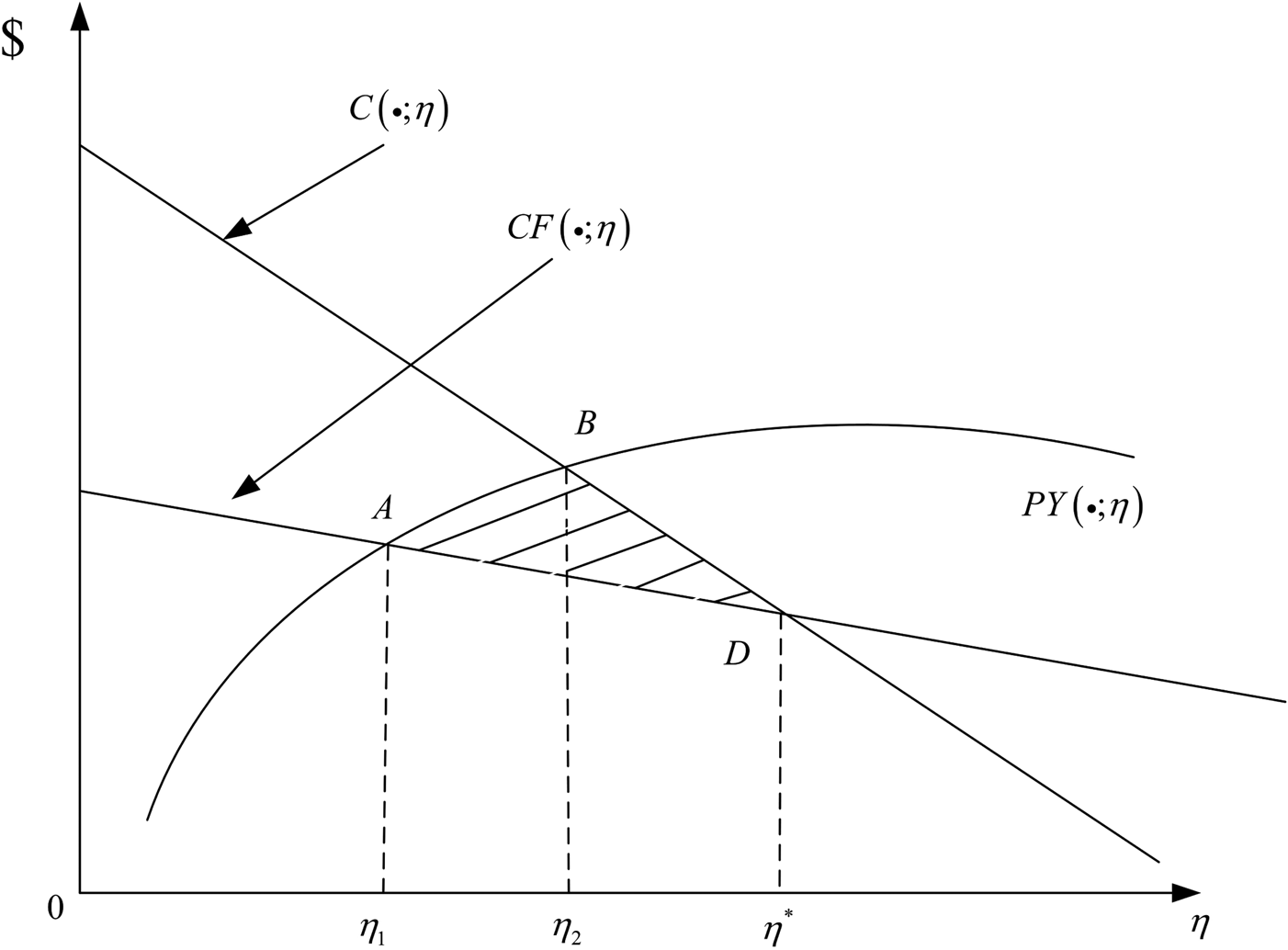
Based on the above analysis, farmers' cost–income under the two scenarios of participation and nonparticipation in contract farming is shown in Figure 1.
Comparison of farmers' cost–income in the two scenarios of participation and nonparticipation in contract farming.

The horizontal axis is farmer characteristic index η, and the vertical axis is farmers' production cost and income per unit of land. The income curve per unit of land PY( ⋅ ;η) intersects the production cost curve per unit of land CF( ⋅ ;η) and C( ⋅ ;η) (under the two scenarios of participation and nonparticipation in contract farming) at A, B, respectively, and CF( ⋅ ;η) intersects C( ⋅ ;η) at D. If a farmer participates in contract farming and the characteristic index is larger than η 1, the farmer will obtain net income. However, when the farmer characteristic index is greater than the threshold value $\eta ^{\rm \ast }$ , the net income obtained is less than that obtained by a farmer who does not participate in contract farming. The closed graphic area S ABD enclosed by points A, B, D is the net income from participation in contract farming relative to nonparticipation. If the farmer characteristic index is within [η 1, η*], participating in contract farming will be the optimal choice.
After analyzing farmers' contract farming participation behavior, this paper explores the impact of participation in contract farming on farmers' organic fertilizer application behavior. Although chemical fertilizers play an important role in ensuring yield, their long-term application causes a substantial loss of soil nutrients, such as potassium, calcium, magnesium, copper and zinc, and a decrease in soil microbial activity, resulting in heavy metal pollution of soil and impoverished soil quality (Choudhary et al., Reference Choudhary, Panday, Meena, Singh, Yadav, Mahanta, Mondal, Mishra, Bisht and Pattanayak2018). Compared with chemical fertilizer, organic fertilizer can effectively improve the physical and chemical properties of the soil, increase the content of organic matter in the soil, maintain the activity of soil microbes and adsorb heavy metals to gradually achieve the purpose of ensuring yield and improving soil quality (Li et al., Reference Li, Liu, Zhao, Gao, Ji, Hu and Li2018). In addition, crops will continue to absorb nutrients from the soil to meet growth needs. With the continuous increase in agricultural yield, the nutrients in the soil will gradually decrease, which will lead to soil quality degradation (Ma et al., Reference Ma, Abdulai and Goetz2018). Therefore, with the application of organic fertilizer, the change function of the soil quality per unit of land can be expressed as follows:

where S 0 represents the soil quality at the initial moment, α represents the proportion of nutrients provided by organic fertilizer in the amount applied and β represents the proportion of nutrients absorbed in the yield of crops during the crop growth process. Therefore, in production planning period T, farmers' maximum income function per unit of land can be expressed as follows:

where $N^{\rm \ast }$ represents farmers' maximum income function per unit of land in the dynamic analysis framework. μ 1 and μ 2 are Lagrange multipliers associated with the upper and lower limits of farmers' contract farming participation behavior θ, respectively. S(T;η)e ζT represents the net present value of soil quality per unit of land after production planning period T, and ζ is the intertemporal discount rate.
Based on formula (4), the Hamiltonian function H of farmers' organic fertilizer application behavior per unit of land can be expressed as follows:

Then, under first-order equilibrium, the internal solution of the Hamiltonian function H to farmers' organic fertilizer application amount OF(t) is as follows:

The boundary solution of the Hamiltonian function H to farmers' contract farming participation behavior is as follows:

In formulas (4)–(7), since the Hamiltonian function H is a linear function of farmers' contract farming participation behavior θ, with θ ∈ [0, 1], the optimal solution to Hamiltonian function H is obtained only at the boundary of farmers' contract farming participation behavior θ. That is, θ can only be 1 or 0, and its economic meaning is whether farmers participate in contract farming.
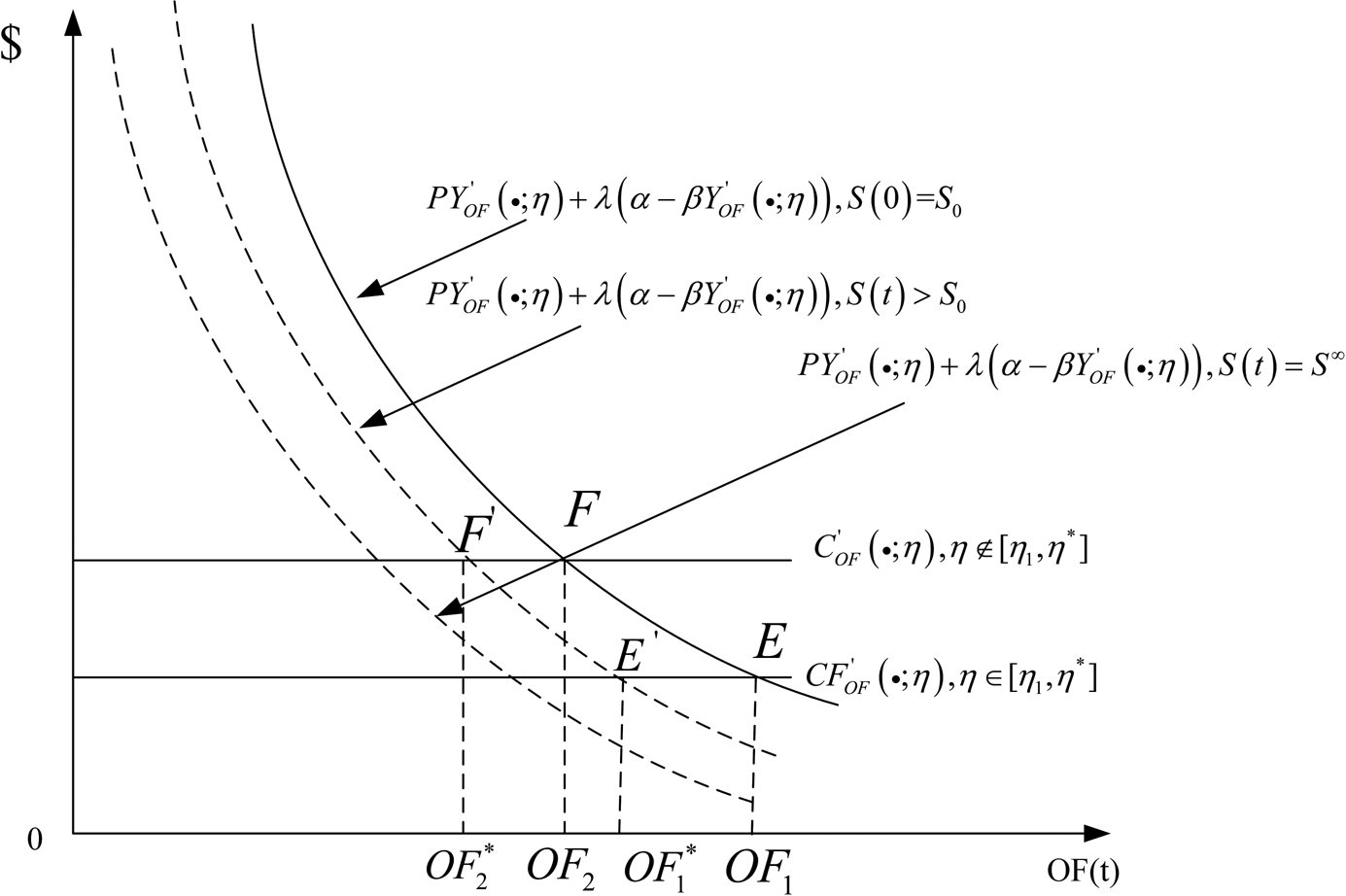
Along with the application of organic fertilizer, soil quality has an optimal stable level in the dynamic change process, where the soil quality of the stable level is S ∞. The soil quality at the initial moment may be S(0) > S ∞ or S(0) < S ∞. Due to the differences in soil quality among farmers, this paper assumes that various soil qualities S(t) exist at a specific moment t. Based on the above assumptions and the actual serious soil quality degradation issue in China, this paper selects the situation S(0) < S ∞ for analysisFootnote 9 and expresses formula (6), as shown in Figure 2.
Comparison of farmers' marginal cost–income in the two scenarios of participation and nonparticipation in contract farming.

The horizontal axis is the amount of organic fertilizer applied per unit of land OF(t), and the vertical axis is the marginal cost and marginal income per unit of land. The optimal equilibrium solution for farmers' organic fertilizer application is the amount at the intersection of the marginal income curve and the marginal cost curve per unit of land. At the short-term equilibrium, the marginal income curve per unit of land of soil quality at initial moment $PY_{OF}^{\prime} ( {\cdot ; \;\eta } ) + {\it \lambda} ( {\alpha -\beta Y_{OF}^{\prime} ( {\cdot ; \;\eta } ) } ) , \;\,S( 0 ) = S_0$ intersects with the marginal cost curve under the two situations of participation and nonparticipation in contract farming $CF_{OF}^{\prime} ( {\cdot ; \;\eta } ) , \;\eta \in [ \eta _1, \;\,\eta ^\ast ]$
 and $C_{OF}^{\prime} ( {\cdot ; \;\eta } ) , \;\eta \notin [ \eta _1, \;\,\eta ^\ast ]$
 at E and F, respectively. The corresponding amount of organic fertilizer is OF 1, OF 2, and OF 1 > OF 2. Therefore, in the short term, farmers participating in contract farming are more likely to increase the use of organic fertilizer than those not participating. In the long term, because the soil quality at the initial moment S 0 is below the stable level S ∞, rational farmers will generally aim to improve their soil quality and bring it closer to a stable level to better meet the soil nutrient requirements of crops. With the continuous improvement in soil quality, the marginal productivity of organic fertilizer per unit of land will gradually decrease. That is, $Y_{OF}^{\prime} ( {\cdot} ; \;\eta )$
 will gradually decrease. Then, the marginal income curve per unit of land by soil quality at the initial moment $PY_{OF}^{\prime} ( {\cdot ; \;\eta } ) + {\it \lambda} ( {\alpha -\beta Y_{OF}^{\prime} ( {\cdot ; \;\eta } ) } ) , \;\,S( 0 ) = S_0$
 will gradually move to the lower left to coincide with the marginal income curve $PY_{OF}^{\prime} ( {\cdot ; \;\eta } ) + \lambda ( {\alpha -\beta Y_{OF}^{\prime} ( {\cdot ; \;\eta } ) } ) , \;\,S( t ) > S_0$
 per unit of land of soil quality at period t. At this time, the marginal income curve per unit of land of soil quality at period t intersects the marginal cost curve under the two scenarios of participation and nonparticipation in contract farming at equilibrium points E ′ and F ′. The corresponding application amount of organic fertilizer is $OF_1^\ast , \;\,OF_ 2^\ast$
 , and $OF_1^\ast > OF_2^\ast$
 . Thus, participation in contract farming has a positive impact on organic fertilizer application behavior in both the short and long terms. Therefore, the hypothesis is as follows.
H1: Farmers' participation in contract farming can promote organic fertilizer application behavior.
Econometric model
Endogenous switching probit model
The ESPM is composed of a switching equation and an outcome equation. The switching equation is used to estimate the factors influencing farmers' contract farming participation behavior, whereas the outcome equation is used to estimate the factors influencing farmers' organic fertilizer application behavior:

$CF_i^\ast$ represents the observed value of farmer i's contract farming participation behavior, and θ is the estimated coefficient in the outcome equation. CF = 1 for farmers participating in contract farming, and CF = 0 for farmers not participating in contract farming. $OF_i^\ast$
 represents the observed value of farmer i's organic fertilizer application behavior. OF = 1 for farmers who apply organic fertilizer, and OF = 0 for farmers who do not apply organic fertilizer. η i represents the characteristic variables that affect farmer i's contract farming participation behavior and organic fertilizer application behavior, and β 1 and β 1 are the corresponding estimated coefficients. α 1 and α 2 are constant terms in the switching and outcome equations, respectively, and u i and v i are residual terms in the switching and outcome equations, respectively. To ensure the identifiability of the switching and outcome equations, at least one identification variable in the switching equation must be excluded from the outcome equation (Hao et al., Reference Hao, Bijman, Gardbbroek, Heerink, Heijman and Huo2018). ω is the identification variable, and δ is the estimated coefficient.
Average treatment effect on the treated
On the basis of the ESPM and drawing lessons from the research of Chiburis et al. (Reference Chiburis, Das and Lokshin2011), this paper calculates the ATT on the probability of applying organic fertilizer for farmers participating in contract farming to further reveal the degree of increase in the probability of organic fertilizer application:

ATT represents the average treatment effect on the treated on the probability of applying organic fertilizer for farmers participating in contract farming. N CF represents the number of farmers participating in contract farming. Pr(OF i = 1|CF i = 1) represents the probability of applying organic fertilizer for farmers participating in contract farming, and Pr(OF i = 0|CF i = 1) represents the probability of not applying organic fertilizer for farmers participating in contract farming.
Variable selection and data source
Variable selection and measurement
Dependent variable
Farmers' organic fertilizer application behavior. When farmers apply organic fertilizer, the value is 1; otherwise, the value is 0.
Main independent variable
Farmers' contract farming participation behavior. When farmers participate in contract farming, the value is 1; otherwise, the value is 0.
Control variables
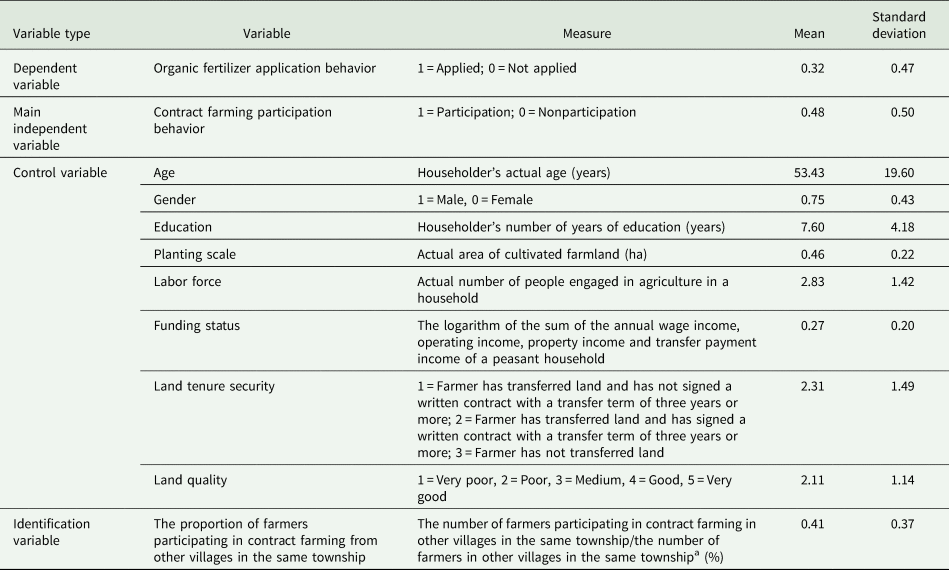
Following previous studies (Ma et al., Reference Ma, Abdulai and Goetz2018; Mao et al., Reference Mao, Zhou and Ying2018; Gao et al., Reference Gao, Liu, Niu, Yu, Yang and Yin2019), this article selects eight variables that cover householder characteristics and householder production and operation characteristics, including age, gender, education, planting scale, labor force, funding status, land tenure security and land quality.Footnote 10 The specific measures are shown in Table 1.
Variable definitions and descriptive statistics

a Obtained by asking the person in charge of contract farming in the sample township government.
Identification variable
On the one hand, the higher the number of farmers in the same township who participate in contract farming is, the greater the likelihood that other farmers will participate in contract farming. On the other hand, the participation in contract farming of farmers from other villages in the same township in contract farming does not directly change farmers' organic fertilizer application behavior. Referring to the research of Sun et al. (Reference Sun, Yang and Zheng2020), this paper selects the proportion of farmers participating in contract farming from other villages in the same township as the identification variable and tests its effectiveness.Footnote 11
Data source
The data were from a field survey in Shandong province conducted from January to March 2018. The reasons for choosing Shandong province as the research area are as follows. First, Shandong province is a major vegetable planting and production province in China. As of 2017, its vegetable planting area and total output had ranked first in China for more than 10 years. Secondly, there is a serious problem with excessive chemical fertilizer application in Shandong province. The average amount of chemical fertilizer applied per hectare is 408 kg, which is 1.28 times the national average.Footnote 12 Thirdly, the number of farmers participating in contract farming in Shandong province has reached 18 million, and contract farming has shown a strong development trend.Footnote 13
The sampling method was as follows. First, two sample counties (or cities or districts) were selected from the top five prefecture-level citiesFootnote 14 in Shandong province.Footnote 15 Secondly, a typical sampling approach was used to select two townships with strong contract farming development from each sample county (or city or district), and a total of 20 townships were sampled. Finally, five vegetable farmers were randomly selected from the east, south, west, north and central portions of each sample township for a total of 500 vegetable farmers. Given the farmers' limited education, the questionnaire survey was administered via one-on-one household interviews. The interviewers were trained graduate students and senior undergraduate students. Overall, 500 questionnaires were distributed, and 473 valid questionnaires were returned. A validity rate of 94.6% was achieved after eliminating questionnaires that omitted key information or presented contradictory information.
Sample description
As shown in Table 1, 151 out of the 473 vegetable farmers surveyed (31.9%) applied organic fertilizer, and 226 farmers (47.8%) participated in contract farming. These two variables are consistent with the low organic fertilizer application rate and the high enthusiasm for participation in contract farming in Shandong province. The organic fertilizer applied was commercial organic fertilizer rather than the farm manure.
In terms of householder characteristics, 75% of householders are male, the householders' average age is 53.4 and householders' average number of years of education is 7.6, indicating that the householders tend to be older and have limited education. In terms of production and operation characteristics, the average planting scale is 0.46 ha, and the average labor force is 2.8. The results for the above indicators are consistent with those reported in the Third Agricultural Census,Footnote 16 which indicates that the sample is representative.
Estimated results
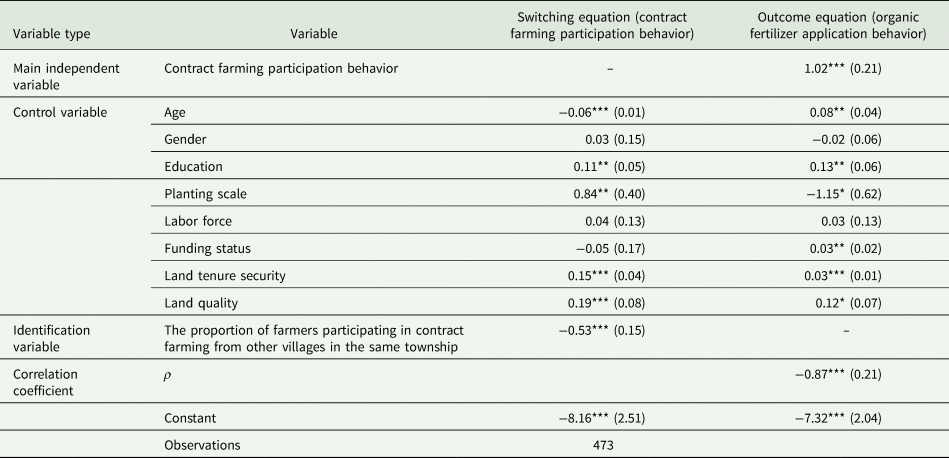
As shown in Table 2, the correlation coefficient ρ of the random disturbance terms in both the switching and the outcome equations is significant at the 1% level, indicating that farmers' contract farming participation behavior is an endogenous variable. Therefore, the ESPM is more appropriate than the independent regression models.
Estimation results of the ESPM

Note: ***, ** and * are significant at the 1, 5 and 10% levels, respectively; standard errors are in parentheses. The same applies to Tables 3–6.
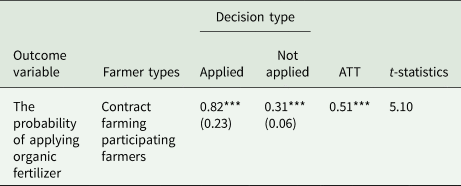
Average treatment effect on the probability of applying organic fertilizer for vegetable farmers participating in contract farming

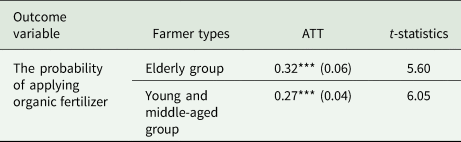
Average treatment effect on the probability of applying organic fertilizer for vegetable farmers participating in contract farming: heterogeneity in age

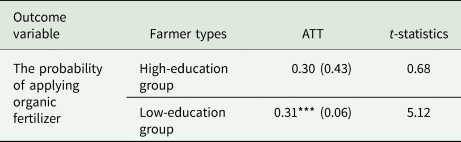
Average treatment effect on the probability of applying organic fertilizer for vegetable farmers participating in contract farming: heterogeneity in education

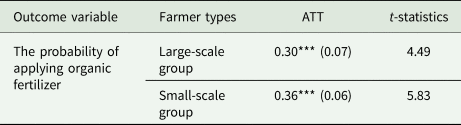
Average treatment effect on the probability of applying organic fertilizer for vegetable farmers participating in contract farming: heterogeneity in land scale

Estimation results of the independent regression models
According to the estimation results of the switching equation, education, land area, land tenure security and land quality significantly and positively affect farmers' participation in contract farming, while age has a significant negative effect. These findings are consistent with the conclusions of Mwambi et al. (Reference Mwambi, Oduol, Mshenga and Saidi2016), Freguin-Gresh et al. (Reference Freguin-Gresh, D'Haese and Anseeuw2012), Arumugam and Arshad (Reference Arumugam and Arshad2011), Wang et al. (Reference Wang, Wang and Delgado2014) and Hu (Reference Hu2013). In addition, gender, labor force and funding status are not significant because major agricultural production decisions generally result from joint consultation between husband and wife and are not related to the householder's gender (Xiao et al., Reference Xiao, Pan and Dai2018). Additionally, with the exception of seasonal workers, the difference in the actual number of people engaged in agriculture in a household is not significant (Miyata et al., Reference Miyata, Minot and Hu2009). Moreover, funding status is neither an obstacle to vegetable farmers' participation in contract farming nor the basis for contract enterprises to choose cooperative vegetable farmers (Mishra et al., Reference Mishra, Kumar, Joshi, D'Souza and Tripathi2018b).
According to the estimation results of the outcome equation, vegetable farmers' participation in contract farming has a significant positive impact on organic fertilizer application behavior. The hypothesis of this study is supported. First, the ability to purchase production materials on credit and the credit mortgages provided by contract enterprises have, to a certain extent, relieved the production and liquidity constraints of farmers participating in contract farming on applying organic fertilizer. Secondly, the information search service and professional technical guidance and training provided by contract enterprises enable farmers to quickly and accurately understand the relevant information about organic fertilizer, to realize the benefits of organic fertilizer and to master the application of organic fertilizer, thereby causing farmers who participate in contract farming to more easily accept organic fertilizer. Thirdly, contract enterprises check the quantity and quality of vegetables produced by farmers participating in contract farming in accordance with regulations. When an inspection fails, the contract enterprises will refuse to purchase the products and may even demand compensation. Therefore, to avoid a failed inspection, farmers participating in contract farming are more interested in applying organic fertilizer.
Shandong Sanxing Food Company Ltd. is taken as an example; this enterprise uses the ‘company + base + farmer’ mode. First, the enterprise gathers dozens of adjacent vegetable farmers to form a production base with a strong production capacity, and it provides production equipment and materials in a unified manner to reduce these farmers' production and liquidity constraints and enhance their ability to apply organic fertilizer. Secondly, the enterprise establishes a long-term cooperative relationship with local agricultural technology extension stations and provides a generous salary to recruit technical personnel. It provides vegetable farmers with not only free information search services and professional technical guidance and training in production, but also follow-up guidance on issues such as the ratio and frequency of organic fertilizer application. This information reduces the difficulty of applying organic fertilizer and makes vegetable farmers more willing to apply it. Thirdly, the enterprise strictly assesses the quantity and quality of vegetables before purchasing. In terms of quantity, the enterprise tests through comprehensive weighing; in terms of quality, it submits samples to the food inspection department for quality testing, and the purchase decision is based on the test results. Therefore, the need to meet the enterprise's quantity and quality requirements will lead vegetable farmers to have a positive attitude toward the application of organic fertilizer. Compared to vegetable farmers, contract enterprises have advantages in terms of funding, technology and information, and they can supervise vegetable farmers' production behavior. That is, contract enterprises not only improve vegetable farmers' technology, information and resource endowment, but also construct a strong supervisory network to promote the application of organic fertilizer.
In addition, among the control variables, age has a significant positive effect on farmers' organic fertilizer application behavior. Older the farmers are, the more experience they have in agricultural production and operation, the more attention they pay to the sustainable use of land to meet their long-term livelihood needs and they apply more organic fertilizer (Aryal et al., Reference Aryal, Sapkota, Krupnik, Rahut and Stirling2021). Education is significantly positive at the 5% level, indicating that the higher the education level of farmers is, the stronger their ability to obtain information and master and adapt to new technologies and they are more likely to apply organic fertilizer (Kassie et al., Reference Kassie, Teklewold, Jaleta, Marenya and Erenstein2015). In addition, the higher the education level of farmers is, the more nonagricultural employment opportunities they have, the stronger their ability to take risks in adopting new technologies and the greater the likelihood that they will apply organic fertilizer (Hu et al., Reference Hu, Sun, Xu, Zhou and Zhu2019). Funding status significantly and positively affects farmers' organic fertilizer application behavior. The reason is that the better the funding status of farmers is, the smaller the asset liquidity constraints they face and the stronger their ability to invest in agricultural production, so they are more inclined to apply organic fertilizer (Pingali et al., Reference Pingali, Aiyar, Abraham, Rahman, Pingali, Aiyar, Abraham and Rahman2019). Land tenure security has a significant positive impact on farmers' organic fertilizer application behavior. The more stable the land tenure of farmers is, the more secure their long-term benefits of organic fertilizer application, the higher their expectations for future benefits and the greater the likelihood that they will use organic fertilizer (Lu et al., Reference Lu, Zhang, Hu, Xie, Yu and Chen2019). Land quality significantly and positively affects farmers' organic fertilizer application behavior. Farmers with better land quality pay more attention to cultivated land protection, are more willing to spend time and energy to maintain land quality and are more likely to apply organic fertilizer (Wang et al., Reference Wang, Zhang and He2020). However, planting scale has a significant negative impact on farmers' organic fertilizer application behavior. The reason is that the larger the scale of farmland is, the higher the labor and supervision costs of applying organic fertilizer and the lesser the extent to which farmers are inclined to apply organic fertilizer (Li and Shen, Reference Li and Shen2021). In addition, gender and labor force are not significant for the same reason as for the estimation results of the switching equation.
ATT of farmers
According to Table 3, the ATT on the probability of applying organic fertilizer for vegetable farmers participating in contract farming is 0.82, and the ATT on the probability of not applying organic fertilizer for vegetable farmers participating in contract farming is 0.31. Furthermore, the ATT on the probability of applying organic fertilizer for vegetable farmers participating in contract farming is 0.51. These results indicate that participation in contract farming increases the probability of applying organic fertilizer by 51%.
Robustness tests
This article conducts a series of robustness tests. One concern is the insufficient sustainability of the impact of participation in contract farming on farmers' organic fertilizer application behavior. To eliminate this concern, this article replaces the dependent variable and directly considers the impact of participation in contract farming on the intensity with which farmers replace chemical fertilizer with organic fertilizer. Referring to the research of Huang and Luo (Reference Huang and Luo2020), the intensity with which farmers replace chemical fertilizer with organic fertilizer is determined by ‘the proportion of organic fertilizer investment in total fertilizer investment’. This paper also uses the RBPM to assess the robustness of the estimation results. Both robustness tests confirm the above research results.Footnote 17
Further discussionFootnote 18
Heterogeneity in age
This paper classifies vegetable farmers according to the internationally recognized age threshold of 60 years: this paper defines farmers with a householder of 60 years old and above as the elderly group and farmers with a householder under 60 years old as the young and middle-aged group. Then, the ATT on the probability of applying organic fertilizer for vegetable farmers participating in contract farming for these two groups is estimated. As shown in Table 4, in the older group, the ATT is 0.32, which is significant at the 1% level. That is, an increase in the probability of applying organic fertilizer for the older group of vegetable farmers when they participate in contract farming is 32%. In the young and middle-aged group, the ATT is 0.27, which is significant at the 1% level. That is, an increase in the probability of applying organic fertilizer for the young and middle-aged group of vegetable farmers when they participate in contract farming is 27%. Therefore, participating in contract farming has a more obvious effect on increasing the probability of applying organic fertilizer for the older group than for the young and middle-aged group.
Heterogeneity in education
With reference to Zhang et al. (Reference Zhang, Wan, Zhang and He2019), this paper defines the sample vegetable farmers with a householder education level of primary school or below (less than or equal to 6 years of education) as the low-education group, while the sample vegetable farmers with a householder education level of junior high school or above (more than 6 years of education) are defined as the high-education group.Footnote 19 The ATT on the probability of applying organic fertilizer for vegetable farmers participating in contract farming for the two groups is estimated. As shown in Table 5, in the high-education group, the ATT is 0.30, but it is not significant; in the low-education group, the ATT is 0.31, and it is significant at the 1% level. That is, an increase in the probability of applying organic fertilizer for the low-education group of vegetable farmers when they participate in contract farming is 31%. Thus, participation in contract farming significantly increases the probability of applying organic fertilizer only for the low-education group.
Heterogeneity at the land scale
On the basis of land scale, this paper divides the sample vegetable farmers into a large-scale group (greater than or equal to 0.47 ha of farmland) and a small-scale group (less than 0.47 ha of farmland),Footnote 20, Footnote 21 and it estimates the ATT on the probability of applying organic fertilizer for vegetable farmers participating in contract farming in the two groups. As shown in Table 6, the ATTs in the large-scale and small-scale groups are 0.30 and 0.36, respectively, and both values are significant at the 1% level. That is, the increase in the probability of applying organic fertilizer for the large-scale and small-scale groups of vegetable farmers when participating in contract farming is 30 and 36%, respectively. Thus, participating in contract farming has a more obvious effect on increasing the probability of applying organic fertilizer for the small-scale group than for the large-scale group.
In summary, vegetable farmers in the older group, low-education group and small-scale group benefit more from participation in contract farming because they are restricted by their endowments, and their ability to obtain information and apply organic fertilizer is poor (Grabowski et al., Reference Grabowski, John, Haggblade and Kabwe2016). Thus, participation in contract farming can improve their ability to apply organic fertilizer at the margins. However, farmers in the young and middle-aged group, high-education group and large-scale farming group have a higher tendency to acquire information and apply organic fertilizer, so their participation in contract farming has a weak, even negligible, marginal effect on their organic fertilizer application.
Conclusion and policy implications
China's agriculture is subject to the degradation of cultivated land quality caused by the extensive production mode of ‘high fertilizer and high pesticide’. The application of organic fertilizer can effectively improve soil quality from the source. However, the low level of organic fertilizer application has become a serious obstacle to sustainable agricultural development in China. As the mismatch between farmers and the market has become increasingly prominent, China's agricultural production and operation mode has been iteratively updated, and contract farming has emerged as a new agricultural production and operation mode, which is also regarded as an effective means to promote farmers' technology adoption. However, related studies have not considered the impact of farmers' participation in contract farming on their organic fertilizer application behavior, and they have neglected the construction of a dynamic theoretical analysis framework. Therefore, this article constructs a dynamic analysis framework for the impact of farmers' participation in contract farming on organic fertilizer application behavior and takes 473 vegetable farmers in Shandong province as an example. The ESPM is used to effectively estimate the impact of farmers' participation in contract farming on organic fertilizer application behavior. The ATT on the probability of applying organic fertilizer for vegetable farmers participating in contract farming is calculated. As robustness tests, the RBPM is used, and the dependent variable is replaced.
The results of the study show the following. First, the theoretical analysis finds that in both the short and long terms, compared with farmers not participating in contract farming, farmers participating in contract farming are more likely to utilize organic fertilizer. Secondly, empirical research based on survey data supports the above theoretical analysis results: participation in contract farming increases the probability of vegetable farmers applying organic fertilizer by 50.7%. Robustness tests conducted using the RBPM and replacing the dependent variable (the intensity with which farmer replace chemical fertilizer with organic fertilizer) confirm the above research results. Finally, the heterogeneity analysis reveals that farmers' participation in contract farming has a more obvious promoting effect on organic fertilizer application behavior in the older group, low-education group and small-scale group.
According to the above research conclusions, this paper applies the improvement of farmers' organic fertilizer application level to the transformation of China's agricultural production and operation mode and it introduces contract farming into dynamic theoretical analysis, which makes the entire theoretical mode closer to the economic reality. Theoretically, this study is not only an extension of research on organic fertilizer application behavior, but also provides a replicable analysis framework for dynamically examining the role of contract farming. In a practical sense, this study provides not only new empirical evidence to promote the development of contract farming in China, but also a basis for decision making on how the government can promote the application of organic fertilizer by farmers, thus improving soil quality and promoting sustainable agricultural development.
Participation in contract farming can not only enable farmers to effectively connect with the market, but also promote the application of organic fertilizer, which has important policy implications for green agricultural development in China. Specifically, first, the government should strengthen its policy guidance for farmers to participate in contract farming, increase the capital investment in contract farming propaganda, promotion and training, provide farmers with appropriate information, knowledge and technical services, establish a complete farmer training mechanism and improve farmers' awareness of contract farming. At the same time, attention should be given to the passive choice of farmers under the government-guided model, thereby effectively increasing enthusiasm for participation in contract farming. Secondly, the government should strengthen the supervision of rural land transfer market standards, maintain the dominant position of farmers in the transfer of agricultural land, protect farmers' land interests and ensure the stability of land rights, thereby enhancing farmers' confidence in participation in contract farming. Thirdly, the government should provide greater policy support to farmers who are older and less educated and those with smaller-scale farms to alleviate the various constraints on participation in contract farming. For example, for farmers who are older and less educated, special consultation and extension services should be provided in a way that is easy for them to accept to increase their contract farming participation rate. For farmers with smaller-scale farms, the government should encourage, support and guide contract agricultural enterprises to focus on the role of order content design in sharing price risks, and ensure that key order information is transparent, written and clear, and effectively protect the interests of small farmers, a vulnerable group, to alleviate the various constraints on participation in contract farming among various types of farmers to the greatest extent possible, thereby ensuring that contract farming plays a greater role in promoting farmers' organic fertilizer application.
Supplementary material
The supplementary material for this article can be found at https://doi.org/10.1017/S1742170522000205.
Acknowledgments
This work was supported by the National Natural Science Foundation of China (grant number 71803096; 71804101; 72073081); the Major Project of National Social Science Foundation of China (grant number 21ZDA063; 21ZDA058; 20&ZD169).
Author contributions
Yang Gao: conceptualization, methodology, investigation, formal analysis, data curation, project administration, writing—original draft, resources, funding acquisition, supervision, writing—review and editing, software, validation. Xue Yao: methodology, writing—original draft, writing—review and editing, software, validation. Chen Chen: methodology, writing—original draft, writing—review and editing, software, validation. Ziheng Niu: methodology, writing—original draft, writing—review and editing, software, validation.
Conflict of interest
The authors declare that they have no known competing financial interests or personal relationships that could have appeared to influence the work reported in this paper.