INTRODUCTION
Empirical evidence from the past three decades confirms the strengthening link between religious identity and partisanship in the United States (Leege and Kellstedt Reference Leege and Kellstedt1993; Layman Reference Layman2001; Green, Rozell, and Wilcox Reference Green, Rozell and Wilcox2003; Olson and Warber Reference Olson and Warber2008; Calfano and Djupe Reference Calfano and Djupe2009). The politicization of religion — the close overlap between specific religious and partisan groups — is a key feature in the alignment of the American political landscape into two competing camps: theologically conservative Republicans, and theologically liberal or secular Democrats.Footnote 1 To validate the existence and extent of the overlap between religious and partisan attachments, empirical studies assume that the two types of attachment are distinct and causally connected: religious identification explains — among other aspects of individual political choice — partisan identification (Wilcox Reference Wilcox1986; Jelen, Smidt, and Wilcox Reference Jelen, Smidt, Wilcox, Leege and Kellstedt1993; Green et al. Reference Green, Rozell and Wilcox2003; Wald and Wilcox Reference Wald and Wilcox2006; Olson and Warber Reference Olson and Warber2008).
The present study introduces an alternative conceptualization and measurement of the role of social identities in the religion-politics nexus. The argument draws on three interrelated literatures: (1) social categorization and self-stereotyping research (Tajfel Reference Tajfel and Tajfel1978; Turner Reference Turner and Tajfel1982; Lau Reference Lau1989; Stryker Reference Stryker, Stryker, Owens and White2000; Roccas and Brewer Reference Roccas and Brewer2002; Crisp and Hewstone Reference Crisp, Hewstone and Zanna2007); (2) scholarship that stresses the importance of the social labels attached to political parties (Bolce and De Maio Reference Bolce and De Maio1999a; Reference Bolce and De Maio1999b; Reference Bolce, De Maio and Wilson2007; Reference Bolce and De Maio2008; Green, Palmquist, and Schickler Reference Green, Palmquist and Schickler2002; Brewer Reference Brewer2009; Campbell, Green, and Layman Reference Campbell, Green and Layman2011); and (3) recent evidence from political behavior research, which suggests that the causal link between religious and political variables may not be as simple as we have previously thought (Hout and Fischer Reference Hout and Fischer2002; Patrikios Reference Patrikios2008; Putnam and Campbell Reference Putnam and Campbell2010; Husser Reference Husser2011).
Based on these three literatures, the study argues that the growing connection between evangelical Christianity and Republican affiliation in the United States does not necessarily entail the alignment of two separate social identities. The article hypothesizes the existence of an overlooked type of group identity that fuses religious and partisan elements into a shared representation of a single category (in-group): born-again or evangelical Republicanism.Footnote 2 Using a representative (online) sample of American adults — the 2008 Cooperative Congressional Election Study — confirmatory factor analysis of identity scales that improve on existing measures documents the existence of this composite evangelical Republican identity, as well as the backlash it has produced among out-group members. A supplementary test establishes the strong link that connects this composite identity with various measures of voting behavior, thus pointing to wider electoral implications.
The existence of a composite religious-partisan identity based on the evangelical Republican stereotype has theoretical and substantive implications. First, religious-partisan identity fusion should be treated as a subcase of social-political identity fusion. For this reason, the analytic strategy used in the present analysis of politicized religious identities has wider applicability. The procedure can be generalized to test the fused nature of other politicized social identities. Examples include identification with the religious “nones” (a group viewed as Democrat) and other sizeable constituencies, such as gun-owners (Republican), or business people (Republican). The observation of identity fusion in these cases would confirm that the politicization of social divisions, and the partisan polarization that rests on these divisions, can alter the way citizens internalize social memberships.
Second, the existence of a composite religious-partisan identity would challenge our understanding of a key function of religion in the United States, namely the creation of “bridges” that connect members of a diverse society (Bellah Reference Bellah1967; Putnam and Campbell Reference Putnam and Campbell2010). Identities are not mere categorizations (what one is), but carry normative dimensions (what one should do) that create social distance between competing groups (Tajfel Reference Tajfel and Tajfel1978). The prevailing assumption in empirical research — the existence of two distinct but aligned social identities — allows for the possibility of evangelicals who do not vote Republican. This cross-cutting possibility is less feasible under a composite religious-partisan identity, which projects a perfect correlation between the two social labels: one cannot be Republican without being evangelical. This crude stereotype — social identities are based on simplistic assumptions of group homogeneity — may also create a negative backlash among out-group members. For instance, Democrats will shun evangelical affiliation as incompatible with their partisanship. In a nutshell, the evangelical Republican stereotype makes it harder to cross religious-partisan borders, and may generate antipathy toward the religious group involved in the stereotype. This strengthens long-term religious and partisan polarization across a single dividing line: evangelical Republicanism. In a sense, this becomes a self-reinforcing process (cf. Iyengar, Sood, and Lelkes Reference Iyengar, Sood and Lelkes2012).Footnote 3
The study describes what this hypothesized fused identity entails, how it builds on existing theoretical propositions, and how it can be studied empirically. This is followed by a description of the dataset and the variables of interest, a discussion of the statistical technique applied, and the presentation of findings. The conclusion suggests directions for future research by speculating on the sources of this identity, and discusses electoral implications of the findings.
THEORETICAL EXPECTATIONS: POLITICIZED SOCIAL IDENTITIES
This section begins with a discussion of different approaches to the study of politicized social identities. Traditional approaches to the relationship between religious and partisan identities in political behavior research have been influenced by the study of religious cleavages in Europe and by the sociological model in the United States. These approaches treat religious identity as a prior, exogenous variable that leads to the development of specific partisan attachments (Lazarsfeld, Berelson, and Gaudet Reference Lazarsfeld, Berelson and Gaudet1944; Lipset and Rokkan Reference Lipset, Rokkan, Lipset and Rokkan1967; Rose and Urwin Reference Rose and Urwin1970). As an example, Catholic identity in the United States historically favored the development of Democratic allegiances. The two social groups of interest (the Catholic in-group and the Democratic in-group) are seen as aligned, but remain supposedly distinct in the public mind. One can still be Catholic without being a Democrat and vice versa. The traditional approach, therefore, proposes an examination of religious and partisan identities as two separate phenomena connected by a causal sequence: religious belonging shapes partisan belonging.
The present analysis hypothesizes the existence of a composite religious-partisan identity, which departs from the aforementioned proposition. The religious-partisan identity is different than simply being born-again or simply being Republican. It is attached to a stereotype that constructs a single group: one that is religious and partisan at the same time. In this crude stereotype, one cannot be evangelical without being Republican. Inversely, one cannot be (a good) Republican without being evangelical (a Mormon would be a case in point here). Empirical studies have discussed the existence of this stereotype in public consciousness (Bolce and De Maio Reference Bolce and De Maio1999a; Reference Bolce and De Maio1999b; Reference Bolce, De Maio and Wilson2007; Reference Bolce and De Maio2008; Green et al. Reference Green, Palmquist and Schickler2002; McDermott Reference McDermott2007; Brewer Reference Brewer2009; Campbell et al. Reference Campbell, Green and Layman2011), while popular commentary on American elections is awash with relevant references (for a recent example, see Young Reference Young2012).
The hypothesized religious-partisan identity draws on social identity theory and self-stereotyping research. Social identity is the “knowledge of [one's] membership of a group together with the value and emotional significance attached to the membership” (Tajfel Reference Tajfel and Tajfel1978, 63). Individuals tend to internalize group membership by perceiving themselves through shared collective attributes and behaviors instead of personal ones — “I am an evangelical Christian/I act as an evangelical Christian.” From the related self-stereotyping perspective, individuals are expected to tackle the complexity of social and political life with the use of simplifying categorizations (Turner et al. Reference Turner, Hogg, Oakes, Reicher and Wetherell1987; Lau Reference Lau1989; Simon and Hamilton Reference Simon and Hamilton1994). Using positive in-group characteristics to define the individual self, and negative out-group characteristics to define others, we create distance from out-group members, and satisfy an inherent human “need for positive self-esteem” (Turner Reference Turner and Tajfel1982, 33). In all, the use of group characteristics to define the self entails a process of depersonalization (Turner et al. Reference Turner, Hogg, Oakes, Reicher and Wetherell1987): the individual perceives herself as typical of a supposedly homogenous social category, and strives to behave accordingly.
Self-stereotyping approaches do not treat definitions of the collective self-concept strictly as overlapping with membership of demographic or other relevant categories. Instead, social labels are seen as “open” and malleable. Definitions often draw on combinations of social memberships: Irish Catholic; Jewish Israeli; evangelical Republican — the combination of definitions of the individual self that prevails depends on social context (Turner et al. Reference Turner, Hogg, Oakes, Reicher and Wetherell1987; Lau Reference Lau1989; Oakes, Turner, and Haslam Reference Oakes, Turner and Haslam1991; Stryker Reference Stryker, Stryker, Owens and White2000; Roccas and Brewer Reference Roccas and Brewer2002; Crisp and Hewstone Reference Crisp, Hewstone and Zanna2007). Contextual factors can be viewed as conditions under which the religious-partisan identity fusion is more likely to emerge; in fact, these conditions also apply to the fusion between social and political identities in general. A discussion of these conditions follows.
First, a composite evangelical Republican identity is more likely to materialize under the intense politicization of religious divisions. Recent evidence confirms the close connection of “evangelical” and “Republican” labels in public discourse, and its behavioral consequences (Hout and Fischer Reference Hout and Fischer2002; Patrikios Reference Patrikios2008; Putnam and Campbell Reference Putnam and Campbell2010; Husser Reference Husser2011). Exposure to this pervasive discourse that promotes specific combinations of group labels, in this case between a religious and a partisan label, facilitates the internalization of a fused identity. This type of rhetoric is common in the partisan arena, where partisan elites present religious and political groups as “naturally” overlapping: for example, the label “evangelical”/“born-again” goes with “Republican”; “non-religious” goes with “Democrat” (Green et al. Reference Green, Palmquist and Schickler2002; McDermott Reference McDermott2007; Brewer Reference Brewer2009; Calfano and Djupe Reference Calfano and Djupe2009; Campbell et al. Reference Campbell, Green and Layman2011). The same kind of symbolism may also appear in the congregation. The importance of congregations as political contexts that favor the contagion of common worldviews is well documented (e.g., Wald, Owen, and Hill Reference Wald, Owen and Hill1988; Brewer, Kersh, and Petersen Reference Brewer, Kersh and Petersen2003). Identity fusion might be constructed through face-to-face interaction with like-minded fellow churchgoers or through exposure to clergy cues that connect the two labels as equivalent. As a result, the religious group begins to frame itself in political terms and recognize as co-religionists only those with the “right” political identities (for the relevant “Black Democrat” link, see Green et al. Reference Green, Palmquist and Schickler2002; Brewer Reference Brewer2009; Campbell et al. Reference Campbell, Green and Layman2011).Footnote 4
Second, the presence of prototypical in-group members helps to exemplify combinations of group memberships such as “evangelical Republican.” Salient members of a given in-group — for example, religious or party elites — play a pivotal role in helping voters to connect social memberships and political affiliations (Green et al. Reference Green, Palmquist and Schickler2002; McDermott Reference McDermott2007; Brewer Reference Brewer2009; Calfano and Djupe Reference Calfano and Djupe2009). But what these prototypical members say or do (or are) can also affect the definitions that individual members use to define their self-image. In a commonly used example, George W. Bush was a prominent in-group member that issued “born-again Republican” cues both explicitly (through policy and an emphasis on values shared by Republicans and conservative Christians) and implicitly (by being a practicing born-again Christian and, at the same time, an unquestionable Republican). These personalized cues emphasize the stereotype of a composite “evangelical Republican” social group. In this way, they provide a concrete foundation for the surfacing of an evangelical Republican identity.
Finally, since “evangelical Republican” group members do not exist in a social vacuum, attention should be paid to non-members. Social identity theory stresses the importance of the presence of another group as a necessary condition for the consolidation of in-group attachment: the demarcation line that leaves out non-members also serves as the line that defines psychological membership to the in-group. Following this reasoning, identity fusion can be strengthened through antagonism with a supposedly homogenous out-group that combines relevant religious and partisan characteristics (another popular stereotype: “secular/theologically liberal Democrats”). Also, in the same way that evangelical Republicans may think of themselves as a singular religious-partisan in-group (positive fusion) that is antagonistic to the relevant out-group, their opponents — an in-group in itself — may stereotype all evangelicals as uniformly Republican (negative fusion) (Bolce and De Maio Reference Bolce and De Maio1999a; Reference Bolce and De Maio1999b; Reference Bolce, De Maio and Wilson2007; Reference Bolce and De Maio2008). When — under intense politicization — the composite label “evangelical Republican” becomes a negative reference point to its opponents, the stereotype spreads beyond the confines of the in-group in a self-reinforcing manner. The “natural” connection is adopted both by in-group and out-group members.
Recent American elections have been marked by the presence of these situational influences: the presence of candidates that combine evangelical status and Republicanism; the prominence of campaign and congregational cues that frame the two features as “naturally” connected; and fierce antagonism of evangelical Republicans with the relevant countermovement. An illustrative example comes from the 2010 election ads of the Faith and Freedom Coalition, a Republican-backing grassroots organization. The radio ads had a common theme, which involved expressions such as: “it's us versus them”; “big government versus a big belief in faith and freedom.” The ads concluded with a call to “vote faith, vote freedom, vote [Republican candidate's name].” These cues serve as simplifications of a complex political reality, neatly dividing the political universe into two camps that are antagonistic and (supposedly) internally homogenous: evangelical Republicans and religiously liberal or secular Democrats.
Overall, these situational conditions can determine whether and in what way a group stereotype is constructed and internalized by in-group and out-group members — is it a mere religious label; a partisan label; or a compound of the two. It follows from this observation that internalization of a particular identity “mix” depends on individual exposure to these situational factors.
To summarize this discussion, contrary to the traditional approach of cleavage-based or sociological models of political behavior, which treat exogenous religious identities and endogenous partisan identities as separate but causally connected phenomena, research on social categorization and self-stereotyping suggests a different reading of politicized religious identities. Definitions of the collective self-concept may consolidate religious group characteristics with partisan group characteristics. The result of this process fits with the experience of a composite identity whereby individuals define their self-concept with reference to a singular group: born-again or evangelical Republicans.
MEASUREMENT STRATEGY
The central expectation of this study is the following: if the group label “born-again/evangelical” is perceived as overlapping with the label “Republican” to the point of equivalence, then individuals identifying as “born-again/evangelical” may at the same time be making a statement about their partisan affiliations and vice versa. This would serve as evidence of a composite social identity that is both religious and partisan. To examine the empirical possibility of a born-again or evangelical Republican identity requires individual information on social identification with religious and partisan groups and a dimension reduction method of analysis to explore fusion between religious and partisan identification. This section will discuss popular survey measures of religious and partisan identification and their inadequacies as indicators of group identity. It will then introduce the scale selected for use in this analysis.
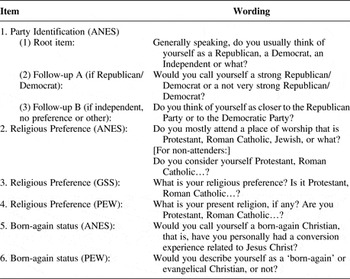
The measurement of social identities with available survey data is not a straightforward exercise. The major survey programs such as the American National Election Study (ANES) and the General Social Survey (GSS) do not include valid indicators of partisan and religious group identification. These programs rarely go beyond the conventional measures of partisan and religious affiliation, which are summarized in Table 1. The flaws of these items as measures of group identity have been highlighted in the relevant literatures.Footnote 5
Existing religious and partisan items

The present analysis requires survey questions that directly ask respondents to define their self-concept in group terms rather than to report formal group membership or a political preference. For this reason, I will use multiple identity scales that refer to the religious and political groups of interest. The survey items that compose each identity scale were fielded through the 2008 Cooperative Congressional Election Study (CCES). The CCES is a large survey designed by 30 collaborating research teams and conducted by YouGov/Polimetrix during the election campaign of 2008 (October and November). The survey is based on a nationally representative internet sample produced with matched random sample methodology. Sample matching is a method of drawing representative samples from non-randomly selected pools of cases (Ansolabehere Reference Ansolabehere2009). Research teams purchased a representative sample of 1,000 cases each out of a total of 32,800 cases that participated in the CCES. Each sample of 1,000 completed a survey questionnaire of approximately 120 questions. Half of the questionnaire content was common across research teams. The other half formed the private content with questions designed specifically by each research team.
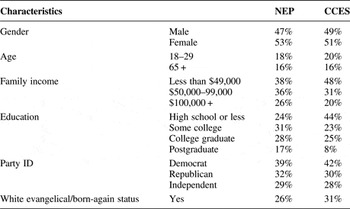
While internet-based surveys have obvious advantages such as speed and a low cost per respondent, they may be skewed toward younger respondents and the more politically interested. Ansolabehere (Reference Ansolabehere2009) describes the steps taken through sample matching and weighting to ensure that each 1,000-case sample produced by the CCES matches the voting population of registered and unregistered voters. Table 2 shows the characteristics of the CCES post-election sample, the one analyzed in this study, and the characteristics of the voting population in the 2008 National Exit Poll (NEP). The two samples look quite similar in terms of key characteristics, even accounting for slight differences in question wording between the two studies. The only exception is education, where the CCES sample somewhat under-represents the more educated.Footnote 6
The 2008 electorate: The national exit poll and the CCES

Notes: The party identification question used by the CCES and the born-again item are slightly different than the ones used by the NEP.
The identity scales used in this analysis come from the private content of the CCES and were asked in the post-election (November) wave. The scales refer to the following groups: Republicans and born-again/evangelical Christians. Each of the two multi-item scales is based on the organizational identification with a psychological group scale (IPGS) proposed by Mael and Tetrick (Reference Mael and Tetrick1992). Each item offers a five-point (Likert) scale of agreement with a statement:
1. When someone criticizes [group], it feels like a personal insult;
2. When I talk about [group], I usually say “we” rather than “they”
3. [Group's] successes are my successes;
4. When someone praises [group], it feels like a personal compliment.
Unlike other commonly used indicators, the four items do not simply ask about formal group membership or a personal preference regarding a political object. They document whether respondents think of themselves in group terms, and have been found to load on a dominant, “shared group experiences” identity factor (Mael and Tetrick Reference Mael and Tetrick1992). Previous work has used these exact four items with reference to the two major American parties (Weisberg and Hasecke Reference Weisberg and Hasecke1999; Greene Reference Greene1999; Reference Greene2002; Reference Greene2004).
Considering the role of situational cues in prioritizing different definitions of shared representations, the experience of the composite religious-partisan identity is not expected to be uniform across all survey participants. Individuals that are not at all interested in political affairs may be immune to the situational cues that reinforce the religious-partisan identity of interest, and by extension may fail to internalize the composite identity construct (cf. Husser Reference Husser2011). Bartels (Reference Bartels1996) has highlighted the role of individual differences in political interest as an important source of heterogenous political experiences (see also Converse Reference Converse and Apter1964). In an attempt to model this moderating effect, the sample is stratified using a standard political interest variable that distinguishes between those attentive to what happens in the political arena and those not (variable: level of interest in politics/current events). The stratification of survey participants along political interest lines uses a median-split of scores to produce two groups. The high interest group is composed of those who claimed to be “very much interested” in politics/current affairs, and contains 420 individuals. The low interest group is composed of those who claimed to be “somewhat interested,” “not very much interested,” and “not sure,” and contains 217 respondents. The cut-off point is selected so that both sub-groups include a substantial number of cases.Footnote 7
The IPGS scales were asked in the post-election module, but 188 respondents did not complete the post-election survey. These respondents are not significantly different from the remaining sample in terms of gender, education, religious preference, political interest, and party identification. Missing cases also include respondents that skipped the IPGS questions altogether, and non-white respondents. Since the prominent connection between born-again status and Republicanism applies mostly to white Americans, the analysis follows standard practice and examines only the white sub-group in the CCES sample. African-Americans have been excluded due to their idiosyncrasies in terms of historical and demographic characteristics, their organizational autonomy within the Protestant family, and their relatively low numbers in national sample surveys.
A final point is in order regarding the timing of this analysis, itself a product of data availability. Given the presence of George W. Bush, the 2004 election might have been a more fertile context in which to observe the “born-again Republican” identity. The 2008 election, however, can serve as an equally valuable test of the identity fusion hypothesis if treated as a crucial case study (Eckstein Reference Eckstein, Greenstein and Polsby1975). The 2008 election was an unusual contest as it featured a “fluently” religious Democrat, Barack H. Obama. The absence of a “secular Democrat” can obviously work against the emergence of identity fusion of the type discussed here. Therefore, if we can observe identity fusion under less favorable conditions (2008), it is likely that we would have observed it under more favorable conditions (2004), provided we had the required measures.
METHOD
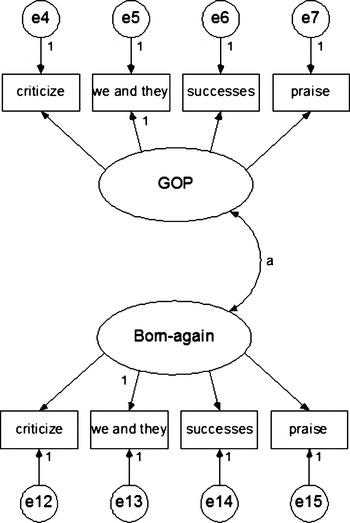
This section will discuss the statistical model used to analyze the IPGS scales. Figure 1 illustrates the hypothesized structure of the confirmatory factor analysis (CFA) model.Footnote 8 The model connects the religious and partisan identity questions. To account for the fact that each Republican item uses wording that is equivalent to a born-again item, error correlations have been added to the model. This represents a method effect (Fiske Reference Fiske, Brinberg and Kidder1982), i.e., the expectation that each pair of items shares unexplained variability due to equivalent wording. For instance, the items “when I talk about Republicans, I usually say ‘we’ rather than ‘they”’ and “when I talk about born-again Christians, I usually say ‘we’ rather than ‘they’” use the same instrument. This might account for part of the variability in these two variables that cannot be explained by the underlying factors.
Hypothesized factor structure of Republican (GOP) and born-again identity. Note: For the unconstrained (two-factor) model, a is freely estimated. For the constrained (one-factor) model, a = 1. Error correlations omitted for clarity (e4-e12; e5-e13; e6-e14; e7-e15).

A two-factor model serves as the baseline model, since this is the commonly assumed identity structure in previous research: a partisan and a — separate — religious identity. This baseline model is then compared to the one-factor model, which postulates that the two identity dimensions are in fact a single factor. The single factor represents the composite “evangelical Republican” hypothesis. Considering the importance of political interest in exposing individuals to contextual factors that reinforce the evangelical Republican stereotype, the one-factor model should provide a better fit among those more interested in public affairs and elections (high interest group).
To conduct the comparisons, the model in Figure 1 is run with parameter a being freely estimated (unconstrained model assuming a bi-dimensional/two-factor structure) and compared against a model that has parameter a fixed to equal 1 (constrained model assuming a uni-dimensional/one-factor structure). A perfect correlation of a = 1 posits that the religious and the partisan identity dimensions are in fact a single dimension. The comparison is conducted with a chi-square difference test (Δχ2), since the two models belong to a hierarchical structure: the constrained, uni-dimensional model is nested within the unconstrained, bi-dimensional model. The difference between the chi-square values for the two nested models is itself distributed as a chi-square value with degrees of freedom equal to the constraints imposed. The chi-square difference test shows whether an improvement to the overall fit achieved with additional constraints is statistically significant. A significant chi-square value indicates that the constrained model is a bad fit. By extension, the freely estimated, unconstrained model is to be preferred (the significance test refers to H0: the constrained model is correct). When the chi-square value is insignificant, the constrained model gives an equally good fit to the observed data structure. As more parsimonious (it does not require the estimation of the fixed term a) the constrained model should then be preferred.Footnote 9
RESULTS
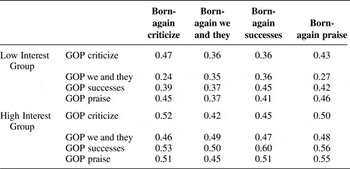
In a general overview of the data, Table 3 presents the correlations between the religious and the partisan items of the IPGS for the two sub-samples of interest (low and high political interest). The positive correlations for both sub-samples suggest that when people (dis)agree with one religious item, they also tend to (dis)agree with the equivalent partisan item. More importantly for this analysis, the larger coefficients in the lower panel of the table suggest that respondents in the high interest group give similar answers to the two sets of items to a greater extent than respondents in the low interest group. This illustrates that the high interest group is better able to match responses to the two types of items. Any fusion between religious and political definitions of the self is more likely to emerge within this group.
Correlations between Republican (GOP) and born-again IPGS items

Note: All coefficients significant at p < 0.01. Source: CCES 2008 (case weight applied).
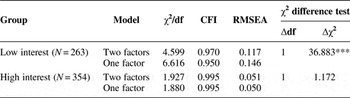
Table 4 presents the main hypothesis test in the form of CFA results, focusing on the fit of the compared models. The values suggest that the baseline, two-factor structure returns a borderline acceptable fit in the low interest group (χ2/df = 4.599; CFI = 0.970; RMSEA = 0.117). The one-factor model, which constrains parameter a to equal a value of 1, is clearly a worse fitting model for the low interest group (χ2/df = 6.616; CFI = 0.950; RMSEA = 0.146). In contrast, when we turn to the high interest group, the two models are not simply equally good. The fit of the baseline model (χ2/df = 1.927; CFI = 0.995; RMSEA = 0.051) is almost identical, if not slightly worse, with the fit of the constrained model (χ2/df = 1.880; CFI = 0.995; RMSEA = 0.050). The constrained model hypothesizes the existence of a unique, common factor.
Model fit indices and χ2 difference test

***p < 0.01; **p < 0.05; *p < 0.10. Source: CCES 2008 (case weight applied).
The chi-square difference test in Table 4 (right column) determines whether these differences in overall fit are statistically significant. The baseline model in the low interest group fits the data better than the fusion model (p < 0.01). Although less parsimonious (i.e., with more parameters to estimate and therefore, possibly, less generalizable), the significant value indicates that it is the preferable model. However, when analyzing data from the high interest group, the hypothesis of fusion (a = 1) between born-again and Republican identification produces a better fit than the baseline model (the statistic is clearly insignificant at both p < 0.05 and p < 0.10). Therefore, the more parsimonious model (the one-factor model) should be adopted. The model postulates that identification (or non-identification) with the Republican group and identification (or non-identification) with the born-again group are in fact tantamount. This overlap only emerges among politically interested respondents, who are supposedly exposed to relevant situational influences.
These results suggest that attachment to a religious camp may contain elements of attachment to a political camp and vice versa. The results are interpreted as evidence of identity fusion. However, the same applies to non-attachment, namely to those who do not identify with the specific religious and partisan camps. This point requires further elaboration. The responses of those who do not see themselves as a typical member of any of the two groups of interest (born-again or Republican) could be another reason for the emergence of the one-factor model. In that case, we should attribute the single factor solution to the responses of out-group members, namely of those who strongly disagree (do not identify) with the Republican items and, at the same time, strongly disagree with the born-again items.
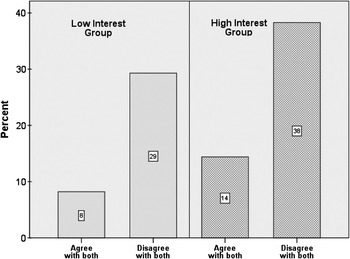
In fact, Figure 2 suggests that identity fusion is driven to a large extent by those who do not identify with any of the two groups (i.e., who disagree with both the born-again and the Republican items). The figure shows how many respondents agree with both religious and partisan items, and how many disagree with both. The right-hand panel of Figure 2 shows that there are more respondents not identifying with any group (38% of the high interest group) than there are respondents identifying with both groups (14%).
Agreement/disagreement with religious and partisan IPGS items. Note: Bars refer to percentage (dis)agreement with each pair of equivalent items (e.g., Republican “we and they” question and born-again “we and they” question) averaged across all pairs. The “Agree with both” category contains the “strongly agree” and “agree” options. The “Disagree with both” category contains the “strongly disagree” and “disagree options.

Figure 2 could be interpreted as confirmation of a backlash against the politicization of religion by those who form the out-group in the “evangelical Republican” stereotype. It seems therefore that the primary outcome of the religious-partisan stereotype is not expressed as a positive fusion of religious and political identities for the in-group (evangelical Republicans). Positive identity fusion benefits the Republican Party in many ways; for example, by keeping in-group members from crossing lines during elections. However, Figure 2 shows that respondents who experience the religious-political identity are not a considerable mass. There is a much larger group of respondents who consistently avoid identifying with both groups, Republican or born-again. Therefore, the politicization of religion appears to produce a recoil against the religious and partisan groups “naturally” connected in public consciousness (negative fusion). What is more, this identification backlash might provide the underlying psychological explanation of what recent studies have documented as a behavioral backlash: evangelical Christians that disagree with the intense “Republicanization” of their religious communities are likely to desert these communities (Hout and Fischer Reference Hout and Fischer2002; Patrikios Reference Patrikios2008; Putnam and Campbell Reference Putnam and Campbell2010; Campbell et al. Reference Campbell, Green and Layman2011; Husser Reference Husser2011).
A SUPPLEMENTARY TEST
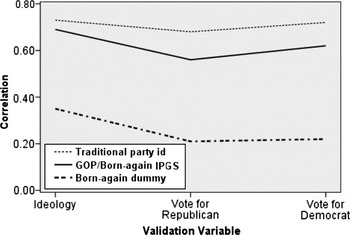
A final test will examine the political consequences of identity fusion. Having documented the internalization of the religious-partisan stereotype by the politically attentive segment of the American public, the final step is to validate whether this has the anticipated consequences for individual political decisions. Using variables from the 2008 CCES, I measure the impact of the single religious-partisan factorFootnote 10 on standard measures of political behavior: ideological self-placement and the vote.Footnote 11 For comparison, the test will also evaluate the impact of other relevant predictors: born-again status and partisan identification.Footnote 12 The vertical axis in Figure 3 illustrates the magnitude of significant product moment correlation coefficients (interpreted as bi-serial for the born-again status dummy). The horizontal axis represents the dependent variables. The patterned lines refer to the independent variables. The analysis uses cases from the politically interested sub-group only.
Consequences of “evangelical Republicanism.” Note: The horizontal axis represents the three dependent variables (political consequences). The patterned lines refer to the three independent variables (the fused identity, and two other predictors of political behavior). The vertical axis illustrates the magnitude of significant product moment correlation coefficients (bi-serial for the born-again dummy).

As Figure 3 suggests, the standard partisan identification item correlates very strongly with each validation variable. The religious-partisan identity factor that uses the IPGS items comes second in strength, but very close to the partisan identification item. The weakest bi-variate correlations are detected for the more crude born-again status dummy. All relationships are in the expected direction. The effect of the religious-partisan identity factor on the three dependent variables does not disappear even when one accounts for the impact of party identification and born-again status, and other controls (results available from the author). Two general observations follow. First, it seems that acceptance or not of the “evangelical Republican” stereotype has a substantial effect on individual political decisions, which would survive net of the effect of other related variables. Second, the size of the effect is very similar to that of the party identification item, which is a fundamental explanatory variable in political behavior research.
DISCUSSION
Confirmatory factor analysis of social identity items from the 2008 Cooperative Congressional Election Study documented an overlap between born-again and Republican identification, but mainly between born-again and Republican non-identification. This overlap was observed as a single factor solution of religious and partisan identity items. Scores on this single factor were then used to successfully explain individual political decisions. These findings challenge the hitherto untested but very popular presumption that the politicization of religion at the individual level means that the voter simply aligns her religious identity and her partisan identity. Instead, the results suggest that voters are likely to incorporate religious and partisan elements in their self–concept to create a unique religious-partisan group label.
The “born-again Republican” factor surfaced only among the politically interested sub-sample, a possible product of greater exposure to the simplistic stereotype that dominates American politics. However, this can only be a tentative causal claim that cannot be tested with the data at hand. In particular, while the findings serve as a first step to document the existence of the composite identity, we can only speculate about the exact social and political processes that lead to internalization of the evangelical Republican stereotype. Here I will return to a discussion of possible underlying processes: religious socialization in the congregation and individual exposure to campaign and other partisan cues.
First, the “born-again Republican” identity might be constructed through face-to-face interaction and exposure to clergy cues within congregational contexts. However, the findings of this study suggest that a sizeable portion of the sample avoids identifying with the partisan and the religious labels of interest. Therefore, congregational contagion might not be a comprehensive explanation, since it only applies to evangelicals who attend church. This makes more plausible the alternative explanation: partisan cues (mediated or unmediated) that lead to the internalization of the composite identity and lead to positive fusion for the in-group and to negative fusion for the out-group. Testing these explanations about the sources of identity fusion requires a contextual approach either using congregational or campaign studies. This approach would take us beyond the methodological individualism of survey results, such as those presented here. It would also allow us to tackle another question, which cannot be answered with the data at hand: when does negative fusion take place instead of positive fusion? In other words, under what conditions can we expect to witness fusion due to negative reference by the out-group as opposed to positive reference by the in-group?
Limitations notwithstanding, this type of analysis can be used to analyze fusion between other social and partisan identities, and to improve our understanding of the nature of politicized social identities. Also, the findings have implications for American electoral politics. If group identities are as consequential as suggested in the relevant scholarship, then the evangelical Republican identity — and the negative reaction to the stereotype that sustains it — provides a good explanation of the polarized choices registered by American religious groups in recent elections. The perfect correlation of the two component parts (religious and partisan), which motivates this composite identity, also indicates that polarization on the basis of the white evangelical Republican stereotype is unlikely to erode in the near future. Finally, if we consider the large segment of the public that appear to identify against this stereotype, then a Republican party that starts challenging the stereotype — say, with a presidential ticket that includes a Mormon or a Roman Catholic — might see an improvement in electoral prospects in the long term.