Antimicrobial resistance (AMR) is currently one of the greatest threats to global health. 1 Appropriate antimicrobial therapy is an important strategy in countermeasures for AMR because the emergence of AMR is driven by inappropriate antimicrobial use. 1 Following the issue of the Global Action Plan for AMR in 2015, 1 the Japanese government identified optimal antimicrobial therapy as a national objective in the National Action Plan in April 2016. 2
In concordance with the national action plans in the United Kingdom 3 and United States, 4 the Japanese National Action Plan set a clear objective to “reduce the antimicrobial use per day per 1,000 inhabitants in 2020 to two-thirds of the level in 2013.” 2 As the first step toward the promotion of optimal antimicrobial therapy by providing clear guidance, the Manual of Antimicrobial Stewardship (1st Edition) was issued by the Government of Japan’s Ministry of Health, Labor, and Welfare in June 2017. 5 These guidelines focus on the clinical management of acute respiratory tract infection (ARTI) and gastroenteritis, because antibiotics are often prescribed unnecessarily for these common conditions. 5 Indeed, in Japan, ~70% of oral antibiotics were prescribed for ARTI and gastroenteritis in 2012–2013. Reference Hashimoto, Matsui and Sasabuchi6 This figure is higher than those in the United Kingdom (47%) Reference Dolk, Pouwels, Smith, Robotham and Smieszek7 and the United States (46%). Reference Fleming-Dutra, Hersh and Shapiro8 Furthermore, broad-spectrum antibiotics (third-generation cephalosporins, quinolones, and macrolides) constituted 88% of oral antibiotic prescriptions. Reference Hashimoto, Matsui and Sasabuchi6 Although the guidelines have been issued and disseminated, 9 evidence is limited as to whether issue of the manual, as the first step in the National Action Plan, has had any impact on reducing antibiotic use for ARTI or gastroenteritis in real-world clinical settings. Reference Kimura, Fukuda and Hayakawa10
To address this knowledge gap in the literature, we carried out an interrupted time-series analysis to examine whether issue of the Manual of Antimicrobial Stewardship had an impact on reducing the use of antibiotics for ARTI or gastroenteritis during the first year after the date of issue.
Methods
Data source
This study was performed using data in a national claims database (Japan Medical Data Center database) from June 2016 to June 2018. The database collects claims from large employers and currently covers ~7 million individuals in the Japanese population. 5 The database includes information on annual health screening programs and administrative claims data for clinic visits and hospital admissions. Diagnoses are recorded using International Classification of Diseases, 10th Revision (ICD-10) codes and drugs are categorized according to the World Health Organization Anatomical Therapeutic Chemical (WHO-ATC) classification system. Further details of the database were described elsewhere. Reference Kimura, Sato, Ikeda, Noda and Nakayama11 The need for informed consent was waived because of the de-identified nature of the data. This study was approved by the Institutional Review Board of The University of Tokyo (approval no. 10862-1).
Study population
Outpatients with ARTI or gastroenteritis from June 2016 to June 2018 were identified. According to the guidelines, outpatients aged ≥6 years were included. 5 ARTI and acute diarrhea were defined by the ICD-10 diagnosis codes shown in Supplemental Table 1 (online). Reference Hashimoto, Matsui and Sasabuchi6
Exposure
The primary exposure was issue of the Manual of Antimicrobial Stewardship (June 1, 2017). These guidelines were created by the Tuberculosis and Infectious Diseases Control Division, Health Service Bureau, Ministry of Health, Labor, and Welfare, Japan to promote antimicrobial stewardship by providing clear guidance on how to improve the clinical management of ARTI and gastroenteritis. “Promote Antimicrobial Stewardship at Medical Institutions” is one of the strategies in the National Action Plan of Japan, and the guidelines are the first official intervention by a public agency to implement this strategy. A digest version was also created to facilitate use of the guidelines in daily clinical practice. 5
Definition of antibiotic use
Use of antibiotics was identified by the WHO-ATC classification codes shown in Supplemental Table 2 (online). Reference Hashimoto, Matsui and Sasabuchi6
Outcome measures
The primary outcome was any antibiotic use for ARTI or gastroenteritis. The secondary outcome was use of broad-spectrum antibiotics including third-generation cephalosporins, quinolones, and macrolides. 5
Statistical analysis
First, a linear regression model using week as a dependent variable and adjusting for seasonality was employed to determine the overall trends in antibiotic use during the entire 2-year study period (June 2016 to June 2018). Next, an interrupted time-series analysis was performed to examine whether issue of the Manual of Antimicrobial Stewardship had an impact on reducing antibiotic use for ARTI or gastroenteritis during the first year after the date of issue (post-issue period: July 1, 2017, through June 30, 2018). An interrupted time-series analysis is a quasi-experimental design for evaluating the effectiveness of population-level health interventions implemented at a clearly defined point in time, and it is thus widely used to evaluate the effectiveness of interventions for national public health legislation. Reference Martin, Cunliffe, Décary-Hétu and Aldridge12–Reference Kontopantelis, Doran and Springate14 Using this method, the changes in antibiotic prescription rates among outpatients with ARTI or gastroenteritis were examined for 2 separate periods before and after the guideline issue date: the pre-issue period (June 2016 to May 2017; week 0 to week 52) and the post-issue period (June 2017 to June 2018; week 53 to week 108). Seasonal variability was adjusted by adding a dummy variable for season (January–March, April–June, July–September, and October–December) as a covariate in the model.
Values of P < .05 were considered statistically significant. All analyses were performed with STATA version 16.0 software (StataCorp LP, College Station, TX).
Results
Patient characteristics
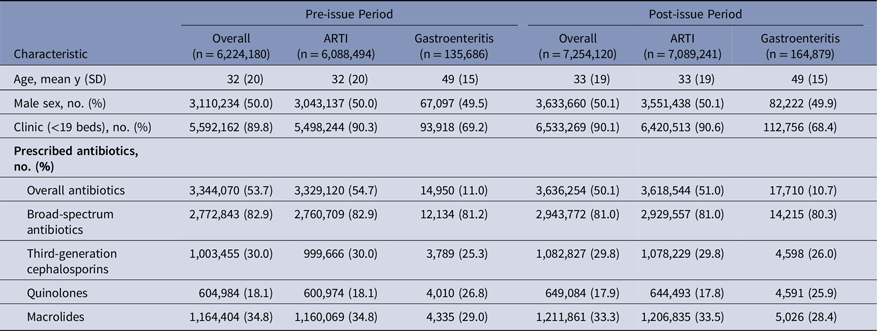
From June 2016 to June 2018, 13,177,735 patients with ARTI (98% of study population) and 300,565 patients (2%) with gastroenteritis were identified. Table 1 shows the baseline characteristics of the total patients (ARTI and gastroenteritis), patients with ARTI, and patients with gastroenteritis, according to the pre-issue and post-issue periods. The mean age was 32 years in patients with ARTI and 49 years in patients with gastroenteritis. Among the 13,177,735 patients with ARTI, 6,594,575 (50.0%) were men, and among the 300,565 patients with gastroenteritis, 149,319 (49.7%) were men.
Characteristics of the Outpatients With Acute Respiratory Tract Infection or Gastroenteritis

Note. ARTI, acute respiratory tract infection; SD, standard deviation.
Trends of antibiotic use in patients with ARTI
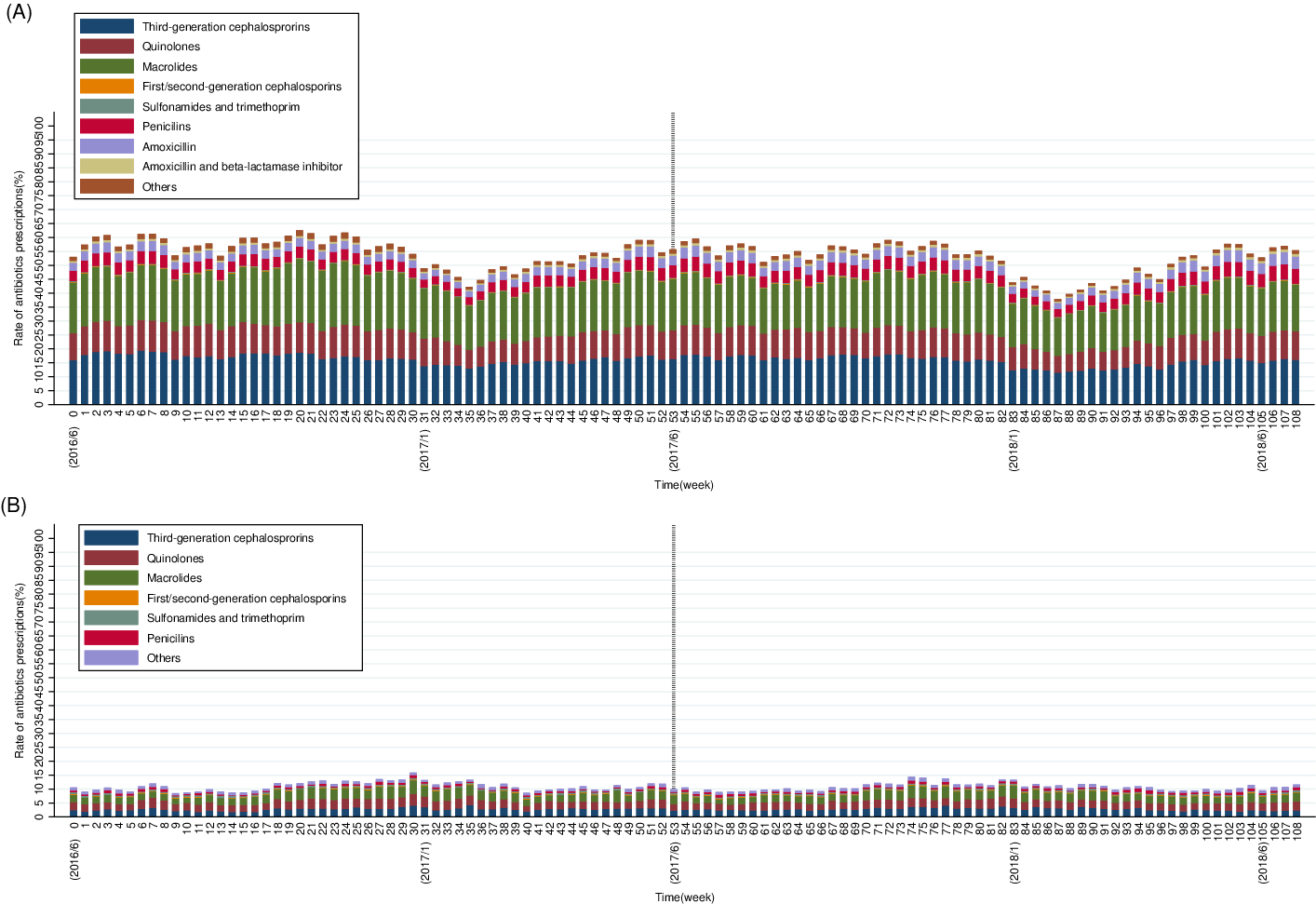
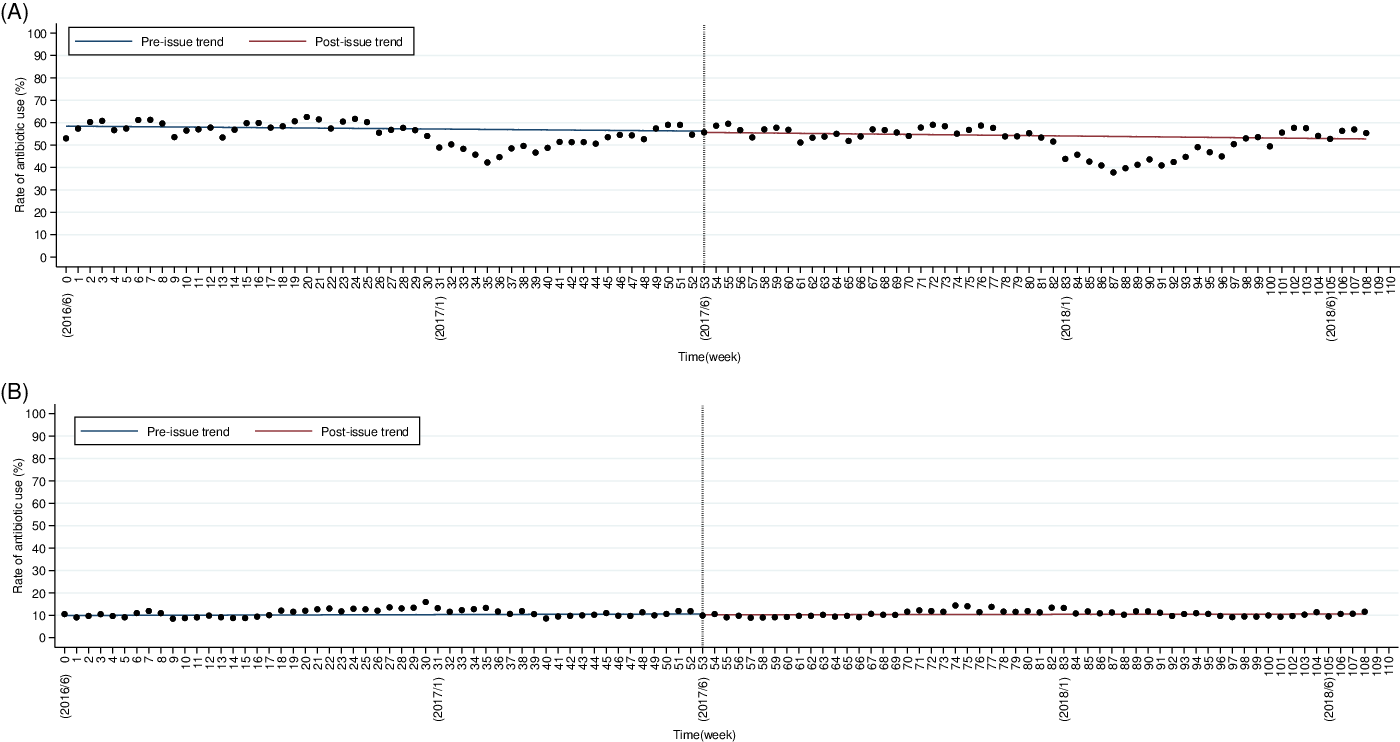
Among patients with ARTI, the rate of any antibiotic use was 54.7% (95% CI, 53.1%–56.3%) in the pre-issue period and 51.0% (95% CI, 49.0%–53.1%) in the post-issue period, with a significant downward trend during the entire 2-year study period (−0.06% decrease per week; 95% CI, −0.07% to −0.04%; estimated annual decrease, −3.12%). The trends in rate of antibiotic use for ARTI stratified by 9 categories are shown in Figure 1 A. The trends in rates of any antibiotic use for ARTI during the pre-issue period and post-issue period are shown in Figure 2 A.
Trends in rates of antibiotic use in the study population. (A) Acute respiratory tract infection. (B) Gastroenteritis.

Trends in rates of any antibiotic use during the pre-issue period and post-issue period. (A) Acute respiratory tract infection. (B) Gastroenteritis.
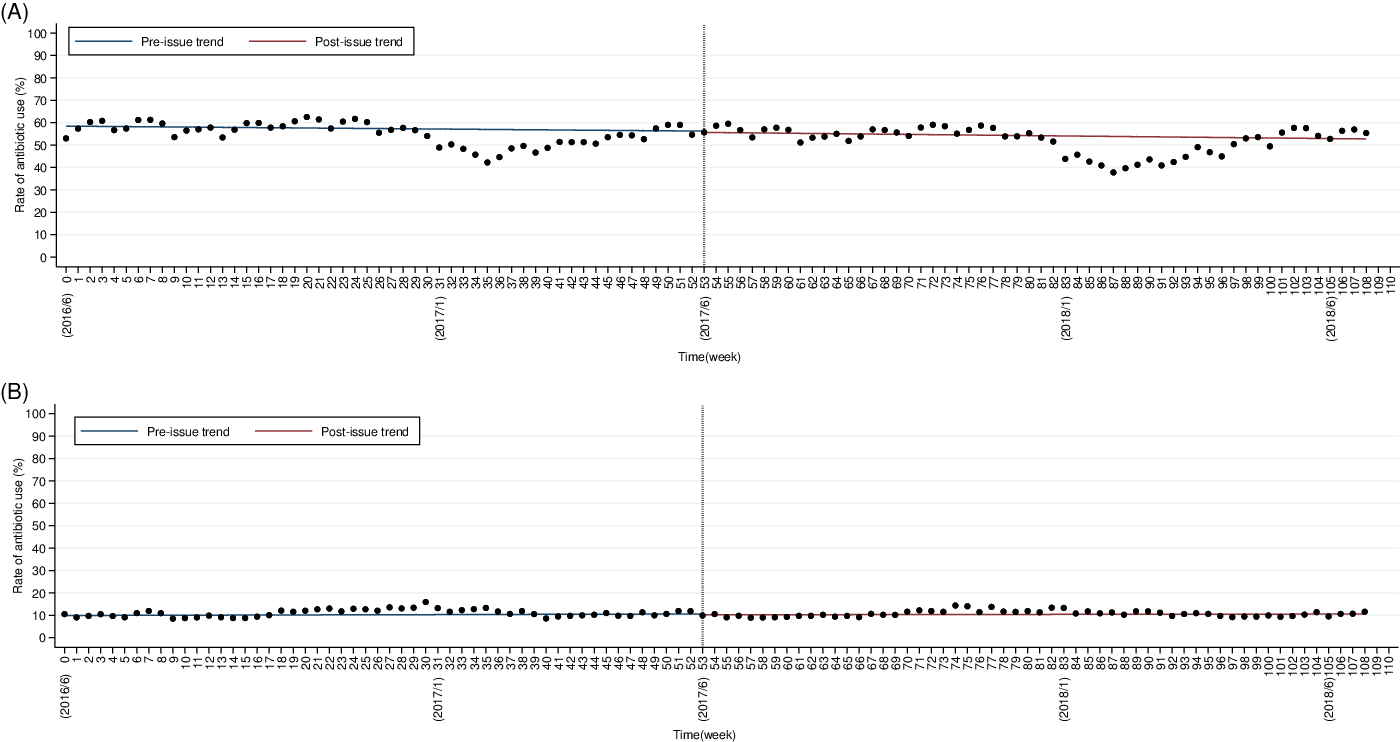
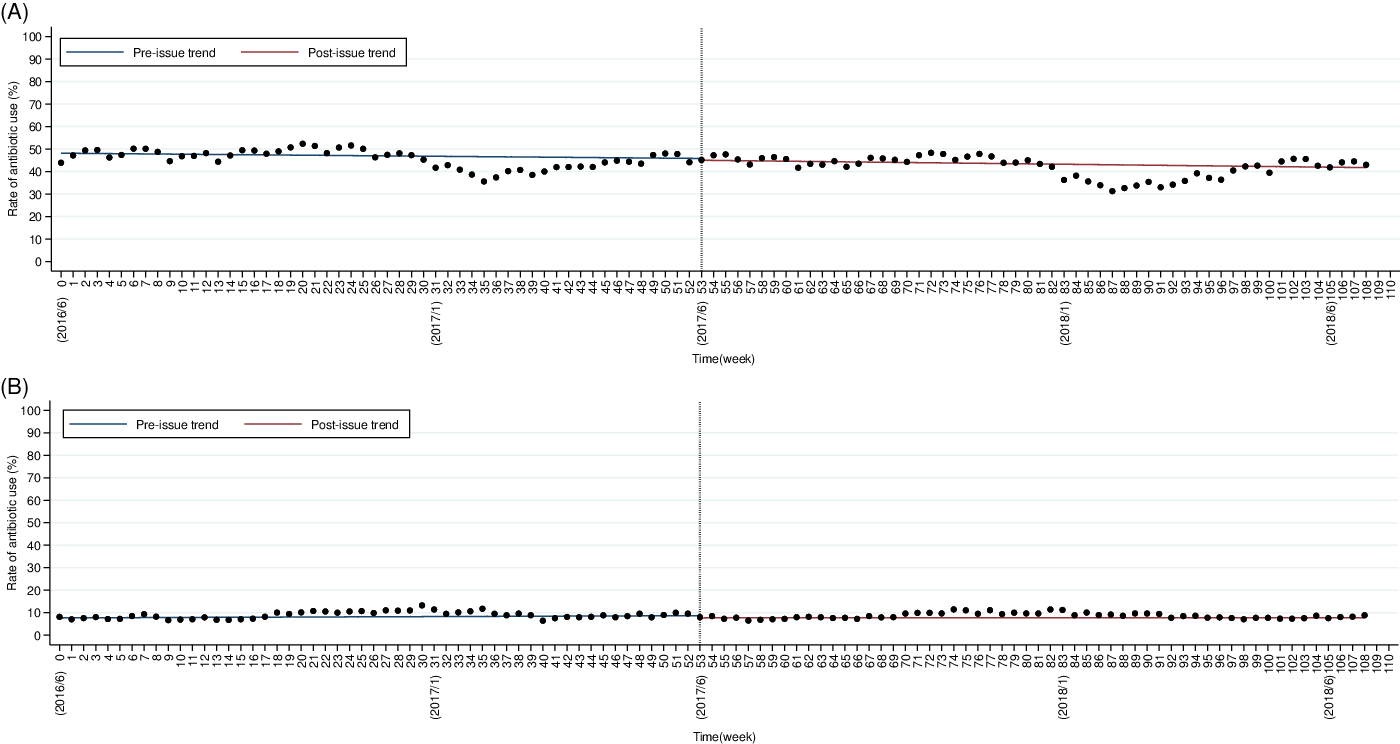
Among patients with prescribed antibiotics, broad-spectrum antibiotics accounted for 82.9% (95% CI, 82.6% to 83.2%) in the pre-issue period and 81.0% (95% CI, 80.6% to 81.3%) in the post-issue period, with a significant downward trend (−0.03% decrease per week [95% CI, −0.04% to −0.03%]). The trends in rate of broad-spectrum antibiotic use for ARTI during the pre-issue period and post-issue period are shown in Figure 3 A.
Trends in rates of broad-spectrum antibiotic use during the pre-issue period and post-issue period. (A) Acute respiratory tract infection. (B) Gastroenteritis.

In the interrupted time-series analysis adjusted for seasonality (Table 2), there was no significant change in trends of antibiotic use between the pre-issue period and the post-issue period (trend difference, −0.01% per week; 95% CI, −0.10% to 0.07%; estimated annual difference by issue of the guidelines, −0.52%). Similarly, there was no significant change in trends of broad-spectrum antibiotic use between the pre-issue period and post-issue period (trend difference, −0.02% per week; 95% CI, −0.08% to 0.05%; estimated annual difference caused by issue of the guidelines, −1.04%).
Trends in Rates of Antibiotic Use for Acute Respiratory Tract Infection or Gastroenteritis in an Interrupted Time-Series Analysis
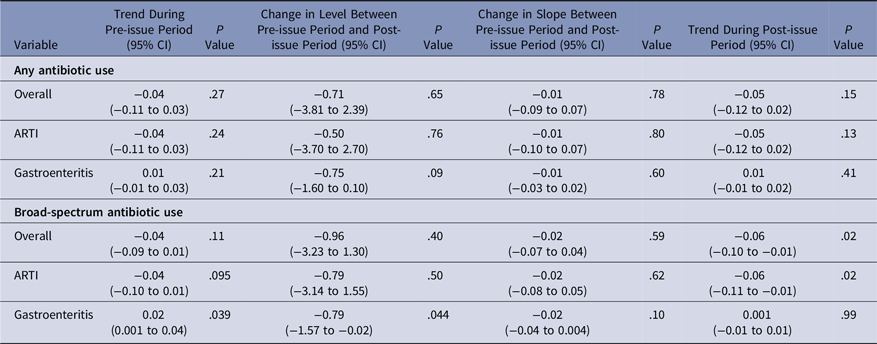
Note. ARTI, acute respiratory tract infection; CI, confidence interval.
Trends of antibiotic use in patients with gastroenteritis
In patients with gastroenteritis, the rate of any antibiotic use was 11.0% (95% CI, 10.6%–11.5%) in the pre-issue period and 10.7% (95% CI, 10.4–11.1) in the post-issue period. The trends in rate of antibiotic use for gastroenteritis stratified by 7 categories are shown in Figure 1B. The trends in rate of any antibiotic use for gastroenteritis during the pre-issue period and post-issue period are shown in Figure 2B.
The rate of broad-spectrum antibiotic use was 81.2% (95% CI, 80.4%–82.0%) in the pre-issue period and 80.3% (95% CI, 79.4–81.1) in the post-issue period. The trends in rates of broad-spectrum antibiotic use for gastroenteritis during the pre-issue period and the post-issue period are shown in Figure 3B.
As shown in Table 2, there was no significant change in trends of antibiotic use between the pre-issue period and post-issue period (trend difference, −0.01% per week; 95% CI, −0.03% to 0.02%; estimated annual difference caused by issue of the guidelines, −0.52%). Similarly, there were no significant changes in the trends of broad-spectrum antibiotic use between the pre-issue period and post-issue period (trend difference, −0.02% per week; 95% CI, −0.04% to 0.01%; estimated annual difference caused by issue of the guidelines, −1.04%).
Discussion
In this interrupted time-series analysis using data in a nationwide claims database, issue of the Manual of Antimicrobial Stewardship had no significant impact on reducing antibiotic use for outpatients with ARTI or gastroenteritis during the 1-year period after the date of issue. Similar findings were noted for use of broad-spectrum antibiotics. The strengths of our study include the use of a quasi-experimental design and nationwide claims data covering primary care settings.
Issue of guidelines is a general and central approach to reducing inappropriate use of antibiotics. Nevertheless, controversy remains on the impact of such guidelines in clinical settings. Reference Bhattacharyya and Kepnes15–Reference Hawker, Smith and Smith17 In the United States, for example, care patterns for medical treatment of acute adult sinusitis changed after guideline publication, with an increase in oral antibiotic prescription rates and an increase in the use of amoxicillin as the first-line antimicrobial agent. Reference Bhattacharyya and Kepnes16 In the United Kingdom, implementation of national guidelines for primary care showed mixed results from 1995 to 2011. Antibiotic prescriptions for sore throats declined from 77% to 62%, but antibiotic prescriptions for otitis media increased from 77% to 85%. Reference Hawker, Smith and Smith17
The aforementioned studies used a before-and-after design to assess the impact of the issue of guidelines. However, a simple before-and-after design may be unable to fully address the causal impact of the guidelines because it cannot account for changes in trends between the pre-issue period and post-issue period. Reference Cousens, Hargreaves and Bonell18 In this context, our study using an interrupted time-series analysis as a quasi-experimental design extended these previous studies and suggested that guideline publication may not be an immediately effective intervention to change the prescribing behavior of physicians.
Although we used Japanese data, we believe that our findings may be generalizable to any developed country and useful for an international readership because of the known international issues related to adopting guideline-issued changes in a timely manner. In addition, our findings can provide an important basis for further development of evidence-based interventions toward prevention of AMR.
Potential reasons for the nonsignificant impact of the issue of national guidelines are likely to be multifactorial. The most important reason may be that doctors were either unaware of the manual (42.2%) or did not use it if they were aware of the manual (43.7%), according to a previous survey of Japanese clinic doctors. Reference Gu, Fujitomo and Soeda19 Qualitative studies showed that trying to meet patient expectations was a major factor for physicians and that pressure from patients, relatives, or carers was an uncomfortable influence on prescribing decisions. Reference Gu, Fujitomo and Soeda19–Reference O’Connor, O’Doherty and O’Regan23 One of the studies also identified other possible factors, including limited time, poor doctor–patient communication, and diagnostic uncertainty. Reference Fletcher-Lartey, Yee, Gaarslev and Khan22 Another factor may be direct marketing strategies by pharmaceutical industries toward prescribing physicians. Reference Avorn and Solomon20 General practitioners can also prescribe antibiotics to gain financial incentives. Reference Burkhard, Schmid and Wuthrich24
The observed nonsignificant impact of the issue of national guidelines warrants further investigations to seek optimal and targeted strategies that can reduce antibiotic use. One potentially effective strategy is financial incentives. Indeed, recent studies in the United Kingdom showed that introduction of financial incentives successfully reduced all antibiotic prescriptions by 8.2% and broad-spectrum antibiotic prescriptions by 18.9% Reference Balinskaite, Johnson and Holmes25 and reduced antibiotic prescription for uncomplicated ARTI by 3%. Reference Bou-Antoun, Costelloe and Honeyford26 Multiple other studies have supported the notion that financial incentives may be an effective strategy for reducing inappropriate antibiotic use. Reference Han, Chae and Kim27 The other potential strategies include (1) prescribing restrictions, (2) educating healthcare professionals, and (3) educating the general population. First, prescribing restrictions (eg, restrictions on antibiotic purchases without a prescription) had consistent evidence for effectiveness at reducing antibiotic consumption and prescription according to a recent systematic review on the impact of national interventions to promote responsible antibiotic use. Reference Lim, Singh, Duong, Legido-Quigley, Hsu and Tam28 Second, in Japan, dissemination of knowledge on antimicrobial stewardship is needed. A recent survey of clinics in Japan reported that physicians in clinics were unaware of the manual (42.2%) and the national action plan (44.9%), but they were aware of the effect of appropriate antimicrobial use on the prevention of antimicrobial resistance (82.1%). Reference Gu, Fujitomo and Soeda19 Thus, continuous education and recommendations to physicians is important. Third, according to a nationwide survey of the general population in Japan, ~30% of respondents preferred physicians who prescribed antibiotics for a cold. Furthermore, 80% of respondents believed that antibiotics were effective for colds and flu. Reference Kamata, Tokuda, Gu, Ohmagari and Yanagihara29 In agreement with a recent study on the importance of educational interventions tailored to patient educational levels, 30,Reference Tsuzuki, Fujitsuka and Horiuchi31 further education for the general population should facilitate the appropriate use of antibiotics. As indicated by these studies, understanding the actual impact of individual strategies is critical for researchers and policy makers.
Our study has several limitations. First, because the database includes patient data from employee-based health insurance societies, little information is available for older patients, particularly those aged ≥65 years. However, the trends in practice patterns may not differ substantially across age categories. Second, after accounting for the dissemination period, the 1-year study period after issue of the manual may not be sufficient to evaluate its impact. Nevertheless, with the rapid increase in AMR-related clinical problems, 32–Reference de Kraker, Wolkewitz and Davey35 it is important to determine whether or not an intervention is immediately effective. Reference Han, Chae and Kim27 Third, there was no control group and a basic interrupted time-series analysis design cannot exclude confounding by cointerventions or other events occurring around the time of the intervention. Reference Lopez Bernal, Cummins and Gasparrini36 Nonetheless, the obvious linear trend without significant changes in the nationwide data may support the assumption that there were no impactful strategies during the study period.
In conclusion, despite the issue of the Manual of Antimicrobial Stewardship to promote optimal antimicrobial therapy, we detected no significant changes in trends of antibiotic use for outpatients with ARTI and gastroenteritis. The present study revealed that broad-spectrum antibiotics still accounted for ~80% of oral antibiotic prescriptions. Our findings indicate that the issue of national guidelines may not be an immediately effective intervention to change the prescribing behaviors of general practitioners, and they suggest the importance of further multifaceted strategies to promote optimal antimicrobial use.
Supplementary material
To view supplementary material for this article, please visit https://doi.org/10.1017/ice.2020.427
Acknowledgments
The results, conclusions, and views expressed in this article are those of the authors and do not reflect the position or policy of the Ministry of Health, Labour and Welfare, Japan. The funding sources had no role in the study.
Financial support
This work was supported by the Ministry of Health, Labour and Welfare, Japan (grant no. 19AA2007) and the Ministry of Education, Culture, Sports, Science and Technology, Japan (grant nos. 20H03907 and 17H05077).
Conflicts of interest
All authors report no conflicts of interest relevant to this article.