1. Context
There are several definitions of visual music available in the established literature, notably those put forward by Cindy Keefer and Jack Ox (Ox and Keefer Reference Ox and Keefer2006–08: 1–2) and by Brian Evans (Evans Reference Evans2005: 11). These definitions tend to attempt to establish visual music as a field of practice, and therefore, to a greater or lesser extent, detail specific modes of working. For the purposes of this paper, a simpler, more universal definition will be applied:
Visual music involves the artistic expression or representation of musical ideas or material through ocular media.
This is a somewhat broad definition in comparison to those mentioned above. Unlike those definitions, it makes no attempt to define how the creative process might be, or indeed has been, carried out. However, by omitting these specifics it perhaps distils visual music as an idea.
If one takes a glance over the history of what is generally deemed visual music, from the colour organs of the eighteenth and nineteenth centuries, through the abstract expressionism of Kandinsky and Klee, the abstract cinema of Fischinger and Brakhage, and the expanded cinema of Jordan Belson; through the animation of the Whitney brothers, Lye and McLaren to relevant areas of contemporary audiovisual practice, one can divide this work into two types of practice, which are sometimes combined: material transference and compositional thinking.
1.1. Material transference
This area of practice involves a process of material transference from music (or sound) to the ocular domain. Within this can be sited a very particular approach often linked to the phenomenon of synaesthesia. This approach can be broadly described as the expression of tone in both aural and ocular domains, where equivalence is sought between the frequency domain in sound and light (colour). This is a fundamental endeavour that can be traced through the work of most practitioners within the colour organ tradition, and can also be found in the theories and paintings of Wassily Kandinsky and others (it can also be found in ‘reverse formation’ in the work of synaesthete composers such as Scriabin and Messaien). To some extent it can also be placed within the psychedelic project of the 1960s, which intertwines with the history of visual music during that decade. One might argue that this attempt at cross-synthesis between aural and ocular domains has reached its apotheosis in the wide variety of contemporary work around audio visualisation, both in commercial contexts (lightshows for live music and club environments, generative graphics for mp3 playback software, etc.) and in more experimental digital arts projects. Within this context, the term mapping has been employed to describe a wide variety of data relationships across media, many of which are considerably more sophisticated than the simple pitch/colour relationship central to earlier synaesthetic art.
A parallel to this practice exists within the tradition of direct sound (sometimes known as synthetic sound or illustrated sound), the generation of sound and music from visual material (by various techniques including images drawn or photographed on an optical film soundtrack). Although in many ways this could be seen as a reversal of visual music (semantically we might call this sonic cinema, but this term has historically been used in other contexts), many of the important figures in the history of visual music have experimented with this technique, including Oskar Fischinger, James and John Whitney and Norman McLaren. Again, a contemporary equivalent might be found – in software which allows sound to be generated from graphic inscription, from Xenakis’ seminal UPIC system to more recent applications such as U&I software's Metasynth.
1.2. Compositional thinking
The second, contrasting, area of practice involves the application of more abstract ideas and principles derived from music to ocular media. The most prevalent of these is perhaps form. Form in music is not just the management of time on the macro level within a compositional framework, but rather an overall controlling principle which affects most or all musical parameters. Visual music works have often striven towards this as an ideal – an obvious example is Viking Eggeling's Symphonie Diagonale, which demonstrates a formal structure that could be argued to have some of the qualities of sonata form, albeit in a somewhat rudimentary form. Visual music often borrows ideas and techniques which shape the structures of music at a fundamental level, the very building blocks from which music is made. One particularly prevalent idea/technique is that of counterpoint, which seems to hold a particular attraction for visual music practitioners. Counterpoint is often cited as a guiding principal specifically for the audiovisual relationship itself, as a more sophisticated alternative to the ‘homophonic’ structure of straightforward synchrony.
One of the most complete expositions of a visual-music compositional practice of this nature – where musical ideas rather than material are used within a ocular/multimedia context, is detailed by Brian Evans in his ‘Foundations of a Visual Music’ (Evans Reference Evans2005). Here Evans talks of principles such as consonance (and dissonance), tension and release, proportion, progression, various kinds of montage and, indeed, counterpoint. His ideas on counterpoint (related to visual media) are to be found in fuller form in his paper ‘Elemental Counterpoint with Digital Imagery’ (Evans Reference Evans1992).
1.3. Common ground
It should be noted that there are a number of parameters which can be used in relation to both aural and ocular media which exist outside of both of these modes of practice. This is a subset of the parameters relating to the use of time. Within the context of music, we tend to describe time on the meso-level as rhythm and on the macro-level as structure or form (though musical form is more than simply a matter of temporal divisions, as discussed above). These terms can be (and indeed are) also applied in ocular media, but to do so involves no process of mapping or translation – although these terms (at least in the case of rhythm) might be argued to have their origins in music, they refer essentially to time or timing, and therefore have a valid place in the vocabulary of any time-based medium. The term ‘rhythm’ is employed in areas of video and film practice which have little to do with the visual music tradition, and it is my contention that parametric time on the meso or macro level, whilst as essential to visual music as it is to any other time-based medium, has no place in this discussion.
2. Finding a compositional practice in visual music
Taking my initial definition of visual music as a model, it can be stated that my own practice in this field applies ideas derived from electroacoustic music to ocular media (specifically digital video). There are currently a number of composers of similar background to my own working in an audiovisual context, and there is, I believe, an emergent practice evolving here which can trace its antecedents as much within the musique concrète tradition as in relation to the roots of visual music within fine art and cinema. In this regard, I have, in my own practice, sought to apply principles derived from musique concrète to a multimedia practice. Musique concrète is of course not entirely separate from other forms of compositional practice, and the principles mentioned above, as outlined by Evans and others and relating to music compositional practice in the broadest sense, also apply here.
However, I have been interested to see if I could take ideas unique to musique concrète and apply them to visual music works. To some extent I have been engaged in an attempt to evolve a kind of ‘video concrète’ – it is for this reason that, to date, I have worked exclusively with time-based camera-sourced video material (as opposed to animation, whether created in camera, direct on film, or in the digital domain). Somewhat to my surprise, this approach is relatively rare; indeed, some definitions of visual music actually view the field as a subset of abstract animation, or indeed a synonym for that term (Evans Reference Evans2005: 11).
In using ‘concrète’ visual materials, I have treated these materials in a manner very much derived from musique concrète practice. Video clips are conceptualised as discrete entities analogous to the objets sonores proposed by Schaeffer and discussed by many later writers. My selection and treatment of these objects follows the model of many electroacoustic compositions from the 1980s and 90s, in which a deliberately focused and limited pool of material is subjected to a wide variety of processes and treatments which put at the centre of the compositional structure the development and transformation of material rather than the original material itself. Works which follow this model are Denis Smalley's Wind Chimes (1987), Jonty Harrison's et ainsi de suite (1992) and Trevor Wishart's Tongues of Fire (1994). My own early audiovisual work Zoetrope (1998) – by way of example – is heavily influenced by works such as these, and attempts to apply a similar compositional methodology across both audio and visual domains.
In his paper ‘A Glow on Pythagoras’ Curtain’, Diego Garro speaks of visual objects, and briefly outlines a phenomenological lexicon à la Schaeffer:
we could describe an art of audio-visual structures in which visual objects also can be described using similar semantic categories. For the sake of compositional considerations, a phenomenology may for example comprise color, shapes or ‘forms’, surface texture, granularity of the geometries, spatial attributes and perhaps others. (Garro Reference Garro2005: 3)
Garro goes a stage further to propose the objet audiovisuelle (Garro Reference Garro2005: 1). I have avoided the use of such a concept in my own practice, as to me it implies a fixed audiovisual synchronic relationship I tend to avoid. In general I tend towards the ‘contrapuntal’ relationship between sound and image mentioned above. However, in Zoetrope the majority of the material used – both sonic and visual – derives from only two sources, a malfunctioning television and a ‘hardware hacked’ arc-welder. This commonality of source material can be often found in my work, but the actual sounds and images, removed from the point of origin, are treated differently and separately. The commonality of source across audio and visual domains is important to me on a conceptual but not on a phenomenological level.
3. Reduced listening
Whilst the idea of a visual object or an audiovisual object can be a useful one in formulating a process for visual music creation, it has, in my opinion, a limited application in this context. However, there have been some attempts at a phenomenological mapping of visual material in these terms which do offer useful insights (Evans Reference Evans2005; Garro Reference Garro2005).
Of more interest and creative potential, I believe, is the idea – closely related to the objet sonore – of écoute réduite or reduced listening. This term has been defined by Shaeffer and Smalley, amongst others. I will here use the definition put forward by Michel Chion within the multimedia-oriented discussion on listening in Audiovision:
the listening mode that focuses on the traits of the sound itself, independent of its cause and of its meaning. Reduced listening takes the sound-verbal, played on an instrument, noises, or whatever-as itself the object to be observed instead of as a vehicle for something else. (Chion Reference Chion1990: 29)
This is closely related to the concept of acousmatic listening, defined by Chion in the same text as ‘a situation wherein one hears the sound without seeing its cause’ (Chion Reference Chion1990: 32). However, these terms are not synonymous – the latter is arguably an objective term describing a situation, namely one of listening to music from loudspeakers (the loudspeakers themselves being conceptualised not as the source of the sound but rather the Pythagorean veil separating sound from source), while the latter is a rather more complex idea, wrapping up a number of interesting ideas and issues. As Chion points out in the text referenced above, it is an active process – indeed, perhaps a discipline – requiring work on the part of the listener. This idea has been problematised by many writers, not least by Schaeffer himself. The argument here is often traced back to Lévi-Strauss’ implied criticism in Le cru et le cuit (Lévi-Strauss Reference Lévi-Strauss1964: 23–24) that the raw material of musique concrète – sounds captured from the world around us – cannot be entirely divorced from their ‘representative value’ – that is, from perceived knowledge of their origins – without entirely losing meaning. Within Lévi-Strauss’ conceptual framework this limits musique concrète to the first level of articulation, short of the second level required by language or, crucially, music.
Towards the end of his life, Schaeffer seems to have accepted this criticism – he spoke of the whole musique concrète project as a failure, largely because of the impossibility of removing sound objects from their representative value and attaining a level of articulation he saw as worthy of being called ‘music’. In his 1986 interview with Tim Hodgkinson, he said:
The whole problem of the sound-work is distancing oneself from the dramatic. I hear a bird sing, I hear a door creak, I hear the sounds of battle; you start to get away from that. You find a neutral zone. Just as a painter or sculptor moves away from a model, stops representing a horse, or a wounded warrior, and arrives at the abstract. A beautiful sculptural form, as beautiful as an egg, a greenhouse, a star. And if you continue this abstracting movement, you get to the graphics of the forms of letters in written language. And in music you get to music …
There are many people working with sound. It's often boring, but not necessarily ugly. It contains dynamic and kinaesthetic impressions. But it's not music. (Hodgkinson Reference Hodgkinson1986: 6)
To most contemporary readers, this conclusion might seem unnecessarily defeatist – Schaeffer's definition of what might be denoted music (and his views on the primacy of solfège) now seems limited, and his insistence on the difference between ‘working with sound’ and ‘music’ seems to be no longer tenable in light of the range of analogue and digital processing techniques available in the contemporary sound studio or workstation.
However much one may take issue with Lévi-Strauss’ arguments and Schaeffer's apparent late defeatism (John Dack essays a robust reply to Lévi-Strauss in his paper ‘Acoulogie: An Answer to Lévi-Strauss?’) (Dack Reference Dack2007), there are some questions here relating to reduced listening which are still of interest. I believe it is still possible to question the relationship between ‘non-musical’ sounds (here I am simply using this term to denote sounds that are not immediately identifiable as belonging to the familiar ‘known’ world of music) and meaning. My personal experience regarding reduced listening is that it is an impossibility, albeit a very interesting and worthwhile one with which to engage. My observation is that, when presented by unfamiliar and abstract sounds, the listener will tend to imagine a source of origin even if such a source is not apparent.
There are, however, two types of material which I believe are relatively resistant to this kind of phenomenological typecasting. These are silence and noise. These sonic states have a number of attributes in common. Both are objectively quantifiable – silence as the complete absence of sound; (white) noise as the total presence of sound – present, that is, across all frequencies (in theory, at least). Neither is found in absolute form in our (human) environment, though we experience many phenomena that are extremely close. Both have a phenomenological typology which is relatively free of associations, both with the environment around us and within the rarefied world of (traditional instrumental) music.
As stated, both these sound-types are essentially theoretical constructs in relation to human existence. Our own bodies produce sound – in an anechoic chamber a listener is made intensely aware of the sounds of their own heartbeat, breathing and so forth. By virtue of our physical existence, we will never experience pure silence. Similarly, mathematically pure white noise does not exist in the natural world, at least within the range of human life on earth. However, we can clearly make a phenomenological identification of a wide variety of ‘nearly silence’ sounds as silence, and a wide variety ‘nearly noise’ sounds as noise. Both areas can offer rich and sonically varied domains for creative work – the latter can be seen as the basis for the various areas of practice broadly described as ‘noise music’, and the former for areas such as Onkyokei and lowercase.
In my audiovisual works I make much use of these sound worlds – tending-towards-silence and tending-towards-noise (without exploring either to the depth of some artists working in the fields mentioned above). I find the extremes of sonic and visual silence and noise – opposites in physical terms – to have much in common in perceptual terms. Both are unusual in being relatively free of associations both from concrète and ‘musical’ worlds. As such they are ideal building blocks in forging new associations within an audiovisual compositional framework.
4. Visual suspension
In attempting to find a visual equivalent of reduced listening, one might consider turning to the literature of phenomenology, and in particular to the writings of Edmund Husserl. These were of great importance to Schaeffer in his formulation of ideas around the sound object and reduced listening. As Brian Kane writes:
throughout the Traité, Schaeffer remains quite close to the letter of Husserlian phenomenological orthodoxy, calling upon it especially often when trying to clearly articulate his theory of the sound object (l'objet sonore). (Kane Reference Kane2007: 1)
In Husserlian terms, the sound object is an intentional object, and reduced listening might be seen as an act of epoché:
The term epoché names this methodological process of reduction, the general abstention from theses bound to the natural standpoint. (Kane Reference Kane2007: 3)
Epoché is from the Greek ἐπoχή, meaning cessation, stoppage, pause or suspension, the latter meaning being used in philosophical discourse from the Greek sceptics onwards. Husserl associated it with the ‘method of parenthesizing’ (Husserl Reference Husserl1913: 60) commonly known as ‘bracketing’, which forms the conceptual basis of reduced listening. For the purposes of this article I propose the term visual suspension as an ocular counterpart to reduced listening.
Such an idea is fraught with precisely the same problems as reduced listening – indeed, in the visual domain I believe our sensory apparatus is if anything more resistant to such a mode of perception. In our everyday lives we are all familiar with the propensity of abstract and random patterns to suggest familiar forms – we might see a face in a mildew stain on a wall, or the outline of an animal in the shape of a cloud. Gestalt psychology offers a number of principles through which such extrapolations take place, such as emergence and reification.
At this point we might question why this propensity – or indeed fundamental urge – to recognise might be problematic for the visual music composer. My personal reasoning here has to do with the sociological constructs most of us associate with mediated audiovisual experience. I would argue that a large percentage of the audiovisual material that we encounter is within the context of narrative cinema and television (and, increasingly, the Internet). Within this context I believe we enter a mode of ‘consumption’ which is highly codified. Associated with this are various constructs, derived from the established and shared language of this content. Amongst these constructs exists a very narrow range of accepted relationships between sound and image. Sound in particular is limited to prescribed roles: diegetic and non-diegetic; dialogue, sound effects and music. Even the musical language employed in the majority of programming is highly restricted and codified, in order to function as an emotional signifier comprehensible to a wide variety of viewers.
Visual suspension might offer a way in which visual material can be divorced from the baggage associated with traditional cinema and television, in the same way as reduced listening can offer the possibility of an alternative both to traditional musical language and what Schaeffer might term the ‘dramatic’. In freeing visual imagery from these associations and histories, it might make available new audiovisual relationships within the context of visual music.
How might visual suspension be achieved, or at least aimed towards? I would posit that within the visual music canon it is generally facilitated through abstraction, and it can be observed that the vast majority of visual music works are broadly abstract in terms of their visual language. An answer more specific to the argument presented here, and cognisant of the issues raised here with both reduced listening and visual suspension, might centre around the use of silence and noise.
4.1. Visual silence
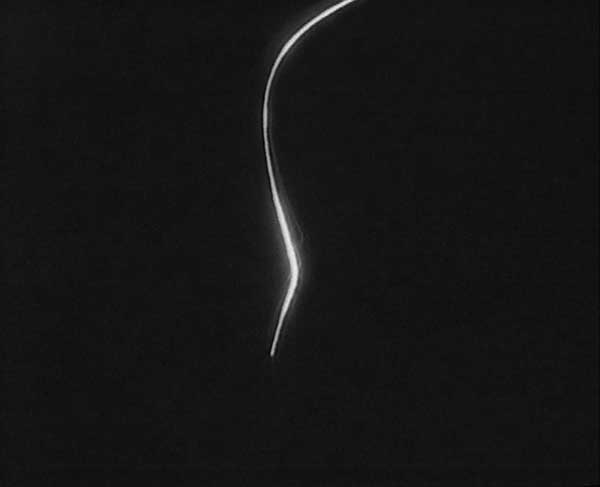
So, what might visual ‘silence’ comprise? If one takes a non-controversial definition of silence as ‘absence of sound’, the ocular equivalent might be defined as the absence of light – in other words, darkness, or black. In the film/video domain I have found this to be a workable assumption (albeit, with video, impossible to fully achieve). Amongst my visual music works will be found several instances of video sequences that are entirely black, where the audience is encouraged to focus solely on what they are hearing – an example is the last section of Songlines (1994). An area I find particularly interesting to explore involves material where the majority of the frame is black – in the language employed in my discussion on silence above, one might call this ‘tending-towards-black’. An example of this is the opening section of Zoetrope, in which a generally black video field is only momentarily interrupted by brief and partial illumination, produced by a series of electrical sparks (figure 1; Movie example 1).
Still from Zoetrope (Hyde 1998)

My early visual music works, such as those mentioned above, were created without a broad acquaintance with the visual music repertoire. In subsequently immersing myself in this field, and embarking on a long process of discovery in terms of the rich variety of work preceding my own, I have found this model to be extremely prevalent. Many early abstract cinema works in particular appear to employ a very particular visual language, which might be characterised as comprising a black background with a foreground made up of discrete and generally small (in relation to the size of the frame) abstract white figures. An obvious example of this type of work is the Oskar Fischinger Studies, but alongside these works we might also include much of the work of Walther Ruttman, Hans Richter and Viking Eggeling.
These works predate the widespread use of colour processes such as Gasparcolor and Technicolor (although Oskar Fischinger was a notable early proponent of the former), but still the full range of greyscale tonalities was available to these filmmakers. It is interesting to note how many of the works made by these artists during this period limit themselves to purely black and white. There is some evidence that this was not a matter of technical limitations, but rather of deliberate aesthetic choice: Hans Richter spoke of his influence from the Suprematism of Kasimir Malevich and others (Richter Reference Richter1952: 269), in which colours were often limited to black and white (so-called Monochrome Suprematism) and form to basic primitives such as the circle and (in particular) the square. Malevich himself painted White on White, a purely white canvas, in 1918, more than thirty years before the more famous white paintings of Robert Rauschenberg.
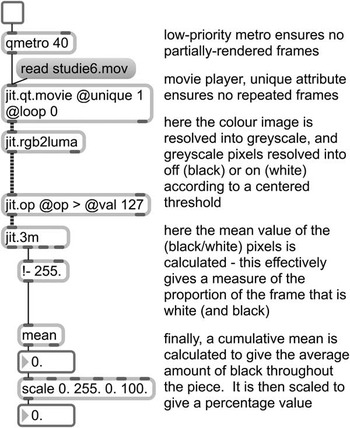
I have constructed a simple test to examine the role of black (or, arguably, visual silence) in one of these films. In the Max patch shown in figure 2, a quicktime video of Oskar Fischinger's Studie No. 6 is subjected to the following processes: firstly the video is constrained to the greyscale colourspace. Secondly, the pixels are divided according to a threshold halfway across the greyscale domain, and in light of this are set to pure black (off) or pure white (on). The mean brightness of each frame of video is then calculated – this is equivalent to the proportion of the frame which consists of black pixels. The average for this value is then found for the entire piece. With this straightforward process we can ascertain that over the course of its duration Studio No. 6 averages 97.22 per cent black.Footnote 2
Max patch to calculate the cumulative proportion of black in image

I would be the first to acknowledge that my equating of silence with black is somewhat simplistic. It does have some basis in the realm of projected light/sound (in which both equate to ‘nothing’), but in the realm of pigmented colour one might argue that silence should be equated with white. In perceptual terms, I would argue that this is actually irrelevant. What one is really considering here is the concept, derived from painting, of ground, and it is ground (whatever that might be) I would posit as equivalent to silence. The significance of the result pertaining to the Fischinger study above is not that most of the pixels are black, but rather that most of the pixels are the same. It is this this aspect of self-similarity which makes it appropriate to suggest that this work ‘tends towards silence’.
4.2. Visual noise
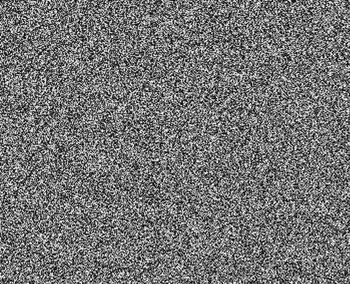
What is the visual equivalent of white noise? The answer might appear to be self-evident: that the visual equivalent of white noise is white light. In both cases, equal amounts of all frequencies (of sound or light) are, at least in theory, present. However, when one considers the spatial and temporal qualities of painting, video or film (the primary mediums of visual music considered here), one has to consider a more complex response to this question. To produce white noise, one would use a random audio signal. What is produced by such a signal is a sound which has statistically equal amounts of all frequencies. If one applies the same principal to a video signal, one would arrive at a situation where each pixel is of random brightness (and colour, if colour video is being used), as seen in figure 3. This is something we might recognise as ‘video snow’.
A video frame made up of random-intensity pixels

Again, the statistical result is evenly distributed throughout the frequency domain, but the pixels are not all the same, and they are certainly not all white. Following the argument outlined above describing visual silence as having high self-similarity, it seems logical that visual noise would exhibit the opposite attribute in having low self-similarity (or high difference). This can be seen as a spatial phenomenon – in any given frame, the pixels will exhibit a maximum amount of difference. It can also be seen as a temporal phenomenon – if one were to look at any given pixel over time, it would also exhibit a maximum amount of difference. These aspects – spatial and temporal – can be considered separately or together.
An artist whose (mature) work might be described as ‘noisy’ in these terms is Jackson Pollock – his paintings can be described as having a high degree of spatial difference, with minimum self-similarity across the spatial field. Pollock is not often cited as a visual music artist – his work has no overt musical allusions either in the work itself or – generally speaking – in the titles of his paintings (unlike, say, Kandinsky or Klee). However, his work arguably has many attributes in common with early visual music practice, and he was associated with many of the pioneers of the field – William Moritz mentions him no fewer than twelve times in his paper ‘Visual Music and Film-as-an-Art Before 1950’ (Moritz Reference Moritz1996). It is also worth noting that Pollock's teacher, Frederick Schwankovsky, was a proponent of synaesthetic colour theories in a similar vein to those of Kandinsky. I therefore feel his work is useful to mention here. His paintings are often associated with chaos (although one of his favourite maxims was ‘No Chaos, Damn It!’) and indeed, controversially, with fractal organisation, through the work of physicist Richard Taylor (Taylor, Micolich and Jonas Reference Taylor, Micolich and Jonas1999). Whether or not either chaos or fractal qualities are indeed present, the quality of high spatial difference in his paintings posited here seems very much to facilitate visual suspension.
To consider temporal difference as a compositional parameter we might turn to the work of Stan Brakhage, an artists whose phenomenological ideas seem to include something close to visual suspension:
Imagine an eye unruled by man-made laws of perspective, an eye unprejudiced by compositional logic, an eye which does not respond to the name of everything but which must know each object encountered in life through an adventure in perception … Imagine a world alive with incomprehensible objects and shimmering with an endless variety of movement and innumerable gradations of color. Imagine a world before the ‘beginning was the word.’ (Brakhage Reference Brakhage2001: 12)
Brakhage's work – the result of an extremely prolific working life – is particularly varied in terms of technique, aesthetic and creative aims. Here we will consider only one area of his practice – his direct animation Footnote 3 works, in which material was generated by interacting directly with the celluloid of (usually) 16 mm film using techniques related to those employed in the ‘direct sound’ works mentioned earlier. These particular works, although generally silent, are often included as part of the visual music canon (they are not the only silent works denoted as such, famous examples being Fischinger's Radio Dynamics and Eggeling's aforementioned Symphonie Diagonale).
Taking one of these films, Mothlight (1963) as an example, I have constructed a similar test to the one described above in relation to the Fischinger study. In this instance, the test is slightly more complex – what we are looking for in this case is for pixels which have changed from one frame to the next. This is a well-known processFootnote 4 – usually known as movement sensing, it is often used within the realm of interaction design as a simple way of detecting movement using a video camera. Here we are employing it as a measure of temporal dissimilarity.
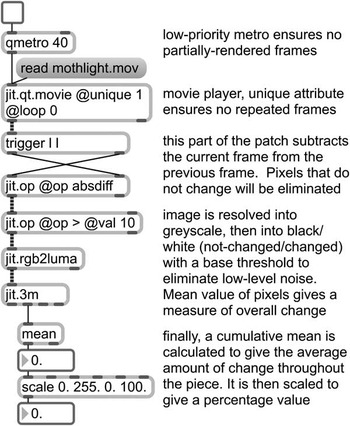
Figure 4 shows another Max patch. Here, a quicktime video of the Brakhage film is subjected to the following processes: each frame is effectively ‘subtracted’ from the one that precedes it (actually, what is calculated here is the absolute difference between the two frames). This is a pixel-by-pixel process, so for each pixel the absolute difference between the values representing red, green and blue for that pixel is calculated. In the resultant image, brighter pixels will indicate more change, or more temporal difference (black pixels will indicate no change). This image is resolved to the greyscale colourspace, and then to binary black (off) or white (on) – pixels will therefore be denoted as having changed (white) or not (black), using a base threshold to eliminate any spurious low-level noise. A calculation of average brightness gives the proportion of pixels that are deemed to have changed, and, finally, a cumulative mean for this value is taken over the duration of the piece.
Max patch to calculate cumulative temporal difference

This test arrives at a figure for average temporal dissimilarity in Mothlight of 62.54 per cent.Footnote 5 By contrast, the average temporal dissimilarity displayed by a piece of randomly chosen BBC TV programming was 9.61 per cent – actually, throughout most such material the temporal difference is generally considerably lower, but the cumulative average is somewhat skewed by the presence of cut edits, which effectively represent ‘spikes’ of 100 per cent temporal change. However, even with this taken into account, the average in the Brakhage material is considerably higher.
This result is somewhat to be expected in the case of direct animation, and it is perhaps no coincidence that this technique is prevalent within the visual music canon – Harry Smith, Hy Hirsh, Len Lye and Norman McLaren all made extensive use of this technique. It should also be noted that many visual music works not based on direct animation display a similar level of temporal complexity/change – another technique which tends to yield levels which are as high, or higher, is the use of particle systems, but many other types of complex abstract animation have this property.
It can also be found in camera-sourced material: many examples of this can be found in my work Vanishing Point (2010), which is intended largely as an exploration of visual (and sonic) noise. Video snow (also featured in Zoetrope) is used as the direct equivalent of the audio static used throughout the piece, and many other types of material – from many different sources – are used which exhibit similar properties of spatial and temporal difference (figure 5; Movie example 2).
Still from Vanishing Point (Hyde 2010)

5. Conclusion
I believe that silence and noise, or tending-towards-silence and tending-towards noise, represent particularly fertile creative ground across visual and sonic media within visual music practice. These ‘types’ occupy a territory somewhere between the self-evident ‘common ground’ identified above (relating to the structuring of time in time-based media) and the phenomenologically contestable equivalence sometimes claimed between pitch and colour (which, whilst it might have real significance for genuine synaesthetes, seems to have no perceptual universality). They have demonstrable physical and phenomenological qualities in common – of particular interest to the visual music artist, I believe, is their propensity to enable a state close to reduced listening and the ocular equivalent I propose here, visual suspension. As discussed, I believe neither action (for they are actions, rather than states) to be entirely possible. I am reminded of the hopeless task of Frenhofer, the fictional artist in Balzac's 1837 short story The Unknown Masterpiece. Frenhofer, a character who both Picasso and Cezanne expressed close identification with, is:
a painter who wants to express life through the use of color alone and who keeps his masterpiece hidden. When Frenhofer dies, his friends find nothing but a chaos of colors and elusive lines … (Merleau-Ponty Reference Merleau-Ponty1948: 18)
Whilst striving towards reduced listening and visual suspension might be an ultimately futile aim, I believe that doing so takes us outside of the established phenomenological frameworks of music, art and cinema into unfamiliar territories in which new kinds of audiovisual associations can be forged.
Supplementary material
To view supplementary material for this article, please visit http://dx.doi.org/10.1017/S1355771812000106