Scholars have focused a good deal of attention on why and how interest groups become involved in the policymaking process. Despite substantial literature that highlights the usefulness of interest groups in the policymaking and monitoring process, there is only a small subset of work devoted to the question of venue choice – that is, when interest groups will choose to contact one actor (e.g., the bureaucracy) rather than another (e.g., the legislature) in parliamentary democracies.
In this paper, we address the venue choice question and do so from a different perspective from previous work on the topic. The literature on venue choice and lobbying strategies in general tends to focus on the characteristics of interest groups themselves and the degree to which the groups share preferences with those that they seek to lobby. However, this gives insufficient attention to the state of the venues that the groups may consider lobbying. For example, it ignores the question of just how solid is the grip on the reins of the policymaking process of those that groups are considering lobbying. Presumably, central to interest groups’ lobbying and venue choice calculi is their assessment of the likelihood that politicians currently in power will continue to be in the near future, and thus whether those they are lobbying are likely to be responsive to the interest groups’ claims and, if so, how credible their commitments are. In contrast to the focus on the alignment of preferences or interest group characteristics, there has been almost no attention paid to the government side of the equation in evaluating interest group–government relations (specifically, whom interest groups decide to contact in their lobbying efforts).
We examine this question within a parliamentary setting, where there is the possibility of substantial government instability. We briefly survey the literature to show that this question of the effects of governmental stability on interest group venue choice is unexplored, but consequential for extant scholarship. Further, the effect of government stability on lobbying venues remains quite ambivalent – stability and instability can each be theoretically argued to have contradictory results, necessitating empirical testing to resolve this confusion.
The question of venue choice – bureaucrat versus politician – also finds resonance in, and may have theoretical consequences for, the principal-agent literature. Since the 1980s, many analyses have emphasized ‘fire alarms’ – interest groups contacting politicians with information about the implementation of policies and the behavior of bureaucrats – as a tool through which politicians are able gain leverage over the bureaucracy and maintain control over policy (see, e.g., Kiewiet and McCubbins, Reference Kiewiet and McCubbins1991). However, additional analysis has suggested that, because bureaucrats in the first place tend to be closer to policy, and especially policy implementation, interest groups may instead choose to set off a ‘smoke detector’ – contacting bureaucrats directly (Brehm and Gates, Reference Brehm and Gates1997). Thus, interest groups act instrumentally to further their own goals in policy, but in so doing may either aid politician principals in monitoring their bureaucratic agents, or alternatively, attempt to gain their ends directly through those agents themselves. An important theoretical and practical question therefore is: what determines whether interest groups will be more likely to contact politicians or bureaucrats?
Of course, expectations about the degree to which a particular politician supports the interest group's position may also shape strategies interest groups craft about whom they are more likely to contact. Scholars have variously argued that interest groups adopt strategies of seeking out allied, opposing, or fence-sitting legislators. If interest groups’ strategies are shaped by expectations of support, they could plausibly also be shaped by expectations of who may be in power in the near future. This may well be a major component of any interest group's rational planning for where to lobby. We suspect that, with respect to the venue choice decision, government stability affects these different groups’ calculus differently as well. From these considerations, we derive a series of competing hypotheses about the impact of governmental stability on the choice of interest groups’ venues.
Drawing from a unique set of surveys of interest groups in Japan, we test these hypotheses with a heteroskedastic probit analysis of interest groups’ propensity to contact politicians and bureaucrats there. Making the data even more useful is the fact that the surveys were conducted during three very different political contexts in Japan: one in which ruling party control of the government was secure, one in which there was great uncertainty about control of the government, and one period of moderate uncertainty.
The results of the analysis suggest that when it was unclear if the party (or parties) controlling the government would maintain power in the near future, interest groups were more likely to contact the bureaucracy. When it was believed that the party in power would retain control for a considerable period, interest groups were more inclined to contact politicians. Moreover, during times of government uncertainty, supporters of the governing party (or parties) were more likely to contact legislators, and opponents of the party were much more likely to contact members of the bureaucracy. In short, venue choice under government uncertainty appeared to encourage interest groups to focus on contacting their allies.
Lobbying, fire alarms, and smoke detectors: literature logic
The most prominent literature on interest group contacts of the government focuses on explaining when groups are most likely to contact members of the legislature to advance their interests by persuading representatives to sponsor, vote for, or vote against a bill. In particular, the literature concentrates on whether groups contact allies, opponents, or fence-sitters for these purposes. Contrary to the long-held view (e.g., Milbrath, Reference Milbrath1963) that interest groups tend to lobby legislators who agree with them, Austen-Smith and Wright (Reference Austen-Smith and Wright1994, Reference Austen-Smith and Wright1996) offer a compelling theory and evidence for the idea that interest groups spend much of their time involved in ‘counteractive’ lobbying: Interest groups attempt to change the positions of legislators aligned against them who might be willing to change their stances, and groups aligned with those legislators lobby to counteract their rivals. Countering this view, scholars such as Baumgartner and Leech (Reference Baumgartner and Leech1996) maintain that groups tend to focus on their legislative allies.
On top of lobbying, there are also other important and broader political functions that interest groups perform by contacting government officials. Moe (Reference Moe and Williamson1990a) points to interest groups as the driving force in policymaking. Interest groups and their relationship to governmental actors are critical to the process, in large part through the information and direction they provide to politicians. Without indicating where information comes from, any description of policy change lacks a mechanism. By pointing out the important role interest groups play in providing information to political principals, Bendor and Moe (Reference Bendor and Moe1985) demonstrate the external feedback mechanism necessary for politicians to influence bureaucratic agents. Without information from interest groups, it would be difficult for political principals (politicians) to judge the behavior of their agents (bureaucrats) and the efficacy of their agents’ actions.
Most commonly cited in the literature on the US Congress, interest groups provide information or express complaints by pulling fire alarms (Lupia and McCubbins, Reference Lupia and McCubbins1994; McCubbins and Schwartz, Reference McCubbins, Schwartz, McCubbins and Sullivan1987; McCubbins et al., Reference McCubbins, Noll and Weingast1987). As McCubbins and Schwartz explain, upon enacting legislation the legislature does not typically examine a sample of administrative decisions, looking for violations. Such behavior (‘police patrols’) would simply be too time-consuming. Rather, the legislature ‘establishes a system of rules, procedures, and informal practices that enable individual citizens and organized interest groups to examine administrative decisions (sometimes in prospect), to charge executive agencies with violating congressional goals, and to seek remedies from agencies, courts, and Congress itself’ (McCubbins and Schwartz, Reference McCubbins, Schwartz, McCubbins and Sullivan1987: 427).
The fire alarm literature makes a compelling case for how politicians can retain control over their bureaucratic agents. At the same time, Brehm and Gates (Reference Brehm and Gates1997) note that in many cases, interest groups are more likely to go directly to the policy implementer and therefore provide ‘smoke detectors’, providing information or bringing their complaints directly to the bureaucratic agency rather than politicians. Interest group contacts can be extremely beneficial to bureaucrats as well; without information from interest groups, it can be difficult for bureaucrats to judge the efficacy of their own actions.
In short, the literature notes the presence of both fire alarms and smoke detectors, but when is one more likely than the other? This question derived from this literature raises the point that groups do not merely choose their governmental targets from the set of legislators in front of them; they also face a choice of whether to focus their efforts on a bureaucratic agency or member of the legislature. Nevertheless, very little scholarly attention has been given to this choice. As Holyoke (Reference Holyoke2003: 325) points out, ‘Too often the choice to lobby in a particular venue has been treated by scholars as a given rather than a strategic choice’ (see also Naoi and Krauss, Reference Naoi and Krauss2009).
Much of the focus of the small number of studies that address this problem is similar to the focus of studies on lobbying the legislature-do groups tend to choose venues controlled by allies, opponents or fence-sitters? And on this question there is significant disagreement between the main studies. Based in part on the assumption that interest groups will be more inclined to use their costly resources to lobby allies, Boehmke et al. (Reference Boehmke, Gailmard and Patty2005) are able to develop a convincing formal model about legislators’ willingness to grant discretion to agencies that are ideologically distant from them in an effort to gain greater information; and the authors use this model to make a compelling case for US congressional policy with respect to the Federal Trade Commission. Waltenburg's (Reference Waltenburg2002) analysis of the choice of venue (legislature, agency or courts) made by organized labor indicates that US unions in the twentieth century typically lobbied venues their allies controlled and avoided those dominated by those likely to oppose them echoes Muramatsu et al.'s finding that Japanese interest groups preferred to contact allies (Reference Muramatsu, Ito and Tsujinaka1986: 196).Footnote 1
Another possibility is that contacts may vary by issue area. For example labor groups might contact politicians but agriculture lobby bureaucrats in Japan. However, Naoi and Krauss (Reference Naoi and Krauss2009: 883) find that there is no substantial differences between labor and agriculture's contact scores with politicians, although the political parties each contacts varies. That is, groups tend to contact parties that they support politically. In Japan, labor tends to contact opposition parties more, agriculture contacts the LDP, and so on.
In contrast, Greene and Heberlig's (Reference Greene and Heberlig2002) quantitative analysis of a wide array of US interest groups suggests that venue choice is counteractive – a la Austen-Smith and Wright – and they argue, moreover, that such counteractive behavior should be especially common for groups that are ‘politically sensitive’: certain groups’ interests are more likely to be harmed by a change in partisan control within the government and such groups will be especially likely therefore to lobby agencies and politicians affected by a shift in political control.
This analysis raises the importance of partisan control, but does not consider a factor about which groups might be even more sensitive: the extent of government stability and ‘the shadow of the future’; that is, especially when it relates to the choice of venue, it does not merely matter who is in power in the legislature, but in fact how confident you are that they will remain in control and therefore how credible their commitments are. How do interest groups behave under conditions of likely continued stability and under likely political instability or change?
The importance of governmental stability: logic and hypotheses
The question of which venue interest groups select in order to advance their interests through lobbying or express dissatisfaction through fire alarms or smoke detectors is important. Unfortunately, the answer is complicated. There is good reason to assume that government instability can lead interest groups to choose either venue for either purpose, leading us below to offer alternative, contradictory hypotheses to test these questions.
First, most obviously in a parliamentary setting, government stability may affect interest group behavior in two key ways. Where a given party's hold on the government is uncertain, interest groups may question incumbent politicians’ ability to maintain control over policies of interest to them in the future. As a result, interest groups who wish to impact policymaking and implementation will have less reason to believe that contacting members of the government will be useful, and will have much greater incentive to contact the bureaucracy directly. The intuition here is that bureaucrats will be likely to maintain their position of influence irrespective of the events that follow in the political world. In other words, politicians’ potential inability to make credible commitments beyond the present may lead interest groups to ‘hedge’ by going instead to bureaucrats.
Second, government stability also affects interest group behavior more indirectly by impacting the degree of cooperation between politicians and bureaucrats. Much of the classic work on principal-agent relations in politics emphasizes the competitive side to the politician-bureaucrat relationship, explaining either how bureaucrats can wield power over politicians (e.g., Niskanen, Reference Niskanen1971) or how politicians can use institutional arrangements to influence the behavior of bureaucrats (e.g., Kiewiet and McCubbins, Reference Kiewiet and McCubbins1991). In reality, though, a simple dichotomy does not usually exist in policymaking. For example, as Huber and Shipan point out, ‘appointment powers, budget authority, monitoring mechanism, and . . . the design of legislation itself provide political actors with considerable opportunities to treat bureaucrats as allies rather than as foes in the policymaking process’ (2002: 42).
Moe's (Reference Moe, Chubb and Peterson1989, Reference Moe and Williamson1990a, Reference Moe1990b) ‘structural politics’ analysis suggests that political uncertainty dramatically impacts the relationship between politicians and bureaucrats, with politicians writing much more detailed and constraining legislation during times of uncertainty. De Figueiredo (Reference de Figueiredo2002) modifies Moe's conceptualization, emphasizing the importance of electoral strength, rather than uncertainty. Government (cabinet) stability falls under both headings, with parties that maintain solid control of the government working from a position of greater electoral strength and political certainty than those in an unstable government. Among parliamentary systems, legislation that constrains the actions of bureaucratic agents is most likely when there are coalition or minority governments – that is, those controlling legislation today are uncertain about their ability to maintain their dominant position in the future (Huber and Shipan, Reference Huber and Shipan2002; Moe and Caldwell, Reference Moe and Caldwell1994).Footnote 2
In contrast, greater government stability may promote closer ties between politicians and bureaucrats. With greater opportunity to correct problems in the future, the structural politics framework suggests that politicians in control of a stable government are more likely to grant substantial discretion to bureaucrats, especially when there is relatively little policy disagreement between the two groups (Huber and Shipan, Reference Huber and Shipan2002). In turn, with less detail mandated by legislation itself, politicians and bureaucrats necessarily must work together, making cooperation more likely. Thus, cooperation between politicians and bureaucrats can be greater during times of government stability. As Huber and Lupia point out, among the most likely problems growing out of government instability is that bureaucrats who are supportive of the government will not do so, out of fear of having to then undo the work if the incumbent is replaced. Such issues are far less likely to exist under conditions of stability. Indeed, Kato (Reference Kato, Loewenberg, Squire and Kiewiet2002) indicates how a longtime stable government context can promote a positive-sum relationship, founded on close cooperation between politicians and bureaucrats, which in turn leads to the two groups developing more similar preferences about policy.
On the other hand, one can also make the opposite case – instability would lead to greater lobbying of politicians rather than bureaucrats. First, as Huber and Lupia (Reference Huber and Lupia2001) demonstrate, government instability can lead to greater conflict between politicians and bureaucrats, but will not necessarily do so. They further suggest that one of the greatest problems of instability for politicians is that it can harm politicians most among bureaucrats whose true preferences ought to lead to support for the sitting government. Bureaucrats also see ‘the shadow of the future’ and may adjust their behavior accordingly by becoming more conservative and unlikely to act, which makes lobbying them less useful to an interest group than trying to gain as much from the incumbent politicians as they can before they might lose power.
Further, the logic of the ‘fire alarm’ and ‘smoke detector’ literature can lead us to assume that a ‘fire alarm’ strategy of complaining to politicians about actions of bureaucrats that threaten the interests of the pressure group may be more likely to occur when government is seen as less stable: if bureaucrats become less willing to serve the goals of the currently incumbent party knowing, they may be out of power tomorrow, interest groups might be likely to more frequently complain to, and share information with, politicians.
Thus, we can come up with two competing and contradictory hypotheses about the effect of government instability on interest group behavior:
Hypothesis 1a: Interest groups will be less likely to contact politicians (and more likely to contact bureaucrats) when control over the government is less stable.
Hypothesis 1b: Interest groups will be less likely to contact bureaucrats (and more likely to contact politicians) when control over the government is less stable.
Any analysis of venue choice should also take into account the extent to which interest groups have developed strong ties to the current incumbent party and how these may be affected by governmental instability. In the context of government stability and cooperation between politicians and bureaucrats, interest groups have incentives to contact either venue. To be sure, where substantial discretion is delegated to bureaucrats, interest groups have strong incentives to directly contact bureaucrats, because it is the bureaucracy that works most closely with policies. But such government stability also suggests that the party has controlled the government for a relatively lengthy period, allowing it to develop extensive ties with many interest groups. As Moe and Caldwell note, ‘Parties and groups, as ongoing organizations, transact with one another again and again over time. All stand to benefit from informal norms and strategies of cooperation. . .that protect political deals from subversion’ (1994: 180).
In contrast, during times of greater government instability and competition between politicians and bureaucrats, the choice to contact one government actor or the other may be more dependent upon the extent to which the interest group is close to and supports the ruling party (or parties). But, we suggest here that with regard to interest groups, the greatest problem of instability relates to those who do not support the party. The competitive relationship between politicians and bureaucrats ought to force interest groups to make a clear choice between the two groups. Given the instability of the government, there is no reason for those unsupportive of the unstable government to spend precious resources on contacting politicians who could be out of power tomorrow. For this reason, in making the decision to contact bureaucrats or politicians in a context of government instability, we expect interest groups to be more likely to contact politicians when they are allies. Among those who support the party, there is generally a greater probability of contacting politicians, and among those who do not support the party, interest groups should be less likely to contact politicians. For this reason, these patterns may be especially true during times of instability (and with the decreased probability of groups contacting politician ‘enemies’ during times of instability).
But, here too, there is reason to believe that instability might have the opposite effect; that is, as government instability increases, formerly close allies of the current ruling party (or parties) might decide to hedge their bets and distance themselves from the incumbents, and try to advance their interests through the bureaucracy until the future becomes clearer. Meanwhile, those who did not have close ties to the incumbent government of course would continue working through bureaucrats while waiting for their favored party to take power. This would be particularly the case if bureaucrats themselves became more ‘neutral’ or even opposed to the current government. The fire alarm and smoke detector logic can lead in the same direction: in times of instability, even allies of the current party may choose to complain less to it and more directly to the bureaucracy; interest groups without close ties to the government can be expected to do so even more.
Once again, therefore, we can come up with two alternative and mutually exclusive, but equally logical hypotheses:
Hypothesis 2a: During times of government instability, there will be a larger difference (than during times of stability) in the frequency of contacting politicians (rather than bureaucrats) by interest groups that do and do not support parties in the government.
Hypothesis 2b: During times of government instability, there will be a smaller difference (than during times of stability) in the frequency of contacting politicians (rather than bureaucrats) by interest groups that do and do not support parties in the government.
Data from Japan
We use a unique set of surveys to test our hypotheses. The data are drawn from surveys conducted with leading representatives of major interest groups in Japan. Michio Muramatsu and associates conducted a series of detailed surveys with Japanese national politicians, bureaucrats, and interest groups. The surveys query interest groups’ top leaders on numerous features of their organization, including their opinions about political parties and the administrative bureaucracy and their relationship with governmental bodies. Respondents range from very high-ranking members of each group to relative neophytes. Perhaps most unusual, the surveys with each group had been conducted roughly once a decade starting in 1976. The data set contains these surveys for interest groups in 1979 (252 respondents), 1994 (247), and 2003–04 (222), thus providing us with a rare set of longitudinal data to test our hypotheses.
The timing of the surveys is particularly useful in helping us to test our conceptual framework here. Perhaps the defining feature of postwar Japanese politics was the longtime state of single party dominance (ruling 1955–93 and 1994–2009). The Liberal Democratic Party (LDP) dominated Japanese politics 1955–93, with little serious threat to its control of the government. The close relationship between the LDP and bureaucracy was a major feature of this period (Amyx, Reference Amyx2004; Okimoto, Reference Okimoto1989). Although admittedly not the height of LDP dominance, the year of the first survey (1979) rests solidly within the period of the LDP's control of the government and is close to its height in the early to mid-1980s. To be sure, during the Ohira Administration in 1979 there was significant upheaval within the legislature surrounding the leadership of the government, a result of the increase in the 1970s in the electoral strength of opposition parties and intra-LDP battles. However, at no point was there a serious threat to the party's likelihood of staying in power. At worst, the LDP would have had to form a coalition government, and indeed just a year later the LDP won a landslide victory and controlled the government for another 13 years.
The events of the 1990s and early 2000s were quite different. The second survey (1994) was conducted during the greatest period of government instability since the LDP was formed in 1955. In 1993, the LDP lost power when defectors from the party created two new conservative parties that split off from the LDP. After new elections were held, the new parties, along with the entire non-Communist opposition, created the Hosokawa coalition government, which excluded the LDP. As a result, 1994 witnessed three wholly different cabinets. We drop the two non-LDP cabinets of the three from the analysis to simplify the analysis and to stay consistent with the same party in power – we are able to distinguish between respondents according to which of the three 1994 cabinets existed at the time that they participated in the survey – and concentrate for comparison on the last of the three, the cabinet in which the LDP was once more dominant.
When the LDP returned to power as part of the Murayama government in 1994, a new dynamic existed between the party and the bureaucracy. Although Tomiichi Murayama was the head of the Japan Socialist Party (JSP), almost all the cabinet members were from the LDP and most observers (and voters) saw the government as an LDP government dressed-up with a figurehead Prime Minister from the erstwhile opposition. During the interregnum, however, in a surprise to the LDP, the Japanese bureaucratic ministries served their new masters, the anti-LDP coalition, and kept the longtime ruling party at arms length. As a result, when the LDP returned to power in 1994, there were bitter feelings between the LDP and bureaucracy. In addition, despite its return to power as the major part of a coalition government, the LDP faced substantial electoral uncertainty. Not surprising, with greater information emerging about the poor state of Japan's banking system, the LDP used the Ministry of Finance (the leader of Japan's bureaucracy) as the scapegoat. In our data set, we have 39 respondents who participated in the survey during the Murayama administration.
The third survey (2003–04) was conducted during the Koizumi administration, after the LDP was more firmly back in power, having now controlled the government for an additional ten uninterrupted years since 1994.
Quantitative analysis
We use as the dependent variable the responses to the question ‘When your group wishes to make a claim or protect their rights, opinions, and profits, which out of the following do you believe to be the most effective in approaching: political parties (or assemblies) or the administrative bureaucracy?’ Respondents were asked to list which was ‘most important’ and which ‘number 2’. We code the dependent variable based on the answer to which was ‘most important’, as groups will undoubtedly put their greatest effort into contacting the actors they find most effective. Answers to additional questions on the surveys indicate that those who responded that the bureaucracy was the most important tended to contact bureaucrats (such as section chiefs – kacho) more frequently than those who responded that politicians were the most important. For this reason, we expect responses to the question of who is most effective to represent whom interest groups will in fact approach when needing help from the government. We code the variable 1 for those who approach parties and 0 for those who approach the administrative bureaucracy.
Model specification
In order to test the relative impact of cabinet instability on the probability of approaching politicians rather than bureaucrats, our first set of hypotheses, we use the different cabinet periods as proxy measures and therefore pool the three surveys into a single data set. When pooling data in this way, it is important to control for possible unobserved time-specific factors affecting survey responses. Unfortunately, because of the small number of surveys/time periods in the data, we cannot use most standard approaches (such as clustering) to correct the standard errors. One approach to handling this problem of lack of independence is to use a multi-level model. But, with only three time periods in the data, this approach does not offer much help here.
Instead, we use a heteroskedastic probit model.Footnote 3 Because the surveys are conducted at different times, it is possible that heteroskedasticity will be present, with systematic differences between responses (and, hence, variance in the model's error) from one survey to the next. If so, the estimates drawn from a standard probit model here will be inconsistent (Greene, Reference Greene1993). However, by running a heteroskedastic model, we address this problem by directly taking into account and modeling the likely heterogeneity (see, e.g., Alvarez and Brehm, Reference Alvarez and Brehm1995). Heterogeneous choice models like heteroskedastic probit are a prominent and useful approach (see, e.g., Alvarez and Brehm, Reference Alvarez and Brehm1995, Reference Alvarez and Brehm1997, Reference Alvarez and Brehm1998, Reference Alvarez and Brehm2002) to problems of this kind.
We should note that Keele and Park (ND) raise concerns with the standard heteroskedastic probit model, arguing that such models tend to be tenuously identified. For this reason, some scholars recommend using a more ‘robust’ estimation method such as RGENOUD. We therefore also run all of our models using RGENOUD and find absolutely no change in our results.
Heteroskedastic probit models are made up of a choice model and a variance model. Our main concern here is the choice model, which estimates the relationship between our explanatory variables and the probability of contacting the bureaucracy or politicians. For this reason, in the main text of the paper, we only discuss the choice model. We discuss the variance model in an appendix.
Operationalization
We create a 0–1 dummy variable for each of the three LDP cabinets in our data: Ohira (1979), Murayama (1994), and Koizumi (2003–04). Again, the Ohira cabinet was during the LDP's longtime run of dominance and was a period of intraparty instability, but with no danger of the LDP losing power. We should note that the samples for each cabinet period are nearly identical, holding roughly the same proportion of each type of group throughout; that is, surveys in each cabinet period have roughly the same proportion of economics-related groups, agriculture-related groups, and so on.
Testing Hypotheses 1a and 1b – that is, whether interest groups will be less or more likely to contact politicians during times of government instability – is straightforward: we use the coefficient estimates from the heteroskedastic model results to generate predicted probabilities of contacting politicians or bureaucrats. The government appeared least stable during the period in which the LDP joined its longtime nemesis, the Socialist Party, in a coalition government (Murayama). In the Murayama government, the LDP and Socialist Party made strange bedfellows, and generated great uncertainty about just what the coalition stood for and the coalition's ability to stay together. If Hypothesis 1a is correct, interest groups would have been less likely to contact politicians during the Murayama Administration.
Presumably, uncertainty surrounding the stability of the LDP government had declined substantially after the LDP had been back in power for roughly a decade, but it was still probably higher than during the era of longtime LDP dominance that had come prior to 1993. Most notably, the 2000 and 2003 elections saw the consolidation of the opposition into a single centrist party, the Democratic Party of Japan (DPJ), which in 2003 had one of the most successful elections ever by a Japanese opposition party.Footnote 4
We also offer in the model a test of Hypotheses 2a and 2b – that is, whether during times of government instability, interest groups that do and do not support parties in the government will have a larger (2a) or smaller (2b) difference in the probability of contacting politicians. In other words, we test whether interest groups supporting the LDP behave differently from groups that don't. We expect that both types of groups will alter their strategies in response to changes in government instability, but the literature supports divergent hypotheses (2a and 2b) as to whether government instability will lead interest groups aligned with the party in power and those not so aligned to behave more similarly or more distinctly.
To test these hypotheses, we first use LDP Support, a variable running from 0 (do not support the LDP) to 4 (extremely high support), to indicate the interest group's support for the LDP. We might expect the coefficient on LDP Support to be positive: compared to groups that do not support government parties, groups that support the LDP should be especially likely to contact politicians if Hypothesis 2a is correct. Next, we create a series of interaction terms between LDP Support and each cabinet. Again, we use the coefficient estimates drawn from the results of the models to generate predicted probabilities of lobbying politicians or bureaucrats. We expect that, relative to the most stable period (Ohira), interest groups supporting and not supporting the LDP behaved more distinctly from each other under uncertain governments (Hypothesis 2a). We expect support for the LDP to have an especially large impact during the Murayama cabinet: if competition between the LDP and bureaucracy were very high, interest groups supportive of the LDP would be even more likely to contact LDP politicians during this time, whereas those who did not support the LDP would be particularly likely to contact the bureaucracy, thus supporting Hypothesis 2a rather than 2b.
We also include a number of control variables:Footnote 5 (1) Trust in Bureaucracy: a variable running from 0 (do not trust the bureaucracy at all) to 4 (extremely high trust in the bureaucracy).Footnote 6 We expect its coefficient to be negative, as more trust in the bureaucracy ought to lead to more contact with the bureaucracy. (2) Group Rep is Diet Member, a dichotomous dummy variable coded 1 when a member of the interest group is currently a representative in Japan's Diet. We expect groups with such a member to be more likely to contact members of the Diet, and so expect a positive coefficient. (3) Amakudari, a dichotomous dummy variable coded 1 for interest groups that offer employment to retired members of the bureaucracy.Footnote 7 We expect groups that provide amakudari landing sites to be more likely to lobby the bureaucracy (negative coefficient). (4) We also control for prominent types of interest groups with three 0–1 dummy variables: agriculture, labor, and economics. Issue area is likely to affect an interest group's choice of whom to contact, so representatives of different types of groups ought to be more or less likely to lobby bureaucrats rather than politicians.Footnote 8
Results
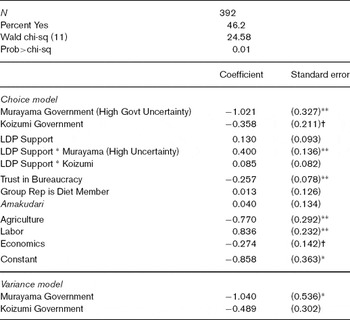
See Table 1 and Figure 1. The coefficient on each of the cabinet variables is negative and statistically significant, with the largest coefficient associated with the Murayama LDP–JSP coalition government. The coefficient on the Koizumi cabinet variable is smaller, but reaches significance at the 0.089 level. Also, all of the LDP Support variables are positive, but only the one interacting with the Murayama cabinet is statistically significant and quite large.
Heteroskedastic probit model of correlates of reporting appealing to politicians (rather than bureaucrats) as effective

Notes: †p < 0.1, *p < 0.05, **p < 0.01.
The dependent variable is generated from answers to the question, ‘When your group wishes to make a claim or protect their rights, opinions, and profits, which out of the following do you believe to be the most effective in approaching: political parties (or assemblies) or the administrative bureaucracy?’
Bureaucracy is coded 0; parties is coded 1.
aBase category for the government variables is the Ohira government (1979), in which there was greater certainty of the LDP remaining in power.
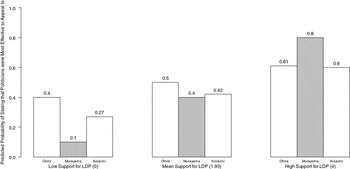
What is the probability of reporting contacting politicians as effective (rather than bureaucrats)? Predicted probabilities based on the heteroskedastic probit results
Note: Shaded bars indicate cabinet of greatest instability.

Nevertheless, given our use of interaction terms, to understand the substantive meaning of the model results we need to generate predicted probabilities – which we present in Figure 1. Derived from the results from Table 1, the figure indicates the probability of a given type of respondent citing politicians as the most effective to appeal to. We break the figure into three types of groupings: those who do not support the LDP (score of 0 on LDP Support), those with the mean level of support for the LDP (score of 1.93), and those with high support for the LDP (score of 4). Within each of these groupings, we break down the probabilities by cabinet period. All other variables are held at their means.
By way of illustration, the figures indicate, first, that the mean respondent during the Ohira administration had a 50% probability of stating that politicians were particularly effective to appeal to (and, hence, a 50% chance of stating that bureaucrats were particularly effective to appeal to). Second, all else equal, the mean respondent and those that did not support the LDP were less likely after 1993 to state that politicians were the most effective to appeal to. Most striking, the mean respondent during the Murayama cabinet had only a 0.4 probability of saying that politicians were most effective to appeal to. This result lends support to Hypothesis 1a that interest groups are less likely to contact politicians when control over government is less stable.
Third, in line with Hypothesis 2a, there are substantial differences from one administration to the next in terms of the impact of LDP Support on the probability of contacting politicians. The lack of statistical significance of the LDP Support variable indicates that the impact of support for the LDP on the probability of contacting politicians rather than bureaucrats is not discernible during the Ohira government. This makes sense as the high level of cooperation between the LDP and bureaucracy during the pre-1993 period should have left interest groups with the sense that an appeal to one (e.g., a politician) was in many ways akin to an appeal to the other (e.g., a bureaucrat). The greatest difference between those with no and high support (70 percentage points) is during the Murayama administration, the period in which competition between the LDP and bureaucracy was at its highest; that is, during the Murayama administration, a time in which competition between politicians and bureaucrats may have been at its hightest, interest groups presumably had a stark choice of contacting either politicians or bureaucrats. Those who did not support the LDP had only a probability of 0.1 of emphasizing contacts with politicians during this period. In contrast, during this period those who strongly supported the LDP had a probability of 0.8 of emphasizing contacts with politicians, the highest probability of any of the administrations.
The LDP Support * Koizumi interaction term is not significant. Combined with the lack of significance of the uninteracted LDP Support variable, this suggests that by the Koizumi administration interest groups perceived that ties between the LDP and bureaucrats had been substantially mended and a shift had occurred away from the competitive relationship back toward a more cooperative one.
Conclusion
Interest groups in parliamentary democracies trying to advance their interests face a major strategic choice of venue: whom should they spend their scarce resources trying to lobby, bureaucrats or politicians? Moreover, the choice they make also has important implications for broader questions of governance. Interest groups clearly can play a critical role in helping politicians maintain a grip on the reins of power over unelected bureaucrats and, therefore, are essential to the functioning of democratic controls over policymaking. That said, the ability of politicians to use the information available to interest groups is dependent upon groups actually contacting them.
To this point, the literature highlighting the existence and importance of interest group contacts remains underdeveloped on the question of when groups will contact politicians rather than bureaucrats. This paper first developed a number of insights into this problem, including deriving exactly contrary but logical hypotheses on how interest groups might react to stable or unstable political contexts. Using a unique longitudinal data set of interest groups in Japan, we then tested three pairs of mutually exclusive hypotheses, and found significant limits on the probability of interest groups’ contacting politicians.
Our evidence suggests, first, that government instability is central to interest groups’ decisions to contact one governmental actor rather than the other. In particular, we find that during times of government instability Japanese interest groups report contacting bureaucrats as more effective. Second, our analysis suggests that instability can also promote a competitive relationship between politicians and bureaucrats, which in turn leads to a significant divide between the types of interest groups that contact each. Far more than during times of government stability, during times of instability those Japanese interest groups not supporting the ruling party saw the bureaucracy as the more effective venue for contact efforts, while those who supported the governing party tended to favor politicians.
One of our most important points here is about the dynamic nature of interest group–government relations and the policymaking process. Most analyses of interest group–government patterns (and politician–bureaucrat relations) tend to have a fairly static component (see Kato, Reference Kato, Loewenberg, Squire and Kiewiet2002, for an exception). This has especially been the case for work on Japan, where it is common for scholars to point to the bureaucracy-dominant frameworks of scholars such as Johnson (Reference Johnson1982) or Pempel (Reference Pempel1974) or legislature-dominant models by Ramseyer and Rosenbluth (Reference Ramseyer and Rosenbluth1993) to make broad-brush generalizations about policymaking in Japan. But it is also the case for work on the US context where scholars are quick to cite work by scholars such as Niskanen (Reference Niskanen1971) or Kiewiet and McCubbins (Reference Kiewiet and McCubbins1991) to make generalizations about policymaking in the US as well. But we find a highly dynamic process and our analysis suggests that the relationships and patterns change over time in systematic ways. Most particularly, as we find in our analysis, interest group patterns of contact may vary in patterned ways as crucial elements of the political context change.
Of course, significant questions remain and future research would do well to consider these. First, to what extent does venue choice depend as well on exactly what interest groups are trying to get out of their contacts with government officials? In some cases, groups will simply push for a change in law or to block a harmful law. In other cases, groups will contact the government when policy implementation violates the law. In still others, groups will be unhappy with the way bureaucratic agents are using their discretion. Each of these different aims may push groups to contact a different actor within the government.
Second, the discussion here has focused on the parliamentary regime type, but to what extent does it apply to presidential regimes that have fixed election cycles? Presumably, it is applicable to cases where an election is approaching and turnover in office is likely. Third, the discussion here has focused on Japan, where a single party had dominated the government to a degree nearly unprecedented in the democratic world, but to what extent is the framework applicable to other parliamentary regimes? It seems reasonable to assume that government uncertainty in general would lead groups to focus on contacting the bureaucracy and under such circumstances there should be a marked difference in venue choice by those who do and do not support the government. But questions remain about what venue choice decisions might be like for parliamentary governments that are not unstable but still lack the certainty of longtime single party dominance. Japan now falls into this category. After the August 2009 general election that saw the LDP suffer its greatest postwar defeat and the only one to a single opposition party, the Democratic Party of Japan (DPJ), Japan now has the prospect of future alternation in government. Government uncertainty in Japan is now more like parliamentary democracies such as the UK. A future iteration of the Muramatsu et al. survey would be useful. Clearly, factors related to the groups themselves and their partisan orientations ought to be important here.
Finally, our analysis has implications for politicians’ capacity to monitor and constrain bureaucratic behavior in general. The political science principal-agent literature puts forward an expectation that even when relations between politicians and bureaucrats are not wholly cooperative, politicians can constrain bureaucratic behavior, in part through contacts with interest groups that provide legislators with policy information (see, e.g., McCubbins and Schwartz, Reference McCubbins, Schwartz, McCubbins and Sullivan1987). However, our analysis suggests some rather pessimistic conclusions about politicians’ ability to use fully all of the advantages provided by interest groups. In a more unstable and uncertain environment, interest groups ought to be less inclined to trip fire alarms by contacting politicians to provide information on governmental policy. Instead, interest groups in this context have a greater incentive to work directly with the relevant bureaucratic ministries (smoke detectors), thereby leaving politicians even more short of information in a time that is already fraught with uncertainty.
About the authors
Ethan Scheiner is Professor at the University of California at Davis. His research focuses on political parties and political institutions (especially electoral rules).
Robert Pekkanen is Associate Professor at the University of Washington. His research interests lie in political parties and civil society.
Michio Muramatsu is Professor Emeritus at Kyoto University. His research focuses on all aspects of Japanese politics and democratic politics, most notably the relationship between politicians, bureaucrats, and interest groups.
Ellis S. Krauss is Professor at the University of California at San Diego. His research interests lie in elections, parties, and prime ministers.
Appendix: Variance model
The heteroskedastic probit model is useful not just because it addresses the methodological problem of heteroskedasticity, but also because it allows us to interpret its substantive meaning as well; that is, as noted in the text, the results of the heteroskedastic probit are divided into two parts: the choice model and the variance model. The variance model indicates the extent to which particular variables are associated with greater or lesser levels of error variance in the model; that is, how closely observed outcomes match the predictions of the model. From a substantive perspective, in the most well-known use of the heteroskedastic probit model in political science, Alvarez and Brehm (Reference Alvarez and Brehm1995) argue that positive coefficients – which indicate greater error variance – on variables within a variance model predicting support for or against abortion rights indicate respondents’ ambivalence about abortion. Similarly, we argue that in our analysis of interest group lobbying of politicians or bureaucrats the variance model can indicate respondents’ level of certainty about whom to lobby.
Here again we raise the potential importance of government stability. Government stability may also be likely to impact the predictability of interest group contacts of politicians, and again can lead to opposing hypotheses. One can argue that where there is greater government stability and, presumably, greater cooperation between politicians and bureaucrats, interest groups may be relatively ambivalent about whom they should contact. With both politicians and bureaucrats working more closely together, there is reason to think that contacting one is in many ways equivalent to contacting the other and therefore interest groups can be more idiosyncratic in their contact choices. But where there is less government stability and, presumably, a more competitive relationship between politicians and bureaucrats, interest groups will no longer have such a luxury and will need to be more systematic in whom they contact.
Yet, one can also argue the opposite, drawing on some of the same logic used with the hypotheses in the text. Under government stability, interest groups may develop stable patterns of consistently contacting either politicians or bureaucrats; but during times of governmental instability, interest groups may become more opportunistic, seeking out whichever type of official they believe may be more available and sympathetic. Thus, those that previously contacted the governing party may believe they are so preoccupied with the possibility of losing power that they will be less amenable to persuasion than bureaucrats. Those that previously contacted bureaucrats may believe that the latter will be unwilling to do much on their behalf until they know who will be in power in the future. Thus, each type of pattern may become more unpredictable.
These opposing, but each possible and logical, assumptions leads us to our third set of hypotheses:
Hypothesis 3a: During times of government instability, interest groups will be less idiosyncratic and more predictable in their decision to contact politicians or bureaucrats.
Hypothesis 3b: During times of government instability, interest groups will be more idiosyncratic and less predictable in their decision to contact politicians or bureaucrats.
The variance model allows us to test the Hypotheses 3a and 3b. We use the dichotomous dummy variables that indicate the cabinet in place at the time of the survey as the independent variables in the variance model.Footnote 9 We test whether during the pre-1993 period of a positive-sum, close-working relationship between the LDP government and the bureaucracy, interest groups were ambivalent about whom to lobby. In contrast, we also test whether in the period emerging after the LDP's 1994 return to power, interest groups saw the more competitive atmosphere surrounding LDP bureaucratic relations, and therefore recognized a greater need to contact one side or the other. If this was the case, we would expect a lower error variance during the cabinets from 1994 on, so the coefficient on the Murayama and Koizumi cabinet dummy variables ought to be negative if Hypothesis 3a is valid; if the error variance is higher and the coefficient is positive, there is more support for Hypothesis 3b.Footnote 10
The results of the variance model offer support for Hypothesis 3a – that is, that during times of government instability, interest groups would be more predictable in their decision to contact politicians or bureaucrats. The negative coefficient on the Murayama and Koizumi cabinet variables indicates that the error variance is lower in those two periods (with the Murayama coefficient significant at the 0.05 level and Koizumi at 0.105). In other words, observed patterns of contacting politicians or bureaucrats match the predictions of the model much more closely during the Murayama and Koizumi administrations than under Ohira. This suggests less ambivalence on the part of respondents with regard to the choice of contacting bureaucrats or politicians from 1994 on. This lends support to the argument that in the earlier, more cooperative period (Ohira), interest groups did not need to ‘pick sides’, and could benefit from contacting either group. In contrast, with the emergence of a more competitive relationship between politicians and bureaucrats in 1994, interest group contacts became more predictable, especially during the Murayama administration. Interestingly, the coefficient on No LDP Government in the variance model is very small (and not statistically significant), indicating no marked difference in the error variance between the Ohira and non-LDP cabinets. As suggested above, the lack of certainty in the No LDP Government period is most likely a result of the confusing political landscape created by the cabinets created by so many (very different) parties.
In sum, combining the findings from the choice and variance models, we find that during times of cabinet instability, not only were interest groups less likely to emphasize the effectiveness of politicians, but they were very reliably less likely to do so. This is in sharp contrast to periods of stability, where interest groups were more likely to contact politicians than during times of instability, but it is harder to predict as systematically during such stability when they would do so.