INTRODUCTION
Bartonella is a diverse genus of intracellular alpha-proteobacteria, associated with mammals and transmitted by ectoparasitic arthropods. Rodents serve as the most important hosts for many different Bartonella genotypes, for which within- and between-species recombination have been reported (Berglund et al. Reference Berglund, Ellegaard, Granberg, Xie, Maruyama, Kosoy, Birtles and Andersson2010; Paziewska et al. Reference Paziewska, Harris, Zwolinska, Bajer and Sinski2011, Reference Paziewska, Sinski and Harris2012; Buffet et al. Reference Buffet, Kosoy and Vayssier-Taussat2013a ). Bartonellosis in humans is most often associated with two human-specific species of the genus – B. bacilliformis and B. quintana, and with a zoonotic agent of cat scratch disease (CSD) – B. henselae. However, there is an increasing evidence of infections caused by rodent-borne bartonellae, for which clinical manifestations are often non-specific – febrile disseases, endocarditis, neuroretinitis and lymphadenitis (Buffet et al. Reference Buffet, Kosoy and Vayssier-Taussat2013a ).
Genotypes from rodents in Western Europe are relatively well characterized. The most widespread and best known is Bartonella grahamii, occurring in wild mice (Apodemus spp.) and arvicolid voles (Myodes spp. and Microtus spp.) throughout Eurasia from the UK to Japan (Knap et al. Reference Knap, Duh, Birtles, Trilar, Petrovec and Avsic-Zupanc2007; Berglund et al. Reference Berglund, Ellegaard, Granberg, Xie, Maruyama, Kosoy, Birtles and Andersson2010; Paziewska et al. Reference Paziewska, Harris, Zwolinska, Bajer and Sinski2011; Deng et al. Reference Deng, Le Rhun, Buffet, Cotte, Read, Birtles and Vayssier-Taussat2012; Buffet et al. Reference Buffet, Kosoy and Vayssier-Taussat2013a ; Hildebrand et al. Reference Hildebrand, Paziewska-Harris, Zalesny and Harris2013). Bartonella doshiae occurs in Microtus spp., Myodes glareolus and rarely in Apodemus spp., while Bartonella birtlesii has been recorded in a number of studies from Apodemus sylvaticus and other Apodemus spp. as well as M. glareolus (Knap et al. Reference Knap, Duh, Birtles, Trilar, Petrovec and Avsic-Zupanc2007; Paziewska et al. Reference Paziewska, Harris, Zwolinska, Bajer and Sinski2011; Gutierrez et al. Reference Gutierrez, Krasnov, Morick, Gottlieb, Khokhlova and Harrus2015). The most diverse, and least well-characterized taxon occurring in European rodents is Bartonella taylorii, which comprises several distinct clades, is prone to recombination and may infect both rodents and insectivores (Bray et al. Reference Bray, Bown, Stockley, Hurst, Bennett and Birtles2007; Knap et al. Reference Knap, Duh, Birtles, Trilar, Petrovec and Avsic-Zupanc2007; Paziewska et al. Reference Paziewska, Harris, Zwolinska, Bajer and Sinski2011; Hildebrand et al. Reference Hildebrand, Paziewska-Harris, Zalesny and Harris2013; Gutierrez et al. Reference Gutierrez, Krasnov, Morick, Gottlieb, Khokhlova and Harrus2015). The spectrum of Bartonella infecting anthropogenic rodents (rats) is quite different, being dominated by Bartonella tribocorum and Bartonella elizabethae (Himsworth et al. Reference Himsworth, Parsons, Jardine and Patrick2013). These rodent-infecting Bartonella taxa appear stable; they are presumed to be transmitted by the rich flea fauna of their woodland and grassland hosts, and are all widespread, having been collected in sufficient studies to draw conclusions about their distribution. Apodemus agrarius, a common but less intensively studied Apodemus species, also harbours common variants of B. grahamii, B. taylorii and other Bartonella spp., which often cannot be assigned unambiguously to particular species (Knap et al. Reference Knap, Duh, Birtles, Trilar, Petrovec and Avsic-Zupanc2007; Hildebrand et al. Reference Hildebrand, Paziewska-Harris, Zalesny and Harris2013), with one distinct Bartonella genotype, which has been collected from this host on two occasions only: once in a faunistic study from Slovenia (Knap et al. Reference Knap, Duh, Birtles, Trilar, Petrovec and Avsic-Zupanc2007) and then again from South West Poland (Hildebrand et al. Reference Hildebrand, Paziewska-Harris, Zalesny and Harris2013). The status of this genotype was unclear, both because of the small number of DNA samples recovered and because of the limited genetic evidence of identity available. It shared characteristics with both B. elizabethae and with an unnamed isolate, AR-15, collected from a ground squirrel (Tamiasciurus hudsonicus) in North America (Inoue et al. Reference Inoue, Maruyama, Kabeya, Hagiya, Izumi, Une and Yoshikawa2009). Clearly this form deserves further investigation to clarify its status as a part of the European range of Bartonella. Here we present further evidence for the existence of this Bartonella genotype in Slovakia, suggesting that it is a widespread form infecting A. agrarius, with a range contiguous in Central and Eastern Europe.
MATERIALS AND METHODS
Rodent sampling
Rodents were live-captured in years 2011–2013 using Swedish bridge metal traps baited with sunflower seeds in four different sites: two with mixed forest vegetation with a predominance of beech, hornbeam and spruce [Čermeľ (208–600 m a.s.l.; 48°45′46·67″N; 21°8′8·17″E) and Hýľov (500–750 m a.s.l.; 48°44′22·80″ N; 21°4′18·90″ E)], and two with deciduous forest vegetation, the Botanical garden in Košice (208 m a.s.l.; 48°44′6·84″N; 21°14′16·14″ E) with a predominance of hornbeam and the game reserve Rozhanovce (215 m a.s.l.; 48°45′36″N; 21°21′30″E), an ecotone of oak-hornbeam forest and pasture in a menagerie. At each site, 50 traps were placed 5 m apart in transects (~250 m in length) for two consecutive nights. Captured animals were transported to the laboratory where they were determined to species and euthanized under the licenses of the Ministry of Environment of the Slovak Republic No. 4874/2011–2·2. Afterwards, sex, reproductive status, body weight and body length were recorded. The ectoparasites were collected into 70% ethanol until determination. Fleas, which are serving as main vectors for Bartonella spp. among rodents (Gutierrez et al. Reference Gutierrez, Krasnov, Morick, Gottlieb, Khokhlova and Harrus2015) were then determined by species and sex using light microscopy (Rosický, Reference Rosický1957). During necropsy rodents were categorized as mature or immature (respectively sexually active or inactive) according to Pelikán (Reference Pelikán1965). Spleen tissue was obtained from each rodent and stored at −20 °C until DNA extraction.
Molecular analysis
DNA was extracted from spleens (about 25 mg tissue sample per rodent) using a commercial DNA extraction kit (NucleoSpin Blood kit, NucleoSpin Tissue kit, Machery Nagel, Germany) and resuspended in a total volume of 100 µL. Lysates were stored at −20 °C prior to use. Bartonella spp. DNA was detected using a PCR assay targeting the 16S–23S rRNA gene intergenic spacer region (ITS), which generated a product of 420–780 bp. To investigate genetic diversity, a further three housekeeping genes were analysed in positive samples; a 379 bp fragment of citrate synthase (gltA), a 333 bp fragment of RNA polymerase β-subunit (rpoB) and a 752 bp fragment of the 60 kDa heat-shock protein (groEL). PCR amplifications were performed in a 25 µL reaction mixture containing 15·8 µL of DNA-free water, 2·5 µL of 10 × PCR buffer, 1·5 µL of 25 mm MgCl2, 1 U of Taq DNA polymerase (Qiagen), 0·5 µL of 10 mm dNTP Mix (Promega), 1 µL of 10 µ m concentration of each primer and 2·5 µL of DNA template. Positive and negative controls (Bartonella spp. DNA from the known infected rodents and confirmed by sequencing, and sterile water, respectively) were used in each PCR reaction. Primers used and detailed description of PCR conditions are presented in Supplementary Table S1. PCR products were visualized on 2% agarose gels stained with GoldView Nucleic Acid Stain (Beijing SBS Genetech, Beijing, China). Products selected for further analysis were purified using ISOLATE II PCR and Gel Kit (Bioline) and sequenced (at the University of Veterinary Medicine and Pharmacy in Košice) in both directions using the same primers as for PCR amplification.
Nucleotide sequence accession numbers
Novel sequences of rpoB (No. 22684) and groEL (No. 22684) genes were deposited in GenBank under accession numbers KU175895 and KU175896, respectively.
Phylogenetic and statistical analysis
Obtained sequences were aligned and visually screened for errors such as frame shifts, stop codons within the gene sequence or unusual amino acid substitutions. This step was allowed also for identification (and exclusion from phylogenetic analysis) of potential mixed infections (i.e. DNA samples where more than one Bartonella genotype was present). A concatenated alignment (gltA, rpoB, groEl gene fragments) was analysed using RAxML version 8 (Stamatakis, Reference Stamatakis2014) via the CIPRES portal [http://www.phylo.org; see (Miller et al. Reference Miller, Pfeiffer and Schwartz2010)]. The underlying Bartonella phylogeny was first constructed using fragments of five housekeeping genes: gltA (287–296 bp), rpoB (825–857 bp), riboflavin synthase (ribC; 482–621 bp), cell division protein (ftsZ; 387 bp) and groEL (564 bp), a concatenated alignment which was sufficient to recreate the published (Guy et al. Reference Guy, Nystedt, Toft, Zaremba-Niedzwiedzka, Berglund, Granberg, Naslund, Eriksson and Andersson2013) phylogeny of Bartonella based on 248 orthologous core genes. Sequences were obtained from GenBank, ideally using the type strain of each species unless substantially better sequence data were available for a closely related strain (all the necessary genes sequenced or longer fragments of them). Species and strains used in this analysis are listed in Supplementary Table S2. The consensus tree was based on 100 bootstrap replications. A phylogeny based on the gltA gene fragment (287 bp) alone was constructed with MEGA 6 software (Tamura et al. Reference Tamura, Stecher, Peterson, Filipski and Kumar2013), using Maximum Likelihood (optimal DNA evolution model was Tamura three-parameter with Gamma distribution of evolutionary rates).
Statistical analysis of Bartonella prevalence was performed using log-linear analysis of contingency tables of data with factors Bartonella infection, sex and age with consequent optimal model selection in Statistica software (StatSoft & Inc., 2013).
RESULTS
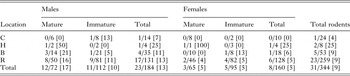
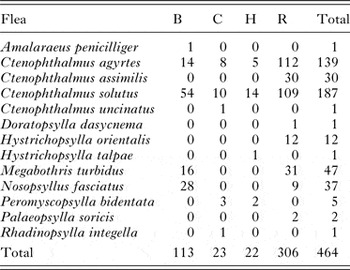
A total of 344 A. agrarius were caught at the four localities between 2011 and 2013 (see Table 1). Fleas were found on 172 animals (50%) and the flea fauna consisted of 13 species, with dominating Ctenophthalmus solutus and Ctenophthalmus agyrtes (Table 2). Most of the identified flea species were typical for A. agrarius; however, single representant of species, which occur mostly on M. glareolus and insectivores were also recorded (see Table 2). Moreover, 37 Nosopsyllus fasciatus, a typically rat fleas, were collected from 25 A. agrarius.
Rodents caught at four sites in years 2011–2013 examined for the presence of Bartonella [no. of infected/no. of captured (prevalence %)]

C, Čermeľ; H, Hýľov; R, Rozhanovce; B, Botanical garden Košice.
Flea species found on A. agrarius in this study
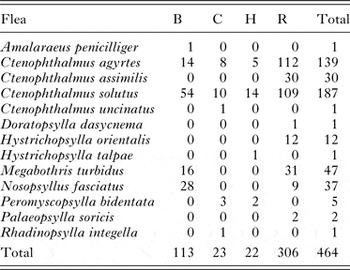
B, Botanical garden Košice; C, Čermeľ; H, Hýľov; R, Rozhanovce.
Prevalence of Bartonella spp. in A. agrarius
Overall Bartonella prevalence was 9%, ranging from 4·2% in Čermeľ to 25% in Hýľov. Due to the small number of rodents captured in Čermeľ, Hýľov, and the Botanical garden Košice, differences in bacteria prevalence between trapping sites were not investigated. There was no significant difference in Bartonella spp. prevalence between years in Rozhanovce. As the host population structure (proportion of males and females, as well as adult and young animals) did not differ between sites (Fisher exact test with P = 0·206 and P = 0·173 for site × sex and site × age, respectively), analysis of intrinsic factors influencing Bartonella spp. prevalence was conducted collectively for all captured rodents using a model with a three-way interaction of categorical factors (infection × sex × age). The optimal model selection resulted in the best model which includes factors age and two-way interaction infection × sex, (Maximum likelihood χ 2 = 1·96, d.f. = 3, P = 0·58). There was a significant influence of sex of rodents on Bartonella prevalence, with males infected more frequently than females (12·5 vs 5%, respectively; χ 2 = 5·8, P = 0·016, d.f. = 1).
Bartonella genotypes in A. agrarius
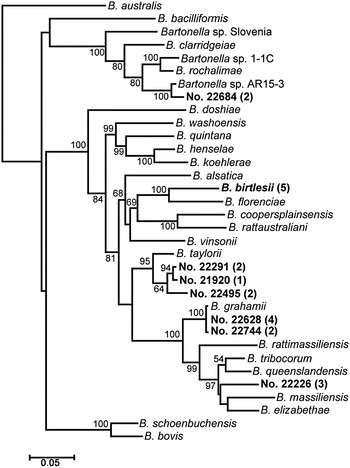
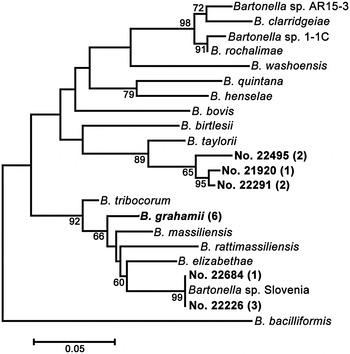
Based on molecular analysis, Bartonella sequences representing five clades were collected. The commonest were referable to B. grahamii (seven DNA sequences, 99·5–100% similarity to the strain as4aup, accession number CP001562), B. taylorii (five DNA sequences, 95·8–99·7% similarity to the strain 8TBB, accession number AIMD01000035), and B. birtlesii (five DNA sequences, only identified for rpoB locus, identical to strain IBS 325, accession number AB196425). However, two further groups of sequences were collected. One was referable to B. clarridgeiae/B. rochalimae clade (two samples with identical DNA sequences; no. 22684) and was the same as Bartonella DNA from A. agrarius isolated in Slovenia (Knap et al. Reference Knap, Duh, Birtles, Trilar, Petrovec and Avsic-Zupanc2007). The similarity of this sequence type to B. clarridgeiae (FN645454) was 92·7% and to B. rochalimae (FN645459) 94·8%. The other sequence type was referable to B. elizabethae/B. tribocorum clade (three DNA sequences, identical to each other, no. 22226) (see Fig. 1). The similarity of this sequence type to B. elizabethae (Z70009) was 94·0% and to B. tribocorum (AM260525) 94·8%. The gltA fragment sequenced from one of the DNA samples type no. 22684 was identical to that of the sequences referable to the B. elizabethae/B. tribocorum clade (Fig. 2), although at rpoB and groEL of this DNA isolate grouped within the B. clarridgeiae/B. rochalimae clade (Fig. 1). All the chromatograms for this DNA isolate were clean and did not show any signs of mixed infection. The gltA locus of this Bartonella sample genotype was excluded from the concatenated phylogenetic analysis.
Maximum likelihood tree obtained from concatenated sequences of five different genes of Bartonella strains with the genotypes from this study superimposed on the core tree (see the text for details) using RAxML. The tree was rooted on the B. australis. Numbers on the nodes indicate bootstrap support (100 replicates); only values above 50% are shown. Genotypes obtained in this study are marked in bold and the number of animals from which the particular Bartonella genotype was obtained is indicated in brackets. GenBank accession numbers of the sequences identical to the B. taylorii and B. grahamii collected in this study (if not identical to the sequence used as reference when constructing the tree; only one representative accession number given for each gene): 22744-GU559869 (groEl); 21920-GU338964 (gltA), GU338935 (rpoB); 22495-GU338947 (gltA); 22291-AY435113 (gltA), GU338929 (rpoB).

Maximum likelihood tree of gltA gene fragment for chosen isolates from GenBank and sequences obtained in this study, was constructed in MEGA 6 software using the Tamura-3-parameter model with evolutionary rates based on Gamma distribution with five rate categories. Root has been set on the B. bacilliformis branch. Numbers on the nodes indicate bootstrap support (500 replicates); only values above 50% are shown. Genotypes obtained in this study are marked in bold and the number of animals from which the particular Bartonella genotype was obtained is indicated in brackets. For accession numbers of B. grahamii and B. taylorii sequences, see legend to Fig. 1.

DISCUSSION
This study confirms the diverse spectrum of Bartonella genotypes carried by the mouse A. agrarius. A genotype most closely related to B. clarridgeiae has now been recovered for the third time from this host in Central Europe, having previously been collected from Slovenia (Knap et al. Reference Knap, Duh, Birtles, Trilar, Petrovec and Avsic-Zupanc2007) and Southwestern Poland (Hildebrand et al. Reference Hildebrand, Paziewska-Harris, Zalesny and Harris2013). Two genotypes, one related to B. elizabethae/B. tribocorum, the other to B. clarridgeiae/B. rochalimae, have only been collected from A. agrarius, again suggesting a unique Bartonella spp. composition for this host, and yet B. grahamii, B. taylorii and B. birtlesii can also commonly infect this mouse. The absence of the B. clarridgeiae/B. rochalimae and B. elizabethae/B. tribocorum genotypes from other woodland rodents in Eurasia is particularly interesting; over 15 studies of Apodemus flavicollis and A. sylvaticus have been undertaken in Western Eurasia, involving thousands of rodents, and yet have never recorded these sequence types, although B. grahamii, B. taylorii and B. birtlesii are widespread (Berglund et al. Reference Berglund, Ellegaard, Granberg, Xie, Maruyama, Kosoy, Birtles and Andersson2010; Buffet et al. Reference Buffet, Pisanu, Brisse, Roussel, Felix, Halos, Chapuis and Vayssier-Taussat2013b ; Gutierrez et al. Reference Gutierrez, Krasnov, Morick, Gottlieb, Khokhlova and Harrus2015).
The presence of these genotypes in A. agrarius is also surprising from a phylogenetic perspective, because B. elizabethae/B. tribocorum isolates are better known as parasites of the Norway rat Rattus norvegicus, and a similar Bartonella sequence has only once been recorded from A. agrarius in South Korea (accession number JN810812). Rattus norvegicus inhabits urban, peri-urban and agricultural habitats, reducing opportunities for transfer to the woodland and scrub-dwelling A. flavicollis and A. sylvaticus, but A. agrarius is more synanthropic, providing opportunities for transmission of Bartonella from rats in agricultural settings. Nevertheless, during our study, 17 R. norvegicus were collected at Rozhanovce, but all spleen samples were found negative for Bartonella (unpublished data), suggesting that A. agrarius does not become infected with these genotypes through accidental contact with rats. Most simply, it is possible that the A. agrarius forms have not yet adapted to other Apodemus species, a hypothesis supported by the distinct nature of the virB5 gene of the A. agrarius-infecting Bartonella isolates (Hildebrand et al. Reference Hildebrand, Paziewska-Harris, Zalesny and Harris2013). The B. clarridgeiae/B. rochalimae clade is even more surprising to recover from A. agrarius. Related Bartonella clades have been recovered from carnivores (cats, dogs, foxes and raccoons), shrews and rats, and in their respective fleas (Gundi et al. Reference Gundi, Billeter, Rood and Kosoy2012). One related Bartonella genotype (AR15-3) has been recorded from squirrels in North America (Inoue et al. Reference Inoue, Maruyama, Kabeya, Hagiya, Izumi, Une and Yoshikawa2009), but the genotype recorded here is not common in Apodemus mice. The concatenated alignment based on fragments of five housekeeping genes recovers the best supported Bartonella phylogeny (Guy et al. Reference Guy, Nystedt, Toft, Zaremba-Niedzwiedzka, Berglund, Granberg, Naslund, Eriksson and Andersson2013); the A. agrarius genotype is placed unambiguously within the B. clarridgeiae/B. rochalimae/AR15-3 clade, as a sister group to AR15-3. The host specificity of this genotype is uncertain; apart from our records from A. agrarius only one isolate from A. flavicollis in Slovenia, differs by a single base in the ITS fragment and has an identical ftsZ locus (Knap et al. Reference Knap, Duh, Birtles, Trilar, Petrovec and Avsic-Zupanc2007).
A. agrarius is a recent immigrant to Europe, spreading west with the development of agriculture over the past 1000 years (Kowalski, Reference Kowalski2001), and it has brought with it a number of unique parasites (Zalesny et al. Reference Zalesny, Hildebrand, Paziewska-Harris, Behnke and Harris2014) otherwise known only from Eastern Asia. The B. clarridgeiae/rochalimae and B. elizabethae/tribocorum clades infecting A. agrarius appear to lack genetic diversity when compared with e.g. B. grahamii, perhaps because they were bottlenecked on entry into Europe. Neither Eastern Asian A. agrarius, nor its nearest relative, A. peninsulae do not appear to be infected by the B. clarridgeiae/B. rochalimae clade, but the range of A. agrarius is discontinuous (Sakka et al. Reference Sakka, Quéré, Kartavtseva, Pavlenko, Chelomina, Atopkin, Bogdanov and Michaux2010) and European A. agrarius are derived from Western Asian populations, for which there are no Bartonella records. The B. grahamii, B. taylorii and B. birtlesii isolates collected from A. agrarius in China and Japan are Eastern Asian forms (Ko et al. Reference Ko, Kang, Kim, Klein, Choi, Song, Youn and Chae2014), in the same way that European A. agrarius are infected by European strains of these species, suggesting that infection of A. agrarius by these Bartonella spp. is related to local rodent faunas, rather than that A. agrarius is infected by its own clades of these species. Such exchange of micro-organisms has previously been described for hantaviruses, as A. agrarius is infected by forms derived from strains infecting A. flavicollis (Lin et al. Reference Lin, Wang, Guo, Zhang, Xing, Chen, Li, Chen, Xu, Plyusnin and Zhang2012).
Bartonella is highly recombinant with widespread intra- and inter-genic recombinations between and within species (Paziewska et al. Reference Paziewska, Harris, Zwolinska, Bajer and Sinski2011, Reference Paziewska, Sinski and Harris2012), making species assignation particularly difficult. In the present case, we have noted possible recombination of the gltA gene between the B. clarridgeiae/B. rochalimae-like genotypes and the B. elizabethae/B. tribocorum-like genotypes. Guy et al. (Reference Guy, Nystedt, Toft, Zaremba-Niedzwiedzka, Berglund, Granberg, Naslund, Eriksson and Andersson2013) identify three clades within the Bartonella genus based on 248 housekeeping genes; one infecting ruminants (B. bovis/B. schoenbuchensis, etc. with a genome size of c. 1·5–1·7 Mb), one made up of B. rochalimae, B. clarridgeiae and the poorly characterized AR15–3, and one containing the remainder of the species in the genus, all with genomes of c. 2 Mb or larger. The possible recombination event noticed in this study represents a genetic interchange between Bartonella taxa within different divisions of the genus. The physiological and genetic consequences of such widespread promiscuity remain to be identified, and it is clear from the present work that substantial parts of the genome may be derived from quite different Bartonella parents. Since representatives of both B. clarridgeiae/B. rochalimae and B. elizabethae/B. tribocorum clades infect rats, the possible origin of this recombination event could be either host or vectors. Flea assemblages collected from A. agrarius mainly composed of non-host-specific species (Table 2). However, N. fasciatus occurs principally on Rattus spp. and may offer a bridge for exchange of Bartonella strains between rats and A. agrarius. In respect to its Bartonella variants, A. agrarius possesses a unique position in the European mammal fauna, forming a bridge between Eastern Asia and Western Europe, and between forest rodents such as A. flavicollis and synanthropic species such as R. norvegicus. The role of this host in bridging habitats and geographical regions should not be overlooked when considering the role that rodent bartonellae may play as emerging pathogens.
SUPPLEMENTARY MATERIAL
The supplementary material for this article can be found at http://dx.doi.org/10.1017/S0031182016000962.
ACKNOWLEDGEMENTS
The authors thank to Monika Onderová, RNDr. Jana Fričová, Ph.D. and RNDr. Bronislava Víchová, Ph.D. for their help in field and laboratory assistance.
FINANCIAL SUPPORT
The study was supported by projects – The Slovak Research and Development Agency (M.S., APVV – 14-0274); VEGA (M.S., 2/0059/15 and 1/0196/15), VEGA (D.M., 2/0060/14); European Cooperation in Science and Technology (COST) (J.K., action TD1303 ‘European Network forNeglected Vectors and Vector-Borne Infections EURNEGVEC); and by the project of Research & Development Operational Programme funded by the ERDF (code ITMS: 26220120022) (0·4).