Broadly speaking, issues in developmental psychopathology are usually studied through one of two different lenses. The most common approach is what we here refer to as the dimensional approach where key concepts are formulated and measured and most often studied using (continuous) variables in standard variable-oriented analyses. The other approach is typological, in which the focus often is on finding psychopathological types and study how they emerge, connect to various outcomes, and so forth. Regardless of what lens is applied, the results are used to inform about developmental psychopathology, its trajectories, precursors, and antecedents.
The purpose of this article is to probe into the underpinnings of these approaches, the dimensional and the typological, to inform about their relative merits and the circumstances where one or the other approach promises to be most useful. Given that the typological approach is much less of a mainstream approach and is more complex than is generally recognized, it is necessary to describe and discuss it more fully than the dimensional approach. We begin this task in the next section where a brief overview of the typological approach is given, followed by a more in-depth examination of the typological concept. The holistic–interactionistic paradigm is then introduced as a metatheoretical framework for our discourse and some considerations relevant for choosing between a dimensional and typological approach are presented. As an illustration of the results achieved applying these two different approaches, an empirical example is given that concerns the prediction of mid adolescent antisocial/criminal behavior from early adolescent teacher-reported problem behaviors. Finally, in the Discussion, we point to implications of our findings for the study of developmental psychopathology and also use the case of studying the development of psychopathy as an example of a situation where the typological–dimensional issue is raised.
A Brief Overview of the Typological Approach
Not many concepts in psychology have been so much questioned and have even led to resentment as the concepts of type and typology (e.g., Bergman, Reference Bergman, Bergman, Cairns, Nilsson and Nystedt2000). For instance, Cattell (Reference Cattell1957) listed 45 different uses of the word “type.” Other sciences, like biology and sociology, have also used the type concept in various ways, and Blashfield (Reference Blashfield1980) gives an overview from a methodological perspective. A type often denotes a specific configuration of values in a number of characteristics and individuals approximately showing this configuration are regarded as belonging to the type. For instance, a cluster obtained from a cluster analysis might be regarded as a type, described by the properties of the cluster (e.g., its centroid) or a type might be an ideal prototype, theoretically derived and defined by a distinctive description (Bailey, Reference Bailey1994). If classes or clusters have a degree of generalizability and validity, then it is common to label each of their categories as a type and the whole collection of classes, for instance, the whole cluster solution, as a “typology.” It should then be observed that the generic properties of these classes, clusters, and so forth are what constitutes the typology. From this definition it follows that, in contrast to the “old” typologies, there is nothing innate or unalterable implied by the types as here defined. It also follows that the subjectivity and lack of replicability that plagued the old typologies, like Kretchmer's (Reference Kretschmer1922) constitutional typology, do not need to be a problem for modern typological research.
In this context it is helpful to distinguish between two perspectives of a typology: (a) the description of the properties of the types and (b) the allocation of individuals/subjects to the different types. It should then be pointed out that a classification analysis is often better at finding replicable classes than it is at allocating the studied subjects to the “correct” classes.
The above empirically grounded definition of a type is regarded by some as too superficial. For instance, it is claimed that a type should have been generated by an underlying causal agent (Gangestad & Snyder, Reference Gangestad and Snyder1985) or should constitute a “natural cluster” (Meehl, Reference Meehl1992). Meehl has done careful work in this area, which he calls “taxometrics,” and he prefers the word “taxon” to type or “cluster,” then implying roughly a meaningful and theoretically interesting type or cluster. However, although he has devised strategies for identifying a taxon, he claims that, at our present stage of knowledge, a more precise definition of a taxon is premature. This view will be discussed in the next section.
Much work in the typological area has been carried out within a cross-sectional perspective, and such an approach can be useful also within developmental psychopathology as a way to understand basic structures from a typological perspective and then use such findings in later developmental analyses. However, it is also natural to take the typological approach one step further and consider the usefulness of longitudinal typologies. These can be of different kinds, with one natural distinction being between a full-fledged longitudinal typology, as exemplified by Block's (Reference Block1971) work on developmental personality types, and a less ambitious approach where typologies at different ages are related in different ways, as exemplified by Bergman and Magnusson's (Reference Bergman, Eklund, Magnusson, Magnusson, Bergman, Rudinger and Törestad1991) work on the evolvement of boys' problem behaviors. The first approach has, in practice, often shown disappointing results, as discussed by Bergman (Reference Bergman, Cairns, Bergman and Kagan1998).
From a methodological standpoint, a crucial distinction between empirically derived typologies is whether they are model based, like in latent class analysis, Meehl's approach, or the longitudinal latent transition analysis of Collins and Wugalter (Reference Collins and Wugalter1992), or whether they are mainly descriptive and the classes are derived as clumpings in hyperspace identified by some method like cluster analysis. If the assumptions of a model-based approach are met, it is preferable to a descriptive approach for obvious reasons. However, these assumptions can be questionable in many contexts (for instance, the assumption that a latent class is identified by a set of subjects for which all pairwise relationships between the variables in the profile are zero implies that higher order interactions can be ignored).
Taking a dimensional, variable-oriented perspective, the typological approach has been heavily criticized, for instance by Ekman (Reference Ekman1951), who claimed that it badly summarizes the full information contained in the data matrix representing the values of the (continuous) variables; a matrix that often is used to produce a dissimilarity matrix that in its turn is used to identify the types. This critique is to some extent relevant, but it should not be overstated. First, the usefulness of a typological summary of dimensional data will vary with the subject of study and must be studied empirically in each specific case. Second, although the full dimensional data are used initially in standard variable-oriented analyses, these analyses in the end also have to resort to summaries, like computing correlations, means, and so forth, and in some ways these summaries are cruder than the one provided by a typological analysis.
An Examination of the Typological Concept
Let us now take a closer look at the typological concept in relation to the classification of individuals. It was emphasized above that a typology can be regarded as a system for describing a set of individual characteristics by a number of types, each showing specific properties of the characteristics. The typology can be in (a) the observed domain of interest (e.g., typical, validated profiles of the Big Five factors) or (b) each type could be the result of a specific causal agent or an “environmental mold” (Meehl, Reference Meehl1992) that may or may not imply that the type will also crystallize as a type in the sense of (a). Common to both of these conceptualizations of a typology is the frequently made assumptions that, using the typology, each individual in a given sample can be linked to one type either deterministically or probalistically and that this allocation is scientifically useful. This usefulness can be shown in different ways such as the typology summarizes complex dimensional information so that meaningful structures are revealed or it generates powerful predictions. Hence, for a typology to be useful it is not always necessary to assume that it reflects any taxons in Meehl's sense.
Definition (a) above is fairly straightforward and procedures can be devised for testing the usefulness of such a typology in comparison to a dimensional approach, whereas definition (b) is more problematic. We are not totally convinced it is possible to avoid a definition of a taxon and taxonicity, as Meehl proposes, and still be able to carry out a trustworthy classification analysis within his framework. His procedures for detecting a taxon are ingenious, but the implications of the assumptions behind them are not quite transparent because of this definitional vagueness. A strength of Meehl's approach is that it makes possible the use of different sets of indicators for different samples and the possibility to use, within the same sample, different subsets of indicators in the taxometric analysis. However, we claim that in many contexts there exists a set of basic indicators within the domain of study that together are believed to inform about the typology, and that can be used to decide class memberships, and that, rather commonly, also a type (b) typology would lead to typical patterns of the basic indicators similar to those obtained by performing a type (a) analysis. Hence, the type (a) typology seems to be potentially useful also for identifying taxons, at least in certain contexts, and in many situations where a taxometric analysis is undertaken it would be of interest to carry out also a type (a) typology analysis.
With the exception of Meehl's work, little attention has been focused on the issue of a partial typology within developmental psychopathology (see, however, Bergman & El-Khouri, Reference Bergman and El-Khouri2001). This is surprising, because in many contexts it seems reasonable to assume that the studied system, as expressed by the components measuring it, might well lead to one or a few patterns being crystallized during development as “typical,” but that for the majority of the sample no clear type belongingness can be shown because of the complexity of the studied process. This situation is discussed in a later section.
The typological issue is complex, and a more full treatment of it would expand beyond the limits of this article. Such a treatment must also be anchored in a general theoretical framework concerning the process under study, especially because we take a developmental perspective. Different general theoretical frameworks exist, and they may have consequences for the choice between a dimensional and a typological approach as well as for the specific method used within each approach; this choice is partly influenced by the involved definitions and assumptions. Therefore, in the next section we concentrate on the dimensional and typological approach within the field of developmental psychopathology as viewed through the lens of the holistic–interactionistic paradigm (Magnusson, Reference Magnusson1985) and as formulated in the person-oriented approach (Bergman & Magnusson, Reference Bergman and Magnusson1997).
The Person-Oriented Approach in Developmental Psychopathology and Its Consequences for Typological and Dimensional Thinking
Much research in the field of developmental psychopathology has focused on identifying single factors that covary with psychopathological conditions, rather than, for instance, studying developmental patterns of maladaptation; an approach that seems closer to the core of developmental psychopathology (Scroufe & Rutter, Reference Sroufe and Rutter1984). Concerns have also been raised against diagnostic systems and their relative lack of consideration for the great heterogeneity among those who receive a diagnosis when it comes to etiology, risk factors, comorbidity, and symptoms (see, e.g., Beauchaine, Reference Beauchaine2003; Kazdin, Reference Kazdin, Maughan and Hill2001). To a fair extent, these shortcomings can be eliminated by applying a person-oriented approach to developmental psychopathology in general and research on personality disorders in particular. A common limitation of research in developmental psychopathology is that insufficient regard is given to potential equifinality and multifinality. With some simplification, equifinality is usually defined as multiple pathways leading to the same outcome, whereas multifinality usually is defined as different outcomes emanating from the same starting point, condition, disorder, and so forth (Cicchetti & Rogosch, Reference Cicchetti and Rogosch1996). Equifinality and multifinality can be incorporated in a person-oriented framework, and the two concepts are further discussed after this framework has been overviewed.
A person-oriented approach in developmental psychopathology is presented in Bergman and Magnusson (Reference Bergman and Magnusson1997) and in Bergman, von Eye, and Magnusson (Reference Bergman, von Eye, Magnusson, Cicchetti and Cohen2006). It is briefly summarized as follows:
1. A holistic, interactionistic system view on individual development has come into the foreground with perhaps David Magnusson being its most forceful advocate (e.g., Magnusson & Törestad, Reference Magnusson and Törestad1993). Within this paradigm the individual is regarded as an organized whole, functioning, and evolving as a totality. Interactions among the involved elements are regarded as central and each operational unit of the structures and processes (behavior, plans, attitudes, biological factors, environmental factors, etc.) takes its meaning from the role it plays in individual functioning. This paradigm is well aligned to a dynamical systems view (see, e.g., Devaney, Reference Devaney1989; von Bertalanffy, Reference Von Bertalanffy1968), and the recent infusion into psychology and developmental psychopathology of methods and models for nonlinear dynamic systems is a further sign of that the holistic-interactionistic system view is becoming seriously considered in empirical research; see Barton (Reference Barton1994), Boker (Reference Boker2002), Cicchetti and Tucker (Reference Cicchetti and Tucker1994), Granic and Hollenstein (Reference Granic, Hollenstein, Cicchetti and Cohen2006), Kelso (Reference Kelso, Bergman, Cairns, Nilsson and Nystedt2000), and Smith and Thelen (Reference Smith and Thelen1993).
2. This view is relevant in all studies of individual development, and it provides a general theoretical framework for problem formulation, the choice of research strategy and methodology, as well as for interpreting the results. Obviously, in practice, not all aspects of an individual's functioning can be investigated in the same study, but this does not make the paradigm less useful. For example, almost all studies carried out in astrophysics use the same general model of nature without any of them including the whole universe, but the presence of a common general theoretical framework helps communication between researchers and the accumulation of knowledge. Similarly, a common general holistic–interactionistic view is helpful for effective communication among researchers in psychology and neighboring sciences, including developmental psychopathology, and for the accumulation of knowledge that transcends scientific discipline boundaries (Magnusson, Reference Magnusson1996). From this theoretical perspective it is also obvious that in empirical research a longitudinal approach is necessary; only in this way you can more directly study individual development (Bergman, Eklund & Magnusson, Reference Bergman, Eklund, Magnusson, Magnusson, Bergman, Rudinger and Törestad1991; Cairns, Elder & Costello, Reference Cairns, Elder and Costello1996).
3. In the standard variable-oriented approach not only are the statistical analyses are carried out with variables as the main units but also the theories are expressed in terms of variables and hypothetical constructs, and the results are reported and interpreted in terms of relationships between variables, and so forth. However, from a holistic–interactionistic perspective, this variable-oriented approach to individual development has severe limitations as pointed out by, for instance, Cairns (Reference Cairns and Valsiner1986) and Magnusson (Reference Magnusson1992), because the modeling/description of variables over individuals can be very difficult to translate into system properties characterizing single individuals because of the variable-oriented, not individual-oriented, nature of the information provided by the statistical method. For instance, whole-system features of individuals can be of critical importance but are usually distorted or even ignored in a standard variable-oriented approach (e.g., a correlation matrix is assumed to carry all relevant information, but it will normally not inform about interactions and nonlinear relationships; see Bergman, Reference Bergman and Rutter1988a).
4. Accepting a holistic–interactionistic paradigm it seems instead natural to apply a person-oriented approach in which the person as a Gestalt is the central object of interest. This often leads to individuals being studied on the basis of their patterns of characteristics relevant for the problem under consideration, and searching for typical patterns, their development, and their connections across domains. It should be pointed out that in this approach variables are also used, but they are now considered only as parts of an indivisible pattern and are interpreted in relation to all the other variables considered simultaneously; it is the pattern or profile of scores that is in focus.
5. The theoretical underpinnings of a person-oriented approach are presented in Bergman and Magnusson (Reference Bergman and Magnusson1997), and here we will point just to one key assumption they listed: “Although there is, theoretically, an infinite variety of differences with regard to process characteristics and observed states at a detailed level, there will often be a small number of more frequently observed patterns (‘common types’), if viewed at a more global level. The assumption is made both intraindividually (viewed over time for the same person) and interindividually (for different individuals at the same time or over time)” (p. 293). They then give arguments and examples that support the credibility of this assumption, and it often provides a reasonable general hypothesis worthy of empirical research and testing. This focus on typical patterns underlines the importance of simultaneously studying multiple domains of variables in psychopathology as proposed by Cicchetti (Reference Cicchetti1993).
Regarding the typological–dimensional issue from this person-oriented perspective, two conclusions are apparent:
1. If relevant operating characteristics in a process have been captured it is an essential aspect of the understanding of this process to find if it leads to the formation of typical patterns of these characteristics (somewhat analogous to the “attractors” studied in dynamical systems research).
2. An uncritical application of standard variable-oriented methods may violate key properties of the process under study (such as bidirectional interactions, nonlinearities, and a nonuniversal relationship structure in the sample, that is, a lack of dimensional identity in von Eye & Bergman's Reference Von Eye and Bergman2003 terminology).
In conclusion, a person-oriented theoretical framework can be applied in developmental psychopathology and for each of its specific scientific problems it should be decided if that framework is relevant as a metamodel for the process under study. If so, there would often be a better problem–method match if a typological approach is applied, or some other approach that analyzes whole patterns or structures, rather than if a standard variable-oriented approach is chosen. It is, of course, possible to use more tailored variable-oriented methods, for instance by introducing interaction terms, nonlinear relationships, multipopulation models, and so forth, and sometimes it can be the best solution, although these approaches tend to be complicated, often with layers of assumptions that are not transparent. Admittedly, referring to yesterday's methodology, Lee Cronbach made a similar point when he talked about entering a “hall of mirrors” when taking interactions into account using standard methodology (Cronbach, Reference Cronbach1975). Of course, sometimes there is no clear typological structure or the general theoretical model one holds is at variance with the person-oriented theoretical framework. Then mainstream variable-oriented methods are a natural choice.
The fact that most of the theories in developmental psychopathology are formulated in terms of concepts explicitly or implicitly treated as variables can create problems for the researcher who wants to carry out person-oriented research. The problems concern both the formulation of the research questions and the interpretation of the results in relation to existing theories and empirical findings. These difficulties are often solvable, and are difficult to address in a general discourse because they are topic specific.
Let us now come back to two important general concepts in developmental psychopathology that were introduced above, namely, equifinality and multifinality. When discussing these concepts, Cicchetti (Reference Cicchetti, Cicchetti and Cohen2006) points out that equifinality relates to that in an open system a diversity of pathways, including chance events, can lead to the same outcome. With an outcome is then meant not the value in a single variable, but instead, the state of the system under study (i.e., the observed configuration of values in relevant variables that defines the outcome at its time of measurement). Multifinality implies that the effects of components on functioning may vary in different systems (i.e., for different individuals depending on individual differences in their system characteristics/environment). Thus, even if individuals are similar in a large number of components describing them at a given time, it would not necessarily lead them to have the same outcome state because of (often unmeasured) individual differences in other aspects of the individuals' systems/environment. This view of equifinality and multifinality is rather complex, but essential aspects of it can be translated into a person-oriented framework and analyzed by person-oriented methods. The two concepts can be reformulated within the present framework in the following way.
Equifinality
From a person-oriented perspective, the focus would be on multidimensional pathways and on the fact that at each step (point in time) there occur typical patterns. These can connect differently over time, and striking connections between different such pathways to a single typical outcome pattern at the endpoint can be defined as equifinality. Special forms of equifinality can be searched for, such as intermediate equifinality (there is a strong connection between a single starting pattern and a single outcome pattern, but there are several different notable multivariate paths in between) or start equifinality (there are strong connections between several starting patterns and a single outcome pattern, but in the intermediate developmental period the different notable multivariate paths become fewer, perhaps reducing to just one typical pattern near the time of the outcome and that connects to the outcome pattern).
Multifinality
Taking a pattern-oriented perspective, an interesting discussion of this issue is given by Cairns and Rodkins (Reference Cairns, Rodkin, Cairns, Bergman and Kagan1998). In a parallel reasoning to that we used when discussing equifinality, multifinality can be defined as a single starting typical pattern, or even a time-ordered identical sequence of typical patterns, leading to different typical outcome patterns. Special forms of multifinality can also be searched for, such as strong multifinality (a single dominant developmental multivariate pathway splits into several typical outcome patterns) and weak multifinality (a single starting pattern evolves through various multivariate pathways into several typical outcome patterns).
Hence, the person-oriented approach can be applied to study process characteristics such as equifinality and multifinality. It also offers a conceptual framework for studying other process characteristics of relevance for developmental psychopathology such as periodicity and structure form versus structure level invariance and change; concepts that can be used as tools in the study of equifinality and multifinality. To elaborate on the last point, if, admittedly somewhat restrictively, structure is defined as the studied value profile in the variables that describe the system under study, structure similarities and differences between individuals can be studied by dividing structure into two components (a) structure form and (b) structure level. These components can be used in the study of aspects of equifinality and multifinality. For instance, multifinality obtained in a longitudinal analysis of typical patterns analyzed according to both profile form and level may change into equifinality when only the form component of a profile is considered. This might indicate that, in essence, there is only one typical outcome state (e.g., one personality disorder) at adult age but with variations in the severity of outcome symptom patterns that have the same form. Another example is that athough there may exist equifinality in that several early-age typical patterns are connected to a specific typical outcome pattern at adult age when one takes into account both the form and level of the structure, it is possible that, if only form is taken into account, there is no longer equifinality but instead a one–one correspondence between a single typical pattern form across age (corresponding to homotypic continuity).
Choosing Between a Typological and a Dimensional Approach
We have pointed to the promise of a person-oriented approach to address important research questions in developmental psychopathology; an approach that often leads to an interest in doing typological work. However, it was mentioned in the introductory section that a dimensional approach is much more of a mainstream approach than a typological approach. We believe that one reason for this state of affairs is discouraging experiences with the results of classification analyses, for instance, in the form of nonreplicable findings or findings that are hard to interpret in relation to current theories, but we also believe that a typological approach has often been applied without careful consideration of its proper design and assumptions, and that, not infrequently, an unsuitable methodology has been used. Below, some principles relevant for the choice between a typological and dimensional approach are briefly discussed, and a number of considerations are given that are relevant for carrying out a sound typological analysis.
1. The general theoretical framework assumed to apply to the process under study must first be explicated. For instance, there is usually no need to consider a person-oriented approach if the involved concepts are regarded as sufficient in themselves (i.e., each concept is measurable as a unidimensional variable, and it is sufficient to study the relationships between the concepts by treating them as separate units, ignoring any properties about them that emerge only at a pattern or system level). Conversely, if the person-oriented theoretical framework is believed to be appropriate, some kind of typological approach should be seriously considered.
2. A typological approach can be methodologically realized in different ways, such as the following:
a. Carry out complete classifications of typical patterns of information and the study of the relationships between such classifications across domains and time. An example is given by Bergman and Daukantaite's (in press) developmental study of middle-aged women's subjective well-being, where linking of clusters after removal of a residue (LICUR) was used to identify typical patterns of subjective well-being with regard to global life satisfaction, positive affect, and negative affect initially at age 43 and then at age 49 for the same sample. (LICUR is a partially cluster analysis based procedure; Bergman, Magnusson, & El-Khouri, Reference Bergman, Magnusson, El-Khouri and Magnusson2003.) In a second step they looked for structural stability and change (e.g., did the same typical patterns emerge at both ages?) and for individual stability and change (e.g., did the women who at age 43 belonged to a certain typical pattern tend to belong to the same typical pattern 6 years later?).
b. A partial classification approach is taken. For instance, it is only searched for one typical pattern in a domain with all other patterns regarded as “noise” and lumped into a complementary category. This approach can be motivated either when just one specific type (which could be a taxon in Meehl's terminology) is of interest or when theoretical considerations or empirical findings make it questionable if a complete classification of the whole sample is attainable. Methods applicable in this context are, for instance, the procedures developed by Waller and Meehl (Reference Waller and Meehl1998) or the Types at Focus procedure for finding dense points in hyperspace (Bergman & El-Khouri, Reference Bergman and El-Khouri2001). This partial classification approach should be distinguished from residue formation, which is a part of the LICUR procedure, meaning that a small set of “unique” subjects that are not classifiable are removed from the sample before the classification analysis is undertaken. This is often important for theoretical and practical reasons, see Bergman (Reference Bergman1988b). However, using a residue is still in essence an (a) approach. Perhaps it should be noted that in a (b) situation it is not always necessary to use procedures like the ones indicated above: sometimes one can stay within a variable-oriented framework and, for instance, define interesting patterns that are coded as dummy variables and added to the investigation variables.
c. The classification is accomplished by producing a complete listing of all possible value patterns in a number of discrete (usually dichotomous) variables and it is looked for value patterns that occur significantly more often than expected by chance (types) and value patterns that occur significantly less often than expected by chance (antitypes). From this starting point, configural frequency analysis has been developed, which contains a number of robust methods designed to address typological and developmental research questions (von Eye, Reference Von Eye1990).
3. It is important to evaluate the quality of a typological representation of a data set and a variety of procedures are available:
a. The usefulness and trustworthiness of a classification can be examined, for instance, by calculating the amount of variation in the variables that is accounted for by the classification (e.g., the total error sum of squares within classes should be much smaller than the error sum of squares for the total sample), by examining whether the within-class relationships almost vanish between the variables constituting the pattern the classification was based on (cf. the assumption of local independence in latent class analysis), and by examining if the classes differ in theoretically predicted ways with regard to external variables or couplings to typologies within other domains.
b. The robustness of the classification can be studied with regard to method variation and sampling variation.
c. If specific predictions are a goal of the study (e.g., predictions of outcome variables), the classes could be translated into dummy variables and the predictive power of them studied in relation to the original variables. Or, if the outcome is a variable pattern, the strength of the relationships between typical such patterns and the original classes could be studied.
d. In case of a model-based classification, model fit can be studied in different ways.
e. The Meehl procedures could be applied to search for taxons and to validate them.
4. There are a number of pitfalls with typological analysis that must be avoided such as the following:
a. adding whatever variables you have to the profile the classification analysis is to be based on without careful considering whether they together give a balanced representation of the system under study and without regarding their psychometric properties (for instance, a variable with a low reliability can distort the results of a cluster analysis);
b. using an unsuitable similarity or dissimilarity measure that does not match the theoretical considerations in the specific case; and
c. skipping procedures for establishing the trustworthiness of typological findings (of which some were indicated above).
5. If the considerations indicated above have been adhered to, the relative merits of a typological and a dimensional approach can be evaluated in the specific case. Of course, an either–or decision is not always necessary: to a certain extent the approaches are complementary (e.g., a cluster analysis of the independent variables is used to find a “strong” cluster that is translated into a dummy variable that is added to the other independent variables in a prediction analysis). However, it can be difficult to relate typological findings to findings based on variable-oriented methods using the same data, in a sense they explore different worlds (Bergman & Trost, Reference Bergman and Trost2006).
In the next section, these considerations for the choice between a typological and a dimensional approach are applied to an empirical example concerning problem behaviors in school and their relationship to later antisocial behavior.
Problem Behaviors in School and Later Antisocial Behavior: An Empirical Example of the Use of a Typological Approach in Developmental Psychopathology
This section is an example of a study of the typological–dimensional issue. To keep the text short and as free as possible from complications obscuring the methodological points, a narrow research area was chosen: the relative merits of a typological and a dimensional representation of boys' problem behaviors in school and their usefulness for predicting later antisocial and criminal behavior. The problem behaviors assessed in early adolescence are fairly parallel to symptoms of conduct disorder and attention-deficit/hyperactivity disorder, whereas the outcomes assessed in mid adolescence are symptoms of antisocial personality disorder according to the Diagnostic and Statistical Manual of Mental Disorders—Fourth Edition, Text Revision (DSM-IV-TR; American Psychiatric Association, 2000) and psychopathy according to the Psychopathy Checklist, Revised (Hare, Reference Hare2003).
Data were taken from the Individual Development and Adaptation longitudinal research program (Magnusson, Reference Magnusson1988). The sample comprised 540 boys for whom we used data mainly from age 13 and ages 15–17. As measures of problem behaviors in school at age 13, teachers' ratings of aggression, motor restlessness, concentration difficulties, and school motivation problems were used. They were rated on 7-point scales in relation to the degree of correspondence to verbally defined extreme points. Previous studies of these variables have shown that, for the purpose of studying adjustment problems, more unidimensional scales are obtained if the positive part of each scale (1–4), indicating the absence of the adjustment problem, is collapsed to 0 and the scale values 5–7 are recoded 1–3 (see Bergman & Magnusson, Reference Bergman, Magnusson, Magnusson, Bergman, Rudinger and Törestad1991, in which a description of the scales is also given). These 4-point scales were subsequently used. Preliminary analyses showed that similar results were obtained regardless of whether the full scale or the reduced 4-point scale was used. As outcome measures of criminality, two variables were included based on the number of registered crimes age 15–17: (a) the natural logarithm of the number of registered crimes plus 1 (the transformation was used to reduce the extreme skewness of the variable) and (b) multiple registered crimes, coded 1 if they had committed more than one crime, otherwise coded 0. The number of self-reported crimes in a questionnaire given at age 16 was also used (this variable was considerably less skewed and was therefore not transformed). In one analysis, school drop out in grade 8 (age 14–15) was used, coded 1 for drop-outs, otherwise coded 0.
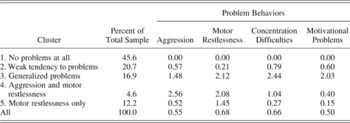
We first note that the correlations between the four extrinsic problem behaviors were rather high, ranging from .48 between aggression and concentration difficulties to .77 between concentration difficulties and school motivation problems. We then carried out a cluster analysis, following the LICUR rationale (Bergman et al., Reference Bergman, Magnusson, El-Khouri and Magnusson2003). No residue case was found, and the 540 boys' four-problem profiles were entered into a cluster analysis using Ward's method. Based on LICUR criteria, a five-cluster solution was chosen. The clusters are described in Table 1.
Cluster means, cluster sizes, and explained error sum of squares for the five-cluster solution for problem behaviors at age 13 (N = 540)

Note: The explained error sum of squares of the cluster solution is 72.2%. Ward's method was used with the squared Euclidian distance as the dissimilarity measure. The variables were not standardized.
The five clusters were labeled as follows: Cluster 1: no problems at all (46%); Cluster 2: weak tendency to problems (21%); Cluster 3: generalized problems (17%); Cluster 4: aggression and motor restlessness (5%); and Cluster 5: motor restlessness only (12%; see Table 1). The cluster solution was successful in that it took care of almost all pairwise relationships between the variables (the median squared correlations between the four variables within clusters ranged from .00 to .04 compared to .41 for the whole sample) and cluster homogeneity was also good with an explained error sum of squares of 72%. Most typical cluster profiles replicated fairly well using another method of cluster analysis (between groups average linkage) and when analyzing approximately the same sample when the subjects were 3 years younger. The best replication was obtained for Cluster 1 and for Cluster 3. We make no claim that the obtained cluster solution is the only possible typological representation of the data: different analyses might arrive at (slightly) different clusters and a different number of clusters. But the homogeneous, replicated clusters are candidates for natural clusters in Meehl's sense (i.e., at first hand Clusters 1 and 3), and the usefulness of the cluster solution for prediction is expected to be mostly decided by how helpful these two clusters are as compared to the original dimensional variables.
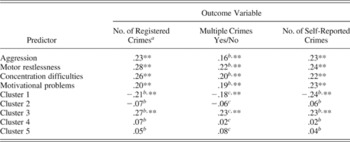
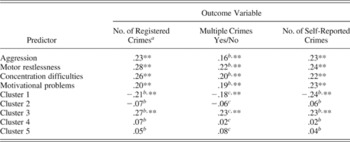
For prediction purposes, five dummy variables were created of the cluster categories so that, for instance, Cluster 1 is coded 1 if the subject belongs to Cluster 1, otherwise it is coded 0. Then the simple relationships were computed between each predictor (the five dummy variables coding for cluster membership and the four original dimensional variables) and the three outcome variables measuring criminality (see Table 2).
Relationships between each age 13 predictor and the outcome variables at age 15–17
Note: Pearson correlations were computed except where otherwise noted.
aThe natural logarithm of (number of crimes + 1) was computed and one outlier with 99 crimes was removed before the analysis.
bPoint-biseral coefficient.
cPhi coefficient.
** p < .01.
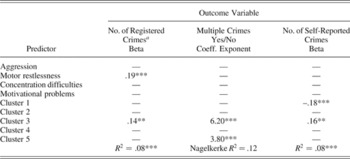
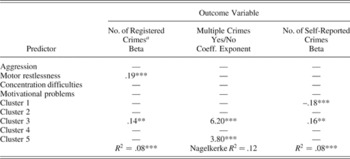
The relationships between predictors and outcomes are not strong, even though they are highly significant. It is difficult to compare the size of different types of correlations, but with this reservation it still seems that the relationships often, but not always, are stronger for the original dimensional variables than for the dummy variables coding for clusters. However, it should be noted that the correlations between the cluster variables are much lower than those between the original dimensional variables (median squared correlations of .04 and .41, respectively, not reported in Table 2). This can only partly be explained by the lower values usually obtained for phi coefficients compared to Pearson coefficients. Hence, for prediction purposes, the use of several cluster variables may still give a better prediction than the use of several dimensional variables, because the cluster variables share much less variance. Therefore, three stepwise regression analyses were carried out with each criminality variable as the dependent variable and the four original 4-point problem behavior variables and the five dummy variables coding for the clusters as the independent variables. The results are presented in Table 3.
Results of stepwise regression analyses predicting the number of registered crimes at age 15–17 (log transformed) and the number of self-reported crimes at age 16
Note: The results were from nine predictors measured at age 13 and from a stepwise logistic regression analysis with the same predictors and dichotomized multiple registered crimes as the dependent variable. (—) The variable was not entered/retained in the stepwise analysis (p > .05).
aThe natural logarithm of (number of crimes + 1) was computed and one outlier with 99 crimes was removed before the analysis.
** p < .01. ***p < .001.
It is seen that the “best” prediction equation selected from all four plus five predictors does not strongly predict any of the three criminality variables. The predictive power is moderate, and for both multiple registered crimes and self-reported crimes, the best prediction equation contains only cluster variables. Considering the very skewed distribution of the number of registered crimes variable and its dubious scale level, we regard the dichotomous dependent variable coding for the presence or absence of multiple crimes as the most informative one. It is best predicted by the dummy variables coding for Clusters 3 and 5, and the squared correlation is .12. (If, instead, the best stepwise regression equation based on the four dimensional variables measuring problem behaviors are used as predictors, the squared correlation is .09 with motor restlessness as the only significant predictor; these results are not presented in Table 3.) According to the regression equation, the odds for multiple registered crimes should be multiplied with 6.2 if a boy belongs to Cluster 3 and by 3.8 if a boy belongs to Cluster 5.
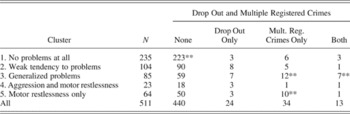
Finally, we looked at the streams from typical patterns of problem behaviors at age 13 to patterns of school drop out and multiple registered crimes at age 15–17 (see Table 4). Drop-out was chosen to qualify the meaning of multiple crimes because the presence of both these conditions is supposed to indicate a serious adjustment situation for a boy, indicating a high risk of persistent criminality. Looking at equifinality, we concentrate on the most serious outcome, namely, the presence of both drop-out and multiple registered crimes. It is evident from Table 4 that there seems to be almost no equifinality: as many as 7 out of the 13 boys with this very problematic outcome come from the cluster characterized by generalized problem behaviors and the remaining 6 boys are spread out over the other clusters. Looking at multifinality we concentrate on two typical patterns of problem behaviors. The first is Cluster 1, characterized by a total absence of adjustment problems. There is almost no multifinality with 95% of the boys in this cluster having no problematic outcome pattern whatsoever, and 99% of the boys not having the most problematic outcome pattern (compared to base rates for the remaining sample of 79% and 96%, respectively). The second typical pattern is Cluster 3, characterized by generalized problems. A considerable multifinality is seen with 69% of the boys in this cluster having no problematic outcome pattern whatsoever and the remaining 31% spread out over the remaining outcome patterns with significant overrepresentations in the registered criminality only category and the most problematic outcome category (compared to base rates for the remaining sample of 89% and 11%, respectively).
Relationship between problem behavior cluster membership at age 13 and drop out and multiple registered crimes pattern at age 15–17

** p < .01 when testing if the observed frequency is larger than the expected using a one-tailed exact hypergeometric test.
Discussion
In this article we have discussed the merits of a typological approach, which in our view, seems underused within the field of developmental psychopathology. Our empirical example concerned the structure of early adolescent problem behaviors in school, indicative of conduct disorder and attention-deficit/hyperactivity disorder, and its relationship to midadolescent antisocial/criminal behavior, as symptoms of antisocial personality disorder according to DSM-IV-TR (American Psychiatric Association, 2000) and psychopathy according to the Psychopathy Checklist, Revised (Hare, Reference Hare2003). It was aimed to raise the general question of how we study early developmental signs of personality disorders. The example underlines that a typological approach, in this case realized by using a cluster analysis-based methodology, not only can contribute to our understanding of the structure of early problems and how this structure connects to later adjustment difficulties, but that it also can be helpful for improving the prediction of them.
Robins (Reference Robins1966) made an important commentary based on her findings concerning the relationship between antisocial symptoms in childhood and the diagnosis of later sociopathic personality. She noted the primary importance for the prediction of the number of symptoms, and that the predictive power of a specific problem might mainly depend on it being an indicator of multiple antisocial problems. (However, she also found that some symptoms had some “unique” predictive power of sociopathic personality.) Somewhat parallel to her findings, we found in our study of teacher-rated problem behaviors that a typical pattern of generalized problems was, broadly speaking, the most powerful predictor of later criminality, being marginally stronger than the “best” original variable (motor restlessness). However, in difference to us, Robins studied sums instead of typical patterns. To make our study more parallel to hers, we computed the sum of the scores on the four dimensional variables for each boy and entered it first into stepwise regression analyses with all the other independent variables included, and with each of the three criminality variables, in turn, as the dependent variable (not shown in tables). None of the four dimensional variables then added to the prediction, whereas in all three analyses a dummy variable coding for cluster membership did. From a prediction viewpoint, a main conclusion from our analyses of these data is that it does not make a large difference whether the four dimensional variables are used, whether just the sum of them is used, or whether the dummy variables coding for clusters are used, but the cluster variables appear in this case to have a slight advantage. From a practical viewpoint, this raises the question of the contexts where it is worthwhile for prediction to carefully measure and analyze by sophisticated methods a set of theoretically sound variables, as contrasted to simply obtaining a number of “cheap” variables (like teachers' ratings) and point out those with multiple problems as the risk group. However, prediction is far from the only goal of basic research (Bergman & Magnusson, Reference Bergman and Magnusson1997). We argue that some of the types we found and our findings concerning equifinality and multifinality are both of theoretical and practical interest. Further, the results underline the importance of recognizing that problems tend to occur in syndromes, and that the study of these syndromes gives additional insights.
Sometimes a diagnostic system is regarded as a typology (e.g., the DSM-IV diagnostic system can be viewed in that way) and in one sense this is, of course, true. Still, many users of such a system hold a basic dimensional view but recognize the need for binary decisions (treat–do not treat). Then, the typology is used as a practical devise without necessarily believing that it says anything fundamental about nature.
In a rapidly growing research field within developmental psychopathology, the focus is on the youth expression of what in adulthood is referred to as psychopathy (Hare, Reference Hare2003). One approach has been to more or less directly apply the adult psychopathy concept to youths as a “juvenile psychopathy” concept (Forth & Book, Reference Forth, Book, Hervé and Yuille2007; Forth, Kosson, & Hare, Reference Forth, Kosson and Hare2003). Research within this approach often focuses on the total score of a juvenile psychopathy measure and its correlates or the correlates of its subdimensions. A typological approach is rarely used, but when it is (e.g., by cluster analyzing the subdimensions/factors of psychopathy and studying differences between the clusters in other variables), it often produces interesting and practically useful knowledge (see, e.g., Andershed, Köhler, Eno Louden, & Hinrichs, Reference Andershed, Köhler, Eno Louden and Hinrichs2008; Vincent, Vitacco, Grisso, & Corrado, Reference Vincent, Vitacco, Grisso and Corrado2003). Another approach in extending the psychopathy concept to youth has been to focus on a single, crucial dimension of the psychopathy concept, namely, the affective deficit involving lack of empathy, shallow affects, and a lack of adequate feelings of remorse or guilt. This dimension has often been labeled callous–unemotional (CU) traits in the youth literature (Frick & White, Reference Frick and White2008), and is often considered the core dimension of psychopathy, although this remains untested. The two approaches of studying juvenile psychopathy, the more comprehensive approach including all aspects of psychopathy and the approach focusing only on CU traits, currently run as separate streams in the literature. An integration is needed, and a typological approach might be helpful, raising questions such as: is the CU trait dimension the most important dimension to focus on or is it the constellation of the subdimensions/subfactors of psychopathy that should be targeted? Combining a dimensional approach (e.g., looking at the predictive power of the different subdimensions, separately and taken together, the CU trait included) with a typological approach (e.g., looking at the predictive power of the different constellations/clusters of the subdimensions) could clarify the standing of CU traits in relation to a more general psychopathy concept. Another key issue to resolve is how stable psychopathic traits in youth are over time. A recent review shows that these traits are usually found to be at least moderately stable during youth and from youth to adulthood (Andershed, in press). All existing studies on stability and change have used a dimensional approach. This means that we do not know as of yet to what extent and how youths change or stay stable concerning their constellation of psychopathic traits. This is quite striking, because it can be argued to be the most relevant type of stability to study concerning psychopathy (see Andershed, in press). In sum, within the area of juvenile psychopathy, we argue that a combination of a dimensional and typological approach has the potential to increase our knowledge concerning causes, risk and protective factors, stability and change, and consequences. In fact, we believe that there are several areas of developmental psychopathology that would benefit from an integration of the dimensional and typological approaches.
Hopefully, in this article we have clarified a number of considerations relevant for the choice between a dimensional and typological approach and that they sometimes can be combined. However, “the typological approach” can take different forms, both theoretically and methodologically. Unfortunately, with regard to methodology, sometimes unsuitable methods are used and certain important considerations are disregarded. This is problematic, especially in combination with the rather frequent lack of reported information about the quality of the typological representation (e.g., the homogeneity of the classes or types is often not indicated). With regard to cluster analysis, this issue is discussed in Bergman (Reference Bergman, Cairns, Bergman and Kagan1998). One issue at the core of the view of typology is whether every subject should be classified. In our opinion, deciding to do this is often at variance with the researchers' theoretical knowledge of the field: it is frequently not warranted to believe that everyone belongs to one of a small number of homogeneous categories with each defining a type. It is often more realistic to accept the presence of a residue of unclassified (Bergman, Reference Bergman1988b) or even to reduce the ambition to finding just one interesting type characterizing a subsample (Bergman & El-Khouri, Reference Bergman and El-Khouri2001). In fact, considering the sensitivity of the findings from cluster analysis to sampling variation (Moadab, Reference Moadab1998) it can often be expected that, if the sample is not large, only types characterizing a sizable proportion of the sample or very clear types that stand out would be identified by the analysis.
Bergman and Magnusson (Reference Bergman and Magnusson1997) pointed out that maladjustment or psychopathology is frequently studied using variables that are not optimal for measuring the range of the dimension of interest. Furthermore, it was emphasized that the scaling often is relative for each variable taken separately, implying that information is lost about, for instance, the different prevalence of different adjustment problems or of the different prevalence of the same adjustment problem across time. In the empirical example presented here, this problem was “solved” by not standardizing the teachers' ratings, for instance, leading to that the verbal definition of an extreme problem was given the same score for all variables. In our empirical example, the dimensionality problem is also present. For instance, it is hard to argue that the total absence of aggression is less of an adjustment problem than a normal level of aggression. This was “solved” in the example by giving a zero score to all ratings below and up to the average level of aggression.
Following Krauth and Lienert's (Reference Krauth and Lienert1982) idea of antitypes, Bergman and Magnusson (Reference Bergman and Magnusson1997) argued for the importance of studying what they called “white spots”: the developmental paths, patterns, and so forth, that do not occur although there are no technical reasons why they should not. Together with the developmental patterns that often occur, they describe the most salient aspects of the system's behavior. In system theory terms, certain complex dynamic systems have inherent constraints of the states that (almost) cannot occur during development, and knowing these are important for understanding the system is sometimes as important as finding out what typically occurs. What does not happen fences what does happen, and both aspects should be taken into account when explaining development. This line of reasoning appears especially relevant in developmental psychopathology because it begins at the boundary where “normal” development gets off track. This line of study is rarely followed despite its obvious relevance for theory testing (see, however, Cairns and Rodkin's, Reference Cairns, Rodkin, Cairns, Bergman and Kagan1998, introduction of prodigal analysis for the purpose of studying “off-track” subjects). For instance, in our example concerning problem behaviors in school, only 4 of the 110 boys who had clear concentration difficulties had this problem as their only problem. Are concentration difficulties an almost necessary condition for multiproblems with a causal status, or are they simply a very good indicator of multiproblems? Or consider the frequent typical pattern characterized by no problem behaviors at all. Why does almost no one who belongs to this type develop later severe adjustment problems?
An issue that has attracted much attention within developmental psychopathology is the developmental course of personality disorders and its explanatory factors, as exemplified by our previous discussion of psychopathy. In this context a person-oriented approach seems promising for at least two reasons:
1. It offers ways of setting the syndrome, not single variables, in focus that is consistent with much current theoretical thinking. For instance, in their definition of developmental psychopathology, Scroufe and Rutter (Reference Sroufe and Rutter1984) emphasized that the field concerns the study of the origins and course of individual patterns of behavioral maladaptation.
2. As previously discussed, the person-oriented approach can handle expanded and more sophisticated concepts of equifinality and multifinality than is possible with a standard approach, and these concepts are key tools for the understanding of the development of personality disorders. This is illustrated by the following line of reasoning. From a developmental perspective, a personality disorder can be regarded in at least two ways. (a) As an “important” specific typical maladaptive configuration of certain characteristics that has a degree of stability in adult age. It is then often studied at what age it first appears, what are its antecedents and concomitant factors, and if several different earlier typical patterns are connected to that specific disorder (equifinality). (b) A personality disorder could be seen as originating from a single underlying condition but the disorder takes (slightly) different forms at different ages (related to heterotypic continuity). In a clear-cut case, this would mean that there is a time sequence of typical patterns, not necessarily identical or even represented by exactly the same variables, so that most individuals ending up with the personality disorder at adult age have followed this sequence. Then it is a debatable issue whether all these connected patterns should be regarded as indicating the same basic disorder. It is also possible that the same underlying condition could result in different maladjustment expressions in different individuals, especially in the type of personality disorder that “finally” emerges because of an increasing complexity and heterogeneity during development. This could be manifested by a branching out of one major early observed maladjustment pattern into several related but not identical personality disorders at adult age (multifinality).
In the social sciences, usually much less is understood about the operating mechanisms underlying the phenomena under study than is the case in the natural sciences; largely depending on the higher complexity of the systems studied in the former case. This means, for instance, that the demonstration and understanding of causality tends to be more problematic in the social sciences. Usually the mechanisms proposed are also difficult to study because of the frequent discrepancy between, on the one hand, sophisticated dynamic interactionistic theories, verbally defined and not very precise, and, on the other hand, “heavy-handed” methods that, partly for mathematical convenience, make assumptions that are frequently unrealistic (like linear relationships invariant over individuals, etc.). This tends to lead to a problem–method mismatch (Bergman & Trost, Reference Bergman and Trost2006). We have suggested that a person-oriented approach, judiciously applied, may diminish this mismatch. However, in its standard conceptualizations, this approach will not solve the problem of the identification and explanation of mechanisms. A major tool for this purpose in the natural sciences is the methodology for studying nonlinear dynamic systems by which an interactionistic, dynamical mathematical model is built of the change process and represents the mechanism. However, at the present state of knowledge this approach offers no panacea in developmental psychopathology, considering the difficulty in modeling systems where basic model properties cannot be assumed to be invariant during a long developmental period. Nevertheless, important concepts and lines of thought from this type of modeling can, with advantage, be incorporated into our fields, and also partial, less ambitious, efforts can be made to mathematically implement such models (Barton, Reference Barton1994; Boker, Reference Boker2002; Granic & Hollenstein, Reference Granic, Hollenstein, Cicchetti and Cohen2006).
Precursors of the typological and person-oriented research paradigm much predate the dimensional or variable-oriented research paradigm (see, e.g., Allport, Reference Allport1937; Lewin, Reference Lewin and Carmichael1954; Stern, Reference Stern1911, Reference Stern1917) and a hundred years ago, the typological view was much more accepted than it is today in psychology and psychiatry. As a reaction to the subjectivity often involved in typological research and riding on the success of the natural sciences in using a dimensional paradigm, the typological approach gradually fell into disrepute. This is partly understandable and great advances in knowledge have occurred in psychology and psychiatry using the variable-oriented approach. However, to a certain extent the tide is turning. As mentioned above, the frequent lack of problem-method match using this approach is becoming more apparent and insightful researchers, taking a system perspective at understanding individuals, have pointed to this (e.g., Gottlieb, Reference Gottlieb and Magnusson1996; Lerner, Reference Lerner1991). Another related trend is an increased understanding of the importance of studying the single individual (Carlson, Reference Carlson1971; Molenaar, Reference Molenaar2004; Nesselroade & Ford, Reference Nesselroade, Ford, Ford and Ford1987). The extent to which this “old–new” insight will lead to that a typological paradigm comes more into the foreground is uncertain, but we believe that some approaches emanating from the person-oriented paradigm will come much more into use as it is increasingly recognized that we need to match our theoretical conceptualizations of the systems we study to methods capturing whole properties of these systems (von Eye & Schuster, Reference Von Eye and Schuster2000).