And though they set on him a new bondage of
Seven years long,
Now once again the world may hear him—
The world is his song.
—Alan BushFootnote 1
For much of the 1950s Paul Robeson was famously denied the right to travel outside of the United States. This prohibition, potently symbolized by the state's revocation of his passport, confined him to what his secretary, lawyer, and civil rights activist William Patterson referred to as a decade of “national arrest.”Footnote 2 It was a state (of) affair(s) that received significant attention, within the United States and globally. At a protest rally in England the Liberal candidate for parliament for Manchester spoke out for the singer and against his incarcerators: “Robeson is a world ambassador . . . America has robbed the world of him and imprisoned him in his own country.”Footnote 3 The metaphor of arrest that Robeson and his supporters drew on suggests not only the judicial context within which the so-called “passport case” played out, and the singer's physical confinement within the nation's borders, but also gestures towards the state's strong-arm attempts to halt Robeson's singing (and therefore political) voice. Thus throughout the decade (American) spaces of performance and recording were systematically closed to the singer.
We can glimpse the state's repressive machinery at work in an unusual project in which Robeson participated. In 1954 he was invited to be part of an all-star international creative team for the epic documentary film Song of the Rivers, which one critic described as “a hymn to Man, honoring labor and assailing colonialism.”Footnote 4 Artistically spearheaded by the pariah Dutch filmmaker Joris Ivens, and involving also Shostakovich, Brecht, and Picasso, Robeson was asked to record the theme song for the English-language version of the film. Like the subject of the song and the film—the world's six “mighty rivers” as sites of labor—the song was to flow through the film as a musical theme. Of course Robeson could not make the recording date in Europe; denied a passport, he was trapped in the United States. The solution proposed by the film's scriptwriter, Vladimir Pozner, was that Robeson would record the song a cappella and the orchestral accompaniment would be dubbed on to this.Footnote 5 Recording the song presented its own problems, as Robeson noted: “The large record companies belong to Big Business and would flatly refuse to rent their studios for such a job, and the smaller companies would be afraid.” He spoke cryptically also of “sabotage done by recording engineers whose ears, keenly attuned to the snarls of [the anti-communist demagogue] McCarthy, were deaf to a singer of Peace.” In the end the song was recorded at Robeson's home in Harlem with his son taking on the job of sound engineer. “The mighty rivers,” concluded the singer, “now ran their course on a thin ribbon of magnetic tape that was packed into a little box and sent across the sea.”Footnote 6 The film was not seen in the United States.
This vignette exemplifies Robeson's uses of media and sound technologies to address in absentia the international audiences from whom he was physically separated throughout the period of national incarceration. The concert film Bridge Over the Ocean (c. 1958) and the transatlantic “telephone concert” are other instances of the use of technology to sidestep the travel ban.Footnote 7 On 26 May 1957 Robeson sang over the wires from a studio in New York to a thousand-strong audience in St. Pancras Town Hall, London. As the cover to the LP record of the concert blandly stated, it was “different from the usual run of recital records,” and for the fifteen-minute duration of the event “passports and visas lost their significance.”Footnote 8 After this, Robeson's wife Eslanda could proclaim, “we have a new means of communication from the jailhouse.”Footnote 9
Film historian Charles Musser notes that Song of the Rivers drew on a “utopian medium in its ability to transcend space and time—to outwit state oppression.”Footnote 10 Its subject matter too, as with its multinational team, transcended national borders. The film was an international trade union–sponsored project, but for Robeson it was more specifically “a song of brotherhood for working people of all lands,” and the singer's involvement would, Pozner realized, resonate with “a deep symbolic significance for people throughout the world.”Footnote 11Song of the Rivers was thus a vehicle for what I call Robeson's cosmopolitics, a politics grounded in the ideas and ideals of cosmopolitanism that I argue was foundational to Robeson's political thinking and aesthetic practices by this time.Footnote 12
Similarly, one could argue that the passport case was in part a consequence of, and elicited responses in the terms of, Robeson's cosmopolitics.Footnote 13 The defense, for example, was formally organized by The Committee to Restore Paul Robeson's Passport, an umbrella organization formed at local, national, and international levels, the workings of which often intersected transnationally. More to my point, the defense was at times framed within a discourse of cosmopolitanism. For the Robeson camp the “basic issues involved in [his] persecution” were thus “international in character and of such importance as to fully justify appeals to world opinion.” Although arguments presented for the restoration of Robeson's passport were constructed in terms of the rights of U.S. citizenship, the specific citizen's right invoked was the right to travel beyond its borders. As an editorial, titled “No Borders for Art,” appearing in the leftist periodical Masses and Mainstream argued, Robeson's right to a passport was “his right as an American citizen and as a world artist.”Footnote 14 The passage afforded by a passport, as we will see, was a fundamental enabling condition of Robeson's cosmopolitan action. The singer's contributions to “the advancement of man's universality, brotherhood and humanism” were, the argument progressed, predicated on “the right to display his artistic genius abroad.” In contrast, the “provincialism” of the State Department operated against this ideal of the “free passage of culture among the nations.” It is unsurprising then that the United Nations’ Declaration of Universal Human Rights provided an additional framework for the Robeson defense, which invoked, among others, section 2 of article 13: “Everyone has the right to leave any country, including his own, and to return to his country.”
It is against this background of the 1950s, during which time Robeson was “an American prisoner of the cold war” (in Patterson's words), that I consider the Carnegie Hall concerts of the spring of 1958. The singer presented two recitals at the august venue, on 9 and 23 May (the second a hastily organized encore recital) as the culmination of an extended nationwide tour marking Robeson's return to public music life. His very appearance on the stage of the Main Hall signaled something of a thaw in his own cold war with the State. Earlier in the decade he had told an interviewer: “Many people stop me on the street and ask me why they haven't heard me sing. When I tell them that concert halls like Carnegie Hall are closed to me they are astounded.”Footnote 15 One way to listen to the 1958 concerts is as Robeson's response to—more pointedly, his cosmopolitan critique of—the U.S. domestic and foreign politics of the 1950s in which he became embroiled. Pursuing that thought I offer here an interpretative reading of the recital program, reflecting on individual songs in the order Robeson performed them at the 9 May recital and the cosmopolitics they invite us to consider.Footnote 16
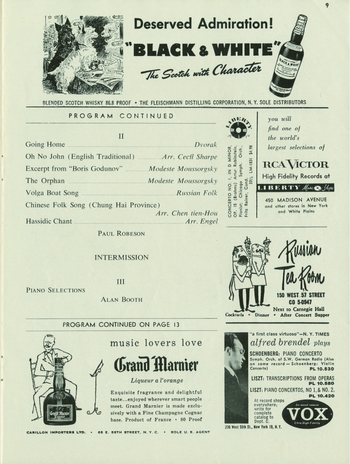
The cosmopolitan program Robeson presented at Carnegie Hall had a long genesis.Footnote 17 Already in the early 1930s, and especially by the mid-1930s, Robeson's programs increasingly “opened up” to song traditions from outside the African American spirituals and folk songs he made famous, and which had made him famous. The New York Town Hall concert of 19 October 1935 concluded not only with a group of spirituals, as would have been the case a few years prior, but with spirituals as well as a song by Rimsky-Korsakoff (“O Ivan, you Ivan”) and a prayer from Palestine arranged by Sir Arthur Somervell.Footnote 18 The Carnegie programs of 1958 are indebted to other “moments” in Robeson's concert career, such as the concert tours in the early 1940s that centered on the Ballad for Americans (when Robeson was involved in the cultural politics of the Popular Front) and the recital tours of the late 1940s. But the radical loosening up of the conventional “group” logic by which song recitals are structured, and which continued to inform Robeson's recitals into the early 1950s, happened more consistently only during the time of his national arrest. This is particularly evident in the explicitly oppositional events to which Robeson lent his voice. The third annual “Peace Arch” concert of August 1954 opened with two spirituals, “Didn't My Lord Deliver Daniel” and “Jacob's Ladder” (arranged by his past and present accompanists Lawrence Brown and Alan Booth), followed by Roger Quilter's arrangement of the English folk song “Over the Mountains,” Schubert's “Cradle Song,” Parry's “Jerusalem,” and concluded with the English ditty “O No John!”Footnote 19 These songs and importantly the modes of their presentation returned in the Carnegie Hall program. (Figure 1 gives the program details for the first group of the 9 May recital.)
Paul Robeson's 9 May 1958 Carnegie Hall recital, first group of songs. Used by permission of the Carnegie Hall Archives.

Although my reading of the 1958 recitals then considers them in their moment, we must acknowledge the longer duration of their making. This is the case too with the genesis of Robeson's cosmopolitan imagination, a somewhat loose nexus of ideas and ideals—by no means a “theory”—some of which were life-long in the making. I am therefore more interested in teasing out aspects of Robeson's cosmopolitan imagination as presented in the Carnegie Hall program rather than tracing a genealogy of his cosmopolitics, a much larger undertaking to be sure. One of the chief interlocutors of cosmopolitan studies, Carol Breckenridge, urges us to be “archivally cosmopolitan:” “Let's simply look at the world across time and space and see how people have thought and acted beyond the local.” In doing so, she suggests, “we can rewrite the history of cosmopolitanism and . . . redraw its map once we are prepared to think outside the box of European intellectual history.”Footnote 20
Robeson's recital program choices and strategies of performance contribute, I argue, to a larger history of cosmopolitan thought and action, and this in turn provides a further framework for thinking about Robeson's position in mid-century America. In other words, I want to insert “the world” more forcibly into our considerations of the singer, into considerations that have already richly explored the articulation of race and nation in Robeson's work.Footnote 21 Indeed, by redirecting the focus to cosmopolitanism we open up our knowledge on Robeson to other domains. One of the most profound insights of recent scholarship on cosmopolitanism has been to argue for and explore its imbrication in the ethics and behaviors of everyday practice, as opposed to, for instance, regarding cosmopolitanism as grand global politics. Although such a mundane cosmopolitanism is always already implicated in the politics of race and nation, my concern in part is to tease out the ethical imperatives and practical actions that arise from a cosmopolitical way of being, one that may also intersect with other ideological and political positions.
Feminist scholar Hazel Carby noted, in passing, that an “unwavering commitment to an internationalist politics of social transformation eventually placed Robeson uncompromisingly in opposition to the national discourse of race, nation, and manhood in the United States.”Footnote 22 My focus is not on Robeson's national arrest—a story much rehearsed in the biographical literature—but on how his (oppositional) cosmopolitics affirms, sometimes idealistically and sometimes contradictorily, another way of being in the world and offers another perspective (on and to the nation) from the cosmo-polis.
“Over the Mountains,” or: Beyond the Local
It was typical of Robeson to begin a major comeback recital in one of the world's great performance venues with a simple folk song, the “Elizabethan Air,” “Over the Mountains.” The song allows for an easing of the voice into sound. It encourages and gently exercises the voice in its melodic meanderings, firmly supported by Alan Booth's busy piano accompaniment. It was in other words a comfortable choice with which to start the recital.Footnote 23 (At this time critics commented on how Robeson coped with the demands of live performance given his extended absence from the formal concert stage.) Of course, the folk song credentials of the song situated it within a body of music from the world that Robeson had long performed and advocated for. It was home turf repertoire.
The version of “Over the Mountains” Robeson performed was arranged by the English composer Roger Quilter, first published in his Old English Popular Songs of 1921. Building on the popular parlor song tradition, the recomposed song, as with much of Quilter's creative output, indexed the transformation of “the popular” into art song via a musical language that by the start of the twentieth century was international, if not quite global. The network of creative connections that gave rise to Robeson's performance of “Over the Mountains” also speaks of international relations: In the early 1920s Quilter met the American pianist Lawrence Brown in London—Brown became Robeson's long-time accompanist in 1925—and the two struck up a mutually beneficial professional relationship.Footnote 24 It was under Brown's influence that Robeson was introduced to Quilter, and he sang and recorded several of the Englishman's songs throughout his career.Footnote 25 A Quilter song was part of Robeson's repertoire history, one borne of an international peripatetic's contacts and collaborations.
By the 1950s the song had accrued additional meaning. Robeson's autobiographical apologia cum manifesto Here I Stand, published only a few months before the Carnegie Hall recital, borrowed the concluding lyrics of the song, “love shall find out the way,” to head a chapter in the book: “In these last several years, during which I have been cut off from personal contact with friends in other lands, I have often reflected on the truth expressed in the words of a song that I have sung at many a concert—‘Love will find out the way.’”Footnote 26 The concert opener thus also gently speaks the defiant stance of much of Robeson's lyrical world. The seemingly innocuous lyrics on love in “Over the Mountains” appropriately itinerize a journey as a series of trials, to be endured but overcome by an indomitable spirit:
To a listener with even limited knowledge of Robeson's biography—and given the publicity surrounding Robeson's life the sympathetic Carnegie Hall audience would have had some idea of these matters—these third-verse words poignantly sum up the story of the singer's life of the prior decade. “It has been great fun to comment publicly, in concert, upon my prolonged detention during my passport fight,” the singer recalled.Footnote 27 Less than two months later, his passport restored and “over the mountains and over the waves,” Robeson was in London and then on to Europe and further afield, returned to the world's stages for the first time in a decade. As much as the Carnegie recitals look ahead to Robeson's re-entry into the world, singing Quilter recalled Robeson's past stay in Britain from 1928 to 1939, a time of relative liberty in the singer's life, and a place from which he entered into a cosmopolitical world.
A genealogy of the performance history of many of Robeson's songs reveals a complex of affiliations and identifications—personal, professional, and political—that problematizes a simple identification of Robeson with any one politics or people, and situates him beyond (or rather, in addition to) the local; a fundamental state of cosmopolitan being. In considering the genealogy of Robeson's performance history of a song we could also be engaged in exploring different typologies of cosmopolitanism itself.
The singer's performance of “Over the Mountains,” we saw, was at first made possible through participation in an inter-national artistic collaboration. As a consequence of his international mobility and connectivity Robeson soon gained the epithet “citizen of the world.” Eslanda Robeson concluded her biography of her husband by situating the black man thus in the world: “Paul Robeson, Negro . . . is carving his place as a citizen of the world.” The epithet would gain increasing currency in its application to the singer, but whereas Eslanda's early focus was on Robeson as a “race man,” Shirley Graham's biography of a decade and a half later hailed Robeson in the first instance as a cosmopolitan: Paul Robeson: Citizen of the World.Footnote 28 There is something in these popular usages of the phrase that recalls, at least in part, critiques of the cosmopolitan as an elite traveller and consumer of the foreign.Footnote 29 It is in this context that one of Lawrence Brown's American correspondents wrote wistfully of the “to London or bust brigade,” in admiration of Robeson's and Brown's “large world.” And it was in this vein that theater critic, and “foremost gossip of our time,” Alexander Woollcott penned his “Cosmopolitan Portrait” of Robeson.Footnote 30 At the same time, it was precisely from this elite access to an enlarged and foreign world that Robeson's cosmopolitan imagination would develop.
“Jerusalem,” a City of Refuge
Robeson paired Quilter's arrangement of an English folk song with the English national song “Jerusalem.” As much as “Jerusalem,” in the poem by William Blake, imagines an idealized pastoral England—the “green and pleasant land”—and in communal performance powerfully enables national affect, its nationalism is contradictory in the critiques it potentially affords. As many commentators have noted, it is also an explicit call to arms—“I will not cease from mental fight / Nor shall my sword sleep in my hand”—that has been used as a rallying cry for various causes that exceed nationalism.Footnote 31 As such it elaborates the poetic-political topos of a typical Robeson recital.
Robeson first recorded Sir Hubert Parry's setting of “Jerusalem” immediately after Britain's declaration of war against Germany in September 1939, apparently at the suggestion of Walter Legge, the Artists’ and Recording Manager for His Master's Voice (H.M.V.).Footnote 32 It was an instance of the singer's involvement in what he broadly referred to as anti-fascist politics, and also a continuation of the original use for which the song was composed during the First World War. But while rousing Britons to the war effort, the song spoke also to the general humanitarian ideals that Robeson repeatedly espoused throughout his life as the antithesis of fascism. The celestial city, in William Blake's imagination (and in the tradition of African American spirituals), portends the coming of universal peace and love. The chronology of events was as follows: “Jerusalem” was recorded on 26 September in Abbey Road, and four days later Robeson quit London after completing shooting on Proud Valley, a curious protest film on the struggles of Welsh miners in “dark satanic mills” to borrow a famous line from the poem.Footnote 33 For a time London was Robeson's Jerusalem, and in one sense “Jerusalem” was Robeson's swan song to London, the city that throughout the 1930s harbored him (and an international black community) and which he called home.
The utopian Jerusalem is what Derrida has called a “city of refuge,” a metropolis whose members have a duty of hospitality to others, a necessity born of “the multiplicity of menaces . . . of persecutions and of enslavements in all their forms” which rages on in the world.Footnote 34 In hosting others the city takes on the potential to become a cosmopolis. The art critic Marsha Meskimmon reminds us that hospitality is born of the cosmopolitan's ethical relationship to the world, and that hospitality allows for conversations that cut across difference, “opening ourselves to others through imaginative engagement rather than assimilation.”Footnote 35 Partly informing Robeson's move to London in the late 1920s was the multiplicity of Jim Crow menaces he experienced in the United States. On a return visit to the United States in 1929, while still resident in London, Robeson privately reflected on not feeling “at home”: “No sense of peace—calm—freedom as in London. I feel so oppressed and weighted down.”Footnote 36 The British capital, by contrast, was a place of refuge, “a congenial and stimulating intellectual atmosphere in which I felt at home,” the singer later recalled: “It was in London, in the years that I lived among the people of the British Isles and travelled back and forth to many other lands that my outlook on world affairs was formed.”Footnote 37
To understand the formation of Robeson's cosmopolitics we need to explore what Derrida calls the “heritage” in which different conceptions of the city of refuge and hospitality have taken shape. Whereas Derrida focuses on the “para-European traditions,”Footnote 38 Robeson's cosmopolitanism is multiply located. A full account of its mixed genealogy, not possible here, would need to consider several sources. One is the practice of community, particularly as Robeson encountered it in the hospitality of the black church in which he grew up; his father was a preacher in the African Methodist Episcopal Zion Church and his brother the pastor of the “Mother” A. M. E. Zion Church in Harlem. Another location for Robeson's cosmopolitics is Harlem itself, as city-host to a cosmopolitan circle with which the young singer first associated in the 1920s, and as place of production of cosmopolitan thought.Footnote 39 It was, in Robeson's own estimation, in the world city of London that his outlook on the world was formed. There he encountered a nascent pan-Africanism, and also what Nico Slate has recently termed a more expansive “colored cosmopolitanism,” both transnational and transracial in the solidarity it sought among the world's “colored peoples.”Footnote 40 There too, through working-class hospitality, Robeson was introduced to a socialist internationalism, which in turn led to his involvement in the Popular Front movement in the United States, which Michael Denning has argued was characterized by a strong “pan-ethnic internationalism.”Footnote 41 These are some of the networks through which Robeson's cosmopolitics was constituted, not as a systematic theory but as an overdetermined and overarching nexus of ideas and practices that could be contained in, and sometimes it seemed constrained by, other ideological positions.
One of the insights that has energized the new or critical cosmopolitanism, and which distinguishes it from the older (European) vision of cosmopolitanism, is its recognition of what we might call positional fluidity. The collection Conceiving Cosmopolitanism is at pains to emphasize that cosmopolitanism “is capable of representing variously complex repertoires of allegiance, identity and interest [and thus] seems to offer a mode of managing cultural and political multiplicities.”Footnote 42 For so-called colored cosmopolitans such as Robeson, therefore, Slate explains how “race” retained its strategic value while simultaneously “complicating specific racial boundaries or embracing a universalistic humanism.” Similarly, they deployed transnational arguments “to make demands of the nation, not to abandon national affiliation.”Footnote 43 “Jerusalem” could thus perform patriotic work while challenging the nation with the cosmopolitan's ideal of hospitality.
“There is a Balm in Gilead,” and Telling the Neighbor
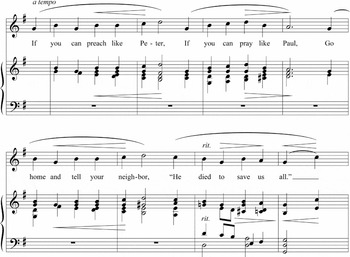
In the third item on the program Robeson turned to another musical home: the African American spiritual. In so doing he looked back not only to his debut appearance at Carnegie Hall in 1929, when he gave a celebrated solo recital of all African American spiritual and secular songs, but also to his childhood singing in his father's church as well. If the opening pair of songs offered various critiques, “Balm in Gilead” was a songful assuage to the troubles Robeson had seen. In the words of the spiritual, and as the singer himself had said numerous times during the 1950s, “sometimes I feel discouraged, and think my work's in vain.” But then too there was a balm that promised “to make the wounded whole.” Instead of urging listeners to spread “the love of Jesus” (as in some traditional versions of the text) Robeson encourages them, following Burleigh's arrangement, to “Go home and tell your neighbor.”Footnote 44 The explicit Christian evangelism at this point is generalized, exhorting the neighbor to action.Footnote 45
H. T. Burleigh (arranger), “Balm in Gilead” (New York: G. Ricordi, 1919), mm. 29–37. To hear an excerpt of Paul Robeson and Alan Booth's performance at the 9 May 1958 Carnegie Hall concert, go to www.journals.cambridge.org/sam2013002.

In Robeson's Carnegie Hall performance of the song it is precisely the word “neighbor” that is made the focus of the musical phrase. The melodic line and expressive markings in Burleigh's arrangement (see Example 1) demand to be realized as such, for the line rises to its acme at “neigh-bor,” which the score, through the accompanying crescendo marking, also signifies as the loudest point. But Robeson sings further notice to the lyric beyond the injunctions of the score. The previous two phrases (from “If you can preach. . .”), with which the verse commences a tempo, are hurried along, whereas “Go home and tell your neighbor” is sung more deliberately, each of its word-notes given due attention. The deliberateness is affected primarily through tempo choice. Robeson does not so much slow down through the phrase—the ritardando is indicated only for the following phrase—but rather sings “Go home. . .” at a much slower pace from the start of the phrase, as if stealing back the time he had taken from the previous hurried phrases, applying rubato across several phrases. The result is that “neighbor” is heard longest. Its intensity is also heard in Robeson's quick but widening vibrato that its longer duration permits.
The neighbor concretizes social relations in specific localities. But neighborly practices are also a model for action beyond the local in the terms of cosmopolitanism. In his exegesis of the spirituals as expressions of black religious thought, of which there is an esteemed tradition in African American theology, Howard Thurman discourses on neighborliness as the possibility of responding “across the barriers of class, race, and condition.”Footnote 46 The hospitality offered by the city of refuge is thus constituted of neighborly acts; indeed, cosmopolitanism has been described in terms of “outreach,” prosaically as “everyday practices of hospitality between people of different backgrounds.”Footnote 47 Inquiring into the “political theology” of the neighbor, Slavoj Žižek, Eric Santner, and Kenneth Reinhard comment that “neighbor-love has come to serve as a test of the meaning of affiliation, membership, and community” as it “requires a relationship or affective bond of some sort between the other and the self.” More than this, they ask, does it “call us to expand the range of our identifications or does it urge us to come closer, become answerable to, an alterity that remains radically inassimilable?”Footnote 48 This problematic question, as I discuss in the sections below, occupied Robeson in various ways.
Robeson's messages, though often engaging global themes and audiences, were directed in the first instance to specific communities in local address, and in local languages. The singer was a polyglot and often spoke to audiences in their own languages, in addition to including local songs on the program. Immediately after the more explicitly cosmopolitan Carnegie Hall concerts Robeson returned to Harlem to the Mother A. M. E. Zion church for a concert, “to come back and give my thanks here.” At the Mother Zion concert spirituals dominated the program for the black church community.Footnote 49 The spiritual performed a different function in Carnegie Hall, however.
In 1963 the BBC radio show “The Years Gone By” asked Robeson if his performance interests had shifted from the Negro spiritual. Robeson's response was that he continued to sing spirituals but that their function in his programs had changed since the 1920s: their inclusion now was to show “the unity, the relation, of Negro music to all the music of the world.”Footnote 50 Arguing for the unity of the world's music became, for Robeson, something of an idée fixe. He thus referred to the repertoire he sung as a “body of world music,” “discover[ing] in song the basic oneness of humankind.”Footnote 51 The first seeds of this thinking can be traced back to the late 1920s. In statements to the press, and some years before his well-known “turn to Africa” in the 1930s, Robeson seems to have desired to connect the spiritual outwards, first to Africa and then to the East.Footnote 52 It was only in the 1950s, however, that the shared genealogy of his songs was elaborated into a fully-fledged, if idiosyncratic, theory inscribed in a sixty-page manuscript provisionally titled “Paul Robeson: Thoughts About His Music,” a much abbreviated version of which appeared as an appendix in Here I Stand as “A Universal Body of Folk Music.” “During the recent years [that is, in the 1950s] of my enforced professional immobilization, I have found enormous satisfaction in exploring the origins and interrelations of various folk musics.”Footnote 53
Through neighboring, that is putting the self (as the spiritual) and the other (musics of the world) into a relationship, Robeson's desire was for unity, which should not be confused with the universalist sameness of identify that characterized the old European cosmopolitanism. In Robeson's singing of “Balm of Gilead,” the other performance highpoint in Example 1 occurs at the final word of the verse—“all”—which through a range of performative emphases are brought into a relationship with the previous lyrical climax on “neighbor.” Both “neighbor” and “all” thus stand out in their respective musical lines. Can we hear in Robeson's vocal emphases an injunction that the inclusiveness of the all-idea is brought about through neighbor-love? Neighborliness and neighboring are crucial to what John Tomlinson has called a “cosmopolitan cultural politics” that seeks to build and shape an openness towards relationships and solidarities beyond the self and local.Footnote 54 Robeson's concerts often expressed this structurally, as did, we will see, the Carnegie Hall recital.
“Unity”
The topoi of protest and freedom that inform many of the songs on the program, and which concerned Robeson for several preceding decades, are made explicit in a piece by Smetana, Píseň svobody (usually translated as “Song of Freedom”), but identified only as “Svornost (Moravian Hussite Melody)” in the program and translated as “Unity.”Footnote 55 That Robeson chose a revolutionary nationalist Czech song for this purpose speaks of the prominence of protest songs, especially from eastern Europe, in Robeson's repertoire and of his stance that the “battlefront is everywhere.”Footnote 56 But this was no mere topical-political move. The first three items on the program can be considered, in one sense, as personal responses—the public commentary in concert Robeson spoke about—to his situation in the 1950s: songs of defiance and heartsore. Having performed catharsis, the subsequent works broached cosmopolitan topics of a more general nature. That the next song, “Svornost,” was not sung in English exclusively perhaps further removed its expression from the sphere of the self.
For English-speaking audiences Robeson almost always presented foreign language songs as macaronic texts by the time of the Carnegie concerts, typically singing the first verse or two in English and the latter part of the song in the original language.Footnote 57 This is how he presented “Svornost,” which at mid-century was not standard art song performance practice. But it was a telling tactic of cosmopolitanism: the English translation, often preceded by a spoken introduction to the song, served to familiarize the music, preparing listeners for the foreign text to come, allowing them to better relate to the foreign. At the same time, as the song unfolded in performance it enabled a sharing of sentiment and message across languages and cultures, a feeling of unity, of “svornost.” Merskimmon suggests that in the cosmopolitan imaginary the process of translation is not one of loss, but rather of generative desire: to connect across national, cultural, linguistic limits, across the historical residue that reinforces people's isolation.Footnote 58 Robeson's macaronic songs become contact zones, interfaces that brought difference into connection. In this regard, one critic noted: “His many world tours have given him such close kinship with the people that when he sings their songs in their original language he so completely lowers any barrier which might exist between the stage and the audience that each person in the auditorium feels that he personally is the recipient of each song.”Footnote 59
A basic tenet of cosmopolitan thought and practice is to be open and receptive to the culture of others, to be interested in lives lived elsewhere.Footnote 60 But as Robeson was all too aware, this in itself is insufficient: “an appreciation of another people's art cannot by itself bridge the gulf which separates one people from another.”Footnote 61 Endeavoring to bridge that gap, to facilitate the understanding of the foreign, was in one sense Robeson's life's work. The philosopher Kwame Appiah notes that “points of entry to cross-culture conversations are things that are shared . . .. They do not need to be universal; all they need to be is what these particular people have in common.”Footnote 62 For Robeson, the fifteenth-century religious suppression of the Hussites or mid-nineteenth-century political and cultural oppression of the Czechs (both of which Smetana's song index) were instances of the struggle for freedom that resonated across time and place, connecting with the anti-imperialist struggles of the mid-twentieth-century world with which Robeson involved himself.
The singer also made connections between the songs he sang, attempting to unite his world audiences in a history of shared song. Thus several years after the Carnegie Hall concerts Robeson explained to a BBC radio audience that the guiding “idea of my concert” is “the suggestion that all men are brothers because of their music.”Footnote 63 The universalist claim was demonstrated with reference to specific songs, many of which appeared on the Carnegie Hall program. Heading the first group of songs in a typical recital was an “Old English song.” “Over the Mountains” fulfills this role in the Carnegie program. Next followed an “old song” from Czechoslovakia, which the singer identified as a Moravian chorale. Hence the significance of Robeson acknowledging the source—“Moravian Hussite Melody”—of Smetana's song of unity in the program book. A Bach chorale might follow and “then I create slight confusion by doing a Negro Spiritual right in the middle because it belongs there.” “Balm in Gilead” is the spiritual “in the middle” in the Carnegie concert.
Robeson's claim of belonging for the spiritual is an argument of place and rights. The social geographer Doreen Massey has written that place changes us “not through some visceral belonging . . . but through the practicising of place.”Footnote 64 Having spent much of his life on the road and lived in several global cities, Robeson's sense of home, as I discuss later, became an increasingly ambivalent one. From the cosmopolitan's outlook, the place of the spiritual, and by extension that of the black subject, radically changed in his thought. His refiguring of the spiritual's place in his programs placed it in terms of world music (history), much as the African American struggle was enlarged into, and sometimes sublimated by, a politics of identity and action for the world's oppressed peoples. This was the case already during his leftist Popular Front work in the late 1930s and early 1940s. In fact, Robeson arrived back in the United States in 1939 proclaiming the spiritual, as Lisa Barg has shown, “an international symbol of freedom,” thereby reconstructing the genre's history. This accorded well with Popular Front ideology, which was characterized by an inclusive cultural pluralism or pan-ethnicism to use Denning's phrase. Charting the contradictory claims this ideology made in terms of the U.S. nation, Barg argues that Robeson's Ballad for Americans project “stands as one of the most dramatic public representations of the Popular Front emphasis on interracial unity and black racial inclusion within the nation,” concluding that it “symbolized not a false unity [of the nation] but the unfinished business of universal democracy.”Footnote 65 Indeed, at a speech to the American Music Festival in Chicago in 1946, Robeson explained how, as a “world citizen” he observed “the essential unity among the great masses of people of different races and faith.” Unity, he claimed, should not be “confined to a city, state, or a nation . . .. There must be unity of the people for their common good—for worldwide . . . democracy.”Footnote 66 The musical connections Robeson invented for his repertoire were therefore part of a broader politics of cosmopolitanism.
A Lullaby and a Fraternal Song
Juxtaposing Smetana's militaristic freedom song and a Schubert lullaby, which followed on the program, presented multiple contrasts: of subject, genre, and mood, and is thus a convention of good recital programming. It also continued to explore the theme of unity. Robeson's desire to be close to other people, and to bring people close to each other, accounts in part for the prominent place of children's songs of varying types, and from different parts of the world, in his repertoire. Schubert's “Wiegenlied” (in the program “Sleep My Little One”) is the representative in the first half of the program, and a Mexican example was placed in the second half; a Chinese children's song was included in the second recital. (With non-English lyrics, these songs all received the macaronic treatment.) Thematizing the subject matter of childhood appealed to Robeson. The lullaby, the singer proclaimed, was “the most universal and beloved of all songs, sung by people of all ages, everywhere.”Footnote 67 It therefore made for logical programming to offer an explicit message on this theme as the climax of the first half: “Then I wind up with the Beethoven of the 9th Symphony, of Schiller's words ‘all men are brothers.’”Footnote 68
That Robeson chose the version of Beethoven's “choral melody” named “All Men Are Brothers” speaks of his often repeated “belief in the oneness of humankind,” and of “the great family of mankind.”Footnote 69 The version he performed at Carnegie Hall is a curious textual conflation. It begins with an English translation, followed by the Beethoven-Schiller German text, and concludes with the latter two verses, with some modifications, of the “Hymn to Nations” popularized by Pete Seeger (which appropriated Beethoven's melody for new words by Josephine Bacon and Don West). Including the latter introduced the protest credentials of “Hymn to Nations”—which would appear on Seeger's LP Songs of Struggle and Protest—while clarifying the original text: “Build the road of peace before us . . . None shall push aside another . . . All for one and one for all.”Footnote 70
The historian David Hollinger has presented a case for the new cosmopolitanism as being doctrinally positioned between universalism (expressed in the “All Men Are Brothers” sentiment) and pluralism (presented in the diverse children's songs). It is determined to “maximise species-consciousness,” to fashion tools of understanding and acting on problems of a global scale. But it also promotes diversity, recognizing the power of the ethnos and nation, and other group formations, in non-dogmatic and more fluid ways than the pluralist tradition.Footnote 71 Following Steven Vertovec and Robin Cohen, we would need to explore how Robeson mediated actions and ideals oriented both to the universal and the particular, the global and the local.Footnote 72 Inevitably tensions arise in these sometimes-conflicted endeavors. One such discord, among several, that Robeson faced in the 1950s was what many saw as an irreconcilable commitment to the (national) civil rights and (global) anti-imperial movements. Slate reminds us that advocates of “Cold War civil rights” embraced narrow notions of civil as opposed to human rights, such that “mainstream” civil rights organizations contributed to the red-baiting of Robeson.Footnote 73 Branded un-American, the singer-activist was also shunned as a black American. Robeson's Here I Stand was in large part an apologetic manifesto, a “clear declaration to black America that Robeson viewed his primary allegiance as being to his own community.” The book's very first words assert: “I am a Negro.”Footnote 74 As Hollinger and others have argued, however, such a position does not necessarily constrain the cosmopolitan imagination.
By concluding the first group of six songs with an hybrid paean to peace, Robeson deconstructed, for cosmopolitan ends, the idea of song grouping itself, an organizing principle of art song recital programming that his own recitals drew on, and which he learned as he entered the “concert field,” as he termed it, in the 1920s and 1930s.Footnote 75 In this tradition songs in a group should affine, commonly through chronological telos, linguistic uniformity, and national kinship. By contrast, the first group of the Carnegie recital displays a radical diversity that undermines these conventional coherences, but one that accommodates—indeed is necessary to—a presentation of cosmopolitanism.
Paul Robeson's 9 May 1958 Carnegie Hall recital, second group of songs. Used by permission of the Carnegie Hall Archives.

As I noted in the introduction, this more radical loosening up of the group logic that structured song recital programming happened more consistently in the 1950s, culminating in Carnegie Hall–type programs. Robeson's son recalled that during the mid-1950s his father developed “a new concert format—a presentation . . . appealing to a broad section of music lovers.”Footnote 76 The format seemed to perplex some, as this 1957 review suggests:
It was an unusual program, not so much in content as in arrangement. It ranged from folk songs to opera, with Othello's final speech tossed in as an encore; it offered an initial group which was mainly religious, but within this unity it placed Bach next to Roger Quilter and a Negro spiritual alongside a Jewish chant in disregard of long standing, if perhaps unnecessary, concert tradition.Footnote 77
Perhaps the presentation of cosmopolitanism in this format, which continued in the Carnegie Hall recitals, distinguishes it from the “performative black internationalism” that Barg has argued embodied the singer's concert programs at the time of his Popular Front work.Footnote 78 Robeson's recital programs at this time, in the early 1940s, tended to adhere to the logic of song recital practice: An all “English” group of four songs commenced the Purdue University Hall of Music recital of 14 February 1942, and a group of four spirituals concluded it; a selection of four “Russian” songs was the central group in a McMillin Theater concert of January of 1943.Footnote 79 Such national and ethnic ordering of song does not structure the Carnegie Hall program in 1958.
“Going Home”?
The concert began with a song about a cosmopolitan's journeying, and the second group with the popular song “Going Home,” prominently positioned midway through the first half of the concert. (It appeared as the final number of the first side of the LP live recording of the concert that was subsequently released.) “Home” is a recurring topos in Robeson's singing and writing—and in the (self-)narration of his life—and “Going Home” offers a certain performing of home. Robeson's discourse on home is often accompanied by anxiety, of the order “where is home?” or “when will I return home?”
In the song, home is lyrically abstracted in the hereafter,Footnote 80 and Robeson's performance too works against creating a visceral sense of place. It is a gentrified performance, appropriate to the venue and its dominant performance tradition, and consistent with Robeson's studied international singing style. The recital program book rejects the American vernacular of the published song title, “Goin’ Home,” and Robeson studiously replaces each vernacularism with standard English: “I'm a goin’ home” becomes, in Robeson's singing, “I'm just going home,” and in the interest of articulating the “lost” syllables in “Mother's there ‘spectin’ me,” he fills out the melodic line. Whereas earlier in his career he typically, if selectively, performed in dialect, he later on preferred an international standard English.Footnote 81 Robeson's interpretation of “Going Home” thus masks the linguistic markers of the song's (African) Americanness. Nonetheless a national identity had long been ascribed to the song; Richard Taruskin makes the point that although it “may not have been a spiritual to begin with, [it] became one.”Footnote 82
Robeson performed many popular “dialect” songs throughout his career, which, together with art song arrangements of spirituals and black secular song, were standards of his concert repertoire. His life-long engagement with this material stemmed from the home and community, the family and church, and its later performance was framed within a politics of black history and heritage, and thereafter as we have seen a cosmopolitics. But at first his singing of spirituals was a symbol of black pride: “we staked our careers-to-be on the concept that the songs of the Negro slaves were concert material, ranking in musical stature with the acknowledged classics.” More than this, putting spirituals on to the concert stage highlighted their value on the world stage, and their value to the development of world culture: “I came to appreciate the fact that the speech and customs of my people are rich, beautiful, vigorous and important, and that they can and should be a rewarding contribution to world culture.”Footnote 83 Speaking to the world from home is how Robeson asks us to hear his performance of black music by the time of the Carnegie recitals. It was also how the Indian cosmopolitan Kamaladevi Chattopadhyaya, who met and admired him, heard the singer:
when Paul Robeson sings he becomes something more than a singer. He transcends all human limitations and becomes the disembodied melody, which knows neither colour nor race. He interprets the ageless, deathless spirit of his lost land of Africa, his priceless heritage, before which even the hooded order of bigotry and hate spontaneously retreat.
In this evocative, if problematic, description, Kamaladevi hears in Robeson the dual nature of “colored cosmopolitanism”: an accommodation of universal humanism and a particularist racial identification, asserted both within the national and international contexts.Footnote 84 If we do not immediately hear “colour [or] race” in Robeson's “Going Home,” the song's text and performance were borne of transracial and transnational encounters. A product of Dvořák's sojourn to the United States, the song was the result of the composer's (and arranger William Fisher's) championing and compositional reimagining of black music, just as Robeson's international English sound was learned in the process of becoming a world artist, and was in part a rejection of the (white-authored) framework of minstrel dialect songs.
A cosmopolitan view might account for how Robeson, through the medium of song, “narrates a dual [or even multiple] structure of feelings” that is attached both to “where one is at” and “where one is from” and has been. Thus formulated, simultaneity is a defining feature of cosmopolitan being.Footnote 85 Cosmopolitanism does not negate the idea or importance of home, but it does allow for its reconfiguration beyond, for example, the local or national. The tensions in Robeson's performance of “Going Home” are revealing of different formulations of cosmopolitanism. On the one hand Robeson's international voice suggests a universalizing of the song and the cosmopolitan subject, and even a denial of home; he is Kamaladevi's “disembodied melody.” Yet at the same time there exists the popular history of the song as “black” and its lyric desire for home; and so Robeson also expresses Kamaladevi's “priceless heritage.”
Tellingly, it was during the period of his intense (self-)discovery of “Africa” in the early 1930s that Robeson identified himself as cosmopolitan: “I am proud of my African descent,” he announced, adding a cautionary qualification: “But I am very far from being color-conscious in the sense in which your true Communist is class-conscious.” His explanation was thus: “you must remember that I am essentially an artist and a cosmopolitan.”Footnote 86 If Robeson here gestured towards what has been called the cosmopolitan's “extroverted sense of belonging,”Footnote 87 then we should recognize that in that enlarged sense of being—the world as home—one's experience of home is sometimes profoundly affected. Robeson's wistful performance of “Going Home” performs the ambivalent affects of home, and the singer was by no means always at home in the world. On receiving news just a month after the Carnegie recitals that his passport had been restored, and facing the reality of global commitments again, he remarked wryly: “I'll inevitably get caught up in the ‘citizen of the world’ maelstrom . . . I'm worried about getting back here.”Footnote 88 He would not return to the United States for five years, and by then his singing career had reached its end.
A Double Dose of Musorgsky
Mid-way through the first half of the recital Robeson lightened the mood by turning to a humorous English folk song: Cecil Sharp's sanitized version of the bawdy “Oh No John.” (“The lines were coarse and needed considerable revision,” moralized Sharp.Footnote 89) The limited melodic content of the song presented in pithy verses at a jaunty pace allowed Robeson a breather, and although the song's spirit was somewhat alien to Robeson's performance persona, its status as folk music was central to his cosmopolitical thinking. Folk songs, Robeson wrote in Here I Stand, “drew me spiritually close to the common peoples.”Footnote 90 The remainder of the half, and indeed of the program, in different ways presented music of the people; something Robeson had been doing since the Popular Front period.
In the foreword to Favorite Songs of the Red Army and Navy (1941) for instance, Robeson lamented that in “many lands, the Arts, and especially Music, have been cut off from the general life of the nation.” It was “one of the great problems of our time” to make “the great creations of the mind and spirit available to all.” Robeson's belief was that such “cultural sharing” (a cosmopolitan ideal) would create an “enlightened and sensitive citizenry.” It was also his belief that the Soviet Union provided a model, for there “Art was closely wedded to life.”Footnote 91 Drawing on a popular, much rehearsed image of the composer, Robeson consistently held up Musorgsky as exemplary of this relationship of art and life. At the Carnegie recital Musorgsky was introduced as “a composer who was so close to the people of his land.”Footnote 92 Robeson typically presented songs of the classical tradition to his audiences in this way: the composer as “people's artist,” an epithet that he himself had worn for some time.
The two Musorgsky items on the program, sung one after the other, took as their subjects down and out people of widely different social station: a king, Boris Godunov (Robeson sang part of the Act 4 death scene aria), and an orphan. “The Orphan” allowed for the continuation of Robeson's self-presentation that in part guided the Carnegie program: the orphan's abandonment is akin to Robeson's betrayal by nation and black community. The song also reiterates a practice of cosmopolitanism I've raised previously, as the alienated orphan is reliant on strangers’ acts of hospitality, acts that, suggested by Robeson's powerful performance of the song's desperate final plea, seem not to be realized.Footnote 93 It is a poignant caution of the consequences of everyday actions not guided by cosmopolitan ethics.
The Musorgsky items were sung in Russian, though with spoken English introductions, revealing Robeson's engagement with the foreign in a very real way, and more so perhaps than at any point on the program to then. He was reasonably fluent in the language, which he demonstrated in a recited monologue that preceded the aria; it was well known that he spent considerable time in Russia (at one point contemplating living there) and admired Russian culture, Soviet policy, and socialist ideals. Robeson moved among the spectrum of Russian society, from Khrushchev to factory workers. It was, as he said of Welsh miners, as if they “had adopted me as kin.”Footnote 94
Robeson's study of languages exceeded the requirements of craftsmanship necessary for the art singer's performance of foreign-language repertoire. We can in addition consider his approach to languages a consequence of a cosmopolitan outlook, which in turn facilitated cosmopolitan action: “Knowing a language,” he observed of his own experiences, “one can go places and meet people, come to know people, and come to know and enjoy and use their music and literature.”Footnote 95 According to this logic, the dialectic of knowledge and encounter resolves itself in the use of others’ music for purposes of exchange and understanding. The “international character” of the passport case was in part argued by appealing to the value of “cultural exchanges between all countries” in the interests of promoting world peace.Footnote 96 That cultural exchange could ameliorate Cold War tensions was a cornerstone of the rhetoric of the transnational Peace movements, for which Robeson was spokesman and symbol. One L. de Boissière wrote from Australia that the “exchange of culture between countries is one of the strongest means of building world peace” and that Robeson “could be of great service to his country by helping to forge a link of friendship between America and other countries.”Footnote 97 The Robeson archive is shot through with expressions of such sentiment.
Robeson's interest in languages had a more specific aesthetic intent than the competent pronunciation of foreign lyrics. He developed a loose theory of the relationship between speech and singing, and was most attracted to song that demonstrated this connection. “I am so interested in this idea of speech-into-song and vice versa,” he professed. Hence his affinity for folk song, which he considered not just close to speech but an extension thereof. Hence also his fondness for Musorgsky. Boris's “Farewell, My Son” aria, which Robeson sang at Carnegie, worked “equally beautiful in speech or song, or combination of both,” he argued.Footnote 98 A combination of different modes of vocalization was indeed how he performed the work at the recital. He begins by introducing the work and its composer (to 0:15), and then gives a spoken synopsis of the aria and its dramatic context in English. During the third person narration of Boris's hallucination (from the end of Act 2) that follows, Robeson's voice glides gradually into recitation (at around 0:30), much in the mode of his oration of an excerpt from Othello that he performed at the recital. By this time Robeson is in classical theater recitation voice. Then he switches to Russian (at around 1:00). But it is spoken-recited Russian, rather than the half-singing called for by Musorgsky's score. The singing voice enters only with the commencement of the prayer (at 1:35). Presenting assorted material from Boris Godunov in this way, from speech-into-song, demonstrated in concert another facet of Robeson's theory that the musics of the world were connected: “classic compositions . . . based on the speech rhythms of their peoples,” were, Robeson argued, like “our Negro music [which] derives its character from the poetry of Negro folk-speech and sermon.”Footnote 99
The “passage” is a useful figure to think through Robeson's cosmo-musical musings. Meskimmon proposes that passages allow for the reconceiving of the world citizen beyond the multicultural fantasy of cosmopolitans, “whose open-mindedness simply transcends material differences between themselves and others.”Footnote 100 The passages effected in Robeson's performance are many: from speech to singing, from English to Russian, from folk music to art song, from one genre to another, and one cultural tradition (in one part of the world) to another (elsewhere in the world). For Robeson these passages were at once aesthetic, ethical, and political. They are ethical because they aimed, through encounter, to foster exchange and understanding—and ultimately action. The figure of the passage links the body and home with the world through journeying. The slave song, and black body politic, originary points in Robeson's domestic economy, are reconfigured to connect with global networks of empire: the singer's global anti-imperialist activism was in part informed by the example of Russia's own revolution, and already as early at 1929 he was making connections between Russian “serf sorrows” and the (music) history of the American slave.Footnote 101 The material world therefore drove Robeson's cosmopolitan imagination.
Passage moreover allows for “an inter-subjective negotiation of place, power and knowledge that can instantiate a new way of inhabiting the world.”Footnote 102 Robeson's evolving interpretation of Othello (and of his own subject-position) is indicative of the transformative effect of passage. His first portrayal of the Moor in London in 1930 was conceived as a “tragedy of racial conflict,” as a “problem of my own people.” By the time of his Broadway and American debut in the role in the early 1940s a “more mature understanding and experience” had led him “to think of Othello not so much as a Negro, but rather as a foreigner, an alien, who finds himself in a strange country, society and culture.”Footnote 103 This position universalizes the problem of Othello—shared by the immigrant or refugee, or, like Robeson, the artist in (self-)exile—and issues a challenge of hospitality to the would-be cosmopolitan. A final consideration of the passage as figure in the cosmopolitan imagination is that the mechanisms by which a song comes into signification are themselves passages, instances of circulation and conversations.
A Trio of Folk Songs and an Encore
To end the first half of the recital Robeson presented a small collection of songs of more explicit folk provenance. There are folk songs from Russia and China, and a Russian Jewish offering: the “Volga Boat Song” made famous in the West by Feodor Chaliapin, an unspecified Chinese song, and the folklorist Joel Engel's 1923 arrangement of the “Hassidic Chant,” a kaddish or prayer.Footnote 104 Together with the two Musorgsky songs they concluded the second group, and the first half. The recital, having started in the West, had by the end of the first half moved to the Orient. How we interpret that “journey”—in one sense, as metaphor for the passage prohibited the singer—and how the western repertoire is juxtaposed with “foreign” songs is a challenge Robeson poses to us.
Cosmopolitanism attempts to “build bridges of cooperation across difference,”Footnote 105 and one of the means by which it does so is to proceed from the belief in and pursuit of commonalities. Robeson's thinking about folk music, which came to guide his recital practices, is an unambiguous statement of this position:
I have found enormous satisfaction in exploring the origins and interrelations of various folk musics, and have come to some interesting and challenging ideas . . . there is a world body—a universal body—of folk music . . . Interested as I am in the universality of mankind—in the fundamental relationship of all peoples to one another—this idea of a universal body of music intrigued me.Footnote 106
In structuring the Carnegie program Robeson created what in cosmopolitan theory has been called a “deterritorialized locality,” a social—and here, concert—space that is deterritorialized and thereby re-territorialized as a cosmopolitan space, a place of civic culture based on multiple publics “opened to the world.”Footnote 107 The effect of this is powerfully enacted through affective exchange, by which different listeners, who may not be positioned as unified subjects, experience connections.
In pursuance of this end, Robeson invoked the congregational ideal in his performance of an encore, the spiritual “We Are Climbing Jacob's Ladder.” In this less formal moment of the recital, at the start of the penultimate verse, Robeson interrupts his own singing: “We are. . .” he sings, but breaks off to invite the audience to “Join me” in song, and then continues singing “. . . climbing Jacob's ladder” (1:45).Footnote 108 In doing this he further connects with the audience, and these listeners-become-singers become a community of “soldiers in this fight,” to borrow Robeson's altered lyrics for the spiritual. Such moments, legion in Robeson's performance history, allow for a participatory, even transformative, “dimension of belonging.”Footnote 109 Robeson begins the final verse of “Jacob's Ladder” in a hushed sotto voce (at 2:20), compelling his auditors to listen closely, to become more intimate in their communal performance. The massed singing then leads to a thunderous climax, and the Robeson-audience voice becomes pure sound stripped of audible word (2:52–2:56). It is tempting to hear in this the dissolution of Robeson's self into the (concert) community, a final gesture of affiliation and unification.
The Carnegie Hall recitals presented many such moments, and listeners around the world would hear the singer's message. A year later, a “humble and sincere listener” from Ireland, Noël Bennett, professed that Robeson's songs “draw us all closer to one another in a deeper bond of love and fellowship.” Bennett hoped that such a “bond” would “break down unnecessary barriers and prejudices.” And from the other side of the world, a Sydney telephone exchange worker Alison Barton acknowledged that she “learnt a lot from [Robeson's] concert,” from “the philosophy which you imparted to us.” She too hoped that “one day . . . we shall see the true brotherliness of man expressed throughout the world.” If, as she confessed, she and her party “sat listening to you and loving you,” she projected this as a mutual exchange of affect: “I had the feeling that you too, loved every one of your audience.”Footnote 110 These everyday expressions of communing, of thinking and feeling beyond the nation, encourage us to contemplate anew the efficacy of music. In the words of one writer, Robeson “sounded like the voice of a community raising a question of history.”Footnote 111 We are challenged to explore what sorts of questions he raised in song and for which communities he did so. The challenge presented by the Carnegie Hall recital was to offer, after a decade of insular American nationalism that had affected Robeson's life and career in the most profound ways, an alternative way of being in and relating to the world, to exercise a cosmopolitan imagination.