In March 1999, cholera struck Mahajanga, Madagascar.Footnote 1 Having never appeared on the island in remembered times, the epidemic took doctors, public health officials, and various publics by great surprise.Footnote 2 The Malagasy Epidemiological Surveillance team erected sanitary barricades at the Mahajanga-Antananarivo provincial border, where oral doxycycline was routinely administered to travelers.Footnote 3 Despite these efforts, the epidemic quickly spread across the island and overwhelmed the country's health system.Footnote 4 In total, the outbreak resulted in some 1,100 deaths and 20,000 cases of infection in the span of a year.Footnote 5 Public health researchers attributed the arrival of the epidemic to the long-standing maritime routes between northwest Madagascar and the Comoro Islands, where cholera had been active since at least 1998.Footnote 6
But city dwellers recalled things differently. In my interviews with long-term residents, they described that the cholera outbreak of 1999 came about, in part, because of the irksome persistence of jangoany (outdoor defecation) and the failure of some to use latrines across the city. Jangoany was widely linked by a range of urban inhabitants to those of Sakalava and Tandroy descent as evidence of those groups' ostensible tenacity to ‘traditional’ ways rooted in longstanding ancestral prohibitions. During the outbreak, city administrators came house-to-house inspecting for the presence of a latrine in or adjacent to each dwelling to ensure inhabitants were not spreading the dangerous bacteria vibrio cholerae through open defecation.Footnote 7 Rumors circulated during and after the cholera epidemic that some ‘Sakalava’ residents constructed latrines only to satisfy the inspectors, but in fact continued to defecate outdoors as ancestral taboos prevented them from defecating in their household compound.Footnote 8 In the aftermath of the epidemic, and apparently informed by these ongoing perceptions, city officials and development workers involved Sakalava royal leaders as key figures in city-wide efforts to eliminate open defecation.Footnote 9 With a recently awarded grant from the Global Sanitation Fund, city leaders hoped to garner the influence of Sakalava royalty to eradicate jangoany throughout the province within four years. Newspaper reports proclaimed that this was a ‘great first for the Sakalava tribe.’Footnote 10
The 1999 cholera epidemic was not the first time that concerns about human waste — its disposal and infrastructure — emerged publicly in Mahajanga's history. Over the past century waste management has constituted a contentious terrain on which competing groups in the city — migrants, long-term residents, and city administrators — debated and reworked moral norms of urban life. Like elsewhere, human waste in northwest Madagascar has been central to the production of social order and the spatialization of social relations.Footnote 11 In the city's colonial era, Malagasy and Comorian migrants, and French colonial officials in Mahajanga, grafted competing norms about ethical propriety, honorable work, and appropriate urban comportment onto waste practices and sanitation labor.
Nor was it the first time that city residents drew on descriptions of waste practices to differentiate themselves from others and to demarcate social-ethnic differences. Waste management in this heterogeneous port town had long been bound up with ethical ideas about purification and pollution which necessarily involve certain spatial and moral practices. Malagasy of diverse backgrounds have generally regarded ancestrally-proffered practices that prohibited contact with excrement and prescribed rituals for purification following contact with different contaminants. Migrants from the Comorian Archipelago to northwest Madagascar were similarly averse to filth, though they primarily undertook purification practices as informed by their Islamic faith. But the boundaries and definitions of contaminants, along with the ritual means for cleansing, varied over time and across kinship and ethno-linguistic affiliations, and the city's inhabitants historically differentiated themselves in part by these perceived standards.
The explicit distinctions of some groups as ‘traditionally bound’ to open defecation that surfaced in the aftermath of the cholera epidemic of 1999, were unusually overt public expressions of ethno-linguistic demarcations in a postcolonial political landscape characterized by efforts to gloss over differences among diverse Malagasy groups. Public rhetoric has long emphasized and enacted a national identification cohering around an ideological concept of collective solidarity (fihavanana), often contrasted with external corrupting influences of contemporary urban life.Footnote 12 But the sentiments evidenced in these public remarks reflected longer-standing historical constructions of difference through the index of waste. This article tracks how shifting ideas about appropriate waste treatment intersected with the emergence of labor regimes over the twentieth century. Following the introduction of colonial sewage infrastructure, city residents ascribed their own ideas about degrees of filth, bounds of contamination, and the stakes of proximity to human waste onto the labor associated with sewage treatment. The boundaries of who could — and could not — handle waste, I argue, came to constitute critical markers of social difference and moral righteousness by the mid-twentieth century.
It is striking that for much discussion of ‘sanitation’ in urban African historiography, relatively little has been documented about how urbanites have conceptualized and managed bodily waste and sewage.Footnote 13 Historians of African cities have long been concerned with sanitation, but these studies have largely focused on how sanitation discourses were instrumental in colonial segregationist and urban planning processes. Scholars have described how anxious colonial administrators invoked public health concerns to justify racist segregationist schemes in cities across the continent, drawing explicitly on Maynard Swanson's longstanding and highly influential concept of the ‘sanitation syndrome’. In a recent article in The Journal of African History, Marc Epprecht cautioned against the use of the term ‘sanitation syndrome’ as an axiomatic explanatory framework and usefully called for ‘careful attention to local evidence’ to assess how historical actors framed and participated in debates around segregation.Footnote 14 This article extends Epprecht's critique to ask: How has ‘sanitation’ been fundamentally constituted as an intellectual and material category by different historical actors over time?
As historians of African cities have shown elsewhere, colonial officials entrenched racial segregation and produced inequalities through infrastructural disparities.Footnote 15 Sanitation systems, along with other infrastructures of electricity, roads, and hospitals were installed disproportionately, and at times exclusively, in European residential areas.Footnote 16 Less is known, however, about the material and labor dimensions of waste management. Drawing on the story of sanitation in Majunga, I argue that historians ought to attend to the particular material arrangement of colonial sanitation infrastructure, in addition to the production of unequal citizenship through differential infrastructural allocations. Doing so exposes how the official choices to implement particular infrastructures in colonial times created new demands for certain kinds of labor — namely construction and maintenance work. Africans valuated these work roles — especially those involving direct disposal of human waste and the maintenance of pit latrines — through moral registers of honorable labor and ethical character, even while they appraised the burdensome constraints on everyday life under French colonial rule.
Following the 1895–6 French military conquest, colonial officials introduced pit latrines as the primary sanitation technology to address waste disposal of the city's growing urban population. Technocrats drew on existing models developed in the metropole and other colonies, to orchestrate a system of decentralized latrines, which required intensive manual labor to preserve their functionality. This fell in sharp contrast to prevailing practices in Majunga of distributed sanitation, where residents disposed of human waste across a sprawling ecological landscape and relied on decomposition through natural elements to prevent contamination and illness. Critically, while established Malagasy waste practices depended on dispersal, the French model introduced in Majunga hinged on a concentration of filth. These contrasting spatial modes reflected different conceptions of human waste treatment that were crystallized, I argue, through French colonial technological interventions and the new labor regimes they required. In the decades between 1910 and 1960, Majungais negotiated new meanings around waste management and debated the codes of honorable work. Many residents — especially those self-identifying as of Sakalava descent — rejected the sanitation work required to maintain the colonial waste infrastructure as abhorrent and polluting, or as a part of a broader rejection of waged work they equated to forms of enslavement and subservience.Footnote 17 In the dearth of willing sanitation workers, French colonial officials were obliged to rely on forced prison laborers to conduct the removal of excrement from public and household pit latrines in the early decades of the 1900s.
Over time, a small group of migrants from the Comorian Archipelago seized the economic affordances of waste work to accumulate capital and expand their property holdings. They, like the entrepreneurs who came after them, used the possibilities of waste work to different ends and with varying consequences. Those that engaged in filth removal work (mangala tay [‘to remove excrement’ in Malagasy] or m'tzaha maji [Shikomori]) often grew relatively affluent, but they risked stigmatization and public suspicions of their moral character. Some town residents questioned the legitimacy of wealth they gained through contact with excrement, signaling the contaminating character of money and the corrosive dimensions of private ownership that came with accrual of capital. At the same time, in interviews with diverse inhabitants, Majungais acknowledged the burden carried by sanitation workers (mpangala tay) and nostalgically recalled that these Comorian workers brought about the city's apogee of urban purity in the 1960s and early 1970s. But this era did not endure. By the mid-1970s, a significant population of Comorians — working in sanitation, private sector manufacturing, and in civil service jobs — garnered enough wealth to establish households, build homes, and collectively erect substantial mosques in the central districts of town. Newer waves of migrants, especially from southern and southeastern Madagascar, however, grew to resent bitterly the overbearing presence of Comorians and lament their own economic vulnerability and marginalization. Tensions grew steadily until December 1976 when, in a culminating moment of unrest, Comorians were violently expelled over three days. This moment exposed urban masses’ longstanding rancor about the economic and spatial dominance of those of Comorian descent.
In charting the historical processes that shaped the shifting debates around waste labor and management, we must also grapple with the methodological and epistemological challenges inherent to waste histories. Concerns about waste are not particular to colonial administrators, but rather have been germane to human societies across deep time and space. Serious excavation of histories of waste thus necessitates moving beyond colonial times and documentary sources, and employing oral, linguistic, and archaeological sources and methodologies to reach into the early African past. Perhaps owing to its distasteful nature, researchers have largely sidestepped histories of solid waste and excrement — the conceptualization and treatment of waste, and the relationships between waste, socio-political hierarchies, and labor economies.Footnote 18 But historical perspectives on waste are critical for understanding the past and may offer possibilities for rethinking the enormous infrastructural, public health, and ecological challenges facing contemporary African cities.
I begin by exploring scant evidence concerning Malagasy perspectives on waste management practices from the city's earliest days in the late eighteenth century to colonial times. Using a range of documentary and oral sources, I then track how the increasing material investments in the city's sanitation system — cesspools, latrines, channels, barrels, and buckets — engendered emergent labor regimes. Just as historians have been reticent to write about waste practices, so too were colonial authorities relatively silent on matters of bodily byproducts in the case of Majunga. Oral accounts and ethnographic fieldwork thus offer important sources of evidence about how moral conceptions of contamination and purification have intersected with sanitation technologies and social hierarchies. Collectively taken, these sources offer a portal into how different communities in Mahajanga negotiated their relationships to urban space — and to one another — through periods of austerity and social tension.
MANAGING SPACE AND WASTE IN EARLY MAJUNGA
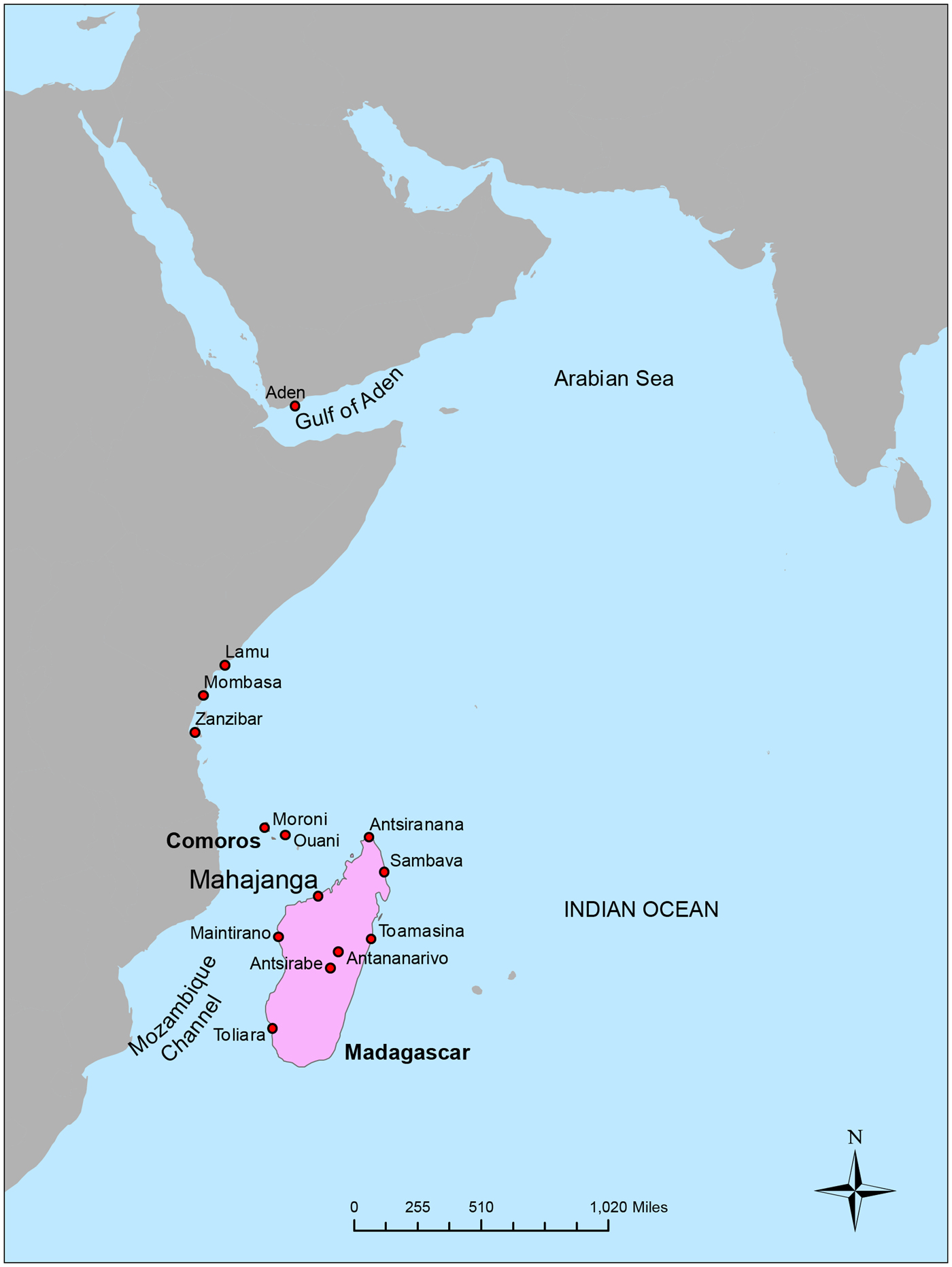
Little is known about how people dealt with waste, or conceived of purity and filth, in the earliest days of the town's formation in the mid-1700s.Footnote 19 The city originally emerged as a trading center, connected to Indian Ocean trade routes through the traversals of Antalaotra merchants, a group of Swahili and Malagasy Muslim elites (see Fig. 1). Antalaotra (literally ‘people of the sea’) established settlements infused with Islamic and Swahili architectural styles along Madagascar's northwest coast from at least the fifteenth century.Footnote 20 They were aligned — somewhat tenuously at times — with Sakalava royal figures who expanded their authority from the southwest into the northwest region during the seventeenth century.Footnote 21 Throughout northwest Madagascar, Antalaotra served as key intermediaries between Europeans and Sakalava monarchs in the slave and spice trade during the seventeenth and eighteenth centuries.Footnote 22 Antalaotra enjoyed longstanding networks with Comorian merchant and religious communities, many of whom also settled in the city.Footnote 23 And they were gradually joined over the eighteenth and nineteenth centuries by other Muslim traders from Surat and Kutch, as well as Makoa, who were brought from northern Mozambique in the mid- to late-nineteenth century as enslaved captives through the trans-Mozambican channel slave trade.Footnote 24 Although traders were obliged to comply with the customs controls and duties of Sakalava rulers, Sakalava monarchs permitted these communities a great deal of autonomy over their religious and judicial matters.Footnote 25
Map of Madagascar and Indian Ocean

Among the key practices shared by diverse Antalaotra, Comorian, Makoa, and South Asian (karana) communities were Islamic observances of purification and reverence. As such, fountains, mosques, and tombs were among the earliest structures erected in the city. Skilled masons from these overlapping communities constructed mosques and tombs adjacent to the main residential area nestled along the low-lying seaside. European travelers to the city in the mid-1800s described a well-built reservoir and fountain on the north side of town from which ‘water would fall in a cascade, in a washing room’ and observed that Muslims went there to perform ablutions.Footnote 26 Eighteenth century accounts also described that, at the city's apogee the town was expansive, stretching nearly one mile along the coastline, with ‘sandy and generally clean streets.’Footnote 27 The dispersed configuration of the town would have lent itself to maintaining distance between human dwellings and human waste, as a tactic for managing waste in the early settlement. Defecating in unpopulated, overgrown areas would have utilized desiccating properties of sunshine and scavenging mammals (goats and rats) to decompose feces and minimize health risks.Footnote 28 The places deemed appropriate to defecate were most likely far from domestic quarters.
Although written accounts of sanitation practices in precolonial Majunga are sparse, textual accounts in dictionaries and contemporary oral accounts offer some insights. Filth has long been central to Malagasy conceptions of personhood, as it is universally.Footnote 29 One of the earliest known written Malagasy dictionaries, compiled by French Governor and botanist Étienne de Flacourt and published in 1658, differentiated between loto (vb. maloto) as ‘dirt,’ ‘filth’, or ‘stain’, and tay(e) as ‘droppings’, ‘fecal matter’, or quite plainly, ‘shit (merde)’.Footnote 30 By the nineteenth century, British missionary J.J. Freeman noted that loto (vb. maloto) meant not only ‘dirty’, ‘filthy’, but also potentially ‘sully’ or ‘blame’.Footnote 31 Subsequent dictionaries, published by French and British missionaries with Malagasy interlocutors, carried forth this definition and by all accounts loto retains this correlation with filth in contemporary times across the island. In coastal dialects, kota (n.) denoted ‘dirt’ or ‘excrement’, while makota (vb.) could be used to describe the act of pollution or a filthy person or thing.Footnote 32 Relatedly, vorery or voretra (vb. mamorèry) indicated an act of defilement and profanity.Footnote 33 This term is likely related to sorcery and has historically been used in highland speech varieties to reflect the longstanding connection between filth and both physical pollution and spiritual corruption.Footnote 34
Across geographical space and time worldwide, human muck has been used as agricultural fertilizer — even likened to ‘liquid gold’.Footnote 35 But this appears to have never been the case in Madagascar. Fertilizer (zezika) was ‘never used of the excrement of human beings’.Footnote 36 The threatening nature of human excrement was embedded in a broader cosmological domain, in which contamination constituted violations of ancestral prescriptions that could destabilize harmonious relations with the spirit world. ‘If one falls into filth [excrement] it is honor that is destroyed’ read a Malagasy proverb recorded in the late nineteenth century.Footnote 37 Even more ominously, Malagasy speakers would excuse themselves when saying something repulsive by uttering ‘the mouth of the sorcerer is filthy as excrement’ (tay be am-bavan'ny mpamosavy).Footnote 38 Contamination associated with feces could apparently bring about not only disgrace, but possibly danger.
The linkage between pollution and spiritual disturbance has been documented, furthermore, by anthropologists working throughout the northwest region who have identified that loto has historically referred to spiritual contamination, following the death of a royal figure or a commoner and required ritual purification.Footnote 39 In contemporary Mahajanga, people generally use loto to describe varying kinds of dirtiness, ranging from a child's muddy clothing, to dogs and pigs (thought to be filthy by many because they eat excrement), to the remains of the dead. Contact with human excrement, however, has continued to be particularly problematic — even associated with historical enslavement — in present times. Tiva refers either to someone of slave descent, for instance, or to someone who has come in contact with excrement and is therefore physically and spiritually polluted.Footnote 40 Akeo, as one young man explained, describes something that is ‘so dirty, very, very dirty, that it is forbidden (fady) … like if you accidentally splash shit on yourself.’Footnote 41
Beyond terms and proverbs, fady (taboos) reveal cosmological conceptions that have traveled across expanses of time and might even be considered as historical records.Footnote 42 In probing the deep historical past, fady around tay can perhaps be understood as built from generations of empirical observations of the harmful outcomes of contact with human feces that gave rise to coherent explanations and protective prescriptions. Taboos are not only complex practices involving symbolic norms, but also environmental and pragmatic dimensions.Footnote 43 Nevertheless, care must be taken not to read contemporary taboos directly into the past, since the present-day prohibitions were not necessarily those followed in eighteenth-century Madagascar. Fady are themselves historical formations, forged and reworked according to dynamic relations between the living, the dead, and political-ecological contexts.
In the cosmopolitan city of Mahajanga, inhabitants have always belonged to ‘overlapping communities of practice’ that defy easy ethnic categorizations.Footnote 44 People have recognized themselves as belonging to different kinds (karazana) which are descent-based, and which can be flexibly claimed bilaterally (through either parent).Footnote 45 One of the historically significant ways in which people expressed their affiliations with their karazana was through respect for ancestrally-proferred practices of prohibition, ritual purification, and spatial management.Footnote 46 In Madagascar, observance of these practices has long qualified one as an ethically righteous adult person, and a veritable contributor to a political-religious community congealed by shared abidance.Footnote 47 Taboos are moral practices not only because observance constitutes a moral subject, but also because they are oriented towards a collective well-being which encompasses the living, the dead, and future progeny. Observances of fady are constitutive acts, making and remaking relationships between families and ancestors and enabling certain kinds of power and persons.
In Mahajanga specifically, these observances have emerged over time in a dynamic field shaped by most prominently (but not only) by Sakalava and Islamic moral-political prescriptions, owing to the sizeable Muslim communities. Inhabitants of mixed Malagasy-Comorian background could, like other Malagasy, align themselves with one or another of their lineal connections and follow those cultural practices. In interviews, however, residents of diverse backgrounds emphasized the dominance of Sakalava prescriptions around waste in shaping historical norms of purity and filth. And though conceptions of filth were influenced by — and coexisted with — Islamic ideas, it appears that the dominant Sakalava cosmological system more overtly shaped everyday discourses around filth.
Longstanding prohibitions (fady) on those of Sakalava descent advised against defecating near or in and thus polluting one's domestic residence (trano), family tombs (fasana), or sacred shrines (doany). Sakalava fady bear resemblance to those found on the island's eastern coast, in which a number of established norms preclude the facile acceptance of latrines for defecation. Some prohibitions forbid the placing of one person's excreta on top of another, or the burying of feces in the ground that might hold the burial remains of the dead or grain surplus — both life-giving forces.Footnote 48 In southeast Madagascar, defecation in the same place as one's mother or sister amounted to incest, thus precluding the use of latrines.Footnote 49 In twentieth-century Majunga, older residents reported, the forested, wild areas uninhabited by humans or the sea were appropriate places to defecate and urinate. People used the materials of those places — wood, water, and leaves — to cleanse themselves. Those that disregarded these prohibitions were likely to encounter troubles with ancestors.Footnote 50 Contaminations of various sorts necessitated the making of amends with ancestral beings through offerings and washing practices.Footnote 51 Maintaining purity and managing filth, in short, depended on practices of dispersal and diffusion of waste.
Prohibition practices that identified and demarcated ‘filth’, moreover, have served as signifiers of kindedness (karazana). Precise prescriptions provided by ancestors and royal rulers over time instilled avoidance of handling human filth, and simultaneously distinguished Sakalava practices (fomba) as distinctively stricter (sarotony), more prolific (befadifady), and more highly valued (misy valeur cultural) than practices of other ethno-linguistic and political groups. To be clear, it is not only Sakalava practices that advised against repeatedly defecating in a single place; indeed, this was true among a wide range of ethno-cultural practices.Footnote 52 Yet local constructions of the strictness, multitude, and weight of Sakalava practices, and the corollary strength of ancestral power, served to index Sakalava difference in contemporary Mahajanga. These fady around the handling of waste have deep roots and were most likely observed — in a similar fashion — in Majunga's earliest days with ecological and pragmatic purpose. Sakalava epistemologies around waste would have worked to prevent illness, by maintaining separation between living bodies and toxic excrement. Early Majunga was situated in a dispersed landscape that accommodated distance between spaces of inhabitance and places for toileting. Such practices reflected the deep awareness of the polluting and harmful effects of human waste and would have served to manage risk through spatial prescriptions.
GENEAOLOGIES OF SANITATION, 1900s–1930s
In the early 1890s, French military troops and explorers surveyed the town's colonial prospects; by this time the urbanity had grown to 8,000–10,000 inhabitants. Following the French colonial conquest of 1895–6 through the port of Majunga, military administrators were tasked with (re)envisioning the city's layout and infrastructure. Early colonial officials were taken by the balmy climate lending itself to healthfulness and its strategic proximity to East Africa and Indian Ocean trade routes.Footnote 53 City administrators seized on Governor General Joseph Gallieni's favorable leaning to Majunga and submitted proposals for ameliorations to the city's communication, maritime, and local commerce activities. Informed by French colonial urban planning initiatives undertaken elsewhere in the Empire, Colonal Hubert Lyautey and his cadre pursued plans for improvements (aménagement) rather than radical restructuring of the town.Footnote 54
Of the many imperatives facing colonial authorities in Madagascar, officials foregrounded the town's seeming disorder. They presumed the unpaved streets, sprawling landscape, and jumbled clusters of houses threatened the safety and wellbeing of a small but growing colonial settler population.Footnote 55 Colonial officials undertook a broad sanitation initiative over several years, with the use of laborers, encompassing the construction of canals, water fountains, wells, public hospitals, and latrines. They first constructed latrines in Majunga in the 1910s, near public spaces such as the central marketplace and the slaughterhouse.Footnote 56 Little archival trace remains about who constructed the public latrines, but at the time French colonial authorities were highly dependent upon prison laborers and migrant laborers from the Comoros, China, and the Kutch and Punjabi regions of India to carry out public works projects.Footnote 57 Those already living in Majunga, especially those of Sakalava descent, saw wage labor as akin to enslavement and were loath to undertake waged work for French infrastructural projects.Footnote 58 Colonial authorities faced a perpetual dearth of voluntary laborers. Many of the planned infrastructural projects of the late 1890s and early 1900s were only accomplished through the efforts of workers recruited from northern and highland Madagascar and forced prison laborers.Footnote 59
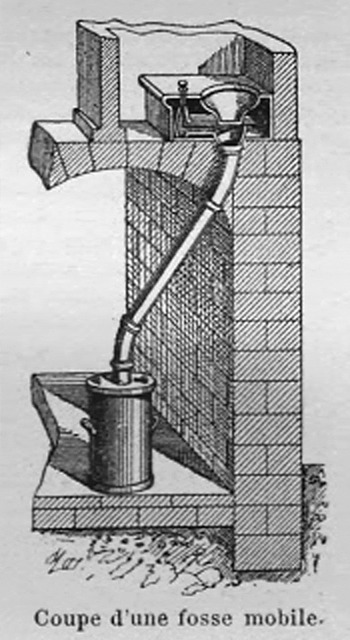
Colonial administrators brought their own conceptions of waste and appropriate infrastructure to sanitation ventures, based on logic that diverged dramatically from local perceptions around managing filth. In surveying appropriate forms of sanitation infrastructure, French colonial officials operated according to contemporaneous norms of equipment in the metropole. Following common practice in early twentieth-century France, authorities in Majunga configured sanitation as a decentralized system based on individual, disconnected latrines constructed in two variations. Either latrines were conjointly built with a privy vault or cesspool, which were dugout holes in the earth lined with rocks. Or they were configured with a moveable bucket system (tinettes mobiles), which consisted of a steel bucket placed atop or inside a concrete or wood platform (see Fig. 2). This approach was labor intensive, however, and in Majunga it was prison laborers and later others who emptied the pails.
Sketch of moveable pail latrine system, c. 1901 (source, Nouveau Larousse Illustré, 1901: 617)

That French military and colonial authorities did not initially consider the construction of a centralized sewage system in Mahajanga, consisting of underground sewers, pipes, and linkages, is unsurprising when considering the metropole's sanitation situation in the late nineteenth century. Until then, human waste collection in European and American cities was predominantly of the privy vault-cesspool system.Footnote 60 It was only in 1894, on the cusp of France's invasion of Madagascar, that the French parliament approved the Paris city council's plan for an all-inclusive sewer (tout-à-l'égout) which would drain rainwater, street debris and human waste.Footnote 61 If the metropole's capital was only beginning to construct all-inclusive sewers in 1894, it would have been nearly unthinkable for colonial authorities to consider implementing a similar system in this provincial, colonial city set in the Indian Ocean basin. Although some limited sewage piping was constructed in the capital city of Antananarivo, most fecal matter was deposited in cesspools.Footnote 62 In Tamatave on the east coast, authorities clamped down on the use and construction of household pit latrines near water pumps and sought to shift to a system of sealed moveable bucket latrines which were dumped on the outskirts of town, and thereafter assiduously disinfected.Footnote 63 But across the island, moveable bucket latrines were generally prescribed for colonial subjects and French colonial authorities alike.Footnote 64
Majunga's sanitation configuration, organized around the manually emptied, moveable bucket latrines was, therefore, not unlike that of other provincial colonial cities in Madagascar in the early 1900s. It is worth pausing here to note that these systems were rooted in a logic of containment and concentration of filth, which ran counter to existing Malagasy practices of waste management. Quite soon after the construction of latrines in Majunga, French colonial officials encountered unanticipated public responses. The movable buckets posed problems. People dumped the foul contents of heaping receptacles in undesignated places (though it is unclear where those places were), despite surveillance. ‘Some of the material sullies the city's soil’ one colonial commentator remarked, ‘and in turn the wells.’Footnote 65 While some officials reported the public latrines ‘are cleaned every morning and function well’, others asserted the latrines were perpetually left in a ‘generally filthy state’ despite multiple cleanings each day.Footnote 66 More troublesome was the defiling of the pit toilets. French authorities were dismayed to find that locals threw stones into the pit, which clogged the dugout cavity and risked waste overflowing onto the street.Footnote 67
Seeing the latrines jeopardized by these unexpected popular responses, city administrators were obliged to modify the design by adding a special basket-like receptacle to collect the rocks separately from the waste, which was to be emptied daily. What is critical here is not only that French engineers were forced to rework their original design because of popular responses to the latrines, but also that such acts of neglect and discard suggest a political dimension to public latrines. According to colonial records, this was an ongoing problem.Footnote 68 And though more research is needed to say definitively, it is possible colonial subjects not only neglected the latrines, but also actively defaced them. If so, then those acts would have been defiant gestures against colonial efforts to regulate people's excremental practices or even outright rejections of the colonial infrastructural scheme.
Eventually French colonial authorities considered eliminating public toilets altogether, as they had apparently done in other colonial Malagasy cities like Tamatave and Diego-Suarez.Footnote 69 The administrative consideration of closing public latrines reveals a cleavage in the colonial logics of sanitation and a shift towards the state-prompted institution of toilets in residential homes. Although the outcome of this discussion requires more research, the debate around the provision of public toilets persisted into the 1930s. At a city council meeting in March 1931, council members made known that the Mahabibo neighborhood (historically, the labor reservoir for the city) with a population of 20,000, was in desperate need of ‘more water closets.’ The proposals to construct these latrines, however, was defeated when one member described that the septic tank model had been introduced in Majunga earlier, ‘without success’, because of the propensity of “‘indigènes” to throw objects in the toilet.’Footnote 70 For French colonial city administrators, such acts were perplexing, aggravating, and enervating. City planners were mindful of the ills of haphazard urban development and the need for technological systems; they contended that Malagasy needed to be ‘guided towards the improvement of their material existence’ through the introduction of infrastructure ‘to attain the greater benefits of the civilization's wellbeing.’Footnote 71
For many Malagasy, by contrast, defecation ‘in place’ translated to attacks on individual and collective wellbeing. Since the latrine system introduced by French planners necessitated increased human contact with excrement (given that the buckets' contents had to be manually discarded), this practice denigrated long-held ideas about proper relationships between people and waste matter, the living, and the ancestors. Although a universal system of meaning among inhabitants of Sakalava descent cannot be assumed, it is likely that for many in the city latrines presented an affront to the logics undergirding historical practices of waste disposal. At play here were conflicting spatial approaches to sanitation. While the French colonial latrine system relied on concentration of filth near to one's most intimate, domestic dwelling, existing Malagasy practices hinged on dispersal of excrement, and explicitly avoided defecating on top of existing human waste, in surrounding uninhabited areas. More epidemiological research is needed to argue with certainty, but the latter mode of sanitation seemed to successfully prevent disease and enable the growing urban population over a century and a half until French colonial interventions.
Contemporary recollections of the problems associated with spatial norms and sanitation in colonial Majunga confirm this sentiment. Tsiavono, a city surveyor in his early sixties, described Majunga's history of sanitation, ‘At first, people just made jangoany, using wood, water or natural things to clean themselves … they would go inside the mangrove swamps (anaty honko) or the sea.’Footnote 72 Household latrines were initially perceived as a ‘vazaha’ (European, outsider, or affluent) practice. Building a small solid structure dedicated to toileting was considered bizarre (hafahafa), since durable (mafy) materials were historically reserved for tombs and ancestral shrines throughout Madagascar.Footnote 73 Despite the presence of such counter-ideas to French architectural norms of latrines-in-house, however, city officials persisted in their efforts to secure toileting cooperation throughout the twentieth century.
Since French authorities perceived the Malagasy home as the nexus of ancestral relations and ideas, it offered the prime site for the colonial cultivation of idealized bodily and mental norms.Footnote 74 Domestic architecture in Madagascar has long been shaped by cosmological and astrological auspicious orders.Footnote 75 Across the island, houses have served as material manifestations of kin groups over time, thus symbolizing fertility and longevity.Footnote 76 The modification of domestic space, then, offered a powerful colonial technique to ushering Malagasy bodies into compliance with sanitation practices and minds into more highly ‘evolved’ states. In 1913, city legislators in Majunga mandated that homes with four or more adults be ‘equipped with movable bucket latrines’ based on a cement platform or emptied into a sealed vault or septic tank.Footnote 77 Thirteen years later in 1926, city legislators enacted a ruling that all homes newly constructed henceforth in Majunga proper must have a fosse septique (septic tank); but since the Mahabibo reserve (the labor reservoir for the city) fell beyond the city's boundaries, this did not apply to the vast majority of the town's inhabitants.Footnote 78
By the 1930s, French urban planners pursued the inclusion of latrines in homes more energetically. Concerned by the ‘lack of hygiene’ found in Mahabibo (the ‘native reserve’) city, officials reworked the budget in 1934 to allocate 13 million francs towards the construction of forty Malagasy homes, complete with conveniences and hygienic fittings, including water provision. These homes were to constitute the ‘beginning of a future native village constructed with all the desirable hygienic conditions.’Footnote 79 Later records indicate that this project was a frustrating failure for French officials, because of their inability to attract prospective renters. Threaded through both the 1913 legislation and the 1934 housing project was the imagining of a colonial populace as homogenously compliant with the toileting regulations; but this vision was later fractured by the refusal of inhabitants and the regime's scarce resource allocation for managing perpetual dilemmas around waste management.
From 1925–27, as the population of Mahabibo grew to some 14,000, city administrators sought to keep apace through the construction of latrines, as well as the extension of existing water pipelines.Footnote 80 The density of Mahabibo's population peaked at 200 to 250 people per hectare (as compared to 30 Europeans per hectare), and the population swelled to 21,172 in 1931.Footnote 81 By 1934, covered sewerage drains were finally installed for the discharge of storm water along the Rue d'Eglise bordering Mahabibo, as well as the cleaning and improvement of open sewerage canals in Mahabibo.Footnote 82 These interventions were apparently inadequate and a malarial epidemic swept across the reserve in 1937. Administrators blamed the epidemic on the city's tardiness in constructing ample sewers, failure to pave over the marshlands, and the level gradation that resulted in standing pools of water in the reserve.Footnote 83 The Digue Metzinger (Metzinger Dike), which was built partly as a passageway across the marshy areas, prevented the drainage of storm water, creating a breeding ground rife with mosquito larvae.Footnote 84 ‘Poorly constructed cesspools’, built in individual household compounds by families in Mahabibo who gradually adopted domestic latrines, apparently worsened the situation.Footnote 85
French colonial approaches to sanitation in Majunga throughout the early to mid-twentieth century were characterized by fits and starts, procrastination, and reactionary crisis management. As scholars have described of urban planning and infrastructure projects in other colonial contexts, sanitation infrastructure in Majunga unfolded haphazardly, rather than in a systematic, coherent fashion.Footnote 86 The as-yet unfinished infrastructure work daunted city officials, even as they made convenient choices to procrastinate important infrastructural investments. In 1939, the city council appraised the public works projects that awaited resource allocation — construction of sewers, improvement of hygiene, and the reclamation of wetlands. They weighed them against desired leisure facilities targeted at the European and elite communities, namely the swimming pool and stadium. They bemoaned the city's steep debt of almost 2.5 million francs owed to the central administration in Antananarivo, and the millions of francs needed to support these projects. Orsini, one council member, urged that the public works projects take precedence over the swimming pool and stadium; but others disagreed, citing the onerous cost of these projects in comparison to the pool and stadium. After lengthy deliberation, the council agreed to approach the central administration for a loan of 500,000 francs to enable the construction of the pool and stadium, altogether foregoing the public works projects.Footnote 87
LABOR REGIMES, VISIBILITY AND THE PROBLEM OF SEWAGE, 1920s–1960s
As the Second World War loomed, the colony's fiscal capacity was stretched and infrastructural investments slowed down. Eventually more and more families built latrines, either utilizing the movable steel drum or dugout septic vault system. It is not entirely clear how or why some groups incorporated latrines, while others did not. While public latrines in the 1920s and 30s were constructed by forced laborers (préstataires) under the Service de la Main d'Oeuvre des Travaux Publics d'Intérêt Général (SMOTIG) program, private household latrines were not.Footnote 88 The introduction of requirements for household compounds shifted the onerous labor burden to individual families charged with building their own latrines, however, part of an increasing turn to privatized land holding in colonial regulations. As latrines were increasingly constructed, the need arose for a maintenance system and laborers to enact it. Given that the proximity to human waste had long been a contentious issue, sustaining the burgeoning latrine system was highly problematic.
Prisoners apparently fulfilled the initial demand for workers to manually empty the steel, shit-filled vats prior to the 1950s.Footnote 89 Several longtime residents narrated the sanitation history of the city by describing how Malagasy families would dig a catchment hole into which they inserted a steel drum (bidon), while French and those with money adopted the cabinet (possibly a flush toilet). At nighttime and under the watchful eye of a foreman, prisoners (gadra) driving a zebu-drawn cart (charrety) came to remove the drum, which took and they emptied elsewhere.Footnote 90 Tsiavono described, ‘My father always told me, don't look! You don't need to watch them! (tsy mila mahita!) If you look at them or say anything, they will throw shit on you!’Footnote 91 Similar narratives, featuring prisoners emptying barrels of feces and urine in the darkness of night, were vividly recalled over and over again by established residents, suggesting its importance in popular historical renderings of everyday life in Mahajanga. Another couple, long-time residents in their sixties narrated that ‘prisoners would come at night, because they were ashamed, and they carried the barrels of feces suspended between long poles of wood. If you dared to tease them, they would dump the waste on your doorstep!’Footnote 92 While the rebellious throwing of feces may have been a subaltern tactic in the face of deeply humiliating labor, others described the strategies prisoners employed to rid themselves of the stigmatized shame of their labor. Since handling excrement was so deeply offensive to ancestors (folaka razana), some prisoners were obliged to bathe in the sea to purify themselves, upon release from prison, before rejoining their families.Footnote 93 Those that were able to accumulate enough wealth to slaughter a cow did so in order to appease angry ancestors and ensure a blessed, more prosperous future.
Over the course of the first half of the twentieth century, however, the source of labor in Majunga shifted as waves of migrants — most notably men — from the Comorian archipelago arrived in the city. By all accounts, ‘Comorians’ came to occupy a critical, dominant position in the city — demographically, culturally, and economically — by the mid-twentieth century. By the late 1950s, migrants from the Comorian Archipelago comprised 50 per cent of the Mahajanga's population of about 68,000.Footnote 94 Comorians characterized Mahajanga as a ‘Comorian city’ from the 1950s until the 1970s; the city was estimated to have a larger composition of Comorians than any other city in the world, including the Comoros.Footnote 95 While those of Sakalava descent were widely regarded as the autochthones of the region (tompontany), Comorians migrated in increasing numbers to the city and provided a steady supply of labor.
Early arrivals from Comoros labored as domestic workers and cooks for Europeans (mpiasa an'vazaha), or as city workers charged with sanitation, such as street sweepers (mpamafa lalana). Others worked as petty traders, dockers, and taxi drivers.Footnote 96 Still others farmed corn and raised goats. As one forty-something physician expressed ‘Comorians sold at the market, oranges, coconuts, meat, everything! All the sellers were Comorian! They were the boat workers and dockers, the fisherman and the taxi drivers. The economy was really in the hands of Comorians. Malagasy did some of this work, but they were in the minority.’ When asked why Comorians were eagerly willing to undertake such a wide range of jobs, many linked it to Islamic work ethics that emphasized human responsibility. As the physician above explained, ‘Allah obliges us to work, as Muslims, so we will work!’Footnote 97 But the choice to labor in municipal jobs was also because of Comorian sentimental attachments to the city. ‘The reality, despite what people say about Comorians, they really loved Malagasy, and really loved this land. They married Malagasy, built the city together, and they know how to live in community with others (mahay miaramonina) … they loved this city.’ Willingness to work in sanitation was an important economic strategy for some — but not all — migrants from the Archipelago who found themselves marginalized in their newfound city.
In their accounts of the past, town residents with limited knowledge of the Archipelago often grouped together all ‘Comorians’ as willing to do lower-status work (asa ambany). Historically, as one man explained, Malagasy speakers have not distinguished (tsy manavaka) between Comorian communities, grouping them instead under ‘Comorian’ or ‘Ajojo’ (for others, the latter refers only to those from Ngazidja, or Grande Comore).Footnote 98 From a distance, Comorians appeared to many Malagasy as linguistically homogenous with shared Shikomoro language competency, as distinct from Malagasy speakers (though many ‘Comorians’ were conversant in both). Malagasy speakers commonly pointed to the distinctive linguistic and kinship practices that differentiated ‘Comorians’ from ‘Malagasy’, notably that migrants from the Comoro Islands observed Islam, practiced elaborate customary marriages (especially grande marriage), and followed matrilineal inheritance traditions. With myriad, inter-island differences collapsed into a single ‘Comorian’ group, many Malagasy speakers similarly generalized that all Comorians were equally willing to undertake sewage work. One man echoed a widely-held perspective, ‘Comorians have not been picky about work (tsy mifidy asa Comorians), they even cleaned the visy (toilet)!’Footnote 99
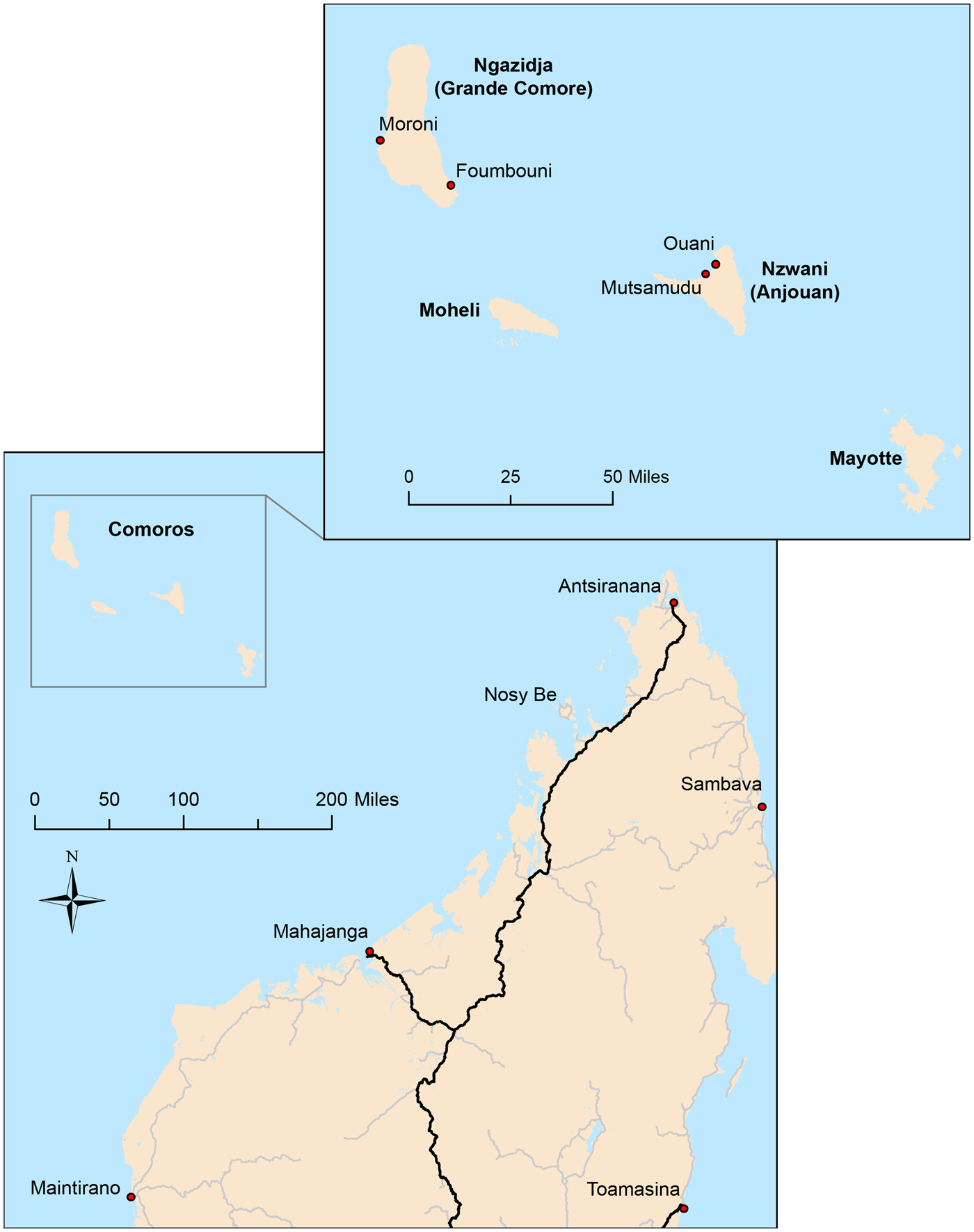
Within mixed Comorian-Malagasy families (known locally as zanatany), however, local constructions of servility, industriousness, and humility — as well as place of origin — defined difference among ‘Comorians.’ Comorian-Malagasy families had more nuanced understandings of the cultural differences across the Comoros, and they distinguished between those from Ndzwani (Anjouan) and Ngazidja (Ajojo) (see Fig. 3). They suggested that across time, Anjouan were the only ones who dared (mahasaky) to undertake sanitation work as m'tzaha maji, cleaning latrines and emptying the moveable steel buckets. As one man in his sixties described, ‘Anjouans would come at night, beginning at 10:00pm, and empty the barrels of shit.’Footnote 100 While those of Anjouan descent cast these descriptions in valuated terms of the virtuous work ethic of those from Ndzwani, those with of Ajojo backgrounds tended to frame their commentary around the demeaning aspects of sanitation maintenance. Mama'Khalid (whose father was Ajojo) succinctly surmised, ‘Anjouans mostly did this denigrating work. Ajojo refused.’
Map of northwest Madagascar and Comores

Anjouan sanitation workers apparently relied on Islamic washing practices to return to a neutral, or honorable, status after encountering filth — but some found their integrity questioned in the public eye. Echoing experiences of capitalism elsewhere, some bystanders (especially those of Ajojo descent who contrasted themselves with the Anjouan willing to work in sewage) observed a connection between the accrual of wealth through debased work and individual moral corruption.Footnote 101 One example involved ‘Ahmed’, a Comorian migrant from Nzwani (Anjouan) who was not formally educated, but nonetheless managed to accrue considerable wealth as commander of Majunga's night soil brigade in the 1950s and 60s. Ahmed accumulated enough capital to construct several homes in town, in which his descendants now reside, and to send his children overseas to France and Mayotte for study. Known pejoratively as ‘Madi Tay’ (boss of shit), Ahmed was remembered with disdain by those who alluded to the questionable legitimacy of his wealth involving filth. His position as a city sanitation worker hovered literally and figuratively between the coveted position of urban civil servants and the humiliated rank of prison laborer.
THE TIME OF TSIRANANA: THE AGE OF MECHANICAL EXTRACTION
Anjouanais were not the only people enterprising in sanitation work. In April 1937, Monsieur Antony Ah-thon and his brother were, according to officials, ‘creole’ private entrepreneurs granted permission by the city of Majunga to ‘engage in the work of sewage treatment’ (vidange).Footnote 102 Although officials identified the Ah-Thons as ‘creole’, their exact origins are murky. In Madagascar ‘creole’ has variably denoted those of Euro-Malagasy or Chinese-Malagasy descent, or those from nearby Mascarene Islands.Footnote 103 While on Madagascar's East Coast, ‘creoles’ were those originally born on Reunion Island, this term was rarely employed in contemporary Mahajanga. In oral accounts, some speculated that the Ah-Thon brothers were of West Indies descent (specifically Dutch Antilles). However, it is also possible that they were of Chinese-Malagasy background since families bearing this same name were historically identified in French colonial official documents as ‘Chinois.’Footnote 104 Although the precise background of the Ah-thon brothers remains unclear, city residents noted that they were enterprising outsiders who easily resolved overflowing household latrine pits and septic tanks.
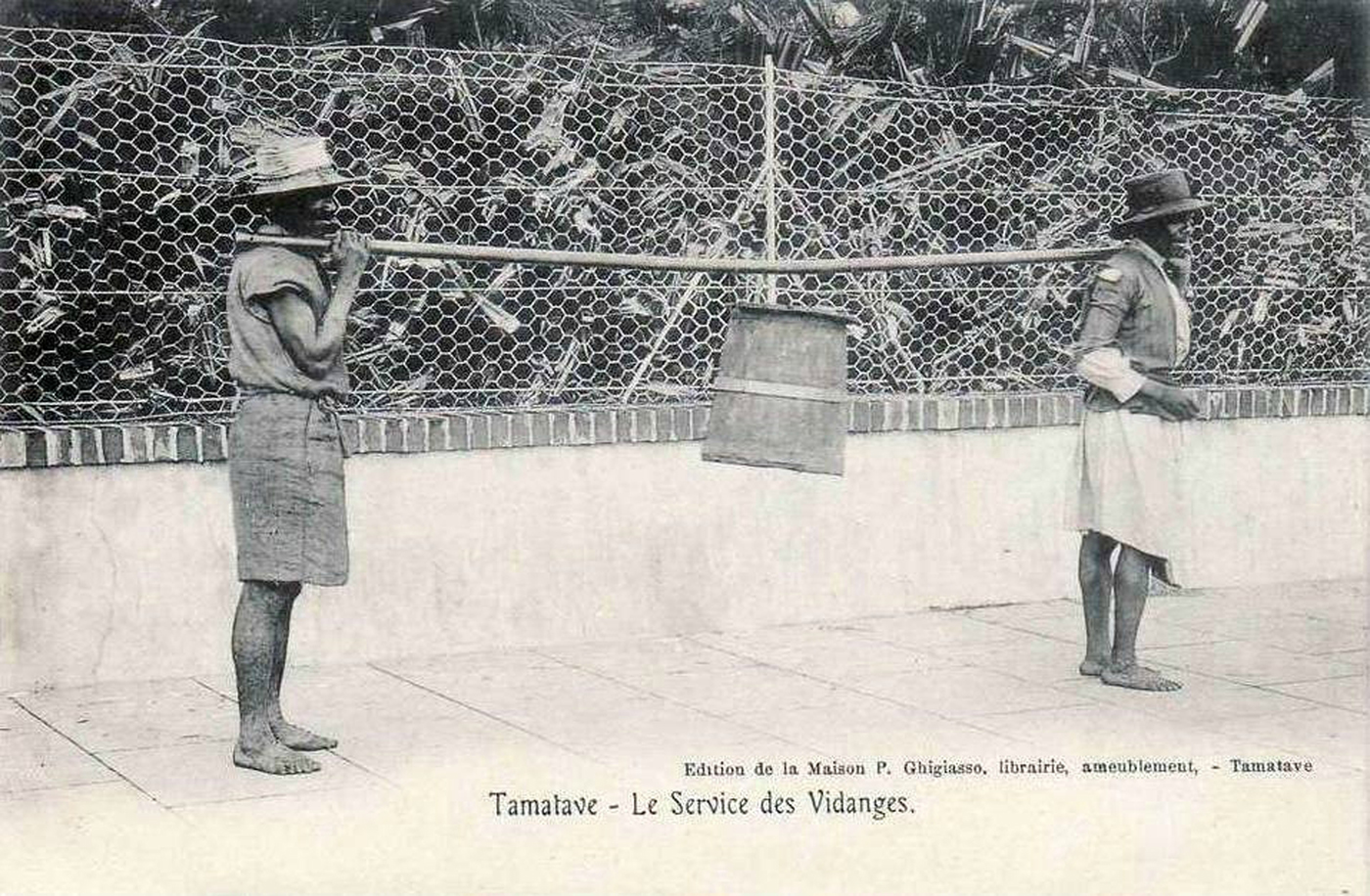
Using a mechanical extractor designed for emptying pits of sewage, Ah-thon and his brother traveled to homes in the city and offered their services. Ah-thon was fondly remembered as a short guy (madinika) who arrived in his green truck, promptly pumped out the sewage, and left latrines clean and empty. After extracting the waste, the Ah-Thon brothers disposed of it in Ambondrona, a settlement on the outskirts of town where the University of Mahajanga currently stands.Footnote 105 The Ah-thon brothers apparently proffered their services well into the 1960s. There was some temporal overlap between prisoners, Comorians and the Ah-Thon brothers in the 1940s to 1960s, but also important distinctions. Though the Ah-Thons were private entrepreneurs, Anjouanais sanitation workers were employed by the city administration. While Anjouanais crews manually disposed of the excrement-filled steel buckets and drums (see Fig. 4, for similar equipment used in Tamatave), the Ah-Thons mechanically retrieved waste from underground cement septic tanks (and thus catered to more affluent families).
Sanitation workers, Tamatave, c. 1910–20s, Postcard (author's collection)

But most striking was that the Ah-thons’ work was not cast in the same, demoralized terms used to describe the prisoners’ and Comorian sanitation workers’ labor of emptying latrine barrels. People often commented that Ah-thon and his brother would work during the daytime since they weren't worried (tsy vaky loha ireo) about being watched. Perhaps this was because of the nature of Ah-Thon's infrastructural engagement, relying as it did on mechanical means to extract raw sewerage. Though it is not clear whether the mechanical extractor elicited responses of awe or wonder among spectators, it surely altered the sensorial dimensions of sanitation work, with hoses and tanks that masked the revolting appearance and noxious odors of solid waste. In light of prohibitions on direct handling of excrement observed by those of Sakalava descent, the Ah-Thon's mechanical extraction admirably elongated one's proximity to filth and minimized bodily contact with abject matter. The use of machinery not only mitigated the moral stakes of sanitation labor, from the perspective many town residents, but also distinguished the Ah-Thon's as adept, enterprising outsiders equipped with technologies of concealment.
Through the mechanization of their work and abetted by their position as relative newcomers to the town, the Ah-thon brothers were apparently relieved of — or protected from — the shame historically associated with sewage extraction. Rather than representatives of an ostensibly coherent group with suspect moral character (as in the case of Anjounais mpangala tay), city residents favorably viewed the Ah-Thon brothers. They were bearers of modern machinery and harbingers of a nascent modernity — one in which human beings would be freed from the troublesome burdens of removing filth. Contemporary residents often wove wistful recollections of both ‘Comorian’ workers and the Ah-Thon brothers into larger, nostalgic narratives of the early, promising post-independence moment of the 1960s. The time of Tsiranana (fotaona Tsiranana), the first post-independence president of Madagascar from 1960– 1972, was sentimentally recalled by many contemporary residents as the city's cultural apex, a climactic moment of cultural vibrancy, harmonious ethnic coexistence, and governmental order.Footnote 106 It was also the ‘cleanest’ time (fotaona madira indrindray) that people could remember in the city's history. People of varied backgrounds attributed the cleanliness of the city to the Comorian presence. As one man in his early sixties of Sakalava background exclaimed, ‘Before, the streets were clean, everywhere was clean thanks to the Comorians!’Footnote 107 If the grouping of Tsiranana, Comorian migrants and a clean city served to demarcate a chronological moment, it also indexed a particular temporal register. Those old enough to recall Tsiranana narrated their contemporary situation in relation to the ‘time of Tsiranana’ — often linked with the ‘time of Comorians’ — rather than chronologies of colonialism and postcolonialism; this temporal frame overlapped for some with a temporality which linked them to their ancestors and future progeny.
CONCLUSION
Sometime in the 1970s, the mechanical sewerage extractor machine broke. The Ah-thon brothers left the city. Comorians' presence in Mahajanga was increasingly contested by more recent Malagasy migrants in Mahajanga, notably those from the island's southeast who, though from different backgrounds, were collectively known in the city as Betsirebaka. Betsirebaka men were first recruited by French colonial authorities to work on tobacco and rice plantations in the northwest of Madagascar in the 1920s, and later in factories around Mahajanga.Footnote 108 In time they grew to a sizeable portion of the migrant population and worked in certain manual labor niches such as rickshaw drivers, dockers, and guardians, thus occupying a marginalized position in the city's political economy.Footnote 109 By the early 1970s, the city began to experience constricted economic times. Following Madagascar's departure from the French franc zone in 1973, the island nation faced economic recession and decreasing wages.Footnote 110 Competition for wage work intensified. And many Betsirebaka found themselves closed out of industrial and manual labor jobs in factories, such as FITIM (Filature et Tissage de Madagascar) which produced jute twine and sacks. These jobs were historically held by newer and older Comorian migrants who had long provided a steady workforce for companies in Mahajanga.Footnote 111 It was within this local and regional context of economic austerity that mounting resentment towards those from the Archipelago, collectively lumped together as ‘Comorians’, was mobilized for collective action in the 1976–77 rotaka that killed some 1,000 of Comorian descent, and expelled 15,000 more, from the city.
The rotaka signified a stark temporal and spatial rupture marked by the loss of a vibrant, sizeable group of Mahajanga's inhabitants and the closing of a nostalgic, ambiance-filled chapter of the city's life. It was also an aberration of physical violence in the island's relatively peaceful history. In the absence of the Ah-thon brothers and the Comorian workforce, those Malagasy left behind filled the labor gap in sewage maintenance. During my fieldwork in 2011–14, migrant laborers, some of whom were identified by neighbors as Betsirebaka from southeast Madagascar, worked tirelessly in teams of two and three during the protection of night, to empty latrines. In the absence of a mechanical sewerage extractor, mpanary tay (those who discard excrement) or mpangala tay (those who take away excrement) manually removed the contents of pit toilets and septic tanks, using crowbars, shovels, buckets, and pitchers.Footnote 112
People commonly perceived mpanary tay as drunkards, which they attributed to their weak character. At least some workers heavily imbibed before and during the hours-long operation, which was undoubtedly an effective coping technique for dealing with vile matters. Yet others did not. And like the Anjouan before them, mpanary tay were drawn to the relatively high wages they could accumulate through waste work. Nonetheless, as they observed these laborers, residents of varied socio-economic backgrounds drew at times on moralizing discourses to criticize the state's failure to provide for sanitation (tsy mikarakara ny fanzakana). But many also invoked a moral register to differentiate themselves from the migrants who would debase themselves to remove the filth of the city. Some remarked that only the very poor (maskiny) or insane (adaladala) would consider such work. Tsiavono, the city administrator quoted earlier, remarked that ‘Nowadays, it's difficult to find anyone to do this work [of clearing latrines - mangala tay]. Maybe they're ashamed, maybe they'll do it but insist on wearing a mask! These days, only Betsirebaka and Tandroy will do that work. But this is especially taboo (fady be) for Sakalava (pause) … you'll never find Sakalava doing this work.’Footnote 113
Threading together these historical experiences of sanitation work are the conjunctural moments by which some people have become involved — either forcibly or willingly — in the work of waste. It was through the convergence of multiple events, interventions, and practices in Mahajanga over time that sanitation work emerged as a veritable, if fraught, labor niche. Among these diverse contingencies were the introduction of a sanitation model premised on concentration of waste in individualized cesspools and septic tanks, the disrepair of the city's mechanical extractor, the city's growing population and consequent overflowing latrines, and a group of marginalized migrants willing to serve as infrastructural laborers. That the labor of sanitation workers is highly gendered as masculine work, and that prisoners, migrants, and newcomers are the ones who have historically performed this disagreeable work resonates with the labor regimes for sanitation elsewhere on the African continent.Footnote 114 In these moments where men engaged with the technologies of filth removal, the ‘otherness’ of certain ethnically-defined groups was tacked onto their sanitation labor role, further entrenching perceptions among some that ‘Anjouan’, ‘Betsirebaka’, or others lacked moral standing. At the same time, these circumstances generated not only a new labor regime to fulfill the needs of the city, but also (for some) a transformed sense of their own possibilities for generating a livelihood and claiming the city as their own.
Returning to the anecdote that opened this article, it is critical to signal how waste practices have served as an index of character and difference, beyond labor. Constructions of ethnicity — what many Malagasy would more specifically term ‘kindedness’ (karazana) — animated the aftermath of the 1999 cholera epidemic. It was not only sanitation work that served as a metric for valuations of moral character, but also the purported rejection of some to engage in waste work and to comply with the sanitation technologies of concentration. In the decade following the epidemic, city officials and development workers developed open defecation awareness campaigns to address the relentless dispersal of human waste across the city. They identified ‘Sakalava’ as key culprits in jangoany, and requested Sakalava royal authorities support their efforts to educate the city's recalcitrant wrongdoers.
Newspaper accounts of this event and some city residents cast ‘Sakalava’ as a coherent group bounded by timeless traditions, marked by adherence to ancestral taboos. In these narrations, ‘Sakalava’ not only failed to progress (tsy mandroso), but also hindered the city's collective march to modernity (fandrosoana).Footnote 115 That ‘Sakalava’ and Sakalava royal leaders were singled out was problematic because it narrowly constructed a delineated ethnic group, effaced complex differences within those claiming Sakalava descent, and assumed that group's culpability for sanitation problems. These narratives also served to conceal the historical forces — colonial interventions, infrastructural limits, and economic inequalities — that shaped the city's sewage situation. City officials and aid workers devoted little attention, for instance, to ascertaining the extent to which open defecation was owing to ‘cultural’ practices or the availability and functionality of household latrines.Footnote 116 In contrast to the Anjounais and migrant workers whose character was morally suspicious on account of their laboring over waste, ‘Sakalava’ were cast by development workers, city officials and some residents as stubborn offenders to modern waste norms. Waste practices — whether the willingness or refusal to engage sanitation labor, or the rejection of waste technologies — served as a defining register for appraisals of character or ‘kind’, in ways that effaced the broader economic, infrastructural, and political realities giving rise the city's sanitation quandaries.
The crystallization of social difference around waste and sanitation work in Majunga requires us to take seriously not only the discursive or instrumental dimensions of sanitation in African cities, but also the ways infrastructural materials and labor practices associated with waste have shaped experiences of urban life. It also signals the need for broadening the historiographical frame to consider filth removal practices in the near and deep pasts, to trace how African intellectual perspectives on moral purity, space, and worthwhile work have shifted over time. In Majunga's ever-growing urban landscape, human waste was seen as troublesome substance — capable of polluting the body, soiling one's integrity, and inducing discord between the living and the dead. French colonial sanitation infrastructures were premised on a praxis of proximity, the utility of decentralized catchment, and the availability of laborers to undertake work deemed dishonorable. Over time inhabitants of Mahajanga reconfigured their sanitation practices and ways of managing urban space, even as they reshaped social hierarchies through the work needed to sustain an expanding sanitation system. Charting the history of sanitation in Madagascar makes clear that contemporary dilemmas around waste in African cities can be neither fully understood, nor resolved, through formulaic urban planning models and policy approaches. By taking into account the enduring, multi-layered, and pluralistic politics of filth, however, historical accounts and anticipated interventions can address the fullness of human experience in cities past and present.