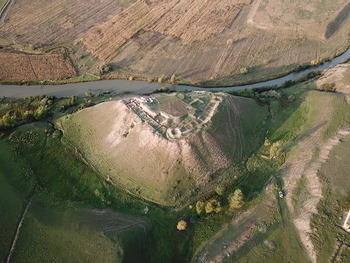


Dedoplis Gora is a multi-phase site in Shida Kartli (Caucasian Iberia, central Georgia) on the left bank of the West Prone, the left-hand tributary of the Mtkvari. Rising 34 m above the river, its oval summit (oriented northeast–southwest) covers c. 3,500 m2 (Fig. 1). On its southern slope, which drops almost vertically for ca. 14 m, archaeological levels from the 6th c. CE down to the Chalcolithic period are exposed.Footnote 1 The main goal of the excavations, which began in 1985 and are still continuing, was to investigate the palace of the Late Hellenistic/Early Roman period. It emerged that it was built in the late 2nd c. BCE and from time to time served as a royal residence, as when the king of Caucasian Iberia visited his family sanctuary to perform an act of worship. Lying 3 km to the north of the palace, this grandiose temple complex, contemporary with the palace, was partly excavated in 1972–76.Footnote 2
Dedoplis Gora palace, drone photograph. (D. Gagoshidze.)

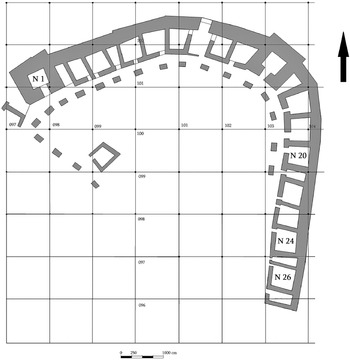
The excavations at Dedoplis Gora have revealed 27 rooms running along the edge of the summit (Fig. 2). The rooms are almost all square in plan, the few narrow and elongated ones seeming to hold wooden staircases leading to the upper floors of this two-story palace, although two towers inserted into the row of rooms had three floors. The doors of all the rooms open onto a corridor, which is set off from the inner court by pillars. The construction technique is typical of Kartli in the Hellenistic age: the load-bearing structure is of wood, while the lower part of the walls and the pillars make use of a frame of wooden beams that was filled with large cobbles. The exteriors of the walls and sometimes their interiors are faced with cut blocks that are fastened by wooden clamps to each other and to the beams of the frame. An adobe wall, also reinforced with wooden beams, is built over the abovementioned load-bearing structure, which is 1.5–2 m high.
Dedoplis Gora palace, general plan. (Plan by I. Esvanjia.)

The surviving rooms on the ground floor served different functions, the most common being those related to household activities. There are bakeries, sacks and vessels full of grains, hand-operated mills, and tools for different purposes. The furniture (table, cupboard, chandelier, couch) and objects found inside the cupboard (scales, styli, ladle) in room N1 near the gate suggest that the room may well have housed an official who was in charge of registering, receiving, and distributing products.Footnote 3
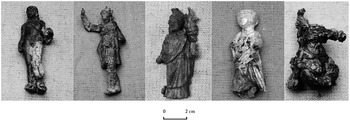
The ground floor also seems to have held rooms with a religious function. Room N20 yielded an arched fire-altar made of adobe. On top of it were found votives that included small statues of Greco-Roman deities (Apollo, Artemis, Leto, Tyche, Silenus; Fig. 3), 13 silver denarii of Augustus, and two gold imitations of staters of Alexander the Great.Footnote 4 Room N26, excavated in 2018, also had a religious use. Its walls, surviving to a height of 1 m, are carefully plastered with a thick coat of adobe mud; similarly well preserved are an arched adobe fire-altar (like that in room N20, but larger), a bread oven, and a podium to which a hand-mill was attached. In the same room were two wine pithoi, one with an Aramaic inscription on the rim. In light of the altar and the provision of bread and wine, room N26 must have been a sanctuary, the wheat being ground and baked in the same place.Footnote 5 Associated with the upper floors are luxury items (furniture, fabrics, precious ornaments, and vessels of silver, bronze, glass, wood, and bone) which presumably belonged to a high echelon of society.
Statuettes of Greco-Roman deities from the fire-altar in room N20. (Courtesy G. Salniker.)

A severe earthquake followed by a conflagration destroyed the palace in the late 1st c. CE.Footnote 6 The burned and melted mass of the upper floors caused the preservation of the ground floor. The earthquake and fire were so sudden that the residents hardly managed to take anything with them, which explains why the finds are so rich and diverse. Almost 15,000 artifacts from 27 rooms, including furniture, weapons, household tools, vessels in many materials, ornaments, and coins, are now in the Georgian National Museum. They allow us to trace the relationship of the kingdom of Kartli with Rome and its eastern provinces. Following Pompey's campaign of 65 BCE, the kingdom was given the status of Rome's friend and ally, a status it then retained for a long time, through a series of conflicts with Parthia.Footnote 7
Statuette with a possible portrait of Ptolemy I Soter
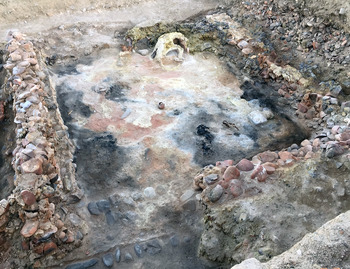
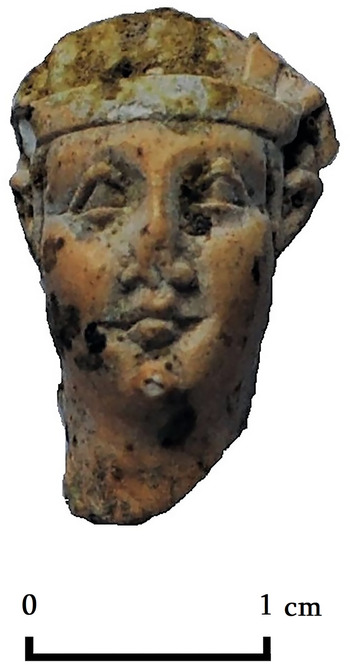
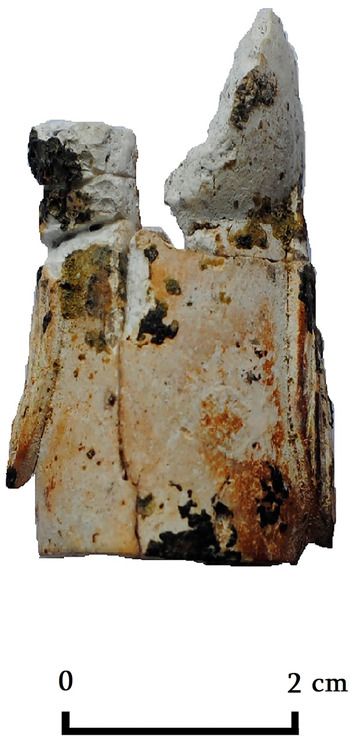
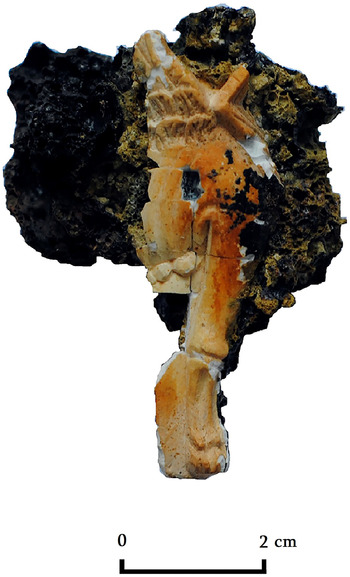
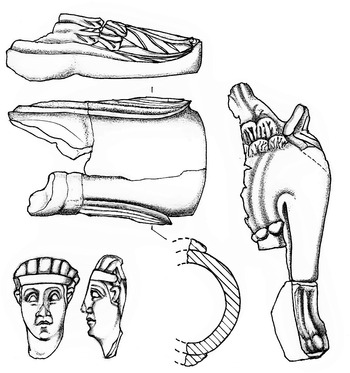
Discovered in 2017 in the debris filling room N24 (Fig. 4) was part of a small statue (h. 2.5 cm, w. 1.0 cm) carved of bone. The male head is adorned with a nemes, the headcloth worn by Egyptian pharaohs (Fig. 5).Footnote 8 Other fragments carved from bone and presumably belonging to the same statuette, such as feathered wings (Fig. 6) and a long leg with a clawed paw (Fig. 7), were discovered nearby. Most had been melted into a mass of stone and adobe that turned to slag; it is impossible to separate them, but they seem to belong to a small figure of a sphinx with a human head (Fig. 8). This sphinx, a striking example of the plastic arts of the Hellenistic period, is executed with great artistic skill. Statues representing sphinxes commonly have the body of a lion, the wings of a bird, and human heads. Sphinx statues were regularly depicted with the heads of pharaohs.Footnote 9
Dedoplis Gora palace, room N24, showing destruction by fire. (D. Gagoshidze.)

Head of the bone statuette found in room N24: Ptolemy I? (D. Gagoshidze.)

Part of the body and feathered wings of the bone sphinx. (D. Gagoshidze.)

Right foreleg with clawed paw, chest, and feathered wing of the bone sphinx. (D. Gagoshidze.)

Drawings of the three fragments of the miniature sphinx with a human head. (Drawings by T. Turkiashvili.)

The head is that of a beardless young man, rendered neatly and skillfully. He has an oval face, a slightly projecting brow, arched eyelids, wide-open eyes, and a straight nose with wide nostrils. His cheeks are full and flat, his lips small and slightly swollen, his chin rounded and prominent. The headcloth is damaged but the headband and vertical stripes adorning the nemes are well preserved.
The portrait bears considerable similarities in the cheeks, brow, lips, and chin to the male heads depicted in relief on the bases of two bowls from the Athenian Agora.Footnote 10 Susan Rotroff has compared the Athenian examples to the image of Ptolemy I on his coinage and to plaster casts taken from Hellenistic silver medallions that are considered to be representations of the same ruler.Footnote 11 She concludes that the individual depicted is Ptolemy I Soter, the first king of Ptolemaic Egypt.Footnote 12 In the case of our piece, the heavy brows, shape of the eyes, and chin resemble the image of Ptolemy I on the coinage that he began to strike in 305/304 BCE.Footnote 13 The fragment also shows parallels with the above-mentioned plaster casts taken from that king's silver medallions; although the portraits differ in some details, their overall resemblance is telling. The main difference between our piece and those from the Agora is that our head is adorned with an Egyptian headdress (nemes), whereas the Athenian examples wear a Macedonian one (kausia).
Broadly speaking, there are two types of portraits of the Ptolemaic kings: Greek/realistic and Egyptian/idealized.Footnote 14 Our head appears realistic but wears the Egyptian headcloth. Portrayals of Ptolemaic family members often bear the attributes of Egyptian pharaohs, especially the nemes, to indicate that they imitated and worshiped the pharaohs and followed their traditions, showing them great respect and considering themselves their descendants.Footnote 15 A basalt, idealized head of Ptolemy I in the British Museum (inv. EA1641) shows him wearing a headcloth,Footnote 16 resembling representations of the pharaohs. A basalt, male head in Krakow that is adorned with a pharaoh's headcloth is recognized as a representative of the Ptolemaic royal family.Footnote 17 The British Museum also holds a bust (inv. EA941) of Ptolemy II Philadelphos wearing a nemes,Footnote 18 and the same ruler may appear on busts held at the University of Strasbourg (inv. no. 1585) and in Turin (inv. no. 1399), on which the heads are adorned with a pharaoh's headcloth.Footnote 19 A colossal granite head of Ptolemy VI in the Greco-Roman Museum at Alexandria (inv. no. 3357) has the face and hair rendered in Greek style but the head covered with a nemes.Footnote 20 I suggest that the head of our sphinx may portray Ptolemy I Soter. The statuette was likely produced in Egypt after the year 282 BCE, when Ptolemy II Philadelphos declared his late father a deity and established his cult.Footnote 21
The bone sphinx, which may have been an element of furniture, is not the only Egyptian item from Dedoplis Gora.Footnote 22 Apart from a very large number of faience beads and amulets considered to be products of Alexandria,Footnote 23 which ended up in Kartli by way of the trade route from Egypt through Syria,Footnote 24 there is a Ptolemaic-period (3rd c. BCE) signet ring with a garnet depicting Arsinoe II, daughter of Ptolemy I Soter and Berenike I.Footnote 25 The excavations also produced a clay bulla with the impression of a signet ring bearing a portrait of Arsinoe III (246–204 BCE).Footnote 26
The discovery of artifacts predating construction of the Dedoplis Gora palace in the late 2nd c. BCE is no surprise. Apart from the above-mentioned gem with the portrayal of Arsinoe II, room N12 yielded a fulcrum dated to the first half of the 2nd c. BCE.Footnote 27 Another find, discovered in the courtyard, is a gold stater of Lysimachus minted at Byzantion in the early 2nd c. BCE.Footnote 28
With regard to a possible historical context, we may note that when Mark Antony was preparing for the campaign against Parthia it was vital for him to gain the support of the kingdoms of southern Caucasia (Iberia, Armenia, Albania) and he sent his commander Publius Canidius Crassus to Iberia. In 36 BCE, Crassus defeated Pharnabazos II, the king of Iberia, and persuaded him to become his ally. Cassius Dio (49.24) points out that Mark Antony took pride in this alliance and was greatly encouraged by it.Footnote 29 Some scholars believe that the artifacts containing Ptolemaic portraits ended up in Georgia along with diplomatic gifts sent by Mark Antony to Pharnabazos II, for it was he who had close relationships with the Ptolemaic court.Footnote 30 It was also accepted practice in that court to gift finger-rings with portraits of the kings and queens to the royal retinue and to political and military figures.Footnote 31 It is quite possible, then, that the Ptolemaic bone sphinx ended up in Caucasian Iberia in the same manner, as a diplomatic gift. In that case, it would not be a surprise that the artifact came to be unearthed in one of the residences of the kings of Caucasian Iberia, the palace of Dedoplis Gora.Footnote 32