Leadership for Change in Pre-Service Teacher Education
Pre-service teacher education institutions have achieved notoriety for their tendency to be large and complex organisations that are difficult to change (Fullan, Reference Fullan2013; McNamara, Reference McNamara2010; Tyack & Cuban, Reference Tyack and Cuban1995). For example, there have been over 30 years of efforts to ensure that first, environmental education, and second, environmental education and education for sustainability,Footnote 1 become a constituent part of pre-service teacher education. However, we cannot yet say that this has occurred in Australia. In this article, we briefly report on our experience trialling the mainstreaming change model we developed (Ferreira & Ryan, Reference Ferreira and Ryan2012) as a guide for effecting change concurrently in many different parts of a broadly defined pre-service teacher education system. This broad definition includes key stakeholders in the teacher education system, that is, not only schools of education but also the universities in which they are located, teacher employing and registration authorities, professional associations and NGOs with an interest in teacher education. We identified a number of possibilities and constraints on change, such as leveraging on pre-existing change efforts, funding, and institutional support. One constraint of particular interest to us was participants’ varying capacities for creating change and how these capacities influence or not the intended outcomes of change efforts. In this article, we argue that being a leader in a field such as education for sustainability does not necessarily mean that one has leadership knowledge or skills to initiate and enact change. We discuss two dimensions of participants’ ‘change agent’ capacity that emerged as problematic in our study — content knowledge and leadership skills — and argue that both these capacities must be explicitly developed if individuals are to lead change that supports education for sustainability becoming a core component of pre-service teacher education.
Study Overview
Sustainability and education for sustainability are not new concerns; historically, there have been nearly three decades of efforts dedicated to ‘re-orienting’ pre-service teacher education towards environmental education (and more recently including education for sustainability) (UNESCO, 1987, 2005). To date, these efforts have largely occurred through institutional professional development in education for sustainability for pre-service education academics — either individually or in small groups (Ferreira, Ryan, & Tilbury, Reference Ferreira, Ryan and Tilbury2007); or, more commonly, as a result of the particular interest and/or dedication of individual academic staff members within pre-service teacher education institutions (Fien, Kumar, & Ravindranath, Reference Fien, Kumar and Ravindranath2001; Henderson & Tilbury, Reference Henderson and Tilbury2004; Steele, Reference Steele2010).
Despite such efforts, however, recent research indicates that pre-service teacher education institutions and programs in Australia are not adequately preparing teachers for teaching education for sustainability in schools (Boon, Reference Boon2010; Ferreira et al., Reference Ferreira, Ryan and Tilbury2014; Miles, Harrison, & Cutter-Mackenzie, Reference Miles, Harrison and Cutter-Mackenzie2006). Indeed, recent research identifies that 80% of Australian teachers are either unaware of education for sustainability or do not understand what it is. Only 2% use education for sustainability teaching practices in their classroom (Australian Education for Sustainability Alliance [AESA], 2014). As we and others have noted (Ferreira & Davis, Reference Ferreira, Davis and Davis2015; Frost, Reference Frost2012; Fullan, Reference Fullan2013; Hargreaves & Shirley, Reference Hargreaves and Shirley2012; Tom, Reference Tom1997), sustaining curriculum change within education institutions is notoriously difficult. The loss or relocation of key champions for education for sustainability in teacher education, contextual constraints such as the increasing publication and teaching expectations placed upon staff (Wergin, Reference Wergin2007), and a constantly changing policy environment in pre-service teacher education have resulted in fragmented and poorly planned projects (AESA, 2014; Russell, McPherson, & Martin, Reference Russell, McPherson and Martin2001; Steele, Reference Steele2010), which all impact on engagement with, and enthusiasm for, further change initiatives. As McNamara (Reference McNamara2010, p. 49) argues, change is difficult because pre-service teacher education institutions are ‘loosely coupled systems with a unique culture of collegial, bureaucratic, political, and anarchical systems and values’. For example, there are a number of contextual issues that impact on teacher education, such as a recognised conservatism now exacerbated by neoliberal imperatives in universities that focus on student outcomes in literacy and numeracy (Furlong, Barton, Miles, Whiting, & Witty, Reference Furlong, Barton, Miles, Whiting and Whitty2000; Mockler, Reference Mockler2013). We see this also in the recent review of the Australian Curriculum (Australian Government Department of Australian Government Department of Educaiton (2014)), where themes such as sustainability are no longer considered important.
In this article we report on and discuss our efforts to overcome some of these shortcomings by adopting a systems-based approach to embedding education for sustainability into pre-service teacher education. Such an approach is argued to be consistent with the widespread and deep learning advocated by sustainability educators (Sterling, Reference Sterling, Corcoran and Wals2004). The research we report on here is drawn from our use of a theoretical model of change — ‘Mainstreaming Change’ (Ferreira & Ryan, Reference Ferreira and Ryan2012) — developed from an earlier analysis of change strategies used to embed education for sustainability in pre-service teacher education in Australia and internationally (Ferreira, Ryan, & Tilbury, Reference Ferreira, Ryan and Tilbury2007). Little research has been undertaken on developing change agent capacity within the higher education context in general (Perry, Reference Perry2010; Simoncini, Lasen, & Rocco, Reference Simoncini, Lasen and Rocco2014), and we hope to contribute to the Australian and international literature on this issue. We investigate two types of capacity — knowledge capacity and leadership capacity — and argue that these should not be assumed as being already evident among either pre-service teacher educator change agents or designated leaders within pre-service teacher education contexts (Kezar, Reference Kezar2012). Instead, it is our contention that these capacities must be clearly and explicitly developed in education for sustainability projects that seek to achieve change in pre-service teacher education. Leadership capacities are increasingly recognised as important in the transition to sustainability more generally (Fien, Reference Fien2014).
As noted above, our aim in this article is not to provide a detailed report on our use of the mainstreaming change model, but rather to focus on the issue of participants’ (primarily pre-service teacher educators) knowledge and leadership capacities for change. Nevertheless, in order to provide some contextual background relevant to this particular study, we briefly describe the mainstreaming change model as well as providing an overview of the study aims, methods, outcomes and key findings. We conclude with a discussion of the need to develop leadership capacities.
The Mainstreaming Change Model
The mainstreaming change model (Ferreira & Ryan, Reference Ferreira and Ryan2012) is one of many proposed strategies aimed at overcoming the myriad of problems of initiating and sustaining changes in pre-service teacher education through using professional development activities. For example, projects such as the Australian Academy of Science's Primary Investigations (Aubusson & Steele, Reference Aubusson and Steele2002) and the Australian government's Gifted Education Professional Learning Package (DEST/GERRIC, 2005) have utilised an innovation diffusion approach (train-the-trainer; Rogers, Reference Rogers1995), while others have utilised participatory action research for more individualised approaches to change (Fien et al., Reference Fien, Kumar and Ravindranath2001; Kennedy, Reference Kennedy, Hyland and Wong2013). The mainstreaming change model seeks to utilise such approaches within an overarching framework for engaging with a whole system simultaneously (see, e.g., Stevenson, Davis, Ferreira, & Evans, Reference Stevenson, Davis, Ferreira and Evans2014), in line with calls within the field of education for sustainability to think systemically (Henderson & Tilbury, Reference Henderson and Tilbury2004; Lozano, Lukman, Lozano, Huisingh, & Lambrechts, Reference Lozano, Lukman, Lozano, Huisingh and Lambrechts2013; Sterling, Reference Sterling2001; Wals & Jickling, Reference Wals and Jickling2002). In the project reflected on in this article, the overarching goal was to facilitate change across a whole system, incorporating multiple people, parts and processes that are involved in pre-service teacher education, including: schools; pre-service teacher education staff, administrators and students; unions; professional associations; registration authorities; and government agencies. The key goal of such an holistic approach is for change to occur concurrently across a number of policy-to-practice ‘levels’ within a pre-service teacher education system, including governmental policy, accreditation and registration standards, course provisioning, and teaching and learning processes.
The mainstreaming change model marries ideas from systems thinking (Meadows, Reference Meadows2009) with contemporary models of change (Fullan, Reference Fullan2013; Kotter, Reference Kotter2012) and of leadership (Fien, Reference Fien2014; Kania & Kramer, Reference Kania and Kramer2011; Spillane, Halverson, & Diamond, Reference Spillane, Halverson and Diamond2001; Tremblay, Reference Tremblay2012) to provide a process for achieving broad change across a whole pre-service teacher education system, while at the same time achieving ‘deep’ change through supporting participants to engage directly with processes of change. As we have argued elsewhere (Ferreira & Ryan, Reference Ferreira and Ryan2012, p. 13):
The model is based on the assumption that long-term sustained change is most likely to occur when a common vision for change is widely shared throughout a system, and when all members of that system are collectively supported to operate in ways that are consistent with the common vision. It is our contention that such an approach could mainstream a change across multiple levels of a system and work to create commitment to and ownership of change across a whole system.
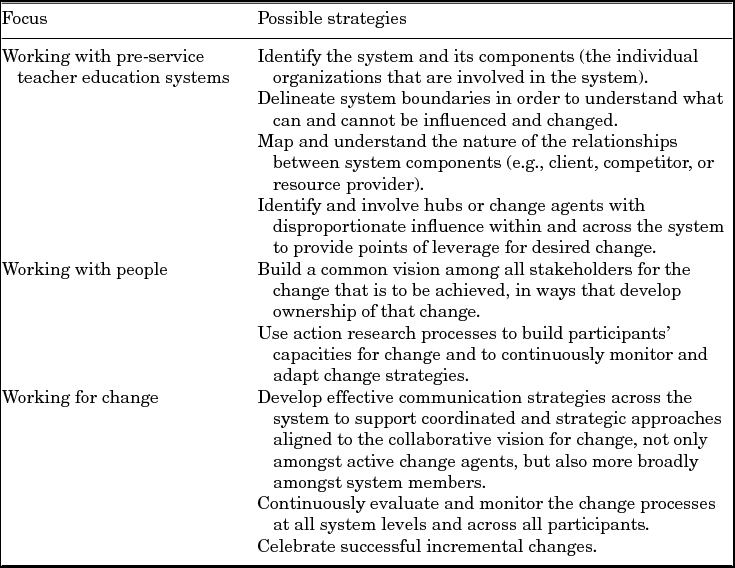
The model proposes a three-part process for sustaining change and provides markers about ‘how to’ achieve change, as shown in Table 1.
Strategies for Achieving Systems Change

Note: Table adapted from Ferreira & Ryan (Reference Ferreira and Ryan2012).
While systems-based approaches to change such as the mainstreaming change model are gaining support, there have been critiques. For example, Caldwell (Reference Caldwell2012) argues that in such change models, the links between practice and learning, and agency and change are not well theorised. However, others argue that such approaches offer innovative ways to overcome the problems of sustaining long-term change initiatives (Fullan, Reference Fullan2013; Hargreaves & Shirley, Reference Hargreaves and Shirley2012) within complex organisations and systems. Through collaborative, multi-level and cross-institutional visions and strategies for change that are cognisant of individual participants’ roles and relationships within the pre-service teacher education system, the mainstreaming change model offers a unique approach to change management.
Conduct of the Study
The aim of our project was to trial the effectiveness or not of the mainstreaming change model in achieving systems-based change in the pre-service teacher education systems of Queensland and the Northern Territory, each distinctly different and independent from one another. Specifically, the project was targeted at increasing both the profile and provision of education for sustainability within pre-service teacher education in these state/territory systems. Therefore, our project was simultaneously and synergistically an education for sustainability capacity-building project, a pre-service teacher education system change management project, and a research project aimed at evaluating the effectiveness of the mainstreaming change model for effecting change in pre-service teacher education.
The overall study drew upon a variety of theoretical frameworks and methods, including organisational change, systems theory and a participatory action research method (Mills, Reference Mills2010; Tripp, Reference Tripp2005; Wadsworth, Reference Wadsworth1998). These choices were premised on the theoretical alignment between action research and the education for sustainability and systems thinking fields, and the need for alignment between the purposes and aims of education for sustainability and the research methods and processes used (Hart, Reference Hart, Dillon, Brody, Stevenson and Wals2013; Robottom & Hart, Reference Robottom and Hart1993). For example, all three encourage: successive cycles of adaptive planning and critical reflection and learning, situated participatory learning and research processes that are contextually driven, and emergent and transformational outcomes that are focused on practical improvement (Barabasi, Reference Barabasi2003; Kemmis & McTaggert, Reference Kemmis, McTaggart, Denzin and Lincoln2000; Mills, Reference Mills2010; Senge, Reference Senge2006; Sterling, Reference Sterling2011; Stone & Barlow, Reference Stone and Barlow2005; Tilbury, Reference Tilbury, Sterling, Maxey and Luna2012; Tripp, Reference Tripp2005; Wadsworth, Reference Wadsworth1998).
The overall study was undertaken over a period of 16 months. Four months were spent in project planning and preparation, which included identifying, recruiting and training potential participants from pre-service teacher education institutions and related institutions and organisations. Participants were mainly identified through known networks in education for sustainability, and hence were already considered to be leaders in this field. This was followed by 8 months using the model, gathering data from baseline context surveys, as well as built-in formative monitoring and evaluation procedures; and 4 months undertaking a reflective meta-analysis of the project results. Ethics approval was obtained from all participating universities’ ethics committees. Participants attended a series of group workshops, which included a mix of learning about action research and systems approaches to change, as well as opportunities to reflect upon and discuss their thoughts and experiences of managing systems change. Drawing distantly located participants together was difficult at times, so participants also kept learning journals for personal reflection and for sharing during a community of inquiry (Garrison, Anderson, & Archer, Reference Garrison, Anderson and Archer1999). The community of inquiry used platforms such as email, teleconferences, Skype and Facebook. Facebook proved to be especially useful for connecting our pre-service teacher participants with each other and with the project. We also maintained a member-only-access website where project documents could be filed and shared confidentially. These also provided sources of data for the allied research, and ethical clearance was gained from participants at the commencement of the project to utilise records of meetings and shared journals as data sources.
Key outcomes of the overall study in pre-service teacher education faculties of the participating universities in Queensland and the Northern Territory included:
• enhanced knowledge about and skills in education for sustainability, developed through workshops, conferences, staff seminars and shared resources between academics from a range of disciplines, administrators and pre-service teachers in participating teacher education institutions;
• changes in teaching and learning practices, including new courses and programs, new content, and the adoption of new teaching and learning pedagogies;
• a community of inquiry for project participants within and between institutions and states/territories. This community of inquiry met both face-to-face and by phone and video chat to discuss experiences, issues and to share resources;
• new institutional positions and policies on sustainability and education for sustainability were developed; and
• new relationships between elements of the pre-service teacher education system were forged. For example, academics from pre-service teacher education institutions engaged with policy developers in government agencies and teacher registration authorities in developing briefing papers for relevant Ministers and departmental heads.
Hence, our study indicates that the change model for embedding sustainability into pre-service teacher education did have some usefulness in generating changes within these two teacher education systems. However, our research also highlighted constraints on the full achievement of systemic change. Of particular note were the knowledge and leadership dimensions that impacted on participants’ capacities to initiate and lead systems change within their own contexts; that is, to be effective change agents within their own institutions/organisations. As we indicated in our introduction, the focus of the remainder of this article is on elucidating these dimensions and discussing their importance within systems change.
Developing Leadership Capacity for Change
In our study, and as we discuss further below, we found that systemic change requires project participants with particular knowledge and leadership capabilities. Issues arose relating to (1) the adequacy of participants’ knowledge bases about action research and systems change, and (2) their personal leadership capacities. In essence, being an academic or professional leader in education for sustainability did not automatically ensure that one would be an effective leader of systems change for sustainability. We discuss these findings here and propose a number of issues for consideration for those also wishing to engage in systems change, whether they use the mainstreaming change model or other similar approaches or models. We argue that leading systems change initiatives requires developing both content knowledge and leadership skills. It is, therefore, of utmost importance that in systems-change projects, attention is paid to individual participants’ knowledge and leadership capacities, and to enhancing these. Issues relating to each of these capacities are discussed below.
Knowledge Capacity for System-Wide Change in Pre-Service Teacher Education
Understanding systems-based organisational change emerged as a key issue in our study. To effect change across a complex system such as pre-service teacher education, change is required within and across a wide range of institutions such as universities, government agencies, statutory authorities and schools. Therefore, an in-depth understanding of one's own organisation and its relationships with other parts of the system is an essential starting point for systems change projects. Organisations are complex and are shaped by a plethora of historical and environmental factors consisting of entrenched beliefs, values and cultures often expressed as unquestioned, normalised daily practices (Frost, Reference Frost2012). When complex organisational cultures are viewed through the framework of a system, the complexity and at times fragmented nature becomes even more evident. Our experiences indicate that it is vitally important to learn how systems work and how organisations — as elements of a system — can change. This is especially so when working within large systems such as pre-service teacher education, which often seem to be resistant to broad-scale change. As others have found, this is because individuals either do not want to change, do not see the changes as relevant, do not feel they have a mandate to implement such a change, have conflicting incentives within the organisation, and/or simply have a different worldview to that being promoted by the project (Drew, Reference Drew2010; Fullan, Reference Fullan2013; Hargreaves & Shirley, Reference Hargreaves and Shirley2012; Kotter, Reference Kotter1995, Reference Kotter2012; McNamara, Reference McNamara2010; Senge et al., Reference Senge, Kleiner, Roberts, Ross, Roth and Smith1999).
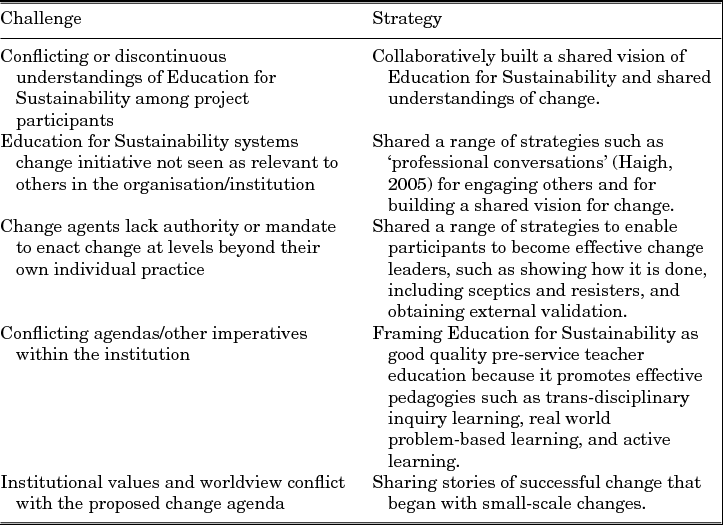
In seeking to address the issue of our study participants’ inadequate knowledge bases and understandings about change, a range of strategies consistent with those advocated in the literature for managing organisational change (Kotter, Reference Kotter1995, Reference Kotter2012; Higgs & Rowland, Reference Higgs and Rowland2000; Senge et al., Reference Senge, Kleiner, Roberts, Ross, Roth and Smith1999) were implemented by the project leaders. For example, project leaders in Queensland and the Northern Territory capitalised on their regular reporting schedules to the overall project funding bodies/managers and discussions with institutional participants as a way of identifying knowledge gaps, and then sought to address these either directly with participants (through phone and email advice, provision of appropriate articles to read, guest speakers/‘experts’ at workshops and so on). Another effective strategy was the phone-based community of inquiry, where group discussions deliberately focused on problematising and clarifying a range of diverse conceptual understandings about key topics in order to build knowledge capacity for systems change. The range of challenges and the strategies we utilised to address these are briefly outlined in Table 2.
Emerging Challenges and Change Strategies From Community of Inquiry
Both project participants and project leaders identified a lack of knowledge about systems change in complex and fragmented organisations. To remedy this, participants and leaders together identified and sought the assistance of an external consultant in change management who provided ongoing advice and support as well as professional development around change management for all participants. Consequently, these project leaders also circulated readings on systemic change to all participants within their project network, and made use of an online discussion forum to facilitate, for example, discussions around the differences between environmental education and education for sustainability, which then highlighted for the project leaders the range of different conceptual understandings held by institutional participants. The data gathered from project participant discussions and researcher reflections allowed project leaders to frame a more nuanced, flexible and responsive approach to change for participants that was specific and situated within their own context.
Leadership Capacity for System-Wide Change in Pre-Service Teacher Education
According to Fullan (Reference Fullan2013) and Hargreaves and Shirley (Reference Hargreaves and Shirley2012), pre-service teacher education systems and the organisations within them have historically been rooted within a hierarchical and authoritarian culture expressed through top-down decision making and policy processes. While there has been significant change in recent times, the vestiges of this culture remain (Fullan, Reference Fullan2013; Hargreaves & Shirley, Reference Hargreaves and Shirley2012). Indeed, these cultural factors often lead to assumptions that change leadership is the sole responsibility of those in formal leadership positions such as heads of schools or chief policy officers, and that ‘valid professional knowledge can only be created and disseminated by authorized agencies’ (Frost, Reference Frost2012, p. 223).
Numerous studies have identified the limitations of relying only on top-down leadership for creating and sustaining change (Fullan, Reference Fullan2011; Fullan & Scott, Reference Fullan and Scott2009). Pearce and Conger (Reference Pearce and Conger2003), for example, argue that over-reliance on formal leaders can lead to lack of creative complexity in developing solutions, with poor participation and buy-in, and can also create a culture of leader dependence. There is a new body of research emerging that focuses on how grassroots or bottom-up leaders (individuals without positions of authority who act as agents of change without the benefits of formal power) are able to effect change (Fullan & Scott, Reference Fullan and Scott2009; Kezar, Reference Kezar2012). In this project we explored a range of systems and leadership concepts such as ‘transformational leadership’ (Fien, Reference Fien2014), ‘networked leadership’ (Davis & Ferreira, Reference Davis and Ferreira2009; Tremblay, Reference Tremblay2012), ‘collective impact’ (Kania & Kramer, Reference Kania and Kramer2011) and ‘distributed leadership’ (Spillane et. al., 2001). The mainstreaming change model is based on a networked leadership approach, which is quite different from the traditional hierarchical leadership approach prevalent in many educational institutions and government departments. A networked leadership approach views leadership as distributed throughout an organisation, not just at ‘the top’, and as involving a group of people in an organisation, not just one (Kania & Kramer, Reference Kania and Kramer2011).
Identifying leaders became a major issue in this project. State-based project participants in effect self-identified as leaders within their system, but the shortcoming of such a process, as we discovered through this project, was that these individuals were leaders who had academic or professional credibility in education for sustainability, but not necessarily the skills for leading systems change. The outcome was that those who were appointed as project leaders had varying degrees of capacity to facilitate a change process, as was observed when these participants were asked to undertake leadership tasks in their individual institutions. Problematically, some did not see themselves, as noted in discussions and the community of inquiry, as being in a position to create change. Thus, there were impacts on the success of some projects as a result of these initial choices.
The main issues in our project related to individuals’ willingness to initiate project activities, their personal perceptions of their capacity to bring about change, and their abilities to inspire and lead others in a change process. This also impacted on the understanding and involvement of others within the system in the process of change. For these reasons, it became clear that we not only needed to develop participants’ knowledge of change and change strategies, but also to develop their personal capacities for leadership. However, the tight project timeframe and limited resources required participants to be active in seeking to facilitate change in their systems from the start of the project. This left little scope for an initial induction into the project. To address this, we deployed a range of strategies, including support and suggestions via email and phone; meetings organised within regions to encourage the local project leaders to engage more widely across their system; and appointing an organisational change consultant to assist project leaders. In addition, some of the participants, in recognising their shortcomings in driving change processes, utilised the concept of ‘convergence’ (Kezar, Reference Kezar2012, p. 726) to try to increase their change influence. Here, participants strategically joined their efforts as ‘grassroots leaders’ with those in formal positions of authority (Pearce & Conger, Reference Pearce and Conger2003). Several participants in our project strategically targeted formal leaders within relevant institutions to gain support for the project, which in turn led to more energy and enthusiasm for the change process and included more participants from across the system in the change process.
It became clear by the end of the project, however, that in order to be an effective leader, one must not only be in a position through which change can be effected within an organisation, but must also believe one is able to initiate and drive change. Indeed, our findings gathered from participants throughout the project, and our own reflections as action researchers, indicate that a lack of belief in one's own capacity to bring about change has a greater negative effect on change than not being in a recognised position of power or authority within an organisation. This was evidenced by project leaders who were not in formal positions of power but who, nonetheless, were able to effect change in curriculum, student engagement and the policies and processes of their organisations. In summary, it became clear through this project that in order for individuals to be effective leaders they need to:
• see themselves as leaders who are able to influence, effect and drive change within their organisation;
• be willing to act as advocates for the change the project is attempting to achieve;
• have an interest in the key issue that they can clearly articulate;
• show a commitment to the ideals of the project; and
• have leadership skills to encourage and engage others in the change process.
Learning to be Leaders for Change
It has become clear through this project, similar to other research on leading systems change projects (Fullan, Reference Fullan2013; Fullan & Scott, Reference Fullan and Scott2009), that if long-term, widespread change is to be achieved in pre-service teacher education, not only must one attend to the macro level of understanding and changing the whole system, including political factors and influences, but also to the micro level of the individuals who are seeking to enact change, and the interaction between these two. While change agents may have skills and knowledge that seem to align with the purposes of the project, our research has shown that possessing appropriate academic and professional knowledge associated with the ‘target’ change is not enough. Pre-service teacher educators also need to learn how to be leaders for change. This requires explicit learning processes that support project participants in identifying their current understandings of leadership and in gaining new understandings about, and strategies for, leading change. If not attended to, then change projects being implemented in pre-service teacher education and more broadly across universities and other large organisations, will continue to struggle to achieve their hoped-for goals and outcomes.
Author Biographies
Jo-Anne Ferreira convenes the Master of Environment (Education for Sustainability) program in the Griffith School of Environment, Brisbane, Australia. Jo-Anne's research field is sociology of education, with a special interest in post-structuralist theories of identity, embodiment and power, and environmental and sustainability education. Recent research focuses on systems-based change in teacher education and on strategies and techniques deployed by environmental and sustainability educators to empower learners to become environmental citizens.
Lisa Ryan is an Associate Lecturer in Sustainability Education at the University of the Sunshine Coast, Australia. Her research focuses on the professional development of sustainable schools teachers and systems approaches to change within teacher education. Her current PhD research draws on postcolonial theories to explore how Eco-Schools teachers are negotiating global eco-schooling discourses in their local contexts.
Julie Davis is Associate Professor of Early Childhood Education at Queensland University of Technology, Brisbane, Australia. Her research interests are twofold: early childhood education for sustainability focused on nurturing young children's capacities as agents of change; and embedding education for sustainability in teacher education through systemic change approaches.