Charleston has long been known for the distinctive character of its sound system (Baranowski, Reference Baranowski2003, Reference Baranowski2006; Kurath & McDavid, Reference Kurath and McDavid1961; McDavid, Reference McDavid1948, Reference McDavid1955; O'Cain, Reference O'Cain1972; Primer, Reference Primer1888), which sets it apart from most other dialects of American English, including the rest of the South. The best-known features of the traditional dialect—ingliding and monophthongal long mid vowels /e:, o:/, as in take and goat, Canadian raising for both /aw/ and /ay/, and a lack of distinction between /ihr/ and /ehr/, as in beer and bear—have now largely retreated (Baranowski, Reference Baranowski2003, Reference Baranowski2006) as part of the process of regionalization operating across American English, whereby many small local dialects are disappearing and becoming part of the larger regions. However, the retreat of the traditional features has not resulted in the Charleston dialect becoming part of the South as a dialect region. As a result of recent changes operating in the dialect, Charleston remains distinct from the South and from most other dialects of American English.
The most striking new development in the dialect is the advanced fronting of the back upgliding vowels /uw/, as in goose, and /ow/, as in goat. Although the traditionally monophthongal and ingliding /o:/, as in goat, was at the back periphery of the system, the vowel nucleus is now front of the center of the vowel space for many speakers. In this way, the Charleston dialect is now involved in one of the most vigorous changes sweeping across North American English, that is, the fronting of the back upgliding vowels. The advanced fronting of /uw/ and /ow/ has been reported for the South (Fridland, Reference Fridland1999, Reference Fridland2001; Fridland & Bartlett, Reference Fridland and Bartlett2006; Thomas, Reference Thomas1989, Reference Thomas2001) and for the West, particularly for /uw/ and to a lesser extent for /ow/ (Conn, Reference Conn2002; Fought, Reference Fought1999; Hall-Lew, Reference Hall-Lew2004, Reference Hall-Lew2005; Luthin, Reference Luthin and Denning1987; Ward, Reference Ward2003). Although there have been reports of the fronting of /uw/ in the North (Anderson & Milroy, Reference Anderson and Milroy1999; Anderson, Milroy, & Nyguyen, Reference Anderson, Milroy and Nyguyen2002; Ash, Reference Ash, Arnold, Blake, Davidson, Schwenter and Solomon1996), the dialect remains conservative in the fronting of /ow/. The Atlas of North American English (Labov, Ash, & Boberg, Reference Labov, Ash and Boberg2006 [ANAE]), which offers the first overview of all the major dialects of North American English, reports that even though the advanced fronting of /uw/ before coronals, as in two and do, is indeed a feature of almost all dialects of American English (ANAE: Map 12.1, p. 154), the fronting of /uw/ after noncoronals, as in goose and move, is most advanced in the Midland and the South (ANAE: Map 12.2, p. 156). Similarly, ANAE shows that the South and, particularly, the Midland are consistently more advanced in the fronting of /ow/ than the other major dialects of American English, including the West (ANAE: Map 12.3, p. 158).
Charleston's modern dialect appears to be more advanced in the fronting of the back upgliding vowels than almost any other dialect of American English; it is ahead of the rest of the South in the fronting of /ow/ and appears to be at least as advanced as the most advanced major dialect region in the country, the Midland.Footnote 1 It is, however, the social patterning of this new change in the Charleston dialect that is particularly intriguing. It may seem somewhat puzzling, in that it appears not to conform to the generalization of the curvilinear principle, whereby linguistic change from below is led by an intermediately located social group, such as the lower-middle or upper-working class, rather than the lowest- or the highest-status social group (Labov, Reference Labov2001: 149–192).
Sampling areas.

METHODS
The study was designed in such a way that it would be representative of the community and that would also allow us to trace change across generations within families. A stratified social class sample was obtained by first making a judgment sample of neighborhoods, and then by selecting randomly within that judgment sample. Based on the data from the 2000 U.S. Census, four major areas were identified as representing the socioeconomic spectrum of the city on the basis of the following indicators: occupation, education, and income. As the study is concerned with the phonological features of the European-American population of Charleston, areas identified by the 2000 Census as inhabited predominantly by African Americans were not included in the sampling.
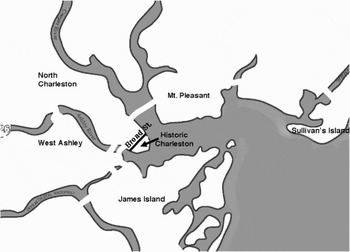
The areas selected for sampling were as follows (Figure 1):
1. The first area comprises two neighborhoods. One is the southern tip of the downtown peninsula, the historic part of the city, including City Hall and the Battery. Sullivan's Island was selected to complement the historic downtown section, as it is very similar to it socioeconomically; the two neighborhoods represent the upper and upper-middle class;
2. Mount Pleasant—a middle to upper-middle-class neighborhood;
3. James Island—a lower-middle- to middle-class neighborhood;
4. West Ashley and North Charleston—working to lower-middle-class neighborhoods.
All the streets contained in the four areas were enumerated and five were randomly selected in each of the four areas. On each of the selected streets, a house was randomly chosen and approached, with a view to interviewing all its inhabitants who had grown up in Charleston. The goal was to obtain data from three age groups of adults across the socioeconomic spectrum, with two people of either sex in each of the age brackets, as well as any children available to be interviewed. The age brackets were 8–17, 18–30, 31–55, and over 55. Each of the 32 informants found in this way and interviewed for the project was asked if he or she had relatives or friends that might be willing to be interviewed as well, which led to 32 further interviews. In addition, five fire stations in the Charleston area were approached, resulting in interviews with six male firefighters and one female dispatcher. As a result, 72 Charlestonians from the working, lower-middle, middle-middle, and upper-middle classes were located in this way.
The term social class as used in this study refers to the relative amount of status, or social standing, enjoyed by different groups in the community. Though it is not easy to measure status directly—it is a subjective dimension—social standing is well known to be correlated with objective socioeconomic indicators, such as occupation, income, education, house value, and so on, at least for Caucasian speakers in Western societies. The general method used in this study categorizes speakers as belonging to different social groups, first by creating a judgment sample of neighborhoods (see previous paragraphs), and then by assigning each speaker to a particular social class on the basis of his or her occupation. For example, a firefighter is categorized as working class, a registered nurse as lower-middle class, a computer consultant as middle-middle class, a doctor as upper-middle class. Occupation was used as the basis for social class assignment for the working and the middle classes, because it has been shown to be more effective than any other individual factor, including education, in accounting for linguistic variation (Labov, Reference Labov2001: 113–120). Children are assigned the social class of their parents, homemakers are assigned the class of the working spouse, and retirees are categorized on the basis of the last occupation held.
The upper class was defined differently and sampled separately, following Kroch (Reference Kroch, Guy, Feagin, Schiffrin and Baugh1996) and Payne (Reference Payne1976), who suggest that the upper class is best accessed through an initial contact, who then introduces the interviewer to other members of this rather exclusive social group. Three such contacts were used, which led to 19 interviews. As the correlation between social status and socioeconomic indicators may differ slightly in different communities, the validity of the social categorization obtained by means of the objective indicators should be checked against the norms and values of the community in question. Charleston's highest-status social group is a case in point. It is not defined as simply the highest group in terms of economic indicators such as income. McDavid (Reference McDavid1955:273) reported that the upper class of Charleston was “based primarily on ancestry and connections, to secondarily on education and cultural experience, and to a relatively minor degree on wealth.” This is true today as well and plays an important role in the distinction between the upper-middle class and the upper class in Charleston. Although the difference between the two groups can be rather subtle or simply nonexistent on economic grounds, it is nevertheless socially real, as indicated in the following quote from Steve M., 24, an upper-middle-class Charlestonian:
There were a number of families at the time whom … I think a lot of people would refer to as sort of your old Charleston families, who were … even though we lived amongst them, my parents were what I would call sort of transplants to the area, who would own properties aside from the peninsula and other places, say around the Edisto…
Indeed, the upper-class speakers in this study all come from old Charleston families. They go back at least seven generations in the United States, often as many in Charleston itself. For example, the ancestors of Elizabeth O., 82, whose family's three generations are represented in the sample, arrived in Charleston right after the city was founded in 1670. The family of Richard A., 77, whose daughter and two grandchildren are also in the sample, has been in Charleston since 1686. The family of Christopher B., 79, including his son Robert, has been in Charleston for 250 years, and Charles C., 71, described his ancestry as going “all the way back to the Mayflower.” Other social characteristics that they share include growing up in the historic downtown section of Charleston south of Broad Street or on plantations outside the city owned by their families; having full-time maids or nannies during childhood; and attending private schools, often single-sex boarding schools for secondary school. Nonetheless, McDavid's characterization still stands—ancestry seems to be the most important ingredient. Although Steve M., quoted above, attended the same private schools as his upper-class friends from south of Broad, which is where he now lives, he remains acutely aware of the distinctiveness of that social group.
Social class differences and the distinctive position of the highest-status social group in Charleston are consciously recognized and commented on by representatives of other social groups, such as Sherry D., 63, a lower-middle-class Charlestonian:
Now you did have some class differences. You had your elitists, that were those that had the most money, and they lived like near or below Broad. We used to call them …, what was it, snobs? What was it … ? S.O.B.s, south of Broad.
Such overt comments give us added confidence that the social categorization of speakers in this study reflects the social reality of the community. More importantly, as will be shown, that categorization accounts for a substantial amount of the linguistic variation found in the dialect. In fact, the role played by social class in the linguistic changes in Charleston is arguably clearer and more dramatic than that in any other dialect of English studied to date.
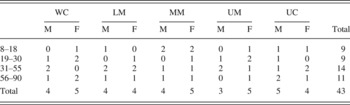
The sample of 91 Charlestonians was supplemented by 9 informants interviewed for a pilot study in 2002, resulting in a total of 100 speakers, ages 8 to 90, representing 5 social classes and both sexes (52 women and 48 men). The speech of the 100 informants was recorded during sociolinguistic interviews, comprising spontaneous speech, the reading of a word list, minimal-pair tests, and discussion of the meaning of words. The recordings were made with a Marantz PMD-670 Compact Flash digital recorder at a sampling rate of 32 kHz in mono, with a battery-powered external microphone, the Sony ECM55B. The speech of 43 of the informants (23 females and 20 males) was analyzed acoustically with Praat 4.1.2 (Boersma & Weenink, Reference Boersma and Weenink2004). Table 1 presents the demographic breakdown of the subset of the 43 speakers whose speech provides the basis for the analyses to follow.
Demographic breakdown of the 43 speakers analyzed acoustically

The analysis of the complete vowel systems of the 43 speakers is based on 15,253 vowels measured, with an average of 355 tokens per speaker. There are 898 tokens of /ow/ and 909 tokens of /uw/, with an average of 21 tokens of each per speaker, which includes 5 and 6 word list tokens of /ow/ and /uw/, respectively. The acoustical analysis method used in this study, following Labov, Yaeger, and Steiner (Reference Labov, Yaeger and Steiner1972) and the Atlas of North American English (Labov et al., Reference Labov, Ash and Boberg2006), consists in selecting a single point in time within the vowel nucleus and obtaining the F1 and F2 values at that point as the best indication of the central tendency of the nucleus of the vowel, that is, its most important perceptual cue.Footnote 2 The single point of measurement within a vowel nucleus coincides with the point of inflection: the point where the tongue reverses in its movement away from its initial position. This point best represents the overall quality of the vowel in terms of its perception. For short vowels and for long upgliding vowels, the point of inflection in the nucleus is usually the lowest position the tongue reaches before moving up again for the production of the glide or a consonantal transition. This is indicated by the highest value of F1, which is where the measurement is taken, together with the F2 at the same point. For vowels whose central tendency is a movement towards and then away from the front or back periphery of the system, the point of inflection corresponds to the maximum F2 value for vowels whose nuclei move towards the front or the minimum F2 value for vowels moving towards the back periphery, which is where the measurement is taken, together with the corresponding F1 at that point (ANAE: 5.5, pp. 37–38).
To adjust for the differences between the sizes of the vocal tracts of different speakers, especially between men, women, and children, the F1/F2 values obtained for each speaker were normalized using the log mean normalization method proposed by Nearey (Reference Nearey1977) and discussed in Labov (Reference Labov2001: Ch. 5.2). The vowel systems of the 43 Charlestonians are analyzed with the help of William Labov's Plotnik program (Labov, Reference Labov2006), which was also used to produce the vowel charts presented in this paper.
The acoustic results were subjected to a series of linear multiple regression analyses, in which a linguistic variable, such as the F2 of a vowel, was entered as the dependent variable, and age, social class, and gender were entered as independent variables; only variables that turn out to be significant are reported in the tables.
FRONTING OF BACK UPGLIDING VOWELS
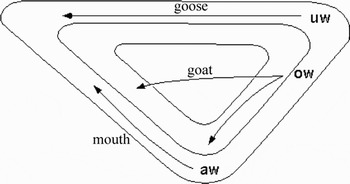
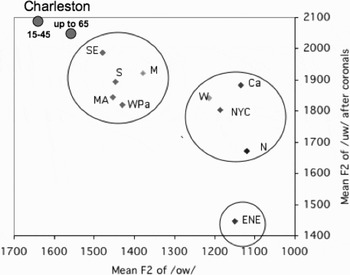
The Charleston dialect, like many other dialects of American English (ANAE; Anderson & Milroy, Reference Anderson and Milroy1999; Anderson, Milroy, & Nyguyen, Reference Anderson, Milroy and Nyguyen2002; Ash, Reference Ash, Arnold, Blake, Davidson, Schwenter and Solomon1996; Conn, Reference Conn2002; Fought, Reference Fought1999; Fridland, Reference Fridland1999, Reference Fridland2001; Fridland & Bartlett, Reference Fridland and Bartlett2006; Hall-Lew, Reference Hall-Lew2004, Reference Hall-Lew2005; Labov, Reference Labov1994; Luthin, Reference Luthin and Denning1987; Thomas, Reference Thomas1989, Reference Thomas2001; Ward, Reference Ward2003), is undergoing the parallel fronting of the back upgliding vowels /uw/, as in do and goose, and /ow/, as in so and goat (Figure 2). In fact, the fronting of the back upgliding vowels is arguably more advanced in Charleston than it is in most other dialects of American English. For speakers up to the age of 65, the Charleston dialect is ahead of the rest of the South, whereas for the youngest generation, it is ahead of all of North American dialects, including those of the most advanced Midland cities, such as Kansas City and Columbus, Ohio, which ANAE shows to be among the most advanced regions in the country (ANAE: Ch. 12, pp. 152–168). Figure 3 presents a typology of American dialects based on the extent of the fronting of /ow/ and of /uw/ after coronals—it shows the Southeastern region, the Midland, and the South to be at the forefront of this change. Superimposed on it is the Charleston dialect for speakers up to 65 (/ow/ F2 = 1557 Hz; /Tuw/ F2 = 2068 Hz) and between 15 and 45 years of age (/ow/ F2 = 1651 Hz; /Tuw/ F2 = 2094 Hz), showing Charleston's dialect to be ahead of other dialects of American English in both /uw/ and /ow/ fronting.
Fronting of back upgliding vowels.

Fronting of /uw/ and /ow/ by dialect (adapted from Figure 12.6 of the Atlas of North American English).

The Charleston dialect with its advanced fronting of /uw/ and /ow/ provides evidence for the lack of a structural relation between the Southern Shift—as defined by the chain shifting of the front vowels—and the fronting of the back upgliding vowels. It is a dialect that resists the Southern Shift (Baranowski, in press), though it is in close contact with dialects affected by it, and in this way lacks the defining characteristic of Southern phonology, and yet it shows very advanced fronting of /uw/ and /ow/. This provides support for treating the two processes as separate phenomena (ANAE).
The following sections present detailed analyses of the linguistic and extralinguistic factors affecting the fronting of /uw/ and /ow/ in the Charleston dialect, with a focus on the role played by social class in advancing the change.
Fronting of /uw/
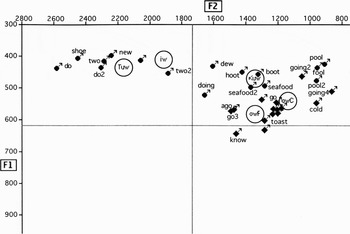
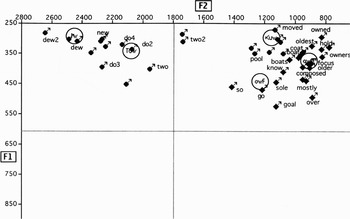
Although historically, and in a few conservative dialects of American English at present, /uw/ is a high back vowel, in the majority of American dialects today the vowel has undergone considerable fronting so that the nucleus is often to the front of the center of the vowel system as a whole, except before /l/ (see Anderson, Milroy, & Nguyen, 2002; Conn, Reference Conn2002; Di Paolo & Faber, Reference Di Paolo and Faber1990; Feagin, Reference Feagin, Nagle and Sanders2003; Fridland, Reference Fridland2003; Fridland & Bartlett, Reference Fridland and Bartlett2006; Hagiwara, Reference Hagiwara1997; Hall-Lew, Reference Hall-Lew2005; Labov, Reference Labov1994, 2001; Thomas, Reference Thomas2001; Ward, Reference Ward2003). There is a well-known allophonic distinction in American English between /uw/ after coronals (/Tuw/), as in do, soon, noon, shoot, and choose, and /uw/ after noncoronal consonants (/Kuw/), as in move, boots, food, and coop: tokens of /uw/ with coronal onsets are, except in the most advanced dialects, further front than tokens with noncoronal onsets (ANAE: Ch. 12, pp. 152–168; Anderson, Milroy, & Nyguyen, Reference Anderson, Milroy and Nyguyen2002; Ash, Reference Ash, Arnold, Blake, Davidson, Schwenter and Solomon1996; Fridland & Bartlett, Reference Fridland and Bartlett2006). For the vast majority of the ANAE informants (389 out of 439) /Tuw/ is in front of the normalized center line of 1550 Hz. The mean F2 of /Tuw/ for all of North America is 1811 Hz, whereas the mean F2 of /Kuw/ is 1433 Hz. Another important allophonic distinction is between /uw/ before /l/ and before all other consonants and word-finally: for all dialects of American English except for the most advanced speakers in the Southern dialect, /uw/ before /l/ does not participate in the fronting and remains firmly at the back of the vowel space.Footnote 3 Charleston's dialect differs from the rest of the South in this respect in that in Charleston /uw/ before /l/, advanced as it is otherwise, remains a back allophone. This common configuration of the three allophones of /uw/ can be seen in the fairly conservative system of Frank T., 48, in Figure 4, where /Tuw/ is front of center, /Kuw/ is further back and behind the center line, and /uw/ before /l/ is at the back of the vowel space.
Frank T., 48, Charleston, SC; working class.

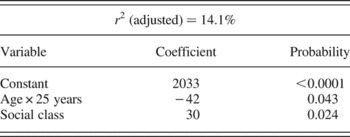
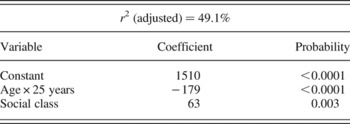
A regression analysis of F2 of /Tuw/ in the Charleston dialect reveals that age and social class play a role in the fronting of the vowel (Table 2). The negative age coefficient indicates that the vowel is fronting in apparent time—younger speakers have higher values of F2, which can be expected to increase by 42 Hz with every successive generation of 25 years. An increase of this size, given the F2 range for high vowels, is not particularly great and indicates that the change is nearing completion. While the youngest Charlestonians' /Tuw/ is among the furthest front in the country, the older generations are not far behind; their /Tuw/ is already further front than it is in most other dialects of North American English. Another indication that the change is nearing completion is that there is no significant difference between women and men in the extent of the fronting—women have been found to lead in changes such as vowel fronting (Hall-Lew, Reference Hall-Lew2004, Reference Hall-Lew2005; Labov, Reference Labov2001: Ch. 8; Luthin, Reference Luthin and Denning1987; Ward, Reference Ward2003) and are caught up with by men as the change spreads throughout the community.
Regression coefficients for F2 of /Tuw/ not before /l/

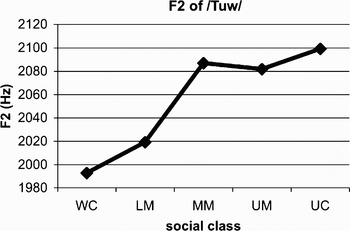
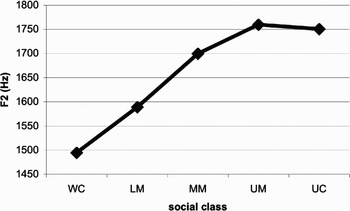
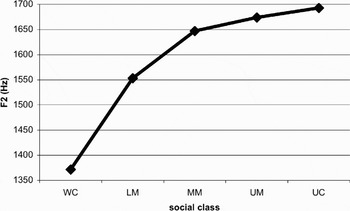
There is also a social class effect—the positive value of the social class coefficient in Table 2 indicates that the higher the social class, the higher the expected F2 of /Tuw/ (i.e., the further front the vowel). Figure 5 presents the means of F2 of /Tuw/ for the five social classes represented in the sample, with the lowest class used as the residual class. There is a considerable difference between the working and lower-middle classes, whose speech is less fronted, and the middle and upper classes, who are leading the change.
Mean F2 of /Tuw/ for five social classes.

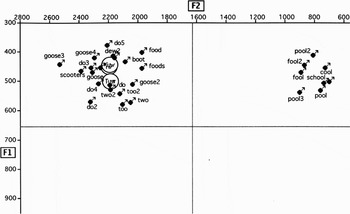
The speech of the informants in the sample shows that the Charleston dialect is at the forefront of not only /Tuw/ fronting, but also /Kuw/ fronting, with a mean F2 of 1667 Hz for /uw/ with noncoronal onsets (SD = 295 Hz) and not before /l/. Furthermore, for some of the youngest speakers, such as Pam K. in Figure 6, /Kuw/ is as far front as the coronal allophone, occupying a high front position in the region of 2000 Hz (cf. the conservative system of Frank T, 48, in Figure 4). Such advanced fronting of /uw/ after a noncoronal onset has not been reported for many dialects of North American English. Again, /Kuw/ before the lateral is at the back of the vowel space.
Pam K., 16, Charleston, SC, upper class: /uw/.

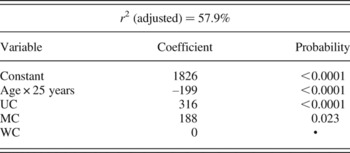
A regression analysis of F2 of /Kuw/ shows that, as in the case of /Tuw/, age and social class play a role in the extent of the fronting (Table 3).Footnote 4 For /Kuw/, however, both coefficients are much larger than in the case of /Tuw/, indicating that the change is both more vigorous and more socially differentiated; the amount of variation accounted for, as expressed by the value of r 2, is also much greater. The positive value of the age parameter indicates that the vowel is moving towards the front in apparent time; with each successive generation of 25 years, the F2 of /Kuw/ can be expected to increase by 199 Hz.
Regression coefficients for F2 of /Kuw/

UC = upper class; MC = middle class; WC = working class.
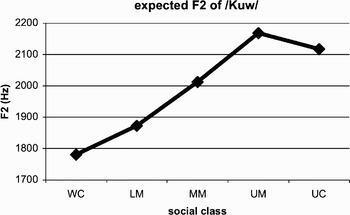
There is a very strong social class effect. The value of the social class coefficient is positive—the higher the social class, the more fronted the vowel can be expected to be—and three times as large as the coefficient for /Tuw/, indicating greater social differentiation. Table 3 presents the influence of social class as three separate factors—working class (the residual), middle class (lower-middle and middle combined), and upper class (upper-middle and upper combined)—which indicates that the fronting of /Kuw/ in the Charleston dialect is being led by the highest-status groups; the vowel can be expected to be further front by 316 Hz in the upper class, as compared with the working class. Figure 7 presents the expected values of the F2 of /Kuw/ for five social classes, derived from adding the age coefficient for a given class to the regression constant. The graph indicates a clear lead of the two highest-status groups and a monotonic relationship between social class and the degree of fronting for the other groups.
Expected values of F2 for /Kuw/ for five social classes (before the effect of age).

Fronting of /ow/
There is similar allophonic conditioning in /ow/ fronting to /uw/ fronting in that coronal onsets promote fronting, but that coronal effect is usually much smaller; Fridland and Bartlett (Reference Fridland and Bartlett2006) also report a fairly strong effect of a following velar. One additional and more important factor playing a role in the extent of the forward movement of /ow/ is the position of the vowel in a word: /ow/ in free position (/owF/), as in go and sow, is usually further front than when it is in checked position (/owC/), as in goat and toast Footnote 5 (ANAE). As in the case of /uw/, /ow/ before /l/ does not usually participate in the fronting and remains at the back of the vowel space, the South being the exception (ANAE: Figures 12.7 & 18.8). In this respect, the Charleston dialect differs from the rest of the South and is similar to most other dialects of American English, in that the two vowels before /l/ are firmly at the back of the vowel space.
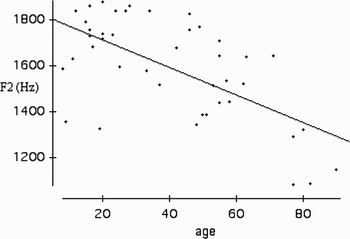
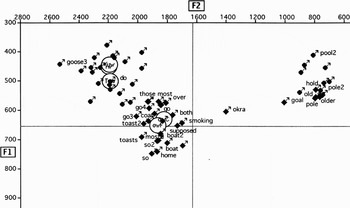
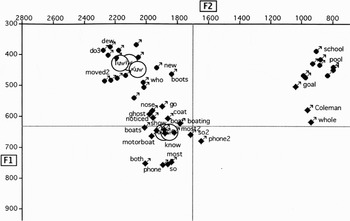
The realization of /ow/ common in Charleston today, a back-upgliding vowel with a fronted nucleus, stands in stark contrast to the traditional form—monophthongal and often ingliding, with a nucleus that was high and back. The traditional realization is still found in the speech of some of the oldest Charlestonians, such as John E., 80, in Figure 8. As the scatterplot in Figure 9 shows, however, there has been a dramatic change in the position of /ow/ in the Charleston dialect over the last few decades viewed in apparent time. Whereas the F2 of /owF/ for the oldest Charlestonians in the sample is as low as 1200 Hz, it rises to more than 1800 Hz for some Charlestonians around 20 years of age, such as Pam K., 17 (Figure 10) or Geena E., 20 (Figure 11), indicating some of the most advanced fronting of /owF/ not only in the South, but also in the whole of North American English.
John E., 80, Charleston, SC, middle class: /ow/.

F2 of /owF/ versus age.

Pam K., 16, upper class: /ow/.

Geena E., 20, Charleston, SC; upper-middle class: /ow/.

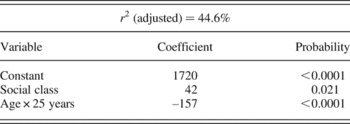
A regression analysis of F2 of /owF/ reveals that the fronting is a very vigorous change in apparent time, indicating that with every consecutive generation of 25 years, the F2 of /owF/ can be expected to increase by 157 Hz (Table 4).
Regression analysis of F2 of /owF/

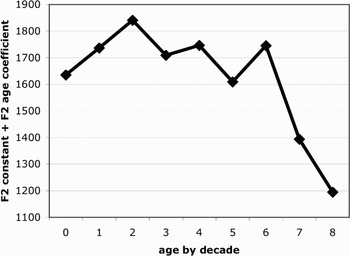
Figure 12 presents the expected values of F2 of /owF/ by decade, derived from adding the regression coefficient of each decade to the regression constant. The graph suggests that there was a rapid change in the fronting during the time represented by decades 8 to 6 (speakers aged 60 to 89)—corresponding to the change from the traditional system of long mid ingliding vowels to a system of upgliding vowels. It also shows a peak for young adults in their 20s and a relatively low value of F2 for children below the age of 10. This is likely not a reflection of the retreat of the fronting in apparent time but rather an indication that the fronting of /ow/ is led by teenagers and young adults. A similar peak in apparent time, representing a reorganization of the vernacular in late adolescence, has been found in other studies of sound change, for example, in the lenition of (ch) in Panama City (Cedergren, Reference Cedergren1973, Reference Cedergren1984), l-vocalization in Philadelphia (Ash, Reference Ash1982), and in changes of the Philadelphia vowel system (Labov, Reference Labov2001: 446–465).
Expected values by decade for the fronting of /owF/.

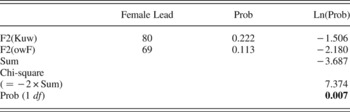
There is a gender difference in the fronting of /owF/: women can be expected by be ahead of men by 69 Hz. Although this difference does not come out as significant in the regression analysis, it is in the same direction as in the fronting of /Kuw/, where women are expected to be ahead of men by 80 Hz. Therefore, we can follow Fisher (Reference Fisher1925) to obtain the overall significance of the gender difference by adding the logs of the two p values in Table 4. Minus twice the sum of the logs is equal to chi-square for the overall relationship with n – 1 degrees of freedom. As shown in Table 5, the probability of the gender difference in the fronting of /Kuw/ and /owF/ being due to chance is .007. This result—the female lead in the fronting of the two back upgliding vowels—provides support for the generalization that women tend to lead linguistic changes such as vowel shifts (Hall-Lew, Reference Hall-Lew2004; Labov, Reference Labov2001; Luthin, Reference Luthin and Denning1987; Ward, Reference Ward2003).
Cumulative significance of gender differences in the fronting of /Kuw/ and /owF/

Social class also emerges as a significant factor—the value of the social class coefficient in Table 4 is positive, indicating that the higher the social class, the more advanced the fronting of /owF/. Figure 13 includes a graph of the mean F2 values of /owF/ for each of the five social classes represented in the sample for speakers up to 65 years of age.Footnote 6 The mean F2 values show that the fronting of /owF/ is being led by the highest-status social groups—the upper-middle and the upper classes—with a mean F2 at around 1750 Hz. The lower social classes show successively less fronting, indicated by the lower F2 values, with the working class being the lowest, at around 1500 Hz.
Mean F2 of /owF/ for five social class for speakers up to 65 years of age.

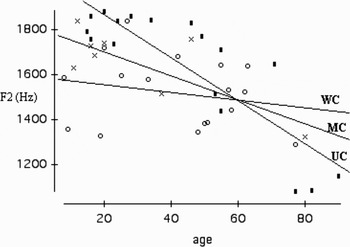
Furthermore, it turns out that the dynamics of the change— the fronting of /owF/—are different for different social classes. Table 6 presents the age coefficients for three social classes separately: working (working and lower-middle combined), middle, and upper class (upper-middle combined with upper class). All three age coefficients are negative, indicating that for all three social classes the fronting of /owF/ can be expected to be more advanced for younger speakers, but also the higher the social class the higher the rate of change in apparent time, expressed by the increase in F2 with each successive generation of 25 years: 43 Hz for the working class, 133 Hz for the middle class, and 239 Hz for the upper class. This indicates that the fronting of /ow/ is most vigorous for the upper class, which is reflected in the different slopes of the regression lines in the graph in Figure 14 showing the values of F2 of /owF/ versus age separately for each of the three social classes—it is the steepest for the upper class. There is a progression for all the classes from conservative and back /ow/ to very front /ow/, but the rates of change are different. The upper class appears to have made a jump from very conservative and back /ow/, reflecting the traditional dialect, to a position ahead of everybody else for the younger generations, all within just a few decades. As a result, the youngest members of this social group lead in the fronting of /owF/ not only in Charleston itself, but are also ahead of speakers of most other dialects of North American English, with F2 of /owF/ as high as 1850 Hz.
F2 of /owF/ versus age for three social classes; upper class: rectangles, middle class: crosses, working class: circles.

Age coefficients for F2 of /owF/ for three social classes

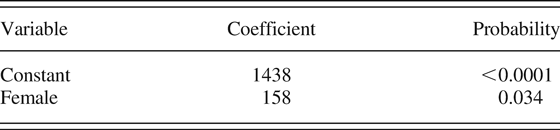
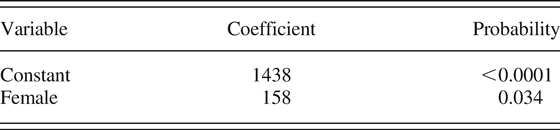
The age coefficient for the working class in Table 6 is not statistically significant. The only significant factor for this social class turns out to be gender: women can be expected to be ahead of men by 158 Hz in F2 of /owF/ (Table 7). In fact, this is the only social class for which there is a significant gender effect. It is in the expected direction in that women are ahead of men, as they usually are in this type of sound change, that is, in vowel shifting. It is quite possible, given what we know about the role of gender in linguistic change that women initially led in the fronting of /owF/ in the higher social groups as well, but as the change progressed, men have caught up with women and are fronting the vowel just as much. In consequence, upper-class men can be expected to be more advanced in the fronting of /owF/ than working-class women (and men). As the working class is the social group most resistant to the fronting—it is lagging behind the other groups—it is not surprising to see women ahead of men in that group.
Regression analysis of F2 of /owF/ for working class
The fronting of /owC/ in checked position, as in goat, is another vigorous change, whereby the youngest speakers are much further to the front than the oldest ones. The positive age coefficient indicates that the vowel can be expected to be 179 Hz further front for each successive generation of 25 years (Table 8). Again, there is a social class effect—the higher the class, the more advanced the fronting, and this effect is even greater than in the case of /owF/. Figure 15 includes a graph showing the expected values of F2 for /owC/, derived by adding the age coefficient for each class to the regression constant—there is a clear progression of the fronting along the social class dimension, with the highest-status social group leading the change.
Expected F2 of /owC/ by social class for speakers up to 65 years of age (before the effect of age).

Regression coefficients for F2 of /owC/

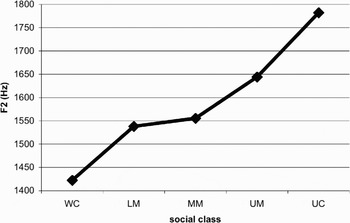
These results show clearly that the change is being led by the highest-status social group and is being resisted the most by the working class. The leading of the upper class is brought into sharper focus if we consider the youngest generation of speakers between the ages of 15 and 40: the mean F2 for the upper class is as high as 1782 Hz in that age group—it is considerably higher than in the other social classes (Figure 16).
Mean F2 of /owc/ by social class for speakers between 15 and 40 years of age.

Similar to /owF/, the highest-status social group shows no gender differential in the extent of the fronting of /owC/. Table 9 presents the mean F2 of /owC/ for three social classes of speakers between 15 and 45 years of age: WC (working class and lower-middle class), MC (middle class), and UC (upper-middle and upper class). There is virtually no difference between the two sexes for the highest class, whereas women are clearly ahead of men in the fronting of /owC/ in the other social classes. As the upper class is leading in the fronting of the vowel, the youngest upper class men have likely caught up with women at this advanced stage of the change. As the other social groups are less advanced, there is still a gender differential in the expected direction—women being ahead of men—and we can expect the gender differences to be greater in the classes that lag behind in the change.
Mean F2 of /owC/ for three social classes for speakers ages 15–40

DISCUSSION
The clear lead of the upper class in the fronting of the back upgliding vowels may seem unexpected in that it would provide a counterexample to the curvilinear principle, whereby language change from below is led by an intermediately located social group (Labov, Reference Labov2001: Ch. 5). However, the fronting of /uw/ and /ow/ in the Charleston dialect does not appear to be an internal, structurally motivated, change. There does not seem to be any structural influence of the front vowels, for example, as Charleston, in contrast to most of the Southern dialects, is not involved in the laxing and lowering of the front upgliding vowels (Baranowski, Reference Baranowski2006). More important, the shift of /ow/ towards the front seems to have advanced far too quickly for an internally motivated change. Even though mergers may happen in one generation, it is rather unlikely for a vowel to shift through internal forces only from the very back of phonetic space to a position further front than that of most other dialects of American English in such a short time, as seen in Figure 12. Rather, the fronting of the back upgliding vowels in Charleston is likely a case of systematic borrowing from outside the dialect, led by the highest-status social group, and as such is a change from above to which the curvilinear hypothesis does not apply. The strong fronting of /ow/ is one of the defining features of the emerging Southeastern superregion, extending from Florida in the south to the Midland in the north (ANAE: Map 11.11, p. 139); other features of this dialect region are the lack of marked Southern features, a nasal system for short-a, and an incipient low back merger (ANAE: 137). Charleston is very much part of this emerging superregion. As a result of the recent changes, particularly /ow/ fronting, its sound system is now strikingly similar to that of the large Midland cities, such as Columbus, Ohio, another leader in the fronting of /ow/ in American English.
Interestingly, although Charleston's upper class leads the rest of the community in the fronting of the back upgliding vowels, it displays a much more conservative behavior in another change found in the dialect, the pin-pen merger. The merger is on its way to completion in Charleston, with the exception of the highest-status social group, who lag behind the rest of the community. At the same time, the upper class is undergoing the low-back merger, another change operating in the dialect, at the same rate as everybody else (Baranowski, Reference Baranowski2006). Therefore, their more conservative behavior does not seem to be motivated by the need to preserve contrasts reflected in the spelling.Footnote 7 It is not clear why one merger should show social class differentiation while others did not, unless perhaps it was at a higher level of social awareness. The pin-pen merger, as opposed to most other mergers, may be above the level of awareness, at least for some speakers, as indicated by overt comments from some of the informants (Baranowski, Reference Baranowski2006). As a feature found throughout the South, it may be associated with other, marked features of the Southern dialect, and as such may be resisted more than a feature such as the low-back merger, which is not associated with any particular region or social group.
The question of possible resistance to features of Southern phonology is related to Charlestonians' sense of distinctiveness and separateness from the rest of the South, or more precisely, a distinction between the Low Country along the coast of South Carolina, including Charleston and Beaufort, and the Upcountry. The division goes back to the original settlement patterns, with the Upcountry settled largely from the Midland, with a substantial Scotch-Irish component, as opposed to the tidewater area, settled from the coast predominantly by Southern British speakers (McDavid, Reference McDavid1948). From the beginning, there were socioeconomic differences between the two regions: the Low Country, with its plantation caste concentrated in Charleston, dominated South Carolina economically and culturally, enjoying a disproportionate amount of social prestige resented by the rest of the state (Fraser, Reference Fraser1989; O'Cain, Reference O'Cain1972; Rosen, Reference Rosen1992).
Consequently, the speech patterns of the two regions were evaluated differently from the very beginning, for example, prestigious r-lessness of the Low Country versus negatively viewed constriction of /r/ by poor whites in the rest of the state. McDavid (Reference McDavid1948) reports a student of his saying: “The reason we Southerners resent the way the Yankees roll their /-r/ is that it reminds us of the way the crackers talk.” McDavid goes on to explain that
[i]n South Carolina the term crackers is used (though less than formerly) by the townspeople, the plantation caste, and the plantation-reared Negroes as a derogatory designation for the poor whites—nonslaveholders, or descendants of nonslaveholders—in areas where large slaveholdings once prevailed (p. 142).
That sense of the distinctiveness of Charleston, both culturally and linguistically, from the rest of the South and the rest of the state in the sense of the Upcountry, is seen in the comments made by the informants during the interviews, such as the one below by Robert B., 49, an upper-class Charlestonian:
I think we all have to acknowledge that one of the strongest attributes of Charlestonians is a hideous sense of arrogance. You know, Charlestonians think they're better than everybody else and everybody, you know, in the rest of the state seems to resent Charlestonians. … Are we Southern? Yes, we're Southern. Are we different from the South? Absolutely. What brings about that dichotomy? I'm not sure. I think that probably we have some of the similar values that the rest of the South has, but I think the difference is that we were for so long, two things, we were a leader and we were isolated.
It is possible that the pin-pen merger is associated by some speakers with other marked features of the Southern dialect—with the speech patterns of the Upcountry—from which Charlestonians have always felt distinct. This association does not seem to be very strong, however, and it may require a greater than usual linguistic awareness—an awareness that the upper class in Charleston may have developed. It may have come from their traditionally high exposure to speech patterns outside of the region. Charleston's upper class is known to have maintained stronger contacts with the other cultural centers of the East Coast (McDavid, Reference McDavid1955:273)—Boston, New York, and Richmond—and with England, than with the rest of the South. Even today, due to their education and professional contacts outside of the South, many upper-class Charlestonians (e.g., lawyers) operate on a national, rather than local level. Finally, they tend to travel beyond South Carolina—some of them travel to Europe, including England, with which they seem to have had a special connection, both in the past (McDavid, Reference McDavid1948:200) and at present,Footnote 8 as reported by Elizabeth O., 82, whose family has spent a few years in England and considers it their second home, and by Sarah E., 80:
We're a proud people and we're more English, I think, than anything. Because this was an English settlement, really. And everywhere you look, if you've been to England, it reminds you of England. Our customs, tea at 4 o'clock in the afternoon, washing down the marble steps every day, shining the brass [laughter], just little English things. When we go to England, we feel very much at home.
This exposure and contact with speakers of dialects outside of the region may have led to a heightened linguistic sensitivity and awareness of newly emerging speech patterns, such as the fronting of /ow/.
Although the fronting of the back upgliding vowels may be at a lower level of social consciousness than the pin-pen merger, in so far as it does not usually elicit any overt comments (Fridland, Reference Fridland2001:249), it nevertheless seems to be just above the level of awareness, at least for some speakers, as indicated by the results of the studies by Fridland, Bartlett, and Kreuz (Reference Fridland, Bartlett and Kreuz2004) and Torbert (Reference Torbert2004). Interestingly, the only overt comment about the mid long vowel /ow/ in this study comes from an upper-class speaker, 16-year-old Pam K., who comments on her Charleston accent by saying,
My sister went to Yale and everybody like an … I could not tell she has the Southern accent at all. She has it even less than I do, ‘cause I do say certain words, like I guess boat [fronted /ow/], or different things, more so than others, but uh …
She clearly associates the fronting of /ow/ with the South and makes an explicit comment about it, which is rare in the sense that /ow/ fronting is not generally known for being the subject of overt comments or stereotyping.
As the fronting of the back upgliding vowels is consistently most advanced in the Midland and, to a lesser extent, in the South (ANAE: Ch. 12, 152–168), it may be crossing the threshold of social awareness and coming to be associated with the Southeastern superregion, rather than with the marked features of the Inland South.Footnote 9 There is some evidence that for a number of dialects, including the Southern, /ow/ fronting not only shows no negative social evaluation but may in fact be acquiring some prestige. Labov notes this for Philadelphia, where the fronting of /owC/ does not show the curvilinear pattern of the other vowel changes, and concludes that “by one means or another, this characteristic feature of the Southern Shift has escaped stigmatization and become associated with middle class norms” (Labov, Reference Labov2001:187). Similarly, Fridland (Reference Fridland2001) reports that in Memphis, /ow/ fronting, as opposed to changes to the front vowels, has a strong middle-class presence and suggests that it is increasingly viewed as an incoming prestige norm in Southern speech, not as competing with national norms. Members of the highest-status social group in Charleston may be particularly sensitive to the newly emerging pattern and may be picking up on the prestige value of /ow/ fronting. They are introducing this superregional feature into the city's dialect, not unlike upper-middle-class New Yorkers introducing the prestige rhotic pattern into New York City's vernacular (Labov, Reference Labov1966).