Introduction
With one of the highest concentrations of scientific research stations anywhere in the world, the waters around the bays of the South Shetland Islands are probably the most well studied shelf areas in Antarctica. A young volcano in this archipelago, Deception Island, erupted before 1843, in the 1920s and then again in 1967, 1969 and 1970 (Elderfield Reference Elderfield1972). Expeditions to sample the benthos of the seabed in and around the caldera from years to decades after the eruption (Gallardo & Castillo Reference Gallardo and Castillo1968, Reference Gallardo, Castillo and Holdgate1970, Gallardo et al. Reference Gallardo, Castillo, Retamal, Hermosilla and Trucco1975, Reference Gallardo, Castillo, Retamal, Yañes and Llano1977, Retamal et al. Reference Retamal, Quintana and Neira1982, Arnaud et al. Reference Arnaud, Ramos-Espla, Ramos, Lopez, Olaso and Ramil1998, Cranmer et al. Reference Cranmer, Ruhl, Baldwin and Kaufmann2003, Lovell & Trego Reference Lovell and Trego2003) have created by far the most documented impact and recolonization of an eruption in polar seas. Gallardo et al. (Reference Gallardo, Castillo, Retamal, Yañes and Llano1977) reported abundance values were still relatively low three years after the last of these eruptions but had increased by 2–3 orders of magnitude to tens to hundreds of individuals per square metre. The opportunistic species Echiurus antarcticus (Echiura) invaded in 1972 and by 11 years after the last eruption some typical fauna, the echinoderms Odontaster validus, Ophionotus victoriae and Sterechinus neumayeri, had recolonized the site (Retamal et al. Reference Retamal, Quintana and Neira1982). Subsequently studies revealed the megabenthic fauna inside the caldera is now dominated by O. victoriae, S. neumayeri, O. validus, the nemerteans Parbolasia corrugatus and the shrimp Notocrangon antarcticus (Arnaud et al. Reference Arnaud, Ramos-Espla, Ramos, Lopez, Olaso and Ramil1998, Cranmer et al. Reference Cranmer, Ruhl, Baldwin and Kaufmann2003, Lovell & Trego Reference Lovell and Trego2003). Sampling throughout the year, Lovell & Trego (Reference Lovell and Trego2003) recently reported a total of 13 phyla, 16 classes and 68 ‘species’ from Deception Island. They also showed that individual samples typically contained less than half of these species and only ~26% and 19% of the species richness found in similar samples from Livingston and King George islands.
Although many plant and a few animal non-indigenous species (NIS) have established on islands south of the Polar Front (Frenot et al. Reference Frenot, Chown, Whinam, Selkirk, Convey, Skotnicki and Bergstrom2005), the situation has seemingly been different in the sea (Barnes et al. Reference Barnes, Hodgson, Convey, Allen and Clarke2006). Deception Island has been and still is a centre of interest for NIS establishment in Antarctica. It had become the most southerly site for establishment of an NIS plant (a Poa species), although this was wiped out by the eruptions (Smith Reference Smith1996). However, a decade ago an invasive NIS alga Enteromorpha intestinalis (L.) was discovered to have become established in the shallows (Clayton et al. Reference Clayton, Wiencke and Klöser1997), and recent evidence suggests several more NIS algae may be present (C. Wienke, personal communication 2007). Adults of one (Tavares & Melo Reference Tavares and Melo2004) and larvae of other NIS decapod crustaceans (Thatje & Fuentes Reference Thatje and Fuentes2003) were found in single samples elsewhere in the South Shetland islands, but to date no NIS animals are known to have established anywhere in the Southern Ocean.
At shelf depths around and inside Deception Island there is now a good record of benthic taxa present. This record effectively documents recovery over the decades since the eruptions. Compared to nearby islands Deception Island is clearly depauperate at depth (Lovell & Trego Reference Lovell and Trego2003). However, the fauna of the shallow subtidal (and intertidal) zone at Deception Island are relatively poorly known despite the area becoming a recognized site for cruise ship recreational SCUBA diving (Trotter Reference Trotter2006). As well as being useful for studies of long-term recolonization, periodic surveys of the fauna of the shallows at Deception Island are important as it is a likely site for the invasion of NIS. The shallows of Deception Island are one of the warmest sites (albeit patchily) in the Southern Ocean and the caldera is one of the more visited sites by ships coming from temperate ports (e.g. Ushuaia, Argentina). Ship borne transport is probably how NIS algae arrived at Deception Island (Clayton et al. Reference Clayton, Wiencke and Klöser1997) and many NIS fauna were documented as arriving at Macquarie Island on a single vessel (Lewis et al. Reference Lewis, Bergstrom and Whinam2006). The current study aimed to generate an inventory of the macro- and mega-benthos of the shallow subtidal at Deception Island from the entrance to far inside the caldera, and to include (for the first time) cryptofauna. Particular effort was made to search for possible NIS and to identify fauna to the highest possible resolution.
Method
Study sites
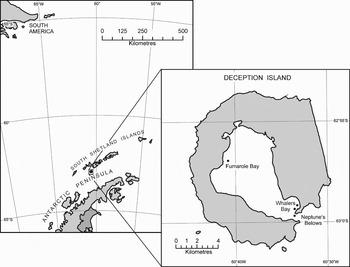
The study sites were in the drowned caldera of Deception Island, an active volcano in the South Shetland Islands at the northern end of the Antarctic Peninsula (Fig. 1). Where part of the caldera wall collapsed there is a narrow sill 11 m deep connecting the marine lake inside with the waters of the Bransfield Strait. Fast ice seasonally covers the area, Port Foster, inside the caldera (Smith et al. Reference Smith Jr, Baldwin, Kaufmann and Sturz2003). At the time of our SCUBA survey, the first site at the entrance, Neptune's Bellows, was characterized by boulder, cobbles and pebbles with patchily abundant macroalgae. Current velocities at peak flow were estimated to be in excess of 1 m s-1 and the sea surface temperature was about 1.5°C. The two sites dived in Whalers Bay had the occasional boulder or piles of cobbles but were typically steeply sloping gravel and coarse volcanic sands and muds. There was negligible current and the sea surface temperature was ~2°C. Digital temperature gauges worn by divers indicated subsurface (to 12 m depth) temperatures differed little from those on the surface. The final site, further inside the caldera, at Fumarole Bay was also characterized by gently sloping coarse volcanic sands and muds. As with the Whalers Bay sites, Fumarole Bay also had negligible current but it was warmer at 4°C, and one near surface measurement was as high as 20°C. Visibility on all dives was c. 6 m.
The position of Deception Island in the Southern Ocean and the location of the sample sites (filled circles) in the caldera (Port Foster).

SCUBA survey
In each area divers swam two transects of ~30 m parallel to the shore, one at 11–12 m depth then one at ~4 m, except for Fumarole Bay where no more than 6 m was reached. These depths were selected as initial observations suggested they seemed to be faunistically different. Approximately two metres each side of this belt transect were surveyed for mega-, macro- and crypto-benthos. Transect lengths were estimated by both divers and by personnel at the surface from furthest position of bubble emergence relative to entry point. All fauna encountered were identified in situ or collected, and the most numerically dominant taxa were noted. A Canon Powershot S50 camera in an underwater housing was carried as well as a quadrat of ~0.25 m2. Abundance of mega and macrofauna was semi-quantitatively scored as occurring as units, tens or hundreds per quadrat for five randomly placed quadrats on each transect. Thus 1.25 m2 was surveyed in detail at each depth at each site but more than 100 m2 at each was also coarsely surveyed. Boulders and other substrata were dislodged and macroalgae examined to inspect cryptofauna. Some pebbles containing surface cryptofauna was collected and examined under binocular microscope in order to make genus and species level identifications.
Analysis
The richness data (number of taxa) and semi-quantitative abundance data were compared between sites (separately for each of the two depths) using non-parametric Kruskal-Wallis tests.
Results
All taxa were identified to family level and, apart from serpulid polychaetes and lyssianasid amphipods, to genus level. No faunal NIS were found at any site. The three main subtidal areas of Deception Island examined, differed considerably in terms of macro- and megafaunal abundance, richness, dominant taxa and patchiness. Richness and abundance both increased with depth at each site (Kruskal Wallis all H1 > 4.6, P < 0.032). Although our samples are not enough to confirm it, we believe that there is a gradient from the channel (Neptune's Bellows) to the caldera interior (Fumarole Bay). From the channel into the caldera at the shallowest study depth both richness and abundance decreased significantly (Kruskal Wallis both H3 > 11.3, P < 0.01), with median values falling by two orders of magnitude.
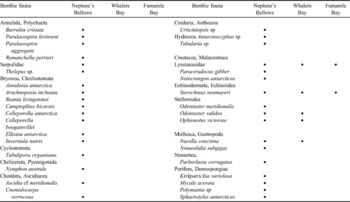
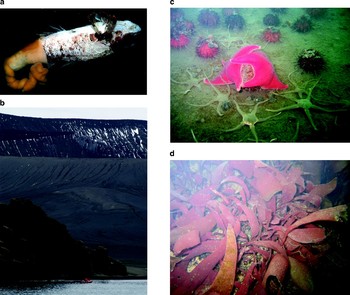
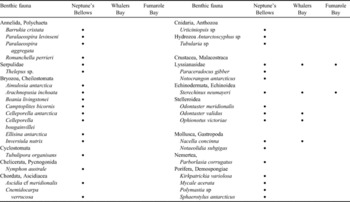
Macro- and megafaunal abundance at Neptune's Bellows was around tens of individuals per 0.25 m2 at 3 m depth increasing to hundreds of individuals at 8–11 m depth. The observed epifaunal community comprised at least 35 species representing 13 classes and 10 phyla (Table I). The dominant fauna and degree of space occupation varied considerably over spatial scales of metres. The upper surfaces of boulders were poorly colonized by fauna (mainly the limpet Nacella concinna) but bryozoans and polychaetes dominated the undersurfaces (cryptofauna). Demosponges, ascidians, cnidarians and their predators (Fig. 2a) dominated the few areas where there were vertical or overhanging surfaces. Notably, echinoderms were not particularly abundant.
Species recorded in the current study during SCUBA surveys at sites in Deception Island, Antarctica.
Only 200 m from Neptune's Bellows inside the caldera at Whaler's Bay, only N. concinna was abundant at 3 m depth and cryptofauna were absent from boulder undersurfaces. Lyssianasid amphipods were the only other macro- or megafauna (patchily) seen. At 8–12 m depth the epifaunal community was comprised of ~98% echinoderms (Fig. 2), dominated by the ophiuroid Ophionotus victoriae which occurred at tens of individuals per 0.25 m2. The echinoid Sterechinus neumayeri and the sea star Odontaster validus were occasional in small clusters. In total, only five species, representing four classes and three phyla, were seen during two dives at different locations within Whaler's Bay. Overall abundance and richness appeared an order of magnitude lower than in Neptune's Bellows.
Species and scenes at Deception Island, including a. one of the most common predator/scavengers at Neptune's Bellows, the nemertean worm Parbolasia corrugatus shown swallowing a dead fish, b. above surface at Fumarole Bay, and below surface at 8–12 m depth at c. Whaler's Bay and d. Fumarole Bay, Deception Island. The benthic species shown at Whaler's Bay are the echinoid Sterechinus neumayeri, the asteroid Odontaster validus and the ophiuroid Ophionotus victoriae.

Abundance and richness levels at Fumarole Bay were considerably lower than in Whaler's Bay. At 3 m no macro- or megafauna was obvious. Deeper at 6 m only lyssianasid amphipods were common associated with boulders and macro-algae with a few scattered S. neumayeri individuals. A few small Rhodophyta macroalgae were the only other obvious macroscopic organisms observed.
Discussion
There are few places around the coast of Antarctica where the nearshore shelf faunas are as well described as at Deception Island. Only in the shallows of the bays of King George Island, Anvers Island, Ryder Bay (in Adelaide Island) and McMurdo Sound, are the fauna as well described, but at all of these sites there have been decades to years of detailed SCUBA work on the shallow fauna. Even around such bays where there are Antarctic research stations we could not find a fauna as well known as at Deception Island for a defined area. This is because whilst many taxa were well recorded, some had been hardly considered e.g. polychaetes at Ryder Bay and that the geographical and bathymetric area surveyed for each taxon varied in extent around bays. Thus, other than at Deception Island, meaningful across taxa, species accumulation curves could not be plotted except for the shallows.
The inventory of macro- and mega-benthos in the shallows of Deception Island generated by the current study were highest at the entrance and lowest in the interior (Table I) but we appreciate that establishment of this as a true gradient would require considerably more samples. The narrow entrance, Neptune's Bellows, has a relatively rich community for its depth (see Dayton Reference Dayton and Smith1990, Arntz et al. Reference Arntz, Brey and Gallardo1994, Barnes Reference Barnes2000 for comparative data). This is probably due to the combination of moderately high flow rates and the shallow sill restricting ice scouring. The fauna list for Neptune's Bellows lists 14 species not previously recorded from Deception Island (e.g. Paralaeospira aggregata and Arachnopusia inchoata) but the presence of these new species is unsurprising as they are well known from the immediate region (see e.g. Knight-Jones & Knight-Jones Reference Knight-Jones, Knight-Jones and Hutchings1984, Hayward Reference Hayward1995). The dives in Whaler's Bay and Fumarole Bay revealed no new records of species but suggested a strong decline of species richness from Neptune's Bellows into the caldera at subtidal depth.
Comparison of Deception Island benthic sampling literature reveals another probable gradient in space, an increase in richness with depth. Data from the literature (Cranmer et al. Reference Cranmer, Ruhl, Baldwin and Kaufmann2003, Lovell & Trego Reference Lovell and Trego2003) is difficult to compare with the current findings because of differing methodologies and sample effort. Many of the species described from deeper than the subtidal are quite obvious, e.g. large species such as Laternula elliptica and Colossendeis megalonyx. Had they been present at the sites we surveyed it is likely divers would have seen them. However, previous SCUBA dives in Whaler's Bay have recorded ‘worms’ (probably Parborlasia corrugatus Fig. 2a) and occasional ascidians (Trotter Reference Trotter2006) that we did not see. Trotter (Reference Trotter2006) however, found that Remotely Operated Vehicle (ROV) dives revealed little obvious change in benthic communities from SCUBA depths to 80 m.
Richness and abundance have increased at Deception Island with time since the 1969–1970 eruptions (Gallardo & Castillo Reference Gallardo and Castillo1968, Reference Gallardo, Castillo and Holdgate1970, Gallardo et al. Reference Gallardo, Castillo, Retamal, Hermosilla and Trucco1975, Reference Gallardo, Castillo, Retamal, Yañes and Llano1977, Retamal et al. Reference Retamal, Quintana and Neira1982, Arnaud et al. Reference Arnaud, Ramos-Espla, Ramos, Lopez, Olaso and Ramil1998, Cranmer et al. Reference Cranmer, Ruhl, Baldwin and Kaufmann2003, Lovell & Trego Reference Lovell and Trego2003). Whilst the fauna has recovered considerably from these locally devastating impacts, Lovell & Trego (Reference Lovell and Trego2003) show that the benthos of Deception is impoverished at species level compared to nearby islands. Furthermore whole classes, such as the anthozoans and holothuroids, are missing and others, such as the gastropods, cephalopods, stelleroids and echinoids, are very poorly represented. In many cases the taxa that have managed to recolonize, for example, within the gastropods and echinoderms, are those with planktotrophic larvae (see Stanwell-Smith et al. Reference Stanwell-Smith, Peck, Clarke, Murray and Todd1999). On shorter time scales Cranmer et al. (Reference Cranmer, Ruhl, Baldwin and Kaufmann2003) and Lovell & Trego (Reference Lovell and Trego2003) found relatively little monthly or seasonal variability in species presence and abundance, and we suggest that our findings in the current study would probably vary little along similar time scales.
How many species are there at Deception Island?
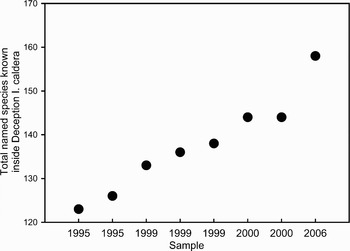
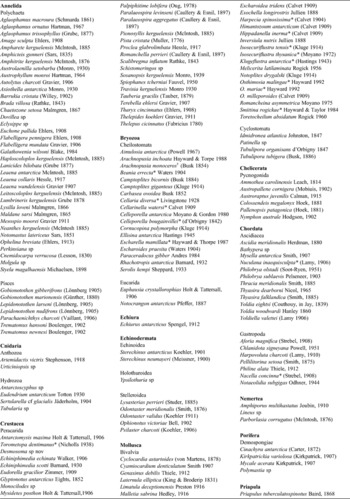
Estimating total faunal or metazoan richness has been attempted for terrestrial biota on a number of sub-Antarctic and Antarctic islands (e.g. Gaston et al. Reference Gaston, Chown and Mercer2001). A recent effort on a similar scale to the current study yielded 14 terrestrial faunal species on Deception Island but the total reported at that time was 57 species (Downie et al. Reference Downie, Convey, McInnes and Pugh2000). In the Southern Ocean generally, the vast majority of known species, locally or regionally, occur in the sea on the continental shelf. Attempts (such as the Census of Antarctic Marine Life – CAML) are being made to catalogue Antarctic marine species and so estimate the number of species in the Southern Ocean (see Clarke & Johnston Reference Clarke and Johnston2003). However, many areas, e.g. the Amundsen Sea, are very poorly sampled and probably nowhere has been sampled to the intensities in terrestrial studies. Deception Island is one of the more sampled sites for its geographic area and thus represents one of the best opportunities at estimating the total number of marine species present in a particular area. In four dives we found a total of 34 species and, together with named species we found reference to in the literature, 163 named species are known to be present (Table II). However, this refers only to benthos and even on the seabed meiofauna and microbes have hardly been investigated. The reported presence of two species of Philobrya, P. olstadi by Soot-Ryen (Reference Soot-Ryen1951) and P. sublaevis by Lovell & Trego (Reference Lovell and Trego2003), might be caused by the morphological similarity and plasticity of the adult shell. The prodissoconch patterns have to be investigated to confirm species identification. The extent to which this is an underestimate of currently known benthic species richness can also be estimated. In addition to the 163 named species, there are phyla and classes (e.g. Nematoda and Calcarea respectively), which are known to occur in the caldera but for which no species names have yet been reported. Across the literature we found reference to unknown morphospecies of at least five annelids, one cnidarian, 33 crustaceans (four mysid, 20 amphipod, two cumacean, five isopod and two euphausid), two nemerteans, one nematode, one sipunculan and seven sponges (e.g. see Cranmer et al. Reference Cranmer, Ruhl, Baldwin and Kaufmann2003, Lovell & Trego Reference Lovell and Trego2003, San Vicente et al. Reference San Vicente, Castelló, Corbera, Jimeno, Munilla, Sanz, Sorbe and Ramos2007). This adds a minimum of 50 species waiting to be named to the current total of 163 named species, thus giving a minimum estimate of 2131 species found to date, none of which have been identified as NIS. Some taxa are clearly undersampled or have been sampled but appear under-represented as species await description or recognition. For example, the many nematodes found by various studies, such as the recent BIOPEARL cruise (BAS unpublished data) are likely to comprise more than one species but how many will be unknown until they receive attention by specialist taxonomists. Despite Deception Island being one of the most intensely sampled small areas in the Southern Ocean, new species are still being recorded. Of course some of these may be genuinely new arrivals recolonizing from previous local eruption-related extinction events. The current study added 7.6% of species to the total number of species known but was the first detailed epifaunal survey of a previously little studied depth (the shallows). New future surveys will undoubtedly increase the total, indeed at least one new species is currently in description from an epibenthic sledge sample taken in the caldera after our SCUBA samples (S. Kaiser personal communication 2007). Species accumulation from recent samples seems to be consistently increasing (Fig. 3) and the number of marine mega- and macro-species may reach 300.
Total number of species known from Deception Island caldera from recent studies with sample date. Data from comparing recent studies of San Martin et al. (Reference San Martin, Parapar, Garcia and Redondo2000), Cranmer et al. (Reference Cranmer, Ruhl, Baldwin and Kaufmann2003), Lovell & Trego (Reference Lovell and Trego2003) and current study to older literature.

Marine species recorded from Deception Island up to March 2007. Data from species recorded by Chevreux Reference Chevreux1913, Gallardo et al. Reference Gallardo, Castillo, Retamal, Yañes and Llano1977, Moyano Reference Moyano1978, Retamal et al. Reference Retamal, Quintana and Neira1982, Olaso et al. Reference Olaso, Garcia-Castrillo and Balguerias1997, Child Reference Child1994, Reference Child1995a, Reference Child1995b, San Martin et al. Reference San Martin, Parapar, Garcia and Redondo2000, Crammer et al. 2003, SOMBASE - Griffiths et al. Reference Griffiths, Linse and Crame2003, Reference Griffiths, Linse and Barnes2008, Lovell & Trego Reference Lovell and Trego2003, San Vicente et al. Reference San Vicente, Castelló, Corbera, Jimeno, Munilla, Sanz, Sorbe and Ramos2007, BAS unpublished data and current study. Some species have been recorded under previous names (*) and some records (†) have been considered unlikely.

This first estimate of a total number of marine species present in the Deception Island caldera area is probably considerably lower than would be found in comparative areas around the Southern Ocean for a number of reasons. Assemblage level studies have shown adjacent areas in the South Shetland archipelago are much richer for some taxa while some taxa seem to be almost entirely absent from Deception Island (Finger Reference Finger1975, Gallardo et al. Reference Gallardo, Castillo, Retamal, Yañes and Llano1977, Saiz Salinas et al. Reference Sáiz-Salinas, Ramos, García, Troncoso, San Martin, Sanz and Palacin1997, San Martin & Pararpar Reference San Martin and Parapar1997, San Vicente et al. Reference San Vicente, Ramos, Jimeno and Sorbe1997, Reference San Vicente, Castelló, Corbera, Jimeno, Munilla, Sanz, Sorbe and Ramos2007, Arnaud et al. Reference Arnaud, Ramos-Espla, Ramos, Lopez, Olaso and Ramil1998, Lörz & Brandt Reference Lörz and Brandt2003, Lovell & Trego Reference Lovell and Trego2003). The history of disturbance by volcanism, current extreme sedimentation and temperature regimes, acidity, trace metals and rarity of three-dimensional structures provided by suspension feeding communities (Cranmer et al. Reference Cranmer, Ruhl, Baldwin and Kaufmann2003 recorded just a few sponges) amongst other factors combine to cause the paucity of taxa at Deception Island. Equivalent Deception caldera-sized areas on the shelf of the Antarctic Peninsula probably have three or four times as many macrofaunal species. To make comparisons meaningful though sampling in other areas needs to be of comparable intensity, area and depth - which is frequently not the case. Nevertheless it seems the small areas of the seabed in the Southern Ocean, even those with the physical extreme conditions of Deception Island, can still be extremely rich at species and high taxonomic levels.
Acknowledgements
The authors would like to thank the officers and crew of RRS James Clarke Ross for aid with SCUBA operations and Dr Igor Smirnov, Huw Griffiths and Stefanie Kaiser for help with species names and lists. Finally we would like to thank Prof Lloyd Peck and three anonymous referees for comments leading to an improved manuscript.