



1 Overview
Intonation and prosodic structure offers an up-to-date survey of these topics as they are pursed within linguistics.* The book is unusually extensive in its breadth; over the course of ten chapters, Caroline Féry presents an overview of a wide range of theoretical approaches and issues, while also providing full-chapter coverage on interface topics such as phonetic realisation, semantic and pragmatic interpretation, and even psycholinguistic processing. The book adds to a list of extensive theoretical and empirical updates to the field in recent years, such as Büring (Reference Büring2016) and Ladd (Reference Ladd2008). It is difficult not to see Intonation and prosodic structure in the context of these two particular recent works, not least because woven into Féry's thorough and accessible survey is an argument that figures prominently in both of them: that prosodic structure, including higher-level prosodic structure, is recursive. In what follows, I offer a brief summary of how the book covers what it does, while highlighting some of the important theoretical problems addressed (and, indeed, revealed) in this important work.
2 Core content
I focus most of my discussion on what may be regarded as the volume's core, namely Chapters 3–5 (which follow two chapters on introductory and preliminary concepts). In these three chapters, Féry surveys the field's prominent theoretical apparatus, while also incorporating her own claims about the nature of prosodic organisation. As alluded to above, chief among these is an argument for recursion, or more specifically for what Ladd (Reference Ladd2008) calls ‘compound prosodic domains’ and Büring (Reference Büring2016) calls ‘limited recursion’. The idea here is that prosodic embedding is simpler than syntactic embedding; prosodic phrase levels can be repeated (e.g. an intonational phrase within an intonational phrase), but they do not contain phrases of higher categories (e.g. an intonational phrase within a phonological phrase) or skip levels (e.g. an intonational phrase directly dominating a prosodic word; see Selkirk Reference Selkirk, Myers, Laver and Anderson1981, Reference Selkirk1986 and Reference Selkirk, Morgan and Demuth1996 for aspects of ‘strict layering’). In Chapter 3, Féry makes skilful use of word-level phenomena to introduce the empirical power of recursive phrasing, presenting Ito & Mester's (Reference Ito and Mester2013) min-max model as a simple and elegant way to implement it formally. The presentation offered here, which includes applications to Japanese, German, English and Swedish patterns, leaves the reader with the impression that recursion is an intuitive and compelling way to approach prosodic structure at lower levels of the hierarchy. This prepares us for Chapter 4, where we see utterance-level examples that suggest that recursion will be needed at higher levels as well.
It is useful to highlight that underlying much of the book is a basic division in phonologically oriented prosody research, namely that between the Prosodic Phonology and Intonational Phonology traditions, which are better understood as distinct research programmes than competing approaches. Characteristic of modelling within Prosodic Phonology is an emphasis on illuminating the strong but indirect relation between syntax and phonology, and on identifying the domains of metrical and segmental alternations in multi-word utterances (see Nespor & Vogel Reference Nespor and Vogel1986, Truckenbrodt Reference Truckenbrodt1995, among many others). Models of this type feature explicitness regarding the relation between prosodic phrasing and other aspects of the linguistic representation, but often need to posit prosodic domains that are very abstract in relation to phonetic realisation. Modelling within Intonational Phonology – and especially what Jun (Reference Jun1998) calls the ‘intonational approach’ – has essentially the inverse emphasis, prioritising surface realisation (and perception) in the identification of prosodic domains, which are assumed to be largely independent from syntactic structure. The primary goal in such work is generally the identification of categorical phonological structure based on a set of assumptions about how that structure is implemented phonetically, with special status given to tonal movements in the identification of phrase edges and prominent words. It is important to point out that models of this type are not accurately characterised as models of phonetic implementation, which is perhaps not always clear in Féry's discussion. However, they do feature a high degree of explicitness with respect to the relation that prosodic constituents have to the speech signal, and in particular which phonetic cues are assigned to which level(s) of structure (Pierrehumbert Reference Pierrehumbert1980, Beckman Reference Beckman1986, Beckman & Pierrehumbert Reference Beckman and Pierrehumbert1986, Grice Reference Grice1995, Jun Reference Jun1998, Grice et al. Reference Grice, Ladd and Arvaniti2000, among many others). Any relationship between prosodic and morphosyntactic structure, however, is not formally addressed. Despite their different foci, it should be noted that these two research programmes have in fact arrived at many of the same conclusions about basic issues, and the state of the field is such that both are still needed to account for all the phenomena that have been attested (Frota Reference Frota, Cohn, Fougeron and Huffman2012).
It is not surprising, then, that considerable progress has been made in recent years by sometimes taking the best of both worlds – that is, positing a prosodic structure in which fairly abstract levels of phrasing sit below more surface-identifiable, intonational ones (e.g. Frota Reference Frota2000, Gussenhoven Reference Gussenhoven2005). Much of this type of work, including what Féry presents us with, incorporates basic elements of Truckenbrodt's (Reference Truckenbrodt1995, Reference Truckenbrodt1999) model. Applied to English, this approach assumes a prosodic hierarchy with two basic levels above the (prosodic) word, the first of which is the phonological phrase. The phonological phrase has two important properties. First, as in earlier work in Prosodic Phonology, this is the prosodic level that most closely interfaces with syntactic structure. In models like Truckenbrodt's, however, the alignment of prosodic phrase edges and syntactic phrase edges is determined via ranked and violable constraints. Most important among them are requirements that syntactic constituents be completely contained within phonological phrases (Wrap-XP) and aligned with the head of a phonological phrase (Stress-XP). Second, the heads of phonological phrases define the locations of phrasal stress (i.e. sentence accents), and the strongest among them is head to the highest prosodic layer, the intonation phrase (where tones are assigned). The head of the intonation phrase is the nuclear accent. Two important features of this model, then, are that (i) prosodic constituents are counted primarily in terms of heads rather than edges, since edges are not necessarily assigned a phonetically realised feature, and (ii) an utterance's metrical structure boils down to relationships among these phonological phrase heads. The former is what separates Truckenbrodt's basic system most clearly from ‘intonation first’ approaches such as those that Jun (Reference Jun1998) describes. The latter has been crucial to the diagnosis of phrase structure in much recent work, and arguments for recursion – including the ones Féry puts forward – emerge mostly from using metrical structure in this way.
In Chapter 4, Féry argues that the sort of system just described is well suited to accounting for sentences with only the simplest syntactic structure. For example, although deriving the metrical structure of simple SVO sentences like (1a) is straightforward, sentences like (1b) (from page 62) seem to require either additional levels in the prosodic hierarchy, or the possibility of recursion in the existing ones. (In her model, the prosodic phrase (φ-phrase) and the intonation phrase (ι-phrase) function like Truckenbrodt's phonological phrase and intonation phrase respectively.) Féry favours recursion, and uses the min-max notation introduced in Chapter 3 to represent the depth that, in principle, either the φ-phrase or ι-phrase can have.
(1)

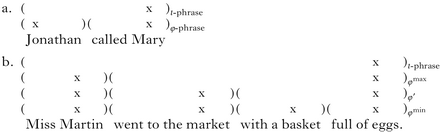
An important question is how structures like (1) relate to the intonational contour – indeed, how the intonational contour is even modelled in this system. These issues are addressed in Chapter 5, where Féry again incorporates some of her own proposals into a broader overview, in this case of approaches to intonation (where ‘intonation’ here refers specifically to melody). Chapter 5 outlines several intonational models with the kind of succinct presentational style we find in the earlier chapters. The primary focus, however, is on the autosegmental-metrical model, or what Féry more carefully refers to (since metrical structure is not a property that all languages clearly have) as the tone-sequence model, particularly the one proposed for English by Pierrehumbert (Reference Pierrehumbert1980). Basic to Pierrehumbert's model – or more specifically, to the minor revision of it in Beckman & Pierrehumbert (Reference Beckman and Pierrehumbert1986) – is that English intonation features tones of two types: those that mark words as prominent (pitch accents) and those that mark the edges of phrasal constituents (phrase accents, which mark intermediate phrases, and boundary tones, which mark intonational phrases). For the purposes of modelling intonation, Féry describes the two distinct categories in her model as corresponding to Beckman & Pierrehumbert's φ-phrases and ι-phrases function like Beckman & Pierrehumbert's intermediate phrases and intonational phrases respectively, and so φ-phrase edges are what phrase accents mark.
Féry's decision to allow for recursion while maintaining the same number of intonationally demarcated phrase levels as Beckman & Pierrehumbert raises interesting questions, not all of which are decisively answered. While the ability to derive the metrical structure of syntactically complex utterances is gained, elegantly so for sentences like (1), it is at the cost of the ability to relate phrase structure explicitly to melody. For example, if φ-phrases are to receive phrase accents, the proposed system generates too many of them for utterances like (1a), where a canonical, ‘out-of-the-blue’ pronunciation likely lacks any clear phrase boundary between the subject and the VP. How can this be addressed? It may be theoretically desirable to sacrifice the requirement that φ-phrase edges be obligatorily marked by tonal targets – perhaps phrase accents are optional, much as prenuclear pitch accents are widely regarded as optional (Gussenhoven Reference Gussenhoven, Bosch and van der Sandt1999). If that is the case, then utterances like (1b), if they have the phrasal structure that Féry assigns to them, are indeed quite interesting; her three levels of recursive φ-phrase layering generate three possible utterance-internal phrase-accent locations, but it is unclear where one (or more) should actually surface. For example, we might assume, intuitively, that it is the edge of the maximal φ-phrase that is most likely to be marked by a phrase accent. Alternatively, we might assume it is the most deeply embedded φ-phrase whose edge gets overtly marked. Interestingly, however, it seems that the most likely pronunciation of (1b) is neither of these, but rather one in which a tonal target occurs between market and with, which is a φ′-level boundary in this structure. Note that one could argue that such a pronunciation actually reflects the presence of a boundary tone at this location, and thus a different structure – i.e. one in which Miss Martin went to the market and with a basket full of eggs form two separate ι-phrases. But Féry explicitly rules this possibility out by imposing a separate requirement that a syntactic clause be contained within a single ι-phrase. The discussion here thus highlights (i) some important differences between the Prosodic Phonology and Intonational Phonology frameworks, and (ii) a major challenge that continues to loom over both. One comes away wondering (certainly for languages like English and German) whether it will ultimately be possible to allow for recursion while simultaneously assuming two distinct levels in the hierarchy that are both associated with the melodic contour.Footnote 1
Pitch-accent scaling (i.e. adjustments to the relative height of tonal targets) also figures into Féry's call for recursion, as well as claims about the prosodic realisation of information structure. She draws on an observation discussed in Ladd (Reference Ladd1988), who observes that the prosody of English coordinate structures differs, depending on the direction of their branching. In addition to the differences in the location of phrase boundaries (which can be argued to reflect a flattening out of the syntactic structure), constructions of the form [A but [B and C]] seem to have sequential downstep from A to B to C, while constructions of the form [[A and B] but C] feature downstep from A to B, but apparent reset (or upstep) of C relative to B. Significant about this asymmetry is, first, that it shows that downstep can occur not just within prosodic phrases, but across them; since the ABC structures can involve two full syntactic clauses, the downstep relation is assumed to be across intonation phrases. Second, it shows that the direction of prosodic subordination mirrors at least some of the depth of the syntactic structure. Building from Ladd's observation, Féry proposes that downstep is derived directly from phrase structure. In particular, downstep is triggered by default among pitch accents that occur in sequences of phrases of the same level, but is blocked by higher levels. Over the course of Chapters 4 and 5, Féry walks us through available evidence for this putative tonal scaling/phrase structure relationship (see also Kentner & Féry Reference Kentner and Féry2013). Although it is not yet clear just how much depth can be encoded in such scaling, I think the inclusion of this phenomenon in Féry's discussion adds considerably to the model she presents. Not only is scaling an underappreciated aspect of the representation in most phonological models, the appeal to it here provides something other than metrical patterns to motivate phrasal structures. The tendency for prosodic domains to be posited for too specific a purpose (e.g. to serve as the domain of a particular sandhi rule) was one of the earliest criticisms of modelling within this framework (Kaisse Reference Kaisse, Inkelas and Zec1990).
3 Prosodic interfaces and prosodic typology
Due in large measure to the developments in prosodic theory discussed above, the contemporary linguistic study of prosody and meaning has largely divided into two rather separate endeavours: on the one hand, modelling the relationship between metrical structure and information structure, and, on the other, modelling the relationship between the melodic contour and pragmatic interpretation. In Chapter 6, Féry addresses both, although the modelling of the former has arguably seen more progress in recent years than the latter, and Féry's own claims mostly involve information structure. For example, Féry proposes that, at least in languages like English and German, information structure makes systematic adjustments to the default pitch-accent scaling that, as described above, she derives via phrase structure. The basic idea (first proposed in Féry & Kügler Reference Féry and Kügler2008) is that the presence of focus on a word boosts its phonetic F0 value relative to that of other pitch-accented words, in a kind of pitch-specific version of Jackendoff’s (Reference Jackendoff1972) Focus Rule (see also Truckenbrodt Reference Truckenbrodt1995 and Schwarzchild Reference Schwarzschild1999), which is combined with a complementary process that lowers the pitch of discourse-given words. In my own opinion, the role of pitch in the prosodic realisation of information structure is grossly understudied in work within autosegmental-metrical theory (see Bishop Reference Bishop2013: ch. 4 and Ladd Reference Ladd1996: 277–283), and Féry's attention to it here allows for some additional empirical coverage. For example, her model would seem to predict the asymmetry found in the relative height of pitch peaks on focus-topic vs. topic-focus constructions in English, which has been largely ignored in work on the prosody–information structure interface. Jackendoff (Reference Jackendoff1972) described the prosodic realisation of this meaning distinction as different orderings of the ‘A’ and ‘B’ accents of Bolinger (Reference Bolinger1965), choosing to elevate the role of the high boundary tone (which correlates with the topic) in cueing it. However, it has long been known that the pitch peak marking the focus is scaled higher than the topic, so consistently that Liberman & Pierrehumbert (Reference Liberman, Pierrehumbert, Aronoff and Oehrle1984) were able to identify an equation that described it; see also Calhoun (Reference Calhoun2012) for evidence that this scaling asymmetry may be more reliable than the presence of a rise at the boundary. Féry's claims come together here as follows. Recursion in her approach would presumably place the focus and the topic in separate ι-phrases, recursively embedded in a larger ι-phrase; her pitch-accent scaling version of the Focus Rule would then subordinate the height of the accent marking the topic to that marking the focus, regardless of their ordering. Simple though it may seem, this is not straightforwardly derivable in most models. It may be noted, however, that Féry's implementation of accent scaling does seem to be rather more phonetic than phonological in nature; certainly, it is less explicitly categorical than the tonal metrical structure that Ladd (Reference Ladd, Kingston and Beckman1990, Reference Ladd2008) uses to represent similarly syntagmatic relations among tonal targets.
Issues related to typology and processing are covered in the final chapters of the book. Readers will find that Féry limits her discussion of processing (Chapter 7) to research on the role of prosody in sentence processing, and particularly the resolution of syntactic ambiguity (involving both explicit and implicit prosody). This seems reasonable, given that it is perhaps the most mature area of research on prosody within psycholinguistics. Chapters 8 and 9 both deal with typology; Chapter 8 considers cross-linguistic differences in word-level prosodic systems and Chapter 9 provides an overview of higher-level prosodic systems, the latter making heavy use of the theoretical machinery developed throughout the first half of the book. These two chapters together make a coherent point: prosodic analysis of word-level and sentence-level organisation cannot be carried out independently of one another. Simply put, it is not a priori clear from the surface patterns of an utterance whether a tone (or a phonetic cue to prominence) is associated with a lexical item, a prosodic word or some higher-level prosodic constituent. Perhaps the most significant proposal Féry offers in this section is for an additional typological category, which she calls the ‘phrase language’ (originally proposed in Féry Reference Féry, Hasnain and Chaudhury2010). Féry uses this category to describe languages that assign tones primarily to higher-level constituents (i.e. φ-phrases and ι-phrases), but without anchoring them to any specific aspect of word structure (in contrast to ‘intonation languages’ like English and German, where tones are assigned at the phrase level, but are anchored to either stressed or unstressed syllables at the word level). Féry's wording here does leave some ambiguity, however, as specifications are not necessarily absent at the word level, but instead are ‘sparse, absent or only weakly implemented’ (p. 270). At one end of the spectrum, then, French (Delais-Roussarie et al. Reference Delais-Roussarie, Post, Avanzi, Buthke, Di Cristo, Feldhausen, Jun, Martin, Meisenburg, Rialland, Sichel-Bazin, Yoo, Frota and Prieto2015) and Korean (Jun Reference Jun1998, Reference Jun2005a) are both clear cases of phrase languages, since (despite their very different phrase-level specifications) they can both be analysed as lacking any kind of word-level prosodic marking. But languages like Hindi (Féry et al. Reference Féry, Pandey and Kentner2016) and Bengali (Khan Reference Khan2014) also count as phrase languages, since word-level stress, though it may be present in these languages, is non-phonemic, and often only weakly or unreliably realised. This part of the book does very little to engage with other recent typological proposals (the intonation-language/phrase-language distinction in fact has considerable overlap with Jun's (Reference Jun2005b, Reference Jun2014a) distinction between ‘head-prominence’ languages on the one hand, and ‘edge-prominence’ and ‘head/edge-prominence’ languages on the other) and in some cases the discussion needs updating (Féry describes Grabe's Reference Grabe1998 distinction between compressing and truncating languages, but this distinction has since been identified as an oversimplification; Grabe et al. Reference Grabe, Post, Nolan and Farrar2000, Ohl & Pfitzinger Reference Ohl and Pfitzinger2009). Nonetheless, the approximately 100 pages of typology-related material in the book is another example of where it will make a particularly valuable resource for linguists (especially graduate students) coming from other linguistic subfields.
4 Production quality
Finally, and in contrast with the impressive content of this book, readers will find it hard not to notice significant deficiencies in its design and production. Typographical errors are rather frequent (sometimes quite dramatic), as are typesetting errors and mistakes and omissions in the references. In terms of design, one feels that space at the end of the book might have been better spent on an expanded subject index than a (modest) glossary of terms. Finally, each chapter is followed by a ‘Discussion points’ section; like the glossary, these seem rather out of place given the target audience (‘linguists and advanced students of linguistics’; p. ix), but the level of sophistication is also very uneven across chapters. It should be noted that what I point out here as deficiencies are often quite out of the modern author's hands; sometimes awkward series formats constrain decisions about design, and the now commonplace practice of outsourcing various stages of editing and typesetting renders post-proof errors far more likely.
5 Conclusion
In summary, Caroline Féry has provided the field with a new and important resource, as well as promising new claims to test. In describing his own now-classic text, Ladd (Reference Ladd1996: 3) noted that, despite considerable progress in the field by that time, ‘there exists no comprehensive account accessible to the outsider’. Intonation and prosodic structure, despite some questions it leaves unanswered, compares favourably with anything currently available in terms of both comprehensiveness and accessibility, and will be important reading for anyone pursuing research on sentence-level prosody.


