I. INTRODUCTION
Because there are so many vitally important applications in gas molecules storage, separation, drug release, photonic, and catalysis,Reference Davis1 the novel porous materials have been of much interest, such as metal-organic frameworksReference Eddaoudi, Moler, Li, Chen, Reineke, O’Keeffe and Yaghi2–Reference Ferey, Mellot-Draznieks, Serre and Millange5 and porous organic frameworks (POFs)Reference Thomas6–Reference Thomas, Kuhn, Weber, Titirici and Antonietti8 recently. The representative POFs include covalent organic frameworks (COFs),Reference Cote, Benin, Ockwig, O’Keeffe, Matzger and Yaghi9–Reference Tilford, Mugavero, Pellechia and Lavigne14 conjugated microporous polymers,Reference Jiang, Su, Niu, Wood, Campbell, Khimyak and Cooper15–Reference Dawson, Laybourn, Clowes, Khimyak, Adams and Cooper17 polymers of intrinsic microporsity (PIMs),Reference Budd, Ghanem, Makhseed, McKeown, Msayib and Tattershall18–Reference McKeown and Budd20 hyper crosslinked polymers,Reference Wood, Tan, Trewin, Niu, Bradshaw, Rosseinsky, Khimyak, Campbell, Kirk, Stockel and Cooper21 crystalline triazine-based organic frameworks,Reference Kuhn, Antonietti and Thomas22 and porous aromatic frameworks (PAFs).Reference Ben, Ren, Ma, Cao, Lan, Jing, Wang, Xu, Deng, Simmons, Qiu and Zhu23–Reference Yuan, Sun, Ren, Jing, Wang, Ma, Zhao and Zhu25 Particularly, the design and synthesis of crystalline POFs are widely concerned because of the convenience to design and achieve their structures and properties.Reference Uribe-Romo, Hunt, Furukawa, Klock, O’Keeffe and Yagh12 However, the required microscopic reversibility of the crystallization of linked organic molecules into solids is still a big challenge because of the irreversible reactions used in their synthesis. A facile dehydration process based on boronic acid building blocksReference Tilford, Gemmill, zur Loye and Lavigne26 was an efficient and simple manner to generate highly porous, crystalline and robust materials which are greatly desired in practical applications. Herein, we first report the targeted synthesis of a germanium-centered three-dimensional crystalline porous aromatic framework, CPAF-13, via the molecular dehydration reaction.
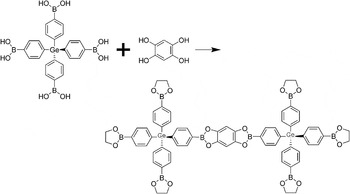
The strategy to achieve the targeted material, CPAF-13, was shown in Fig. 1.Reference Stockel, Wu, Trewin, Wood, Clowes, Campbell, Jones, Khimyak, Adams and Cooper27–Reference Holst, Stockel, Adams and Cooper29 The four-node building block tetra(4-dihydroxyborylphenyl)germanium (TBPG) was designed and synthesized. A diamond topology framework was expected to form via the linkage of TBPG and 1,2,4,5-tetrahydroxybenzene (THB) through a simple dehydration process. In the dehydration process, one boronic acid molecule and one diol molecule converge to form a planar five-membered BO2C2 ring with the elimination of two water molecules. Another advantage of this dehydration reaction is that it does not need the addition of catalysts or other reagents.
Synthetic pathway toward CPAF-13.

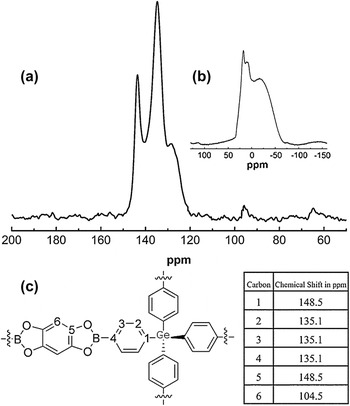
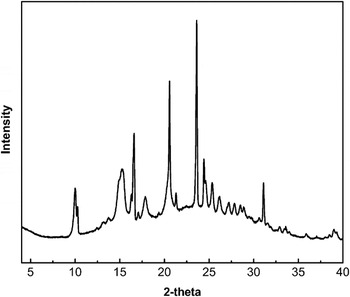
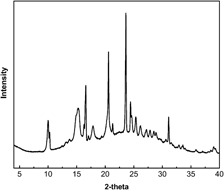
As shown in Fig. 2, CPAF-13 has three pronounced signals at δ = 148.5, 135.1, and 104.5 ppm, corresponding to substituted and unsubstituted phenyl carbons [Fig. 2(c)].Reference El-Kaderi, Hunt, Mendoza-Cortes, Cote, Taylor, O’Keeffe and Yaghi11 All the expected peaks from the starting material are present, showing the survival of the building block. Note the resonances at 135.1 and 148.5 ppm indicate the incorporation of tetraphenylene molecule. Peaks arising from the incorporation of the THB are also present, confirming the identity of the product. Some of the carbon signals are too close in chemical shift to be resolved. The solid-state 11B CP magic angle spinning nuclear magnetic resonance (MAS NMR) spectroscopy is highly sensitive to the immediate bonding environment of boron. Any differences in B–C and B–O distances and/or angles will result in a notable change in the line shape and intensity of the spectra [Fig. 2(b)]. As the data of 13C CP MAS NMR experiments show the presence of the expected number and environment of each type of respective nucleus, further substantiating the structural assignments.Reference El-Kaderi, Hunt, Mendoza-Cortes, Cote, Taylor, O’Keeffe and Yaghi11 However, the covalent linking of building blocks through expected five-membered BO2C2 boronate ester rings was assessed with Fourier transform infrared (FTIR). FTIR spectra contain strongly attenuated bands arising from boronic acid hydroxyl groups indicative of successful condensation of the reactants. Cocondensed CPAF-13 products have strong C–O stretching bands at 1255 cm−1, signals that are distinctive for boronate ester five-membered rings. This FTIR spectroscopy data are fingerprints for the expected boron-containing rings. PXRD was performed to investigate the crystallinity of CPAF-13, which confirms the crystallinity and reveals no diffraction peaks that could be attributed to starting materials or its known solvates (Fig. 3). The first peak of CPAF-13 could be observed at 10°. Although the pattern cannot agree with that of the simulated diamond structures, all peaks were narrow and sharp, which indicates high crystallinity. This result may be caused by the interpenetration of diamond structures, and the structure of CPAF-13 has diamond structures with mixed folds. The lack of peaks before 10° should be due to the lack of long-range order of CPAF-13.
(a) Solid-state 1H CP magic angle spinning nuclear magnetic resonance (MAS NMR) spectra of network CPAF-13 recorded at MAS rate of 5 kHz. (b) Solid-state 11B NMR spectra CPAF-13.

Powder x-ray diffraction analysis (PXRD) pattern of CPAF-13.

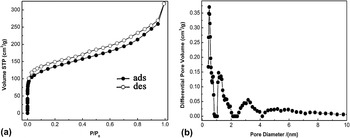
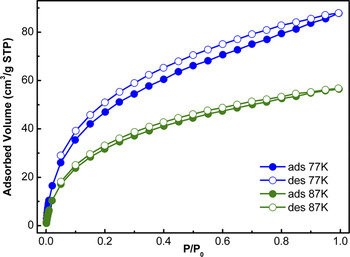
To characterize the porosity of the CPAF-13 network, the Ar sorption isotherm was measured at 87 K. Prior to the analysis of Ar sorption, a sample was suspended in dry CH2Cl2 for 24 h. After filtration, the wet sample was dried under vacuum at room temperature primarily and then at 60 °C and high vacuum for 12 h. As shown in Fig. 4(a), CPAF-13 exhibits a sharp uptake at low relative pressures, which suggests that CPAF-13 has the microporous structure in its framework. In addition, CPAF-13 exhibits distinct hysteresis extending to low pressure between the adsorption and desorption cycles. This result confirms the mesoporous nature of CPAF-13. For some polymers, the hysteresis is observed at low relative pressures.Reference Weber and Thomas30 This feature is due to elastic deformations in the course of Ar sorption, i.e., the network is swelling. Therefore, the network can be regarded as soft matter in comparison to stiff, inorganic materials like zeolites, indicating a lower degree of cross-linking. This is in accordance with the low surface area of CPAF-13. As shown in Fig. 4(b), the porous structures of CPAF-13 were further corroborated by fitting nonlocal density functional theory using the carbon cylindrical pore adsorption branch model with a 1.583% fitting error. The narrow pore-size distribution centered at 0.48, 1.22, and 3.18 nm. The apparent surface area derived from BET model for CPAF-13 is 417 m2/g, which is very close to that of Pc-PBBA COF,Reference Spitler and Dichtel31 but much lower than PAF-1 and other POFs.Reference Ben, Ren, Ma, Cao, Lan, Jing, Wang, Xu, Deng, Simmons, Qiu and Zhu23, Reference Lee, Wood, Bradshaw, Rosseinsky and Cooper32 However, CPAF-13 shows comparatively higher H2 sorption capacity measured at 77 and 87K, which can be seen in Fig. 5. As shown, an increase of total H2 capacity with increasing pressures is observed. At 1 bar, CPAF-13 can adsorb 0.79 and 0.51 wt% H2 at 77 and 87 K respectively, but no saturation is reached indicating an expected higher uptake with increasing pressure. This value is slightly below that of PIMs reported to adsorb 1.04–1.43 wt%.Reference McKeown, Gahnem, Msayib, Budd, Tattershall, Mahmood, Tan, Book, Langmi and Walton33 The desorption isotherm shows a weak hysteresis. In principle, the hysteresis could be due to sample contamination (e.g., sorption of less volatile molecules such as H2O), but control experiments suggested that this was not the case. Extensive washing and Soxhlet extraction of the sample also failed to eliminate the hysteresis. This weak hysteresis might be explained by some interaction between the gas and the adsorbent. This may be responsible for the slight hysteresis.Reference Hasell, Wood, Clowes, Jones, Khimyak, Adams and Cooper34 The gradual rise of the isotherm indicates a small adsorption enthalpy. Indeed, the fit to the data of CPAF-13 yields initial isosteric heat of adsorption of ∼3.09 kJ mol−1.
(a) Ar adsorption isotherms of CPAF-13 measured at 87 K. (b) Pore-size distribution curve.

H2 adsorption isotherms of CPAF-13 measured at 77 K.

II. CONCLUSIONS
A crystalline metal centered PAF material, CPAF-13, based on the tetrahedral unit TBPG and linear linker THB, was targeted and synthesized via dehydration reaction successfully. CPAF-13 displays high crystallinity, high apparent surface, and considerable H2 capacity, which proves that it is a good porous material. Novel synthesis strategies are underway for the synthesis of novel crystalline PAF materials.
ACKNOWLEDGMENTS
We are grateful for the financial support of the Outstanding Young Scientist Foundation of NSFC (20625102), International Science and Technology Cooperation Program (2007DFA40830), and NSFC (Grant No. 20831002).