Introduction
Although tuberculosis (TB) seems to be decreasing worldwide, a large proportion of cases is occurring in adults with comorbidities. 1 AIDS, neoplasms, diabetes mellitus, transplantation, chronic renal diseases, connective tissue diseases, and immunosuppression are risk factors for the occurrence of the disease, including the more severe clinical forms where diagnosis is difficult and may require hospitalization.Reference Ribeiro and Matsui 2 In addition, progressive aging of the populationReference Kobashi, Mouri and Fukuda 3 , Reference Davies 4 and the advent of mycobacterial resistance have increased the need for complex health services.
Delay in pulmonary tuberculosis (PTB) diagnosis can result in increased patient morbidity and in-hospital disease transmission, especially among healthcare workers.Reference Jensen, Lambert, Iademarco and Ridzon 5 Patients with active PTB are the major source of disease transmission. Because institutional risk seems to be related to patients care indicatorsReference Greenway, Menzies and Fanning 6 and location,Reference Ollenberger and Worsley 7 prompt identification and isolation of patients with active PTB are imperative.
The diversity of clinical presentations, decrease in patients with evident symptoms, and increase in patients with atypical radiologic patterns hinder early detection.Reference Kobashi, Mouri and Fukuda 3 , Reference Greenway, Menzies and Fanning 6 , Reference Sokolove, Rossman and Cohen 8 In these contexts, bacillary load is usually lower,Reference Resende, Sinkoc and Garcia 9 making it difficult to use microbiologic examination as a single screening criterion.
Depending on the method used, smear microscopy can accurately detect 25% to 65% of cases. Patients with negative smear results and positive culture results are therefore frequent and, although being less efficient transmitters of the PTB, may cause up to 17% of new cases of PTB.Reference Behr, Warren and Salamon 10
Mycobacterium tuberculosis culture, the diagnostic reference standard, can take up to 42 (Mycobacteria Growth Indicator Tube [BD]) or 60 (Lowestein Jensen medium) days to provide final results. Thus, rapid and high-sensitivity molecular laboratory tests have been increasingly gaining importance as diagnostic tools. The test currently recommended by the World Health Organization, Xpert MTB / RIF, allows rapid detection of up to 99% of smear-positive and 67% of smear-negative culture-confirmed TB cases.Reference Steingart, Schiller, Horne, Pai, Boehme and Dendukuri 11 Nevertheless, there are constraints related to its widespread use in low- and middle-income countries on account of cost and test logistics. Implementation requires identifying target groups and defining diagnostic algorithms.
Independent of the healthcare setting, request of specific tests for TB will always rely on clinical suspicion.Reference Catanzaro, Perry and Clarridge 12 Clinical prediction rules (CPRs) quantify the contributions of several components of the clinical-epidemiologic history, physical examination, and basic laboratory tests to diagnosis, providing stratification algorithmsReference McGinn, Guyatt, Wyer, Naylor, Stiell and Richardson 13 and generating scores with cut-offs indicative of risk of having the disease. The World Health Organization 1 currently recommends the use of algorithms for systematic screening of active TB in priority groups, specifically those with conditions that are risk factors for the disease, but makes no special recommendations for in-hospital screening.
Wisnivesky et alReference Wisnivesky, Serebrisky and Moore 14 and Solari et alReference Solari, Acuna-Villaorduna, Soto and Stuyft 15 reported that CPRs for PTB diagnosis have greater sensitivity than direct microbiologic examination of sputum smear alone. A positive screening by a CPR could guide the request of both simple (eg, chest radiograph) and more complex tests (eg, molecular biology tests) and optimize the use of respiratory isolation rooms.
The development and application of a CPR involves a 4-step method using prospective, blind designs for accuracy and cost-effectiveness studiesReference Laupacis, Sekar and Stiel 16 , Reference Toll, Janssen, Vergouwe and Moons 17 : (1) derivation (definition of the most important predictors in a specific population); (2) external validation in similar populations (temporal or narrow validation) or different populations (broad or geographical validation)Reference Moons, Royston, Vergouwe, Grobee and Altman 18 ; (3) the assessment of its impact on the physician’s behavior or patient outcome, to determine its ability to accurately define the targeted disease, reduce costs, and improve care; and (4) actual dissemination of the CPR in daily practice to guide health professionals with disease management, which is optimized with simpler rules.Reference McGinn, Guyatt, Wyer, Naylor, Stiell and Richardson 13 , Reference Reilly and Evans 19
Several studies have been conducted to derive and/or validate CPRs for the diagnosis of active PTB in outpatient,Reference Mello, Bastos and Soares 20 emergency care,Reference Redd and Susser 21 , Reference Solari, Acuna-Villaorduna and Soto 22 and inpatientReference Mylotte, Rodgers, Fassl, Seibel and Vacanti 23 – Reference Aguiar, Almeida and Ruffino-Netto 30 settings. However, the CPR’s performance can vary with healthcare setting,Reference Ollenberger and Worsley 7 warranting the specific assessment of CPRs for inpatient diagnosis of PTB.
CPRs for PTB diagnosis in adults reported in the literature have varied regarding predictors, accuracy, and epidemiologic contexts.Reference Mello, Bastos and Soares 20 , Reference Rakoczy Ks and Nguyen 27 We aimed to summarize studies of CPRs for active PTB in adult patients (at least 15 years old) admitted to general hospitals, identify level of evidence (derivation or validation), and compare their accuracy and predictors, highlighting implications for practice and further research.
Method
This is a systematic review of CPRs in adult patients admitted to acute care hospitals. Procedures adopted and results reported follow Preferred Reporting Items for Systematic Reviews and Meta-Analyses.Reference Liberati, Altman and Tetzlaff 31
The search was conducted in indexed databases PubMed-MEDLINE, Scopus, Web of Knowledge, Latin-American and Caribbean Center on Health Sciences Information, and EMBASE, and by using the “alert” resource to keep the search updated. The Zotero Standalone software, version 3.0.3 for Windows, was used for searching and storage of references. A librarian experienced in conducting systematics reviews (M.F.M.M.) developed the search strategies.
Keywords were combined according to the proper syntax of each base and included the following expressions: “inpatient”; “hospitalization”; “predict”; "sensitivity and specificity"; "tuberculosis pulmonary"; "mycobacterium tuberculosis"; and “TB”. The search strategy at PubMed was “((Inpatient*[Title/Abstract]) OR hospitalization [Title/Abstract]) AND ((("predictive value of tests"[MeSH Terms]) OR predict*[Title/Abstract]) OR sensitivity and specificity [MeSH Terms]) AND (("tuberculosis, pulmonary"[MeSH Terms]) OR "mycobacterium tuberculosis/isolation and purification"[MeSH Terms])”. There was no restriction regarding language and publication date and studies up to January 2013 were included.
Three pairs of reviewers (B.D.G.-S.R.L.P., B.D.G.-F.C.Q.M., and B.D.G.-C.A.F.A.) read and selected the abstracts and full texts independently and blind to authorship and journal. In case of discrepancies between the members of any pair, one member of the other 2 pairs gave an opinion. A data extraction sheet was developed and piloted, including characteristics of the studies, clinical and laboratorial predictors, cutoffs for the score, and accuracy parameters used. We also reviewed cross-references and alerts of the indexed databases.
The eligibility criteria were as follows: articles including patients in general care hospitals, aged at least 15 years and assessed regarding signs and symptoms as well as laboratory and imaging tests; articles aimed at defining CPRs (combination of 2 or more clinical, laboratory, or radiologic predictors) for active PTB diagnosis and using positive culture results for M. tuberculosis as the reference standard. Cross-sectional, cohort, or case-control studies were included as long as their accuracy measures were stated. Articles with the following characteristics were excluded: those having no parameters for comparison with other rules (ie, neural networks or decision tree); studies focusing on specific populations (ie, homeless, elderly, prisoners, or pneumonia or AIDS patients); and studies restricted to assessing cases with negative microbiologic examination; studies of isolated inpatients; as well as studies aiming to compare TB patients having positive versus negative smear results.
We used the following criteria from Standards for Reporting of Diagnostic Accuracy to evaluate methodologic quality of the articles: prospective design, with consecutive or randomized selection of the population included and masking to the result of the reference test. Criteria employed aimed to avoid possible biases and confounders.Reference Aguiar, Almeida and Ruffino-Netto 30 Accuracy results of the derivation and validation studies for the same CPR are shown as long as populations were different. However, because the predictors were the same, each rule was considered only once. Accuracy parameters included were sensitivity, specificity, and the area under the receiver operating characteristic curve, which allows assessment of sensitivity and specificity variation of different cutoff values for the result. Positive likelihood ratios (LRs) (true-positive rate / false-positive rate) were estimated by us for all CPRs on the basis of data provided in the original studies. The larger the positive LR, the greater the likelihood of disease. Positive LR values between 5 and 10 indicate moderate and greater than 10 indicates strong increases in posttest probability of disease. Negative likelihood ratio is given by the probability of a negative test result in those with disease, compared with the probability of a negative test result in those without disease. Thus, the smaller the negative LR, the greater the likelihood of disease.
We also performed a meta-analysis using WinPepiReference Abramson 32 version 11.29 for those CPRs with at least 2 validation studies. We compared studies with respect to test performance: sensitivity, specificity, LR of positive and negative test results, and diagnostic odds ratio. We inspected the forest plot for visual appraisal of heterogeneity and considering test I-squared greater than 0.70 as statistical heterogeneity. Overall pooled and Dersimonian-Laird (random effects) estimates values of the measures of test performance were computed.
Results
Selection and Characteristics of the Studies Included
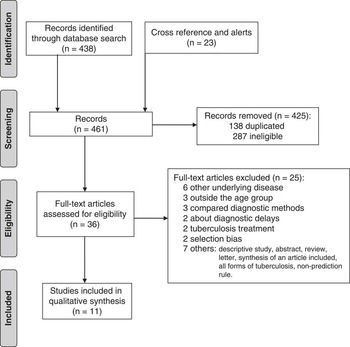
The search yielded 461 registries, of which 438 were found in electronic databases, 19 by use of cross-references, and 4 by the alert system of indexed databases. After discarding duplicates and ineligibles, we fully analyzed 36 articles, ultimately resulting in 11 approved articles (Figure 1).
Flow diagram of the systematic review (PRISMA Model 2009Reference Liberati, Altman and Tetzlaff 31 )

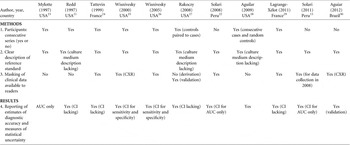
The articles included met almost all quality criteria, allowing comparison of population and accuracy data; in 4, however, there was no reference to masking in any stage of data collection and assessmentReference Mello, Bastos and Soares 20 , Reference Rakoczy Ks and Nguyen 27 , Reference Aguilar, Yang, Brar and Markowitz 28 , Reference Aguiar, Almeida and Ruffino-Netto 30 (Table 1).
Quality Assessment Parameters for Studies Included (Adapted From Standards for Reporting of Diagnostic Accuracy)

NOTE. AUC, area under receiver operating characteristic curve; CI, confidence interval; CXR, chest radiograph.
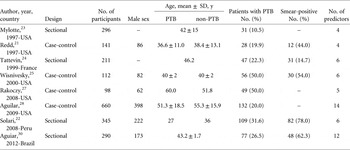
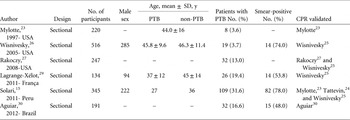
The 11 articles, published between 1997 and 2012, reported on 8 CPRs derived in 4 countries (United States, France, Peru, and Brazil). Three narrow validationReference Tattevin, Casalino, Fleury, Egmann, Ruel and Bouvet 24 , Reference Rakoczy Ks and Nguyen 27 , Reference Aguiar, Almeida and Ruffino-Netto 30 and 2 broad validation studiesReference Mylotte, Rodgers, Fassl, Seibel and Vacanti 23 , Reference Wisnivesky, Kaplan, Henschke, McGinn and Crystal 25 were performed. The studies as a whole included 3,461 patients, active PTB being confirmed in 646 (18.7%). The number of patients included and PTB prevalence in individual studies ranged from 98 to 660 patients and 10.5% to 50.0% for derivation studies, and from 134 to 516 patients and 3.6% to 31.6% prevalence in validation studies. Mean age ranged from 27.0 to 55.3 years, male population predominating in all studies. Sputum smear result was positive in 14.7% to 78.0% of the patients with positive microbiologic culture result. Presence of comorbidities, especially AIDS, ranged from 24.6% to 60% (Tables 2 and 3).
Characteristics of Clinical Prediction Rule Derivation Studies for Hospitalized Adult Patients With Suspected Pulmonary Tuberculosis (PTB)

Characteristics of Clinical Prediction Rule (CPR) Validation Studies for Hospitalized Adult Patients With Suspected Pulmonary Tuberculosis (PTB)

Calculation of the final CPR score was mostly based on angular coefficients or odds ratios of final predictors obtained using logistic analysis for all studies except one using the Classification And Regression Tree model.Reference Aguiar, Almeida and Ruffino-Netto 30
CPR derivation studies had 2 types of retrospective design: case-control and cross-sectional. Five CPRsReference Mylotte, Rodgers, Fassl, Seibel and Vacanti 23 , Reference Wisnivesky, Kaplan, Henschke, McGinn and Crystal 25 , Reference Rakoczy Ks and Nguyen 27 , Reference Aguilar, Yang, Brar and Markowitz 28 , Reference Aguiar, Almeida and Ruffino-Netto 30 used comparators restricted to controls isolated on admission to the hospital. All the validation studies had cross-sectional or prospective designs (Tables 2 and 3).
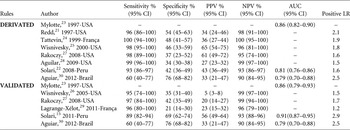
Only 2 CPRsReference Mylotte, Rodgers, Fassl, Seibel and Vacanti 23 , Reference Wisnivesky, Kaplan, Henschke, McGinn and Crystal 25 were validated by authors other than those deriving them, thus generating evidence sufficient to consider for use in practice (level 2). Lagrange et alReference Lagrange-Xélot, Porcher and Gallien 29 and Rakoczy et alReference Rakoczy Ks and Nguyen 27 validated CPR by Wisnivesky et al.Reference Wisnivesky, Kaplan, Henschke, McGinn and Crystal 25 Solari et alReference Solari, Acuna-Villaorduna, Soto and Stuyft 15 reviewed 13 CPRs, including Wisnivesky et al,Reference Wisnivesky, Kaplan, Henschke, McGinn and Crystal 25 and applied them to a population presenting to the emergency department that they had studied earlierReference Solari, Acuna-Villaorduna and Soto 22 (Table 3). The best validation results of Solari et alReference Solari, Acuna-Villaorduna, Soto and Stuyft 15 were obtained for the CPR of Myllote et al,Reference Mylotte, Rodgers, Fassl, Seibel and Vacanti 23 with results presented in Table 4.
Sensitivity, Specificity, Positive Predictive Value (PPV), and Negative Predictive Value (NPV) of Prediction Rules for the Diagnosis of Pulmonary Tuberculosis in Hospitalized Adults

NOTE. AUC, area under receiver operating characteristic curve; CI, confidence Interval; LR, likelihood ratio.
Predictors and Accuracy of CPRs
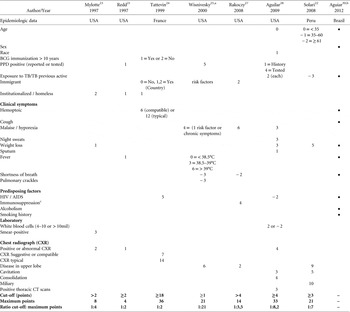
Individual CPRs included from 4 to 14 predictors and 28 to 132 patients with PTB (Table 2). Only 4 CPRs adhered to the recommendation of keeping a predictor: case ratio of 1:10.Reference Solari, Acuna-Villaorduna and Soto 22 , Reference Wisnivesky, Kaplan, Henschke, McGinn and Crystal 25 , Reference Rakoczy Ks and Nguyen 27 , Reference Aguilar, Yang, Brar and Markowitz 28 The cutoff point of scores recommending respiratory isolation ranged from 1 or greater to 18 or greater (Table 5). Wisnivesky´s CPRReference Wisnivesky, Kaplan, Henschke, McGinn and Crystal 25 presented the lowest cut-off (≥1) and, paradoxically, the highest maximum score (36). Data about homeless, immigrants, and purified protein derivative testing predominated in studies from countries with a low prevalence of TB, and older age, male sex, alcoholism, and smoking history in high-prevalence countries.
Clinical Prediction Rule Derivation Studies for In-Hospital Pulmonary Tuberculosis: Predictors and Weights

NOTE. BCG, bacillus Calmette-Guérin; CT, computed tomography; HIV, human immunodeficiency virus; PPD, purified protein derivative RT 23.
a Wisnivesky grouped as risk factors or chronic symptoms with weighting 4 points.
b Aguiar included marked symptoms.
c Immunosuppression: liver disease, chronic renal diseases, diabetes mellitus, cancer, use of steroid drug and alcohol ≥3 months.
Clinical signs most often included as predictors were weight loss (7 of 8 CPRs) and fever (5 of 8 CPRs). The CPRs of Mylotte et alReference Mylotte, Rodgers, Fassl, Seibel and Vacanti 23 and Solari et alReference Solari, Acuna-Villaorduna and Soto 22 included weight loss as their sole clinical predictor. Cough was included as a predictor in 3 CPRs and sputum production in 1. Only 3 CPRsReference Wisnivesky, Kaplan, Henschke, McGinn and Crystal 25 – Reference Rakoczy Ks and Nguyen 27 provided any detail for clinical predictor description.
In 4 studiesReference Tattevin, Casalino, Fleury, Egmann, Ruel and Bouvet 24 , Reference Wisnivesky, Kaplan, Henschke, McGinn and Crystal 25 , Reference Rakoczy Ks and Nguyen 27 , Reference Aguiar, Almeida and Ruffino-Netto 30 clinical PTB signs and symptoms were grouped into a single aggregate predictor named “chronic symptoms” or “typical symptoms.” In 3 of these,Reference Wisnivesky, Kaplan, Henschke, McGinn and Crystal 25 , Reference Rakoczy Ks and Nguyen 27 , Reference Aguiar, Almeida and Ruffino-Netto 30 the weight of this aggregate predictor exceeded the cut-off (Table 5).
All models included chest radiography imaging predictors, mainly disease in upper lobe or typical CRX (Table 5). In 3 CPRsReference Tattevin, Casalino, Fleury, Egmann, Ruel and Bouvet 24 , Reference Wisnivesky, Kaplan, Henschke, McGinn and Crystal 25 , Reference Aguilar, Yang, Brar and Markowitz 28 imaging predictors, independently of other predictors, could yield scores sufficient to recommend isolation.
One CPR included sputum smear microscopy for the detection of M. tuberculosis in respiratory specimensReference Mylotte, Rodgers, Fassl, Seibel and Vacanti 23 as a predictor and 3 CPRs derived in low–TB prevalence countries included tuberculin (purified protein derivative) skin testing, used to assess previous contact with Mycobacterium. Reference Redd and Susser 21 , Reference Wisnivesky, Kaplan, Henschke, McGinn and Crystal 25 , Reference Aguilar, Yang, Brar and Markowitz 28 The BCG (bacillus Calmette-Guérin) vaccine, used to protect against TB, was listed as a predictor in a rule from the 1990sReference Tattevin, Casalino, Fleury, Egmann, Ruel and Bouvet 24 (Table 5).
Regarding accuracy measures (Table 4), all studies showed high sensitivities and area under the curve and low specificities, but none presented LRs. The positive LRs estimated by us were low and varied from 1.5 to 2.9, demonstrating that CPRs would not significantly change the number of culture-confirmed cases among patients included by their predictors. These CPRs are therefore more adequate to triage than to confirm cases.
For derivation studies, sensitivity ranged from 60% to 100%, specificity from 34% to 76%, and area under the curve from 0.79 to 0.81. For validation studies, sensitivity ranged from 60% to 97%, specificity from 21% to 76%, and area under the curve from 0.79 to 0.91.
Meta-analysis of four retrieved validation studiesReference Solari, Acuna-Villaorduna, Soto and Stuyft 15 , Reference Wisnivesky, Henschke and Balentine 26 , Reference Rakoczy Ks and Nguyen 27 , Reference Lagrange-Xélot, Porcher and Gallien 29 for the CPR of Wisnivesky et alReference Wisnivesky, Serebrisky and Moore 14 (the only rule with more than 1 validation study) indicate optimistic pooled results: sensitivity, 94.1% (95% CI, 89.7%–96.7%); LR negative, 0.22 (95% CI, 0.12–0.40); and odds ratio diagnostic, 5.81 (95% CI, 3.11–10.85).
However, due to high heterogeneity (I-squared 90.9% and 71.2%, respectively) both specificity-weighted estimate 25.3% (95% CI, 22.7%–27.9%) and LR-positive Dersimonian-Laird 1.24 (95% CI, 1.13–1.36) should be viewed with caution.
The CPR of Myllote et al,Reference Mylotte, Rodgers, Fassl, Seibel and Vacanti 23 derived in the United States, has 2 validation studies (1 from Solari et alReference Solari, Acuna-Villaorduna, Soto and Stuyft 15 in Peru) with excellent performance—area under the curve, 0.86—and is an easy-to-use rule with only 4 predictors. The remaining CPRs were derived and validated only once or not at all, preventing meta-analyses.
Discussion
This study summarized 8 CPRs for PTB diagnosis focusing on hospital settings and adult inpatients. As required for screening algorithms, which favor avoiding false-negative results, accuracy of the CPRs was high and mainly based on high sensitivity at the expense of lower specificity.
Signs of PTB traditionally used as surveillance parameters 1 in many countries—that is, a history of persistent cough (only 3 CPRsReference Tattevin, Casalino, Fleury, Egmann, Ruel and Bouvet 24 , Reference Rakoczy Ks and Nguyen 27 , Reference Aguiar, Almeida and Ruffino-Netto 30 ) and sputum production (in oneReference Aguilar, Yang, Brar and Markowitz 28 )—were not alone good predictors in hospital settings compared with primary care settings, as previously pointed out by Greenway et al.Reference Greenway, Menzies and Fanning 6
Clinical symptoms most often included were fever and weight loss, suggesting these signs could guide the correct decision in terms of respiratory isolation and of request for more specific laboratory tests. Future CPRs should investigate more specific patterns for these signs—for example, more precise definitions of weight losses and fever´s intensity and duration.
All CPRs included radiologic abnormalities and in some,Reference Solari, Acuna-Villaorduna and Soto 22 , Reference Tattevin, Casalino, Fleury, Egmann, Ruel and Bouvet 24 , Reference Wisnivesky, Kaplan, Henschke, McGinn and Crystal 25 scoring weights were higher than for other predictors. A previous meta-analysis of patients with TB and human immunodeficiency virusReference Getahun, Kittikraisak and Heilig 33 showed that an abnormal chest radiograph result increases the sensitivity of a CPR in 11.7% but decreases specificity in 10.7%, highlighting the trade-offs of using imaging studies as predictors.
Despite the fact that CPRs need successive assessments in different settings and populations to enhance their level of evidence,Reference McGinn, Guyatt, Wyer, Naylor, Stiell and Richardson 13 , Reference Reilly and Evans 19 only 2 of the 8 CPRsReference Solari, Acuna-Villaorduna and Soto 22 , Reference Aguiar, Almeida and Ruffino-Netto 30 were derived or validated in developing (high-prevalence) countries and both in the past 6 years. Only 5 CPRs were evaluated by prospective validationsReference Solari, Acuna-Villaorduna, Soto and Stuyft 15 , Reference Mylotte, Rodgers, Fassl, Seibel and Vacanti 23 , Reference Wisnivesky, Henschke and Balentine 26 , Reference Rakoczy Ks and Nguyen 27 , Reference Lagrange-Xélot, Porcher and Gallien 29 , Reference Aguiar, Almeida and Ruffino-Netto 30 and 2 of them have undergone broad validationReference Moons, Royston, Vergouwe, Grobee and Altman 18 by authors other than those who proposed them.Reference Solari, Acuna-Villaorduna, Soto and Stuyft 15 , Reference Lagrange-Xélot, Porcher and Gallien 29
We identified 2 previous systematic reviews of CPRs for PTB diagnosis over the past 8 years.Reference Wisnivesky, Serebrisky and Moore 14 , Reference Solari, Acuna-Villaorduna, Soto and Stuyft 15 Main differences from ours include years of publication up to 2003Reference Wisnivesky, Serebrisky and Moore 14 and 2009Reference Solari, Acuna-Villaorduna, Soto and Stuyft 15 ; inclusion of outpatients, emergency care, exclusively AIDS patients, homeless, or prisoners; and analysis of accuracy not discriminating derivated from validated rules. This explains the higher sensitivities (81%–100%)Reference Wisnivesky, Serebrisky and Moore 14 compared with ours (60%–97%), because validation data tend to be more conservative than derivation data. Our review included 5 and 7 new studies compared with those of Solari et alReference Solari, Acuna-Villaorduna, Soto and Stuyft 15 and Wisnivesky et al,Reference Wisnivesky, Serebrisky and Moore 14 respectively. The latterReference Wisnivesky, Serebrisky and Moore 14 did not include the CPR of Mylotte et al,Reference Mylotte, Rodgers, Fassl, Seibel and Vacanti 23 which proved to be the most accurate CPR in the validation study of Solari et al.Reference Solari, Acuna-Villaorduna, Soto and Stuyft 15
Limitations of our study could be losses due to syntax aspects and publication bias of negative or gray literature results. Nevertheless, our syntax is similar to that suggested in specialized literature.Reference Ingui and Rogers 34 We also used alerts and cross-references to minimize losses.Reference Redd and Susser 21 Our study also has the strengths of scoping larger publication intervals, no restriction regarding language, and strict appraisal of studies´ quality.
Further validation studies are needed to maximize CPR generalization potential and strengthen their evidence level in settings different from the original studies, especially for countries with limited resources. Methodologic approaches to strengthen CPRs’ external generalization could include (a) using the entire population of inpatients as controls in place of only isolated patients, thus increasing heterogeneity between groups; (b) performing studies in high-prevalence settings so as to avoid overfitting due to predictor: case (outcome) ratios (under 1:10); (c) including reliability studies in original CPRs designs; and (d) performing meta-analysis of individual data of validated CPRs.Reference Brehaut, Stiel, Visentin and Graham 35
At the time of writing, no CPR to diagnose PTB on hospital admission has been successfully implemented into clinical practice (maximum level of evidence)Reference Laupacis, Sekar and Stiel 16 or been shown to change health professionals´ behavior.Reference McGinn, Guyatt, Wyer, Naylor, Stiell and Richardson 13 Personal experience of the attending healthcare worker remains the basis for adoption and correct use of validated CPRs.Reference Brehaut, Stiel, Visentin and Graham 35
Two of the CPRsReference Mylotte, Rodgers, Fassl, Seibel and Vacanti 23 , Reference Wisnivesky, Henschke and Balentine 26 warrant consideration for clinical practice and further assessment (evidence level 2) by impact studies and implementation, especially that of Wisnivesky et al.Reference Wisnivesky, Henschke and Balentine 26 Our meta-analysis of this CPR showed good performance to rule out true-negative patients but low accuracy to confirm cases, tending to over-refer patients to isolation.
On the basis of a critical appraisal of the 2 best performing or validated rules, the presence of consumptive symptoms (weight loss and/or fever) in inpatients, regardless of the existence of productive cough, suggests the need of a chest radiograph.Reference Wisnivesky, Serebrisky and Moore 14 , Reference Solari, Acuna-Villaorduna, Soto and Stuyft 15 Should an abnormal chest radiograph be found, mainly in the upper lobe with or without cavitation, isolation measures are warranted until results of a more specific test are available. The elevated prevalence of sputum smear–negative and culture-confirmed cases in the reviewed CPRs suggests that hospital inpatients could be a potential target group for Xpert MTB/RIF (Cepheid) on an add-on basisReference Steingart, Schiller, Horne, Pai, Boehme and Dendukuri 11 following use of this algorithm. Further validation and cost-effectiveness studies are in order to test this recommendation.
Acknowledgments
We thank Yara Hahr M. Hökerberg, MD, PhD, from Fundação Oswaldo Cruz–Laboratory of Clinical Epidemiology for her advice about some points in this article.
Financial support. Federal Fluminense University and Oswaldo Cruz Foundation, Evandro Chagas Clinical Research Institute.
Potential conflicts of interest. All authors report no conflicts of interest relevant to this article.