Over the past decade, China has launched a number of online government transparency policy initiatives aimed at improving publicly available information concerning the activities of lower-tier officials. These initiatives have been praised as innovations that leverage the power of the Internet to improve governance and transparency (Horsley Reference Horsley2007; Jiang and Xu Reference Jiang and Xu2009; United Nations Reference Tullock2012). Senior leaders within the Chinese Communist Party (CCP) and government regulations have described these efforts as ways to ensure “hard-working and honest government” (Seifert and Chung Reference Yiannakis2009, 14).
This paper shows that China’s Internet-based government transparency initiatives are commandeered by local-level officials to boost their public image. Through both automated text analysis of 1.92 million county government web pages and close reading of web content, this study analyzes the information published online by local governments to fulfill transparency requirements. These data allow us to measure the activities and preferences of local officials and to show that, although the content of county-level governmentFootnote 1 websites may closely follow the topics mandated by central authorities, websites serve as channels to support the self-promotion of local agents and are used to convey flattering details consistent with their desired public image that are in line with local political incentives. The majority of the web content produced at the county-level emphasizes either the benevolence or competence of county executives, depending on where leaders are in their political tenure cycle. Early tenure county executives project an image of benevolence by emphasizing their attentiveness and concern toward citizens. Late tenure executives project images of competence by highlighting their achievements.
The central theoretical contribution of these findings is to expand the nature of debates related to the role of the Internet in the politics of authoritarian regimes. Current debates focus on whether Internet technologies alter power dynamics between regimes and society—specifically, whether these technologies empower citizens or reinforce dictatorial control (Kalathil and Boas Reference Kalathil and Boas2010; Earl and Kimport Reference Earl and Kimport2011; Howard et al. 2011; MacKinnon Reference MacKinnon2012).Footnote 2 This paper systematically studies how the Internet affects political dynamics within an authoritarian regime—how the Internet changes communication and the flow of information between central leaders and lower-level regime agents.
The findings of this study suggest that a different logic governs the interactions of authoritarian polities with online media. Instead of either strengthening authoritarian control over societies or empowering dissident actors, the Internet becomes a vehicle of self-promotion for local politicians. Dissemination of information has always been crucial to the survival and durability of authoritarian regimes (Tullock Reference Seifert and Jongpil1987; Lorentzen Reference Lorentzen2013; Dimitrov Reference Dimitrov2014). The flow of information within a regime is not only necessary for educating the public about the regime’s policies, but also for selecting loyal and competent lower-level regime agents, and for monitoring the performance of these agents in implementing autocratic policies. However, the information available for selection and monitoring is scarce in authoritarian regimes where free media is absent (Wintrobe Reference Whiting1998). Though Internet does have the capacity to provide new channels of information about subordinates, this paper shows that rather than simply providing objective information about regime agents, the Internet has been harnessed as a channel for self-promotion and a platform to further the political aspirations of lower-level elites, uses which may not align with the goals of central autocrats or societal actors.
These findings also reveal some functional convergence in the use of mass media by political elites across regime types. The use of mass media to bolster public support is a well-developed strategy in democracies (Iyengar and McGrady Reference Iyengar and McGrady2007). Elected politicians make public appeals via mass media in order to exert pressure on other politicians by enlisting constituent support (Kernell Reference Kernell2006). Elected politicians engage in public credit claiming to secure re-election (Mayhew Reference Mayhew1974; Yiannakis Reference Wintrobe1982; Grimmer, Messing and Westwood Reference Grimmer, Messing and Westwood2012). While the incentives and rationale for online image building among officials in authoritarian regimes differ substantially from the incentives facing democratically elected politicians, the use of the Internet by local Chinese officials to build their public image bears striking similarity to the media behavior of elected politicians.
This paper contains four main sections. The second section provides brief background on China’s online transparency initiatives (more detailed information on these initiative, the central regime’s aims for introducing them, incentives and processes of implementation, as well as the demand for information on government websites can be found in the Online Appendix Section 1). The third section describes the process and challenge of collecting large quantities of data from government websites in China. The fourth section analyzes the content of government web pages, showing how websites contain topics mandated by central authorities but also trumpet the competence and benevolence of leaders. The fifth section shows the relationship between the political tenure of county executives and website content. The final section concludes by discussing the implication of the findings.
Online Government Transparency in China
Since 1999, the central regime has promulgated three sets of regulations that require local levels of government to make information publicly available on the Internet:
1. The Government Online Project (
 $$\raster="rg1"$$
) in 1999: encourages government bureaus to make their documents, archives, and databases available online
2.Decree No. 17, “Guiding Suggestions on Constructing China’s E-Government” (
 $$\raster="rg2"$$
) in 2002: requires every level of government to create its own web site and information databases
3. “Open Government Information” Ordinance (
 $$\raster="rg3"$$
) in 2007: delineates specific types of information that local governments must make public
A common objective of all three information openness initiatives is to improve oversight of lower-level regime agents—central authorities gain information about the performance of local agents when agents make their activities public and when Internet users can validate or dispute this information.
With each successive transparency initiative, the central government increased the level of specificity and strength of enforcement contained in the regulations. Incentives for local officials to implement also increased, as did actual implementation. However, local officials retained a great deal of leeway with respect to how transparency requirements were fulfilled, including control over determining the exact content of the information that is disseminated, as well as the extent to which the general public could provide public scrutiny over local activities. Although public demand for information from local governments is strong (Meng, Pan and Yang 2017; Chen, Pan and Xu Reference Chen, Pan and Xu2016), where local malfeasance or incompetence is present, local officials have incentives not to provide full access to information about their activities.
For more detailed information on these transparency initiatives, the central regime’s aims for introducing them, incentives and processes of implementation, as well as the demand for information on government websites, see Online Appendix Section 1.
Data
This section describes the process and challenge of collecting large quantities of data from a diverse array of government websites in China, and discusses the existing limitations. Replication data, including content of collected web pages, is available online, see Pan (Reference Pan2017).
The unit of analysis is the county.Footnote 3 County-level government holds primary responsibility for policy implementation and for allocating fiscal expenditures. However, counties are several steps removed from central authorities, and there is typically substantial variation in the implementation of central measures among counties.
Website Content
First, I identified county government websites through automated searches of the name of the county and its upper-level prefecture along with the words “government website” in Chinese. I collected the top ten search results generated by each search term, and human coders evaluated each result to identify the county government website.Footnote 4
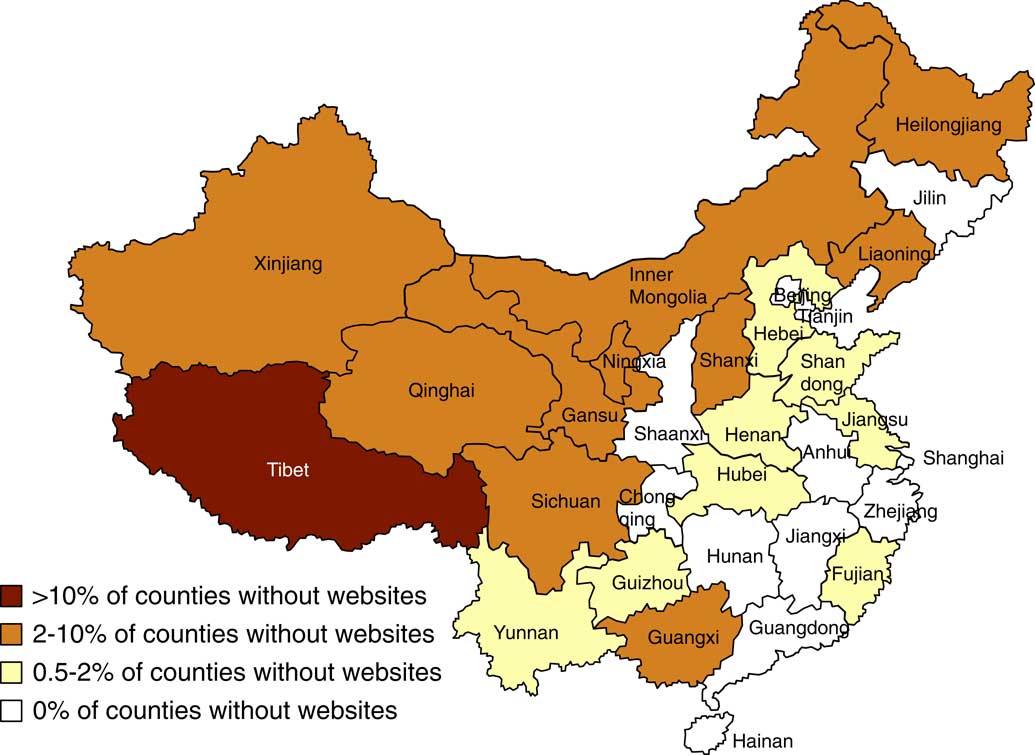
I identified county government websites for 2796 (97 percent) of China’s 2876 county-level (xian) administrative units.Footnote 5 Figure 1 is a map of Chinese provinces based on county website availability.
County government website availability by province

China’s western and northern provinces were found to have a greater number of counties without government websites. In total, 80 counties without websites appear in 20 provinces, but are primarily concentrated in Tibet. This data shows that the vast majority of county governments have set up websites as required by central-level transparency regulations.
From the full set of counties, I selected a random sample of 100 for more extensive data collection. These 100 counties are located in 29 of China’s 31 provinces. In total, 61 are county-level cities (xianji shi) or county-level counties (xian), and 39 are county-level districts (qu). In total, 34 of the counties are located in West China, 31 in Central China, and 35 in East China (see Online Appendix Section 2 for list of counties).
All web pages were collected from the government websites of each of these 100 counties. A full site map of the government website was generated using an automated algorithm that started at the government website home page URL and followed all links to internal web pages. This yielded a total of 1,927,412 links, representing a total of 1,469,715 government web pages.Footnote 6 The number of web pages ranged from 18 to 129,646 for the sampled county government websites. Only counties with more than 100 web pages containing Chinese language content are included, resulting in a 71-county sample.Footnote 7
Limitations
This data, while it may reveal a great deal about how county executives shape the content of local government websites, will miss government actions on other mass media channels including traditional media outlets like government-controlled county newspapers and local government TV stations, as well as social media platforms like Weibo or Wechat.Footnote 8
There is anecdotal evidence that traditional government-controlled media outlets such as newspapers also provide opportunities for image building among local officials (Qin, Strömberg and Wu Reference Qin, Strömberg and Wu2016). However, it is not unreasonable to assume that to the extent these other channels are used by county governments, they would not present a drastically different picture than what is observed through their online website content. Qin, Strömberg and Wu (Reference Qin, Strömberg and Wu2015) find that propaganda messages posted to social media by local governments have a strong positive correlation with the pro-government media bias in newspapers. In many cases, the content appearing on county government websites consists of reprints of local newspaper articles, and these stories are in turn reposted and shared on social media.
Using Government Websites to Build Public Image
In this section, I analyze the content of web pages to show that (1) county government websites meet the content requirements stipulated by Open Government Information (OGI) regulations, and (2) website content projects the competence and benevolence of local officials.
Meeting Transparency Requirements
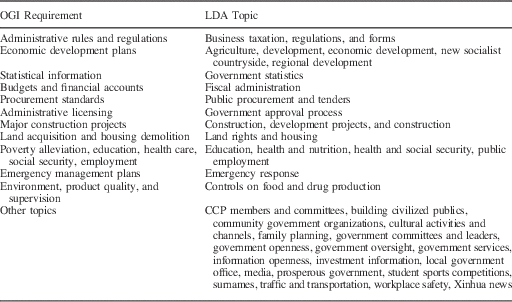
To determine whether county government websites meet OGI content requirements, web pages are analyzed using a latent Dirichlet allocation (LDA) topic model (Blei, Ng and Jordan Reference Blei, Ng and Jordan2003).Footnote 9 Table 1 lists the labeled topics alongside the information categories mandated by OGI.Footnote 10 LDA topics falling under the category of administrative rules and regulations include those pertaining to government regulations as well as business taxation. Topics that correspond to economic development include agriculture, economic improvements, regional development, and the “New Socialist Countryside”—a program launched under then president Hu Jintao and premier Wen Jiabao that sought to modernize agriculture and rural systems. Other topics corresponding to OGI content requirements include government statistics, fiscal administration, public procurement and tenders, government approval processes, construction, land rights and housing, education, health, social security, public employment, emergency response, and controls on food and drug safety.
Latent Dirichlet Allocation (LDA) Topics and Open Government Information (OGI) Requirements

Note: CCP=Chinese Communist Party.
As Table 1 shows, all of the topics required by OGI are found in the content of county government web pages. In addition, many other topics not explicitly mandated by OGI also appear on government websites.
Projecting Competence and Benevolence
Although the topics mandated by OGI regulations appear across county websites, our unsupervised method of text analysis reveals little about the level of information provided through discussions of these topics or the valence and tone of this content.
Close reading of a random sample of 300 county government web pages reveals three ways in which topics are presented. First, web pages highlight the competence of county leadership (competence), especially when discussing OGI-mandated topics, such as economic development, that can also serve as performance indicators when evaluating officials for promotion (Edin Reference Edin2003; Whiting 2004). Second, web pages project the benevolence of the county executive (benevolence). Finally, web pages were found that fulfill the goals of the policy, providing objective information on government plans, activities and outcomes, and allow space for citizen complaints (information and services).Footnote 11
Web pages falling into the competence category laud the achievements of the county or county officials in areas evaluated by performance indicators such as economic growth and fiscal revenue. Below are two examples:
Especially in recent years, the people of the county have unified under the leadership of the county government, which has unswervingly persisted in prioritizing economic construction … county GDP has increased 47-fold since 1978, fiscal income 30-fold, per capita farming income 31-fold, and resident savings deposits 8720-fold. In provincial lists, the county has moved from 127th place to 81st place in economic strength rankings in the past 2 years.
Since 2008, industry in our district has not only withstood the huge impact of the global financial crisis, but also maintained fast-paced overall growth. Total GDP reached 19 billion in 2010, an increase of 96.9% over the 11th Five-Year Plan period … our district has vigorously implemented a strong industry-based development strategy, has optimized industrial structure, and has transformed the mode of economic growth.
Web pages falling into the benevolence category highlight the responsiveness of county officials to the concerns of local residents in a variety of contexts, ranging from economic innovation to social welfare to cultural development. These web pages emphasize how local government actions and programs are intended to benefit local residents.Footnote 12 The following are examples:
With the concern and support of the county Party and government, the township citizen service center was recently constructed and opened. This center will have service windows for forestry, family planning, civil affairs, and social security … this service center will be a one-stop shop for our farmer friends.
On the afternoon of the 15th, county mayor Cao visited Lianhua neighborhood to check on the renovation … Mayor Cao spoke on the side of the road to people who were cooling in the shade, inquiring whether they had any suggestions for renovation work, and where they were not yet satisfied. The people all commended the work … giving thanks from the bottom of their hearts.
Lastly, web pages falling in the information and services category contain two main types of content. The first are texts of laws, regulations, and rules, objective information about the government and its officials such as addresses, phone numbers, and biographies, as well as information about government processes such as procurement.Footnote 13 The following excerpts provide examples of this content category:
Since the county government has studied and decided to form a committee to lead reconstruction to provide relief following disasters related to animal husbandry, the committee members are as follows: committee lead, Chen (vice county mayor); vice committee lead, He (vice chair of the county political consultative conference)…
Village government building renovation tenders: the winner is Central Sea Contruction Co. Ltd. at 153,003 CNY. Second place candidate is Quanli Construction Co. Ltd. at 153,518 CNY. There will be a probationary period of three days. If you have any concerns or issues, please call 0577-XXXXXXXX
The second type of content in the information and services category consists of citizen complaints made via forums on government websites. Below are some examples of publicly viewable complaints:
My cousin lives in Shuian Yihe. A few days ago his electric scooter was stolen. Public security sucks!
Most honorable county mayor, On the afternoon of March 8, I took my 9-year-old niece to the maternal and child health station for her hepatitis B vaccination. I was informed that it was 15 yuan, but I heard the government is now covering the cost of hep B vaccines … then I took her to Wucheng hospital, where they showed me a 17 yuan invoice for the vaccine … afterwards, I called the disease prevention center, and they said it is 13 yuan … My question is: is the hepatitis B vaccine supposed to be free? If not, how much should it cost? You have to give people a reasonable explanation.
This analysis of website content reveals that while some web pages do contain content (information and services) that accords with the spirit of government transparency regulations, web pages also trumpet the competence of county leaders by highlighting their achievements and extol the benevolence of leaders by demonstrating their attentiveness to citizens.
Prevalence of Public Image Building
In order to assess the effectiveness of transparency policies in providing improved public access to online information, it is important to determine the extent to which government website content is devoted to self-promotion (competence and benevolence) of local officials as opposed to objective information and citizen complaints. I systematically examine the relative proportion of web pages engaged in demonstrating competence, projecting benevolence, and providing information and services using the Hopkins–King algorithm on Chinese text without translation (Hopkins and King Reference Hopkins and King2010).
The Hopkins–King algorithm is a supervised method of machine learning that relies on human coding of a training set. In our case, rules were developed for categorizing web pages into the three categories examined in this study—competence, benevolence, and information and services—and research associates read and manually categorized several hundred randomly selected web pages across counties, reaching 84 percent inter-coder agreement. These hand-coded web pages form the training set used to estimate the overall proportion of content falling into each of the three categories when all web pages were taken into account.Footnote 14
In the analysis below, the proportion of content dedicated to a particular category is taken as a measure of the relative importance of this category. Taking the quantity of certain types of content as a measure of its relative importance is appropriate in this case because users are more likely to arrive at any particular web page via search engine results (e.g., by searching for a particular county and topic on baidu.com) rather than navigating around the site (Ma 2014).Footnote 15
Across all counties, 26 percent of web pages (25–27 percent)Footnote 16 focus on competence, 28 percent of web pages (27–29 percent) focus on benevolence, and the remaining 46 percent of web pages (44–48 percent) provide objective information and services. In other words, less than half of China’s county government web pages provide purely objective information or services for citizens.
Public Image and Political Tenure
This section examines the relationship between the political tenure of county executives and public image building. I focus on political tenure because previous research has identified it as a key factor shaping the incentives and behaviors of local Chinese officials (O’Brien and Li Reference O’Brien and Li1999; Cai Reference Cai2004; Guo Reference Guo2009; Kung and Chen Reference Kung and Chen2013). To advance in political office, local officials—including county executives—are evaluated against performance indicators such as gross domestic product (GDP) growth and societal targets such as ensuring social stability, which make up China’s cadre evaluation system (Liu and Tao Reference Liu and Tao2007). Local officials often increase spending in their later years of tenure to create visible projects appropriately timed to boost their public image before promotion evaluations. O’Brien and Li (Reference O’Brien and Li1999) find that local governments engage in large-scale building projects know as “political achievement projects” prior to promotion evaluations. Cai (Reference Cai2004) identifies examples of the same phenomena, undertakings he refers to as “image-building projects.” In a large-scale analysis of county executives, Guo (Reference Guo2009) finds that the likelihood of promotion peaks in the fifth year of office, and county executives time spending in order to demonstrate visible projects by their fifth year of tenure.
In this paper, the primary outcome of interest is the political tenure of county executives rather than that of county party secretaries. This is because county executives have direct control of government websites and because county party secretaries have alternate channels of communicating with upper-level superiors and thus have less incentive to intervene in website content. Guo (Reference Guo2009) finds that among county executives who advance to party secretary, the vast majority (86 percent) become party secretaries of the same county. This means most county party secretaries were county executives in the same locality and were promoted by prefecture-level superiors in the region. As a result, party secretaries are more likely to have stronger relationships with prefecture-level officials than executives in the same county and are also more likely to have better informal channels of communicating with these upper-level superiors. In addition, county party secretaries are also likely to have greater control over mass media channels than county executives because party secretaries have ultimate authority over local propaganda departments and subordinate media channels, such as local newspapers and television stations.
Measuring Tenure
For county executives, political tenure is measured in two ways:Footnote 17 (1) by the executive’s year in office (Year in Office), and (2) by the proximity of the executive to leaving office (Proximity to Leaving Office).Footnote 18 Both measures are created based on the month and year the executive took office, as well as the month and year the executive left office, using biographical data of county leaders obtained from baike.baidu.com and from county government websites.Footnote 19
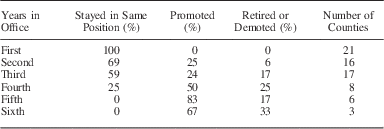
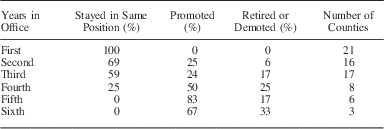
The first measure of political tenure is the county leader’s year in office (Year in Office). County web content was collected in July 2011, and an individual is considered to be in the first year of office if s/he took office from July 1, 2011 to June 30, 2012, in the second year of office if s/he took office between July 1, 2009 and June 30, 2010, in the third year of office if s/he took office between July 1, 2008 and June 30, 2009, etc. This measure of tenure compares county leaders by the amount of time they have been in office. County executives from the 100 counties have been in office for one to six years (see Table 2). Similar to results from Guo (Reference Guo2009), political promotion is most likely to occur between the fourth and sixth years of office and peaks in the fifth year of office.Footnote 20
Distribution of Year in Office
The second measure of political tenure is the proximity of county leaders to the end of their tenure (Proximity to Leaving Office). In other words, rather than examining the number of years an executive has been in office, this second measure examines whether an executive has just taken on the role or whether he is about to leave. Since web content was collected in July 2011, individuals are defined as being at the beginning of their tenure if they took office between January and June of 2011.Footnote 21 County leaders are defined as being at the end of their tenure if they left office between August and December of 2011. Everyone else is defined as being in the middle of their tenure. Based on this measure of political tenure, 21 county executives were at the beginning of their tenure, 12 were at the end of their tenure, and the remaining 38 were in the middle of their tenure.
Descriptive Results
I use the Hopkins–King algorithm to estimate the proportion of county website content focused on demonstrating competence and the proportion focused on projecting benevolence of county executives by pooling data for executives by Year in Office (year 1, year 2, year 3, year 4, and year 5 and above) and by Proximity to Leaving Office (beginning of tenure, middle of tenure, end of tenure).
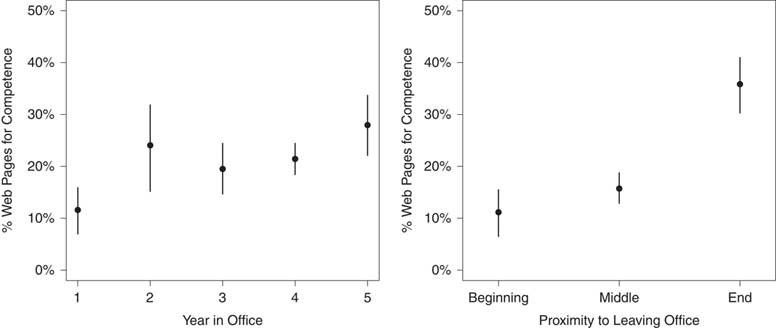
The public image county executives project on government websites vary over the course of their political tenure cycles. The left panel of Figure 2 shows that the proportion of web pages focused on projecting competence increases over time and is highest in later years of office. Content focused on competence increases from 12 percent (7–16 percent, 95 percent confidence intervals) among counties where executives are in their first year of office to around 20 percent in the second to fourth years of office, and finally to 28 percent (22–34 percent) among counties where executives are in the fifth and sixth years of office. This pattern holds when measuring political tenure by proximity to leaving office (see right panel of Figure 2). Executives who are at the end of their tenure (within six months of leaving office) dedicate 36 percent (30–41 percent) of government website content to demonstrating competence, whereas executives at the beginning and middle of their tenures dedicate 15–20 percent of website content to these claims.Footnote 22
Proportion of web pages with content focused on competence by year in office with 95 percent bootstrapped confidence intervals (left panel) and by proximity to leaving office, where Beginning refers to executives within six month of taking office, End refers to executives within six months of leaving office, and Middle everyone in between (right panel) Note: Year 5 includes executives in their fifth and sixth years of office.

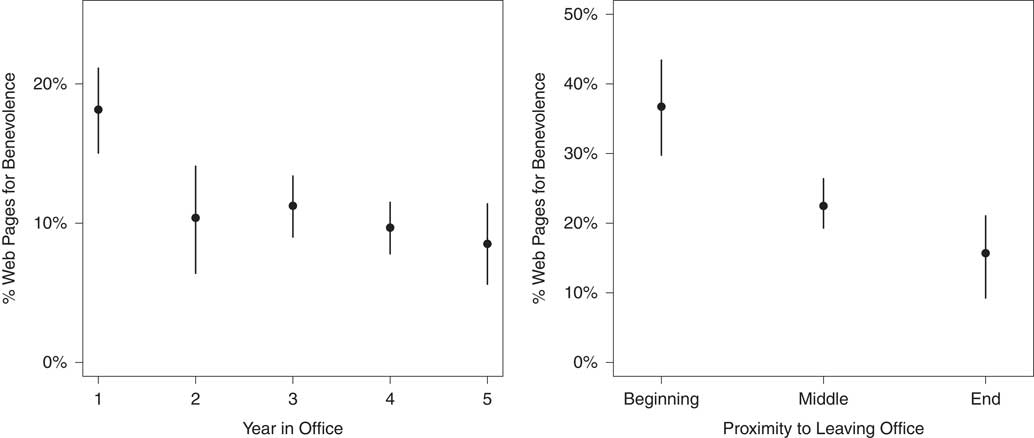
When examining the proportion of web pages focused on projecting benevolence, content falling into the benevolence category is highest in the first year of office and declines over time as the executive moves closer to leaving office (see Figure 3).Footnote 23 In total, 37 percent (30–43 percent) of website content is focused on benevolence when county executives first take office, while projecting benevolence declines to around 20 percent in the middle years of office, and to 16 percent (9–21 percent) in the last months of office.
Proportion of web pages falling into the benevolence category by year in office (left panel) and by proximity to leaving office (right panel) Note: 95 percent bootstrapped confidence intervals shown.

Predictive Inference
The previous section provides evidence of a strong correlation between political tenure and public image. In this section, I examine the predictive effect of tenure on public image building while controlling for potential confounding factors and alternative explanations.Footnote 24
Quantities of interest
Our outcomes of interest are (1) the proportion of web pages for each county government website dedicated to demonstrating competence, and (2) the proportion of web pages focused on projecting benevolence. I use a multiclass support vector machine (SVM), a supervised method of individual classification (Chang and Lin Reference Chang and Lin2011), to estimate (1) and (2) for each county with training data described in the Prevalence of Public Image Building section. The outcome of interest is then calculated by counting the number of individually classified documents falling into the categories for each county.Footnote 25
Explanatory variables
The relationship I am interested in evaluating is whether county executive tenure predicts public image building on government websites. Since the results of the Descriptive Results section show that the incentives generated by political tenure affect web content at the beginning and end of county executive tenure, I create two dummy variables for county tenure. Beginning Tenure takes on the value of 1 if the county executive took office between January and June of 2011 (this corresponds to “Beginning” in the Proximity to Leaving Office variable). End Tenure takes on the value of 1 if the county executive left office between August and December of 2011 (this corresponds to “End” in the Proximity to Leaving Office variable).
Control variables
Variables are included in our regression analysis to address alternative explanations in five main areas. First are control variables that account for resource availability and environmental factors (Resource controls) at the county level such as literacy, the number of individual employed in information sectors, the size of the government website, county expenditures in related areas, and county GDP per capita. Second, to account for the confounding effect of peer preferences on online content, county party secretary tenure is included as a control variable (Peer controls). Third, because upper-level level superiors may also influence the content of subordinate county government websites, characteristics of the prefecture in charge of the county in question such as prefecture party secretary tenure and education as well as prefecture GDP per capita are included as control variables (Prefecture controls). Fourth, there is a broad debate around the role of ability versus incentives in shaping political behavior in China (Li and Zhou Reference Li and Zhou2005). In the context of government websites, a county executive’s ability could also influence what content is shared online, and thus variables such as the county executive’s level of education, gender, and age are included as controls (Ability controls). Finally, in one specification I also include information on county executive career path (Career path controls).Footnote 26 For more detailed description of these control variables see Online Appendix Section 4.
Claims of competence
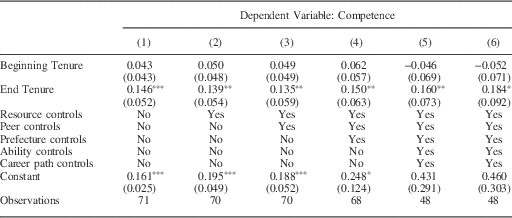
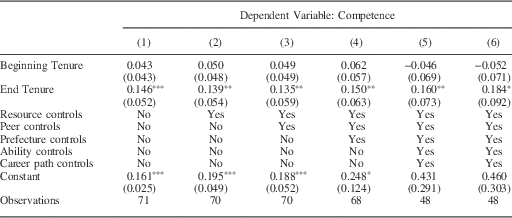
Table 3 shows six different specifications of regression estimates where the dependent variable is the proportion of web pages focused on competence. Column (1) only includes county executive tenure as independent variables in the regression; column (2) adds county resources and environmental factors; column (3) adds incentives of county party secretaries; column (4) adds the incentives of prefecture party secretary and other prefecture-level characteristics that may influence the data generation process; column (5) adds the county executive’s ability, age, and gender; and column (6) includes the post-treatment variable of whether the county executive was promoted. The unit of analysis is the county, and the number of observations is 71 counties in column (1), 70 observations in columns (2) and (3), 68 observations for column (4), and finally 48 observations for columns (5) and (6).Footnote 27
Regression Results: Competence
Note: *p<0.1; **p<0.05; ***p<0.01.
Across all specifications in Table 3, political tenure of the county executive—specifically, being in the last year of office—is predictive of web content focused on claims of competence. This result is statistically significant.Footnote 28 When a county executive is in the last year of office, an additional 15 percent or so of website content is on average dedicated to claims of competence. For full regression tables and discussion of results aside from political tenure, see Online Appendix Section 5.
Projecting benevolence
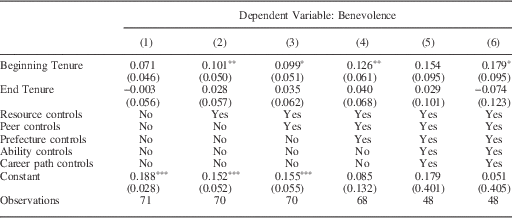
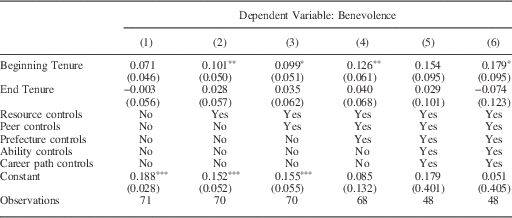
Table 4 shows the regression estimates where the dependent variable is the proportion of web pages focused on benevolence with the same six specifications as the previous set of regression results: column (1) with county executive tenure only, column (2) adding in county resources and environment, column (3) adding peer incentives, column (4) adding prefecture incentives and characteristics, column (5) adding in the county executive’s ability, age, and gender, and column (6) adding in county executive promotion.
Regression Results: Benevolence
Note: *p<0.1; **p<0.05; ***p<0.01.
In four out of the six specifications in Table 4, columns (2) through (4) and column (6), political tenure of the county executive—being in the first year of office—is predictive of web content focused on projections of benevolence. This result is statistically significant at the 0.1 or 0.05 level. In the specifications where this primary explanatory variable does not cross the significance threshold (columns 1 and 5), the p-value of the coefficient estimate for being in the first year of office is 0.127 and 0.114, respectively. When a county executive is in the first year of office, an additional 10–15 percent of website content is on average dedicated to claims of benevolence. For full regression tables, see Online Appendix Section 5.
Conclusion
Taken together, these results show that while county government websites may adhere to the letter of central government transparency regulations, the majority of content on local government web pages is dedicated to showcasing the positive qualities of county-level government executives. The exact qualities highlighted vary in relation to the political tenure of the particular government official under consideration. For instance, in counties with executives who are early in their tenure, government websites focus on projecting the benevolence of these officials and their attentiveness toward the needs of the citizenry under their purview. In counties overseen by executives who are late in their tenure, government websites focus on highlighting competence, and showcasing accomplishments against economic and fiscal performance indicators.
The findings of this study advance the existing theoretical understanding the Internet’s role as a political instrument in authoritarian regimes. Rather than the expected outcomes of either strengthening authoritarian control over society or empowering dissident actors observers may have assumed, the Internet serves as a vehicle for self-promotion among local politicians. This outcome may not align with the goals of central autocrats who want to use the Internet to obtain information about lower-level officials. This outcome may also not align with the interests of societal actors since the heavily controlled content of government websites precludes meaningful engagement by the public on government plans, activities, and outcomes. These results show that the Internet and the ever greater amounts of information being generated online does not necessarily resolve the information problems faced by autocrats. Although information is growing at a rapid pace, the accurate and objective information central authorities need for selection and monitoring of regime agents remains scarce.
These results also reveal functional convergence across both authoritarian and democratic regimes in the use of mass media by political elites for shaping their public image and building support. The motivation behind public appeals by Chinese county executives is not driven by their desire for re-election, but by the incentives for political advancement available through selection. Likewise, public appeals are not used by local Chinese officials for the purpose threatening other political actors with constituent pressure, as is sometimes the case in democratic settings, but rather to strengthen the legitimacy of their claims in the eyes of other political actors. However, despite these differences in motivation, mass media channels are being used by political elites in very different types of regimes to build their public image and pursue political advancement.
Finally, in exploiting a combination of methods ranging from machine learning to close reading of a large-scale data set, this research reveals that though authoritarian regimes may go to great lengths to control the production and dissemination of information, when such content is analyzed in aggregate, patterns of information production reveal a great deal about the political incentives of these regimes. The data and methods used in this paper provide a useful measure of the informational preferences and activities of local officials, trends that have previously been challenging to quantify. The measure of “public image” used here can be applied as an explanatory variable in addressing other questions, such as relationship between officials’ preferences and policies, or the relationship between preferences and economic and social outcomes like the level of development and social stability. The current data are cross-sectional, but plans are in place to collect panel data for the same set of counties, in order to facilitate future research and deepen our understanding of the role of the Internet in authoritarian politics.