


Introduction
Institutional foodservice operations (IFOs), such as schools, hospitals and long-term care facilities, are an important food marketing channel. In 2017, commercial and non-commercial foodservice providers are expected to generate US$796.0 billion in food sales, of which 14.2% ($113.2 billion) will be sales to institutional operations (NRA, 2017). For fruit and vegetable farmers, institutional markets have the potential to be a large and economically important outlet. For buyers and consumers of fresh produce, purchasing from small and local farms provides access to fresh produce and the potential for a variety of socio-economic benefits (Boys and Hughes, Reference Boys and Hughes2013). Locally grown foods can offer health benefits as well. As produce harvested closer to its peak maturity can offer more health-promoting benefits and as fresh produce can quickly lose its nutrient value after harvest (Rickman et al., Reference Rickman, Barrett and Bruhn2007a, Reference Rickman, Barrett and Bruhnb), locally grown produce can be more nutritionally dense. Recognizing these benefits, governmental agencies and non-government organizations (NGOs) have undertaken a range of farm-to-institution initiatives to improve access of institutional clients to fresh produce from small-scale fruit and vegetable (SFV) farmers.
The challenge with many such initiatives is the limited human resources, kitchen and processing capacity of IFOs, coupled with the lack of market-based incentives to incorporate locally sourced produce into menus. Further, the centralized nature of the United States (US) food system largely precludes SFV farmers from serving as suppliers to institutional operations. First, most institutions purchase food through contract vendors, who require producers to have certifications [e.g., Good Agricultural Practices (GAPs), Good Handling Practices (GHP)]. Secondly, while marketing channel constraints vary by product and setting, produce availability due to seasonality, limitations on available quantity, logistic considerations and lack of price competitiveness, can further limit SFV farmers supplying institutional markets (Izumi et al., Reference Izumi, Rostant, Moss and Hamm2006; Vogt and Kaiser, Reference Vogt and Kaiser2008; Feenstra et al., Reference Feenstra, Allen, Hardesty, Ohmart and Perez2011; Harris et al., Reference Harris, Lott, Lakins, Bowden and Kimmons2012).
Passage of the Food Safety Modernization Act (FSMA) in 2011 further complicates this matter. The Tester–Hagen Amendment to FSMA aims to provide SFV farmers some exemptions from increased food safety regulations. However, as FSMA does not limit the scope or extent of liability that agri-food industry firms may face in cases of foodborne disease (Boys et al., Reference Boys, Ollinger and Geyer2015), buyers may choose to impose FSMA requirements on their suppliers to potentially reduce their own liability as well as help ensure food safety in their operations. This is particularly true of product traceability requirements. This latter issue is important and, counter to much government and NGO effort, could further limit access of SFV farmers to institutional markets.
Due to the economic, environmental, social and agricultural sector importance of SFV farmers, improving access to institutional markets presents an important opportunity. Broadly, the aims of this study were to: (1) identify challenges and potential remedies of SFV farmers who sought to directly supply IFOs, and (2) identify and examine actions required of SFV farmers to meet current and anticipated food safety requirements of IFOs. All of these issues are examined though the lens of agricultural marketing. To date, most research exploring marketing challenges to institutions has focused on farm-to-school programs. This study offers an important contribution through a more general consideration of farm-to-institution marketing channels.
As local food system marketing challenges are shaped by agricultural production environment (e.g., soils, water availability and climate), policy environment, food system infrastructure and regional food demands, challenges will vary by place. This issue is thus most appropriately examined on a regional or sub-regional basis. Due to the particular and diverse needs of the southeastern US population, the prevalence of small, and diversified, fruit and vegetable growers in this region, and the limited research focused on this geographic area, this study focused on the South-Atlantic US states of North Carolina, South Carolina and Georgia.
This paper begins with an introduction to IFOs followed by a review of literature that examined small farms marketing to institutions. To permit an in-depth and nuanced understanding of actual and perceived challenges SFV farmers face when accessing institutional markets, a series of 21 focus group meetings were conducted throughout the study region with SFV farmers and IFO buyers. The methods used for this data collection, and the findings from this analysis are then presented. This paper concludes with a consideration of the challenges, considerations and proposed solutions to improve the access to and efficiency of this marketing channel.
Overview of the small-farm to institution marketing channel
Small farms are defined as those that generate less than US$350,000 annual gross cash farm income (GCFI; Hoppe, Reference Hoppe2014). In the US, small family farms account for 89.7% of all farms and 25.5% of agricultural production (Hoppe, Reference Hoppe2014). In addition, small farms account for more than half (52.1%) of land used in agricultural production and play an important role in land management and conservation programs (Hoppe, Reference Hoppe2014). Among small farms, over half (56.6%) are non-commercial operations, generating less than US$10,000 in GCFI. While small farms represent a relatively small proportion of total US farm sales and generally have higher per-unit costs of production than do large farms (MacDonald et al., Reference MacDonald, Korb and Hoppe2013), they play an important role in the US food system. Due to their small size, these farms are relatively flexible in production activities and so have a comparative advantage in producing highly differentiated products to serve niche markets (Kirschenmann et al., Reference Kirschenmann, Stevenson, Buttel, Lyson, Duffy, Lyson, Stevenson and Welsh2008). Moreover, they offer an important source of rural employment and economic growth (Boys and Hughes, Reference Boys and Hughes2013), offer benefits in terms of labor income (Schmit et al., Reference Schmit, Jablonski and Mansury2016), can stimulate formation of social capital (Hughes and Boys, Reference Hughes and Boys2015) and are important stewards of crop genetic diversity (Boyce, Reference Boyce, Boyce, Cullenberg, Pattanaik and Pollin2006).
Fruits, tree nuts and berries, and vegetables, melons, potatoes and sweet potatoes together comprise the category used herein of ‘fruits and vegetables’. Nationally, production of these crops were valued at US$42.7 billion in 2012, and account for 10.8% of the value of US agricultural output (author calculation based on USDA, 2014).
Marketing fruits and vegetables
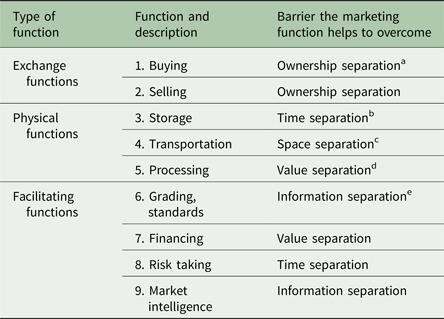
While often incorrectly perceived to be synonymous with selling, marketing is a much broader concept that encompasses all activities involved with the flow of goods (or services) from production to consumption. There are, however, barriers or ‘separations’ between sellers and buyers, which limit a producer's ability to (efficiently) meet their consumer's needs. In the case of agricultural marketing, these ‘separations’ include ownership, space, time, information and value (Kohls and Uhl, Reference Kohls and Uhl2001). An effective agricultural marketing system must overcome these separations by providing: (1) exchange functions that facilitate transfer of ownership; (2) physical functions which enable product to arrive in the form, time or place desired by the consumer; and (3) facilitating functions which enable and improve the efficiency of the exchange process. These marketing functions and the separations they help overcome are summarized in Table 1.
The functions of agricultural marketing

a The need to exchange the legal title of the product for some form of payment between the buyer and the seller.
b Time between production and consumption.
c Distance between point of production and point of consumption.
d Difference between the current form of a product (e.g., raw produce) and a form that has greater value to a consumer.
e Difference between buyers and sellers in knowledge concerning market conditions (e.g., price, inventory levels), or conditions of the product being exchanged (e.g., product quality).
Adapted from Kohls and Uhl (Reference Kohls and Uhl2001).
SFV farmers have many marketing options. As consumers generally perceive SFV farmers to be the source of ‘locally grown’ foods (Adams and Salois, Reference Adams and Salois2010), their products are currently in demand by several types of food buyers. SFV farm marketing options include: (1) direct-to-consumer sales through farmers’ markets or roadside stands; (2) direct-to-institution sales though which they would directly supply IFOs; and (3) sales though intermediated outlets where farms supply wholesalers, distributors, grocers and other businesses who, in turn, resell their farm products. Among these options, direct-to-consumer channels are highly preferred by most SFV farms. Among other benefits, this channel offers farms flexibility to select the quality and quantity of products they sell, freedom from contracts and frequently higher per-unit sales prices than what is available through other marketing channels. Selling exclusively into direct-to-consumer channels, however, can be a risky business strategy. Competition, weather and other factors can adversely affect potential revenues. In addition, the relatively high per-unit marketing cost of selling into these marketing outlets can also reduce profits. Indeed, in some circumstances, farmers selling only through direct-to-consumer outlets report earnings that are significantly lower than earnings through other marketing strategies (Park et al., Reference Park, Mishra and Wozniak2014).
Institutional foodservice operations
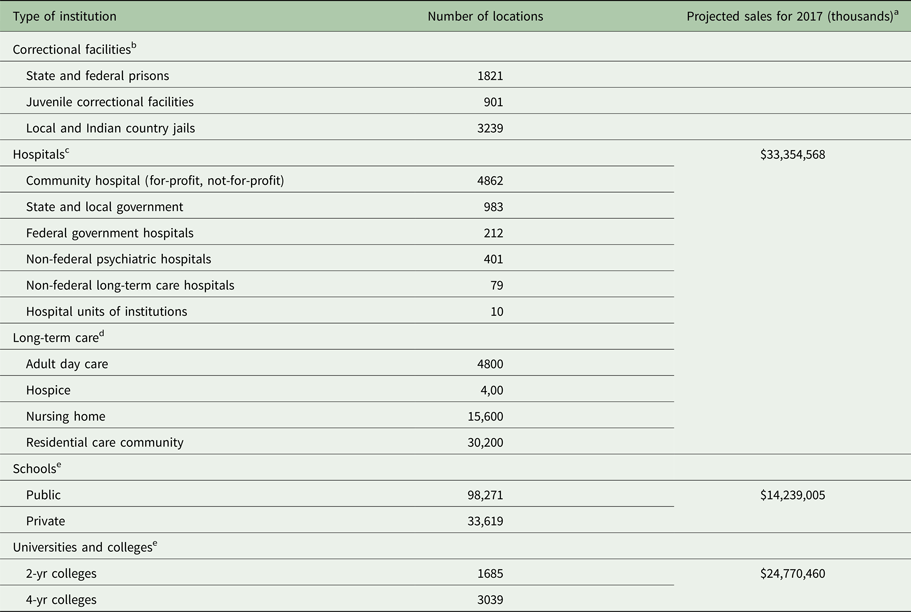
Although less commonly used, marketing directly to an IFO is another important and a potentially sizable market for SFV farms. IFOs, which include childcare, K-12 schools, universities, hospitals, long-term care facilities and correctional facilities, are significant sources of food demand. Information presented in Table 2 illustrates the size of this market.
Number of locations and projected sales of select institutional foodservice markets in the US

a National Restaurant Association (2017).
b Wagner and Rabuy (Reference Wagner and Rabuy2017).
c American Hospital Association (2017).
d Centers for Disease Control (2016).
e U.S. Department of Education (2016).
A variety of factors motivate institutions to purchase directly from SFV farms. For many institutions, buying direct from an SFV farm is thought to offer benefits, such as supporting the viability of the local agricultural sector, offering social connections and economic support for the community, and providing perceived environment and sustainability benefits (Martinez et al., Reference Martinez, Hand, Da Pra, Pollack, Ralston, Smith, Vogel, Clark, Lohr, Low and Newmand2010; Smith et al., Reference Smith, Kaiser and Gomez2013; HWH, 2017). In terms of health, two characteristics of nutrition available from produce support a model of local sourcing. First, produce quickly loses it nutrient value after harvest (Rickman et al., Reference Rickman, Barrett and Bruhn2007a). Secondly, foods harvested closer to their peak maturity are thought to be more health promoting than those harvested early. In both cases, when given an option, it would be preferred to buy fresh produce from a local farm to permit the produce a greater opportunity to mature prior to harvest and to lessen the time between harvest and consumption. For schools, additional benefits are generated through increasing student interest in food systems and agriculture as well as providing an opportunity to link food to student learning (NFSN, 2017).
Buying from an SFV farm might also make good business sense for IFOs. For many institutions, the per-meal spending limit is quite low, and there are no market-based revenue incentives to procure products from anyone but a low-cost seller. While buying from small (local) farms is perceived to be more expensive, in some regions buying local, in-season, produce was reported to be less expensive than non-local produce (HWH, 2007). Government programs and NGO initiatives also provide financial support and incentives to encourage IFOs to purchase food from within their local food system.Footnote 1 For example, incorporating food from SFV farms could increase revenue as well. Within hospital or university foodservices, or K-12 school à la carte menus, the appeal of local food could increase sales. For example, a healthcare system in Montana has found that use of local foods allowed the foodservice operation's budget to be redirected from purchasing processed foods to paying hospital employees to process local foods. In addition to economic benefits to the local economy from local procurement and perceived benefits in terms of food quality, this strategy also generated additional work for hospital foodservice employees, which was thought could improve their job satisfaction (Montague et al., Reference Montague, Wilcox and Harmon2014). The availability of local farm products has also been suggested as an effective workplace perk to attract and retain workers (Sachs and Feenstra, Reference Sachs and Feenstra2015).
From the SFV farm perspective, selling to IFOs may also be good for business. While the per-unit prices paid by IFOs is frequently lower than that earned through direct-to-consumer sales, the lower marketing costs and reduced sales completion risk by having a pre-established buyer, can make selling to IFOs both a comparatively profitable market (Hardesty and Leff, Reference Hardesty and Leff2010) and an opportunity to diversify marketing risk (Izumi et al., Reference Izumi, Alaimo and Hamm2010a). In addition, farmers may be motivated to sell to an IFO for a variety of socially embedded values (Izumi et al., Reference Izumi, Wright and Hamm2010b; Conner et al., Reference Conner, King, Kolodinsky, Roche, Koliba and Trubek2012).
Literature review
Despite interest and public support to buy products from local farms, in some geographic areas, there remain challenges in incentivizing and facilitating SFV farmer sales into IFO channels. In a review of studies that examined marketing of regionally grown food to institutions, Vogt and Kaiser (Reference Vogt and Kaiser2008) reported that barriers identified by both IFOs and farmers included a lack of physical infrastructure (e.g., storage, processing facilities), and insufficient staff time and expertise to wash and prepare fresh products. Lack of financial resources, the seasonality of product availability, relative ease of ordering from current suppliers and, in the case of schools, regulations concerning procurement practices were other commonly identified institutional marketing barriers. Less evident, Buckley et al. (Reference Buckley, Conner, Matts and Hamm2013) reported important roles for supply chain partner trust, and the importance of having a ‘champion’ within the institution for such relationships to work effectively.
Some barriers reported by Vogt and Kaiser (Reference Vogt and Kaiser2008) were also identified in studies that specifically examined procurement challenges in school foodservice operations. In addition, Dimitri et al. (Reference Dimitri, Hanson and Oberholtzer2012) reported that historic procurement patterns, operation size and socio-economic barriers limited the use of local food in Maryland private and public schools. In this study, those that bought more than 50% of their products from one vendor, or with a higher percentage of students eligible for free lunch, were less likely to use local foods. Janssen (Reference Janssen2014) suggested that social barriers in the form of different approaches and knowledge bases to food production and handling by farmers and school food buyers adversely affected school participation in farm-to-school programs. Boys and Fraser (Reference Boys and Fraser2017) found that school buyers without experience purchasing products from small farms significantly overestimated the difficulty of procuring from them relative to buyers with experience buying from these farms.
Like schools, hospitals foodservice procurement is generally contracted; in this case of schools, it is most commonly with a broadline distributor, and in hospitals, it is typically with a Group Purchasing Organization. In both cases, contract terms are relatively inflexible and frequently require that 80–90% of purchases by the IFO be sourced through their contracted supplier (Klein, Reference Klein2015; Pullman and Wikoff, Reference Pullman and Wikoff2017). These terms leave little room for the direct purchase of produce (or any other item) from local and/or specialty suppliers. There are, however, key differences between hospital and school settings. Hospital foodservice operations are a year-round, rather than seasonal (academic year) buyer. This allows for a deeper and more sustainable partnerships to be formed with farm suppliers. In some hospitals, chefs are now planning seasonal menus to take advantage of local produce availability (HWH, 2007). In addition, hospitals have a higher proportion of cafeteria sales for which they have market-based incentives to offer local food (Klein, Reference Klein2015). Procurement challenges by IFOs in other institutional settings have been less well studied, and frequently are focused on direct-from-farm purchasing initiatives undertaken at one site or through pilot programs (Eldridge, Reference Eldridge2012).
Methods and data
This study of SFV farmers was conducted in two phases. During phase I, a series of focus group meetings were conducted with SFV farmers to explore barriers and challenges they experienced in their efforts to directly market their produce to institutions. This research phase culminated with a 2-day conference involving stakeholders throughout the farm-to-institution marketing channel including several IFO buyers. During the conference, research results were shared with all channel stakeholders and practical solutions to these challenges were explored. Among these results, concerns about food safety challenges were widely expressed. As such, a second set of focus group meetings (phase II) with SFV farmers were held to explicitly examine this issue, particularly as it is related to FSMA and on-farm traceability. This second research phase culminated in a second mixed stakeholder conference aimed to identify and examine practical solutions to farm-to-institution food safety and traceability needs.
The focus group methodology used in this study closely follows that recommended by Morgan and Krueger (Reference Morgan and Krueger1997). For both study phases, discussion guides were developed and pre-tested to guide data collection in both meetings where challenges and barriers were identified, and where solutions were explored (conferences). In total, four guides were developed.
To recruit SFV farmers,Footnote 2 announcements about the focus group meetings and the conferences were disseminated with the assistance of local NGOs and university extension partners. Snowball sampling, from among those who registered to attend a session, was used to reach additional participants. Meeting locations were dispersed across North Carolina, South Carolina and Georgia to ensure that, to the extent possible, the breadth of production types and state-specific constraints were represented, and to reduce the travel burden on farmers. A small financial incentive was provided to partially compensate for the time and travel cost in participating. In total, 21 focus group meetings were held.
All focus group meetings (including discussions at the conferences) were audio-recorded and transcribed. The data were later cleaned, coded, organized using NVivo qualitative data analysis software. Both deductive and inductive approaches were used to identify themes from the interview transcripts. Once major themes were identified, a coding index was created and content organized using standard approaches as described by Saldaña (Reference Saldaña2009).
Results
Characteristics of respondents
A total of 93 SFV farmers participated, 57 during phase I and 36 during phase II. Among these, 33 participated in the eight focus group meetings held at locations throughout the study region, and 60 participated in the 13 focus group meetings held during the two conferences. Among SFV farmers participating at the individual meetings, 9.6% were from Georgia, 5.3% were from North Carolina and the remainder from South Carolina.Footnote 3 All were the owner, co-owner or manager of their farm, and most (72.7%) were male.
Participants represented farms with diversified production who grow between three and 25 different vegetables, fruits and tree nuts. Demographic and business characteristics of participants were generally reflective of farmers from the South-Atlantic region. Participating farms were slightly larger than the norm; 84% of farms in the southeast had sales of <$100,000 (USDA-ERS, 2012) compared with 72% of participants in this study had sales of this amount. Women were also over-represented as 15% of farmers in the southeast are female, while focus group participants were 27% female. A majority of the focus group participants indicated that they did not currently sell to institutions; as information concerning the proportion of farms selling to directly to institutions in this region is not available, the representativeness of our sample concerning this characteristic not known.
Barriers in the farm-to-institution marketing channel
Discussions with SFV farmers revealed many barriers they perceived to hinder them from selling directly to IFOs. Key were price and payment arrangements, lack of access to value-added processing facilities, insufficient production to satisfy the quantity demanded and buyer demand for specific varieties, and insurance and certification requirements. Issues surrounding food safety, and, in particular, meeting traceability requirements, were also perceived to be a challenge.
To be clear, the challenges discussed herein are limited to those related to marketing produce from small farms to institutions. Several other challenges were identified but cannot be fully overcome through marketing solutions. Most notable were difficulties in SFV farmers accessing financial and suitable human resources, employee training, the limited food preparation infrastructureFootnote 4 and human resources available in many IFOs, and the misalignment of produce seasonal availability and produce demand (primarily relevant to marketing to school foodservice operations). As these constraints cannot be overcome through marketing solutions, they will not be discussed herein.
Challenge: price and payment arrangements
SFV farmers who were not selling to IFOs were asked why they were not using this marketing channel. Most voiced preference to sell to retail rather than wholesale markets due to the price per-unit they could earn. The SFV farmers believed it was hard to move into the institutional market because they would have to forego the good (‘retail’) prices they got selling at a farmers’ market or to a restaurant. Institutions, even those who bought directly from farmers, were thought to be willing to pay ‘only’ wholesale prices. One producer (FG2, Prod1)Footnote 5 thought that, for his operation, the only way to make a profit was to sell into retail markets. Another noted:
‘If we're going to sell to the schools, we're not going to make anything. We're going to lose money.’ (FG8, Prod6)
Indeed, in the experience of those who previously sold into IFO channels, even ‘premium’ institutional buyers, those with the flexibility and revenue incentive to charge customers for premium products, were not willing to pay for multiple unique product features. For example, several participants reported a stronger desire by institutional buyers to purchase ‘local’ rather than ‘local organic’ produce.
‘All the nursing homes I have been in…are really cost conscious… [and] don't want to do a premium for organic or fresh local when they can get the same looking thing from California for $2 less than that.’ (FG3, Prod4)
Another frequently cited challenge was payment schedule. One SFV farmer selling through direct-to-consumer channels typically received payment at the time of sale. When selling to institutions, it could be a month or two, or longer, before payment is received.
‘You are talking about selling to institutions, we all already know we are in the 30–60 day pay range so that is an important factor to us as far as being able to sell to them ⋯ when you start getting into these institutions; it's a harder thing to get paid.’ (FG7, Prod4)
Delayed payment could be problematic for many producers who do not have the revenue flows or assets to cover delays in payment.
Challenge: infrastructure for processing, packaging and delivery
The ability to access the infrastructure required to meet the processing and delivery demands of IFOs was also an expressed concern. Many institutions require value-added processing beyond washing (e.g., specific cutting, packaging or other requirements), which must be done in an inspected and licensed facility. Establishing such facilities is costly and, given the relatively small volumes of production output by SFV farms, is generally difficult for a single operation to justify. In addition, the considerable product diversification among southeastern SFV farmers poses another challenge. Even if one decided to invest in a processing facility, multiple types of processing and/or packaging equipment would be needed. Alternatively, a farmer could opt to alter their production portfolio to grow fewer crops. Maintaining a variety of products was reported to be important to many participating SFV farmers; indeed, it was because of the wish to retain this product diversity that these producers felt they would be unable to grow the larger quantities that institutional buyers demand
‘I could plant…20 acres of purple hull peas…that's sort of the antithesis of our philosophy, we're diversified.’ (FG5, Prod6)
Meeting packaging requirements was another challenge for SFV farms. Meeting IFOs produce packaging requirements was perceived to be difficult and costly as some buyers require their produce be in a specific type of box or crate, with a special label and the buyer's barcode.
‘I would [need to] add packaging…UPC, barcodes, all that sort of stuff, we pick it into containers in the field.’ (FG 3, Prod2)
‘We don't buy the wax cardboard boxes, I'm not spending all that money…that is one of the biggest drawbacks…they required those standard packaging boxes.’ (FG3, Prod2)
Lastly, delivery of farm products to institutional buyers is complicated on multiple fronts. In some cases, it is not possible for the producer to make deliveries as most reported having few (or no) employees, so sparing time for deliveries was thought to be not possible. In addition, many did not want to be responsible for arranging deliveries with several expressing their desire to be in the ‘growing business’ and not in the ‘delivery business’. Further, IFOs were reported to be accustomed to receiving everything they need for the week delivered in one truckload. Most IFOs do not want numerous small trucks delivering product, and frequently do not have the staff to process multiple small deliveries.
Challenge: varieties, quantity and quality of produce
For ease of preparation and to allow consistent cooking times, institutional buyers often want produce to meet color, size, shape and other specifications. Participants reported it was difficult to consistently provide products, which meet these specifications in sufficient quantities. Small farms also reported difficulty in meeting quality requirements. As they often serve high health-risk clientele, institutional buyers must be cautious in making purchases:
‘I've also had the buyers come to my farm…They checked it for quality…Their reputation is on the line and if they are going to buy from you, they have to know that you are going to produce quality product. You have one chance to sell them something bad and you can guarantee you're not getting any more orders. It's a one and done.’ (FG7, Prod4)
Another producer's experience exemplified a common conflict between timing of demand and the ideal growing season for their products. Depending on the time of year and cost of production, it may not be feasible to fulfill IFO requests.
‘They asked us to pursue planting seedless watermelon. The cost of seedless watermelon is high, and [we would need] to meet their window when school is in session versus when it is the best to grow, …[it was] something that we looked at and didn't pursue.’ (FG3, Prod 5)
Another reoccurring theme was concern as a single SFV farm that they would not be able to supply the volume needed by IFOs. Institutions often need to purchase enough food to feed hundreds (or more) of people each day; it would be difficult, if not impossible, for many SFV farmers to independently fulfill this quantity.
‘I just don't have the volume to supply them and that's been my biggest hurdle.’ (FG5, Prod7)
One participant who had sold to a school spoke of the difficulty of supplying the large quantity necessary to meet school demand:
‘…it took two of us three days a week to supply that school. And there's not a farmer in the room that can produce this much that fast and that regularly.’ (FG6, Prod3)
Many also felt they do not have the ability or resources (particularly land and employees) needed to sufficiently increase the scale of their operation to serve IFOs. The prospect of SFV farmers working together to fill larger orders, or for a given institution to fill its needs with multiple SFV suppliers, was not suggested by the participants. Among those who could scale up production, concerns arose about lifestyle conflicts. Many wanted to remain small regardless of potential gains that could come from increasing production scale:
‘We are kind of at that point in my family…we are getting to certain capacities of…got to make that decision, do you want to expand and maybe hire some part time help or temporary help…it is a lifestyle choice. And some people are going to want to make it, some people just say no thank you.’ (FG5, Prod3)
Production planning for serving IFO customers also proved difficult. Farmers noted that many institutions do not keep as detailed records of previous purchasing history as wholesalers do,Footnote 6 so unless a farmer had previous experience with a particular buyer, they found it difficult to anticipate demand:
‘The schools can't provide that information either. For some reason, they don't have the records that a middleman has…[One middleman we work with] keeps records that are just unbelievable for years. You can walk in there and say when do they eat cucumbers at school, he can pull it up.’ (FG8, Prod6)
Challenge: insurance requirements
Insurance and, specifically, food or farm product liability insurance (FPLI) was also identified as a challenge to accessing institutional foodservice markets. Should there be a case of foodborne disease, the final seller of a product and the organizations who facilitated its sale might be held (jointly) liable for legal damages resulting from that hazard. As a result, more businesses, including schools and hospitals, require food suppliers to carry FPLI to provide them some protection in the event of injury to a consumer (Boys, Reference Boys2013).
Several challenges were reported with this insurance requirement. First was cost of insurance coverage. During meetings, participants reported their premiums were typically US$1000 to US$1500 per year.Footnote 7 It was difficult for many to justify purchasing this insurance to sell to a single buyer. One producer felt the insurance requirement and cost of coverage ‘outrageous’; this sentiment was shared by others in both that and other meetings. Responses concerning the amount of insurance coverage required typically varied from US$1 to US$5 million; this is consistent with the findings reported by Boys and Hughes (Reference Dimitri, Hanson and Oberholtzer2013). Secondly, some reported difficulty in obtaining insurance coverage. Their usual farm insurance providers did not always provide this type of coverage and, in some instances, were unable to suggest an alternative provider in their market area. Even when policies were available, several producers wondered if they would actually cover claims against them if they were found to be the cause of a foodborne disease event.
Purchasing this insurance, however, is no guarantee that SFV farms would be welcomed into IFO supplier networks. It was reported that institutions and wholesalers were worried about the (perceived) additional liability of buying from small producers. One producer (FG13, Prod3) indicated that he had not made any inroads in selling to a school or hospital because they did not want to bear the risk, despite the fact he already carried liability insurance to satisfy requirements of another wholesale buyer. Those selling to restaurants were generally not required to carry this insurance, which made these outlets more appealing.
Challenge: food safety certifications
The need to obtain food safety certification, which was viewed by many as a barrier to selling to IFO customers. Hospitals, most long-term care facilities and some schools require producers to have GAPs certification. Becoming GAPs certified or pursuing any type of certification was perceived by many to be a considerable challenge. While most participants were aware of GAPs training provided by university extension services and NGOs, and some had even taken this training, they still expressed feeling overwhelmed by the challenge of interpreting and adapting their operation to the requirements. Following a (free) GAPs training provided by the Extension Service, one participant reported:
‘I left and felt overwhelmed. I thought I can't do it, it's not going to work and felt like I did it [the training] for nothing.’ (FG16, Prod1)
Others were concerned about costs associated with preparing for and becoming certified, expressing the need for financial assistance for these activities.
‘I'd like to see some grants for smaller producers.’ (FG20, Prod1)
Several participants did not feel it would be worth the investment to become certified as it was not required by their current marketing channels. Several did note though they thought eventually everyone was going to have to be GAPs certified.
It is worth noting that some financial support is available to assist farms to become GAPs certified. The Specialty Crop Block Grant Program provides grants to offset certification costs and several NGOs and other groups provide resources to partially or fully offset the cost of GAPs audits. Importantly, however, these grants usually do not help producers offset the cost of making changes to facility layout and practices, which are frequently required prior to certification, and which are typically the largest expense of becoming GAPs certified. In addition, the value-added processing of products required by many institutions, especially schools, requires access to a certified kitchen. Most SFV farmers do not have the means or interest to build a processing center or install their own certified kitchen.
Despite these concerns, it was recognized that food safety certifications do offer some benefits. There seemed to be unanimous agreement that becoming certified would help SFV farmers expand into institutional marketing channels and an opinion by many that, in some cases, certification would allow them to charge higher prices for their products.
Challenge: food safety
Recognizing the numerous and extensive impacts of foodborne disease, Congress passed FSMA in January 2011 to reform food safety oversight in the US. Implications and requirements of this legislation are extensive. FSMA authorizes, for the first time, the Food and Drug Administration to oversee some on-farm activities. For the farms, food handlers, processors and other firms that must implement the new regulations, these requirements affect an extensive range of business and production practices. Management and operational activities addressed by this legislation include recordkeeping practices, worker training, hazard analysis and monitoring procedures, treatment of agricultural water and soil amendments, and sanitary equipment design and maintenance.
Although generally addressed during phase I, phase II meetings explicitly focused on the food safety challenges currently and expected to be faced by SFV farms due to FSMA and potential changes in buyer requirements. Much of the discussion focused on challenges related to implementing GAPs, understanding and implementing FSMA requirements, general recordkeeping, employee training related to food safety and the costs associated with these changes and activities. From the perspective of small and largely diversified farms, several of these challenges have already been explored by several authors (e.g., Bateman et al., Reference Bateman, Engel and Meinen2014; Matts et al., Reference Matts, Conner, Fisher, Tyler and Hamm2016). As these concerns expressed during the focus group meetings did not substantively differ from those reported by SFV farms in other geographic areas, they are not further explored herein. Instead, this discussion will focus on the underexamined topic of challenges associated with implementing traceability systems in SFV farms.
Tracking and tracing of food and recordkeeping
Supply chain traceability offers the ability to track products from the point of production to consumption. Basic traceability programs require ‘one step up, one step down’ information on a product's flow (Biros, Reference Biros2014)—the ability to answer questions regarding where did you get the product from and where did you send it. In the event of a problem, the source of contamination can be quickly identified, and the affected produce removed from outlets where it is being sold.
FSMA directly calls for an enhancement in the ability of US food industries to track and trace food. The FSMA Produce Rule includes differential treatment for very small and small-sized farms by offering more time to comply with requirements (Boys et al., Reference Boys, Ollinger and Geyer2015).Footnote 8 Further, this law provides exemptions for certain food types, and includes language that allows foods marketed through some farm-to-institution channels (including schools) to be granted modified traceability requirements.Footnote 9
Aside from regulatory requirements, the ability to identify the origins and supply chain of a given product has additional marketing implications. Food buyers increasingly require their suppliers to have a traceability program in place to lessen the time required and the economic impact of a food recall. It is possible, indeed likely, that to limit potential legal liability, IFOs may one day require traceability of all of their produce suppliers. During several focus group meetings also, producers discussed their frustration with out-of-region producers (or resellers) intentionally mislabeling their produce to claim it was grown within the local area. Implementing a traceability program could help assure farmers’ market managers and consumers the origin of a given product.
Traceability programs can also provide supporting evidence for a farmer should a buyer makes a claim against their products. One producer (FG20, Prod7) told of problems with schools claiming a product had spoiled after they (the school) improperly handled it after delivery. If a traceability system was in place, that producer would have been able to verify the date on which the product was delivered and determine if the buyer was at fault. Similarly, another producer (FG17, Prod3) spoke about a colleague forced to discard thousands of dollars of lettuce after a California lettuce scare; the producer's lettuce was not contaminated, but consumers would not purchase it due to contamination fears. Traceability systems can thus potentially shift liability in the event of spoilage or contamination. Finally, implementing a traceability program can help improve production efficiency by providing an opportunity to see where an operation uses its resources and determine if they can be better used in the future. Producers suggested that accounting processes could be improved, and underperforming employees or product defects better identified using the detailed documentation required by some traceability systems. Overall, producers felt that implementing traceability is beneficial because it gives confidence to the consumer, and peace of mind to producers and sellers. The producers that did not currently have a traceability program in place said it was because their buyers have not asked this of them. Many expressed their willingness to consider implementing a program if buyers began requesting it.
For a typical small farm, proper product labelling and knowing details of where, when and who was associated with a given product, and where it was shipped to, is usually sufficient to meet requirements of a basic traceability program. What may appear to be relatively simple practices, however, can be difficult for a small farm to implement. Many SFV farmers do not use identifying information, such as batch numbers, in their production or packaging process. By way of example, one producer said that once harvested, his products are lightly cleaned and visually inspected. Following this, produce is sorted into boxes for particular customers then boxes are sealed and put in storage until delivery to the buyer. The only information put on the box is a count of the number of units of produce. It was generally agreed that implementing a traceability system would be a very intensive process as most SFV farmers need to develop it from scratch. Doing so, would be further complicated if any value-added processing using multiple ingredients is undertaken.
SFV farmers expect a variety of changes would be required, and challenges encountered, to implement a traceability system. The time needed to develop and implement a traceability program was perceived to be significant and a majority of participants indicated that they, themselves, would need training and support about how best to do this (requiring time and possibly additional expense). The monetary cost and time required for documentation were perceived to be the largest challenge due to the time commitment and perceived complexity of the system. Indeed, several SFV participants reported feeling overwhelmed by this task as many SFV farms do not employ full-time workers; rather, labor is brought in when needed. It was felt that at least one part-time worker with specialized training would be required to keep up with the documentation required of a traceability program. One producer (FG16, Prod2) estimated that the cost to maintain his traceability program was 4 or 5% of his gross sales. Another (FG17, Prod2) reported having a full-time employee who spends half of each day working on their traceability program.
Additional expenses would also be required for employee training on the traceability protocol and relevant documentation, and for purchasing equipment and supplies. In addition to the expense of staff time for training, one producer estimated it would cost between US$100 and US$150 a year for training materials. This issue is further complicated by staffing norms. SFV farm seasonal or temporary workers are unlikely to have experience with traceability systems; this could be problematic in ensuring accurate documentation, may require managers to set aside additional within-season training time. Those who prefer to automate their traceability system would require software, barcode scanners and potentially a (new) computer system; one participant conservatively estimated this to cost more than US$1500. Generating product labels required for traceability was also perceived to be costly as it would likely require new equipment and label printing supplies, or hiring a company to print labels.
Solutions of farm-to-institution marketing barriers
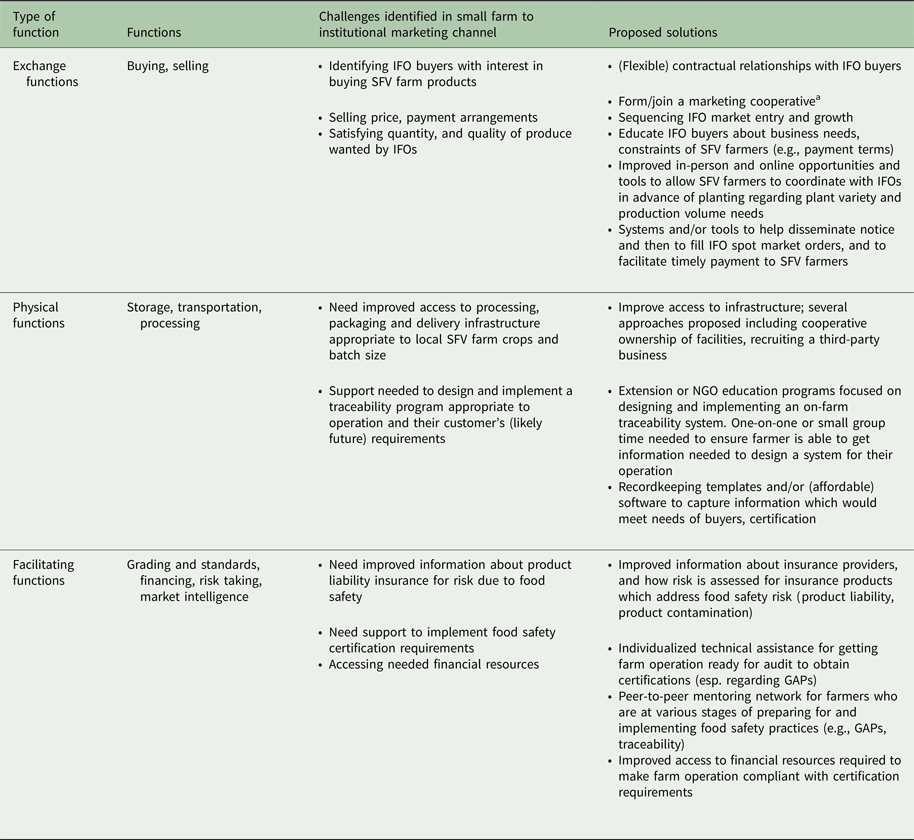
Despite the many challenges identified, a majority of producers remained encouraged that IFOs are a viable marketing option and were quick to identify potential solutions to challenges identified. The most repeated, feasible and potentially impactful solutions are presented below. Note that most of the solutions offered cannot be accomplished by a single producer and many would require additional study to explore their feasibility. The marketing challenges, and where available, proposed solutions are in Table 3.
Summary of small farm-to-institution marketing barriers for produce from the perspective of small farmers

a Focus group meeting discussions suggest that many SFV farmers in this region misunderstand the finer points of how marketing cooperatives can function. Although it was not suggested by the study participants, some effort to educate these farmers on the actual (rather than perceived) advantages and disadvantages of cooperatives is needed.
Proposed solution: improved access to new or existing infrastructure
Many IFOs require suppliers do some value-added processing, such as chopping and bagging; most SFV farmers, however, do not have access to an approved kitchen facility. Among the most commonly suggested solutions to this challenge was to establish a community processing facility that could be used by all local growers. Given the likely processing capacity constraints immediately following harvest, the facility would require sizable storage space appropriate to hold raw form of crops in the area (i.e., dry, refrigerated, freezer). Ideally, the facility would also include room to securely store processed product for producers who needed this option. An alternative suggestion was a mobile unit that could be moved from farm to farm so producers would not have to transport their produce. Obtaining resources to build and coordinate access to processing facilities would be challenging, but it was thought not to be insurmountable.
Among other options, one producer (FG6, Prod2) described a local cannery that farmers in his area could rent. The cannery provided guidance on the canning process while the producer did the actual canning and cleaning. Other producers in this focus group meeting were very interested in this as a processing option and expressed their wish for access to this type of facility. Another potential solution was using certified kitchens in restaurants. Multiple producers (FG15, FG16) noted that they were currently or had been recently offered use of this type of facility. These arrangements offered a ‘win’ for both parties; the restaurant earned a small, additional revenue from renting out their facility and/or negotiated a reduced purchase price on some of the value-added farm product. One producer (FG16, Prod2) spoke about his wish to eventually build his own on-site facility for both his personal use and others in his community.
Other farmers did not want to be involved with processing activities. These producers suggested that their local business and agricultural communities should encourage the establishment of a company whose business was to buy and process local produce. One producer (FG8, Prod9) spoke of a facility in Florida to which farmers bring in their produce and the facility staff does all the value-added processing. The facility is equipped to sort, grade, wash, package and has coolers and storage. This option was enthusiastically supported:
‘That's kind of the model that we have been trying to work towards…where the producer can just bring it and sell it and be done with it.’ (FG8,Prod5)
Proposed solution: integrated ordering system
The creation of an online system through which institutional buyers could place orders for local produce was also suggested. After the order was placed, on a first-come, first-served basis, producers with available produce of the required type and grade, could ‘claim’ part of requested amount, thus allowing farmers to effectively pool their output to fill the order. It was suggested that this system could be facilitated by an independent group (e.g., a NGO) or as a service of a marketing cooperative. One producer (FG15, Prod2) described a group in Georgia that was doing something similar. In this example, a producer cooperative posted an online estimate of what they could produce. Once an order was placed, the cooperative let individual producers know what was needed and they each brought their contribution to a central site (in this case, a farmers’ market). Once there, the order was aggregated, picked up by the buyer and checks provided to each producer for their share of the order. This approach addresses both delivery concerns and the problem of delayed payment.
Proposed solution: contractual agreements
Perceptions of contracts were decidedly mixed; some viewed contracts as a potential solution to their marketing challenges, while others viewed them as a marketing barrier. Those in favor of entering into a contract believed that they would offer a guarantee that the contracted amount of produce would be sold, that they could negotiate terms of sale and that it would assist in planning. It was generally agreed that contracts could benefit SFV farmers if terms were more flexible than had historically been offered. For example, a contract could be structured to offset potential difficulties in being able to supply the contracted amount. In one producer's experience:
‘They contracted my entire broccoli. If the sun never comes out and the temperature is below 30° here it will actually start growing. At some point we will be able to sell it to them; they know by Friday what they can pick up the following week, approximately how many pounds.’ (FG7, Prod4)
Alternatively, the contract could specify that the institution would purchase directly from the producer if the producer has the product at a specified time. If the farmer knows they are not going to have the contracted amount available, then the producer would let them know in advance so the institution could buy from a wholesaler.
‘…Or maybe the contract could say if you don't have it, let us know a week ahead of time and we can buy it from US Foods.’ (FG7, Prod6)
Admittedly, most IFOs would be unlikely to agree to such terms as they would limit their own planning ability and would subject them to filling SFV producer's unmet orders with purchases at potentially more costly spot market prices.
Resolving other concerns with entering into contracts would not be easy. For example, several voiced concern about their (in)ability to negotiate a ‘fair’ price with institutional buyers. Depending upon the type and management structure of an institution, they might not be able to change the terms of the payment or other contract features. Given how different many standard contract features are from what is needed by SFV farmers, crafting a contract to meet the needs of both buyers and farmers would require concessions by both parties. This issue was further examined by Barrowclough et al. (Reference Barrowclough, Boys and Carpio2015). Expanded efforts to help educate institutional buyers on the contract needs of SFV farmers would also be very beneficial.
Proposed solution: sequencing market entry and growth
Some SFV farmers suggested starting small when trying to access IFO marketing channels. Rather than trying to access a large school district, some producers suggested starting with a smaller institution, such as a private university or long-term care facility, to gain the experience needed to evolve to working with a larger buyer. It was thought that this approach could also alleviate other exchange function challenges concerning quantity, delivery and payment arrangements.
Some producers expressed the desire to begin small by selling to grocery stores.Footnote 10 Frequently though, it was found that even local grocery stores want enough produce for all of their regional stores, which can be just as (or more) challenging as trying to meet the quantity requirements of a large school. More successfully, long-term care facilities had been used as a first point of entry into institutional markets by two participants. The quantity demanded was lower, buyers have more market-based incentives to supply higher quality products, and for those which were privately owned, there was some flexibility in payment schedules.Footnote 11 Farmers reported, however, that the ownership of a long-term care facility often significantly impacted the requirements and relationship with these buyers. Those selling to corporate-owned facilities faced many of the same exchange-function challenges as encountered when selling to other types of institutions.Footnote 12 Marketing to independently owned facilities was described in a manner similar to selling to restaurants. Multiple producers (FG13, FG16) reported that independently owned facilities were willing to pay a premium to serve fresh produce; in these facilities, the buyer only wanted ‘the best’ for his/her clients and had the budget to buy ‘the best’.
Proposed solution: cooperatives
It was frequently suggested that many of the infrastructure requirements could be at least partially resolved through the formation of a marketing cooperative and/or through the cooperative ownership of marketing infrastructure (FG2, FG5, FG6, FG15, FG16 and FG19). Establishing a marketing cooperative could provide participating producers with the quantities needed to meet the volume requirements of institutions. A cooperative could also partially remedy processing, storage and delivery challenges as needed equipment could be collectively purchased. It was also thought this would make purchasing from SFV farmers more appealing to IFOs by reducing the number of deliveries.
Despite these potential benefits, however, in the course of discussion strong resistance to this option surfaced. In considering the potential for marketing cooperatives, there were frequent concerns about administrative free-riding, and about the intermingling of products deteriorating the quality of a given farm's output.
‘I think it depends on who I co-oped with because if someone is using chemicals and harmful things to grow their produce I wouldn't want mine next [to theirs]. …It would take away all the work of not using then.’ (FG16, Prod1)
While these concerns could be addressed by standard co-op membership requirements and governance procedures, other reservations about cooperative marketing ran deeper. Overall, there was a deep lack of trust among participants that co-op managers and members would uphold their commitments to one another. There was concern that managers, in particular, would not act in the best interest of the cooperative and may take advantage of their leadership position, connections and knowledge of market information to further their own interests. Many also voiced strong concern that other producers would violate the group's agreed-to production standards, would sell their products to a higher paying buyer regardless of their commitments to the cooperative (leaving remaining members scrambling to fill the group's orders) or would otherwise not fulfill their commitments to the group. This distrust in the effectiveness of the cooperative structure and leaders within such groups was unexpected and was subsequently explored further with university extension personnel. It was mentioned that several years ago, a cotton marketing cooperative in Georgia had taken advantage of its members.Footnote 13 It was suspected that this story had spread broadly and had implanted a strong resistance to cooperatives among farmers in the region.
Roles for extension services, NGOs and state departments of agriculture
Many of the suggestions to improve access to IFOs centered on the need for specific information and resources. Some suggestions were for the development of new market coordination tools. For example, producers felt it would be useful to know what institutional chefs were, or would like to, include on their menus so they could plan accordingly. Similarly, there was much interest in market coordination support to identify IFOs interested in purchasing from SFV farms, and in having tools available would allow more direct communications with potential IFO buyers. There were many requests for additional resources related to GAPs implementation and traceability. For example, a list or small booklet summarizing what is necessary to be in compliance with GAPs, and a software program and/or education programs for producers regarding how to document information for a traceability system were requested. Other resources not specifically related to marketing, such as templates for financial recordkeeping, food safety and food handling training videos, were also identified. A variety of organizations, including university extension services, state departments of agriculture and various NGOs, were suggested as organizations that should (or would best) provide these resources.
Subsequent examination of a compiled list of these resource and information requests showed that a majority were already available within the study region through one or more of the types of organizations identified above. While there were examples where the resources were outdated and thus less useful, in many instances, programs and resources addressing these topics are currently available, but most producers were unaware of them. This suggests that there is an important, and somewhat ironic, lack of marketing of the marketing services and resources available through these organizations. Additional efforts to promote their resources, and an organized, centralized, online inventory of the resources available from organizations in the region, and other relevant resources (e.g., eXtension Communities) could remedy some of the information challenges perceived by SFV farmers and would help reduce the potential for duplication of effort among the organizations that support them.
Conclusions
This study explored the challenges encountered in the direct marketing channel between SFV farmers and IFOs. A series of focus groups were conducted with SFV farmers in three South-Atlantic states to better understand the challenges and solutions in direct farm-to-institution marketing (phase I), and then to specifically examine food safety challenges associated with this channel (phase II). While not possible to document each of marketing barriers and proposed solutions herein, those which were particularly emphasized during meetings or which were uniquely shaped in some way by the circumstances of this region, are included in this discussion.
The list of marketing challenges identified through this process were numerous. Most were not unique to the southeastern US, but several were complicated by the extent of diversification typical among SFV farms in this area, the limited availability of local food system infrastructure in the region and by a lack of interest and trust among many of these farmers in working cooperatively. Practical marketing considerations, such as payment terms, and processing, packaging and delivery requirements of supplying IFO buyers were identified as obstacles to the efficient function of this channel. Food safety challenges, including the related issues of obtaining (food) products liability insurance and food safety certifications, were also among top concerns.
Producers offered many remedies that they thought could potentially alleviate the discussed barriers. The solutions offered which are related to produce marketing are improvements to physical and technological infrastructure quality and availability, changes to market entry and growth strategies, and changes to SFV farmer marketing strategies through cooperatives or redesigned contractual agreements. It is worth emphasizing, however, that any of these proposed options could not be implemented by an individual farmer, but instead would require leadership and resources from agriculture sector support organizations such as university extension services, NGOs or state or local government.
The qualitative approach used in this study, and the effort to include an extensive number of small farmers focused on varied types of specialty crops production and from across the geographic area of interest, has enabled the development of a deep and nuanced understanding of seller's constraints and perspectives concerning marketing into the farm-to-institution channel. This, however, is simply the first step to facilitating this marketing channel. For many of the proposed solutions, their relative cost-effectiveness would need to be considered before policy recommendations or funding allocations should be made. The research reported here was complemented by a concurrent series of focus group meetings independently held with institutional foodservice buyers; findings stemming from these results are presented in Boys and Fraser (Reference Boys and Fraser2017). Future research efforts will pair SFV farmer's constraints with those identified from the institutional buyer's perspective to offer a unique and holistic perspective of these issues.
Acknowledgements
The authors gratefully acknowledge the assistance provided by members of Clemson Cooperative Extension, the University of Georgia Cooperative Extension, and the Carolina Farm Stewardship Association. In addition, the authors would like to particularly thank David Hughes, Beth Kunkel, Laura Westray, Anita Nunnelley and students registered in Clemson University's creative inquiry course ‘Developing Linkages for a Sustainable Food System’ for your valuable input and assistance. Funding for this study was made available the Southern-Sustainable Agriculture, Research & Education grants program (grant LS10-236), and the USDA Specialty Crops Research Initiative (SCRI) (grant 2009-51181-05981).