Introduction
The societal and economic changes triggered by digital technologies rank among the biggest challenges in the first half of the 21st century, having profound effects on the ways people communicate, learn, age, work, or spend their leisure time. Leaving almost no aspect of life untouched, the multifaceted reshaping of the economy and society associated with the “Digital Transformation” (OECD, 2017, p. 20) – with digitization or digitalization often used as a shorthand – has been likened to the first industrial revolution (Brynjolfsson & McAfee, Reference Brynjolfsson and McAfee2011; Rifkin, Reference Rifkin2013; Aronson & Cowhey, Reference Aronson and Cowhey2017). At its core, the transformation is economic, based on new forms of innovation and value creation as well as business models and competition dynamics, and thus holds a promise for substantial productivity gains and economic growth (Loebbecke & Picot, Reference Loebbecke and Picot2015; Aronson & Cowhey, Reference Aronson and Cowhey2017). However, the digital transformation also creates profound challenges for societies and individuals through its broader implications, for instance, through the increasing automation and the replacement of human work, issues related to privacy and data security, or the question of accountability and control of automated decision machines as well as artificial intelligence (Arntz et al., Reference Arntz, Gregory and Zierahn2016; Mittelstadt et al., Reference Mittelstadt, Allo, Taddeo, Wachter and Floridi2016; OECD, 2017). It is, therefore, clear that digitization presents a wide range of changes expanding across a broad array of issue areas such as business, public service, education, health, energy, and security.
The digital transformation entails disruptive challenges to existing policy frameworks and calls for updates across various policy areas. Confronted with these trends, policy actors face the task of shaping the ongoing digital transformation. However, while the digital revolution is proceeding at a breathtaking pace, the mills of democratic politics are well known to grind rather slowly. Politicians have been hesitant to place digitization high on the public agenda. A telling example in this regard is German Chancellor Angela Merkel cautioning in 2013 that “the internet is for us all an unchartered territory” (Dewey, Reference Dewey2013) – a statement followed by public incomprehension if not outright ridicule.
Yet, this reluctance to address the challenges associated with the digital transformation does not constitute a lack of responsiveness. On the contrary, it can be interpreted as reflecting voter preferences given that in their electoral calculus, they do not seem to assign much weight to the consequences of the digital transformation. Even in 2017, digitization does not make the list of the 13 most important topics among European citizens (European Commission, 2017, p. 7). As long as it remains nonpoliticized, political competition will hardly drive parties to address this topic, and controversial aspects linked to it are unlikely to enter public opinion formation as long as there are no relevant exogenous shocks forcing parties to show a strong commitment to digital change. The issue of digitization thus seems to exemplify democracy’s inherent barriers for a forward-looking handling of major societal challenges.
Taking all of the above into consideration, it is particularly peculiar to see digitization enter the arena of party politics, nonetheless. We therefore aim to shed light on what drives the parties to signal commitment to this topic. This is not easily explained with existing theoretical approaches. A major potential explanation of the change in salience of issue dimensions – the issue entrepreneurship model – presumes that parties have an incentive to mobilize a policy dimension that lies dormant, but about which voters already care about and on which they take clearly opposing positions (Carmines & Stimson, Reference Carmines and Stimson1986; De Vries & Hobolt, Reference De Vries and Hobolt2012; van de Wardt et al., Reference van de Wardt, De Vries and Hobolt2014). These requirements, however, hardly apply to digitization. The same goes for the standard issue competition model, which assumes that parties compete by emphasizing those issues in which they already have a positive standing and which are relevant in the electorate (Budge, Reference Budge2015; seminally see Budge & Farlie, Reference Budge and Farlie1983; Petrocik, Reference Petrocik1996; Green-Pedersen, Reference Green-Pedersen2007; Green & Hobolt, Reference Green and Hobolt2008; Walgrave et al., Reference Walgrave, Tresch and Lefevere2015; Green & Jennings, Reference Green and Jennings2018). Regarding digitization, however, parties have barely been able to establish issue ownership, neither is this topic of substantial electoral relevance nor can parties expect that their efforts of emphasizing digitization will pay off in the near future. It thus makes more sense for a party to invest its limited resources in those issues, which are already salient and in which they have a strong reputation, so they can yield an immediate utility through attracting more voters.
By explaining why parties take up digitization in their electoral manifestos, we aim to make a twofold contribution: First, we draw on and extend the issue competition and issue entrepreneurship models. Besides the direct utility for parties resulting from electoral demand for an issue, we take into account two additional aspects, which are particularly relevant when investing in an emerging topic. These are, first, costs that parties incur, and second, the indirect utility as parties can accentuate other elements of their policy portfolio through emphasizing digitization. Second, we test the theoretical expectations focusing on party competition in German subnational elections as we examine (a) how the German Länder and (b) how parties within them differ regarding the salience of digitization in their party manifestos.
The article is structured as follows: Section two introduces the theoretical underpinnings of the issue competition and issue entrepreneurship models, based on which section three then presents an extended analytic framework together with our main hypotheses. In section four, we describe the research design of our study, providing information on case selection, data collection, and measures used in the empirical analyses. Section five presents the main findings of our analyses before ending with some concluding remarks in section six.
Issue ownership and issue salience in party competition
The issue competition model offers a suitable framework to analyze how parties compete over attracting voters. It revolves around the notion that the relative emphasis on issues matters for the electoral appeal of parties – a premise that is shared by many contributions, which, however, do not always share the same label (Budge & Farlie, Reference Budge and Farlie1983; Petrocik, Reference Petrocik1996; Green-Pedersen, Reference Green-Pedersen2007; Bélanger & Meguid, Reference Bélanger and Meguid2008; Green & Hobolt, Reference Green and Hobolt2008; Wagner & Meyer, Reference Wagner and Meyer2014; Walgrave et al., Reference Walgrave, Tresch and Lefevere2015). In all these accounts, issue emphasis matters because parties differ in their perceived competence and commitment dealing with a range of issues. If a party has the reputation of handling an issue best – what Petrocik (Reference Petrocik1996) termed “issue ownership” – the party benefits from this issue being highly salient in the electorate because it informs voters’ evaluative standards. Consequently, parties try to attract votes based on emphasizing issues they “own” while neglecting others.
According to the issue ownership model, two conditions have to be simultaneously present for a party to be successful: parties need to be perceived as competent as well as committed to an issue, and the issue must reach a certain level of salience among the electorate. The problem is, however, that parties have only limited direct influence on their perceived competence. As evidence by Stubager and Slothuus (Reference Stubager and Slothuus2013) suggests, established ties between a party and voters through identity or organizational channels operate as filters that strongly influence the perception of party issue ownership. Beyond these predispositions and the biases they involve, it has also been shown that parties’ own communication efforts, media coverage about parties, and policy performance do matter for their issue ownership (see also Boomgaarden & Vliegenthart, Reference Boomgaarden and Vliegenthart2007; Walgrave & De Swert, Reference Walgrave and De Swert2007; Stubager & Slothuus, Reference Stubager and Slothuus2013). There is, however, also countervailing evidence with regard to the role of policy performance (Egan, Reference Egan2013), and the contributions by Green and Jennings (Reference Green and Jennings2018) and by Seeberg (Reference Seeberg2017) suggest that while it is hard for parties to gain a reputation of competence on issues, it is comparatively easy for them to lose it. Specifically, they show that unfavorable events and developments, which are beyond the control of parties, such as economic downturns or exogenous crises, quickly erode government parties’ issue ownership. Besides working toward the reputation of competence, parties also have an incentive to signal that a party is committed to dealing with an issue. This also contributes to a party’s issue ownership because through emphasizing an issue in public, a party demonstrates its willingness to address it.
Emphasizing an issue – ideally one on which the party possesses issue ownership – also serves a second purpose as parties can increase its salience in the electorate to prime voters on it. According to Carmines and Stimson (Reference Carmines and Stimson1986), trying to achieve this second goal is particularly attractive for parties with a weaker standing in party competition and with an incentive to change the political status quo. A party can do so by mobilizing a dormant issue dimension on which it takes a policy position that promises to attract more voters than it does with its position on the currently dominating dimension. Although this argument is rooted in the spatial model, it also applies to issue competition. Accordingly, one would expect that parties, which have little to gain from currently dominating issues, try to increase the salience of those issues which they own and where other parties perform worse in comparison.
The idea of so-called issue entrepreneurs mobilizing a dormant policy dimension has been put forward in other studies that transfer Carmines and Stimson’s (Reference Carmines and Stimson1986) argument to parliamentary democracies (Riker, Reference Riker1986; Tavits, Reference Tavits2007; De Vries & Hobolt, Reference De Vries and Hobolt2012; van de Wardt et al., Reference van de Wardt, De Vries and Hobolt2014). They show that opposition parties, especially those that have not been in government, make an effort to change the game of party competition through mobilizing a latent issue dimension on which they are more competitive and subsequently profit from it. While this view on issue entrepreneurs concedes parties a strong role in shaping the political agenda and the salience of the issue, their success can be presumed to also depend on favorable conditions. Indeed, a change in the economic and political circumstances, for example, unemployment or immigration, may make an issue salient on which mainstream or government parties have a weak or decreasing issue ownership, and which can consequently be exploited by competitors (see, e.g., Davidsson & Marx, Reference Davidsson and Marx2013; Kurzer, Reference Kurzer2013). Under these conditions, those mainstream or government parties are induced to emphasize the suddenly salient issue, not to further boost its salience but to signal commitment to it and to increase their issue ownership in order to appear as a viable choice for voters.
Altogether, looking at party behavior according to the issue competition framework, parties have an incentive to emphasize and push the issues they own, and this particularly concerns parties that are finding themselves in a losing position in the current state of politics and gain little from the dominance of issues attached to the status quo. Yet if an issue suddenly becomes salient, parties also have an incentive to show commitment to that issue to make sure they have a good reputation handling it. These assumptions directly follow from the prerequisites of success in issue competition – issue ownership combined with issue salience, and the double role of emphasizing issues in one’s public communication: that of signaling commitment and of making the issue salient. Systematic evidence that parties behave this way has, for instance, been provided by Dalmus et al. (Reference Dalmus, Hänggli, Bernhard, Van Aelst and Walgrave2017). Looking at parties’ press releases during election campaigns in Switzerland, Germany, France, and the United Kingdom, they show that parties generally emphasize issues they own in their public relations communications. They, however, divert from this behavior when a certain issue becomes highly salient in the public and switch to prioritizing that issue, hence following public opinion.
The preceding considerations have important implications for how parties deal with topics such as digitization, which are emerging but which (i) have not (yet) become salient and (ii) on which parties did not yet have the chance to develop issue ownership. In short, the preconditions to successfully enter into issue competition are hardly present. Parties would have to make a considerable effort to build up issue ownership first to profit from the emerging topic becoming salient; and trying to make it salient in the electorate may be futile because digitization, despite its relevance for society, may simply not become politicized as a major issue of party competition. As we argue in the following section, one therefore needs to introduce additional assumptions to explain why some parties take up digitization in their policy portfolio and why they signal more commitment to it than other parties do.
Applying the issue competition model to digitization as an emerging issue
Issue competition has largely been studied with regard to issues that were or became a priority on the political agenda, whether it be in established policy areas or new ones (see, e.g., Green-Pedersen & Krogstrup, Reference Green-Pedersen and Krogstrup2008; Green-Pedersen & Mortensen, Reference Green-Pedersen and Mortensen2010; Davidsson & Marx, Reference Davidsson and Marx2013). This is understandable as the issue competition framework can easily be applied to these topics. High issue salience translates into high direct utility for those parties that have ownership of these issues. In contrast, emerging political topics such as digitization are of little relevance to the electorate and hence may or may not become salient and established in the future. One would therefore not expect notable issue competition in the form of differential issue emphasis by parties. The immediate direct utility from signaling commitment to and thus investing in digitization is low at best.Footnote 1
Yet, although the electoral salience of emerging issues may be dwarfed by major issues, there may still be relevant differences in degree regarding the importance of digitization to the electorate. Some settings might be characterized by higher electoral demand for parties to address aspects of digital change than others, which in turn translates into differences in party behavior. In other words, if certain constituencies care more about digitization and if this topic is thus comparatively more salient, parties have an incentive to emphasize it more, too (Burstein, Reference Burstein2003). Applying the argument to the German context, if digitization is more relevant to the public of one particular region, parties can expect to profit comparatively more from emphasizing it in this setting than in others.
There are, however, two possible reasons why digitization might be more relevant in a given region. First, digitization could be important in those regions that have advanced further than others in the incorporation of digital technologies into the society, economy, and the administration, that is, where the topic is simply more familiar and established. Second, digital change can also be conceived of as a modernization process and is thus likely to follow the known form of an S-curve with a take-off and dynamic stage after a period of slow change followed by a phase of leveling off (Rogers, Reference Rogers1995). In our context, we would therefore expect that the emphasis on digitization will be low in those Bundesländer where digitization has not yet notably progressed. Moreover, we anticipate a normalization effect among those regions that have progressed the most and reached a certain saturation level, so that digitization becomes less important and recedes into the background. The relationship between the degree of digital modernization in a region and the extent to which parties emphasize digitization would then be of an inverse U-shape. We therefore formulate the following two hypotheses:
Hypothesis 1a: The more a region has adopted digital technologies in society, economy, and public administration, the more parties emphasize digitization in their manifestos.Hypothesis 1b: In regions, where digital modernization (i.e., adoption of the digital technologies in society, economy, and public administration) reaches its highest or its lowest level, parties tend to emphasize digitization in their manifestos less.
These two hypotheses refer to the demand-side and circumstances that condition the immediate utility, which parties can derive from emphasizing digitization due to its higher salience. While this might prove to have some explanatory power, it is unlikely to be the full story. To explain why parties differ in the emphasis they put on the digital policy, we look beyond the direct utility and concentrate on two additional components: costs and indirect utility.
The importance of costs comes into view when considering why digitization as an emerging issue proves to be a risky investment for parties. Parties cannot simply try to be on the safe side and invest in digitization in addition to other issues that are already salient. Trying to occupy a new topic is a costly enterprise, and parties have only limited resources, such as time, money, and personnel at their disposal, to make an issue salient in the public and to improve a party’s reputation for handling it. Investing in an emerging issue therefore draws resources away from established issues. Additionally, working toward placing an issue on the public agenda means steering away a portion of the public’s limited attention from other issues (Baumgartner & Jones, Reference Baumgartner and Jones1991).
This zero-sum game due to limited public attention and restricted party resources makes costs an important element in issue competition. Parties must decide whether investing in a topic is worth the effort. Digitization can be expected to be a low priority in this regard. It has hitherto been of little relevance in the calculus of voters. This means that the direct utility, which results from emphasizing emerging issues and trying to build issue ownership on them, lies in the future whereas the immediate utility is low. Adhering to the common assumption that political actors discount the future and value short-term gains over long-term returns (Axelrod, Reference Axelrod1981), it is generally not very attractive for parties to invest in an issue with uncertain future benefits, while there are already issues, which do have substantial voter appeal and which a party either already owns or can realistically hope to win ownership on, hence, issues that promise more certain and more immediate payoffs.
Although the expected utility from emphasizing digitization is generally low for parties, costs may differ between them and can affect the issue competition calculus among parties in two major ways. First, if a party has already incurred costs and has to work less to be seen as competent and committed with regard to an emerging issue, it can be expected to be more likely to emphasize that issue. This holds true for parties in government, as they inevitably deal with pressures for policy action in face of the digital transformation. This means that while in government, these parties can develop issue ownership through policy performance and are in a comparatively better position to gain from emphasizing digitization in their manifestos. Not doing so would essentially mean forfeiting an opportunity as the performance record has already reduced the costs and the effort parties have to make first to profit from emphasizing digitization.
Hypothesis 2a: If a party has been in government before a given election, it emphasizes digitization more in its party manifesto in this election.
We furthermore expect larger parties to invest more into digitization in their manifestos. This is based on two arguments. First, larger parties have more resources in terms of money and expertise allowing them to cover a broader range of issues in their programmatic portfolio and to achieve a positive reputation in several of them at the same time (Wagner & Meyer, Reference Wagner and Meyer2014, p. 1022). The relative costs to invest in emerging topics therefore decrease for larger parties compared to smaller parties, whereas for the latter, it is relatively more costly to spend their limited resources and attention on an issue. Second, emphasizing digitization at the expense of other issues is more likely to pay off in the future for large parties based on the argument put forward by Kraft (Reference Kraft2018). He argues that public investment, for example, in infrastructure and human capital formation, is tied to the prospect of fostering growth that is however not immediate but lies in the future. As larger parties have higher vote and office aspirations and are more likely to be in government, they face better prospects of profiting from such public investments (Kraft, Reference Kraft2018, p. 132). The choice of investment is simply less risky for them. The argument can be transferred to digitization as the potential of the digital transformation lies in generating a positive economic stimulus. However, digital change also comprises various other societal opportunities, problems, and challenges and is therefore not solely a matter of public investment. Based on the preceding considerations, we formulate the following hypothesis:
Hypothesis 2b: The larger a party is in terms of voter support, the more it puts emphasis on digitization.
The rationale of costs also enters the calculus of parties if the potential costs of inaction on an emerging issue – even of low salience – are high. Parties that are unsuccessful with their existing policy portfolio have strong reasons to make changes. The basic logic behind this assumption is that if the status quo is already costly for a party, it increases the party’s inclination to engage in risky choices such as spending its resources on an emerging issue (Vis & van Kersbergen, Reference Vis and van Kersbergen2007). A clear case of such a negative status quo in party competition exists if a party has suffered severe vote losses in an election triggering parties to adapt their manifestos (Adams et al., Reference Adams, Clark, Ezrow and Glasgow2004; Somer-Topcu, Reference Somer-Topcu2009). We thus expect a party to be more inclined to take up digitization in its manifesto after having been unsuccessful at the preceding election.
Hypothesis 3: The higher the vote share losses of a party in the preceding election, the more the party emphasizes digitization in its party manifesto in a present election.
The potential costs of ignoring digitization are also heightened in a different scenario: if there is a new party focusing on digitization, which can draw at least some electoral appeal. Germany, like some other European countries, has seen a rise – and demise – of such a party, the Pirate Party. While the Pirate Party is a niche party advocating a sort of cyberlibertarianism and stressing issues of digitization (Hartleb, Reference Hartleb2013), it was nevertheless a potential threat to established parties. The party competed in various countries at the national, subnational, and also supranational level and celebrated some remarkable and unexpected successes considering its niche party status. For instance, it gained between 7 and 9 percent in four German regional elections in 2011 and 2012, 7.1 percent vote share in Sweden in the European Parliament Elections of 2009, and more than 4 percent in Luxembourg and the Czech Republic in the subsequent European Parliament Elections.Footnote 2
The Pirate Party therefore can be seen as a credible threat for established parties. Although aspects of digitization were hardly important in the electorate at the time, established parties have had an incentive to address digitization to confront the risk that the Pirate Party success might have something to do with this topic and that its importance had been underestimated. In other words, Pirate Party success makes the status quo costlier due to the threat from a competitor, therefore inducing established parties to invest in digitization. Moreover, this kind of threat can be expected to be particularly severe for those parties that are ideologically close to the challenger. Given the overall orientation and image of the Pirate Party as a libertarian and progressive party, parties neighboring the Pirate Party on a sociocultural (libertarian versus authoritarian) dimension are especially likely to perceive the party as a threat and hence include the issues that the challenger party emphasizes, such as digitization, in their manifestos. We therefore formulate the following two hypotheses:
Hypothesis 4a: The greater the electoral appeal of the Pirate Party, the more do other parties emphasize digitization in their party manifestos in a given election.Hypothesis 4b: The effect of the Pirate Party success is stronger for those parties, which are its ideologically closest competitors on a sociocultural political dimension.
Turning next to the indirect utility, emphasizing digitization may, due to its low electoral relevance, not translate into direct utility through electoral appeal based on this topic, but it can still help parties to strengthen their competitiveness indirectly. Signaling a commitment to digitization, however, can serve to bolster parties’ reputation on other issues that they and voters care about. The resulting utility is thus not through party appeal based on digitization as such but through a better ability to compete on other issues, which are more directly instrumental to garnering voter support. There are strong reasons why an economic as well as a sociocultural policy stance is likely to matter for such an indirectly derived utility. Given the importance of the digital transformation for economic development and competitiveness (Breznitz et al., Reference Breznitz, Kenney, Rouvinen, Zysman and Ylä-Anttila2011; Brynjolfsson & McAfee, Reference Brynjolfsson and McAfee2011; OECD, 2017), market-liberal parties can use digitization more easily to underscore economic aspects in their policy portfolio, that is, issues on which they are already perceived as competent and which their voter base is likely to care about most. Similarly, socioculturally liberal parties already emphasize progressive issues and cater to voter segments that are more open to social change and new forms of societal organization (Oesch, Reference Oesch2013; Kitschelt & Rehm, Reference Kitschelt and Rehm2014). These parties hence might try to strengthen this image through emphasizing digital change. Based on these arguments, we propose two additional hypotheses.
Hypothesis 5a: The more market-liberal a party, the more it emphasizes digitization in its party manifesto.Hypothesis 5b: The more socioculturally liberal a party, the more it emphasizes digitization in its party manifesto.
Research Design
Case selection
Germany and its Bundesländer lend themselves as an instructive case to be studied for several reasons. First, while Germany is one of the largest and most competitive economies in the world, it is has not taken a leading role in the digital transformation of its economy and society. The country ranks in the middle on the EU Commission’s Digital Economy and Society Index for 2018, and given its closeness to the European average, it can be regarded as a representative case.Footnote 3 Moreover, as a coordinated market economy with a strong industrial sector, the digital transformation presents a particularly large challenge for maintaining the country’s future competitiveness, perhaps best exemplified by the strong pressures on Germany’s automotive industry.
Second, the German Länder enjoy one of the highest degrees of regional authority (Hooghe et al., Reference Hooghe, Schakel, Marks, Niedzwiecki, Osterkatz and Shair-Rosenfield2016). They are responsible for implementing laws made at the federal level, and they have substantial competences – either exclusive or shared with the federal level – in various areas that are shaped by digitization, such as education (including higher education and research), law and order, and to some degree economy and the public sector. As the digital transformation touches on so many policy areas such as infrastructure, education, economy, and public service, it involves not just the federal government, but also subnational units to the degree that the regions have competences over areas affected by digitization. The fact that all regional governments have issued their own regional digital strategies by 2017 and that some even have created digital ministries is also indicative of the growing importance of digitization – at least as an object of policy-making, not necessarily in the larger public.
Third, German federalism is marked by a strong component of regional competition that is supposed to foster innovation in policy and governance (Benz, Reference Benz2007). Given this competitive and dynamic element, it is reasonable to presume that the German regions with their socioeconomic disparities try to use digitization for regional socioeconomic development, either to catch up or to maintain their standing.
Moving to the subnational level has the additional advantage that the regions are embedded in a common context, therefore allowing to keep conditions such as the general institutional design or cultural aspects more or less constant between these units (Snyder, Reference Snyder2001). Moreover, the overall structure of the party systems of the German Länder is very similar (Bräuninger & Debus, Reference Bräuninger and Debus2012), whereas the regions also have their own dynamics of party competition where it matters for policy outputs which are the parties that get into government (Jeffery et al., Reference Jeffery, Pamphilis, Rowe and Turner2016; Schmidt, Reference Schmidt2016). We can thus expect substantially interesting variation at the subnational level. One important difference concerns the emergence and success of the Pirate Party as a challenger party with a strong focus on digitization (Hartleb, Reference Hartleb2013). The party temporarily made it into regional parliaments while never reaching significant vote shares on the national level. Analyzing the German regions therefore allows us to probe possible effects stemming from the pressure of a niche party competitor focusing on digitization.
We base our analyses on the election manifestos of parties that competed in the regional elections of the 16 German Länder between 2010 and 2018.Footnote 4 We focus on the politically most relevant parties, that is, those represented in the German Bundestag after the 2017 national election:Footnote 5 the Christian Democratic Union (CDU) together with its sister party Christian Social Union (CSU) in Bavaria, the German Social-Democratic Party (SPD), the Free Democratic Party (FDP), the Green Party, the Left Party, and the Alternative for Germany (AfD). Although it has not been represented in the Bundestag and has also largely disappeared on the regional level, we also include the Pirate Party (Pirates) as an instructive reference case and to analyze the influence it had on other parties (thus to test H4a and H4b).
Data and strategy of analysis
Our dependent variable is the extent to which parties stress digitization in their manifestos. While there is no consensual definition of digitization, it is commonly understood in the way we have described it at the outset, as a comprehensive transformation in the economy and society that is ultimately rooted in the advances and the adoption of digital technologies and that involves opportunities as well as challenges and problems. As it touches on various areas, parties can be expected to refer to multiple aspects of digitization, such as cybersecurity, data protection, modernizing the public sector, infrastructure (e.g., broadband), and digital skills and literacy.
Altogether, 190 electoral manifestosFootnote 6 for 29 elections have been collected.Footnote 7 This is an enormous amount of material for manual coding. Because of this and because we can presume that parties signal commitment to digital change through specific and readily identifiable keywords, we have opted for a dictionary approach. We screened the text material for the suitable search strings and used the generated list of keywords (see online Appendix A1) to extract relevant sentences from the manifestos. These extracted sentences were, in turn, checked to correct for overcoverage in terms of sentences that were clearly not related to digitization even though they contained the search strings (e.g., sentences mentioning the word data but referring to tax data or data used in environmental studies). This procedure resulted in 10,625 sentences. The number of extracted and screened sentences per manifesto was then divided by the total number of sentences in the manifesto to obtain a digitization emphasis score, which serves as the dependent variable in our analyses.
Turning to the independent variables, we measure the direct utility that parties may reap from emphasizing digitization in their manifestos – that is, the demand for digital policy (H1) – using the digitization index created by the Fraunhofer Institute for the year 2017 (Opiela et al., Reference Opiela, Tiemann, Gumz, Goldacker, Bieker and Weber2017). This is based on data for the digital infrastructure, usage of digital technologies, economy and research, and public administration as an overall measure for the importance of digital change in a region. Alternatively, we use the strength of the information and communication technology (ICT) sector in two variants: the share of businesses and the GDP share of this sector; values for the year 2018 are extrapolated based on the preceding trend. However, one can safely assume that the Länder differences are highly stable over time, especially since there is almost no change in the Länder-relations regarding the importance of the ICT sector over time. We also add GDP per capita and the regional debt as a percentage of GDP as control variables, for they may condition the ability of governments in the Länder to invest in digitization and thus affect how much parties are ready to emphasize this topic.
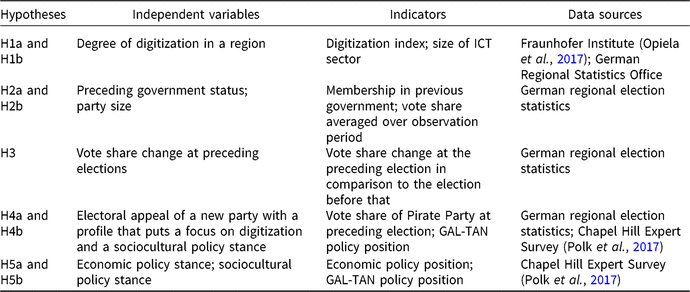
Reduced costs due to the performance record (H2a) are measured by distinguishing between whether a party was part of the government before an election (1) or not (0). The decreased relative costs of committing to and emphasizing digitization (H2b) is measured by the party size by taking the average vote share of a party in a region for the entire observation period. An unfavorable status quo (H3) is measured by means of vote share change that a party experienced at the preceding election. As the gravity of a given absolute change depends on the party size – for instance, a three-percent point gain is large for a party that has only had five percent before, but small for a party that had 40 percent – we calculate the relative change, that is, the absolute change in relation to a party’s previous vote shares.Footnote 8 To measure the competitive pressure stemming from a new party that puts a strong focus on digitization (H4a and H4b), we draw on the vote share that the Pirate Party attained in the preceding election. This score varies between elections but not between parties within an election. It indicates how much the other parties were under pressure to react to the Pirate Party in the view of this party’s results at the previous election, possibly by emphasizing digital policy more. We presume the economic (H5a) and sociocultural stance (H5b) to capture an indirect utility resulting from an emphasis on digitization. As we are interested in parties’ overall orientation and not in possible shifts between elections, we draw on the scores from the Chapel Hill Expert survey on the national party policy positions (Polk et al. Reference Polk, Rovny, Bakker, Edwards, Hooghe, Jolly and Zilovic2017). We take the score that is closest to a given election. The economic stance is measured by the left-right economy dimension of the expert survey, and the sociocultural stance is based on the GAL-versus-TAN dimension (green, alternative, libertarian vs. traditional, authoritarian, nationalist). Table 1 summarizes the independent variables, the corresponding hypotheses, the chosen indicators, and data sources.
Summary of independent variables, their indicators, and used data sources

Turning to the method of analysis, we first performed a multilevel model using a random intercept for elections to be able to explain variance between as well as within elections. However, with just two well-explaining higher level variables (the year variable and the u-shaped digitization index), the estimation of the level-two variance components is already close to zero. Following Snijders and Bosker (Reference Snijders and Bosker2012, p. 87), we take this estimated variance for the random component as a sign that the explanation of higher level variance is so complete that this random component can simply be left out and an OLS regression can be modeled instead. We thus present results from pooled OLS regression models that include Länder- and election-specific variables trying to explain the variance over Länder, years, and parties. To check the robustness of the results, other model specifications with fixed effects for elections and for Länder and multilevel models have been used. These models, which are depicted in Appendix A2, are almost identical to the findings from the pooled OLS, thus reassuring us that this is an adequate choice for modeling the data.
Findings
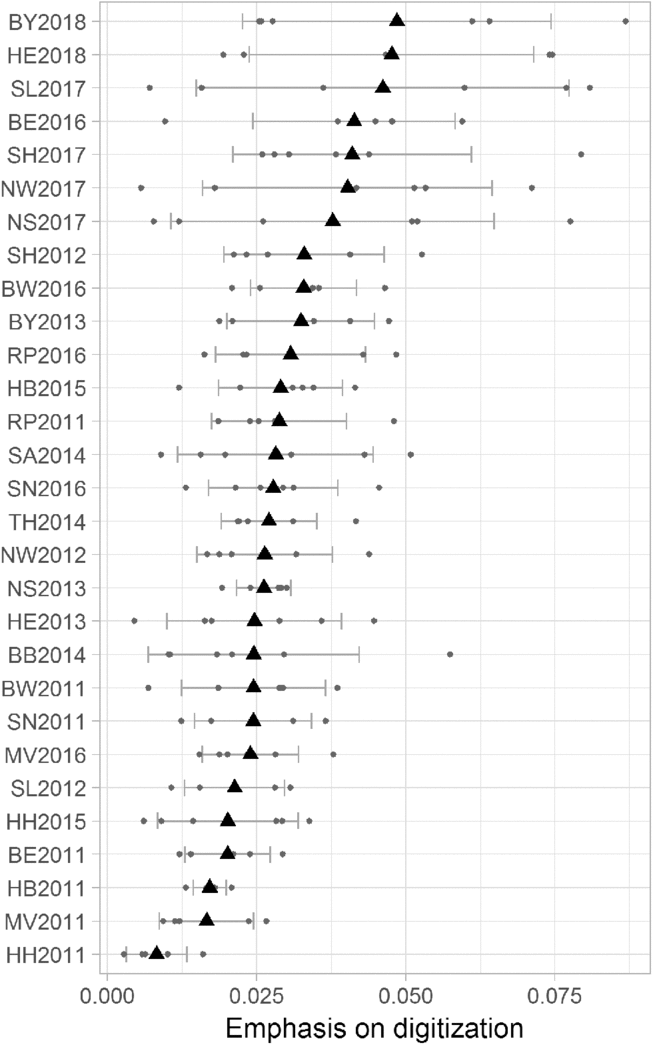
To get a first impression of the data, Figure 1 plots the dependent variable for all regional elections in the sample (without the Pirate Party). It contains the party scores and election means, and additionally depicts the variation by marking the range from one standard deviation below the election mean to one standard deviation above. This descriptive picture reveals some interesting patterns.
Distribution of the dependent variable by election

First, the largest mean scores can be observed for the more recent elections, whereas almost all of the lowest mean scores are from the earliest elections in the sample. The emphasis on digitization thus clearly increases over time. Second, there is a tendency toward an increasing variation in the party scores over time, especially when looking at the seven elections in the figure. Apparently, there are some parties in more recent elections that have markedly distinguished themselves from their competitors with a heightened emphasis on digitization in their manifestos.
Looking at the regional variation, there is no apparent pattern in the sense that certain geographical areas of Germany stand out as being different from others. Just looking at the top of the figure, the elections are all at a similar time – from 2016 to 2018 – but the regions are highly diverse. The ranking is led by the rich regions Bavaria and Hesse, closely followed by the Saarland, which is a comparatively poor region among the old German Länder. Ranking below this region, we find the largest, but also the poorest city-state Berlin, Schleswig-Holstein as a smaller region with average economic development, and North Rhine-Westphalia as the largest region, which is also among the wealthiest ones. It is striking that no region from Eastern Germany ranks among the top as shown in Figure 1. It should be noted, however, that most of the elections in the Eastern Länder are of an earlier date and thus are harder to put in comparison. Arguably most striking about Figure 1 is that parties in the city-states Hamburg and Bremen show a relatively weak performance with regard to highlighting digitization – two Länder that have already strongly developed their digital infrastructure and digital public services.
Comparison between parties

Further instructive differences come into view when looking at the digitization emphasis scores of each party in different elections. Figure 2 shows six parties represented in the Bundestag ordered according to their overall left-right stance (Polk et al. Reference Polk, Rovny, Bakker, Edwards, Hooghe, Jolly and Zilovic2017). The figure also includes the Pirate Party, deliberately placed at the left margin for comparison. It provides a suitable benchmark as it originally was most popular for its commitment to internet freedom and other issues related to digital technologies. Indeed, the Pirate Party clearly stands out against the other parties through its markedly higher scores in Figure 2. Most of its electoral manifestos exhibit almost ten percent of sentences referring to aspects related to digitization, which by far surpasses the average scores of the other parties depicted in the boxplots. Among these other parties, there are notable differences too. It is the parties at the political extremes, that is, the left-libertarian Left Party and the far-right AfD, that display consistently lower attention to digitization in their manifestos. The CDU/CSU, SPD, FDP, and the Green Party all exhibit similar levels, but for the FDP and the Green Party (plus one case for the CDU/CSU), one can observe several outliers, which accentuate digitization to a similar degree as the Pirate Party. Compared to the party differences, there are also overall discernible regional differences even within the same party. This finding conforms to the idea that regionalism fosters inter-regional diversity, which leads to varied dynamics of party competition.
In sum, we can observe an overall trend of increasing party emphasis on digitization over time. This trend is, however, accompanied by variation between German Länder as well as differences between parties, with ideologically more extreme parties accentuating issues of digitization to a far lesser degree. To get a better understanding of the roles which Länder, party, and election differences play for the parties’ extent of emphasizing digitization, we next turn to the regression analyses.
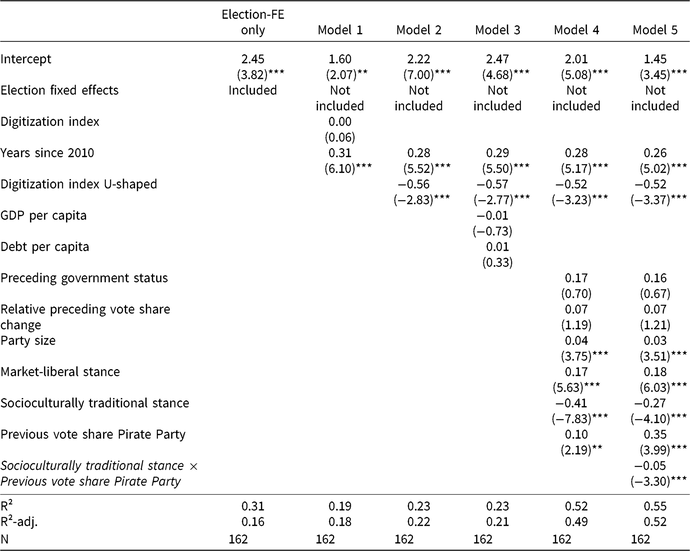
The results from the linear regressions are presented in Table 2. For a comparison with the other models in Table 2, model 1 only includes fixed effects for the elections, thus accounting for variance over time and regions. This model explains about 30 percent of the variance. Model 2 only contains a variable with variation between the Länder, the digitization index, and a variable for the number of years passed since 2010. While the digitization index has no explanatory power at all, the time variable already captures almost 20 percent of the variance. When exchanging the variable measuring the overall degree of digitization of a region for the share of ICT businesses in a region or the GDP share of the ICT sector, the pattern does not change – in no case is there a notable effect, thus contradicting H1a. However, the rescaled digitization index in model 3 does have a clear negative effect. The negative effect of this variable means that parties emphasize digitization less both in regions with the highest and with the lowest degree of digitization. We thus find evidence in line with the demand-side argument that parties address digitization more in those Länder where digital change has already reached high levels but is far from saturated (H1b). As model 3 shows, this relationship remains robust when adding the regional GDP per capita and debt per capita as control variables.
Results from regression models

Notes: * P < 0.1, ** P < 0.05, *** P < 0.01
Model 4 adds the party-specific variables and hence allows to assess which kinds of parties signal a stronger commitment to digitization. It seems that it is generally larger parties that do so, whereas parties that have been in government before an election and parties that have lost vote shares at the preceding election date are not more likely to emphasize digitization – a result that strongly supports H2b while disconfirming H2a and H3.Footnote 9
Preceding vote share change, however, never shows a clear effect, suggesting that previous losses in elections do not make parties more likely to change their manifestos, and specifically to take up new and emerging issues like digitization. While this is unexpected in light of H3, an irrelevance of preceding electoral loss versus success has also been found in other studies (Adams et al., Reference Adams, Clark, Ezrow and Glasgow2004; Schumacher et al., Reference Schumacher, van de Wardt, Vis and Klitgaard2015). However, the explanation by Schumacher et al. (Reference Schumacher, van de Wardt, Vis and Klitgaard2015, p. 1015) that this could be due to parties trying to maximize not just their vote but their coalition potential does not fit the analysis above. This is because emphasizing digitization is not the same as a thorough change of the policy platform and does not equally affect coalition potential. Our data do not tell us whether parties have made other substantial programmatic changes as a reaction to their electoral losses; they merely suggest that these losses do not drive parties to focus more on digitization as an emerging topic.
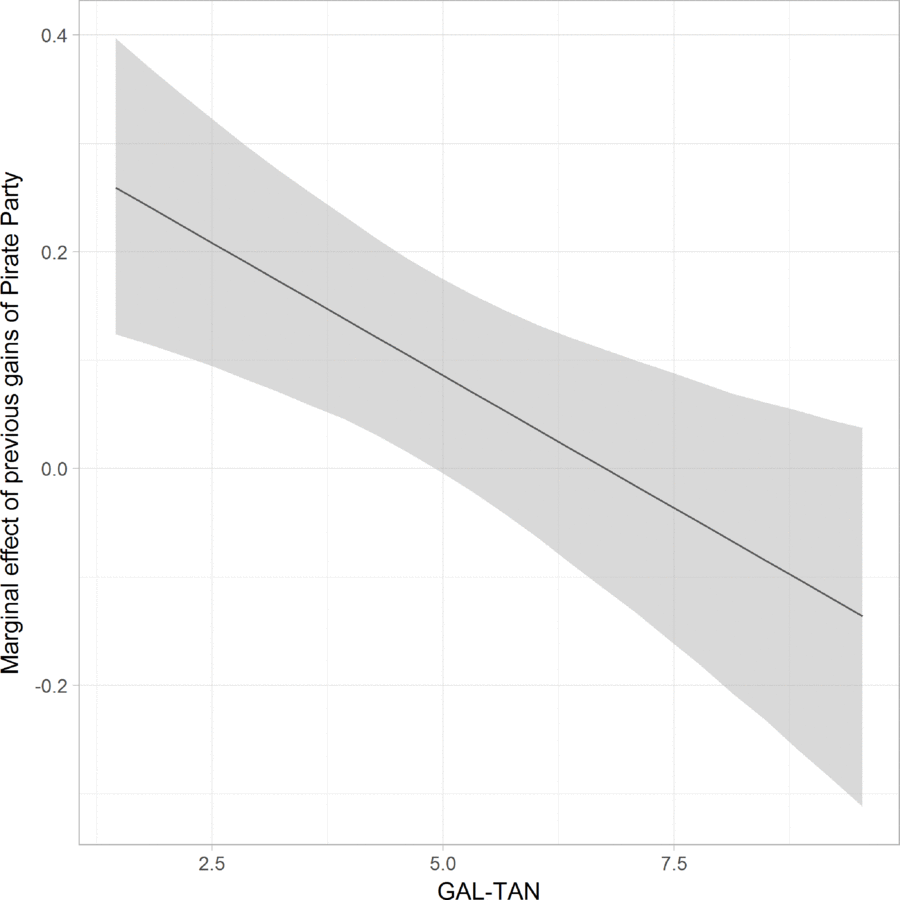
Altogether, the results support the cost-based argument that larger parties are more inclined to take up and invest in digitization as they can more easily afford to concentrate on a broader range of topics in their manifestos, and – as argued by Kraft (Reference Kraft2018) – these parties are more likely to profit from societal development through digitization in the future. We furthermore find evidence that a credible electoral threat by the Pirate Party has driven parties to signal a stronger commitment to digital policy, as indicated by the effect of preceding Pirate Party vote share in model 4 of Table 2 (H4a). The expectation that this effect is particularly strong for ideologically close competitors who target similar constituencies, that is, libertarian parties (H4b), is supported by the interaction effect observed in model 5. Visualizing the conditional effect preceding Pirate Party strength, Figure 3 shows that the competitive threat by the Pirate Party is strongest for parties that take a more liberal stance on the GAL-TAN dimension.Footnote 10
Effect of GAL-TAN orientation conditioned by Pirate Party strength

Turning, finally, to the direct effects of the ideological variables, the evidence is in line with the assumption that programmatic compatibility and the indirect utility resulting from it plays a role for the extent to which parties are disposed to signaling a commitment to digitization. Specifically, the more market-liberal and the more socioculturally liberal a party, the more it stresses aspects related to digital technologies and their societal consequences (H5a and H5b). These effects go against the notion that digitization is treated as a pure matter of public investment as it is not ideologically neutral. Rather, parties are more likely to invest in digitization the better it fits their policy portfolio.
Altogether, the full model (model 5 in Table 2) explains a substantial portion of the dependent variable (R² = 0.55, adjusted R² = 0.52), closely resembling the model specification that uses election fixed effects (R² = 0.63, adjusted R² = 0.53; see Appendix A2). Moreover, the pattern of effects is nearly identical for the different model variants (see Appendix A2). The full model in Table 2 thus provides a compelling summarizing account of the issue competition dynamics with regard to digitization in the German Länder during the observation period.
Conclusion
Digitization, understood as the broad transformation in society and economy stemming from the advances in digital technologies, creates functional pressures for policy actors in all kinds of policy areas. However, digitization as an emerging, but not yet salient or established topic in the electorate, has remained largely nonpoliticized. Under these circumstances, we have argued, parties have little incentive to put strong emphasis on digitization instead of competing on established issues. Following the assumptions of the issue competition and issue entrepreneurship models, parties can derive direct utility in the form of greater electoral appeal through signaling commitment to issues that are already salient among voters or attempting to increase the salience of those issues in which they have a comparatively strong reputation of competence. These conditions are, however, hardly met with regard to digitization.
Our empirical analyses based on party manifestos from German Länder elections between 2010 and 2018 contribute to the party competition literature shedding light on the conditions under which parties address emerging issues like digitization. The evidence provided above, first, offers some support for a demand-side argument. With the passing of time, as digitization has arguably become more important, parties have given more attention to digitization in their manifestos. We furthermore find that in Länder where digital modernization has already progressed, but which do not belong to the leading regions, parties try to catch up as they show a stronger emphasis on issues linked to digitization.
Second, the analyzed party competition variables altogether suggest that digitization is likely to enter party competition gradually and only to the extent to which addressing this topic is convenient for parties. Among the examined parties, there are no signs of behavior in line with that presented by the issue entrepreneurship model. Contrary to the usual pattern of issue entrepreneurship (Carmines & Stimson, Reference Carmines and Stimson1986; De Vries & Hobolt, Reference De Vries and Hobolt2012; van de Wardt et al., Reference van de Wardt, De Vries and Hobolt2014), parties with the strongest niche character and most to gain from mobilizing new issues emphasize digitization the least.
We also find that whether the party has previously been in the government or remained in the opposition does not have a clear effect. Nor do preceding vote share losses lead to a greater readiness of parties to invest more into digitization as an emerging topic. Instead, we find that (a) party size and (b) ideology matter. Party size has a strong positive effect in the analysis, which conforms to the idea that it is relatively less costly for larger parties to invest in emerging topics, whereas smaller parties would need to invest relatively more resources. This effect is also in line with the argument that larger parties – due to their larger likelihood to be in office (Kraft, Reference Kraft2018) – are most likely to profit in the future from investing in digitization and are thus emphasizing digitization more.
Moreover, emphasis on digitization is also a question of ideological compatibility as it increases, ceteris paribus, with an economically stronger market-liberal and with a socioculturally more liberal stance. This finding is plausible as the strong economic connotation and potential of digitization as well as its role as a driver for social change and modernization fit these respective policy orientations. The effect of parties’ programmatic orientation, however, also implies that digitization is not simply an ideologically neutral public investment.
Finally, we find evidence that the short-lived successes of the Pirate Party as a new challenger with a strong focus on digitization have pushed other parties to pay more attention to this topic. Parties have reacted to this competitive threat and the Pirate Party has left a mark even though it has been unable to establish itself.Footnote 11 The analysis shows that the more vote shares the Pirate Party gained, the stronger was the reaction by other parties, and this effect is especially pronounced for socioculturally liberal parties as its ideologically closets competitors.
Our analyses concentrate on a critical point in time in which the far-reaching consequences of digital technologies have come to be acknowledged by political actors. Yet, it seems unlikely that parties experience strong incentives to heavily mobilize aspects of digital change as long as there are no exogenous developments that suddenly politicize digitization. The establishment of the environmental policy presents a fine example of such a phenomenon; it took severe incidents with devastating ecological consequences for parties to mobilize the issue.
Digitization may not follow this trajectory without similarly incisive events such as serious forms of data leakage and misuse felt by many people or large-scale failure by automated decision-making machines. In the absence of such exogenous shocks, digitization is more likely to be silently integrated into party politics. If at some point digitization becomes salient and crystallizes into a politicized issue with clear stakes and possibly consequential trade-offs, future research might also look beyond the aspect of salience and examine the priorities that parties set. In any case, shaping the digital transformation can be expected to become a core task for policy actors for some years to come and it will arguably take some time before this topic has solidified, thus serving as an interesting subject in the study of party politics.
Supplementary material
To view supplementary material for this article, please visit https://doi.org/10.1017/S1755773919000109
Acknowledgments
We would like to thank the three anonymous reviewers for their very helpful feedback and suggestions. Many thanks also to Wiebke Baumann, Anna Geyer, and Joschka Frech for their assistance with the preparation of the dataset and the article. Our research was supported by the Early Career Researchers in Focus Program of the Goethe University Frankfurt.