


Introduction
Domestic cats are among the most widely kept companion animals worldwide (Howell et al. Reference Howell, Mornement and Bennett2016). This trend is clearly reflected in Italy, where their numbers have risen from 10.1 million in 2022 to 11.9 million in 2025 (Assalco-Zoomark 2022, 2024, 2025), making cats the third most commonly kept pet type in the country, following fish and birds and preceding dogs (Assalco-Zoomark 2025). The increasing popularity of cats as companion animals has also led to a growing interest in cat breeding (Goericke-Pesch & Packeiser Reference Goericke-Pesch and Packeiser2022). In this context, Italian catteries (i.e. cat breeding establishments) — ranging from small-scale amateur operations (i.e. hobby breeders) to professional establishments (i.e. individuals involved primarily for financial gain) (Tateo et al. Reference Tateo, Ricci-Bonot, Felici, Zappaterra, Nanni Costa, Houpt and Padalino2023) — are showing a greater interest in reproductive management to enhance queens’ performance and welfare (Romagnoli et al. Reference Romagnoli, Bensaia, Ferré-Dolcet, Sontas and Stelletta2019). Breeding cats are usually housed exclusively indoors in many countries (Povey Reference Povey1978; Schaper et al. Reference Schaper, Packeiser and Goericke-Pesch2025), including Italy (Romagnoli et al. Reference Romagnoli, Bensaia, Ferré-Dolcet, Sontas and Stelletta2019), as it is generally considered the safest option (Rochlitz Reference Rochlitz2005; Jongman Reference Jongman2007; Sandøe et al. Reference Sandøe, Nørspang, Forkman, Bjørnvad, Kondrup and Lund2017). Some breeding establishments allow partial or full outdoor access, as it is considered beneficial for cats by supporting mental well-being, enriching sensory experiences, and promoting physical activity (Oliveira et al. Reference Oliveira, Viana-Junior and de Azevedo2023; International Cat Care 2025). However, despite the widespread presence and rapid increase of companion animals and welfare debate on the appropriate husbandry systems, comprehensive laws regulating their welfare, including reproductive practices, are still lacking in Europe (Candiani et al. Reference Candiani, Drewe, Forkman, Herskin, Van Soom, Aboagye, Ashe, Mountricha and Van der Stede2023). Therefore, given that elevated stress levels resulting from poor breeding and husbandry practices are a well-known cause of behavioural and health problems (Stella & Croney Reference Stella and Croney2016; Goericke-Pesch & Packeiser Reference Goericke-Pesch and Packeiser2022; Padalino et al. Reference Padalino, Zappaterra, Felici, Ricci-Bonot, Nanni Costa, Houpt and Tateo2023), the European Commission is moving toward introducing a new EU-wide law aimed at improving the welfare of cats kept by breeders, selling establishments and shelters across the European Union (EU) (Council of the European Union 2024, 2025).
Among management practices, housing represents one of the key factors influencing animal welfare (Blokhuis et al. Reference Blokhuis, Veissier, Miele and Jones2010). The type, quality, and size of the accommodation provided to cats should meet their physiological and behavioural needs (Wagner et al. Reference Wagner, Hurley and Stavisky2018a,Reference Wagner, Hurley and Staviskyb; EU Platform on Animal Welfare 2020; Candiani et al. Reference Candiani, Drewe, Forkman, Herskin, Van Soom, Aboagye, Ashe, Mountricha and Van der Stede2023). Providing cats with larger spaces can have positive effects on their welfare (Loberg & Lundmark Reference Loberg and Lundmark2016); on the contrary, prolonged confinement and a lack of adequate social stimulation are among the main factors contributing to the development of behavioural problems and a poor level of welfare (Sonntag & Overall Reference Sonntag and Overall2014). The Responsible Cat Breeding Guidelines therefore recommend avoiding the long-term housing of cats in cattery-style pens (i.e. simple or barren enclosures that restrict movement and behavioural opportunities) and instead providing a complex, enriched, and stimulating physical environment (EU Platform on Animal Welfare 2020). Multi-tiered cages must be avoided due to their limited space and the unnatural conditions they create, such as cats being positioned at inappropriate heights, one directly above the another, and being exposed to excessive or insufficient light (Overall & Dyer Reference Overall and Dyer2005; Morgan & Tromborg Reference Morgan and Tromborg2007; Candiani et al. Reference Candiani, Drewe, Forkman, Herskin, Van Soom, Aboagye, Ashe, Mountricha and Van der Stede2023). The provision of adequate and appropriate light, in terms of both duration and type, is another housing-related aspect to consider in relation to cat welfare (Delmar Cerutti et al. Reference Delmar Cerutti, Rizzo, Alberghina, Cristina Scaglione and Piccione2019), even if proper regulations are scant (Candiani et al. Reference Candiani, Drewe, Forkman, Herskin, Van Soom, Aboagye, Ashe, Mountricha and Van der Stede2023). The EU Platform on Animal Welfare (2020) recommends, where feasible, maintaining natural lighting conditions for cats to guarantee appropriate cycles of light and darkness that align with their intrinsic circadian activity patterns. Natural light is fundamental for the maintenance of seasonal rhythms, including the regulation of reproductive cycles (Dawson Reference Dawson1941; Scott & Lloyd-Jacob Reference Scott and Lloyd-Jacob1959; Leyva et al. Reference Leyva, Addiego and Stabenfeldt1984, Reference Leyva, Madley and Stabenfeldt1989). When artificial lighting is required, at least 10–12 h of light, with a minimum of 8 h of darkness, is recommended in breeding catteries (EU Platform on Animal Welfare 2020). However, scientific evidence on the optimal parameters for artificial lighting in cats (e.g. illuminance, spectrum, timing) remains limited (Candiani et al. Reference Candiani, Drewe, Forkman, Herskin, Van Soom, Aboagye, Ashe, Mountricha and Van der Stede2023).
Regarding breeding management, key points of discussion include the queen’s age at first breeding and the frequency of breeding (Candiani et al. Reference Candiani, Drewe, Forkman, Herskin, Van Soom, Aboagye, Ashe, Mountricha and Van der Stede2023). Queens usually reach puberty (i.e. the onset of reproductive function) between 4 and 12 months of age (Griffin Reference Griffin2001; Johnson Reference Johnson2022), depending on the breed (Povey Reference Povey1978; Romagnoli et al. Reference Romagnoli, Bensaia, Ferré-Dolcet, Sontas and Stelletta2019), season of birth (Johnson Reference Johnson2022), and management (Griffin Reference Griffin2001; Ng et al. Reference Ng, Fascetti and Larsen2023). However, in queens, puberty does not coincide with sexual maturity, which refers to the stage at which the queen has reached both skeletal and mental maturity, so she is fully grown and able to perform appropriate maternal behaviour (Candiani et al. Reference Candiani, Drewe, Forkman, Herskin, Van Soom, Aboagye, Ashe, Mountricha and Van der Stede2023). Breeding queens only once they have reached sexual maturity helps safeguard their health and welfare and optimises reproductive performance (e.g. the number of kittens born alive, the number of stillbirths, and the number of kittens weaned or kittens that died before weaning), which is closely linked to overall well-being (Ström Holst & Frössling Reference Ström Holst and Frössling2009; Nowak et al. Reference Nowak, Mucha, Moska and Kruszyński2020; Goericke-Pesch & Packeiser Reference Goericke-Pesch and Packeiser2022). Regarding breeding frequency, there are currently no official EU regulations establishing a minimum required resting period between two queenings (Candiani et al. Reference Candiani, Drewe, Forkman, Herskin, Van Soom, Aboagye, Ashe, Mountricha and Van der Stede2023); only non-binding national guidelines exist (Netherlands Enterprise Agency 2019), which in practice are rarely enforced. However, repeatedly mating queens in order to produce multiple litters in the same year without adequate rest can compromise kittens’ survival (Nutter et al. Reference Nutter, Levine and Stoskopf2004). To prevent physical exhaustion, the European Food Safety Authority (EFSA) has suggested providing a minimum interval of 12 months (Candiani et al. Reference Candiani, Drewe, Forkman, Herskin, Van Soom, Aboagye, Ashe, Mountricha and Van der Stede2023), and the Fédération Internationale Féline (2025b) states that queens must not have more than two litters within 12 months, with a maximum of three litters over a 24-month period. Finally, C-sections are another breeding practice that requires careful management, as they are often associated with pregnancy and parturition complications, which may recur (Axnér et al. Reference Axnér, Jakobsson, Vermelin and Hermansson2025), and repeated procedures may negatively affect the queen’s welfare and should be avoided.
In 2023, the EFSA was asked by the EU to compile a report summarising the available scientific evidence on the management, welfare, and reproductive practices of cats in commercial breeding establishments. Although data from several Northern European breeder associations were included, no information was available for Italy (Candiani et al. Reference Candiani, Drewe, Forkman, Herskin, Van Soom, Aboagye, Ashe, Mountricha and Van der Stede2023). Information on reproductive management among Italian breeders has been reported only for selected breeds, with no comprehensive data available (Romagnoli et al. Reference Romagnoli, Bensaia, Ferré-Dolcet, Sontas and Stelletta2019). This knowledge gap is particularly relevant considering that Italy has a relatively large and active community of cat breeders (Associazione Nazionale Felina Italiana 2025), but their management and reproductive practices remain largely undocumented. Therefore, the present survey-based study aimed to collect information on the management, reproductive practices and performance of cats kept by members of the Associazione Nazionale Felina Italiana, while also investigating possible associations between welfare issues (i.e. stillbirth, death at weaning, C-section, and reproductive success) and specific management or reproductive practices. The goal is to provide evidence to support the development of welfare-based policies and recommendations for feline breeding.
Materials and methods
Respondents
The survey targeted Italian cat breeders, members of the Associazione Nazionale Felina Italiana (ANFI), one of the most prominent feline associations in Italy, affiliated with the Fédération Internationale Féline (FIFe).
Considering a total population of 2,500 ANFI members (Associazione Nazionale Felina Italiana 2025), the number of responses returned (n = 512; covering a total of 3,090 pedigree cats) represents a significant sample size, providing an absolute precision (margin of error) of approximately 5.1% with a 99% confidence interval (CI).
Survey
The study was based on a cross-sectional online anonymous survey. The survey was developed through an iterative review process by the authors. It was designed in Italian with the Qualtrics Software© platform (QualtricsXM, Provo, UT, USA) and distributed via email by ANFI using their mailing list, as well as being made available on the association’s official website (Associazione Nazionale Felina Italiana 2025). The survey link was available for completion between 14 January and 13 April 2025 (~ 3 months). The first email to all the members was sent on the 14th of January, then two reminders were sent to all the members once a month.
The survey was built with sections, each focusing on different aspects of breeding: (i) the environment (e.g. outdoor or indoor housing, natural or artificial light, space allowance); (ii) cattery composition (e.g. breed, number of cats, number of breeding cats); (iii) cattery management (e.g. feeding, veterinary checks, genetic analyses); (iv) breeding activity (e.g. internal or external mating, artificial insemination); (v) queen reproduction management (e.g. number of breeding queens, use of contraceptives); and (vi) individual queen record (e.g. reproductive history of queens) (for the full list of questions included in the survey, see Table S1 in the Supplementary material).
The flow was designed to ensure a smooth user experience by using the ‘loop’ feature, which allows for hiding or repeating groups of questions based on responses to key items (i.e. respondents who indicated that their female cats were kept free did not see — and therefore were not required to answer — questions related to the size of boxes or cages).
The survey included 21 main questions plus 10 optional follow-up questions, for a total of 31 items, including 8 open-ended and 23 multiple-choice questions. In addition, one table-based question was introduced to facilitate the entry of information on individual breeding events (i.e. the instance in which a queen was bred, regardless of whether the mating resulted in pregnancy).
Ethical approval
This study did not involve the use of live animals, and therefore approval from an Animal Ethics Committee was not required. Participation in the survey was voluntary. The Associazione Nazionale Felina Italiana (ANFI) distributed the survey to its members, who were informed about the purpose of the study, that their responses would be used for research, and that participation was entirely voluntary. By completing the survey, participants provided informed consent for the use of their anonymised responses for research purposes.
ANFI securely managed the collection and storage of participants’ information and did not share any personally identifiable or sensitive data with the authors. The authors received only fully anonymised, coded data that could not be traced back to individual participants, thereby ensuring compliance with applicable data protection and privacy requirements.
Data handling and definition of the variables
The survey responses collected through Qualtrics were exported and organised in Microsoft Excel® (Microsoft® Excel for Microsoft 365) for descriptive and further analysis. The data were structured into three separate spreadsheets (i.e. catteries, queens, breeding events) according to the main subject of the responses (i.e. for each cattery, information could refer to multiple queens, and for each queen, up to six different breeding events could be recorded). Questions regarding cattery details (e.g. Q1: ‘Where is your cattery located?’; Q8a: ‘What breed do you breed?’) were organised into one spreadsheet, with each row representing an individual cattery and each column corresponding to a specific survey question. Questions referring to individual queens (e.g. Q20: ‘Enter the queen’s year of birth’) were entered into another spreadsheet, where each row represented a single female cat used for reproductive purposes (i.e. a queen). Finally, questions concerning individual breeding events (i.e. T22: ‘Breeding events table’), including the total number of kittens born, born alive or alive at weaning, were organised in a third spreadsheet, with each row representing a single breeding event.
Data were manually checked to identify errors in open-ended responses resulting from misunderstandings of the questions (e.g. incorrect units used, or interpreting the total number of kittens born as the number of male kittens rather than including females). When possible, doubtful cases arising from survey misinterpretation were reviewed together with the senior authors. Where the cause of an error could be determined, the data were corrected accordingly. Where it was not possible to clarify the cause, the data were excluded as unreliable.
In addition to the variables directly derived from the survey questions, further variables were calculated starting from the available data. Tables S2 and S3 (Supplementary material) report the description, data handling and type (categorical or continuous) of the different variables related to catteries and to queens and breeding events, respectively. Briefly, the total number of cats per cattery was calculated by summing the numbers reported for each breeding category (e.g. neutered females, queens, tomcats), and re-categorised into a new variable, based on the quartile distribution (Breeder size: Small, 1–5 cats; Medium, 6–10 cats; and Large, 11–36 cats).
For each individual breeding event, the following numerical variables were derived: Age at breeding (i.e. the age of the queen at the time of the breeding event), Stillbirth (i.e. the total number of kittens that were stillborn per litter), Dead at weaning (i.e. the total number of kittens that were dead at weaning per litter), Overall litter mortality (i.e. the total number of dead kittens per litter, regardless of the time of death), Stillbirth rate (i.e. the percentage of stillborn kittens per litter), Pre-weaning mortality rate (i.e. the percentage of kittens that died before weaning per litter), and Overall litter mortality rate (i.e. stillbirth plus pre-weaning mortality rate).
For each queen reported by the breeder in the survey, the following summary numerical variables were created: Mean breeding events per year (i.e. average number of breeding events per year per queen), Mean litters per year (i.e. the average number of litters per year per queen), Mean litter size (i.e. the average number of kittens born per litter per queen, including stillborn kittens), and Reproductive success (i.e. the percentage of breeding events that resulted in a confirmed pregnancy for each queen). The variables Mean breeding events per year and Mean litters per year were then categorised as ‘≤ 1’ or ‘> 1’ to facilitate interpretation of the queen’s reproductive activity in subsequent analyses. Moreover, the Age at first breeding was calculated for each queen by subtracting the year of birth from the year of the first recorded breeding event and was then categorised as ‘≤ 1’ or ‘> 1’. Finally, information on kitten mortality and C-sections, previously recorded for individual breeding events, was summarised for each queen into the dichotomous variables (Yes/No) reported in Table 1.
List of the welfare issues identified in the study for each queen and analysed as outcomes in the logistic mixed-effects regression models. For each reproductive issue, the name and corresponding criteria for classification are provided.

Table 1. Long description
The table lists the welfare outcomes analysed in the study and the criteria used for their classification. Three binary outcomes are included: C-section (whether the queen underwent at least one C-section during her pregnancies), stillbirth (whether at least one kitten was stillborn across all litters), and dead at weaning (whether at least one kitten died before weaning across all litters). Each outcome is coded as Yes (1) or No (0).
Where possible, categories with an insufficient number of answers (i.e. less than 5% of answers) (Peduzzi et al. Reference Peduzzi, Concato, Kemper, Holford and Feinstein1996) were merged to avoid unbalanced categories to facilitate subsequent regression analyses. In particular, the breeds of the queens were grouped into four categories, according to the classification recognised by Fife: Category 1 (i.e. Birman, Exotic, Persian, and Ragdoll); Category 2 (i.e. Maine Coon, Neva Masquerade, Norwegian Forest, and Siberian); Category 3 (i.e. Bengal, British, Chartreux, and European); and Category 4 (i.e. Abyssinian, Cornish Rex, Russian Blue, and Sphynx) (Fédération Internationale Féline 2025a).
Statistical analysis
Descriptive statistics for all numeric, categorical, and dichotomous variables were performed using a free online statistical software (Statulatorbeta, Sydney, NSW, Australia; https://statulator.com/). Numerical variables are reported as minimum (min), maximum (max), mean, standard deviation (SD), median, and interquartile range (IQR), while categorical variables are reported as counts and percentages. The number of missing values is also provided for both numerical and categorical variables. A Chi-squared goodness-of-fit test (χ² GOF) was used to assess whether the categories within each variable followed a uniform distribution.
Univariable and multivariable logistic regression analyses were performed using Generalised Linear Mixed Models (GLMMs) with a binomial distribution and logit-link for the binary outcome variables Stillbirth (Yes/No), Dead at weaning (Yes/No), and C-section (Yes/No), considering each queen as the unit of observation. Cattery ID was included as a random effect in all models to account for clustering of queens within the same cattery.
For the univariable logistic analysis, separate models were created to assess the association between each binary outcome and selected predictors. The following predictors were tested: Housing system, Space allowance, Presence of males (i.e. one or more tomcats cohabiting with the queens), Experience, Breeder size, Queen breed, Age at first breeding, Mean litters per year, Mean litter size, Mean breeding events per year, and C-section (the latter included only for the outcomes Stillbirth and Dead at weaning). The significance of each predictor was assessed using Wald tests, both for individual coefficients and for overall effect of the predictor. Predictors with a P-value < 0.25 in the univariable analysis were initially retained for inclusion in the backward stepwise selection for multivariable models (Bursac et al. Reference Bursac, Gauss, Williams and Hosmer2008). Multivariable regressions were performed only if at least three predictors met this criterion (i.e. P-value < 0.25).
For each multivariable model, variance inflation factors (VIFs) were calculated to assess multicollinearity among the independent variables included in the analysis. Predictors with a VIF score higher than 5 were considered to be collinear (Menard Reference Menard2001); no collinearity issues were observed.
Backward elimination was conducted manually by systematically removing the least significant predictor at each step, with model performance assessed using the Akaike Information Criterion (AIC). The overall significance of each multivariable model was assessed using the likelihood ratio test (LRT). When differences in AIC values and significance were minimal, the more parsimonious model was preferred.
For the Reproductive success, only univariable analysis was performed, using the total number of pregnancies per queen and the total number of failed pregnancies per queen combined as a two-column response with a binomial distribution, to account for the total number of breeding attempts per queen. The following predictors were tested: Housing system, Space allowance, Presence of males, Experience, Breeder size, Queen breed, Age at first breeding, Mean breeding events per year, and C-section.
All regression analyses were conducted in R environment (R Version 4.4.3; www.r–project.org). Results are reported as odds ratios (ORs), with 95% confidence intervals (CIs) and P-values. Observations with missing values were automatically excluded from the analysis by the software. Significance was set at P ≤ 0.05.
Results
Descriptive statistics
A total of 512 ANFI breeders, each representing a single cattery, responded to the survey. However, 130 respondents stopped the survey in Section 2, when information on the composition of the breeding herd (i.e. number of cats in each reproductive category) was requested, and 304 did not report the number of breeding queens as required in Section 5. Only 109 respondents completed Section 6 (i.e. individual queen record), thereby providing individual data on their queens and specific breeding events. Breeders were allowed to enter data for up to ten queens, and for each queen to report a maximum of six breeding events. Overall, data were collected for a total of 250 queens and 484 breeding events.
Catteries
The majority of respondents were breeders of medium size (50.3%), mainly keeping fewer than 10 cats (median = 7, IQR = 5–10), with 3 queens (IQR = 2–4) and 1 tomcat (IQR = 1–2). The breeders were located mainly in Northern Italy (63.7%), and most of them had more than 3 years of breeding experience (74.5%) (χ² GOF test; P < 0.001). Only 16 out of 512 respondents declared that they bred for profit, whereas 96.9% reported being amateur breeders. Two breeders did not answer this question.
Almost all catteries were single-breed (94.1%), with Maine Coon being the most prevalent breed (25.7%), followed by Birman (15.2%), British (10.5%), and Persian (7.9%) (χ² GOF test; P < 0.001) (Table S4; Supplementary material).
In 368 out of the 512 catteries, the cats were housed exclusively indoors. Seven catteries housed their cats exclusively outdoors, while 137 adopted a mixed system (i.e. both indoors and outdoors). Space allowance per cat differed according to the housing system (Table S5; Supplementary material): indoor catteries provided an average of 23.4 (± 15.5) m² per cat, while mixed and outdoor catteries 31 (± 24.7) m² per cat (Table S6; Supplementary material).
Natural light was the preferred lighting type (87.4%). Among the 64 catteries using artificial light, warm light was the most common type (79%) (χ² GOF test; P < 0.001), provided in the majority of the cases for more than 8 h per day (33.9% for 8–10 h; 48.4% for 10–12 h) (χ² GOF test; P = 0.013).
Within the catteries, the animals were mainly housed freely (93.8%) (χ² GOF test; P < 0.001), and in 56.3% of catteries where females were kept free, at least one male cohabited with the female group.
The majority of breeders provided a separate space for queening (94.1%). A dedicated single room was the most common arrangement (88.7%), whereas the use of a box (6%) or a dedicated room with multiple boxes (5.3%) was less frequent (χ² GOF test; P < 0.001).
Breeding was mainly carried out internally within the cattery (i.e. both tomcats and queens were not used for breeding outside the cattery and had no contact with cats from other catteries; 59.9%). External breeding occurred in only 10.7% of catteries, whereas 29.4% adopted a mixed breeding method (i.e. both internal and external; χ² GOF test; P < 0.001). Semen checks and artificial insemination were rarely performed (7 and 2.4%, respectively). A total of 225 breeders reported never using contraceptive methods on their queens, while 148 did, and 139 did not answer this question.
Regarding cattery management, more than half of the respondents reported feeding their cats with commercial pet food (58.5%), while 34.4% provided a mixed diet (e.g. pet food plus homemade food). Only 21 breeders (5.6%) exclusively used a Biologically Appropriate Raw Food (BARF) diet. Most breeders regularly performed vaccination (96.8%), antiparasitic treatment (74.3%), and health checks and genetic tests for breed-specific diseases (88.9%). The summary descriptive statistics of the numerical and categorical variables related to cattery details are reported in Tables S4 and S5, respectively (see Supplementary material). For the categorical variables, GOF tests; P-values are also reported (Table S4; Supplementary material).
Queens’ management
The majority of queens with available data on their characteristics and individual breeding events were Maine Coons (32.4%), followed by Birmans and British (13.6 and 12.0%, respectively), and most of them were between 2 and 4 years old (i.e. born in 2021–2023) (χ² GOF test; P < 0.001). When individual breeds were grouped into FIFe categories, the Category 2 group (i.e. Maine Coon, Neva Masquerade, Norwegian Forest, and Siberian) was the most represented, with 97 queens out of 250, of which 81 were Maine Coons (χ² GOF test; P < 0.001).
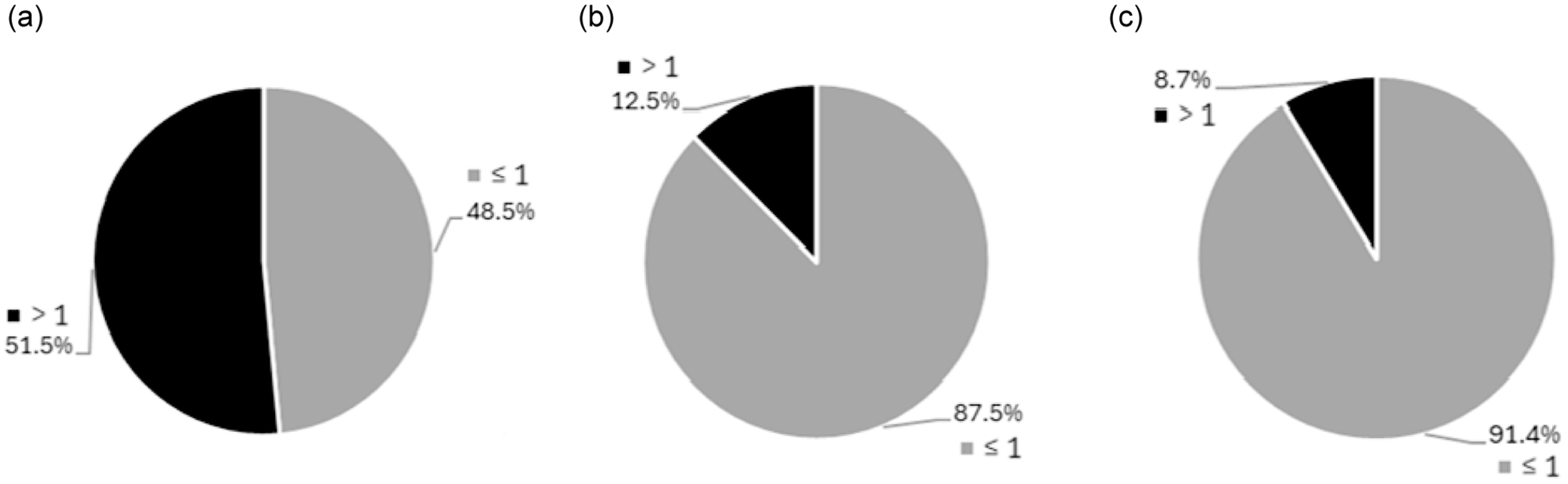
Almost half of the queens were bred for the first time at one year of age or younger. The majority were bred a maximum of once per year and produced a maximum of one litter per year (χ² GOF test; P < 0.001) (Figure 1). However, 26 queens out of 208 with available data were bred more than once per year and 18 had more than one litter during the same year.
Reproductive management of queens among Italian cat breeders who responded to the survey distributed to members of the Associazione Nazionale Felina Italiana (ANFI) showing (a) age of the queen at first breeding (≤ 1 year, >1 years), (b) mean number of times the queen is bred per year (≤ 1, > 1) and (c) mean number of litters produced per year (≤ 1, >1).

Figure 1. Long description
The figure consists of three panels arranged horizontally.
* Panel a: A pie chart divided into two nearly equal segments. The black segment on the left represents values greater than 1 at 51.5 percent. The gray segment on the right represents values less than or equal to 1 at 48.5 percent.
* Panel b: A pie chart where the gray segment is dominant, representing values less than or equal to 1 at 87.5 percent. A smaller black segment at the top left represents values greater than 1 at 12.5 percent.
* Panel c: A pie chart where the gray segment is even more dominant, representing values less than or equal to 1 at 91.4 percent. A small black segment at the top represents values greater than 1 at 8.7 percent.
The average number of oestrous cycles per year, as reported by breeders, was 5 (± 4.6), with large individual variability across queens, ranging from a minimum of 1 to a maximum of 35.
Welfare issues, including C-section, stillbirth, and dead at weaning, were recorded in 10.6, 23.6, and 18.6% of queens, respectively. Mean reproductive success was 83.3 (± 33.6)%, with the majority of queens achieving a 100% success rate. The summary descriptive statistics of the numerical and categorical variables related to queen details are reported in Tables S7 and S8, respectively (see Supplementary material). For the categorical variables, GOF tests; P-values are also reported (Table S7; Supplementary material).
Reproduction and welfare indicators
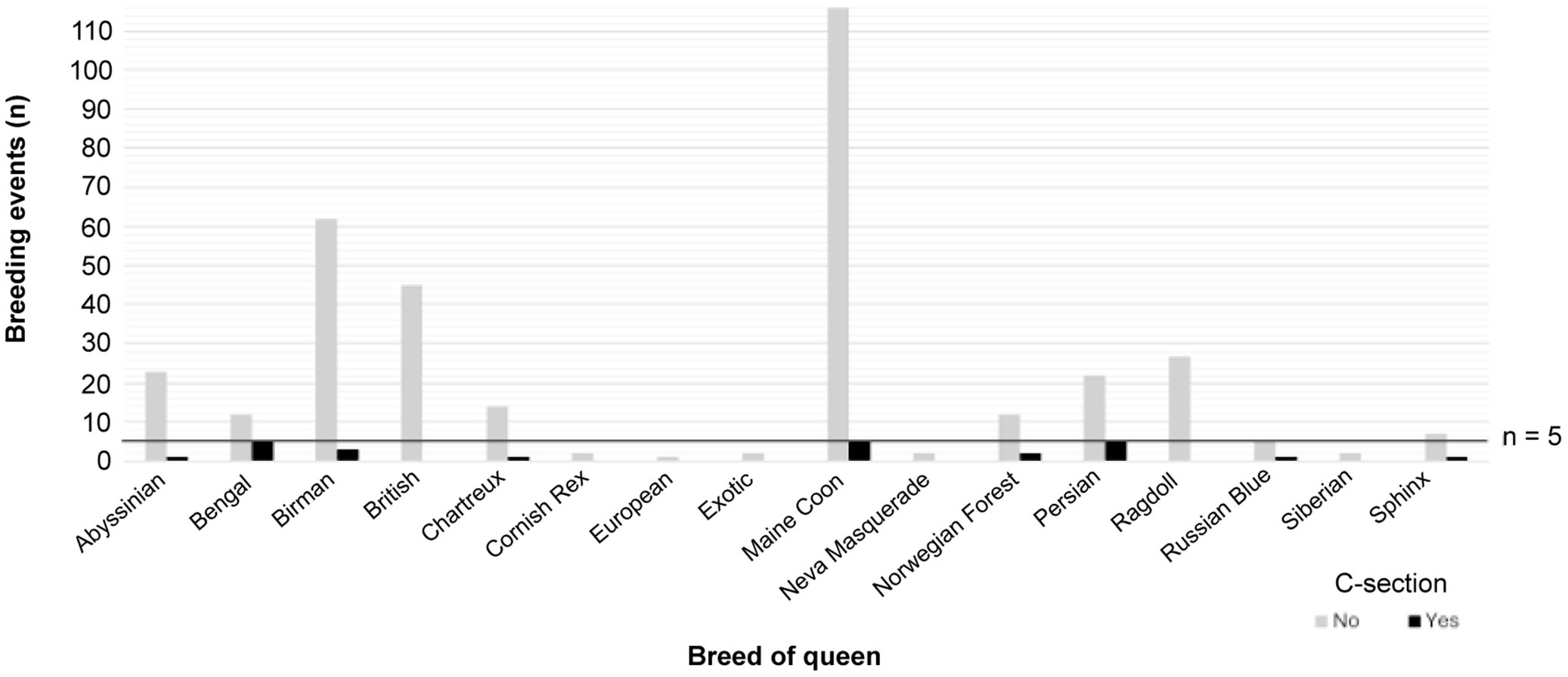
The average age at breeding was 2.7 (± 1.7) years. Pregnancy was achieved in 380 out of 442 breeding events for which breeders provided data, whereas in the remaining 62 cases the breeding did not result in pregnancy, and in 42 cases breeders did not provide an answer. The median number of kittens born per litter was 4 (range: 1–10), with a median of 4 kittens (range: 1–9) born alive, including a median of 2 (range: 0–7) males and 2 (range: 1–6) females, and 4 kittens (range: 1–9) alive at weaning. The mean stillbirth and mean pre-weaning mortality rates were 4.3 (range: 0–75%) and 3.5% (range: 0–75%), respectively. Among the breeds with sufficiently large sample sizes (≥ 10 queens), Bengal (10%), Persian (8.7%), and Maine Coon (5.7%) showed the highest observed mean stillbirth rates, whereas British (6.2%) showed the highest observed mean pre-weaning mortality rate (Table 2). The mean overall litter mortality rate (i.e. considering both stillborn kittens and those that died before weaning) was 7.5% (range: 0–75%), while the median value was 0%. Among the adequately represented breeds, Persian (11.9%), Bengal (10%), and Maine Coon (9.1%) showed the highest observed mean overall litter mortality rates, while Ragdoll (3%) and Chartreux (3.3%) showed the lowest (Table 2). C-sections happened in only 6.4% of breeding events that resulted in a pregnancy, with the highest observed counts occurring in Bengal, Persian, and Maine Coon (Figure 2). Pyometra and other uterine or ovarian diseases were reported in 2% of cases. The summarised descriptive statistics of the numerical and categorical variables related to individual breeding events details are reported in Tables S9 and S10, respectively (see Supplementary material). For the categorical variables, GOF tests; P-values are also reported (Table S9; Supplementary material).
Descriptive statistics of stillbirth rate, pre-weaning mortality rate, and overall litter mortality rate by breed for breeding events reported in the survey distributed to members of the Associazione Nazionale Felina Italiana (ANFI). For each level of the variable Queen breed original, the number of responses (n°) is provided. The overall rate is presented in bold in the last row, along with the total number of responses for each variable. The overall sample consisted of 484 breeding events

Table 2. Long description
The table presents descriptive statistics for three mortality outcomes recorded in cat breeding events reported in the survey: stillbirth rate, pre-weaning mortality rate, and overall litter mortality rate. Data are reported for each queen breed, including mean percentage rate, standard deviation, minimum–maximum range, and number of breeding events for which responses were provided. The final row reports overall values for the entire sample, consisting of 484 breeding events included in the survey.
SD = Standard Deviation; Min = Minimum; Max = Maximum.
NaN = data not available or not defined.
* Missing Values: Stillbirth rate (n = 135); Pre-weaning mortality rate (n = 151); Overall litter mortality rate (n = 135)
Occurrence of C-sections by breed per individual breeding event resulting in pregnancy reported in the survey distributed to members of the Associazione Nazionale Felina Italiana (ANFI). The horizontal reference line indicates the highest number of C-sections recorded for a single breed in the data-set.

Figure 2. Long description
The bar chart shows the occurrence of C-sections by queen breed for breeding events (matings) resulting in pregnancy reported in the survey. For each breed, light grey bars indicate breeding events that did not require a C-section, whereas black bars indicate breeding events resulting in a C-section. The number of breeding events varies among breeds, with Maine Coon being the most represented breed in the survey and showing the highest number of recorded breeding events. The horizontal reference line indicates the maximum number of C-sections recorded for a single breed in the data-set, which was five.
Associations between management, reproduction and welfare issues
Factors associated with stillbirth
In the univariable models, the presence of stillborn kittens was associated with the occurrence of C-section (OR: 2.01, CI: 1.35–13.04; P = 0.013) and the average size of the litter (OR: 1.39, CI: 1.12–1.72; P = 0.003). The full list of Wald test P-values for the predictive variables associated with the binary outcome variable Stillbirth is reported in Table S11 (see Supplementary material).
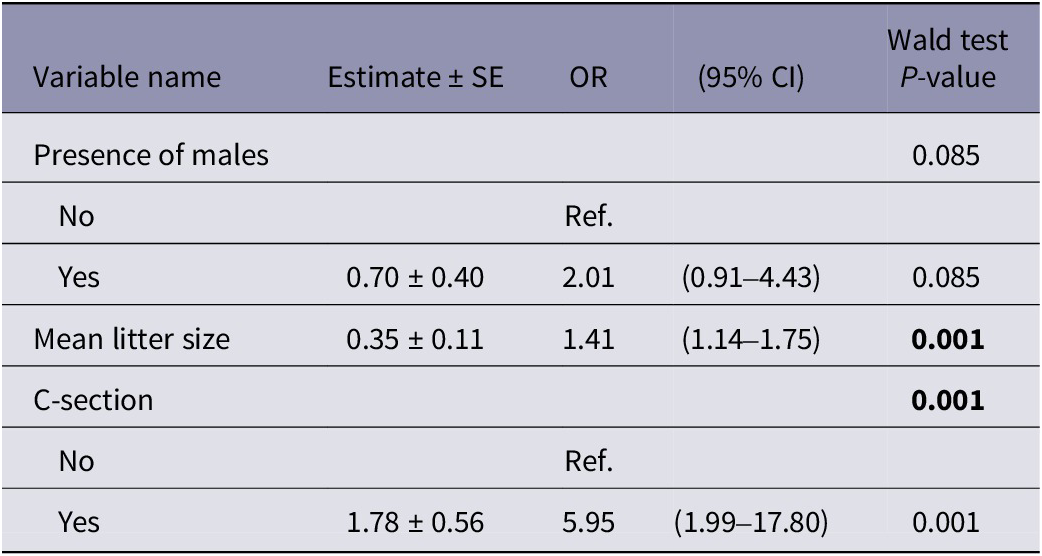
The predictor variables retained in the final multivariable regression model for the presence of stillborn kittens (model P-value < 0.001, AIC = 181.78) were Presence of males (P = 0.085), Mean litter size (P = 0.001), and C-section (P = 0.001) (Table 3). Specifically, queens with larger litters that co-housed with at least one male and underwent a C-section were more likely to have stillborn kittens.
Multivariable logistic mixed-effects model for the binary outcome variable Stillbirth. Data are presented as estimate ± standard error (SE), odds ratio (OR), confidence interval (CI), and Wald test P-values

Table 3. Long description
The table presents the results of a multivariable logistic mixed-effects model analysing the variable Stillbirth as a binary outcome. Predictors include presence of males, mean litter size, and C-section occurrence. For each variable, estimates with standard errors, odds ratios, 95% confidence intervals, and Wald test P-values are reported. Presence of males and C-section are categorical variables with ’No’ as the reference category. Significant predictors are indicated by P-values ≤ 0.05 and highlighted in bold. The model shows that higher mean litter size and occurrence of C-section were associated with increased odds of stillbirth.
P-values in bold refer to the statistical significance (P ≤ 0.05) of the predictive variables in the model; the significance of a category against the reference is reported in regular font.
Ref = reference category.
Factors associated with dead at weaning
No significant association was found between the binary outcome variable Dead at weaning and the investigated factors (Table S12; Supplementary material).
Factors associated with C-section
The full list of Wald test P-values for the predictive variables associated with the binary outcome variable C-section is reported in Table S13 (see Supplementary material).
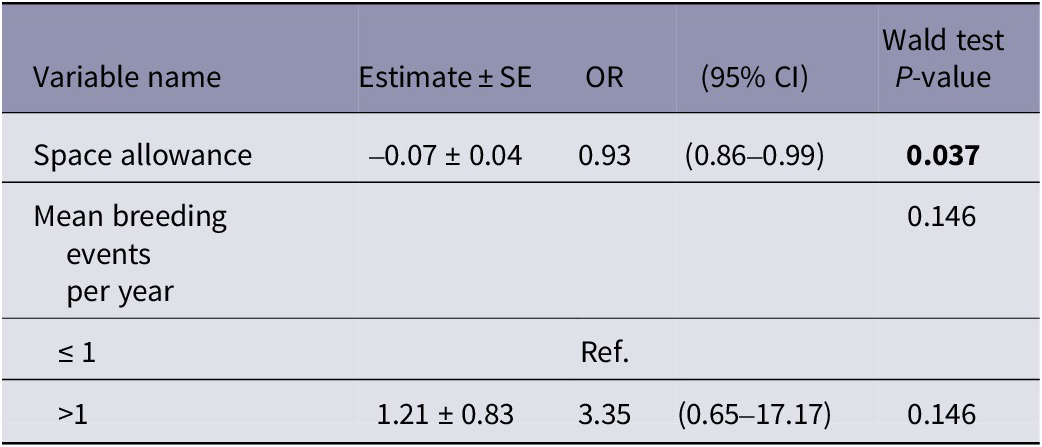
In the final multivariable regression model, only Space allowance and Mean breeding events per year were retained (model P-value = 0.083, AIC = 121.68). Specifically, queens kept in smaller spaces and bred more than once per year were more likely to undergo a C-section (Table 4).
Multivariable logistic mixed-effects model for the binary outcome variable C-section. Data are presented as estimate ± standard error (SE), odds ratio (OR), confidence interval (CI), and Wald test P-values.

Table 4. Long description
The table presents the results of a multivariable logistic mixed-effects model analysing the variable C-section occurrence as a binary outcome. Predictors include space allowance and mean breeding events per year. For each predictor, estimates with standard errors, odds ratios, 95% confidence intervals, and Wald test P-values are reported. Mean breeding events per year is a categorical variable with ’≤1 event’ as the reference category. A significant association was observed for space allowance (P ≤ 0.05, highlighted in bold), whereas mean breeding events per year was not statistically significant associated with the outcome.
P-values in bold refer to the statistical significance (P ≤ 0.05) of the predictive variables in the model; the significance of a category against the reference is reported in regular font.
Ref = reference category.
Factors associated with queens’ reproductive success
In the univariable models, no significant associations were found for queens’ reproductive success (Table S14; Supplementary material).
Discussion
Our data provide, for the first time, detailed information on management, reproduction and welfare issues among Italian purebred cat breeders. We investigated potential associations between housing and reproductive practices and key welfare issues — such as stillbirth, dead at weaning, and C-sections — as well as queens’ overall reproductive success, as reproductive outcomes are often considered indirect proxies of maternal and neonatal welfare in breeding animals (Broom Reference Broom1991). Previous international studies have described cats’ welfare issues in breeding-related settings in various countries (Povey Reference Povey1978; Sparkes et al. Reference Sparkes, Rogers, Henley, Gunn-Moore, May, Gruffydd-Jones and Bessant2006; Ström Holst & Frössling Reference Ström Holst and Frössling2009; Fournier et al. Reference Fournier, Masson, Corbiere, Mila, Mariani, Grellet and Chastant‐Maillard2017; Schaper et al. Reference Schaper, Packeiser and Goericke-Pesch2025). A most recent study documented breeding management and contraception methods used by cat breeders internationally (Schaper et al. Reference Schaper, Packeiser and Goericke-Pesch2025), but no data from Italy were included. Therefore, our study fills a gap by providing the first comprehensive data from Italy, complementing international findings on breeding management, reproduction, and welfare issues. These results are relevant for upcoming European welfare regulation (Council of the European Union 2024), as requested in the EFSA 2023 report (Candiani et al. Reference Candiani, Drewe, Forkman, Herskin, Van Soom, Aboagye, Ashe, Mountricha and Van der Stede2023).
According to our data, the majority of Italian cat breeders are amateurs, with only 3.1% breeding for financial gain. This finding is in line with a study on litter-management practices conducted among Italian cat owners, in which 91.8% of respondents were amateurs (Tateo et al. Reference Tateo, Ricci-Bonot, Felici, Zappaterra, Nanni Costa, Houpt and Padalino2023). Respondents to our survey typically focus on a single breed, with the Maine Coon being the most represented. This preference for single-breed catteries is consistent with the ANFI records, the preliminary findings reported by Romagnoli et al. (Reference Romagnoli, Bensaia, Ferré-Dolcet, Sontas and Stelletta2019) and with broader international trends (Ström Holst & Frössling Reference Ström Holst and Frössling2009; Schaper et al. Reference Schaper, Packeiser and Goericke-Pesch2025). Interestingly, Maine Coon was the second most kept breed also internationally (Schaper et al. Reference Schaper, Packeiser and Goericke-Pesch2025). Italian cat breeders reported to keep an average of 8.1 adult cats per cattery, similarly to Swedish cat breeders (mean = 6.1 [± 3.4]) (Ström Holst & Frössling Reference Ström Holst and Frössling2009). However, it is worth highlighting that many breeders (130 out of 512) chose not to answer the questions on cattery composition, and an even larger number (n = 304) abandoned the survey when asked to report the number of breeding queens, even if those questions were at the beginning of the survey. This could explain the reason why, in our survey, the average number of breeding queens (3.2 [± 2.4]) was lower than previously observed at the national level (4.8 [± 2.3]) (Romagnoli et al. Reference Romagnoli, Bensaia, Ferré-Dolcet, Sontas and Stelletta2019). However, the lower number of breeding queens per cattery could also be due to increased regulation of catteries in recent years in Italy (Gazzetta ufficiale della Repubblica Italiana 2022), which may have reduced the average size, bringing it more in line with recent international data (Schaper et al. Reference Schaper, Packeiser and Goericke-Pesch2025). Furthermore, a possible concern that may have influenced the declaration of the actual number of queens could be related to upcoming European regulations (Council of the European Union 2024), which would require establishments exceeding certain thresholds of queens to be authorised after an on-site inspection by competent authorities. Overall, our results suggest that cat breeding in Italy is predominantly pursued as a hobby (i.e. the income from the sales of the kitten does not create a real profit): breeders usually operate small- to medium-sized catteries and allow approximately one litter per queen per year, mostly through natural mating with internal tomcats. Nevertheless, despite their amateur status, most respondents appeared to manage organised catteries rather than strictly home-based breeding and had more than three years of breeding experience, consistent with patterns reported among international cat breeders (Ström Holst & Frössling Reference Ström Holst and Frössling2009; Schaper et al. Reference Schaper, Packeiser and Goericke-Pesch2025).
Most Italian breeders kept their cats exclusively indoors (71.9%), confirming that indoor housing is the most widely adopted practice in cat breeding (Povey Reference Povey1978; Ström Holst & Frössling Reference Ström Holst and Frössling2009; Romagnoli et al. Reference Romagnoli, Bensaia, Ferré-Dolcet, Sontas and Stelletta2019; Schaper et al. Reference Schaper, Packeiser and Goericke-Pesch2025). This is particularly common for queens (Foreman-Worsley et al. Reference Foreman-Worsley, Finka, Ward and Farnworth2021), as confinement may help prevent undesirable outcomes, such as unwanted pregnancies (Tan et al. Reference Tan, Jajou, Stellato and Niel2021). When respondents to our survey reported that cats were provided with outdoor access, the area was almost always fully fenced, thereby helping to mitigate the aforementioned risks. Although an empirically validated minimum space requirement has not yet been established, current Responsible Cat Breeding Guidelines recommend enclosures of at least 200 cm in height and a floor area of no less than 4.0 m² (EU Platform on Animal Welfare 2020). Supporting this, Loberg and Lundmark (Reference Loberg and Lundmark2016) found that cats housed in larger enclosures exhibited more play behaviour and higher activity levels, suggesting that providing this minimum space may positively influence their welfare. In our survey, space allowance was generally adequate for both indoor-only cats and those with outdoor access, with only a few breeders providing less than 4 m² per cat (minimum recorded = 2.9 m²) or enclosures below the recommended height (minimum reported for boxes/pens = 175 cm). Only a few breeders (4.2%) kept their queens exclusively confined in boxes or pens, including multi-tier cages, which are considered detrimental to welfare and may be banned in the future (Candiani et al. Reference Candiani, Drewe, Forkman, Herskin, Van Soom, Aboagye, Ashe, Mountricha and Van der Stede2023). Some responses regarding enclosure dimensions as well as the average space allowance, occasionally lacked accuracy, highlighting the need for prospective studies on how cats are housed in Italy.
Natural lighting was provided in almost all catteries. In the few cases where artificial lighting was used (12.6%), cats generally received at least 8 h of light per day (33.9%), and in most cases up to 10–12 h (48.4%), in accordance with EFSA recommendations (Candiani et al. Reference Candiani, Drewe, Forkman, Herskin, Van Soom, Aboagye, Ashe, Mountricha and Van der Stede2023). Regarding feeding, commercial diets were confirmed to be the most popular choice (Povey Reference Povey1978), however, it is interesting to note that a small proportion of cat breeders are shifting to other feeding regimes, such as BARF. It is worth highlighting that scientific guidelines recommend that any homemade or raw diet should be carefully formulated to ensure nutritional adequacy — based on breed, activity level, age, and health or physiological condition — and minimise contamination risk, such as bacterial, parasitic, and viral contamination (EU Platform on Animal Welfare 2020; Główny et al. Reference Główny, Sowińska, Cieślak, Gogulski, Konieczny and Szumacher-Strabel2024). Constant access to fresh, clean water should also be provided (EU Platform on Animal Welfare 2020). Unfortunately, no specific questions were asked regarding water access and environmental data. These are all important factors that could have influenced the welfare issues investigated (Goericke-Pesch & Packeiser Reference Goericke-Pesch and Packeiser2022) and warrant further study. Vaccination, antiparasitic treatment, and health checks, including genetic tests for breed-specific diseases, were almost always performed regularly, in accordance with the requirements for genetic testing for hereditary disease requested by ANFI for specific breeds and with other European recommendations (EU Platform on Animal Welfare 2020). This aligns Italian practices with those reported in other countries (Ström Holst & Frössling Reference Ström Holst and Frössling2009; Howell et al. Reference Howell, Mornement and Bennett2016). Overall, apart from a few cases, the majority of Italian cats appear to be managed in line with the recent welfare recommendations published by the DG Sante Platform (EU Platform on Animal Welfare 2020). However, this finding should be interpreted with caution, as breeders who are not in line with welfare recommendations may have been less likely to complete the survey. Therefore, the results may reflect a higher response rate from more motivated and welfare-oriented breeders, potentially introducing a selection bias.
Queens were generally kept freely in small groups, with isolation during parturition being the most common practice. Responsible Cat Breeding Guidelines recommend providing a safe, dedicated area 10–14 days before parturition and limiting access to other animals during the first two weeks of the kittens’ lives to ensure environmental stability, continuous maternal contact, and protection from stressors (EU Platform on Animal Welfare 2020; Veronesi & Fusi Reference Veronesi and Fusi2022). Isolation also facilitates close monitoring of maternal behaviour during parturition and the first 48 h postpartum, which is crucial, especially for primiparous queens, to promptly detect abnormalities and support kitten survival (Veronesi et al. Reference Veronesi, Castagnetti and Taverne2012). However, the unbalanced distribution of our data (only 26 breeders did not isolate queens out of 443 respondents) precluded testing the effect of nursery presence on the welfare outcomes, particularly pre-weaning mortality. The majority of breeders reported not using contraceptive methods on their queens, consistent with international statistics (Schaper et al. Reference Schaper, Packeiser and Goericke-Pesch2025), although many breeders did not answer this question. Cases of queens bred more than once per year were rare but present (12.5%), including occasional multiple litters within a single year. Most breeding events occurred when queens were older than one; however, about half of the queens were bred for the first time at or before one year of age. It is important to note that our survey did not directly ask for the age at first breeding, so the age in months could not be analysed, and this should be considered as a limitation.
The mean overall litter mortality rate observed in the present study was 7.5%, approximately half of that reported in a survey-based study conducted in France across 45 different breeds (15.7%) (Fournier et al. Reference Fournier, Masson, Corbiere, Mila, Mariani, Grellet and Chastant‐Maillard2017), which itself was already among the lowest values reported in the literature (Povey Reference Povey1978; Sparkes et al. Reference Sparkes, Rogers, Henley, Gunn-Moore, May, Gruffydd-Jones and Bessant2006; Ström Holst & Frössling Reference Ström Holst and Frössling2009). It is important to note that the French study was an epidemiological analysis over a four-year period, based on a substantial data-set (5,303 queens), whereas our data were self-reported and breeders could voluntarily choose which queens or breeding events to include, introducing potential selection bias. Both the stillbirth rate (4.3%) and pre-weaning mortality rate (3.5%) observed here were among the lowest values reported to date. Pre-weaning mortality has previously been reported between as 8 and 14% (Ström Holst & Frössling Reference Ström Holst and Frössling2009; Fournier et al. Reference Fournier, Masson, Corbiere, Mila, Mariani, Grellet and Chastant‐Maillard2017; Romagnoli et al. Reference Romagnoli, Bensaia, Ferré-Dolcet, Sontas and Stelletta2019), substantially higher than in our study. The stillbirth rate was similar to that reported in the UK (5.9%) (Jemmett & Evans Reference Jemmett and Evans1977), but lower than in France (8.5%) (Fournier et al. Reference Fournier, Masson, Corbiere, Mila, Mariani, Grellet and Chastant‐Maillard2017), Sweden (9.7%) (Ström Holst & Frössling Reference Ström Holst and Frössling2009), and a previous Italian study by Romagnoli et al. (Reference Romagnoli, Bensaia, Ferré-Dolcet, Sontas and Stelletta2019) (11.8%). However, the latter study included breeds predisposed to higher stillbirth rates, such as the Persian cat (Johnstone Reference Johnstone1987). Although breed was not retained as a significant factor in any of the statistical models — likely due to the unbalanced sample with a predominance of Maine Coon breeders — our data were consistent with previous findings. Persian, Bengal, and Maine Coon showed the highest observed mortality rates (Fournier et al. Reference Fournier, Masson, Corbiere, Mila, Mariani, Grellet and Chastant‐Maillard2017; Romagnoli et al. Reference Romagnoli, Bensaia, Ferré-Dolcet, Sontas and Stelletta2019).
The factors associated with an increased risk of stillbirth in the final multivariable model included the occurrence of C-section, the presence of a male in the group of females, and the litter size. More specifically, larger litters were linked to a higher likelihood of stillbirth, confirming findings reported in previous studies (Sparkes et al. Reference Sparkes, Rogers, Henley, Gunn-Moore, May, Gruffydd-Jones and Bessant2006; Romagnoli et al. Reference Romagnoli, Bensaia, Ferré-Dolcet, Sontas and Stelletta2019). This association is likely related to the higher incidence of intrauterine crowding, which can result in impaired placental function, foetal hypoxia, foetal intrauterine growth restriction (Chaiyapatmaetee et al. Reference Chaiyapatmaetee, Saenghinghoy, Charuchinda, Wichathippayananon, Ruampatana, Adi, Taechamaeteekul and Tummaruk2025), or complications during parturition (Cornelius et al. Reference Cornelius, Moxon, Russenberger, Havlena and Cheong2019). Moreover, large litters are often associated with shorter gestation lengths (Musters et al. Reference Musters, De Gier, Kooistra and Okkens2011) — particularly in large-sized breeds such as the Maine Coon (Socha et al. Reference Socha, Lengling, Bonecka and Janowski2019) and Norwegian Forest Cat (Romagnoli et al. Reference Romagnoli, Bensaia, Ferré-Dolcet, Sontas and Stelletta2019) — which may further compromise foetal growth, development, and maturation (Veronesi & Fusi Reference Veronesi and Fusi2022). Therefore, it is recommended to identify litter size using an early ultrasound pregnancy check (Zambelli & Prati Reference Zambelli and Prati2006), and queens with larger litters should be closely monitored throughout pregnancy and parturition. Cohabitation of males with the group of females should also be monitored, as it was identified as a factor which may increase the risk of stillbirths. This could be due to several reasons. Keeping one or more tomcats with the queen during gestation has been shown to lead to multiple mating attempts, including by different males (Kustritz Reference Kustritz2006), potentially resulting in larger litters (Harman Reference Harman1917). Another possible explanation is that male proximity may induce maternal stress — as observed in other species (Garratt et al. Reference Garratt, Kee, Palme and Brooks2016) — which, in turn, can increase the likelihood of abortion or stillbirths (Lamm & Njaa Reference Lamm and Njaa2012). An additional concern may also be related to an increased risk of infanticide by the tomcat immediately after birth, which may occur unnoticed (Pontier & Natoli Reference Pontier and Natoli1999). However, this has not been directly assessed in our study, and it deserves further investigation. Finally, queens that underwent a C-section showed a substantially greater likelihood of stillbirth compared with those delivering naturally, confirming previous findings (Ström Holst & Frössling Reference Ström Holst and Frössling2009; Romagnoli et al. Reference Romagnoli, Bensaia, Ferré-Dolcet, Sontas and Stelletta2019). We may therefore hypothesise that the association we found could be related to the underlying reasons that made the procedure necessary. In the literature, it has been reported that C-sections are often performed in response to complications during parturition (Ekstrand & Linde‐Forsberg Reference Ekstrand and Linde‐Forsberg1994), including the presence of stillbirth (Axnér et al. Reference Axnér, Jakobsson, Vermelin and Hermansson2025). It is important to note that we did not know the reason why the queens underwent a C-section, nor the foetuses’ vitality at the time of surgery, and this is a survey-based study, so epidemiological studies are needed to confirm this finding. Fortunately, C-sections were rarely performed among the Italian breeders who responded to the survey, occurring in 6.4% of pregnancies, within the range reported for UK breeders in previous studies (5.8–8%) (Gunn-Moore & Thrusfield Reference Gunn-Moore and Thrusfield1995; Sparkes et al. Reference Sparkes, Rogers, Henley, Gunn-Moore, May, Gruffydd-Jones and Bessant2006). It is not surprising that this procedure was more commonly reported in brachycephalic breeds, such as Persian, and in giant breeds, such as Maine Coon, given their well-recognised predispositions to parturition-related problems (Ekstrand & Linde‐Forsberg Reference Ekstrand and Linde‐Forsberg1994; Gunn-Moore & Thrusfield Reference Gunn-Moore and Thrusfield1995; Romagnoli et al. Reference Romagnoli, Bensaia, Ferré-Dolcet, Sontas and Stelletta2019). In our study, there was a negative association between C-section and space allowance. One possible explanation could be that cats with limited space are at higher risk of low locomotory activities, which can lead to obesity, which in turn increases the likelihood of dystocia, a condition often necessitating a C-section (Zoran Reference Zoran2010). Overall, this finding may be useful to support the importance of adequate space to promote better welfare and reproductive health; however, further research on the effect of space availability on reproductive outcomes is still needed to confirm or update existing recommendations.
No significant factors associated with pre-weaning mortality (i.e. dead at weaning) were identified. However, it should be noted that, as this was a survey-based study, several biologically relevant management-related factors potentially influencing pre-weaning mortality — such as feeding and environmental characteristics (Veronesi & Fusi Reference Veronesi and Fusi2022) — as well as well-known infectious related risk factors (Dolan et al. Reference Dolan, Doyle, Tran and Slater2021), were not evaluated. Further studies investigating how to improve the kitten survival rate and the overall welfare of Italian pedigree cats are therefore recommended.
Queens being bred after one year of age tended to have higher reproductive success (i.e. lower probability of pregnancy failure) compared with those bred younger. It should be noted that, in line with the aim of exploring a potential threshold relevant to the upcoming EU regulation, only year-level information (i.e. year of birth and year of the first breeding event) were available in the data-set; therefore, the exact age in months could not be determined. Although official laws regulating the age at first breeding are still lacking (Candiani et al. Reference Candiani, Drewe, Forkman, Herskin, Van Soom, Aboagye, Ashe, Mountricha and Van der Stede2023), literature suggests the first litter should occur after 12 months (Candiani et al. Reference Candiani, Drewe, Forkman, Herskin, Van Soom, Aboagye, Ashe, Mountricha and Van der Stede2023). Breeding before one year of age may compromise queen health, welfare, and reproductive performance, as well as kitten safety (Ström Holst & Frössling Reference Ström Holst and Frössling2009; Johnson Reference Johnson2022); so, waiting until an older age may be even more beneficial (EU Platform on Animal Welfare 2020). However, since the onset of puberty in queens varies among different breeds (Povey Reference Povey1978; Romagnoli et al. Reference Romagnoli, Bensaia, Ferré-Dolcet, Sontas and Stelletta2019), rather than recommending a fixed age threshold, in the literature it has been suggested to use X-rays and other veterinary procedures (e.g. ultrasounds, clinical evaluation) to assess skeletal maturity and reproductive development (e.g. ovarian, follicular, and oocyte development) case-by-case (Miranda et al. Reference Miranda, Souza, Viegas, Megda, Nepomuceno, Tôrres and Rezende2020; Candiani et al. Reference Candiani, Drewe, Forkman, Herskin, Van Soom, Aboagye, Ashe, Mountricha and Van der Stede2023). In light of this consideration, appropriate reproduction management should be implemented, including the use of contraceptives to delay breeding. However, contraceptive use was infrequently reported in our data-set, as well as internationally (Schaper et al. Reference Schaper, Packeiser and Goericke-Pesch2025); therefore, further studies are needed to evaluate both their common use in breeding catteries and their effect on queens’ welfare.
Study limitations
Our data should be interpreted with caution, given the intrinsic limitations of a survey-based study (Dean Reference Dean2015), and the type of statistical analyses performed, as associations should never be interpreted as causations. Beyond the previously mentioned limitations, the first constraint concerns the use of self-reported data, which may have introduced bias in the reported welfare issues, potentially leading to underestimation. Additionally, our survey included only members of ANFI, meaning that data were collected exclusively on pedigree cats managed by this breeding association and may not be representative of all Italian breeders. Moreover, the sample was highly unbalanced, with Maine Coons being overrepresented. All these factors could have influenced the results and prevented the identification of significant associations between breed and the welfare issues investigated which are, instead, well documented in the literature (Sparkes et al. Reference Sparkes, Rogers, Henley, Gunn-Moore, May, Gruffydd-Jones and Bessant2006; Ström Holst & Frössling Reference Ström Holst and Frössling2009; Romagnoli et al. Reference Romagnoli, Bensaia, Ferré-Dolcet, Sontas and Stelletta2019). Another limitation concerns the presence of potentially ambiguous questions, or questions that were misinterpreted by respondents, or possible missing questions (e.g. exact age in months at the first breeding, hygiene practices), requiring minor data adjustments where possible, or even the exclusion of some responses or the absence of important data. Despite these limitations, this study provides the first comprehensive information on management, reproduction and welfare issues in Italian cat breeding establishments. Furthermore, in the context of current efforts toward EU-wide legislation, our findings can support evidence-based recommendations for enhancing best practices and welfare standards.
Animal welfare implications
Key management factors — such as adequate space allowance, age at first mating, and breeding frequency — can strongly affect queen and kitten welfare, as well as reproductive performance (Ström Holst & Frössling Reference Ström Holst and Frössling2009; Loberg & Lundmark Reference Loberg and Lundmark2016; Nowak et al. Reference Nowak, Mucha, Moska and Kruszyński2020; Goericke-Pesch & Packeiser Reference Goericke-Pesch and Packeiser2022; Candiani et al. Reference Candiani, Drewe, Forkman, Herskin, Van Soom, Aboagye, Ashe, Mountricha and Van der Stede2023). Even with several limitations, our analysis highlights management practices associated with common welfare issues, which can be translated into evidence-based recommendations useful for informing welfare policy changes, especially with regard to the upcoming EU-legislation (Council of the European Union 2024). Additionally, we confirmed that kittens from larger litters are at higher risk of experiencing welfare problems. Therefore, closely monitoring these situations could help prevent unwanted outcomes.
Conclusions and recommendations
Our findings demonstrate that Italian purebred cat breeders affiliated with ANFI, despite being predominantly amateur breeders, are experienced and generally comply with recommended animal welfare guidelines. Mortality rates and the occurrence of welfare issues were low, which could also reflect a growing interest in animal welfare and greater adherence to good practices.
Adequate space allowance should be provided to cats, as it was found to have a positive association with better welfare outcomes. The age of first mating should not be anticipated before one year of age, and our data, plus literature, suggest that waiting beyond one year may even be preferable and contraceptive use may represent a useful tool to support appropriate reproductive management; however, further studies are needed to assess their effects on cat welfare. Finally, based on our results, we recommend assessing litter size via early pregnancy ultrasound and closely monitoring pregnancies involving large litters, especially in brachycephalic and giant cat breeds. Further targeted research, including standardised assessments of breeding queens and tomcats, is required to confirm our survey-based findings and to refine both our suggestions and current recommendations, to enhance the welfare of cats in breeding establishments.
Supplementary material
The supplementary material for this article can be found at http://doi.org/10.1017/awf.2026.10105.
Data statement
Data are available upon request to BP.
Acknowledgements
The authors would like to thank ANFI and the people who helped in sharing the survey, and all respondents who took their time to fill in the survey. No funding was received to perform this study.
Competing interests
None.




 Open access

