INTRODUCTION
Analysis of the substantive representation of women (SRW) has become a significant part of gender and politics scholarship over the last decade; numerous empirical studies have sought to identify when representatives “act for” women. Such research reveals that higher percentages of women present in elected institutions are no guarantee that political representatives will act for women (Childs and Krook Reference Childs and Krook2006). More recent empirical studies demonstrate a particular concern with discovering what constitutes the content of the SRW, eschewing a priori assumptions about women's interests (Celis Reference Celis2006; Celis et al. Reference Celis, Childs, Kantola and Krook2008). At the same time in political theory, Michael Saward (Reference Saward2006) has begun to talk about representative “claims making” and Judith Squires (Reference Squires2008) has developed the concept of the constitutive representation of gender (CRG).
This article applies these new approaches to the study of women's representation in the parliamentary setting—the first time this has been undertaken. The case study identifies how a particular actor, in this instance the UK Conservative Party, constructs notions of femininity and gender relations (the CRG) and seeks to act for women (the SRW). To this end, the research design set out to capture the content of women's concerns and interests, existing relations between the sexes, and depictions of what gender relations should be, as articulated in the Conservatives' general election manifestos over a period of more than a decade. Interrogating representative claims made about, and policy pledges for, women not only enables a better understanding of the SRW—because it does not presume in advance what constitutes women's substantive representation—but also permits exploration of the relationship between the SRW and the CRG. The congruency or otherwise between these two dimensions of representation is revealed through comparison: do, for example, “actions for women” map onto claims made about women's interests, concerns, or needs?
Discussion of recent developments in the gender and politics literature opens the article, followed by a consideration of the data and methods. The case study itself offers a close reading of four general election manifestos (1992–2005). Analysis of the CRG reveals that it is women, more than men, who are constituted as a constituency warranting substantive representation. However, it also finds that “women” have disappeared from the text of the more recent manifestos—replaced by “families” and “parents”, Bifurcated gender roles are dominant, especially in pictorial representations in the manifestos: women, whether in the private or public sphere, act out private roles, especially caring ones, whereas men are represented as inhabiting the public sphere. Over time, differences are also observable, with an apparent shift away from representations of women in the public sphere—and a commitment to women's participation therein—toward conceptions of the family as a private institution, within which undifferentiated couples make choices. Analysis of the party's policy pledges for women also suggests a changing conception of the SRW: many policy proposals and commitments advanced in the 1990s manifestos are absent from later ones.
RECENT RECONSIDERATIONS ON REPRESENTATION
The focus on women's descriptive and substantive representation—that is, counting and accounting for the numbers of women in political institutions and exploring whether, and under what conditions, representatives “act for” women—has dominated gender and politics scholarship for more than a decade. Individual case studies, as well as comparative and large-n studies, reveal not only that women remain underrepresented in almost all lower Houses across the globe, but also that there is no one condition or factor that is sufficient for either form of representation (see for example, Kittilson Reference Kittilson2006; Norris and Lovenduski Reference Norris and Lovenduski1995). Even the presence of proportional representation or sex quotas cannot guarantee parity of descriptive representation (Krook Reference Krook2009). In any case, higher numbers of women representatives do not deliver, in any straightforward fashion, women's substantive representation (Childs Reference Childs2006). Some studies do find that the greater presence of women in legislatures can lead to changes in discourses, proposals, debates, and outcomes, but others uncover little or no difference (Childs and Krook Reference Childs and Krook2009).
“Critical mass theory” is sometimes employed to explain away the contradictory findings of empirical studies—the argument being that there are simply too few women present as yet to deliver women's substantive representation (Childs and Krook Reference Childs and Krook2006). But critical scholars identify additional concerns, inter alia: 1) legislatures are only one of the many possible sites for the substantive representation of women (Weldon Reference Weldon2002); 2) that even when examining the SRW in legislative settings, mediating factors, for example, party affiliation, newness, institutional norms, and the external political environment, have an impact on representatives' behavior;Footnote 1 and 3) that empirical studies have employed a variety of research methods and designs, and adopted different measures as evidence for the SRW—the “what” or “content” of women's substantive representation—thereby, limiting comparability.
In conceiving of the content of women's substantive representation scholars, variously use the terms women's interests, needs, concerns, and perspectives, sometimes interchangeably. Helpfully mapping the conceptual debates, Karen Celis (Reference Celis2005, Reference Celis2008) notes that these can reflect the “private distribution of labor,” for example, women's roles in giving birth and caring for children (Sapiro Reference Sapiro and Phillips1998); emphasize the role of the gendered division of productive labor (Diamond and Hartsock Reference Diamond, Hartsock and Phillips1998); or refer to perspectives that derive from women's structural position in society (Lovenduski Reference Lovenduski2005; Phillips Reference Phillips1995; Young Reference Young2000). In the applied gender and politics literature, two main approaches are evident (Celis Reference Celis2005, Reference Celis2008). In the first, women's interests are subjectively defined by the researcher as either those traditionally associated with women (such as child care and the family), or those with a “feminist accent” (such as abortion or domestic violence). This approach, however, suffers from a tendency to essentialize women, which sits uncomfortably with feminist concerns with women's heterogeneity and intersectionality. The second approach looks to the demands of the contemporaneous women's movement to identify women's interests. This not only privileges women's movement demands but also presumes that they have space to articulate their demands. For these reasons, Celis (Reference Celis2008) argues that gender and politics scholars should admit that women's concerns are a priori undefined, context related, and subject to evolution. As such, they are to be discovered as part of the empirical research project, rather than regarded as something “out there at the start” that can simply be ticked off against particular representatives' actions.
At the same time as these more empirically based critiques are evident in the SRW literature, political theorists have begun to speak about representation as claims making. Saward's notion of representational claims starts from a concern with Hanna Pitkin's conception of the represented as “fixed”, “transparent”, “given”, and “knowable”: those whose interests can be “read off” by the representative (Saward Reference Saward2006, 301, 310). For Saward, the represented—“or that which needs to be represented”—is constructed, constituted, framed, and created by representatives. He writes that “at the heart of the act of representing is the depicting of a constituency as this or that, as requiring this or that, or having this or that set of interests” (pp. 301, 310; emphasis in the original).Footnote 2
The language of representative claims foregrounds then, the performative aspect of representation and reveals how representatives make claims to know what constitutes the interests of “someone or something”—here women (Saward Reference Saward2006, 302, 305). In line with the more recent SRW literature, representatives are, importantly, not just elected representatives. Representative claims are, in themselves, neither good nor bad. Rather, successful representatives are those whose claims are not contested, although in an “economy of claims,” all claims can be contested (Saward Reference Saward2006, 304).
Developing these ideas, Squires advances the concept of the constitutive representation of gender. This refers to the process whereby representatives articulate women's interest “in ways that inevitably privilege” and constitute “particular concepts of gender relations.” Squires contrasts the CRG with traditional conceptions of the SRW, which she refers to as the process by which representatives aim to speak for women by voicing women's “preferences and consciously held interest” (Squires Reference Squires2008, 187–88). In other words:
Explorations of the SRW have … traced a bottom-up representative process, starting with women and their interests (though not necessarily in an essentialist way), and seeking to establish the extent to which these interests are articulated and reflected by representatives. Explorations of the CRG would, by contrast, entail explorations of more top-down representative processes, starting with claims-making of representatives, seeking to establish the ways in which identities are narrated by representative claims. (Squires Reference Squires2008, 190)Footnote 3
Analysis of the CRG reveals, then, the “extent to which, when claiming to speak for women, representatives are actively engaged in making claims about women, participating in the construction of feminine subject-positions” (Squires Reference Squires2008, 192). In this way, studying the CRG offers new insights in respect of “understanding the process of political claims making” and in raising questions about the “nature of power relations” that shape them (p. 200). Both the SRW and the CRG are understood by Squires as archetypes, albeit likely intertwined in practice. For this reason, she considers the CRG to complement, rather than replace, the SRW.Footnote 4
Applying these new conceptions of the SRW and the CRG in this exploratory empirical case study involves 1) examining “the claims-making of representatives” in order to establish the construction of feminine identities (Squires Reference Squires2008, 188–89) and 2) examining how the representatives seek to “act for” women—what policy commitments they make “for women.” Analysis of the former is undertaken by exploring the construction of “feminine” and “masculine” identities and the nature of gender relations in the images and discourses of the Conservative Party's manifestos (1992–2005). To examine the latter the surrogate measure is manifesto policy pledges (defined below). Research questions asked of representative claims and pledges include: what is the nature of the interests claimed to be “women's” and “men's”? How is “what it means to be a woman and a man” constituted? What is the acclaimed nature of the relations between women and men? Are these premised upon notions of sex and gender sameness or difference? Are they cooperative or conflictual, and/or hierarchical or egalitarian?
Given both the analytic distinction drawn between the CRG and the SRW and Squires's (Reference Squires2008) assumption that they are likely intertwined, it is fruitful to compare the two facets of representation in practice. In case studies that look at more than one political actor, one could explore the “evaluation, contestation and legitimacy” of multiple representative claims (and pledges), as Saward (Reference Saward2006, 306) suggests. Examining a single case study, one can look for congruency between the CRG and the SRW. This might imply that the SRW is a logical response to the CRG (description of X, gives rise to critique Y, which is resolved with policy pledge Z). In turn, this might legitimize the particular representative's claims and indicate a substantive commitment to act for women. Alternatively, dissonance might suggest tensions (policy pledge Z may be in conflict with, or fail to address, X and/or Y). Consequently, this might undermine the robustness and legitimacy of the CRG and/or signal a rhetorical rather than substantive commitment to “act for” women (for example, X or Y might be misperceived; alternatively, policy pledge Z may purposefully avoid substantively addressing X or Y, for any number of reasons).Footnote 5
THE UK CASE: DATA AND METHOD
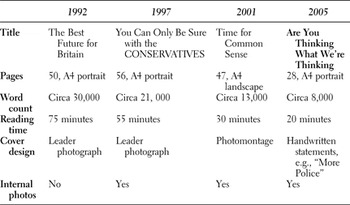
The data for the analysis are the four Conservative Party manifestos for the 1992, 1997, 2001, and 2005 general elections. The form and nature of individual manifestos vary (as summarized in Table 1), making over-time comparison more complicated.Footnote 6 Even so, manifestos have clear advantages over alternative data, such as party leader speeches or other party documents. First, they contain explicit statements of intent that a party wishes to put in front of the electorate in advance of each general election (Bara Reference Bara2005, 585). Secondly, political parties choose the content and form of their manifestos. Thirdly, manifestos are likely to reflect internal party debates as well as the wider political context, not least the state of interparty competition, and so they permit a certain degree of insight into the wider political terrain. Fourthly, the audience—voters—is the same across time. Finally, and contra popular expectations, manifesto commitments are often implemented (Bara Reference Bara2005); office-seeking parties in particular are unlikely to make pledges that they cannot fulfill.
Conservative Party Manifestos, 1992–2005

A manifesto pledge refers to “a specific commitment on behalf of a party to act in a certain area following a strategy also mentioned” (Colin Rallings, cited in Bara Reference Bara2005, 587). In this study, a “general” pledge states what the party seeks to achieve but provides no clear indication of how this will be achieved: “the next Conservative Government will achieve X.” A “detailed” pledge indicates, albeit in different degrees of detail, how it will be achieved: “the next Conservative Government will achieve X by doing Y.”Footnote 7 In identifying women's pledges, the researcher faces similar difficulties to those identified in respect of women's interests. In the first instance, pledges that explicitly name women either as women or as mothers (that is, as childbearers, a role that only women can undertake) can be considered unproblematically “women's pledges,”Footnote 8 Other pledges that may also constitute pledges “for women” are, as before, to be discovered as part of the research process rather than assumed a priori.
Qualitative content analysis is the main research method, alongside a few instances of “simple counting.”Footnote 9 In qualitative content analysis, the subjective judgment and expertise of the researcher is central to the analysis of the data (Burnham et al. Reference Burnham, Gilland, Grant and Layton-Henry2004, 236; Harrison Reference Harrison2001). Guiding our analysis is an appreciation of the dominant ideological tenets and premises of UK conservatism, most especially with respect to gender, together with our acknowledgment of second-wave Western feminism, especially as articulated in the UK (Bryson Reference Bryson1999; Bryson and Heppell Reference Bryson and Heppell2008). Crucially, and following Celis and her colleagues (2008, 2009), the manifestos are not subject to examination against a set of preexisting feminist criteria, as this would presume in advance the constituency of women and what constitutes women's concerns and interests.Footnote 10
Center-right parties, whether in the UK or elsewhere, might well be expected to constitute women and men as different, albeit complementary, sexes, with different accompanying gender roles. Yet wider societal forces, as well as more specific interparty relations at a particular moment in time, are likely to have an impact on manifestations of the CRG and SRW by a specific center-right party. In the UK, relevant factors would include a generic shift away from strictly bifurcated gender roles in the last quarter century or so, not least in respect to women's participation in paid employment; evidence of an increasingly feminist orientation among younger women (Campbell Reference Campbell2006; Campbell et al 2009); and an asymmetry in party politics, in the Labour Party's favor (Childs Reference Childs2008a, Reference Childs2008b). Once the party “of” women, the UK Conservative Party has, since the rise of “New Labour” in the mid-1990s, lost younger women's votes. Given the dynamics of party competition in a two-party system with a majoritarian electoral system, we might expect the ways in which the Conservative Party constitutes women's concerns and its pledges for women to show over-time changes, particularly in the most recent manifestos.Footnote 11 Following its election defeat in 1997, the Conservative Party spent more than a decade in the electoral wilderness, seemingly out of touch with the British electorate.
Nevertheless, it is unlikely that a right-of-center party will seek, or be able, to adopt a radically feminist position (however this might itself be defined); the party's ideological core is likely to constitute one constraint. Claims that conservatism is merely a disposition rather than an ideology are not accepted here, on the grounds that Conservatives have particular views on, for example, the role of the state, human nature, and the meaning of liberty and equality. Postwar twentieth-century British conservatism was characterized by a division between “One Nation Conservatism” and the New Right, with the latter dominant since 1979 (Gamble Reference Gamble1994).Footnote 12 The New Right's dual strands of neoliberal economics and social conservatism are likely to throw up sex- and gender-based tensions: if social conservatives emphasize the nuclear family and the single-earner model, economic liberals are likely to valorize the free economy, equal opportunities, and the adult-worker model. In practice—under the premierships of Margaret Thatcher and John Major in the 1980s and 1990s—Conservative governments did not universally overturn the gains achieved by the British women's movement in the preceding decades (Bashevkin Reference Bashevkin1998).
THE CONSTITUTIVE REPRESENTATION OF GENDER
Four broad themes emerge in the analysis of the constitution of feminine and masculine identities, women and men's concerns and interests, and broader gender relations.
1. Women Are Constituted as a Group More Often Than Men
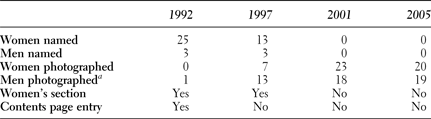
In the text of the Conservative Party manifestos, it is women rather than men who are directly constituted as a constituency (see Table 2). Men hardly feature at all, unless there is a prefix that defines their occupation—fisherman; policeman. Fathers are only mentioned once. Neither are there “men's sections” in any of the manifestos. In contrast, women are explicitly named in the text of the 1992 and 1997 manifestos, 25 and 13 times, respectively.Footnote 13 Mothers are represented in three of the manifestos, a total of five times. Yet women, like men, are absent textually in the 2001 and 2005 manifestos. Furthermore, while in the 1990s women warrant their own “women's section.” there is a reduction in the length, from circa 430 to 260 words, between 1992 and 1997. The ways in which the women's sections are introduced presented changes over time, too: in 1992, but not in 1997, the women's section is signposted on the manifesto's contents page. And in 1992 its subtitle is “Women and Opportunity,” under a heading “Opportunity for All,” whereas in 1997 the subheading “Opportunities for Women” comes under the heading “Opportunity and Ownership for Individuals and Families”—foreshadowing the increasing prominence given to families in later manifestos. In both years, the women's sections emphasize women's paid work, equal opportunities, and child care. The 1992 manifesto is the only one of all four manifestos to explicitly constitute a category of “women's concerns,” which include after-school care and violent and sexual crime.
Representations of women and men in Conservative Party manifestos 1992–2005
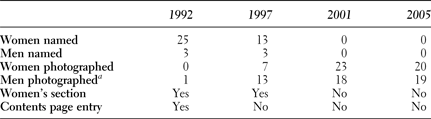
aThe 1992 Conservative Party manifesto contained no photographs other than the front cover picture.
2. Bifurcated and Traditional Representations of Gender Roles
Men, masculinities and crime
Men are constituted predominantly as inhabitants of the public sphere: textually, as policemen and fishermen (in 1992 and 1997) and as Members of Parliament and war pensioners (1992); pictorially, as both professional and manual workers—scientists, surgeons, businessmen, police officers, firefighters, construction workers, industrial workers, and bus drivers (1997); police officers, medical professionals, farmers (2001); and doctors, surgeons, scientists, and factory workers (2005). Ethnic differences between men are noted in the most recent manifesto: one of the two businessmen in a photograph is BME (black and minority ethnic).Footnote 14 Men are also represented as society's criminals—a 2005 photo montage shows a male mugger, and there is also an image of a young man being chased by a policeman. Such negative constructions of masculinity stand in direct contrast with positive images of men as police officers and members of the armed forces. A few representations of men in the private sphere are included—as members of a nuclear family (1997 and 2001) and part of an elderly, heterosexual couple (1997). In none are they represented as fathers in the absence of their “wives” and/or the “mother” of their children. In 2001, there also are representations of men in need of (women's) care: men are old and in the hospital.
Women, femininity, and caring
Across the manifestos women are overwhelmingly depicted as caregivers, whether they act in the public or the private sphere. In 2001, for example, they are the mother who has taken her child to the doctors and the woman who is caring for—by having a coffee with—an older man. This is not to say that women are not represented textually and pictorially as paid workers. Indeed, this is their dominant representation. Women are teachers, police officers, and office workers. A wheelchair-bound woman sits in front of a computer in 2001, for example. But these representations are, at times, rather ambiguous. The manifestos tell us that assaults occur only on policemen (suggesting that women are not proper police officers), and a photograph of a businesswoman in 2005 only partially includes her alongside her colleagues (suggesting that she is marginal to their discussions). And many of the representations reinforce traditional assumptions about women's paid caring work: women are lollipop ladies (an unskilled job helping schoolchildren cross the road, here performed by a black woman) and nurses (a skilled job, performed by a white woman), ward sisters (nurses), and matrons (2005). Other representations depict women as passive: the middle-age woman is talking/listening to male police officers, a BME mother is attentive to the doctor, and an older woman is being guided by a younger person while using a computer.
Mothers and married women
Mothers are constituted across the manifestos in two main ways. First, as the bearers of children, mothers have unique rights: to “named midwives” (1992) and to more flexible maternity leave and pay (2005). Secondly, mothers are constituted as the caregivers of children (1992 and 2001): the mother has rights to receive monetary support from the state, in recognition of her “caring” roles. The transfer of tax allowances in 1997 is linked to mothers. At the same time, there is an explicit commitment to mothers being “treated equally” by government whether “they work outside the home or not” (1992); full-time parents are to be supported—they can “transfer their unused personal allowance to their spouse” (1997). The language here is formally sex neutral, but the statement occurs in the manifesto section entitled “Opportunities for Women.” So the “spouse” to whom the tax allowance will be transferred is male. Similarly, married women are represented both as individuals and as part of a single, undifferentiated unit—the married couple.
3. Traditional Gender Relations: Critique and Reinforcement
Paid employment
According to the 1992 and 1997 manifestos, the UK is a good place to be a woman, and paid employment is a good thing for women to do. A higher proportion of women undertake paid work than in most other European Union countries; they are able to work part time, safeguarded from exploitation; benefit from comprehensive anti–sex discrimination laws; are independently taxed; and pay no tax on workplace nurseries. The Conservative Party is, moreover, committed to “breaking down artificial barriers to women's advancement based on prejudice or lack of imagination” (1992). In 1997 this interpretation is reiterated: women are “succeeding”—they are better educated, more financially independent, and with more opportunities than ever before (a success attributed to women's efforts and determination). Girls are doing better than boys educationally, and women live longer than ever before. Yet “some women still face barriers.” They lack financial security, particularly when they retire and are divorced; they face the barrier of “affordable, high quality childcare”; and they have the particular problem of juggling “job and family”—something the manifesto also proclaims affects “some men.”
Equal opportunities
Explicit rhetorical commitments to equal opportunities are presented in each manifesto, although gender equality is only explicitly stated in two (1992 and 2001). However, the 2001 manifesto also contains a commitment to retain “Section 28 of the Local Government Act,” which prohibited local authorities in England and Wales from “promoting” homosexuality.Footnote 15 Hence, it is the 1992 manifesto that comes out on top relative to the other three. It is peppered with statements about gender equality, even while its equal-opportunities statement, relating to sex discrimination, is placed in the section of the manifesto entitled “Community Relations,” and in which the subsequent statements all refer to race. The 1992 manifesto also contains, as noted, a women's section. The other side of the coin to equal-opportunities rhetoric in the manifestos is criticism of political correctness, evident in the later manifestos. This criticism in respect to marriage, the armed forces (2001), and education (2005). this sentences doesn't make sense now
4. The Rise of the Family and Parents
The family and parents have replaced women in the text of the 2000s manifestos. The leitmotifs are clear: 1) marriage is the bedrock of the strong and successful family; 2) state intervention in the family should be limited; 3) families should be taxed less; 4) families should not be subject to government prescription but free to make their own choices; and 5) parents should decide to care for their children themselves if they want.Footnote 16
There is, at the same time, some recognition of the difficulties of balancing families' and parents' paid work and caring commitments and an acknowledgment that governments have a role to play in supporting the family. In all of these depictions, however, the family is represented as a single, homogeneous, nonsexed or nongendered unit, rather than characterized by hierarchy, inequality, and/or conflict. The same applies to parents. For example, the 2001 manifesto states that parents “feel they aren't getting enough help at the time they need it most,” There is also acknowledgment of the caring, “stay at home parent” who looks after the children. Here, the sex of this parent—those who “will be able to apply for a scholarship” for “vocational or professional training”—is not identified. Lone parents are a subset of parents named in the first three manifestos. Their sex is not identified, perhaps surprisingly, given Conservative antipathy toward single mothers.Footnote 17 Over time, lone parents are depicted as bearers of rights (1992); as a source of concern—that the structure of benefits privileges lone parents vis-à-vis two-parent families (1997); and then as subject to prescription about responsibilities to engage in paid employment (2001).
THE SUBSTANTIVE REPRESENTATION OF WOMEN: PARTY PLEDGES FOR WOMEN
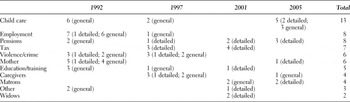
Most of the Conservative pledges “for women” refer to the intersection of women's roles in the family and in the paid workforce. The highest number of individual pledges, as Table 3 shows, relate to child care. Only one “women's pledge” is addressed across all four manifestos—pensions—while two are addressed across three – child care (1992, 1997, and 2005) and education and training (1992, 1997, and 2005). In the 1990s but not in the 2000s manifestos, there are pledges on both women's employment and violence and crime, whereas in the 2000s but not the 1990s manifestos, there are pledges relating to matrons and widows. No clear pattern emerges by theme and level of detail.
Pledges for women by theme and level of detail

Notes: Pledges can be counted under more than one theme. See data and methods section for discussion of classifying pledges; see also n. 7.
Crime
The 1992 violence and crime pledges are explicitly framed as dealing with sexual and violent crime against women: “[w]e will encourage victims to report sexual offences by giving them statutory anonymity”; “women only taxi services are being encouraged under the same Safer Cities programme”; “we will increase the maximum penalties for making obscene or malicious phone-calls.”Footnote 18 This is also true of 1997: “[a]nyone convicted of a second serious sexual or violent crime, like rape or armed robbery, will get an automatic life sentence”; “we will also take action to allow a judge to stop a defendant from personally questioning the victim in rape cases and other cases where the victim is particularly vulnerable.” In comparison, there are no crime pledges for women in the 2001 or 2005 manifestos. A series of six photographs in the 2005 manifesto depicts a woman having her handbag stolen in the street. But such an image looks to be a long way from the representations of gender crime—as violent and sexual crime against women—in the 1990s manifestos.
Paid work, child care, and caring
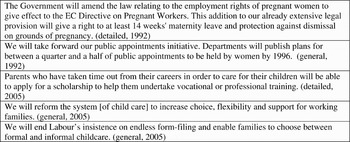
There is an over-time decline in the attention given to women's presence and participation in the public sphere of paid work, at least in the sense of enhancing women's paid employment in tangible ways. Crudely, in the 1992 and 1997 manifestos, “acting for women” refers to enabling women—and especially working mothers who require child care—to participate more fully in paid employment. Later talk about parents and families (see Figure 1).
Representations of parents, families, and paid work.

By 2005, the Conservative manifesto replaces a concern with women's education, training, and equal opportunities with a more general concern with families and their need for flexible and affordable child care; there is an absence of any pledges relating directly to women's employment, other than in relation to child-care provision. The 2005 manifesto builds on such conceptions of women's caregiving responsibilities, over and above individual “caring” “women's pledges.” In two child-care pledges, the party offers financial support to parents “irrespective of the type of childcare they choose” and permits families to opt for “informal childcare”—read: care by the grandmother (Childs Reference Childs2004). Women's caregiving role is further addressed with the pledge to “boost respite” care and the provision of “more choice and information” about support for caregivers.
DISCUSSION
The disappearing constituency of women
The apparent disappearance of women from the text of the 2000 Conservative manifestos—replaced by family and parents—invites two readings. In the first, women's absence might be interpreted as meaning that the party no longer considers women as constituting a particular identity/category; neither does it see women anymore as a group to whom they should be appealing. For those who perceive that women and men in British society live gender-differentiated lives, the later manifestos might be interpreted as denying women their gendered identity and their lived gendered experiences. In a second reading, women's absence is to be welcomed, for they are no longer being constituted as a distinct category on the basis of their sex and/or their gender.
Representations of women and men and the public/private division
Neither women nor men are constituted in a single fashion in the 1992–2005 manifestos. Women inhabit both the public and the private spheres and are engaged in both unpaid and paid labor—they are mothers and paid workers. Similarly, men are depicted in both spheres, albeit to a lesser degree. Neither is there an explicit prescription of what women and men should be doing. Even so, differences in representations are apparent. Men are overwhelmingly the inhabitants of the public sphere; and when they are represented in the private sphere, this is as members of a nuclear family and in need of care, most notably when they are old. There are but few indications that men might prefer to inhabit the private sphere and take primary responsibility for child care. Men are also represented as society's criminals and (paradoxically) its protectors. Representations of women are, at least on one level, more expansive: women are shown to be paid workers, working mothers, stay-at-home mothers, and caregivers. Yet the dominant representations of women as paid workers have them working in particular occupations. There is an abundance of representations of women as those who care for babies, children, the sick and the elderly, or who “assist” doctors, rather than being professionals themselves. Moreover, and despite not having explicit, prescribed gender roles, it is working mothers (but not working fathers) who are regarded as particularly concerned with caring for children; it is women who are acknowledged as nontaxpayers, and who should be able to transfer their tax allowance to their spouses; it is mothers who should (normally) receive state financial support as the caregiving parents. It is women who are the victims of male crime and men the perpetrators.
The family, gender and privacy
In the manifestos' description and critique of women's experiences in British society, a changing concern emerges over time, away from a representation of women's participation in the public sphere and the commitment to enhance that participation—of ensuring that barriers are removed. This is most acutely evident in the rise of the family and of parents in the 2000s manifestos. In them, the family is regarded as a private institution and one that is undifferentiated by sex and gender. Once again, the Conservative Party is formally agnostic about the particular division of labor within families—women's and men's roles are left to parents to decide. Again, there is more than one possible reading. It might be that such agnosticism reflects the Conservative Party's commitment both to notions of the family as a private space free from government intervention and of individuals' freedom to choose how to distribute public and private tasks. A second reading, and one that derives from the 1990s Conservative manifestos, might challenge this account on the basis that it fails to acknowledge the gender-differentiated experiences of women and men in British society, and the gender hierarchies and inequalities that are likely to have the effect of reinforcing, rather than challenging, the existing sexual divisions of labor.
According to this latter reading, the 2005 manifesto account of modern families shows little appreciation of the dominant domestic division of labor in British households, where despite women's entry into the paid workforce, they still disproportionately undertake child care and domestic responsibilities. Hence, it is the mother and not the family who has to “juggle work and family life.” Nor does the Conservative Party appear to wish to intervene in challenging the sanctity of the family: the state will not dictate the terms of child care or the balance between paid work and family responsibilities, for they “trust” the decisions the family takes. Again there is no presumption here that the extant division of labor between women and men might or should be overturned. Further, and despite recognizing that women are financially insecure, not least after divorce and in retirement, the 2000s manifestos do not address the specific implications of financial insecurity for women continuing to be the sex who undertakes most of the unpaid child care and who withdraws from the world of paid work to provide care.
The Conservatives' increasing emphasis on the family in the 2000s manifestos also suggests a preference for family forms privileging the heterosexual, monogamous, lifelong and state-/religion-sanctioned relationship. In this, the privacy of the family and of families (as undifferentiated units) making choices about how they wish to live is again evident. At the same time, there are glimpses of the Conservatives' preference for more traditional gender roles within families. Recall that transferable tax allowances are presented as benefiting women in the 1997 manifesto: it is included in the section “Opportunities for Women.” Agnosticism regarding who within the family does the caregiving is replaced by a preference for mother care. Similarly, and notwithstanding explicit protestations about rolling back the state from the family, there is acknowledgment that the “family” requires particular kinds of state support. There might be a sense, shared with the Labour government, that the costs associated with familial care for children or dependent relatives are not just the responsibility of the individual family—because society benefits from strong families. There may also be agreement that governments should, therefore, act to support the family. But the nature of this support is more frequently fiscal, an approach that began to emerge in 1997.
Finally, the manifestos reveal a shifting concern from enhancing women's access to the paid employment in the earlier documents to a later concern with parental access, and arguably a concern that balancing work and family responsibilities might be less of a problem for women (as it was depicted in 1992 and 1997) and more of a problem for society—because of its links with social cohesion and breakdown. Crudely, women's engagement in paid work is, normatively, a good thing in the 1992 and 1997 manifestos; by 2001 and 2005, the party chooses not to devote manifesto space to making such pronouncements.
CONCLUSION
The empirical case study that lies at the core of this article was informed by new approaches to the study of political representation, namely, political theory accounts of representation as claims making, and by approaches in the substantive representation of women literature that problematize the content of women's substantive representation. In so doing, it offers the first application of Squires's (Reference Squires2008) concept of the constitutive representation of gender to the parliamentary setting. Two main contributions to the extant scholarship are made. First, the case study begins to fill an important gap in the empirical literature, in the UK and globally. Hitherto, most analysis of women's substantive representation has been dominated by research on left-of-center parties. Yet centre-right parties “act for” women, too, and in this way constitute femininity and masculinity and gender relations. Second, the case study shows how exploring the CRG can become part of the process of empirically interrogating the SRW. This enables gender and politics scholars to take seriously Celis's (Reference Celis2006) rejection of a priori assumptions of what constitutes women's interests. At the same time, this analysis cannot, on the basis of its research design, offer strong conclusions about why particular representative claims and pledges are made—in this instance by the UK Conservative Party—nor account fully for changes in the nature of these claims and pledges over time. Because we are not examining a party in government, neither can we consider whether or how any of these representative claims and pledges are realized in practice. In sum, this article stops some way short of answering the question of Celis and her colleagues (2008) concerning “how the substantive representation of women occurs,”Footnote 19 These are empirical questions for subsequent research.
Despite being unable to make generalizations on the basis of a solitary case study, several more general insights can be proffered. Researchers examining the SRW who do not want to presume the “what” of substantive representation in advance would do well to look beyond explicit statements about women or women's interests or actions intended for women in their research. In the case of the UK Conservative Party, the 2000s general-election manifestos were less likely to see and construct “women” as constituents, and they rarely made explicit pledges “for women”—the party preferred to talk about, and to, “families” and “parents.” These entities were, in turn, often explicitly depicted in non–sex or gender-differentiated fashion. Such observations, and any insights gained from considering them, are likely to be missed if researchers look only for explicit statements about women and women's interests. Our research further suggests that analyzing the relationship between the CRG and SRW is likely to be rewarding, both empirically, in showing relations between these two dimensions in practice, and conceptually, in furthering an understanding of how they might relate to each other. In this case, party pledges are broadly in line with the depiction of women's lives and gender relations in the corresponding manifesto, although in the later manifestos implicit assumptions about bifurcated sex roles and gender relations sit less easily with party pledges for parents and families. This points to the potential for dissonance between the CRG and the SRW by a single actor/representative. Once again, these observations beg additional research questions, not least how to explain them, and whether and how such dissonance plays out in practice. Only new research can answer such questions.
The close reading of Conservative Party general-election manifestos over four election cycles has permitted consideration of how the UK's right-of-center party conceives of women, men, and gender relations, and how it seeks to act for women. If the earlier manifestos problematized women's engagement in the public sphere and aimed to facilitate women's participation in paid work, the later ones consider such issues a matter of familial choice and parental need, rather than a question of gender inequality—or, in the Conservative Party's own language—of the “barriers” that women face. Such observations have also been shown to hold for other women's interests: most pointedly, the earlier manifestos named sexual and violent crime as a particular concern to women; in 2005 crime against women is depicted as handbag snatching. Judged by the CRG and the pledges of the earlier manifestos, it is apparent that the Conservative Party shifted its position in the 2000s relative to the 1990s.
Such findings invite additional comparisons in subsequent research, not least with the forthcoming 2010 general-election manifesto, as well as general-election manifestos from the other main parties over the same period (and other center-right parties elsewhere, for that matter). It might be expected that the next Conservative manifesto will differ significantly in its representation of gender and gender relations, both constitutive and substantive, from those analyzed here; the party political landscape in the UK has changed. Having lost the 1997 general election, the Conservative Party managed to lose three more general elections in a row—the first time it had suffered this fate in almost a hundred years (Cowley and Green Reference Cowley, Green, Geddes and Tonge2005). Arguably, the party competed on the wrong terrain in 2001 and 2005. Indeed, its political fortunes did not turn more favorable until after the election of a new leader, David Cameron, in the autumn of 2005 (and, it was not until the global credit crisis that the party began to look electorally competitive).
Cameron's office-seeking strategy has been to adopt a self-conscious policy of “de-contamination”; the party had to stop being perceived as the “nasty party.” One aspect of this change in strategy is acceptance of “modern Britain”: “I live in a world as it is, not how it was,” as Cameron himself stated.Footnote 20 Thus, the party has sought to appeal to “middle England,” that is, those voters who supported Tony Blair and New Labour. This category explicitly includes women—recall that 2005 was the first general election when more women voted for the Labour Party than for the Conservatives. Overtly gendered responses include highly publicized reform of the party's parliamentary selection procedures (Campbell, Childs, and Lovenduski Reference Campbell, Childs and Lovenduski2006) and the 2008 publication of the Conservative Women's Policy Group report, Women in the World Today. Specific pledges therein refer to employment and violence against women, perhaps suggesting a return to the terrain of the 1990s manifestos.Footnote 21 And yet, much Cameroonian rhetoric reproduces views of the family that valorize marriage and regard the family as a unit within which parents make choices, continuing the discourse of the 2000 manifestos. Amid much talk of the UK as a “broken society” (characterized by single-parent families, poverty, drug and alcohol dependency, intergenerational unemployment, and crime) strengthening the family, not least through recognition of marriage in the tax system, has become an emblematic solution. All this suggests that long-standing tensions identified within British conservatism between neoliberalism and neoconservatism, as well as with gender relations, are still very much in play.