Restenosis continues to be the Achilles heel of interventional cardiology. It generally arises within 6–9 months after the procedure and is principally due to neointimal hyperplasia (3). The incidence of in-stent restenotic lesions is estimated at 10–40 percent, depending on the characteristics of the patient and the lesion (12).
In the drug-eluting stent (DES), an antimitotic agent (e.g., sirolimus or paclitaxel) is released from a biocompatible polymer coating that acts as a drug reservoir. It has been shown that neointimal hyperplasia is decreased. This finding further decreases angiographic restenosis rates and the subsequent need for repeat revascularization procedures in the short- to medium-term compared with bare metal stents (BMS) (3).
For allocating limited healthcare resources to cover the entire population, we need to choose only cost-effective treatments bearing opportunity cost in mind. We aimed at systematically reviewing economic analyses comparing DES to BMS in patients who undergo percutaneous coronary intervention (PCI) to form an overall view about cost-effectiveness of DES, and to construct a simple decision analysis model to evaluate the cost–utility and cost-effectiveness of DES in comparison to BMS.
Methods
Search Strategy
The following electronic databases were searched without language restrictions from January 2004 to January 2006: Cochrane Database of Systematic Reviews; Cochrane Central Register of Controlled Trials; DARE, HTA, EED (NHS CRD); MEDLINE(R) In-Process, Other Non-Indexed Citations, MEDLINE(R). References of the papers identified were checked.
The search strategies were planned by an information specialist for each database. The following MeSH search terms were used: Stents, Paclitaxel, Sirolimus, Costs and cost analysis, Stents/economics.
Selection
We included randomized controlled trials (RCT) or model-based cost-effectiveness analyses comparing DES to BMS in patients with coronary artery disease. All papers judged to be potentially relevant were retrieved for detailed evaluation.
Validity Assessment
The methodological quality of the papers was assessed by using Drummond's check-list for assessing economic evaluations (5). The scale combines ten main items, scored 1 (criterion met) or 0 (criterion not met), resulting in a maximum score of 10.
Data Abstraction
Paper selection, validity assessment, data extraction, and qualitative synthesis of the data were performed independently by two of the authors (P.K., P.R.). The selections made and the data collected were compared in each phase, and consensus was required from the two authors on each item. Disagreements were solved in a consensus meeting by checking the original data once more. Researchers were not precluded from knowing the journal or authors of the papers.
Study Characteristics and Data Synthesis
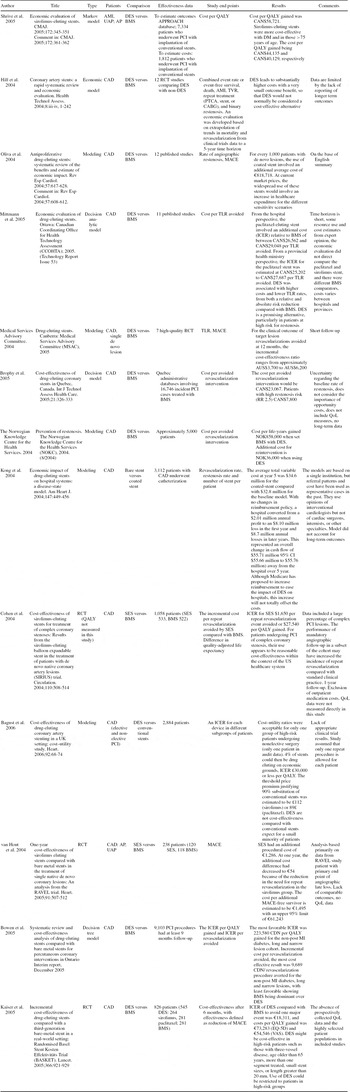
The baseline characteristics of the included economic analyses were tabulated (Supplemental Table 1, available at http://www.journals.cambridge.org/jid_thc). Data were synthesized descriptively. The cost-effectiveness of DES in comparison to BMS, as concluded by the authors, was classified as (i) DES cost-effective, (ii) DES probably a cost-effective strategy in some circumstances, or (iii) DES not cost-effective.
Details of Selected Studies

Method of Economic Evaluation
A decision-analytic model was used to evaluate the cost–utility of DES compared with BMS over a 2-year time horizon. Due to the short time horizon, discounting was not carried out.
As a primary outcome, we used quality-adjusted life-years (QALYs) gained, which were derived by measuring health-related quality of life (HRQoL) by the 15D. Cost of one avoided reintervention was used as a secondary outcome. The model was developed using DATA software (TreeAge version Pro 2006).
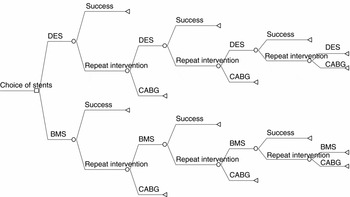
A simplified representation of the decision model is shown in Figure 1. The two initial branches of the decision tree represent a decision node between the BMS and DES for patients undergoing a PCI.
Simplified decision tree: comparison of bare metal stents (BMS) and drug-eluting stents (DES) within current practice. CABG, coronary artery bypass graft.

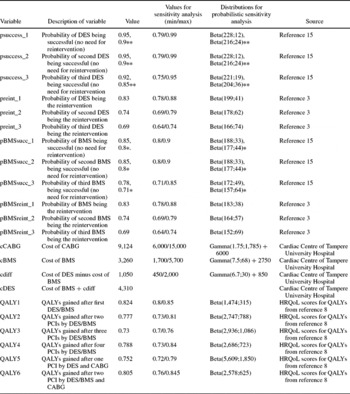
The input parameters and their sources are presented in Supplemental Table 2 (available at http://www.journals.cambridge.org/jid_thc). The HRQoL scores used were taken from a study of Kattainen et al. (Reference Kattainen, Sintonen, Kettunen and Merilainen2005). The HRQoL scores were 0.730 (95 percent confidence interval [CI], 0.716–0.744) for situation before PCI and 0.824 (95 percent CI, 0.806–0.842) 6 months after. In the coronary artery bypass graft (CABG) group, the HRQoL scores were 0.752 (95 percent CI, 0.743–0.761) for the situation before CABG and 0.858 (95 percent CI, 0.844–0.872) 6 months after, respectively. To estimate QALYs, the HRQoL scores were assumed to change linearly between the measurements. The direct hospital costs of PCI, CABG, DES, and BMS were included, but possible productivity costs, for example, due to absence from work, were omitted. All costs were based on data from Cardiac Centre of Tampere University Hospital and are presented in 2006 euros.
Values of Input Parameters, Their Ranges and Sources in the Base-Case Analysis

Note. The probabilities of revascularizations changed in probabilistic sensitivity analyses: in the first analysis, the success rates of BMS (denoted with one asterisk) were decreased, and in the second, the success rates of DES (denoted with two asterisks), when distributions for other variables were unchanged.
BMS, bare metal stents; DES, drug-eluting stents; CABG, coronary artery bypass graft; QALY, quality-adjusted life-years; PCI, percutaneous coronary intervention; HRQoL, health-related quality of life.
To account for uncertainty around model input parameter values, one-way and probabilistic sensitivity analyses with 10,000 Monte Carlo simulations were carried out. The first probabilistic sensitivity analysis was based on the base-case data, where the difference in the probability of revascularization between DES and BMS over the time horizon of 2 years was 0.12 in favor of DES. In the second and third analysis, the difference in the probability was assumed to be 0.188 (“DES high”) and 0.062 (“DES low”), respectively. The parameter values behind these overall differences, as well as other parameter values used in sensitivity analyses are shown in Supplemental Table 2 (available at http://www.journals.cambridge.org/jid_thc). For utility and transition probability variables, beta distribution was assumed, and gamma distribution for cost variables (Supplemental Table 2, available at http://www.journals.cambridge.org/jid_thc). Results are given as incremental cost-effectiveness ratio (ICER), mean incremental costs and effects, cost-effectiveness plane, and cost-effectiveness acceptability curve.
Results
Systematic Review
Trial Flow
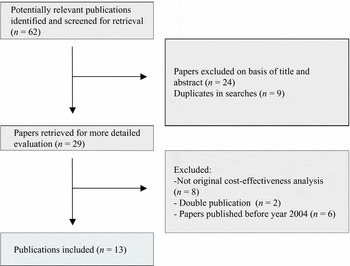
In the primary searches, sixty-two potentially relevant publications were identified: seven in the Cochrane Database of Systematic Reviews; thirty-six in DARE, HTA, EED (NHS CRD); seven in MEDLINE(R) In-Process, Other Non-Indexed Citations, and ten MEDLINE(R). One paper was found by information specialist during the search process (2), and one paper was identified in reference lists (7). The flow diagram of inclusion/exclusion of the economic analyses is shown in Figure 2.
Flow diagram of inclusion/exclusion of drug-eluting stents versus bare metal stents cost-effectiveness analyses.

Study Characteristics
Supplemental Table 1 (available at http://www.journals.cambridge.org/jid_thc) shows the study characteristics of the papers and contains information describing the paper, type of economic evaluation, patients, intervention contrast, source of effectiveness data, study end points, results, and comments given by original authors.
The quality of the thirteen economic evaluations included in this overview is summarized in Table 1. Median quality score was 9 (range, 7–10) on a 0–10 scale.
Quality of the Identified Systematic Reviews According to Drummond et al. (Reference Drummond, Sculpher and Torrance2005)

a Stent length.
Data Synthesis of the Economic Evaluations
Two of the identified economic evaluations based on RCTs found DES cost-effective compared with BMS (4;16). In six studies, the authors concluded that DES might probably be a cost-effective strategy in some circumstances but not as a single strategy (2;3;7;10;11;14) and four studies concluded that DES is not cost-effective compared with BMS (1;6;13;14). One study did not draw a clear conclusion (9).
Economic Evaluation
Table 2 shows the costs and QALYs in both strategies, and the ICER for DES based on our modeling. The ICER of DES versus BMS is €98,827 per QALY, that is, DES was considerably more costly and slightly more effective than BMS. The cost per avoided revascularization was €4,794.
Cost-Effectiveness of DES Compared with BMS (Base-Case)

QALY, quality-adjusted life-years; C/E, cost-effectiveness; ICER, incremental cost-effectiveness ratio; BMS, bare metal stents; DES, drug-eluting stents.
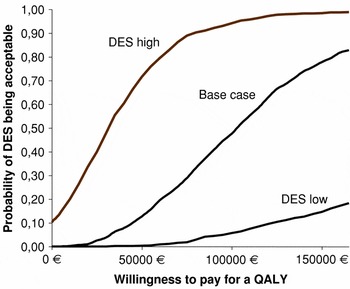
The one-way sensitivity analyses showed that the result was only sensitive to the cost difference between DES and BMS. At the threshold of €498 or less, DES became dominant, for example, more effective and less costly. In probabilistic sensitivity analysis of base-case, DES was almost in all simulated cases both more effective and costly (Quadrant II in cost-effectiveness plane, see Figure 3). The mean incremental cost was €579 (95 percent CI, €222–€909), and the mean incremental QALY was 0.00583 (0.00231–0.01033). Even at a level of 50,000 euros of societal willingness to pay for a QALY, the probability of DES being acceptable is only 13 percent (Figure 4). At that level of willingness to pay, the probability of DES being acceptable was 71.7 percent, when the difference in the probability of revascularization between DES and BMS over the time horizon of 2 years was 0.188 in favor of DES (“DES high”), and 0.4 percent, if the difference in favor of DES is 0.062 (“DES low”) (Figure 4). In the “DES high” scenario, the cost per QALY gained was €30,600 and in the “DES low” scenario was €296,712. The probabilistic sensitivity analyses, thus, show that the result is quite sensitive to difference in the probability of revascularization.
Discussion
In reviewing the latest literature systematically, we were not able to demonstrate consistent evidence of DES being a cost-effective treatment strategy, except probably in patients with high restenosis risk. Our simple cost–utility analysis showed that compared with BMS DES produces an extra QALY at a very high incremental cost.
In some of the economic analyses RCT data are used as effectiveness data. Trials usually aim at establishing efficacy, that is, outcome in ideal settings. Thus, there is a risk of overestimating the effectiveness in routine practice. Some analyses use register data coming closer to a real-world setting. However, economic analyses are naturally connected to the local healthcare system and treatment practice.
Cost-effectiveness plane. In 99.77 percent of cases, drug-eluting stents were both more costly and more effective (Quadrant II), and in 0.23 percent of cases less costly and more effective (Quadrant IV). QALYs, quality-adjusted life-years.

Cost-effectiveness acceptability curves for drug-eluting stents (DES). Base-case refers to probabilistic sensitivity analysis (PSA) conducted with base-case distributions (difference in the probability of revascularization between DES and bare metal stents over the time horizon of 2 years 0.12 in favor of DES), “DES high” to PSA with a probability difference of 0.188 and “DES low” to PSA with a probability difference of 0.062 (see Supplemental Table 2, available at http://www.journals.cambridge.org/jid_thc). QALYs, quality-adjusted life-years.

Only economic evaluations based on SIRIUS (4) and RAVEL (16) RCTs concluded that DES was cost-effective strategy compared with BMS by using incremental cost per repeated revascularization and major adverse cardiac events as end points, respectively. The third economic analysis based on the BASKET RCT (7), using both sirolimus and paclitaxel stents, showed DES cost-effective only in high-risk patients.
Six of the ten modeling studies found that DES might be a cost-effective strategy in patients with high risk of restenosis, and in four papers, DES was not considered cost-effective compared with BMS. High-risk patients in different series represent minority of patients (1;3). Thus, the evidence of DES being cost-effective as a single strategy remains inconsistent.
Our results seem to suggest that the cost-effectiveness of DES in comparison to BMS is questionable. The cost per QALY gained in the base-case analysis turned out to be around 100,000 euros, which can be considered higher than usually accepted to adopt a new method over an old one. If the decision maker would like to reach an 80 percent certainty of DES being acceptable, the willingness to pay should be €156,000 per QALY gained (Figure 4).
When the difference in the probability of revascularization between DES and BMS over the time horizon of 2 years was assumed to be 0.188 in favor of DES rather than 0.12 in base-case analysis, the cost per QALY gained would be €30,607. This scenario may apply to patients with high risk of restenosis. If the decision maker would like to reach an 80 percent certainty of DES being acceptable, the willingness to pay should be €60,500 per QALY gained (Figure 4).
It may be that the difference between DES and BMS in the probability of revascularizations are smaller in the “real world” than in RCTs. To represent this possibility, the “DES low” scenario was considered, where the difference in the probability was 0.062 rather than 0.12. In this scenario, the cost per QALY was €296,712.
The cost of one avoided re-intervention was, in the base-case analysis, €4,794, which can be considered relatively high. This cost is 1.5 times higher than the cost of revascularization with BMS.
Furthermore, it is worth noting that the cost of medication was assumed to be the same in both treatment arms. However, after DES, a longer and more costly drug regimen is needed to prevent the late stent thrombosis.
We focused the literature review on a 2-year period and were not able to cover the latest economic evaluations. Assumptions in decision models are always context-dependent; thus, the results need to be interpreted with caution. However, systematically reviewed economic analyses can give a robust background for decision modeling with local input parameters. These parameters may not be generalizable to other settings.
QALY gain of DES over BMS was small. This finding may be explained by the assumption that PCI with DES or BMS results in a similar improvement in HRQoL. In addition, our HRQoL data suggest that the HRQoL improvement following PCI and CABG is approximately the same. The overall mortality and probability of cardiovascular events were assumed to be the same in both treatment arms as suggested by our systematic review. The small QALY gain is attributable to fewer revascularizations, which are preceded by lowered HRQoL.
Several studies report subgroup analyses with stratification of patients with diabetes, lesions in small vessels, or long lesions, but these studies had not enough power to analyze the treatment effect in subgroups (15). Therefore, more data are needed to focus the treatment on patients with the highest risk of restenosis. Similarly, data on the HRQoL effects of DES and BMS with long-term follow-up in a real-life setting are required.
Conclusions
The systematic review indicated that the evidence is inconsistent of whether DES would be a cost-effective treatment option compared with BMS in any healthcare system where evaluated. Our model-based cost–utility analysis suggests that the cost difference between DES and BMS is too large for DES to be cost-effective given the small QALY gain.
POLICY IMPLICATIONS
A marked restenosis risk reduction should be expected before use of DES is justifiable at present prices. When considering adoption of a new health technology with a high incremental cost within a fixed budget, opportunity cost in terms of untreated patients should be seriously considered as a question of collective ethics.
CONTACT INFORMATION
Pekka Kuukasjärvi, MD, PhD (pekka.kuukasjarvi@stakes.fi), Senior Medical Advisor, Pirjo Räsänen, MSc, RN (pirjo.rasanen@stakes.fi), Researcher, Antti Malmivaara, MD, PhD, (antti.malmivaara@stakes.fi), Senior Medical Officer, Pasi Aronen, MSocSc (pasi.aronen@helsinki.fi), Researcher, Harri Sintonen, PhD (harri.sintonen@helsinki.fi), Professor, Finnish Office for Health Technology Assessment (FinOHTA), Stakes, P.O. Box 220, FIN-00531, Helsinki, Finland