INTRODUCTION
Tropical montane forests (TMFs) are famous for their unusual ecological features, especially in the cloud zone where the forest is characterized by small, often twisted trees with unusually low productivity. Traditionally, TMFs are defined as occurring above 1000 m asl (Churchill et al. Reference CHURCHILL, BALSLEV, FORERO and LUTEYN1995, Stadtmüller Reference STADTMÜLLER1987, Troll Reference TROLL1956, Webster Reference WEBSTER, Churchill, Balslev, Forero and Luteyn1995) and they usually encompass complex and steep environmental gradients. Tropical montane climates are unique globally because of high diurnal temperature variability combined with low annual variability (Sarmiento Reference SARMIENTO, Vuilleumier and Monasterio1986). These regions also exhibit particularly complex altitudinal gradients in radiation, temperature and humidity based on the timing of temperature and precipitation seasonality, and the effects of clouds which diminish coldness but also lower solar radiation (Sarmiento Reference SARMIENTO, Vuilleumier and Monasterio1986). Marked declines in soil nutrients with altitude are also common (Dalling et al. Reference DALLING, HEINEMAN, GONZÁLEZ and OSTERTAG2016, Grubb Reference GRUBB1977). The environment in the cloud zone is particularly distinctive with cool temperatures, ample rainfall and persistent cloud and mist that limits sunlight and maintains very high humidity. Not surprisingly, TMFs display dramatic changes in vegetation structure and composition across the montane landscape – often exemplified by distinct floristic zonation, sharp ecotones and high levels of beta diversity (Crausbay & Hotchkiss Reference CRAUSBAY and HOTCHKISS2010, Martin et al. Reference MARTIN, FAHEY and SHERMAN2011). These patterns have been overwhelmingly attributed to environmental drivers, especially climate gradients associated with altitude (Churchill et al. Reference CHURCHILL, BALSLEV, FORERO and LUTEYN1995, Fahey et al. Reference FAHEY, SHERMAN and TANNER2016, Hamilton et al. Reference HAMILTON, JUVIK and SCATENA1995, Stadtmüller Reference STADTMÜLLER1987). Moreover, these patterns are often implicitly treated as steady-state and in equilibrium with climate. In contrast, the roles of disturbance and vegetation dynamics have received little attention in TMFs, despite the importance of these topics in understanding the spatial patterns of plant communities in other biomes and numerous palaeoecological studies distributed across the tropics that detail the pervasiveness of change and disturbance in TMF landscapes (Bush et al. Reference BUSH, HANSEN, RODBELL, SELTZER, YOUNG, LEON, ABBOTT, SILMAN and GOSLING2005, Conserva & Byrne Reference CONSERVA and BYRNE2002, Crausbay et al. Reference CRAUSBAY, GENDERJAHN, HOTCHKISS, SACHSE, KAHMEN and ARNDT2014a, Reference CRAUSBAY, MARTIN and KELLY2015; Dull Reference DULL2004, Hope Reference HOPE2009, Islebe & Hooghiemstra Reference ISLEBE and HOOGHIEMSTRA1997, Urrego et al. Reference URREGO, NICCUM, LA DREW, SILMAN and BUSH2011). To date, four books have provided the main synthesis and conceptual framework of TMF ecology (Bruijnzeel et al. Reference BRUIJNZEEL, SCATENA and HAMILTON2011, Churchill et al. Reference CHURCHILL, BALSLEV, FORERO and LUTEYN1995, Hamilton et al. Reference HAMILTON, JUVIK and SCATENA1995, Stadtmüller Reference STADTMÜLLER1987), yet natural disturbances and forest dynamics received very little attention therein. This raises an important issue: is disturbance a minor focus in TMFs because it is comparatively infrequent and low intensity or is disturbance sufficiently important in TMFs that it should be more fundamentally integrated into models of TMF ecology?
Disturbance plays a central role in the dynamics of many forested ecosystems and is known to create much of the heterogeneity in structure and floristics of forested landscapes (Oliver & Larson Reference OLIVER and LARSON1996, Pickett & White Reference PICKETT and WHITE1985, Sousa Reference SOUSA1984). Disturbances create hotspots of resource availability – most notably in the distribution of sunlight (Canham et al. Reference CANHAM, DENSLOW, PLATT, RUNKLE, SPIES and WHITE1990) – and trigger rapid changes in plant dynamics and ecosystem processes. As in TMFs today, the importance of disturbance was not always generally appreciated in ecology, however. Before the 1970s, a widely held, though far from unanimous, simplifying assumption was that forests were ‘closed systems’ in rough equilibrium with little spatial heterogeneity (see Schliemann & Bockheim Reference SCHLIEMANN and BOCKHEIM2011 and review in Perry Reference PERRY2002). From the 1970s onwards, the prevailing view of temperate and tropical forests expanded to recognize that natural, occasionally large-scale disturbances such as fire and windstorms were recurring events and responsible for much of the spatiotemporal patterns in forests (Heinselman Reference HEINSELMAN1973, Levin & Paine Reference LEVIN, PAINE and Levin1975, Loucks Reference LOUCKS1970, Pickett & Thompson Reference PICKETT and THOMPSON1978, Whitmore Reference WHITMORE1974). A new paradigm of a disturbance-driven, scale-dependent ‘shifting-mosaic steady state’ soon followed (Bormann & Likens Reference BORMANN and LIKENS1979), and ecologists embraced disturbance as an integral process that maintains species coexistence, influences ecosystem processes and fundamentally contributes to patterns in community composition and structure (Pickett & White Reference PICKETT and WHITE1985, Sousa Reference SOUSA1984). Conceptual refinements in the role of disturbance continue to this day, and natural disturbance is so entrenched in the ecological literature that it is surprising that it remains a peripheral theme in TMF ecology.
In this paper, we review and synthesize research on disturbance and vegetation dynamics in TMFs and the role of disturbance in the ecological organization and patterns in TMFs. Just as the disturbance-recovery paradigm replaced the fragility-stability paradigm for lowland tropical forests (Chazdon Reference CHAZDON2003, Waide & Lugo Reference WAIDE, LUGO and Goldammer1992, Whitmore Reference WHITMORE, Gómez-Pompa, Whitmore and Hadley1991), we argue that disturbance should assume a larger role in TMF ecology. In this framework, we ask these four organizing questions: How common is disturbance generally across TMFs? Are there geographic gradients in disturbance type across TMFs? How do TMF disturbance regimes compare to lowland tropical forests? Are TMFs unusually sensitive to disturbance given the low productivity characteristic of these ecosystems? We expect that TMFs are subject to a wide range of disturbance types and regimes, and that disturbance is a strong driver of TMF ecology for four fundamental reasons. First, marked environmental heterogeneity is inherent to montane environments. In particular, TMFs usually have high topographic complexity, strong variation in soils (due to differences in parent material and soil development), and steep altitudinal patterns in climatic and atmospheric conditions. This heterogeneity interacts strongly with natural disturbance to influence the disturbance type, frequency and severity, and can promote striking spatial structure in disturbance patterns. Second, large areas of TMFs are exposed to tropical cyclones much more frequently than other latitudes and TMFs are highly prone to landslides due the steep terrain, high rainfall, and, in some regions, frequent earthquakes (Garwood et al. Reference GARWOOD, JANOS and BROKAW1979). Third, when a disturbance occurs in TMFs, it creates canopy openings and increases resources for species with contrasting life histories, but because TMFs often have very low growth rates and productivity (Fahey et al. Reference FAHEY, SHERMAN and TANNER2016), recovery from disturbance may be slow (Ewel Reference EWEL1980). Finally, TMFs have a rich mixture of tree species from contrasting biogeographic affinities including tropical, temperate and cosmopolitan lineages which offer a wide diversity of functional and life-history traits that influence susceptibility and resilience to disturbance.
DISTURBANCE REGIMES IN TROPICAL MONTANE FORESTS
In this review, we emphasize ‘pulsed’, exogenous natural disturbances that affect TMFs and typically cause mortality of canopy-dominant trees, including canopy gaps, forest die-back, tropical cyclones and large wind storms, fire, landslides and volcanic activity. We compiled all peer-reviewed publications written in English returned in a Google Scholar search for the years 1980–2014 using keyword combinations of tropical montane forest or tropical montane cloud forest and any of our focal disturbance types, e.g. cyclone or natural disturbance. We also scrutinized the cited works in each of these articles for additional studies. We define tropical montane forests per traditional classifications as occurring between 23.5°S and 23.5°N latitude and including altitudes above 1000 m asl (Churchill et al. Reference CHURCHILL, BALSLEV, FORERO and LUTEYN1995, Stadtmüller Reference STADTMÜLLER1987, Troll Reference TROLL1956, Webster Reference WEBSTER, Churchill, Balslev, Forero and Luteyn1995). This definition includes areas above and below cloud-affected altitudes, and excludes some disturbance research from well-known tropical forests below 1000 m asl (e.g. Luquillo, Puerto Rico). For the purposes of this review, we also excluded purely palaeoecological studies. Finally, disturbance has been defined variously, but we use the general definition of Pickett & White (Reference PICKETT and WHITE1985): ‘any relatively discrete event that disrupts the structure of an ecosystem, community, or population, and changes resource availability or the physical environment’. We also refer at times to the disturbance regime, meaning the spatial pattern, frequency and intensity of disturbance events.
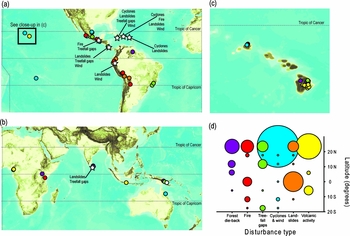
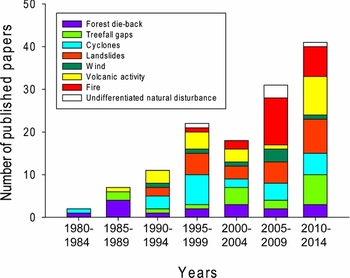
We found 119 articles that fitted these criteria. These studies were broadly distributed across many TMFs and address many different disturbance types, though more studies originate from the northern hemisphere and there is a strong focus on cyclones (Figure 1). The topic shows a marked increase in publication especially since the mid-1990s (Figure 2). We compiled information from each article into a database, including latitude, longitude, altitude, climatic descriptions and features of the disturbance regime including: type(s), frequency, spatial extent, mortality rate, environmental influences on disturbance, and disturbance effects on composition, structure and ecosystem function. We provide an overview of the literature for each category of disturbance, followed with a discussion of ecological effects of these disturbances in a TMF-specific context. It should be stressed that disturbance can be highly variable in scale, intensity and effects from one event to the next. The stochasticity and heterogeneity in disturbance regimes is important, but in this review our goal is to summarize the emergent features of each disturbance type when possible over and above this inherent variability.
Map of the location for peer-reviewed papers and the disturbance types of study for the western hemisphere (a), the eastern hemisphere (b), a close-up of the Hawaiian Islands (c), and the number of studies within eight equal-sized latitudinal belts (23.5−17.62°, 17.62−11.75°, 11.75−5.87°and 5.87−0° north or south latitude) per disturbance type (d). The size of the circle represents the number of studies in that belt, ranging from 1 to 23. Study sites are shown in circles and disturbance types are colour-coded: purple = forest die-back, red = fire, green = treefall gaps, blue = cyclones and wind, orange = landslides, yellow = volcanic activity, and white = undifferentiated natural disturbance. White stars represent sites that focus on multiple disturbances, with the types listed on map.

The frequency over time of peer-reviewed publications that focus on natural disturbance in tropical montane forests. This graph includes all peer-reviewed publications returned in a Google Scholar search using keyword combinations of tropical montane forest or tropical montane cloud forest and any of our focal disturbance types, e.g. cyclone or natural disturbance. We define tropical montane forests per traditional classifications as occurring between 23.5°S and 23.5°N latitude and above 1000 m asl. Bars are partitioned by the contribution of seven different disturbance types and undifferentiated natural disturbance.

Treefall gaps
Canopy gaps created by treefalls are ubiquitous in all forest types globally, yet there are strong patterns in gap regimes between forest types. An important driver in treefall patterns across forest types is variability in the cause of treefalls, which can include wind, snow and ice, insects, lightning, disease, drought and climate change and fires (Schliemann & Bockheim Reference SCHLIEMANN and BOCKHEIM2011). The majority of research on TMF gap dynamics has occurred in Central and South America, with some work in the Pacific (Figure 1), and it suggests treefall gaps in TMFs are created predominantly by wind.
In the lowland tropics, treefall gaps are fundamental to regeneration patterns in many forests because gaps are often quite large and other types of naturally occurring disturbance are often less common (Denslow Reference DENSLOW1987). Treefall gaps are an important source of heterogeneity and vegetation turnover in TMF landscapes as well (Arriaga Reference ARRIAGA1988, de Carvalho & Oliveira-Filho Reference DE CARVALHO and OLIVEIRA-FILHO2001, Lawton & Putz Reference LAWTON and PUTZ1988). However, in contrast to tropical lowland forests, treefall gaps in TMFs are smaller (Lawton & Putz Reference LAWTON and PUTZ1988), and occur less often (Arriaga Reference ARRIAGA1988), in part because of relatively short canopy heights in TMFs and because many TMF trees are highly resistant to uprooting and snapping (but see Bellingham et al. Reference BELLINGHAM, TANNER and HEALEY1994). Such structural resistance can mean mortality occurs predominantly as standing dead in some TMFs, leading to a slow and subtle increase of canopy light. However, others report that < 10% of the gaps in their sites result from standing dead trees (Arriaga Reference ARRIAGA1988, Lawton & Putz Reference LAWTON and PUTZ1988). TMFs also have few to no lianas which can make gaps much larger in lowland forests by bringing down neighbouring trees when a tree falls (Grubb Reference GRUBB1977, Putz Reference PUTZ1984). Finally, when trees do fall in a TMF, they frequently survive partially or fully horizontal (Gannon & Martin Reference GANNON and MARTIN2014, Soethe et al. Reference SOETHE, LEHMANN and ENGELS2006), further limiting the opening in growing space created by the gap. Taken together, the effects of treefall gaps on light levels in TMFs are much less dramatic in TMFs than many other forest types, and light levels in treefall gaps in TMFs are often not high enough to stimulate germination or recruitment of seedlings from shade-intolerant species (Arriaga Reference ARRIAGA2000).
Treefall gaps remain important in TMF dynamics nonetheless and there are notable patterns across sites. In TMFs, both gap apertures – and hence the availability of light – and the number of gaps vary greatly, with gap abundance ranging from 30 ha−1 to nearly 150 ha−1 across TMFs in our review (Alves et al. Reference ALVES, ASSIS, VAN MELIS, BARROS, VIEIRA, MARTINS, MARTINELLI and JOLY2012, Arriaga Reference ARRIAGA1988, Kellner et al. Reference KELLNER, ASNER, VITOUSEK, TWEITEN, HOTCHKISS and CHADWICK2011). Gap regimes result in canopy turnover rates ranging from ~ 100 to 150 y in some well-studied TMFs (Arriaga Reference ARRIAGA1988, de Carvalho & Oliveira-Filho Reference DE CARVALHO and OLIVEIRA-FILHO2001, Lawton & Putz Reference LAWTON and PUTZ1988). Patterns in gap size, mode and frequency can strongly relate to latitude between sites and topographic exposure within sites (Lawton & Putz Reference LAWTON and PUTZ1988), where the complex topography of TMFs creates a mosaic of exposure (to wind, lightning, etc.) that ranges from sheltered to fully exposed. The mode of gap formation (e.g. uprooted, snapped) has important implications for light and resource availability and varies along latitudinal gradients. Some studies indicate that gaps in TMFs at > 20° latitude are derived from uprooted trees due to significantly stronger wind storms in these latitudes (Arriaga Reference ARRIAGA1988, de Carvalho & Oliveira-Filho Reference DE CARVALHO and OLIVEIRA-FILHO2001), whereas gaps occurring at < 10° latitude are more typically derived from snapped trees (Arihafa & Mack Reference ARIHAFA and MACK2013, Matelson et al. Reference MATELSON, NADKARNI and SOLANO1995).
Treefall occurrence within a site is often related to soils and substrate. Rocky, shallow soils can be more susceptible to tree death and gap formation from wind disturbance (Arriaga Reference ARRIAGA2000, Bellingham et al. Reference BELLINGHAM, KAPOS, VARTY, HEALEY, TANNER, KELLY, DALLING, BURNS and SIDRAK1992), whereas areas with deeper, humic soils result in lower mortality because the deep humus allows trees to flex in the wind, reducing crown damage (Tanner & Bellingham Reference TANNER and BELLINGHAM2006). Recent work has also shown that patterns of the treefall gaps can be strongly linked to nutrient status and substrate age (Kellner et al. Reference KELLNER, ASNER, VITOUSEK, TWEITEN, HOTCHKISS and CHADWICK2011). Using a remotely sensed dataset of nearly half a million canopy gaps in Costa Rica (below 1000 m) and Hawai‘i (above 1000 m), Kellner & Asner (Reference KELLNER and ASNER2009) found that the size frequency distributions of canopy gaps had very similar patterns across all sites despite the differences in altitude, taxa, environments and prevailing wind patterns. In particular, gaps were more frequent and larger in size (due to larger trees making larger tree-fall gaps) in the most fertile sites.
Patterns of gap-phase regeneration in TMFs appear to be influenced by the biogeographic lineages of the tree species, with species of tropical affinities showing better recruitment in small gaps than those of temperate lineage (Arriaga Reference ARRIAGA2000). The role of biogeography in TMF gap dynamics needs more study, but the biogeographic mixture of TMFs is rich in life-history strategies (Arriaga Reference ARRIAGA2000, Lawton & Putz Reference LAWTON and PUTZ1988). Overall, the comparatively low frequency (Arriaga Reference ARRIAGA1988) and smaller size of gaps in TMFs suggests that there will be fewer species adapted to or dependent on gaps compared with other forest types.
Forest die-back
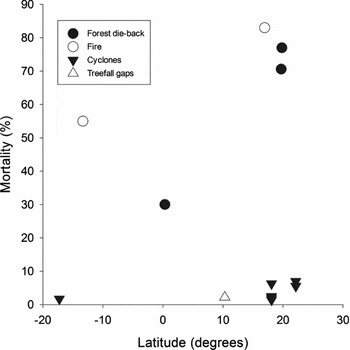
Forest or canopy die-back is a large-scale, synchronous forest mortality event. Forest die-back can stretch the ‘relatively discrete’ definition in Pickett & White (Reference PICKETT and WHITE1985), but it undoubtedly plays a pervasive role in the dynamics of some TMFs. Die-back is a common disturbance on Pacific island TMFs especially in Hawai‘i (Mueller-Dombois Reference MUELLER-DOMBOIS1986), as well as Papua New Guinea and Sri Lanka (Auclair Reference AUCLAIR1993), Borneo (by Podocarpus gibbsiae, possibly in response to El Niño-induced drought; Sawada et al. Reference SAWADA, AIBA, TAKYU, REPIN, NAIS and KITAYAMA2015), and in some continental TMFs including Venezuela (Dezzeo et al. Reference DEZZEO, HERNÁNDEZ and FÖLSTER1997) and Kenya (Fashing Reference FASHING2004) (Figure 1). Die-back is distinct from many other disturbance types because of its long return interval (as long as 1000 y; Crausbay et al. Reference CRAUSBAY, GENDERJAHN, HOTCHKISS, SACHSE, KAHMEN and ARNDT2014a, Mueller-Dombois Reference MUELLER-DOMBOIS1986). Die-back often begins as patches up to 2 ha in size (Dezzeo et al. Reference DEZZEO, HERNÁNDEZ and FÖLSTER1997), which can coalesce into areas of over 1000 ha of contiguous die-back (Jacobi Reference JACOBI1983). Along with fire (see below), the high mortality during die-back events – ranging from 30–90% across all die-back studies – makes it is distinct among TMF disturbance types (Figure 3).
Mortality caused by different disturbance types in tropical montane cloud forests from studies that report mortality; in Hawai‘i (Anderson et al. Reference ANDERSON, GARDNER, DAEHLER and MEINZER2002, Harrington et al. Reference HARRINGTON, FOWNES, SCOWCROFT and VANN1997, Herbert et al. Reference HERBERT, FOWNES and VITOUSEK1999, Jacobi Reference JACOBI1983), Jamaica (Bellingham et al. Reference BELLINGHAM, KAPOS, VARTY, HEALEY, TANNER, KELLY, DALLING, BURNS and SIDRAK1992, Reference BELLINGHAM, TANNER and HEALEY1995, Bellingham & Tanner Reference BELLINGHAM and TANNER2000, Tanner & Bellingham 1996), Kenya (Fashing Reference FASHING2004), Oaxaca (Asbjornsen et al. Reference ASBJORNSEN, VELÁZQUEZ-ROSAS, GARCÍA-SORIANO and GALLARDO-HERNÁNDEZ2005), the Andes (Román-Cuesta et al. Reference ROMÁN-CUESTA, SALINAS, ASBJORNSEN, OLIVERAS, HUAMAN, GUTIÉRREZ, PUELLES, KALA, YABAR, ROJAS, ASTETE, JORDÁN, SILMAN, MOSANDL, WEBER, STIMM, GÜNTER, KNOKE and MALHI2011), Monte Verde (Matelson et al. Reference MATELSON, NADKARNI and SOLANO1995), Papua New Guinea (Mack Reference MACK1998) and Australia (Herwitz & Young Reference HERWITZ and YOUNG1994).

Die-back events are integral in the regeneration strategy of some TMF tree species, as stands are generally colonized from seed by the same species experiencing die-back in the canopy (Arentz Reference ARENTZ1988, Boehmer et al. Reference BOEHMER, WAGNER, JACOBI, GERRISH and MUELLER-DOMBOIS2013, Jacobi et al. Reference JACOBI, GERRISH, MUELLER-DOMBOIS and WHITEAKER1988, Mueller-Dombois Reference MUELLER-DOMBOIS1986). For example, Metrosideros rarely recruits under mature forest stands, but shows vigorous recruitment in die-back stands (Jacobi et al. 1988, Mueller-Dombois Reference MUELLER-DOMBOIS1986). Similarly in the Kakamega Forest in Kenya, Prunus africana regenerates poorly except in Prunus die-back stands (Fashing Reference FASHING2004).
Tropical cyclones and large wind storms
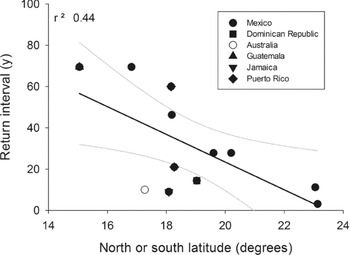
Tropical cyclones are notably large and intense disturbances, capable of influencing substantial areas of forested landscapes. The majority of research on the ecological impacts of tropical cyclones (also called hurricanes or typhoons) in TMFs has been conducted in the Caribbean where cyclonic storms are very common. Additional work has occurred in Central America, the Pacific and Australia (Figure 1). Other important studies of cyclone impacts to tropical forests occur in areas that are outside of the definition of TMFs used in this review, especially in Puerto Rico (below 1000 m) and in Taiwan (in study sites just north of the Tropic of Cancer). The mountainous areas of the Philippines and southern Taiwan are undoubtedly impacted regularly by cyclones given their very high frequency in the north-western Pacific (Xi et al. Reference XI, CHEN and CHU2012); to our knowledge, however, there are no published studies from these regions that fit our review criteria. Cyclone return intervals are tied to latitude, as cyclones generally occur at > 10° latitude and the amount of time between storms decreases with increasing distance from 10° latitude (Figure 4). This occurs because the prevailing trajectories of cyclones is to move away from the equator, creating strong recurrence gradients in TMFs across higher to lower latitudes, from frequent, to infrequent, to very rare. Reconstructions of historical storm tracks from 1848 to 2013 (the International Best Track Archive for Climate Stewardship) show that TMFs between ~ 10°N–10°S, and in Africa and South America entirely, were not affected by tropical cyclones at all.
Linear regression and 95% confidence intervals between cyclone return intervals and degrees of latitude (north or south) based on data reported in published papers from tropical montane forests from northeastern Mexico (Arriaga Reference ARRIAGA2000), Mexico and Guatemala (Vargas-Rodriguez & Platt Reference VARGAS-RODRIGUEZ and PLATT2012), Puerto Rico (Walker et al. Reference WALKER, ZARIN, FETCHER, MYSTER and JOHNSON1996), Dominican Republic (Gannon & Martin Reference GANNON and MARTIN2014), Jamaica (Bellingham et al. Reference BELLINGHAM, TANNER and HEALEY1995) and Australia (Herwitz & Young Reference HERWITZ and YOUNG1994). Note however that this trend would not continue to even lower latitudes, as cyclonic activity is essentially non-existent in latitudes < 10°.

Where frequent, tropical cyclones can be the primary source of damage and turnover in TMF landscapes, yet their impacts are often less catastrophic than anticipated. Rather, impacts are typically patchy and produce strong gradients of damage and mortality at landscape scales. This patchiness in TMFs is in sharp contrast to tropical lowland forests where cyclone damage is often high and spatially uniform, especially in flat areas without the sheltering effects of topography (Boose et al. Reference BOOSE, FOSTER and FLUET1994, Vandermeer et al. Reference VANDERMEER, MALLONA, BOUCHER, YIH and PERFECTO1995, Yih et al. Reference YIH, BOUCHER, VANDERMEER and ZAMORA1991). Patchy cyclone effects in TMFs are due to the inherent variability of wind speed and direction in a storm, but also because of marked variation in topography, soils and substrates, altitude and vegetation types in TMFs (Bellingham & Tanner Reference BELLINGHAM and TANNER2000, Bellingham et al. Reference BELLINGHAM, KAPOS, VARTY, HEALEY, TANNER, KELLY, DALLING, BURNS and SIDRAK1992, Gannon & Martin Reference GANNON and MARTIN2014, Lawton & Lawton Reference LAWTON and LAWTON2010, Martin et al. Reference MARTIN, SHERMAN and FAHEY2007, Reference MARTIN, FAHEY and SHERMAN2011; Sherman et al. Reference SHERMAN, MARTIN and FAHEY2005, Soethe et al. Reference SOETHE, LEHMANN and ENGELS2006, Tanner & Bellingham Reference TANNER and BELLINGHAM2006, Vázquez & Givnish Reference VÁZQUEZ-G and GIVNISH1998). For example, soils and topography influence cyclone damage patterns in Jamaican TMFs (Tanner & Bellingham Reference TANNER and BELLINGHAM2006), and cyclone-induced mortality is higher near ridge crests and upslope positions in TMFs (Bellingham & Tanner Reference BELLINGHAM and TANNER2000, Bellingham et al. Reference BELLINGHAM, KAPOS, VARTY, HEALEY, TANNER, KELLY, DALLING, BURNS and SIDRAK1992, Herwitz & Young Reference HERWITZ and YOUNG1994). Tree species’ characteristics, such as size (Walker Reference WALKER1991) and wood density (Zimmerman et al. Reference ZIMMERMAN, EVERHAM III, WAIDE, LODGE, TAYLOR and BROKAW1994), and stand attributes – especially species composition (Canham et al. Reference CANHAM, THOMPSON, ZIMMERMAN and URIARTE2010, Zimmerman et al. Reference ZIMMERMAN, EVERHAM III, WAIDE, LODGE, TAYLOR and BROKAW1994), diversity (Tanner & Bellingham Reference TANNER and BELLINGHAM2006) and structure (Brokaw & Grear Reference BROKAW and GREAR1991), interact with the meteorology and path of a cyclone to shape the patterns of damage and mortality in TMFs.
Cyclones in tropical mountains were originally thought to cause catastrophic damage to forests. However, cyclone mortality levels are usually quite low in TMFs, ranging from only 1.4% to 7% (Figure 3; Bellingham & Tanner Reference BELLINGHAM and TANNER2000, Bellingham et al. Reference BELLINGHAM, KAPOS, VARTY, HEALEY, TANNER, KELLY, DALLING, BURNS and SIDRAK1992, Harrington et al. Reference HARRINGTON, FOWNES, SCOWCROFT and VANN1997, Herbert et al. Reference HERBERT, FOWNES and VITOUSEK1999, Herwitz & Young Reference HERWITZ and YOUNG1994, Tanner & Bellingham Reference TANNER and BELLINGHAM2006; but see Gannon & Martin Reference GANNON and MARTIN2014). Although this is at least double background mortality levels, it is much lower than originally expected. Cyclone-induced mortality is low for several reasons, but foremost because many TMF tree species are highly resilient to wind damage via canopy, stem and stump re-sprouting ability, multi-stem growth habit, shorter tree height, biomechanical features and root grafting that anchors multiple individuals together (Asner & Goldstein Reference ASNER and GOLDSTEIN1997, Bellingham et al. Reference BELLINGHAM, TANNER and HEALEY1994, Reference BELLINGHAM, TANNER and HEALEY1995; Chai et al. Reference CHAI, HEALEY and TANNER2012, Gannon & Martin Reference GANNON and MARTIN2014, Herwitz & Young Reference HERWITZ and YOUNG1994, Tanner & Bellingham Reference TANNER and BELLINGHAM2006, Vargas-Rodriguez & Platt Reference VARGAS-RODRIGUEZ and PLATT2012). Cyclone-caused mortality in lowland tropical forests is also often low (Yih et al. Reference YIH, BOUCHER, VANDERMEER and ZAMORA1991, Zimmerman et al. Reference ZIMMERMAN, EVERHAM III, WAIDE, LODGE, TAYLOR and BROKAW1994), but overall TMFs are more resistant to cyclone damage and mortality than lowland tropical forests due to these plant traits and because storms usually weaken when passing over higher-altitude landmasses (Gannon & Martin Reference GANNON and MARTIN2014).
When a cyclone does impact a TMF, recovery appears to be fast with low mortality and rapid vegetative recovery of adults (Bellingham et al. Reference BELLINGHAM, TANNER and HEALEY1995, Harrington et al. Reference HARRINGTON, FOWNES, SCOWCROFT and VANN1997, Herbert et al. Reference HERBERT, FOWNES and VITOUSEK1999, Tanner & Bellingham Reference TANNER and BELLINGHAM2006). Growth rates for some species can be higher post-cyclone (Bellingham et al. Reference BELLINGHAM, TANNER and HEALEY1995, Walker et al. Reference WALKER, ZARIN, FETCHER, MYSTER and JOHNSON1996), often for decades (Tanner et al. Reference TANNER, RODRIGUEZ-SANCHEZ, HEALEY, HOLDAWAY and BELLINGHAM2014), and stand-level productivity can recover within 2 y (Harrington et al. Reference HARRINGTON, FOWNES, SCOWCROFT and VANN1997). However, experimental work suggests basal area may be slow to recover after cyclones, especially because of low-nutrient conditions and slow growth rates (Chai et al. Reference CHAI, HEALEY and TANNER2012). Some research suggests that regular exposure to high-wind storms and cyclones may cause or augment the short-statured forest structure characteristic of some cloud forests (Herwitz & Young Reference HERWITZ and YOUNG1994, Weaver Reference WEAVER2010), though short-statured canopies are not confined to wind- or cyclone-exposed TMFs.
Fire
Research on fire disturbance in TMFs has increased rapidly. Studies are mostly centred in the Neotropics, including the Caribbean (e.g. the Cordillera Central in the Dominican Republic, Martin & Fahey Reference MARTIN and FAHEY2006), Mexico (Asbjornsen et al. Reference ASBJORNSEN, VELÁZQUEZ-ROSAS, GARCÍA-SORIANO and GALLARDO-HERNÁNDEZ2005, Román-Cuesta et al. Reference ROMÁN-CUESTA, RETANA and GRACIA2004) and several sites in the Andes ranging from 2°S to 13°S latitude (Coblentz & Keating Reference COBLENTZ and KEATING2008), but there is also important work in Africa (Hemp Reference HEMP2005) (Figure 1). Recent palaeoecological studies have also demonstrated the historic importance of fire in TMFs, finding correlations in climatic fluctuations, fire occurrence and human land use over millennial time-scales (Bush et al. Reference BUSH, HANSEN, RODBELL, SELTZER, YOUNG, LEON, ABBOTT, SILMAN and GOSLING2005, Conserva & Byrne Reference CONSERVA and BYRNE2002, Crausbay et al. Reference CRAUSBAY, GENDERJAHN, HOTCHKISS, SACHSE, KAHMEN and ARNDT2014a, Reference CRAUSBAY, MARTIN and KELLY2015; Dull Reference DULL2004, Hope Reference HOPE2009, Islebe & Hooghiemstra Reference ISLEBE and HOOGHIEMSTRA1997, Urrego et al. Reference URREGO, NICCUM, LA DREW, SILMAN and BUSH2011). Until recently however, fire was generally considered rare in TMFs (Asbjornsen & Wickel Reference ASBJORNSEN, WICKEL and Cochrane2009), in part because of the prominence of the fire-resistant cloud zone in the study of TMFs, but natural fires can be quite common in some parts of tropical montane landscapes (Ashton Reference ASHTON2003, Martin & Fahey Reference MARTIN and FAHEY2006, Martin et al. Reference MARTIN, SHERMAN and FAHEY2007, Smith & Young Reference SMITH and YOUNG1987).
Patterns of fire regimes on tropical mountains are often spatially abrupt due to the unique climatic patterns in TMFs, in particular the influence of the trade wind inversion (TWI) on many tropical mountains. The TWI is a conspicuous, broad-scale climate feature that is a consequence of the descending arm of the Hadley Cell and as a result, it is limited to higher latitudes in the tropics. The TWI traps moist air and clouds on windward slopes below a roughly constant altitude (Martin & Fahey Reference MARTIN and FAHEY2014), above which a pronounced decrease in relative humidity and precipitation occurs. Fire occurrence in TMFs is associated with these altitudinal patterns in moisture (Crausbay et al. Reference CRAUSBAY, GENDERJAHN, HOTCHKISS, SACHSE, KAHMEN and ARNDT2014a, Reference CRAUSBAY, MARTIN and KELLY2015), and fire-prone and fire-resistant vegetation types often occur in close proximity. Mountains which are influenced by the TWI and tall enough to have areas above the cloud zone probably experience regular natural fires due to the generally arid conditions, as exemplified by the fire regimes in the high-altitude páramo and puna grasslands of the Andes and Central America (see review in Horn & Kappelle Reference HORN, KAPPELLE and Cochrane2009). Orographic effects on moisture patterns also influence tropical montane fire regimes with fires concentrated in the rainshadow (Martin & Fahey Reference MARTIN and FAHEY2006), as in temperate systems (Baisan & Swetnam Reference BAISAN and SWETNAM1990, Brown et al. Reference BROWN, KAYE, HUCKABY and BAISAN2001). The TMF fire regime is strongly influenced by these climate gradients, with fire return intervals varying from less than 30 y in some drier areas to over 500 y depending on latitude, altitude, topographic position and vegetation type (Asbjornsen & Wickel Reference ASBJORNSEN, WICKEL and Cochrane2009, Martin & Fahey Reference MARTIN and FAHEY2006, Martin et al. Reference MARTIN, FAHEY and SHERMAN2011, Román-Cuestra et al. Reference ROMÁN-CUESTA, RETANA, GRACIA, NEWTON and Newton2007). TMFs that support a regular fire regime generally occur in study sites with significantly lower rainfall compared with other disturbance types in this review (median rainfall = 1850 mm; Kruskal–Wallis, P = 0.005) and often have a marked dry season where precipitation averages < 100 mm mo−1 for at least several consecutive months. TMF fires also show strong patterns with topography as in other montane regions, with small-scale burn patterns associated with topographic position (Martin et al. Reference MARTIN, FAHEY and SHERMAN2011, Sherman et al. Reference SHERMAN, MARTIN, FAHEY and DEGLORIA2008), greater burn intensity based on aspect (Aráoz & Grau Reference ARÁOZ and GRAU2010), and fire spread limited by topographic roughness and configuration (Coblentz & Keating Reference COBLENTZ and KEATING2008). Indeed, increased topographic roughness and decreased spatial connectivity at higher altitudes a priori make fire spread idiosyncratic, creating a mosaic of burn patterns on the landscape despite the aridity characteristic of the highlands. Such fire-topography interactions in the Andes leave tree islands that have escaped past fires in a matrix of fire-affected vegetation (Coblentz & Keating Reference COBLENTZ and KEATING2008).
Of course, large areas of TMF are not regularly impacted by naturally ignited fires. Zones which are always wet or do not experience a marked dry season are probably mostly fire-free. A palaeorecord from a Hawaiian TMF shows that for ~ 7000 y the montane cloud forest experienced no fire until a fire regime began a few hundred years after human arrival (Crausbay et al. Reference CRAUSBAY, GENDERJAHN, HOTCHKISS, SACHSE, KAHMEN and ARNDT2014a). TMFs infrequently or rarely affected by fires can be broadly grouped by geography: equatorial latitudes, which generally are not affected by the TWI and have weak or non-existent dry seasons; TMFs near the ocean, which usually experience high precipitation; TMFs on smaller mountains, which are mostly too low to have a high-altitude arid zone above the clouds and which do not create a pronounced rain shadow in leeward areas; and TMFs where prevailing weather patterns regularly distribute high humidity and moisture across the TMF landscape.
In combination with sharp discontinuities in climate along the altitudinal gradient, fire-vegetation feedbacks often maintain and reinforce sharp vegetation boundaries on many tropical mountains. In particular, the cloud forest with its heavy bryophyte abundance (which can ‘strip’ moisture from low-lying clouds; Veneklaas et al. Reference VENEKLAAS, ZAGT, VAN LEERDAM, VAN EK, BROEKHOVEN and VAN GENDEREN1990) rarely burns, while nearby or bordering vegetation can be fire-prone with highly flammable fuels (Sherman et al. Reference SHERMAN, MARTIN, FAHEY and DEGLORIA2008). This dynamic is evident in several fire-maintained discrete ecotones on tropical mountains: a Podocarpus–Erica boundary in Africa (Hemp Reference HEMP2005), a tropical montane cloud forest (TMCF)-Pinus ecotone in the Dominican Republic (Martin & Fahey Reference MARTIN and FAHEY2006, Martin et al. Reference MARTIN, SHERMAN and FAHEY2007, Reference MARTIN, FAHEY and SHERMAN2011; Sherman et al. Reference SHERMAN, MARTIN and FAHEY2005, Reference SHERMAN, MARTIN, FAHEY and DEGLORIA2008), and a TMCF-puna boundary in the Andes (Zimmermann et al. Reference ZIMMERMANN, MEIR, SILMAN, FEDDERS, GIBBON, MALHI, URREGO, BUSH, FEELEY, GARCIA, DARGIE, FARFAN, GOETZ, JOHNSON, KLINE, MODI, RURAU, STAUDT and ZAMORA2010). At very high altitudes, a paradigm of fire-controlled treelines has been often applied in tropical mountains, particularly where fire regimes are influenced directly or indirectly by human activities (Cavalier et al. Reference CAVALIER, AIDE, SANTOS, EUSSE and DUPUY1998, Corlett Reference CORLETT1987, Ellenberg Reference ELLENBERG1979, Lægaard Reference LÆGAARD, Balslev and Luteyn1992, Young Reference YOUNG1993). Fires regularly create ecotones between tropical montane forest types at low altitudes as well (Ashton Reference ASHTON2003, Grau & Veblen Reference GRAU and VEBLEN2000, Hemp Reference HEMP2005, Kowal Reference KOWAL1966, Ohsawa Reference OHSAWA, Hamilton, Juvik and Scatena1995, Unwin Reference UNWIN1989). Fire-maintained ecotones in TMFs are likely to be highly sensitive to changing climatic conditions as warming temperatures and increased variability in moisture patterns will directly alter the behaviour of fire regimes (Asbjornsen & Wickel Reference ASBJORNSEN, WICKEL and Cochrane2009).
Periodic droughts associated with El Niño-Southern Oscillation events and other climatic oscillations are especially important in the triggering of fires in TMFs (e.g. TMFs in the Caribbean and New Guinea). Once started, a fire's spread is then determined by wind conditions and spatial patterns in moisture, topography, fuels and vegetation type. However, when a drought is severe enough and/or extreme fire weather occurs, fires can override landscape controls and spread into forests where fire is normally excluded, like the cloud forest (Asbjornsen & Wickel Reference ASBJORNSEN, WICKEL and Cochrane2009, Asbjornsen et al. Reference ASBJORNSEN, VELÁZQUEZ-ROSAS, GARCÍA-SORIANO and GALLARDO-HERNÁNDEZ2005, Martin & Fahey Reference MARTIN and FAHEY2006, Martin et al. Reference MARTIN, FAHEY and SHERMAN2011, Román-Cuesta et al. Reference ROMÁN-CUESTA, RETANA, GRACIA, NEWTON and Newton2007, Sherman et al. Reference SHERMAN, MARTIN, FAHEY and DEGLORIA2008). In addition to droughts and weather, cyclone damage also has been found to make portions of a cloud forest more susceptible to burning than undamaged areas (Sherman et al. Reference SHERMAN, MARTIN, FAHEY and DEGLORIA2008). As in other forest types sensitive to fire (e.g. moist lowland tropical forests), fires in the cloud forest are usually highly damaging and recovery can be quite slow (Asbjornsen et al. Reference ASBJORNSEN, VELÁZQUEZ-ROSAS, GARCÍA-SORIANO and GALLARDO-HERNÁNDEZ2005, Martin et al. Reference MARTIN, FAHEY and SHERMAN2011). Indeed, fire is unusual in this review among disturbance types (along with die-back) due to associated high mortality (Figure 3; Asbjornsen et al. Reference ASBJORNSEN, VELÁZQUEZ-ROSAS, GARCÍA-SORIANO and GALLARDO-HERNÁNDEZ2005, Sherman et al. Reference SHERMAN, MARTIN, FAHEY and DEGLORIA2008), though some drier TMFs are well adapted to surface fire regimes.
In some TMFs, there is strong evidence that fire disturbance is part of the natural forest regeneration cycle. A study in the pine-oak and montane cloud forests of western Mexico found that exposure to fire and its by-products (heat, smoke and ash) increased germination in 92% of species tested, but different species required different combinations to break dormancy (Zuloaga-Aguilar et al. Reference ZULOAGA-AGUILAR, BRIONES and OROZCO-SEGOVIA2011). For example, most species from burned areas of pine-oak and mixed forests in Mexico (1600–2200 m asl) required heat shock for germination (Zuloaga-Aguilar et al. Reference ZULOAGA-AGUILAR, BRIONES and OROZCO-SEGOVIA2010), showing that TMCF seeds from Mexico can survive low-intensity fires. Distinct fire-regeneration cycles also can be found in Hagenia abyssinica-dominated forests in Africa, in Polylepis and other subalpine forests in South America, and in Metrosideros polymorpha forests in Hawai‘i (Bussmann Reference BUSSMANN2004).
Landslides
Landslides are perhaps more common in TMFs than any other ecosystem in the world, occurring frequently due to steep slopes, heavy precipitation, earthquakes and frequent cyclone activity which collectively cause regular slides. Research on landslides in TMFs is therefore fairly well-represented, with studies from nine different countries spread across the Caribbean, Central and South America, and in the Pacific.
Landslides play a central role in the disturbance, primary succession and dynamics of tropical montane forest systems, and are important in the maintenance of structural and species diversity at regional scales (Kessler Reference KESSLER1999, Ohl & Bussmann Reference OHL and BUSSMANN2004, Richter Reference RICHTER2009). There are well-defined successional stages following landslides, often beginning with nitrogen-fixing cryptograms. The early stages of succession are typically very low in species richness, sometimes due to the dominance of clonal or climbing ferns and grasses (Ohl & Bussmann Reference OHL and BUSSMANN2004). Diversity increases to peak levels at intermediate age in succession (Kessler Reference KESSLER1999) and reaches levels higher than the surrounding matrix (Ohl & Bussmann Reference OHL and BUSSMANN2004). For example, around 20% of all landslide taxa are landslide-dependent and only occur in these early stages of landslide succession (Kessler Reference KESSLER1999), though this pattern does not apply at every site (Walker & Shiels Reference WALKER and SHIELS2012).
Landslides are notable for affecting only a very small portion of the TMF landscape – generally only up to 1.5% per century (Dalling & Iremonger Reference DALLING and IREMONGER1994, Larsen & Torres-Sánchez Reference LARSEN and TORRES-SÁNCHEZ1998, Restrepo & Alvarez Reference RESTREPO and ALVAREZ2006) – while usually creating very severe impacts due to the nearly complete loss of soil. In particular, landslides impact the organic horizon and post-landslide soils have notably lower nutrients and organic material for more than two decades after the slide (Bussmann et al. Reference BUSSMANN, WILCKE, RICHTER, Beck, Bendix, Kottke, Makeschin and Mosandl2008). Relative to the undisturbed matrix, landslides are also characterized by the loss of mycorrhizal symbionts, high rates of herbivory (e.g. losses of new plant recruits as high as 15%), and strongly altered soil temperature and moisture, all of which are major compositional filters on germination, colonization and regrowth of vegetation (Dalling Reference DALLING1994, Dalling & Tanner Reference DALLING and TANNER1995, Myster Reference MYSTER1997, Restrepo & Alvarez Reference RESTREPO and ALVAREZ2006). The rate of vegetation development on landslides can be high, but is extremely variable, and the exact pathway is controlled by altitude, microclimate, soil stability, competitive interactions and nutrient availability (Bussmann et al. Reference BUSSMANN, WILCKE, RICHTER, Beck, Bendix, Kottke, Makeschin and Mosandl2008, Walker et al. Reference WALKER, ZARIN, FETCHER, MYSTER and JOHNSON1996).
Landslides have predictable spatial patterns of occurrence based on topography and substrate distributions, and occur most frequently in areas with regular seismic activity, at higher altitudes, on slopes > 12° inclination, in smaller catchment areas, on slopes facing prevailing winds (e.g. trade winds), in locations with high rainfall, and in areas subject to cyclones (Gannon & Martin Reference GANNON and MARTIN2014, Larsen & Torres-Sánchez Reference LARSEN and TORRES-SÁNCHEZ1998, Muenchow et al. Reference MUENCHOW, BRENNING and RICHTER2012). Overall, more than 75% of the planimetric area of TMFs have slopes > 27° and are therefore highly landslide-prone (Spracklen & Righelato Reference SPRACKLEN and RIGHELATO2014). Vegetation loads can also trigger landslides, and the idea of a ‘mosaic succession cycle’ is used to describe the oscillation between slope stability and instability, where instability is increased by growing forests, while after a landslide, slopes are quickly stabilized by a regenerating root system and changes in the flow regime (Richter Reference RICHTER2009). Overall, the importance of landslides is receiving more attention globally, not only in terms of their effect on ecological processes, but also in their role in human societal well-being and the role of humans in landslide intensification (Walker & Shiels Reference WALKER and SHIELS2012).
Volcanic activity
Volcanic activity occurs throughout much of the montane tropics, yet our search only found papers from Africa (Mount Cameroon), Indonesia (Gunung Merapi) and the Hawaiian Islands (Mauna Loa Volcano and Kīlauea Volcano) that address volcanic disturbance in TMFs (Figure 1). On Mount Cameroon, volcanic eruptions have occurred eight times in last 100 y or once every 12.5 y on average (Forboseh et al. Reference FORBOSEH, SUNDERLAND, COMISKEY and BALINGA2011), while Hawai‘i and Indonesia experience eruptions twice as frequently, averaging every 3–5 y and 2–3 y, respectively. Volcanic activity creates a variable disturbance regime that includes lava flows, pyroclastic flows, large revolving superheated clouds of gases (Suryonto et al. Reference SURYANTO, ZAKI, AZANI and AZMY2010), and deep ash and cinder deposits that can cover extensive areas of developed forest. Ash and cinder deposits can thin an established forest, increase mortality and increase regeneration (Forboseh et al. Reference FORBOSEH, SUNDERLAND, COMISKEY and BALINGA2011, Vitousek & Walker Reference VITOUSEK and WALKER1989). In Hawai‘i, ash- or cinder-fall events are often followed by high recruitment of tree ferns, opportunistic colonizers or non-native invasive species (Forboseh et al. Reference FORBOSEH, SUNDERLAND, COMISKEY and BALINGA2011, Vitousek & Walker Reference VITOUSEK and WALKER1989). Vegetation development on lava constitutes a fairly regular and predictable process, but as with landslides, the rate and exact pathway varies with climate (Aplet & Vitousek Reference APLET and VITOUSEK1994, Aplet et al. Reference APLET, HUGHES and VITOUSEK1998, Clarkson Reference CLARKSON1998) and can be highly altered by invasive species (Clarkson Reference CLARKSON1998, Vitousek & Walker Reference VITOUSEK and WALKER1989, Walker & Vitousek Reference WALKER and VITOUSEK1991).
Recurring lava flows also fragment the TMF landscape, creating mosaics of fresh lava, early successional vegetation and established forest ‘islands’, offering a model system to study the effects of fragmentation on TMF communities. Fresh lava surrounding fragments of intact forest creates discrete habitat edges with acute differences in substrate and microclimate, which in turn creates pronounced edge effects on the forest fragment. For instance, in a Hawaiian TMF impacted by lava flows, structure in forest fragments (i.e. stand volume, maximum tree height and canopy height heterogeneity) was highly correlated with fragment area, which in turn translated into differences in dominance and diversity of animal communities (Flaspohler et al. Reference FLASPOHLER, GIARDINA, ASNER, HART, PRICE, LYONS and CASTANEDA2010, Vandergast & Gillespie Reference VANDERGAST and GILLESPIE2004).
EFFECTS OF DISTURBANCE IN TROPICAL MONTANE FORESTS
Forest structure
Natural disturbance events in TMFs can have conspicuous impacts on forest structure, often with important feedbacks on community composition, ecosystem processes, and future disturbance probabilities. As in other forested ecosystems, disturbances generally reduce stand-level basal area, tree canopy height and leaf area index (LAI) in TMFs while simultaneously increasing dead biomass, fine fuels, and resources in the understorey especially light and nutrients (Aplet & Vitousek Reference APLET and VITOUSEK1994, Raich et al. Reference RAICH, RUSSELL and VITOUSEK1997, Román-Cuesta et al. Reference ROMÁN-CUESTA, SALINAS, ASBJORNSEN, OLIVERAS, HUAMAN, GUTIÉRREZ, PUELLES, KALA, YABAR, ROJAS, ASTETE, JORDÁN, SILMAN, MOSANDL, WEBER, STIMM, GÜNTER, KNOKE and MALHI2011). A number of disturbances – especially wind storms, cyclones and fires – can promote the partially leaning, horizontal and multi-stemmed tree structure so common in TMFs (Arriaga Reference ARRIAGA2000, Asbjornsen & Wickel Reference ASBJORNSEN, WICKEL and Cochrane2009, Chai et al. Reference CHAI, HEALEY and TANNER2012, Gannon & Martin Reference GANNON and MARTIN2014, Hemp Reference HEMP2006, Martin et al. Reference MARTIN, SHERMAN and FAHEY2007, Román-Cuestra et al. Reference ROMÁN-CUESTA, SALINAS, ASBJORNSEN, OLIVERAS, HUAMAN, GUTIÉRREZ, PUELLES, KALA, YABAR, ROJAS, ASTETE, JORDÁN, SILMAN, MOSANDL, WEBER, STIMM, GÜNTER, KNOKE and MALHI2011, Tanner & Bellingham Reference TANNER and BELLINGHAM2006, Zuloaga-Aguilar et al. Reference ZULOAGA-AGUILAR, BRIONES and OROZCO-SEGOVIA2010). Multi-stemmed structures are both a response to disturbance and an adaptation to future disturbance; in particular, multi-stemmed trees experience lower mortality after a cyclone than single-stemmed trees, which subsequently favours multi-stem persistence in TMFs (Bellingham & Sparrow Reference BELLINGHAM and SPARROW2009, Tanner & Bellingham Reference TANNER and BELLINGHAM2006).
The relationship between structure and disturbance patterns can be related to soil fertility gradients across broad scales in TMFs. In particular, nutrient availability has been linked to the degree of damage caused by disturbance. Structural resistance to damage from cyclonic winds appears to be highest in stands with low P availability, while areas with higher fertility and attendant higher LAI are far more susceptible to wind damage (Herbert et al. Reference HERBERT, FOWNES and VITOUSEK1999). These data are in line with recent work that suggests an underlying principle that processes associated with ecosystem development and nutrient availability directly influence forest structure through feedbacks on disturbance type, size and frequency (Kellner & Asner Reference KELLNER and ASNER2009, Kellner et al. Reference KELLNER, ASNER, VITOUSEK, TWEITEN, HOTCHKISS and CHADWICK2011).
Disturbance may also directly contribute to the classic patterns in TMF structure of short-statured stands with a high diameter:height ratio and a high root:shoot ratio, especially in the cloud zone (see review in this issue, Fahey et al. Reference FAHEY, SHERMAN and TANNER2016). Lawton (Reference LAWTON1982) first suggested frequent disturbance by strong winds was partly responsible for the structure of elfin cloud forest, perhaps as a chronic or ‘pressed’ event. Subsequent research in Costa Rica has found that low canopy height, low basal area and presence of stilt-roots are more frequent in ridge areas of TMFs that received frequent disturbance by strong winds (Hager & Dohrenbusch Reference HAGER, DOHRENBUSCH, Bruijnzeel, Scatena and Hamilton2011). In contrast, in Puerto Rico and Australia short-statured elfin cloud forests are thought to result in part from recurrent cyclone events (Herwitz & Young Reference HERWITZ and YOUNG1994, Weaver Reference WEAVER2010). A review of lowland tropical forests worldwide supports this hypothesis, finding a significant correlation between short forest canopies and the occurrence of tropical cyclones (de Gouvenain & Silander Reference DE GOUVENAIN and SILANDER2003). There is some doubt that such a correlation applies everywhere, however. Thomas et al. (Reference THOMAS, MARTIN and MYCROFT2015) downplayed the role of cyclones as a determinant of height of lowland rain forests in Dominica, maintaining that chronic high-winds override other determinants of height allometries in tropical trees. Depending on scale and type, disturbance can also compound the conditions contributing to low productivity in TMFs, both directly by causing mortality and damage to primary producers, and indirectly via nutrient limitation by increasing pools of unavailable nutrients in woody debris and necromass. Clearly, disturbance-productivity interactions in TMFs are a strong candidate for further study.
Vegetation turnover
Mortality and recovery rates of forest structure to pre-disturbance levels are highly variable among disturbance types. In particular, mortality rates span a large range among disturbance types, with die-back and fire resulting in very high mortality while cyclones, though often expected to be catastrophic, result in low mortality (Figure 3). Nutrient availability, climatic context and competitive interactions all play a role in TMF post-disturbance recovery rates. Where the soil is altered or eroded due to disturbance, rates of recovery can be very slow. In particular, the effects of landslides on TMF structure and composition are significantly more persistent than other disturbance types, especially cyclones (Dalling Reference DALLING1994, Dislich & Huth Reference DISLICH and HUTH2012). Post-disturbance recovery rates across tropical mountains differ with altitude, perhaps because of strong temperature gradients. A classic example of this pattern is found in the rate of biomass accumulation on lava flows declining with altitude in Hawai‘i: at 1200 m asl, biomass reached 1000 g m−2 after ~ 85 y, while taking ~ 450 y to reach the same biomass at 1800 m asl (Aplet & Vitousek Reference APLET and VITOUSEK1994, Raich et al. Reference RAICH, RUSSELL and VITOUSEK1997). TMFs with rich mixtures of biogeographic lineages can complicate this pattern, however, as some tree species with temperate lineages – especially from the Pinaceae – can continue to grow vigorously at high altitudes (Ohsawa Reference OHSAWA, Hamilton, Juvik and Scatena1995, P. H. Martin unpubl. data). Far more studies in TMFs which include individual tree and plot-level growth and productivity data along gradients are needed to verify the generality of this pattern.
Composition and richness
Disturbance has profound impacts on patterns of composition and dominance in TMFs. A key contribution of disturbance in many forest types is its effects on species co-existence and landscape-scale patterns of species richness. Spatially patchy and low-to-moderate-severity natural disturbances can serve as ‘intermediate disturbances’ in TMFs, which are theorized to maintain the co-existence of species with contrasting life-histories in forests (sensu Connell Reference CONNELL1978). Evidence shows that intermediate disturbances can increase diversity at landscape scales in TMFs by facilitating the recruitment and persistence of rare and early-successional species (Bellingham et al. Reference BELLINGHAM, KAPOS, VARTY, HEALEY, TANNER, KELLY, DALLING, BURNS and SIDRAK1992, Chai et al. Reference CHAI, HEALEY and TANNER2012, Gannon & Martin Reference GANNON and MARTIN2014, Lawton & Lawton Reference LAWTON and LAWTON2010, Tanner & Bellingham Reference TANNER and BELLINGHAM2006, Tejeda-Cruz & Sutherland Reference TEJEDA-CRUZ and SUTHERLAND2005).
Tropical cyclones can create intermediate disturbances, leaving a mosaic of conditions and patches across the TMF landscape and significantly increasing the recruitment and abundance of light-demanding species, leading to long-term increases in beta and gamma diversity at landscape scales (Martin et al. Reference MARTIN, SHERMAN and FAHEY2007, Sherman et al. Reference SHERMAN, MARTIN and FAHEY2005, Tanner & Bellingham Reference TANNER and BELLINGHAM2006). Light-demanding early-successional species comprise a significant fraction of the species richness in cyclone-influenced Caribbean forests below 1000 m (Uriarte et al. Reference URIARTE, CANHAM, THOMPSON, ZIMMERMAN and BROKAW2005) and in general occur at a higher frequency in cyclone-influenced montane forests relative to expectations from gap dynamics alone (Bellingham et al. Reference BELLINGHAM, KAPOS, VARTY, HEALEY, TANNER, KELLY, DALLING, BURNS and SIDRAK1992). Studies of cyclone effects on TMF composition and richness come predominately from regions where cyclones are moderately frequent. We lack information on effects in TMFs where cyclones are very frequent (especially in the Philippines), although studies indicate that major shifts in composition do not occur in subtropical Taiwan where cyclones are very frequent (Xi et al. Reference XI, CHEN and CHU2012). Compositional effects similar to moderately frequent cyclones are associated with other disturbance types as well. For example, around 20% of all landslide taxa are landslide-dependent and only occur in the early stages of landslide succession (Dalling Reference DALLING1994, Kessler Reference KESSLER1999), while in Monteverde treefall gaps can function in a similar manner by increasing diversity locally (Patrick et al. Reference PATRICK, FOWLER, DUNN and SANDERS2012).
Disturbance-driven changes in resources preferentially increase the abundance and vigour of some species compared with pre-disturbance levels (Bellingham et al. Reference BELLINGHAM, TANNER and HEALEY1995, de Carvalho et al. Reference DE CARVALHO, FONTES and DE OLIVEIRA-FILHO2000, Tanner et al. Reference TANNER, RODRIGUEZ-SANCHEZ, HEALEY, HOLDAWAY and BELLINGHAM2014, Walker et al. Reference WALKER, ZARIN, FETCHER, MYSTER and JOHNSON1996), and can result in marked increases in regeneration for some taxa (Arentz Reference ARENTZ1988, Boehmer et al. Reference BOEHMER, WAGNER, JACOBI, GERRISH and MUELLER-DOMBOIS2013, Jacobi et al. Reference JACOBI, GERRISH, MUELLER-DOMBOIS and WHITEAKER1988, Martin et al. Reference MARTIN, FAHEY and SHERMAN2011, Mueller-Dombois Reference MUELLER-DOMBOIS1986). Recent research has found that germination of many TMCF seeds can be improved under conditions which mimic fire (Zuloaga-Aguilar et al. Reference ZULOAGA-AGUILAR, BRIONES and OROZCO-SEGOVIA2011). Furthermore, some TMF species recruit best in large-scale openings (Arentz Reference ARENTZ1988, Boehmer et al. Reference BOEHMER, WAGNER, JACOBI, GERRISH and MUELLER-DOMBOIS2013, Fashing Reference FASHING2004, Jacobi et al. Reference JACOBI, GERRISH, MUELLER-DOMBOIS and WHITEAKER1988, Mueller-Dombois Reference MUELLER-DOMBOIS1986) and show episodic recruitment events in their population structure and declining growth rates or abundance in the absence of disturbance (Arriaga Reference ARRIAGA2000, Chapman et al. Reference CHAPMAN, CHAPMAN, JACOB, ROTHMAN, OMEJA, REYNA-HURTADO, HARTTER and LAWES2010). These findings are in contrast to Weaver (Reference WEAVER1990), who hypothesized that a relatively infrequent level of disturbance in elfin TMFs limits the evolution of species adapted to colonizing large openings from seed.
However, in most TMFs, regeneration patterns after disturbances that do not disrupt soil profiles are strongly influenced by advance regeneration of seedlings and saplings in the understorey (Arriaga Reference ARRIAGA2000, Bellingham et al. Reference BELLINGHAM, TANNER and HEALEY1995, Lawton & Putz Reference LAWTON and PUTZ1988), as in many temperate forests. Hence, post-disturbance ‘colonizers’ often come from pre-existing juveniles. As with shade-tolerant species in temperate forests (Canham Reference CANHAM1988), the propagules of some of these shade-tolerant tree species in TMFs appear to require a gap to reach the canopy (de Carvalho et al. Reference DE CARVALHO, FONTES and DE OLIVEIRA-FILHO2000). The limited evidence we have also suggests tree species of tropical lineage are better adapted to succeed as advance regeneration through higher shade tolerance and the ability to respond rapidly to pulsed increases in resources (especially light) relative to species with temperate affinities which have more seasonal growth rhythms (Arriaga Reference ARRIAGA2000). Perhaps unique to TMFs, the regeneration of some hemi-epiphytic gap colonizers occurs preferentially on nurse logs in disturbed sites, often as the result of the hemi-epiphytic tree species growing in a canopy tree and then surviving a tree- or branch-fall to establish in new gaps (Lawton & Putz Reference LAWTON and PUTZ1988). Overall, the environmental heterogeneity produced by disturbance, particularly in light, coupled with the life-history variation in the community, has been demonstrated to promote co-existence and diversity in plants (Arriaga Reference ARRIAGA1988, Cruz-Fernández et al. Reference CRUZ-FERNÁNDEZ, ALQUICIRA-ARTEAGA and FLORES-PALACIOS2011, de Carvalho et al. Reference DE CARVALHO, FONTES and DE OLIVEIRA-FILHO2000, Goodale et al. Reference GOODALE, ASHTON, BERLYN, GREGOIRE, SINGHAKUMARA and TENNAKOON2012), as well as animals (Patrick et al. Reference PATRICK, FOWLER, DUNN and SANDERS2012).
Disturbance does not always increase species richness in TMFs. In particular, disturbances have rapidly accelerated the rate of invasion by exotic species in TMFs, at least on tropical islands (Anderson et al. Reference ANDERSON, GARDNER, DAEHLER and MEINZER2002, Bellingham et al. Reference BELLINGHAM, TANNER and HEALEY2005, Chai et al. Reference CHAI, HEALEY and TANNER2012, Clarkson Reference CLARKSON1998, Jacobi Reference JACOBI1983, Jacobi et al. Reference JACOBI, GERRISH, MUELLER-DOMBOIS and WHITEAKER1988, Merlin & Juvik Reference MERLIN, JUVIK, Hamilton, Juvik and Scatena1995, Mueller-Dombois Reference MUELLER-DOMBOIS2000, Tanner & Bellingham Reference TANNER and BELLINGHAM2006, Vitousek & Walker Reference VITOUSEK and WALKER1989, Walker & Vitousek Reference WALKER and VITOUSEK1991). A classic example of post-disturbance invasions in TMFs is ongoing in Jamaica where a cyclone in 1988 dramatically accelerated the invasion by the alien tree Pittosporum undulatum (Bellingham et al. Reference BELLINGHAM, TANNER and HEALEY2005). In Hawaiʻi, biomass recovery in die-back stands can be delayed by the colonization of non-native species (Anderson et al. Reference ANDERSON, GARDNER, DAEHLER and MEINZER2002, Jacobi Reference JACOBI1983, Jacobi et al. Reference JACOBI, GERRISH, MUELLER-DOMBOIS and WHITEAKER1988, Mueller-Dombois Reference MUELLER-DOMBOIS2000) and/or the native invasive fern Dicranopteris linearis (Gleicheniaceae). This fern is common throughout the Old World tropics and Polynesia, and regularly forms dense thickets > 3 m deep over large areas and can initiate an alternative stable state where tree species are excluded long-term from the patch (Mueller-Dombois Reference MUELLER-DOMBOIS2000). Such post-disturbance fern-thickets are common in other TMFs – for example, hectare-sized thickets of Dicranopteris pectinata persist in portions of the highlands in the Dominican Republic for at least a century after disturbance (Martin et al. Reference MARTIN, FAHEY and SHERMAN2011). Ferns from the Gleicheniaceae in general ‘are prominent on tropical landslides where they often form thickets that stabilise soils and competitively exclude other species’ (Walker & Shiels Reference WALKER and SHIELS2012).
Overall, disturbance is capable of generating pronounced changes in species-specific demography via altered growth and survivorship rates, fecundity and reproductive success. Such population-level effects scale-up to influence community patterns, altering biotic interactions, patterns dominance and diversity, and spatial organization on multiple scales. On a broad level, the spatial distribution and abundance of trees in TMFs are strongly influenced by the spatial patterns of disturbance, and where frequent, disturbance can weaken or supersede the biotic interactions that determine community dynamics, such as competition (Lawton & Lawton Reference LAWTON and LAWTON2010). More broadly, this research shows that equilibrium species composition and richness in TMFs at landscape scales is strongly shaped by the spatiotemporal structure of the disturbance regime, and will change as the disturbance regime changes (Turner Reference TURNER2010).
Function
Disturbance in TMFs have strong effects on nutrient cycling and productivity. Large wind and cyclone events have been shown to increase nutrient availability by causing large-scale deposition of fresh leaves, twigs and fine litter, resulting in a post-disturbance pulse of nutrients ~1.5 times higher for N, ~1.7 times higher for P and ~3.1 higher times for K (Harrington et al. Reference HARRINGTON, FOWNES, SCOWCROFT and VANN1997, Walker et al. Reference WALKER, ZARIN, FETCHER, MYSTER and JOHNSON1996). At slightly lower altitudes (700–900 m asl), epiphytic bromeliads brought to the ground after wind storms subsequently rooted into the soil and rapidly increased organic C, Fe, C, N and particularly P locally (Pett-Ridge & Silver Reference PETT-RIDGE and SILVER2002). Cyclone-caused pulses in nutrients can be short-lived in TMFs, however, depending on the degree of damage. Where significant inputs of woody debris occur, decomposition processes following cyclones can lower productivity due to nutrient immobilization by detritivores (Waide et al. Reference WAIDE, ZIMMERMAN and SCATENA1998). Given the strong effect of ambient temperatures on decomposition rates, this pattern presumably is more pronounced at higher altitudes, where inputs of wood debris will take longer to decompose due to colder conditions. Landslides also create patches of extremely low and extremely high levels of productivity that overall reduce productivity on a landscape scale (Restrepo et al. Reference RESTREPO, VITOUSEK and NEVILLE2003), and drive important transfers of carbon and sediments from TMFs into lower-altitude forests, riverine and coastal systems (Ramos Scharrón et al. Reference RAMOS-SCHARRÓN, CASTELLANOS and RESTREPO2012). It is tempting to conclude that disturbances in general negatively impact productivity across TMFs, but a modelling exercise found that typical treefall gap regimes in TMFs could actually increase productivity by ~ 7 Mg C ha−1 y−1 (Dislich & Huth Reference DISLICH and HUTH2012). This study suggests an improved understanding of the impacts of disturbance on nutrient availability and productivity in TMFs is needed.
Species traits
Our review found evidence of many TMF tree species with life-history traits that interact strongly with specific disturbances, indicating that disturbance has been part of TMF ecosystems over evolutionary time scales. Rates of mortality, revegetation and turnover in TMFs can vary according to species traits as much as disturbance type and species-specific traits have a direct influence on the level of damage and mortality sustained by the vegetation from a disturbance (Bellingham et al. Reference BELLINGHAM, TANNER and HEALEY1995).
A key trait in response to various disturbances in TMFs is branch, stem and/or stump sprouting. Resprouting ability broadly can be predicted from a species’ wood properties and sometimes by geographic affinity (Arriaga Reference ARRIAGA1988, Reference ARRIAGA2000; Asner & Goldstein Reference ASNER and GOLDSTEIN1997). Many cloud-forest taxa resprout vigorously from aerial buds after mechanical damage from high winds, allowing a relatively quick recovery of leaf area and leaf-level processes. In general, shade-tolerant species appear to be better resprouters than shade-intolerant, early-successional species (Matelson et al. Reference MATELSON, NADKARNI and SOLANO1995). Some TMF tree species can resprout after fire as well, especially after experiencing repeated burning and in locations near ecotones where fire is typically more common (Asbjornsen & Wickel Reference ASBJORNSEN, WICKEL and Cochrane2009, Hemp Reference HEMP2006, Román-Cuesta et al. Reference ROMÁN-CUESTA, SALINAS, ASBJORNSEN, OLIVERAS, HUAMAN, GUTIÉRREZ, PUELLES, KALA, YABAR, ROJAS, ASTETE, JORDÁN, SILMAN, MOSANDL, WEBER, STIMM, GÜNTER, KNOKE and MALHI2011, Zuloaga-Aguilar et al. Reference ZULOAGA-AGUILAR, BRIONES and OROZCO-SEGOVIA2010), and many shrubs (Martin & Fahey Reference MARTIN and FAHEY2006) and bamboos in TMF landscapes resprout vigorously after fire. However, tree species characteristic of the cloud forest are generally believed to lack resistance or resilience to fire, presumably because fire is rare in the cloud zone as noted above. This dynamic was exemplified in a cloud forest in the Dominican Republic where an anthropogenic-caused crown fire resulted in high mortality of trees, low resprouting of damaged trees, and an inability to recolonize the area via seed (May Reference MAY2000). Likewise, palaeoecological research in New Guinean TMFs showed that only tree ferns (Cyathea spp.) survived repeated fires, either as surviving residents or post-fire recruits (Hope Reference HOPE1976, Reference HOPE2009). However, recent work in the Peruvian Andes challenges this idea by showing that there are some fire-tolerant species within most common TMCF genera, including Clethra, Clusia, Miconia, Myrsine and Weinmannia (Oliveras et al. Reference OLIVERAS, MAHLI, SALINAS, HUAMAN, URQUIAGA-FLORES, KALA-MAMANI, QUINTANO-LOAIZA, CUBA-TORRES, LIZARRAGA-MORALES and ROMÁN-CUESTA2014). In general, TMF tree species’ ability to resprout after a disturbance is both species-specific and dependent on the disturbance type and can lead to stand-level changes in composition and dominance (Gannon & Martin Reference GANNON and MARTIN2014).
Root traits also interact with disturbance to influence damage and mortality patterns. TMF tree species have a variety of root traits that affect tree stability and susceptibility to wind damage, as elucidated in detail in a TMF in Ecuador (Soethe et al. Reference SOETHE, LEHMANN and ENGELS2006). Most of the structural roots in this TMF are confined to the ‘forest floor’ organic horizons and the ratio of root cross-sectional area to the height of a tree decreases with tree height. Where wind speeds and soil saturation are higher, Soethe et al. (Reference SOETHE, LEHMANN and ENGELS2006) found that as many as half of the trees were growing partially uprooted in a leaning or horizontal fashion. These rooting traits make many TMF tree species both resistant to blowdowns and resilient once blown down by surviving in inclined and partially uprooted positions. In contrast, there are some less common floristic elements of TMFs (e.g. Pinaceae) that are highly susceptible to uprooting, and large-scale blowdowns can occur where these species are abundant in areas exposed to wind storms or cyclones (Gannon & Martin Reference GANNON and MARTIN2014).
Landslides and volcanic activity initiate primary succession, in marked contrast to other natural disturbances where soil disturbance is comparatively minimal. Conditions of primary succession interact strongly with species traits and provide opportunities to regenerate for species unable to colonize in other early-successional environments (Dalling Reference DALLING1994). Species with certain life-history strategies such as nitrogen-fixers (e.g. lichens of the genus Stereocaulon on lava flows in Hawai‘i, Clarkson Reference CLARKSON1998), species with ericoid mycorrhizas and some ectomycorrhizal species (e.g. Pinus kesiya on landslides in Sumatra, Whitmore Reference WHITMORE1975) can be far more prevalent during primary succession relative to closed forests. Likewise, many small-seeded, wind-dispersed trees are especially successful on such exposed surfaces, where the lack of litter and organic layers combined with a high-light environment is advantageous for germination and early growth. When present, many clonal and climbing taxa – especially ferns from various families (e.g. Gleicheniaceae) – are amongst the most prominent colonists of landslides in tropical mountains (Walker & Shiels Reference WALKER and SHIELS2012). Such taxa often flourish in these environments and can rapidly colonize fresh landslides via several adaptations, notably extensive rhizome or stolon growth. Once established, ferns and other taxa can arrest subsequent tree regeneration for long periods (Walker & Shiels Reference WALKER and SHIELS2012). Some plant taxa appear to be landslide-obligates, for example certain herbaceous plants in the Bolivian Andes including ferns, bromeliads and grasses (Kessler Reference KESSLER1999). These landslide-obligate taxa may also require disturbed habitats because they disrupt competitive interactions which typically exclude them (Kessler Reference KESSLER1999). Overall, species that are successful in primary succession possess traits that allow them to regenerate and grow in extreme substrates and soils, which are characterized by high temperatures, low stability, low moisture and nutrient availability, low abundance of mycorrhizal fungi and other soil symbionts, and higher seed predation (Dalling Reference DALLING1994).
Global change
Disturbance regimes around the globe are in flux as temperatures warm and the broader climate changes (Turner Reference TURNER2010). Many TMF disturbance regimes are strongly shaped by climatic forcing, and so anticipating how disturbance regimes will be altered in TMFs by global change is urgent. Novel or unusual disturbances, induced by climate change, can result in rapid ecological change, far faster than by climate change alone. Palaeoecology offers vivid evidence of such dynamics – for example, in an upper montane cloud forest in Hawai‘i, climate-mediated changes in the disturbance regime was the primary cause of rapid and directional change in plant composition (Crausbay et al. Reference CRAUSBAY, GENDERJAHN, HOTCHKISS, SACHSE, KAHMEN and ARNDT2014a). Beyond direct effects on the frequency and severity of disturbance, climate change is altering TMFs in ways that are likely to interact with disturbance regimes. In particular, TMFs may gain species of tropical lineages and lose species of temperate lineages (which are often restricted to and dominant in the highest altitudes of tropical mountains; Ashton Reference ASHTON2003, Martin et al. Reference MARTIN, SHERMAN and FAHEY2007, Ohsawa Reference OHSAWA1990) as tree species of all lineages move higher upslope with warming temperatures (Chen et al. Reference CHEN, HILL, OHLEMULLER, ROY and THOMAS2011, Feeley et al. Reference FEELEY, SILMAN, BUSH, FARFAN, CABRERA, MALHI, MEIR, REVILLA, QUISIYUPANQUI and SAATCHI2011). Other features of global change – such as N-deposition (Phoenix et al. Reference PHOENIX, HICKS, CINDERBY, KUYLENSTIERNA, STOCK, DENTENER, GILLER, AUSTIN, LEFROY, GIMENO and ASHMORE2006), and rates of deforestation, afforestation and land-use change (Grau & Aide Reference GRAU and AIDE2008) – will most certainly increase in TMFs in the future as well.
Fires, landslides and cyclonic activity are the disturbance types most likely to be affected by climate change. Higher temperatures, altered precipitation patterns, and deeper and more frequent droughts are all likely to make fires more common and severe in TMFs. Likewise, models and observations show that tropical cyclones are increasing in severity under climate change (Knutson et al. Reference KNUTSON, MCBRIDE, CHAN, EMANUEL, HOLLAND, LANDSEA, HELD, KOSSIN, SRIVASTAVA and SUGI2010), and this could lead to increased fire severity in TMFs. Cyclones can leave high fuel loads and allow fuels to dry more rapidly due to greater light penetration to the understorey (Myers & van Lear Reference MYERS and VAN LEAR1998). The high fuel loads left by Hurricane Gilbert (1988) in the lowland forests of the Yucatán and a subsequent drought in 1988–1989 led to exceptionally severe and large fires in 1989 (Goldammer & Price Reference GOLDAMMER and PRICE1998). Patterns of cyclone-promoted fires have been reported also for tropical rain forests in the cyclone-prone region of Australia (Stocker Reference STOCKER1981, West et al. Reference WEST, STOCKER and UNWIN1988). In addition, drought may occur more frequently in the future (Dai Reference DAI2013), and while we did not consider drought as a disturbance type in this review, anticipating the potential effects of drought events in TMFs, particularly increased tree mortality and fire, is increasingly important (Crausbay et al. Reference CRAUSBAY, FRAZIER, GIAMBELLUCA, LONGMAN and HOTCHKISS2014b, Sawada et al. Reference SAWADA, AIBA, TAKYU, REPIN, NAIS and KITAYAMA2015). Likewise, increasing human populations and land-use pressures surrounding TMFs, combined with climate warming from anthropogenic forcing, is leading to dramatic intensification of fire regimes in TMF regions (Asbjornsen & Wickel Reference ASBJORNSEN, WICKEL and Cochrane2009).
TOWARDS A DYNAMIC VIEW OF TROPICAL MONTANE FORESTS
Here we address the organizing questions in this review. First, how common is disturbance generally across TMFs? Based on the evidence in this review, we posit that disturbance is very widespread and common in many TMFs. Natural disturbance is a fundamental trigger of dynamics in TMFs, altering resources and conditions in these low-productivity and low-light systems. In many TMFs, natural disturbance is the key determinant of canopy turnover, patterns of forest structure and tree species regeneration. Furthermore, natural disturbance in these resource-limited and often wind-exposed systems has influenced evolution of various life-history traits, including regeneration strategies, the ability to resprout and survive horizontally, and trade-offs between wood density and strategies for growth and productivity, suggesting that natural disturbance has long been an inherent component of TMF systems. At a minimum, natural disturbance is more prevalent in TMFs than commonly acknowledged and should take a larger role in models of tropical montane vegetation patterns and ecosystem function along with geography and environmental drivers.
Second, are there geographic gradients in disturbance type across TMFs? Tropical montane forests are widely distributed across the tropics in regions with steep environmental gradients and disturbance regimes are inherently stochastic. Consequently, the specific character of the disturbance regime in a TMF can be idiosyncratic. Nevertheless, at large scales TMF disturbance regimes display general patterns in frequency, type and severity along gradients in geography, climate, landscape position and topography, soil fertility and development and biotic composition, with latitude providing the most consistent driver of this variation. In particular, TMFs in wet, equatorial regions (between ~ 10°N and 10°S) are generally outside the global cyclone belts and do not experience a regular and deep dry season. Hence, these TMFs are probably the least affected by catastrophic and large-scale disturbances events like fire and cyclones. Instead, small-scale disturbance regimes, particularly landslides (Figure 1d), dominate near the equator, and can have strong local-regional effects on species abundance and diversity. However, these small-scale disturbances are unlikely to have strong effects on the spatial patterns of species distributions and community zonation. In contrast, the higher latitudes of the tropics – with greater seasonality, periodic droughts and cyclones – experience far more large disturbances and general interpretations of the ecological patterns and processes in these areas should carefully consider the role of disturbance. However, natural disturbance in TMFs has been studied much more at higher latitudes (Figure 1d) and > 75% of published papers in this review originate from latitudes > 10°. In particular, there are no studies addressing the dynamics and disturbance regime of TMFs near the equator in tectonically stable regions, such as the forests on the tabletop mountains or Tepuis of Venezuela (Steyermark & Dunsterville Reference STEYERMARK and DUNSTERVILLE1980). Most information about TMF dynamics close to the equator comes from tectonically active zones (especially the Andes), although Sawada et al. (Reference SAWADA, AIBA, TAKYU, REPIN, NAIS and KITAYAMA2015) is an exception. The scarcity of research in these areas highlights that a greater understanding of natural disturbance and forest dynamics in low-latitude TMFs is needed.
Third, how do TMF disturbance regimes compare to lowland tropical forests? In contrast to lowland tropical forests, disturbance regimes in TMF are more spatially structured, as the steep environment gradients and geographic complexity in tropical mountains can confine disturbance types and impacts to one portion of the gradient, which can feedback to reinforce vegetation zonation patterns. The complexity in tropical mountains can also support more disturbance types than a similar area of lowland forest, and hence disturbance interactions are more likely in TMFs, as in temperate mountains (Bigler et al. Reference BIGLER, KULAKOWSKI and VEBLEN2005). Relative to lowland tropical forests, TMFs are clearly more prone to landslides, and also appear more prone to catastrophic disturbances like fires and die-backs that affect large portions of the landscape. The spatial patterns created by disturbance can leave longer legacies on TMF structure and composition, in comparison to higher productivity lowland systems with faster turnover. Fourth, are TMFs unusually sensitive to disturbance given the low productivity characteristic of these ecosystems? Post-disturbance recovery rates are slow in very low-nutrient environments, particularly landslides, and they clearly decline with altitude (Aplet & Vitousek Reference APLET and VITOUSEK1994, Raich et al. Reference RAICH, RUSSELL and VITOUSEK1997, Restrepo et al. Reference RESTREPO, VITOUSEK and NEVILLE2003, Walker et al. Reference WALKER, ZARIN, FETCHER, MYSTER and JOHNSON1996). However, there are multiple examples of growth rates post disturbance that exceeded expectations, particularly in sites dominated by temperate lineage trees and in post-cyclone disturbance areas (Bellingham et al. Reference BELLINGHAM, TANNER and HEALEY1995, Tanner et al. Reference TANNER, RODRIGUEZ-SANCHEZ, HEALEY, HOLDAWAY and BELLINGHAM2014, Walker et al. Reference WALKER, ZARIN, FETCHER, MYSTER and JOHNSON1996), and models point to increased productivity in TMFs with treefall gap regimes (Dislich & Huth Reference DISLICH and HUTH2012). These studies suggest that TMFs are not inherently or unusually sensitive to disturbance because of low productivity, but rather that disturbance sensitivity is idiosyncratic, site-specific, and deserves further study.
The diversity and geographic coverage of TMFs combined with the inherent stochasticity of disturbance regimes makes a general, unified theme difficult to construct. Understanding the role of disturbance in TMFs is foremost site-specific, but the geographic context of the site – especially latitude and altitude – offers general principles for predicting which disturbance types are most likely. TMFs offer model gradients in latitude, nutrients, altitude, topographic heterogeneity and biogeographic lineage to study the influence of disturbance on TMF ecology in a systematic way. Disturbance is usually infrequent and its influence is often not apparent at first glance. Currently, in contrast with lowland tropical forests, we have too few long-term data from haphazard assessments of TMFs to make firm conclusions about the importance of various mortality drivers and background turnover rates. Given this lack of data and the pressures TMFs face, an investment in long-term research on the dynamics of TMFs is a priority, for example by expanding the Smithsonian Tropical Research Institute's Center for Tropical Forest Science permanent plot network to more tropical mountains. Moving forward with TMF ecology and conservation will also require a conceptual framework that integrates disturbance in these ecosystems, as well as anticipates the effects of changing disturbance regimes with global change. In particular, long-term, systematic studies that take advantage of broad environmental gradients in TMFs will increase our understanding of what drives variation in mortality, recovery and turnover with disturbance. Understanding how this relationship may change with ongoing global changes is a new, pressing frontier in TMF ecology.
ACKNOWLEDGEMENTS
This work was partially supported by the tropical montane forest Research Coordination Network CloudNet (http://cloudnet.agsci.colostate.edu) funded by the National Science Foundation (DEB-1146446). We appreciate the support of P. Bellingham and two reviewers whose comments greatly improved this review.