On 19 May 1868 the Conservative MP Percy Wyndham rose in the House of Commons to ask the Secretary of State for the Home Department “whether he is aware that Publications, the sale of which has been condemned by a Court of Law, are now being openly offered for sale in the Streets of London, and such being the case, whether the Police have power to interfere?” Gathorne Hardy replied that
Sir, I have made inquiries into the subject of my hon. Friend's Question, and I find that since the decision referred to that book has not been sold in the streets, though there is no doubt – for I hold one of the covers in my hand – that the cover is put on books in order to sell them, but within the cover the purchaser finds a book of a totally different character, and of a harmless nature. The attraction of the title appears to be great, as it is used for advertising and selling books of a very different kind. I am told that the Police keep a register of the books and pamphlets sold in the streets, and interfere when their interference is called for. As to the book referred to by my hon. Friend – for I presume his Question relates to The Confessional Unmasked – I find on inquiry at the depôt from which it was issued that all the remaining copies have been destroyed, and that there are none now for sale. (Hansard)
The legal regulation of pornography in England from the later nineteenth century relied on a definition of obscenity derived from a case concerning a religious tract, The Confessional Unmasked (1836) (McDonald). This pamphlet had been circulating for many years before it came to the notice of the courts. Henry Scott, a metal broker from Wolverhampton, had reprinted the text and circulated it on behalf of the Protestant Evangelical Union. The case went on appeal from the local magistrates, one of whom was Benjamin Hicklin, to the Court of Queen's Bench, where judgment was given on 29 April 1868 (“A Judgment” and Scott). This seems, on the face of it, bizarre. Indeed, that this case was brought at all has been seen as highlighting the problematic nature of the Obscene Publications Act (1857) under which the action was brought (Roberts 627). However, it can be argued that the danger that the act was defined to prevent had much more to do with the publication of religious tracts than might appear to have been the case.
Lord John Campbell, who introduced the act, appears to have taken the meaning of “obscenity” as being obvious since he did not seek to place a definition of the word in his legislation. The Oxford English Dictionary indicates that the word came into English via French from Latin, in which language that word “obscēnus, obscaenus has been variously associated, by scholars ancient and modern, with scaevus left-sided, inauspicious . . . and with caenum mud, filth.” The current definition of the word is given as being “offensively or grossly indecent, lewd; (Law) (of a publication) tending to deprave and corrupt those who are likely to read, see, or hear the contents.” This latter phrase is the legal (“Hicklin”) test framed by Lord Chief Justice Sir Alexander Cockburn, in Regina v. Hicklin (1868, 3 Q. B. 360): “whether the tendency of the matter charged as obscenity is to deprave and corrupt those whose minds are open to such immoral influences, and into whose hands a publication of this sort may fall.” It is quite clear from this definition that pornographic works might be obscene, but that a range of other materials might equally fall under this broad test of dangerous materials.Footnote 1
Lord Campbell's aim was specifically to curtail the complete freedom to trade in cases where vulnerable members of the public – he had in mind women and children – might be harmed by an incautious purchase. His concern, as he explained to the House of Lords on 9 May 1857, was to stop the “sale of poison more deadly than prussic acid” (Roberts 609). It might have been expected that the most intense critical scrutiny would have been applied to the precise determination of the nature of this alleged danger but, in the event, greatest opposition came from those who were either determined to protect free trade at all costs, or who were concerned that the bill would give the police the jurisdiction to meddle in the affairs of gentlemen with literary or artistic interests. Campbell was able to overcome such concerns on the back of a campaign in the media to harness middle-class desires for regulation and reform of mass-market products. Procedural protections were established so as to limit police action and give appropriate grounds for appeal (616). In terms of religious background, evangelicals (who at this point dominated the upper ranks of the Church of England) supported it, but many non-conformists, with their awareness of past official regulation of their own practices and beliefs, were notably less enthusiastic (623).
Cockburn's test was important because it established the principle that the intention of the producers of the matter in question was not significant. It did not matter why the dangerous material had been produced, only that it was held to be dangerous. In explaining his reasoning, he referred to a case in which “a person carried a child which was suffering from a contagious disease, along the public road to the danger of the health of all those who happened to be in that road, [and] it was held to be a misdemeanour, without its being alleged that the defendant intended that anybody should catch the disease” (Regina v. Hicklin 1868, 3 Q. B. 360, 376). The test also required an assessment of the likelihood that such materials would fall into hands of those liable to be harmed by them. Thus, “a medical treatise, with illustrations necessary for the information of those for whose education or information the work is intended, may, in a certain sense, be obscene, and yet not the subject for indictment” because it was not likely to be owned by other than professional men (367). A crucial feature of obscene materials was their indiscriminate circulation, such as was the case with tracts. As Cockburn commented, “this work, I am told, is sold at the corners of streets, and in all directions, and of course it falls into the hands of persons of all classes, young and old, and the minds of those hitherto pure are exposed to the danger of contamination and pollution from the impurity it contains” (372).
The tract, in fact, had recently been associated with a wave of public disorder that had followed in the wake of inflammatory lectures given by William Murphy, a travelling preacher. He had been born a Catholic in Ireland in 1834 but converted to Protestantism when he was twenty-eight years old. Crossing to Liverpool, he made his way on foot to London where he was taken up by the secretary of the obscure Protestant Electoral Union, Robert Steele, who then persuaded its president to expand the group through the establishment of a Protestant Evangelical Mission. Travelling preachers were launched across Britain, and a programme of publication was initiated. In 1865, a copy of The Confessional Unmasked was sent to every Member of Parliament. This anonymous seventy-five page pamphlet is a compilation of Roman Catholic materials, with a short inflammatory preface and has been attributed to the obscure London bookseller David Bryce (?–1875). First published in 1836, it reappeared in 1852, before the Union produced twenty-five thousand copies in 1865, and another fifteen thousand in 1867 (“C. B.” and Arnstein 52–54). The Union's edition made clear the uncompromising position of its publishers who, it stated on the back cover, recognised only two sorts of people, “British Freeman and Papal Slaves.” Purchasers were further encouraged to buy such other anti-Catholic gems as The Photograph of the Great Antichrist and the Awful Disclosures of Maria Monk, of which more will be said shortly. Most of The Confessional Unmasked consists of extracts from works by Saint Alphonso Liguori and Peter Dens and the latter part focusses upon questions that a confessor might put to investigate the propriety of the sex lives of a married couple. The editor of the original version was clearly very interested in Catholic sexuality. He also issued an account of an earlier scandal, in which Giovanni Giacinto Achilli, a Roman priest turned Protestant provocateur, successfully sued John Henry Newman for libel in 1852 for making allegations concerning sexual assaults (Achilli). The reissue of The Confessional Unmasked was sold by Murphy for a shilling when he went to lecture at the Wolverhampton Agricultural Hall – after which rioting ensued. It was in this context that the tract came to the attention of the local magistrates (Arnstein 64, n.16).
Erotic and seditious publications had often been produced by the same publishers in the eighteenth and early nineteenth centuries (Janes, Reference Janes2008, 105). A typical scenario involved undermining the authority of members of the elite through the exposé of their supposedly libidinous and corrupt lives. Thus it is no accident that the work that appears to have most upset Lord Campbell, and inspired him to seek to strengthen controls over publications, was called Singular Misadventures of the Right Honourable Filthy Lucre (Manchester 226). Moreover, erotic satires on Roman Catholicism were a staple of radical critique of traditional power structures on the Continent. The private lives of monks and nuns were popular subjects in such literature, as was the trope of the confessional understood both as the mode by which sins were confessed in Catholic practice, but also the means by which transgressions were made in pornographic literature. Anti-Catholic polemic could, in these circumstances, be consumed as erotic even if this had not been the intention of its creators. Thus, in Arnold Lunn's novel The Harrovians (1913) public school boys are treated to a lecture on the fatal dangers of masturbation by one Canon Rail who “sketched with great power the slow degradation of an undergraduate whose vice was in some way stimulated by a dreadful thing that he kept locked up in a box. The school woke up. This was getting interesting. ‘He would take this terrible thing out, glance at it, shudder, and replace it.’ Canon Rail then proceeded to draw a fine picture of the boy's suicide’” (148). After the talk there was much debate amongst the boys: “‘I wonder what was in the box,’ mused Kendal; perhaps it was ‘The Awful Confessions of Maria the Nun’?” (149).
The first edition of the Awful Disclosures of Maria Monk, or, The Hidden Secrets of a Nun's Life in a Convent Exposed was published in 1836, by a Canadian woman who claimed to have been sexually assaulted in her convent in Montreal by priests who killed the babies resulting from such unions and also any nun who refused to co-operate. This sensational book is now generally regarded as a fabrication. It should be regarded in relation to the existence in the mid-nineteenth century of a resurgence of anti-Catholicism at a time when expanding literacy was creating a mass market for literature for the first time.Footnote 2 It all happened quite suddenly. The novelist Wilkie Collins wrote in 1858 of the discovery of an “‘unknown public’ as dramatically as if he had come upon the sources of the Nile” (Altick 5). Meanwhile, whilst hundreds of thousands of religious tracts were given away, just as many were also being sold. The estimated totals for best-selling authors, such as the Baptist celebrity preacher Charles Spurgeon, are in the millions (Ellison 61). Whilst accounts such as that of Maria Monk were widely disputed, it was quite clear that Roman Catholic priests did use manuals with sexually explicit passages to advise them during the practice of confession. The most widely used such manual in England was The Garden of the Soul by Richard Challoner (1691–1781) (Janes, 2007, 40–41). Knowledge of the potential explicitness of the questioning involved led to a particular scare that Catholic priests would use the confessional for the purposes of sexual prurience, or what was thought even more alarming, to gain control over vulnerable women and break up marriages.
Moral panic over the confessional was fuelled by its adoption by a minority of “ritualist” Anglican priests in the wake of the Tractarian Movement of the 1830s. Thus opponents, such as the journalist and tub-thumping Protestant propagandist, Walter Walsh, alleged that E. B. Pusey, the leading Tractarian leader after the conversion of John Henry Newman to Rome in 1845, had circulated “secret” confessional manuals as early as 1851 (Walsh, 1894, 14). One such publication, The Priest in Absolution, was being sold for half a crown in 1866, and concerning which, Walsh proclaimed in a lecture, “I dare not read to you certain passages from this work. They are so indecent and filthy, that no harlot on the streets of London could be found abandoned enough to read them aloud in any respectable society” (25. See also The Priest).
A typical mode of Protestant attack was to hold a public meeting after which an inflammatory account of the event would be printed and circulated. To give a typical example, on 11 June 1858, the Rev. Frederick Baring called a meeting at St. James's Hall in London at which he read out a series of letters that he had sent to the bishop of London concerning the conduct of one Alfred Poole, a curate of the ritualist church of St. Barnabas in Pimlico (Janes, 2009, 153. See also Liddell). Poole had by this point had his license to preach suspended and Baring was attempting to create a sensation in the context of the curate's legal appeal. The nature of the proceedings was itself attacked in a piece written by “Fairplay” (1858) who said that “the place for discussing so important a subject is not at all events a music hall, hired by unknown persons, and filled with an audience collected together by placards and advertisements, stimulating enough in their terms, and appealing to the morbid sympathies if not to the lowest passions of the crowd” (6). Moreover, the proceedings had been in themselves infused with prurience, as for instance when Baring alleged that “it is probable that these ladies themselves ‘had gone through a most searching examination,’” a statement that was “received by your audience with ‘cheers and laughter.’ The audience thoroughly appreciated all the delicacy of your double entendre” (7). In other words, it was not so much the nature of the original proceedings that produced indecency, but the way in which they were received and reimagined by the audience. Thus, obscenity did not so much inhere in the original events, but was generated through their reception by Protestants, a mode which Richard Hofstadter in The Paranoid Style in American Politics (1965, 21) has referred to as the “pornography of the Puritan.” Pornographic content was to be discovered not so much through any inherent quality of the text itself, but rather in relation to its results on the reader. Such effects spilled over, so to speak, from sexual arousal to other forms of physical disorder, as when Murphy appeared in Huddersfield on 27 June 1868 to give a lecture “to which men only were admitted” concerning the Roman Catholic College at “Maynooth and its teachings, and the confessional unmasked, showing the questions bachelor priests ask married and single women in private.” After the talk Murphy was mobbed and rioting broke out in the street (Lectures).
In City of Dreadful Delight: Narratives of Sexual Danger in Late-Victorian London, Judith R. Walkowitz, made an interesting juxtaposition between urban reformers and flaneurs. At first glance the respective gazes would seem to be quite different, the former earnestly seeking improvement, and the latter lingering for pleasure. However, she argues that they were both modes of fascinated scrutiny that verged on voyeurism (46). The Catholic priest in confession was imagined by many Protestant reformers as an erotic voyeur precisely because of the voyeuristic mode of the contemporary reformist imagination. Thus, such people participated in the production of the very things they appeared to be denouncing. This helps us to understand how it was that what Lynda Nead has referred to as the “brash” new commercial form of mass-market pornography was both produced and consumed by men (149) and, as with the audience-restrictions on Murphy's lectures, to be kept from the “vulnerable” hands of women and children. The consumption through purchase of both tracts and erotica helped to create, as Lisa Sigel put it, a “perception of mastery” (2002, 114) that included both physical and spiritual elements on the part of men.
Pornography as a genre of mass-market materials has been the subject of extensive research over the last few decades.Footnote 3 Contemporary panics over the emergence of the sale of pornographic photography indicate that changes in media technology that reduced the cost of materials played a crucial role in generating popular anxiety (Popple; see also Bates). Lord Campbell's act was never meant to have impeded the appreciation of “high art” for instance. What seems to have most worried men at this time was the potential for cheap literature, or cheap photographs, to create disorder amongst vulnerable members of society. Danger was not generated, as the Pall Mall Gazette highlighted, by rude things in technical publications, “because the interests of medicine, law and classical literature require it” . . . but certainly would occur, as in The Confessional Unmasked, “if a man were to pick out every foul passage in the authors we have named, to translate them into broad English, and to sell them in a penny pamphlet to boys in the streets” (“The legality” 10). It was left unstated, but the great fear was that arousing literature would either lead boys into masturbation (a practice regarded as dangerous to health, as we have seen) or into the possibly syphilitic arms of prostitutes. This was, in other words, not so much a problem of arousal itself, as of its safety. It was, as Frank Mort identified in the subtitle of his book Dangerous Sexualities (1987), a “Medico-Moral” panic.
What is particularly remarkable about The Confessional Unmasked as a source for such fears is that it is composed of disciplinary texts. It is as if someone had demanded that the law on sodomy be abolished because it evoked the notion of same-sex eroticism. In fact it was precisely this fear that led to this word being written as S– in legal notation, and to the practice being referred to by the euphemism of “the crime not to be named among Christians.”Footnote 4 The struggle to discipline sex matters without speaking directly about them created a fascination with sexuality as a secret, and hence with the above-identified eroticisation of confessional acts whether they took place in the confessional or in a court of law. This process also led to a powerful tendency to eroticise and fetishise the circumstances and accoutrements of seduction. The erotic was disbursed into a variety of peripheral cultural forms, such as religious practice, even as its explicit depiction was problematised. Thus, even if the Victorians had great difficulty in engaging with the kind of explicit expressions of sexuality to be found in pre-modern Catholic denunciations of deviant sexuality, they actively participated in the multiplication of erotic contexts and materials – the very process which, as we have seen, led to moral panic.Footnote 5 It was the fear of the uncontrolled spread and reproduction of dangerous materials in the body of the modern city that spurred Lord Campbell and his supporters into action.
It is no accident that this sounds reminiscent of concerns over physical pollution, because the urge to put limits on the sale of obscene literature should absolutely be seen in the context of a general move in the 1850s and 60s to create some basic safeguards for the protection of citizens and customers even at the cost of breaching the hitherto sacred belief in the free trade in goods and services. Just as the cities expanded in the nineteenth century, so did their potential to create dirt and disorder. The “sanitary idea” was thus born in the context of medical advice to the upper and middle classes that they could not, in the absence of state action, protect themselves from the pollutions and infections prevalent as a result of industry and the conditions of the working classes (Beck 478). Lord Campbell's mind turned to the comparison between obscene materials and poison on 11 May 1857 precisely because he had spoken out during a debate on the regulation of the sale of poisons. The first attempt to restrict the sale of dangerous chemicals, the Arsenic Act (1851), was of limited utility and so various other attempts followed to bring in more extensive regulation (Bartrip 68). It is notable that in 1849 James Tunstall's pamphlet, Observations on the Sale of Arsenic and the Prevention of Secret Poisoning, was sent to every member of Parliament by the Provincial Medical and Surgical Association (Bartrip 66). In other words, the circulation of The Confessional Unmasked to MPs by the Protestant Electoral Union was simply an accepted means by which to attempt to effect legislative change. Whilst the protection of the vulnerable was the aim of such legislation the question of who was to have the power of regulating the market was also at stake. Thus the action against The Confessional Unmasked represents not simply the discovery of obscenity in campaigning literature, but, also by implication, the rejection of regulatory power by minority religious interests, be they Protestant or Catholic.
Chief Justice Cockburn made it quite clear from his summing up that the case against The Confessional Unmasked was directly comparable to those against purveyors of other forms of dangerous merchandise by referring to the case of Rex v. Dixon:
The question in that particular case was, whether or not an indictment would lie against a man who unlawfully and wrongfully gave to children unwholesome bread, but without intent to do them harm. The defendant was a contractor to supply bread to a military asylum, and he supplied the children with bread which was unwholesome and deleterious, and although it was not shewn or suggested that he intended to make the children suffer, yet Lord Ellenborough held that it was quite sufficient that he had done an unlawful act in giving them bread which was deleterious, and that an indictment could be sustained, as he must be taken to intend the natural consequences of his act (Regina v. Hicklin 1868, 3 Q. B. 360, 376).
The first bill against the adulteration of food had been passed in 1860. Again, its passage had come about through the publication of startling claims, notably in 1851 when “a sensation was caused” by the publication in The Lancet of Arthur Hill Hassall's studies on food and drink, which proved that “scarcely a single item of common consumption was not widely adulterated, sometimes in ways highly damaging to health” (Searle 91). A select committee of inquiry was duly set up in 1855 whose work paved the way for legislative action.
Furthermore, The Confessional Unmasked could be seen as dangerous, indeed as poisonous literature, because there was also a panic in progress about that very possibility in relation to the circulation of mass-market publications in general. Patrick Brantlinger has explained in his interesting article, “The Case of the Poisonous Book: Mass Literacy as a Threat in Nineteenth-Century British Fiction” (1994), that novels were often thought of as being dangerous ways in which to spend one's leisure time in that they supposedly enchanted the reader like a drug. Decadent writers – Brantlinger singles out Oscar Wilde – explicitly declared that their works were poisonous. This article goes on to argue, however, that a popular genre such as the mystery novel was both poison and antidote, in that the “story of detection – the law-abiding story – always consists of the reconstruction and retelling of the story of the crime” – and since both good and evil are fantasies it is hard to prevent the status of the one side bleeding across, so to speak, to contaminate the other (128). Concern with such matters rested upon an optimistic notion that great books were inherently elevating and improving. But that also meant that low publications were, by contrast, inherently degrading, and that a watch had to be kept for the presence of moral ambiguity which might lead the improving elements of a text to be fatally contaminated by the rest, as appears to have been the concern with The Confessional Unmasked (which was of course a handbook to aid the detection of sin). The number of publications was increasing exponentially during this period, and many of them competed for sales not through literary excellence, but through garish sensation. The fear that such “Sensation Novels” might be inherently dangerous was mocked, and yet also acknowledged, by Punch when it began to run a regular column at this time on the topic of “Arsenical Literature” (123).
An anonymous article, “Pen-Poison” (1868), locates The Confessional Unmasked in precisely this cultural location. The author complains that whilst poisons cannot now be bought without impunity over the counter, yet “penny dreadfuls” can. Such pamphlets are described as being the epitome of poor quality publication values since “each specimen . . . consists of eight shabby diminutive pages of typography inscribed on a square of rubbishing paper about the size of half a page of the Times newspaper. In quality the paper is perhaps a little superior to that in which the grocer ties up his parcels of tea”; and, the author adds, is only that good so as to enable the purchaser to be able to make out the picture that came with each week's instalment (292). But the danger of these publications lies not in their explicit eroticism but in their abject stimulation of desire without giving proper satisfaction. Referring to the familiar erotic trope of the decadent aristocrat, the author continues: “the pen-poisoner with his marquis puppet does not bluntly thrust his brutal indecencies before his reader; did he so, loathing and disgust would be the inevitable and speedy result, and the ‘author’ would find himself neglected and with no other sustenance than the great dirt pie of his own manufacture. He is too clever a scoundrel to do anything of the kind. His great forte is tantalization. His feast perpetually is spread of empty platters in an atmosphere of baked meats and wines, luscious and intoxicating” (294).
The writer was spurred into writing by finding that “there is being publicly sold at a shop at the west end of town and hawked about at street corners a pamphlet entitled ‘The Confessional Unmasked.’ From beginning to end the book – (which might as well, as regards print and paper, be produced for a penny, but which is sold at a shilling a copy) – is a tissue of the vilest that can be conceived. There is not a page of it that does not stink of filth and obscenity, and the whole work is spiced with suggestions so hideous and appalling . . . [and] yet this work is sold by thousands and tens of thousands” (291). The protests of the publishers that their aims were just was irrelevant because what they had produced was simply leprous. “What though his disease is contagious, are we not good Protestants to whose pure garments infections cannot possibly cling?” (291), the author writes, assuring the reader that pestilence every day fells evil and godly alike. This is a powerfully materialist understanding of The Confessional Unmasked not so much as a disembodied polemic, but as a physical object in which miasmatic particles of corruption have been concentrated into a deadly strength (Douglas-Fairhurst 135). The corrupting danger of these particles lay in the fact that they acted on the mind and body to inflame but not to satisfy desire and were, thus, powerfully addictive (as was thought to be the case with many drugs). What the Protestant Electoral Union had done was to manufacture thousands of dangerous objects, a view taken by the Pall Mall Gazette (The Court, 1868) which opined that the publishers had simply managed to “rake all this filth together, translate it from the Latin, in which it was comparatively harmless, into the broadest English, publish it in a cheap pamphlet, and then hawk it about the streets of large towns by the thousand.”
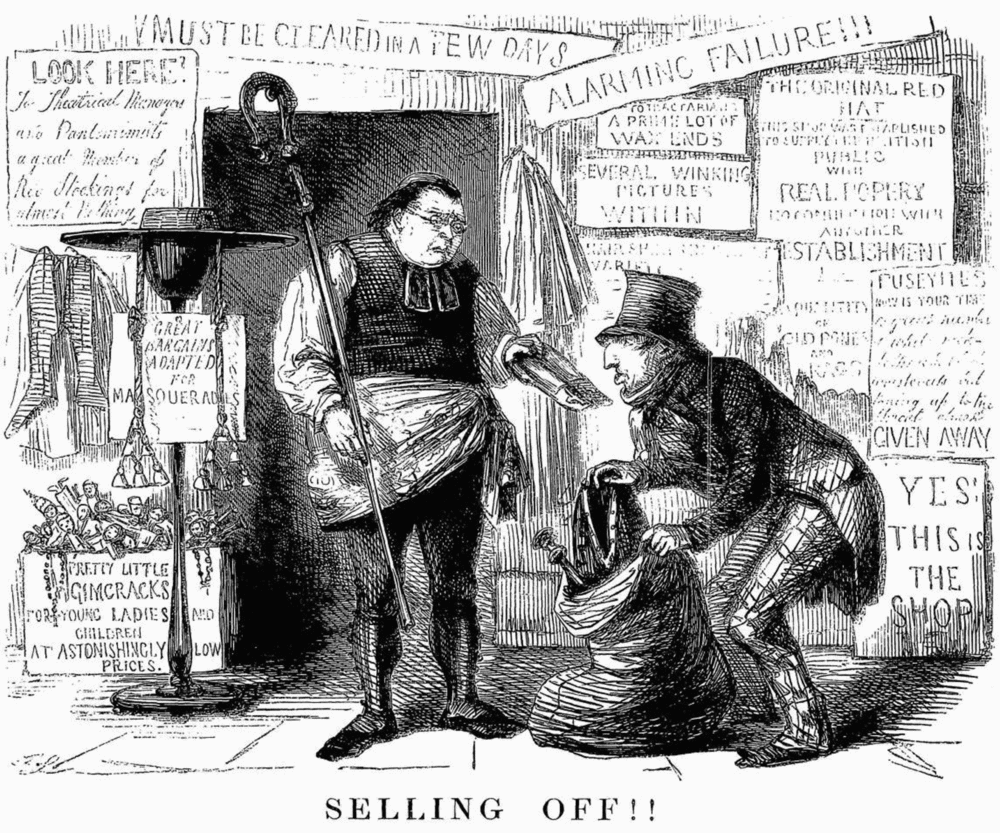
This attack on a Protestant group as the producer of faulty and dangerous merchandise is particularly interesting because this was an accusation that such parties repeatedly made against Roman Catholicism. This can be illustrated by the example of material published in Punch in 1850. At this time the Pope had just unilaterally declared the re-establishment of the episcopal hierarchy of bishops in Great Britain and had instituted Nicholas Wiseman as Cardinal of Westminster. The Roman episcopal hierarchy had been in abeyance since the Reformation and its sudden revival by the Papacy caused a storm of anti-Catholic agitation. This included calls for legislation to declare these acts illegal and to strip the Catholic Church in Britain of its resources. Punch joined in with enthusiasm by publishing cartoons such as one which showed Wiseman as the owner of a business who had been forced into selling up his goods at knock-down prices (Figure 9). Various objects associated by Protestants with Catholic superstition are shown piled up in sale-bins accompanied by desperate advertisements. It would appear, however, that no one was buying these things even at the bargain prices on offer, because Wiseman is shown as having been reduced to selling his own clothes (mitre and Cardinal's slippers) to a Jewish second-hand clothes dealer. Catholicism is here reduced not simply to its material culture, but to a material culture exposed as fraudulent which only Jews – depicted here, anti-semitically, as amoral – would touch. Those “pretty little gimcracks for young ladies and children at astonishingly low prices” are the equivalent of penny dreadfuls.
“Selling off!!,” Punch 20 (1851): 77, photograph by the author, with permission, from the edition held at the library of Birkbeck College, London.

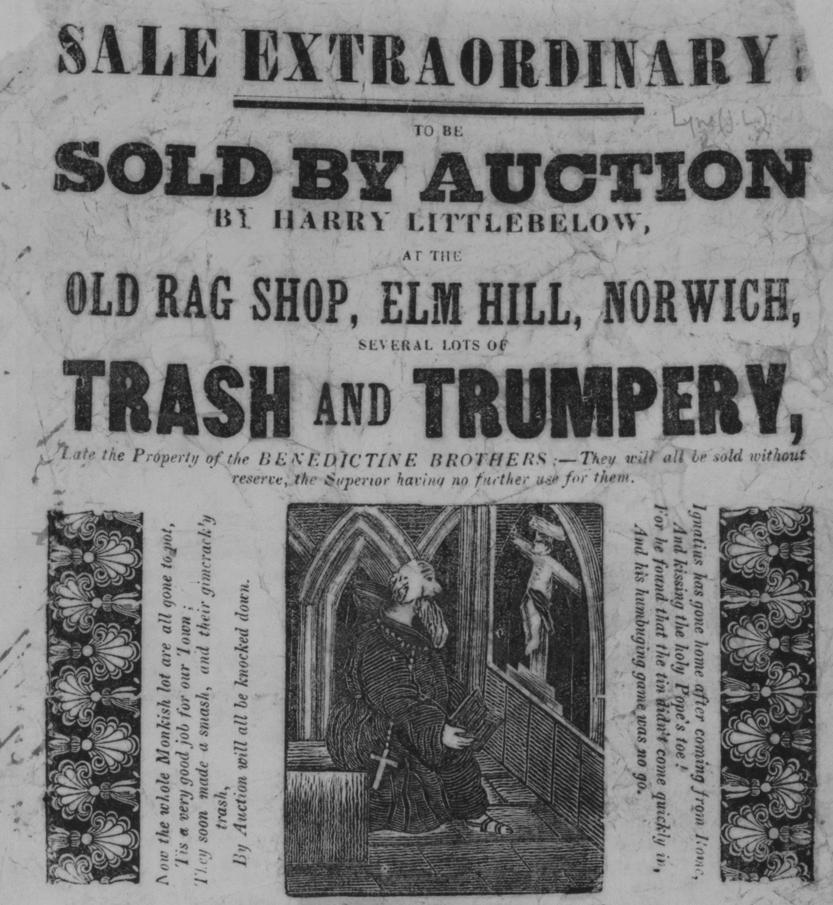
The same picture of Catholics as fraudulent traders in debased goods appears from a broadsheet that appeared in Norwich in c.1866. This celebrates the downfall of Joseph Leycester Lyne's attempts to establish a Benedictine monastery in the town (Yates 79; Anson 51–72 and 220–42). In this case Lyne was operating without the blessing of either the Roman or the Anglican episcopal authorities, although his aim at this time was to re-establish Roman Catholic models of monastic life within the Church of England. The alarmed local populace of this strongly Protestant town, nevertheless, regarded his endeavours as an outbreak of extreme Popery. Lyne's venture foundered amid both financial and (homo)sexual scandal; a sequence of events which was celebrated as having led to another act of “selling off.” As with the Punch cartoon, what we see here is a fire-sale of perverse bric-a-brac which was both of poor quality and misleading “trash and trumpery” (Figure 10). The items signal quite clearly that a connection was made between falsity (“artificial flowers in abundance (somewhat faded), with Rosaries, Charms, Talismans, etc, suitable for masquerading”); concealment (“a brazen mask, much used by the order”); perverse pleasures (“Bagatelle board and Cat o nine Tails, used by the Monks for their amusement after Vespers”); and sexual scandal (“the original Love Letter, sent by Brother Augustine to the Boy”). The depiction in this broadsheet of Lyne at his devotions emphasises the view that his acts of Catholic worship should be seen as nothing more than the practices of a failed and corrupt businessman.
Detail, Sale Extraordinary! (Norwich: R. Cullum, c.1866). © British Library Board, all rights reserved, 85/1882.c.2 (260).
Protestants were, thus, particularly exercised by the notion that priests were making money by exploiting the credulous through the exaltation of things that were essentially worthless. The topic of relics was of particular concern. Thus Michael Hobart Seymour, an Irish Protestant clergyman, condemned the mining of the catacombs in Rome, calling it “a traffic of the most disgraceful and degraded nature,” which led to frenzied figures in cowls and wimples pillaging the underground caverns, ripping bones out of graves and pounding them into splinters. And when these seams of perverse gold were worked out and the supply of “lawful relics of ecclesiastical merchandise” ran low, “the monks who were the merchants in this matter” manufactured fake relics, and thus “the demand of the market called forth an adequate supply” (Seymour 330; discussed in Janes, 2012, 230). A slightly later anonymous tract referred to the “manufacture of relics” as having been a regular trade since the time of the early Church, and “as the demand increased, the audacity of the manufacturers grew correspondingly” (“Religion,” 230). Another writer argues that it was at the time of the Crusades that “the manufactory of relics became a profitable trade, followed unscrupulously by many, until at length, whole shiploads of them were imported into Europe” (Sargent 6–7). Protestants might appear to have been so exercised by such matters not only because of the condemnation of relic cults at the Reformation, but also because of their own fascination with personal and sentimental memorials. Samantha Matthews, for instance, has highlighted in Poetical Remains: Poets’ Graves, Bodies, and Books in the Nineteenth Century (2004, 50. Compare Waters Reference Waters2003) that many Victorians were horrified by the idea of the disturbance of the rest of the dead. Yet the repeated complaint from anti-Catholic campaigners was not based upon such a principle, but upon the idea that most of the relics for sale were fakes. In other words they were raising a precisely commercial fear that huge profits were being made out of counterfeit goods. The journalist Somner Merryweather repeated a popular trope when he asserted that the system was a cynical exercise on the part of the Church hierarchy, since it was “with them but a fraud, sanctified by the ends achieved” (1850, 154).
Not only were Catholic objects often fake, but they had a tendency to be directly harmful not simply to the health of the soul but also to that of the body. An example of this tendency was memorialised by the aforementioned Walter Walsh when he described the rivalry between neighbouring Protestant and Catholic booksellers in Paternoster Row, near St Paul's Cathedral in the city of London (Machin 284; Walsh, Reference Walsh1897, 38–39). John Kensit set up shop at no. 18, in 1885. Four years later he established the Protestant Truth Society, an organisation whose aims and modus operandi were in a direct line of descent from the Protestant Electoral Union (Machin 285). On 9 September 1896 the Westminster Gazette reported that Kensit had put up a poster in his window showing pictures of instruments of penitence which were, he alleged, on sale at the Catholic establishment next door. These included a “stomacher of horse hair,” a “barbed heart (how many of these are pressing today against lacerated breasts,” and anklets and wristlets of “similar construction, and equally fiendish in purpose.” Two scourges were depicted, one of them steel – “every blow from this, when the penitent swings it over his shoulder upon his bare back, must produce five wounds, or bruises or sores. No wonder the crowd gazes incredulously until ordered to ‘move on’” (38). The use of such items was understood to have been demanded by sadistic priests in the confessional, or to have represented personal masochistic desires as in the reference to the aforementioned “Cat o nine Tails, used by the Monks for their amusement after Vespers” in the Norwich broadsheet (Figure 10), or indeed the appearance of a sale bin of “perfumed rods” in another Punch cartoon, this time against the use of incense by Anglo-Catholic ritualists (“Incense-ibility,” 259). The accusation, at base, was that Catholic shops were selling kinky sex toys, but it was an accusation that was a product of the voyeuristic Protestant gaze.
In the light of all this the application of the Obscene Publications Act 1857 to The Confessional Unmasked would appear to have been doubly surprising, not simply because it represents the classification of a religious tract as pornography but also because it, by implication, equates Protestant merchandise with that of Roman Catholics. Kathleen Frederickson (309) has suggested against such views that this action was not, however, an “incidental feature” of the operation of the act because of the extensive earlier links between erotica, sedition and blasphemy. From this point of view extreme Protestant trouble-making was as dangerous as its Catholic counterpart. Moreover, Parliament had removed most of the previously long list of legal impediments that had hampered Romans and non-conformists for centuries, leaving both groups open to equal freedoms to trade. On the other hand, England continued to be, overwhelmingly, a Protestant country and a very substantial proportion of its circulating literature came in the form of Protestant tracts, sermons, books and periodicals. Bearing in mind the close contextual links between the Obscene Publications Act and a raft of other measures regulating the safe production of manufactures, it is also possible to suggest that the action against The Confessional Unmasked was intended to maintain the perceived safety and quality of Protestant texts as manufactures. The fact that the test for the meaning of “obscenity” in English law derived from this action suggests that a tract that was both impure and Protestant was the epitome of that which could not be allowed to remain in print.