Writing in 1957, Leonard Krieger famously argued that Lutheranism was “not itself central” to what he called the “problem of political liberty” in the German lands during the nineteenth century.Footnote 1 By downplaying the influence of Luther's teachings on German political thought, Krieger tacitly aimed to refute the controversial “from Luther to Hitler thesis” proposed by some historians in an effort to identify the ideological roots of National Socialism.Footnote 2 Contrary to these scholars, Krieger blamed the emergence of Germany's “peculiar 19th century version of political freedom” not on religious doctrine, but on a complex of political and socioeconomic circumstances that, he argued, were unique to central Europe.Footnote 3 Scholars have almost universally followed Krieger's line of interpretation. Recent debate focuses not on whether he was correct to argue that political and socioeconomic factors were primarily responsible for engendering a distinctively German species of liberalism, but rather on the question of which of these factors was paramount. As a consequence, religion's role in the making of early German liberalism seldom receives serious consideration today.
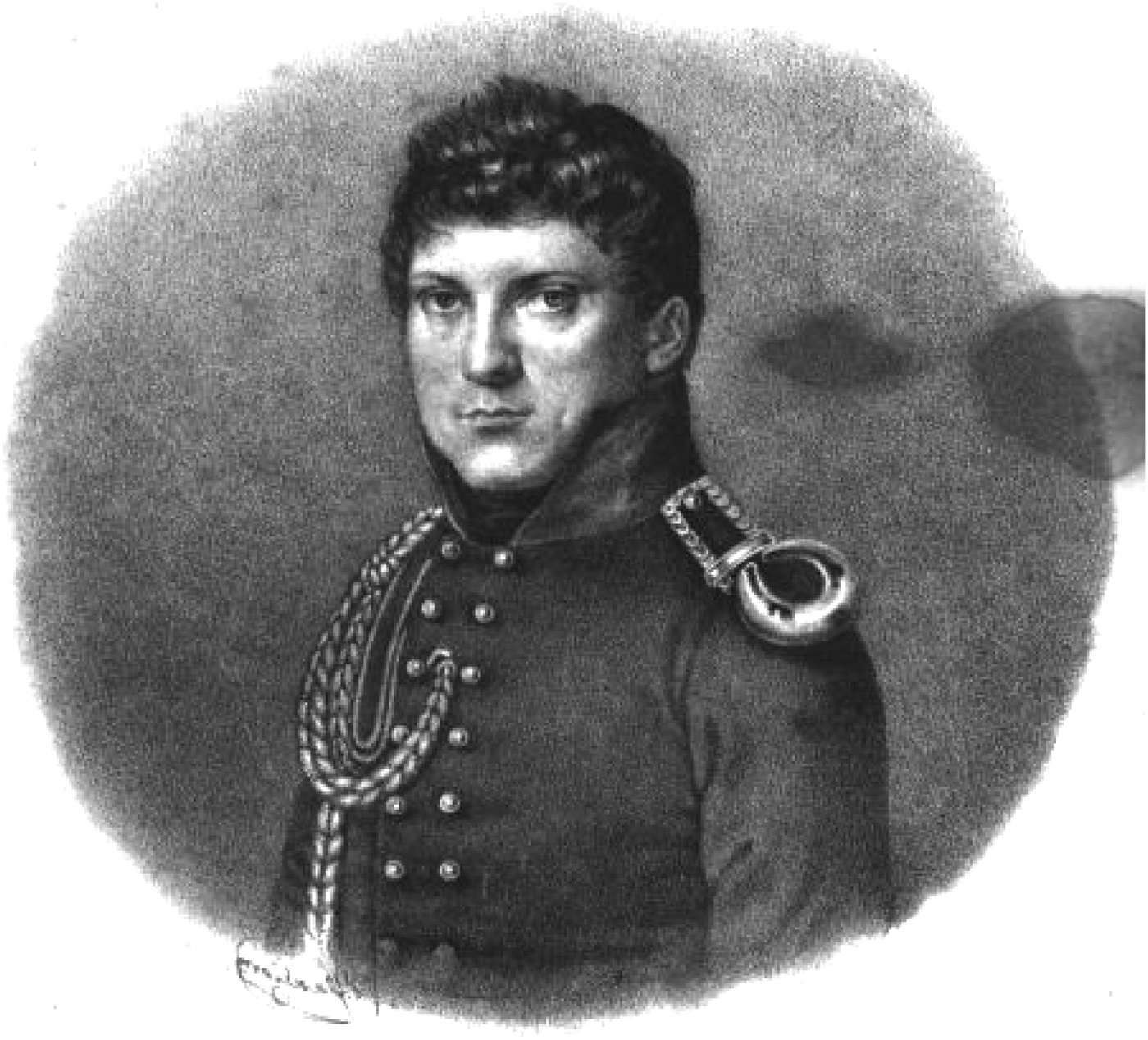
This essay seeks to reevaluate scholars' dismissal of religion's role in the development of German liberal ideology by taking a fresh look at the nexus of politics, philosophy, and Lutheran Pietism in early nineteenth-century Prussia. Rather than attempting to offer a comprehensive analysis, it follows the approach of a case study whose focus is the writings of a rank-and-file Prussian jurist named Maximilian Karl Friedrich Wilhelm Grävell (1781–1860) (Fig. 1). In the early nineteenth century, Grävell was well known throughout the German lands as the author of several widely read works of popular philosophy. Yet when scholars have written about him, they have overlooked his success as an author, presumably because his best-selling works would seem to have no connection to his political activities. This is not surprising, considering that those works all dealt to one degree or another with the topic of life after death. In what follows, I claim that, contrary to scholarly opinion, Grävell ought to be regarded as a popular political philosopher, because his widely circulated meditations on the afterlife were overtly political. I argue that his publications on life after death have a unique potential to shed light on the murky conflux of Pietism, Kantian idealism, and liberal politics in early nineteenth-century Prussia. Specifically, Grävell's writings on the afterlife reopen the debate over the existence of a fundamentally religious dimension to early Prussian liberal ideology—a dimension that may help to explain some of its puzzling features.
Grävell in military uniform ca. 1814. From the title page of Maximilian Karl Friedrich Wilhelm Grävell, Der Mensch. Eine Untersuchung für gebildete Leser (Leipzig: Güntz, 1839).

Grävell and his Afterlife Writings
The son of a Lutheran chaplain, Grävell was born in the East Prussian town of Belgard, Pomerania (now Białograd, Poland) in 1781. After studying philosophy and law at the University of Halle, he joined Prussia's judicial bureaucracy in 1803. As Christina von Hodenberg has shown, the judiciary was an important center of liberal agitation in early nineteenth-century Prussia.Footnote 4 Grävell shared the liberal convictions of his fellow jurists, as evidenced by his numerous publications.Footnote 5 In those works, he called for the establishment of a Prussian parliament, an end to arbitrary rule by the administrative bureaucracy, and greater political representation for the middle classes. He condemned the institution of serfdom and tax exemptions for the nobility. He pushed the Crown to adopt a written constitution that guaranteed legal equality, he argued that the Lutheran Church should have freedom over its own affairs, and he supported granting Prussia's Jews their civil rights.
At least initially, Grävell's liberal sympathies did not impede his rise through the judicial ranks, because the start of his career coincided with the progressive era of the Stein-Hardenberg reforms. Yet as the Prussian administration grew increasingly reactionary following Napoleon's defeat, Grävell's fortune took a turn for the worse. Beginning in 1815, Hardenberg's ministry reinstituted strict censorship, not merely to tame the political public, but also to discipline the liberal wing of the civil service.Footnote 6 In defiance of the new press laws, Grävell continued to compose writings that denounced princely absolutism and advocated freedom of the press. These publications soon got him into trouble. In 1816, one of his manuscripts was confiscated and he was fined.Footnote 7 Two years later, he became involved in a disagreement with several high-ranking officials that resulted in his suspension and a six-month stay in a Berlin jail. One observer noted that, following Grävell's release from prison, “he could not be dissuaded from voicing his opinion freely and bluntly as he had done earlier, regardless of the status of the person to whom he was speaking.”Footnote 8 As a result, in 1832 he was charged with the slander of high officials, leading to another prison stint.Footnote 9 Worn out by his struggles with the Prussian authorities, he successfully petitioned for his release from the civil service in 1834 and retired to the countryside outside Frankfurt an der Oder. There he lived quietly until, as we shall see, the revolutionary tide of events in 1848 swept him back into public life.
During and after his troubled career in the judiciary, Grävell churned out a flood of reform-minded works. While it is true that these publications generally failed to attract much notice, it is not accurate to assert, as one scholar has done, that as a writer Grävell “appears not to have had any sort of impact.”Footnote 10 In fact, in 1815 he achieved great success with a book that was quite different from his usual legal and political treatises. This work was a wide-ranging exploration of human nature entitled Der Mensch. Eine Untersuchung für gebildete Leser (Man: An Investigation for Educated Readers). It remained in print for twenty-nine years and sold well over 20,000 copies, arguably making it one of early nineteenth-century Germany's most widely read works of popular philosophy.Footnote 11Der Mensch's success can be explained by the fact that it departed from Grävell's earlier writings in two key respects. First, whereas he usually directed his works at a small audience of government administrators and legal scholars, he consciously tailored the language of Der Mensch “for the educated members of all classes.”Footnote 12 Secondly, in contrast to his other writings, the book touched on a sensational topic that had a proven potential to pique the public's interest: life after death.
For centuries, most Germans had conceived of heaven as a pristinely spiritual realm, a view that was reinforced by Lutheran orthodoxy and rationalist philosophy. Lutheran preachers and Wolffian rationalists both taught that the flesh was peripheral to man's essence, which was captured entirely in the immaterial soul. This starkly dualistic understanding of the human being implied that in death, man would cast off his body and live as a pure spirit. Writing in 1766, an anonymous Halle pastor thus reasoned that “if I rationally consider what part of me is to be reborn, or what part of me will participate in this new spiritual life, I find that it will not be my body [. . .] Rather it is my undying soul that will partake in this precious beneficence.”Footnote 13 Beginning around 1750, the mind-body dualism that underpinned the notion of a purely spiritual existence in the afterlife was challenged by a revival of vitalism in the life sciences.Footnote 14 Peter Reill has explained that whereas mechanist philosophers regarded matter as being entirely separate from force, for eighteenth-century vitalist physicians, “the separation of principle, power, or force from substance appeared a contradiction in terms.”Footnote 15 By arguing that no force could exist independently of its material substrate, vitalist thinkers inspired a more holistic understanding of man as the union of his soul and body. The Swiss naturalist Charles Bonnet helped to formulate this new concept of the human being when he wrote in 1769 that “man is not a certain soul; he is a certain soul joined to [. . .] a certain body, and it is this composite that bears the name ‘man.’”Footnote 16
The notion that the human being was a psychophysical unity suggested to some contemporaries that, if man were to survive death with his essence unchanged, then he must continue to possess a bodily aspect in the next life. One early proponent of that belief was Johann Gottfried Herder. In his Ideas for a Philosophy of the History of Mankind (1784–91), Herder expressed the vitalist conviction that “wherever we observe a power in operation, it is inherent in some organ and in harmony with it,” such that “we know of no spirit capable of operating apart from, or without, matter.”Footnote 17 Convinced that the human psyche was no exception in this regard, Herder declared in a 1769 letter to Moses Mendelssohn that a soul deprived of a body was “a disproportionate representation of human nature, a monster.” After death, he reasoned, “I will continue to be a mixed essence, as I am now.”Footnote 18 Similar arguments in favor of a bodily survival in the afterlife were widely repeated in the popular genre of consolation literature that emerged in the late eighteenth century. Writers routinely asserted that the soul would pass to the next life joined to a subtle “organ,” “husk,” “shroud,” or “germ” that lay hidden within the flesh.
The idea that departed souls would retain a corporeal aspect served to revolutionize the afterlife discussion, because it suggested a means by which earthly love could endure in heaven. In the past, theologians had argued that a person's terrestrial affections could not survive the passage to the next life, because his memories and emotions must perish with his body. Johann Friedrich Teller, an elderly pastor near Halle, summed up the traditional view of heaven when he wrote that “there will be no more friends of the blood, no more fathers and children, and no more brothers of the flesh, there being only brothers of the spirit.”Footnote 19 From the mid-eighteenth century onward, this customary vision of the afterlife as a place where amnesiatic souls would forfeit their filial ties began to wane in the popular imagination. Writers increasingly argued that heaven's inhabitants would nurture the same emotional attachments that preoccupied them on earth, owing to the fact that their earthly recollections and feelings would be preserved in the imperishable aspect of the flesh to which the soul was joined.Footnote 20
As a result, writers reconceived the afterlife as a land where long-separated souls, in full possession of their inclinations and memories, would find each other again and rekindle their earthly affections.Footnote 21 This was the picture of heaven presented by the Schwerin physician Karl Friedrich Engel in his 1787 treatise Wir werden uns wiedersehen (We Will See Each Other Again). Like most writers who argued for the possibility of heavenly reunions, Engel based his claims on the assertion that “insofar as the soul is concerned, the supposition that it is destined to move from its union with organs to a completely spiritual state appears to be without basis.” He explained that, due to the indestructibility of some subtle part of the flesh, “we will take with us the inclination to associate with just that being who had interested us so strongly and in so many ways here on earth.”Footnote 22 While Engel was careful to propose the immortality of earthly love in a way that de-emphasized its sensual aspect (he wrote that “only virtuous bonds [. . .] are capable of being renewed in the next world”), other writers were not as cautious.Footnote 23 In 1804, a struggling Thuringian writer named Johann Karl Wötzel created a sensation by claiming that his dead wife had appeared to him in bodily form.Footnote 24 Wötzel's account of his spouse's ghostly visitations was laden with erotic undertones: one afternoon he awoke to find his Hännschen lingering sensually in a doorway; a few nights later, she glided into the bedroom and, overcome with longing, he tried to embrace her spectral body. Wötzel's book was symptomatic of what Udo Mason has called an “eroticization of the Christian heaven” that occurred in the late eighteenth and early nineteenth centuries.Footnote 25 This trend culminated in the Swedish mystic Emanuel Swedenborg's writings, which were widely translated into German and could, according to one contemporary, be found “in every bookstore.”Footnote 26 Swedenborg shocked his readers by claiming that long-separated lovers would consummate their reunion in the next life by indulging in an angelic version of sexual intercourse.
To be sure, the new conception of heaven as a paradise of earthly love was not without its critics, who attacked it from a variety of perspectives ranging from the religious, to the skepticist, to the Kantian.Footnote 27 Few writers, however, were as outspoken in their opposition as was Grävell, the Prussian jurist. Grävell mocked the sentimental tone of the many books and poems that promoted the notion of everlasting love, arguing that those works were nothing but “fantasies” that must quickly dissipate “before the court of reason.”Footnote 28 He declared that “foolish is the hope of gentle souls who believe that they will find and recognize one another in the afterlife, that there will be a continuation of their exclusive feelings of tenderness beyond the grave. [. . .] In vain you hope to find again your father, your children, your bride, your friend.”Footnote 29 The harshness of his tone provoked a torrent of criticism, prompting him not only to strike the word “foolish” from Der Mensch's future editions, but also to write two additional works devoted to defending his ideas about the impossibility of heavenly reunions: Das Wiedersehen nach dem Tode (Reunion after Death, 1819) and Briefe an Emilien über die Fortdauer unserer Gefühle nach dem Tod (Letters to Emilie Concerning the Survival of Our Feelings After Death, 1821).
In those works, Grävell sought to debunk belief in everlasting love by attacking the holistic understanding of man that underpinned it. In contrast to the vitalist notion that some essential aspect of the flesh would remain forever joined to the soul, Grävell elaborated a radically dualist understanding of the human being that hearkened back to the arguments of the Lutheran theologians and rationalist philosophers. That view posited that man's soul and body were locked in constant struggle: whereas the rational soul desired only union with other souls, the body prevented this union by giving rise to selfish passions in the hearts of men. Like the ancient Platonists, Grävell suggested that the battle between psyche and soma would be resolved only in death, which he regarded as “a restoration of health, the end of the earthly struggle between reason and sensuality, between the spirit and the body.”Footnote 30 Rather than asserting that the soul's victory over the flesh would be immediate, however, he posited that the body would be vanquished only gradually, for “as our perfection increases step-by-step, we will receive ever finer, more spiritual bodies.”Footnote 31 He argued that, over time, this process would ensure that souls would “purify and cleanse themselves of those individualities and particular traits that are brought forth [. . .] by the union with a body.”Footnote 32
By claiming that man's corporeal aspect would gradually recede in the next life, Grävell was led to elaborate a curious vision of heavenly unity in terms of “an ever-greater melding” (Verschmelzung) of souls.Footnote 33 He noted that as the barriers between souls vanished, eventually there would be nothing to hold them apart, such that they would literally fuse together.
The more spiritual we become, the less will be the differences among us, the weaker will be the separation between us that is caused by the soul's union with a body, the more negligible will be our personalities and our individuality, and thus the closer we will be drawn together. As we move step-by-step toward perfection, differences in personality will retreat, and increasingly our ideas will run together and merge to the point that all disparities in our consciousnesses will cease to exist, such that as thinking beings we will conceive of ourselves as merely a single self, whose parts cannot be differentiated in the least from one another.Footnote 34
Grävell asserted that, melded together into an amorphous mass, individual souls could no longer be said to exist, because “stripped of the body, the soul [. . .] could only arrive at ideas that spring from its own self-consciousness, and these ideas must sooner or later become the same in all rational creatures. At the moment that thought becomes identical, all differences between souls vanish and they become a single being.”Footnote 35 He thus presented his readers with a description of heavenly unity in which souls, by relinquishing their bodies, surrendered their individual thoughts and desires and merged into a collective mind.
The Political Dimension of Grävell's Vision of Heavenly Unity
Scholars of early German liberalism have paid no attention to Grävell's descriptions of life after death for the simple reason that they would seem to have nothing to do with his politics. Upon closer examination, however, it becomes clear that his meditations on the afterlife were not as unrelated to his political activities as they initially appear to be. Indeed, in the preface to Der Mensch, Grävell declared that “it is my purpose that this book be regarded as merely an introduction to a more complete study of politics on which I am working.”Footnote 36 He envisioned that book as the first volume in a political trilogy: he would follow it with two additional works, entitled Der Bürger (The Citizen, 1822) and Der Regent (The Regent, 1832), that explored the duties of the citizen and the ruler, respectively. Yet it was in the first volume, Der Mensch, where Grävell provided the theoretical foundation for his political ideas. He explained that he had become convinced that “politics would be forever fluctuating if a philosophical justification for the state [. . .] was not established, and that this in turn could not be done [. . .] without first investigating the fate and nature of men themselves.”Footnote 37 He thus regarded his afterlife speculations as being closely linked to the liberal crusade for a constitutional nation-state. Like most Prussians, he favored the kleindeutsch version of national unity that excluded Austria's German-speaking territories, although he believed that the two states should remain fraternally affiliated in something like the German Confederation of his day.Footnote 38
The political dimension of Grävell's afterlife speculations is suggested in part by the circumstances in which he conceived them. In the preface to Das Wiedersehen nach dem Tode, he explained that he was first led to theorize about heaven while serving as a captain in the Prussian army during the war against the French. During the winter of 1813–14, he was camped in remote Gorgast, not far from the occupied fortress of Küstrin. Sometime in the midst of that winter, he was approached by a distraught soldier who confessed to him certain doubts concerning the next life. It was to calm this man's fears, Grävell claimed, that he had begun to write down his thoughts on life after death, thoughts that would become integral to his best-selling book. He found plenty of time to write, for he noted that “as fate would have it, I spent the whole war in front of blocked fortresses, where there was not much to do.”Footnote 39
In language reminiscent of the Lutheran theologians, Grävell assured the worried soldier that while there would certainly be life after death, earthly attachments could not possibly survive in heaven because “love of individual things must be submerged in the general, all-encompassing love toward which we are progressing.”Footnote 40 He asserted that earthly love had no place in the afterlife, because such love was inherently selfish: “You love only to win something from this love. Egoism—which is the basis of all your thoughts, feelings, and dispositions—is also present in your love.”Footnote 41 Grävell thus regarded the yearning to be reunited with departed loved ones as an expression of human beings' all-consuming egoism, a selfishness that “causes us to regard all things as merely the tools of our enjoyment and our appetites [and] which, taking cover under tender and noble sentiments, desires that everything in this life that made us happy is eternally destined to be only an object of our affection.”Footnote 42
As Grävell brooded over his conversation with the anxious soldier, he became convinced that belief in the immortality of earthly love, though a seemingly harmless conceit, was in fact a dangerous fantasy that had “the most important consequences for people's social relations on earth.”Footnote 43 This was so, he argued, because that belief not only expressed a destructive undercurrent of egoism in society, but it also encouraged egoism's spread. He thus likened the “idea of a survival of our earthly sensations” to a creeping sickness that had fatally weakened the social body.
[This idea] exercises its sad consequences throughout our lives, because it is the fruit of an expanded egoism that extends to those whom one regards as belonging to one's self, and that serves to set oneself and one's loved ones apart from humanity. And just as that fantasy is the fruit of egoism, so, too, does it contain new germs of egoism according to the immutable laws of nature. It facilitates the denial of humanitarian obligations when these collide with obligations to one's own, thus leading one—if he can care only for the happiness of himself and of his family—to neglect the well-being of humanity, of the state, of the community. This idea causes man's spiritual eye to be habitually directed toward the smaller sphere of his family's happiness, thereby drawing his eye away from the broader prospect, the larger spheres of society.Footnote 44
When Grävell wrote about the corrosive effects that belief in the immortality of earthly love had had on public morals, he was not referring to society in the abstract. Rather, he was commenting on his own society of early nineteenth-century Germany. His arguments suggested that the German lands had fallen to Napoleon's armies because a tendency to place one's private interests before those of the polity had taken hold of the German people.
By condemning his age's self-seeking mentality, he was repeating a well-known refrain. Johann Gottlieb Fichte had expressed a similar view in his Reden an die deutsche Nation (Addresses to the German Nation, 1808). The Reden, which Fichte delivered in Berlin in the winter of 1807–08 in the midst of the French occupation, were widely circulated and became one of the founding texts in the German nationalist movement. Fichte's speeches were partly a response to widely publicized reports of the “treachery” of the larger German states in the initial phases of the confrontation with France. Following the revolutionary armies' invasion of the Rhineland in 1794, some of the most powerful German lands had concluded treaties with the French rather than joining in defense of the empire, the most notorious example being Prussia. In the German nationalist mythology of the early nineteenth century, the states that entered into pacts with the French were portrayed as having sacrificed their loyalty to the German Reich in favor of their own narrow interests. Grävell's readers were thus well prepared to accept the claim that their defeat was ultimately the result of a spirit of egoism that had seized the German people.
Dismayed by this pitiful state of German affairs, Grävell turned his gaze to the heavens. There, in the life to come, he believed one could find the antidote to the moral sickness that had brought Germany to its knees. Encouraged by this discovery, he presented his vision of heavenly unity to the public with the intention that it should serve as a model for political unification. That model suggested that the key to national unity was the promotion of the same spirit of selflessness that caused souls to merge together in the next life. Just as in heaven, Grävell asserted, so, too, on earth “our feelings for all the particular things here that we love, treasure, and honor must be sacrificed to the loftier and more universal feelings in which we shall partake.”Footnote 45 In an effort to illustrate this idea for his readers, he drew parallels between the altruistic spirit that reigned in the afterlife and the selfless mentality that, he believed, would characterize the German nation. In nationalistic language he likened the departed soul to a citizen who takes leave of his family in a time of war, arguing that both renounce their exclusive loves in the service of a higher love. Addressing his female readers, he asked, “If duty were to tear your husband from your side, would you hold him back, dear friend? Would you not say to him with an aching heart, ‘Go! May you prove yourself worthy of yours and mine!’”Footnote 46 Elsewhere he praised as “humane and virtuous” that “Spartan mother, who, while handing the shield to her only son, said ‘Better to return upon it than without it!’”Footnote 47
Yet how could nineteenth-century Germans be made to adopt the selfless mentality of the ancient Spartans? The answer, Grävell believed, lay in the Spartans' ability to deny the egoistic impulses arising from their bodies. His afterlife writings indicate that he harbored a deep-seated conviction that sensuality was the root of all egoism, and therefore the cause of all social and political strife. By describing a future life in which souls fused together due to the disappearance of their bodies, he implied that the flesh was the chief impediment to unity not just in heaven, but also on earth. He hinted that, just as in the next life, the denial of the body would allow a spirit of selflessness to take hold of earth's inhabitants, because that denial would serve to “purify and cleanse” them of their self-interested desires and attachments. Grävell thus suggested that the path to a united Germany lay in the cultivation of selflessness through the vanquishing of sensuality. He held out the hope to his readers that, by stifling the selfish inclinations that arose from their bodies, they could create a harmonious national community that was founded upon complete unanimity.
Kantian Idealism and Pietism in Grävell's Thought
In the opening pages of Der Mensch, Grävell announced that “first and foremost I hope to appeal to the Kantians, because I myself take the greatest pride in being an admirer of the immortal Kant.”Footnote 48 Eager to show that Kant's philosophy supported his description of heavenly unity in terms of a denial of bodily egoism, Grävell went to great lengths to impart his afterlife meditations with a rigorous Kantian framework. The result was not felicitous: Der Mensch is so steeped in idealist jargon that one frustrated critic complained that its “esoteric reasoning has had the misfortune of falling into the hands of the ‘uninitiated,’ who have become confused rather than enlightened.”Footnote 49 Be that as it may, a closer examination of Der Mensch and its author reveals that its arguments originated not in Kant's philosophy, but in Pietist theology.
The young Grävell received a strict Pietist education that began at home under the guidance of his chaplain father, who preached in the garrison at Belgard. Grävell would later write that “my most ardent wish was to be like him.”Footnote 50 Thus it was an especially hard blow when his parents died just nine months apart of each other, leaving him an orphan at the age of seven. Grävell spent much of his remaining boyhood in Lutheran boarding schools, where his pastor-instructors exercised an incalculable influence over him. His substitute father became Pastor Bechstein of the Kostschule at Niederwiesa, who, together with his pious wife, saw to it that “the exalted teachings of Jesus made a deep impression on him.”Footnote 51 After several years at Niederwiesa, Grävell was sent to the orphanage at Züllichau, an institution that was closely modeled after Francke's Waisenhaus and Pädagogium at Halle.Footnote 52 By all accounts, he showed himself to be an unusually devout student. His faith was so strong that he initially planned to join the clergy, but he was ultimately dissuaded from doing so by Wöllner's Religionsedikt, which was an attempt by the Prussian state to control the Pietist movement in Prussia by imposing harsh regulations with respect to preaching and teaching.
Given Grävell's intensely religious upbringing, there is reason to suspect that his faith helped to shape the vision of national unity that he presented in Der Mensch. This suspicion is partly confirmed by the book's dedication, which he addressed not to his law professors, but to his pastor-instructors at Züllichau: “I would be all the more pleased if in the following pages I can make good on my intention to give back to you a product worthy of your education and care, which nurtured the germ of this work in me.” In view of the central importance that Grävell gave to the influence of Züllichau's Pietist instructors on his worldview, it would seem that Kant's philosophy contributed to the formation of that worldview only secondarily, by serving to reinforce his religious beliefs. Indeed, Grävell consistently interpreted the writings of the idealists through a Lutheran lens, even going so far as to confess that “to me, Kant has been for philosophy what Luther is for my faith. Kant is the father of Protestantism in philosophy.”Footnote 53 In an effort to demonstrate this alleged agreement between idealism and Lutheranism for his readers, he appended to Der Mensch lengthy passages from Scripture that were meant to provide religious justification for his philosophical arguments, assuring his readers that “this philosophy and Christianity contain one and the same teaching.”Footnote 54
The key concurrence that Grävell believed he saw between the idealists' writings and Luther's theology concerned their ethical teachings. Specifically, he perceived in the idealists' division of the world into two distinct realms—reason versus passion, freedom versus necessity—something akin to the hostile opposition of soul and body that underlay Protestant moral teachings. It is well known that Luther, who was influenced by the Neo-Platonic dichotomy of spirit and matter that informed Augustine's writings, placed heavy emphasis in his theology on the sanctity of the soul versus the sinfulness of the flesh. Although the notion of a moral opposition of psyche and soma had long been a central tenet of the Christian faith, Luther went to new extremes to exalt the immaterial soul as the wellspring of selfless action, while condemning the body as the source of egoistic desire. This puritanical aspect of orthodox Lutheranism was given renewed emphasis in the late seventeenth century by the Halle Pietists. In contrast to the generally favorable view of the passions taken by Pietist groupings elsewhere in central Europe, Prussian Pietism tended to be much sterner in nature. Carl Hinrichs has argued that in Halle, religion “had none of the emotional softness that one typically associates with the concept of Pietism,” rather it was “a sober and austere reform movement” that shared a great deal in common with Calvinism.Footnote 55 The puritanical streak within Prussian Pietism can be seen in the Halle theologians' criticisms of the Swabian Pietists as Schwärmer who indulged in emotive forms of worship, as well as in their denunciations of Zinzendorf's Herrnhüter, whose theology they condemned as crudely sensual in nature.
The Halle theologians' hostility to the passions was partly a consequence of the great importance that they placed on the Christian ethos of Selbstverleugnung, or “self-denial.”Footnote 56 The centrality of Selbstverleugnung to early Pietist theology is evidenced by the fact that it featured prominently in many of the movement's foundational texts, including Arndt's Wahres Christentum.Footnote 57 That ethos has been held responsible for imbuing Pietism with a world-denying tendency. Writing at the end of the nineteenth century, the theologian Albrecht Ritschl argued that the impulse to deny the self within Pietism imparted it with an ascetic character that hearkened back to the monasticism of the Middle Ages.Footnote 58 Max Weber famously refined Ritschl's arguments by pointing out that Pietism differed from medieval asceticism in the sense that the former was characterized by an innerliche Askese (“inner-worldly asceticism”) similar to that of the ancient Stoics, who sought to cultivate virtue in a way that did not entail an actual retreat from the world.Footnote 59
It was in this Halle tradition of “inner-worldly asceticism” that Grävell was schooled at Züllichau. In keeping with Francke's plan of instruction, Züllichau's pastors were concerned less with filling their students' heads with facts than they were with training young people to desire that which was blessed—a process that Francke called the breaking of der natürliche Eigenwille (“the natural self-will”) of his pupils.Footnote 60 This meant that Grävell was taught that to be virtuous, he must practice Selbstverleugnung by denying the egoism of his own flesh. His teachers' insistence that the body was the site of sin and suffering must have resonated with him especially strongly owing to his traumatic memory of seeing his mother's corpse at the tender age of six. Years later he would recall how he had sat beside her body, swatting away flies.Footnote 61 That experience, combined with the puritanical slant of his education, insured that for the rest of his life, he harbored deep misgivings about the body. He never tired of praising his Züllichau teachers for having steeled his will against the evils of the flesh, thereby teaching him “to judge accurately the true worth of things, and not to seek happiness where it is not to be found.”Footnote 62
The distrust of the body that Grävell imbibed from his religious education served to color his reading of idealist philosophy along Lutheran Pietist lines. Above all, it led him to interpret Kant's moral philosophy as advocating not merely a rationalist ethics, but also the renunciation of the selfish impulses of the flesh in favor of the divine mandates of the soul—an act of renunciation that, Grävell argued, was commanded by “the religion of Jesus—the religion of self-denial.”Footnote 63 A clear statement of his tendency to conflate the Pietist ideal of Selbstverleugnung with Kantian ethics can be found in his treatise Der Werth der Mystik (The Worth of Mysticism, 1822). In that work, he categorized reason as an attribute of the immaterial soul, arguing that it was “part of God's kingdom, so that its maxims are characterized by universality and by the subordination of the particular to the whole.” Conversely, he described the passions as sinful epiphenomena of the flesh, asserting that “egoism and sensuality [. . .] are what one commonly calls the devil.” This logic led him to conclude that “virtue is the inclination and ability to follow the mandates of reason and to prefer them over the temptations of sensuality. From this it follows that there are only two ways of becoming virtuous, namely by repressing sensuality and by elevating the power of reason.”Footnote 64 By means of statements such as this, Grävell presented his readers with a portrait of Kant's moral philosophy that, contrary to its textbook portrayal, looks as if it is infused with the religious ethos of self-abnegation.
It can be debated whether Grävell was in fact correct to regard Kantian ethics as a reworking of his Pietist teachers' exhortations to turn away from the flesh. As is well known, Kant was raised in the Halle tradition of Prussian Pietism, and there is a long scholarly tradition that regards him as the Protestant philosopher par excellence.Footnote 65 Yet even if one allows that Kantian philosophy was somehow an expression of Pietist religiosity, one might still object to the notion that his thought was underpinned specifically by the assumption of a moral antagonism between body and soul.Footnote 66 That belief is called into question by researchers' claims that Kant's dualistic language was primarily epistemological rather than ontological in nature. And yet, while it may be true that Kant and his successors were less concerned with counterposing the realms of spirit and matter than with drawing a distinction between pure and practical reason, moral freedom and necessity, Grävell did not have to look hard to find in Kant's writings the suggestion of a hostile opposition between psyche and soma. Researchers note that his works are riddled with expressions of contempt for the body that were more characteristic of the seventeenth-century rationalists than of the thinkers of his own day.Footnote 67
While scholars have usually commented on Kant's tendency to disparage the flesh and its passions in the context of his moral and aesthetic philosophies, that tendency can also be seen in his writings on life after death. In the final section of his Allgemeine Naturgeschichte und Theorie des Himmels (Universal Natural History and Theory of Heaven, 1755), Kant elaborated a vision of the afterlife that bears a striking similarity to Grävell's. According to Kant, man's future life would entail a progressive rebirth that would transplant him to planets ever further removed from the sun. Kant argued that, as human beings were reborn on more distant planets, their bodily aspect would increasingly recede, so that eventually it would cease to exist. Like Grävell, Kant asserted that this gradual retreat from materiality would make mankind morally better, because “if one looks for the cause of impediments that keep human nature in such a deep abasement, it will be found in the crudeness of matter into which his spiritual part is sunk.”Footnote 68
Grävell's Puritanical Politics and his Relations with the Frankfurt Assembly
Regardless of whether Grävell was correct to believe that Kant's thought was underpinned by the religious assumption of the sanctity of the soul versus the sinfulness of the flesh, his reading of Kantian philosophy served to reinforce that belief powerfully in his mind. As we shall see, that belief shaped his political outlook in two key respects. First, it was responsible for his devotion to a utopian vision of the nation that emphasized consensus, and second, it made him distrustful of democratically legitimate forms of political opposition.
Grävell's devotion to a politics of consensus is dramatically illustrated by the model of national unity that he presented in his writings on life after death. It will be recalled that that model was remarkable for its emphasis on total unity, in the sense that Grävell described an afterlife in which souls literally fused into a single being. Such a model of the German nation-state implied an understanding of national unity not as the product of a balancing of competing interests, but as the result of the eradication of all special interests in favor of a single line of thought. This curiously antiliberal understanding of the nation might ultimately be attributed to Grävell's embrace of the Pietist ethos of Selbstverleugnung. As we have seen, he proposed that national consensus could be achieved by compelling people to disregard the egoistic proddings of their bodies in favor of the selfless inclinations of their souls. This utopian belief was bolstered by his tendency to interpret Kant's philosophy in a religious light. As we have seen, Grävell habitually equated Kant's concept of universal reason with the Lutheran theologians' notion of the soul's divine mandates. By equating these two things, Grävell could claim that once people had shunned their bodily egoism in an act of Selbstverleugnung, they would be left with the same rational longings, such that national unity must inevitably result in the form of rational unanimity. He expressed this fundamentally religious conviction in the secular language of his favorite philosopher, “the immortal Kant,” arguing that “reason, if permitted to operate freely, always reveals itself to be the same; therefore reason's laws are valid for all thinking beings, because it is a single power. Humanity is one being, one substance.”Footnote 69
Closely related to Grävell's desire for consensus was the other key feature of his political outlook, namely his suspicion of political opposition. Like his yearning for unanimity, his hostility toward all expressions of discord—from armed rebellion to squabbling among parliamentary factions—may have stemmed from his habit of seeing the world in morally antonymic terms, as a contest between the soul and body. Owing to his tendency to conflate the soul's divine mandates with the teachings of universal reason, Grävell seems to have conceived of Vernunft as not merely the faculty for critical thought, but as a divine light that revealed absolute truth. His sanctified view of reason served to elevate its teachings in his mind into a dogma akin to Scripture. As a result, he regarded any opinion that departed from his “rational” arguments, much as the church saw any teaching that diverged from its doctrines, as heresy. Like an uncompromising preacher, he understood such “heresies” to be the result of people having been led off the path of Christian virtue by their bodily passions.
Grävell's hostility toward competing viewpoints, coupled with his dogmatic faith in consensus, made for an oddly conservative brand of liberalism that would be put to the test in 1848. In that fateful year, the sixty-seven-year-old Grävell emerged from retirement to take a seat in the Frankfurt National Assembly as a delegate for Muskau, Silesia. Like many of his fellow deputies, he arrived in the city on the Main River full of hope for the creation of a constitutional nation-state. That hope was dashed in April 1849 when Frederick William IV rejected the assembly's offer of the imperial crown and denied the validity of its newly drafted constitution. In open defiance of the king, radicals in the assembly vowed to continue the fight for a constitutional state. Unwilling to sponsor rebellion, the prime minister of the provisional government, Heinrich von Gagern, resigned his post in mid-May. At this point the man charged with selecting von Gagern's successor, the Reichsverweser (Imperial Regent) Archduke Johann of Austria, turned his gaze in an unlikely direction: on the elderly Grävell. It seems that the archduke regarded Grävell as a safe choice, because the white-haired delegate from eastern Prussia was widely known to be a conservative liberal who would work to forestall revolution.
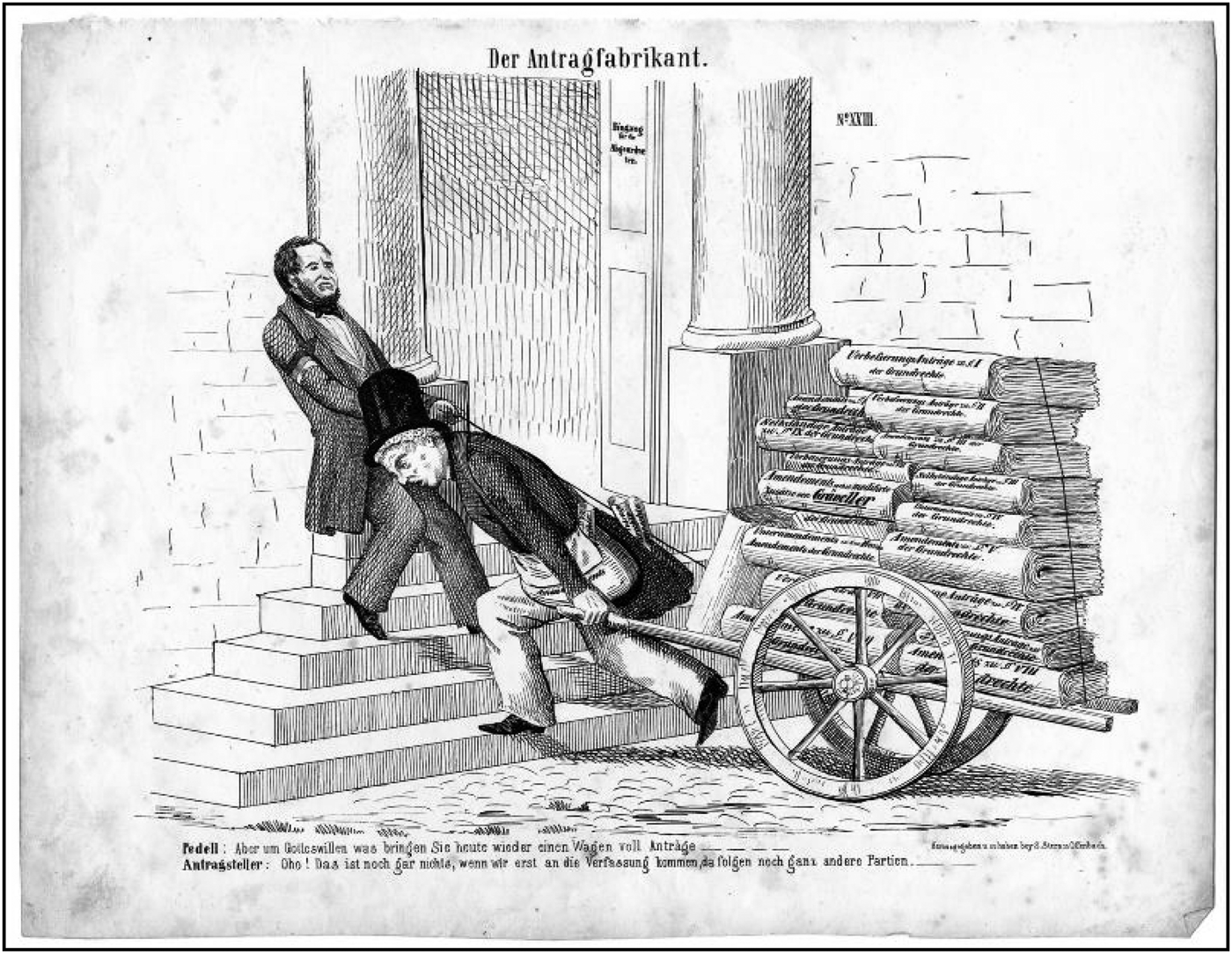
From the beginning, his relations with the Frankfurt Assembly were beset with difficulties owing to his stubborn adherence to a politics of consensus and his distrust of political opposition. Grävell's yearning for unanimity found expression in the Paulskirche in two ways. First, it manifested itself as a willingness to engage in seemingly endless debate due to the conviction that the nearly eight hundred delegates could be made to assent to a single line of thought. Not surprisingly, the universal sort of agreement that Grävell sought to foster by means of rational arguments proved elusive. The other deputies found his speeches not only annoying, but also counterproductive. In this infamous “talking shop” of professors, Grävell was widely regarded to be the most persistent and tedious talker. He was mocked in the press for his never-ending suggestions to amend the Grundrechte (Statement of Basic Rights). One cartoon, entitled Der Antragfabrikant (“The Proposal Manufacturer”), depicted a stooped Grävell arriving at the Paulskirche, pulling behind him a cart loaded with proposed amendments (see Fig. 2). In response to the doorman's amazement at the sheer number of proposals, Grävell is shown to boast, “Oh! This is nothing—just wait until we get to discussing the constitution, then lots more will follow.” This unflattering portrait has found its way into the scholarship, exemplified by Valentin's references in his well-known history of the revolution to “the old, gray, irritating, boring Grävell,” whom Valentin scorned as “parliament's odd and tedious bellyacher.”Footnote 70
Grävell depicted as “the Proposal Manufacturer.” Nr. 043, Lithographie from the Dokumentationssammlung zur Geschichte der deutschen Revolution 1848/49 mit Schwerpunkt Berlin at Humboldt-Üniversität zu Berlin.

In addition to encouraging Grävell's propensity for making long-winded speeches, his yearning for consensus found expression in another way: it instilled in him a desire for conciliation with Germany's rulers that gave his politics a decidedly conservative bent. His inclination to seek reconciliation with the authorities was most apparent in his attitude toward Frederick William III, to whom he continued to pledge his fealty despite being twice incarcerated by the Prussian state. This willingness to submit to the king was a consequence of Grävell's refusal to endorse a politics that pitted subjects against sovereigns, because he fervently believed that the goal of government should be the attainment of rational assent between the people and their rulers.Footnote 71 It is no surprise, then, that he—like most German liberals—repudiated violent revolution. More telling is his refusal to support some variety of the “constitutional dualist” model of governance that was embraced by the majority of delegates within the assembly. That model posited an oppositional relationship between the parliament and the German princes in which each side served to check the other. In contrast to this moderate vision of constitutional monarchy, Grävell maintained that the assembly's decisions were merely suggestions to be offered to the German princes.Footnote 72 He protested that the rulers of the German states each had to give their stamp of approval for the assembly's acts to become binding.
Grävell was thus outraged when, in June 1848, the assembly's president Heinrich von Gagern unilaterally proclaimed the creation of a provisional central authority to which the German princes were expected to pledge their allegiance. A clear departure from a politics of consensus, von Gagern's self-proclaimed kühner Griff (bold maneuver) was condemned by Grävell as a presumptuous act of insurrection by the assembly. Reminding his fellow deputies that “unity is in reason alone,” he argued that “we must strive to win the German governments' trust and goodwill by acknowledging and showing respect for their rightful status and legitimate standing, to reach agreement with them about what the fatherland requires and how this is best achieved so that everyone works together for the common good.”Footnote 73 Grävell was so angered by von Gagern's action that in September 1848 he switched his affiliation from the moderate Casino faction to the conservative Café Milani, thereby relegating himself to the assembly's extreme right fringe.
Like his devotion to a politics of consensus, Grävell's deep suspicion of all forms of political opposition also served to darken his relations with the Frankfurt Assembly. That distrust manifested itself in the Paulskirche as an unconcealed hostility toward party politics. In a pamphlet that he wrote shortly after his defection from the Casino, he denounced what he called the Factionsgeist at work in the Frankfurt Assembly, arguing that “the formation and breaking away of parties and factions is the surest path that leads little by little to the decay of the state and of the general peace.”Footnote 74 Grävell's dislike for party politics helps to explain his inability to find common ground with any group in the assembly. Soon after affiliating himself with the Café Milani, he was forced to recognize that he did not fit in there, either. Rather than evidence of what some historians have called his kautzig (oddball) nature, Grävell's outsider status is probably more accurately understood as a consequence of his reluctance to associate himself with any faction due to his belief that none truly represented the interests of the fatherland. Indeed, he praised himself as “a man who belonged to no faction, who could never bring himself to take sides, and who thus remained free and independent of all parties.”Footnote 75
Grävell's hostility to political factions can be traced, it seems, to his religious conviction that the assembly's fragmentation into rival parties was a result of the delegates' inability to resist their bodies' egoistic urges, which had caused them to disavow the teachings of reason in favor of their own selfish wants. He therefore chastised his former associates in the Casino for their support of von Gagern's maneuver by hinting that they were being led by their passions toward something like the tyranny of the Jacobins, who had selfishly imposed their agenda on the French people without regard for the general will. The irony of this comparison, of course, is that the Jacobins justified their ruthless repression of all dissent by appealing to something like the same faith in rational consensus that informed Grävell's vision of the nation (although their understanding of consensus did not include the monarchy). Like the Jacobins' species of radical democracy, Grävell's liberal politics harbored a latent tendency toward authoritarian rule that is not easily reconciled with his advocacy of constitutional government and the right to free speech. His was a brand of liberalism that was colored by the conviction that there was something irrational and even immoral about political conflict, a conviction that might ultimately be traced to his habit of regarding any expression of political disagreement as bodily in origin and therefore as subversive of the moral and rational order.
The authoritarian tendency in Grävell's politics emerged with striking clarity during his brief tenure as prime minister, when he took the reactionary step in May 1849 of calling for the dissolution of the revolutionary government over which he presided in the belief that it no longer possessed a legal basis. In his eagerness to avoid a violent clash with the German princes, he ordered the assembly to submit a report of its grievances and to disband. This decree predictably provoked outrage from the radical deputies, who condemned Grävell for presiding over “an anti-parliamentarian and downright ridiculous ministry, which did not have three votes in the Paulskirche at its disposal.”Footnote 76 Faced with overwhelming opposition, he was forced to step down just two weeks after taking office. In a pamphlet dashed off shortly after his resignation, he sought to defend his actions by asserting that, following the Prussian king's rejection of the constitution, “the revolution was hereby factually and legally ended, and every undertaking that aims directly or indirectly to renew it is a punishable attempt at unlawful self-assertion and mutiny, in the face of which social order cannot exist.”Footnote 77 Although he knew that his reactionary stance would earn him the assembly's approbation, Grävell willingly sacrificed himself for the sake of order. Adopting the mantle of a Christian martyr, he lauded himself for the “extraordinary Selbstverleugnung” that he had exhibited by attempting to halt the revolution.Footnote 78
Further evidence of his readiness to quell dissent can be seen in his response to the wave of protests that erupted across Germany in May 1849, culminating briefly in the establishment of revolutionary regimes in the Palatinate and Baden. Grävell looked upon these regimes with horror, proclaiming that resistance against the legitimate authorities was a “crime against the state's existence and the moral person of the Volk.” He decreed that “the authorities must in no way allow these crimes to be committed, or permit any attempt or preparation for such an attempt, or tolerate anywhere the assembling of powers that would be in a position to resist the state's authority or to hinder its ability to compel obedience.”Footnote 79 This was strong language, because it suggested not merely that the agitators should be apprehended, but that all opposition to the state ought to be outlawed. This tyrannical call to root out opposition cannot be dismissed as simply a panicked response to the chaotic situation in spring 1849, given that he had articulated similar arguments decades earlier. In 1820, he had gone so far as to publish a treatise that advocated the creation of a secret police force to stifle opposition movements.Footnote 80 Alf Lüdtke has seen in Grävell's treatise an ominous foreshadowing of “that characteristic mode of bureaucratic governance in Prussia” that Lüdtke dubbed Festungspraxis (the fortress mode of operation)—a manner of governing that posited that the state was under constant threat of insurrection, such that far-reaching emergency powers needed always to be at its disposal.Footnote 81
The Pietist Underpinnings of Early Prussian Liberalism?
What can Grävell teach us about early Prussian liberalism? In light of his troubled relations with the Frankfurt Assembly, debate has arisen as to whether he should be classified as a liberal at all. Some scholars have described him as “an eccentric conservative Prussian jurist,” “a reactionary, pedantic, and grumpy outsider,” and “a Prussian individualist of the Right, who did not have any following.”Footnote 82 Those who accuse Grävell of being a conservative often identify him with the “bureaucratic liberals” in the administration, a group that included the famous cohort of Stein, Hardenberg, Frey, Schön, Schroetter, Stägemann, and the other aristocrats who spearheaded the Prussian reform movement in the aftermath of the French invasion. Historians have long disagreed about how best to characterize the political attitudes of these men. Whereas one school of thought regards them as “modernizing conservatives” whose goals and approaches reflected the legacy of enlightened absolutism, another school asserts that they were progressive thinkers whose desire to transform Prussia's administration and society reflected a true commitment to liberal ideals.Footnote 83
Certain features of Grävell's outlook would seem to justify placing him in this disputed bureaucratic liberal camp. Perhaps most importantly, even after he left the civil service, he never really abandoned the bureaucratic belief that change should come down from the state instead of up from the citizenry, as evidenced by his conviction that parliaments ought merely to offer monarchs advice rather than to make laws.Footnote 84 In addition, he harbored an exaggerated respect for Germany's traditional rulers that made him quick to defer to princely authority. His deferential attitude is readily apparent, for example, on the dedication page to his Anti-Platonischer Staat, where he pledged “to die in deepest subservience” to “the great and good princes, who are the rulers and fathers of their people.”Footnote 85 That attitude was also manifest in the fact that, even after his persecution by the government, he stayed loyal to the Prussian king, preferring to blame his mistreatment on corrupt ministers rather than on the crown itself.Footnote 86 Finally, by defending Prussia's guilds and corporate estates in his writings, he sided with those aristocrats in the ministry who, despite their desire to modernize Prussia, continued to champion certain aspects of traditional ständisch society.Footnote 87
Nevertheless, to classify Grävell as a typical bureaucratic liberal is to ignore the ways in which he overstepped the parameters of that camp.Footnote 88 As we have seen, he was frequently in conflict with the Prussian administration, which scholars point out was separated by a wide gulf of opinion from the predominantly middle-class judiciary to which he belonged.Footnote 89 His clashes with the administration arose in part from his complaint that, as the historically exclusive domain of the nobility, it had been corrupted by personal influence. Those feuds were also fueled by his demands for freedom of speech, such as in 1819, when he criticized Hardenberg's press laws in a controversial publication that earned him the enmity of Prussia's most powerful politician.Footnote 90 Above all, however, Grävell broke ranks with the bureaucratic liberals by attempting to appeal directly to the middle-class public with his writings. In this respect he bore a greater affinity to the rising tide of bourgeois activists—intellectuals such as Fichte and publicists such as Ernst Moritz Arndt—than he did to the statesmen who implemented the great series of reforms between 1807 and 1819.Footnote 91
On balance, then, Grävell is probably best described as what one scholar has called a Grenzgänger (borderline figure) who straddled the boundary between the bureaucratic liberal tradition and a more broadly based, middle-class liberalism that began to emerge in Prussia in the 1820s.Footnote 92 His ambivalent stance can be seen in his tendency to hover in the Frankfurt Assembly between the Center-Right and far Right factions. Although his attempt to bridge these groupings ultimately left him stranded in the no-man's-land between them, I contend that he has greater explanatory potential for the history of early Prussian liberalism than his outsider status in the assembly seems to suggest. Specifically, his role as a Grenzgänger between Prussia's aristocratic reformers and bourgeois activists indicates that he harbored ideas that were common to each of these groups, thus pointing to certain underlying continuities in their political outlooks. Captured in Grävell's politics was something that both categories of early Prussian liberals shared: a longing for consensus and a pronounced hostility to competing interests.
Research indicates that these tendencies, far from being unique to Grävell, were in fact deeply rooted in early Prussian liberalism. In a recent study of Vormärz Prussian nationalism, Matthew Levinger asserted that the reformers in the ministry, as well as many of Prussia's middle-class liberals, subscribed to a vision of the nation that “emphasized the importance of harmony and internal unanimity.”Footnote 93 Levinger noted that these men believed that laws ought to be made not by parliamentary majorities, but “by deriving an informed consensus of the citizenry and the government authorities concerning the public good.”Footnote 94 Few Prussians took their desire for consensus so far as to endorse Grävell's view that parliament should exist merely in an advisory capacity. Instead, they typically championed something like the theory of “constitutional dualism” proposed by the Göttingen professor Friedrich Dahlman. Yet while that theory sounded quite democratic, in reality it was plagued by the same longing for consensus that distorted Grävell's vision of government. Scholars point out that Dahlmann's dualist model was skewed decisively in the crown's favor, because it failed to make ministers responsible to parliament, and it denied the legality of active resistance against the government.Footnote 95 Thus, most Prussian liberals, notwithstanding their demands for a representative assembly, continued to seek harmony between subjects and sovereigns by essentially depriving the people of power to challenge the state.
Moreover, Prussian liberals' yearning for unanimity appears to have engendered in their outlook the same intolerance for competing opinions that marred Grävell's politics. Levinger observed that the reformers in the ministry displayed “a pervasive tendency to exaggerate the negative effects of political strife” that “inhibited the effectiveness of the liberal movement in nineteenth-century Prussia by making it difficult to form a loyal opposition.”Footnote 96 A similar tendency existed in the judiciary. Christina von Hodenberg noted that Prussia's judges aspired to “the ascertaining of truth and not political compromise,” because they believed that party politics were sullied by “the odium of private interest.”Footnote 97 In spite of the fact that the jurists' desire to introduce a more bourgeois social and political order often set them at odds with aristocrats in the administration, both of these wings of the civil service were united by their disdain for democracy, which they scorned as a political system that validated competing interests. Administrators and judges were not the only Prussians who condemned democratic partisanship; so, too, did many intellectuals and journalists. One prominent example was Friedrich Ludwig Jahn, founder of the German gymnastics clubs and a key initiator of the student fraternity movement. As a delegate to Frankfurt who allied himself with the assembly's right wing, old “Father Jahn” railed against a democratic republic and voted in favor of a hereditary emperor.Footnote 98
Finally, research indicates that Prussian liberals' intolerance for competing viewpoints imbued their politics with an authoritarian streak similar to that exhibited by Grävell.Footnote 99 The fact that, despite their reformist tendencies, the progressive aristocrats in the administration did not flinch from using force to silence dissent may not be all that surprising, given that they were determined to retain their hold on the reins of power, to say nothing of their noble privileges. More unexpected is the willingness of the middle-class judiciary to sanction the use of violence to quell opposition. Studies show that Prussia's liberal jurists were no less prepared than the generals to call for police proceedings, even if the former were more apt to cloak those calls in sanctimonious appeals to die gesetzliche Ordnung.Footnote 100 When one considers that even Prussia's bourgeois defenders of the rule of law endorsed the police state, Grävell's treatise of 1820 ceases to appear so anomalous in the context of Prussia's early liberal movement. The same is true of his hard-line response to the rebellions that swept Germany in spring 1849. Although his cries to quash the revolution have often prompted historians to label him a reactionary, in fact most Prussians agreed with his assertion that, following Frederick William's refusal to endorse the constitution, the revolution had lost all legitimacy. Indeed, upon hearing of the king's refusal, many Frankfurt deputies turned their backs on the revolution and abandoned the city. The caricature of Grävell as an intransigent conservative that lingers in the scholarship seems to have originated largely among the assembly's remaining radicals, whose desire to continue the revolution did not represent the wishes of the vast majority of Prussians.
Grävell's case raises the possibility that the yearning for consensus and distrust of competing opinions that characterized the outlook of a wide swath of early Prussian liberals might be partly attributed to their shared conception of the nation in terms of the Pietist ethos of Selbstverleugnung. As we have seen, that ethos suggested not only that dissenting opinions were sinful expressions of bodily egoism, but it also fostered the belief that unanimity could always be found in the teachings of reason, understood as the soul's divine mandates. Of course, one might object to any attempt to generalize about early Prussian liberalism on the basis of Grävell's writings by pointing out that his habit of deriving political conclusions from his otherworldly speculations made him unusual, even by the standards of his day. Yet I believe that it is precisely the exceptionality of Grävell's afterlife writings that makes them worthy of study, for often it is to the extremes that one must look to discern tendencies that are buried or repressed in the mainstream. As a singular attempt to demonstrate the Pietist underpinnings of his politics, Grävell's writings have unique potential to reveal the religious ethos that only tacitly informed the outlook of his fellow liberals, many of whom were raised in devoutly Pietist households. For instance, Jahn also studied at the university in Halle and was the son of a Lutheran pastor. He, too, extolled the ethos of self-denial in his nationalistic writings, such as in his Die Deutsche Turnkunst (1816), where he praised the gymnastics associations for promoting a “sense of communalism and patriotic feeling, persistence and Selbstverleugnung” among the German youth.
One clue that suggests that the Pietist impulse to scorn bodily egoism was widespread among early Prussian liberals is provided by their attacks on materialist philosophy. Prussian intellectuals were obsessed with the threat posed by materialism, which they condemned as a worldview that exalted human sensuality and self-interest. Among the most strident of these antimaterialism crusaders was Fichte, who in his Reden argued that materialist philosophy engendered political instability by promoting a relativistic ethics in which bodily feeling replaced the soul as the gauge of moral conduct. Fichte thus drew a connection between a materialist ethics and democratic anarchy, a connection that many of his contemporaries believed they saw as well. Their assaults on democracy are revealing, because they hint at a deep-seated contempt for the body. By denouncing democrats such as Heine and his literary circle as “sensualists,” liberals left little doubt as to the puritan ethic that inspired their distrust of political pluralism.Footnote 101 Recoiling from the morally chaotic implications of a worldview that enshrined the flesh as man's essence, liberals in Prussia seized upon Kant's philosophy as a buttress to their vision of a rationally ordered national community. Research shows the full spectrum of early Prussian liberals—from aristocratic reformers in the ministry, to middle-class jurists, academics, and publicists—embraced Kant's writings.Footnote 102 By rejecting the materialists' suggestion that bodily feeling could afford multiple paths to truth, Kantian philosophy may have affirmed liberals' religious conviction that there was a single truth that was accessible through the rational soul alone, an affirmation that worked to reinforce their belief in the sinfulness of political opposition.
The accusation that Kant helped to guide Prussians off the path to English parliamentarianism has been so often repeated that it has almost become a cliché. Nevertheless, it is suggestive that, in scholars' attempts to explain what, exactly, about Kant's thought may have encouraged Prussians to arrive at their own illiberal idea of freedom, researchers have almost invariably pointed to his philosophy's moral underpinnings. There is widespread agreement that Kant was guilty of elaborating what Krieger called “a politics ultimately based upon ethics.”Footnote 103 Indeed, Frederick Beiser has identified Kant as the chief inspiration behind a “rationalist” camp of early German liberalism that was distinguished by an “ethic of duty” that stressed that “our vocation is to fulfill our moral obligations.”Footnote 104 As is well known, Kant claimed that these moral obligations could be discerned by means of his categorical imperative, which decreed that one was compelled to choose the most rational course of action (i.e., that which was best suited to serve as a universal maxim), because it was necessarily the most virtuous. Critics assert that the categorical nature of Kant's ethics fostered an inflexible sort of liberalism, because his emphasis on obedience to reason's mandates served to undermine the perceived legitimacy of divergent opinions. Rather than promoting a politics of creative conflict, Kant's moral philosophy may have encouraged the pursuit of rational unanimity.
The scholarship thus offers indirect support for my contention that Prussian liberals' yearning for consensus and distrust of competing interests were first and foremost the expression of a particular moral orientation, and only secondarily the result of social and political circumstances. Contrary to researchers' claims that Prussian liberals derived their rigid moral outlook from Kant's writings, however, I argue that they were drawn to his philosophy because they believed they saw in it their own religious beliefs, above all the Pietist injunction to turn away from the egoistic proddings of the body in favor of the universal mandates of the soul. Their tendency to superimpose their religious sensibilities onto Kant's rationalist philosophy had far-reaching consequences for German politics. By conflating the ethos of Selbstverleugnung with Kant's moral teachings, Prussian liberals seem to have effectively translated that ethos into lay terms, thereby ensuring its survival in a more secular age. Reformulated in Kant's language, that ethos was able to infiltrate the nationalist discourse in Prussia, contributing to the emergence there of a uniquely conservative liberalism.
Although the religious interpretation of Kantian philosophy in terms of the Pietist ethos of self-abnegation seldom appears to have been expounded from the pulpit or lectern in early nineteenth-century Prussia, preliminary research indicates that it may have been widely disseminated nonetheless by means of less official channels. One of these may have been freemasonry, whose membership included many of the aristocratic reformers and bourgeois activists who comprised the mainstay of Prussia's early liberal movement.Footnote 105 Scholars have long recognized that rationalist and religious currents merged to an unusual extent in the Masonic underground, as evidenced by the brotherhood's engagement with Hermeticism, Neo-Platonism, Rosicrucianism, and other esoteric traditions. Theosophical attempts to combine rational inquiry with religious belief seem to have held a special attraction for Prussia's Freemasons due to their belief in the existence of a deeper wisdom that neither reason nor faith alone could fully reveal. Because the brotherhood was convinced that such secret knowledge could be grasped only through rational deliberation coupled with spiritual insight, it was likely inclined to disregard the strict limits that Kant had set for his inquiries by interpreting his writings in a much broader context that included the teachings of pagan mystics and Christian theologians.
One indication that Prussia's Freemasons may have read Kant in a way that was inclusive of their Lutheran spirituality is that Grävell began to articulate his Pietist understanding of Kant's philosophy shortly after he joined the brotherhood in 1809.Footnote 106 Moreover, studies suggest that Lutheran religiosity pervaded Prussian lodges to a degree that was unique in the Masonic world. The Protestant bias of the Prussian freemasonry was evident not only in its well-documented prejudice against Catholics and Jews, but also in the unmistakably religious overtones of the lodge discourse.Footnote 107 Stefan-Ludwig Hartmann has observed that, in contrast to Masonic speeches elsewhere in Germany, lodge addresses in Prussia “dealt primarily with moral issues and resembled Protestant sermons.”Footnote 108 Drawing from Luther's theology and Kant's philosophy, speakers commonly warned against the dangers of neglecting the rational good by succumbing to passionate self-interest. That the brotherhood employed this moralistic message in support of the national crusade is suggested by a highly politicized defense of freemasonry that Grävell wrote in 1810.Footnote 109 By enlisting a revamped, Kantian version of the Pietist ethos of self-denial in the service of national unity, the brotherhood appears to have promoted an illiberal vision of the German nation in terms of unanimous assent. This may help to explain why Prussia's lodges—in contrast to those in cities such as Leipzig, Hamburg, or Frankfurt—were overwhelmingly hostile to a vision of national unity in terms of a balancing of competing interests.Footnote 110
In addition to freemasonry, rationalist-theological groups may also have helped to encourage the interpretation of Kant's philosophy in terms of the ethos of Selbstverleugnung. The most important of these was the Lichtfreunde, or “Protestant Friends of Light.” Founded in 1841 by reform-minded pastors and laity throughout Saxony and Prussia, the Lichtfreunde endorsed a freer organization of church life and a more rational liturgy in opposition to state-sponsored orthodoxy. The organization attracted many liberal supporters, including Grävell, who declined an offer to head it in the early 1840s.Footnote 111 Similar to the Freemasons, the Lichtfreunde seem to have played a vital role in propagating the view that Kant had outfitted the Pietist ethos of Selbstverleugnung with a rational basis. The possibility that the Lichtfreunde championed that ethos in support of something like Grävell's self-sacrificial vision of national unity is supported by scholars' claims that, far from being just a religious association, it was also a vital instrument of nationalist agitation in Vormärz Prussia.Footnote 112
Research suggests that where the fusion of Kant's ethics with Pietist morals was less pervasive, more democratic forms of liberalism were able to develop. According to Beiser, the uncompromising “rationalist” variety of liberalism that dominated in eastern Prussia competed with a “humanist” variety elsewhere in the German lands. He argued that “while the rationalists insisted on justifying moral principles according to pure reason alone, the humanists stressed that they must be based upon experience, and in particular the knowledge of the characteristic powers of human nature.”Footnote 113 Beiser's division of early German liberals into rationalist and humanist camps is instructive, because it hints that their political differences were in some ways a consequence of their contradictory attitudes toward the body. Whereas rationalists clung to an ethics of reason that was divorced from the senses, humanists subscribed to an empiricist ethics that was grounded on historical experience, and thus on bodily engagement with the world. Because the humanists sanctioned the diversity of desires arising from the flesh, they may have been more apt to embrace a political model that validated competing interests.
Indeed, all the figures whom Beiser identified as early proponents of the humanistic variety of liberalism—Humboldt, Schiller, Forster, and Jacobi—subscribed to something like Herder's holistic understanding of man as an amalgamation of his spiritual and sensual aspects. Believing that sensuality was an integral aspect of the human being, these thinkers all criticized Kant's philosophy for its puritanical attitude toward the flesh. Wilhelm von Humboldt provides a good example. Repudiating the asceticism of both Halle Pietism and Kantian rationalism, Humboldt embraced classical paganism and a vitalist view of nature.Footnote 114 These dual influences inspired him to praise the body and sense experience as essential components of human nature, as evidenced by his “neo-humanist” ideal of Bildung, or self-cultivation. Humboldt's concept of Bildung departed from the educational ideals of Francke and Kant by exalting sensuality as a crucial means of mankind's moral improvement.Footnote 115 His willingness to validate mankind's sensual aspect also informed his visions of life after death. Like Herder, he, too, hinted at an embodied afterlife in which departed souls would retain their earthly memories and affections.Footnote 116 While Humboldt's endorsement of the diversity of bodily feeling—in contrast to Forster and Jacobi—did not make him into a champion of radical democracy, it nevertheless led him to articulate a vision of the nation that, though monarchist, expressly sanctioned divergent lifestyles and opinions.Footnote 117
It is no accident that something like Beiser's humanist strain of liberalism flourished in precisely those regions where the Halle school of Pietism did not hold sway. One of those areas was Baden, whose religious culture was shaped by Catholicism, together with a markedly less puritanical form of Pietist religiosity than that which dominated in Prussia's eastern heartland. Researchers have shown that the less ascetic character of southwest German Pietism owed much to the influence of the circle of eighteenth-century Swabian theologians led by Friedrich Christoph Oetinger. Oetinger not only maintained close ties to those Herrnhüter Pietists maligned by Francke as “sensualists,” but he was also largely responsible for introducing Swedenborg's visions of an embodied afterlife to German readers.Footnote 118 Because Badenese Pietism was not as hostile to the flesh as its Prussian counterpart, moral injunctions against self-interest seem not to have been as pervasive in Baden, so that a tradition of political pluralism could take root there. Karl Rotteck and Karl Theodor Welcker helped to nurture that tradition by elaborating a version of constitutional dualism that gave greater agency to the people.Footnote 119
Nor did a puritanical contempt for the flesh serve to stifle the pursuit of self-interest in the Prussian Rheinland. Due in part to the influence of the Catholic Church, Halle Pietism never achieved hegemony there, despite the fact that the region was absorbed into the Prussian kingdom in 1815. Uninhibited by Pietist approbations against bodily egoism, Rhenish liberals were thus freer than their East Prussian counterparts to endorse competing interests not only in the political realm, but also in the economic sphere.Footnote 120 Rhinelanders such as David Hansemann, Ludolf Camphausen, and Gustav Mevissen were among the first Germans to vouch explicitly for the interests of the industrial capitalist. While it is true that a small number of Prussia's aristocratic reformers flirted with Adam Smith's free-market theories, their initiatives often met with intense opposition within the ministry.Footnote 121 Most early Prussian liberals appear to have shared Grävell's belief that “Smith and his adherents idealize the national economy by starting from the premise that self-interest is the basis of all human interactions, and that this self-interest is somehow purified by reason.”Footnote 122
Conclusion
Given the evidence that the Pietist ethos of self-abnegation may have played a key role in inspiring Prussian liberals' desire for consensus and their distrust of competing interests, it would seem that Krieger and the many scholars who followed his lead have been too quick to downplay religion's role in the development of German politics. It is noteworthy that the last in-depth investigations of the relationship between Pietism and German nationalism appeared more than half a century ago.Footnote 123 As Hartmut Lehmann has argued, these pathbreaking studies suffered from a tendency to treat Pietism as a monolithic movement.Footnote 124 No scholar in recent years has sought to pick up where these investigations left off. Matthew Levinger's book, though deserving of praise for its clear discussion of the peculiar features of early Prussian liberalism, nevertheless attributed those features to what one reviewer called the “familiar trinity” of Enlightenment rationalism, the esprit de corps fostered by the French invasion, and the fragmented state of German politics.Footnote 125 Levinger took account of religion only peripherally by briefly mentioning it as a factor in the thinking of “bourgeois popular activists” such as Jahn, Fichte, and Arndt, who “drew their inspiration partly from the culture of romanticism and from pietist spirituality.”Footnote 126 Nor has much research been done on religion's role in shaping the liberal politics of the middle-class judiciary to which Grävell belonged. Although Christina von Hodenberg noted that more than ninety-five percent of Prussia's jurists were Protestant, she explained their political views with reference not to their faith, but rather to their bourgeois backgrounds and the bureaucratic milieu in which they were working.Footnote 127 Others have sought to explain the jurists' political outlook in terms of their median age or the particular theory of law in which they were educated.Footnote 128
Scholars' dismissal of Pietism's influence on early Prussian liberalism may be partly due to their tendency to seek an overt connection between politics and specific tenets of Luther's theology, such as his understanding of freedom in purely spiritual terms, or his “two kingdoms doctrine” by which he sought to command obedience to secular authorities. Religion's influence on Prussian politics may have been more subtle than these examples suggest. The case of Grävell indicates that his Pietist faith was responsible not so much for generating a specific political ideology as it was for fostering a general mind-set. Specifically, Prussian liberals' Pietist assumption of a radical opposition of soul and body may have instilled in them an intensely polarized outlook—a tendency to perceive the world in terms of binary oppositions such as good versus evil, right versus wrong, enlightened versus ignorant—that made for a conservative vision of the nation that was marked by an aversion to competing viewpoints and a utopian desire for unanimity.
To be sure, this current of early Prussian liberal thought was gradually subsumed by more democratic streams of thought after 1830 or so. As time wore on, a politics underpinned by religious ideals was increasingly challenged by one that was formulated more directly in response to material realities. Yet Grävell's peculiar brand of liberalism, with its underlying belief in a hostile opposition of the spirit and the flesh, was not without consequence for the future of German politics. Above all, that conservative species of early liberal thought powerfully contributed to the nineteenth-century understanding of the Rechtsstaat, an idea with a long genealogy. In particular, early Prussian liberals' assumption of the sanctity of the soul versus the sinfulness of the flesh may have helped to imbue older notions of the Rechtsstaat with a more prominent moral dimension. Throughout the nineteenth century, German liberals of different stripes were united by the fact that they all subscribed to a glorified view of “the constitutional state” as not merely the most rational or sustainable form of government, but as the prime agent of mankind's moral improvement. The politicians and philosophers of Wilhelmine Germany repeatedly voiced the belief that a political order that was erected on the basis of rational laws must inevitably lead its citizens to perfection.
The heavy ethical connotations inherent in the nineteenth-century concept of the Rechtsstaat might ultimately be traced to the sanctified understanding of reason that arose from early Prussian liberals' puritanical tendency to exalt the divine mandates of the rational soul in opposition to the egoistic desires of the body. Because they understood Vernunft in explicitly religious terms, they were led to claim that by enshrining reason's mandates into laws, they were carrying out God's will, such that they were establishing a more godly order on earth. Grävell hinted at this idealized vision of the state when he told his readers that “it is not merely man's duty to be a citizen of a state. It is also to his benefit—the greatest benefit that life has to offer. The state is a passage to morality for humanity.”Footnote 129 The problems inherent in this religiously conditioned vision of the state would become all too apparent in the second half of the nineteenth century, when liberals' tendency to conceive of Bismarck's authoritarian Reich in intensely moral terms served to undermine their authority to challenge the government.