Implications
Limiting feed intake after weaning is a nutritional strategy commonly used in meat rabbit farms as an alternative to antibiotics to prevent the frequent occurrence of digestive disorders in the post-weaning period, which are responsible for considerable production losses. By comparing the health and productivity responses of rabbits of two genotypes to 3-week post-weaning restricted or ad libitum medicated or non-medicated feedings, this study showed that short-term feed restriction may be beneficial, also for high growth potential genotypes, for promoting rabbit health. Its negative impact on rabbit growth and carcass weight could be counterbalanced partly by improved feed utilisation.
Introduction
In most livestock sectors today there is great interest in developing models of sustainable production to provide consumers with safe products of animal origin. This is true also in rabbit production, which aims to enhance the value of rabbit meat as a functional and safe food, especially through proper feeding strategies (Hernández Reference Hernández2008; Cavani et al., Reference Cavani, Petracci, Trocino and Xiccato2009; Dalle Zotte and Szendrő, Reference Dalle Zotte and Szendrő2011).
A short feed restriction after weaning is commonly used in meat rabbit farms (Gidenne et al., Reference Gidenne, Combes and Fortun-Lamothe2012) to prevent the frequent occurrence of digestive disorders in the post-weaning period, as such disorders are responsible for high mortality rates and consequently considerable losses in productivity. This technique represents an alternative to the use of antibiotics to control rabbit enteropathies, reducing feed and drug costs and resulting in the production of meat by healthy animals without serious risk of the development of microbial resistance to antibiotics.
Moreover, the lower growth rate and dressing out percentage associated with limited post-weaning intake seems to be counterbalanced by the improvement in feed efficiency and compensatory growth supported by the subsequent ad libitum feeding (Xiccato, Reference Xiccato1999; Gidenne et al., Reference Gidenne, Combes and Fortun-Lamothe2012).
In the past few years, several studies (Gidenne et al., Reference Gidenne, Combes and Fortun-Lamothe2012; Knudsen et al., Reference Knudsen, Combes, Briens, Coutelet, Duperray, Rebours, Salaun, Travel, Weissman and Gidenne2014; Read et al., Reference Read, Combes, Gidenne, Destombes, Grenet and Fortun-Lamothe2015) have verified the impact of various restricted feeding programmes (FP) on the health, physiological and productive traits of growing rabbits. As reported in the review of Gidenne et al. (Reference Gidenne, Combes and Fortun-Lamothe2012), the methods used to control rabbit feed intake differ in terms of duration and intensity, but commonly involve a limited feeding time or a reduced supply of feed; studies have also examined energy (Szendrő et al., Reference Szendrő, Metzger, Febel, Hullar, Maertens, Bianchi, Cavani, Petracci, Biró-Németh and Radnai2008; Metzger et al., Reference Metzger, Szendrő, Bianchi, Hullár, Fébel, Maertens, Cavani, Petracci, Radnai and Biró-Németh2009; Pascual et al., Reference Pascual, Soler, Cervera, Pla, Pascual and Blas2014) and water restriction (Bovera et al., Reference Bovera, Lestingi, Piccolo, Iannaccone, Attia and Tateo2013). Nevertheless, only Matics et al. (Reference Matics, Dalle Zotte, Radnai, Kovács, Metzger and Szendrő2008) studied the effects of a post-weaning feed restriction compared directly with the dietary use of antibiotics, whereas there is a lack of information regarding these effects in relation to the growth potential of rabbits genotypes.
The object of this research was to promote the health of growing rabbit through a 3-week feed restriction after weaning. This restricted feeding was compared with ad libitum feeding and with the consumption of diets that did or did not contain antibiotics. The effects of the feeding strategies on feed intake, growth performance, health status and carcass and meat quality have been assessed on rabbits of two different genotypes.
Material and methods
Animals, housing and feeding programmes
This experiment was conducted on a commercial rabbit farm in Sicily from March to June 2014 using a total of 512 rabbits of both sexes, weaned at 31 days of age.
The rabbits were of two genotypes, the Italian White pure breed (IWP), derived by Italian genetic selection of the New Zealand White breed, with an adult weight of 4.3 to 4.7 kg, and the Hycole hybrid×Italian White crossbred (HIWC), achieved inseminating IWP does with semen of bucks of a coloured Hycole hybrid line with an adult weight of 6 to 7 kg.
The rabbits were kept in an indoor unit under natural photoperiod at a temperature of 18°C to 24°C and a relative humidity of 60% to 75% maintained by a forced heating and cooling system. During the experiment, all rabbits were managed according to EC Directive 86/609/EEC regarding the protection of animals used for experimental and other scientific purposes and Recommendation 2007/526/EC.
At 36 days of age, rabbits were equally singled out from two batches of litters born at a 42-day interval and divided into four groups (n=128 per group) according to genotype and sex, and homogeneous in terms of weaning weight. In each group, eight rabbits of the same sex and genotype were pair-housed in a wire net, flat-deck cage formed by four cells of 28×40×30 cm (length×width×height) equipped with nipple drinkers (1 per cell) providing drinking water ad libitum and a common, central round feeder.
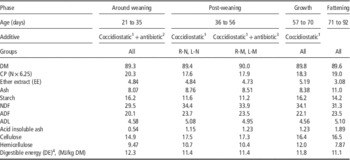
For 3 weeks, from 36 to 57 days of age, the rabbits in each group were assigned to a different FP: restricted non-medicated (R-N), ad libitum non-medicated (L-N), restricted medicated (R-M) or ad libitum medicated (L-M). The experimental non-medicated and medicated diets had the same formulation and similar chemical compositions (Table 1). The medicated diet was supplemented with 1540 mg/kg oxytetracycline and 240 mg/kg colistin sulphate. The feed restriction was achieved by giving an individual feed amount equal to 70, 80 and 90 g/day (as-fed basis) during the 1st, 2nd and 3rd week, respectively, in accordance with the restriction plan practised in the farm. In the successive 5 weeks of the experiment, all groups received the same farm diet supplied ad libitum. Table 1 shows the commercial diets fed to rabbits during the weaning period and the successive growth phases and their chemical compositions.
Chemical composition (% dry matter (DM)) of commercial diets fed to rabbits by phase

R-N=restricted non-medicated feeding; L-N=ad libitum non-medicated feeding; R-M=restricted medicated feeding; L-M=ad libitum medicated feeding.
1 Diclazuril E771 (Clinacox 0.5% Premix Janssen) 1 mg/kg.
2 Apramicyn 60 mg/kg, tylosyn 120 mg/kg.
3 Oxytetracycline 1540 mg/kg, colistin sulphate 240 mg/kg.
4 DE (MJ kg/DM)=14.2−0.205 ADF%+0.218 EE%+0.057 CP% (Fernández-Carmona et al. Reference Fernández-Carmona, Cervera and Blas1996).
Intake, growth, health and slaughter
Feed intake per cage was measured by weighing the feed supplied and refused daily with restricted feeding and weekly with ad libitum feeding. Individual live weight (LW) was recorded at 36, 57 and 92 days of age. Mortality was checked daily, whereas morbidity was recorded when the rabbits were weighed. A rabbit was considered morbid when it showed signs of digestive disorders or weight loss or had a growth rate −2 SD below the mean for the period, as suggested by Gidenne et al. (Reference Gidenne, Combes and Fortun-Lamothe2012). Mortality was attributed to enteropathies when external signs of diarrhoea were evident. The health risk index was calculated as the sum of morbid and dead rabbits (Gidenne et al., Reference Gidenne, Combes, Feugier, Jehl, Arveux, Boisot, Briens, Corrent, Fortune, Montessuy and Verdelhan2009).
At the end of the 8-week growth period, at 92 days of age, 32 rabbits per FP were selected to represent the composition, in terms of sex and genotype, and the variability of their experimental group. On the next day, after 12 h fasting from solids, applied to reduce the gastrointestinal content and facilitate its post-slaughter removal, they were weighed and then slaughtered by cutting the carotid arteries and jugular veins after electric stunning and individually processed in the commercial slaughterhouse annexed to the farm.
Commercial carcasses were obtained as recommended by Blasco and Ouhayoun (Reference Blasco and Ouhayoun1996) by removing the skin, the distal part of the tail, the distal parts of fore and hind legs (HL), the urogenital organs and the gastrointestinal tract. To estimate the gastrointestinal content, the weight of full and empty gastrointestinal tract was recorded; to remove its content, the full gastrointestinal tract was washed under running water, dripped and then got dry with absorbent paper. The hot carcasses were weighed, then stored at 4°C for 24 h.
Carcass and meat quality measurements
At 24 h after slaughter, the chilled carcasses were weighed and then dissected, as indicated by Blasco and Ouhayoun (Reference Blasco and Ouhayoun1996), by removing the head and internal organs (thymus, trachea, oesophagus, lungs, heart, liver and kidneys) to obtain the reference carcasses; cutting the anatomical joints, such as fore (cut between the last thoracic and the first lumbar vertebrae), intermediate and hind parts (cut between the sixth and seventh lumbar vertebrae); separating perirenal and scapular fat, and both HL from the hind part. Each left HL was dissected to weigh the tissue components, such as fat (inguinal and intramuscular), bone and meat.
pH and colour were measured 24 h after slaughter. pH was measured in duplicate on the Longissimus lumborum (LL) and right HL (Biceps femoris) muscles using a Hanna FC 200 pH meter (Hanna Instruments, Baranzate, Milan, Italy) equipped with a penetrating probe. Colour was assessed at ambient temperature in duplicate on the surface of the right HL muscles and the transversal section of the muscle LL at level of the sixth lumbar vertebrae, with a Minolta chroma meter CR300 (Minolta, Osaka, Japan) measuring lightness (L*), redness (a*) and yellowness (b*) according to the CIE L*a*b* system (CIE, 1986).
Each right HL was vacuum packed, frozen at −20°C, and then thawed at 4°C for 24 h. The weights of frozen and thawed HL were recorded to determine thawing loss. Cooking loss was measured on right HL wrapped in polyethylene bags, cooked in a water bath at 80°C for 2.5 h, cooled for 1 h, and then reweighed to determine moisture loss, as reported by Xiccato et al. (Reference Xiccato, Trocino, Filiou, Majolini, Tazzoli and Zuffellato2013).
Warner–Bratzler (WB) shear force was measured in triplicate on rectangular samples of cooked right HL meat 2×1 cm in cross-section, excised along the muscle fibre direction, using an Instron 5564 (Instron, Trezzano sul Naviglio, Milan, Italy).
Feed and meat chemical analyses
Samples of diets offered during the experiment were analysed for dry matter (DM), ash, ether extract (EE) and CP (N×6.25) using Association of Official Analytical Chemists (AOAC, 2000) methods; starch using the Ewers polarimetric method (ISO 10520, 1997); and structural carbohydrates, such as NDF, ADF and ADL, together with acid insoluble ash (AIA), following the sequential procedure of Van Soest et al. (Reference Van Soest, Robertson and Lewis1991). Accordingly, cellulose (ADF−(ADL+AIA)) and hemicellulose (NDF−ADF) were calculated. Digestible energy was estimated as (MJ kg/DM)=14.2–0.205 ADF%+0.218 EE%+0.057 CP%, according to Fernández-Carmona et al. (Reference Fernández-Carmona, Cervera and Blas1996).
The meat dissected from the left HL was freeze dried and analysed for water, lipids (EE) and ash content using AOAC (2000) methods, whereas protein was calculated by difference (100−water−lipids−ash), in accordance with Dalle Zotte et al. (Reference Dalle Zotte, Szendrő, Gerencsér, Szendrő, Cullere, Odermatt, Radnai and Matics2015). The total collagen content in HL meat was determined by measuring hydroxyproline according to the colorimetric NMKL-AOAC method (Kolar, Reference Kolar1990) using a multiplication factor of 7.14 (Etherington and Sims, Reference Etherington and Sims1981).
Statistical analysis
The experimental unit was the 8-rabbit cage for the feed intake and feed conversion ratio and a single rabbit for the other parameters. Data were analysed statistically using the GLM procedure in SAS 9.2 (Statistical Analysis Systems Institute, 2010). For the analysis, morbidity, mortality and health risk index were considered Bernoulli variables (0 or 100). The statistical model included the fixed effects of FP (R-N, L-N, R-M or L-M), genetic type (IWP or HIWC), sex and litter batch (1, 2). The interactions among the effects were removed from the model when not significant. Tukey’s test was used to compare means when the effects of FP or interactions were significant (P<0.05).
Results
Feed intake, growth performance and health
The chemical composition of the commercial diets that the growing rabbits received in sequence, according to the feeding plan, is shown in Table 1. The diets offered to the groups in the 3 weeks post-weaning, from 36 to 57 days of age, had the same nutrient and energy contents, but differed in antibiotics. Compared with the diets offered ad libitum in the growth and fattening phases, until 71 and 92 days of age, the post-weaning diets were characterised by lower starch content, whereas they had a lower CP content especially in comparison with the fattening diet.
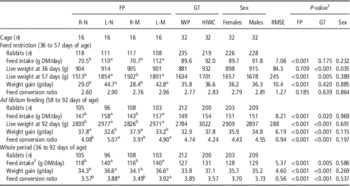
Table 2 summarises feed intake and growth performance. The R-N and R-M rabbits, compared with the L-N and L-M rabbits, maintained a similarly low feed intake during the entire experiment, then also after 57 days, when they were fed ad libitum, although to a lesser extent. In contrast to the restriction period, the reduced ingestion of both restricted groups from days 58 to 92 was associated with a higher weight gain (P<0.001) and, as a consequence, a lower and more favourable feed conversion rate (P<0.001). In spite of their compensatory growth, at 92 days of age the restricted groups had a lower final LW by about 150 g than the rabbits fed ad libitum (P<0.001), regardless of diet medication. With regard to genotype, the high growth potential allowed the HIWC rabbits to show higher initial LW at 36 days of age, and better growth and feed conversion rate, especially from days 58 to 92, reaching a higher final LW (+238 g) than the pure breed rabbits. A significant FP×GT interaction emerged for total feed intake because of the significantly greater intake of HIWC rabbits than IWP rabbits in the L-N regime (145 v. 134 g DM/day, respectively; P<0.05), that did not emerge with R-N (118 v. 120 g DM/day), R-M (118 v. 115 g DM/day) or L-M diets (141 v. 139 g DM/day). No difference due to the rabbits’ sex emerged for feed intake or growth performance.
Effects of feeding programme (FP) and genetic type (GT) on growth, feed intake and feed conversion of rabbits by phase

DM=dry matter. R-N=restricted non-medicated feeding; L-N=ad libitum non-medicated feeding; R-M=restricted medicated feeding; L-M=ad libitum medicated feeding. IWP=Italian White pure breed; HIWC=Hycole×Italian White crossbred.
a,b P<0.05.
1 The interactions among the effects were removed from the model because not significant (P>0.05).
2 Significant interaction FP×GT (P=0.0225).
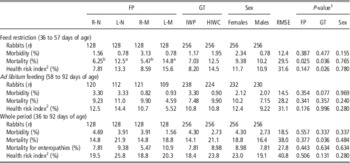
Table 3 shows the health of the rabbits during the experiment. Health conditions on the farm were generally poor, as total mortality and the health risk index reached 17.6% and 21.1%, respectively. The incidence of morbidity and the health risk index were not affected by the FP; however, mortality decreased in both restricted groups in the first 3-week period (P<0.05), but did not differ significantly among groups in the second period. About half of the total losses in each group were rabbits showing signs of diarrhoea, for which death was attributed to enteropathies. Compared with the IWP rabbits, the HIWC rabbits showed higher levels of mortality and a higher health risk index during the restricted period; this between-genotype difference was maintained for total mortality only. Also with regard to health, no difference was recorded between female and male rabbits during the growth period.
Effects of feeding programme (FP) and genetic type (GT) on the health and mortality of rabbits by phase

R-N=restricted non-medicated feeding; L-N=ad libitum non-medicated feeding; R-M=restricted medicated feeding; L-M=ad libitum medicated feeding. IWP=Italian White pure breed; HIWC=Hycole×Italian White crossbred.
a,b P<0.05.
1 The interactions among the effects were removed from the model because not significant (P>0.05).
2 Health risk index=morbidity+mortality.
Carcass and meat quality
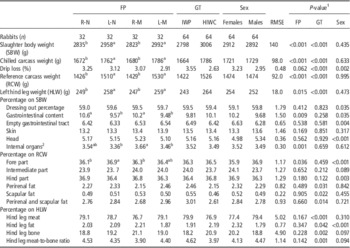
Table 4 shows results related to carcass traits. At slaughter, which was performed at 92 days of age, the restricted rabbits had a lower body weight and, as a consequence, lighter chilled carcasses (−100 g; P<0.001) than the rabbits fed ad libitum. The FP did not affect the dressing out percentages, although, among the removed body parts, the gastrointestinal content and internal organs had lower incidence in the rabbits on ad libitum diets (P<0.01). Diet influenced some carcass characteristics: the percentage incidence of fore parts was lower in carcasses of R-N and R-M rabbits than those fed ad libitum (P<0.05). However, the lower weight of the dissected HL in the restricted groups did not imply differences in terms of tissue composition.
Effects of feeding programme (FR) and genetic type (GT) on carcass traits of rabbits slaughtered at 92 days of age

R-N=restricted non-medicated feeding; L-N=ad libitum non-medicated feeding; R-M=restricted medicated feeding; L-M=ad libitum medicated feeding. IWP=Italian White pure breed; HIWC=Hycole×Italian White crossbred.
a,b P<0.05.
1 The interactions among the effects were removed from the model because not significant (P>0.05).
2 Thymus, trachea, oesophagus, lungs, heart, liver and kidneys.
With regard to genotype, the higher body weight at slaughter of the HIWC rabbits resulted in heavier carcasses that showed a lower drip loss and were characterised by a lower perirenal and scapular fat contents. At dissection, the heavier left HL of the crossbred rabbits resulted in higher fat and bone, thus decreasing the meat content and the meat-to-bone ratio.
Also, sex affected some carcass traits. Indeed, at equal weights, the carcasses of females showed a higher drip loss, lower dressing out percentage and a greater incidence of empty gastrointestinal tracts. In addition, female carcasses had a different cut and tissue composition due to the greater contributions of intermediate and hind parts and of fat and bone tissue, respectively.
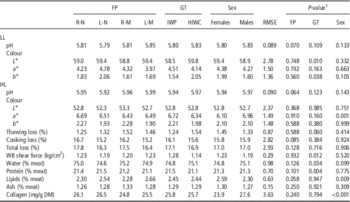
Meat quality was not affected by the FP, as reported in Table 5. Only tendencies towards a higher cooking loss and a lower lipid content were recorded for the meat from restricted rabbits compared with that from rabbits fed ad libitum, together with tendencies towards higher pH in LL and HL meat from L-M rabbits. Genotype affected some meat traits: indeed, the HIWC genotype showed higher L* and b* colour indexes of the LL muscle; a tendency towards higher thawing loss; major meat tenderness, as indicated by a lower value of WB shear force; as well as higher water and lower protein contents in the HL meat. The HL meat of female rabbits had a lower a* colour index, a tendency to a lower water content, but higher lipid and lower collagen contents.
Effects of feeding programme (FP) and genetic type (GT) on physical and chemical traits of Longissimus lumborum (LL) and right hind leg (HL) meat

DM=dry matter; WB=Warner–Bratzler; R-N=restricted non-medicated feeding; L-N=ad libitum non-medicated feeding; R-M=restricted medicated feeding; L-M=ad libitum medicated feeding. IWP=Italian White pure breed; HIWC=Hycole×Italian White crossbred.
1 The interactions among the effects were removed from the model because not significant (P>0.05).
No significant interaction of FP with genotype or sex emerged for carcass traits and meat quality.
Discussion
Effects on feed intake, growth performance and health
This study has investigated the potential of post-weaning feed restriction as an alternative to the use of antibiotics in the diet for improving the digestive health of growing rabbits of two different genotypes.
The commercial medicated and non-medicated diets offered to the experimental rabbit groups in the 3 weeks post-weaning, from 36 to 57 days of age, differed only in the supplement of antibiotics. The diets were formulated to meet the nutritional needs of weaned rabbits, preventing digestive disorders and, at the same time, growth reduction, in line with Gidenne (Reference Gidenne2000). Nevertheless, compared with the suggestions of Gidenne (Reference Gidenne2000) expressed on as-fed basis, the post-weaning diets resulted adequate in starch (<140 g/kg) and ADF (>190 g/kg), quite close to CP (<160 g/kg) and NDF (>300 g/kg), but slightly lower in ADL (>55 g/kg). Moreover, especially because of their high EE content, the diets had slightly more digestible energy (10.3 MJ/kg) than the maximum recommended level (9.8 MJ/kg; Gidenne, Reference Gidenne2000) so that the restricted rabbits could compensate for their lower feed intake. In this regard, Knudsen et al. (Reference Knudsen, Combes, Briens, Coutelet, Duperray, Rebours, Salaun, Travel, Weissman and Gidenne2014) and Read et al. (Reference Read, Combes, Gidenne, Destombes, Grenet and Fortun-Lamothe2015) observed enhanced nutrient utilisation in rabbits on restricted diets eating a diet rich in energy.
The restricted feeding plan, which offered 70, 80 and 90 g/day of feed in the 1st, 2nd and 3rd week after weaning, respectively, equalled 64% of the voluntary intake recorded in the rabbits fed ad libitum, resulting in a stronger restriction than the 75% in other experiments (Gidenne et al., Reference Gidenne, Combes, Feugier, Jehl, Arveux, Boisot, Briens, Corrent, Fortune, Montessuy and Verdelhan2009; Knudsen et al., Reference Knudsen, Combes, Briens, Coutelet, Duperray, Rebours, Salaun, Travel, Weissman and Gidenne2014), and was responsible for a marked decrease in growth without a significant improvement in the feed conversion ratio. The effects of feed restriction on the growth of rabbits were independent of the dietary use of the antibiotics supplement, as was also reported by Matics et al. (Reference Matics, Dalle Zotte, Radnai, Kovács, Metzger and Szendrő2008), as well as did not change in relation to the rabbit genotype.
From days 58 to 92, when all experimental groups were fed freely, rabbits that were previously restricted continued to maintain a slightly lower feed intake compared with those fed ad libitum, also due to their lower LW, as feed intake resulted in similar percentages of LW with restriction (5.12%) and ad libitum diets (5.30%). It is interesting that, contrary to expectations, this lower feed intake of restricted rabbits was associated with compensatory growth and, as a consequence, a lower and more favourable feed conversion ratio, in line with the observations of other authors (Gidenne et al., Reference Gidenne, Combes, Feugier, Jehl, Arveux, Boisot, Briens, Corrent, Fortune, Montessuy and Verdelhan2009; Gidenne et al., Reference Gidenne, Combes and Fortun-Lamothe2012; Knudsen et al., Reference Knudsen, Combes, Briens, Coutelet, Duperray, Rebours, Salaun, Travel, Weissman and Gidenne2014). Because this improvement in feed utilisation was not found to be linked to an increase in nutrient digestibility, Knudsen et al. (Reference Knudsen, Combes, Briens, Coutelet, Duperray, Rebours, Salaun, Travel, Weissman and Gidenne2014) suggested that it could be of metabolic origin through reduced extra-heat production, or the higher relative weight of a full gastrointestinal tract could have led to an overestimation of rabbits’ growth. In accordance with this latter hypothesis, in this study the restricted rabbits showed a higher incidence of content in the digestive tract at slaughter. However, the incidence of empty gastrointestinal tracts did not differ among groups, and the small differences in the weights of the content of the tracts (about 1%) do not seem to be enough to justify the differences in the rabbits’ growth and LW. It is possible that, in the current study, the more intense feed restriction (to 64% of the voluntary intake) could have increased the digestibility of the feed, mainly as a consequence of the longer retention time of the digesta in the intestinal tract (Gidenne and Feugier, Reference Gidenne and Feugier2009).
On the whole, from days 36 to 92, in front of a consistent feed intake reduction (of 16% to 17%), the restricted rabbits reduced less markedly the growth rate (by 6% to 7%) and final LW (by about 5%) in comparison with the rabbits fed freely. Whereas, the higher growth performance of HIWC than IWP rabbits were in line with the differences observed by Szendrő et al. (2010) comparing Hycole line×maternal line crossbred rabbits with purebred rabbits of the maternal line, although for both genotypes the weight gain found in the present study were lower by about 10 g/day than those reported by these authors, only in part due to the contribution of the restricted feeding.
The results also demonstrate that this short-term (3-week) and intense limited feed intake (64%) after weaning, applied on a rabbit farm with poor health conditions, reduced rabbit mortality compared with the ad libitum medicated (by 8.6 percentage points) and non-medicated (by 6.2 percentage points) diets with the same nutrient composition, and had a mortality analogous than that with the restricted medicated diet (R-M). Instead, this favourable effect of lower intake on the health of rabbits was not maintained during the following period when rabbits were fed ad libitum with the growth and fattening diets. However, probably due to the poor health level of the farm, the diet medication with antibiotic did not result very effective during the first 3-week period; instead, during the second period, the mortality recorded in the L-M group (4,6%) was lower by 6.4 percentage points than L-N, although not significantly, suggesting a delayed effect of the antibiotics, ingested ad libitum with the post-weaning diet, in preserving the health status of rabbits. Nevertheless, this trend implies that, on the whole, mortality losses and the health risk index for R-N (14.8% and 19.5%) were lower than those for L-N (21.9% and 25.8%), although these differences did not reach significance, and comparable with those for L-M (18.8% and 20.3%). Accordingly, other than the comparable results in terms of mortality, the feeding restriction (R-N), in respect to an ad libitum medicated diet, ensures the advantage of avoiding the use of antibiotics and the risks connected to their release in the environment contributing to the spread of antibiotic resistance.
During the whole growth period, the health of female and male rabbits did not differ; however, the crossbred (HIWC) rabbits exhibited a higher mortality than the pure breed (IWP) rabbits from days 36 to 57 and over the entire period (+5.5 and +7.0 percentage points, respectively). These results are consistent with observations by Dal Bosco et al. (Reference Dal Bosco, Mugnai, Mourvaki, Cardinali, Moscati, Paci and Castellini2009), who recorded lower immune resistance in commercial hybrid rabbits selected for rapid growth compared with rabbits of a more rustic local population, and also with results reported by Szendrő et al. (Reference Szendrő, Metzger, Febel, Hullar, Maertens, Bianchi, Cavani, Petracci, Biró-Németh and Radnai2008), who found an analogous higher mortality (+9.4 percentage points) in rabbits selected for low body fat deposition (and more rapid growth) than in those characterised by high body fat deposition, even though that difference did not reach statistical significance.
Effects on carcass and meat quality
In this study, the carcass weight of the rabbits on the restricted diets were 5% to 6% lower than that of the rabbits fed freely. But, unlike in other studies (Xiccato, Reference Xiccato1999; Knudsen et al., Reference Knudsen, Combes, Briens, Coutelet, Duperray, Rebours, Salaun, Travel, Weissman and Gidenne2014), the feed restriction did not reduce the dressing out percentages because of the lack of differences in the incidence of major body parts removed, such as skin and empty gastrointestinal tracts and the slight differences emerged for digestive content. Knudsen et al. (Reference Knudsen, Combes, Briens, Coutelet, Duperray, Rebours, Salaun, Travel, Weissman and Gidenne2014), who did not apply a pre-slaughter fasting, justified the lower slaughter yield of rabbits on restricted diets by the higher weight of the full digestive tract caused by overeating when the rabbits were fed freely. In the current study, this overeating behaviour of the restricted rabbits did not occur from days 58 to 92, as proved by the lower feed intake and the analogous incidence of feed intake on LW, as well as of the empty gastrointestinal tracts in comparison with the rabbits fed ad libitum.
With regard to carcass traits, the feed restriction was responsible for only a lower incidence of fore parts and a higher incidence of internal organs that would indicate differences in the growth rate of these body parts. In this regard, Gidenne et al. (Reference Gidenne, Combes and Fortun-Lamothe2012) and Bovera et al. (Reference Bovera, Lestingi, Piccolo, Iannaccone, Attia and Tateo2013) reported that compensatory growth associated with free intake following a period of limited feed intake favours the rapid growth of digestive organs, such as the liver.
In line with other authors (Tumova et al., Reference Tumova, Zita and Stolc2006; Gidenne et al., Reference Gidenne, Combes, Feugier, Jehl, Arveux, Boisot, Briens, Corrent, Fortune, Montessuy and Verdelhan2009; Bovera et al., Reference Bovera, Lestingi, Piccolo, Iannaccone, Attia and Tateo2013) who observed no effect of limited feed intake on physical and chemical characteristics of meat, in this study the feed restriction did not influence meat quality and tended only to reduce the meat fat content, which corresponded with slightly higher cooking losses, whereas the tendency towards an higher pH in L-M was so weak as to be considered negligible.
Instead, the effect of genotype on carcass and meat quality was more relevant than that of feeding treatment, as it affected several traits, in particular carcass weight, perirenal and scapular fat content, HL tissue composition, the L* and b* colour indexes and tenderness. These results can depend on the different degree of maturity of the two genotypes, linked to the different adult body weight of their respective paternal lines, that influences greatly the carcass and meat traits (Dalle Zotte, Reference Dalle Zotte2002); indeed, a lower maturity at slaughtering, as for the HIWC rabbits, can reduce fat deposition and the meatiness of the carcass. However, in accordance with Metzger et al. (2009), genotype never interacted with the feeding treatment, meaning that restricted feeding did not interfere differently with the reared breed in terms of carcass or meat quality traits.
Lastly, the gender of rabbits is confirmed to be one of the factors influencing the carcass traits and meat quality, although in this regard the data reported in literature are conflicting (Dalle Zotte et al., 2016). On the whole, the effects of gender depend on the differences between sexes in the relative growth of organs and tissues. Indeed, for the females, the lower dressing out percentage has to be related to the greater incidence of the empty gastrointestinal tract, whereas the higher HL fat could be responsible of the lower collagen content.
Conclusions
Under the conditions of this study, a 3-week post-weaning feed restriction to a level of 64% of voluntary intake has showed that could represent, regardless of the reared genotype and its growth potential, a suitable strategy for preserving rabbits’ digestive health while avoiding the use of antibiotics in the diet. Indeed, applied in a farm characterised by high incidence of mortality, restricted feeding maintained mortality and the health risk index at levels comparable with those recorded with a medicated diet offered ad libitum without markedly impairing rabbits’ productive performance or affecting the quality of the meat. The negative impact of the restricted feeding on rabbits’ growth rate and carcass weight could be counterbalanced partly by the use of a drug-free diet and improved feed utilisation by rabbits inducing compensatory growth and a lower and more favourable feed conversion ratio.
Acknowledgements
The authors would like to thank Stefania, Marina and Paolo Intravaia of the CUNISUD farm for their technical collaboration and valuable assistance provided throughout the experiment.