





Kurdistan has experienced prolonged political violence and armed conflict, with substantial consequences for the population’s mental health. On 16 March 1988, Iraqi forces used chemical weapons against the Kurdish town of Halabja, killing an estimated 5000 civilians and injuring more than 10 000 others. Reference Rubin1 The long-term effects of such violence are elevated levels of post-traumatic stress disorder (PTSD) symptoms, depression symptoms, anxiety symptoms and other stress-related symptoms. Previous research has shown that war-affected and displaced persons, particularly survivors exposed to chemical attacks, may be at increased risk of long-term psychiatric symptoms. Reference Bisson, Cosgrove, Lewis and Roberts2 Survivors of collective traumatic events, such as the Halabja attack, have been reported to exhibit high levels of PTSD, depression and anxiety symptoms, even years after exposure, particularly women and individuals exposed to multiple traumatic events. Reference Dworkin, Prescott, Jamal, Hardawan, Abdullah and Galea3,Reference Ahmed and Heun4 Cortisol, the principal glucocorticoid regulated by the hypothalamic–pituitary–adrenal (HPA) axis, has been widely studied as a biological marker of stress-related processes following trauma exposure. Reference Herane Vives, De Angel, Papadopoulos, Strawbridge, Wise and Young5 However, the association between cortisol and PTSD symptom severity remains inconsistent, suggesting that cortisol may not directly correspond to psychological symptom severity in all trauma-exposed populations. Reference Schumacher, Engel, Klusmann, Niemeyer, Küster and Burchert6 Psychological comorbidities, including depression and anxiety symptoms, are also commonly associated with PTSD symptoms. Reference Flory and Yehuda7,Reference Rauch, Favorite, Giardino, Porcari, Defever and Liberzon8 In addition to biological processes, sociodemographic and psychosocial factors may influence PTSD risk and symptom severity. Previous research has identified gender, prior trauma exposure, previous mental disorders, coping style and social support as important risk or protective factors for PTSD symptoms. Reference Sareen9 These findings highlight the importance of a multidimensional approach to trauma research, particularly among survivors of political conflict, genocide and mass violence. Quantification of cortisol dysregulation can be achieved using biological substrates such as hair, blood and saliva. Reference Stalder and Kirschbaum10
Hair cortisol concentration (HCC) is particularly useful because it provides a retrospective measure of long-term HPA axis activity over several months. Previous research has examined hair cortisol in relation to trauma exposure and PTSD. For example, Steudte et al reported lower HCCs among PTSD patients and traumatised controls than among non-traumatised controls, suggesting altered long-term cortisol secretion following trauma exposure. Reference Steudte, Kirschbaum, Gao, Alexander, Schönfeld and Hoyer11 However, systematic review and meta-analytic evidence suggest that findings remain mixed, with studies reporting both higher and lower HCCs depending on factors such as the type of adversity, timing of exposure, ongoing stress and sample characteristics. Reference Schindler-Gmelch, Capito, Steudte-Schmiedgen, Kirschbaum and Berking12,Reference Khoury, Bosquet Enlow, Plamondon and Lyons-Ruth13 Therefore, further research is needed to clarify whether hair cortisol and cortisone are associated with psychological symptom severity among trauma-exposed populations.
Trauma-exposed individuals may exhibit heterogeneous patterns of PTSD and related psychological symptoms, with symptom severity and presentation varying across subgroups. Latent profile analysis (LPA) has been used to examine this heterogeneity by identifying distinct symptom profiles from continuous symptom indicators. For example, Murphy et al used LPA to explore PTSD symptom heterogeneity among treatment-seeking veterans and identified six symptom profiles, supporting the value of person-centred approaches for understanding variation in trauma-related symptoms. Reference Murphy, Ross, Busuttil, Greenberg and Armour14
The present study aimed to examine the long-term psychological and biological correlates of trauma exposure among survivors of the Halabja chemical attack. Specifically, the study aimed to determine the prevalence and severity of probable PTSD symptoms and common comorbid psychological symptoms, including depression, anxiety and stress-related symptoms and somatic complaints; investigate associations between psychological symptom severity and sociodemographic characteristics, trauma-related experiences and social support; examine associations between psychological symptom severity and biological stress markers, namely hair cortisol and cortisone, as indicators of HPA axis activity; apply LPA to identify distinct psychological symptom profiles; and examine symptom patterns within a multidimensional biopsychosocial framework integrating psychological, biological and sociodemographic factors.
Method
Ethical approval and consent procedures
The research was formally approved by the Ethics Committee of the University of Duhok on 3 October 2021 (Ethical Approval Number: 141). Additional approval was obtained from the University of Halabja (Approval Number: 01/2024/1). In April 2022, the Governorate of Halabja granted official approval (Reference Number: 10/158) following consultations with the General Directorates of Security and Police, as well as with the relevant humanitarian and medical authorities in the region. These procedures were implemented to ensure the protection and safety of participants during the data collection process. The authors affirm that all procedures undertaken in this study comply with the ethical standards of the relevant national and institutional committees on human experimentation and with the Helsinki Declaration of 1975, as revised in 2013.
Before enrolment, all potential participants were contacted either in person and/or by telephone and were invited to participate. The purpose of the study, all known risks and the conditions of confidentiality were clearly explained, with additional clarification provided during home visits where necessary. Written informed consent was obtained from all participants. Participants were informed that they could withdraw from the study at any time without any negative consequences and that participation was entirely voluntary.
Pilot study
Seven months before the main data collection, a pilot study was conducted to explore the cultural adaptation and feasibility of the measures. It involved 18 participants speaking the Sorani dialect in Halabja. Participants in the pilot study were not included in the main study.
All measures were translated into Kurdish (Sorani) using forward–backward translation by independent translators and were checked by bilingual specialists for semantic and cultural equivalence. Disagreements were resolved through discussion, and cultural acceptability was further verified by piloting the measures with Kurdish-speaking samples, reviewed by a bilingual checker. The measures were administered as structured interviews rather than self-report questionnaires because of low literacy levels and limited time.
Five psychologists worked at the Halabja location. They received a 1-week orientation covering psychometric measurement, interview protocols, hair collection and supportive interventions for bereaved participants, to ensure sensitivity and consistency. During data collection, daily check-ins and weekly supervision sessions were conducted, and research staff were present for 1 week at the site for closer supervision. Structured self-care support was provided to each psychologist at the end of data collection.
The pilot study confirmed the suitability of the measures, verified the cultural acceptability of the instruments after adaptation and assessed the appropriateness of the data collection procedures for the primary study.
Main study and sampling
The main study included 209 participants. The survivors of the 1988 Halabja chemical attack were directly exposed to chemical weapons. Potential participants were identified in collaboration with the Halabja Hospital for Treatment of Chemical Victims. Written informed consent was obtained after a detailed explanation of the study aims and procedures, including assurances of anonymity, voluntary participation and the right to withdraw at any time without consequence.
Data collection for the Halabja group was conducted approximately 35 years after the chemical attack and took place across 2 periods (March–April 2023 and July–September 2023). Structured interviews were completed with 209 survivors. Approximately 145 potential participants in the Halabja group declined participation or did not complete study procedures, primarily because of cultural concerns and mistrust related to hair sample collection. However, because recruitment relied on community-based convenience and snowball sampling, detailed records distinguishing refusals, exclusions and incomplete participation were not systematically maintained. Due to the sensitive nature of the topic and challenges related to participant access, a combination of convenience sampling, snowball sampling and community network recruitment was employed to enhance variability in age, gender and social background. All interviews were conducted in Sorani Kurdish by specially trained psychologists.
Participants who experienced emotional distress during or following the interviews were referred to appropriate mental health services provided through non-governmental organisations and public healthcare institutions. In addition, a formal follow-up procedure was implemented to facilitate access to ongoing psychological support when required.
Study sample
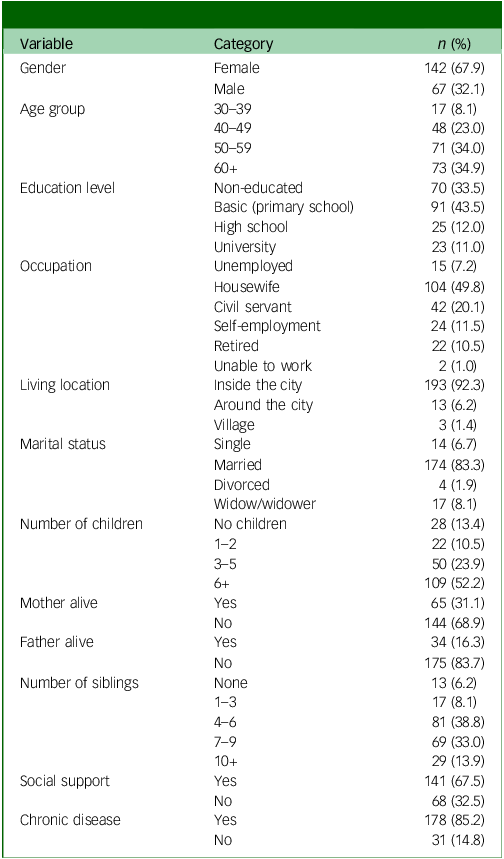
The Halabja group consisted of 209 participants, of whom 67.9% were female and 32.1% were male. More than two-thirds of the sample were aged 50 years or older at the time of assessment. Educational attainment was generally low, with most participants reporting either no formal education or only primary-level education. Nearly half of the sample were housewives, followed by smaller proportions of civil servants and self-employed individuals. The majority of participants were married (83.3%) and resided within the city of Halabja (92.3%). More than half of the participants reported having six or more children. High rates of chronic illness were also observed, with 85.2% reporting at least one chronic medical condition. The demographic characteristics of participants are presented in Table 1.
Sociodemographic characteristics (N = 209)

Table 1 Long description
The table presents sociodemographic characteristics of 209 participants from Halabja. It has 14 rows and 3 columns. The columns are labeled Variable, Category, and n (%). The table includes data on gender, age group, education level, occupation, living location, marital status, number of children, parental status, number of siblings, social support, and chronic disease. Each row lists a variable, its categories, and the corresponding number and percentage of participants in each category. For example, the gender variable shows 142 females (67.9%) and 67 males (32.1%). The age group variable includes categories from 30-39 years to 60+ years, with the highest percentage being 60+ years at 34.9%. Education level categories range from non-educated to university, with the majority being non-educated (33.5%). Occupation categories include housewife, civil servant, self-employment, retired, and unemployed, with housewives being the largest group at 49.8%. Living location is predominantly inside the city (92.3%). Marital status shows most participants are married (83.3%). The number of children category indicates that more than half have six or more children (52.2%). Parental status shows that 68.9% have their mothers alive and 83.7% have their fathers alive. The number of siblings ranges from none to 10+, with 4-6 siblings being the most common (38.8%). Social support is present for 67.5% of participants, and 85.2% report having a chronic disease.
Percentages may not total exactly 100% because of rounding.
The reported age categories reflect participants’ current ages at the time of assessment rather than their ages during the 1988 Halabja chemical attack. As data collection was conducted approximately 35 years after the attack, participants experienced the traumatic event at different developmental stages, ranging from childhood to adulthood. This distinction is clinically important, as the long-term psychological consequences of chemical warfare exposure may vary according to developmental stage at the time of trauma exposure. The majority of participants were in older exposure-age categories, whereas relatively few had experienced the attack in early childhood.
Due to feasibility considerations, participant burden, interview length and the relatively modest sample size, the study focused on a limited set of sociodemographic and social variables considered most relevant to long-term psychological outcomes. Additional variables such as income, displacement history, disability and access to mental health care were not systematically assessed. This approach was also intended to reduce model overfitting and maintain the interpretability of the regression analyses.
Data collection procedure
Standardised instruments were used to assess psychological symptoms and trauma exposure among survivors of the Halabja chemical attack. Due to limited literacy levels and time constraints, data were collected through structured interviews rather than self-administered questionnaires. Following translation, back-translation and pilot testing, all instruments were administered in Kurdish Sorani to ensure linguistic and cultural appropriateness. To enhance communication accuracy and participant comfort, interviews were conducted by a specialised team of five psychologists fluent in the native Sorani dialect spoken in Halabja. This approach facilitated mutual understanding and minimised potential barriers related to language and accent differences. Interviews lasted approximately 60–90 minutes and included both psychological assessment and the collection of hair samples for cortisol analysis. During the first week of data collection, interviews were monitored to ensure adherence to study protocols. Thereafter, trained psychologists independently conducted assessments under weekly supervision to maintain consistency, quality assurance and ethical standards.
Measures
The following standardised and validated instruments were used to assess PTSD symptoms, trauma exposure, psychological distress, somatic symptoms and perceived stress.
The Post-Traumatic Stress Disorder Checklist for DSM-5 (PCL-5; 20 items) was used to assess PTSD symptoms across four domains: re-experiencing, avoidance, negative alterations in cognition and mood and hyperarousal. Reference Weathers, Litz, Keane, Palmieri, Marx and Schnurr15 Items are rated on a 0–4 scale, with higher scores indicating greater symptom severity.
The War and Adversity Checklist-26 (WAEC-26) was used to assess exposure to war-related traumatic events using dichotomous items (0 = no, 1 = yes). Reference Mahmood, Ibrahim, Ismail and Neuner16 For the Halabja cohort, the checklist was expanded with 13 additional items specifically related to chemical attack experiences, including vision loss, unconsciousness and separation from family members during the attack, resulting in a 37-item trauma exposure measure. To enhance contextual relevance, the additional items were designed to capture trauma experiences unique to chemical warfare exposure that were not represented in the original checklist. Before analysis, items were screened based on predefined criteria, including contextual relevance and item-level absence. Two items related to sexual trauma (unwanted sexual experience and witnessing unwanted sexual experience) were excluded due to substantial missing data and cultural sensitivity, which likely reduced participants’ willingness to respond. This approach is consistent with established psychometric practices in trauma research aimed at improving cultural appropriateness, data validity and interpretability. The final version of the checklist was used to compute cumulative trauma exposure scores.
The trauma exposure assessment included both direct experiences related to the 1988 Halabja chemical attack and additional lifetime war-related and interpersonal traumatic events. Consequently, the assessed trauma burden reflects cumulative and chronic trauma exposure rather than a single isolated traumatic event.
The Hopkins Symptom Checklist-25 (HSCL-25) was used to assess anxiety (10 items) and depression (15 items), with responses rated from 1 (‘not at all’) to 4 (‘extremely’). Reference Mahmood, Ibrahim, Goessmann, Ismail and Neuner17 For descriptive analyses, mean subscale scores for anxiety and depression were computed and reported separately using the established clinical cut-off score of ≥1.75 for each subscale. For all inferential analyses, including correlations, regression analyses, gender comparisons and LPA, the HSCL-25 total score was used as an overall indicator of psychological distress. The total score has been validated as a reliable index of combined anxiety and depression symptom burden in conflict-affected populations. Reference Mahmood, Ibrahim, Goessmann, Ismail and Neuner17,Reference Ibrahim, Ertl, Catani, Ismail and Neuner18
The Patient Health Questionnaire-15 (PHQ-15) was used to assess somatic symptom severity. Reference Kroenke, Spitzer and Williams19 In the present study, a culturally adapted 13-item version was used after excluding 2 items with limited applicability in this population. Previous validation research among Kurdish survivors of chemical attacks demonstrated that two items related to menstrual symptoms and sexual pain showed limited applicability, high absence and reduced psychometric performance within this population. Reference Mohammed, Sharif, Kizilhan, Hasin, Papiol and Ruebekeil20 Consequently, these items were excluded to improve cultural relevance, measurement validity and model fit, resulting in a psychometrically reliable instrument adapted for trauma-exposed Kurdish populations.
The Perceived Stress Scale-14 (PSS-14) was used to evaluate perceived stress during the previous month, with items scored from 0 (‘never’) to 4 (‘very often’). Four positively worded items were reverse-coded prior to total score computation. Reference Santiago, Roberts, Smithers and Jamieson21 The reliability of the study measures demonstrated satisfactory to excellent internal consistency across all instruments. Cronbach’s α coefficients for the Halabja group ranged from 0.810 to 0.940. The adapted trauma exposure checklist also demonstrated good reliability (α = 0.81), supported by omega total (0.81), omega hierarchical (0.80), omega hierarchical asymptotic (0.98) and Guttman’s lambda-6 (0.91).
Previous studies have demonstrated cross-validation of the PCL-5 and HSCL-25 in Kurdish populations. Reference Ibrahim, Ertl, Catani, Ismail and Neuner18,Reference Neldner, Noori, Mahmood, Neuner and Ibrahim22 In addition, factorial validity for the HSCL-25 has been established in international trauma-exposed populations, including studies conducted in Lebanon and Spain. Reference Rodríguez-Barragán, Fernández-San-Martín, Clavería-Fontán, Aldecoa-Landesa, Casajuana-Closas and Llobera23,Reference Fares, Dirani and Darwish24 The PHQ-15 and PSS-14 have likewise demonstrated strong psychometric validity across diverse clinical and community populations. Reference Kroenke, Spitzer and Williams19,Reference Santiago, Nielsen, Smithers, Roberts and Jamieson25 Pilot testing further confirmed the acceptability, feasibility and cultural appropriateness of the adapted instruments within the Halabja context.
An LPA was used to identify unobserved subgroups of participants based on their PTSD and HSCL-25 symptom patterns. An LPA is a person-centred, categorical latent variable approach that classifies individuals into latent profiles using continuous indicator variables such as symptom scale scores. Reference Murphy, Ross, Busuttil, Greenberg and Armour14,Reference Spurk, Hirschi, Wang, Valero and Kauffeld26 In this study, PTSD symptom scores and HSCL-25 scores were used as indicators to identify distinct symptom profiles among participants.
Hair sampling
Hair cortisol was selected as a biomarker of chronic stress, reflecting cumulative long-term activation of the HPA axis and providing a retrospective index of systemic cortisol exposure over several months. Unlike serum or salivary cortisol, which primarily capture acute or short-term fluctuations in cortisol secretion, HCC provides a retrospective measure of long-term systemic cortisol exposure over weeks to months. Reference Stalder and Kirschbaum10 Hair sampling was chosen because it represents a practical and non-invasive method for assessing long-term cortisol exposure. In contrast to blood or saliva sampling, hair collection does not require medically trained personnel and can be conducted easily in field settings. Furthermore, hair samples can be stored at room temperature without the need for specialised storage facilities or immediate laboratory processing, making this method particularly suitable for research conducted in community settings and post-conflict environments. Reference Stalder and Kirschbaum10,Reference Stalder, Steudte-Schmiedgen, Alexander, Klucken, Vater and Wichmann27 Previous research has demonstrated that HCC reflects cumulative cortisol secretion and chronic activation of the HPA axis over extended periods. Reference Stalder and Kirschbaum10,Reference Wright, Ford, Perazzo, Jones, Mahari and Sullenbarger28
Following standardised procedures, 30–50 strands of hair were cut close to the scalp with sterilised scissors and stored for analysis. Reference Wright, Ford, Perazzo, Jones, Mahari and Sullenbarger28 The proximal 2 cm segment was analysed, reflecting cortisol accumulation over the preceding 2 months, based on an average hair growth rate of approximately 1 cm per month. Reference Stalder, Steudte-Schmiedgen, Alexander, Klucken, Vater and Wichmann27 Cortisone was measured alongside cortisol as an index of peripheral conversion and as an additional indicator of HPA axis activity. Hair cortisol and cortisone levels were quantified using the LC–APCI–MS/MS assay, based on 10 mg of pre-washed, non-pulverised hair. The analytical method had quantification limits <0.1 pg/mg and intra-/inter-assay coefficients of variation <10%. Reference Gao, Stalder, Foley, Rauh, Deng and Kirschbaum29
Statistical analysis
All statistical analyses were conducted using IBM SPSS Statistics version 29.2.0 (for macOS; IBM Corporation, Armonk, New York, USA; https://www.ibm.com/spss) and R statistical software (version 4.4.3; for Microsoft Windows; R Core Team, R Foundation for Statistical Computing, Vienna, Austria; https://cran.r-project.org/). Descriptive statistics were calculated for all study variables. Categorical variables were summarised using frequencies and percentages, whereas continuous variables were summarised using means and s.d.
Correlations among PTSD symptoms, psychological distress, somatic symptoms, perceived stress, cumulative trauma exposure and hair-based biomarkers were examined using Pearson or Spearman correlation coefficients, depending on distributional assumptions. Hair cortisol and cortisone concentrations were log-transformed before analysis because of skewed distributions.
Multiple linear regression analyses were conducted to examine sociodemographic and psychosocial predictors of PTSD symptoms (PCL-5), psychological distress (HSCL-25), somatic symptoms (PHQ-13) and perceived stress (PSS-14). Predictor variables included age, gender, education, occupation, living location, marital status, number of children, parental status, number of siblings, social support and cumulative trauma exposure. Additional multivariable regression models were conducted to examine whether log-transformed cortisol concentrations independently predicted psychological outcomes after adjustment for trauma exposure and psychosocial covariates.
Independent-samples t-tests were conducted to examine gender differences in psychological symptoms and cumulative trauma exposure. Effect sizes were estimated using Cohen’s d.
Latent profile analysis was conducted using PCL-5 symptom domains and HSCL-25 total scores to identify distinct symptom profiles among survivors. Models with one to five latent classes were estimated and compared using the Akaike Information Criterion (AIC), Bayesian Information Criterion (BIC), sample-size adjusted BIC (SABIC), entropy, bootstrapped likelihood ratio tests (BLRT), class size and theoretical interpretability. The final model was selected based on statistical fit and clinical interpretability.
Multinomial logistic regression analyses were subsequently conducted to examine predictors of latent profile membership. Predictor variables included cumulative trauma exposure, cortisol, cortisone, age, gender and social support. Odds ratios, confidence intervals and p-values were reported where appropriate.
One-way analysis of variance (ANOVA) was additionally conducted to examine differences in cortisol concentrations across latent symptom-profile classes.
All statistical tests were two-tailed, and statistical significance was set at α = 0.05. Given the number of comparisons, findings from multiple tests were interpreted cautiously to reduce the risk of Type I error.
Results
Lifetime trauma exposure
For descriptive purposes, cumulative lifetime traumatic events were categorised into 4 exposure groups (0–2, 3–6, 7–10 and 11–37 events) to facilitate comparisons across different levels of trauma exposure. The trauma checklist used in the present study included 37 items assessing war-related and chemical attack-related traumatic experiences. In addition to general war-related trauma, the checklist incorporated experiences specifically associated with the Halabja chemical attack, including direct exposure to chemical agents, vision loss, unconsciousness, separation from family members during the attack, severe injury, witnessing death and long-term medical consequences associated with chemical exposure.
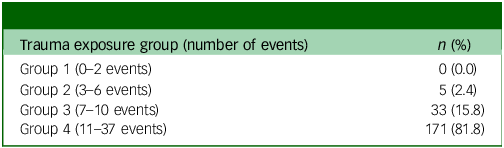
The findings demonstrated an extremely high cumulative burden of trauma exposure among survivors. No participants (0%) were classified in the lowest exposure category (0–2 traumatic events). A small proportion of participants (2.4%) reported exposure to 3–6 traumatic events, whereas 15.8% were categorised within the 7–10 event group. The majority of the sample (81.8%) belonged to the highest trauma exposure category, reflecting exposure to 11 or more traumatic events across the lifespan. Lifetime traumatic event exposure among survivors is presented in Table 2.
Distribution of lifetime traumatic event exposure

Table 2 Long description
A table showing the distribution of lifetime traumatic event exposure groups and their percentages. The table has four rows and three columns. The columns are labeled ‘Trauma exposure group (number of events)’, ‘n’, and ‘%’. The rows are labeled as follows: Group 1 (0-2 events) with 0 (0.0 percent), Group 2 (3-6 events) with 5 (2.4 percent), Group 3 (7-10 events) with 33 (15.8 percent), and Group 4 (11-37 events) with 171 (81.8 percent).
Trauma exposure was assessed using the adapted 37-item War and Adversity Exposure Checklist (WAEC), which included the WAEC-26 and 13 additional items specific to the Halabja chemical attack.
These findings indicate that survivors of the Halabja chemical attack experienced not only the initial chemical warfare exposure in 1988 but also substantial cumulative trauma and psychosocial adversity across subsequent decades. The high rates of repeated trauma exposure likely reflect the long-term consequences of war, displacement, bereavement, chronic illness and ongoing social and economic hardship experienced within the region.
Types of war-related and chemical trauma exposure
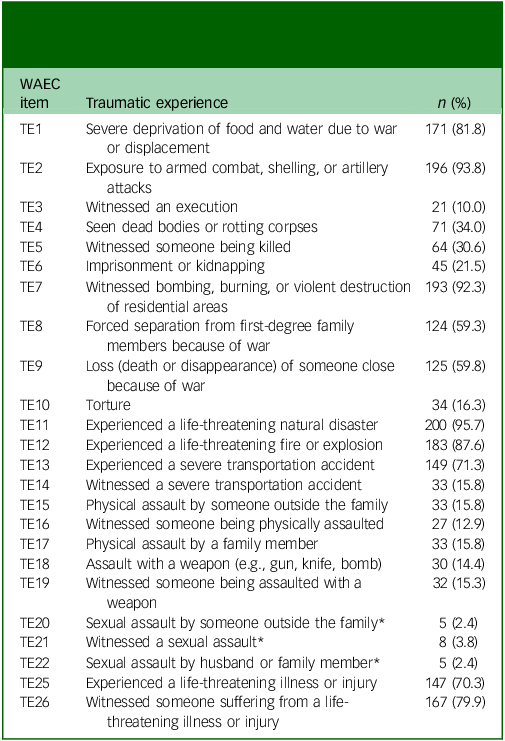
Participants reported extremely high levels of cumulative war-related and chemical attack–related trauma exposure across the lifespan. The most commonly reported war-related traumatic experiences included exposure to armed combat, shelling or artillery attacks (93.8%), witnessing bombing or violent destruction of residential areas (92.3%), severe deprivation of food and water due to war or displacement (81.8%) and witnessing life-threatening illness or injury in others (79.9%). A substantial proportion of participants additionally reported forced separation from family members (59.3%), loss or disappearance of close persons because of war (59.8%), direct exposure to life-threatening illness or injury (70.3%) and severe transportation accidents (71.3%). Although less frequent, experiences including torture (16.3%), imprisonment or kidnapping (21.5%), physical assault and assault involving weapons were also reported by a meaningful proportion of survivors. War-related and lifetime traumatic experiences assessed using the WAEC-26 are shown in Table 3.
War-related and lifetime traumatic experiences assessed using the War and Exposure Checklist (WAEC-26) among survivors of the Halabja chemical attack

Table 3 Long description
A table titled ‘War-related and lifetime traumatic experiences assessed using the War and Exposure Checklist (WAEC-26) among survivors of the Halabja chemical attack’ with 26 rows and 3 columns. The columns are labeled ‘WAEC item’, ‘Traumatic experience’, and ‘n (%)’. The table lists different traumatic experiences and the corresponding percentage of participants who reported them. Row 1: TE1, Severe deprivation of food and water due to war or displacement, 171 (81.8). Row 2: TE2, Exposure to armed combat, shelling, or artillery attacks, 196 (93.8). Row 3: TE3, Witnessed an execution, 21 (10.0). Row 4: TE4, Seen dead bodies or rotting corpses, 71 (34.0). Row 5: TE5, Witnessed someone being killed, 64 (30.6). Row 6: TE6, Imprisonment or kidnapping, 45 (21.5). Row 7: TE7, Witnessed bombing, burning, or violent destruction of residential areas, 193 (92.3). Row 8: TE8, Forced separation from first-degree family members because of war, 124 (59.3). Row 9: TE9, Loss (death or disappearance) of someone close because of war, 125 (59.8). Row 10: TE10, Torture, 34 (16.3). Row 11: TE11, Experienced a life-threatening natural disaster, 200 (95.7). Row 12: TE12, Experienced a life-threatening fire or explosion, 183 (87.6). Row 13: TE13, Experienced a severe transportation accident, 149 (71.3). Row 14: TE14, Witnessed a severe transportation accident, 33 (15.8). Row 15: TE15, Physical assault by someone outside the family, 33 (15.8). Row 16: TE16, Witnessed someone being physically assaulted, 27 (12.9). Row 17: TE17, Physical assault by a family member, 33 (15.8). Row 18: TE18, Assault with a weapon (e.g., gun, knife, bomb), 30 (14.4). Row 19: TE19, Witnessed someone being assaulted with a weapon, 32 (15.3). Row 20: TE20, Sexual assault by someone outside the family, 5 (2.4). Row 21: TE21, Witnessed a sexual assault, 8 (3.8). Row 22: TE22, Sexual assault by husband or family member, 5 (2.4). Row 23: TE25, Experienced a life-threatening illness or injury, 147 (70.3). Row 24: TE26, Witnessed someone suffering from a life-threatening illness or injury, 167 (79.9).
Items TE23 (‘other unwanted sexual experience’) and TE24 (‘witnessed someone experiencing unwanted sexual violence’) were excluded from analyses because of substantial missing data and cultural sensitivity concerns.
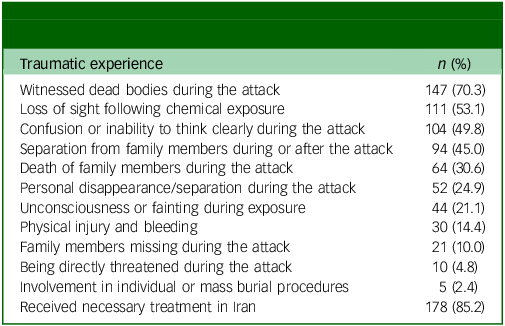
Chemical attack–specific traumatic experiences further underscored the severe and multifaceted nature of exposure during the Halabja attack. The most frequently reported experiences included witnessing dead bodies during the attack (70.3%), loss of sight after chemical exposure (53.1%), confusion or inability to think clearly during exposure (49.8%) and separation from family members during or after the attack (45.0%). Nearly one-third of participants reported the death of family members during the attack (30.6%), while others reported unconsciousness or fainting (21.1%), physical injury and bleeding (14.4%) and prolonged family separation or disappearance. The most commonly reported traumatic experiences among survivors of the Halabja chemical attack are summarised in Table 4. Most participants reported receiving necessary treatment in Iran after the attack (85.2%). The item assessing complete material loss was excluded from descriptive analyses due to substantial missing data. Collectively, these findings indicate that survivors were exposed not only to the immediate effects of chemical warfare but also to chronic and repeated war-related adversity, interpersonal loss, displacement and severe psychosocial disruption over subsequent decades. In addition to lifetime war-related adversity assessed using the WAEC, participants were asked about traumatic experiences specifically associated with the Halabja chemical attack.
Most commonly reported traumatic experiences among survivors of the Halabja chemical attack (N = 209)

Table 4 Long description
A table with 13 rows and 2 columns. The columns are labeled ‘Traumatic experience’ and ‘n (%)’. The rows list various traumatic experiences and the corresponding number and percentage of survivors who reported each experience. Row 1: Witnessed dead bodies during the attack, 147 (70.3). Row 2: Loss of sight following chemical exposure, 111 (53.1). Row 3: Confusion or inability to think clearly during the attack, 104 (49.8). Row 4: Separation from family members during or after the attack, 94 (45.0). Row 5: Death of family members during the attack, 64 (30.6). Row 6: Personal disappearance/separation during the attack, 52 (24.9). Row 7: Unconsciousness or fainting during exposure, 44 (21.1). Row 8: Physical injury and bleeding, 30 (14.4). Row 9: Family members missing during the attack, 21 (10.0). Row 10: Being directly threatened during the attack, 10 (4.8). Row 11: Involvement in individual or mass burial procedures, 5 (2.4). Row 12: Received necessary treatment in Iran, 178 (85.2).
Trauma exposure was assessed using the adapted 37-item War and Adversity Exposure Checklist (WAEC), which included the WAEC-26 and 13 additional items specific to the Halabja chemical attack.
Current symptoms
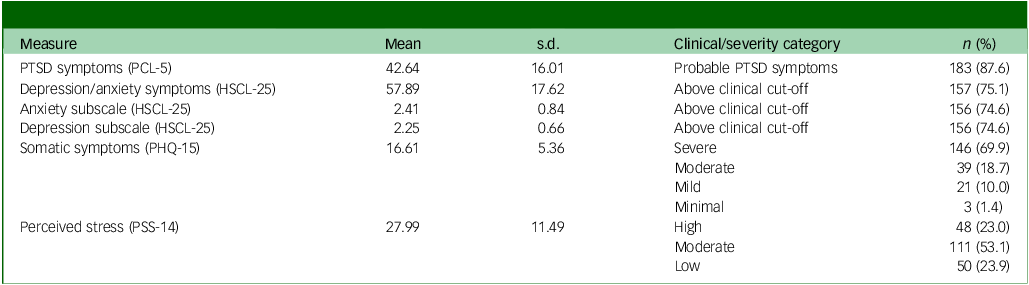
The analysis of symptom severity among the 209 participants revealed a substantial burden of long-term psychological distress and psychiatric symptoms. The sample had a mean PCL-5 score of 42.64 (s.d. = 16.01), with 87.6% of participants exceeding the clinical threshold for probable PTSD symptoms. For depression and anxiety symptoms assessed using the HSCL-25, the mean summed total score was 57.89 (s.d. = 17.62), and 75.1% of participants exceeded the established clinical cut-off for clinically significant symptoms. Somatic symptom severity assessed using the PHQ-15 yielded a mean score of 16.61 (s.d. = 5.36). Severe somatic symptoms were reported by 69.9% of participants, whereas 18.7% reported moderate symptoms, 10.0% mild symptoms and 1.4% minimal symptoms. The mean perceived stress score (PSS-14) was 27.99 (s.d. = 11.49), with 23.0% of participants reporting high stress, 53.1% moderate stress and 23.9% low stress. Descriptive statistics and prevalence estimates for psychological symptoms among survivors are presented in Table 5.
Descriptive statistics and prevalence of psychological symptoms among survivors

Table 5 Long description
A table with five rows and five columns summarizing psychological symptoms among survivors. The columns are labeled Measure, Mean, s.d., Clinical/severity category, and n (%). The table includes data on PTSD symptoms (PCL-5), Depression/Anxiety symptoms (HSCL-25), Anxiety subscale (HSCL-25), Depression subscale (HSCL-25), Somatic symptoms (PHQ-15), and Perceived stress (PSS-14). Each row provides the mean, standard deviation, clinical/severity category, and the number and percentage of participants in each category. Notable trends include high percentages of participants exceeding clinical cut-offs for PTSD, depression, and anxiety symptoms, as well as a significant proportion reporting severe somatic symptoms and moderate perceived stress.
PTSD, post-traumatic stress disorder; PCL-5, Post-Traumatic Stress Disorder Checklist for DSM-5; HSCL-25, Hopkins Symptom Checklist-25; PHQ-15, Patient Health Questionnaire-15; PSS-14, Perceived Stress Scale-14.
Correlation analysis
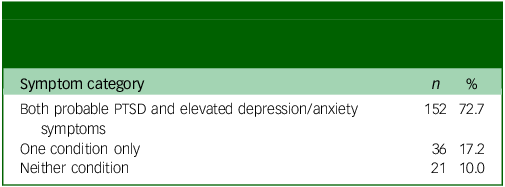
Consistent with this pattern, correlation analyses demonstrated strong positive associations between PTSD symptom severity and depression/anxiety symptoms (r = 0.788, p < 0.001), somatic symptoms (r = 0.643, p < 0.001) and perceived stress (r = 0.570, p < 0.001). Depression/anxiety symptoms were likewise strongly associated with somatic symptoms (r = 0.695, p < 0.001) and perceived stress (r = 0.731, p < 0.001), reflecting the pervasive and interconnected nature of chronic psychological distress among survivors of the Halabja chemical attack. Correlations among the main psychological symptom variables are reported in Table 6. Importantly, a high degree of symptom overlap was observed between trauma-related and affective symptoms. Specifically, 72.7% of participants met criteria for both probable PTSD symptoms and elevated depression/anxiety symptoms, whereas 17.2% met criteria for only one of the two conditions and 10.0% met criteria for neither condition, as shown in Table 7. These findings indicate substantial symptom comorbidity within the survivor population and suggest that PTSD symptoms rarely occur in isolation.
Correlation matrix of main psychological symptom variables

Table 6 Long description
A table titled ‘Correlation matrix of main psychological symptom variables’ with six rows and six columns. The rows and columns are labeled with different psychological symptom variables. Row 1: PTSD symptoms (PCL-5). Row 2: Anxiety symptoms. Row 3: Depression symptoms. Row 4: Somatic symptoms (PHQ-15). Row 5: Perceived stress (PSS-14). Row 6: Depression/anxiety symptoms (HSCL-25 total). The table shows correlation values between these variables. Row 1: PTSD symptoms (PCL-5) has values: blank, 0.747, 0.760, 0.643, 0.570, 0.788. Row 2: Anxiety symptoms has values: 0.747, blank, 0.830, 0.682, 0.640, 0.949. Row 3: Depression symptoms has values: 0.760, 0.830, blank, 0.652, 0.749, 0.964. Row 4: Somatic symptoms (PHQ-15) has values: 0.643, 0.682, 0.652, blank, 0.464, 0.695. Row 5: Perceived stress (PSS-14) has values: 0.570, 0.640, 0.749, 0.464, blank, 0.731. Row 6: Depression/anxiety symptoms (HSCL-25 total) has values: 0.788, 0.949, 0.964, 0.695, 0.731, blank.
PTSD, post-traumatic stress disorder; PCL-5, Post-Traumatic Stress Disorder Checklist-5; PHQ-15, Patient Health Questionnaire-15 item; PSS-14, Perceived Stress Scale-14; HSCL-25, Hopkins Symptom Checklist-25. Values are Pearson correlation coefficients. Dashes indicate correlations of variables with themselves. Empty cells are omitted because the matrix is symmetrical. ** p < 0.01.
Comorbidity between probable post-traumatic stress disorder (PTSD) symptoms and depression/anxiety symptoms among survivors

Table 7 Long description
A table showing the distribution of participants based on the presence of probable PTSD and elevated depression/anxiety symptoms. The table has three rows and three columns. The columns are labeled Symptom category, n, and %. The rows are as follows: Row 1: Both probable PTSD and elevated depression/anxiety symptoms, 152, 72.7. Row 2: One condition only, 36, 17.2. Row 3: Neither condition, 21, 10.0.
Probable PTSD symptoms were defined using the Post-Traumatic Stress Disorder Checklist-5 clinical cut-off.
Depression/anxiety symptoms were defined using the Hopkins Symptom Checklist-25 clinical cut-off score of ≥1.75.
Factors associated with severity of psychological symptoms
A series of multiple linear regression analyses was conducted to examine associations between sociodemographic variables and psychological outcomes, including PTSD symptoms (PCL-5), depression and anxiety symptoms (HSCL-25), physical symptoms (PHQ-15) and perceived stress (PSS). Predictor variables included age, gender, education, occupation, living location, marital status, number of children, parental status, number of siblings and social support. All regression models were statistically significant, indicating that the included predictors jointly explained significant proportions of variance across psychological outcomes. Model-fit statistics for these regression analyses are presented in Table 8.
Model-fit statistics for multiple regression analyses predicting psychological outcomes

Table 8 Long description
A table with five rows and five columns presenting model-fit statistics for multiple regression analyses predicting psychological outcomes. The columns are labeled Outcome, R, R squared, Adjusted R squared, F(df1, df2), and p. The rows list different psychological outcomes and their corresponding statistics. Row 1: Outcome, PCL-5 (PTSD symptoms); R, 0.445; R squared, 0.198; Adjusted R squared, 0.084; F(df1, df2), 1.731 (26, 182); p, 0.020. Row 2: Outcome, HSCL-25 (Depression and anxiety symptoms); R, 0.509; R squared, 0.259; Adjusted R squared, 0.158; F(df1, df2), 2.558 (25, 183); p, <0.001. Row 3: Outcome, PHQ-15 (Physical symptoms); R, 0.491; R squared, 0.241; Adjusted R squared, 0.138; F(df1, df2), 2.331 (25, 183); p, <0.001. Row 4: Outcome, PSS (Perceived stress); R, 0.523; R squared, 0.273; Adjusted R squared, 0.174; F(df1, df2), 2.751 (25, 183); p, <0.001.
PCL-5, Post-Traumatic Stress Disorder Checklist for DSM-5; PTSD, post-traumatic stress disorder; HSCL-25, Hopkins Symptom Checklist-25; PHQ-15, Patient Health Questionnaire-15; PSS, Perceived Stress Scale.
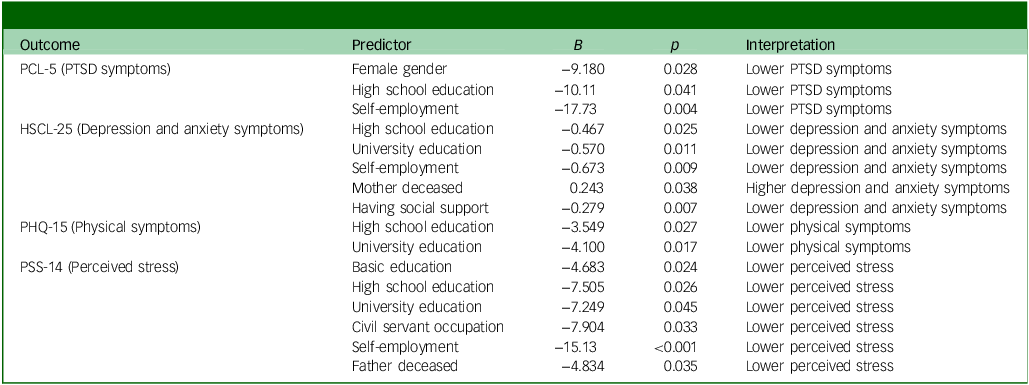
For PTSD symptoms (PCL-5), the regression model was significant, F(26, 182) = 1.731, p = 0.020, explaining 19.8% of the variance (R 2 = 0.198). Female gender, high school education and self-employment were significantly associated with lower PTSD symptom severity.
For depression and anxiety symptoms (HSCL-25), the model explained 25.9% of the variance, F(25, 183) = 2.558, p < 0.001. High school education, university education and self-employment were associated with lower HSCL-25 scores, indicating lower levels of depression and anxiety symptoms. Having a deceased mother was associated with higher HSCL-25 scores, indicating greater psychological distress. Higher social support was significantly associated with lower depression and anxiety symptoms.
The regression model predicting physical symptoms (PHQ-15) was significant, F(25, 183) = 2.331, p < 0.001, accounting for 24.1% of the variance. High school education and university education were associated with lower physical symptom severity. No other predictors were statistically significant.
Similarly, the perceived stress model (PSS) explained 27.3% of the variance, F(25, 183) = 2.751, p < 0.001. Basic education, high school education, university education, civil servant occupation and self-employment were associated with lower perceived stress scores. Having a deceased father was also significantly associated with lower perceived stress scores.
Overall, educational attainment and occupational status emerged as the most consistent predictors across psychological outcomes. In contrast, age, marital status, number of children and number of siblings were not significant predictors in any regression model. Multiple regression coefficients for sociodemographic predictors of psychological outcomes are presented in Table 9. These findings suggest that socioeconomic and social-support-related factors may play an important role in long-term psychological outcomes among survivors of chemical warfare exposure.
Multiple regression analyses of sociodemographic predictors of psychological outcomes

Table 9 Long description
A table with five rows and four columns detailing the outcomes, predictors, regression coefficients (B), and p-values of sociodemographic factors on psychological outcomes. The outcomes include PCL-5 (PTSD symptoms), HSCL-25 (Depression and anxiety symptoms), PHQ-15 (Physical symptoms), and PSS-14 (Perceived stress). Predictors include factors like female gender, education levels, employment status, and family status. Each row lists a predictor, its regression coefficient, and p-value, indicating the strength and significance of the predictor’s impact on the respective outcome. The table highlights how different sociodemographic factors influence various psychological outcomes.
PCL-5, Post-Traumatic Stress Disorder Checklist for DSM-5; PTSD, post-traumatic stress disorder; HSCL-25, Hopkins Symptom Checklist-25; PHQ-15, Patient Health Questionnaire-15; PSS-14, Perceived Stress Scale-14. Only statistically significant predictors are presented.
Gender differences in psychological symptoms and trauma exposure
Gender differences in psychological symptoms and cumulative trauma exposure were examined using independent-samples t-tests. Male participants reported significantly greater cumulative trauma exposure than female participants. Specifically, men had higher total trauma exposure scores (M = 15.64, s.d. = 3.94) than women (M = 13.44, s.d. = 3.83), t(207) = 3.85, p < 0.001, d = 0.57, indicating a moderate effect size. In contrast, women demonstrated significantly higher somatic symptom severity, as assessed with the PHQ-15 (M = 17.62, s.d. = 4.86), than men (M = 14.48, s.d. = 5.77), t(207) = −4.10, p < 0.001, d = 0.61, also reflecting a moderate effect size. No significant gender differences were observed for PTSD symptom severity measured with the PCL-5, t(207) = −0.18, p = 0.856, d = 0.03; for depression and anxiety symptoms measured with the HSCL-25, t(207) = −1.77, p = 0.079, d = 0.26; or for perceived stress assessed with the PSS-14, t(207) = −0.40, p = 0.687, d = 0.06. Given the multiple comparisons conducted, findings were interpreted cautiously to reduce the risk of Type I error inflation. Gender differences in psychological symptoms and trauma exposure are summarised in Table 10.
Gender differences in psychological symptoms and trauma exposure

Table 10 Long description
A table comparing psychological symptoms and trauma exposure between males and females. The table has six rows and seven columns. The columns are labeled Variable, Male M (s.d.), Female M (s.d.), t(df), p, and Cohen’s d. The rows are labeled Total Trauma Exposure (TotalTE), PTSD symptoms (PCL-5), Depression/Anxiety symptoms (HSCL-25), Somatic symptoms (PHQ-15), and Perceived Stress (PSS-14). Row 1: Total Trauma Exposure (TotalTE), Male M (s.d.) 15.64 (3.94), Female M (s.d.) 13.44 (3.83), t(df) 3.85 (207), p <0.001, Cohen’s d 0.57. Row 2: PTSD symptoms (PCL-5), Male M (s.d.) 42.34 (16.81), Female M (s.d.) 42.77 (15.68), t(df) -0.18 (207), p 0.856, Cohen’s d 0.03. Row 3: Depression/Anxiety symptoms (HSCL-25), Male M (s.d.) 2.19 (0.78), Female M (s.d.) 2.37 (0.66), t(df) -1.77 (207), p 0.079, Cohen’s d 0.26. Row 4: Somatic symptoms (PHQ-15), Male M (s.d.) 14.48 (5.77), Female M (s.d.) 17.62 (4.86), t(df) -4.10 (207), p <0.001, Cohen’s d 0.61. Row 5: Perceived Stress (PSS-14), Male M (s.d.) 27.52 (12.35), Female M (s.d.) 28.21 (11.10), t(df) -0.40 (207), p 0.687, Cohen’s d 0.06.
PTSD, post-traumatic stress disorder; PCL-5, Post-Traumatic Stress Disorder Checklist for DSM-5; HSCL-25, Hopkins Symptom Checklist-25; PHQ-15, Patient Health Questionnaire-15; PSS-14, Perceived Stress Scale-14. Cohen’s d values represent effect sizes for group differences. Positive t values indicate higher scores among male participants, whereas negative values indicate higher scores among female participants.
Cortisol and psychological symptoms
Multinomial logistic regression predicting latent profile membership
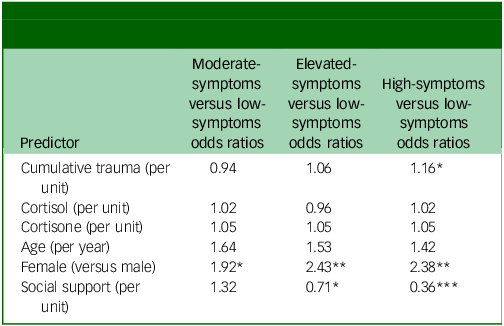
To examine predictors of latent profile membership, multinomial logistic regression analyses were conducted with the low-symptom class as the reference category. Predictor variables included cumulative trauma exposure, cortisol, cortisone, age, gender and social support. All models were adjusted simultaneously for multiple covariates. Odds ratios predicting membership in elevated-symptom classes relative to the low-symptom class are presented in Table 11.
Odds ratios predicting membership in elevated symptom classes relative to the low-symptom class

Table 11 Long description
A table with three columns and six rows, comparing odds ratios of various predictors for moderate-symptoms versus low-symptoms, elevated-symptoms versus low-symptoms, and high-symptoms versus low-symptoms. The columns are labeled ‘Predictor’, ‘Moderate-symptoms versus low-symptoms odds ratios’, ‘Elevated-symptoms versus low-symptoms odds ratios’, and ‘High-symptoms versus low-symptoms odds ratios’. The predictors include cumulative trauma, cortisol, cortisone, age, gender, and social support. Row 1: Cumulative trauma (per unit), 0.94, 1.06, 1.16*. Row 2: Cortisol (per unit), 1.02, 0.96, 1.02. Row 3: Cortisone (per unit), 1.05, 1.05, 1.05. Row 4: Age (per year), 1.64, 1.53, 1.42. Row 5: Female (versus male), 1.92*, 2.43**, 2.38**. Row 6: Social support (per unit), 1.32, 0.71*, 0.36***.
*p < 0.05. **p < 0.01. ***p < 0.001.
Higher cumulative trauma exposure was associated with increased odds of membership in the high-symptom class relative to the low-symptom class (odds ratio 1.16, p < 0.05). Female participants demonstrated significantly greater odds of belonging to elevated-symptom classes, particularly the elevated-symptoms and high-symptoms profiles. Greater social support was associated with a reduced likelihood of membership in more severe symptom classes, particularly the high-symptom class. In contrast, cortisol and cortisone levels were not significantly associated with latent profile membership, suggesting that these biological markers did not clearly differentiate symptom-profile classes within this sample.
Cortisol and psychological symptoms: multivariable regression models
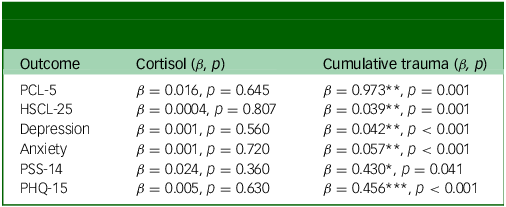
To further examine the relationship between cortisol levels and psychological outcomes, multivariable regression analyses were conducted for PTSD symptoms (PCL-5), psychological distress (HSCL-25), depression, anxiety, perceived stress (PSS-14) and somatic symptoms (PHQ-15). All models included cortisol levels, cumulative trauma exposure, age, gender, social support and education as predictors. Standardised regression coefficients for cortisol and trauma exposure predicting psychological outcomes are presented in Table 12.
Standardised regression coefficients (β) for cortisol and trauma exposure predicting psychological outcomes

Table 12 Long description
A table with three columns and six rows, including a header row. The columns are labeled ‘Outcome’, ‘Cortisol (β, p)’, and ‘Cumulative trauma (β, p)’. The row labels are PCL-5, HSCL-25, Depression, Anxiety, PSS-14, and PHQ-15. The values in the ‘Cortisol (β, p)’ column are: β = 0.016, p = 0.645; β = 0.0004, p = 0.807; β = 0.001, p = 0.560; β = 0.001, p = 0.720; β = 0.024, p = 0.360; β = 0.005, p = 0.630. The values in the ‘Cumulative trauma (β, p)’ column are: β = 0.973***, p = 0.001; β = 0.039**, p = 0.001; β = 0.042**, p < 0.001; β = 0.057***, p < 0.001; β = 0.430*, p = 0.041; β = 0.456***, p < 0.001.
PCL-5, Post-Traumatic Stress Disorder Checklist-25; HSCL-25, Hopkins Symptom Checklist-25; PSS-14, Perceived Stress Scale-14; PHQ-15, Patient Health Questionnaire-15. *p < 0.05. **p < 0.01. ***p < 0.001.
Across all models, cumulative trauma exposure emerged as a significant predictor of symptom severity, whereas cortisol levels were not significantly associated with any psychological outcome after adjustment for covariates. Social support and educational attainment demonstrated protective effects in several models, particularly for PTSD and psychological distress outcomes. No significant cortisol × gender interaction effects were observed, indicating that gender did not moderate the relationship between cortisol levels and psychological symptoms. Overall, these findings suggest that psychological symptom severity among survivors was more strongly associated with cumulative trauma exposure and psychosocial factors than with cortisol concentrations.
Cortisol differences across symptom profiles
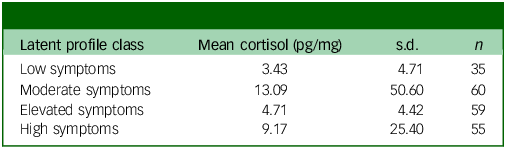
A one-way ANOVA was conducted to examine differences in cortisol levels across the four latent profile classes derived from the combined PTSD (PCL-5) and HSCL-25 model. The effect of class membership on cortisol levels was not statistically significant, F(3, 205) = 1.10, p = 0.35. Mean cortisol levels across latent profile classes are presented in Table 13.
Mean cortisol levels across latent profile classes

Table 13 Long description
A table comparing mean cortisol levels across different latent profile classes. The table has four rows and four columns. Column headers are Latent profile class, Mean cortisol (pg/mg), s.d., and n. Row 1: Low symptoms, 3.43, 4.71, 35. Row 2: Moderate symptoms, 13.09, 50.60, 60. Row 3: Elevated symptoms, 4.71, 4.42, 59. Row 4: High symptoms, 9.17, 25.40, 55.
Large s.d., particularly in the moderate- and high-symptom classes, indicate substantial within-class variability in cortisol levels.
Although mean cortisol levels varied across symptom classes, these differences were not statistically significant. Taken together, the findings suggest that long-term psychological symptom severity among survivors may be more strongly associated with cumulative trauma exposure and psychosocial factors than with cortisol levels.
Sensitivity analyses
Sensitivity analyses were conducted to evaluate the stability of the latent profile solution. Separate LPAs for PCL-5 and HSCL-25 produced symptom-severity patterns similar to those identified in the combined model. Furthermore, hair cortisol levels were not significantly associated with class membership or psychological symptom outcomes in alternative model specifications. These findings support the robustness and consistency of the primary analyses.
Latent profile analysis of PTSD and HSCL-25
To examine co-occurring PTSD and depression/anxiety symptom patterns, an LPA was conducted using PCL-5 and HSCL-25 scores in the full sample (N = 209). Whereas the regression analyses examined predictors of symptom severity at the variable level, an LPA was used to identify clinically meaningful subgroups characterised by distinct patterns of co-occurring PTSD and depression/anxiety symptoms. This person-centred approach enables examination of how trauma exposure, biological markers and psychosocial factors are associated with membership in clinically meaningful symptom profiles rather than individual symptom scales alone.
Models with one to five classes were estimated under the assumptions of equal variances and zero covariances across indicators. Fit indices supported a four-class solution, which demonstrated the lowest AIC (= 1987) and BIC (= 2030), acceptable entropy (0.764) and a statistically significant BLRT; p = 0.0297). The five-class solution did not provide a statistically significant improvement in model fit (BLRT p = 0.396). Because total symptom scores were used as indicators, the resulting classes primarily reflected differences in overall symptom severity rather than entirely distinct symptom configurations.
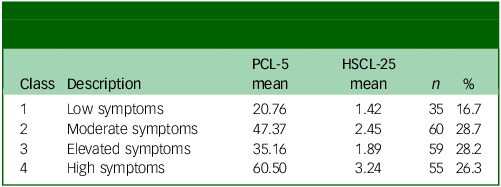
The four-class solution identified subgroups characterised by differing levels of PTSD and depression/anxiety symptom severity. PTSD and depression/anxiety symptom scores across latent profile classes are presented in Table 14. The low-symptom class (16.7%) demonstrated relatively low PTSD symptoms and minimal depression/anxiety symptoms. The moderate-symptom class (28.7%) showed elevated PTSD symptoms with moderate levels of depression/anxiety. The elevated-symptom class (28.2%) demonstrated intermediate levels of PTSD and depression/anxiety symptoms relative to the moderate- and high-symptom classes. Finally, the high-symptom class (26.3%) demonstrated the highest levels of both PTSD and depression/anxiety symptoms.
Post-traumatic stress disorder and depression/anxiety symptom scores across latent profile classes among survivors

Table 14 Long description
A table comparing PTSD and depression/anxiety symptom scores across different classes. The table has four rows and five columns. The columns are labeled Class, Description, PCL-5 Mean (M), HSCL-25 Mean (M), n, and %. Row 1: Class 1, Low symptoms, PCL-5 Mean (M) 20.76, HSCL-25 Mean (M) 1.42, n 35, % 16.7. Row 2: Class 2, Moderate symptoms, PCL-5 Mean (M) 47.37, HSCL-25 Mean (M) 2.45, n 60, % 28.7. Row 3: Class 3, Elevated symptoms, PCL-5 Mean (M) 35.16, HSCL-25 Mean (M) 1.89, n 59, % 28.2. Row 4: Class 4, High symptoms, PCL-5 Mean (M) 60.50, HSCL-25 Mean (M) 3.24, n 55, % 26.3.
PCL-5, Post-Traumatic Stress Disorder Checklist-25; HSCL-25, Hopkins Symptom Checklist -25.
Overall, the findings indicate substantial heterogeneity in psychological symptom presentation among survivors of the Halabja chemical attack. In particular, some participants demonstrated elevated PTSD symptoms without corresponding elevations in depression/anxiety symptoms, whereas others exhibited severe comorbid symptom profiles across domains. These findings suggest that symptom burden among survivors is not uniform and that person-centred analyses may provide clinically meaningful insights beyond single-scale severity analyses alone.
Discussion
The present study demonstrated a substantial long-term psychological burden among survivors of the Halabja chemical attack more than three decades after exposure. Nearly 88% of participants exceeded the screening cut-off for probable PTSD symptoms, 75% reported elevated depression/anxiety symptoms and most participants reported moderate-to-severe somatic symptoms. As participants were recruited through hospital networks, community referral procedures, convenience sampling and snowball sampling, the observed prevalence estimates may over-represent survivors experiencing persistent psychological and physical difficulties. Nevertheless, the findings are broadly consistent with previous evidence documenting severe long-term psychological consequences among genocide-exposed and chemically exposed populations. Reference Bisson, Cosgrove, Lewis and Roberts2,Reference Dworkin, Prescott, Jamal, Hardawan, Abdullah and Galea3,Reference Neldner, Noori, Mahmood, Neuner and Ibrahim22 The findings, therefore, extend previous evidence suggesting a persistent psychological symptom burden decades after exposure to chemical warfare and mass violence.
Importantly, survivors reported extremely high levels of cumulative trauma exposure across the lifespan. More than 80% of participants experienced exposure to 11 or more traumatic events, including armed conflict, destruction of residential areas, bereavement, forced family separation, severe deprivation and repeated war-related adversity. In addition to broader war-related experiences, participants reported substantial direct exposure to chemical attack–related traumatic experiences, including witnessing dead bodies, visual impairment following chemical exposure, confusion during exposure, unconsciousness, physical injury and death of family members during the attack. These findings suggest that the long-term psychological symptom burden observed among survivors reflects not only the initial chemical attack itself, but also prolonged cumulative trauma exposure and chronic psychosocial adversity across subsequent decades.
Long-term psychological symptom outcomes may partly vary according to developmental stage at the time of exposure. Participants exposed during adulthood may have retained more direct autobiographical memories of chemical exposure, injury, bereavement and immediate threat to survival, whereas childhood exposure may have involved more developmentally mediated trauma effects. Future longitudinal research should further examine age at trauma exposure as a predictor of long-term psychological symptom severity among survivors of chemical warfare.
Men reported significantly greater cumulative trauma exposure, whereas women demonstrated significantly greater somatic symptom severity. No statistically significant gender differences were observed for PTSD symptoms, depression/anxiety symptoms or perceived stress, although women demonstrated a trend toward higher depression/anxiety symptom severity. Women were also more likely to belong to elevated-symptom-profile classes in multinomial analyses. These findings partially differ from previous studies reporting greater PTSD symptom severity among women exposed to mass violence. Reference Dworkin, Prescott, Jamal, Hardawan, Abdullah and Galea3 Sociocultural factors influencing emotional expression, symptom reporting and gender roles within Kurdish society may partly contribute to these patterns.
Educational attainment and occupational status emerged as the most consistent protective factors across psychological symptom outcomes. Higher levels of education and employment were associated with lower PTSD symptoms, psychological distress, somatic symptoms and perceived stress. Greater social support was likewise associated with lower psychological distress and a reduced likelihood of belonging to more severe symptom-profile classes. These findings suggest that socioeconomic and psychosocial resources may play an important role in long-term adaptation following exposure to chemical warfare and chronic adversity.
The findings further demonstrated substantial symptom comorbidity and heterogeneity in symptom presentation. PTSD symptoms were strongly associated with depression/anxiety symptoms, somatic symptoms and perceived stress, indicating that trauma-related psychological symptoms rarely occurred in isolation. Furthermore, more than two-thirds of participants demonstrated co-occurring probable PTSD symptoms and elevated depression/anxiety symptoms, reflecting substantial overlap between trauma-related and affective symptom burden. Latent profile analysis identified four symptom-severity classes ranging from low to high overall symptom burden, supporting the presence of clinically meaningful heterogeneity among survivors. Similar four-class solutions have previously been reported in latent class and LPAs of trauma-related psychopathology and depression/anxiety symptom patterns. Reference Lei, Chen, Hagiwara, Kusumi, Tanabe and Inoue30,Reference Campbell, Trachik, Goldberg and Simpson31 Greater cumulative trauma exposure and reduced social support were associated with membership in more severe symptom classes, highlighting the importance of psychosocial factors in shaping long-term psychological symptom outcomes.
Because the latent profiles were derived from overall symptom severity indicators rather than item-level symptom patterns, the identified classes should primarily be interpreted as quantitative severity groupings rather than categorically distinct psychiatric subtypes. Although the profiles mainly reflected differences in overall symptom severity, some classes demonstrated relatively greater PTSD symptom burden compared with depression/anxiety symptoms. These findings suggest that person-centred analyses may provide clinically meaningful insights beyond single-scale symptom severity analyses alone.
HCCs were not significantly associated with PTSD symptom severity, latent symptom-profile membership or most psychological outcomes after adjustment for trauma exposure and psychosocial variables. These findings are consistent with previous research demonstrating inconsistent associations between cortisol concentrations and PTSD symptom severity. Reference Schumacher, Engel, Klusmann, Niemeyer, Küster and Burchert6,Reference Schindler-Gmelch, Capito, Steudte-Schmiedgen, Kirschbaum and Berking12 The findings further suggest that long-term psychological symptom burden among survivors may be more strongly associated with cumulative trauma exposure and psychosocial adversity than with cortisol concentrations alone.
Limitations and future perspective
Several limitations should be considered when interpreting the present findings. The present study specifically focused on survivors of the Halabja chemical attack rather than the general population; however, participants were recruited through hospital networks, community referrals, convenience sampling and snowball procedures, which may have increased the likelihood of including individuals with ongoing psychological or physical health difficulties.
Consequently, prevalence estimates of PTSD, depression/anxiety symptoms, somatic complaints and perceived stress should be interpreted cautiously, as the sample may over-represent survivors experiencing persistent symptom burden and may not fully generalise to all survivors of the Halabja chemical attack. Nevertheless, such recruitment strategies are common and often necessary in conflict-affected and hard-to-reach populations.
In addition, the absence of a non–trauma-exposed control group limits causal interpretation of the psychological and biological findings, particularly regarding cortisol regulation, which multiple medical and environmental factors may influence. The study also relied primarily on self-report measures administered through structured interviews, which may be affected by recall bias, social desirability and sociocultural norms regarding the expression of psychological distress.
Because the trauma checklist assessed cumulative lifetime exposure, the exact timing of several traumatic events in relation to the Halabja attack could not be determined. Information regarding psychiatric treatment history, psychological interventions and medication use after the Halabja chemical attack was not available in the present data-set, which limits the interpretation of long-term symptom trajectories and potential treatment effects.
Future studies should employ larger and more representative survivor samples, longitudinal designs and more detailed analyses of developmental, social and trauma-related predictors of long-term psychological symptom severity among survivors of chemical warfare.
Implications
Survivors of the Halabja chemical attack continue to experience substantial psychological distress more than three decades after exposure. The findings demonstrate high levels of cumulative trauma exposure, persistent PTSD symptoms, depression/anxiety symptoms, somatic complaints and perceived stress among survivors. Long-term psychological symptom severity appears to be more strongly associated with cumulative trauma exposure and psychosocial adversity than with HCCs. The identification of heterogeneous symptom profiles further highlights substantial variability in psychological symptom burden and clinical presentation among survivors. These findings emphasise the need for long-term, trauma-informed, culturally sensitive and psychosocially integrated mental health interventions for survivors of chemical warfare and mass violence.
Data availability
The data supporting the findings of this study are available in a restricted Zenodo repository (https://doi.org/10.5281/zenodo.17079672). Due to the sensitive nature of the data involving human participants, the files are restricted to protect participant confidentiality. Access for peer reviewers is available via a private reviewer link provided during the review process. The analytic code and research materials are available in Zenodo, with details to be provided after peer review.
Acknowledgements
Our sincere thanks go to Ahmed Sharif, Zara Khider, Christian Guter, Natiq Silo, Dr Halkawt Ismael, Zaid Khalaf Ali Kicho, Aso Ahmed, Aswda Ahmed, Nina Ahmed, Gizing Ahmed, Soma Ahmed and Nijin Osman. We also thank the Governorate of Halabja for its support and permission to collect data.
Author contributions
H.A.S.: study design, organisation of data collection, statistical analysis and manuscript writing. M.H.: supervision, funding, study design, review of statistical analysis, manuscript review and manuscript drafting. T.G.S.: supervision, revision of the manuscript and study design. I.M.: organisation of data collection and study design. U.H.: supervision, manuscript review and study design. J.I.K.: manuscript review and study design. M.I.H.: study design and statistical consultation.
Funding
This study was supported by the University of Tübingen, Department of Psychology.
Declaration of interest
T.G.S. is a member of the BJPsych Open Editorial Board. He had no involvement in the editorial review, peer-review process or decision-making regarding this manuscript. The remaining authors declare no conflicts of interest.
Transparency declaration
As the first author, H.A.S. affirms that the manuscript is an honest, accurate and transparent account of the study reported; that no important aspects of the study have been omitted; and that there are no discrepancies between the study as planned and as reported in this manuscript. Language editing was facilitated using Perplexity (a web-based platform accessed via macOS; Perplexity AI, Inc., San Francisco, California, USA; https://www.perplexity.ai/) to improve grammar, clarity and readability. Its use was limited to editorial and language refinement; all scientific content, methodological decisions, analyses, interpretations and conclusions remain the original work of the authors. All AI-assisted revisions were reviewed and approved by the authors.




 Open access


eLetters
No eLetters have been published for this article.