



1. Introduction
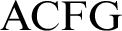
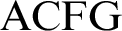
The theory of algebraically closed fields of fixed positive characteristic with a predicate for an additive subgroup admits a model companion,
 $\mathrm {ACFG}$
[Reference d’Elbée16].
 $\mathrm {ACFG}$
is
 $\mathrm {NSOP}_{1}$
and not simple, unlike other generic expansions of
 $\mathrm {ACF}_p$
, such as
 $\mathrm {ACFA}$
or the expansion by a generic predicate [Reference Chatzidakis and Pillay11], which are simple. The study of
 $\mathrm {NSOP}_{1}$
theories has been rekindled due to the recent success in developing a Kim–Pillay style characterization (Chernikov and Ramsey [Reference Chernikov and Ramsey13]) and a geometric theory based on the notions of Kim-forking and Kim-independence (Kaplan and Ramsey [Reference Kaplan and Ramsey22]). Various examples of strictly
 $\mathrm {NSOP}_{1}$
theories appear since then. Among them are
-
(1) Generic
 $\mathscr {L}$
-structure
$T^{\emptyset }_{\mathscr {L}}$
[Reference Kruckman and Ramsey25];
-
(2) Generic
$K_{n,m}$
-free bipartite graphs [Reference Conant and Kruckman15]; and -
(3) omega-free PAC fields [Reference Chatzidakis9].


 $\mathrm {ACFG}$
shares many features with those three archetypical examples. Our example appears to be slightly more complicated than (1) and (2), due to the lack of weak elimination of imaginaries and its more algebraic aspect, which makes it closer to (3). Throughout this paper, we will point out both the similarities and the differences between those four examples, in order to emphasise what might be typical of
 $\mathrm {NSOP}_{1}$
theories.
We intend to give a description of
 $\mathrm {ACFG}$
based on the study of various independence relations in models of
 $\mathrm {ACFG}$
. In §2, we give basic properties of
 $\mathrm {ACFG}$
. A notion of weak independence (following the denomination of [Reference Chatzidakis9]) was already described in [Reference d’Elbée16], and shown to coincide with Kim-independence over models. We prove here that it satisfies all the properties of the Kim–Pillay characterization of simple theories [Reference Kim and Pillay24] except one: base monotonicity. This phenomenon, not predicted by [Reference Kaplan and Ramsey22], is similar to the case of (2). We define strong independence—a similar notion appears in (1), (2), and (3)—and we show that it lacks only one property of the Kim–Pillay characterization of simple theories: local character. We give some structural properties of models of
 $\mathrm {ACFG}$
, and prove that there exists generic subgroups of
 $\overline {\mathbb {F}_p}$
, even more, almost all (in the sense of Baire) subgroups of
 $\overline {\mathbb {F}_p}$
are generic, see §2.4.
§3 and §4 can be read independently.
§3 is dedicated to the description of imaginaries in a given model
 $(K,G)$
of
 $\mathrm {ACFG}$
. Consider the canonical projection
 $\pi : K \rightarrow K/G$
and the expanded structure
 $(K,G,K/G)$
with a new sort for the structure
 $(K/G,+)$
and the function
 $\pi : K \rightarrow K/G$
. We extend the weak independence relation from
 $(K,G)$
to
 $(K,G,K/G)$
and this allows us to mimic the classical argument that appears for instance in [Reference Blossier and Martin-Pizarro5, Reference Chatzidakis and Pillay11, Reference Kruckman and Ramsey25] to prove that
 $(K,G,K/G)$
has weak elimination of imaginaries.
In §4, we describe forking in
 $\mathrm {ACFG}$
. The strong independence relation plays a key role to show that forking equals dividing (for types). We also advertise some nice phenomena that appear when one forces the base monotonicity property on a given independence relation. It seems that a general method for proving that dividing equals forking for types is arising from different examples, see §4.4.
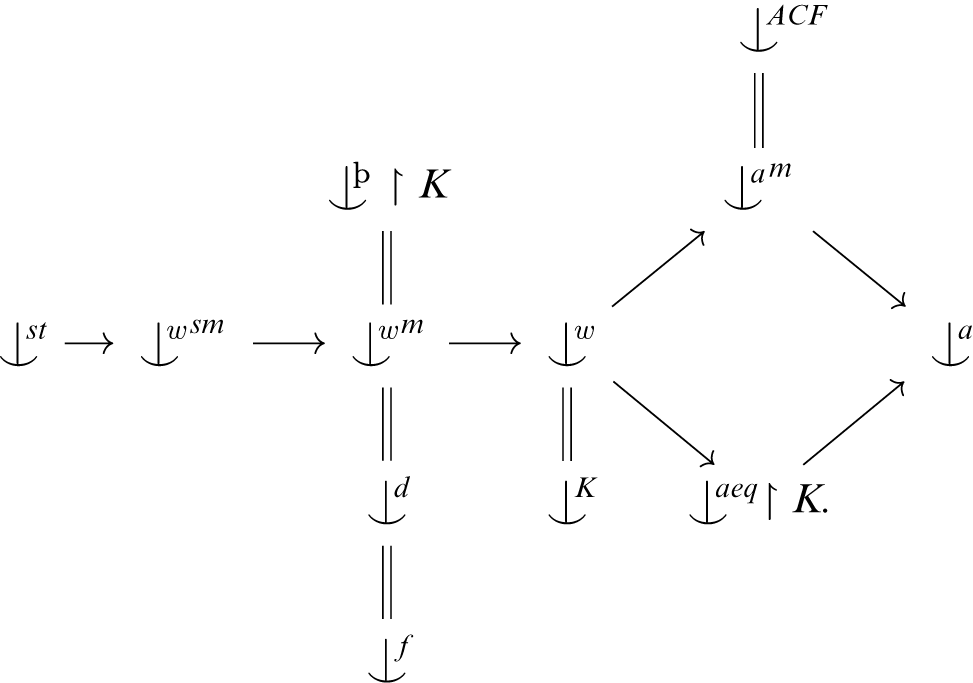
The diagram in Figure 1 represents the interactions between the independence relations that appears in models of
 $\mathrm {ACFG}$
and links them with usual independences. All arrows are strict, from that point of view,
 $\mathrm {ACFG}$
differs from (1), (2), and (3), see §4.4.
Interactions of independence relations in
 $\mathrm {ACFG}$
.

Conventions and notations. Capital letters
 $A,B,C$
stands for sets whereas small latin letters
 $a,b,c$
designate either singletons, finite or infinite tuples.
We often identify tuples and sets when dealing with independence relations. For example, given some tuple
 $a=a_1,\dots $
then
 has the same meaning as
 . Let
 be two ternary relations. We say that
 is stronger than
 (or
 is weaker than
 ) if for all
 $a,b,C$
we have
 . We denote this by
 . For a prime q,
 $\mathbb {F}_{q^n}$
is the field with
 $q^n$
elements.
Throughout this paper numerous notions of independence will appear. The following independence relations are defined in every theory.
-
(1)
if and only if
$acl(Ca)\cap acl(Cb) = acl(C)$
-
(2)
if and only if
$acl^{eq}(Ca)\cap acl^{eq}(Cb) = acl^{eq}(C)$
-
(3)
if and only if
$\textit{tp}(a/Cb)$
does not thorn-fork over C -
(4)
if and only if
$\textit{tp}(a/Cb)$
does not Kim-fork over C -
(5)
if and only if
$\textit{tp}(a/Cb)$
does not divide over C -
(6)
if and only if
$\textit{tp}(a/Cb)$
does not fork over C -
(7)
if and only if
$\textit{tp}(a/Cb)$
is finitely satisfiable in C


Here is a list of properties for a ternary relation
 defined over small subsets of
 $\mathbb {M}$
, a big model of some countable theory T (in the last case the property is defined with respect to another ternary relation
 , also defined over small subsets of
 $\mathbb {M}$
).
-
• Invariance. If
$ABC\equiv A^{\prime }B^{\prime }C^{\prime }$
then
if and only if
. -
• Finite Character. If
for all finite
$a\subseteq A$
, then
. -
• Symmetry. If
then
. -
• Closure
if and only if
. -
• Monotonicity. If
then
. -
• Base Monotonicity. If
then
. -
• Transitivity. If
and
then
. -
• Existence. For any C and A we have
. -
• Full Existence. For all
$A,B$
and C there exists
$A'\equiv _C A$
such that
. -
• Extension. If
, then for all D there exists
$A'\equiv _{CB}A$
and
. -
• Local Character. For all finite tuple a and infinite B there exists
$B_0\subset B$
with
$\lvert {B_0} \rvert \leq \aleph _0$
and
. -
• Strong Finite Character over E. If
, then there is a formula
$\Lambda (x,b,e)\in \textit{tp}(a/Eb)$
such that for all
$a'$
, if
$a'\models \Lambda (x,b,e)$
then
. -
• Stationarity over E. If
$c_1 \equiv _E c_2$
and
,
then
$c_1\equiv _{EA} c_2$
. -
• Witnessing. Let
$a,b$
be tuples,
$\mathscr {M}$
a model and assume that
. Then there exists a formula
$\Lambda (x,b)\in \textit{tp}(a/\mathscr {M} b)$
such that for any global extension
$q(x)$
of
$\textit{tp}(b/\mathscr {M})$
finitely satisfiable in
$\mathscr {M}$
and for any
$(b_i)_{i<\omega }$
such that for all
$i<\omega $
we have
$b_i\models q\upharpoonright \mathscr {M} b_{<i}$
, the set
$\{ { \Lambda (x, b_i) \mid i<\omega } \}$
is inconsistent. -
•
-amalgamation over E. If there exists tuples
$c_1,c_2$
and sets
$A,B$
such that-
–
$c_1\equiv _E c_2$
-
–
-
–
and
then there exists
such that
$c\equiv _A c_1$
,
$c \equiv _B c_2$
,
,
and
. -


If
 , the set C is called the base set.
2. Generalities on
$\mathrm {ACFG}$

Let
 $p>0$
be a fixed prime number. Unless stated otherwise, every field we consider has characteristic p. Let
 $\mathscr {L}_{\mathrm {ring}}$
be the language of rings and
 $\mathscr {L}_G = \mathscr {L}_{\mathrm {ring}}\cup \{ {G} \}$
for G a unary predicate. Let
 $\mathrm {ACF}_G$
be the
 $\mathscr {L}_G$
-theory whose models are algebraically closed fields of characteristic p in which G is a predicate for an additive subgroup. Let
 $\mathrm {ACFG}$
be the model companion of
 $\mathrm {ACF}_G$
, see [Reference d’Elbée16, Example 5.11].
2.1. Preliminaries, axioms and types
From the proof of [Reference d’Elbée16, Theorem 5.2], for each
 $\mathscr {L}_{\mathrm {ring}}$
-formula
 $\phi (x,y)$
, there exists
 $\theta _\phi (y)$
such that
 $K\models \theta _\phi (b)$
if and only if in an elementary extension of K, there exists a tuple of realisations of
 $\phi (x,b)$
which is
 $\mathbb {F}_p$
-linearly independent over K.
The following is [Reference d’Elbée16, Proposition 5.4].
Fact 2.1 (Axiomatisation of
$\mathrm {ACFG}$
)

The theory
 $\mathrm {ACFG}$
is axiomatised by adding to
 $\mathrm {ACF}_{G}$
the following
 $\mathscr {L}_G$
-sentences, for all tuples of variables
 $x'\subset x$
,
 $y' \subset y$
and
 $\mathscr {L}_{\mathrm {ring}}$
-formulae
 $\phi (x,y)$
 $$ \begin{align*}\forall y (\langle {y'} \rangle\cap G = \{ {0} \} \wedge \theta_{\phi}(y)) \rightarrow (\exists x \phi(x,y)\wedge \langle {xy'} \rangle\cap G = \langle {x'} \rangle).\end{align*} $$
By [Reference d’Elbée16, Proposition 1.16] we have the following, for
 $(K,G)\models \mathrm {ACFG}$
sufficiently saturated, and
 $a,b, C$
in K
-
(1)
$\mathrm {acl}_{\mathrm {ACFG}}(C) = \mathrm {acl}_{\mathrm {ACF}}(C) =: \overline C$
; -
(2)
$a\equiv _C b$
if and only if there exists an
$\mathscr {L}_G$
-isomorphism
$\sigma : \overline {Ca}\rightarrow \overline {Cb}$
over C such that
$\sigma (a) = b$
; and -
(3) the completions of
$\mathrm {ACFG}$
are given by the
$\mathscr {L}_G$
-isomorphism type of
$(\overline {\mathbb {F}_p}, G(\overline {\mathbb {F}_p}))$
.


Let x be a tuple from a field extension of K and H be an additive subgroup of the field
 $\overline {Cx}$
. If
 $$ \begin{align*}\overline{Cx}\cap K = \overline{C}\mbox{ and }H\cap \overline{C} = G(\overline{C})\end{align*} $$
then, by [Reference d’Elbée16, Proposition 1.16], the type associated to the
 $\mathscr {L}_G$
-isomorphism class of the pair
 $(\overline {Cx}, H)$
is consistent in
 $(K,G)$
, i.e., there exists a tuple a from K such that there is a
 $\mathscr {L}_G$
-isomorphism over C
 $$ \begin{align*}f : (\overline{Ca},G(\overline{Ca})) \rightarrow (\overline{Cx},H)\end{align*} $$
with
 $f(a) = x$
.
Example 2.2 (Empty types)
Let
 $(K,G)$
be a
 $\kappa $
-saturated model of
 $\mathrm {ACFG}$
,
 $C\subseteq K$
such that
 $\lvert {C} \rvert <\kappa $
and x a finite tuple algebraically independent over K. By previously, the type associated to the pair
 $(\overline {Cx}, G(\overline {C}))$
is consistent. Hence there is some tuple a from K, algebraically independent over C such that
 $G(\overline {Ca}) = G(\overline {C})$
. This type is unique if
 $G(\overline {C})\subseteq C$
: let a and
 $a'$
realise this type, meaning that
 $G(\overline {Ca}) = G(\overline {Ca'}) = G(\overline {C})$
. Then
 $a \equiv _C a'$
. Indeed if
 $\sigma $
is a field isomorphism over C between
 $\overline {Ca}$
and
 $\overline {Ca'}$
, then it fixes
 $G(\overline {C})$
so it is an
 $\mathscr {L}_G$
-isomorphism. The type is unique in particular if C is algebraically closed. This uniqueness is a special case of the stationarity of the strong independence relation (see Proposition 2.8).
2.2. Independence relations in
$\textrm{(K,G)}$

We work in a monster model
 $(K,G)$
of
 $\mathrm {ACFG}$
. For two subsets A and B of K, we denote
 $A+B$
the sumset
 $\{ {a+b\mid a\in A,\,b\in B} \}$
.
Definition 2.3 (Weak and strong independence)
Let
 $A,B,C$
be subsets of K. Let

be forking independence in the sense of
 $\mathrm {ACF}$
. Recall the weak independence relation:

and the strong independence relation:

Theorem 2.4. The relation
 satisfies Invariance, Closure, Symmetry, Full Existence, Monotonicity, Existence, Local Character, Transitivity, Strong Finite Character over algebraically closed sets,
 -amalgamation over algebraically closed sets.
Proof Apart from Transitivity and Local Character, all properties have been proven in [Reference d’Elbée16, Theorem 4.2, Example 5.21].
Transitivity. Assume that
 and
 . We may assume that
 $A = \overline {ABC},B=\overline {CB}$
and
 $D=\overline {CD}$
. By Monotonicity, it is sufficient to show that
 . We clearly have
 by Transitivity of
 . We show that
 $G(A+D) = G(A)+G(D)$
. By
 we have
 $G(A + \overline {BD}) = G(A)+G(\overline {BD})$
. It follows that
 $G(A+D)$
is included in
 $(A+D)\cap (G(A)+G(\overline {BD}))$
, which, by modularity, is equal to
 $$ \begin{align*}G(A)+ ((A+D)\cap G(\overline{BD})) = G(A)+ G(A\cap \overline{BD} + D).\end{align*} $$
As
 ,
 $A\cap \overline {BD} = B$
. By
 ,
 $G(B+D) = G(B)+G(D)$
hence
 $$ \begin{align*}G(A+D) = G(A)+G(B)+G(D) = G(A)+G(D).\end{align*} $$
Local Character. We start with a claim.
Claim. Let
 $A,B$
be subsets of
 $(K,G)$
with B a subgroup of
 $(K,+)$
, then there exists
 $C\subseteq B$
with
 $\lvert {C} \rvert \leq \lvert {A} \rvert $
such that
 $$ \begin{align*}G(A+B) = G(A+C)+G(B).\end{align*} $$
Proof of the claim
For each
 $a\in A$
define
 $C(a)$
to be the set of those
 $c\in B$
such that
 $a+c\in G$
. Take
 $c(a)\in C(a)$
for each a such that
 $C(a)$
is nonempty, and set
 $$ \begin{align*}C = \{ {c(a) \mid a\in A \text{ and }C(a)\neq \emptyset} \}.\end{align*} $$
Now if
 $g\in G(A+B)$
then
 $g=a+b$
with
 $a\in A$
,
 $b\in B$
. We have
 $C(a)$
nonempty so we can write for
 $c = c(a)$
 $$ \begin{align*}g =(a+ c)+ (b-c).\end{align*} $$
It follows that
 $b-c \in G(B)$
hence
 $g\in G(A+C)+G(B)$
. The reverse inclusion is trivial. ⊣
Let a be a finite tuple and B an algebraically closed set. We construct two sequences
 $(A_i)_{i<\omega }$
and
 $(D_i)_{i<\omega }$
such that the following holds for all
 $n<\omega $
:
-
(1)
$A_n\subseteq A_{n+1}\subseteq \overline {Ba}$
and
$D_n\subseteq A_{n}$
. -
(2)
$G(A_n + B)\subseteq G(A_{n+1})+G(B)$
. -
(3)
. -
(4)
$\lvert {A_n} \rvert \leq \aleph _0$
.


Using Local Character for
 there exists a countable set
 $D_0\subseteq B$
such that
 . We define
 $A_0 = \overline {a D_0}$
. Assume that
 $D_n$
and
 $A_n$
has been constructed and that
 $\lvert {A_n} \rvert \leq \aleph _0$
. By the claim there exists
 $C\subseteq B$
with
 $\lvert {C} \rvert \leq \aleph _0$
such that
 $G(A_n+B) = G(A_n+C)+G(B)$
. Using Local Character
Footnote
1
of
 on the set
 $A_nC$
there exists
 $D_{n+1}\subseteq B$
with
 $\lvert {D_{n+1}} \rvert \leq \aleph _0$
such that
 . We set
 $A_{n+1} = \overline {A_n C D_{n+1}}$
. Note that
 $A_n+C \subseteq A_{n+1}$
so
 $G(A_n+B)\subseteq G(A_{n+1})+G(B)$
.
Now set
 $A_\omega = \bigcup _{i<\omega } A_i$
and
 $D_{\omega } = \bigcup _{i<\omega } D_i$
. We have
 $\lvert {A_\omega } \rvert \leq \aleph _0$
and
 $\lvert {D_\omega } \rvert \leq \aleph _0$
. We claim that

If u is a finite tuple from
 $A_\omega $
, then
 $u\subseteq A_{n}$
for some n, so as

we have

. Now as
 $D_\omega \subseteq B$
, we use Base Monotonicity of

to conclude that

. As this holds for every finite tuple u from
 $A_\omega $
, we conclude that

It remains to show that
 $G(A_\omega +B) = G(A_\omega )+G(B)$
. If
 $g\in G(A_\omega +B)$
then there is some n such that
 $g\in A_n+B$
and so
 $$ \begin{align*}g\in G(A_n+B)\subseteq G(A_{n+1})+G(B)\subseteq G(A_\omega)+G(B).\end{align*} $$
The reverse inclusion being trivial, we conclude that
 $G(A_\omega + B)= G(A_\omega )+G(B)$
, so

. As
 $a\subseteq A_\omega $
we conclude by Monotonicity of

.⊣
Remark 2.5. The Kim–Pillay theorem states that if a relation
 satisfies Invariance, Symmetry, Monotonicity, Base Monotonicity, Transitivity, Full Existence, Local Character,
 -amalgamation over models and Finite Character,Footnote
2
then the theory is simple and this relation is forking independence. From Theorem 2.4 and [Reference d’Elbée16, Proposition 5.20], the weak independence relation
 satisfies all the previous properties except Base Monotonicity. This is similar to the case of
 $K_{n,m}$
-free bipartite graphs [Reference Conant and Kruckman15, Remark 4.17].
Proposition 2.6. Assume that
 $C=\overline {C}$
. If
 , then for any C-indiscernible sequence
 $(b_i)_{i<\omega }$
in
 $\textit{tp}(b/C)$
such that
 there exists
 $a'$
such that
 $a'b_i \equiv _C ab$
for all
 $i<\omega $
. In particular, the following are equivalent, for C algebraically closed and
 .
-
(1)
; -
(2) for any C-indiscernible sequence
$(b_i)_{i<\omega }$
in
$\textit{tp}(b/C)$
such that for all
$i,k<\omega $
,
and
$G(\overline {Cb_i}+\overline {Cb_k}) = G(\overline {Cb_i})+G(\overline {Cb_k})$
there exists
$a'$
such that
$a'b_i \equiv _C ab$
for all i; and -
(3) for some C-indiscernible sequence
$(b_i)_{i<\omega }$
in
$\textit{tp}(b/C)$
such that for all
$i,k<\omega $
,
and
$G(\overline {Cb_i}+\overline {Cb_k}) = G(\overline {Cb_i})+G(\overline {Cb_k})$
there exists
$a'$
such that
$a'b_i \equiv _C ab$
for all i.





Proof The first assertion holds because
 satisfies
 -amalgamation over algebraically closed sets (Theorem 2.4). The proof is a classical induction similar to the proof of Lemma 4.12 or [Reference Conant and Kruckman15, Proposition 4.11].
(1) implies (2) is a particular case of the first assertion. (2) implies (3) follows from the fact that such sequence exists, which follows from Full Existence of
 . We show that (3) implies (1). Assume that
 and let
 $\Lambda (x,b,c)$
be as in [Reference d’Elbée16, Lemma 3.6]. If (3) holds, then in particular
 $\{ {\Lambda (x,b_i,c)\mid i<\omega } \}$
is consistent, for some
 $(b_i)_{i<\omega }$
such that
 $b_i\equiv _C b$
and
 . This contradicts [Reference d’Elbée16, Lemma 3.6].⊣
In particular, we have the following combinatorial characterization of
 over algebraically closed sets.
Corollary 2.7. The following are equivalent, for C algebraically closed
-
(1)
; -
(2) for any C-indiscernible sequence
$(b_i)_{i<\omega }$
in
$\textit{tp}(b/C)$
such that for all
$i<\omega $
,
there exists
$a'$
such that
$a'b_i \equiv _C ab$
for all i; and -
(3) for some C-indiscernible sequence
$(b_i)_{i<\omega }$
in
$\textit{tp}(b/C)$
such that,
there exists
$a'$
such that
$a'b_i \equiv _C ab$
for all i.


Proof
(1) implies (2) follows from Proposition 2.6, and (2) implies (3) holds since
 satisfies Full Existence. Assume that (3) holds for some
 $a'$
and indiscernible sequence
 $(b_i)_{i<\omega }$
such that
 for all
 $i<\omega $
. In particular,
 $(b_i)_{i<\omega }$
is a Morley sequence in the sense of
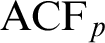 $\mathrm {ACF}_p$
, and
 $a'b_i \equiv ^{\mathrm {ACF}}_C ab$
for all
 $i<\omega $
. As
 is forking independence in the sense of
 $\mathrm {ACF}_p$
, we have
 . By Proposition 2.6 we have
 .⊣
Proposition 2.8. The relation
 satisfies Invariance, Finite Character, Symmetry, Closure, Monotonicity, Base Monotonicity, Transitivity, Full Existence, Stationarity over algebraically closed sets.
Proof This is [Reference d’Elbée16, Lemma 3.10].⊣
Remark 2.9. The property
 -amalgamation over models follows from Stationarity over algebraically closed sets. Hence from Proposition 2.8, strong independence
 satisfies every property of the Kim–Pillay characterization except Local Character otherwise,
 $\mathrm {ACFG}$
would be simple. Example 4.4 shows directly that Local Character is not satisfied by
 , nor by any relation stronger than
 which satisfies Base Monotonicity. Finally, by Proposition 2.8 and [Reference d’Elbée16, Remark 4.7],
 $\mathrm {ACFG}$
is mock stable in the sense of Adler [Reference Adler1].
2.3. Some structural features of
$\textrm{(K,G)}$

Let
 $P(X)$
be a polynomial in variables
 $X = X_1,\dots ,X_n$
with coefficients in K. We say that P is
 $\mathbb {F}_p$
-flat over K if whenever u is a zero of P in some field extension of K, there exists a non trivial
 $\mathbb {F}_p$
-linear combination of u that falls in K.
Lemma 2.10. Let
 $(K,G)$
be an
 $\aleph _0$
-saturated model of
 $\mathrm {ACFG}$
, and
 $P(X_1,\dots ,X_n)$
a polynomial non-
 $\mathbb {F}_p$
-flat over K. Then for every
 $I\subset \{ {1,\dots ,n} \}$
there exists a zero a of P in K such that
 $a_i\in G \iff i\in I$
.
Proof Let
 $I\subset \{ {1,\dots ,n} \}$
. As P is non-
 $\mathbb {F}_p$
-flat, there exists a zero t of P in an extension of K such that no non-nontrivial
 $\mathbb {F}_p$
-linear combination of t falls in K. It follows that
 $(\overline {K(t)}, G+\langle {t_i \mid i\in I} \rangle )$
is an
 $\mathscr {L}_G$
-extension of
 $(K,G)$
. Indeed
 $(G+\langle {t_i \mid i\in I} \rangle )\cap K = G$
. Furthermore
 $t_j\in (G+\langle {t_i \mid i\in I} \rangle )$
if and only if
 $j\in I$
. As
 $(K,G)$
is existentially closed in
 $(\overline {K(t)}, G+\langle {t_i \mid i\in I} \rangle )$
, we have that
 $$ \begin{align*}(K,G)\models \exists x (P(x)=0 \wedge \bigwedge_{i\in I} x_i\in G \wedge \bigwedge_{j\notin I} x_j\notin G).\\[-44pt]\end{align*} $$
⊣
Lemma 2.11. A polynomial P in
 $K[X]$
is
 $\mathbb {F}_p$
-flat over K if and only if all its irreducible factors in
 $K[X]$
are of the form
 $c(\lambda _1X_1+\dots +\lambda _n X_n -b)$
for some
 $\lambda _1,\dots ,\lambda _n$
in
 $\mathbb {F}_p\setminus \{ {0} \}$
and
 $b,c\in K$
.
Proof Assume that P is
 $\mathbb {F}_p$
-flat over K. If
 $\lvert {X} \rvert = 1$
, then P satisfies the conclusion. Assume that
 $\lvert {X} \rvert>1$
. Let
 $t_2,\dots ,t_n$
be algebraically independent over K, and consider
 $P(X_1,t_2,\dots ,t_n)$
. This polynomial has zeros in
 $\overline {K(t_2,\dots ,t_n)}$
hence by
 $\mathbb {F}_p$
-flatness each root u satisfies
 $\lambda _1u + \lambda _2t_2+\dots +\lambda _n t_n =b$
for some non-zero tuple
 $\lambda _1,\dots ,\lambda _n$
from
 $\mathbb {F}_p$
and
 $b\in K$
. By hypothesis on
 $t_2,\dots ,t_n$
we have that
 $\lambda _1\neq 0$
. It follows that
 $X_1-\lambda _1^{-1}(\lambda _2t_2+\dots +\lambda _n t_n -b)$
divides
 $P(X_1,t_2,\dots ,t_n)$
hence
 $\lambda _1X_1+\dots +\lambda _n X_n -b$
divides P, as
 $K[X_1,t_2,\dots ,t_n]\cong K[X]$
. If
 $\lambda _i = 0$
for some i, then the tuple
 $(0,\dots ,t,\dots ,0)$
with t transcendental over K at the i-th coordinate, is a zero of P that contradicts the
 $\mathbb {F}_p$
-flatness. It follows that P is of the desired form. The other direction is trivial.⊣
Example 2.12 (
$\mathbb {F}_p$
-flatness might depends on p)

Consider the polynomial
 $P = X^2+Y^2$
, with
 $b\in K$
. Then P is
 $\mathbb {F}_p$
-flat over any algebraically closed field if and only if
 $-1$
is a square in
 $\mathbb {F}_p$
. From [Reference Fresnel19, Exercise 1.9.24], when
 $p>2$
this is equivalent to
 $p\in 4\mathbb {Z}+1$
. Using Lemmas 2.10 and 2.11 it follows that whenever
 $(K,G)\models \mathrm {ACFG}$
,
 $p>2$
,
-
• if
$p\notin 4\mathbb {Z}+1$
there exists
$g\in G$
and
$u\in K\setminus G$
such that
$g^2+u^2 = 0$
and -
• if
$p\in 4\mathbb {Z}+1$
such couple
$(u,g)$
does not exist in
$(K,G)$
, as every pair of solutions to
$X^2+Y^2 = 0$
are
$\mathbb {F}_p$
-linearly dependent.


For two sets A and B in a field, we denote by
 $A\cdot B$
the product set
 $\{ {ab\mid a\in A,\ b\in B} \}$
.
Proposition 2.13. Let
 $(K,G)$
be a model of
 $\mathrm {ACFG}$
. The following holds:
-
(1)
$K = G\cdot G = G\cdot (K\setminus G) = (K\setminus G)\cdot (K\setminus G)$
; -
(2) G is stably embedded in K; and
-
(3) For
$a\notin \mathbb {F}_p$
and
$P\in K[X]\setminus (K+\mathbb {F}_p\cdot X)$
, we have
$K = G+aG = (K\setminus G)+aG = G+P(G)$
.


Proof
(1) For all
 $b\in K$
the polynomial
 $XY-b$
is not
 $\mathbb {F}_p$
-flat by Lemma 2.11, so we conclude using Lemma 2.10.
(2) From (1), every element in K is product of two elements in G, so any
 $\mathscr {L}_G$
-formula
 $\phi (x,a_1,\dots ,a_n)$
is equivalent to
 $\phi (x,g_1h_1,\dots ,g_nh_n)$
with
 $g_i,h_i\in G$
.
(3) For all
 $P\in K[X]\setminus (K+\mathbb {F}_p\cdot X)$
,
 $b\in K$
, the polynomial
 $Y+P(X)-b$
is not
 $\mathbb {F}_p$
-flat, similarly to (1).
Proposition 2.14. Let
 $\zeta _1,\dots ,\zeta _n$
be
 $\mathscr {L}_{\mathrm {ring}}$
-definable endomorphisms of
 $(K,+)$
,
 $\mathbb {F}_p$
-linearly independent. Then
 $$ \begin{align*}K/(\zeta_1^{-1}(G)\cap\dots\cap\zeta_n^{-1}(G)) \cong K/\zeta_1^{-1}(G) \times \dots\times K/\zeta_n^{-1}(G).\end{align*} $$
Proof Using the first isomorphism theorem, it is sufficient to prove that the function
 $\zeta :K\rightarrow K/\zeta _1^{-1}(G) \times \dots \times K/\zeta _n^{-1}(G)$
defined by
 $\zeta (u) = (u+\zeta _1^{-1}(G),\dots , u+\zeta _n^{-1}(G))$
is onto. Let
 $c_1,\dots ,c_n\in K$
, we want to show that there exists
 $c\in K$
such that for all
 $i \zeta _i(c-c_i)\in G$
. Let t be a transcendental element over K, by model completeness of
 $\mathrm {ACF}_p$
,
 $\zeta _1,\dots ,\zeta _n$
are
 $\mathbb {F}_p$
-linearly independent definable endomorphisms of
 $(\overline {Kt},+)$
. Consider the
 $\mathscr {L}_G$
-structure
 $$ \begin{align*}(\overline{Kt}, G+\langle {\zeta_i(t-c_i)\mid i\leq n} \rangle).\end{align*} $$
We have
 $(G+\langle {\zeta _i(t-c_i)\mid i\leq n} \rangle )\cap K = G+\langle {\zeta _i(t-c_i)\mid i\leq n} \rangle \cap K$
. For
 $\lambda _1,\dots ,\lambda _n\in \mathbb {F}_p$
, if
 $\sum _i \lambda _i \zeta _i(t-c_i)\in K$
then
 $\sum _i \lambda _i \zeta _i(t)\in K$
. It is standard that a definable additive endomorphism is of the form
 $x\mapsto a_1\mathrm {Frob}^{n_1}(x)+\cdots +a_k\mathrm {Frob}^{n_k}(x)$
with
 $n_i\in \mathbb {Z}$
(see [Reference Bouscaren, Delon, Hindry, Hrushovski, Lascar, Marker, Pillay, Wood and Ziegler6, Chapter 4, Corollary 1.5] and [Reference Humphreys21, Lemma A, VII, 20.3]) hence there is some k such that
 $t\mapsto (\sum _i \lambda _i \zeta _i(t))^{p^k}$
is polynomial. As t is transcendental over K,
 $(\sum _i \lambda _i \zeta _i)^{p^k} = 0$
, so
 $\sum _i \lambda _i \zeta _i = 0$
. As
 $\zeta _1,\dots ,\zeta _n$
are
 $\mathbb {F}_p$
-linearly independent,
 $\lambda _1=\dots =\lambda _n = 0$
. It follows that
 $(G+\langle {\zeta _i(t-c_i)\mid i\leq n} \rangle )\cap K = G$
, so
 $(\overline {Kt}, G+\langle {\zeta _i(t-c_i)\mid i\leq n} \rangle )$
extends
 $(K,G)$
. As
 $(K,G)$
is existentially closed in
 $(\overline {Kt}, G+\langle {\zeta _i(t-c_i)\mid i\leq n} \rangle )$
we have that
 $(K,G)\models \exists x \bigwedge _i \zeta _i(x-c_i)\in G$
, hence
 $\zeta $
is onto.⊣
If
 $\zeta _1,\dots ,\zeta _n$
are
 $\mathbb {F}_p$
-linearly independent
 $\mathscr {L}_{\mathrm {ring}}$
-definable isomorphisms of
 $(K,+)$
, the previous result can be used to find canonical parameters for the quotient
 $K/(\zeta _1^{-1}(G)\cap \dots \cap \zeta _n^{-1}(G))$
provided one have canonical parameters for the quotient
 $K/G$
, see Example 3.1.
2.4. Models of ACFG in
$\overline {\mathbb {F}_p}$

Recall that from [Reference d’Elbée16, Theorem 5.2], for any quantifier free
 $\mathscr {L}_{\mathrm {ring}}$
-formula
 $\phi (x,y)$
, there exists an
 $\mathscr {L}_{\mathrm {ring}}$
-formula
 $\theta _\phi (y)$
such that for
 $K\models \mathrm {ACF}_p$
sufficiently saturated and b tuple in K such that
 $K\models \theta _\phi (b)$
if and only if there exists a realisation a of
 $\phi (x,b)$
which is
 $\mathbb {F}_p$
-linearly independent over
 $\overline {{\mathbb {F}_p(b)}}$
. By quantifier elimination in
 $\mathrm {ACF}_p$
, the formula
 $\theta _\phi $
can be chosen quantifier-free.
Lemma 2.15. If
 $\mathbb {F}_{p^n}\models \theta _\phi (b)$
then there exists
 $m> n$
such that
 $$ \begin{align*}\mathbb{F}_{p^m}\models \exists x\phi(x,b)\wedge x\ \text{is}\ \mathbb{F}_p\text{-linearly independent over}\ \mathbb{F}_{p^n}.\end{align*} $$
Proof Assume that
 $\mathbb {F}_{p^n}\models \theta _\phi (b)$
. Then as
 $\theta _\phi $
is quantifier free,
 $\overline {{\mathbb {F}_p}}\models \theta _\phi (b)$
. It follows that for some elementary extension K of
 $\overline {{\mathbb {F}_p}}$
, there is some realisation a of
 $\phi (x,b)$
which is
 $\mathbb {F}_p$
-linearly independent over
 $\overline {{\mathbb {F}_p}}$
. In particular, in K, no nontrivial
 $\mathbb {F}_p$
-linear combination of a is a root of
 $X^{p^n}-X$
. As
 $\overline {\mathbb {F}_p} \equiv ^{\mathrm {ACF}} K$
, the following sentence holds in
 $\overline {\mathbb {F}_p}$
:
 $$ \begin{align*}&\forall y (\theta_\phi(y)\\&\quad\rightarrow (\exists x \phi(x,y) \wedge \mbox{``no nontrivial}\ \mathbb{F}_p\mbox{-linear combination of} x \mbox{is a root of}\ X^{p^n}-X")).\end{align*} $$
Hence for some
 $m>n$
there exists a tuple a from
 $\mathbb {F}_{p^m}$
such that
 $$ \begin{align*}\overline{\mathbb{F}_{p}}\models \phi(a,b)\wedge\ ``a\ \text{is}\ \mathbb{F}_p\text{-linearly independent over}\ \mathbb{F}_{p^n}".\end{align*} $$
As
 $\phi (x,y)$
is quantifier-free, we also have that
 $$ \begin{align*}\mathbb{F}_{p^m}\models \phi(a,b)\wedge\ ``a\ \text{is}\ \mathbb{F}_p\text{-linearly independent over}\ \mathbb{F}_{p^n}".\\[-30pt]\end{align*} $$
⊣
Proposition 2.16. For any
 $n\in \mathbb {N}$
and any additive subgroup
 $G_0$
of
 $\mathbb {F}_{p^n}$
there exists a subgroup G of
 $\overline {\mathbb {F}_p}$
such that
 $ G\cap \mathbb {F}_{p^n} = G_0$
and
 $(\overline {\mathbb {F}_p},G)\models \mathrm {ACFG}$
.
Proof Start with the following claim.
Claim. Let
 $n,s,k_1,\dots , k_s \in \mathbb {N}$
and let
 $\phi _1(x^1,y^1),\dots ,\phi _s(x^s,y^s)$
be quantifier free formulae in
 $\mathscr {L}_{\mathrm {ring}}$
. For
 $i\leq s$
, let
 $B_i = \{ {b\in \mathbb {F}_{p^n}^{\lvert {y^i} \rvert } \mid b\models \theta _{\phi _i}(y)} \}$
. Then there exists
 $m>n$
such that for all
 $i\leq s$
and
 $b\in B_i$
there exists some
 $\lvert {x^i} \rvert $
-tuples
 $a^{i,1},\dots ,a^{i,k_i}$
(depending on b) from
 $\mathbb {F}_{p^m}$
such that
-
(1)
$(a^{i,j}_k)_{i\leq s, j\leq k_i,k\leq \lvert {x^{i}} \rvert }$
is a
$\mathbb {F}_p$
-linearly independent tuple over
$\mathbb {F}_{p^n}$
-
(2)
$\mathbb {F}_{p^m} \models \phi _i(a^{i,1},b),\dots ,\mathbb {F}_{p^m}\models \phi _i(a^{i,k_i},b)$
.


Proof of the Claim
We do it step by step, as there are only a finite number of tuples to add. Start with
 $\phi _1(x^1,y^1)$
. Take a first
 $b\in B_1$
. As
 $\mathbb {F}_{p^n}\models \theta _{\phi _1}(b)$
, we use Lemma 2.15 with
 $m=n$
to get a first
 $m_1>n$
such that there exists
 $a^1\in \mathbb {F}_{p^{m^1}}^{\lvert {x_1} \rvert }$
such that
 $\models \phi _1(a^1, b)$
and
 $a^1$
is
 $\mathbb {F}_p$
-linearly independent over
 $\mathbb {F}_{p^n}$
. Using again Lemma 2.15 with
 $m=m_1$
there exists
 $m_2>m_1$
and a second
 $a^2\in \mathbb {F}_{p^{m_2}}^{\lvert {x^1} \rvert }$
such that
 $\mathbb {F}_{p^{m_2}}\models \phi _1(a^2, b)$
and
 $a^2$
is
 $\mathbb {F}_p$
-linearly independent over
 $\mathbb {F}_{p^{m_1}}$
. In particular
 $a^2$
is
 $\mathbb {F}_p$
-linearly independent from
 $a^1$
over
 $\mathbb {F}_{p^n}$
. So we can construct as many (finitely) solutions to
 $\phi _1(x^1, b)$
as we want which are
 $\mathbb {F}_p$
-linearly independent over
 $\mathbb {F}_{p^n}$
. Once we have enough
 $\mathbb {F}_p$
-linearly independent solutions of
 $\phi _1(x,b)$
, we can do the same trick with another
 $b'\in B_1$
, and add as many (finitely) solutions as we want,
 $\mathbb {F}_p$
-linearly independent from one another and from the ones corresponding to b, in a finite extension of
 $\mathbb {F}_{p^{n}}$
. Once we have done it for all elements of
 $B_1$
, we do the same with every element
 $b\in B_2$
, continuing to use Lemma 2.15 to get solutions of
 $\phi _2(x^2,b) \mathbb {F}_p$
-linearly independent from one another and from the previous ones. As every
 $B_i$
is finite and they are in finite number, we can finish to add
 $\mathbb {F}_p$
-linearly independent solutions of
 $\phi _i$
in a finite number of steps and the claim is proven.⊣
From Proposition 2.1, the axioms for
 $\mathrm {ACFG}$
are given by the following scheme: for all quantifier free
 $\mathscr {L}_{\mathrm {ring}}$
-formula
 $\phi (x,y)$
, for all
 $0\leq k\leq \lvert {x} \rvert $
and
 $0\leq k'\leq \lvert {y} \rvert $
 $$ \begin{align*}\forall y ( (\theta_\phi(y)\kern1.2pt{\wedge}\kern1.2pt \langle {y_1,\dots,y_{k'}} \rangle\cap G \kern1.2pt{=}\kern1.2pt \{ {0} \})\kern1.2pt{\rightarrow}\kern1.2pt (\exists x \phi(x,y)\kern1.2pt{\wedge}\kern1.2pt \langle {x,y_1,\dots,y_{k'}} \rangle\kern1.2pt{\cap}\kern1.2pt G \kern1.2pt{=}\kern1.2pt \langle {x_1,\dots,x_k} \rangle))\end{align*} $$
with the following convention:
 $a_1,\dots ,a_0 = \emptyset $
. We will denote the previous sentence by
 $\Gamma (\phi ,k,k')$
. Now we construct by induction a model of
 $\mathrm {ACFG}$
starting from
 $(\mathbb {F}_{p^n}, G_0)$
. Let
 $(\phi _i(x^i,y^i))_{i<\omega }$
be an enumeration of all quantifier-free formulae in
 $\mathscr {L}_{\mathrm {ring}}$
. We construct an increasing sequence
 $(n_j)_{j<\omega }$
starting with
 $n_0 = n$
and additive subgroups
 $G_j$
of
 $\mathbb {F}_{p^{n_j}}$
such that for all
 $s<\omega $
, for
 $\phi _1(x^1,y^1),\dots ,\phi _s(x^s,y^s)$
, for all
 $1\leq l \leq s$
, for all
 $0\leq k\leq \lvert {x^l} \rvert $
and
 $0\leq k'\leq \lvert {y^l} \rvert $
the following holds for all
 $\lvert {y^l} \rvert $
-tuples b from
 $\mathbb {F}_{p^{n_s}}\!$
:
If
 $\mathbb {F}_{p^{n_s}}\models \theta _{\phi _l}(b)\wedge \langle {b_1,\dots , b_{k'}} \rangle \cap G_s = \{ {0} \}$
then there exists
 $a^{l,k}$
an
 $\lvert {x^l} \rvert $
-tuple from
 $\mathbb {F}_{p^{n_{s+1}}}$
such that
 $\mathbb {F}_{p^{n_{s+1}}} \models \phi (a^{l,k},b)\wedge \langle {a^{l,k},b_1,\dots ,b_{k'}} \rangle \cap G_{s+1} = \langle {a^{l,k}_1,\dots ,a^{l,k}_k} \rangle $
. (
 $\star $
)
Assume that for some
 $s<\omega $
we have
 $n_0,\dots ,n_s$
and
 $G_0\subseteq \mathbb {F}_{p^{n_0}},\dots , G_s\subseteq \mathbb {F}_{p^{n_s}}$
constructed as above. For every
 $i\kern1pt{\leq}\kern1pt s$
, we define as above
 $B_i= \{ {b\in \mathbb {F}_{p^{n_s}}^{\lvert {y^i} \rvert } \mid b\models \theta _{\phi _i}(y)} \}$
, and we apply the claim with
 $k_i = \lvert {x^i} \rvert +1$
, to get some
 $n_{s+1}>n_s$
. For each
 $1\leq i \leq s$
and
 $b\in B_i$
we have
 $\lvert {x^i} \rvert +1$
many
 $\lvert {x^i} \rvert $
-tuples
 $a^{i,1}(b), \dots , a^{i,k_i}(b)$
from
 $\mathbb {F}_{p^{n_{s+1}}}$
all
 $\mathbb {F}_p$
-independent over
 $\mathbb {F}_{p^{n_s}}$
and such that for all j, we have
 $\mathbb {F}_{p^{n_{s+1}}}\models \phi _i(a^{i,j}(b),b)$
. Now define
 $G_{s+1}$
to be
 $$ \begin{align*}G_s\oplus \bigoplus_{1\leq i\leq s}\bigoplus_{b\in B_i}\langle {a_1^{i,2}(b)} \rangle\oplus\langle {a_1^{i, 3}(b),a_2^{i,3}(b)} \rangle\oplus \dots\oplus \langle {a_1^{i,k_i}(b),\dots,\oplus a_{k_i}^{i,k_i}(b)} \rangle.\end{align*} $$
In other words,
 $G_{s+1}$
is obtained by adding to
 $G_s$
the low triangle of the
 $(\lvert {x_i} \rvert +1)\times \lvert {x_i} \rvert $
matrix
 $(a^{i,j}_k(b))_{1\leq j\leq k_i,1\leq k\leq \lvert {x^i} \rvert }$
for each
 $i<s$
and
 $b\in B_i$
:

Now we have for each
 $1\leq i\leq s$
and any
 $0\leq k\leq \lvert {x^i} \rvert $
and
 $0\leq k'\leq \lvert {y^i} \rvert $
, if
 $b\in B_i$
, then there exists
 $a^{i,k}(b)\in \mathbb {F}_{p^{n_{s+1}}}^{\lvert {x^i} \rvert }$
such that
 $ \mathbb {F}_{p^{n_{s+1}}}\models \phi _i(a^{i,k}(b), b)$
. By construction and
 $\mathbb {F}_p$
-linear independence of all the
 $a^{i,k}$
, if
 $\langle {b_1,\dots ,b_{k'}} \rangle \cap G_s = \{ {0} \}$
then we have
 $\langle {a^{i,k},b_1,\dots ,b_{k'}} \rangle \cap G_{s+1} = \langle {a^{i,k}_1,\dots ,a^{i,k}_k} \rangle $
. By induction we construct a family
 $(\mathbb {F}_{p^{n_i}},G_i)$
satisfying (
 $\star $
). Now let
 $$ \begin{align*}G= \bigcup_{i<\omega} G_i \subseteq \overline{\mathbb{F}_p}.\end{align*} $$
By construction, we have that
 $(\overline {\mathbb {F}_p},G)$
is a model of
 $\mathrm {ACFG}$
.⊣
The set of all subgroups of some countable abelian group can be endowed with a topology that is compact, it is called the Chabauty topology (see for instance [Reference de Cornulier17]). In the case of the group
 $(\overline {\mathbb {F}_p}, +)$
, this topology has a very explicit description. Let
 $\mathrm {Sg}(\overline {\mathbb {F}_p})$
be the set of all subgroups of
 $(\overline {\mathbb {F}_p}, +)$
. The Chabauty topology on
 $\mathrm {Sg}(\overline {\mathbb {F}_p})$
is the topology of the Cantor space, and is generated by clopens of the form
 $$ \begin{align*}\mathbb{B}(H_0,\mathbb{F}_{p^n}) = \{ {H\in \mathrm{Sg}(\overline{\mathbb{F}_p}) \mid H\cap \mathbb{F}_{p^n} = H_0} \}\end{align*} $$
for some finite group
 $H_0\in \mathrm {Sg}(\overline {\mathbb {F}_p})$
. Let
 $$ \begin{align*}\mathcal{C} = \{ {G\in Sg(\overline{{\mathbb{F}_p}}) \mid (\overline{{\mathbb{F}_p}},G)\models \mathrm{ACFG}} \}.\end{align*} $$
Recall that, in a topological space, a set is
 $G_\delta $
if it is a countable intersection of open sets.
Proposition 2.17.
 $\mathcal {C}$
is a dense
 $G_\delta $
of
 $Sg(\overline {{\mathbb {F}_p}})$
.
Proof The density of
 $\mathcal {C}$
in
 $\mathrm {Sg}(\overline {\mathbb {F}_p})$
follows directly from Proposition 2.16: every clopen
 $\mathbb {B}(G_0, \mathbb {F}_{p^n})$
contains an element of
 $\mathcal {C}$
.
We show that
 $\mathcal {C}$
is a
 $G_\delta $
. First, from Proposition 2.1,
 $\mathrm {ACFG}$
is axiomatised by adding to the theory
 $\mathrm {ACF}_G$
the following
 $\mathscr {L}_G$
-sentences, for all tuples of variables
 $x'\subset x$
,
 $y' \subset y$
and
 $\mathscr {L}_{\mathrm {ring}}$
-formulae
 $\phi (x,y)$
 $$ \begin{align*}\forall y (\langle {y'} \rangle\cap G = \{ {0} \} \wedge \theta_{\phi}(y)) \rightarrow (\exists x \phi(x,y)\wedge \langle {xy'} \rangle\cap G = \langle {x'} \rangle)\end{align*} $$
which is equivalent to
 $$ \begin{align*}\forall y\exists x \left[\neg \theta_\phi(y))\vee \langle {y'} \rangle\cap G \neq \{ {0} \} \vee (\phi(x,y)\wedge \langle {xy'} \rangle\cap G = \langle {x'} \rangle)\right].\end{align*} $$
Let
 $\phi (x,y)$
,
 $x'\subseteq x$
and
 $y'\subseteq y$
be given. Let b be a
 $\lvert {y} \rvert $
-tuple, and consider the set
 $$ \begin{align*}\mathscr{O}_b =\!\! \!\bigcup_{a\in \overline{\mathbb{F}_p}^{\lvert {x} \rvert},\overline{\mathbb{F}_p}\models \phi(a,b)}\!\!\! \{ {H\kern1.5pt{\in}\kern1.5pt \mathrm{Sg}(\overline{\mathbb{F}_p}) \kern1pt{\mid}\kern1pt \langle {b'} \rangle\cap H \kern1.5pt{\neq}\kern1.5pt \{ {0} \}} \}\kern1.5pt{\cup}\kern1.5pt \{ {H\kern1.5pt{\in}\kern1.5pt \mathrm{Sg}(\overline{\mathbb{F}_p}) \kern1pt{\mid}\kern1pt \langle {ab'} \rangle\cap H \kern1pt{=}\kern1pt \langle {a'} \rangle} \kern-1pt\}.\end{align*} $$
 $\mathscr {O}_b$
depends on b and the choice of
 $\phi (x,y)$
,
 $x'\subseteq x$
and
 $y'\subseteq y$
.
 $\mathscr {O}_b$
is the set of
 $H\in \mathrm {Sg}(\overline {\mathbb {F}_p})$
such that there exists
 $a\in \overline {\mathbb {F}_p}$
such that
 $\overline {\mathbb {F}_p} \models \phi (a,b)$
and if
 $\langle {b'} \rangle \cap H = \{ {0} \}$
, then
 $\langle {ab'} \rangle \cap H = \langle {a'} \rangle $
.
The set
 $\{ {H\kern1pt{\neq}\kern1pt \mathrm {Sg}(\overline {\mathbb {F}_p}) \mid \langle {b'} \rangle \cap H \kern1pt{\neq}\kern1pt \{ {0} \}} \}$
is equal to
 $\bigcup _{u\in \langle {b'} \rangle \setminus \{ {0} \}}\{ {H\kern1pt{\in}\kern1pt \mathrm {Sg}(\overline {\mathbb {F}_p}) \mid u\kern1pt{\in}\kern1pt H} \}$
which is open since each set
 $\{ {H\in \mathrm {Sg}(\overline {\mathbb {F}_p}) \mid u\in H} \}$
is open. The set
 $\{ H\in \mathrm {Sg}(\overline {\mathbb {F}_p}) \mid \langle {ab'} \rangle \cap H = \langle {a'} \rangle \}$
is also open, so
 $\mathscr {O}_b$
is open. Now it is an easy checking that
 $$ \begin{align*}\mathcal{C} = \bigcap_{\phi(x,y), x'\subseteq x, y'\subseteq y}\bigcap_{b\in \overline{\mathbb{F}_p}^{\lvert {y} \rvert},\overline{\mathbb{F}_p}\models \theta_\phi(b)} \mathscr{O}_b.\end{align*} $$
Hence
 $\mathcal {C}$
is a countable intersection of open sets, i.e.,
 $\mathcal {C}$
is
 $G_\delta $
.⊣
Remark 2.18 (Ultraproduct model of
$\mathrm {ACFG}$
)

From the proof of Proposition 2.16, starting from
 $G_0\subseteq \mathbb {F}_{p^{n_0}}$
, there exists a strictly increasing sequence
 $(n_i)_{i<\omega }$
of integers and an increasing sequence of groups
 $G_i\subseteq \mathbb {F}_{p^{n_i}}$
satisfying (
 $\star $
). Let
 $\mathscr {U}$
be a nonprincipal ultrafilter on
 $\omega $
, it does not take long to see that the ultraproduct
 $ \prod _{\mathscr {U}} (\overline {\mathbb {F}_p}, G_i))$
is a model of
 $\mathrm {ACFG}$
, in which the group is pseudo-finite. The construction of the
 $G_i$
’s in the proof of Proposition 2.16 is rather artificial. Are there more “natural” generic subgroups of
 $\overline {\mathbb {F}_p}$
? Given an arbitrary set
 $\{ {G_i \mid i<\omega } \}$
of subgroups of
 $\overline {\mathbb {F}_p}$
and a nonprincipal ultrafilter
 $\mathscr {U}$
on
 $\omega $
, how likely is it that
 $ \prod _{\mathscr {U}} (\overline {\mathbb {F}_p}, G_i)) $
is a model of
 $\mathrm {ACFG}$
?
Remark 2.19 (Pseudofinite generic subgroup of a pseudofinite field)
Let F be an infinite locally finite field.Footnote
3
Let
 $\phi (x,y)$
be an
 $\mathscr {L}_{\mathrm {ring}}$
-formula and assume that there exists a formula
 $\theta _\phi (y)$
such that for all tuples b, we have
 $F\models \theta _\phi (b)$
if and only if there exists a realisation a of
 $\phi (x,b)$
in an elementary extension of F such that a is
 $\mathbb {F}_p$
-linearly independent over F. The proof of Lemma 2.15, yields the following: if
 $\phi (x,y)$
is universal and
 $\theta _\phi (y)$
is existential, if
 $F_0$
is a finite subfield of F and
 $F_0\models \theta _\phi (b)$
, then there exists a finite subfield
 $F_1$
of F and a tuple a from
 $F_1$
realizing
 $\phi (x,b)$
which is
 $\mathbb {F}_p$
-linearly independent over
 $F_0$
. Consider the theory
 $\mathrm {Psf}_c$
(the theory of pseudo-finite fields with constants for irreducible polynomials, see for instance [Reference Chatzidakis8, Section 3]), it is model-complete, hence every formula is equivalent to an existential formula and a universal formula, with some constants. It is possible to choose constants
 $c(i)$
in
 $F_i$
such that
 $X^n+c_{n-1,n}(i)X^{n-1}+\cdots +c_{0,n}(i)$
is irreducible over
 $F_i$
, for all n. Let
 $(\phi _i(x^i,y^i))_{i<\omega }$
be an enumeration of all
 $\mathscr {L}_{\mathrm {ring}}$
-universal formula, and by [Reference d’Elbée16, Example 5.10], for each i we a have an associated formula
 $\theta _{\phi _i}(y^i)$
that can be chosen existential. By the same method as in the proof of Theorem 2.16, we may construct an increasing sequence of finite fields
 $(F_i)_{i<\omega }$
and finite subgroups
 $G_i\subseteq F_i$
such that for each
 $i<\omega $
,
 $k<\lvert {x^i} \rvert $
and
 $k'<\lvert {y^i} \rvert $
, if
 $(F_i,G_i)$
satisfies the premise of the axiom
 $\Gamma (\phi _i,k,k')$
(see notation in the proof of Theorem 2.16), then the conclusion is satisfied in
 $(F_{i+1},G_{i+1})$
. Then one can check that a nonprincipal ultraproduct of
 $(F_i, c(i))_{i<\omega }$
is a model of
 $\mathrm {Psf}_c$
, hence the ultraproduct
 $\prod _{\mathscr {U}} (F_i,c_i,G_i)$
is a model of the expansion of a pseudo-finite field of characteristic p with a pseudofinite generic subgroup, see [Reference d’Elbée16, Example 5.10].
Remark 2.20 (Characteristic
$0$
)

Let
 $\mathscr {P}$
be the set of prime numbers and
 $\mathscr {U}$
a nonprincipal ultrafilter on
 $\mathscr {P}$
. For each
 $q\in \mathscr {P}$
let
 $G_q$
be a subgroup of
 $\overline {\mathbb {F}_q}$
such that
 $(\overline {\mathbb {F}_q},G_q)$
is a model of
 $\mathrm {ACFG}$
(here we mean
 $\mathrm {ACF_qG}$
). Recall that
 $\mathbb {C}\cong \prod _{q\in \mathscr {P}} \overline {\mathbb {F}_q}/ \mathscr {U}$
. Consider the ultraproduct
 $$ \begin{align*}(\mathbb{C},V) \cong \prod_{q\in \mathscr{P}} (\overline{\mathbb{F}_q},G_q)/ \mathscr{U}.\end{align*} $$
It is clear that V is a subgroup of
 $\mathbb {C}$
. For each
 $q\in \mathscr {P}$
,
 $$ \begin{align*}Stab_{\overline{\mathbb{F}_q}}(G_q) := \{ {a\in \overline{\mathbb{F}_q}\mid a G_q \subseteq G_q} \} = \mathbb{F}_q,\end{align*} $$
this follows from Proposition 2.13 (3). Hence
 $F = Stab_{\mathbb {C}}(V)$
is a pseudo-finite subfield of
 $\mathbb {C}$
, and V is an F-vector space. It follows from [Reference d’Elbée16, Proposition 5.34] that
 $(\mathbb {C},V)$
is not existentially closed in the class of
 $\mathscr {L}_G$
-structures consisting of a field of characteristic
 $0$
in which G is an additive subgroup. Nonetheless, some properties such as the ones in Proposition 2.13 will be satisfied by
 $(\mathbb {C},V)$
(replacing
 $\mathbb {F}_p$
by F).
3. Imaginaries
Let
 $(K,G)$
be a saturated model of
 $\mathrm {ACFG}$
. It is easy to see that for all
 $a\in K\setminus G$
, there exists
 $b\in K\setminus G$
algebraically independent from a over
 $\mathbb {F}_p$
such that
 $a-b\in G$
(see Lemma 3.2). Let
 $\alpha = a/G = b/G\in (K,G)^{eq}$
. If it exists, a canonical parameter for
 $\alpha $
in K would be definable over both a and b, hence it would be definable over an element of
 $\overline {\mathbb {F}_p}$
. This would give an embedding of
 $K/G$
into the countable set
 $\mathrm {dcl}^{eq}(\emptyset )$
which is absurd in a saturated model
 $(K,G)$
for cardinality reasons. This proves that
 $(K,G)$
does not eliminate the imaginaries of the sort
 $K/G$
.
Let
 $(K,G)$
be a model of
 $\mathrm {ACFG}$
, there is a canonical projection
 $$ \begin{align*}\pi : K \rightarrow K/G.\end{align*} $$
Consider the two-sorted structure,
 $(K, K/G)$
with the
 $\mathscr {L}_{\mathrm {ring}}$
-structure on K, the
 $\mathbb {F}_p$
-vector space structure on
 $K/G$
and the
 $\mathbb {F}_p$
-vector space epimorphism
 $\pi : K \rightarrow K/G$
. We forget about the predicate G as it is
 $0$
-definable in
 $(K,K/G)$
. The structure
 $(K, K/G)$
is bi-interpretable with
 $(K,G)$
. We fix
 $(K,G)$
and
 $(K,K/G)$
for the rest of this section.
In this section, we show that
 $(K,K/G)$
has weak elimination of imaginaries, hence imaginaries of
 $(K,G)$
can be weakly eliminated up to the quotient
 $K/G$
.
Some definable imaginaries in
 $(K,G)$
can be easily eliminated in the structure
 $(K,K/G)$
.
Example 3.1. Let
 $\zeta : K \rightarrow K$
be a
 $\mathscr {L}_{\mathrm {ring}}$
-definable group endomorphism. Then in
 $(K,K/G)^{eq}$
, every element in
 $K/\zeta ^{-1}(G)$
is interdefinable with an element in
 $K/G$
. Indeed, for any element
 $a\in K$
and any automorphism
 $\sigma $
of
 $(K,K/G)$
,
 $\sigma (a) - a\in \zeta ^{-1}(G)$
if and only if
 $\sigma $
fixes
 $\pi (\zeta (a))$
, hence
 $\pi (\zeta (a))$
is a canonical parameter for the class of a modulo
 $\zeta ^{-1}(G)$
.
Let
 $\zeta _1,\ldots ,\zeta _n$
be
 $\mathbb {F}_p$
-linearly independent
 $\emptyset $
-
 $\mathscr {L}_{\mathrm {ring}}$
-definable group endomorphisms
 $K\rightarrow K$
. Let
 $\pi _\zeta : K \rightarrow K/{\zeta _1^{-1}(G)\cap \cdots \cap \zeta _n^{-1}(G)}$
and consider an element
 $\alpha $
of the sort
 $K/{\zeta _1^{-1}(G)\cap \cdots \cap \zeta _n^{-1}(G)}$
in
 $(K,K/G)^{eq}$
. From Proposition 2.14 the natural map
 $$ \begin{align*}K/{\zeta_1^{-1}(G)\cap \cdots \cap \zeta_n^{-1}(G)}\rightarrow K/\zeta_1^{-1}(G) \times \cdots \times K/\zeta_n^{-1}(G)\end{align*} $$
is an isomorphism. Let a be such that
 $\pi _\zeta (a) = \alpha $
. For each
 $1\leq i\leq n$
let
 $\alpha _i = \pi (\zeta _i^{-1}(a))\in K/G$
. Then the tuple
 $\alpha _1,\ldots ,\alpha _n$
is a canonical parameter for
 $\alpha $
.
If quotients of the form
 $K/\zeta ^{-1}(G)$
can be fully eliminated, what about quotients of the form
 $K/\zeta (G)$
? In this case the kernel of
 $\zeta $
is a finite vector space, hence a canonical parameter for
 $\alpha \in K/\zeta (G)$
is a finite set of the form
 $\pi (a+\ker (\zeta ))$
which is not necessarily eliminable in
 $(K,K/G)$
as shown by Example 3.16. We even show in Example 3.17 that adding canonical parameters for the sort
 $K/G$
is not sufficient to eliminate all finite imaginaries of the structure
 $(K,K/G)$
.
In this section, Greek letters
 $\Gamma $
,
 $\alpha $
denote subsets or tuples (which might be infinite) from
 $K/G$
. Any tuple in the structure
 $(K,K/G)$
will be denoted by
 $a\gamma $
, with a a tuple from K,
 $\gamma $
a tuple from
 $K/G$
. We also extend
 $\pi $
for (finite or infinite) tuples by
 $\pi (a) := (\pi (a_i))_{i}$
.
3.1. First steps with imaginaries
Let
 $\sigma $
be a field automorphism of K. It is clear that the following are equivalent:
-
•
$\sigma $
is an
$\mathscr {L}^G$
-automorphism of K and -
• there exists
$\tilde {\sigma } :K/G \rightarrow K/G$
such that
$ \pi \circ \sigma = \tilde {\sigma } \circ \pi $
.


An automorphism of the structure
 $(K,K/G)$
is a pair
 $(\sigma ,\tilde {\sigma })$
as above. It follows that for
 $a,b,C$
from K, we have
 $$ \begin{align*}a\equiv_C^{(K,G)} b \iff a\equiv_C^{(K,K/G)}b.\end{align*} $$
In this section, the relation
 $\equiv $
means having the same type in the structure
 $(K,K/G)$
.
Lemma 3.2. Let
 $a,b$
be two tuples of the same length from K. Let
 $C,D\subseteq K$
and assume that
-
•
$\pi (a)$
is an
$\mathbb {F}_p$
-independent tuple over
$\pi (\overline {C})$
, -
•
$\pi (b)$
is an
$\mathbb {F}_p$
-independent tuple over
$\pi (\overline {C})$
.


Then there exists
 $a'\equiv _C a$
such that
 and
 $\pi (a') = \pi (b)$
.
Proof Let x be a tuple from an elementary extension of the field K, such that
 and such that
 $x \equiv ^{\mathrm {ACF}}_C a$
, and
 $f : \overline {Cx} \rightarrow \overline {Ca}$
a field isomorphism over C sending x to a. Let
 $G_{Cx} = f^{-1}(G(\overline {Ca}))$
. Consider now the subgroup of
 $\overline {CDbx}$
defined by
 $$ \begin{align*}H = G_{Cx}+G(\overline{CbD}) + \langle {x_i - b_i \mid i\leq \lvert {x} \rvert} \rangle.\end{align*} $$
We show that the type in the sense of
 $\mathrm {ACFG}$
defined by the pair
 $(\overline {CDbx}, H)$
is consistent. As
 we have
 $\overline {CDbx}\cap K = \overline {CDb}$
. In order to prove that
 $H\cap \overline {CDb} = G(\overline {CDb})$
, it suffices to show that
 $$ \begin{align*}\overline{CDb}\cap (G_{Cx}+ \langle {x_i - b_i \mid i\leq \lvert {x} \rvert} \rangle)\subseteq G(\overline{C}).\end{align*} $$
Assume that
 $g_{Cx}+\sum _i\lambda _i(x_i-b_i) \in \overline {CDb}$
, where
 $g_{Cx}\in G_{Cx}$
. It follows that
 $g_{Cx}+\sum _i\lambda _i x_i \in \overline {CDb}$
. On the other hand
 $g_{Cx}+\sum _i\lambda _i x_i \in \overline {Cx}$
. As
 we have
 $\overline {Cx}\cap \overline {CDb} = \overline {C}$
hence
 $g_{Cx}+\sum _i\lambda _i x_i \in \overline {C}$
. Apply
 $\pi \circ f$
to get that
 $\sum _i\lambda _i\pi (a_i)\in \pi (\overline {C})$
hence by hypothesis
 $\lambda _i = 0$
for all
 $i\leq \lvert {x} \rvert $
. It follows that
 $g_{Cx}\in \overline {C}$
and so
 $g_{Cx}\in G(\overline {C})$
. We have showed that
 $\overline {CDb}\cap (G_{Cx}+ \langle {x_i - b_i \mid i\leq \lvert {x} \rvert } \rangle )\subseteq G(\overline {C})$
. The type is consistent by §2.1, so realised by say
 $a'$
. As
 we have
 . In order to show that
 $a'\equiv _C a$
we have to check that
 $H\cap \overline {Cx} = G_{Cx}$
, this is similar to the argument above, using this time that
 $\pi (b)$
is
 $\mathbb {F}_p$
-independent over
 $\pi (\overline {C})$
. We have
 $a_i'-b_i\in G$
hence
 $\pi (a_i') = \pi (b_i)$
, for all
 $i\leq \lvert {x} \rvert $
.
Lemma 3.3 (Minimal representative)
Let a, C be in K such that
 $\pi (a)$
is an
 $\mathbb {F}_p$
-independent tuple over
 $\pi (\overline {C})$
. Then there exists
 $a'$
of same length as a, algebraically independent over
 $Cb$
such that
-
•
$\pi (a)=\pi (a')$
, -
•
$\pi (\overline {Ca'}) = \langle {\pi (\overline {C})\pi (a)} \rangle $
, -
•
.


Proof It is again a type to realise. Consider a tuple x from an elementary extension of the field K, such that x is of the same length as a and algebraically independent over
 $Cba$
. Let V be a
 $\mathbb {F}_p$
-vector space complement to
 $\overline {C}\oplus \langle {x} \rangle $
in
 $\overline {Cx}$
and set
 $$ \begin{align*}H = G(\overline{Cab})+\langle {x-a} \rangle+V.\end{align*} $$
We check that the pair
 $(\overline {Cabx}, H)$
defines a consistent type over
 $Cab$
. We have to show that
 $$ \begin{align*}H\cap \overline{Cab} = G(\overline{Cab}).\end{align*} $$
First, as
 $G(\overline {Cab})\subseteq \overline {{Cab}}$
, we have that
 $$ \begin{align*}H\cap \overline{Cab} = G(\overline{Cab})+ (\langle {x-a} \rangle+V)\cap \overline{Cab},\end{align*} $$
so it suffices to show that
 $(\langle {x-a} \rangle +V)\cap \overline {Cab} = \{ {0} \}$
. Let
 $v\in V$
, if
 $\sum _i \lambda _i(x_i-a_i) +v\in \overline {Cab}$
then
 $\sum _i \lambda _i x_i + v\in \overline {Cab}$
. As
 $\overline {Cab}\cap \overline {Cx} = \overline C$
,
 $\sum _i \lambda _i x_i + v\in \overline {C}$
hence
 $v =0$
and, as x is
 $\mathbb {F}_p$
-independent over
 $\overline {C}$
,
 $\lambda _i = 0$
for all
 $i\leq \lvert {x} \rvert $
. The type is consistent by §2.1. We show now that
 $$ \begin{align*}H\cap \overline{Cx} = G(\overline C )+V.\end{align*} $$
Again, as
 $V\subseteq \overline {{Cx}}$
,
 $$ \begin{align*}H\cap \overline{Cx} = V+\overline{Cx}\cap (G(\overline{Cab})+\langle {x-a} \rangle).\end{align*} $$
Let
 $g+ \sum _i \lambda _i (x_i-a_i) \in (G(\overline {Cab})+\langle {x-a} \rangle )\cap \overline {Cx}$
, then
 $g+\sum _i \lambda _i a_i \in \overline {Cab}\cap \overline {Cx} = \overline C$
and so applying
 $\pi $
gives
 $\sum _i \lambda _i \pi (a_i) \in \pi (\overline {C})$
hence
 $\lambda _i = 0$
for all
 $i\leq \lvert {x} \rvert $
. It follows that
 $\overline {Cx}\cap (G(\overline {Cab})+\langle {x-a} \rangle )=G(\overline {C})$
hence
 $H\cap \overline {Cx} = G(\overline C )+V$
. Assume that
 $a'$
realises this type, it is clear that
 $\pi (a)=\pi (a')$
and
 . By construction there exists
 $V'\subseteq \overline {Ca'}$
such that
 $\overline {Ca'} = \overline C \oplus \langle {a} \rangle \oplus V'$
and
 $G(\overline {Ca'}) = G(\overline {C})\oplus V'$
, so it follows that
 $\pi (\overline {Ca'}) = \pi (C)\oplus \langle {\pi (a')} \rangle $
.⊣
In particular if
 $\alpha $
is an
 $\mathbb {F}_p$
-independent tuple over
 $\pi (\overline {C})$
then there exists some algebraically independent tuple a over C such that
 $\pi (a) = \alpha $
and
 $\pi (\overline {Ca}) = \langle {\pi (\overline {C})\alpha } \rangle $
. We call such a tuple a minimal representative of
 $\alpha $
over C. Lemma 3.3 states that minimal representatives always exists and that they can be taken independent in the sense of fields from any parameters.
Corollary 3.4. Let
 $\alpha $
and
 $\beta $
be tuples in
 $K/G$
of the same length,
 $\gamma $
tuple from
 $K/G$
and
 $C\subseteq K$
. If
 $\alpha $
and
 $\beta $
are
 $\mathbb {F}_p$
-independent tuples over
 $\langle {\pi (\overline {C})\gamma } \rangle $
then
 $\alpha \equiv _{C\gamma } \beta $
.
Proof We may assume that
 $\gamma $
is linearly independent over
 $\pi (\overline {C})$
and let
 $r_\gamma $
be a minimal representative of
 $\gamma $
over C. Let a and b be representatives of
 $\alpha $
and
 $\beta $
over
 $\overline {{Cr_\gamma }}$
. Using Lemma 3.2, there exists
 $a' \equiv _{Cr_\gamma } a$
such that
 $\pi (a') = \pi (b) = \beta $
. Let
 $\sigma $
be an automorphism of
 $(K,K/G)$
over
 $Cr_\gamma $
sending a on
 $a'$
. It is clear that
 $\sigma $
fixes
 $\gamma $
and sends
 $\alpha $
to
 $\beta $
hence
 $\alpha \equiv _{C\gamma } \beta $
.⊣
Remark 3.5. A consequence of Corollary 3.4 is that the induced structure on
 $K/G$
is the one of a pure
 $\mathbb {F}_p$
-vector space.
We now describe the algebraic closure
 $\mathrm {acl}$
in the structure
 $(K,K/G)$
. Surjectivity of
 $\pi : K\rightarrow K/G$
implies that every formula in the language of
 $(K,K/G)$
without parameters and with free variables in the home sort K is equivalent to an
 $\mathscr {L}^G$
-formula. In particular
 $\mathrm {acl}(C)\cap K = \overline {C}$
for all
 $C\subseteq K$
.
Corollary 3.6. Let
 $C\subseteq K$
and
 $\gamma \subseteq K/G$
, then
-
•
$\mathrm {acl}(C\gamma ) \cap K = \overline {C}$
, -
•
$\mathrm {acl}(C\gamma )\cap K/G = \langle {\pi (\overline {C})\gamma } \rangle $
.


Proof For the first assertion, we may assume that
 $\gamma $
is an
 $\mathbb {F}_p$
-independent tuple over
 $\pi (\overline {C})$
. Let u be in
 $\mathrm {acl}(C\gamma )\cap K$
witnessed by an algebraic formula
 $\phi (x,c,\gamma )$
with
 $c\in C$
. Using twice Lemma 3.3, let
 $r_\gamma $
be a minimal representative of
 $\gamma $
over C, and
 $r_\gamma '$
a minimal representative of
 $\gamma $
over C such that
 . As u satisfies
 $\phi (x,c,\pi (r_\gamma ))$
and
 $\phi (x,c,\pi (r_\gamma '))$
, u belongs to
 $\overline {Cr_\gamma }\cap \overline {Cr_\gamma '} = \overline {C}$
(note that we don’t use the minimality here). The reverse inclusion being trivial, it follows that
 $\mathrm {acl}(C\gamma ) \cap K = \overline {C}$
.
For the second assertion, assume that
 $\alpha \notin \langle {\pi (\overline {C})\gamma } \rangle $
. By Corollary 3.4, any element in
 $K/G\setminus \langle {\pi (\overline {C})\gamma } \rangle $
has the same type as
 $\alpha $
over
 $C\gamma $
hence
 $\alpha \notin \mathrm {acl}(C\gamma )$
. The reverse inclusion being trivial, it follows that
 $\mathrm {acl}(C\gamma )\cap K/G = \langle {\pi (\overline {C})\gamma } \rangle $
.⊣
3.2. Independence in
$(K,K/G)$

Recall weak independence in
 $(K,G)$
:

It is an easy checking that under the assumption that
 $\overline {Ca}\cap \overline {Cb} = \overline {C}$
the following two assertions are equivalent:
-
•
$G(\overline {Ca} + \overline {Cb}) = G(\overline {Ca})+G(\overline {Cb})$
. -
•
$\pi (\overline {Ca})\cap \pi (\overline {Cb}) = \pi (\overline {C})$
.


We define the following relation in
 $(K,K/G)$
:

It is the right candidate for Kim-independence in
 $(K,K/G)$
. We study only the restriction of this relation to sets
 $a\alpha ,b\beta ,C\gamma $
with
 $\alpha \beta \gamma \subseteq \pi (\overline {Ca})\cap \pi (\overline {Cb})$
. This restriction can be described only in terms of the structure
 $(K,G)$
as we will see now.
An infinite tuple r of elements of
 $\mathbb {F}_p$
is almost trivial if
 $r_i = 0$
for cofinitely many i’s. If
 $\gamma $
is an infinite tuple, an element
 $u\in \langle {\gamma } \rangle $
is an almost trivial linear combination of
 $\gamma _i$
’s, i.e., there exists r almost trivial such that
 $u=\sum _i r_i \gamma _i$
. Given two tuples a and b, the tuple consisting of the coordinates
 $a_i-b_i$
is denoted by
 $a-b$
.
Lemma 3.7. Let
 $a,b$
be tuples from K such that
 $\gamma $
is a (finite or infinite) tuple from
 $\pi (\overline {a})\cap \pi (\overline {b})$
. Assume that
 $\overline {a}\cap \overline {b} = \overline {C}$
, then the following are equivalent:
-
(1)
$\pi (\overline {a})\cap \pi (\overline {b}) = \langle {\pi (\overline {C})\gamma } \rangle $
. -
(2)
$G(\overline {a}+\overline {b}) = G(\overline {a})+G(\overline {b}) + \langle {r^a - r^b} \rangle $
for some (all) representatives
$r^a$
,
$r^b$
of
$\gamma $
in
$\overline {a}$
and
$\overline {b}$
respectively.


Proof
(1) implies (2). Let
 $u_a\in \overline {a}$
and
 $u_b\in \overline {b}$
such that
 $u_a-u_b \in G$
. Then
 $\pi (u_a)=\pi (u_b) \in \pi (\overline {C})+\langle {\gamma } \rangle $
so there exists
 $u_c\in \overline {C}$
and
 $\lambda \in \mathbb {F}_p^{\lvert {\gamma } \rvert }$
such that for some (any) representatives
 $r^a$
and
 $r^b$
of
 $\gamma $
in
 $\overline {a}$
and
 $\overline {b}$
respectively, there exists
 $g_a\in G(\overline {a})$
,
 $g_b\in G(\overline {b})$
and an almost trivial sequence
 $\lambda \in \mathbb {F}_p^{\lvert {\gamma } \rvert }$
with
 $$ \begin{align*} u_a = g_a + u_c +\sum_i \lambda_i r^a_i,&\\ u_b = g_b + u_c +\sum_i \lambda_i r^b_i.& \end{align*} $$
It follows that
 $u_a-u_b \in G(\overline {a})+G(\overline {b})+\langle {r^a - r^b} \rangle $
.
(2) implies (1). If
 $u_a\in \overline {a}$
and
 $u_b\in \overline {b}$
are such that
 $\pi (u_a) = \pi (u_b)$
, then
 $u_a-u_b \in G(\overline {a}+\overline {b})$
hence
 $u_a-u_b = g_a+g_b + \sum _i \lambda _i (r^a_i - r^b_i)$
(for an almost trivial sequence
 $\lambda \in \mathbb {F}_p^{\lvert {\gamma } \rvert }$
). It follows that
 $u_a-g_a - \sum _i \lambda _i r^a_i\in \overline {a}\cap \overline {b} = \overline {c}$
, so
 $\pi (u_a) \in \pi (\overline {C}) +\langle {\gamma } \rangle $
.⊣
Lemma 3.8 (Maximal representative)
Let
 $\gamma $
be a tuple
 $\mathbb {F}_p$
-independent over
 $\pi (\overline {C})$
and d a tuple from K such that
 $\pi (d)=\gamma $
. Then there exists
 $(K',G')\succ (K,G)$
and a tuple
 $r_\gamma $
of length
 $\lvert {\gamma } \rvert $
in
 $K'$
, algebraically independent over K such that
 $$ \begin{align*}G(\overline{Kr_\gamma}) = G(K)+\langle {r_\gamma-d} \rangle.\end{align*} $$
Furthermore the following hold for all tuples
 $a,b$
from K containing C such that
 $\gamma \in \pi (\overline {a})\cap \pi (\overline {b})$
:
-
(1) if
$C = \overline {C}$
then
$a\equiv _{C\gamma } b$
if and only if
$a\equiv _{\overline {Cr_\gamma }} b$
and -
(2)
if and only if
.


Proof Let x be an algebraically independent tuple over K of size
 $\lvert {d} \rvert $
, and define H on
 $K(x)$
to be
 $G(K) + \langle {x-d} \rangle $
. It is easy to see that
 $(\overline {K(x)}, H)$
defines a consistent type over K so let
 $r_\gamma $
be a realization of this type in an elementary extension
 $(K',G')$
of
 $(K,G)$
. We may assume that
 $(K',G')$
is
 $\kappa $
-saturated and
 $\kappa $
-homogeneous for some big enough
 $\kappa $
.
Claim. if
 $C = \overline {C}$
and
 $r_\gamma ' \equiv _{C\gamma } r_\gamma $
with
 and
 $G(\overline {Cbr_\gamma '})= G(\overline {b})+\langle {r_\gamma ' - r^b} \rangle $
for some
 $r^b\in \pi ^{-1}(\gamma )\cap \overline {b}^{\lvert {\gamma } \rvert }$
, then any
 $\mathscr {L}^G$
-isomorphism over
 $C\gamma $
that sends an enumeration
 $R_\gamma '$
of
 $\overline {Cr_\gamma '}$
to an enumeration
 $R_\gamma $
of
 $\overline {Cr_\gamma }$
(and sends
 $r_\gamma '$
to
 $r_\gamma $
) extends to an
 $\mathscr {L}^G$
-isomorphism between
 $\overline {R_\gamma ' b}$
and
 $\overline {R_\gamma b}$
which fixes b.
Proof of the Claim
Let
 $\sigma $
be an automorphism of
 $(K',K'/G')$
over
 $C\gamma $
sending
 $r_\gamma '$
to
 $r_\gamma $
. Then it sends any enumeration
 $R_\gamma '$
of
 $\overline {Cr_\gamma '}$
to an enumeration
 $R_\gamma $
of
 $\overline {Cr_\gamma }$
. We may assume that
 $b=\overline {b}$
. By stationarity of the type
 $\textit{tp}^{\mathrm {ACF}}(b/C)$
, the field isomorphism
 $\sigma \upharpoonright \overline {CR_\gamma '}$
extends to
 $\tilde {\sigma } : \overline {bR_\gamma '}\rightarrow \overline {bR_\gamma }$
with
 $\tilde {\sigma }$
fixing b. We show that
 $\tilde {\sigma }$
is an
 $\mathscr {L}^G$
-isomorphism. First observe that since
 $G(\overline {Kr_\gamma })= G(K)+\langle {r_\gamma -r^b} \rangle $
then
 $G(\overline {br_\gamma })= G(b)+\langle {r_\gamma -r^b} \rangle $
. As
 $\tilde {\sigma }$
fixes b and sends
 $r_\gamma '$
to
 $r_\gamma $
it is clear that
 $\tilde {\sigma }$
send
 $G(\overline {br_\gamma '})$
to
 $G(\overline {br_\gamma })$
so
 $\tilde {\sigma }$
is an
 $\mathscr {L}^G$
-isomorphism. Now this isomorphism extends to an automorphism of
 $(K',G')$
and an automorphism of
 $(K',K'/G')$
that fixes
 $\gamma $
as it send
 $r_\gamma '$
to
 $r_\gamma $
.⊣
(1) Assume that
 $a\equiv _{C\gamma } b$
and let
 $\sigma $
be an automorphism of
 $(K',K'/G')$
over
 $C\gamma $
sending a on b. As before, we have that
 $G(\overline {ar_\gamma })= G(\overline {a})+\langle {r_\gamma - r^a} \rangle $
and
 $G(\overline {br_\gamma })= G(\overline {b})+\langle {r_\gamma - r^b} \rangle $
, for some (any) representatives
 $r^a, r^b$
of
 $\gamma $
in
 $\overline {a}$
,
 $\overline {b}$
respectively. Let
 $R_\gamma $
be an enumeration of
 $\overline {Cr_\gamma }$
and
 $R_\gamma ' = \sigma (R_\gamma )$
,
 $r_\gamma ' = \sigma (r_\gamma )$
. As
 , we have
 . Furthermore
 $G(\overline {ar_\gamma })= G(\overline {a})+\langle {r_\gamma - r^a} \rangle $
and
 $aR_\gamma \equiv _{C\gamma } bR_\gamma '$
, then
 $G(\overline {Cbr_\gamma '})= G(\overline {b})+\langle {r_\gamma ' - r^b} \rangle $
. By the claim,
 $\sigma ^{-1}\upharpoonright \overline {Cr_\gamma '}$
extends
 $\overline {Cr_\gamma 'b}$
with the identity on b hence
 $R_\gamma \equiv _{Cb\gamma } R_\gamma '$
. It follows that
 $aR_\gamma \equiv _{C\gamma } bR_\gamma $
. The other direction is trivial.
(2) From left to right. It is clear that
 . We want to show that
 $G(\overline {ar_\gamma }+\overline {br_\gamma }) = G(\overline {ar_\gamma })+G(\overline {br_\gamma })$
. Observe that
 $G(\overline {abr_\gamma }) = G(\overline {ab})+\langle {r^a-r_\gamma } \rangle $
for any tuple
 $r^a$
from
 $\overline {a}$
with
 $\pi (r^a)$
. Let
 $u\in \overline {ar_\gamma }$
and
 $v\in \overline {br_\gamma }$
. If
 $u+v\in G$
there exists
 $g_{ab}\in G(\overline {ab})$
and
 $\lambda \in \mathbb {F}_p^{\lvert {x} \rvert }$
such that
 $u+v = g_{ab} + \sum _i\lambda _i(r^a_i - r_{\gamma i})$
for an almost trivial tuple
 $\lambda $
. It follows that
 $g_{ab} \in (\overline {ar_\gamma } + \overline {br_\gamma })\cap \overline {ab} = \overline {a}+\overline {b}$
, using [Reference d’Elbée16, Lemma 5.16] with
 $T=\mathrm {ACF}$
. As
 and using Lemma 3.7, we have that
 $G(\overline {a}+\overline {b}) = G(\overline {a})+G(\overline {b})+\langle {r^a - r^b} \rangle $
. We deduce that
 $g_{ab} = g_a + g_b + \sum _i \mu _i(r^a_i - r^b_i)$
, for an almost trivial tuple
 $\mu $
. For all i,
 $r^a_i-r_{\gamma i}\in G(\overline {a r_\gamma })$
and
 $r_{\gamma i}-r^b_i \in G(\overline {br_\gamma })$
hence
 $g_{ab}= g_a + g_b + \sum _i \mu _i(r^a_i - r_{\gamma i}) + \sum _i \mu _i(r_{\gamma i} - r^b_i)\in G(\overline {ar_\gamma })+G(\overline {br_\gamma })$
. It follows that
 $u+v \in G(\overline {ar_\gamma })+G(\overline {br_\gamma })$
. The other inclusion being trivial we have
 $G(\overline {ar_\gamma }+\overline {br_\gamma }) = G(\overline {ar_\gamma })+G(\overline {br_\gamma })$
.
From right to left. First,
 hence by Transitivity and Monotonicity
 . By hypothesis,
 $G(\overline {ar_\gamma }+\overline {br_\gamma }) = G(\overline {ar_\gamma })+G(\overline {br_\gamma })$
. Furthermore
 $G(\overline {ar_\gamma }) = G(\overline a)+\langle {r_\gamma - r^a} \rangle $
and
 $G(\overline {br_\gamma }) = G(\overline b)+\langle {r_\gamma - r^b} \rangle $
. It is easy to see that
 $$ \begin{align*}(G(\overline a)+ G(\overline b)+\langle {r_\gamma - r^a} \rangle+\langle {r_\gamma - r^b} \rangle)\cap (\overline{a}+\overline{b}) = G(\overline a)+ G(\overline b)+\langle {r^b - r^a} \rangle.\end{align*} $$
It follows that
 .
Remark 3.9. Let

be the following relation, defined for
 $\gamma \in \pi (\overline {Ca})\cap \pi (\overline {Cb})$
:

A maximal representative of
 $\gamma $
over C with respect to b is a representative
 $r_\gamma $
such that

. The previous result implies that this relation satisfies Full Existence and Stationarity over algebraically closed sets. This relation clearly extends the strong independence relation in
 $(K,G)$
.
Theorem 3.10. The relation
 satisfies the following properties.
-
(1) (Full Existence) Let
$a,b,C=\overline {C}$
in K and
$\gamma \in K/G$
such that
$\gamma \in \pi (\overline {Ca})\cap \pi (\overline {Cb})$
and
$\gamma $
is
$\mathbb {F}_p$
-independent over
$\pi (\overline {C})$
. Then there exists
$a'\equiv _{C\gamma } a$
such that
. -
(2) (Transitivity) If
and
then
. -
(3) (Independence theorem) Let
$c_1,c_2,a,b,C=\overline C$
in K and
$\gamma \in K/G$
such that
$\gamma \in \pi (\overline {Ca})\cap \pi (\overline {Cb})\cap \pi (\overline {Cc_1})\cap \pi (\overline {Cc_2})$
and
$\gamma $
is
$\mathbb {F}_p$
-independent over
$\pi (\overline {C})$
.If
$c_1\equiv _{C\gamma } c_2$
and
,
,
, then there exists c such that
$c\equiv _{Ca\gamma } c_1$
,
$c \equiv _{Cb\gamma } c_2$
and
.


Proof
Transitivity is just checking from the definition of
 . For Full Existence, assume the hypothesis and let
 $r_\gamma $
be a maximal representative as in Lemma 3.8. By Full Existence of
 in
 $(K,G)$
there exists
 $a'\equiv _{Cr_\gamma } a$
such that
 . Using again Lemma 3.8,
 $a'\equiv _{C\gamma } a$
and
 . For Independence theorem, we use the same strategy. Assume the hypothesis and let
 $r_\gamma $
be a maximal representative of
 $\gamma $
as in Lemma 3.8. From Lemma 3.8, we have that
 $c_1\equiv _{\overline {Cr_\gamma }} c_2$
and
 ,
 ,
 . As
 in
 $(K,G)$
satisfies
 -amalgamation over algebraically closed, sets there exists c such that
 $c\equiv _{\overline {Cr_\gamma }a} c_1$
,
 $c \equiv _{\overline {Cr_\gamma }b} c_2$
and
 . It follows that
 $c\equiv _{Ca\gamma } c_1$
,
 $c \equiv _{Cb\gamma } c_2$
, and by Lemma 3.8,
 .⊣


3.3. Weak elimination of imaginaries in
$\text{(K,K/G)}$

The following lemma is a rewriting of the classical argument for the proof of elimination of imaginaries that appears for instance in [Reference Chatzidakis and Pillay11, Reference Kruckman and Ramsey25]. It is similar to [Reference Conant and Kruckman15, Proposition 4.25], the only difference being that in our case,
 is defined only on some subsets, and the base set might contain imaginaries, but the proof is the same.
Lemma 3.12. Let
 $\mathscr {M}$
be a
 $\kappa $
-homogeneous and
 $\kappa $
-saturated structure. Let
 $E\subset \mathscr {M}^{eq}$
. Assume that there exists a binary relation
 on some—not necessarily all—tuples from
 $\mathscr {M}$
such that
-
• (Invariance) If
and
$ab\equiv _E a'b'$
then
. -
• (Extension) If
and d tuple from
$\mathscr {M}$
then there exists
$a'\equiv _{Eb}a$
and
. -
• (Independent consistency) If
,
and
$a_2\equiv _E b$
, then there exists a such that
$a\equiv _{Ea_1} a_2$
,
$a \equiv _{Ea_2} b$
.




Let
 $e\in \mathscr {M}^{eq}$
. If there exists a
 $0$
-definable function f in
 $\mathscr {M}^{eq}$
and
 $a_1,a_2$
in
 $\mathscr {M}$
such that
 $f(a_1) = f(a_2) = e$
and
 then
 $e\in \mathrm {dcl}^{eq}(E)$
.
Proof If e is not in
 $\mathrm {dcl}^{eq}(E)$
, then there exists
 $e'\neq e$
such that
 $e'\equiv _E e$
. Let
 $\sigma $
be an automorphism of
 $\mathscr {M}^{eq}$
over E sending e on
 $e'$
. Let
 $b_1b_2 = \sigma (a_1a_2)$
. By Invariance,
 and
 $f(b_1)=f(b_2) = e'$
. By Extension there exists
 $b\equiv _{Eb_1}b_2$
such that
 . By Independent Consistency, there exists a such that
 $a\equiv _{Ea_1} a_2$
,
 $a \equiv _{Ea_2} b$
. From
 $a\equiv _{Ea_1} a_2$
follows that
 $f(a) = f(a_1) = e$
and from
 $a \equiv _{Ea_2} b$
follows that
 $f(a)\neq e$
, a contradiction.⊣
Remark 3.13. Recall that Extension follows from Full Existence, Symmetry, and Transitivity. Independent consistency is a consequence of the independence theorem. It follows from Theorem 3.10 that for all
 $C=\overline {C}$
and
 $\gamma \mathbb {F}_p$
-independent over
 $\pi (\overline {C})$
, the restriction of
 to tuples a such that
 $\gamma \in \pi (\overline {Ca})$
satisfies the hypothesis of the previous lemma.
The following classical fact follows from a group theoretic lemma due to Neumann [Reference Neumann26]. It appears first in [Reference Evans and Hrushovski18, Lemma 1.4].
Fact 3.14. Let
 $\mathscr {M}$
be a saturated model, X a
 $0$
-definable set,
 $e\in \mathscr {M}$
,
 $E = \mathrm {acl}(e)\cap X$
and a tuple a from X. Then there is a tuple b from X such that
 $$ \begin{align*}a\equiv_{Ee} b \mbox{ and } \mathrm{acl}(Ea)\cap \mathrm{acl}(Eb)\cap X = E.\end{align*} $$
Theorem 3.15. Let
 $e\in (K,G)^{eq}$
. Then there exists a tuple
 $c\gamma $
from
 $(K,K/G)$
such that
 $c\gamma \in \mathrm {acl}^{eq}(e)$
and
 $e\in \mathrm {dcl}^{eq}(c\gamma )$
. It follows that
 $(K,K/G)$
has weak elimination of imaginaries.
Proof We work in
 $(K,G)^{eq}$
, seeing
 $(K,K/G)$
as a
 $0$
-definable subset. Suppose that e is an imaginary element, there is a tuple a from K and a
 $0$
-definable function f such that
 $e = f(a)$
. There exists
 $C = \overline {{C}}\subseteq K$
and
 $\gamma \subseteq K/G$
such that
 $C\langle {\pi (C)\gamma } \rangle = \mathrm {acl}^{eq}(e)\cap (K,K/G)$
. We may assume that
 $\gamma $
is
 $\mathbb {F}_p$
-linearly independent over
 $\pi (C)$
. As
 $\gamma \subseteq \mathrm {acl}^{eq}(e)\cap K/G \subseteq \mathrm {acl}^{eq}(a)\cap K/G$
we have that
 $\mathrm {acl}^{eq}(Ca\gamma )\cap (K,K/G) = \overline {Ca}\pi (\overline {Ca})$
and
 $\gamma \subseteq \pi (\overline {Ca})$
. By Fact 3.14 there exists
 $b\equiv _{C\gamma e} a$
such that
 $$ \begin{align*}\mathrm{acl}^{eq}(Ca\gamma)\cap \mathrm{acl}^{eq}(Cb\gamma) \cap (K,K/G) = C\langle {\pi(C)\gamma} \rangle.\end{align*} $$
Again,
 $\mathrm {acl}^{eq}(Cb\gamma )\cap (K,K/G) = \overline {Cb}\pi (\overline {Cb})$
and
 $\gamma \subseteq \pi (\overline {Cb})$
. Furthermore
 $f(b) = e$
and
 $$ \begin{align*}(\overline{Ca}\pi(\overline{Ca}))\cap (\overline{Cb}\pi(\overline{Cb})) = C\langle {\pi(C)\gamma} \rangle.\end{align*} $$
We construct a sequence
 $(a_i)_{i<\omega }$
such that

Start by
 $a_1 = a$
and
 $a_2 = b$
. Assume that
 $a_1,\dots ,a_n$
has already been constructed. We have that
 $a_{n-1} \equiv _{C\gamma } a_n$
so let
 $\sigma $
be a
 $C\gamma $
-automorphism of the monster such that
 $\sigma (a_{n-1}) = a_n.$
By Full Existence (Theorem 3.10) there exists
 $a_{n+1} \equiv _{Ca_n\gamma } \sigma (a_n)$
such that

It follows that
 $$ \begin{align*}a_n a_{n+1} \equiv_{C\gamma} a_n\sigma(a_n)\equiv_{C\gamma} a_{n-1}a_n.\end{align*} $$
Let
 $(a_i)_{i<\omega }$
be such a sequence. In particular the following holds for all
 $i<j<k$

By Ramsey and compactness we may assume that
 $(a_i)_{i<\omega }$
is indiscernible over
 $C\gamma $
. As the three properties above hold for the whole sequence, it is in the Ehrenfeucht–Mostowski type of the sequence, and hence is still true for the indiscernible sequence. Note that
 $f(a_i) = e$
. We have that
 $(a_i)_{i<\omega }$
is totally indiscernible over C in the sense of
 $\mathrm {ACF}$
hence
 $a_1a_2a_3 \equiv ^{\mathrm {ACF}}_C a_1a_3a_2$
. Furthermore we have

, hence by Invariance

. By elimination of imaginaries in
 $\mathrm {ACF}$
it follows that

, since
 $\overline {{Ca}}\cap \overline {{Cb}} = \overline {{C}}$
. As
 $\pi (\overline {Ca_1})\cap \pi (\overline {Ca_2}) = \langle {\pi (C)\gamma } \rangle $
, we have that

As
 $f(a_1) = f(a_2) = e$
, we deduce from Lemma 3.12 that
 $e\in \mathrm {dcl}^{eq}(C\gamma )$
.⊣
Example 3.16 (
$(K,K/G)$
does not eliminate finite imaginaries)

The structure on
 $K/G$
is the one of an
 $\mathbb {F}_p$
-vector space (with twisted algebraic and definable closures,
 $\mathrm {acl}(\alpha ) = \langle {\pi (\overline {\mathbb {F}_p})\alpha } \rangle $
and
 $\mathrm {dcl}(\alpha ) = \langle {\pi (\mathrm {dcl}(\mathbb {F}_p))\alpha } \rangle $
). This follows from Corollaries 3.4 and 3.6. Consider the unordered pair
 $\{ {\alpha ,\beta } \}$
for two singletons
 $\alpha , \beta \in K/G$
, linearly independent over
 $\pi (\overline {\mathbb {F}_p})$
. Assume that there exists a tuple
 $d\gamma $
such that for all automorphism
 $\sigma $
of
 $(K,K/G)$
 $$ \begin{align*}\sigma(d\gamma) = d\gamma \iff \sigma(\{ {\alpha,\beta} \}) = \{ {\alpha,\beta} \}.\end{align*} $$
As
 $d\gamma $
and
 $\alpha \beta $
are interalgebraic, we have first that
 $d\subset \overline {\mathbb {F}_p}$
and hence
 $\alpha ,\beta \in \mathrm {acl}(\gamma )\cap K/G = \mathrm {dcl}(\gamma )\cap K/G = \langle {\gamma } \rangle $
. As
 $\alpha ,\beta $
are linearly independent over
 $\mathrm {acl}(\emptyset )$
, we have
 $\alpha \beta \equiv _\emptyset \beta \alpha $
so let
 $\sigma $
be an automorphism of
 $(K,K/G)$
sending
 $\alpha \beta $
on
 $\beta \alpha $
. As
 $\sigma $
fixes
 $\gamma $
, it fixes
 $\langle {\gamma } \rangle $
hence
 $\alpha = \beta $
, a contradiction.
Example 3.17 (
$K\times (K/G)^{eq}$
does not eliminate finite imaginaries)

Let t be a transcendental element over
 $\mathbb {F}_p$
. For convenience, we assume for that
 $G(\overline {\mathbb {F}_p(t)}) = \overline {\mathbb {F}_p(t)}$
(in a model
 $(K,G)$
of
 $\mathrm {ACFG}$
such that
 $G(\overline {\mathbb {F}_p}) = \overline {\mathbb {F}_p}$
). Let
 $\alpha ,\beta \in K/G$
be
 $\mathbb {F}_p$
-independent, and let e be the unordered pair
 $\{ {\sqrt {t}\alpha , -\sqrt {t}\beta } \}$
. We have the following:
-
(1)
$\mathrm {dcl}^{eq}(e)\cap K = \mathrm {dcl}(t)$
, -
(2)
$\mathrm {dcl}^{eq}(e)\cap (K/G)^{eq} = \mathrm {dcl}^{eq}(\{ {\alpha ,\beta } \})\cap (K/G)^{eq}$
.


(1) The right to left inclusion is clear. Let
 $u\in \mathrm {dcl}^{eq}(e)\cap K$
, in particular
 $u\in \mathrm {dcl}^{eq}(t,\alpha \beta )\cap K\subseteq \mathrm {acl}^{eq}(t,\alpha \beta )\cap K = \overline {\mathbb {F}(t)}$
. Assume that
 $u\notin \mathrm {dcl}(t)$
. There exists
 $u'\neq u $
with
 $u'\equiv _t u$
. Let
 $\alpha ',\beta '$
such that
 $u'\alpha '\beta '\equiv _t u\alpha \beta $
. As
 $\alpha ,\beta $
and
 $\alpha ',\beta '$
are
 $\mathbb {F}_p$
-lineary independent over
 $\pi (\overline {\mathbb {F}(t,u)})=\pi (\overline {\mathbb {F}(t)})=\{ {0} \}$
, we have that
 $\alpha \beta \equiv _{\overline {\mathbb {F}_p(t)}}\alpha '\beta '$
(Corollary 3.4). It follows that
 $u'\equiv _{t,\alpha ,\beta } u$
hence
 $u' \equiv _e u$
so
 $u\notin \mathrm {dcl}^{eq}(e)$
, a contradiction.
(2) The right to left inclusion is clear. Let
 $\{ {\gamma _1,\dots ,\gamma _n} \}$
be an element of
 $\mathrm {dcl}^{eq}(e)\cap (K/G)^{eq}$
. For all i,
 $\gamma _i$
is algebraic over
 $t\alpha \beta $
, by Corollary 3.6
 $\gamma _i\in \langle {\pi (\overline {\mathbb {F}_p(t)}),\alpha ,\beta } \rangle = \langle {\alpha ,\beta } \rangle $
. It follows that permutations of the set
 $\{ {\sqrt {t}\alpha , -\sqrt {t}\beta } \}$
that permutes
 $\{ {\gamma _1,\dots ,\gamma _n} \}$
are exactly permutations of the set
 $\{ {\alpha ,\beta } \}$
that permutes
 $\{ {\gamma _1,\dots ,\gamma _n} \}$
hence
 $\{ {\gamma _1,\dots ,\gamma _n} \}\in \mathrm {dcl}^{eq}(\{ {\alpha ,\beta } \})$
. In fact, such a set
 $\{ {\gamma _1,\dots ,\gamma _n} \}$
is the union of two sets of the same cardinal (possibly intersecting), every element in one set is of the form
 $\lambda \alpha +\mu \beta $
and has a “dual” element
 $\mu \alpha +\lambda \beta $
in the other set.
If e is interdefinable with an element from
 $K\times (K/G)^{eq}$
, by (1) and (2), we may assume that
 $e\in \mathrm {dcl}^{eq}(t\{ {\alpha ,\beta } \})$
. By hypothesis
 $\alpha \beta \equiv _{\overline {\mathbb {F}_p(t)}} \beta \alpha $
, hence an automorphism sending
 $\sqrt {t},-\sqrt {t}\alpha \beta $
to
 $\sqrt {t},-\sqrt {t}\beta \alpha $
fixes
 $t\{ {\alpha ,\beta } \}$
and moves e to
 $\{ {\sqrt {t}\beta , -\sqrt {t}\alpha } \}$
, hence
 $e\notin \mathrm {dcl}^{eq}(t\{ {\alpha ,\beta } \})$
, a contradiction.
4. Forking and thorn-forking in
${\rm ACFG}$

In this section, we give a description of forking and thorn-forking in the theory
 $\mathrm {ACFG}$
. We also link these notions with other classical relations or other independence relations encountered in the previous sections.
4.1. Forcing base monotonicity and extension
In this subsection, given a ternary relation
 in an arbitrary theory, we introduce the relations
 and
 , following the work of Adler in [Reference Adler2].
Definition 4.1 (Monotonisation)
Let

be any ternary relation, we define

to be the relation defined by

We call

the monotonisation of

.
Note that the relation
 in [Reference Adler2, Section 4] is the relation
 in our context.
Lemma 4.2. The relation
 satisfies Base Monotonicity. Furthermore, for each of the following properties
-
• Invariance
-
• Monotonicity
-
• Transitivity
if
 satisfies it then so does
 .
Proof Let
 $A,B,C,D$
such that
 . Then for all
 $D'\subseteq \mathrm {acl}(BCD)$
we have that
 $DD'\subseteq \mathrm {acl}(BCD)$
hence
 hence
 . To prove that Invariance is preserved, suppose that there exists an isomorphism
 $\sigma : ABC \rightarrow A^{\prime }B^{\prime }C^{\prime }$
. Then, it extends to
 $\mathrm {acl}(ABC) \rightarrow \mathrm {acl}(A^{\prime }B^{\prime }C^{\prime })$
and so induces an isomorphism
 $ABCD\rightarrow A^{\prime }B^{\prime }C^{\prime }\sigma (D)$
for all
 $D\subseteq \mathrm {acl}(BC)$
. For Monotonicity, it is an easy checking. For Transitivity assume that
 and
 , and take
 $D\subseteq \mathrm {acl}(AC)$
. We have in particular that
 and
 hence using Transitivity of
 we have
 . This holds for any
 $D\subseteq \mathrm {acl}(AC)$
hence
 .⊣
Let
 ,
 be two ternary relations, such that
 is stronger than
 . If
 satisfies Base Monotonicity then
 is stronger than
 . Note that
 may be symmetric and
 not (see Corollary 4.18). However in some cases, the monotonisation is symmetric, as shows the following example.
Example 4.3. We work here in
 $\mathrm {ACF}$
. We have

Indeed the right to left implication follows from

and the fact that

satisfies Base Monotonicity. From left to right, assume that

, we may assume that
 $A,B,C$
are algebraically closed, and
 $C=A\cap B$
. There exists
 $b_1,\dots ,b_s\in B$
algebraically independent over C such that for
 $D=\{ {b_2,\dots ,b_s} \}$
, then we have
 $b_1\in (\overline {AD}\cap B) \setminus \overline {CD}$
so

.
This result translates as follows: in
 $\mathrm {ACF}$
,
 . It raises the following question: when do we recover forking independence from the monotonisation of the relation
 ? Does the Symmetry of the monotonisation of a symmetric relation imply nice features on the theory? Observe that the proof above shows that in any pregeometry
 $(S,\mathrm {cl})$
, the independence relation associated with the pregeometry is obtained by forcing Base Monotonicity on the relation
 . The interested reader might read Hans Adler’s thesis dissertation Explanation of Independence (p. 46) for more on that subject.
The following example shows that the monotonisation does not preserve Local Character. Also it implies that
 doesn’t satisfy Local Character since
 .
Example 4.4. In
 $\mathrm {ACFG}$
, the relation
 does not satisfy Local Character.
Let
 $\kappa $
be any uncountable cardinal and consider the set
 $A = \{ {t_i,t_i'\mid i<\kappa } \}$
and an element t such that
 $t(t_i,t_i')_{i<\kappa }$
are algebraically independent over K. Let
 $F = \overline {\mathbb {F}_p(t,A)}$
and define H over F as
 $G(\overline {\mathbb {F}_p})+\langle {t\cdot t_i+t_i'\mid i<\kappa } \rangle $
. The pair
 $(F,H)$
defines a consistent type over
 $\emptyset $
, as
 $\overline {\mathbb {F}_p}\cap H = G(\overline {\mathbb {F}_p})$
and
 $F\cap K = \overline {\mathbb {F}_p}$
, so we assume that
 $(t,A)$
is a realisation of the type in K. By contradiction suppose that there exists
 $A_0\subset A$
with
 $\lvert {A_0} \rvert \leq \aleph _0$
such that
 . By definition, for all
 $D\subseteq A$
we have
 . Let
 $D = \{ {t_i\mid i<\kappa } \}\setminus A_0$
. We have that
 $$ \begin{align*}G(\overline{tDA_0} + \overline{A}) = G(\overline{tDA_0}) + G(\overline{A}).\end{align*} $$
We compute the
 $\mathbb {F}_p$
-dimension over
 $G(\overline {\mathbb {F}_p})$
on each side of the previous equation. On one hand, we have
 $t\cdot t_i + t_i'\in G(\overline {tDA_0} + \overline {A}) $
for all
 $i<\kappa $
, as they are
 $\mathbb {F}_p$
-linearly independent over
 $\overline {\mathbb {F}_p}$
we have
 $\mathbb {F}_p$
-
 $\dim (G(\overline {tDA_0} + \overline {A})/G(\overline {\mathbb {F}_p})) \geq \kappa $
. For all
 $i<\kappa $
,
 $t\cdot t_i +t_i'\in G(\overline {tDA_0})$
if and only if
 $t_i'\in \overline {tDA_0}$
if and only if
 $t_i'\in A_0$
, because if
 $t_i'$
is algebraic over
 $t, A_0,t_1,\dots ,t_k$
then t is in
 $A_0$
otherwise this contradicts that
 $t ,A$
are algebraically independent. We conclude that
 $\mathbb {F}_p$
-dim
 $(G(\overline {tDA_0})/G(\overline {\mathbb {F}_p})) \leq \lvert {A_0} \rvert \leq \aleph _0$
. As
 $G(\overline {A}) = G(\overline {\mathbb {F}_p})$
we have that
 $\mathbb {F}_p$
-dim
 $([G(\overline {tDA_0}) +G(\overline {A})]/G(\overline {\mathbb {F}_p})) \leq \aleph _0$
so the equality cannot hold.
Definition 4.5 (Adler, [Reference Adler2] Section 3)
For

any ternary relation,

is defined as follows:

Fact 4.6 (Lemma 3.1 [Reference Adler2])
If
 satisfies Invariance and Monotonicity then
 satisfies Invariance, Monotonicity and Extension. Furthermore, for each of the following properties
-
• Base Monotonicity
-
• Transitivity
-
• Full Existence
if
 satisfies it then so does
 .
Recall that
 if and only if
 $\textit{tp}(a/Cb)$
is finitely satisfiable in C.
Remark 4.7. Let
 $(b_i)_{i<\kappa }$
be a C-indiscernible infinite sequence with
 $\kappa>\omega $
. Then for all
 $\ \geq \alpha \geq \omega $

Furthermore, for
 $\kappa $
big enough, the sequence
 $(b_i)_{i<\kappa }$
is indiscernible over
 $\mathrm {acl}(C)$
(see [Reference Casanovas7, Corollary 1.7.2.]).
Lemma 4.8. If
 satisfies Invariance and Extension, then
 implies
 . If
 further satisfies Base Monotonicity, then
 satisfies Closure.
Proof Assume that
 . By Extension, let
 $A'$
be such that
 $A'\equiv _{BC} A$
and
 . There is an automorphism
 $\sigma $
over
 $BC$
sending
 $A'$
to A hence by Invariance,
 . Now, as sets,
 $\sigma (\mathrm {acl}(BC)) = \mathrm {acl}(BC)$
so
 . The last assertion is trivial, as
 $\mathrm {acl}(C)\subseteq \mathrm {acl}(BC)$
.
Remark 4.9. By Lemma 4.8 and Fact 4.6, if
 satisfies Invariance, Monotonicity, then
 satisfies Invariance, Monotonicity, Extension, and Closure over algebraically closed sets. If
 satisfies also Base Monotonicity, then so does
 hence
 satisfies Closure over any sets. In particular, by Lemma 4.2 if
 satisfies Invariance and Monotonicity, then
 satisfies Invariance, Monotonicity, Closure, Base Monotonicity, and Extension.
Fact 4.10. The following are standard facts more or less obvious from the definition.
-
(1)
satisfies Invariance, Monotonicity, Transitivity, Existence, Extension, and Full Existence; -
(2)
satisfies Invariance, Monotonicity, Base Monotonicity, and Transitivity; -
(3)
satisfies Invariance, Monotonicity, Base Monotonicity, Transitivity, and Extension; -
(4)
satisfies Invariance, Monotonicity, Base Monotonicity, Transitivity, Extension, Existence over models, Full Existence over models; -
(5)
; -
(6)
; -
(7)
and


Proof
(1) is [Reference Adler2, Proposition 1.5]. (2) and (3) are [Reference Adler3, Proposition 1.3]. (4) is [Reference Chernikov and Kaplan12, Remark 2.16], Base Monotonicity is trivial. For (5), it is clear that if
 in
 $\mathbb {M}$
, then
 in
 $\mathbb {M}^{eq}$
, and by [Reference Adler2, Remark 5.4] it follows that
 $\mathrm {acl}^{eq}(Ca)\cap \mathrm {acl}^{eq}(Cb) = \mathrm {acl}^{eq}(C)$
hence
 . (6) follows from [Reference Chernikov and Kaplan12, Example 2.22], and the previous results. (7) is by definition.⊣
Remark 4.11. Recall that our definition of Transitivity is stated on the left side. When stated on the right side, the property Transitivity for
 characterises simple theories.
Lemma 4.12. Let
 be a ternary relation, which satisfies
-
• Invariance, Monotonicity and
-
•
-amalgamation over algebraically closed sets.

Then
 .
Proof We show that

, the result follows from

, in Fact 4.10. By Remark 4.9,

satisfies Invariance, Monotonicity, Base Monotonicity, Extension, and Closure. Assume

, for any
 $a,b,C$
. Let
 $(b_i)_{i<\kappa }$
be a C-indiscernible sequence with
 $b = b_0$
, for a big enough
 $\kappa $
. By Remark 4.7,

for all
 $i\geq \omega $
. By Fact 4.10, and Lemma 4.8,

satisfies Closure and Monotonicity, hence

. Also
 $(b_i)_{i\geq \omega }$
is
 $Cb_{<\omega }$
-indiscernible, so if
 $\kappa $
is big enough, by Remark 4.7 we have that
 $b_i\equiv _{\mathrm {acl}(Cb_{<\omega })} b_\omega $
. There exists a C-automorphism sending b to
 $b_{\omega }$
hence there exists some
 $a_\omega $
such that
 $a_\omega b_\omega \equiv _{C} ab$
. By Invariance, we have

, so by Closure we have

, hence by Extension there exists
 $a_\omega '$
such that
 $a_\omega '\equiv _{\mathrm {acl}(Cb_\omega )} a_\omega $
and

. It follows from Closure and Base Monotonicity that

We also have
 $$ \begin{align*}a_\omega'b_\omega \equiv_C a_\omega b_\omega \equiv_C ab.\end{align*} $$
For each
 $i\geq \omega $
there exists an
 $\mathrm {acl}(Cb_{<\omega })$
-automorphism
 $\sigma _i$
sending
 $b_\omega $
to
 $b_i$
, so setting
 $a_i' = \sigma _i(a_\omega ')$
we have:

We show that there exists
 $a''$
such that
 $a''b_i \equiv _{\mathrm {acl}(Cb_{<\omega })} a_\omega b_\omega $
for all
 $\omega \leq i<\omega +\omega $
. By induction and compactness, it is sufficient to show that for all
 $\omega \leq i<\omega +\omega $
, there exists
 $a_i''$
such that for all
 $\omega \leq k\leq i$
we have
 $a^{\prime \prime }_i b_k \equiv _{\mathrm {acl}(Cb_{<\omega })} a_\omega b_\omega $
and

. For the case
 $i = \omega $
take
 $a_\omega '' = a_\omega '$
. Assume that
 $a_i''$
has been constructed, we have

As
 $a_{i+1}' \equiv _{\mathrm {acl}(Cb_{<\omega })} a_i''$
, by
 -amalgamation over algebraically closed sets, there exists
 $a_{i+1}''$
such that
-
(1)
$a_{i+1}''b_{i+1} \equiv _{\mathrm {acl}(Cb_{<\omega })} a_{i+1}'b_{i+1}$
, -
(2)
$a_{i+1}'' b_{\leq i}\equiv _{\mathrm {acl}(Cb_{<\omega })} a_i''b_{\leq i}$
, -
(3)
.


By induction and compactness there exists
 $a''$
such that
 $a''b_i \equiv _{\mathrm {acl}(Cb_{<\omega })} a_\omega b_\omega $
for all
 $\omega \leq i<\omega +\omega $
. By indiscernibility of
 $(b_i)_{i<\kappa }$
there exists
 $a''' $
such that for all
 $i<\kappa a'''b_i \equiv _C ab$
, hence
 .
Remark 4.13. It is important to observe that since
 is not in general a symmetric relation, the parameters a and b in the statement of
 -amalgamation do not play a symmetrical role. If a relation satisfies
 -amalgamation, we mean that
 $\textit{tp}(c_1/Ca)$
and
 $\textit{tp}(c_2/Cb)$
can be amalgamated whenever
 or
 .
Proposition 4.14. Let
 be a relation such that
-
(1)
is weaker than
; -
(2)
satisfies Invariance, Monotonicity,
-amalgamation over algebraically closed sets; -
(3)
satisfies Extension over algebraically closed sets;


Then
 .


4.2. Forking in
${\rm ACFG}$

We show that forking in
 $\mathrm {ACFG}$
is obtained by forcing the property Base Monotonicity on Kim-independence.
We work in a big model
 $(K,G)$
of
 $\mathrm {ACFG}$
.
Lemma 4.15. Let
 $A,B,C$
be three additive subgroups of K, then
 $A\cap (B+C) = A\cap \left [B+ (C\cap (A+B))\right ]$
.
Proof Let
 $a \in A\cap (B+C)$
. There exist
 $b\in B$
and
 $c\in C$
, such that
 $a = b+c$
. Then
 $c = a-b\in C\cap (A+B)$
hence
 $a\in A\cap \left [B+ (C\cap (A+B))\right ]$
. The other inclusion is trivial.⊣
Lemma 4.16. Let
 $A,B,E$
be algebraically closed subsets of K. If
 , then
 $\overline {{AE}}\cap \overline {{AB}} = \overline {{A(E\cap B)}}$
.
Proof Let
 $v\in \overline {{AE}}\cap \overline {{AB}}$
. Then
 $\textit{tp}^{\mathrm {ACF}}(v/AE)$
and
 $\textit{tp}^{\mathrm {ACF}}(v/AB)$
are isolated by
 $\phi (x,a,e)$
and
 $\psi (x, a,b)$
, for
 $\mathscr {L}_{\mathrm {ring}}$
-formulae
 $\phi (x,z,y)$
and
 $\psi (x,z,y)$
algebraic in x. Then
 $(v,a)\models \phi (x,z,e)\wedge \psi (x,z,b)$
. As
 $E\cap B$
is algebraically closed and
 ,
 $\textit{tp}^{\mathrm {ACF}}(e/v,a)$
and
 $\textit{tp}^{\mathrm {ACF}}(b/v,a)$
are finitely satisfiable in
 $E\cap B$
, hence there exists
 $d,d'\in E\cap B$
such that
 $(v,a)\models \phi (x,z,d)\wedge \psi (x,z,d')$
, so v is algebraic over
 $A(E\cap B)$
.⊣
Lemma 4.17 (Mixed Transitivity on the right)
Let
 $A,B,C,D$
be algebraically closed sets, with
 $A,B,D$
containing C and
 $B\subseteq D$
. If
 and
 then
 .
Proof Let
 $A,B,C,D$
be as in the hypothesis. Let
 $E\subseteq D$
containing C, we want to show that
 . We may assume that E is algebraically closed. We clearly have
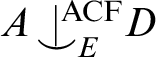 , so we have to show that
 $$ \begin{align*}G(\overline{AE} + D) = G(\overline{AE})+G(D).\end{align*} $$
From
 we have
 and
 . By elimination of imaginaries in
 $\mathrm {ACF}$
,
 . By Lemma 4.16, it follows that
 $\overline {AE}\cap \overline {AB} = \overline {A(E\cap B)}$
.
Claim.
 $(\overline {AE}+D)\cap (\overline {AB}+D) = \overline {A(E\cap B)}+D$
.
Proof of the claim
By modularity, we have that
 $(\overline {AE}+D)\cap (\overline {AB}+D) = D + \overline {{AE}}\cap (\overline {{AB}}+D)$
. By Lemma 4.15 we have that
 $$ \begin{align*}\overline{{AE}}\cap (\overline{{AB}}+D) = \overline{{AE}}\cap (\overline{{AB}}+(\overline{{AE}}+\overline{{AB}})\cap D).\end{align*} $$
Applying [Reference d’Elbée16, Lemma 5.16] with
 $T=\mathrm {ACF}$
, we have
 $(\overline {AE}+\overline {AB})\cap D = E+B$
, hence
 $$ \begin{align*} \overline{{AE}}\cap (\overline{{AB}}+D) &= \overline{{AE}}\cap(\overline{{AB}}+E+B) \\ &=\overline{{AE}}\cap (\overline{{AB}} + E)\\ &= \overline{{AE}}\cap \overline{{AB}} + E\ \text{by modularity }\\ &= \overline{{A(E\cap B)}}+E. \end{align*} $$
It follows that
 $(\overline {AE}+D)\cap (\overline {AB}+D) = \overline {{A(E\cap B)}} + D +E = \overline {{A(E\cap B)}}+D$
.⊣
By hypothesis,
 $G(\overline {AD}) = G(\overline {AB})+G(D)$
, so, by the claim
 $$ \begin{align*}G(\overline{AE} \kern1pt{+}\kern1pt D) \kern1pt{=}\kern1pt G(\overline{AE} \kern1pt{+}\kern1pt D)\kern1.5pt{\cap}\kern1.5pt (G(\overline{AB})\kern1pt{+}\kern1ptG(D)) \kern1pt{=}\kern1pt G(\overline{A(E\kern1pt{\cap}\kern1pt B)}\kern1pt{+}\kern1pt D)\kern1pt{\cap}\kern1pt G(\overline{AB}) \kern1pt{+}\kern1pt G(D).\end{align*} $$
Furthermore
 $G(\overline {A(E\cap B)}+D)\cap G(\overline {AB}) =G(\overline {A(E\cap B)} + D\cap \overline {AB}) = G(\overline {A(E\cap B)} +B)$
. As
 we have
 $G(\overline {A(E\cap B)} +B) = G(\overline {A(E\cap B)}) +G(B)$
. We conclude that
 $$ \begin{align*}G(\overline{AE} + D) = G(\overline{A(E\cap B)}) +G(B) + G(D) = G(\overline{A(E\cap B)})+ G(D).\\[-32pt]\end{align*} $$
⊣
Corollary 4.18. In
 $\mathrm {ACFG}$
,
 satisfies Extension. In particular, in
 .
Proof Assume that
 and d is given. By Full Existence of
 there exists
 $a'\equiv _{Cb} a$
such that
 . Also
 hence by Lemma 4.17
 , which shows Extension for
 . In particular
 satisfies hypothesis (3) of Proposition 4.14. We check that it satisfies the rest of the hypotheses of Proposition 4.14. (1) follows from Corollary 2.7. From Theorem 2.4,
 satisfies the properties Invariance, Monotonicity, and
 -amalgamation over algebraically closed sets (since
 , by Fact 4.10), so
 satisfies (2).⊣
4.3. Thorn-Forking in
${\rm ACFG}$

Let
 $(K,G)$
be a monster model of
 $\mathrm {ACFG}$
. Recall that

is the relation

in the sense of
 $(K,G)^{eq}$
. The thorn-forking independence relation

is the relation defined over subsets of
 $(K,G)^{eq}$
by

. We will only consider the restrictions of

and

to the home sort, which we denote respectively by

and

. By Corollary 3.6 and Theorem 3.15, for
 $a,b,C\subset K$

Fact 4.19 ([Reference Adler2] Theorem 4.3)
The following are equivalent.
-
• T is rosy
-
•
in
$T^{eq}$
satisfies Local Character.


Proposition 4.20. Let
 $(K,G)$
be a model of
 $\mathrm {ACFG}$
. Then
 . In particular
 $\mathrm {ACFG}$
is not rosy.
Proof Assume that

. In particular

so for all
 $C\subseteq D \subseteq \overline {Cb}$
we have
 $\overline {Da}\cap \overline {Cb} = \overline {D}$
hence by Example 4.3 we have

On the other hand, we have
 $\pi (\overline {Ca})\cap \pi (\overline {Cb}) = \pi (\overline {C})$
, hence by §3.1

It follows that

. By Fact 4.10,

, hence as

satisfies Base Monotonicity and Extension it follows that

. Hence by Corollary 4.18 we conclude that

. As
 $\mathrm {ACFG}$
is not simple,

does not satisfy Local Character, so

does not satisfy Local Character hence neither does

. By Fact 4.19,
 $\mathrm {ACFG}$
is not rosy.⊣
Remark 4.21. There is another way of proving that
 $\mathrm {ACFG}$
is not rosy which does not use the description of forking in
 $\mathrm {ACFG}$
but only the fact that
 . Indeed
 does not satisfy Local Character from Example 4.4 hence neither does
 and hence neither does
 .
Remark 4.22. It is worth mentioning that in the definition of
 , the relation
 cannot be replaced by
 . Indeed, in the structure
 $(K,G)$
, by Example 4.3
 and then as Extension clearly holds for
 , we have
 . This relation satisfies Local Character. This means that
 is not the restriction of
 to the home sort. This is what Adler mentions in [Reference Adler2, Example 4.5].
4.4. Forking and thorn-forking in other generic constructions
Forking and dividing. In the three following examples:
-
(1) Generic
$\mathscr {L}$
-structure
$T^{\emptyset }_{\mathscr {L}}$
[Reference Kaplan and Ramsey22, Proposition 3.18]; -
(2) Generic
$K_{n,m}$
-free bipartite graph [Reference Conant and Kruckman15, Corollary 4.12]; and -
(3) omega-free PAC fields [Reference Chatzidakis9, Theorem 3.3];


we also have that forking and dividing coincides for types, and coincides with the monotonisation of Kim-independence. In (1) and (2) the strategy is the following: first prove that
 and then show that
 satisfies Extension. The latter is obtained using Full Existence of the strong independence relation and a similar mixed transitivity result. This is discussed in [Reference Kruckman and Ramsey25, Subsection 3.3]. We followed a close strategy: using Lemma 4.12 (based on the approach of (3)), have that
 strengthens
 . Then we use a mixed transitivity result and Full Existence of strong independence to show that
 satisfies Extension. These results suggest that Proposition 4.14 can be used to show that in other examples of
 $\mathrm {NSOP}_{1}$
theories, forking and dividing agrees on types, for instance in Steiner triple system [Reference Barbina and Casanovas4], or bilinear form over an infinite dimensional vector space over an algebraically closed field [Reference Chernikov and Ramsey13, Reference Granger20].
Strong independence and Mixed Transitivity. There is also a notion of strong independence in the three previous examples which is symmetric and stationary over algebraically closed sets. Concerning (3) strong independence also satisfies the other axioms for mock stability [Reference Kim and Kim23, Example 0.1 (3)]. In (2), it also satisfies Full Existence, Monotonicity, and Transitivity [Reference Conant and Kruckman15, Proposition 4.20]. In (1), it is defined in [Reference Kruckman and Ramsey25, Remark 3.19] to state a mixed transitivity result, but nothing about it is proven. It is likely that (1) and (2), are also mock stable, witnessed by the strong independence relation. Informally, the strong independence relation is in general defined to hold between two sets when they are the most unrelated to each other with respect to the ambient theory. Another way of seeing this relation is by saying that the two sets can be somehow “freely amalgamated.” The definition given in [Reference Kaplan and Ramsey22, Remark 3.19] makes this precise, for
 $C\subseteq A\cap B$
, we have
 if and only if the substructure spanned by
 $ABC$
is isomorphic to the fibered coproduct of the structures spanned by A and B over the substructure spanned by C. This definition coincides with our definition of strong independence in
 $\mathrm {ACFG}$
.
Question 1. Is there a model-theoretic definition of the strong independence relation that encompasses the strong independence relations in the three examples above and in
 $\mathrm {ACFG}$
?
The mixed transitivity result (Lemma 4.17) is starting to be reccurent in
 $\mathrm {NSOP}_{1}$
examples. It holds in example (1) ([Reference Kruckman and Ramsey25, Remark 3.19]) and in (2) ([Reference Conant and Kruckman15, Lemma 4.23]). Note that a similar mixed transitivity appears in a
 $SOP_3$
(hence
 $SOP_1$
) example: the generic
 $K_n$
-free graph ([Reference Conant14]), this was observed in [Reference Kruckman and Ramsey25, Remark 3.19].
The mixed transitivity result holds as well in omega-free PAC fields. Let
 be the weak independence and
 the strong independence in the sens of [Reference Chatzidakis9, (1.2)]. Then for all
 $A,B,C,D \mathrm {acl}$
-closed in an omega free PAC field, with
 $C\subseteq A\cap B$
and
 $B\subseteq D$
we have:
If
 and
 then
 .
This is contained in the proofFootnote 4 of [Reference Chatzidakis9, (3.1) Proposition].
Thorn-forking. The three other examples are also not rosy. For (1), it is [Reference Kaplan and Ramsey22, Subsection 3.3], for (2), it is [Reference Conant and Kruckman15, Proposition 4.28] and for (3), it is [Reference Chatzidakis10, Subsection 3.5]. Also, for both (1) and (2) we have
 , and they both weakly eliminate imaginaries.
The following questions have been asked for the last two or three years by specialists in regards to the observations above.
-
$(Q_1)$
Does forking equal dividing for types in every
$\mathrm {NSOP}_{1}$
theory?
-
$(Q_2)$
Does the mixed transitivity result hold in every
$\mathrm {NSOP}_{1}$
theory? (Provided an answer to Question 1.)
-
$(Q_3)$
Is there an
$\mathrm {NSOP}_{1}$
not simple rosy theory?


Remark 4.23. In omega-free PAC fields [Reference Chatzidakis9], strong independence

and weak independence

are linked by the following relation for
 $A,B,C \mathrm {acl}$
-closed,
 ${A\cap B = C}$
:

In
 $\mathrm {ACFG}$
this is not the case. Let
 $(K,G)$
be a model of
 $\mathrm {ACFG}$
and for convenience assume that
 $G(\overline {\mathbb {F}_p}) = \{ {0} \}$
. Let t and
 $t'$
be algebraically independent over
 $\mathbb {F}_p$
, let
 $u = t\cdot t'$
. Assume that
 $G(\overline {\mathbb {F}_p(t,t')}) = \langle {u} \rangle $
. Then by [Reference d’Elbée16, Lemma 5.19.],
 $u\notin \overline {\mathbb {F}_p(t)}+\overline {\mathbb {F}_p(t')}$
, so
 $G(\overline {\mathbb {F}_p(t)})+G(\overline {\mathbb {F}_p(t')})=\{ {0} \}$
so

. We show that for all
 $D\subseteq \overline {\mathbb {F}_p(t)}$
and
 $D'\subseteq \overline {\mathbb {F}_p(t')}$
we have

. Let D and
 $D'$
be as such. There are three cases to consider (the middle case is symmetric):
 $$ \begin{align*} &t\cdot t' \in \overline{D't} \text{ and } t\cdot t' \in \overline{Dt'}, \kern-5pt\!\quad\! &G(\overline{D't}) = \langle {u} \rangle,\!\quad\! &G(\overline{Dt'}) = \langle {u} \rangle, \kern-7pt\!\quad\! &G(\overline{D't}+\overline{Dt'}) = \langle {u} \rangle,\\ &t\cdot t' \in \overline{D't} \text{ and } t\cdot t' \notin \overline{Dt'}, \kern-5pt\!\quad\! &G(\overline{D't}) = \langle {u} \rangle,\!\quad\! &G(\overline{Dt'}) = \{ {0} \}, \kern-7pt\!\quad\! &G(\overline{D't}+\overline{Dt'}) = \langle {u} \rangle,\\ &t\cdot t' \notin \overline{D't} \text{ and } t\cdot t' \notin \overline{Dt'}, \kern-5pt\!\quad \!&G(\overline{D't}) = \{ {0} \},\!\quad\! &G(\overline{Dt'}) = \{ {0} \}, \kern-7pt\!\quad\! &G(\overline{D't}+\overline{Dt'}) = \{ {0} \}. \end{align*} $$
In every cases we have
 $G(\overline {D't}+\overline {Dt'}) = G(\overline {D't}) + G(\overline {Dt'})$
. As

is clear we have

.
Summary on independence relations in
 $\mathrm {ACFG}$
. Every arrow in Figure 2 is strict. From that point of view,
 $\mathrm {ACFG}$
is different from (1), (2) and (3).
Interactions of independence relations in
 $\mathrm {ACFG}$
.

Denote by
 the relation for all
 $C\subseteq D\subseteq \overline {AC}$
and
 . Remark 4.23 states that
 is strictly stronger than
 , in (3), this is not the case. In (1), we have that
 is strictly weaker than
 . In (2),
 is strictly weaker than
 and
 .
Acknowledgements
This work is part of the author’s Ph.D. dissertation. The author would like to thank Thomas Blossier and Zoé Chatzidakis for their valuable advising. The author is very grateful to Alex Kruckman and Nicholas Ramsey for numerous exchanges on
 $\mathrm {NSOP}_{1}$
theory and examples. The author would like to give a special thanks to Gabriel Conant for many useful discussions. Part of the results in §4.1 was also observed by Gabriel Conant in an unpublished note which inspired the form of this subsection. Finally, the author is very grateful to the anonymous referee for their tremendous work.