INTRODUCTION
Marine mammal capture, both incidental and intentional, is a matter of concern worldwide. Marine mammal mortality due to fishing operations is identified as one of the major threats to the viability of local and regional populations throughout the range of a species (Northridge & Pilleri, Reference Northridge and Pilleri1986). At the same time, the marine mammal–fishery interactions cause a loss in revenue to small and large scale fishermen by way of mechanical damage to gear and to a certain extent loss of captured fish. Among several gears, gill-nets and purse seines have been identified as the main cause for marine mammal mortality at the global scale (Cockcroft & Krohn, Reference Cockcroft, Krohn and Perrin1994; Perrin et al., Reference Perrin, Donovan and Barlow1994; Archer et al., Reference Archer, Gerrodette, Dizon, Abella and Southern2001; Wise et al., Reference Wise, Silva, Ferreira, Silva and Sequeira2001; Read et al., Reference Read, Drinker and Northridge2006).
India with its vast coastline and associated fishery industry, both artisanal and mechanized, is a source of huge marine incidental catch ranging from threatened species of molluscs and fish to endangered turtles, sea snakes and marine mammals. The literature on incidental catch of cetaceans reported in India is vast (Lal Mohan, Reference Lal Mohan and Silas1985; Mahadevan et al., Reference Mahadevan Pillai and Chandrangathan1990; Kasim et al., Reference Kasim, Ameer Hamsa and Balasubramanian1993; Satya Rao & Chandrasekar, Reference Satya Rao and Chandrasekar1994; Thiagarajan et al., Reference Thiagarajan and Krishnapillai2000). According to Lal Mohan (Reference Lal Mohan1994), the annual cetacean mortality caused by the Indian gill-net fishery is 1000–1500. Entanglement of cetaceans in other fishing gears such as trawls, purse seines, shore seines and long-lines has also been reported. While the Indian Wildlife Protection Act of 1972 puts all marine mammals in Schedule I of the Act, very little has been done in ways to mitigate mortality. It is imperative to initiate a systematic by-catch assessment programme by the monitoring of fish landing sites. At the same time, it is important to identify the reasons that lead to by-catch so as to find ways to reduce or mitigate marine mammal mortality.
Here we sampled three selected fish landing centres along the south-east coast and one centre on the west coast of India. We used short-term surveys to quantify the number of marine mammals incidentally caught and interviews to gain perceptions of local fishers towards issues of by-catch, by-catch utility and conservation of marine species.
MATERIALS AND METHODS
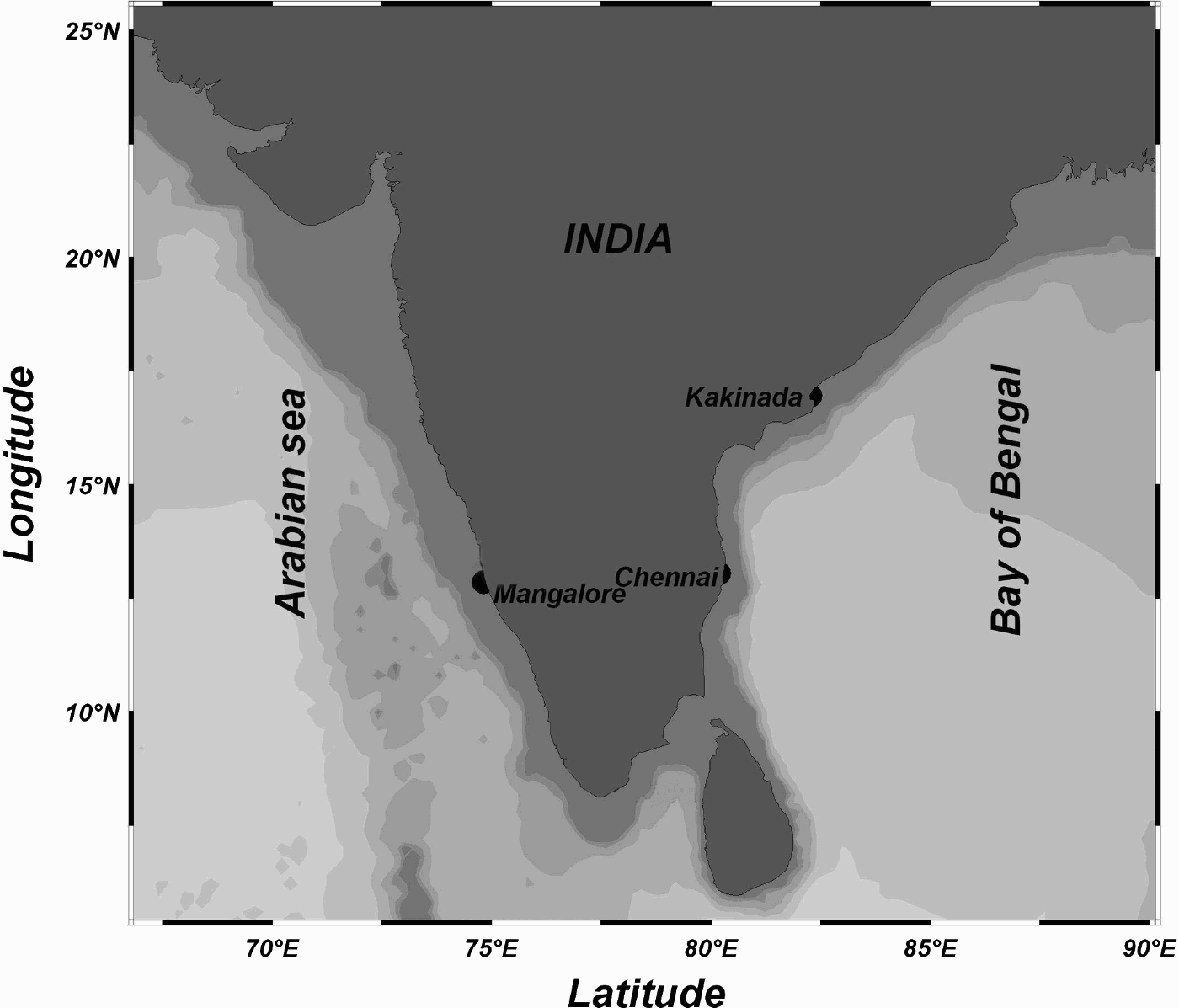
Direct observations were made in three major fishing harbours: Chennai Fisheries harbour (13°05′N 79°46′E) for 20 days during September–October 2004; Kakinada Fisheries harbour (16°51′N 80°10′E) in March, May and September 2004 for 15 days in each month; and Mangalore Fisheries harbour (12°51′N 74°49′E) for 15 days during November–December 2005 (Figure 1). The observations were made between 0600 and 0900 hours. Basic data for each animal (species, sex and morphometric measurements wherever possible) along with the type of craft and gear that landed the catch were recorded.
Map of India showing the centres where the cetaceans were landed.

Interviews with fishermen were conducted to collect information regarding knowledge and perceptions that fishermen hold regarding marine mammals. For this purpose, a questionnaire designed to extract information known to fishermen on cetaceans and their interactions with fisheries was used (Appendix 1). A total of 60 fishermen were asked questions pertaining to their fishing effort and marine mammal sightings, strandings, hunting, incidental catches, and their beliefs and myths toward the animals.
RESULTS
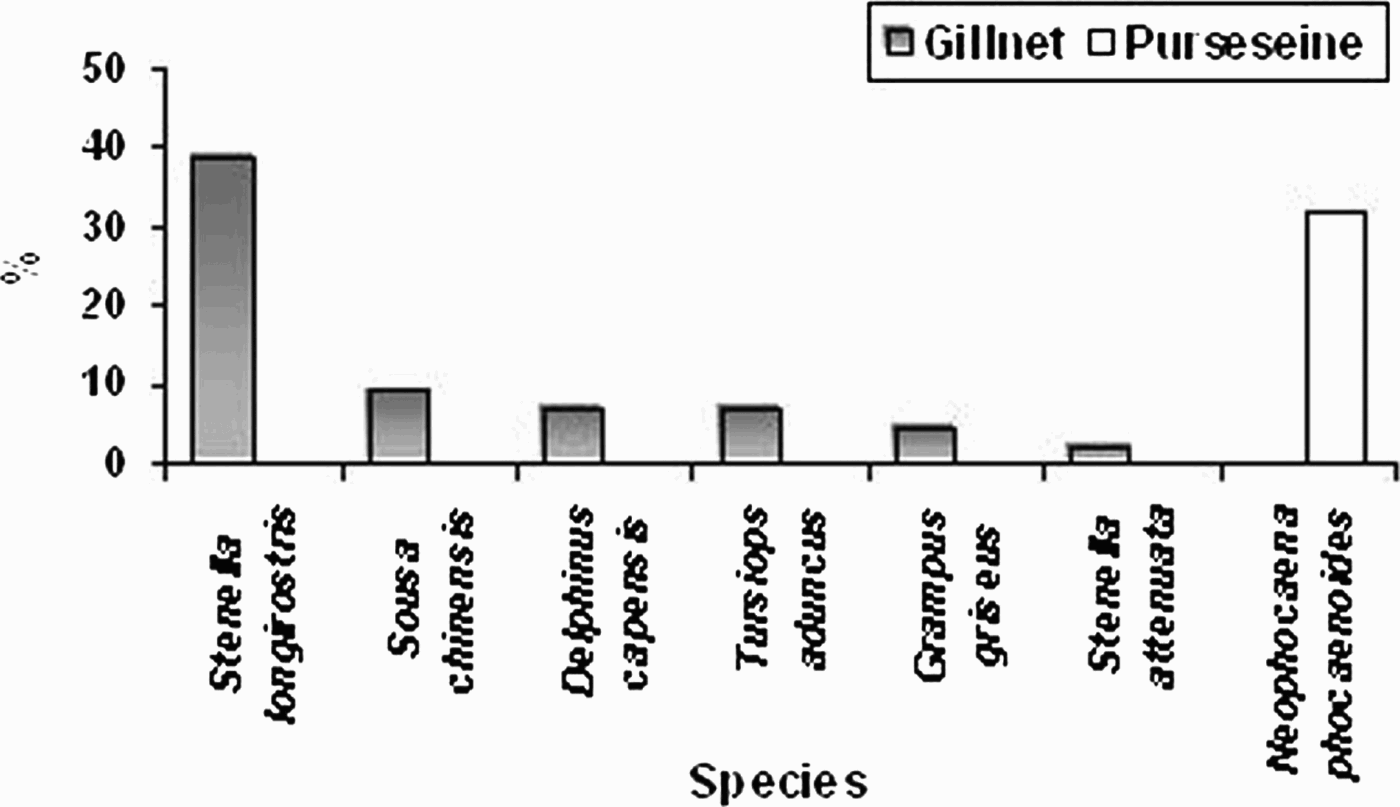
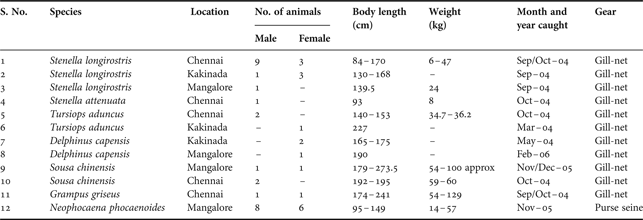
A total of 44 cetaceans was recorded as incidental catch from the three centres during the survey period (Table 1). Seven species of cetaceans were recorded: spinner dolphin (Stenella longirostris), finless porpoise (Neophocaena phocaenoides), Indo-Pacific bottlenose dolphin (Tursiops aduncus), pantropical spotted dolphin (Stenella attenuata), Risso's dolphin (Grampus griseus), Indo-Pacific humpback dolphin (Sousa chinensis) and long-beaked common dolphin (Delphinus capensis). The spinner dolphin was the species most commonly caught (38.6%) followed by the finless porpoise (31.8%) (Figure 2). The catch landed at Chennai consisted of five species: Stenella longirostris, T. aduncus, Sousa chinensis, Stenella attenuata and G. griseus. At Mangalore, the catch comprised mostly N. phocaenoides, with some Delphinus capensis, S. longirostris and Sousa chinensis. Three species (Stenella longirostris, D. capensis and T. aduncus) were recorded at Kakinada. In descending order of frequency of by-catch, the order was as follows: S. longirostris, N. phocaenoides, T. aduncus, Sousa chinensis, D. capensis, G. griseus and Stenella attenuata.
Ratios of species by-caught in fishing gear and landed at the three centres surveyed.

Details of cetaceans caught by fishing during the study period.

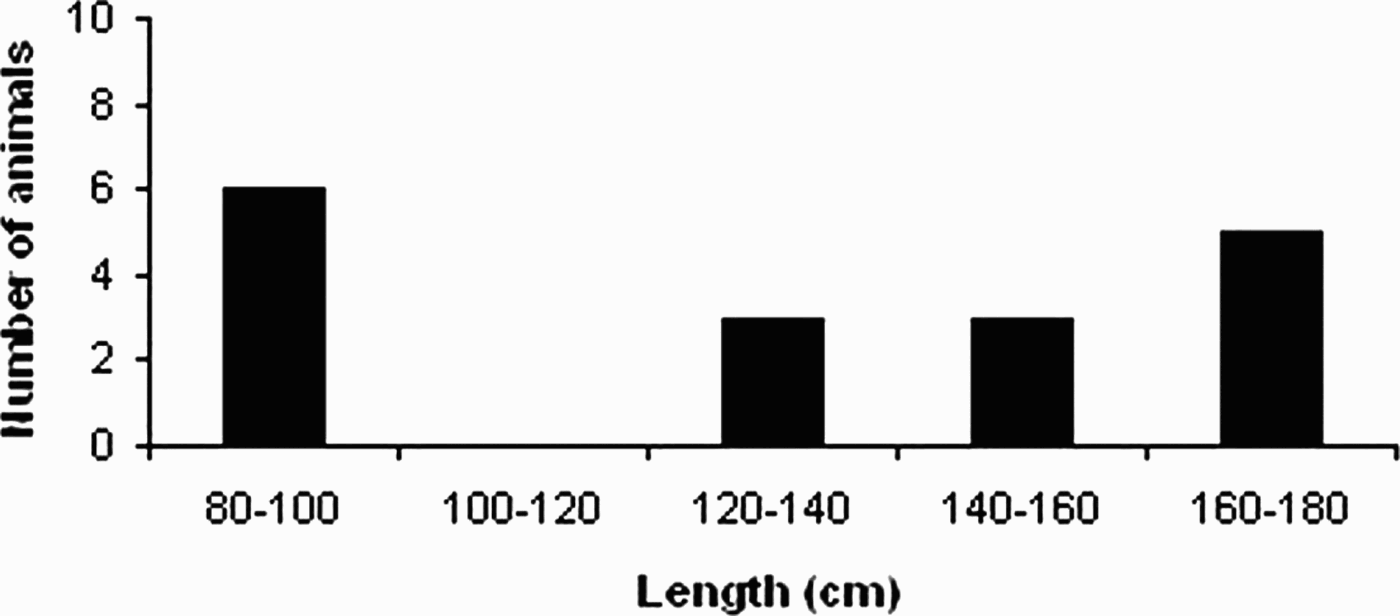
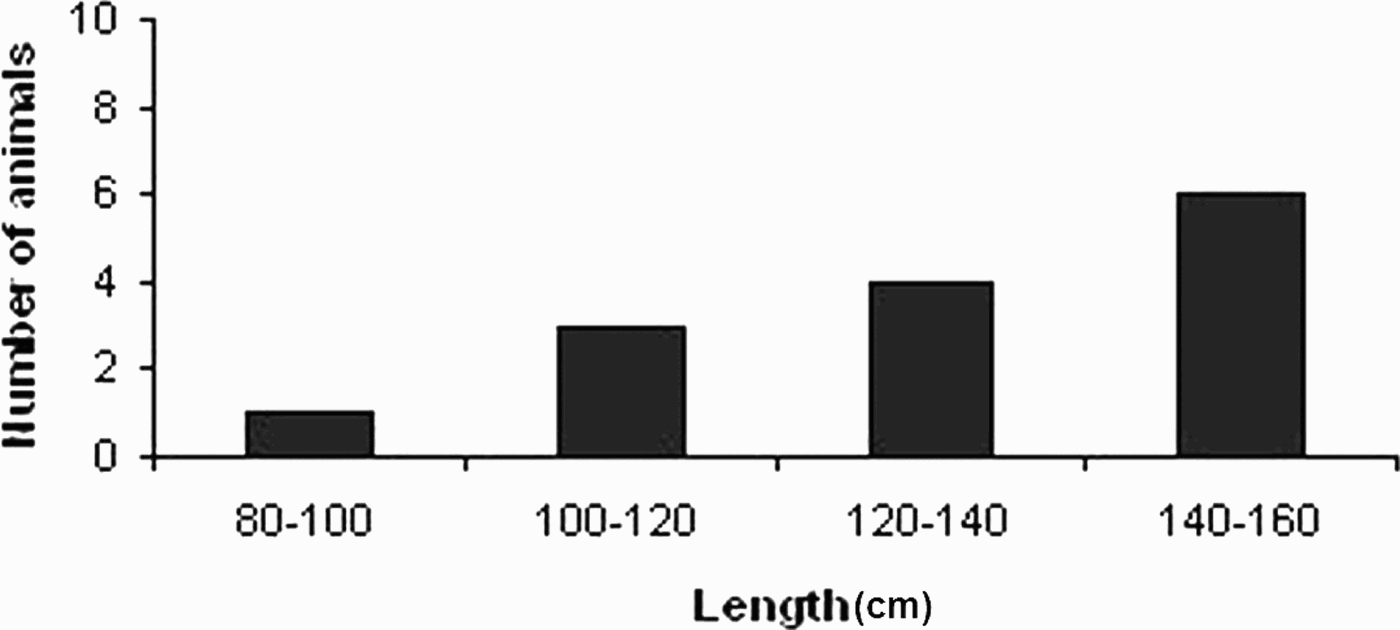
The length of S. longirostris ranged from 84 to 170 cm and that of N. phocaenoides from 95 to 149 cm. The modal length groups for S. longirostris were 80–100 cm and 160–180 cm (Figure 3) and for N. phocaenoides 140–160 cm (Figure 4). Juveniles measuring < 100 cm were also caught.
Length–frequency of Stenella longirostris caught by gill-net (N = 17).

Length–frequency of Neophocaena phocaenoides caught by purse seine (N = 14).

Fisheries and fishing gear
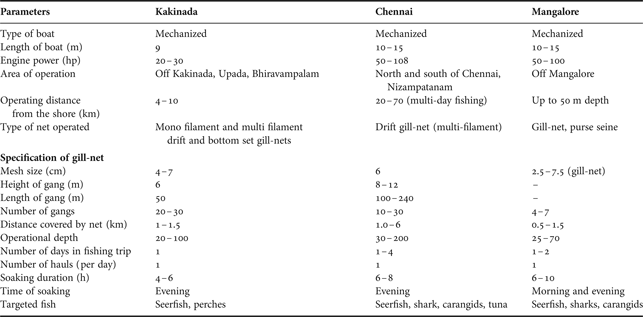
Of the 44 incidentally caught cetaceans, 30 were taken in gill-nets and 14 by purse seines, both operated from motorized boats. The purse seine operation targeted the oil sardine (Sardinella longiceps) and was operated at 5–8 m depth at midnight very close to the shore. The mesh size ranged from 1 to 3 cm; the height from 2 to 3 m and length from 180 to 270 m. Purse seines operated off Mangalore commonly caught N. phocaenoides. Interviews with fishermen also confirmed higher cetacean entanglement in gill-nets at all the landing centres. The gill-netters that took cetaceans as by-catch fished 4 to 70 km out from the shore with mesh size ranging from 4.0 to 7.5 cm. The total length of gill-net ranged from 0.5 to 6 km. The total number of gangs varied from 4 to 30, with length of each gang from 50 to 240 m and height from 6 to 12 m. These boats fished between evening and early hours in the morning with the maximum number of dolphin entanglements encountered in the pelagic fishery for yellowfin tuna (Thunnus albacares), sharks, and seerfish (Scomberomorus commerson and Scomberomorus guttatus).
The two species commonly involved in the gill-net fishery were Stenella longirostris and Tursiops aduncus. The overall size of motorized boats that incidentally caught dolphins and porpoises in the surveyed centres were 9–15 m (20 to 108 hp engine) (Table 2).
Specification of craft and gear operations in which cetaceans were incidentally caught.

Responses by fishermen
Of the 60 fishermen interviewed, 95% were aware that marine mammals were protected under law enforced by the State Forest Department. Some fishermen interviewed in Kakinada and Chennai informed us that the meat of incidentally caught dolphins was used as bait in the shark fishery, while others said they discarded the incidentally caught cetaceans while at sea. In the case of animals that were found stranded or washed ashore, they reported the same to the local Forest Department officials. The fishermen at all three centres informed us that there was no deliberate catch of cetaceans. However, targeted fishing by purse seines for porpoises was reported off Mangalore. A few fishermen in Kakinada mentioned that consumption of dolphin meat is considered a good remedy for knee and back pain. About 85% of the respondents complained that while they carry out fishing, dolphins eat the fish caught in the net, causing damage to the gear.
DISCUSSION
Though the surveys of incidental catch were limited to a few landing centres for a short duration, they indicate the great vulnerability of cetaceans to fishing gear. In 80 days' observations in three centres, 44 incidentally caught cetaceans were recorded, i.e. one animal was recorded for about every two days. This is probably an underestimate, since the observations were restricted to only three hours in a day. Among the three centres, the highest cetacean by-catch was recorded at Mangalore (1.2 cetaceans per day of observation) followed by Chennai (1.0 per day) and Kakinada (0.2 per day). However, earlier incidental cetacean catch records (Nageswara Rao & Venkataramana, Reference Nageswara Rao and Venkataramana1994; Venkataramana & Achaya, 1997; Thathaya & Achaya, Reference Thathaya and Achayya1998) show that the gill-net fishery operated in and around Kakinada causes considerable mortality.
Stenella longirostris was the most frequently caught species off Chennai in the gill-net fishery. This species has earlier been reported as by-catch in the gill-net fishery off Calicut (Lal Mohan, Reference Lal Mohan and Silas1985). In the sighting cruises carried out on board FORV SAGAR SAMPADA, the spinner dolphin was recorded as the most abundant species in the Indian EEZ (CMFRI, 2007). In the three surveyed centres, trawls were the most dominant gear with approximately 2500 active trawlers, compared to 400 motorized gill-netters and 50 purse-seiners. Purse-seiners operate only from Mangalore. However, gill-netters accounted for 68.9% of the catch and purse-seiners for the remaining. No cetacean catch was recorded in trawlers in the present study. Entanglement of Tursiops aduncus in trawl nets has been earlier reported off Mandapam and Visakhapatnam (Pillai & Kasinathan, Reference Pillai and Kasinathan1987; Chandrasekar et al., Reference Chandrasekar, Chittibabu, Achaya, Prabhakar and Viyayakumaran1993). Nevertheless, trawlers cause less mortality of marine mammals compared to gill-netters and purse-seiners. This could be explained by the disturbance caused by the trawling action at the bottom and at midwater warning cetaceans before they can get caught. In Mangalore, a large number of Neophocaena phocaenoides were incidentally caught by purse seines. Purse-seining is known to be the main cause of dolphin mortality worldwide (Archer et al., Reference Archer, Gerrodette, Dizon, Abella and Southern2001; Wise et al., 2007) but in India, the purse seine is not a predominant gear and is operated only along the coasts of Karnataka and Goa. By analysing the stomach contents of incidentally caught cetaceans, Anoop et al. (2007) concluded that finless porpoise are caught by purse seines when they move very close to the shore off Mangalore for feeding on oil sardine.
Maigret (Reference Maigret1994) states that a dolphin's slower movement near the surface, being less alert and poor net detection capacity could be the reasons for high entanglement in gill-nets. Waring et al. (Reference Waring, Gerior, Payne, Parry and Nicolas1990) suggest that catch at night is due to nocturnal behaviour of prey that the cetaceans feed upon. In the present study, all the gill-net by-catch was from nets operated at night, which could be one of the reasons for low detection rates. Thus the higher vulnerability of cetaceans to gill-net may be due to the large area covered by the net in the water column, and poor detection of the net by cetaceans.
The conflict between gill-net fisheries and incidental capture of cetaceans is one between the conservation of endangered animals and the economic factors and livelihood of fishermen. The drift gill-nets are popular among the fishermen, as they are effective in catching the target fish, namely seerfish, tuna and sharks. According to a marine fisheries census, 14,183 motorized gill-netters are operating along the Indian coast (CMFRI, 2006). In recent years, the length of the gill-net has been increased and the fishing grounds have been extending to oceanic waters. The total number of dolphins killed by fishing operations in the Indian seas must be quite substantial considering the extent of the operation of these nets. Considering that 44 cetacean kills were recorded in 80 days by ~400 gill-netters, we could be looking at alarmingly high numbers of around 9000–10,000 cetaceans killed every year by 14,183 motorized gill-netters in about 240 days of operation in Indian waters. This could still be an underestimate, as our observations were restricted to only three hours per day. This estimate is considerably higher than the estimates (1000–1500) by Lal Mohan (Reference Lal Mohan1994). Increases in the number and efficiency of gill-netters have perhaps increased mortality in the last 15 years. To arrive at a better estimate of marine mammal mortality along the Indian coast, it is important to undertake surveys covering more fish landing centres for a longer duration.
In addition to humanitarian and ecological concern for dolphins, the killing of dolphins is detrimental to the fishermen. Dolphins are valuable to the fishermen because the presence of dolphins indicates the presence of fish schools. Thus reducing dolphin kill as much as possible is in the interest of the fishermen themselves. If the fishermen are convinced of this, skilful fishermen will be able to effectively reduce the incidental capture and mortality of dolphins (NRC, 1992).
Trying to find approaches to better manage gill-netting so that by-catch can be reduced is a difficult task. Fishing and fishing type are cultural aspects of identity. It is also difficult to find alternative cost-effective fishing methods as efficient as gill-netting. Perhaps reducing the set time of the net may help in recovery and release of dolphins, but the fishermen find the job of setting nets labour intensive and thus prefer longer set times. However, as an incentive-based programme, this method of mitigation could be approached. Avoiding areas and seasons of abundance of dolphins could be another method to effectively reduce mortality. However, without detailed information on distribution, abundance, core areas and habitat use for the different species, it is not yet possible to identify regions that could be assigned spatial or temporal protection.
Use of passive sonar and other acoustic instruments to recognize the presence of dolphins could also reduce the incidental kill (NRC, 1992) by informing fishers of their presence. Attaching pingers to the gill-nets to scare away the dolphins may be attempted, but is a very expensive option. Acoustic pingers are found to be effective for some species of (harbour) porpoise (Werner et al., Reference Werner, Kraus, Read and Zollett2006) and in the drift gill-net fishery, as per an experiment off California (Barlow & Cameron, Reference Barlow and Cameron2003), while excluder devices attached to trawl nets are found to be effective for reducing by-catch of dolphins and turtles (ICAR, 2005). Research needs to be conducted urgently to investigate possible by-catch reduction methods in India, bearing in mind that the methods used may have to be specially tailored for the region. Without such research, and swift implementation of effective by-catch reduction methods, many local populations of marine mammal species could well face extirpation in India.
ACKNOWLEDGEMENTS
We are grateful to the Director of CMFRI, Cochin for encouragement and for facilities. The authors thank Dr William Perrin and Ms Dipani Sutaria for their critical review of the paper. We are grateful to anonymous referees for their valuable suggestions. It is a pleasure to express our gratitude to all the fishermen who provided information on cetaceans and their incidental catches. The funding by the Central Marine Living Resources & Ecology, Ministry of Earth Sciences, Government of India, is gratefully acknowledged.
APPENDIX-1
Questionnaire