Introduction
Stroke, also known as cerebrovascular accident, is a major cause of mortality and morbidity globally (Connor, Walker, Modi, & Warlow, Reference Connor, Walker, Modi and Warlow2007). Within the space of two decades, absolute number of incidences of stroke, stroke-related deaths and morbidity increased by 68%, 26% and 12%, respectively with even higher rates in low-income and middle-income countries (68.6%, 70.9% and 77.7%) (Feigin et al., Reference Feigin, Forouzanfar, Krishnamurthi, Mensah, Connor, Bennet and Murray2014). The increase in the economic burden of stroke globally, and especially in developing countries is also significant (Mukherjee & Patil, Reference Mukherjee and Patil2011). In Nigeria, data on stroke epidemiology are largely from hospital-based studies (Adeloye, Reference Adeloye2014) which have limited external validity while the few population-based studies report incidence rates such as 1.14 per 1000 (Danesi, Okubadejo, & Ojini, Reference Danesi, Okubadejo and Ojini2007) and 1.31 per 1000 (Sanya et al., Reference Sanya, Desalu, Adepoju, Aderibigbe, Shittu and Olaosebikan2015) which appear to underestimate the real situation (Adeloye, Reference Adeloye2014). Similarly, data on cost of stroke care is scarce and the only available study reported a minimum of 600 US dollars for 9 months of stroke care which is unaffordable for majority of Nigerians (Birabi, Oke, Dienye, & Okafor, Reference Birabi, Oke, Dienye and Okafor2012) especially as 33.1% of the country's population live below the poverty line of 1.25 dollars a day (World Bank, 2014).
Stroke-related deaths and disability in Nigeria as in other developing African countries also present a gloomy picture with reported mortality rates as high as 45% (Komolafe, Ogunlade, & Komolafe, Reference Komolafe, Ogunlade and Komolafe2007). The morbidity and mortality from stroke may result directly from the cerebrovascular insult or may derive from the consequences of the disease. A major complication of stroke that has been associated with profound negative outcomes is falls (Hyndman, Ashburn, & Stack, Reference Hyndman, Ashburn and Stack2002).
Serious injuries such as fractures occur in a significant proportion of fallers post stroke and majority of fractures affect the hip (Ramnemark, Nyberg, Borssén, Olsson & Gustafson, Reference Ramnemark, Nyberg, Borssén, Olsson and Gustafson1998). Hip fractures constitute 30% (Dennis, Lo, McDowall, & West, Reference Dennis, Lo, McDowall and West2002) to 45% (Ramnemark et al., Reference Ramnemark, Nyberg, Borssén, Olsson and Gustafson1998) of all post stroke fractures with adverse effects such as increased morbidity and mortality (Cummings & Melton, Reference Cummings and Melton2002; Ramnemark et al., Reference Ramnemark, Nilsson, Borssén and Gustafson2000; Sibolt et al., Reference Sibolt, Curtze, Melkas, Pohjasvaara, Kaste, Karhunen and Erkinjuntti2014), reduced participation in rehabilitation training and attendant increase in the length of hospitalisation (Feng, Zhang, Shen, Hu, & Cao, Reference Feng, Zhang, Shen, Hu and Cao2009). Apart from the physical sequelae of post stroke falls, psychological consequences of falls such as fear of falling may occur in up to 66% stroke survivors (Schmid et al., Reference Schmid, Arnold, Jones, Ritter, Sapp and Van Puymbroeck2015), and result in self-induced restriction in activities of daily living (Schmid et al., Reference Schmid, Van Puymbroeck, Knies, Spangler-Morris, Watts, Damush and Williams2011; van Haastregt, Zijlstra, van Rossum van Eijk, & Kempen, Reference van Haastregt, Zijlstra, van Rossum, van Eijk and Kempen2008). All of these outcomes of post stroke falls could ultimately result in increased cost of care (Nyberg & Gustafson, Reference Nyberg and Gustafson1995; Schmid et al., Reference Schmid, Van Puymbroeck, Knies, Spangler-Morris, Watts, Damush and Williams2011; Sibolt et al., Reference Sibolt, Curtze, Melkas, Pohjasvaara, Kaste, Karhunen and Erkinjuntti2014).
Going by the negative and debilitating consequences of post stroke falls, it is important to identify and implement effective falls prevention strategies in stroke survivors. Achieving such a critical goal may however require vital information such as prevalence of falls and falls risk factors after stroke. Available data show a wide variation in prevalence of falls after stroke across studies (Ashburn, Hyndman, Picking, Yardley, & Harris, Reference Ashburn, Hyndman, Picking, Yardley and Harris2008), with prevalence rates ranging from as low as 23% in Norway (Jørgensen, Engstad, & Jacobsen, Reference Jørgensen, Engstad and Jacobsen2002) to as high as 75% in the United Kingdom (Forster & Young, Reference Forster and Young1995). Similarly, factors that have been reported to be associated with, or that predict post stroke falls appear to vary across the available studies from different countries of the world (Jørgensen et al., Reference Jørgensen, Engstad and Jacobsen2002) and these variations underscore the need for country-specific data. For instance, previous falls and depression were identified as risk factors for post stroke falls in a study conducted in New Zealand (Kerse et al., Reference Kerse, Parag, Feigin, Mc Naughton, Hackett and Bennett2008) while balance emerged as a significant risk factor in post stroke studies in Australia and United States (Mackintosh, Hill, Dodd, Goldie, & Culham, Reference Mackintosh, Hill, Dodd, Goldie and Culham2005; Tilson et al., Reference Tilson, Wu, Cen, Feng, Rose, Behrman and Duncan2012). Demographic variables such as age, in studies conducted in New Zealand and United States (Kerse et al., Reference Kerse, Parag, Feigin, Mc Naughton, Hackett and Bennett2008; Tilson et al., Reference Tilson, Wu, Cen, Feng, Rose, Behrman and Duncan2012), and gender, in post stroke studies conducted in Germany and Austria (Homann et al., Reference Homann, Plaschg, Grunder, Haubenhofer, Griedl, Ivanic and Homann2013; Stolze et al., Reference Stolze, Klebe, Zechlin, Baecker, Friege and Deuschl2004), have also been identified as risk factors for falls among stroke survivors. Additionally, level of functional independence was reported as a significant post stroke falls risk factor in studies conducted in Australia and New Zealand (Kerse et al., Reference Kerse, Parag, Feigin, Mc Naughton, Hackett and Bennett2008; Mackintosh et al., Reference Mackintosh, Hill, Dodd, Goldie and Culham2005). It is however worthy of mention that in addition to the variations in the available post stroke falls data, only studies from developed/Western countries appear to have significantly contributed to existing post stroke falls data (Ashburn et al., Reference Ashburn, Hyndman, Picking, Yardley and Harris2008; Forster & Young, Reference Forster and Young1995; Jørgensen et al., Reference Jørgensen, Engstad and Jacobsen2002; Kerse et al., Reference Kerse, Parag, Feigin, Mc Naughton, Hackett and Bennett2008; Mackintosh et al., Reference Mackintosh, Hill, Dodd, Goldie and Culham2005; Tilson et al., Reference Tilson, Wu, Cen, Feng, Rose, Behrman and Duncan2012), with a dearth of information from developing countries.
There is an increasing incidence of stroke in developing African countries, which is expected to further increase in the future as populations undergo what is referred to as the ‘health transition’ (which implies a decrease in previously endemic infectious diseases and an increased prevalence of chronic non-communicable diseases due to increasingly westernised lifestyles). This, coupled with the high susceptibility of people of African descent to stroke (Connor et al., Reference Connor, Walker, Modi and Warlow2007), indicates a need for information on falls prevalence and associated factors from the continent. This need becomes even more pronounced as effective post stroke falls prevention, achievable through insight into the frequency of the problem and identification of stroke survivors at heightened risk, is much more desirable and cost effective in our low-resource settings. Post stroke falls risk (Ashburn et al., Reference Ashburn, Hyndman, Picking, Yardley and Harris2008) and its prevalence (Jørgensen et al., Reference Jørgensen, Engstad and Jacobsen2002) has been reported to be higher among community-residing stroke survivors. Therefore, this study sought to document the proportion of community-dwelling stroke survivors with at least 3 months post stroke history who had experienced a fall.
Materials and Methods
Study Design
A cross-sectional survey.
Participants
One hundred stroke survivors attending physiotherapy outpatient facilities who consented to participate in the study were recruited. Eligibility criteria were surviving a stroke for three or more months prior to the study, living in the community and ability to communicate in English and/or Hausa language. Information on the cognitive status of the stroke survivors was also obtained from respective participant's hospital case notes as this would affect their ability to respond to the survey questions.
Study Setting
Physiotherapy clinics of three government hospitals in North-eastern Nigeria. Nigeria has six geopolitical regions with the North-eastern region comprising six states. With the shortage or, in some instances, non-availability of other rehabilitation professionals in the country, physiotherapy remains the main stroke rehabilitative care. Furthermore, with the marginal health insurance coverage in Nigeria, payment for health care, including stroke rehabilitation, is mostly out-of-pocket (Olaleye & Suddick, Reference Olaleye and Suddick2012) with the implication that stroke survivors often can access care for as long as they have funds and deficits for which they seek care. Additionally, the delayed discharge practice in many physiotherapy facilities in the country contributes to long-term rehabilitation use even several years after a stroke event. Physiotherapy outpatient facilities therefore serve as a consistent pool from which participants for stroke studies in Nigeria are recruited.
Procedure
The protocol for the study was approved by the Research and Ethical Committee of one of the participating hospitals. Stroke survivors who expressed their willingness to participate in the study by provision of informed consent were consecutively recruited into the study. Socio-demographic data namely age, educational and marital status were obtained from the stroke survivors. Information regarding the date of stroke onset (post stroke duration) was also obtained from the stroke survivors while the other clinical data, namely stroke laterality, was obtained from the hospital case notes of each participants.
The stroke survivors were requested to provide information on occurrence of at least one fall within 3 months prior to the study using a ‘yes’ or ‘no’ response format. A fall was defined as an event which results in a person coming to rest inadvertently on the ground or floor or other lower level (World Health Organization, 2007) while the term ‘fallers’ was operationalised to mean stroke survivors who had experienced at least one fall within 3 months prior to study.
Functional status was assessed with the Modified Rankin Scale (mRS). The mRS is a validated global disability scale (Wolfe, Taub, Woodrow, & Burney, Reference Wolfe, Taub, Woodrow and Burney1991) that assesses disability on a six-point ordinal scale ranging from 0 (no disability) to 5 (severe disability). For ease of categorisation and for the purpose of inferential analyses due to the small size of the sample in the ‘0’ to ‘2’ disability categories, scores of 0 to 2 on the mRS were classified as ‘no disability’ while a score of 3 to 5 was classified as ‘disability’ similar to the format utilised in a study by Hankey et al. (Reference Hankey, Spiesser, Hakimi, Bego, Carita and Gabriel2007). Data collection was carried out by the second author (AUG) from January to March 2011.
Data Analyses
All the data obtained were summarised using descriptive statistics of frequency and percentage, or range, mean and standard deviation. The proportion of the participants who fell, distribution of gender, employment, educational and marital status, stroke laterality and functional ability were presented as frequencies and percentages while age and post stroke duration were presented as range, mean and standard deviation.
Pearson's Chi square statistics was used to examine the socio-demographic and clinical characteristics of participants that fell. Level of statistical significance was set at .05.
Results
Participants
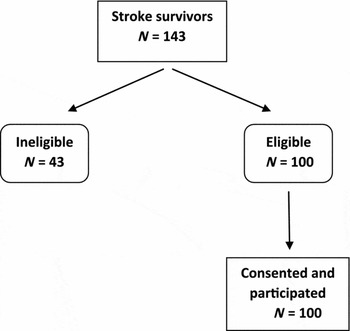
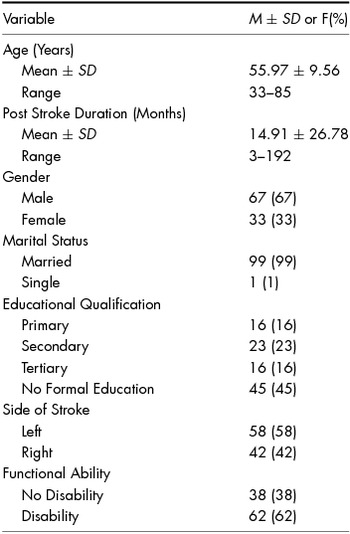
All the 100 eligible stroke survivors participated in this study (Figure 1) with predominance of males (62%) and those classified as having disability (62%). The age of the stroke survivors ranged from 33 to 85 years with a mean ± SD of 55.97 ± 9.56 years. Mean ± SD post stroke duration was 14.91 ± 26.78 months. Details of the socio-demographic and clinical characteristics of the stroke survivors are presented in Table 1.
Flowchart of recruitment of stroke survivors.

Socio-Demographic and Clinical Characteristics of Participants (N = 100)

F = frequency.
Proportion of Fallers and Their Socio-Demographic and Clinical Characteristics
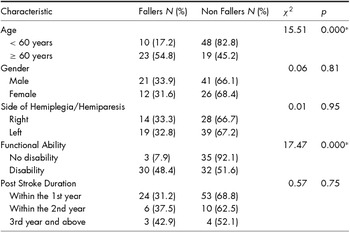
Thirty-three (33%) out of the 100 participants reported that they fell within the 3 months prior to the study. A significant association was observed between falling and age (p < .001), with more stroke survivors aged 60 years and above (54.8%) reporting a fall compared to 17.2% of those below 60 years. Functional ability was also a significant characteristic (p < .0001) with 48.4% of those with disability having experienced at least one fall while only 7.9% of stroke survivors with no marked disability fell within 3 months prior to the study. The other socio-demographic and clinical characteristics were not significantly associated with whether a participant fell or not (Table 2).
Chi Square Test for Socio-Demographic and Clinical Characteristics of Fallers and Non Fallers

*p < .001.
Discussion
Post stroke fall is a major source of morbidity and mortality among stroke survivors and this study examined the proportion who fell in a cohort of community-dwelling stroke survivors in Nigeria.
Proportion of Stroke Survivors that Fell
Approximately one-third (33%) of the stroke survivors fell within the 3 months prior to this study. This is similar to the projected annual rate of falls among the general population of the elderly (Campbell, Robertson, & Gardner, Reference Campbell, Robertson and Gardner1995; Gillespie et al., Reference Gillespie, Robertson, Gillespie, Sherrington, Gates, Clemson and Lamb2012) but lower than the ≥ 50% prevalence reported in many of the stroke studies conducted in developed countries (Ashburn et al., Reference Ashburn, Hyndman, Picking, Yardley and Harris2008; Hyndman et al., Reference Hyndman, Ashburn and Stack2002; Mackintosh et al., Reference Mackintosh, Hill, Dodd, Goldie and Culham2005; Tilson et al., Reference Tilson, Wu, Cen, Feng, Rose, Behrman and Duncan2012; Yates, Lai, Duncan, & Studenski, Reference Yates, Lai, Duncan and Studenski2002). A possible explanation for our findings, compared to those of the above-cited studies, could be that the stroke survivors in our study had diminished mobility and functioning, similar to that of the elderly. Less mobility lowers the risk of falls (Yates et al., Reference Yates, Lai, Duncan and Studenski2002) and falls are in a way linked to mobility and engaging in activities. This presupposition appears to be further supported by the fact that the majority (62%) of the stroke survivors in our study had significant disability (mRs ≥ 3). With the scarcity of data on post stroke falls from developing countries, it is difficult to draw a comparison between our findings and what is available on falls in other developing countries. However, the data obtained in the present study, though less than what is available in developed countries, is still an indication that post stroke falls constitute an important problem that should not be ignored. There is therefore the need for rehabilitation professionals to actively engage in falls prevention and routinely obtain information from stroke survivors on the occurrence of falls with a view of addressing features that increase their risk for falls.
Characteristics of Stroke Survivors that Fell
Stroke survivors that fell were older and had diminished functional ability. Falls is a common and major problem in the elderly (Gillespie et al., Reference Gillespie, Robertson, Gillespie, Sherrington, Gates, Clemson and Lamb2012; World Health Organization, 2007). Several factors associated with ageing such as impaired balance (Mackintosh et al., Reference Mackintosh, Hill, Dodd, Goldie and Culham2005; Muir, Berg, Chesworth, Klar, & Speechley, Reference Muir, Berg, Chesworth, Klar and Speechley2010) and gait (Rubenstein, Reference Rubenstein2006), have been linked to the high rate of falls in the elderly population and these factors also constitute some of the most common post stroke impairments. Effective falls prevention, and rehabilitation strategies that are capable of addressing these and other ageing-associated factors, may therefore be required in the provision of effective rehabilitation and care for elderly stroke survivors.
The impact of functional limitation/disability on the incidence and prevalence of falls has also been well documented in different fall-prone patient populations (Allen, Schwarzel, & Canning, Reference Allen, Schwarzel and Canning2013; Homann et al., Reference Homann, Plaschg, Grunder, Haubenhofer, Griedl, Ivanic and Homann2013). Functional limitations remain one of the most prominent and obvious sequelae of stroke (Feigin et al., Reference Feigin, Barker-Collo, Parag, Senior, Lawas and Ratnasabapathy2010; Wolfe et al., Reference Wolfe, Crichton, Heuschmann, Mckevitt, Toschke, Grieve and Rudd2011), and a substantial number of individuals who survive a stroke are left with varying degrees of disabilities in the long term (Feigin et al., Reference Feigin, Barker-Collo, Parag, Senior, Lawas and Ratnasabapathy2010; Wolfe et al., Reference Wolfe, Crichton, Heuschmann, Mckevitt, Toschke, Grieve and Rudd2011). The effect of disability on falls can be described as ‘spiral-like’ and disability often precipitates a vicious cycle. A common scenario is that an individual experiencing functional limitation will ultimately experience deconditioning and a reduction in functional ability which further engenders inactivity, limits functional activities and increases the risk of falls when ambulation is attempted (Donoghue, Cronin, Savva, O'Reagan, & Kenny, Reference Donoghue, Cronin, Savva, O'Reagan and Kenny2013; Gillis & Macdonald, Reference Gillis and Macdonald2005). Every fall increases the likelihood of psychological responses especially fear of falling which results in fallers consciously restricting their activities in order to prevent future fall. This reduction of functional activities results in further deconditioning and further increases the likelihood of having a fall (Gillis & Macdonald, Reference Gillis and Macdonald2005) when affected persons endeavour to walk, and the cycle continues. It is therefore essential that functional limitations be appropriately addressed with proven and effective therapies in order to prevent or terminate the negative spiral as the case may be. It is however important to state that occurrence of fear of falling was not assessed in this present study and future studies to assess this topic are therefore required. The mRS was used to assess functional disability in this study and participants in the ‘disability’ category (mRS levels 3 to 5) were those with ‘moderate disability requiring some help, but able to walk without assistance’, those with ‘moderately severe disability; unable to walk without assistance and unable to attend to bodily needs without assistance’ or those with ‘severe disability; bedridden, incontinent, and requiring constant nursing care and attention’. A significantly higher proportion of participants with the aforementioned disabilities fell and a common feature shared by participants in this category was that they all experienced some degree of dependence and the need for assistance in one form or the other. Conversely, a lesser proportion of the participants in the mRS levels 0 to 2 (levels that are characterised by ability to carry out activities without any form of assistance) fell. However, being a global measure of disability, the mRS was not able to provide information on limitations experienced in the performance of specific activities.
While female gender has been linked with increased risk of falls in some studies (Homann et al., Reference Homann, Plaschg, Grunder, Haubenhofer, Griedl, Ivanic and Homann2013; Stolze et al., Reference Stolze, Klebe, Zechlin, Baecker, Friege and Deuschl2004), a review of six previous studies on post stroke falls showed that none found an association between post stroke falls and gender similar to our findings (Batchelor, Mackintosh, Said, & Hill, Reference Batchelor, Mackintosh, Said and Hill2012). Post stroke duration also was not associated with post stroke falls in this study although a study has shown that long-term stroke survivors are at increased risk of falling (Jørgensen et al., Reference Jørgensen, Engstad and Jacobsen2002). The varying post stroke duration of the stroke survivors in the present study possibly affected the ability to adequately explore the association between falls and post stroke duration. Prospective studies with uniform post stroke duration would therefore be necessary to provide further insight. Aside from information on stroke survivors who fall and the associated factors, it will equally be important to explore the incidence of post stroke falls and its impact on important outcomes as this may further impress the importance of preventing and attending to post stroke falls on all stakeholders. Future studies on the impact of post stroke falls on morbidity (including fractures and other injuries), functioning and quality of life of stroke survivors in Nigeria are therefore required.
Limitations of the Study
The non-probability sampling technique utilised in recruiting the stroke survivors constitutes a limitation of the study as well as the small size of the study sample. The hospital-based design of the study and the fact that the stroke survivors were recipients of physiotherapy care may also limit the generalisability of findings and may not represent the situation of community-dwelling stroke-survivors not receiving rehabilitative care. The non-inclusion of important clinical attributes previously reported as predictors of post stroke falls, such as balance and motor performance (Ashburn et al., Reference Ashburn, Hyndman, Picking, Yardley and Harris2008; Tilson et al., Reference Tilson, Wu, Cen, Feng, Rose, Behrman and Duncan2012), among falls risk factors assessed in this study also limits the implications for clinical practice especially as these factors are amenable to rehabilitation. The fact that falls were assessed through patients’ report which relied on their ability to recall at least one fall event within the 3 months prior to the study also constituted a significant limitation.
Conclusion
This study presents preliminary data on fallers in a cohort of stroke survivors in a developing country that has a shortage of rehabilitation professionals and infrastructure, and other vital health care resources. With the observed proportion of stroke survivors that fell, there is a need to incorporate falls risk assessment, falls prevention strategies, and appropriate, proven and cost-effective therapies into routine rehabilitative care of stroke survivors in Nigeria especially for those with marked functional limitations, and the elderly. Further studies utilising prospective designs to identify the incidence of post stroke falls in Nigeria are however urgently required. Future intervention studies on effective falls prevention strategies that will be appropriate for Nigeria's health care and cultural environment are also recommended.
Financial Support
None.
Conflict of Interest
None.
Ethical Standards
The authors assert that all procedures contributing to this work comply with the ethical standards of the relevant national and institutional committees on human experimentation and with the Helsinki Declaration of 1975, as revised in 2008.