





Introduction
Public engagement is becoming an increasingly important topic for the Antarctic sector (Salmon et al. Reference Salmon, Carlson, Zicus, Pauls, Baeseman and Sparrow2011, Salmon & Priestley Reference Salmon and Priestley2019, Xavier et al. Reference Xavier, Mateev, Capper, Wilmotte and Walton2019, Marx et al. Reference Marx, Leane and Alexander2025a). The southern polar region is facing a range of challenges in the coming decades, including the impact of climate change and changing great-power politics (McGee et al. Reference McGee, Edmiston and Haward2022). Whether it is through individual pro-environmental behaviour, support of science and conservation programmes or participation in political discourse, members of the public have a role to play in responding to these challenges. Cultivating a broad base of public support for Antarctica’s protection has, therefore, become an essential component of polar conservation strategies. However, supporting people to understand and care about Antarctica implicitly means asking them to establish and maintain a relationship with a place that they themselves will most probably never visit. The question of how to foster public engagement with such a remote environment has been considered as a challenge for science communication and education (Salmon & Priestley Reference Salmon and Priestley2019, Cusick et al. Reference Cusick, Dixon, Cajiao, Gilmore, Cheeseman and Mascioni2025), for the arts (Jackson Reference Jackson2019) and for news media (Alexander et al. Reference Alexander, Marx, Hunt and Zhang2022, Hunt et al. Reference Hunt, Lester, Williams and Haward2025). In this paper, we approach this topic from a social perspective by examining the ways in which members of the public engage with the various Antarctic communities in the gateway city of Hobart, Australia.
Background
Our approach is underpinned by the intersection of three key theories: 1) place attachment theory, 2) social capital theory and 3) structuration theory. Place attachment refers to the bonds that individuals form with specific physical environments (Scannell & Gifford Reference Scannell and Gifford2010a). It has been shown to occur at various spatial scales, meaning that a person can form attachments to small-scale places such as a home or neighbourhood, but also feel a connection to larger areas such as cities or regions (Hidalgo & Hernández Reference Hidalgo and Hernández2001, Lewicka Reference Lewicka2010, Ardoin et al. Reference Ardoin, Gould, Lukacs, Sponarski and Schuh2019). Scholars such as Massey (Reference Massey1991) have also called for a more progressive understanding of the concept that links to nodes potentially spanning geographical areas. Place attachment has been linked to increased pro-environmental behaviour (Scannell & Gifford Reference Scannell and Gifford2010b); hence, it is a useful framework for examining public engagement with the natural world. Place attachment is also a highly social phenomenon, with several studies showing a link between a person’s attachment to a place and their sense of connectedness to the community surrounding it (Milligan Reference Milligan1998, Stedman Reference Stedman2002, Mihayalov et al. Reference Mihayalov, Perkins, Stedman, Manzo and Devine-Wright2020).
Social capital theory - conceptualised by Bourdieu (Reference Bourdieu and Richardson1986) and popularized by Putnam (Reference Putnam2000) - focuses on the value embedded in social networks, shared norms, trust and reciprocal relationships. It argues that individuals and groups gain resources - such as information, support or opportunities - through their social connections. At its core, social capital is about how relationships shape social cohesion and collective action. Social capital can influence the pathways through which people become aware of, feel empowered by or get invited into place-based engagement. Scholars have identified several subtypes of social capital, including bonding capital, referring to close ties between individuals based on shared experience, identity and background; and bridging capital, which refers to weaker ties between groups with little in common (Putnam Reference Putnam2000, Wallace & Pichler Reference Wallace and Pichler2007, Torrejón & Martin-Matthews Reference Torrejón and Martin-Matthews2022).
Finally, Giddens’ structuration theory proposes that social life is produced and reproduced through the ‘duality of structure’ (Giddens Reference Giddens1984). That is, structures (rules, norms, institutions) shape individuals’ actions, yet these same structures exist only because individuals continually recreate them. In this way, Giddens argues that the micro (individual action) and the macro (social systems) are both the medium and the outcome of social practice. This means that people’s capacity to act depends on the rules and resources embedded in a social system, but also that engagement practices themselves reproduce or challenge these structures.
When integrated, the three theories depict a multi-layered dynamic: place attachment can shape how individuals perceive and engage with Antarctica; these engagements may then contribute to the formation of social capital within Antarctic communities; and, through repeated practices embedded in place, individuals and groups may reproduce or alter social structures within these communities.
The question of how people connect with either the southern polar region or with the communities surrounding it has already drawn some scholarly attention. Marx et al. (Reference Marx, Alexander, Leane and Nielsen2025b) have shown that people can form place attachment to Antarctica, and they have argued that this can happen remotely (i.e. without visiting in person) and can occur at different spatial scales. Hehir et al. (Reference Hehir, Stewart, Maher and Ribeiro2021) have demonstrated a link between ongoing social bonds in Antarctic communities and long-term pro-environmental behaviour. A number of studies have also examined social dynamics within Antarctic-focused communities, and, while they have not referred directly to the concept of social capital, they have noted the existence of strong social bonds (Neufeld Reference Neufeld2013, Frederick & Rock Reference Frederick and Rock2018, Roldan Reference Roldan2020). As evidence of these bonds, both Neufeld (Reference Neufeld2013) and Frederick & Rock (Reference Frederick and Rock2018) have observed expeditioners describing the feeling of belonging to an elite or special ‘club’, while Roldan (Reference Roldan2020) has noted that people have given a name to this sense of community by referring to themselves as ‘Antarcticans’. To date, however, this sense of Antarctic-focused social bonding has primarily been observed among groups of people who have visited the southern polar region. Most people will never visit Antarctica, however, which means that if we wish to foster broad-based support for the continent, we need to understand how social dynamics influence people’s relationship with Antarctica in communities located physically outside of the southern polar region. If the self-identified ‘Antarctic community’ can be extended beyond those who directly experienced Antarctica, this significantly increases the scale and diversity of potential public support.
Obvious locations to include in such an extension would be the places known as ‘Antarctic gateway cities’. These are cities that are relatively close to Antarctica and enable access to and from the continent, and as a result they ‘concentrate the polar political, economic and cultural associations of their host countries’ (Roldan Reference Roldan2020). Five cities - Hobart (Australia), Christchurch (New Zealand), Punta Arenas (Chile), Ushuaia (Argentina) and Cape Town (South Africa) - together self-identify as the key Antarctic gateways (City of Ushuaia et al. 2009), although others, such as Stanley (Falkland/Malvinas Islands) and Puerto Williams (Chile), could also make a case for gateway status. With their diverse array of connections to the far south, gateway cities are useful locations for examining Antarctic social dynamics in a place outside of Antarctica.
In recent years, political and scholarly interest in public engagement in gateway cities has increased. Various levels of government across multiple southern-rim countries have authored policies that reference the importance of Antarctic public engagement (Instituto Antártico Chileno 2015, Christchurch City Council 2018, Australian Government 2022, Tasmanian Government 2022). Similarly, there have been a number of studies examining the relationship that gateway residents have with Antarctica (e.g. Leane et al. Reference Leane, Lucas, Marx, Datta, Nielsen and Salazar2021, Estrada-Goic et al. Reference Estrada-Goic, González-Ortega, Mancilla, Latorre, Cerda and Jalil2023, Salazar et al. Reference Salazar, James, Leane and Magee2026). All note that residents identify with a sense of care and responsibility for the region to their south, which is described as ‘custodianship’ or ‘stewardship’. While these studies provide emerging data about how gateway residents feel about Antarctica, we know less about their relationship with the Antarctic communities based in their own backyards. Exceptions include Herbert (Reference Herbert2014), who conducted an ethnographic study of place-making in Argentina’s Antarctic gateway, Ushuaia; Roldan (Reference Roldan2020), who focused on gateway identity across and between the five primary cities; and Morgavi & Cohen (Reference Morgavi, Cohen, Varnajot, Vereda and Ioannides2025), who examined tourism-focused communities of practice in Punta Arenas and Ushuaia. Herbert (Reference Herbert2014) and Roldan (Reference Roldan2020) both point to a gap between those citizens who are directly involved in Antarctic-related work and those who are not. Herbert finds a degree of distance between Ushuaia residents and the city’s Antarctic sector, noting in particular the idea that you need to know someone in order to be able to gain work connected to the city’s lucrative Antarctic tourism industry. Commenting on Hobart, Roldan (Reference Roldan2020) describes the city’s Antarctic sector as ‘tight-knit and somewhat unapproachable for outsiders’ (p. 204). It is this perception of a gap between Antarctica’s communities and the wider public that we seek to explore further in this paper.
Methods
Research setting
Situated at the southern tip of Australia’s island state of Tasmania, Hobart is relatively close to the ice continent, with only the Southern Ocean intervening. Correspondingly, the city has a long history of acting as the launching site for southern polar expeditions. Its connections with the Antarctic are wide-ranging, spanning politics, economics, science and culture (Indigenous and settler). Hobart is currently home to a number of Antarctic research and logistics organizations, including the Australian government’s Antarctic Division headquarters (the AAD) and the secretariat of the Commission for the Conservation of Antarctic Marine Living Resources (CCAMLR), which sits within the Antarctic Treaty System (ATS). The sole Australian research icebreaker, the Nuyina, has its home in Hobart’s port, which lies at the city’s centre, meaning the ship is often in full view of many residents. The Tasmanian Antarctic sector is an important economic factor in the city, worth over 200 million AUD annually, with roughly 1200 (full-time equivalent) local residents employed (Tasmanian Government 2025). Culturally, Hobart showcases its connections to the south through museum exhibits, public sculptures, a biennial festival and occasionally musical and theatre performances. Although the city is not a key tourist gateway, the growth and diversification of Antarctic tourism has seen several operators recently begin to use its port to reach East Antarctic destinations, as they have done at times in the past (Muir et al. Reference Muir, Jabour and Carlsen2007). Hobart’s rich array of Antarctica connections may help foster residents’ sense of connection with the far south. A subset of residents - small by comparison to the city’s population, but much larger as a percentage of this population Than in non-gateways - are researchers and other personnel who have visited Antarctica. This combination of direct and mediated experience makes Hobart a useful setting for research into public engagement with Antarctica’s communities.
Research questions
In this paper, we pose two key research questions (RQs) designed to explore the influence that social dynamics have on the public engagement with Antarctic communities:
-
RQ1: What Antarctic communities are present in Hobart and how are they perceived by residents?
-
RQ2: What factors influence public participation in Hobart’s Antarctic communities?
We chose to take a qualitative approach in this research, conducting in-depth interviews - an open-ended, discovery-orientated method to obtain detailed information about a topic. While qualitative research does result in a smaller overall sample size, it also creates a rich and nuanced dataset. Such data allow for deeper exploration of a relatively new research area, offering key insights into connection with places near and far.
Interview design
Interviews were structured around four topics (see Supplemental Material 1 and 2 for a full guide):
-
1) The participant’s connection with Hobart
-
2) The participant’s connection with Antarctica
-
3) The factors that influence the participant’s relationship with Antarctica
-
4) The impacts of the participant’s relationship with Antarctica
Four mock interviews were undertaken to test the topics and the mode of delivery. Based on this testing, we developed a paper-based graphic conversation guide resembling a mind map to assist orientation during the interview discussion (Yin Reference Yin2016). Participants were shown this guide at the start of the interview, and the graphic was positioned between the interviewer and participant throughout the conversation. While the guide was intended to improve accessibility, it may have primed participants for particular responses related to levels of perceived connection, so this is a potential limitation of the study. In practice, the guide was not referred to by most participants and rather served as a guide for the interviewer.
Data collection
Participants in this study were residents of Greater Hobart aged 18+ years. ‘Greater Hobart’ in this study refers to any area within commuting distance from the Hobart Central Business District, resulting in a geographical range that encompassed much of southern Tasmania’s population. Participants reported a range of different Antarctic experiences; some had visited in person or had professional links with Antarctica, but others had never visited Antarctica or had no connections to the continent through their work. It was important for us to be able to speak with Hobart residents who had a diverse range of Antarctic experiences and connections. For this reason, we used a combination of voluntary and purposive sampling to recruit interview participants. In order to reach residents with a lived experience of Antarctica and/or existing professional connections to the continent, we contacted a range of local Antarctic organizations, who in turn promoted the opportunity within their networks. To recruit participants from the broader community, we put up posters in public spaces, appeared on local radio and contacted local municipal governments, community centres and demographic-specific organizations (e.g. the Multicultural Council of Tasmania and Youth Network of Tasmania) to ask for their assistance with promotion.
As per the project’s ethics approval with the University of Tasmania’s Human Research Ethics Committee (reference number S23011), participants were provided with an information sheet and asked to sign a consent form in advance of the interviews.
Data analysis
Interviews were recorded using an audio recorder or Zoom’s recording function (depending on whether the interviews were in-person or online) and then transcribed using a web-based artificial intelligence (AI) transcription platform and converted into MS Word files for analysis. Participants were provided with their transcription within 1 week of their interview and then had a further 2 weeks in which to review their transcription and make corrections.
To analyse the interviews, we employed an inductive coding approach using NVivo. Coding means assigning meaning to a small body of text (a phrase, sentence or paragraph) using a label that best represents this text (Chandra & Shang Reference Chandra and Shang2019, pp. 91–106). Inductive coding allows research findings to emerge from the raw data rather than being restrained by structured methodologies such as the use of a predefined code book. Our method involved 1) sorting data into different codes as they emerged during a line-by-line reading of the transcripts, 2) distilling these the codes into a smaller number of key themes and 3) conducting another line-by-line read-through to identify commonalities between these key themes.
Results
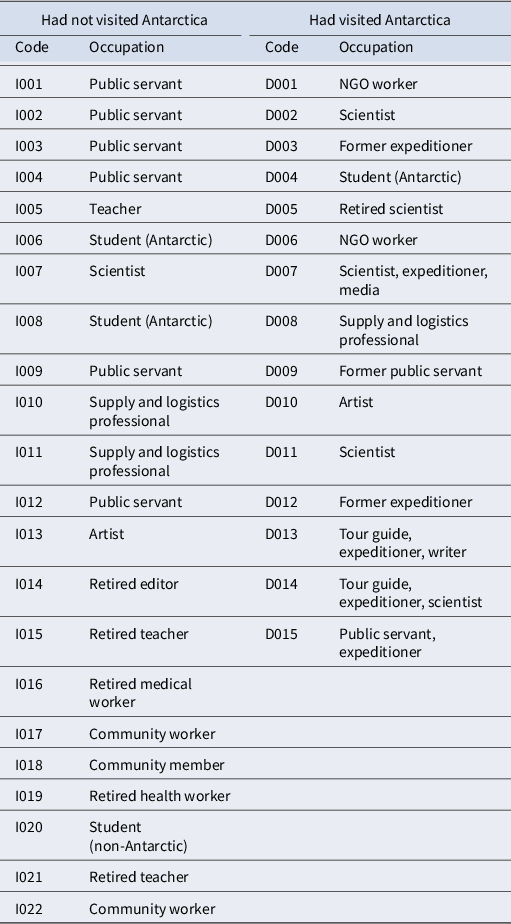
In total, 37 residents participated in an interview, including public servants, teachers and students, community workers, supply and logistics personnel, scientists, tour guides and retirees (Table I).
A summary of the research participants.

Table I. Long description
37 people participated in interviews for this study. This included 15 who had visited Antarctica (signified by a codename starting with “D”) and 22 who had not (codenames starting with “I”).
NGO = non-governmental organization.
Fifteen participants had visited Antarctica (code indicated by an initial ‘D’), and all of the 22 participants who had not travelled to Antarctica (code indicated by an initial ‘I’) knew someone who had. Participant age groups ranged from 18–29 through to 70–79 years, with the highest level of representation among people aged 50–59 years. Thirty participants reported past or present professional links with Antarctica. These links were frequently tangential in nature, and these participants had not identified as sector employees during the recruitment process. This demonstrates that the line between having professional links and not having professional links is relatively porous or ambiguous within this participant sample - something that may be a specific feature of Hobart as a gateway city.
What Antarctic communities are present in Hobart and how are they perceived by residents?
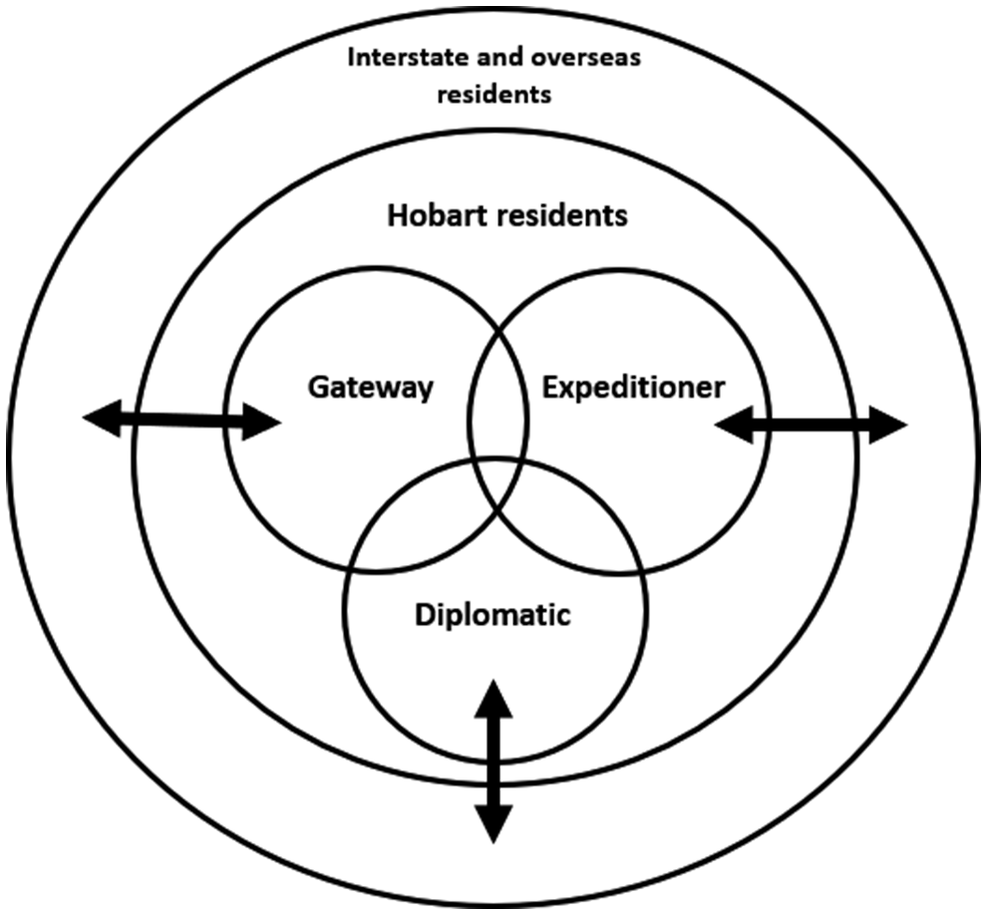
When asked to describe Hobart’s Antarctic community, participants mentioned a range of individuals and groups that coalesced into three separate but overlapping Antarctic communities: the expeditioner community, the diplomatic community and the gateway community. As illustrated in Fig. 1, each of these communities sat within the broader community of Hobart residents but also had links to residents from the rest of Australia as well as overseas.
A conceptual model of the relationships between the various Antarctic communities within Hobart. Each community sits within the broader Hobart community and has links with the others as well as with the international Antarctic community.

The expeditioner community
Formed on the basis of shared experiences in Antarctica, the expeditioner community comprises Hobart residents who have spent time in the far south. In the eyes of many participants, Hobart’s expeditioners act as the elite ‘core’ of the city’s Antarctic community, being the most visible and also the most admired.
Participants associated this group predominantly with scientists who had travelled south in a professional capacity with national programmes, with I003 describing the community as ‘largely an academic science research community’. The AAD was frequently referenced as a core part of the community, although participants also cited the University of Tasmania’s Institute for Marine and Antarctic Studies (IMAS) and the Commonwealth Scientific and Industrial Research Organisation (CSIRO). Long-term tour guides also formed a subsection of this expeditioner community. D013, for example, was part of a small community of tour guides based in Hobart who would meet up for dinner while the world outside of Tasmania was in lockdown during the COVID-19 pandemic. This aspect of the expeditioner community was, however, relatively hidden. D013 described this group as living ‘dual lives’, travelling to South America to work on ships during the summer season and then returning to other jobs in Hobart, where their Antarctic connections were largely unknown.
Interview participants equated the expeditioner community with a number of positive qualities. Approximately half of the participants saw the expeditioner community as an elite section of the broader Hobart community, using terms such as ‘extraordinary’, ‘world leaders’ and ‘special’. Public servant I001, for example, stated that they felt in ‘awe’ of the community members who had travelled to Antarctica. Participants admired the expeditioner community for the practical skills needed to operate in this environment, and they felt that they were doing critical work in Antarctica. While participants did acknowledge the importance of the logistical and support work that enables science to happen, this admiration was primarily focused on scientists. Participants saw members of the Antarctic sector as elite because they had won their position in a competitive environment. Business owner and former expeditioner D008, for example, emphasized that people needed to be ‘selected’ for expeditions, I017 called expeditioners ‘chosen ones’, and former sector employee D009 described people saying they would ‘kill’ for their job.
Conversely, while participants saw the expeditioner community as elite, several also felt that Hobart’s polar connections ran so deep that everyone had either been to Antarctica themselves or knew someone who had, and that travelling south was, in I014’s words, ‘no big deal’ for local residents. D001 described an encounter with an American tourist while on a day trip with friends outside of Hobart:
He was pretty excited about the fact he’d been to Antarctica, so we just started chatting. And in the chat, it was like, ‘Oh, yeah, I’ve been there twice.’ And then my sister said, ‘Yeah, I’ve been there six times.’ And then there was another one, which was, ‘Yeah, I went down there as a doctor.’ So I think about, of the six of us, five of us had been there … So it was pretty funny. I just laughed and went, ‘Yeah, sorry about that. You go back to the US, you’ll be special, but here, just no, not quite so unusual.’
The expeditioner community was particularly notable for its strong social bonds. D012, who had overwintered as part of the Australian programme, described a close-knit community of former expeditioners residing in Hobart, adding that the sense of shared experience was so strong that some expeditioners struggled to reintegrate into the wider community upon their return from Antarctica. Similarly, D003 recounted having strong social links to international expeditioners who lived outside of Australia, which they maintained through email communications and offers to visit Hobart. Many participants who had been to Antarctica described feeling strong connections with other expeditioners as a result of their travels. For some, this related to forming close ties with people who had been on the same expedition, and for others this was more about feelings of broader kinship and shared experience with all expeditioners.
Several participants likened Antarctic expeditions to military experiences, commenting that they produced a similar amount of social and team bonding. D005, who had been to Antarctica, said, ‘It’s a sense of intense bonding. It’s a sense of, “We have done it. You and me, we have done it. Not those people over there. They’ve got no idea of what it’s like, but we have. And that is something that we will share forever and a day.”’ D004 similarly saw Antarctica’s remoteness as one of its key bonding agents: ‘I reckon just purely because there’s so few people there to be honest.’ From the outside, participants who had not been to Antarctica also saw it as a place that created strong bonds between travellers. I017, for example, stated:
I have [a] kind of dreamy image of researchers going out there and kind of forming a little temporary community all huddled up together, like trying to make sense of their surrounds. From what I know, from my wider community who’s done work out there, I’ve seen images of this beautiful, natural beauty. And because of the extreme conditions, people are kind of forced to share resources and connect. And because they’re shut off from the rest of the world, it’s kind of drove them to this really strong connection with each other.
In addition to these informal bonds, the ANARE Club - essentially an Australian Antarctic expedition alumni associationFootnote 1 - provided a more structured framework for social interactions between members of the expeditioner community. Participants were mixed in their assessments of ANARE’s success in bringing together the expeditioner community. D013 described the club’s midwinter dinners as times when they very much felt part of Hobart’s Antarctic community. On the other hand, both D005 and D011 stated that ANARE was mainly for people who had overwintered, suggesting that not every expeditioner feels included within the club’s activities.
The gateway community
Unlike the expeditioner community, which is formed via shared experiences in Antarctica, the gateway community is based on activities that are focused on Antarctica but take place in Hobart. Therefore, while it does include some expeditioners, it also incorporates a wider group of residents who have never travelled south. Participants described a diverse array of groups and individuals within Hobart’s gateway community. These included Hobart-based employees of the city’s key Antarctic organizations, but also people in more obscure or tangential Antarctic roles, including health sector employees responsible for providing medical support to outbound expeditioners, teachers responsible for training Antarctic tradespeople and small businesses providing goods and services to support Australia’s Antarctic operations. Public servant I004, for example, mentioned a local dry cleaning firm who had a contract with the AAD for cleaning expeditioner clothing each year. Beyond providing support to expeditioners, the gateway community also included members focused on growing Antarctica’s cultural, political and economic footprint within Hobart. Several participants, for example, were actively involved in artistic or cultural engagements with Antarctica, ranging from the production of art through to the curation of archival materials and museum exhibitions. In contrast with expeditioners, however, the gateway community had less of a cohesive identity. Despite being involved in Antarctic activities (albeit often on a part-time or incidental basis), several participants did not themselves identify as Antarctic community members.
Mirroring the broader conception of Antarctica as a place for international cooperation, interview participants also saw the gateway community as diverse yet close-knit and collaborative. I002 and I004, for example, both felt that the Antarctic sector was much less divided or combative than other industries in Tasmania. Close to a third of participants saw the community as being united through their passion for Antarctica, with I011 relating how ‘the noise level is very high when you get a group of Antarctic people together’, and with I010 and I011 both stating that local Antarctic initiatives would frequently reach across political divides and attract ‘tripartisan support’ from Tasmania’s three main political parties. Two participants also attributed the Antarctic community’s collaborative nature to a general appetite for cooperation within Tasmanian industry. I009 noted that there was a strong ‘no dickheads’ ethos within Tasmania, and I010 described how the state’s small size frequently led to partnerships between different groups.
The Tasmanian Polar Network (TPN) provides an institutional framework for the gateway community, enabling individuals and organizations to formally identify as participants in the local Antarctic sector through signing on as members. Regular meetings provide a formal environment for community interaction and enable the sector to deliberate on emerging issues and opportunities. I011, a long-time member, described the TPN as an organization that helped members stay up to date with new developments, but also supported them and the community as a whole to have some degree of influence on Antarctic operations.
The bonds described by participants within the gateway community were primarily economic and professional, based on cooperative work between different groups to achieve Antarctic-related goals. There was, however, evidence of social bonds between gateway community members, albeit of a more muted nature than those of their expeditioner counterparts. D007, who migrated to Tasmania from Europe, described finding a sense of belonging in Hobart’s Antarctic community. Similarly, I011, a local business owner, had never been to Antarctica but felt that the local Antarctic sector was a place where they knew everyone and everyone knew them, stating, ‘[I]t’s just a nice feeling to be part of that community.’
The diplomatic community
Hobart’s diplomatic Antarctic community is based around shared experiences of Antarctic activities that take place at a global level. This is distinct from international visitors spending time in Hobart on Antarctic business, who are discussed in the next section. Hobart residents who are members of the diplomatic community are active in the global administration and management of Antarctica, and they include representatives from non-governmental organizations, members of the Hobart-based CCAMLR secretariat and participants in Antarctic Treaty Consultative Meetings and collaborative international research projects through groups such as the Scientific Committee for Antarctic Research (SCAR).
Participants had less to say about the city’s diplomatic community than they did about its expeditioner and gateway counterparts. This may be due to the line of enquiry taken during this research, which focused primarily on the Hobartian experience of Antarctica, and may similarly reflect an under-representation in the interview participant samples of diplomats and policy workers, who form one component of the international community. As discussed later, it may also point to a general lack of transparency and engagement on the part of the ATS and its secretariats. Participants did, nevertheless, note the international community’s cooperative nature, with I011 stating:
And here’s this pure continent with 40 or so countries all cooperating, all working together, all doing positive scientific things, all … reporting on climate change and the effects in Antarctica, how that affects the rest of the world. I just think it has just such a large effect on everything that’s going on.
Comments such as these, however, tended to focus on the diplomatic community as an abstract force of diplomacy rather than as something that Hobart residents (other than those professionally involved) felt any connection to. The one slight exception to this was CCAMLR, which, as noted, has its secretariat based within the city’s central business district. I014, for example, felt some degree of connection with CCAMLR due to the fact that a friend had worked there, but they went on to say, ‘It’s good that CCAMLR exists, but we don’t hear much about it, do we? I don’t think the average Hobartian would know what CCAMLR was, if you mentioned it.’ This suggests that, despite having a presence in Hobart, the diplomatic Antarctic community might not be widely known or visible to the city’s broader population.
What factors influence public participation in Hobart’s Antarctic communities?
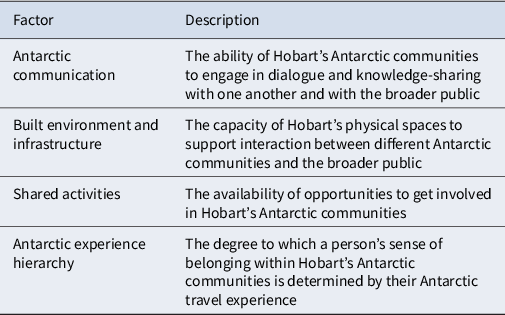
Participants described a range of factors that they felt influenced their ability to participate in Hobart’s Antarctic communities. From these, we identified four key themes: 1) Antarctic communication, 2) Hobart’s built environment and infrastructure, 3) shared activities and 4) the Antarctic experience hierarchy (Table II).
A summary of the four factors identified within this study that influence public participation in Hobart’s Antarctic communities.

Table II. Long description
The four factors include: 1) Antarctic communication - The ability of Hobart’s Antarctic communities to engage in dialogue and knowledge sharing with one another and with the broader public. 2) Built environment and infrastructure - The capacity of Hobart’s physical spaces to support interaction between different Antarctic communities and the broader public; 3) Shared activities - The availability of opportunities to get involved in Hobart’s Antarctic communities; and 4) Antarctic experience hierarchy - The degree to which a person’s sense of belonging within Hobart’s Antarctic communities is determined by their Antarctic travel experience.
Antarctic communication
Having the opportunity to hear about the work taking place in and around Antarctica helped many participants strengthen their sense of connection to Antarctica itself, as well as to its communities. This sometimes took the form of structured talks given in a formal environment. Retired high school teacher I021, for example, spoke about attending a talk given by a former student turned Antarctic researcher, while I018 expressed a desire for more education-focused public events. More frequently, however, participants emphasized the value of informal, ad hoc Antarctic communication with people they already knew. I011, for example, recounted their father’s friend sending ‘little notes’ to their mother from Macquarie Island, and they even brought these letters, now more than 40 years old, to show the lead author at the interview.
The type of community-focused Antarctic communication described by participants tended to focus on showcasing the work and people of the expeditioner community, although a small number of participants did emphasize the need to highlight the ‘invisible’ Antarctic people in the gateway and diplomatic communities, such as the workers providing medical screenings for expeditioners. While some people showed an interest in hearing about Antarctic scientific work, participants appeared to place more value in hearing about other aspects of Antarctic work. I005, for example, wanted to know more about the technical specifics of operating machinery in subzero temperatures, whereas I019, whose former partner had worked as an expeditioner, enjoyed hearing about the more prosaic aspects of life in Antarctica:
I do think what I learnt by [former partner] being down there is fascinating. You know, their routines and stuff like that. I think it’d be interesting to other people, too. And I don’t know how much it’s out there. Yeah, it’s very interesting, their lives.
However, we note that this informal style of communication, while valued, was only open to people who already had the necessary personal connections. I018, who had recently moved to Tasmania from mainland Australia, observed:
I would think that a lot of people in Tasmania would have probably some involvement or know someone or, or someone [in] their family has been involved in some way. I mean, I know of a guy who lives here in Kingston Beach, who used to work in the Antarctic Division … Just go down to Kingston shopping centre, and you see people walking around in the [AAD] uniform and so they obviously work there, and they’re someone’s friend or a member of someone’s, you know, running club or something like that. So, you’d probably like to hear their stories and hear what they’re up to, what research they do.
Additionally, a number of participants felt that the Antarctic community struggled to communicate with the wider population. This was attributed to a lack of focus on public engagement and an overuse of scientific jargon, and this contributed to participants describing the Antarctic sector as ‘inward-focused’, operating in a ‘bubble’ and out of touch with the realities and concerns of Greater Hobart. When asked to describe the community, I015, for example, said, ‘I don’t want to say “closed”, but they’re not … they’re so devoted to their work, where they work, the people they work with, that I’m not sure they understand that there are people, other people out here who would like to know what they’re doing.’
Built environment and infrastructure
For some participants, Hobart’s built physical spaces offered opportunities to develop and strengthen their ties with the city’s Antarctic communities. The various icebreakers that frequent Hobart’s waterfront offered a particular point of connection, with people valuing the opportunity to meet sailors and ship crew during on-board public tours at events such as the Australian Antarctic Festival and recounting having stood on the banks of the Derwent (Hobart’s river) to bid farewell to Australia’s former flagship icebreaker on its final voyage. For those with connections to the expeditioner community, the ships also acted as an important focal point during the departure and arrival of voyages, although D007 noted that they felt that this was starting to diminish with increases in waterfront security:
For quite many years when the ship was the centre of Hobart and when you could just see the ship’s farewell, you know, like very easily from the non-secure wharf, and everyone would gather … it felt like this Antarctic life was really at the centre of Hobart. You had this community down there and then you had still all your people … You’d turn up at the ship’s arrival just because you want to say g’day to people and catch up with people. I mean, people do that still a bit, but it’s been lost quite a bit. Harbour security and all those things. You know, the ship became more remote. It’s just over there [but] you couldn’t just wave goodbye or hang streamers. You know, the bit that made Hobart so special because of that connection with the ship and the people of Hobart like just farewelling the ship to Antarctica, it was very special.
Participants noted a number of other instances in which aspects of Hobart’s built environment prevented or diminished opportunities for connecting with the city’s Antarctic communities. For example, the AAD headquarters are located ~10 km from Hobart’s central business district in the suburb of Kingston. While some participants, particularly Kingston residents, embraced this location, others commented that this meant that the AAD felt invisible and inaccessible to the wider community. Similarly, I009 described feeling that IMAS, while located centrally, was not a welcoming environment to members of the public: ‘Yeah, I guess I haven’t seen any invitations … you walk past IMAS and you assume that’s a closed culture, I can’t go in there, I’m not invited into that. And I think a lot of people would feel that.’
Shared activities
Participants described building or strengthening their ties with Hobart’s Antarctic communities by finding tangible Antarctic things to do together with those communities. For those with professional ties to the Antarctic sector, this was something they were able to do on a regular basis through their paid work. For other participants, shared Antarctic activities were something they experienced (or sought) on a voluntary or recreational basis.
Attending events such as the biennial Australian Antarctic Festival was one mode of connection for participants. Some people also described attending smaller events such as the midwinter ANARE Club dinner or the City of Hobart’s annual launch of the season reception. Neither of these events is easily accessible to the public, however, as full and associate ANARE Club membership is restricted to past and present expeditioners, and invitations to the City of Hobart reception are similarly limited to departing expeditioners and sector representatives. In addition to formal events, two participants described the winter solstice as a time of the year when they feel closer to the far south. D005, for example, stated that midwinter was important to them because of local and international Antarctic events, but also because of its importance ‘to the boots on the ground, to those people who for 6 weeks at Mawson Station haven’t seen the sun’.
While events provided one-off ways to engage with Hobart’s Antarctic communities, participants reported that there were limited opportunities to get involved in ongoing Antarctic activities that did not involve visiting the continent or working in the sector. Finding Antarctic work could also prove difficult, as former US programme expeditioner D003 described giving up on finding a job in the Antarctic sector after arriving in Hobart in the mid-2000s: ‘I pretty much heard from everybody that I didn’t stand a chance, because it’s a very closed group. They hire from within. They hire from their friends.’ Similarly, while some participants were eager to volunteer for Hobart-based Antarctic initiatives, they were not sure whether these opportunities existed or where to find them. Several participants also described feeling that Antarctic issues were too big and complex to meaningfully interact with, and they commented that they would be more likely to invest their time in work relating to local environmental issues, in which they knew they could make a difference.
For their part, participants with active professional links to the Antarctic sector also found it difficult to conceptualize or describe what it might look like for members of the public to become more involved in the city’s Antarctic activities. D014, for example, commented that members of the public could attend talks by experts but felt that people who had not travelled south would struggle to form a more active connection with Antarctica or its communities. Similarly, D005 felt that the public’s best chance of participating in activities was via short-term events, such as the Australian Antarctic Festival, and commented that there would always be a boundary between core members of the community and the general public:
I’m sorry, there is a boundary, because what I would like would be for all the citizens of Hobart [to] feel that they’re involved, and they could be involved through this annual day, or 2 or 3 days or whatever it is, they could be involved, the same way that that we feel perhaps that we’re involved with [midwinter arts festival] Dark Mofo.
The Antarctic experience hierarchy
Closely related to this sense of a boundary preventing non-Antarctic citizens being involved in shared activities is a phenomenon we term the ‘Antarctic experience hierarchy’. This term refers to a feeling many participants expressed that, within Hobart, people have more perceived validity as Antarctic community members if they have travelled there in person; as participant I001 stated, ‘[W]hen I really think of Antarctic community, I think to be a community member, you kind of have to have gone.’ For some people, this hierarchy came with benefits; a significant number of participants who had travelled south described feeling as though they had more of a sense of belonging within Hobart’s Antarctic communities once they had been to Antarctica. D004, for example, recounted how a work colleague began interacting with them differently once they had returned from the continent, sharing stories and jokes about their experiences in Antarctica. For participants who had not had the opportunity visit Antarctica, however, this hierarchy did in some cases lead to a sense of marginalization. Participant I001, who worked in the Antarctic sector but had not travelled south, described feeling ‘on the outside’. Similarly, I008 stated that, despite being an active part of the local research sector, they felt that they were not a part of the Antarctic community because they had not travelled south.
The experience hierarchy appeared to be more prevalent in some Antarctic communities than others. This was, for example, a key theme among expeditioners and scientific researchers, but it was less relevant to those working within Hobart’s gateway community. Both I004 and I010, for example, felt that people working in logistics and support were less likely to equate someone’s Antarctic value with their travel experience and would instead just consider a person ‘lucky’ if they had had the opportunity to travel south. In this sense, people who were embedded in the expeditioner community were more likely to make a finer distinction between different types of Antarctic experience.
Participants also noted feeling as though, within Hobart, some forms of Antarctic travel had more validity or prestige than others. This distinction related primarily to the duration of a person’s Antarctic travel and to the role that they were fulfilling while there. For example, many participants felt that spending an entire winter in Antarctica, or ‘overwintering’, was seen as a more legitimate Antarctic experience than shorter visitations over the summer season. Former expeditioner D013, for example, described such a hierarchy on stations: ‘[Y]ou know, there’s the round-trippers at the bottom of the hierarchy; the summerers, the winterers, the repeat winterers.’ Similarly, while scientist D002 rejected the notion of such a hierarchy, they did state that they felt less authorized or qualified to talk about Antarctica in public than a colleague of theirs who had overwintered. In terms of roles, many participants felt that travelling with a scientific expedition was more admirable than visiting as a tourist. This was at least partially linked to the feeling that they would be more likely to feel that they belonged in Antarctica if they worked while being there, as opposed to visiting in a more passive role. I018 drew a comparison with their time spent working on a ski resort:
I think unless you were working there, you’d always feel like you were just there on a visit, you know, you’re not really there … That’s how I felt when I worked in the snow as well, the fact that I was working there for a ski season, I’d see all these people come and go, but you know what, I was there for the whole ski season and I got to see all the different temperatures, all the different weather patterns that came through and, and it was being there and belonging was a lot different than being there just as a tourist.
We noted several instances in which institutional or linguistic practices within Hobart appeared to reinforce the Antarctic experience hierarchy. For example, former expeditioner (and overwinterer) D012 stated that people who overwinter with the Australian programme are awarded a special medallion. Other participants commented on the annual ANARE Club midwinter dinner, which they felt was, at least at the time of interviewing, reserved for overwinterers. Former expeditioner D011, who has not overwintered, also recounted feeling frustrated and undervalued by the ANARE Club’s tendency to focus solely on overwintering expeditioners. Similarly, the experience hierarchy seemed to influence whether people felt comfortable calling themselves or someone else an ‘Antarctican’. As other scholars have noted, people in Hobart as well as other parts of the world have used ‘Antarctican’ to identify themselves as part of the polar community (Roldan Reference Roldan2020). Long-term expeditioner D014 described the term as meaning ‘just immersion, you know, having had a long experience in Antarctica’. While D014 was comfortable applying the label to themselves on the basis of their significant in-person experience in the far south, which included multiple overwinters, they hesitated when I asked whether they thought it was possible for someone to claim the title without visiting:
I don’t know … I’m trying to think if someone said to me, ‘Oh, yeah, I’m an … I see myself as an Antarctican, but I haven’t been there.’ I’d think, well, they must be researching it, or they must be connected with it in some way tangentially, you know?
D009, who had worked in the sector for decades and travelled south for several short stints, used the related term ‘Antarctician’ to describe ‘people who have spent a lot of time there and who are knowledgeable about it’. Unlike D014, however, D009 did not describe themselves as an Antarctican, stating that they felt they lacked the ‘expertise’ that such a term warranted. Finally, I011 gave the following description:
It’s just a simple word that sort of encompasses anyone who has an interest in Antarctic activities. Like, the Antarctic community, you’ve got the students who are prospective expeditioners, and scientists, and businesspeople involved in Antarctic activities. Again, enthusiasts like myself. It’s just a single word that encompasses anything [that] goes on within Tasmania. I mean, in other places, too, but it’s easy to sort of understand the range of people involved in some way.
I011, who had never been south, was nonetheless happy to call themselves an Antarctican on the basis of their enthusiasm, coupled with their decades of work in the polar sector. Participants differed, therefore, in how they defined the concept of an Antarctican, but they appeared to apply the label predominantly to people who spent an extensive period of time in the far south.
Discussion and conclusion
We have drawn two key findings from the results of this paper. Firstly, there are three separate but overlapping Antarctic communities present in Hobart: the expeditioner community, the gateway community and the diplomatic community. Secondly, we have found that Hobart residents’ ability to engage with these communities is influenced by at least four factors: Antarctic communication, Hobart’s built environment and infrastructure, the availability of shared Antarctic activities and the Antarctic experience hierarchy. These findings have implications for the application of place attachment, social capital and structuration theory in an Antarctic context, as well as policy implications relating to Antarctic public engagement.
Scholars such as Massey (Reference Massey1991) have argued that the concept of a ‘place’ can span multiple geographical nodes. We suggest that the three communities we have identified in Hobart are each formed around a shared version of Antarctica that is perceived from a specific geographical viewpoint. The expeditioner community, for example, focuses on a version of Antarctica that is perceived from Antarctica, whereas the gateway community perceives Antarctica from the viewpoint of Hobart, and the diplomatic community perceives Antarctica in a global context. Previous studies have also observed that people can form attachments to places at different spatial scales, ranging from feeling a connection to one’s house or room through to a neighbourhood, city or geographical region (Hidalgo & Hernández Reference Hidalgo and Hernández2001, Lewicka Reference Lewicka2010, Ardoin et al. Reference Ardoin, Gould, Lukacs, Sponarski and Schuh2019), and Marx et al. (Reference Marx, Alexander, Leane and Nielsen2025b) have argued that people can form place attachment to Antarctica at a variety of spatial scales. We propose that Hobart’s three Antarctica communities may each, to varying degrees, have formed around shared experiences of Antarctica at different spatial scales. For example, members of the expeditioner community have shared experiences of the parts of Antarctica that exist at a small scale, such as the ‘neighbourhood’ of a research base, and that are less accessible to other communities, while participating in a CCAMLR meeting may give people in the diplomatic community the opportunity to experience Antarctica as it exists at a global scale. In this sense, not only are there are multiple ways to engage with Antarctica, but there are multiple versions of ‘Antarctica’ to engage with.
Previous studies have shown that people who spend time in Antarctica together can form strong social bonds with one another (Neufeld Reference Neufeld2013, Frederick & Rock Reference Frederick and Rock2018, Roldan Reference Roldan2020). Our results support this notion, in that we have found that strong social bonds appear to be a hallmark of Hobart’s expeditioner community. We suggest that it may be useful for future studies to approach these bonds as a type of ‘Antarctic social capital’, as this may assist in measuring these bonds and exploring how they are experienced differently by different people. Furthermore, the term ‘Antarctican’ may function as an indicator of Antarctic social capital, in that individuals with high social capital are more likely to claim the title or have it bestowed upon them. Scholars have observed that there are various types of social capital (Putnam Reference Putnam2000, Wallace & Pichler Reference Wallace and Pichler2007, Torrejón & Martin-Matthews Reference Torrejón and Martin-Matthews2022). Our findings suggest that the expeditioner community serves as a strong example of a community defined by bonding social capital in that it is characterized by deep ties formed through shared experience. Putnam (Reference Putnam2000) notes that one potential downside of bonding social capital is its tendency towards exclusivity and exclusion. Some evidence for this can be seen in the expeditioner community; it has a high barrier to entry (visiting Antarctica) that is out of reach for most people, and while this may create a heightened sense of belonging for those who have travelled south, it may also marginalize those who have not. In contrast, something like the gateway community appears to be characterized by shallower ties between a larger and more diverse set of people and hence may represent an example of Antarctic bridging social capital. With its emphasis on transboundary exchange and its reputation for holding intense multi-day events such as CCAMLR meetings, the diplomatic community could potentially serve as an example of both types of social capital, and we suggest that further research is needed to explore this community in greater detail.
Giddens (Reference Giddens1984) argues that macro structures and the actions of individuals are constantly shaping and reinforcing one another. In this study, we have identified four factors influencing Antarctic community participation in Hobart. We suggest that repeated practices relating to these four factors help to reaffirm residents’ place attachment to Antarctica and strengthen their social capital within the three Antarctic communities. For the expeditioner community, this may take the form of sharing stories at the ANARE midwinter dinner (Antarctic communication), congregating at the waterfront to bid farewell to an outbound voyage (built environment and infrastructure) or visiting Antarctica over multiple seasons (experience hierarchy). Equally, the gateway community may attend TPN meetings (communication, shared activities) or collaborate on the Australian Antarctic Festival (shared activities, built environment and infrastructure), while the annual CCAMLR meetings may serve a similar function for the diplomatic community. Access to these opportunities is not evenly distributed throughout Hobart, however, and there are circumstances relating to each factor that currently serve to shape (and even limit) the ways in which different groups of residents can perform these repeated practices. For example, the interiors of many of Hobart’s Antarctic physical spaces are not publicly accessible, and while opportunities for communication and shared activities appear to be valued by residents, they can be infrequent and difficult to find. Most notably, few people will ever have the opportunity to visit Antarctica with a research programme or overwinter at a base, and, for a variety of environmental, political and economic reasons, this is unlikely to change, making the experience hierarchy an implicitly exclusive and exclusionary structure.
The Tasmanian and Australian governments have both referenced the importance of public engagement in their current Antarctic strategies (Australian Antarctic Division 2022, Tasmanian Government 2022). From a policy perspective, our findings have several implications for those looking to implement or update these strategies.
Firstly, each Antarctic community in Hobart has a unique set of insights and experiences and is, therefore, well positioned to support members of the public to understand (and potentially form an attachment to) a different aspect of Antarctica. We suggest, therefore, that policymakers consider which Antarctic communities are best placed to support different engagement outcomes within the Hobart-focused components of their strategies. For example, while the results of this paper suggest that the expeditioner community is the most visible Antarctic group within Hobart and may therefore be seen as the primary focus for any public engagement campaign, the gateway community may be better positioned to contribute to discussions around career pathways for young Hobart residents, while the diplomatic community may have a role to play in supporting increased Antarctic governance literacy.
Secondly, the distinction between bonding and bridging social capital is significant because it signifies how open a community is to interacting with people who do not share their own experiences. In this sense, the expeditioner community has a high degree of visibility, but its members may also benefit from support in sharing their experiences in a way that emphasizes connection rather than exclusivity.
Thirdly, public engagement strategies should consider how we can support a greater range of people to communicate on Antarctic issues, visit Antarctic spaces and participate in shared Antarctic activities. This could include increasing the frequency of public talks, conducting open days at sites such as CCAMLR and creating volunteering programmes. A community-run Antarctic book club operating out of an underutilized physical space such as the IMAS gallery or the AAD cafe may even help to address multiple needs at once.
Finally, public engagement strategies should also focus on interrogating and deconstructing the barriers presented by the experience hierarchy; one easy-to-achieve starting point would be to change the criteria for the Australian Antarctic Medal so that it is no longer considered ‘exceptional circumstances’ to award the medal to people who have not spent 12+ months on the continent (Department of Prime Minister and Cabinet 2024).
More research is needed to understand how various Antarctic communities interact with one another and with the general public in other gateway cities, and to identify what it looks like in other parts of the world where Antarctica’s social and cultural footprint is more diffuse. However, studies to date have shown that social division exists in other gateway cities (Herbert Reference Herbert2014, Roldan Reference Roldan2020), albeit in locally specific forms, which suggests that policymakers across the gateways should be exploring strategies to strengthen residents’ connections with local Antarctic communities. To date, the Chilean Government’s Norma General de Participación Ciudadana (Instituto Antártico Chileno 2015) is the only gateway-focused policy to include community-building strategies such as a civil society council (Consejo de la Sociedad Civil). One future direction for research might, therefore, seek to explore the successes and challenges of Chile’s strategy and assess whether something similar might be employed in a city such as Hobart. In addition, we see a need for future research to focus more explicitly on the experiences of gateway residents who have formed their connections with Antarctica via tourism. Whether they have visited as tour guides or as guests, this group of residents may have a different lived experience of Antarctica when compared with residents who have visited via national programmes. Equally, our findings relating to the experience hierarchy suggest that some gateway residents may feel that tourism has a less valued role in Antarctica than scientific expeditions, which may in turn influence the level of Antarctic social capital experienced by tourists (and tour guides) in gateway cities. For this reason, the relationship between tourism, communities and Antarctic public engagement warrants further scholarly attention.
Outside of the gateways, public engagement has historically been framed by the Antarctic Treaty Parties and the Council of Managers of National Antarctic Programs (COMNAP) as a problem to be tackled through education and outreach (Xavier et al. Reference Xavier, Mateev, Capper, Wilmotte and Walton2019). While education is of critical importance, we suggest that national programmes and the broader Antarctic sector should also consider the role of social dynamics within their engagement strategies. Given that the international Antarctic workforce is composed of a mix of people with varying degrees of Antarctic travel experience, there is also potential for phenomena such as the experience hierarchy to lead to discord and dissatisfaction within the workplace. For this reason, we suggest that our findings also have potential implications for workforce culture within the Antarctic sector.
Much of the current discourse on Antarctic public engagement focuses on asking how we as a sector can help the public to understand and care about a place that they will probably never see. Based on the findings from this paper, we contend that there is another important question that requires sustained attention within the Antarctic sector: what does it mean to be a member of an Antarctic community, and how can we support more people to enjoy the pleasures, privileges and responsibilities that come with calling oneself an Antarctican? If we are to move society towards protecting Antarctica, the first step should be understanding, fostering and empowering Antarctic communities, as appropriate to whichever form they take.
Supplementary material
To view supplementary material for this article, please visit http://doi.org/10.1017/S0954102026100844.
Competing interests
The authors declare none.


 Open access

