INTRODUCTION
The Old Copper Complex (OCC) refers to the long tradition of copper use by Native American societies in North America during the Archaic period (11,500–2500 cal BP) (Martin Reference Martin1999; Martin and Pleger Reference Martin, Pleger, Williamson and Watts1999; Pleger and Stoltman Reference Pleger and Stoltman2009; Bebber and Eren Reference Bebber and Eren2018). Copper artifacts associated with the OCC have been found throughout the Great Lakes region, with the greatest concentration occurring around Lake Superior in Wisconsin, Minnesota, Ontario, and the upper peninsula of Michigan (Figure 1). The OCC is characterized by the production of large, utilitarian copper technology including knives, projectile points, and axes. Archaeological, geological, and metallurgical trace-element analyses indicate that native copper was procured from the Lake Superior region through surface collection of float copper and/or subsurface mining of native copper veins or outcrops (Levine Reference Levine2007; Pleger and Stoltman Reference Pleger and Stoltman2009). In a study of copper artifacts excavated from OCC sites in Wisconsin, McKern (Reference McKern1942) proposed that the production of copper artifacts likely occurred prior to the Woodland period (i.e., before 2500 cal BP) because the excavated OCC artifacts predate pottery-producing cultures. More recent data suggest that, rather than a single group or entity, the OCC should be viewed as a series of Archaic cultures extending over thousands of years, which are united by the tradition of copper working (Pleger and Stoltman Reference Pleger and Stoltman2009).
Regional map showing locations of copper artifact 14C dates (orange triangles) and lake sediment core records (green circles). 14C date numbers and associated site information are found in Table 1. Lake sediment cores are abbreviated as: LP=Lake Pepin, BL=Boston Lake, SL=Seneca Lake, CFL=Copper Falls Lake, LM=Lake Medora, LMa=Lake Manganese, and McC=McCargoe Cove (Lake Superior). (Please see electronic version for color figures.)

Because the OCC spans millennia and involves distinct hunter gatherer societies, its timing has not been easy to delineate. To address this problem, we present a comprehensive analysis of all published radiocarbon (14C) dates associated with OCC copper mines and copper technology in the Lake Superior region, as well as provide eight new 14C dates. Since the suite of published and new 14C dates were obtained from a variety of materials, an issue that could potentially influence the conclusions, dates were grouped by archaeological context and material: (1) wood and cordage found embedded in (or wrapped around) copper artifacts, which we interpret to represent the timing of discard or the point of loss during use; (2) organic material stratigraphically associated (i.e., found in the same horizontal stratigraphic layer) with worked copper in excavations; (3) charcoal and bone from cremated burials with copper grave goods, which we interpret to reflect the timing of the transformation of the artifact from one use realm to another; and (4) wood and charcoal recovered from infill materials at the bottom of prehistoric copper mines on Isle Royale. The purpose of this analysis is to refine the chronology of the OCC by analyzing dates from a variety of contexts. Artifact 14C dates were compared with previously developed sediment-based records of copper mining pollution (e.g., Pb) from six lake records in the Michigan Copper District to assess the relationship between the two lines of evidence for the timing of the OCC. We discuss potential reasons for some of the dating discrepancies and confirm that Archaic societies in the Lake Superior region produced one of the oldest metalworking industries in human history.
The Old Copper Complex
The OCC encompasses a series of mobile, egalitarian, hunting and gathering cultures that differed in burial practices and bone and lithic tool industries (Ehrhardt Reference Ehrhardt2009; Pleger and Stoltman Reference Pleger and Stoltman2009). These cultural groups were linked by a common knowledge of native copper extraction and metalworking, which allowed them to produce utilitarian implements, weapons, and ornaments (Gibbon Reference Gibbon1998). OCC-derived copper artifacts have been collected from the surface or excavated from occupation sites, cemeteries, and ancient copper mine pits (Martin Reference Martin1999; Ehrhardt Reference Ehrhardt2009). The origin of the raw native copper material is presumed to be glacial float copper and bedrock deposits surrounding Lake Superior, as evidenced by thousands of prehistoric copper pit and fissure mines (Whittlesey Reference Whittlesey1863; Pleger and Stoltman Reference Pleger and Stoltman2009). The bulk of native copper artifacts include items for hunting, fishing, and woodworking, such as spear points, harpoons, fishhooks, adzes, wedges, awls, and drills (Pleger and Stoltman Reference Pleger and Stoltman2009). Items of symbolic use or personal adornment are uncommon, with beads, bracelets, and rings having been occasionally found (Pleger and Stoltman Reference Pleger and Stoltman2009). Considering the wide geographic dispersal of copper artifacts, a sophisticated mechanism of intersocietal exchange and trade is surmised to have existed during the Middle Archaic period (i.e., 7000–3700 cal BP) (Pleger and Stoltman Reference Pleger and Stoltman2009). The Red Ocher Complex in Wisconsin and Michigan provides insight into the timing of the end of the Archaic OCC and transition to the Woodland period. For example, in the burials from Red Ocher cemeteries, copper tool use and production seem to be replaced by chipped stone tools during the transition, with copper artifacts becoming more exclusive and occurring as ornaments (beads) (Ehrhardt Reference Ehrhardt2009; Pleger and Stoltman Reference Pleger and Stoltman2009). However, the exact timing of the shift into the Woodland period is poorly understood on the basis of the Red Ocher data alone.
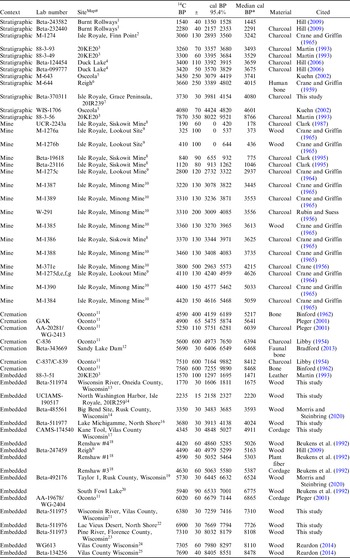
The development of 14C dating by Willard Libby in AD 1946 allowed for the direct dating of organic material associated with copper use. Libby, in AD 1954, was the first to 14C date charcoal found in cremated burials containing OCC grave goods from the Oconto site in Wisconsin (Figure 1, Table 1). The Oconto site is an OCC cemetery originally excavated in AD 1952, which consisted of both individual and multiple burials with grave offerings (Pleger and Stoltman Reference Pleger and Stoltman2009). Burials included primary extended inhumation, primary flexed inhumation, secondary inhumation (bundled), and cremations. The 14C analyses revealed dates of 7510 ± 600 BP and 5600 ± 600 BP (Libby Reference Libby1954) that were initially met with skepticism by researchers who argued that the site should date to the Woodland period (Pleger Reference Pleger2001). However, subsequent 14C measurements at Oconto resulted in dates of 7560 ± 600 BP and 4590 ± 400 BP, supporting Libby’s original findings (Mason and Mason Reference Mason and Mason1961; Binford Reference Binford1962). Work by Crane (Reference Crane1956) expanded the number of 14C measurements associated with the OCC by dating charcoal and wood preserved at the bottom of copper mines on Isle Royale. These dates range from 4420 ± 150 BP to 325 ± 100 BP, thus extending the potential age range for copper exploitation to younger periods (Crane Reference Crane1956; Crane and Griffin Reference Crane and Griffin1959, Reference Crane and Griffin1964, Reference Crane and Griffin1965) (Table 1).
14C dates associated with the Old Copper Complex.

* This is the median of the 14C calibration distribution.
The development of accelerator mass spectrometry (AMS) 14C dating made it possible to measure smaller masses of organic material associated with copper artifacts. Native copper is a known bactericide and fungicide that preserves organic matter (Martin Reference Martin1999). Beukens et al. (Reference Beukens, Pavlish, Hancock, Farquhar, Wilson, Julig and Ross1992) were the first to employ AMS techniques to date organic matter preserved with copper artifacts in North America. Until recently, a 14C date of wood embedded in a copper projectile point (i.e., 5940 ± 90 BP) from South Fowl Lake (Figure 1, Table 1) was considered one of the oldest reliable dates for worked copper in North America (Beukens et al. Reference Beukens, Pavlish, Hancock, Farquhar, Wilson, Julig and Ross1992; Martin Reference Martin1999). However, more recent AMS dating of wooden shafts embedded in copper projectile points from Vilas County, Wisconsin, produced even older ages of 7690 ± 40 BP and 7305 ± 60 BP (Reardon Reference Reardon2014). Copper has also been found in association with OCC-era bundle burials and partial cremations from the Osceola site in Wisconsin (Wittry and Ritzenthaler Reference Wittry and Ritzenthaler1956); two pieces of charcoal stratigraphically associated with burials at the site had dates of 4080 ± 70 BP and 3450 ± 250 BP (Stoltman Reference Stoltman1997; Kuehn Reference Kuehn2002). In general, these ages, and other 14C measurements suggest that copper use in the Lake Superior region occurred over thousands of years beginning in the Early Archaic period (i.e., 11700–7000 cal BP) (Martin Reference Martin1993; Clark Reference Clark1996; Hill Reference Hill2012; Bradford Reference Bradford2013; Morris and Steinbring Reference Morris and Steinbring2020).
Many OCC-era copper mines are located near small inland lakes on the Keweenaw Peninsula and Isle Royale. Previous experimental and crystallographic evidence has shown that the native copper ore was likely processed and worked into usable forms by heating with fire and working with stone hammers via a process known as annealing (Schroeder and Ruhl Reference Schroeder and Ruhl1968; Laronge Reference Laronge2001). Lakes are sensitive recorders of environmental change and therefore can be used to detect emissions from nearby metalworking activity (Lee and Tallis Reference Lee and Tallis1973; Renberg Reference Renberg1986; Graney et al. Reference Graney, Halliday, Keeler, Nriagu, Robbins and Norton1995). Pompeani et al. (Reference Pompeani, Abbott, Steinman and Bain2013) were the first to use lake sediments to reconstruct the timing of prehistoric copper mining and annealing emissions in Michigan. While the native copper in this region is of high purity, trace metals are found in the raw copper ore (Kerfoot et al. Reference Kerfoot, Urban, McDonald, Zhang, Rossmann, Perlinger, Khan, Hendricks, Priyadarshini and Bolstad2018), the surrounding bedrock (Woodruff et al. Reference Woodruff, Cannon, Dicken, Bennett and Nicholson2003; Pompeani et al. Reference Pompeani, Abbott, Bain, DePasqual and Finkenbinder2015), and in wood smoke (emitted during annealing) (Larson and Koenig Reference Larson and Koenig1994). Lead (Pb) volatilizes at temperatures found in wood fires, causing it to become airborne. Pompeani et al. (Reference Pompeani, Abbott, Steinman and Bain2013) proposed that Pb was released into the air along with wood smoke during mining and annealing and subsequently deposited in nearby lakes and retained in the sediment. This work was expanded upon by Pompeani et al. (Reference Pompeani, Abbott, Bain, DePasqual and Finkenbinder2015) and Pompeani (Reference Pompeani2015) to include other element proxies (e.g., copper) and an additional lake sediment record from Isle Royale.
METHODS
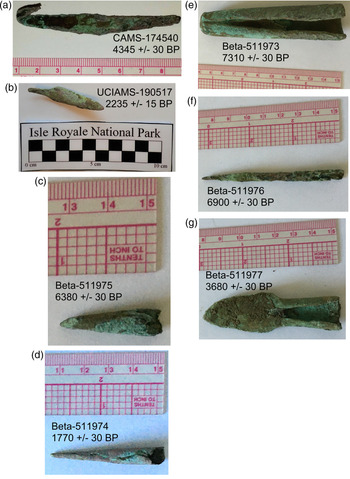
We assembled 14C dates associated with worked copper and copper artifacts typical of the OCC (i.e., described as heavy copper-tool technology in McKern Reference McKern1942) from the Lake Superior region (Table 1). We included seven new AMS 14C dates of wood and cordage embedded in copper artifacts (Figure 2) and one date of charcoal found in stratigraphic association with worked copper. With respect to the new dates presented here, all were subjected to a standard acid/base/acid pretreatment (Abbott and Stafford Reference Abbott and Stafford1996) prior to AMS analysis at Beta Analytic, Lawrence Livermore National Laboratory Center for Accelerator Mass Spectrometry, and the University of California Irvine Keck Carbon Cycle Accelerator Mass Spectrometer facility. 14C dates were calibrated to calendar ages using the IntCal13 calibration curve (Reimer et al. Reference Reimer, Bard, Bayliss, Beck, Blackwell, Ramsey, Buck, Cheng, Edwards and Friedrich2013). The dates were grouped according to context (i.e., stratigraphically associated, mine, cremation, and embedded), and the median age for each calibration distribution was calculated along with 95.4% confidence intervals (Table 1). For each of the four groupings of 14C ages, the probability density functions were summed in order to calculate cumulative probability distributions and a median estimated age for each grouping (Table 2; see appendix for code) (Reyes and Cooke Reference Reyes and Cooke2011; Crema et al. Reference Crema, Habu, Kobayashi and Madella2016; Drake et al. Reference Drake, Blanco-González and Lillios2016). For the summed (i.e., cumulative) distributions, the 14C dates were calibrated using OxCal v4.3 (Bronk Ramsey Reference Bronk Ramsey2009).
Images of copper artifacts with embedded organic material (i.e., wood and cordage) suitable for 14C dating. The 14C laboratory number and 14C date are shown in Table 1. A. Kane Tool, Vilas County, Wisconsin (photo credit: Robin Mueller), B. North Washington Harbor, Isle Royale (photo credit: Seth DePasqual), C. Wisconsin River, Vilas County, Wisconsin (photo credit: William Reardon), D. Wisconsin River, Oneida County, Wisconsin (photo credit: William Reardon), E. Pine River, Florence County, Wisconsin (photo credit: William Reardon), F. Lac Vieux Desert, North Shore (photo credit: William Reardon), G. Lake Michigamme, North Shore (photo credit: William Reardon).

Summed probability age distributions (cal BP).

Artifact 14C ages were compared with six lake sediment records from the Michigan Copper District (Pompeani Reference Pompeani2015) and one control lake from southeastern Minnesota (i.e., Lake Pepin) (Dean Reference Dean2009). Previous research suggests that Pb concentrations in lake sediment are sensitive to both historical and prehistoric emissions from nearby metalworking activity. Enrichment factor equations using titanium, magnesium, iron, and organic matter as references were applied to generate four Pb enrichment indices. The indices were averaged to produce a mean anthropogenic enrichment factor (EF), wherein values ≤1 are considered background levels (Pompeani et al. Reference Pompeani, Abbott, Steinman and Bain2013). The sediments were dated using a combination of 210Pb and AMS 14C measurements of terrestrial macrofossils. More detailed information regarding the study lakes and sedimentary analyses can be found in Pompeani et al. (Reference Pompeani, Abbott, Steinman and Bain2013, Reference Pompeani, Abbott, Bain, DePasqual and Finkenbinder2015) and Pompeani (Reference Pompeani2015).
RESULTS AND DISCUSSION
Stratigraphically Associated Dates
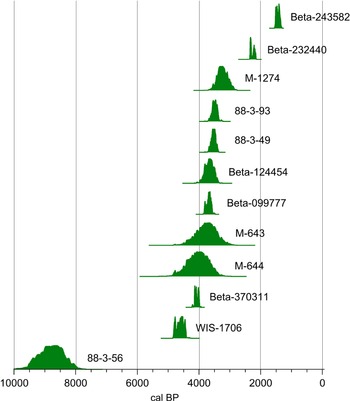
The stratigraphically associated ages are, for the most part, tightly clustered around the median summed probability age of 3630 cal BP (n=12), with nine dates within 1000 years of the median, two that are younger, and one that is much older (Table 2, Figure 3). Organic material stratigraphically associated (though not directly in contact) with copper is susceptible to mixing (e.g., animal disturbance, root intrusion, etc.), potentially confounding 14C results. In addition, stratigraphically associated materials may have been remobilized by natural processes (e.g., tree wind throw, mass wasting, etc.) or deposited after the abandonment of the copper artifact (e.g., wildfire in the case of charcoal).
Calibration probability distributions for 14C dates stratigraphically associated with copper artifacts (Table 1).

Dates from Copper Mines on Isle Royale
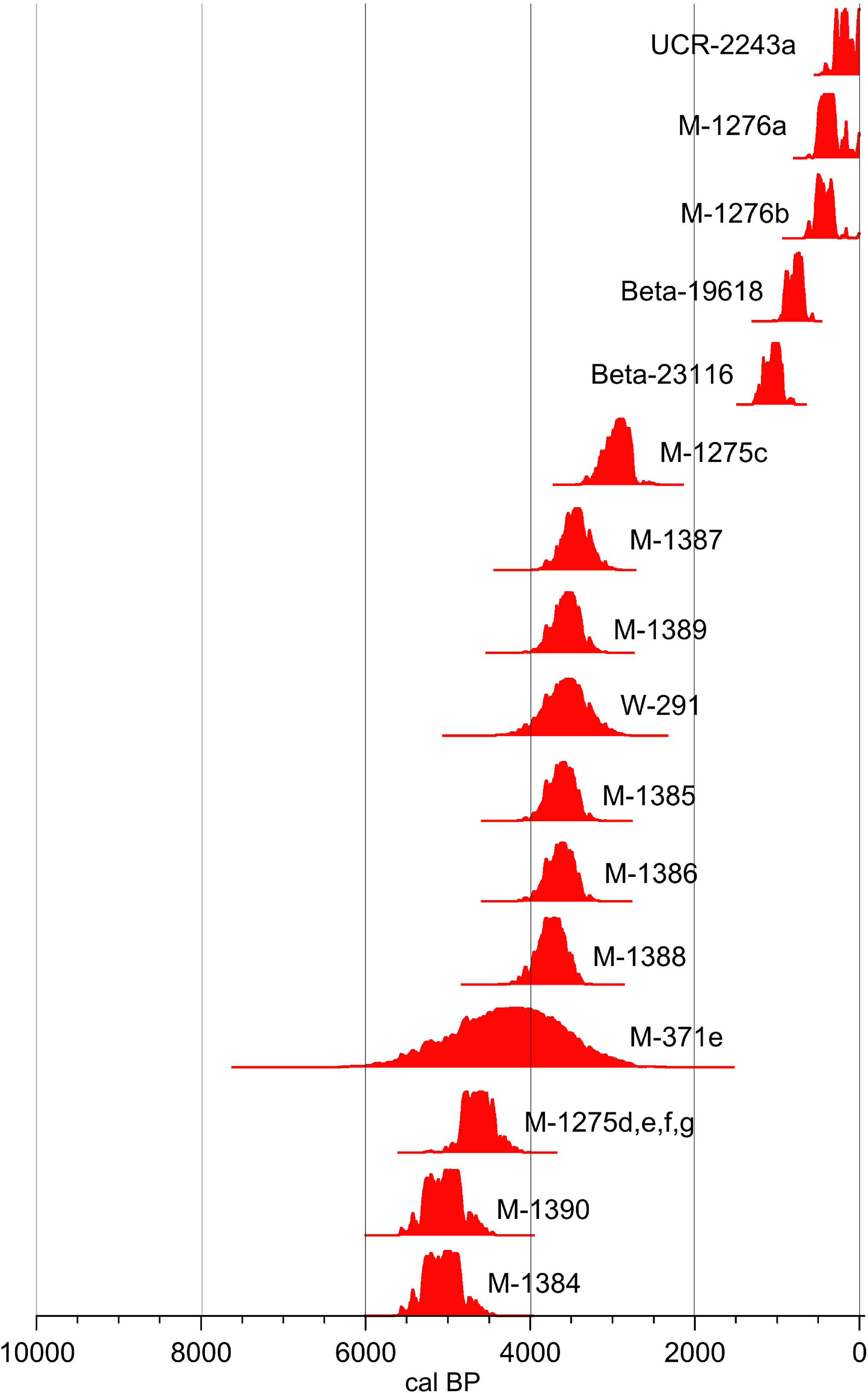
14C dates of wood and charcoal obtained from the bottom of prehistoric copper mine pits (Table 1) have been used to estimate the age for copper mining on Isle Royale, with early research proposing that they should reflect the period of active copper mining (see Halsey (Reference Halsey2018)). The ages from copper mines have a distinct bimodal distribution, with a separation of ca. 3000 years between the two modes (Figure 4). The median summed probability age of the mine dates (i.e., 3500 cal BP, n=16) is similar to the median summed probability age of the stratigraphically associated dates (Table 2).
Calibration probability distributions for 14C dates recovered from the bottom of copper mine pits on Isle Royale (Table 1).

Cremation Dates
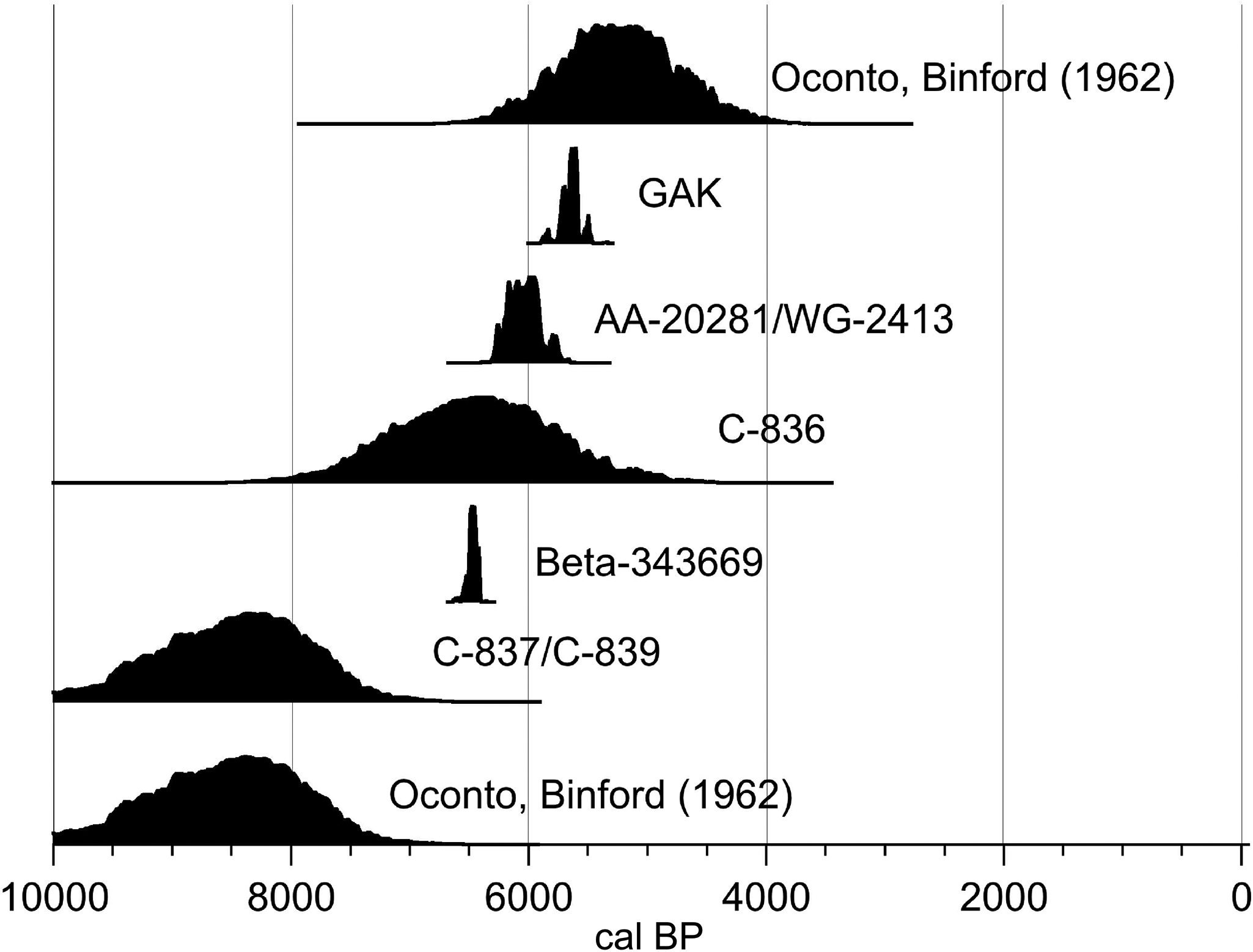
Cremation burials directly associated with copper artifact grave goods are generally older than dates found in stratigraphic association with copper artifacts and dates from mines (Figure 5). Five of the seven cremation ages are within 500 years of the median summed probability age of 6400 cal BP (Table 2), while two from the Oconto site (Table 1) are substantially older. These two anomalously old cremation dates were analyzed prior to the development of AMS and current chromatographic methods (e.g., High Performance Liquid Chromatography for dating bone) (Binford Reference Binford1962; Devièse et al. Reference Devièse, Stafford, Waters, Wathen, Comeskey, Becerra-Valdivia and Higham2018; Libby Reference Libby1954). 14C analysis (using AMS) of cordage wrapped around (i.e., embedded in) a copper grave artifact returned a date (i.e., 6020 ± 60 BP) comparable to that of charcoal (5250 ± 110 BP) taken directly from cremated burials (Pleger Reference Pleger2001) (Table 1). From the OCC burial site known as Osceola (Figure 1), however, two 14C dates of charcoal are younger (i.e., 4080 ± 40 and 3450 ± 250 BP) (Table 1) (Kuehn Reference Kuehn2002; Stoltman Reference Stoltman1997). This is probably due to the 14C ages at Osceola being taken from an associated stratigraphic layer, which as discussed above can produce anomalously young ages, rather than from material directly associated with burial deposits.
Calibration probability distributions for 14C dates of material recovered in cremation burials containing copper grave goods (Table 1).

Embedded Material Dates
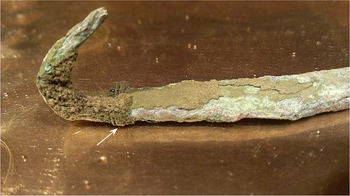
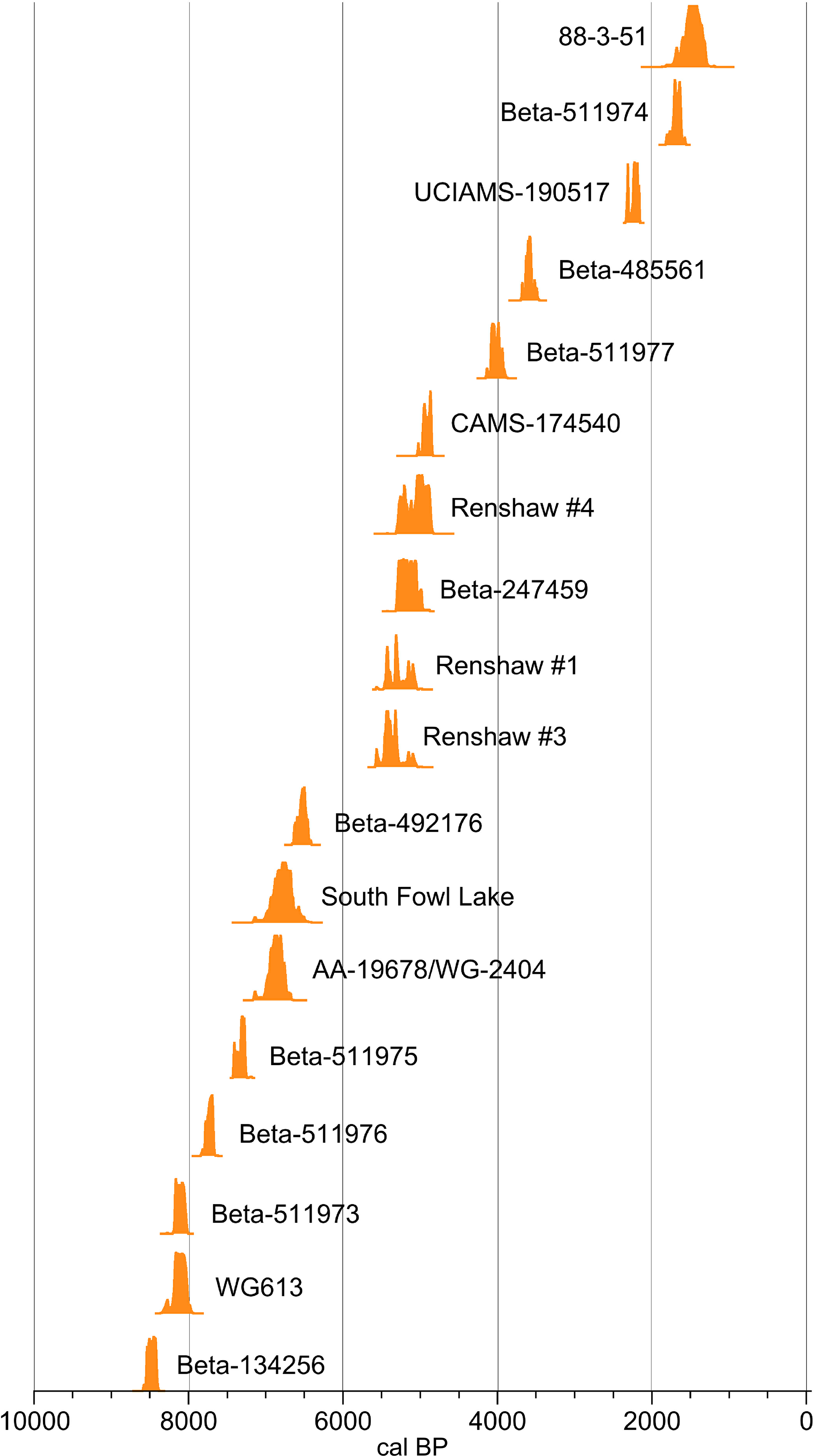
Embedded materials can be used for dating the timing of copper use because the weathering products of native copper oxidation are natural fungicides and bactericides that preserve organic material for long periods of time (Martin Reference Martin1999) (Figure 6). The embedded age distribution is different from the mine and stratigraphically associated date distributions in that there are no large clusters of similar ages, but rather a large range that spans a much greater time period than that of the other contexts (Figure 7). For example, the oldest age is 8480 cal BP and the youngest is 1470 cal BP. There is a small cluster around the median summed probability age of 5340 cal BP (n=18) (Table 2), with 13 of the 18 embedded ages dating to before 5000 cal BP (Figure 7).
Picture showing cordage preserved by native copper oxidation. This copper artifact was found in Vilas County, Wisconsin and the cordage shown was dated to 4345 ± 30 BP (CAMS-174540, Table 1) (photo credit: Robin Mueller).

Calibration probability distributions for 14C dates of wood and cordage found embedded or wrapped around a copper artifact (Table 1).

Three 14C dates of embedded organic material are anomalously young (Table 1, Figure 7). For example, a leather bag containing copper found on the Keweenaw Peninsula (site 20KE20) dates to 1570 ± 100 BP (Martin Reference Martin1993). However, no base pretreatment was applied to the leather prior to 14C analysis (Martin Reference Martin1993), which can result in anomalously young ages (Abbott and Stafford Reference Abbott and Stafford1996). In addition, two 14C dates of wood embedded in conical copper projectile points exhibiting a typical OCC shape have relatively young ages (i.e., <3000 cal BP, lab numbers UCIAMS-190517 and Beta-511974). One is a copper projectile point found at Washington Harbor on Isle Royale that dates to the Archaic-Woodland transition period (i.e., 2235 ± 15 BP), although the point was found on an Archaic period paleo-shoreline of Lake Superior, while another is a copper projectile point recovered near the Wisconsin River that dates to 1770 ± 30 BP (Table 1). Since the other reported 14C dates of conical copper projectile points are older than 3600 cal BP (or older than 3350 ± 30 BP) (Beukens et al. Reference Beukens, Pavlish, Hancock, Farquhar, Wilson, Julig and Ross1992; Hill Reference Hill2009; Reardon Reference Reardon2014; Morris and Steinbring Reference Morris and Steinbring2020), we propose that the organic material embedded in these OCC-style artifacts may have been contaminated after artifact abandonment (e.g., by intrusive plant remains), during excavation, during transport and storage after excavation, and/or pretreatment prior to 14C analysis. It is also possible that the projectile points are older than their associated dates but were re-shafted and reused during a later period. When the three anomalously young dates are excluded (n=15), embedded organic materials associated with copper artifacts have a median summed probability age of 6520 cal BP (Table 2).
Regional Lake Sediment Comparison
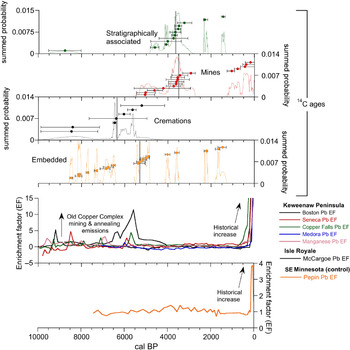
14C dates obtained from embedded organic material and cremated remains are contemporaneous with increases in Pb concentrations from ca. 9500 to 5000 cal BP in sediments from six lakes (Figure 1) on the Keweenaw Peninsula and Isle Royale (Pompeani Reference Pompeani2015; Pompeani et al. Reference Pompeani, Abbott, Bain, DePasqual and Finkenbinder2015; Pompeani et al. Reference Pompeani, Abbott, Steinman and Bain2013) (Figure 8). The study lakes are located near prehistoric copper mines (Gillman Reference Gillman1873; Whittlesey Reference Whittlesey1863; Winchell Reference Winchell1881) and are sensitive to heavy metal inputs from historical human activity. While the copper is of high purity, Pb is found in native copper ore at 0.2–1.4% concentration (Blakemore et al. Reference Blakemore, Sparks and Bos2017), as well as in the surrounding bedrock (Pompeani et al. Reference Pompeani, Abbott, Bain, DePasqual and Finkenbinder2015), and in wood smoke emitted during annealing (Larson and Koenig Reference Larson and Koenig1994). These levels of Pb are consistent with a relatively small (3–12 ppm) increase in Pb detected in sediments from lakes across the region. Pompeani et al. (Reference Pompeani, Abbott, Steinman and Bain2013) proposed that Pb was released into the air along with wood smoke during mining and annealing and deposited in nearby lakes. Therefore, increases in Pb in the sediment are interpreted to reflect the intensity of nearby copper mining and annealing activities (Pompeani Reference Pompeani2015; Pompeani et al. Reference Pompeani, Abbott, Steinman and Bain2013). Middle Holocene Pb increases were not found in sediments from Lake Pepin in southeastern Minnesota (Dean Reference Dean2009) (Figure 8), suggesting that the source of Pb was localized to the Michigan Copper District area, although comparing the Pb record in Lake Pepin (i.e., a basin found on the Mississippi River) to the small study lakes in Michigan might be complicated by Lake Pepin’s large watershed and high volume of water throughflow.
(Top) Median 14C ages (small circles ± 95.4% range) and summed probabilities of copper artifact 14C ages (colored lines) grouped according to archaeological context. Gray vertical lines are the median ages of the summed probability distributions for each group (Table 2). (Bottom) Anthropogenic lead (Pb) enrichment factors (EF) from the Keweenaw Peninsula and Isle Royale lake sediment cores. Increases in Pb EF during prehistoric times are interpreted to reflect emissions from Old Copper mining and annealing activity. The southern control site (i.e., Lake Pepin, see Figure 1) does not record middle Holocene increases in Pb (Dean Reference Dean2009), indicating that Pb emissions were restricted to the Michigan Copper District area. The Pb EF increases are contemporaneous with 14C dates from cremations and 14C dates of organic material embedded in copper artifacts, suggesting that they reflect the actual timing of the Old Copper mining industry.

The exact timing of the Pb increases in the Michigan Copper District area appear to be different at each lake, consistent with the hypothesis that the Pb deposition signals are uniquely associated with local metalworking activity (Pompeani et al. Reference Pompeani, Abbott, Steinman and Bain2013). The correspondence between the embedded and cremated 14C ages and sedimentary Pb contamination in lakes near prehistoric copper mines provides strong evidence that embedded 14C dates, not mine and stratigraphically associated dates, reflect the actual timing of the copper mining industry associated with the OCC (Figure 8). We suggest that 14C dates from mines and in stratigraphic association with copper artifacts likely reflect the timing of post-abandonment transformational processes.
Conclusions
An evaluation of all available 14C dates associated with OCC technology suggests that the type of material dated, and archaeological context are important when applying 14C data to establish the contemporaneity between sites and artifacts (Figure 1, Table 1). The 14C data show that, with a few exceptions, the ages of organic materials embedded within (or wrapped around) copper artifacts are older than both the ages of organic matter found in stratigraphic association with copper artifacts and 14C dates from the bottom of prehistoric copper mine pits (Figure 8, Table 2). This suggests that dates from layers in stratigraphic association or from the bottom of mine pits are likely affected by post-abandonment transformational processes, and therefore are not reliable indicators of site occupation and feature use. Conversely, organic material found directly in contact with a copper artifact appears to be ideal for determining the timing of use because the weathering products of native copper oxidation preserves the integrity and context of the organic material (Figure 6).
Embedded 14C dates from copper artifacts display a strong correspondence to the ages of Pb increases found in sediment from nearby lakes (Figure 8), reaffirming that these dates reflect the actual timing of the peak of the copper industry in the Lake Superior region. Taken together, these independent lines of evidence indicate that during the Archaic period, a copper mining industry emerged around Lake Superior, in some places multiple times, which was intensive enough to produce a signal detectable in lake sediment geochemical records. 14C dates from cremations and embedded material, along with large increases in Pb in sediment from several lakes across the region, converge on a time period sometime between 7000 to 5000 cal BP. We propose that this marks the timing of the peak in the ancient copper industry, an assertion supported by previous research demonstrating that the earliest reliable material associated with an OCC artifact dates to 5940 ± 90 BP (Beukens et al. Reference Beukens, Pavlish, Hancock, Farquhar, Wilson, Julig and Ross1992). The 14C ages presented herein and by Reardon (Reference Reardon2014) push back the oldest known copper artifact age to at least 7690 ± 40 BP (ca. 8500 cal BP), thus demonstrating that the OCC is among the oldest reliably dated metalworking industries in the world.
Acknowledgments
D.P.P. would like to thank the Department of Geology at Kansas State University for support during the writing of this manuscript. We thank Daniel Bain for laboratory support and James Cwiklik, Matthew Finkenbinder, and Christopher Purcell for help with fieldwork. Lake sediment geochemistry data are archived online at the NOAA National Centers for Environmental Information Paleoclimatology Database.
APPENDIX
The Matlab® code used to produce the stratigraphically associated summed probability distribution appears below. The code is identical to that used for the other groups of ages.
% compute summed probability distribution of radiocarbon ages, median and 2σ range of summed distribution and plot results
clear
close all
% create reference time frame
reftime = [-50:5:1E4]';
con = [0.023 0.159 0.5 0.841 0.977]; % 1 and 2 sigma
% assemble associated
files=dir('A*.dat');
% number of ages in ensemble
nfiles=size(files,1);
% assemble structure with all ages
for n = 1:nfiles
age = load(['A',num2str(n),'.dat']);
age(:,1) = 1950 - age(:,1);
age_int = interp1(age(:,1),age(:,2),reftime);
age_int = cat(2,reftime,age_int);
davesbigmatrix(n).a = age;
davesbigmatrix(n).aint = age_int;
end
for n = 1:nfiles
asum(:,:,n) = davesbigmatrix(n).aint;
asum = nansum(asum,3);
asum(:,1) = reftime;
end
acumsum = cumtrapz(asum(:,1),asum(:,2))/trapz(asum(:,1),asum(:,2));
for n = 1:size(con,2)
[c index] = min(abs(acumsum-con(n)));
arange(1,n) = reftime(index);
end
figure;
plot(asum(:,1),asum(:,2))
y1 = get(gca,'ylim');
hold on
for n = 1:size(arange,2)
if n == 3
plot([arange(n) arange(n)],y1,'k––','linewidth',3)
else
plot([arange(n) arange(n)],y1,'k––')
end
end
set(gcf,'Position',[100 100 900 300])
set(gca,'fontsize', 20)
xlabel('Year BP')
ylabel('Summed Probability')
xlim([min(reftime) max(reftime)])
title('Associated Age Summed Probability')