Introduction
Global Plan of Action provides a new framework
The need to enhance conservation and sustainable use of farm animal genetic resources (AnGR) reached a major milestone when the Global Plan of Action (GPA) and the Interlaken Declaration on Animal Genetic Resources (FAO, 2007c) were adopted. These documents set out the objectives and commitment for the work on AnGR. Their text fully responds to the obligations set out by the process following the Convention on Biological Diversity (CBD) to conserve AnGR as part of biodiversity, to ensure their sustainable use and to provide for equitable sharing of the benefits arising from their use. The first two pillars are comprehensively covered in the GPA and the text for the third pillar urges countries, under the Food and Agriculture Organization of the United Nations (FAO) coordination, to review their needs as regards access and benefit sharing (ABS) issues.
The core of the GPA is made of four priority areas: (1) characterization, inventory and monitoring of trends and risks; (2) sustainable use; (3) conservation; and (4) policies, institutions and capacity building. Of the four important priority areas, the European region was very particularly keen to emphasize the sustainable use priority area. This interest is due to the need to improve the self-sustainability of local breeds and to pay attention to selection goals and maintenance of genetic variation in intensively selected mainstream breeds. Many European countries have, over the last few decades, worked actively in creating inventories of their AnGR and in implementing actions to enhance conservation and sustainable use of AnGR. National programmes include strategies and actions to rescue rare breeds and measures aiming to re-establish the self-sustainability of local breeds. On the other hand, there is still an urgent need for further action to halt the loss of diversity and to promote sustainable use. Both in situ and ex situ strategies need to be strengthened. In some countries, better data management might be needed, while in other countries emphasis may need to be placed on issues such as cryopreservation. In many countries, contingency plans are not in place.
Europe strongly contributed to the GPA
The preparation of the GPA was strongly based on contributions from countries. The country reports contained not just information on the state of AnGR within individual countries, but also an analysis of the country's capacities in the area and future needs. It is probably not an exaggeration to say that before the country reports, AnGR were considered as consisting of only rare or forgotten local breeds. The new survey opened participants' eyes and allowed them to look into questions in a new way and to think about the state of the animal production sector as a whole and about its potential for development. European countries were very keen on reviewing their animal production and development work and the related AnGR. The individual country reports are available to view on DAD-IS (Domestic Animal Diversity Information System). The outcome of the European country reports have also been summarized (FAO, 2007a) and annexed to the State of the World's Animal Genetic Resources for Food and Agriculture (SoW-AnGR; FAO, 2007b). European experts have actively taken part in writing thematic studies and individual chapters in the SoW-AnGR. The topics have covered areas like regulatory options for exchange and sustainable utilization of genetic variation and genomics.
Current policy issues: GPA implementation and ABS regime
Implementation of the GPA on AnGR is one of the priority areas in the Multi Year Programme of Work of the FAO Commission on Genetic Resources for Food and Agriculture (CGRFA). Moreover, as the Conference of the Parties of the CBD have been discussing an international regime on ABS, and the 11th Regular Session of CGRFA also agreed on the importance of considering ABS in relation to all components of biodiversity for food and agriculture, an international regime on ABS under the CBD is likely to be a framework regime requiring further elaboration for specific genetic resource areas. Animal Genetic Resources for Food and Agriculture forms one such area. In particular, an important unanswered question is: Which specific policies and measures might best constitute components of an international regime specific for AnGR?
At first sight, international exchange and use of AnGR might seem to take place relatively unhampered, and without strong government policy interference, with the exception of veterinary protection measures. The exchange of breeding animals and semen is active and occurs on a regular basis. Questions related to the ownership of AnGR and ABS have been mostly ignored, except the patenting of new tools, which exploit molecular genetics. Some potentially unfair process patents have also triggered discussion on ABS-type issues. However, the likely adoption of an international regime on ABS justifies a consideration of current practices against the background of new generic rules on ABS. Clearly in strengthening national programmes and in tackling international questions, there is much work ahead and active discussion is needed within and between countries.
The plant genetic resources community has experienced a different kind of development. Plant varieties have been protected since the early 1960s. At the same time, diversity-rich regions and developing countries have been emphasizing the benefit sharing issues and plant breeders have been interested in the facilitation of easy access to genetic resources. These are some of the key motivations for adopting the International Treaty for Plant Genetic Resources for Food and Agriculture (2004). Although the practices for AnGR are very different (e.g. Hiemstra et al., Reference Hiemstra, Drucker, Tvedt, Louwaars, Oldenbroek, Awgichew, Abegaz Kebede, Bhat and da Silva Mariante2006), it is worth thinking about the political implications and possible benefits of the development of common guidelines or recommendations or even, perhaps, a formalized agreement on AnGR. This would clarify the issues involved and remove uncertainties. It would certainly give the sector the visibility and recognition it deserves.
The aim of this article is:
1. to describe developments and trends in Europe related to AnGR conservation and use;
2. to introduce European policies and major actors, stakeholders and networks.
With this publication we also want to show that AnGR conservation and sustainable use are a matter of different policy areas that can contribute to the same objective. There are lots of opportunities to support and enhance agrobiodiversity in Europe.
State of AnGR and animal production in Europe
European trend in production and consumption and international trade
The use of AnGR follows the trends in the livestock sector, in particular trends in food consumption. There is an increasing demand in global consumption of animal protein. On average, per capita consumption of animal-derived food is highest among high-income groups and growing fastest among lower- and middle-income groups in countries that are experiencing strong economic growth. People in industrialized countries currently derive more than 40 percent of their dietary protein intake from food of livestock origin, and there has been little change in this proportion in the last two decades (Steinfeld et al., Reference Steinfeld, Gerber, Wassenaar, Castel, Rosales and de Haan2006). Some higher-income sections in societies are cutting down on these components in diet for a number of reasons including health, ethics and an altered level of trust in the livestock sector.
There is some heterogeneity among European countries in the trends in production and consumption, but overall the state and changes follow the patterns seen in developed countries. Between 1985 and 2008, the total meat production in Europe stayed the same or decreased slightly. Only poultry production experienced considerable increase, with the annual rate being 2.5 percent. Pork production fluctuated over the 20-year period with hardly any overall increase and beef production actually declined by one-third. In Europe, the number of dairy cows is now less than half of what it was 20 years ago while owing to higher yield the total milk production has decreased only by 20 percent. Consequently, more dairy products are now imported to Europe (FAO, 2009).
In many European countries, livestock production and merchandising are a significant business, accounting for half of the agricultural gross domestic product. The last decades have seen the transition from extensive to intensive production. These changes have often been accompanied by major negative environmental consequences. Consumers perceive organic farming as a sustainable way to produce food. Many European farms have switched to certified organic production. Within EU, some 4 percent of the farmed area belonged to organic agricultural production in 2005 with much variation across countries. The area was highest (11.0 percent) in Austria, while in many other countries less than 1 percent (European Commission, 2009).
For Europe, population growth has very much ceased and moderate economic growth is expected. For these reasons, no major changes in demand can be expected. Poultry, pork and cheese production are expected to increase by 10 percent in the next 10 years while butter and beef consumption will reduce by some 5 percent. In the context of increased yields per head and strict quota rules, the EU dairy herd is projected to fall. This is a major factor driving the decline in EU beef production (Table 1, OECD-FAO Agricultural Outlook, 2009–2018).
The actual and predicted changes in cattle, pig and chicken sectors in Europe.

1Production in whole Europe (source: FAOSTAT).
2Predicted change in production over the period 2008–2018 in EU-27 countries (source: OECD-FAO).
The trade balances in animal products have recently changed and this is expected to continue in the coming years. From the European perspective, this is linked with growing demand in developing countries and EU policy reforms. The proportion of world exports supplied by Europe is projected to decrease. Moreover, the global threat of disease outbreaks and their after-effects are a dampening factor affecting otherwise generally positive prospects for world meat trade (Silvis, Reference Silvis2006).
State of European AnGR
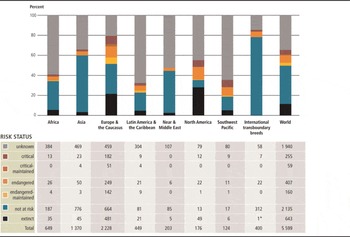
The trends in the livestock sector in Europe during the past decades have gone hand in hand with the use of specialized breeds and hybrids. A few international mainstream breeds dominate animal production and mainstream breeds of the past became rare breeds. Table 2 (FAO, 2007b) shows that more than 20 percent of the European breeds are reported as extinct and about 30 percent of them are “at risk”. The percentage of breeds with status unknown is less than in other regions; however, the high number of breeds at risk is still worrying.
Risk status of the world's mammalian breeds in January 2006 (figures by region) (copied from the SoW report, FAO, 2007b).

In this context of global breed statistics we also must realize that “breed” is a European concept. Although there are different breed definitions in use, in the European context, a “breed” is an important conservation entity. However, maintaining within breed diversity or “overall allelic diversity” is as important as maintaining breeds.
History of breed development
Over centuries, livestock populations have been divided into a number of subpopulations, because of geographical isolation, selection by their human keepers and other evolutionary forces. These subpopulations may loosely be termed as breeds. We can argue that breed is often also a cultural term.
The year 2009 celebrated Darwin, as it was 200 years from his birth and 150 years from the publication of The Origin of Species (Darwin, Reference Darwin1859). He was very familiar with domestic animals, and to denote the difference from natural selection or unconscious selection, he called the farmers' and breeders' work “artificial selection”. Prior to Darwin, species and breeds were considered fixed and idealized types with no meaningful variation, which made Darwin sarcastically consider “that there formerly existed in Great Britain eleven wild species of sheep peculiar to it”.
Livestock shows have had an effect on emphasizing the ideas about the correct conformation and colour. Intentional inbreeding was sometimes used to remove the heterogeneity within a breed. While most of the European breeds are fairly uniform by their image, there are exceptions. For example, European goat breeds are phenotypically very heterogeneous. In Iceland, a uniform outlook has never been a target in cattle, sheep or horse, while variation in colour has been much appreciated (Adalsteinsson, Reference Adalsteinsson1991).
Developments in animal breeding
Gibson and Pullin (Reference Gibson and Pullin2005) describe several phases of livestock breeding in industrialized countries. In the nineteenth century, urbanization and the development of more intensive agriculture led to the stabilization of many breeds as distinct genetic entities through the establishment of breed societies that defined breed characteristics and purity. The first pedigree books were established in Great Britain as early as in the eighteenth century. The turn of the twentieth century was a very active period in the foundation of breeding associations. Local breeds were seen as a part of national identity.
Breeds that were better adapted to modern production systems became more widespread, while other breeds consequently declined and even became extinct in a considerable number of cases (FAO, 2007b). In the middle to late twentieth century, modern within-breed genetic improvement programmes became widely established. This was coupled with specialization in the livestock sector, extensive use of crossbreeding, and the rise of breeding cooperatives and companies. Animal breeding was modernized by market growth, transport and communication, and an improved understanding of genetics.
Primary production with specialized breeds is part of a standardized and efficient food chain that is very much controlled by national, and also more and more by international, commercial operators. Although mainstream breeds stem from local breeds, the major factors driving the livestock sector are often a threat for less competitive and marginalized local breeds. On the other hand, the last two decades are showing how European/national policies and stakeholder strategies can positively influence the future of local cattle breeds. Since European countries committed themselves to international obligations to conserve and sustainably use AnGR (CBD, FAO GPA), national action plans are being developed. National action plans are now including strategies and measures on how to maintain local cattle breeds and how to make them more self-sustaining.
Global exchange and the rise of global players in animal breeding
Over the recent decades, the exchange of breeding animals within Europe has been very active. The global gene flow has been mainly between the countries in the north, less so from north to south or from south to south. Compared with these flows, there is very little south to north exchange. Among the five major livestock species – cattle, sheep, goat, pig and chicken – the internationalized breeds are dominating the breed spectrum in the world. In cattle, eight of the most popular breeds have a European origin. The most important is the Friesian dairy breed with its North-American Holstein upgrade. Charolais is the most widely used of the pure beef breeds. In sheep the European dominance is lower, with five of the top ten breeds and the figures are much lower for goats. All five leading pig breeds are European (FAO, 2007b).
In terms of the number of active breeding organizations or breeding companies, European companies and cooperatives have obtained a substantial market share. Breeding material or breeding stock from European breeding industry forms the basis for a large share of global cattle, pig or poultry production. For example, in the poultry industry, a small number of multinationals are actively selling highly specialized hybrid layers and broilers, using a very limited number of intensively selected breeding lines. Similar developments could also be seen in the pig and cattle sector.
Common policies
Common Agricultural Policy since the late 1950s
Agriculture has always been one of the most important sectors in European policy. Although not all European countries are part of the EU, non-EU countries have gone through similar developments as EU countries. The first Common Agricultural Policy (CAP) was set as early as 1957. There was a need to make agriculture more productive to meet the requirements for more stable markets and for moderately priced food. The farmers' living standards were also hoped to be improved. The objectives were gradually realized and eventually over-realized, so that discussion over decades changed to overproduction, trade distortion and environmental questions. The 1990s have seen reformations in the CAP aiming at moving agriculture towards market principles and at the same time becoming more sustainable. At the same time, policies have been widened to cover rural activities other than agriculture, such as on-farm food processing and tourism.
Policy changes in agriculture and rural development
As a result of the CAP reform, adopted by the European Council in 2003, subsidies became more independent from the volume of production and rather linked to environmental, food safety and animal welfare standards. The goals for rural development are achieved through diversification. Farmers are encouraged to take part in new kinds of activities directed towards e.g. biodiversity and environmental services, as conventional agriculture is no longer an automatic source of income.
Management of AnGR in Europe can also benefit from this shift in CAP. The European legal framework provides for financial support to be given to farmers rearing farm animals of “local breeds indigenous to the area and in danger of being lost to farming” in the context of rural development objectives and agri-environmental programmes.
In the world or even within a region, like Europe, there is wide heterogeneity among animal production systems and the use of local or mainstream genetic resources. Common policies have to be comprehensive enough to be adapted to specific breed cases, their needs, and national or regional specificities. At the European level, a number of policy areas might, directly or indirectly, promote or hamper the use of local breeds. For example, livestock biodiversity and rural development objectives can be easily connected, or strict sanitary measures should not unnecessarily hamper the conservation and use of local cattle breeds. Common policies should avoid unbalanced effects across countries and should be accompanied by local policies tailored to specific country/breed situations (“one size does not fit all”).
Veterinary and zootechnic legislation
The EU has identified food safety as one of its top priorities and has developed considerable legislation regulating the safety of food, including animals and animal products. Because of newly discovered health hazards and newly developed technologies, such as genetic engineering, EU legislation with regard to food has recently undergone significant reform.
The EU legislative framework for food safety affects livestock production and marketing, and hence the utilization of AnGR. The legislative texts are designed primarily to regulate imports and intracommunity trade involving animals and animal products.
The situation on animal diseases in Europe remains very good, despite the recent issues such as BSE (Bovine Spongiform Encephalopathy) and foot and mouth disease. Modern animal production is more affected by multifactorial syndromes related to poor housing, feeding or hygiene. At present, the veterinary control and eradication schemes in Europe are so effective that any emerging major disease is quickly removed (Cunningham, Reference Cunningham2003).
EU legislation related to animal breeding is contained in the Community's zootechnical legislation. This legislation aims to promote free trade in breeding animals and genetic material while considering the sustainability of breeding programmes and conservation of genetic resources.
The aims are reached by harmonized recognition of breeding organizations, pedigree certificates, criteria governing entry in herd books, performance testing, and genetic value assessment and acceptance for breeding purposes.
Programme GENRES 870/04
In the Biodiversity Action Plan for Agriculture, the European Commission proposed to launch a new community programme on the conservation, characterization, collection and utilization of genetic resources in agriculture. The community programme, which has been established by Council Regulation (EC) No 870/2004, promotes genetic diversity and the exchange of information including close coordination between member states and between the member states and the European Commission. The budget allocated to this programme, which complements the actions co-funded by the new Rural Development Council Regulation (EC) No 1698/2005 [Article 39(5)], amounts to EUR 8.9 million. The community programme co-funds 17 actions, involving 178 partners located in 25 member states and 12 non-EU countries. The actions started in 2007 and have a maximum duration of 4 years. There are five projects dealing with AnGR (http://ec.europa.eu/agriculture/genetic-resources/actions/index_en.htm). The first community programme, established by Council Regulation (EC) No 1467/1994, gave rise to 21 projects, with a total EU co-funding of around EUR 10 million in 1996–2005.
Incorporation of AnGR in different policy areas
Over the years, the EU has shown much interest in incorporating issues of genetic resources in policy making. The member states coordinate their common position at the council level and the member state holding the presidency expresses the EU position at FAO level. So far, the AnGR issues are dealt by several directorate generals: SANCO (Health and Consumer Affairs – zootechnics, animal health), AGRI (Agriculture and Rural Development – CAP), ENV (Environment – follow-up of CBD), RTD (research) and DEV (Development – FAO-issues). Currently, the European Commission, however, lacks expert units devoted solely to AnGR issues. The work on AnGR would benefit if there was a single body dealing with animal breeding and conservation issues within the EU, as it is the case for plants. The common legislation has harmonized national legislation in EU countries and raised the awareness on the importance of sustainable conservation and utilization of AnGR. EU is emphasizing the need for achieving profitable production for all farm animal breeds. The patent rights are defined in Europe by the European Patent Convention and EU has adopted a directive for biotechnological patents, which is setting special rules for the grant and scope of the protection for this type of patents (98/44/EC). This directive has rules targeting patents on both plant- and animal-related inventions.
Modern approaches in the management of AnGR
Sustainable breeding programmes
Modern animal breeding has moved from selection on single traits (e.g. growth, leanness, milk production and egg production) to selection for multiple traits that balance production, reproduction, product quality and animal robustness characters.
Sustainability of a breeding programme has many aspects worth considering. A wide-ranging discussion on them is given by Woolliams et al. (Reference Woolliams, Berg, Mäki-Tanila, Meuwissen and Fimland2005) with some of them presented here. (1) The objectives in the operations should be shared by all the stakeholders in the production chain. The development schemes should also address socio-economic impact (rural economy, national economy, subsidies and export/import), public perception on breeding technology and environmental consequences (quality of environment and landscape management). (2) The analysis of demand and market should take into account political and economic global and national trends, and the preference by the consumers and the society. Fragmentation in consumption habits and marketing is an important factor in modern societies. (3) The recording schemes are an integrated part of production in farms. The more expensive schemes involve health and welfare traits and molecular genetic typing of animals. (4) A breeding and conservation scheme should be designed to avoid genetic risks owing to a low number of parents, which may cause genetic drift or even inbreeding depression. A breeding programme needs backup storage of genetic material in frozen semen and embryos to replenish the genetic variation in the future. Another type of risk is that the long-term results in breeding programme may deviate from the desired ones because of ignorance of unfavourable side-effects owing to narrowly focussed selection. (5) Importation planning should also take into account the possible risks of diseases. Avoiding continued dependence on importation is in this sense very wise. (6) The best possible experts should be used in development, planning and operative work. For example, if the marketing is not done professionally, domestic or international operations may fail in gaining new market ground or in maintaining the existing one.
Revolutionary genomic tools
Genomics research has made impressive progress in recent years. Genomic tools have been exploited widely in many areas, in characterizing the diversity of farm animal populations and in locating genes (QTL, quantitative trait loci) mediating the variation in production, health and reproduction traits. Assuming that the DNA markers being used are neutral, with a number of independent markers it is possible to find out which marker alleles are common or different among related breeds and thereby estimate the relationships among breeds. Pig breed diversity was assessed using 50 microsatellites (SanCristobal et al., Reference SanCristobal, Chevalet, Haley, Joosten, Rattink, Harlizius, Groenen, Amigues, Boscher, Russell, Law, Davoli, Russo, Désautés, Alderson, Fimland, Bagga, Delgado, Vega-Pla, Martinez, Ramos, Glodek, Meyer, Gandini, Matassino, Plastow, Siggens, Laval, Archibald, Milan, Hammond and Cardellino2006). The neighbour-joining tree drawn from the Reynolds distances among the breeds showed that the national varieties of major breeds and the commercial lines were mostly clustered around their breeds of reference (Duroc, Hampshire, Landrace, Large White and Piétrain). In contrast, local breeds, with the exception of the Iberian breeds, exhibited a star-like topology.
In sheep, levels of heterozygosity were slightly higher in southern than in northern sheep breeds, consistent with declining diversity with distance from the near eastern centre of domestication (Lawson et al., Reference Lawson, Byrne, Santucci, Townsend, Taylor, Bruford and Hewitt2007). The diversity study on goats (Cañón et al., Reference Cañón, García, García-Atance, Obexer-Ruff, Lenstra, Ajmone-Marsan and Dunner2006) also supports the hypothesis that domestic livestock migrated from the Middle East towards western and northern Europe and indicate that breed formation was more systematic there than in the Middle East. The studies have been used to find the genetic distances between the cattle breeds and thereby find the most unique breeds with highest value for conservation (Cañón et al., Reference Cañón, Alexandrino, Bessa, Carleos, Carretero, Dunner, Ferran, Garcia, Jordana, Laloë, Pereira, Sanchez and Moazami-Goudarzi2001). The Weitzman approach in breed diversity studies has been criticized for neglecting the within breed variation (e.g. Toro, Reference Toro2006). The chicken diversity study (Hillel et al., Reference Hillel, Groenen, Tixier-Boichard, Korol, David, Kirzhner, Burke, Barre-Dirie, Crooijmans, Elo, Feldman, Freidlin, Mäki-Tanila, Oortwijn, Thomson, Vignal, Wimmers and Weigend2003) was accompanied by a cluster analysis about the composition of named breeds (Rosenberg et al., Reference Rosenberg, Burke, Elo, Feldman, Freidlin, Groenen, Hillel, Mäki-Tanila, Tixier-Boichard, Vignal, Wimmers and Weigend2001). This kind of study would set more comprehensive criteria for choosing populations for conservation.
The most recent technology is direct sequencing of individual genomes. This would provide new possibilities to reveal how domestication and selection have affected the genomes. The approach has been recently used in chicken (Rubin et al., Reference Rubin, Zody, Eriksson, Meadows, Sherwood, Webster, Jiang, Ingman, Sharpe, Ka, Hallböök, Besnier, Carlborg, Bed'hom, Tixier-Boichard, Jensen, Siegel, Lindblad-Toh and Andersson2010).
QTL mapping has attracted many research groups. The research has been aimed at improving the understanding about quantitative genetics and at finding markers that could be used in enhancing the selection in traits subject to substantial non-genetic variation where conventional selection is rather inefficient. Thousands of QTL have been found across species, while very few cases have led to identification of the actual locus causing the variation. Many QTL-related patents have been released, though with rather thin practical usefulness. The animal breeding industry has therefore very enthusiastically switched to a new approach of using thousands of single nucleotide polymorphism (SNP) markers to find their individual effects among reliably tested individuals and thereby obtain predicted genetic values for marker typed newly born individuals (Meuwissen, Hayes and Goddard, Reference Meuwissen, Hayes and Goddard2001). The new strategy would accelerate breeding programmes with only a fraction of the costs of a conventional programme (Schaeffer, Reference Schaeffer2006). The successful application would require over 2000 reference individuals with accurately known genetic values (VanRaden et al., Reference VanRaden, Van Tassell, Wiggans, Sonstegard, Schnabel, Taylor and Schenkel2009), feasible only in large-scale dairy cattle breeding. When individual operations at a country level in Europe are far from the required scale, this has triggered a new kind of collaboration between the countries and breeding companies.
Actors and networks
Networking in Europe has taken many forms. There is regional collaboration by the countries to respond to the FAO-coordinated work. Non-governmental organizations (NGOs) are functioning in different areas: research, general animal production, animal breeding, rare breeds, etc. The EU research framework programmes are facilitating lots of different types of collaboration across countries. There is also collaboration on harmonizing and delivering the data on breed diversity and state of conservation work in Europe.
Governmental organizations
The implementation of CBD is carried out by individual countries. The treaties, obligations, standards and recommendations accepted at an international level are developed and implemented within the countries by adjusting and completing the respective national strategies and policies, laws and statutes. Most of the European countries have national action plan to coordinate the inventory, breeding, conservation and capacity building topics for AnGR. Each country has networks for the management of genetic resources, including administration, breeding organizations, research and hobby societies. European National Coordinators for AnGR (NC) play a central role in the coordination of work at national level and NCs are organized in a European network.
European Regional Focal Point for Animal Genetic Resources
Europe plays an important role in the global programme for AnGR. Until 2007, it was the only region that had a common secretariat working towards a coordinated programme. It is called the European Regional Focal Point for Animal Genetic Resources (ERFP). The ERFP is the European implementation of global strategy of the FAO for the management of farm AnGR. ERFP is a communication platform managed by a secretariat and steering committee. It publishes information for the national coordinators and ensures the exchanges of information and experience between the different countries and the governmental and NGOs. When compared with the well-established networks in the PGR sector (ECP/GR – European Cooperative Programme for Crop Genetic Resources Network) and forestry (Euforgen – European Forest Genetic Resources Programme), there is clearly a need to further strengthen the European regional coordination on AnGR.
ERFP works with subregional organizations in order to reinforce the common approach in neighbouring countries having the same problems or needs. For example, the Nordic countries are collaborating in the area of AnGR. This includes research, breeding organizations and the joint work within the animal sector of the Nordic Genetic Resource Centre (NordGen). Such a close subregional collaboration is unique. It is based on common values, needs and goals and brings benefits in cost efficiency and increased critical mass. The NordGen animal sector has had working groups, for example, on sustainable management of AnGR (Woolliams et al., Reference Woolliams, Berg, Mäki-Tanila, Meuwissen and Fimland2005) and the policy issues related to access and benefit sharing (Mäki-Tanila et al., Reference Mäki-Tanila, Tvedt, Ekström and Fimland2009).
ERFP has also established close working relationship with international NGOs such as Rare Breeds International (RBI), The SAVE Foundation (Safeguard for Agricultural Varieties in Europe), Danubian Alliance for Conservation of Genes in Animal Species (DAGENE) or the European Forum of Farm Animal Breeding (EFFAB). For all the scientific aspects, it receives help from the European Association of Animal Production Working Group on Animal Genetic Resources (EAAP WG-AGR). The ERFP does not create new structures but relies as far as possible on existing functional structures in the different countries. ERFP has recruited working groups to focus on regional or general questions on AnGR. An example of an outcome from such working groups has been the guidelines on cryopreservation (Hiemstra, Reference Hiemstra2003; Planchenault, Reference Planchenault2003).
The ERFP has also supported a range of regional workshops organized by NCs. These workshops have looked at issues such as the practical and scientific aspects of the conservation of AnGR in individual countries, strategies for conservation, and use and training in various aspects of AnGR conservation.
The ERFP holds an annual meeting of NCs. The meeting is organized at the same location as the EAAP annual meeting to allow NCs to participate in the scientific sessions of EAAP, in which there is also a scientific session organized by the ERFP, relating to the scientific aspects of AnGR research and conservation.
Non-governmental organizations
In Europe, there is a variety of organizations and networks actively involved in AnGR management, representing different stakeholder groups (including animal breeding, conservation and research).
European Federation of Animal Science
The EAAP represents the professional interests of scientists, academics, professionals and producers, technicians, extension officers, government departments and farmer organizations. Its mission is to promote generation and dissemination of knowledge and views on animal science and production. It organizes annual meetings with several study commissions. An example is the Genetics Commission, which attracts highly qualified speakers often also from outside Europe. EAAP also established a specific – and in many ways pioneering – working group on AnGR as early as 1980 (Maijala et al., Reference Maijala, Cherekaev, Devillard, Reklewski, Rognoni, Simon and Steane1984). EAAP recently started publishing a scientific journal Animal. There are also report-type publications appearing regularly on specific topics. Most of the funding to the EAAP organizations comes from national organizations within European countries, with major contributions from the national governments.
SAVE Foundation
The SAVE Foundation is the European umbrella organization for the safeguarding of agricultural varieties. Its mission is the conservation and promotion of genetic and historically important cultural variety in agricultural flora and fauna. Particular emphasis is placed on ensuring the survival of threatened breeds of farm animals and species of cultivated plants. SAVE Foundation links the work of NGOs throughout Europe.
European Forum of Farm Animal Breeding
The EFFAB is an independent European forum for farm animal reproduction and selection organizations (industry and farmer's cooperatives), including companies involved in related technologies. A number of animal breeders came together to form the group in Utrecht in 1995. Their first goal was to improve industry access to research and promote the technology transfer of research results within the biotechnology and agriculture research programmes of the European Commission. EFFAB is approaching funding bodies to enhance the positive image of animal breeding. Furthermore, it is promoting transparency, diversity and animal welfare in interacting with the media and the general public. Recently, EFFAB joined the group of NGOs working closely with FAO.
Research
Knowledge lies at the heart of the European Union's Lisbon Strategy to become the “most dynamic competitive knowledge-based economy in the world”. The “knowledge triangle” – research, education and innovation – is a core factor in European efforts to meet the ambitious Lisbon goals. Numerous programmes, initiatives and support measures are carried out at EU level in support of knowledge. The Seventh Framework Programme (FP7) bundles all research-related EU initiatives together under a common goal and plays a crucial role in reaching the goals of growth, competitiveness and employment; along with a new competitiveness and innovation framework programme, education and training programmes, and structural and cohesion funds for regional convergence and competitiveness. It is also a key pillar for the European Research Area (ERA). The broad objectives of FP7 have been grouped into four categories: cooperation, ideas, people and capacities. For each type of objective, there is a specific programme corresponding to the main areas of EU research policy. All specific programmes work together to promote and encourage the creation of European centres of (scientific) excellence.
In the area of cooperation, for example, Erasmus Mundus is a cooperation and mobility programme in the field of higher education that aims to enhance the quality of European higher education and to promote dialogue and understanding between people and cultures through cooperation with third countries. The Erasmus Mundus programme promotes collaboration between excellent universities within the EU. Also in the area of animal breeding and genetics, joint courses have been developed and funded by the EU (EM-ABG).
The EU lays special emphasis on funding research programmes. One of the themes is related to food agriculture and fisheries, and biotechnology. The funding strategy is carried out by programmes that operate periodically. The programmes support transnational cooperation in research, innovation delivery and policy support across the European Union, and beyond. The programme is promoting a European knowledge-based bio-economy by bringing together science, industry and other stakeholders, to exploit new and emerging research opportunities that address social, environmental and economic challenges. There are many types of research collaboration: networks of excellence, collaborative project (generic), large-scale integrating project, small- or medium-scale focused research project, support actions, coordination (or networking) actions and collaborative project for specific cooperation actions dedicated to international cooperation partner countries (SICA).
Research will be enabled for the sustainable production and management of biological resources (microbial, plants and animals) and will include “omics” technologies incorporating genomics, proteomics, metabolomics and converging technologies, and their integration within systems biology approaches, as well as the development of basic tools and technologies and relevant databases for variety identification within species groups. Sustainability and competitiveness are improved while safeguarding consumer health and decreasing environmental impacts in agriculture, horticulture, forestry, fisheries and aquaculture, at the same time taking into account climate change. Through the development of new technologies, a whole ecosystem approach will be addressed.
The topics, funded by FP7, have covered or are currently covering many areas in genetics, genomics, breeding and diversity of farm animals. Few examples are: QTL mapping, genomics applications, organic sustainable breeding of dairy cattle, breeding in low-input production, candidate genes for meat quality and fatness, sustainable use of reproduction technology, use of high performance computing, genetic strategies for controlling salmonellosis, breeding tools for mastitis resistance, animal disease genomics, improvement of robust dairy cattle, sheep health genetics, utilization of SNPs in commercial pig breeds, sequence tools for livestock genomes, characterization of pig breed diversity, genetic tools to mitigate environmental impact and diversity information system.
Monitoring and characterization
To monitor diversity in European farm animal breeds a European farm animal biodiversity system (EFABIS) was developed. The European EFABIS database connects data from a network of national biodiversity databases (EFABISnet). EFABIS is also linked directly to the global database hosted by the FAO. The development projects for the database have been funded by EU, and supported/initiated by EAAP and ERFP. The recent EFABISnet phase includes also a database tool for national cryopreservation banks.
Conclusions
In planning future strategies for AnGR conservation and use, it is useful to identify the major strengths, weaknesses, opportunities and threats. European countries have efficient breeding organizations. Many breeds have established herd books and the commercial breeding industry is leading in the world market. Furthermore, Europe has a successful tradition of scientific research, which has supported conservation, sustainable use and exploitation of farm animal genetic diversity. AI (artificial insemination) industry has in many countries supported the cryopreservation of local breeds.
For the coordination of the work, most European countries now have a national plan for AnGR covering inventories, breeding, conservation and capacity building. AnGR conservation and sustainable use can both directly and indirectly benefit from European policies; however, within the EU Commission the AnGR issues are dealt with by multibodies without a steering umbrella unit.
In many countries, the development of agriculture and livestock production has resulted in a specialized and intensive type of animal production. Local AnGR are, in the majority of cases, lower producers when compared with the mainstream breeds. The production gap will become larger with every generation, as new technologies such as genomic selection can only be used successfully in large populations. The change of the CAP and implementation and funding of rural development programmes may be beneficial for the maintenance of local breeds in a local context. Farmers should also benefit financially from other values of local breeds, e.g. environmental values. When subsidies are paid to keep local breed animals, it is important to integrate that into a serious development programme, driven by a network of farmers and a breed association.
European citizens in general have a strong awareness about the importance of biodiversity. An increasing demand for diversified products by consumers is an opportunity for development of breed-specific products (niche markets), including organic products, resulting in an added value for the farmers. Food chains are in very few hands, which makes it sometimes difficult for niche products to enter the market successfully.
Conservation and sustainable use of AnGR in Europe could benefit from further collaboration and exchange of knowledge and experiences across countries. The ERFP is a common forum for the coordinators of European national programmes on AnGR. There are also many NGOs working for the animal sector in general animal production and the conservation of AnGR and in animal breeding in specific. These NGOs and networks are most relevant to raising awareness about the importance of values of AnGR and in enhancing activities that contribute to conservation and sustainable use of AnGR.
Acknowledgement
The authors would like to thank Mark Macquire for several valuable comments on the text.