Guidelines from the Centers for Disease Control and Prevention recommend using contact precautions when healthcare personnel (HCP) provide care to patients with antibiotic-resistant bacteria or Clostridium difficile.Reference Siegel, Rhinehart and Jackson1 Contact precautions include use of personal protective equipment (PPE) such as gloves and gowns to prevent the spread of infectious organisms. However, challenges to achieving high HCP compliance using PPE exist. Isolation gowns can be uncomfortable and difficult to use, and can interrupt workflow.Reference Yanke, Moriarty, Carayon and Safdar2–Reference Guillemin, Marrel and Beriot-Mathiot4 HCP report that contact precautions decrease quality of communication with patients and leave patients feeling alienated.Reference Siebert, Speroni, Oh, Devoe and Jacobsen3, Reference Guillemin, Marrel and Beriot-Mathiot4 In addition to low levels of fully compliant PPE use,Reference Yanke, Zellmer, Van Hoof, Moriarty, Carayon and Safdar5 significantly fewer visits are made to patients on contact precautions.Reference Dashiell-Earp, Bell, Ang and Uslan6–Reference Morgan, Pineles and Shardell8 As a result, some facilities have discontinued the use of contact precautions for endemic methicillin-resistant Staphylococcus aureus and vancomycin-resistant Enterococcus.Reference Bardossy, Alsafadi and Starr9–Reference Edmond, Masroor, Stevens, Ober and Bearman11 However, there is limited evidence to-date demonstrating that the elimination of contact precautions is safe.Reference Rubin, Samore and Harris12
In light of these challenges, strategies termed “safe zones” or “red box” have been proposed that require PPE use only during higher-risk encounters with patients on contact precautions. These approaches mark boundaries where lower-risk areas (eg, door thresholds) transition to areas of higher risk by placing red tape on floors of rooms in contact precautions. Within the lower-risk area, HCP do not need to don PPE (eg, gloves, gowns) normally required in a precautions room. If HCP cross the “safe zone” boundary marker farther into a patient room, they are expected to don appropriate PPE items. The motivation for this approach is to ease workflow for HCP by allowing patient checks where there is low risk of transmission. The red tape used to outline these zones may also serve as a visual cue to remind HCP to don PPE. However, to our knowledge, this approach has not been well studied because implementation of the strategy has been limited to patient care locations with <10 bedsReference Salim13 or as part of local quality improvement projects.Reference Franck, Behan, Herath, Mueller and Marhoefer14–Reference Blomberg17
We hypothesized that a PPE-free zone would increase HCP compliance with entry hand hygiene and donning PPE in rooms of patients in contact precautions. Our secondary objectives were to assess HCP perceptions of the PPE-free zone and whether effectiveness of the zone differed by type of isolation precautions, under the hypothesis that the intervention may be more useful with precautions types associated with greater HCP burden (eg, donning gowns and gloves, rather than just gloves).
Methods
Study design
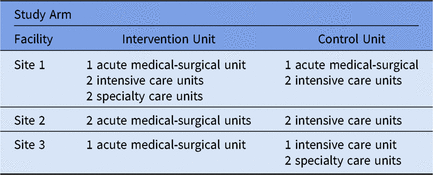
The study was conducted at 3 facilities (2 academic medical centers, 1 Veterans Affairs [VA] hospital) on 16 units (5 acute medical-surgical, 7 intensive care, and 4 specialty care units) (Table 1). The study was approved by the institutional review board at each facility. A quasi-experimental before-and-after design was used, with concurrent control units in both baseline and intervention phases at 2 facilities and only in the intervention phase at 1 facility.
Description of Unit Types Participating in Study, Stratified by Intervention and Control

In May 2016, we conducted a literature review of strategies similar to a PPE-free zone (“safe zone,” “red box,” etc). The search identified 4 reports in the gray literature from conference abstracts about local quality improvement projects.Reference Franck, Behan, Herath, Mueller and Marhoefer14–Reference Blomberg17 Two authors (L.V. and J.M.) conducted three 30-minute phone interviews of infection preventionists from facilities identified in these reports to identify barriers and facilitators for PPE-free zone implementation. Feedback from interviews and theoretical constructs from human factors engineering supported placing a red tape outline of the zone only when a patient was placed on contact precautions instead of leaving it in place permanently to prevent habituation.
Observations of hand hygiene and PPE use
Observations were conducted by study personnel of whether HCP donned appropriate PPE and performed hand hygiene as well as when and where in the patients’ room it occurred. Staff at the lead site provided training to all observers on how to conduct observations and record data on a standardized data collection instrument. Trainees needed to attain 95% or higher agreement with a 153-item reference standard of training scenarios to be cleared to conduct observations in the clinical setting. Newly trained observers were paired with experienced observers at each site and had to achieve 90% interobserver agreement before participating in data collection.
We recorded each opportunity for hand hygiene and PPE use, defined as at least 1 HCP crossing the door threshold of a room of a patient on contact precautions. Each observation included information about the occurrence and sequence of (1) entry hand hygiene (yes/no and method [ie, alcohol-based hand rub or soap and water]); (2) gown, glove, and mask donning; as well as (3) location where each hand hygiene or donning event took place (outside room, inside door threshold, or far inside patient room). We also collected information on whether HCP crossed the PPE-free zone boundary farther into the patient room during the observed episode. Observations were conducted Monday through Friday throughout the day.
Implementation of the PPE-Free Zone
For all rooms in participating units, study staff premeasured boundaries for the PPE-free zone and placed small colored markers to indicate corners of the zone. In general, the PPE-free zone allowed HCP to stand 1.2 m inside of the patient room to check on and converse with patients without donning PPE (Supplemental Fig. 1 online). Zone size was selected (1) based on prior implementor interviews; (2) to exclude frequently contaminated touchable surfaces such as curtains, sinks, and medication cabinets from the zone; and (3) to maximize zone size while complying with CDC guidelines recommending PPE use within 2 m (6 feet) from the head of the patient bed for droplet precautions. This latter consideration was due to an initial attempt at 1 facility to include droplet precautions in addition to contact and enteric (C. difficile) precautions. Airborne precautions rooms were not eligible for the PPE-free zone and droplet precautions were deemed unsuitable for the study due to the potential for patient movement.
In both the planning and implementation stages, study staff organized stakeholder meetings at each of the 3 sites and included infection prevention and control staff, nurse managers on intervention units, and environmental services (EVS) leadership to inform as well as solicit feedback on the intervention. In addition, ad hoc discussions occurred with unit medical directors and other interested physicians. Stakeholders served as champions to support the intervention and to communicate with the staff about the PPE-free zone. Prior to implementation, presentations were conducted at EVS staff meetings to review the purpose and role of EVS in the PPE-free zone (e.g., tape left down until terminal cleaning and boundary markers always left down).
Study kits and binders were stocked on each intervention unit and included supplies of red, low-adhesive, duct tape, disinfectant wipes, PPE-free zone signage to post on patient room doors, informational handouts, and HCP scripting regarding the purpose of the PPE-free zone for patients and family members. Poster boards to increase staff and provider awareness of the intervention were placed in unit break rooms and on bulletin boards. A step-by-step protocol with photographs was provided for unit staff at 2 sites for setting up the PPE-free zone when a patient was placed on contact or enteric precautions. Study staff placed tape at the remaining facility, which lacked sufficient unit staff resources to set up the zone. To assure compliance, audits were conducted to assess timely placement and removal of the PPE-free zone and accompanying signage at initiation and discharge from a room that had housed a patient on contact precautions.
Study outcomes
The primary study outcomes were HCP compliance to (1) entry hand hygiene and (2) entry PPE donning. HCP that entered the room but did not go beyond the zone were considered compliant. HCP that did cross the zone and did pass farther into the patient room had to complete hand hygiene (alcohol-based or soap and water) outside of the room or within the PPE-free zone before crossing the tape to be considered compliant. HCP that did not complete hand hygiene prior to crossing the zone were considered noncompliant. Compliance with donning PPE involved donning of all PPE items required by the site’s infection prevention policy, according to the same rubric outlined for hand hygiene.
Secondary outcomes of HCP perceptions on intervention units were assessed using a 21-item survey using a 7-point Likert scale (strongly disagree to strongly agree). Questions assessed HCP risk perception for transmission of antibiotic-resistant organisms, and attitudes toward isolation precautions; 8 items addressed perceptions of the PPE-free zone. Multiple survey dissemination strategies were used to increase participation. Paper copies were provided alongside complimentary snacks in nursing break rooms and physician workrooms; the site investigator distributed the surveys in person to attending and house staff physicians at conferences; and ancillary service managers distributed them to their staff at staff meetings. Electronic surveys were provided via an anonymous online link e-mailed to unit nursing staff and advanced nurse practitioners. Surveys were conducted in the month prior to implementation of the PPE-free zone and again 2–4 months into use of the PPE-free zone. No identifying information was collected from survey respondents. We also attempted to assess patient perceptions of the zone with a similar survey, but this was infeasible due to issues with patient acuity and patient disorientation during hospitalization.
Statistical analysis
Models of PPE donning and entry hand hygiene compliance were constructed using Poisson generalized linear mixed-effects models. Models included facility- and unit-level random effects and fixed effects for study phase, unit type (control or intervention), the interaction between study phase and unit type, and (for hand hygiene models only) glove use. Glove use was included in hand hygiene models to account for the possible practice of donning gloves in lieu of hand hygiene. The model main effects (labeled intervention units and control units in results tables) examine only how compliance changed over time. The interaction term in each model tests the effect of the PPE-free zone by testing whether the change in compliance between study phases for intervention units is different from the change in compliance in control units. Relative risks comparing probability of hand hygiene compliance in the intervention phase to probability of compliance at baseline were calculated for control and intervention units. The same approach was used for PPE compliance and models stratified by type of isolation precautions. Survey responses were dichotomized to “agree” or “strongly agree” versus all other values. Analysis was based on χ2 tests comparing responses between study phases for each survey item. Observation data were analyzed using R studio software (R Foundation for Statistical Computing, Vienna, Austria), and survey responses were analyzed using SAS version 9.4 software (SAS Institute, Cary, NC).
Results
Overall entry hand hygiene and PPE compliance
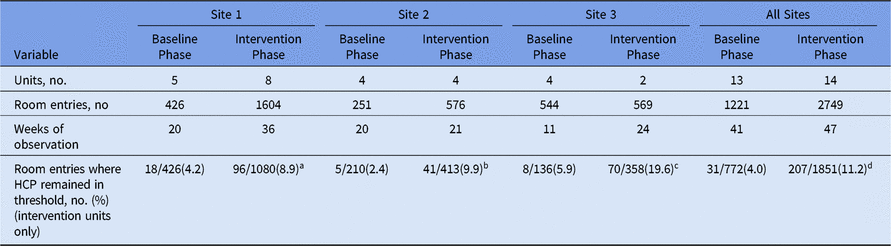
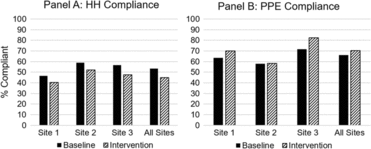
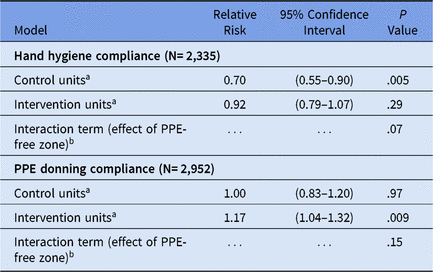
We observed 3,970 isolation patient room entries during the study (1,221 baseline and 2,749 intervention phase) (Table 2). During the intervention phase of the study, 1,851 observations were conducted on units receiving the PPE-free zone intervention and 898 were performed on control units. Prior to implementation of the PPE-free zone, HCP remained in the PPE-free zone 4% of the time. This rate increased during the intervention phase of the study to 11.2% (P < .0001). Baseline HCP compliance with entry hand hygiene was 53.5% (422 of 789 observations) (Fig. 1, panel A); compliance with donning PPE on room entry was 66% (615 of 932 observations). Compliance with entry hand hygiene declined over the course of the study in both intervention and control units at all 3 facilities but less so in intervention units. However, the effect of the PPE-free zone on entry hand hygiene was not significant after adjusting for facility, unit, and glove use (Table 3). There was also no change in entry PPE donning compliance between study phases for both unadjusted (Fig. 1, panel B) and adjusted comparisons (Table 3).
Characteristics of Healthcare Personnel Hand Hygiene and Personal Protective Equipment Use Observations for Intervention and Control Units Combined, Stratified by Facility and Study Phase

Note. The results of a χ2 test were statistically significant between baseline and intervention phases.
a Site 1, P = .003.
b Site 2, P = .001.
c Site 3, P = .004.
d All sites combined, P < .0001.
Unadjusted hand hygiene compliance (panel A) and PPE donning compliance (panel B) at baseline versus intervention phase, by facility. Solid black bars represent baseline compliance and hashed bars represent intervention phase compliance.

Changes in Hand Hygiene and Personal Protective Equipment (PPE) Donning Compliance During Intervention Versus Baseline and Estimated Effect of the PPE-Free Zone

Note. Hand hygiene model was adjusted for facility, unit, and glove use; the PPE donning model was adjusted for facility and unit.
a Compares probability of compliance during intervention phase to probability of baseline compliance.
b The interaction term tested the effect of the PPE-free zone intervention on compliance by comparing the change in compliance in intervention units to the change in compliance in control units between the PPE-free zone intervention phase and baseline.
Effect of isolation precautions type
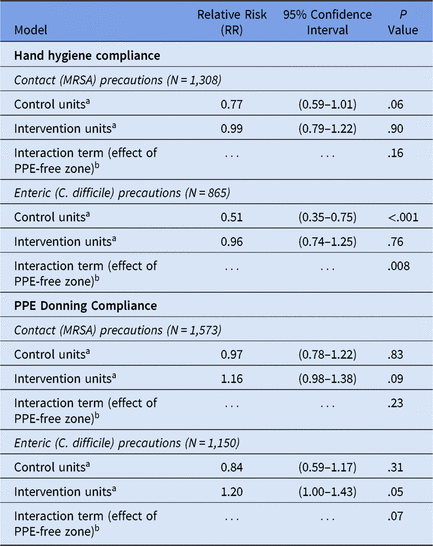
We examined whether the type of isolation precautions in which a patient was placed modified the effect of the PPE-free zone. In rooms of patients on contact precautions for organisms such as methicillin-resistant Staphylococcus aureus or vancomycin-resistant Enterococcus, the PPE-free zone did not significantly impact HCP compliance with hand hygiene (Table 4). However, among rooms in enteric precautions (most often for C. difficile), the PPE-free zone had a significant effect (P = .008) on entry hand hygiene compliance (Table 4). Control units had a 2-fold significant decline in entry hand hygiene, whereas intervention units did not. The type of isolation precautions had no impact on compliance with entry PPE donning.
Effects on Hand Hygiene and Personal Protective Equipment Compliance and Effect of the PPE-Free Zone, Stratified by Type of Isolation Precaution

Note. The hand hygiene model was adjusted for facility, unit, and glove use; the PPE donning model was adjusted for facility and unit.
a Compares probability of compliance during intervention phase to probability of baseline compliance.
b The interaction term tested the effect of the PPE-free zone intervention on compliance by comparing the change in compliance in intervention units to the change in compliance in control units between the PPE-free zone intervention phase and baseline.
HCP perceptions of the PPE-free zone
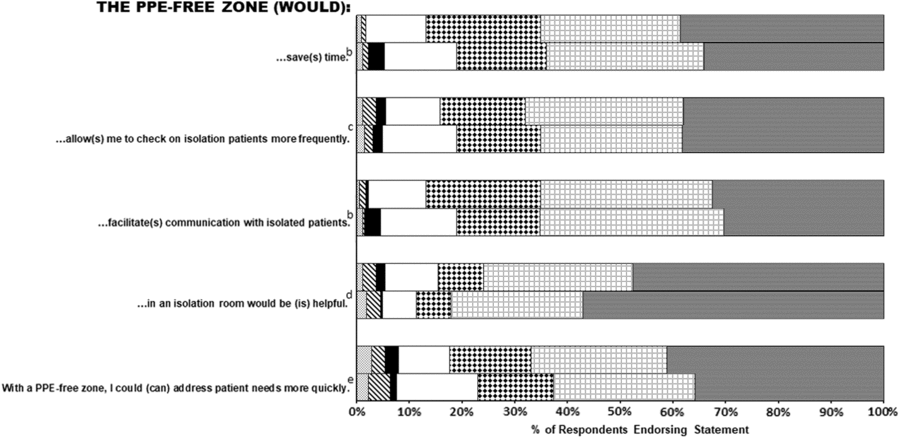
In the baseline phase, we received 353 survey responses, and we received 267 responses during the intervention (response rates: ~55.9% baseline and ~38.3% in the intervention phase). HCP reported positive attitudes toward the PPE-free zone prior to using it; attitudes did not significantly change after using the zone (Fig. 2). Both before and after using the PPE-free zone HCP agreed or strongly agreed that (1) the zone saved time (64.7%); (2) the zone facilitated communication (65.1%) and more frequent visits (66.8%) to patients in isolation precautions; (3) the zone was helpful (78.6%); and (4) the zone allowed HCP to address patient needs more quickly (65%). Anecdotal feedback from unit staff was also generally positive, including the following remarks: “Can we keep the dots?” [nurse]; “It was very important. It helped us to know when a room was an isolation room during discharge cleaning.” [environmental services]; “My doctors and nurses, HCAs, and families want the RED ZONE [PPE-free zone] BACK ‘right now’!” [nurse manager].
Healthcare personnel perceptions of the PPE-free zone, baseline (N = 353) versus intervention phase (N = 267). Baseline survey responses are shown in the top bars of each question; intervention phase survey responses are the bottom bars for each item. Each pattern corresponds to percentage of respondents endorsing the Likert-scale rating: dotted bar (strongly disagree); diagonal hash (disagree); solid black (somewhat disagree); no fill (neither agree nor disagree); diamonds (somewhat agree); square grid (agree); horizontal stripes (strongly agree). b Six respondents did not complete this question. cNine respondents did not complete this question. d Eight respondents did not complete this question. eFive respondents did not complete this question. Note. HCP, health-care personnel; PPE, personal protective equipment

Discussion
In a multifacility study, the use of a PPE-free zone for rooms of patients in contact or enteric isolation precautions did not improve HCP compliance with completing entry hand hygiene or donning PPE. Although we observed no increase in hand hygiene and PPE compliance, HCP reported positive views of the PPE-free zone due to its impact on workflow.
The work that first introduced the PPE-free zone did not measure impact of the zone on PPE donning or hand hygiene compliance.Reference Franck, Behan, Herath, Mueller and Marhoefer14 Other efforts reported increases in perceived PPE compliance by HCP survey response.Reference Snell16 In 2 abstracts reporting on implementing a PPE-free zone in the community hospital setting, the first reported a 14% increase in PPE compliance after implementation, and the second reported improvement in entry hand hygiene from 66% compliance before implementation to 98% during implementation.Reference Pollard and Wickens15, Reference Blomberg17 Pilot implementation at an academic medical center yielded findings similar to ours, with positive feedback from staff but no significant change in PPE compliance (written communication, A.M. Pettis, RN, June 2016). However, in all previous reports, a quasi-experimental before-and-after design without control units was utilized so it is unclear what historical effects on hand hygiene may have occurred concurrent with implementation of the PPE-free zone at these sites. HCP were equally or more enthusiastic in previous pilots of a PPE-free zone (written communication, A.M. Pettis, RN, June 2016).Reference Franck, Behan, Herath, Mueller and Marhoefer14–Reference Blomberg17
Others have also reported low rates of entry hand hygiene and compliance to PPE donning for patients on contact precautions, with <20% of room entries preceded by hand hygiene and gloves and gowns being donned in only ~68% of room entries.Reference Clock, Cohen, Behta, Ross and Larson18 This pattern was observed even when restricted to enteric precautions rooms, where full compliance with contact precautions ranged from 7% to 22% and entry hand hygiene compliance ranged from 18% to 29%.Reference Yanke, Zellmer, Van Hoof, Moriarty, Carayon and Safdar5 Our observation that HCP were more likely to perform entry hand hygiene for enteric precautions rooms was paralleled by a recent report from Katanami et al,Reference Katanami, Hayakawa and Shimazaki19 who observed that HCP had 2.5-fold increased odds of PPE donning compliance for toxin-confirmed C. difficile than for all other multidrug-resistant organisms, including S. aureus. HCP may have higher risk perception with pathogens such as C. difficile, which prompts higher compliance through self-protective behavior.
Although the Hawthorne effect may have influenced our findings because this was an observation based study, our observations of HCP practices began in May 2016 and concluded in January 2018 and it is unlikely that HCP awareness of being observed would lead to behavior changes sustained for such an extended period (Supplementary Fig. 2 online). One additional study limitation was the burden placed on unit HCP to install floor tape each time a patient was placed in precautions, which may have affected attitudes toward using the zone. This procedure was intended to reduce habituation to tape being present regardless of occupant isolation status but PPE-free zone strategies that require less effort from frontline staff should be explored. Also, attempts to reduce the chance of HCP touching potentially contaminated environmental objects such as sinks or privacy curtains by excluding them from the zone may have made the zone too small or far from the patient to be useful. Future implementation efforts should examine the effect of zone size. Additionally, the focus of this study was HCP behavior and perceptions; future work should assess patient and family perceptions of the PPE-free zone. Finally, future studies should consider a stepped wedge or other study design to better address challenges inherent in a before-and-after concurrent control design. To our knowledge, this implementation of the PPE-free zone is the first large-scale, multifacility study testing the effectiveness of the PPE-free zone. Currently, contact precautions as an infection prevention policy is controversial, with some arguing for discontinuing its use in specific settings and organisms.Reference Bardossy, Alsafadi and Starr9–Reference Edmond, Masroor, Stevens, Ober and Bearman11, Reference Morgan, Wenzel and Bearman20 However, as others have noted,Reference Rubin, Samore and Harris12 there remain significant unanswered questions on safety and the effect on transmission rates of discontinuing contact precautions. The PPE-free zone, which does not appear to have any negative effect on HCP compliance with contact precautions or entry hand hygiene, may be a viable approach for reducing HCP burden while maintaining contact precautions use until the controversy is better studied and resolved.
Studies employing human factors research to understand how workflow and systems influence PPE compliance have identified several barriers, including sequential required tasks, time cost for donning, adequacy of PPE and hand hygiene supplies, and organizational culture.Reference Yanke, Zellmer, Van Hoof, Moriarty, Carayon and Safdar5 In addition, Krein has argued that a number of types of noncompliance (eg, violations, mistakes, slips, failures of intention and execution) and multiple intervention strategies are required to address each of these differing sources of PPE noncompliance.Reference Krein, Mayer and Harrod21 Our current findings, in addition to human factors studies of PPE compliance issues, highlight the fact that changing human behavior is complex and multifactorial. Many current interventions to improve hand hygiene and PPE behavior, including the PPE-free zone, are single-factor interventions that do not take into account the complex socio-technical environments in which we are trying to enact change. Future intervention strategies should emphasize human factors, consider HCP workflow, and be designed in a manner that addresses the multifactorial nature of behavior change.
Supplementary material
To view supplementary material for this article, please visit https://doi.org/10.1017/ice.2019.111
Author ORCIDs
Lindsay D. Visnovsky, 0000-0002-6503-328X
Acknowledgments
The authors gratefully acknowledge the descriptions and advice of Ann Marie Pettis RN, BSN, CIC, Angel Mueller MPH, CIC, and Carolyn Terhune MT(ASCP), CIC regarding their experiences with a PPE-free zone implementation. The contents are solely the responsibility of the authors and do not necessarily represent the official position or policy of the Centers for Disease Control and Prevention, the Department of Health and Human Services, the US Department of Veterans Affairs, or the United States government.
Financial support
This work was supported by the Centers for Disease Control and Prevention (contract no. 200-2011-42039 2015-002) to M.S. and the United States Department of Veterans Affairs Health Services Research and Development Service by COIN (grant no. CIN-13-414) to M.S.
Conflicts of Interest
All authors report no conflicts of interest relevant to this article.