

Introduction
Homer has traditionally occupied a central place in classical and literary education, both in Greece and internationally. Yet for many students today, epic poetry appears linguistically demanding and culturally remote – a challenge repeatedly noted in both Greek and international pedagogy (Fountopoulou, Reference Fountopoulou2010, 129–133, 140–144; Hall, Reference Hall2008, 3–15; Morris and Powell, Reference Morris, Powell and Regakos2009, xviii). As Alexandra Lianeri has argued, the ‘Homeric moment’ is never a recovery of an original, timeless Homer but always a historically situated act of interpretation, refracted through successive layers of translation, ideology, and cultural mediation. Indeed, the classical text itself emerges within what she describes as a ‘dialectic of the meaningful and the meaningless, the eternal and the historical’, a tension that becomes particularly visible in the long history of translations of Homer (Lianeri, Reference Lianeri, Martindale and Thomas2006, 142). For modern learners, this means that Homer’s meaning often reaches them at a distance, filtered through these mediations. The pedagogical question therefore remains pressing: how can canonical texts be made meaningful to twenty-first-century students, and how might modern media foster affective investment and deeper engagement with them (Hardwick, Reference Hardwick2003, 98–113; Martindale, Reference Martindale1993, 23–29; OECD, 2018; UNESCO, 2015). The present article addresses these questions through Singing Homer, a two-year cultural project in a Greek lower-secondary school (2021–2023), in which students engaged with the Iliad and the Odyssey via modern Greek songs.
Within the framework of the Greek secondary curriculum, the teaching of Ancient Greek literature is defined by a coherent set of interrelated aims. Central among these are the study of the factual and cultural context of the literary work, the exploration of ideology (beliefs, values, and life stances), and the perspectives that link ancient texts with the modern cultural and intellectual environment (Fountopoulou, Reference Fountopoulou2010, 129–144). Although Ancient Greek literature holds a pivotal place in the official curriculum as a vehicle of humanistic paideia (Greek Ministry of Education, 2003; Tsafos, Reference Tsafos2004, 25–30), its value is frequently contested within an increasingly technocratic school culture, which tends to privilege efficiency, quantifiable outcomes, and the perceived utility of the natural sciences, often justified by the promise of economic gain through their practical applications (Regakos, Reference Regakos2001, 19–20). This tension underscores the need for a renewed pedagogical identity, which connects ancient Greek texts with the lives of modern adolescents. Such a reorientation is grounded in principles of interdisciplinarity, inquiry-based and discovery learning (Ministry of Education & IEP, 2024).
Against this curricular background, reception studies provide a productive perspective: classical texts acquire meaning as they are continually reshaped by later audiences (Hall, Reference Hall2008; Hardwick and Stray, Reference Hardwick and Stray2008; Martindale, Reference Martindale1993). This article advances the notion of experiential reception – an approach in which students actively reinterpret Homer through affective, creative, and participatory practices, such as researching modern songs inspired by Homeric themes, comparing their lyrics with passages from the epics and producing collaborative digital presentations and videos.
Among the available media of reception, music offers a particularly powerful mode of mediation. It resonates with memory and emotion, shapes adolescent identity, and provides culturally familiar idioms through which learners, in the present case, can reimagine ancient heroes and dilemmas (North et al., Reference North, Hargreaves and O’Neill2000, 262–269; Small, Reference Small1998, 2–14). In the Singing Homer project, music provided precisely such a medium: students researched songs, transcribed lyrics, and produced digital presentations that juxtaposed epic passages with modern musical responses. In this way, they did not merely illustrate Homer; they experienced his world as a living cultural presence, discovering echoes of ancient conflicts within modern voices.
This article addresses three interrelated research questions:
-
1. How do modern Greek songs reinterpret Homeric figures and motifs, and how can these reinterpretations be mobilised in the classroom?
-
2. In what ways does the integration of music foster student motivation, emotional engagement, and creative expression?
-
3. How does the combination of music, collaboration, and digital tools contribute to the cultivation of twenty-first-century competencies?
The study theorises experiential reception as a bridge between reception studies and pedagogy, while providing a systematically documented classroom case that foregrounds modern song as a distinctive vehicle of Homeric reception. At the same time, it proposes a transferable model for integrating epic literature with music to enhance engagement, critical reflection, and digital literacies. It proceeds by outlining the theoretical framework and then presenting methods and materials, followed by analyses of Iliad and Odyssey themes, survey findings, and a discussion of implications for classical reception pedagogy and secondary education.
Theoretical framework
Homer as a pedagogical text
The educational value of the Homeric epics has been acknowledged since antiquity: the poems functioned as paradigms of paideia, with heroes such as Achilles, Hector, Odysseus, and Penelope serving as moral exemplars that shaped ethical formation and civic identity: Dio Chrysostom has pointed out in Discourses 18, On Training for Public Speaking 8 (Cohoon, Reference Cohoon1939, 218–219): ‘Ὅμηρος καὶ πρῶτος καὶ μέσος καὶ ὕστατος παντὶ παιδὶ καὶ ἀνδρὶ καὶ γέροντι, τοσοῦτον ἀφ’ αὑτοῦ διδοὺς ὅσον ἕκαστος δύναται λαβεῖν’ (But Homer comes first and in the middle and last, in that he gives of himself to every boy and adult and old man just as much as each of them can take). Educationally, Homer’s poems were instruments of enculturation which told the youth of heroic ancestors. Through the epic songs, young children became familiar with those heroic exemplars, or cultural models, after which they could pattern their own values (Fountopoulou, Reference Fountopoulou2010, 129–139; Maronitis, Reference Maronitis2005, 37–54; Ready and Tsagalis, Reference Ready and Tsagalis2018, 12–18; Tilk, Reference Tilk2014; University of Minnesota ICONICS Project, 2013). Plato underscores this formative role in Republic 606e, where he observes that Homer ‘educated Greece’: ‘Τὴν Ἑλλάδα πεπαίδευκεν οὗτος ὁ ποιητὴς καὶ πρὸς διοίκησίν τε καὶ παιδείαν τῶν ἀνθρωπίνων πραγμάτων ἄξιος ἀναλαβόντι μανθάνειν’ (This poet has educated Greece, and he is worthy to be taken up for study by anyone who would learn how to govern and how to cultivate the affairs of human life). Furthermore, Griffin (Reference Griffin1980, 50–80) highlights the capacity of epic narratives to train ethical judgement. This performative and audience-responsive understanding of epic – emphasising oral delivery and the ‘afterlife’ of Homer – provides a bridge to classroom practice, where learners actively (re)enact and reinterpret epic narratives.
Classical reception and education
Reception studies shift attention from fixed textual meanings to the ways later audiences and media reconstitute ancient works (Hall, Reference Hall2008; Hardwick and Stray, Reference Hardwick and Stray2008; Martindale, Reference Martindale1993). This orientation reframes students as active participants in an ongoing dialogue with antiquity: rather than passively receiving the wisdom of antiquity, learners co-produce meaning as they transpose ancient narratives into modern concerns. Hardwick (Reference Hardwick2003, 5–11) characterises reception as dialogic, foregrounding the mutual construction of meaning between text and audience. Music – alongside theatre, film, and visual arts – has repeatedly mediated reception by reframing classical plots for modern publics (Hall and Macintosh, Reference Hall and Macintosh2005, 28, 345–347, 366–371; Hall, Reference Hall2008, 59–71; Hardwick and Stray, Reference Hardwick and Stray2008, 231–246).
Multimodality and music as mediation
Multimodality recognises that meaning is produced across verbal, visual, auditory, and digital modes, a perspective central to modern literacy research (Kress, Reference Kress2010; Walsh, Reference Walsh2010). Within this framework, music is pedagogically powerful: rhythm, melody, and lyrics mobilise affect and memory while offering familiar idioms that connect students’ repertoires with classical texts (Albers and Harste, Reference Albers and Harste2007). Small’s (Reference Small1998, 9–10) notion of ‘musicking’ foregrounds performance and participation as meaning-making practices, while case studies show that comparisons between epic figures and modern media render Homer and the classics a living presence (Jenkins, Reference Jenkins2015; Nikoloutsos, Reference Nikoloutsos2013). Beyond affect, music also operates mimetically: by embodying stances and values through melody and rhythm, it enables learners to internalise patterns of ethos – a view already articulated by Aristotle (Politics VIII.1340a–1341b: Rackham, Reference Rackham1944).
Experiential learning and student agency
An experiential model privileges learning by doing: students debate meanings, transcribe lyrics, and produce digital artefacts that align ancient passages with modern music. Such tasks foster agency and ownership – students become co-creators rather than passive consumers – while consolidating learning cognitively, affectively, and aesthetically (Kolb, Reference Kolb1984, 31–38; Walsh, Reference Walsh2010). Arts education research confirms this orientation: Burnard and Dragovic (Reference Burnard and Dragovic2015) collaborative music-making enhances engagement and self-efficacy by involving students in shared decision-making, peer-supported interaction, and reflective as well as embodied musical participation within a community of practice – dynamics closely reflected in Singing Homer. Music education studies further emphasise learning as a social and lifelong process, grounded in experience, interaction, and the co-construction of meaning, which can foster critical thinking through open-ended, inquiry-based musical tasks that require evaluation and interpretation rather than the application of fixed answers (Kokkidou, Reference Kokkidou2013, 5–10; Westerlund, Reference Westerlund2008, 81–85).
Music, identity, and twenty-first-century skills
Educational psychology and sociology underscore music’s central role in adolescent identity formation: it acts as a marker of belonging and a resource for self-expression and emotional regulation (Kokkidou, Reference Kokkidou2013, 8–10; North et al., Reference North, Hargreaves and O’Neill2000; Wright, Reference Wright2012). Empirical evidence shows that adolescents engage intensively with music in their daily lives and use it both to construct social identity and to regulate emotional experience. In classroom settings, such identity work becomes pedagogically valuable, as students articulate aspects of themselves through music, strengthening both engagement and peer connection; crucially, this process depends on supportive environments in which learners feel able to take creative risks and express personal musical meanings (McFerran, Reference McFerran2016, 106–110; Saunders, Reference Saunders2010, 70–76). Combined with collaboration and digital tools, this experiential and socially grounded engagement – rooted in interaction, shared interests, and reflective practice – cultivates internationally recognised twenty-first-century competencies, including creativity, critical thinking, collaboration, communication, and digital literacy (OECD, 2018; UNESCO, 2015). In this light, Singing Homer exemplifies how music can function not as an add-on but as a pedagogical vehicle for integrating classical learning with modern skills agendas, enabling students to negotiate both ancient material and their own identities through creative practice, while providing models of ethos and ethical stance that adolescents can explore and internalise.
From theory to practice: positioning Singing Homer within the Greek School Context
The project was implemented as a cultural programme in a Greek lower-secondary school (2021–2023), explicitly aligned with national curriculum aims: to foreground the enduring relevance of ancient Greek culture, to investigate the impact of the epics on modern music, and to develop critical digital literacy (Information and Communication Technologies, ICT) through student-produced media. This alignment was operationalised across three interrelated dimensions. At the level of content, selected Homeric passages from the Iliad and the Odyssey were coordinated with thematic units of the Ancient Greek syllabus, ensuring continuity with formal instruction. At the level of skills, the project cultivated critical interpretation, intertextual comparison, and multimodal literacy, as students moved between textual analysis, musical listening, and visual representation. At the pedagogical level, the emphasis on collaborative inquiry, structured role distribution, and student-produced artefacts reflected a student-centred approach consistent with curriculum priorities for active and ICT-integrated learning.
The workflow – web search, corpus curation, thematic coding, transcription, and audiovisual production – was implemented as a structured sequence of inquiry-based tasks. Students conducted guided digital searches using targeted keywords, evaluated and selected songs according to explicit criteria (thematic relevance, interpretive potential, and clarity of lyrics), and organised the material through thematic coding by identifying recurring motifs (e.g. exile, desire, honour, and return). Transcription and close reading enabled detailed textual analysis, while audiovisual production required students to translate interpretive insights into multimodal compositions, combining text, sound, and image into coherent narrative arguments. Thematic axes (Iliad: Helen, Achilles, Hector, and Fall of Troy; Odyssey: Odysseus, Penelope, Circe–Calypso–Nausica, Ithaca, and Adventures) functioned not merely as organisational categories but also as heuristic frameworks structuring systematic intertextual comparison. Each axis guided a recurring analytical sequence: close reading of a Homeric episode, identification of analogous motifs in modern lyrics, and articulation of these correspondences through discussion and digital production. For example, the ‘Ithaca’ axis enabled students to map the concept of nostos onto contemporary expressions of longing and return across both epic and musical texts. Thus, the thematic axes framed the relationship between Homer and modern music in a systematic way, anchoring it in clear narrative and ethical correspondences rather than relying on intuitive or incidental associations.
Methods and materials of the Singing Homer project
Context, participants, and objectives
In Singing Homer, a single cohort of 49 students (aged 13–15, mixed gender groups) participated voluntarily across both years, committing to weekly sessions outside the regular timetable. The project was endorsed by the Ministry of Education within the framework of the yearly Cultural Programmes, designed to promote heritage awareness, critical literacy, and creative engagement with ICT.
Learning goals and outcomes were fourfold: (a) to connect ancient Greek culture and literature with modern artistic creation and highlight their diachronic vitality, (b) to cultivate attentive listening and interpretation of musical works, (c) to promote digital literacy through online research and media production, and (d) to encourage symbolic interpretation of Homeric figures and themes (e.g. Achilles, Hector, Helen, and Troy).
Design and procedure
Grounded in experiential and multimodal pedagogy, the teaching plan and process comprised weekly 90-minute sessions (approximately 24 per year). Each cycle followed a stable but flexible sequence:
-
1. Student exploration and proposals of modern Greek songs;
-
2. Transcription of lyrics and close discussion of salient motifs (love, war, exile, longing, and fidelity) and their epic parallels;
-
3. Dialogic reading with Homeric passages (in translation and, for advanced students, in Greek) to trace intertextual links;
-
4. Collaborative production of digital presentations and short videos juxtaposing lyrics with specific epic episodes;
-
5. Public presentation of outcomes to peers, teachers, and parents.
To implement these tasks, students were divided into groups with differentiated roles:
-
• Internet Researchers curated a corpus of songs through keyword searches on Google, YouTube, and greeklyrics.gr, overseen by two coordinators who organised results thematically (Iliadic, Odyssean, and other mythological cycles).
-
• Media Collectors retrieved video and audio files using digital tools, applying criteria of appropriateness, artistic integrity, and thematic relevance.
-
• Lyric Transcribers digitised and reviewed lyrics, excluding material irrelevant to Homeric themes.
-
• Video Producers employed Windows Movie Maker to illustrate selected songs with visual material (vase paintings, artworks, and photographs), experimenting with montage, transitions, and synchronisation.
-
• Philologist-Critics engaged in comparative reading and listening, aligning song lyrics with Homeric passages and initiating classroom debates (e.g. Achilles versus Hector, or whether Homer can be read as a ‘national’ author).
This division of work operationalised principles of project-based learning by structuring students’ engagement around clearly sequenced, authentic tasks – researching songs, transcribing and analysing lyrics, aligning them with Homeric passages, and producing multimedia presentations. Each step required interpretive judgement, collaborative decision-making, and technical skills, fostering active, hands-on learning across multiple modes. The cyclical progression from research to digital production allowed students to refine both their analytical insights and their communicative expression, while public presentation transformed their work into a social practice, encouraging reflection, peer feedback, and awareness of methodological choices.
Materials and data corpus
Across the two years, students compiled a corpus of more than 100 songs, spanning both canonical and contemporary artists. From these, approximately 40 were selected for detailed analysis and integration into group projects. Outputs included eight short videos (four on Iliad themes and four on Odyssey themes) and multiple group presentations. The teacher kept detailed field notes documenting discussions and collaboration processes, while end-of-cycle questionnaires (N = 49) combined closed and open items on engagement, perceived relevance, and skill development (Table 1).
Overview of Participants, Materials, and Outputs

Table 1. Long description
A table with 3 rows and 6 columns detailing participant activities and outputs over two years. The columns are labeled Year, Cycle Focus, Participants, Songs Collected, Songs Analysed in Depth, Group Outputs, and Public Presentation. Row 1: 2021-2022, Iliad, 49, approximately 40, 14+, 4 videos + presentations, Yes (school event). Row 2: 2022-2023, Odyssey, 49 (same cohort), approximately 60, 26, 4 videos + presentations, Yes (school event). Row 3: Total, Iliad + Odyssey, 49, 100+, approximately 40, 8 videos + multiple presentations, Both years. The table notes that the same cohort of 49 students participated in both cycles.
Note: The same cohort of 49 students participated in both cycles.
Analytic approach
A qualitative case-study design combined thematic analysis of lyrics and student artefacts with descriptive survey data, while frequencies illustrated trends in engagement and perceived relevance. Thematic analysis (Braun and Clarke, Reference Braun and Clarke2006, 79–81) examined how motifs of rage, fidelity, exile, and return were expressed through musical techniques, stylistic patterns, and conventions – such as melody, rhythm, harmony, and instrumentation – alongside the multimodal orchestration of text, music, and image. Attention was also paid to moments of ethical reasoning in student commentary, highlighting how interpretive judgements intertwined with aesthetic appreciation and cultural understanding.
Ethics and limitations
All student names were anonymised, and consent procedures followed the Institute of Educational Policy (IEP) guidelines, including parental consent, student assent, and school approval. Data were securely handled, and participation was voluntary, with the right to withdraw at any stage (IEP, 2018; Valkanos et al., Reference Valkanos, Vozikas and Koutsougeras2012, 158–159). Excerpts from lyrics and student reflections are paraphrased to respect copyright and confidentiality. As a single-site case study with N = 49 and no pre/post testing, the project does not claim statistical generalisation. Nonetheless, the combination of artefacts (songs, videos, and presentations), observational notes, and survey data provides evidence of how music mediated the reception of Homer in secondary education.
Findings and analysis
The analysis is presented thematically, following the structure of the students’ work on the Iliad and the Odyssey. Each subsection examines how selected songs mediated the reception of Homeric figures and episodes, highlighting the interpretive connections students drew between ancient texts and modern Greek music. The discussion integrates close reading of the epics, classroom debates, and the musical corpus, showing how these materials fostered ethical reflection, emotional engagement, and creative reinterpretation.
Evidence emerged not only from the thematic alignment of songs with Homeric passages but also from students’ explicit responses in classroom discussions and project work. For instance, when working on Achilles, students disagreed on whether his withdrawal from battle should be seen as an act of justified self-respect or as destructive anger, with some expressing admiration for his martial virtue and others emphasising the human cost of his rage. In contrast, Hector elicited strong affective identification: several students described him as ‘closer to real life’ because of his role as husband and father, and classroom discussions often revealed a preference for Hector grounded in values of care and responsibility. Similarly, in the Odyssey cycle, reflections on Penelope and Ithaca prompted students to articulate personal associations with waiting, separation, and the desire for return, linking epic motifs to their own experiences. These responses, documented in field notes and student artefacts, indicate that ethical reasoning and emotional engagement were enacted through dialogue, comparison, and creative interpretation rather than remaining implicit outcomes.
The Iliad through music
Helen: love, betrayal, and contested identity
Students examined lyrical narratives that frame femininity ambivalently – both idealised and vilified. Read alongside Iliadic episodes, these materials opened discussions of agency, responsibility, and culturally embedded expectations about female desire. Students traced how modern narratives reproduce or challenge gendered standards – particularly the tendency to attribute collective male violence to a woman’s actions while simultaneously denying her full agency. For instance, in I Oraia Eleni, the lyrics oscillate between ‘πως πήγε με δικό της νου’ (she went of her own will) and ‘δεν ήθελε η καημένη’ (the poor woman did not want it), reflecting contradictory cultural attitudes towards responsibility and victimhood. The insistence on her social status – ‘ήτανε παντρεμένη’ (Helen was married) – further intensifies the moral judgement directed at her. Similarly, in O Paris, the line ‘για μια γυναίκα άμυαλη ρημάξαν τα λιμάνια’ (for a foolish woman the harbours were destroyed) foregrounds how collective suffering and prolonged war are attributed to a single female figure, while male actions (abduction, war, and political ambition) are backgrounded. In contrast, in Gia tin Eleni, the refrain ‘Αχ Ελένη… εικόνα δακρυσμένη’ (Ah Helen… an icon/image in tears) frames her as a figure of loss and lament rather than a cause of destruction, eliciting student sympathy and affective identification. Music’s immediacy mediated this reception, enabling reflection on Helen’s contested status across ancient and modern contexts.
In Iliad III (Teichoscopia), Helen’s beauty is never described directly; it is implied through the reactions of others, particularly the Trojan elders, who acknowledge her attractiveness while associating her with the causes of war. This indirect presentation constructs her symbolically, through the gaze and judgements of others, as the figure through whom desire, political conflict, and destruction converge. Songs referencing Helen were thus interpreted less as celebrations of beauty than as emblems of crisis and downfall, as illustrated in I Oraia Eleni, where she is described as ‘cursed’, in Hatzidakis’ song, where her absence generates longing and loss, and in O Paris, where her elopement precipitates widespread destruction.
Songs studied:
-
• Mikis Theodorakis/Kostas Kartelias/Giannis Poulopoulos: I Oraia Eleni (Beautiful Helen)
-
• Manos Chatzidakis/Nikos Gatsos/Maria Farantouri: Gia tin Eleni (For Helen)
-
• Kostas Ch. Myris/Giorgos Zouganelis: Eleni (Helen)
-
• Giorgos Mouflouzelis/Thodoros Panagiotou: O Paris (Paris)
-
• Sokratis Malamas/Giannis Tsatsopoulos: I Eleni stin Tehni – Diodia (Helen in Art – Tolls)
Achilles: rage, honour, and existential conflict
Across songs foregrounding anger, alienation, and defiance, students reconstructed a trajectory of rage – provocation, withdrawal, loss, and return – and debated whether Achilles should be admired for dignity or pitied as tragic, imprisoned by passion. Instead of focusing on a single heroic image, the songs offered diverse emotional perspectives – ranging from glorification to lament – that encouraged students to question the value and cost of honour. In this way, music deepened engagement with Achilles while preserving the complexity of his character.
In Akrotiriasmenos Achilleas, lines such as ‘Δαμάζω τον εαυτό μου… να μην έχω πια καμία αδυναμία’ (I tame myself… so that I no longer have any weakness) prompted discussion of Achilles’ self-directed struggle with pain and vulnerability. In Sti Chora Sou Gennithike o Ilios, the refrain ‘The Sun was born in your land’ elicited reflection on the celebration of excellence, while encouraging critique of the human cost of heroism in ‘το θρήνο των Ελλήνων πάνω απ’ τα κάστρα’ (The lament of the Greeks [over Achilles’ death] above the castles). In I Gennisi tou Achilleα, students noted that even the greatest hero originates in vulnerability, in lines such ‘δω γεννιέται ο άφθαρτος θνητός’ (Here is born the imperishable mortal). These examples collectively allowed students to engage with both the moral and existential dimensions of Achilles’ honour and suffering.
Drawing on Iliad I and XIX–XXI, Achilles was perceived as the archetypal hero: powerful, semi-divine, and embodying martial excellence. The songs’ hymnic tones paralleled Homer’s glorification prompting students to consider how ancient ideals of heroism resonate – or clash – with modern perspectives.
Songs studied:
-
• Rapsodos Philologos: Akrotiriasmenos Achilleas (Mutilated Achilles)
-
• Giannis Markopoulos/Giorgos Papakostas: Sti Chora Sou Gennithike o Ilios (Omirikos Iroas Achilleas) [(In Your Land the Sun Was Born) Homeric Hero Achilles]
-
• Giorgos Ioannou/traditional-style setting: I Gennisi tou Achillea (The Birth of Achilles)
Hector: loyalty, family, and sacrifice
Songs associated with Hector emphasised domestic bonds and civic responsibility, presenting him as embodying an ethic of care set against the Iliad’s agonistic values, and musical reception thus foregrounded everyday heroism and alternative value systems within the epic. Classroom reflections recorded a recurrent preference for Hector over Achilles, interpreted as a moral orientation towards solidarity and communal duty. Students highlighted Hector’s selfless commitment in lines such as those in Me ton Ektora, ‘Ήμουνα πάντα με τον Έκτορα που ήξερε πως δεν έχει ελπίδα, βγήκε από τα τείχη και πολέμησε για της ψυχής του την πατρίδα’ (I was always with Hector who knew he had no hope; yet he went out from the walls and fought for the homeland of his soul).
Discussion centred on his dialogue with Andromache in Book VI, where Hector appears as devoted husband and father – an ‘anti-Achilles’ balancing war with family. Students weighed martial prowess against domestic loyalty, with musical interpretations emphasising Hector’s ethical priority on solidarity and care for others.
Songs studied:
-
• Giorgos Andreou/Christos Thivaios: Me ton Ektora (With Hector)
-
• Manos Chatzidakis: Ektoras kai Andromachi (Hector and Andromache)
Fall of Troy: destruction, loss, and cultural memory
Students selected songs that underscored the inevitability of downfall, linking the epic’s catastrophe with broader experiences of war, displacement, and trauma. Rather than simple laments, these pieces articulated an awareness of fate, reframing the fall of Troy as a transhistorical pattern of inevitable loss within cultural memory, as in line ‘στην πολιορκία πέφτει πάντα η Τροία’ (In a siege, Troy always falls). They connected this musical fatalism with Hector’s forebodings in Book VI, Zeus’s will in Book XV, and Priam’s laments in Books XVI and XXI, recognising how Homeric prefigurations of ruin resonate with modern poetic expressions of destiny and grief.
Songs studied:
-
• Giorgos Stavrianos/Kostas Mantzios: Stin Poliorkia Panta Peftei i Troia (In a Siege Troy Always Falls)
-
• Haris & Panos Katsimichas: Sygkatoikoi Eimaste Oloi stin Trela (We’re All Roommates in Madness)
The Odyssey through music
Odysseus: wandering, cunning, and resilience
Students emphasised Odysseus’ polytropia as a form of resilience under uncertainty, pairing episodes of wandering, disguise, and return with songs that highlighted perseverance, strategy, and survival. This reception framed Odyssean intelligence as both tactical and ethical – a commitment to repairing bonds and re-entering community.
Students interpreted Odysseus’ adventures as emblematic of modern experiences of displacement, uncertainty, and perseverance. Episodes of wandering (Books IX–XII) resonated with contemporary feelings of isolation and navigation through unfamiliar social or geographic spaces, as evoked in songs such as Navagos and O Efialtis tou Odyssea. His cunning and strategic intelligence in confronting challenges – Polyphemus, Circe, and the Sirens – mirrored modern demands for adaptability and problem-solving, highlighted in To Tragoudi tou Odyssea and San ton Odyssea. Episodes of disguise, reintegration, and recognition were read through the lens of repairing relationships and reclaiming identity, with songs like Odysseas and Thalassa Magissa emphasising the ethical and emotional labour of returning to community. Overall, modern musical reception frames Odysseus as a heroic figure and enduring emblem of the Greek every person, whose intelligence, resilience, and ethical engagement resonate with contemporary experiences of displacement and reintegration in a complex and unpredictable world.
Songs studied:
-
• Thanos Mikroutsikos/Alkis Alkaios/Vasilis Papakonstantinou: To Tragoudi tou Odyssea (The Song of Odysseus)
-
• Dionysis Savvopoulos: O Efialtis tou Odyssea (Odysseus’ Nightmare)
-
• Nikos Zoudiaris/Eleftheria Arvanitaki: San ton Odyssea (Like Odysseus)
-
• Haris & Panos Katsimichas: Hai-Kai (Haiku)
-
• Manolis Mitsias (performance): Navagos (Castaway)
-
• Haris Alexiou: Thalassa Magissa (Sea Witch)
-
• Giannis Manolidis: Odysseas (Odysseus)
-
• Nama (band): Odysseas (Odysseus)
Penelope: fidelity, waiting, and ambivalence
Students interpreted modern treatments of waiting and endurance as complicating the archetype of fidelity. Penelope emerged both as guardian of the oikos and as a subject negotiating loneliness and desire. Song narratives underscored her perseverance while also evoking fatigue and weariness, opening space to reconsider fidelity as at once sustaining and exhausting. This duality resonated with epic motifs of weaving and recognition, and explained the intensity of student identification.
Songs studied:
-
• Giannis Kotsiras: Aperanto Keno (Endless Void)
-
• Manolis Paschalidis: Pinelopi (Penelope)
-
• Dimitris Basis: Erotiko Taxidi stin Ithaki (Erotic Journey to Ithaca)
Circe–Calypso–Nausica: temptation, desire, and hospitality
Students interpreted Odysseus’ encounters with these female figures as existential choices rather than fixed morals. Circe (Book X) emerged as enchantress and transformer, emblematic of fascination and loss of self-control. Calypso (Book V) was portrayed as alluring yet disorienting, offering paradisiac isolation that blurred Odysseus’ sense of identity – captured in the rhetorical question, ‘Who is Penelope and who is Calypso?’ By contrast, Nausica (Book VI) was framed through tenderness and hospitality, signalling renewal and the possibility of reintegration. Songs thus differentiated these figures as contrasting dimensions of temptation, isolation, and welcome.
Songs studied:
-
• Giorgos Andreou/Eleftheria Arvanitaki: Kirki (Circe)
-
• Dionysis Savvopoulos: Afinontas tin Kalypso (Leaving Calypso)
-
• Giannis Markopoulos/Giannis Kalatzis: Sti Nausika (To Nausica)
-
• Rodon tou Anemou (band): Nausika (Nausica)
Ithaca: the quest for home and existential longing
Ithaca was interpreted both as destination and as existential ideal. Students argued that nostos is less a place than a process of becoming, with songs portraying Ithaca as magnet, memory, and metaphor of longing. Musical mediation translated this motif into lived experience: the journey was valued as much as the destination, yet the memory of Ithaca sustained the traveller, often with inexhaustible – even tormenting – nostalgia. Lyrics suggesting that ‘those without an Ithaca have not truly lived’ reinforced its symbolic intensity.
Songs studied:
-
• Notis Mavroudis: Ithaki Magissa (Ithaca the Enchantress)
-
• Manolis Chatzimanolis: Ithaki (Ithaca)
-
• Dionysis Theodosis: Gia Mian Ithaki (For an Ithaca)
-
• Giannis Kotsiras: Pao gia tin Ithaki (I’m Going to Ithaca)
-
• Lakis Papadopoulos: Stin Ithaki (In Ithaca)
-
• Dionysis Savvopoulos: Ithaki (Ithaca) [of Constantine Cavafy]
Adventures: danger, loss, and human limitation
Encounters with the Cyclops, Sirens, and Scylla/Charybdis were read as allegories of modern risks – distraction, seduction, and double binds – mirroring the trials of adolescence. Students stressed that such perils must be navigated rather than avoided, framing the monsters as emblems of human dilemmas rather than mythic others. Songs reinforced these readings through contrasts of texture and tempo (allure, dissonance, and crescendo), embodying danger, enticement, and decision-making under pressure.
Songs studied:
-
• Thanos Mikroutsikos/Alkis Alkaios/Vasilis Papakonstantinou: Oi Seirenes (The Sirens)
-
• Giannis Spanos: Seirenes (Sirens)
-
• Manos Chatzidakis: To Tragoudi ton Seirinon (The Song of the Sirens)
-
• Mikis Theodorakis: Skylla kai Charybdis (Scylla and Charybdis)
-
• Foivos Delivorias: To Kyklopaki (The Little Cyclops)
Taken together, these thematic axes – developed through the parallel reading of modern Greek songs and Homeric passages – formed the backbone of the programme. They show how intertextual analysis illuminated ancient dilemmas while offering culturally familiar idioms for re-experiencing nostos, fidelity, temptation, and endurance.
Survey findings (questionnaires)
Sample
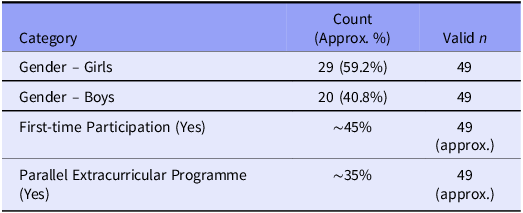
Questionnaires were collected from 49 students (ages 13–15; 29 girls and 20 boys) who participated across both years of the programme (Q1). Not all students answered every item, but the dataset covers the full cohort. Because the same group experienced both the Iliad and Odyssey cycles, the results provide insight into sustained engagement over time (Table 2).
Sample (N = 49)

Table 2. Long description
A table with four rows and three columns summarizing participant demographics and activities. The columns are labeled Category, Count (Approx. percent), and Valid n. The first row shows that 59.2 percent of participants are girls, with a valid count of 49. The second row indicates that 40.8 percent are boys, also with a valid count of 49. The third row shows that approximately 45 percent of participants are first-time participants, with a valid count of approximately 49. The fourth row reveals that approximately 35 percent of participants are involved in a parallel extracurricular program, with a valid count of approximately 49.
Gender split (Q1), first-time participation (Q2), parallel extracurricular involvement (Q3).
Note: Percentages based on valid n; approximations flagged where applicable.
Source: Student questionnaires, 2021–2023.
Motivations to join
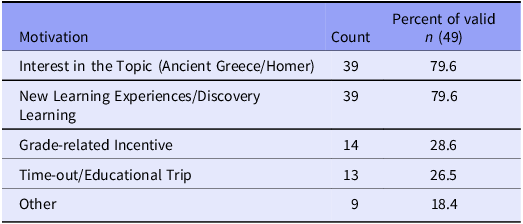
The strongest entry points were intrinsic: nearly four out of five students reported joining out of curiosity about Homer and Ancient Greece or because they were attracted by the promise of discovery-oriented pedagogy (both 79.6%). By contrast, extrinsic motives, such as the prospect of higher grades (28.6%) or the opportunity for an excursion (26.5%), were less prominent, and ‘other’ reasons (18.4%) were diverse and individually minor. This pattern is significant: it suggests that students were not primarily seeking a break from routine or tangible rewards but were genuinely motivated by content relevance and by the novelty of the learning approach. In this sense, the project appears to have recruited learners predisposed to active engagement, which helps explain the later findings on affective depth and sustained participation (Table 3).
Motivations to Join the Project (Q4, n = 49, Multiple Response)

Table 3. Long description
The table has five rows and three columns. The columns are labeled Motivation, Count, and Percent of valid n (49). The rows are labeled as follows: Interest in the Topic (Ancient Greece/Homer) with a count of 39 and a percent of 79.6, New Learning Experiences/Discovery Learning with a count of 39 and a percent of 79.6, Grade-related Incentive with a count of 14 and a percent of 28.6, Time-out/Educational Trip with a count of 13 and a percent of 26.5, and Other with a count of 9 and a percent of 18.4.
Note: Multiple responses permitted; percentages refer to valid n = 49 and may exceed 100%.
Sustained interest
Once the project was underway, student engagement was sustained through a combination of social, aesthetic, and technological factors (Q5). Collaboration with peers and the teacher was by far the strongest driver (75.7%), highlighting the importance of teamwork, shared responsibility, and the supportive role of the instructor. The musical corpus itself followed closely (54.1%): students emphasised that the repertoire of art songs – often unusual or unfamiliar in their everyday listening – was engaging precisely because it reframed Homer through modern sounds. A further 35.1% underlined the use of ICT, which lent the project a sense of novelty and authenticity, while 29.7% valued the autonomy they were given in choosing songs and shaping the direction of their work. Feedback confirms these patterns: students cited the teacher’s enthusiasm and encouragement, the freshness of encountering Greek songs in a new interpretive frame, and the perceived connection between antiquity and modern life as decisive elements. Together, these findings suggest that collaboration, music, digital tools, and learner agency interacted dynamically, creating an environment where engagement was both affective and intellectual, sustained not by external incentives but by meaningful participation.
Perceived benefits
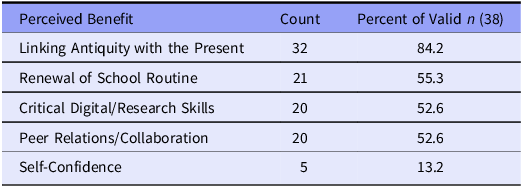
The most widely acknowledged benefit was the connection of antiquity with the present (84.2%), confirming the project’s central aim of showing Homer’s relevance today. Students often described this as acquiring a clearer understanding of their Greek cultural heritage, along with an appreciation of the continuity of both values and the Greek language. More than half also highlighted renewal of school routine (55.3%), improved collaboration and peer relations (52.6%), and the development of digital and research skills (52.6%). Several noted the creativity and joy brought by working with music, while a smaller group (13.2%) referred to gains in self-confidence, particularly through presenting their work in public. Taken together, these outcomes suggest that the project offered not only cognitive benefits but also social interaction, digital competence, and affective growth, aligning the reception of Homer with the broader aims of secondary education (Table 4).
Perceived Benefits (Q8, n = 38, Multiple Response)

Table 4. Long description
A table comparing perceived benefits from a survey with multiple responses allowed. The table has four columns and five rows. Column headers are Perceived Benefit, Count, and Percent of Valid n (38). Row labels include Linking Antiquity with the Present, Renewal of School Routine, Critical Digital/Research Skills, Peer Relations/Collaboration, and Self-Confidence. Linking Antiquity with the Present has a count of 32 and 84.2 percent. Renewal of School Routine has a count of 21 and 55.3 percent. Critical Digital/Research Skills has a count of 20 and 52.6 percent. Peer Relations/Collaboration has a count of 20 and 52.6 percent. Self-Confidence has a count of 5 and 13.2 percent.
Note: Multiple responses permitted; percentages refer to valid n = 38.
Affective responses
Students reported a spectrum of positive emotions (Q9), with satisfaction being the most frequent (63.2%), followed by surprise (39.5%), anticipation (31.6%), and aesthetic enjoyment (26.3%). The element of surprise proved particularly significant: Homer, often considered inaccessible, emerged instead as engaging and enjoyable through the medium of music. Feedback confirmed this affective impact, with students highlighting pride in their creative work and a sense of novelty in connecting epic poetry to songs familiar from their everyday lives. These emotions, reinforced by collaboration with peers and teachers, helped to sustain interest and create a supportive classroom environment. In this way, affective engagement did not merely accompany learning but also actively reshaped students’ perceptions of both Homer and the value of Ancient Greek as a living subject.
Attitudes towards Ancient Greek
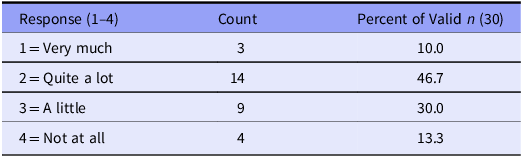
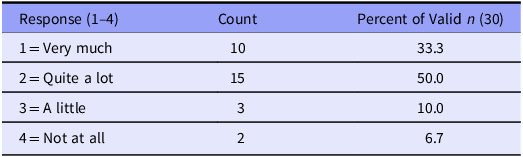
A majority of students reported a more positive stance towards Ancient Greek after the project (56.7% ‘Very much/Quite a lot’) (Table 5), while 83.3% supported its continued place in the curriculum (Table 6). These results suggest that experiencing Homer through modern music not only enhanced enjoyment but also improved perceptions of a subject often seen as difficult and remote. Students came to view Ancient Greek less as a compulsory requirement and more as a meaningful element of cultural and educational identity. In this way, the project reshaped perceptions of Homer and reinforced the broader legitimacy of Ancient Greek in today’s classroom.
Stance towards Ancient Greek after the Project (Q10, n = 30, Single Response)

Table 5. Long description
A table with three columns and five rows, including a header row. The columns are labeled ‘Response (1-4)’, ‘Count’, and ‘Percent of Valid n (30)’. The rows detail the responses: Row 1: Response 1 = Very much, Count 3, Percent 10.0. Row 2: Response 2 = Quite a lot, Count 14, Percent 46.7. Row 3: Response 3 = A little, Count 9, Percent 30.0. Row 4: Response 4 = Not at all, Count 4, Percent 13.3.
Ancient Greek’s Place in Today’s School (Q11, n = 30, Single Response)

Table 6. Long description
A table with three columns and four rows. The columns are labeled ‘Response (1–4)’, ‘Count’, and ‘Percent of Valid n (30)’. The rows are labeled with responses ranging from ‘1 = Very much’ to ‘4 = Not at all’. Row 1: Response 1 = Very much, Count 10, Percent of Valid n (30) 33.3. Row 2: Response 2 = Quite a lot, Count 15, Percent of Valid n (30) 50.0. Row 3: Response 3 = A little, Count 3, Percent of Valid n (30) 10.0. Row 4: Response 4 = Not at all, Count 2, Percent of Valid n (30) 6.7.
Open-ended responses (Q9 and Q12)
The open-ended items provided additional qualitative insight.
Q9 (Feelings during the project)
Out of 18 responses, 7 explicitly mentioned joy and satisfaction (‘I had fun, it was very enjoyable’), while another 7 emphasised surprise at the unusual combination of Homer and modern songs (‘It surprised me how Homer could be connected with songs we listen to today’). A smaller group highlighted pride and self-confidence, often linked to producing and presenting videos (‘I felt proud because we made something creative ourselves’). About eight responses were brief (‘good’, ‘different’), but even these conveyed broadly positive attitudes. Overall, students described the project as enjoyable, novel, and empowering – evidence of the affective engagement central to experiential reception.
Q12 (Why do Ancient Greek texts have a place in the twenty-first-century schools?)
Twenty students wrote justifications. Twelve stressed the connection between antiquity and the present, citing cultural roots, enduring values, and relevance for language and history (‘Because they show us our roots and who we are today’; ‘They help us understand our language and history’). Seven gave shorter or vaguer comments, while one offered a general positive evaluation without explanation. Notably, none dismissed the premise; the prevailing stance was that Ancient Greek remains relevant and important in today’s education.
Responses to Q9 and Q12 converged
Students reported joy, pride, and surprise in engaging with Homer through music, and at the same time articulated reasons why ancient texts matter in modern schooling. Affective engagement and rational justification thus reinforced each other. The project did not merely entertain; it strengthened students’ conviction that classical literature continues to hold cultural and educational value.
Challenges
About 45% of students reported difficulties, mainly time constraints, uneven group workload, and varying ICT readiness. Such frictions are typical of project-based learning, where coordination and equitable participation require management (Burnard and Dragovic, Reference Burnard and Dragovic2015). A minority noted digital literacy gaps, underscoring the need for timely scaffolding so that technology supports rather than overshadows interpretation (Walsh, Reference Walsh2010, 225–226). Importantly, no conceptual barriers emerged: once logistical issues were resolved, students engaged readily with both Homeric texts and music. These challenges were organisational rather than pedagogical, confirming the overall viability of the experiential design and illustrating Kolb’s (Reference Kolb1984, 21–22) point that structured cycles sustain creativity and reflection.
Taken together, the survey results show a clear pattern: students were drawn by curiosity; stayed engaged through collaboration, music, and digital tools; and perceived benefits that connected antiquity with present-day culture while strengthening social and digital skills. Their responses underline that the project not only sustained motivation but also reframed Homer as a living resource for modern education.
Discussion: experiential reception and pedagogical implications
Experiential reception in practice: from consumption to co-interpretation
Classroom practice and questionnaires show that encountering Homer through music and digital production enabled students to shift from passive consumption to active co-interpretation. The project cycled through inquiry, analysis, production, and public presentation, scaffolded by stable thematic axes (Iliad: Helen, Achilles, Hector, and Fall of Troy; Odyssey: Odysseus, Penelope, Circe–Calypso–Nausica, Ithaca, and Adventures). This structure ensured that musical work culminated in close engagement with Homeric passages rather than remaining at surface level, and it closely mirrored Kolb’s (Reference Kolb1984, 21–22) experiential learning cycle – concrete experience, reflective observation, abstract conceptualisation, and active experimentation. The convergence of student artefacts, classroom reflections, and questionnaire data confirms that experiential reception operates not only as a theoretical lens but also as a workable pedagogy. In this sense, the project substantiates – what Hall and Macintosh’s book (Reference Hall and Macintosh2005) claims – that reception through performance and media generates new cultural meanings, while aligning with recent calls for active student roles in classical education (Hardwick and Stray Reference Hardwick and Stray2008, 478–479).
Music as mediation: emotional engagement, identity, and ethical judgement
Music operated simultaneously as an emotional and interpretive mediator. Students engaged with contrasting musical idioms – lament and vigilance, provocation and restraint – to weigh ethical dilemmas such as honour versus cost or responsibility versus desire across the Iliad and Odyssey. This process resonates with Small’s (Reference Small1998, 9–10) concept of musicking as a meaning-making practice and with psychological research on music’s role in adolescent identity and emotional regulation (North et al., Reference North, Hargreaves and O’Neill2000, 269–270). The strong affective register of student responses in Q9 (‘joy’, ‘surprise’, and ‘pride’) validates the claim that emotional engagement is a gateway to deeper interpretation. Questionnaire data (Tables 2–6) reinforce this picture: intrinsic motivation was dominant, enjoyment widespread, and attitudes towards Ancient Greek shifted positively. At the same time, the sophistication of student artefacts – pairing lament motifs with epic destruction or contrasting rhythmic textures to mark ethical tension – demonstrates a growing capacity to orchestrate multimodal argument. In effect, music did not simply motivate; it scaffolded ethical judgement and interpretive choice, rendering abstract dilemmas tangible.
A recurrent theme in open-ended responses was the significance of the teacher’s presence. Students often noted that the instructor’s passion for Homer and encouragement during the creative process heightened their own motivation. This confirms research showing that teacher affect and modelling are decisive for sustaining engagement in project-based and arts-integrated learning (Burnard and Dragovic, Reference Burnard and Dragovic2015, 371–392). The project’s success was therefore not only structural (music, ICT, and collaboration) but also relational, grounded in the pedagogical stance of the educator.
Re-energising Homer as a pedagogical text
The project reaffirms Homer’s enduring value as a ‘school of virtue’ (Maronitis, Reference Maronitis2005; Tilk, Reference Tilk2014, 32–57). Its innovation lay in the mode of access: rather than relying on rote translation or commentary, students reinterpreted Homer through cultural forms familiar to them, particularly modern music. Their recurrent preference for Hector – framed as an ethic of care and solidarity – illustrates how reception enables alternative models of heroism to emerge (Garcia, Reference Garcia2018, 299–319; Tsagalis, Reference Tsagalis2012, 27–61). Similarly, students reconfigured nostos and fidelity in terms of modern identity dilemmas, linking Odysseus’ perseverance or Penelope’s endurance with their own adolescent concerns. These outcomes echo the emphasis on audiences as co-creators of meaning and support performance-oriented approaches to epic that foreground adaptation and re-use (Macintosh, Reference Macintosh, Hardwick and Stray2008, 247–258; Varakis, Reference Varakis, Hardwick and Stray2008, 259–273).
At the same time, a minority of students expressed reservations, citing the difficulty of Ancient Greek as a language and questioning its immediate usefulness. While limited in number, such responses indicate that experiential reception cannot entirely bridge the distance of the subject. Their coexistence with predominantly positive affective responses highlights the ongoing need for innovative pedagogies that render classical texts both accessible and meaningful.
Instructional implications for the classroom
The findings suggest four practical lessons for educators. Thematic scaffolding is essential: by structuring inquiry around recurring Homeric patterns, teachers can prevent fragmentation and support recognition of cross-textual and cross-media continuities. Team-based digital production enhances collaboration, role-taking, and responsibility, though it requires clear timelines and explicit division of labour to ensure equitable workload. Public presentation before authentic audiences consolidates rhetorical clarity, self-confidence, and motivation, echoing the performative origins of epic poetry. Light ICT support – brief tutorials and targeted scaffolds – proves sufficient to overcome technical hurdles without displacing interpretive work.
Together, these design features are adaptable to other contexts and align with broader research on multimodality and collaborative learning (Albers and Harste, Reference Albers and Harste2007; Walsh, Reference Walsh2010). They illustrate how experiential reception can be translated into concrete classroom strategies that both sustain engagement and deepen interpretation.
Limitations and prospects for transferability
As a single-site case study (N = 49) without systematic pre/post testing, the scope for generalisation is inevitably restricted (Yin, Reference Yin2014). Nevertheless, the triangulation of artefacts, classroom observations, and questionnaire data provides robust evidence for the mechanisms at work: music-mediated reception heightened engagement, fostered collaboration, and deepened reflection. Future research could extend this work by adopting comparative designs (e.g. parallel classes with and without music), introducing pre/post measures of attitudes towards Ancient Greek, and exploring cross-curricular applications that link literature, history, and music.
Despite these limitations, the project provides a pedagogically grounded and potentially scalable pathway for re-energising Homer and for sustaining classical literature as a living cultural resource in modern education.
Conclusion
This two-year cultural project (Singing Homer, 2021–2023) demonstrates that modern Greek songs can function as compelling mediators of Homeric reception in secondary education. Within a carefully scaffolded yet creative process of inquiry, interpretation, and digital production, students did not merely ‘learn about’ Homer; they immersed themselves in his texts, reworking epic dilemmas through cultural repertoires familiar to them. The result was a distinctive blend of affective engagement, collaborative creativity, and ethical reflection.
Three key findings stand out. First, music opened an emotional gateway: students consistently reported joy, pride, and surprise, emotions that sustained engagement and deepened interpretation. Second, learners articulated clear rationales for the modern relevance of ancient texts, presenting Homer as a resource for identity, values, and cultural continuity. Third, the integration of digital tools and authentic public presentation transformed classical reception into a twenty-first-century competence practice, reinforcing creativity, collaboration, critical thinking, and communication.
At the same time, the project illustrates that reception is itself a pedagogy. By positioning learners as co-creators of meaning, Singing Homer substantiates reception theory’s emphasis on audience agency and multimodality’s recognition of cross-semiotic learning. Students’ recurrent preference for Hector – framed as an ethic of care and solidarity – or their reconceptualisation of nostos as a journey of identity shows how adolescent learners appropriate Homer to negotiate their own ethical and existential concerns. Open-ended responses further confirm this process: students not only associated Homer with enjoyment and novelty but also argued explicitly for the continuing importance of Ancient Greek texts in modern schooling, grounding their conviction in cultural roots, values, and linguistic heritage.
Although the study’s scope (single site, N = 49, no pre/post testing) restricts generalisation, triangulated evidence confirms that music-mediated reception can reshape student attitudes towards Ancient Greek and deepen their engagement with classical literature. Future research should adopt comparative and longitudinal designs, extend to cross-curricular contexts, and explore further how music and other media sustain classical texts as living interlocutors.
Overall, Singing Homer provides a pedagogically grounded and transferable model for revitalising epic in the classroom. By combining the emotional immediacy of music with collaborative inquiry and digital creativity, the project re-energises Homer both as cultural heritage and active pedagogical resource, sustaining his relevance in the twenty-first-century curriculum.
Author biography
Vasileios Tsiotras is adjunct lecturer and post-doctoral researcher at the School of Philosophy and Education, Aristotle University of Thessaloniki (AUTH), and research associate at the Research Centre for Medieval and Modern Hellenism, Academy of Athens, where he works on the manuscripts of the Aristotelian commentator Theophilos Korydalleus. He holds a PhD in Classical Philology from AUTH and has taught Ancient Greek literature at the University of Thessaly and the didactics of Ancient Greek at AUTH and the University of Western Macedonia. He is a councilor on the new national curricula for Ancient Greek of the Greek Ministry of Education (Institute of Educational Policy). His teaching and research interests embrace classical studies, palaeography and the manuscript tradition of commentaries on Aristotle, and Claudius Ptolemy, and the history of higher education in the Greek-speaking Orthodox East, especially in Constantinople during the Ottoman era (17th–18th c.). He is the author of two monographs, and his work has appeared in Greek and international peer-reviewed journals and collective volumes.


 Open access

