INTRODUCTION
Paleodiet studies based on analysis of carbon and nitrogen stable isotopes in bone collagen are now one of the most important methods to investigate ancient human subsistence (e.g. Shoeninger Reference Shoeninger2014; Sealy Reference Sealy2017; see also Roberts et al. Reference Roberts, Fernandes, Craig, Larsen, Lucquin, Swift and Zech2018). In the Russian Far East, this kind of bioarchaeological research is still at the very early stage, mainly due to the poor preservation of bones at the prehistoric sites; human remains are known mostly from shellmiddens and limestone caves (see review: Kuzmin Reference Kuzmin2015).
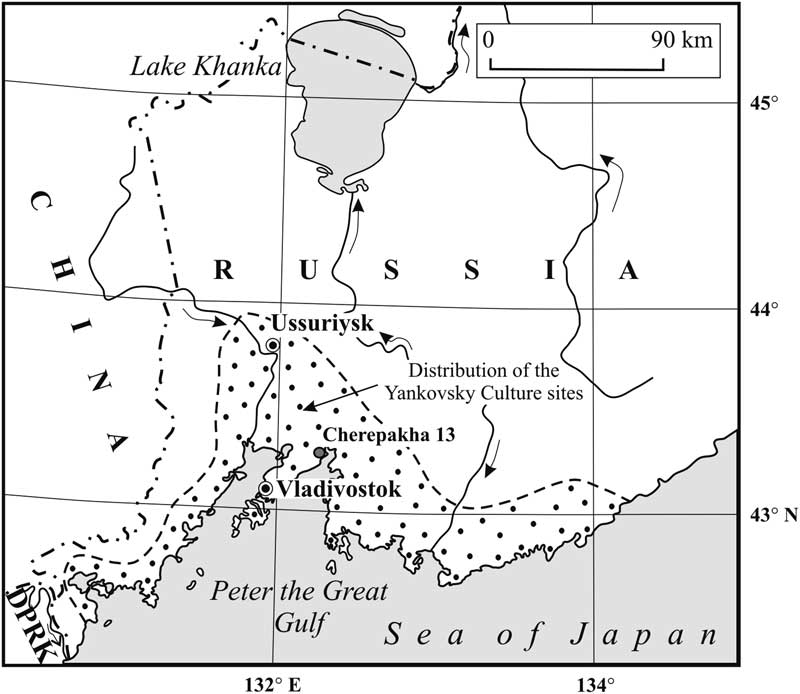
In the Russian Far East, encompassing the mainland Primorye Province and the Amur River basin, and insular regions of Sakhalin Island and the Kurile Islands, one of the most prominent cultural complexes studied since the late nineteenth century is the Yankovsky Culture (YC) of the Early Iron Age. The settlements and burial grounds of the YC are located in the southern part of Primorye (Maritime) Province (e.g. Okladnikov Reference Okladnikov1965; Andreeva et al. Reference Andreeva, Zhushchikhovskaya and Kononenko1986), roughly between two points—one ca. 125 km SW of the city of Vladivostok, and another ca. 150 km E of the same city (Figure 1). Sites are situated mainly on the Sea of Japan shore, but sometimes more inland, up to ca. 80 km from the coastline, near the modern city of Ussuriysk. In the course of surveys and excavations of the YC, around 100 habitation sites and shellmiddens, and a few burial grounds were studied (Andreeva et al. Reference Andreeva, Zhushchikhovskaya and Kononenko1986). Unfortunately, the human osteological materials from these burials did not survive. The numerous shellmiddens on the Sea of Japan coast are the “trademark” of this cultural complex, and it was assumed that marine mollusks played an important role in human subsistence. The real proportion and importance of this food source for YC, however, was not established before this study. From the view of chronology, the YC is generally dated to the 12th–5th millennia BC based on charcoal radiocarbon (14C) dates from habitation sites (Kuzmin et al. Reference Kuzmin, Boldin and Nikitin2005).
The position of the Cherepakha 13 site in southern Primorye Province of Russia (the dotted area is the territory with YC sites).

New data were generated after the discovery and excavation in 2015–2017 of the Cherepakha 13 site in Primorye Province, with a plethora of animal bones and numerous human remains. Overall, in 26 graves the skeletons of 37 individuals were unearthed. This is the largest prehistoric burial ground excavated so far in the entire far eastern Russia. This provided us with an excellent opportunity to conduct paleodietary studies in this region, less studied compared to neighboring Japan, the Korean Peninsula, and North China. In this paper, we report the first data on the composition of carbon and nitrogen stable isotopes in human bone collagen of the Early Iron Age coastal populations in Primorye, and discuss the results obtained in a wider context.
MATERIAL AND METHODS
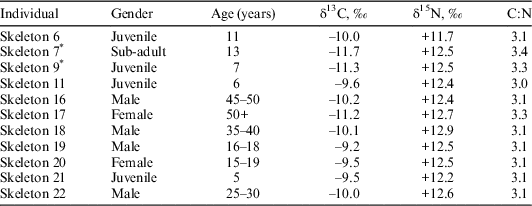
The Cherepakha [Turtle] 13 site is located near the coast of Ussuri Bay, part of the larger Peter the Great Gulf, Sea of Japan (coordinates 43°17′N, 132°18′E; see Razjigaeva et al. Reference Razjigaeva, Ganzey, Lyaschevskaya, Makarova, Kudryavtseva, Grebennikova, Panichev, Arslanov, Maksimov, Petrov and Malkov2017a) (Figure 1). Although several cultural components have been identified at this site (Malkov Reference Malkov2017), its main occupation phase and human burials belong to the YC. As for the site’s chronology, the most securely YC-associated 14C date for the Cherepakha 13 site was obtained on charcoal from the Dwelling 26 where skeletons 7 and 9 (see Table 1) were found: 2960±95 BP (SOAN-9602); this corresponds to 2880–3360 cal BP or 930–1410 cal BC (based on Calib Rev 7.0.2 software; http://calib.qub.ac.uk/calib/).
Gender, age and stable isotope composition of collagen of the Cherepakha 13 humans.

* A 14C date of ca. 2960 BP was obtained for Dwelling 31 where these skeletons were found.
Zooarchaeological information for the Cherepakha 13 site was obtained by the determination of animal bones to species/genus level. Overall, around 17,300 bones were collected during the excavations, and 78% of them are identifiable. About 11,250 bones (71% of the total assemblage) belong to YC, and 80.9% of them are large mammals, 5.3% are birds, and 13.8% are fish; the two latter groups were not studied in detail. The large terrestrial mammals are represented by artiodactyls (Artiodactyla), carnivores (Carnivora) and lagomorphs (Lagomorpha); and marine mammals belong to carnivores and cetaceans (Cetacea). Domesticated animals are represented by dog (Canis familiaris) (8.5% of the total for YC) and pig (Sus scrofa domestica). Concerning the latter, there is a problem of separation from the wild boar (Sus scrofa), and the amount of suids’ (pig/boar) bones is 7544 (82.9% of the total for YC). Major species of wild mammals (8.3% of the total for YC) are Siberian roe deer (Capreolus pygargus) and red deer (Cervus elaphus) (dominant species); and fox (Vulpes vulpes), sable (Martes zibellina), kolinsky (Mustela sibirica), and Asian badger (Meles leucurus). The amount of marine mammal bones—Steller’s sea lion (Eumetopias jubatus) and largha seal (Phoca largha)—is very small (0.04% of the total for YC).
The paleoenvironmental study of the area around the Cherepakha 13 site (Razjigaeva et al. Reference Razjigaeva, Ganzey, Lyaschevskaya, Makarova, Kudryavtseva, Grebennikova, Panichev, Arslanov, Maksimov, Petrov and Malkov2017a) allowed us to establish that during the site’s existence the nearby territory was covered with forest consisting mainly of oak, with admixture of Korean pine and hornbeam. The climate was cooler than today; on the adjacent hills the main vegetation type was forest with a dominance of dark conifers (fir and Korean pine), with some broadleaved species (Razjigaeva et al. Reference Razjigaeva, Ganzey, Mokhova, Makarova, Panichev, Kudryavtseva, Arslanov, Maksimov and Starikova2017b). Overall, during the existence of the YC sites in southern Primorye the climate fluctuated between warmer (at ca. 3380–3220 and 2950–2630 cal BP) and colder (at 3220–2950 cal BP) episodes (Razjigaeva et al. Reference Razjigaeva, Ganzey, Mokhova, Makarova, Panichev, Kudryavtseva, Arslanov, Maksimov and Starikova2017b). It is suggested that when the Cherepakha 13 site was occupied by the YC population, the level of the Sea of Japan dropped, and this may have caused a decrease of marine resources (Razjigaeva et al. Reference Razjigaeva, Ganzey, Lyaschevskaya, Makarova, Kudryavtseva, Grebennikova, Panichev, Arslanov, Maksimov, Petrov and Malkov2017a). Archaeobotanical research at the Cherepakha 13 site (Sergusheva and Moreva Reference Sergusheva and Moreva2017) allowed us to identify the seeds of two species of millet: broomcorn millet (Panicum miliaceum) and foxtail millet (Setaria italica) in the YC layer. It is clear that the bearers of the YC practiced agriculture based on domesticated millets which are C4 plants.
For this study, the bones of 11 humans and 30 animals were selected for stable isotope analysis. Samples were milled to the size of 200–300μm, and were treated with chloroform to remove lipids and fats. After that, the material was rinsed with methanol 3–4 times. The resulting powder was dried, and treated with a 0.5M solution of HCl overnight. This was followed by the removal of humic acids with a 0.1M solution of NaOH (for 30min), and then the powder was treated with 0.5M HCl for 1hr to eliminate the admixture of atmospheric CO2. After each treatment, the powder was washed with mQ water 3–4 times. Gelatinization was performed at pH 3 (temperature of 70°C, 24hr), and the gelatin obtained was freeze-dried. The C:N ratios were measured by a EuroEA 3000 HT elemental analyzer, and δ13C and δ15N values were determined with the help of a Finnigan Delta-V mass spectrometer.
As for comparative materials from the Primorye region and neighboring parts of the Russian Far East, there is a dearth of evidence currently available. Only 2 Neolithic sites in Primorye were analyzed, Boisman 2 and Chertovy Vorota (Kuzmin et al. Reference Kuzmin, Richards and Yoneda2002); in the Amur River basin, 11 individuals from the Early Iron Age and Medieval cultural complexes were investigated (Kuzmin Reference Kuzmin2015); and on Sakhalin Island, 13 skeletons from the Paleometal and ethnographic times were analyzed (see Kuzmin Reference Kuzmin2015). In order to generate a more comprehensive interpretation, we used the data available from the Japanese Islands, southern Siberia (Russia), southern Kazakhstan, and northern China (see references below).
RESULTS AND DISCUSSION
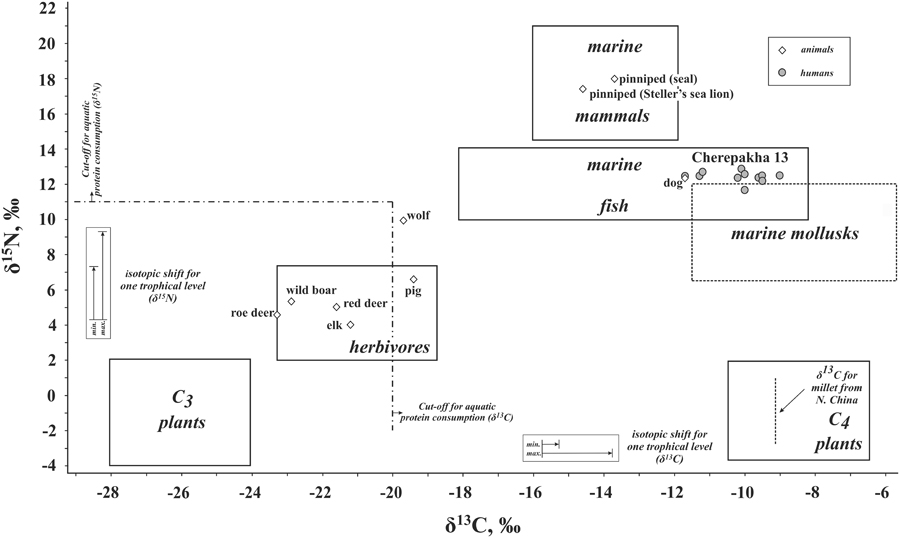
The results of the stable isotope analyses for the Cherepakha 13 site (YC component) are presented in Tables 1–2 and in Figure 2. For humans, good quality collagen (C:N ratio of 3.0–3.4) yielded the following values (with±1 sigma): δ13C=–10.2±0.8‰; and δ15N=+12.4±0.3‰. No significant difference based on gender or age of the individuals was observed.
Composition of carbon and nitrogen stable isotopes in the bone collagen of the Cherepakha 13 site (humans and animals); boxes with ranges of the main dietary sources are from Choy and Richards (Reference Choy and Richards2010).

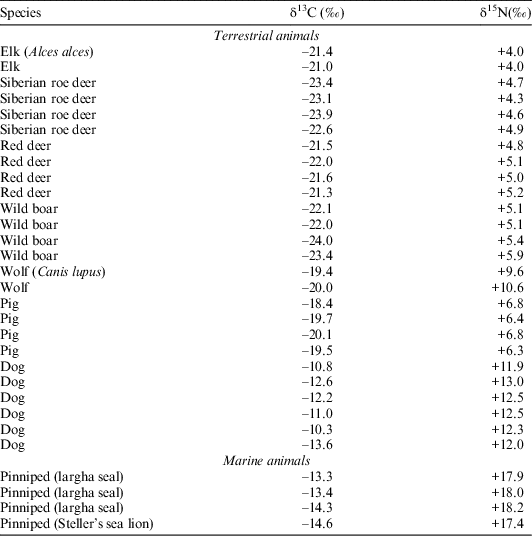
Stable isotope composition of animal collagen from the Cherepakha 13 site.

Concerning the animals from the YC component, terrestrial wild mammals (elk, red deer, roe deer, and wild boar) show the usual isotopic signals in the following ranges: δ13C=–19.4 ÷ –23.3‰; and δ15N=+4.6 ÷ +6.6‰ (for wolves, up to 10.1‰). Marine mammals have common values for these kinds of animals: δ13C=–13.7 ÷ –14.6‰; and δ15N=+17.4 ÷ +18.0‰. Dogs have an isotopic composition similar to humans: δ13C=–11.7±1.2‰; and δ15N=+12.4±0.4%. Judging from the published data on soft tissues of marine fish and mollusks from coastal waters of Primorye (Kharlamenko et al. Reference Kharlamenko, Kiyashko, Imbs and Vyshkvartzev2001, Reference Kharlamenko, Kiyashko, Rodkina and Imbs2008, 2011; Kiyashko et al. Reference Kiyashko, Velivetskaya and Ignatiev2011), the δ13C values are in the range of –16.8 ÷ –20.7‰, and δ15N are of +9.9 ÷ +12.6‰ for fish. As for mollusks, their stable isotope values are in the following ranges: from –9.1 ÷ –11.3‰ to –17.9 ÷ –18.8‰ (for δ13C); and +7.7 ÷ +9.2‰ (for δ15N).
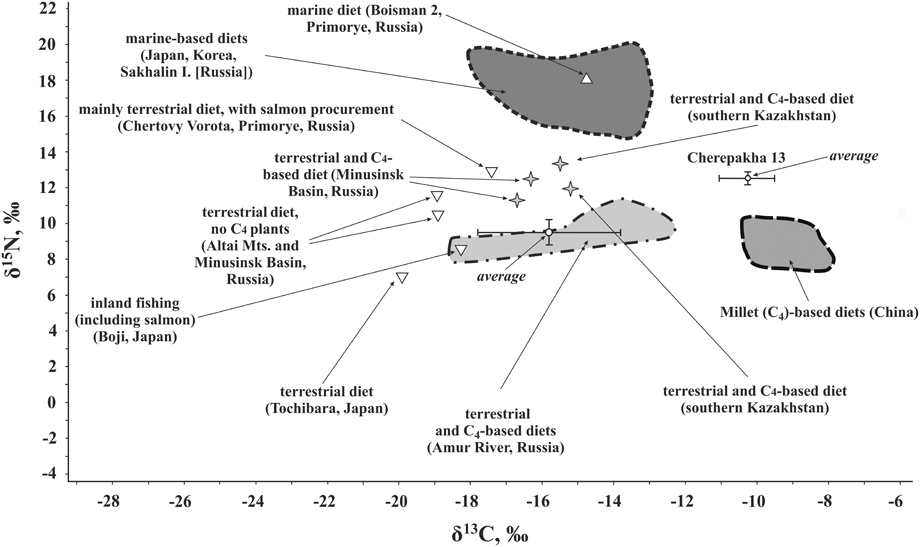
When the data for the Cherepakha 13 site are plotted on the background of the available information on the paleodiet in Primorye and other regions of Northeast Asia (Figure 3), it is clear that the YC individuals consumed less marine-based protein compared to the population of the Boisman 2 site (Kuzmin et al. Reference Kuzmin, Richards and Yoneda2002). The cut-off values for consumption of aquatic protein are δ13C=–20‰, and δ15N=+10–12‰ (e.g. Katzenberg Reference Katzenberg2008) (see Figure 2). This is also consistent with data on the marine-based diet of coastal prehistoric and Medieval people in Northeast Asia (Japan, Korea, and Sakhalin Island; see references in Kuzmin Reference Kuzmin2015); and the mainly terrestrial diets of the Tochibara and Boji sites belonging to the Jomon of Japan (Yoneda et al. Reference Yoneda, Hirota, Uchida, Tanaka, Shibata, Morita and Akazawa2002, Reference Yoneda, Suzuki, Shibata, Morita, Sukegawa, Shigehara and Akazawa2004), and the Chertovy Vorota site in Primorye (Kuzmin et al. Reference Kuzmin, Richards and Yoneda2002); for the latter two sites, the consumption of a certain amount of anadromous fish (salmon) was also suggested (Kuzmin et al. Reference Kuzmin, Richards and Yoneda2002; Yoneda et al. Reference Yoneda, Suzuki, Shibata, Morita, Sukegawa, Shigehara and Akazawa2004; Kuzmin 2009).
Comparison of carbon and nitrogen stable isotopes in the bone collagen of the Cherepakha 13 humans with isotope values for the prehistoric and Medieval populations of the Russian Far East and neighboring regions of Northeast Asia (see references in the text).

Based on δ15N values, the Cherepakha 13 individuals are close to those of the Chertovy Vorota site, with the diet of the latter based on a mixture of terrestrial animals and anadromous fish (Kuzmin et al. Reference Kuzmin, Richards and Yoneda2002, Reference Kuzmin, Keally, Jull, Burr and Klyuev2012); however, the former is much higher in terms of δ13C values than the latter (–10.2‰ vs. –17.6‰) (see Figure 3). The δ13C signatures of the Cherepakha 13 humans are also higher compared to those for the Early Iron Age and Medieval populations in the Amur River basin, with the diet based on a mixture of terrestrial animals, C4 plants (domesticated millets), and C3 plants (mainly wheat) (see Kuzmin Reference Kuzmin2015). While the variation of δ13C values for the Amur River sites is quite large (Figure 3), from –18.5‰ to –12.4‰, the mean value is toward the lower end: –15.8±2.0‰. The highest value of –12.4‰ was determined for the Alekseevsy Bugor site of the Early Iron Age (also called “Paleometal,” according to Russian archaeological terminology) when millet agriculture was an important part of the economy.
Millet was the first cultivated plant introduced to the Russian Far East at ca. 4600 BP, most probably from China (Kuzmin et al. Reference Kuzmin, Jull and Jones1998; Kuzmin Reference Kuzmin2013; see also Pechenkina and Oxenham Reference Pechenkina and Oxenham2014; Stevens and Fuller Reference Stevens and Fuller2017); unfortunately, no skeletons of this or a similar age have been recovered and analyzed, and we can only use the materials from the adjacent regions of northern Asia (see Figure 3). In the Altai Mountains and the Minusinsk Depression of southern Siberia, the terrestrial-based diet gives us the δ13C values of ca. –19‰ (Svyatko et al. Reference Svyatko, Schulting, Mallory, Murphy, Reimer, Khartanovich, Chistov and Sablin2013, Reference Svyatko, Polyakov, Soenov, Stepanova, Reimer, Ogle, Tyurina, Grushin and Rykun2017a, Reference Svyatko, Schulting, Poliakov, Ogle and Reimer2017b; Motuzaite Matuzeviciute et al. Reference Motuzaite Matuzeviciute, Lightfoot, O’Connell, Voyakin, Liu, Loman, Svyatko, Usmanova and Jones2015, Reference Motuzaite Matuzeviciute, Kiryushin, Rakhimzhanova, Svyatko, Tishkin and O’Connell2016). Populations of the Late Bronze Age, Late Iron Age, and the Middle Ages from the Minusinsk Basin and southern Kazakhstan, with a mixed diet consisting of terrestrial animals, C3 plants, and millet, have higher δ13C values of ca. –17 ÷ –15‰ (Motuzaite Matuzeviciute et al. Reference Motuzaite Matuzeviciute, Lightfoot, O’Connell, Voyakin, Liu, Loman, Svyatko, Usmanova and Jones2015; Svyatko et al. Reference Svyatko, Schulting, Poliakov, Ogle and Reimer2017b; Ananyevskaya et al. Reference Ananyevskaya, Aytqaly, Beisenov, Dmitriev, Garbaras, Kukushkin, Loman, Sapolaite, Usmanova, Varfolomeev, Voyakin, Zhuniskhanov and Motuzaite Matuzeviciute2018). Abundant information on the stable isotopes of a millet-based diet in mainland China (e.g. Pechenkina et al. Reference Pechenkina, Ambrose, Ma and Benfler2005; Barton et al. Reference Barton, Newsome, Chen, Wang, Guilderson and Bettinger2009; Liu et al. Reference Liu, Jones, Zhao, Liu and O’Connell2012; Hou et al. Reference Hou, Hu, Zhao, Li, Wie, Hou, Hu, Lv, Li, Song and Wang2013; Lightfoot et al. Reference Lightfoot, Liu and Jones2013; Atahan et al. Reference Atahan, Dodson, Li, Zhou, Chen, Barry and Bertuch2014; Ma et al. Reference Ma, Dong, Lightfoot, Wang, Liu, Jia, Zhang and Chen2014; Chen et al. Reference Chen, Fang, Hu, Hou, Lü, Yuan, Song, Fuler and Richards2016; Ma et al. Reference Ma, Fuller, Wei, Shi, Zhang, Hu and Richards2016; see also review: Hu Reference Hu2018) shows that the δ13C values for populations which relied heavily on C4 plant protein are in the range of ca. –8 ÷ –10‰. The average δ13C value for charred millet from Late Neolithic–Bronze Age sites in northern China is ca. –9.1‰ (Chen et al. Reference Chen, Yu, Underhill and Fang2017; see Figure 2). The Cherepakha 13 δ13C values (average –10.2±0.8‰) are quite similar to those from China. When we compare the Cherepakha 13 data with information on Chinese C4-dependent populations, it is quite possible that the former consumed a certain amount of millet as a source of C4 protein.
The elevated δ15N values for the Cherepakha 13 site inhabitants (Figure 3) can be explained by the consumption of marine-based protein (mainly from fish and mollusks); they are, however, lower than the δ15N values for pure marine hunters and fishers from the coasts of Japan, Korea, and Sakhalin Island (see references in Kuzmin Reference Kuzmin2015). It can be assumed that the share of sea food resources of high trophic level (i.e., marine mammals) for the people buried at the Cherepakha 13 site was not large. If we compare it with the paleoenviromental situation at that time, ca. 3000 BP, the regression of the Sea of Japan level (e.g. Kuzmin Reference Kuzmin2002; see also Korotkii Reference Korotkii1985) can indicate a deterioration of the maritime ecosystems and a decrease of their productivity, including the disappearance of oyster shellbeds which existed in estuaries and lagoons and were one of the main sources of food for coastal populations. This may explain why the role of marine-based protein in the subsistence of the YC population at the Cherepakha 13 site was smaller compared to the Boisman 2 site (Kuzmin et al. Reference Kuzmin, Richards and Yoneda2002). Nevertheless, the consumption of certain amount of marine food should be taken into account when direct 14C dating of skeletons belonging to YC will be undertaken, as in case of other maritime-oriented prehistoric populations of the Russian Far East (see Kuzmin Reference Kuzmin2015: 577–8).
According to the data obtained and their interpretation, the main protein sources for the population of Cherepakha 13 site were the following: (1) marine mollusks, fish, and possibly mammals; (2) C4 plants (domesticated millets); and (3) terrestrial animals. It is possible that consumption of a large amount of marine protein from low trophic level organisms (mollusks) alone can give humans isotopic signatures of ca. –10.2‰ (δ13C) and +12.4‰ (δ15N). More work is therefore needed to find out more precisely protein sources for the Cheerepakha 13 population, as it was done with the help of modeling using the FRUITS software (Fernandes et al. Reference Fernandes, Millard, Brabec, Nadeau and Grootes2014). As it is known from general zooarchaeological and archaeobotanical data for YC, its economy was based on a combination of gathering marine shellfish, marine fishing, and hunting marine mammals; and terrestrial hunting and plant gathering, and animal husbandry (mainly dogs and pigs, and to some extent cattle and horses), supplemented by millet and wheat agriculture (e.g., Andreeva et al. Reference Andreeva, Zhushchikhovskaya and Kononenko1986; Kuzmin Reference Kuzmin1995, Reference Kuzmin1997; Kuzmin and Rakov Reference Kuzmin and Rakov2011; Gasilin Reference Gasilin2013). Our results are in accord with these reconstructions.
CONCLUSIONS
Using stable isotope data for the Early Iron Age individuals from the Cherepakha 13 site in southern Primorye Province, it is assumed based on direct evidence (i.e. human and animal bone collagen) that its diet consisted of at least two main sources: (1) marine mollusks, fish, and probably mammals; and (2) terrestrial animals (both wild and domestic species). The possible consumption of C4 plants (domesticated millets) is also noteworthy. Marine organisms were one of the main food resources for the population of the YC, following the earlier maritime-oriented Boisman cultural complex of the Neolithic, dated to ca. 5800 BP (ca. 4700 cal BC). We have now for the first time in paleodiet studies of the Russian Far East the isotopic data for a population with a mixture of marine and terrestrial resources, and possibly C4 plants. In order to find out the ratios of other food components (such as fats and carbohydrates), analysis of bioapatite in the human bones of the Cherepakha 13 site is now planned. Cherepakha 13 therefore has a high potential for in-depth studies of human subsistence in the Early Iron Age of Primorye.
ACKNOWLEDGMENTS
We are grateful to Drs AV Zubova and VG Moiseev for the determination of gender and age of the Cherepakha 13 humans used in this study, to two anonymous reviewers and Dr R Fernandes for their useful comments, remarks, and suggestions, and to Dr SG Keates for polishing the grammar. This research was supported by the Tomsk State University Competitiveness Improvement Program; and the State Contract of the Institute of Plant and Animal Ecology, Urals Branch of the Russian Academy of Sciences.