Although failure to resolve the stage-salient tasks of a developmental period successfully is not indicative of psychopathology per se, such incompetent organization, in concert with the genotype and/or environmental stressors that predispose for a mood disorder or biological anomalies that constitute a diathesis for unipolar or bipolar illness, might signal a prototypical depressive or manic depressive organization that forebodes the subsequent development of a mood disorder (Cicchetti & Toth, 1995, p. 382).
Bipolar disorder (BD) is a chronic, recurrent disorder carrying high morbidity and mortality. It is the sixth leading cause of disability among all illnesses (Murray & Lopez, 1996). Up to 4% of the US population is affected by bipolar I or II disorder (Kessler, Berglund, Demler, Jin, & Walters, 2005). Twenty-five to 50% of individuals with BD attempt suicide at least once, and 8.6 to 18.9% die by suicide (Chen & Dilsaver, 1996).
As the other articles in this Special Issue have explained, the early-onset form of BD (EOBD) has wide-ranging effects on a child's functioning. It is characterized by frequent mixed episodes, continuous cycling, impairment in academic and social functioning, suicidality, psychosis, and comorbidity with disruptive, anxiety, and substance misuse disorders (Bellivier, Golmard, Henry, Leboyer, & Schurhoff, 2001; Biederman et al., 2003; Brent et al., 1988; Carter, Mundo, Parikh, & Kennedy, 2003; Pavuluri, Birmaher, & Naylor, 2005). These phenomenological features are associated with treatment resistance and poor outcome in adult samples. The majority of EOBD patients have recurrences within a 2- to 4-year period (55–70%) even when maintained on pharmacotherapy (Geller, Tillman, Craney, & Bolhofner, 2004).
Without early intervention, EOBD patients can be derailed, sometimes irrevocably, in social, intellectual, and emotional development. Notably, the onset of EOBD and its subsequent treatments interfere with key developmental tasks of adolescence, including identity consolidation, forming successful romantic relationships, academic success, and psychological autonomy (Cicchetti & Rogosch, 2002; Masten & Coatsworth, 1998). Families are significantly affected by BD in an offspring, with high levels of emotional, economic, and practical burden and distress (Perlick, Hohenstein, Clarkin, Kaczynski, & Rosenheck, 2005). Parents of bipolar patients, young or old, often develop depression themselves, and are frequently candidates for psychiatric treatment, in part because of the stigma toward mental illness in the larger social system (Hinshaw & Cicchetti, 2000; Perlick et al., 2005, 2006).
Fortunately, advances in the treatment of EOBD indicate that early intervention may lead to more hopeful outcomes. These interventions are both pharmacological (e.g., Kowatch, Sethuraman, Hume, Kromelis, & Weinberg, 2003) and psychosocial (Fristad, Gavazzi, & Mackinaw-Koons, 2003; Miklowitz et al., 2004). Notably, adding family-focused treatment (FFT)—a manualized psychosocial intervention consisting of psychoeducation, communication training, and problem-solving skills training—to pharmacotherapy delays relapses and reduces symptom severity among adult bipolar patients (Miklowitz, George, Richards, Simoneau, & Suddath, 2003; Miklowitz, Richards, et al., 2003; Rea et al., 2003). It also enhances medication adherence and the emotional tone of family interactions (Miklowitz, George, et al., 2003; Simoneau, Miklowitz, Richards, Saleem, & George, 1999). The application of FFT to EOBD patients is relatively new.
This article has four objectives. First, we present a biopsychosocial model for understanding the longitudinal relationships between family systemic processes and mood disorder symptoms in children and adults (Cicchetti & Rogosch, 2002; Engel, 1977; Miklowitz, 2004; Wynne, Shields, & Sirkin, 1992; see also Davies & Cicchetti, 2004). This model has been highly influential in our thinking about family interventions for EOBD. Second, we review our recent work on stress as a risk factor in the course of BD in adults and adolescents, including new data on the prognostic role of expressed emotion (EE; Vaughn & Leff, 1976) and life stressors. Third, we describe our model of family-focused treatment for adolescents and present data on its clinical efficacy from a small-scale open trial. Finally, we make recommendations for developmentally oriented research on family factors and interventions in the onset and course of EOBD.
BD: A Developmental Psychopathology Perspective
The developmental psychopathology view holds that a child's mood disorder symptoms and associated functional impairments come about as the result of the conjoint, interactive influences of genetic vulnerability, biological and psychological vulnerability, family distress, and life stress at different points of development (Cicchetti & Rogosch, 2002). Our view incorporates this position along with a traditional biopsychosocial view of medical illness (Engel, 1977; Wynne et al., 1992), which highlights the reciprocal influences of a patient's biological and psychological functioning, stage of cognitive, social, and emotional development, the family, cultural, and medical context in which symptoms are expressed, and the need for integrated treatment.
Far from viewing the family as a causal agent in the illness, this model focuses on the family's way of organizing itself in response to episodes of psychiatric disorder in one or more family members. Parents vary considerably in their emotional reactions to an episode of schizophrenia or mania in an offspring (e.g., Miklowitz, Goldstein, & Nuechterlein, 1995) The nature of these reactions is likely to play a role in determining whether the family is a protective or risk factor in the subsequent course of an illness. Protective family environments will be those in which caregiving members educate themselves about the disorder and how it is likely to affect the at-risk child, take a structured and measured approach to managing the child's emotional outbursts or other symptoms (e.g., suicidal behaviors), and rely on extrafamilial resources including mental health treatment, extended family, and community supports. High-risk family environments will be those in which members have overly fluid boundaries or engage in uncontrolled cycles of negative affective communication that become entangled with the symptom exacerbations of the at-risk person. These patterns prevent the family from moving forward to the next developmental level and the ill person from stabilizing (e.g., Rosenfarb, Goldstein, Mintz, & Nuechterlein, 1995; Simoneau, Miklowitz, & Saleem, 1998). There may be critical periods in development in which family conflict and criticism play their most influential role on the development of emotional competence, and the interval in which an at-risk adolescent is first developing mood dysregulation is likely to be one such period (Cicchetti & Rogosch, 2002; Cicchetti & Toth, 1995).
The core treatment implication of the model is that severe pediatric medical illnesses, including EOBD, will best respond to a combination of pharmacotherapy and psychosocial intervention, particularly if this intervention is oriented toward modifying the environmental context in which core vulnerabilities are expressed. Many pediatric medical disorders respond positively to the combination of pharmacotherapy and psychotherapy (notably family psychoeducation), including diabetes (Hampson et al., 2001; Satin, La Greca, Zigo, & Skyler, 1989; Wysocki, Greco, Harris, Bubb, & White, 2001), chronic pulmonary disease (Mossay, De Buck, Filosof, & Parise, 2003), and asthma (Brown et al., 2002; Panton & Barley, 2000).
A Developmental Psychopathology Perspective on EE
In illustrating this model, consider the extensive literature on EE as a predictor of relapse in many psychiatric disorders. A meta-analysis of 26 studies showed that schizophrenic patients who return to highly critical, hostile, or emotionally overinvolved families following a hospitalization have a two to three times greater risk of relapse in the next 9 months than patients who return to families rated low in criticism, hostility, or overinvolvement (Butzlaff & Hooley, 1998). Even stronger results for EE and relapse were found in studies of bipolar and major depressive patients (Butzlaff & Hooley, 1998; Miklowitz, Goldstein, Nuechterlein, Snyder, & Mintz, 1988; O'Connell, Mayo, Flatow, Cuthbertson, & O'Brien, 1991; Priebe, Wildgrube, & Muller-Oerlinghausen, 1989; Yan, Hammen, Cohen, Daley, & Henry, 2004).
Why would highly critical, hostile, or overprotective attitudes in caregivers bring about a mood disorder relapse in a biologically vulnerable family member? To fully answer this question, we need to examine two mediational pathways: the pathways leading to high-EE attitudes among caregivers, and the processes that intervene in the relationship between high-EE attitudes and mood disorder relapses in patients.
The developmental psychopathology/biopsychosocial model posits that the seeds of critical, hostile, or overprotective behaviors or attitudes begin with a child who has a temperamental vulnerability to mood swings. Parents of bipolar children report that their children were affectively dysregulated when they were infants and toddlers (Radke-Yarrow, Nottelmann, Martinez, Fox, & Belmont, 1992; Zahn-Waxler et al., 1988). Temperamental disturbances may include irritability, low frustration tolerance, mood swings, and high anxiety (e.g., Akiskal, 1996), as well as early deficits in cognitive or behavioral functioning (Cornblatt, Obuchowski, Roberts, Pollack, & Erlenmeyer-Kimling, 1999). These disturbances may reflect the early phenotypic expression of a genetic predisposition to mood disorder. However, the developmental progression of these predispositions is likely to be worse if there is a poor “temperamental fit” (Gordon, 1981) between the child and parent. Notably, some parents, because of their own neurobiology and social history, are prone to react with frustration, guilt, or anxiety to a child with temperamental or cognitive disturbances (e.g., Greene & Ablon, 2006).
Regardless of the nature of the child's disturbances, a parental history of psychopathology places the child at greater risk for experiencing hostile and critical interactions, and can have detrimental effects on the child's striving for adaptation (Cicchetti & Toth, 1995). In a study contrasting the families of toddlers whose mothers had experienced a major depressive episode since the child's birth with families with no history of parental mental illness, Rogosch, Cicchetti, and Toth (2004) found that maternal criticism regarding the child, self, and spouse was higher among the depressed mothers. Children of depressed mothers were vulnerable to criticism as early as the second year of life.
Repeated critical or hostile statements from parent to child during critical developmental periods may influence the development of insecure or disorganized–disoriented attachment styles, negative self-representations in the child (e.g., beliefs that one is worthless, inept, or incapable of being loved), self-criticism, hopelessness, negative attributional styles, and internal working models of relationships as conflict ridden (Cicchetti & Toth, 1995). The child who is exposed to parental overprotective attitudes at a young age may develop a schema for the world as a dangerous place in which they are unable to navigate without help. Negative schemas about the self may interfere with the child's acquisition of emotional self-regulation skills (e.g., the ability to learn to appropriately express negative feelings) and the subsequent quality of family and peer relationships. In late childhood or early adulthood, the presence of these negative views of self, world, and future may interact with high parental criticism to foster the development of a depressive episode in a genetically predisposed child.
Parental negativity may also be associated with neuropsychological deficits in at-risk children. In a cross-sectional study of offspring of mothers with BD, Meyer et al. (2006) found that the association between maternal negativity and risk for BD in offspring was mediated by compromised frontal–cortical functioning on the Wisconsin Card Sort. The cause/effect direction of these relationships is unclear, in that both parental criticism and offspring frontal lobe impairment may reflect a cross-generationally shared genotype.
The child's reactions to high-EE parents—which may include temper tantrums, self-destructive behavior, depression, or anxiety—may further fuel the negative attitudes of criticism, hostility, or overinvolvement among parents, which further contribute to the child's cognitive and emotional vulnerabilities. Thus, although high-EE is only measured in the caregiver, it may be a “leading indicator” of bidirectional family processes that affect and are affected by one or more member's symptoms (Miklowitz et al., 1989; Strachan, Feingold, Goldstein, Miklowitz, & Nuechterlein, 1989).
Once a child or young adult has actually developed a mood disorder, a different series of processes may mediate the relationship between parental EE attitudes and relapse. Notably, well-controlled laboratory experiments have shown that EE attitudes can affect an at-risk individual physiologically as well as psychologically. In a functional magnetic resonance imaging (fMRI) paradigm, Hooley, Gruber, Scott, Hiller, and Yurgelun-Todd (2005) observed that college students who were euthymic but had had prior episodes of depression failed to activate the dorsolateral prefrontal cortex when listening to tapes of their mothers criticizing them. In contrast, normal activation of the dorsolateral prefrontal cortex was observed among healthy controls when exposed to maternal criticism. No group fMRI differences emerged when students listened to tapes of maternal praise.
Other studies have found that patients with schizophrenia who interact with highly critical relatives in a laboratory setting have higher levels of electrodermal activity, diastolic blood pressure, or cardiovascular activity than patients interacting with less critical relatives (Altorfer, Kasermann, & Hirsbrunner, 1998; Sturgeon, Turpin, Kuipers, Berkowitz, & Leff, 1984; Tarrier, Barrowclough, Porceddu, & Watts, 1988; Tarrier, Vaughn, Lader, & Leff, 1979). These studies have not been conducted in adult or pediatric bipolar samples, which seems an important direction for future research.
Implications of the Biopsychosocial Model for Family Intervention
Consistent with the developmental psychopathology notion of multifinality, persons with core vulnerabilities to mood disorder may never develop depression or BD in adulthood if there are compensatory factors within the individual or environment (Cicchetti & Schneider-Rosen, 1986). Family environments can be protective influences if family members are able to modify and adapt their patterns of reaction to fit the developmental requirements of an at-risk or ill child. In contrast, a family that remains unduly fixed in its interactional patterns, but that does not provide external structure and consistency, may inhibit the at-risk child's ability to learn emotional self-regulation skills and form successful extrafamilial relationships.
FFT attempts to modify the parents' and siblings' reactions to the ill child, and the ill child's reactions to family members through psychoeducation. A key objective of psychoeducation is for families to understand the sequences of interaction that lead to stress and symptomatic exacerbation. For example, we emphasize that (a) much of the child's aversive behavior is beyond his or her control and not intent upon hurting others and (b) the parents' emotional reactions, however aversive for the child, are usually a by-product of their intent to promote the health of the child. Thus, family members are encouraged to view each others' behavior in a different light. In turn, family members learn methods for managing their own emotions through communication and problem-solving skills training.
In later sections of this article, we describe the adaptation of FFT to EOBD patients. But first, we present evidence in support of our view that family stress is a risk factor in the course of BD.
Studies of Family Stress and Outcome in Adult Bipolar Patients
In a small, prospective study of hospitalized young-adult bipolar patients (N = 23), we found that patients discharged to families that were high in negative affectivity were particularly relapse prone. If patients returned to parental homes characterized by high EE attitudes or negative affective style interactional behaviors (negative parent–patient communication in laboratory-based problem-solving discussions), their risk of relapse in the subsequent 9 months was 94%. If the parents were neither high in EE nor negative in affective style, the risk was only 17%. These relationships were independent of the patients' medication regimens or compliance (Miklowitz et al., 1988).
Later studies clarified the family processes associated with high- and low-EE attitudes. In laboratory-based family interactions conducted an average of 1 month after patients were discharged, we found that high-EE families containing bipolar adults were locked into negatively escalating patterns of affective communication (“point–counterpoint cycles”; Simoneau et al., 1998). In these cycles, the probability that a family member expressed a negative statement increased when he or she had just been the target of a negative statement from another family member. In turn, this back and forth sequence increased the probability that the first partner would express another negative comment. Both patients and caregivers initiated these sequences. In fact, high-EE families were most statistically distinguishable from low-EE families by the “three-volley sequence,” involving a negative statement by one family member, a negative response by a second, and a third negative statement by the first member. In many of these interactions, we observed that the content became more critical, personal, and hostile as the interchanges continued. In contrast, low-EE families were better able to derail and discontinue negative cycles of interaction before they escalated (Simoneau et al., 1998).
A second process correlated with EE involved the attributions made by caregivers for negative events involving the patients. In family interactions, high-EE parents or spouses were more likely than low-EE parents or spouses to attribute negative patient-related events to personal and controllable factors (e.g., “You wouldn't get into so much trouble if you would just slow down and do one thing at a time”). In contrast, low-EE relatives were more likely to make universal and/or uncontrollable attributions, such as attributions of illness causation (Wendel, Miklowitz, Richards, & George, 2000).
We reasoned that both interactional and attributional processes are amenable to modification through psychosocial intervention. Negative interchanges can be restructured through instruction in communication, problem-solving, and negotiation skills. Likewise, attributions can sometimes be modified through educating relatives about the behavioral correlates of bipolar episodes (e.g., excessive reactivity, pessimism, intrusiveness) and the neurological underpinnings of these behaviors. Both of these objectives are central to FFT.
Studies of Stress in Early-Onset BD
Family attitudes and outcome
Surprisingly little research has been done to clarify the role of family stress in childhood-onset BD. Parents with BD often create a caregiving environment characterized by high expressions of negative affect toward the at-risk child (e.g., Radke-Yarrow, Nottelmann, Belmont, & Welsh, 1993). Among children already diagnosed with BD, Geller et al. (2004) found that low ratings of maternal warmth by children and/or parents predicted earlier manic recurrences following recovery in a 4-year follow-up of manic children (mean age 10.8 years). Of interest, the family also operated as a protective influence in this study: children who resided in two-parent biological families had more rapid recoveries from mania than children residing in one-parent families (Geller et al., 2002). Of course, none of these findings necessarily implicate family processes as causal culprits in illness recurrence. Maternal warmth may drop, and negative affectivity may increase in reaction to a child who has subsyndromal or residual symptoms of mood disorder that predispose him or her to earlier recurrence. Likewise, single-parent families may be more heavily genetically loaded than dual-parent families for major affective disorder.
Recent data from our laboratory confirm the role of EE in the course of early-onset BD. We recently completed a study of FFT and pharmacotherapy among 20 bipolar teens (mean age = 14.8) and their parents. Based on the Kiddie Schedule for Affective Disorders and Schizophrenia, Present and Lifetime Version (K-SADS-PL; (Chambers et al., 1985; Kaufman et al., 1997), 16 of the 20 teens met DSM-IV-TR (American Psychiatric Association, 2000) criteria for bipolar I disorder with an acute illness episode in the prior 3 months (four with a DSM-IV-TR manic episode, five with a mixed episode, four with a depressive episode, and three with alternating periods of mania and depression). One of the adolescents met criteria for bipolar II disorder with a depressed episode, alternating with symptoms of hypomania. Three adolescents had BD, not otherwise specified (NOS) with depressive, manic, or mixed symptoms that did not meet the full DSM-IV-TR criteria for episode status.
All families received up to 21 sessions of FFT over 9 months, and regular pharmacotherapy sessions with a study-affiliated psychiatrist for a full 2-year period. An independent evaluator assessed patients every 3 months during Year 1 and every 6 months in Year 2 using the interview-based K-SADS Depression and Mania Rating Scales (Axelson et al., 2003; Chambers et al., 1985). Summary ratings were based on consensus scores from interviews of the child and at least one parent. Parents also completed the Child Behavior Checklist (CBCL; Achenbach, Edelbrock, & Howell, 1987) every 6 weeks in Year 1 and every 3 months in Year 2.
Research staff members interviewed parents at entry into the trial using the Camberwell Family Interview for EE (Vaughn & Leff, 1976). EE data were missing from one family. In all, 14 of the remaining 19 families were rated high-EE (74%) and 5 (26%) were low EE. In a previous study of adult bipolar patients, the rate of high EE among parents was 61% (Miklowitz et al., 2000).
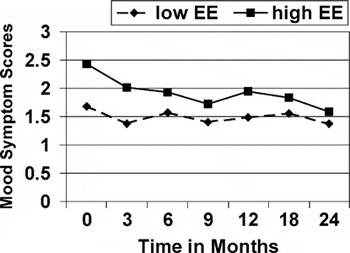
The relationships between EE and K-SADS or CBCL scores were examined using mixed effects regression models (Gueorguieva & Krystal, 2004). These analyses, which included all data points including those for patients who did not complete treatment or follow-up, revealed that adolescents in high-EE families had consistently higher mood disorder symptom scores over a 24-month follow-up than adolescents in low-EE families (Figure 1), F (1, 17) = 6.33, p = .02; Cohen's d = 0.98. Separate effects were observed for EE on mean depression scores, F (1, 17) = 5.87, p = .027, and to a lesser extent, mania scores over time, F (1, 17) = 3.46, p = .08).

Parental expressed emotion predicts total mood symptom scores among adolescent bipolar patients in a family treatment program (N = 19). Mood symptom scores were the sum of all Likert items from the Kiddie Schedule for Affective Disorders and Schizophrenia, Depression and Mania Rating Scales; main effect of EE in a mixed effects regression model, F (1, 17) = 6.33, p = .02; Cohen's d = 0.98.
The associations between EE and parent behavioral problem ratings on the CBCL were more complex. There was no main effect of EE on CBCL Total Problem Behavior t scores over the 24-month follow-up, F (1, 17) = 1.02, p > .10; N = 19. However, there was an interaction between EE and time in predicting total problem behavior scores, F (1, 141) = 4.79, p = .03. The EE by time interaction was stronger for internalizing t scores (p = .019) than externalizing t scores (p = .095). These interactions indicated that high-EE parents rated the adolescents as higher in problem behaviors than did low-EE parents during the first year of treatment and follow-up. The group differences were smaller in the second year, during which no active FFT sessions occurred. These findings may suggest that family intervention blunts the associations between high-EE attitudes and patients' symptoms over time, as we found in a study of adults (Kim & Miklowitz, 2004). Of course, the CBCL is a parent self-report instrument, and high-EE attitudes may exaggerate the degree to which parents report symptoms or other negative behaviors of the child.
Life stress
EE research has traditionally focused on family stress as an influence on the course of psychiatric disorders. It is possible that adolescents with BD are equally affected by life events or stressors inside (e.g., parental loss) or outside (e.g., relationship breakups) of the family, depending on the balance of risk and protective factors in the individual and his or her environment. Life events stress has been found to be strongly predictive of time to recovery (Johnson & Miller, 1997) and the probability of relapse (Ellicott, Hammen, Gitlin, Brown, & Jamison, 1990) among adult bipolar patients.
A study by our group (Kim, Miklowitz, Biuckians, & Mullen, in press) examined the association between life stress and illness course among 38 bipolar teens (mean 15 years) who took part in either an open trial of FFT (n = 12) or a randomized trial of FFT or a brief psychoeducational comparison intervention (n = 26). All patients received standard medications for EOBD as given by study psychiatrists. Adolescents were interviewed at study entry and at 3-month intervals using the UCLA Life Stress Interview (Hammen, Ellicott, Gitlin, & Jamison, 1989), a 45-min interview designed to evaluate episodic stress (e.g., stressful events) and chronic stress (e.g., longstanding family conflicts, poverty, social isolation). Episodic stressors were rated on the degree to which they were “dependent” or caused by the adolescent's behavior (e.g., getting suspended from school for disruptive behavior), or were independent of his or her behavior (e.g., death of a close relative). Patients completed an average of 40.89 weeks of follow-up and 3.34 life stress assessments.
The highest ratings of chronic stress were in the domains of family relationships and school. The most frequent stressful events were also those related to the family (e.g., parents undergoing a separation), followed by events involving close friends (e.g., fights with a best friend). After controlling for the effects of age, gender, psychosocial treatment condition, and whether the teen was diagnosed with bipolar I, bipolar II, or BD NOS, hierarchical linear regression models revealed that higher levels of chronic stress in intimate relationships (family or romantic) predicted less improvement in depression symptoms, F (1, 52) = 9.86, p = .003, β = .21, mania symptoms, F (1, 52) = 10.37, p = .002, β = .22, and combined (depressive plus manic) symptoms, F (1, 52) = 14.75, p = .0003, β = .24, over an average of 40 weeks. A significant interaction between age and chronic stress indicated that, with increases in age, chronic strains in intimate relationships became more closely associated with combined mood symptoms, F (1, 51) = 4.71, p = .03, β = .25. In addition, higher chronic stress in peer relationships was significantly associated with less improvement in mania, F (1, 52) = 6.50, p = .01, β = .20, but not depression, F (1, 52) = .04, p = .85, or combined mood symptoms, F (1, 52) = 2.86, p = .10. An interaction between the severity of independent events (i.e., events not dependent on the child's behavior, such as a parent's loss of a job) and age indicated that, with increases in age, the severity of independent events was more strongly correlated with depression, F (1, 53) = 4.54, p = .04, β = .12, mania, F (1, 53) = 9.00, p = .004, β = .18, and combined mood symptoms, F (1, 53) = 8.24, p = .006, β = .30. In addition, girls reported a stronger association between independent events and depression, F (1, 53) = 4.08, p = .05, β = .11, and combined mood symptoms, F (1, 53) = 4.45, p = .04, β = .21, than boys. However, this gender by severity of events interaction did not significantly predict mania symptoms, F (1, 53) = 2.34, p = .13 (Kim et al., in press).
These results suggest that chronic family or romantic stressors are associated with slow improvement in depression and mania symptoms independent of age. Chronic stressors and severe events that are independent of the child's behavior are more strongly associated with mood symptoms among older than younger adolescents. Thus, as was previously shown in studies of children with major depressive illness (Asarnow, Goldstein, Tompson, & Guthrie, 1993; Hammen, Brennan, & Shih, 2004), the course of EOBD is affected by family and life stressors.
Conclusions
Collectively, these findings provide evidence for a central assumption of the developmental psychopathology/biopsychosocial model: the environmental context is an important risk or protective factor in the course of BD in children, teens, and adults. Family relationships that are low in stress and conflict are crucial to long-term stability and resiliency.
We have observed the bidirectional nature of these relationships in assessment and treatment sessions, in which adolescents often provoke their parents into high-EE behavior, which in turn, leads to short-term symptom exacerbations in the adolescent, sometimes even within sessions. When considering the role of life events stress, we must consider the effects of the teen's behavior on his or her social environment: many of the stressors adolescents reported were dependent events rather than independent events.
Future research should examine how family stress, life stress, external social supports, and mood disorder symptoms evolve over time at different levels of development. We have hypothesized that high-EE attitudes reflect conflicts between the temperaments of parents and their genetically susceptible children. It is possible that changes in family relationships over time—either through treatment, adoption of new coping strategies, or changes in family structure—delay or mitigate the emergence of severe mood symptoms in a vulnerable offspring. Likewise, life events stress may be more or less contributory to symptom onset if it occurs within the context of high- versus low-EE environments. A study of bipolar adults found that life events stress and social support were independent (but noninteractive) predictors of depressive episode recurrence (Cohen, Hammen, Henry, & Daley, 2004).
The intervening effects of genetic risk in the relations between environmental variables and mood deserve further examination. It is possible that high-EE attitudes are a phenotypic expression of an underlying susceptibility to mood disorder among parents, and that the entire EE/outcome association is an epiphenomenona of shared heritability. Evidence against this hypothesis comes from several studies. First, EE is as strong a predictor of depression recurrence when the caregiver is a spouse as when the caregiver is a parent (Butzlaff & Hooley, 1998). Second, there does not appear to be a relationship between high- and low-EE attitudes in parents or spouses and their individual psychopathology (Goldstein, Miklowitz, & Richards, 2002). Third, Caspi et al. (2004) found that within monozygotic twin pairs, the twin who was exposed to more maternal criticism and less warmth had more conduct problems than the twin who was exposed to less maternal negativity. Thus, maternal EE attitudes may play an etiological role in the development of antisocial behavior problems independently of the effects of genetic vulnerability. Whether the same is true for the development of mood disorders deserves examination.
The remainder of this article focuses on an application of family-focused psychoeducational treatment (Miklowitz & Goldstein, 1997) to EOBD. This treatment emerged in part from the biopsychosocial framework described earlier. We first review the results of studies of adults with BD who are treated with FFT or a comparison intervention, followed by a description of the developmental adaptations undertaken for EOBD patients. We then present the results of an open trial of FFT in combination with pharmacotherapy for bipolar adolescents.
Family-Focused Treatment
Studies of adults
The FFT model for adults consists of 9 months (21 sessions) of psychoeducation (didactic information about the nature, course, treatment, and self-management of BD), communication enhancement training (behavioral rehearsal of effective speaking and listening skills), and problem-solving skills training. It commences shortly after the patient has begun to recover from an acute episode of bipolar mania, depression, or mixed disorder. In our two randomized trials involving adults, over 80% of patients began in the hospital and were followed as outpatients.
FFT assists patients and their relatives (parents, spouse, or siblings) to (a) understand the nature, pattern, and biopsychosocial context of the patient's most recent mood episode; (b) recognize the patient's vulnerability to the disease and develop plans to prevent or delay recurrences; (c) accept the necessity of ongoing medication treatment, (d) distinguish the disorder from stable personality attributes or age-normative behaviors; (e) manage stressors or daily hassles that provoke swings of mood; (f) implement strategies for maintaining stability during euthymic periods (e.g., mood charting, sleep/wake cycle stabilization); and (g) promote a family environment whose communication and problem-solving practices enhance the patient's and caregivers' stability and functioning.
In a study at the University of Colorado (Miklowitz et al., 2000; Miklowitz, George, et al., 2003), 101 patients were randomly assigned to FFT (21 sessions over 9 months) plus standard medications or a brief psychoeducational comparison treatment known as crisis management (CM) plus medications. The latter consisted of two sessions of family psychoeducation on the management of BD, followed by crisis intervention sessions given as needed over a 9-month interval. Over a 24-month study period, patients in FFT had higher rates of survival without relapse (52%) than patients in CM (17%; p = .003). The mean survival duration for FFT patients was 73.5 weeks and for CM patients, 53.2 weeks. FFT was superior to CM in reducing depressive symptoms over 2 years (p = .005; Cohen's d = 0.56) and to a lesser extent, manic symptoms (p < .05; Cohen's d = 0.40). Patients in FFT also had lower levels of psychotic symptoms throughout follow-up (p < .05). A treatment by EE interaction, F (1, 74) = 4.28, p < .05, indicated that the most dramatic short-term (i.e., over the first year) improvements in depressive symptoms occurred among patients from high-EE families who received FFT.
In terms of mediators of treatment effects, patients in FFT were more consistently medically adherent (45%) and less likely to discontinue medications (16%) over 2 years than patients in CM (21 and 44%; χ2 (2) = 9.1, p < .01). Medication adherence mediated the effects of FFT versus CM on improvement of manic symptoms, but not on improvement of depressive symptoms.
Simoneau et al. (1999) identified one other mechanism by which FFT achieves its effects. Improvements from pre- to posttreatment in family communication were greater among families in FFT than among families in CM. Moreover, improvements in patient–relative communication were correlated with the patients' mood improvements over 12 months, notably in depressive symptoms. Thus, FFT may exert its effects on mania through enhancing medication adherence, and on depression through increasing the protective effects of the family.
A second randomized trial of FFT conducted at the University of California, Los Angeles examined 53 patients assigned to FFT plus medications or an individually focused psychoeducational treatment (IFPT) plus medications (Rea et al., 2003). IFPT was given in the same frequency as FFT (21 sessions over 9 months). Survival analyses indicated no differences in relapse or rehospitalization rates during the first year of treatment. However, patients in FFT had fewer relapses during a 1- to 2-year posttreatment period (28%) than patients in individual IFPT (60%; p < .05). Patients in FFT also had substantially fewer rehospitalizations during the posttreatment period (12% in FFT vs. 60% in IFPT; p < .01). Patients in FFT were less likely (55%) to require hospitalization when they did relapse than patients in IFPT (88%; p < .05).
In summary, two randomized controlled trials have found that adjunctive FFT is effective in delaying relapses among adult BP patients. Treatment mechanisms may include enhancing medication adherence and facilitating positive family communication, which mediate improvements in mania and depressive symptoms, respectively. FFT may also prevent rehospitalizations through teaching family members to recognize the patients' relapses early and obtain emergency treatment.
Adaptation of FFT to Early-Onset Bipolar Patients
In 1999, we began adapting FFT to adolescent bipolar patients (ages 13–17) with a recent episode of mania, mixed disorder, or depression. In surveying the literature, we were struck by key developmental differences in the presentation of EOBD versus adult-onset BD: EOBD episodes are shorter and fluctuations more rapid; episodes are usually characterized by mixed symptoms rather than pure forms of mania or depression; moods are more likely to be irritable than elated or classically depressed (an issue of considerable controversy); comorbidities with attention-deficit/hyperactivity disorder, anxiety disorders, and oppositional defiant disorders are the rule rather than the exception; and medication responses are often inadequate (for a review, see Pavuluri et al., 2005). Parents or other family members often have mood disorders themselves.
In our pilot treatment sessions with families of teen bipolar patients, parents frequently complained of having little control over the behavior of the adolescent, who seemed to have an unusual amount of power in the family system. Adolescents struggled with identity issues related to the disorder: how could they accept a psychiatric diagnostic label if they viewed their behavior as no different from that of their peers? It was clear that FFT had to be modified to address these developmental differences.
Many of the parents' and teen's questions centered upon what was or was not an illness episode. Thus, clinicians attempted to clarify the distinctions between age-appropriate moodiness and BD. Rather than implementing a classic relapse prevention drill, in which families identify early warning signs of impending episodes and develop plans to stave off full recurrences, parents of adolescents were usually more interested in developing plans to control brief but intense mood swings that emerged very rapidly. Relapse prevention plans frequently involved changes in the environmental context to remove triggers for mood instability (e.g., arranging for the adolescent to get safely out of the house when he or she felt suicidal or became rageful).
Among older adolescents, we observed that poor medication adherence often reflected the adolescent's struggle for autonomy with parents. Parents typically insisted that medications were essential to stability, whereas adolescents tended to externalize the causes of their behavior (e.g., “I wouldn't be so grouchy if they didn't try to control me all the time”). Treatment required framing the use of medication as a means of achieving autonomy from parents rather than giving it up.
The developmental psychopathology literature finds that parents who provide stable routines, consistency in caretaking, and external structure help their children develop internal controls that probably contribute to the development of emotional self-regulation (Cicchetti & Toth, 1995; Field, 1989; Zahn-Waxler, Iannotti, Cummings, & Denham, 1990). For bipolar patients, inconsistency of routines and sleep disruption are part of a hypothesized mediational pathway between stress and manic symptoms (Malkoff-Schwartz et al., 1998). Thus, addressing problems with the regularity of sleep and daily routines—a critical component of the treatment of nearly all teenagers—may be especially relevant to emotional self-regulation among bipolar teens (see also Harvey et al., this issue). In FFT, behavioral plans are often negotiated between parents and teens to help teens maintain more regular sleep and wake rhythms and decrease stimulation at night (Frank et al., 2005).
The treatment was initially tested in an open trial of 20 teens. During the trial, the manual was continually modified to address the issues most relevant to EOBD. In the following sections, we review these adaptations to psychoeducation, communication training, and problem-solving skills training.
Psychoeducation module
The psychoeducation module, usually conducted in Sessions 1–9, offered adolescents, their parents, and their siblings didactic information about the symptoms, differential diagnosis, comorbidity, course, treatment, and self-management of bipolar illness. Clinicians explained the interactive roles of genetic and biological vulnerability, stress, and coping in the disorder's onset, the role of risk factors (i.e., disruptions in sleep/wake rhythms, suddenly discontinuing medications, substance misuse, escalating family conflicts) and protective factors (i.e., consistency with medications and pharmacotherapy visits, stable sleep/wake patterns, structured, low conflict family routines). Clarifying the differences between “teenage behavior” and “bipolar behavior” was aided by a self-rated mood chart completed by the adolescent (and sometimes by a parent as well) and examined in each session. Reports on the adolescent's behavior from friends, even if second hand, also helped clarify this distinction (e.g., one teen's friend, upon observing his euphoric mood, said “that's something I haven't seen before”).
The impact of the disorder on family functioning was discussed openly. Care was taken to avoid any implication of blame of the parents, and therapists repeatedly clarified that many of the adolescents' aversive behaviors were due to a biologically based illness rather than to willful intention.
We encouraged families to plan during periods of stability for emergency intervention (medical or behavioral) when the adolescent's moods started to fluctuate or when he/she became suicidal. These plans usually centered upon preventing or minimizing the severity of brief, intense escalations or deteriorations in mood. Families recalled previous periods of the adolescents' mood instability and identified sequences consisting of triggers, early warning signs of relapse, and palliative measures. An individualized prevention plan was developed for each family (e.g., no suicide/no harm contracts, notifying the physician of symptom exacerbation, reducing stress triggers at home, stabilizing sleep/wake rhythms). Emphasis was placed on keeping family routines regulated (e.g., standardized meal times, bed times), and keeping family conflict to a minimum (e.g., adjusting expectations of the child when he or she was moody).
Many parents in our study suffered from mood disorders. During psychoeducation and other phases of FFT, clinicians provided emotional support for parents and clinical referrals as appropriate (including pharmacotherapy). They taught parents to identify and cope with triggers for their own mood cycling (including high-intensity interactions with the bipolar offspring) and emphasized communication strategies (see below) to help preserve marital relationships and relations with the affected and nonaffected offspring. In some cases, we were able to use a parent's own history of depression and subsequent treatment to normalize the offspring's experiences of depression.
Communication and problem-solving modules
The communication module (Sessions 10–15) is designed to reduce unproductive, aversive interactions among family members and improve the quality of day to day exchanges. It is guided by the assumption that aversive communication reflects distress in the family's attempts to cope with EOBD. It uses a role-playing format to teach adolescents and their family members four skills: expressing positive feelings, active listening, making positive requests for changes in each others' behaviors, and constructive negative feedback. Clinicians offer handouts listing the components of each skill (e.g., for active listening: making eye contact, paraphrasing), and model each for the family. Then, participants practice the skills with each other, with coaching and shaping by the clinician.
Communication training was done less formally with adolescents than adults, capitalizing as much as possible on spontaneous interactions. Homework assignments, in which the participants recorded their efforts to use each skill, facilitated generalization to the home setting.
In the final FFT module (Sessions 16–21), families were taught to identify and define specific areas of disagreement, generate and evaluate solutions, and implement solutions. It focused on behavior management strategies the parents could employ without interfering with the adolescent's normal developmental quest for independence. In our adolescent trial, participants listed their most pressing problems and defined each one (e.g., the adolescent does not get to school on time and conflict ensues). Then, parents generated two to three solution choices and the adolescent was asked to evaluate the pros and cons of each. Next, the family conjointly chose a best option or set of options and developed an implementation plan. Families practiced problem solving between sessions using a self-guided homework sheet and reported on their efforts in the next session.
For EOBD patients, the primary objective of the problem-solving module was to increase the parents' power in the family hierarchy. Clinicians' routinely encouraged parents to implement solutions that increased their self-efficacy in managing the disorder. For example, one family developed a quid pro quo agreement in which the teen's privileges became contingent on keeping compliant with his medications.
Maintenance sessions
Toward the end of FFT, sessions are tapered to trimonthly (Months 10–24). Maintenance sessions revisit the seven objectives of FFT: has the family gained an understanding of the cyclic nature of the disorder? Is consistency of medication treatment in place? Has the family developed (and where necessary, implemented) a relapse prevention plan? These sessions usually involve problem solving and rehearsal of the communication skills.
Results From an Open Trial of FFT for Adolescent Patients
As indicated earlier, we enrolled 20 adolescents in an open trial of FFT and pharmacotherapy. The active period of psychosocial treatment was 9 months, followed by a 15-month maintenance period in which the adolescent continued in pharmacotherapy and trimonthly FFT booster sessions.
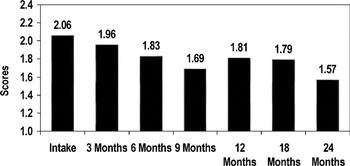
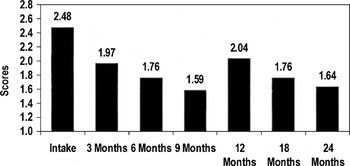
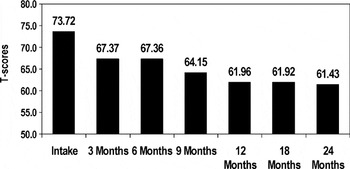
Changes in K-SADS Mania and Depression Scale Scores, and changes in parent-rated CBCL problem behavior scores are depicted in Figures 2, 3, and 4. As indicated, adolescents showed improvements in depression, F (1, 96) = 10.05, p < .002; Cohen's d = 0.87, mania, F (1, 94) = 17.24, p < .0001; Cohen's d = 1.19, and total mood (sum of depression and mania items) scores, F (1, 94) = 16.10, p < .0001; Cohen's d = 1.05, over time. We also observed substantial improvements in parent-rated CBCL total problem behavior scores, F (1, 142) = 20.73, p < .0001; d = 0.99 (Figure 4), externalizing t scores, F (1, 142) = 20.61, p < .0001, d = 1.02, and internalizing t scores, F (1, 142) = 12.59, p < .0005, d = 0.70, over 2 years. Improvements were not linear, however: some of the adolescents showed steady improvement in the first year and then had a rebound of symptoms by Month 18, and stabilized again by Month 24. It is notable that the active FFT treatment interval occurred during the first 9–12 months. Possibly, symptom return coincided with the withdrawal of regular sessions. Alternatively, FFT may promote symptom stabilization in only a subpopulation of adolescents. The trajectory of symptoms over time underlines the fluctuating nature of bipolar symptoms even when patients are maintained on state-of-the-art pharmacotherapy and maintenance psychosocial treatment.

Family-focused treatment for adolescents with bipolar disorder; Kiddie Schedule for Affective Disorders and Schizophrenia (K-SADS) depression scores during and following treatment; main effect of time in a mixed effects regression model, F (1, 96) = 10.05, p < .002; Cohen's d = 0.87.

Family-focused treatment for adolescents with bipolar disorder; Kiddie Schedule for Affective Disorders and Schizophrenia (K-SADS) mania scores during and following treatment; main effect of time in a mixed effects regression model, F (1, 94) = 17.24, p < .0001; Cohen's d = 1.19.

Parents' Child Behavior Checklist total problem behavior ratings during and following family-focused treatment; main effect of time in a mixed effects regression model, F (1, 142) = 20.73, p < .0001; Cohen's d = 0.99.
Of course, without an appropriate comparison group it is difficult to determine whether the pattern of results indicates the effects of FFT, medication, or simply the passage of time. A controlled clinical trial of FFT plus pharmacotherapy versus brief psychoeducation plus pharmacotherapy, conducted in a collaboration between the University of Colorado and the University of Pittsburgh Medical Center is now nearing completion (N = 58). This project will examine the added benefit of FFT in conjunction with pharmacotherapy in stabilizing the course of EOBD.
Conclusions and Future Directions
This article has summarized our work on family processes as prognostic factors in BD, and the role of family intervention as an adjunct to pharmacotherapy in ameliorating the disorder's course. Our treatment is based on a biopsychosocial, developmental psychopathology model that views bipolar symptoms as the result of the interactive influences of genetic vulnerability, biological vulnerability, disturbances in family systems, and life stress at different points of development.
FFT is in many ways a “medical model” intervention, in that families are viewed as treatment allies in assisting a bipolar patient to achieve mood stability, stay on medications, and incorporate illness management strategies. It also requires that parents examine and modify their own communication, problem-solving, and emotional self-regulation skills as a means of creating a more protective environment for the bipolar family member.
Developmental pathways to BD
Many questions remain about the development of BD in a biopsychosocial context. Researchers have productively applied methods of developmental psychopathology to schizophrenia, and have begun to articulate pathways from genetic predispositions to early neurodevelopmental abnormalities to later onset of the prodromal and acute phases of the illness (Cornblatt et al., 1999; Cornblatt, Green, & Walker, 1999). Surprisingly, no studies have described the developmental pathways to BD beyond demonstrating the importance of genetic endowment. We cannot assume that the pathways to BD are similar to those in schizophrenia, especially because premorbid social adjustment is generally better in BD, and there is, to date, little evidence for the role of birth complications or viral infections in its onset (Cannon et al., 1997; Miklowitz & Johnson, 2006; Murray et al., 2004).
It is likely that multiple genetic, biological, and socioenvironmental risk and protective factors operate in the onset of BD, or affect the severity of the first episode or the age at onset. There are promising clues to the nature of these pathways. For example, Henin et al. (2005) found that children of bipolar parents were more likely to develop bipolar spectrum disorders if their bipolar parents had younger versus older ages at illness onset. Leverich et al. (2002) found that childhood or adolescent experiences of physical or sexual abuse predisposed bipolar adults to earlier illness onset, serious suicide attempts, and more recurrent courses of illness. Marchand, Wirth, and Simon (2005) found that among 66 youths with BD, 35 had experienced childhood maltreatment. Exposure to adverse events predicted delays in when the diagnosis was given, a higher likelihood of hospitalization or residential treatment, and a poorer overall response to treatment. We do not know, however, the degree to which such risk factors reflect genetic or psychosocial influences, how they might operate at different stages of development, or how they interact with other risk or protective factors.
Researchers have begun to apply prevention and early intervention science to identify the developmental pathways to individual disorders. The effects of a psychosocial intervention occur through ancillary, process variables, and the measurement of such variables may provide information about the mechanisms underlying developmental pathways to healthy and pathological development (Cicchetti & Hinshaw, 2002; Howe, Reiss, & Yuh, 2002; Hudson, Kendall, Coles, Robin, & Webb, 2002). The measurement of mediating variables, such as risk and protective factors, in the context of a randomized clinical study can provide evidence for causal agents in pathological development.
For example, we have hypothesized that family intervention decreases familial criticism, which in turn, predicts decreases in bipolar depression but not mania (Miklowitz, George, et al., 2003). A separate pathway has been hypothesized from psychosocial intervention to increases in the regularity of daily and nightly routines to decreases in mania symptoms (Frank et al., 2005). From this pattern of results, one could hypothesize that the pathways to bipolar depression involve the balance of risk versus protective influences within the family or social environment whereas pathways to the onset of mania are more heavily influenced by regularity of caretaking routines, structure, and social and circadian rhythms. Future studies of FFT that include measures of mediators may provide information about the development of EOBD, the severity of the first episode, or the balance of depressive versus manic symptoms in the disorder's subsequent course.
The role of preventative interventions
It is not too early to investigate the role of preventative interventions in the onset of EOBD. Preliminary data (Howe, Saxena, & Chang, 2006) indicate that among children with EOBD who had at least one parent with BD, the age at onset of mania was 2 to 3 years later among children with prior exposure to either divalproex, carbamazepine, or lithium compared to those who had not received mood stabilizing agents. Similar questions could be raised about psychosocial interventions. Can the introduction of an FFT-based intervention for children of bipolar parents who are already showing subsyndromal mood disturbances help delay the onset of the disorder, or perhaps reduce the severity of cycling once it is manifest? Can early family intervention modify the negative cycles of affective communication that develop between parents and emotionally dysregulated children, and thus enhance the longer term protective effects of the family context?
Little is known about when biological or psychosocial interventions will have their maximal impact on the development of mood disorders or their patterns of recurrence. The impact of interventions is likely to depend upon the individual balance of risk and protective factors in the genetic, biological, cognitive, psychosocial, familial, and socioemotional domains (Cicchetti & Toth, 1995; Post, 1992).
Finally, we know little about whether EOBD develops into adult BD, and even less about whether psychosocial interventions can decrease the likelihood of this trajectory. The continuity between pediatric and adult BD is unclear (e.g., Lewinsohn, Seeley, Buckley, & Klein, 2002), and has led some (e.g., McClellan, 2005) to question whether they are really the same disorder.
This apparent lack of continuity may reflect a developmental process in which vulnerability to BD presents itself quite differently at different stages of development. As explained by Cicchetti and Toth (1995):
It is important that early forms of incompetent organization of biological and behavioral systems may not phenotypically resemble later unipolar or bipolar disorder, although a coherence in molar organization between a prior prototype and later depression or manic depression may be discerned … for some individuals there may be continuity between early difficulties in affect regulation and later depression, although the phenotypic behavioral presentation, poor early anger control versus later dysphoria and chronic sadness, might appear discontinuous (p. 378).
Some children with onset of BD during the school-aged years encounter risk factors (e.g., adverse life events) or protective influences (e.g., supportive peer relationships in adolescence) at later stages of development, which may help explain why there is considerable variability in the outcome of BD in adulthood (an example of “multifinality”; Cicchetti & Rogosch, 1996). Some high-risk individuals (e.g., children with more than one bipolar parent) avoid developing fully syndromal BD despite numerous psychological and biological challenges, possibly due to their strong psychological resilience and protective influences within the family and social environment. Conceivably, the introduction of early psychosocial interventions to enhance coping with family and life stress will decrease the probability that EOBD develops into the adult form of BD.